From Daikon to Agitator: Lessons and Challenges in
Building a Commercial Tool For Developer Testing
DRAFT: Do Not Distribute
Marat Boshernitsan, Roongko Doong, Alberto Savoia
Agitar Software, Inc.1350 Villa Street Mountain View, CA 94041
{
marat,roongko,alberto
}@agitar.com
ABSTRACT
Developer testing, also known as unit testing, is of one of the most effective strategies for improving the quality of soft-ware, reducing its cost, and accelerating its development. Despite its widely recognized benefits, developer testing is still only practiced by a minority of developers. We believe that the slow adoption of developer testing is primarily due to the lack of adequate and effective tools to automate the more tedious and time-consuming aspects of this practice. Motivated by the need for a developer testing solution, and helped and inspired by the wealth of academic research in software test automation, we set out to create a developer testing tool based on a technique we callsoftware agitation. Software agitation combines the results of many years of re-search in test data generation with more recent rere-search in the area of dynamic invariant detection. We implemented software agitation in a commercial developer testing tool called Agitator. This paper gives a high-level overview of software agitation and its implementation in Agitator, but focuses primarily on the lessons we learned, and the chal-lenges that we had to face, in leveraging and applying the results of academic research to the implementation of a com-mercial product. The paper concludes with several recom-mendations for future research directions.
Categories and Subject Descriptors
D.2.5 [Software Engineering]: Testing and Debugging -testing tools.
General Terms
Algorithms, Performance, Reliability.
Permission to make digital or hard copies of all or part of this work for personal or classroom use is granted without fee provided that copies are not made or distributed for profit or commercial advantage and that copies bear this notice and the full citation on the first page. To copy otherwise, to republish, to post on servers or to redistribute to lists, requires prior specific permission and/or a fee.
ISSTA’06July 17-20, 2006, Portland, Maine USA. Copyright 2006 ACM X-XXXXX-XX-X/XX/XX ...$5.00.
Keywords
Developer testing, unit testing, automated testing tools, soft-ware agitation, invariant detection, test data generation.
1.
INTRODUCTION
Researchers and practitioners alike agree that developer test-ing, also known as unit testtest-ing, is one of the best strategies for improving the quality of software and ensuring timely completion of software projects (for example, see Petsche-nik [17] for one of the earliest references).
Developer testing requires developers to commit to test-ing their own code prior to integration with the rest of the system. This testing is typically accomplished by creating and running small unit tests that focus on isolated behav-ior and do not require running the entire software system. Developer testing is not designed to replace system testing or integration testing, which are typically practiced by the Quality Assurance organization. Rather, developer testing is designed to make it possible for the QA organization to focus on identifying system- and integration-level, instead of unit-level, defects. This is critical for two reasons. First, because the time and cost of detecting and fixing a unit-level defect during system or integration testing is orders of magnitude greater than doing so during development [23]. Second, be-cause any time spent by the QA organization on unit-level defects either precludes or takes time away from the very necessary tasks of system- and integration-level testing.
Sadly, the evidence suggests that today the practice of developer testing finds limited and inconsistent adoption among developers. We believe that this problem stems from a cultural problem (i.e., that, historically, developers have not been held responsible for testing their own code) coupled with a lack of adequate developer testing tools. Fortunately, there is reason for optimism. Agile software development practices, which have been growing in popularity in the last few years, consider developer testing an integral and impor-tant part of the development process [1]. A new breed of unit-testing frameworks (such as JUnit, NUnit, etc.) has helped to standardize the way unit tests are written and executed. However, even with these frameworks, the cost of developing unit tests is still very high, both for most individ-ual developers and for development organizations. Test still have to be written by hand, and the combinatorial nature of software testing requires 2 to 4 lines of test code for every
line of code under test in order to achieve adequate code coverage. In addition, it is often very difficult for developers to switch mode, from the mostly constructive and focused activity of development to the mostly destructive and ex-ploratory activity of testing. For most developers, thinking about all the ways their freshly-written code could be wrong, broken, or incomplete does not come naturally. This is one of the most often cited reasons for letting developers focus on developing and quality assurance engineers on testing.
We believe that with the proper developer testing tool it is possible to address and minimize the main obstacles to more widespread adoption of developer testing. To achieve this, a developer testing tool must be effective in two areas. First, it must automate most of the tasks that don’t require human intelligence, creativity, or insight. Second, it should facilitate and accelerate the developer’s mental transition from development mode to testing mode; in other words, it has to present interesting input conditions that the de-veloper may not have considered, and help the dede-veloper explore and discover the code’s actual behavior under those conditions. Third, once the developer is satisfied with the breadth and depth of exploration, has achieved a sufficient level of insight into the code’s behavior, and corrected any undesired behavior, the tool should automatically generate a reusable set of tests to prevent regressions from the desired behavior.
Various aspects of software test automation, as well as the necessary static and dynamic code analysis, have been pop-ular topics for academic research. The impressive body of work in both of these areas already contains the core con-cepts and ideas necessary for building a highly-effective de-veloper testing tool. Unfortunately, the benefits of much of this research have not reached the broader development community in a form they could use in their day-to-day de-velopment; this is especially true for some of the more re-cent research. At Agitar Software, we set out on a mission to leverage several key test automation ideas from academic research, integrate them in a novel technique we call soft-ware agitation, and build a commercial developer testing tool. This tool, called Agitator, makes developer testing of Java programs practical and productive.
Software agitation brings two main research ideas – dy-namic invariant detection and test input generation – to bear on the task of automating developer testing. Dynamic de-tection of program invariants was pioneered by Ernst in the Daikon invariant detector [5]. We adapted Ernst’s work to the problem of developer testing. Automated generation, selection, and optimization of test input values has been an active area in testing research. We combined some of the well-known ideas from that body of work with human-assisted test data creation to provide sufficiently rich test inputs to enable automatic detection of invariants. In mov-ing these research ideas into practice, we faced a number of significant challenges and learned a series of valuable lessons. In this paper we emphasize the issues that are encountered in testing commercial software, show how research ideas can be applied in the industrial settings, and propose several areas for further research.
The rest of this paper is organized as follows. In Section 2 we describe software agitation in more detail. We outline its research origins and summarize a number of
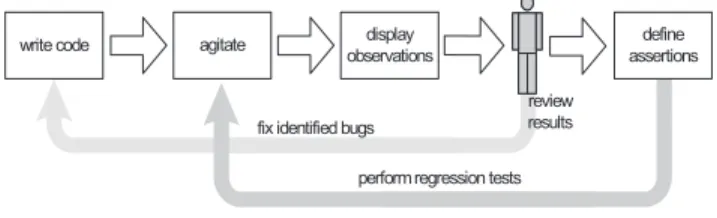
contribut-Figure 1: Overview of software agitation.
ing technologies that inspired the development of Agitator. Section 3 discusses some of the challenges that must be ad-dressed in applying this research technology to “industrial grade” software systems. Section 4 presents a high-level dis-cussion of software agitation in Agitator. We describe the tool both at the architectural level and from the user’s (de-veloper’s) perspective. We also present a few of the lessons that we learned while building and deploying Agitator, in-cluding some of the surprising discoveries of how the use of Agitator affects software development habits. Finally, in Section 5 we present some of our future directions and dis-cuss a number of areas that warrant further research explo-ration.
2.
SOFTWARE AGITATION
Software agitation is a unit-testing technique for automati-cally exercising individual units of source code in isolation from the rest of the system. At a very high level, agita-tion involves creating instances of the classes being exercised, calling all of the methods of those classes with a wide variety of input data, and recording the results. Figure 1 presents a diagram that provides a high-level view of the agitation process.
The result of software agitation is a set of observations
that represent the observed behavior of the unit under test. Observations take the form of relationships between various values in the source code that were determined to hold under a variety of different inputs. For example, for a method computing the maximum of two values a and b, agitation might determine thatmax(a, b)≥a∧max(a, b)≥b.
The development of software agitation was inspired by Ernst’s work ondynamic invariant detection [5]. Dynamic invariant detection is a technique for discovering program invariants from dynamic execution traces that are extracted by executing a software system on a variety of valid test inputs. In their ICSE’99 paper [6], Ernst et al. demonstrated that Daikon dynamic invariant detection can infer many of the same invariants that a diligent programmer would write as part of a program’s specification. We extended the Daikon work to the domain of testing.1
We observed that dynamic invariant detection can be used for developer testing in two ways. First, the inferred invari-ants represent the observed behavior of the unit under test. As such, they can be presented to developers, who must de-termine whether this observed behavior coincides with the
1However, the invariant detection approach implemented in
desired behavior. This facilitates early detection of defects. Second, the invariants can be captured by the developers as part of the specification for the unit under test. We call this process a “promotion of observations toassertions.” The as-sertions can be checked after subsequent agitations, creating the basis for automated regression testing. Additionally, de-velopers can add their own assertions to complement those discovered during agitation. These assertions become part of the testing suite.
One of Daikon’s limitations is that it requires a broad range of input data values to generate a statistically signif-icant sample of observed invariants. Fortunately, automatic generation of test input data has been a well-studied area of research. We combined several well-known techniques, such as symbolic execution, constraint solving, heuristic- and feedback-driven random input generation, and human input specification.
A similar application of dynamic invariant detection to testing was also independently proposed by Xie and Notkin in their ASE’03 paper [25]. (For historical accuracy, we should note that by that time Agitator was already in early beta testing, but not yet available to the public.) In their work Xie and Notkin use an existing unit-test suite to ex-ercise the program under test using Daikon, generating a series of design-by-contract (DbC) annotations. The DbC annotations represent pre- and post-conditions on individual methods in the program. The annotations are subsequently passed to a commercial test generation tool, to generate ad-ditional tests that violate DbC invariants. The generated tests are presented to developers for examination and po-tential inclusion in the unit-test suite.
Unlike Xie and Notkin approach, software agitation does not require any pre-existing tests. Software agitation dele-gates more control to the users: it is up to the developer to decide which of the inferred invariants contribute to the specification in a useful way. Both approaches are meant to be used iteratively. And, as in the Xie/Notkin tool, one of the major objectives of test data generation in software agitation is aimed at challenging and violating assertions.
Software agitation is a testing technique with a rich re-search heritage. It combines a number of well-rere-searched ideas and applies them to the developer testing problem. In bringing software agitation to market we are indebted to the many researchers who have influenced and inspired our work.
3.
CHALLENGES AND REQUIREMENTS
This section presents some of the more significant design and implementation challenges that we faced while developing a commercial testing tool based on software agitation.
3.1
Usability
Software agitation involves several new concepts. Because the developer plays an essential role in the software agitation workflow, a software agitation tool must provide an interface that makes it easy to understand these new concepts and fosters efficient communication between a developer and the tool. This realization leads to several important conclusions: • Speak the user’s language. While it may be tempt-ing to present discovered invariants to the users in the form of axioms in first-order logic, it is likely that the
users will not be able to connect the invariants to the behavior of their code. Likewise, we cannot expect developers to learn a new specification language or ex-pend any significant effort on figuring out the tool. These conclusions are partly due to Doong’s and Savoia’s earlier work on ADL (Assertion Definition Language) [18]. Despite ADL’s success in describing the behavior of programmatic interfaces, the final report on the first four years of ADL research [4] concludes that “devel-oper productivity in producing [a test suite] was lower than would be expected from manual development [...] due to a very steep learning curve for ADL.”
• Make no assumptions about user expertise.Some developers may have experience programming with in-variants pre- and post-conditions; others – may not. A software agitation tool must provide scaffolding for those users that need it, while not inhibiting the work of more experienced developers.
• Integrate into the established workflow. Soft-ware agitation, or any other developer testing approach, requires developers to adjust some of their routines and habits. With software agitation, for example, when the developers are ready to test their code, they switch from a traditional edit/compile/debug cycle to an ed-it/compile/agitate/debug cycle. We discovered that it is extremely important for developers to be able to per-form the agitate phase entirely within their preferred development environment. This implies that, in order to maximize adoption, a software agitation tool must be a fully integrated and natural extension of the de-velopment environment and use the idioms and con-ventions of that environment.
• Support refactoring. Code refactoring has become a very common practice, helped by the fact that most modern IDEs provide extensive refactoring functional-ity and support. A software agitation tool must be able to track and perform refactoring operation to preserve user investment in assertions and test data.
• Support mock objects. When the code under test relies on other complex objects or layers of infrastruc-ture, it’s often impractical and time-consuming to set up an environment for testing that code. Mock objects (objects that conform to the interface of real objects but only implement enough functionality to allow unit testing) are an important component of a unit-testing strategy [21]. A software agitation tool must support and, ideally, be able to automatically generate mock objects when necessary.
3.2
Applicability
A software agitation tool must work with a variety of code bases. In contrast to the usually elegant and relatively small and self-contained examples used in academic research, real-world applications are typically large collections of nasty code. These application may have started with an elegant design but, over time, have organically evolved into sys-tems that make testing, by human, or by automated tools, a considerable challenge. It is not unusual to find poorly-structured code where a single function or a method stretches
for hundreds of lines. A software system may depend on a variety of support libraries for which the source code is not available, inhibiting source-level analysis. A Java applica-tion may includenative methods implemented in a low-level language (typically, C or C++), inhibiting any analysis of
those methods. Unfortunately, much of the existing research in automated testing makes simplifying assumptions about the amenability of a software system to analysis and about the size of these systems. A commercial software agitation tool must be ready to face these challenges.
Commercial software systems are also evolving artifacts. From the day the first line of source code appears on the com-puter screen, the entire software system undergoes constant modification. Any tool that collects and stores information about a software system must be able to participate in this continuous change process. In particular, a developer test-ing tool must facilitate evolution of tests together with the system under test without requiring a developer to manually propagate source code changes to the tests.
3.3
Scalability and Performance
Software systems grow increasingly more complex and in-terdependent. It is not uncommon for modern software to consist of millions line of code written by a multitude of soft-ware developers over the course of many years. This com-plexity can be taxing on the performance of any software development tool. A software agitation tool is no exception. While only a small subset of the source code base is exer-cised during agitation of a unit, many of the analyses that take place are global and non-linear with respect to the size of the source code base. Moreover, because software agita-tion exercises user code, bad performance of that code may reflect badly on the overall performance of the tool. At the same time, tight integration with the development workflow dictates that the response time of a software agitation tool must be sufficiently short, so as not to distract developers from their work and interrupt their flow.
These limitations present a serious dilemma. On the one hand, many of the recently developed program analysis tech-niques can be applied to software agitation to provide bet-ter test input data and to generate betbet-ter invariants. On the other hand, less precise approaches can result in better performance on the real-life software systems. This choice, however, is not binary. Most of the analysis technologies can be outfitted with various shortcuts to tolerate some degree of imprecision and ambiguity. Finding a sweet spot in this continuum represents one of the most significant challenges in building a successful software agitation tool.
4.
AGITATOR: THEORY INTO PRACTICE
This section briefly describes the implementation of software agitation in Agitar’s Agitator. We do not attempt to provide a complete description of the product. Rather, we concen-trate only on those aspects of the implementation that illus-trate how we addressed the challenges in moving Agitator’s research foundation into practice.
4.1
Agitator from a User’s Perspective
In order to provide tight integration with the development workflow, Agitator’s interface is implemented on top of the Eclipse Java Development Tools (JDT), a popular IDE for
the Java programming language.2 While agitation can be invoked using a command-line tool, such a use is mostly re-served for build automation and is not meant for day-to-day development. Invoking Agitator entails selecting a unit to be tested (a class, a package, or even an entire project) and clicking the “Agitate” button. Starting an agitation is akin to invoking a compiler in a traditional development work-flow.3 Upon completion, Agitator presents several
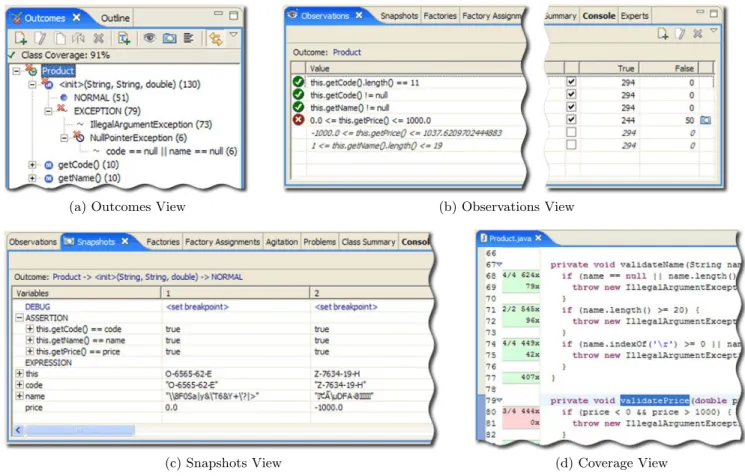
informa-tion panes (called “views” in Eclipse). Four of these views – the outcomes view, the observations view, the snapshots view, and the coverage view – are particularly illustrative of how Agitator meets the usability requirements put forth in Section 3. These views, shown in Figure 2, are discussed below.
The Outcomes View (Figure 2a). This view shows the
outcomes that Agitator identified for a class or method and any additionaloutcome partitions that the user has defined. Outcomes represent all possible ways in which a method’s execution can terminate. A “normal” outcome occurs when no exceptions were thrown; other outcomes represent possi-ble exceptions. The notion of method outcomes originated in ADL [18] and represents a mechanism that permits users to reason about the flow of execution through a method. Outcomes may be subdivided intooutcome partitions, which represent various post-conditions on the method execution that users may wish to track.
Outcomes are divided into three categories: expected, un-expected, and unspecified. Expected outcomes include the
normal outcome, any user-defined partitions of the normal outcome, and any explicitly thrown exception in the body of a method. Unspecified outcomes represent outcomes where the user does not care about tracking the results. Unex-pected outcomes include Java runtime exceptions that are not explicitly declared in the method signature.
The Observations View(Figure 2b). This view displays
observationsandassertionsfor the selected class, method, or outcome. Observations represent the invariants inferred by Agitator during the most recent agitation. Agitator displays different observations for each outcome of a method. When an observation represents expected behavior, users can click the check box next to the observation to promote it to an as-sertion. Assertions represent either observations from other agitations that the user explicitly promoted to the status of an assertion, or explicit assertions entered by the user. Each assertion gets a pass/fail score after each agitation run.
Agitator displays observations and assertions as boolean Java expressions. This choice of representation reflects our desire to present information to the user in a language they can clearly understand. Using the expression notation from the underlying programming language raises the level of dis-course between the user and the tool without overburdening the user. Similarly, the choice of terminology (e.g., “obser-vation”vs. “invariant”) is a conscious attempt to translate traditional notions into a more readily understandable form.
The Snapshots View(Figure 2c). This view shows sample
2
Recent studies suggest that Eclipse JDT holds about 70% of Java IDE market.
3
The compiler metaphor is not entirely accurate in the case of Eclipse JDT, where incremental compilation (when en-abled) eliminates a separate compilation step.
(a) Outcomes View (b) Observations View
(c) Snapshots View (d) Coverage View
Figure 2: Several of the information views available to developers upon completion of agitation.
input values used when exercising the method, for each out-come of a method. Each snapshot captures the state of the method’s class and parameters before and after a method call. The snapshots provide a mechanism for the user to examine the input data used during agitation and to set de-bugger breakpoints based on these values.
The Coverage View(Figure 2d). This view is actually not a separate view. Rather, it is a panel that appears within the Eclipse JDT Java editor and indicates Agitator’s success in finding data values that direct execution to every statement and to every possible exception in the code. The coverage metrics used by Agitator represent line coverage, augmented with expression coverage for every conditional in a branch. Developers use the coverage view to assess the quality of the agitation and to decide whether they need to assist Agitator in finding suitable input values that improve coverage.
The coverage view represents one of the mechanisms that Agitator uses to provide immediate feedback about agitation to developers. By reviewing the sections of source code that were not covered during agitation, developers can identify input values that Agitator was not able to construct, and detect possible unreachable paths in the source code.
4.1.1
Helping Agitator Generate Input Data
Using auto-generation of input data, Agitator can usually generate relevant test input values with no user intervention. However, for some methods, the developer might want to
refine the generated values by specifying a valid range of input data or by providing a set of particular test values that improve the quality of observations. In some cases, it may be necessary to supply more information so that Agitator can construct complex object states. (This situation is further considered in Section 4.3.2, where we discuss the analysis algorithms used to construct test input data.) In all of these cases, Agitator allows users to definefactoriesto accomplish their goals.
A factory tells Agitator how to construct interesting and relevant test data objects of a given type. The user can de-fine factories in two basic ways: by configuring one of the predefined factories that come with Agitator, or by using the included Factory API to define their own. Agitator in-cludes a rich set of pre-defined factories, ranging from the very simple, such as returning values within a given numer-ical range, to the fairly sophisticated, such as those that use Java reflection to create complex objects from constructors or methods. Any factory can be used as part of another factory. For example, the user can configure an integer fac-tory to generate values within a specific range, and then use that factory in a collection factory, to generate collections of integers in that range. The factories defined by one user become durable assets for the rest of the development team to use and share.
4.1.2
Domain Knowledge for Testing
source code bases usually requires some amount of “tweak-ing.” This is especially true when an application utilizes a third-party framework (such as J2EE) that requires some configuration to enable independent agitation of units. In such situations, many reusable test assets such as factory configurations, outcome partitions, and assertions are com-mon across all classes and methods that rely on these frame-works.
Configuring Agitator for every such application from scratch requires domain knowledge and understanding. To facilitate and accelerate this task, Agitator enables packaging of com-mon domain knowledge in independent modules that can be applied in various application contexts. These modules are calleddomain experts. Agitar provides experts that address some common patterns, such as those arising in J2EE [11], Struts [3], and other widely-used Java frameworks.
Agitator recognizes code patterns and uses experts to en-able better agitation results by applying appropriate boil-erplate configuration information, including factories, as-sertions, and outcome partitions. Using experts eliminates many of the repetitive tasks that the users would otherwise have to perform when agitating source code that uses a par-ticular framework. Some experts are applied automatically; others are configurable by the user.
New experts can be created using the Expert API. The Expert API is not intended for everyday use. Rather, this facility exists for the benefit of framework and component providers, who wish to supply an Agitator expert with their library. We envision the Expert API as evolving into a generic plug-in mechanism for Agitator, enabling much more extensive use of the experts within the internals of the agi-tation process. This would enable the use of Agitator as a platform for research into novel techniques and methods for automated testing. We present this vision in more detail in Section 5.
4.2
Agitator-Driven Refactoring
One of our most surprising, and pleasant, discoveries from users of software agitation has been about the influence of Agitator in indirectly encouraging good object-oriented de-velopment practices. Users of Agitator quickly realize that if they follow certain code patterns, they not only end up with better designed code, but they also get much better results from Agitator because the code is more testable and the tests are more thorough and more readable. One example of this is what we callAgitator-driven refactorings.
The concept ofrefactoringwas introduced by Opdyke [14] and involves modifying software source code to improve some aspect of its internal structure without affecting its behavior. Fowler’s book [7] catalogs many refactorings that have since become a standard practice. Many of these refactorings have the beneficial side-effect of helping Agitator users to affect some aspect of agitation. Some examples follow:
• Introduce Type. This refactoring introduces a new class that wraps a primitive type (such asint) or a non-specific class (such asjava.lang.Integer). Agitator works best when it has the most information about the format of the data that it is trying to use as input to agitation. Unfortunately, it is a common practice to conflate various types of values by using primitive or insufficiently specialized types. For
exam-User Input
Agitation
Factories Test classes Setup methods Assertions (tests) Static/dynamic analysisCreate input data Exercise code Validate assertsions Observe code behavior Check coverage and outcomes Complete?
Code
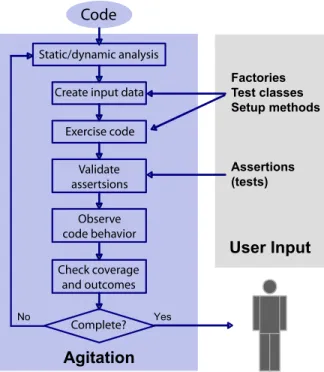
Figure 3: Inside agitation.
ple, a salary value may be represented as an integer, which carries no indication that the salary may not be negative. Moreover, nothing in such a representation distinguishes a salary value from an employee number, permitting Agitator to reuse a value obtained by call-inggetSalary()as an input tosetEmployeeNumber(). TheIntroduce Typerefactoring alleviates this problem by encapsulating each value in the corresponding class, such asSalaryorEmployeeNumber.
• Replace Error Code With Exception. This refac-toring replaces the return of an error code (such as return -1) with the throw of an exception (such as throw new IllegalArgumentException).
Agitator uses exceptions thrown from the source code to create distinct outcome partitions for each excep-tion. This permits easier tracking and debugging of the exception outcomes. Similar result can be achieved by manually constructing an outcome partition that spells out the conditions under which the error code is returned. However, having Agitator create an ex-ception partition automatically is much easier for the user.
4.3
What Happens During Agitation
The overall agitation process includes both automated pro-cessing and human intervention. This section focuses on the internals of the agitation process and on the individual steps that comprise agitation, as presented in Figure 3.
4.3.1
Analysis and Input Data Generation
Software agitation is an iterative process, driven by the ob-jective of reaching maximum code coverage while achieving every possible expected outcome. Software agitation begins
with static and dynamic analysis of the code (at the bytecode level), followed by dynamic generation of test data based on identified behavior of the code. The dynamic analysis uti-lizes data values and coverage information from the preced-ing iteration to direct execution along a particular code path. Static analysis uses limited symbolic execution to collect and resolve input value constraints that can cause execution to take the selected path.
In order to satisfy the scalability and performance con-straints described in Section 3, Agitator takes several short-cuts and makes a number of approximations. For instance, rather than trying to solve constraints for the entire out-come path, Agitator may consider only a part of that path. While such an approach may be sub-optimal in theory, we found that in practice it works reasonably well and cuts down analysis time. Similarly, Agitator does not perform a receiver-type analysis when considering paths spanning multiple methods. Instead, it uses heuristics to “guess” the potential candidates among all possible methods.
Solving of path constraints is implemented in Agitator us-ing a wide array of generic and specialized constraint solvers. For instance, Agitator includes a string solver for java.lang-.String objects, producing strings that satisfy constraints imposed by the String API (e.g., a string that.matches(...) a regular expression). Similarly, Agitator includes several solvers for the Java Collections classes.
In addition to using constraint solving and other sophis-ticated methods for generating test inputs, Agitator uses a few heuristics that often allow it to explore otherwise un-reachable paths. Some of these include:
• For integers: use 0, 1, -1, any constants found in the source code (and the negation of each such constant), any constant incremented and decremented by 1. • For strings: generate random text of varying lengths,
varying combinations of alpha, numeric, and alphanu-meric values, empty strings, null strings, any specific string constants occurring in the source code.
• For more complex objects: achieve interesting object states by calling mutator methods with various auto-generated arguments.
• For all objects: use various objects of the appropri-ate type creappropri-ated during execution. Agitator accumu-lates some of the objects that it creates at various points during agitation for possible reuse in place of constructing new ones.
In some cases, Agitator lacks the information to construct objects, or to put objects in very specific states, that is re-quired to test a class. In those cases, users provide help by defining one or more factories, which tell Agitator how to construct an object (see Section 4.1.1).
The above shortcuts represent a point of departure from the established research in test-data generation. Most of these were necessary to achieve adequate memory and run-time performance. An important benefit afforded by the it-erative nature of software agitation is that it is not necessary for Agitator to achieve the desired goal on the first attempt. Rather, Agitator specifically attempts to execute every path through a method multiple times, so that the invariant infer-encing algorithm has sufficient distinct data points. Thus,
the goal of test-input generation is to create a large number of input values, while maximizing the likelihood that these values provide the desired coverage.
Further research is needed to adapt some of the recent work in test-data generation to the commercial-scale source code bases. We revisit this point in Section 5.
4.3.2
Execution and Invariant Detection
Following test-input generation, Agitator begins exercising each method in each class under test. Execution of poten-tially defective source code with random inputs may present a significant risk to system security and integrity. For exam-ple, a utility that deletes files from the filesystem must not be allowed to do so during its execution by an agitation tool. Agitator takes special care to isolate all application source code that it executes using the Java security manager.
During agitation of each testable method, Agitator ap-plies dynamic its invariant detection algorithm to discover “interesting” method invariants that can be presented to the user as observations. The algorithm for invariant de-tection in Agitator is different from that used in Daikon. The Daikon approach is to record a detailed execution trace that captures every variable value at every appropriate pro-gram point. This execution trace is subsequently analyzed to perform invariant inference over the captured data values. The inferred invariants are further filtered to remove those that present no interest to the user (for more information see Chapter 5 of the Daikon User Manual [20]).
Due to the scalability and performance constraints, we had to adopt a different strategy for invariant detection. Rather than inferring invariants from individual data values after agitation, Agitator starts out by positing a number of hypothetical relationships between values within a method. Because the number of available values can be very large, we filter the list of hypothetical relationships using simple heuristics. For example, we assume that two variables oc-curring in the same expression are related, whereas vari-ables that never occur in the same context are independent. During agitation, as Agitator discovers that a particular re-lationship is violated, it discards that rere-lationship. When agitation is complete, the list of “surviving” relationships is presented to the user as observations.
Agitator finds data values to observe using the following heuristics:
• By examining the values of instance variables and method parameters.
• By checking properties of simple data types (array length, string length, etc.)
• By identifying “getter” methods for objects in scope. • By considering class fields that are related to the method
under test.
Additionally, Agitator considers “pre” values for all observ-able expressions (values prior to agitation of a method) as well as the return value of that method.
When forming a hypothesis about data value relation-ships, Agitator considers a number of properties such as:
• Expressions in source code. Simple expressions found in the method under test are always observed and checked for invariability.
• Relational: x = y, x > y, x ≥ y, x < y, x ≤y.
These relationships are possible between numeric data types. Note that with our approach, hypothesisx6=y is useless (unless it occurs in the code), because the likelihood of disproving it is small.
• Range: A < x < B, A ≤ x < B, A < x ≤ B, A≤x≤B. Another set of relationships for numeric values. Agitator makes initial estimates for the values ofAandBand then iteratively refines the boundaries. • Logical: x∧y. Agitator checks this relationship for boolean values. Early versions of Agitator also consid-ered x∨y and x ⇒ y, but we found that these two relationships resulted in too much noise (useless obser-vations).
• Linear: Ax+By=C, Ax+By+Cz =D. Agita-tor checks these relationships for integer values. The three-variable relationship is only considered whenA, B, andC are +1 or−1; the two-variable relationship is checked for all constant values.
• Object: x = y, x.equals(y), x = null, x 6= null.
Agitator considers these relationships for all applicable object values.
The relationships that remain after agitation and that are considered invariant are sorted by relevance and presented to the user. The relevance score reflects how closely com-ponents of the relationship are “related” in the source code. Expressions that appear in source code verbatim score the highest, while expressions that are pure guesses score the lowest.
Our other point of departure from the Daikon approach is to preserve implied invariants, rather than attempt to eliminate them. (The latest releases of Daikon even include the interface to a theorem prover specifically for that pur-pose.) Our reasons for keeping redundant invariants are twofold. First, we found (via experimentation) that elim-inating implied invariants proved too taxing on Agitator’s performance. Because the tool is used interactively, squeez-ing every second out of the response time is essential from the usability perspective. Second, we discovered that a fully reduced set of observations was not always appropriate for human inspection. For example, consider the following two sets of observations (full and simplified):
x = y y = z x = z x 6= null y 6= null z 6= null ⇒ x = y y = z x 6= null
Logically, these two sets are equivalent. However, the user might want to see and test each assertion separately and not hide the fact that z 6=null inside the deductive chain (z =y∧y=x∧x6=null⇒z 6=null). Consider another example:
(1) x > y (2) x = y+ 1
Here, we do not know whether the right behavior is (1) or (2). Perhaps, the intended behavior is (1), but due to a bug (and Agitator), the user discovered that the code always increments by 1. By presenting both options, Agitator shifts the burden of this decision to the user.
5.
THE ROAD AHEAD
After two years of commercial deployment we are happy to state that Agitator has become an invaluable tool for many of our customers. Still, much work lies ahead. Some of the challenges are purely technical; others – require more re-search in various areas, ranging from better test-input gen-eration algorithms to understanding developers’ motivation for writing tests. In this section, we outline several directions for further exploration.
5.1
Agitator as a Research Platform
Creating a research infrastructure is the bane of many soft-ware engineering research projects. On the one hand, the infrastructure is necessary to provide many of the support services, such as some basic source code analyses and user in-terfaces. On the other hand, building such an infrastructure typically involves a significant engineering effort by several researchers, while providing little opportunity for novel pub-lishable research.
We would like to extend Agitator to provide such a plat-form for research in testing tools. Even now, the Expert API (Section 4.1.2) provides some rudimentary hooks to Agita-tor’s internals. We are interested in extending this API and creating a true plug-in architecture that would enable out-side researchers to modify and extend Agitator’s behavior.
5.2
Improving Testing Technology
In the recent years, test input generation has been the area of active research. Advances in symbolic execution techniques (e.g., [22, 24, 19]), random testing (e.g., [8]), and test selec-tion (e.g., [15, 26, 9]) suggest many plausible improvements to the algorithms currently used by Agitator. Yet, scalabil-ity of these approaches remains a major obstacle to adop-tion. Further research is needed in adapting these and sim-ilar techniques to large, commercial-scale code bases. One promising direction, suggested in Tillman and Shulte [22], is to store the intermediate results of the analysis of library code in a reusable manner. Another example is the work on CUTE [19], which proposes a set of domain-specific opti-mizations that improve the performance of constraint solv-ing.
Increasingly, we are seeing software systems that are im-plemented using several programming languages. A proto-typical example is thenative code (C or C++), often found
in Java libraries. Unfortunately, we are not aware of any research that attempts to address analysis and generation of test inputs across the boundary between two (or more) lan-guages. As the popularity of such hybrid systems increases, we feel that further research effort is definitely warranted.
5.3
Helping the User
The human component plays a big role in software agitation. While we believe that we succeeded in developing a user interface that facilitates communication between the user and the tool, our work is far from complete. Below are just
a few of the ideas for helping the user that merit further exploration.
Visual language for factory configuration. Input value factories in Agitator are configured using interactive dialogs. Often, the factories need to nest (e.g., an array factory that uses another factory for its components), sometimes more than a single level. Configuration of nested factories can be confusing to the user. However, the dependencies be-tween different factories can be visualized using a dataflow network, similar to those used in visual programming lan-guages, such as SCIRun [16] and Fabrik [12]. Designing a specialized visual programming language for factory compo-sition and configuration would be a welcome improvement to Agitator.
Assertion generalization. Observations reported by Ag-itator are fairly low-level, code-based invariants. We are interested in exploring mechanisms that can generalize the inferred invariants into higher-level observations and asser-tions. The work of Xie and Notkin [26] and Hankel and Diwan [10] appears to be a good start in that direction.
Outcome filtering. Some outcomes reported by Agitator surprise the users. For instance, Agitator might report that a method throws a NullPointerException, because it was able to cause that exception by supplying anullvalue as a parameter. However, the users object to such a discovery, claiming that theyknowthat anullvalue cannot propagate to that location intheir system. We are interested in find-ing mechanisms that would help Agitator in this, and other similar cases.
5.4
Studying the Testers
Experience suggests that having great tools is often insuffi-cient to achieve wide acceptance of a new software-development practice. Developer testing is no exception. Unless the de-velopers are motivated to make an effort (however small), they will not use even the best of the tools. Unfortunately, very little is known about the human component of the de-veloper testing practice and no conclusive evidence exists on what motivates developers to test (or not to test) their code. Myers provides some high-level insights in Chapter 2 ofThe Art of Software Testing [13], yet much more work is needed in that domain.
In his recent post to the Psychology of Programming mail-ing list [2], Ruven Brooks (one of the foundmail-ing fathers of the field), poses the following questions about testing:
• How do people decide what to test? • How do people construct tests?
• How do people actually use test tools (as opposed to the way the authors of those tools envisioned their use)?
• How do programming language syntax and semantics affect test strategy and behavior?
• How do novice programmers learn to do testing? All of theses are very good questions and none have an an-swer in either testing or psychology literature.
6.
CONCLUSION
Perhaps one of the most satisfying conclusions that we can draw from this paper is that academic research in software testing can and does have relevance to industrial applica-tions. By paying attention to the usability, scalability, and performance requirements of commercial software develop-ment, we were able to deliver a tool that adapts a number of academic research ideas to the problem of developer testing. The work on the Daikon invariant detector, as well as the wealth of research on test-input generation were instrumen-tal to our success. Yet, we must ask why so few of the research ideas find their way into commercial applications. We do not have a definite answer to this question, but we suspect that the primary reason is the significant investment required to transform brilliant research ideas and prototypes into full-fledged, industrial-strength applications. The cur-rent version of Agitator (3.0) is the result of over 50 engineer-years of development and testing (with a very senior team of developers with significant prior experience in test automa-tion and software development tools). And, as one might expect, the bulk of the development effort was not spent on the basic software agitation algorithms, but on usability, ap-plicability, reliability, scalability, and performance. Tracking and addressing changing developer preferences in terms of IDEs, frameworks, etc., is also a necessity for a commercial product. Even though support for a specific IDE is rarely a relevant factor in academic work, it is an imperative for a commercial product. So when Eclipse JDT became the IDE of choice for most Java developers, we had to port the origi-nal version of Agitator from a stand-alone Swing application to an Eclipse plug-in.
Ultimately, however, if the problem solved is big enough – and software testing is definitely a big problem – we believe that the significant cost and effort required to productize promising research ideas is well worth it. Researchers get the satisfaction of seeing their ideas used broadly, software development tools companies are able to differentiate them-selves through innovation, and users benefit by having more powerful and more effective products to help them deliver quality software.
We hope that other individuals and companies will follow suit in driving some of the best research ideas from recent years to commercial success.
7.
REFERENCES
[1] K. Beck and E. Gamma. Test infected: Programmers love writing tests. InJava Report, volume 3, pages 37–50, 1998.
[2] R. E. Brooks. Commercial reality. Psychology of Programming Interest Group Mailing List, March 2005.
http://www.mail-archive.com/[email protected]/msg00958.html. [3] C. Cavaness.Programming Jakarta Struts. O’Reilly &
Associates, Inc., 981 Chestnut Street, Newton, MA 02164, USA, 2002.
[4] J. deRaeve and S. P. McCarron. Automated test generation technology. Technical report, X/Open Company Ltd., 1997.
[5] M. D. Ernst.Dynamically discovering likely program invariants. PhD thesis, University of Washington, 2000.
[6] M. D. Ernst, J. Cockrell, W. G. Griswold, and D. Notkin. Dynamically discovering likely program invariants to support program evolution. InICSE ’99: 21st International Conference on Software
Engineering, pages 213–224, 1999.
[7] M. Fowler, K. Beck, J. Brant, W. Opdyke, and D. Roberts.Refactoring: improving the design of existing code. Object Technology Series.
Addison-Wesley, 1999.
[8] P. Godefroid, N. Klarlund, and K. Sen. DART: directed automated random testing. InPLDI ’05: 2005 ACM SIGPLAN Conference on Programming Language Design and Implementation, pages 213–223, 2005.
[9] M. Harder, J. Mellen, and M. D. Ernst. Improving test suites via operational abstraction. InICSE ’03: 27th International Conference on Software Engineering, pages 60–73, 2003.
[10] J. Henkel and A. Diwan. Discovering algebraic specifications from java classes. InECOOP ’03: European Conference on Object-Oriented Programming, pages 431–456, 2003.
[11] J. Hunt and C. Loftus.Guide to J2EE: Enterprise Java. Springer-Verlag, Berlin, Germany / Heidelberg, Germany / London, UK / etc., 2003.
[12] D. Ingalls. Fabrik: A visual programming environment. InOOPSLA ’88: International
Conference on Object-Oriented Programming, Systems, Languages, and Applications, volume 23, pages 176–190, Nov. 1988.
[13] G. J. Myers.The Art of Software Testing. Wiley -Interscience, New York, 1979.
[14] W. F. Opdyke.Refactoring object-oriented frameworks. PhD thesis, University of Illinois at Urbana-Champaign, 1992.
[15] C. Pacheco and M. D. Ernst. Eclat: Automatic generation and classification of test inputs. InECOOP ’05: European Conference on Object-Oriented
Programming, pages 504–527, 2005.
[16] S. G. Parker, D. M. Weinstein, and C. R. Johnson. The SCIRun computational steering software system. In E. Arge, A. M. Bruaset, and H. P. Langtangen, editors,Modern Software Tools in Scientific Computing. Birkhauser Press, 1997.
[17] N. H. Petschenik. Building awareness of system testing issues. InICSE ’85: 8th International Conference on Software Engineering, pages 182–188, Los Alamitos, CA, USA, 1985. IEEE Computer Society Press. [18] S. Sankar and R. Hayes. Specifying and testing
software components using ADL. Technical Report SMLI TR-94-23, Sun Microsystem Laboratories, April 1994. http://research.sun.com/techrep/1994/smli tr-94-23.pdf.
[19] K. Sen, D. Marinov, and G. Agha. CUTE: a concolic unit testing engine for c. InESEC/FSE-13: 10th European software engineering conference/13th ACM SIGSOFT international symposium on Foundations of software engineering, pages 263–272, 2005.
[20] The Daikon Project.Daikon Invariant Detector User Manual, January 2006.
http://pag.csail.mit.edu/daikon/download/doc/daikon.pdf. [21] D. Thomas and A. Hunte. Mock objects.IEEE
Software, 19(3):22–24, 2002.
[22] N. Tillmann and W. Schulte. Parameterized unit tests. InESEC/FSE-13: 10th European software engineering conference/13th ACM SIGSOFT international symposium on Foundations of software engineering, pages 253–262, 2005.
[23] R. Vanmegen and D. B. Meyerhoff. Costs and benefits of early defect detection - experiences from developing client-server and host applications.Software Quality Journal, 4(4):247–256, 1995.
[24] T. Xie, D. Marinov, W. Schulte, and D. Notkin. Symstra: A framework for generating object-oriented unit tests using symbolic execution. InTACAS ’05: 11th International Conference on Tools and Algorithms for the Construction and Analysis of Systems, volume 3440 ofLNCS, pages 365–381. Springer-Verlag, Apr. 2005.
[25] T. Xie and D. Notkin. Tool-assisted unit test selection based on operational violations. InASE ’03:
International Conference on Automated Software Engineering, pages 40–48, 2003.
[26] T. Xie and D. Notkin. Automatically identifying special and common unit tests for object-oriented programs. InISSRE ’05: International Symposium on Software Reliability Engineering, pages 277–287, 2005.