W&M ScholarWorks
W&M ScholarWorks
Dissertations, Theses, and Masters Projects Theses, Dissertations, & Master Projects
Spring 2017
A Paradigm Shift Within University Museums
A Paradigm Shift Within University Museums
Emily BagdasarianCollege of William and Mary - Arts & Sciences, [email protected]
Follow this and additional works at: https://scholarworks.wm.edu/etd
Part of the Anthropology Commons
Recommended Citation Recommended Citation
Bagdasarian, Emily, "A Paradigm Shift Within University Museums" (2017). Dissertations, Theses, and Masters Projects. Paper 1499450062.
http://doi.org/10.21220/S2N37N
A Paradigm Shift Within University Museums
Emily Louise Der Bagdasarian Fairfax, Virginia
Bachelor of Science, James Madison University, 2015
A Thesis presented to the Graduate Faculty
of The College of William & Mary in Candidacy for the Degree of Master of Arts
Department of Anthropology
College of William & Mary May 2017
ABSTRACT
This thesis examines the role of university museums in the United States and their relationship to academic and local communities as well as their influence on a national and international level. The purpose of this study is to identify how changes in
educational, social, and cultural issues have affected the role of university museums in the United States during their almost two hundred and fifty years of evolution. The goal is to identify which audiences (academic or public) they chose to focus on. Taking a multifaceted approach, this thesis studies three museums from Ivy League institutions: The University of Pennsylvania Museum of Archaeology and Anthropology, The
Peabody Museum of Archaeology and Ethnology at Harvard University, and The
Peabody Museum of Natural History at Yale University. Three major research questions are explored: (1) What function or role do university museums play? And how have these changed over time? (2) What were the reasons for the development and growth in university museums? (3) How and why do university museums include or exclude
certain audiences? Ultimately, this study provides an in-depth examination of the role and function of university museums in the United States since the 18th century.
TABLE OF CONTENTS
Acknowledgements ii Dedication iii List of Tables iv List of Figures v Introduction 1 Theoretical Perspectives 3Development of University Museums 5
Methods 10
Results and Analysis 13
Case Studies 20
The University of Pennsylvania Museum of
Archaeology and Anthropology 23
The Peabody Museum of Archaeology
And Ethnology at Harvard University 34 The Peabody Museum of Natural History at Yale University 41
Discussion 46
Conclusion 48
Appendices 49
Appendix A: State Schools with University Museums by Type 49 Appendix B: Distribution of Museums by State 57 Appendix C: Number of University Museums in Other Countries 58 Appendix D: University Museum Types in Other Countries 60
ACKNOWLEDGEMENTS
I wish to express my deepest appreciation and admiration to Dr. Danielle
Moretti-Langholtz for her endless guidance and positive feedback. I also want to thank Dr. Grey Gundaker for probing me to think outside the box and Dr. Jennifer Kahn for pushing me to become a better writer. Special thanks to the Anthropology Cohorts of 2013, 2014, and 2015 and School of Education Cohort of 2015 for their endless support and comradery.
This master’s thesis is dedicated to Tammy Bagdasarian. I love you, pretty mommy. Thank you for everything over the last twenty-some years.
LIST OF TABLES
Table 1. College Degrees Awarded, 1870–2009 7 Table 2. Number of Educational Institutions: 2007–2012 15 Table 3. Ivy League Schools with University Museums 21
LIST OF FIGURES
Figure 1. Number of U.S. Museums in the World 13 Figure 2. Public 4-year Colleges and Universities with Museums by Type 18 Figure 3. How Do Visitors Experience the Museum? 29
Figure 4. What Did We Miss? 30
Figure 5. What Topics Did Visitors Say They Liked Best? 31 Figure 6. What Visitors Said They Liked Best in the Exhibit 32
Figure 7. Share Your Ideas! 33
Figure 8. Example of Dual Language Displays at Harvard Peabody 35 Figure 9. Entrance to the Peabody Museum and the Harvard Museum 37 Figure 10. The Department of Anthropology at Harvard 38 Figure 11. Harvard Student Exhibit Display Case 39 Figure 12. Detail of Harvard Student Exhibit 40
Introduction
Museums are established institutions that exist in a changing world. Birthed from the Age of Enlightenment as a means of showcasing peoples and cultures of the world, their roots are intertwined with the rise of anthropology as a discipline along with the advances of ethnography and ethnology.
Foucault likens museums to slices of time that are “simultaneously represented, contested, and inverted” (1984:3). Rather than perfected
representations or utopias, museums are heterotopias because they reflect the Western idea:
… of accumulating everything, of establishing a sort of general archive, the will to enclose in one place all times, all epochs, all forms, all tastes, the idea of constituting a place of all times that is itself outside of time and inaccessible to its ravages, the project of organizing in this way a sort of perpetual and indefinite accumulation of time in an immobile place, this whole idea belongs to our modernity [Foucault 1984:3].
Museums create a space to present the relationships among: material objects, how they are collected, exchanged, and displayed; and audiences, including local, indigenous, academic, and colonial. Museums “not only collect, preserve, and exhibit objects valuable to art, history, and science but also are educational institutions, research agencies, and cultural centers.”1 Nestled in a heterotopia structure, museums are slowly untangling themselves from the ivory tower of academia; over the last decade, the primary focus of museums
has shifted from solely assisting researchers and specialists to serving the masses. While the topic of university museums is complex and multifaceted, this thesis will focus on the changing role of university museums and how institutions that once served as academic spaces are incorporating and catering to the general public and community.
To address this, I examined the University of Pennsylvania Museum of Archaeology and Anthropology, The Peabody Museum of Archaeology and Ethnology at Harvard University, and The Peabody Museum of Natural History at Yale University. I focused on three research questions: (1) What role or roles do university museums play, and how have these changed over time? (2) What were the reasons for the development and growth in university museums? (3) How and why do university museums include or exclude certain audiences? Drawing upon ethnographic and archival research, role and function of university museums in the United States since the 18th century will be established.
Theoretical Perspective
Spaces of Power and Knowledge Production
In order to address this paper’s primary research questions, it is imperative to craft a theoretical framework for examining the role in which university museums play for a wide variety of audiences. Blending theories of cultural capital and knowledge production, symbolic power created by
university museums is entrenched within western cultural ideas of power. Theories of power and knowledge production, derived from Bourdieu’s notion of social distinction and symbolic power (1984), examine discussions within different audiences exploring and utilizing university museums. Drawing upon Bourdieu’s theory of social hierarchy, those who have access to knowledge production and the means to accumulate more resources both physical and intellectual possess greater social power and wealth. In an analysis of Bourdieu, Swartz (1989:373-85) argues that there are:
two major competing principles of social hierarchy — what Bourdieu calls a ‘charismatic structure’ — [that] shape the struggle for power in modern industrial societies: the distribution of economic capital (wealth, income, and property), which Bourdieu calls the ‘dominating principle of hierarchy,’ and the distributor of cultural capital (knowledge, culture, and educational credentials), which Bourdieu calls the ‘second principle of hierarchy [Swartz 1997:137]; emphasis added.
This thesis focuses on the second principle of hierarchy, which is the
distributor of cultural of capital, such as knowledge, culture, and educational credentials, positing that this principle characterizes university museums.
Those who have access to and utilize cultural capital found within the walls of the exhibits, galleries, and laboratories have the potential to increase their social status and wealth. Increasing one’s cultural capital implies “a certain claim to symbolic authority as the socially recognized power to impose a certain vision of the social world, i.e. of the divisions of the social world” (Bourdieu 1994:106). Cultural capital and symbolic power are tools in which individuals and groups can use to exert dominance over one another. The more knowledge one possesses, the more symbolic authority they possess over another.2
2 One should keep in mind that knowledge is only a display of knowledge, and it exists relationally in terms of to how and when it is displayed (Gundaker 2017).
Development of University Museums
Harkening back to ancient Greece, temples to “the Muses,” or goddesses of the arts and sciences, began appearing in the U.S. as early as 1786. Filling temples or museums with odds and ends satisfied an urge to study and explore the exotic and new continent of North America.
Several monumental events contributed to the rise of museums in America in the 1800s. The end of the Civil War (1865), Custer’s Last Stand (1876), the Centennial Exposition (1876), and the World’s Fair in Chicago (1893) served as catalysts for social change in American society and paved the way for nation building for decades to come (Moretti-Langholtz 2017).
Universities began expanding upon this notion of nation building by creating spaces to display historical artifacts and accounts laying the groundwork for a university museum model.
In the United States, professional anthropology was born around museums, such as the National Museum, the Smithsonian Institute, the Peabody Museum of American Archeology and Ethnology (at Harvard University), the Field Museum (in Chicago), the American Museum of Natural History (Patterson, 2001). Even under the influence of the Boasian project, which, up to a certain point, helped transfer the center of anthropological practice from the museum to the university, the complementarity of ethnographic research and museumology remained. In fact, several scholars endeavored to map out new areas of research by developing comparative regional projects that were materialized in new ethnographic collections while they intensified studies within existing lines of research [Silva and Gordon 2013:428].
Moving forward to the next series of major wars America became involved with, university faculty began shifting its focus out of the museums
and into theory based work as a result of WWII (1939-1945)3. It wasn’t until the 1980s that anthropologists began returning to the museums to implement theories developed years prior for their ethnographic and archaeological collections (Moretti-Langholtz 2017).
However, museums were not the only spaces where ideas were
increasingly exchanged and assimilated within large groups. Over the last few centuries, the rise in public postsecondary education has paralleled the
proliferation of museums, which has skyrocketed to over 35,000 in the United States. Examination of these similar exchanges of ideas and knowledge
production will be key in tracing the development of the university museum as a unique institution in its own right.
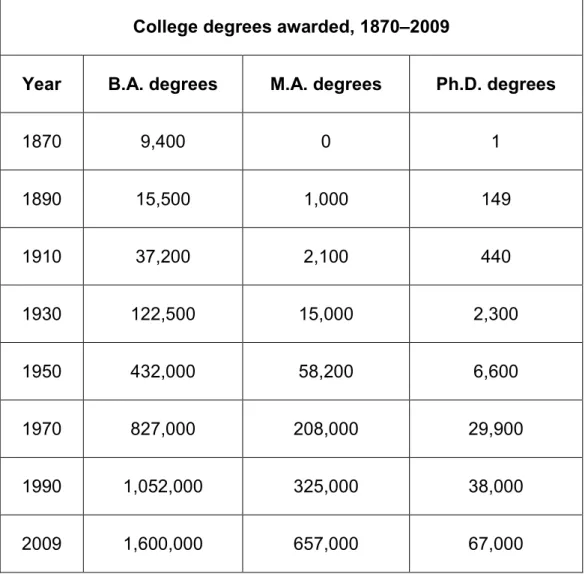
The number of postsecondary degrees awarded in the 20th and 21st century increases roughly fifty percent every twenty years. This exponential growth can be credited to Congress passing the GI Bill in 1944 and various Great Society programs in 1964. Veterans returning from the war were provided with the funds to pursue a higher education rather than obtaining an entry-level job. With an influx of people gaining specialized knowledge, more universities opened their doors to keep up with this rapid growth. Catering to the civilian population in America, Congress passed several Great Society programs under President Lyndon B. Johnson in 1964 that assisted
3 Margaret Mead, Ruth Benedict, Gregory Bateson, and Geoffrey Gorer joined the Committee for National Morale in order to promote American morale during WWII.
those who were previously financially unable to attend college. The Higher Education Act of 1965 proposed “to strengthen the educational resources of our colleges and universities and to provide financial assistance for students in postsecondary and higher education” (P.L. 89–329).
College degrees awarded, 1870–2009
Year B.A. degrees M.A. degrees Ph.D. degrees
1870 9,400 0 1 1890 15,500 1,000 149 1910 37,200 2,100 440 1930 122,500 15,000 2,300 1950 432,000 58,200 6,600 1970 827,000 208,000 29,900 1990 1,052,000 325,000 38,000 2009 1,600,000 657,000 67,000
Table 1. College degrees awarded, 1870–2009 (Source: Bureau of the Census, Historical Statistics of the United States, Colonial Times to 1970 (1976) series H 752, 757, 761; Statistical Abstract: 2012 (2011) table 300).
With a large increase in students attending some form of
postsecondary education, more resources are required to keep pace with the rapid exchange of ideas and production of knowledge. University libraries, museums, and research centers were created in order to foster a “community of practice” (Wegner 1998) and maintain an environment of learning4. Such resources enable individuals to grow their cultural capital and increase their social authority.
Differences Between University Museums and National Museums
National museums are maintained and managed by the state or central government, and their primary objectives serve the interests of the general public first with their governing body’s research agenda second. In contrast, university museums serve their research agendas first and the general public second. Both cater to a wide variety of audiences but the focus and emphasis differ. University museums are seen as a resource to their university, whereas national museums are seen as a resource to the general public. There is considerable overlap between these two types of museums as they both serve as research centers and sources of educational outreach. For example, the American Museum of Natural History (AMNH) in New York adheres to the post-secondary educational formula of a university museum by offering
4 See also Lave, 1988; Bourdieu, 1977; Giddens, 1984; Foucault, 1980; and Vygostsky, 1978.
graduate degrees from the AMNH. Students can now earn a Ph.D. in
Comparative Biology or a Master of Arts in Teaching (MAT)5. This is the first time a museum has taken on the sole role of a university by awarding degrees. The AMNH resists a total paradigm shift by remaining a laboratory of
learning by offering high caliber lectures rather than solely entertaining audiences.
5 According to the American Museum of Natural History’s “Richard Gilder Graduate School” website page.
Methods
As anthropologist Homayun Sidky implies, ethnographic research revolves around cultural similarities and differences through empirical fieldwork and can help anthropologists produce generalizations pertaining to the underlying structures, systems, and conditions which people behave and interact under (Sidky 2004:9). Taking a holistic approach by looking at the past, present, and future of a particular group or community, ethnographic research is crucial for gaining first-hand, meticulous accounts and experiences of a particular community or segment of society. In this case, I will be
observing how communities using university museums have evolved over the last several hundred years.
Undertaking an emic approach for this study, I observed, interacted with, and participated in activities in which participants encounter during their visit to the museums. As an avid and international museumgoer myself, I could place other museumgoers into socio-cultural contexts that bear proper significance. Socio-cultural contexts influence and shape how significant personal memories and shared historical patterns emerge.
Data Collection
Drawing upon several research methods, I aimed to gather as much information as possible within a limited timeframe, carefully selecting each method to generate different information from each case study. Specifically, I
gathered data from participant observations, literature reviews, fieldnotes, and archival research.
First, before conducting research at Yale University, Harvard
University, and the University of Pennsylvania, I read literature pertaining to the museum realm and its various influences on museumgoers within both academic and public realms. This literature review was conducted to both ensure that this study had not already been researched and provide appropriate context.
Participant observation was essential in gaining an unbiased and natural sense of how museum visitors interact and engage with university museums. Archival research includes materials such as pamphlets,
promotional materials and handouts given out at the museums. Photographs were taken at the site for research analysis. Data was captured in the forms of note-taking, digital-still photographs, and collecting physical handouts and materials.
After gathering data, information was then coded using Dedoose, a qualitative software management program. The data security description for Dedoose indicates these data transfer occurs over SSL encryption for data transfer and stores data on the HIPAA compliant Amazon S3 storage
platform6. Field notes, observations, and handouts were uploaded to the program.
In addition to research at my three primary field sites, I researched 279 public state universities and colleges and their affiliated museums and
galleries. I derived a dataset7 based on five different types of museums and galleries: Art, Anthropology / Archaeology, Natural History, Science /
Technology, and History. These data will shed light on which specific types of museums are in operation and their trends.
6 Additional details regarding security are available at
http://www.dedoose.com/Terms#SECURITY.
Results and Analysis
Museums by the Numbers
The World Museum Community estimates that there are more than 55,000 museums in 202 countries across the globe (Saur 2014). In the United States alone, there are 35,144 museums in operation, more than double than in the 1990s.8
Figure 1. According to The Institute of Museum and Library Services, over 60% of museums in operation are located in the U.S.
8 According to The Institute of Museum and Library Services “About Us” website page.
The staggering number of museums in the United States as compared to the rest of the world can be credited to America’s emphasis on education. According to Theodore Low, “Europe never has had education in our sense in its museums, and it has always been the educational aspects of American museums which have distinguished them from the European ones which they have tried so hard to imitate” (Anderson 2004: 33). The purpose of museums emphasizes stirring curiosity within the minds of museumgoers, thus
providing opportunities for continued education of the general public. According to a nonprofit and nonpartisan Pew Research Center
survey9 (2016), 73% of adults consider themselves lifelong learners with 74% of adults classified as personal learners who participated in at least one
learning activity such as reading, taking courses, or visiting museums in the past 12 months. Such activities are undertaken in order to gain knowledge on a subject of personal interest.
Participants of the study cited several reasons for their continued interest in learning. 80% of personal learners said “they pursued knowledge in an area of personal interest because they wanted to learn something that would help them make their life more interesting and full” (Pew Research Center 2016), and 33% said they wanted to “learn things that would help them keep
9 This survey, conducted by Princeton Survey Research Associates
International, administered telephone interviews in both English and Spanish “with a nationally representative sample of 2,752 adults living in the United State from Oct. 13 to Nov. 15, 2015. The margin of sampling error for the complete set of weighted data is ±2.1 percentage points” (Horrigan 2016).
up with the schoolwork of their children, grandchildren or other kids in their lives” (Pew Research Center 2016), making university museums an ideal catalyst for lifelong learning in both children and adults.
Participants in the 2016 study also named several benefits associated with lifelong learning such as: feeling well rounded (87%), opening new perspectives and opportunities in their lives (69%), making new friends (64%), feeling connected to their local community (58%), and becoming involved with volunteer opportunities (43%). All aforementioned benefits are present in the educational and outreach opportunities university museums offer to both academic and local communities.
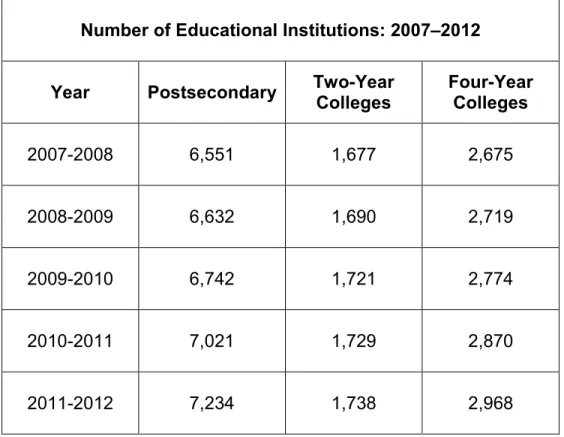
Number of Educational Institutions: 2007–2012
Year Postsecondary Two-Year Colleges Four-Year Colleges 2007-2008 6,551 1,677 2,675 2008-2009 6,632 1,690 2,719 2009-2010 6,742 1,721 2,774 2010-2011 7,021 1,729 2,870 2011-2012 7,234 1,738 2,968
Table 2. Number of Educational Institutions: 2007–2012 (Source: U.S. Department of Education, National Center for Education Statistics. 2015).
There is the correlation between educational level and interest in being a lifelong learner, as 87% of participants with a bachelor’s degree or higher participate in learning activities as opposed to only 60% of those with a high school degree or less. Those who earned a degree from a university had a greater opportunity of being exposed to their university’s museum planting seeds of knowledge to utilize university resources post-graduation. The rise in 2- and 4-year post-secondary institutions in America can be also attributed to the rise in knowledge production and access.
The Role of University Museums
For this study, I researched 279 public state universities and colleges and their affiliated museums and galleries. I derived a dataset10 based on five different types of museums and galleries: Art, Anthropology / Archaeology, Natural History, Science / Technology, and History.
Out of the 279 universities and colleges researched, 268 have at least one art museum or gallery on campus. 79 universities and colleges have at least one museum or gallery showcasing anthropological and/or
archaeological artifacts. 90 universities and colleges have at least one museum of natural history. 45 universities and colleges have at least one museum relating to STEM or technology. 84 universities and colleges have at least one history museum. These different history museums focus on different sub-genres of history, ranging from sports to music and to the college or university
in general. As evident in these data, art museums and galleries are the most common to find on a college campus with 96% of institutions surveyed containing at least one art museum or gallery.11 This high percentage can be ascribed to the long-standing tradition and history of displaying art in an academic setting.
Origins of such institutions can be traced back to Western European art academies or salons of the 19th century. The Royal Academies of Art in France and England, established in 1648 and 1768 respectively, are two highly influential schools of thought and training that shaped the development of university museums in the United States in dramatic ways (Rosenfeld 2004). Hosting exhibitions for artists to display work for critical feedback, artists of the academies sought recognition and patronage from wealthy donors or collectors.
In contrast, American university museums moved away from the consumerism found at the European academies, instead creating and emphasizing atmospheres of learning and self-reflexivity over profit. University museums support the goals of academia by providing an environment of study and observation. Previously, university museums provided access and opportunities to those with connections to the university
11 Colleges or universities lacking an art museums or gallery on campus were generally institutions pertaining to engineering, geosciences, or maritime
Figure 2. Number of schools with at least one museum in the category of: art,
(i.e. students and faculty); currently, museums grant more access to the general public (or those without close ties to the specific university) in the form of educational outreach programs or online databases.
According to the guidelines of the University Museums and
Collections (UMAC), a subsidiary of the International Council of Museums (ICOM), the purpose of university museums is to:
… reflect the history, heritage and standing of a university and the nation. The objects in collections contain information of importance to future research. University collections and their curators are important interdisciplinary links for the community. Collections enhance teaching and research. They promote a positive image of the institution and provide welcoming access points to the campus. The collections in universities are ideally placed to connect disparate pieces of knowledge into lucid maps [UMAC Guidelines].
The purpose of UMAC and ICOM is to provide a governing body to oversee the development and advancement of public and university museums in an ethical and sustainable manner. The main goal of UMAC is to “promote university museums and collections within governments and their agencies, institutes of learning, the broad museum sector, the professions, business and the population generally” which coincides with the growing concept of including the general public in decisions and developmental plans of university museums. ICOM operates on a global scale with the help of UNESCO, INTERPOL and the World Customs Organization (WCO) to promote cultural knowledge in a safe, legal, and respectful manner for all audiences.
Case Studies
With the emergence of comparative methodologies in the 1700s and 1800s, “direct observation and ‘knowing by seeing’ became a privileged epistemology” (Watson 2001:6). Museums created a space wherein observations, comparisons, and analysis could manifest. In The Politics of
Display: Museums, Science, Culture, Sharon Macdonald frames this
manifestation as such:
What the museum offered was a site in which scientific findings were open to a general public as well as to a community of scientists: here [in the museum], ‘anybody’ might come and survey the evidence of science [Macdonald 1998:8].
Starting in the 1800s, university museums began to create spaces for general curiosity and knowledge production. I will now use three different case
studies of (and audiences within) university museums to explore this paradigm shift. For this paper, I highlight the University of Pennsylvania Museum of Archaeology and Anthropology, The Peabody Museum of Archaeology and Ethnology at Harvard University, and The Peabody Museum of Natural History at Yale University, examining how each university museum’s mission statement, educational programs, and museum displays cater to a variety of audiences inside and outside the university realm.
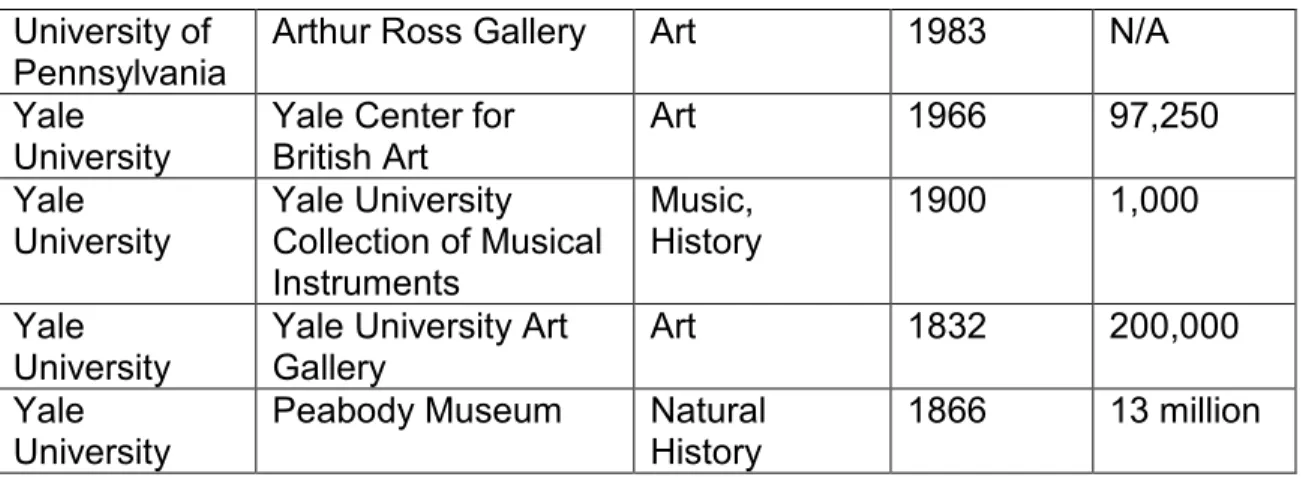
Name of School
Name of Museum Type of Museum Year Founded # Objects Brown University Haffenreffer Museum of Anthropology Anthropology 1955 60,000 Brown University
David Winton Bell Gallery
Art 1971 6,000 Columbia
University
Miriam and Ira D. Wallach Art Gallery
Art 1986 N/A Cornell University Herbert F. Johnson Museum of Art Art 1973 35,000 Cornell University Anthropology Collections Anthropology 1869 N/A Dartmouth College
Hood Museum of Art Art 1772 65,000 Harvard
University
Fogg Museum Art 1895 250,000 Harvard University Busch-Reisinger Museum Art 1903 250,000 Harvard University Arthur M. Sackler Museum Art 1912 250,000 Harvard University Collection of Historical Scientific Instruments Science, History 1949 20,000 Harvard University Warren Anatomical Museum Science, History 1847 15,000 Harvard University
Fisher Museum Science, History 1920 23 Harvard University Harvard Museum of Natural History Natural History 1998 26 million Harvard University Peabody Museum of Archaeology & Ethnology Anthropology, Archaeology 1876 1.2 million Harvard University Harvard Semitic Museum Anthropology, Archaeology 1889 40,000 Princeton University Princeton University Art Museum Art 1882 92,000 University of Pennsylvania Penn Museum of Archaeology and Anthropology Anthropology, Archaeology 1887 1 million University of Pennsylvania Institute of Contemporary Art Art 1963 N/A University of Pennsylvania Charles Addams Fine Arts Gallery
Table 3. Ivy League Schools with University Museums including information about the type, founding, and size of their permanent collections.
As presented in Table 3, each Ivy League school houses at least one university museum on campus, if not more, spanning an extensive time-period and encompassing a massive collection of objects. For the purpose of this paper, I focus on the anthropological, archaeological, or natural history university museums at Harvard University, Yale University, and the
University of Pennsylvania. I selected these three university museums based on their extensive collections and rich history.
University of Pennsylvania
Arthur Ross Gallery Art 1983 N/A Yale
University
Yale Center for British Art Art 1966 97,250 Yale University Yale University Collection of Musical Instruments Music, History 1900 1,000 Yale University
Yale University Art Gallery
Art 1832 200,000 Yale
University
Peabody Museum Natural History
The University of Pennsylvania Museum of Archaeology and Anthropology
The University of Pennsylvania Museum (commonly known as the Penn Museum) opened its doors in 1887 and was built on the principles of manifest destiny and progression. Thanks to the 1876 Centennial Exposition hosted in Philadelphia and an influx of wealth in a post-Civil War era,
university museums “became a means of earning social recognition, and many wealthy and civic-minded Americans thus turned their attention to cultural life and institutions” (Pezzati 2012:1). Under the direction of Provost William Pepper (1881-1894), the University of Pennsylvania began amassing a large collection of objects and artifacts acquired through global archaeological excavations. Struggling to keep up with the ever-growing collection, the University of Pennsylvania sought out a permanent space to store and display its collections. In 1894, the “Free Museum of Science and Art” was built as a solution, and true to its namesake, the Penn Museum did not charge admission until 1987 in hopes of drawing in both academics and the general public. After undergoing two name changes, the University of Pennsylvania Museum of Archaeology and Anthropology now permanently houses all material objects collected by the University.
Shortly after opening the Penn Museum, collecting objects for collection’s sake became obsolete in archaeological field work and research; “though good for educating the public in a general way, it could not produce future specialists in the discipline” (Pezzati 2012:15-16), which resulted in a
rift between the Museum and the Anthropology Department lasting several decades. During this split, the Penn Museum began to shift its focus back onto catering to the general public as well rather than primarily focusing on those who were collecting for the museum.
Since 1887, the University of Pennsylvania Museum has collected nearly one million objects filling three gallery floors with materials and objects collected directly through its own field excavations or anthropological research conducted across the globe.
The Penn Museum encapsulates and illustrates the human story: who we are and where we came from. As a dynamic research institution with many ongoing research projects, the Museum is a vibrant and engaging place of continual discovery, with the mandate of research, teaching, collections stewardship, and public engagement—the four ‘pillars’ of what we do.’ 12
These four pillars are the driving force behind keeping the museum open and current for all museumgoers. In March 2014, the Board of Overseers adopted the following mission statement: “The Penn Museum transforms
understanding of the human experience.” Reflecting such values and beliefs, the Penn Museum launched its Unpacking the Past partnership program with
the Philadelphia School District in order to bring more school groups into the museum. 5,400 seventh grade Philadelphian students participated in an onsite visit through this program.13
12 According to the Penn Museum’s “About Us” website page. 13 According to the Penn Museum’s 2015-2016 Annual Report.
In order to maintain relevancy and ensure an overall enjoyable experience at the Penn Museum, a full renovation of the galleries, labs, and lecture rooms in the West Wing of the original 1899 building was completed in 2015. Currently, the Penn Museum is undergoing complete redevelopment and reinstallation of the Upper and Lower Egyptian Galleries, the Rotunda, and the Near East Galleries as part of their 2013–2020 Strategic Plan.
Renovations, such as ramps and new entrances, will allow visitors of all ages and abilities to access the Penn Museum and its collections.
Visitorship is expected to grow “from families with children in strollers enjoying the interior and garden spaces, to senior groups engaged in daytime tours and lectures” (Penn Museum 2015:7). These renovations are necessary as visitorship increases. Between 2014 and 2015, the Penn Museum saw a total of 166,292 visitors. Of those visitors, 5,046 experienced the museum through a group tour. Utilizing the numerous public events, 23,390 people attended at least one of the 186 lectures, film screenings, or other public-oriented events. As an extension of the classroom, the Penn Museum serves a large number of college and grade school children. 27,104 school children, teachers and chaperones attended a workshop, program, or tour at the
museum, and 4,777 University of Pennsylvania students participated in a class that incorporated the museum’s galleries, classrooms, or storage facilities.
In order to witness such statistics in action, I conducted participant observation research on educational and outreach programs for adults and
children in the community as well as traditional research and educational programs geared towards university students and faculty. Several programs are specifically designed for the general public in hopes of generating lifelong learners and revenue. By including members of the general public, the veil of exclusivity is lifted, allowing open access and opportunities for all visitors to engage with the collections and materials.
For example, the Young Friends of the Penn Museum offers a monthly
social program called P.M. @ Penn Museum as a means draw in a crowd of
young professionals. Each month’s social revolves around a theme such as: “Drink and Dig,” “Famous Queens of the Penn Museum,” “Legends of the Hidden Temple,” or “Ancient Ale Tasting.” Each event ties into and promotes the Penn Museum’s collections. In addition to a cocktail hour, the Penn Museum offers a monthly lecture series entitled Great Myths and Legends,
playing up the romantic notion of history to draw in both the town and gown. Each lecture is given from a professor at the University and incorporates both their research and some component of the Penn Museum’s collections.
Catering to an even younger audience, summer camps and school programs make up a significant portion of the Penn Museum’s educational and outreach program. The popular program Anthropologists in the Making
had roughly 60-70 middle school children attending each week in 2015. During the eight-week camp, children participated in activities pertaining to history, arts, and crafts focused on a different region of the world in order to
stimulate knowledge production and curiosity. If children are exposed to learning in a fun and interactive manner, they are more likely to continue feeding their passion for learning throughout their life explained a docent of the Penn Museum. Docents and volunteers are the lifeline to the museum; almost 15,000 hours are volunteered at the Penn Museum each year. One docent explained that their favorite museum visitors are children because “they are so willing to go out on a limb and make an educated guess unlike adults who shy away from asking questions or engaging in conversations with us for fear of being wrong.” Docents are encouraged to ask open-ended questions to stimulate conversations between guide and museumgoers. In addition to youth camps, the Penn Museum offered a 10-week summer internship program in 2015 for 17 participating undergraduate and graduate students. The program was intended for students to gain hands-on experience by participating in weekly research talks with Penn Museum staff and faculty along with trips to other museums, such as the Philadelphia Museum of Art. This interactive program illustrates real-world applications that the Penn Museum has to offer its affiliated students.
With various programs and activities offered to a wide range of audiences, the Penn Museum breaks away from the previous model of focusing on the academics first and the public second. The collection of feedback on its exhibits from all visitors, for example, maintains this
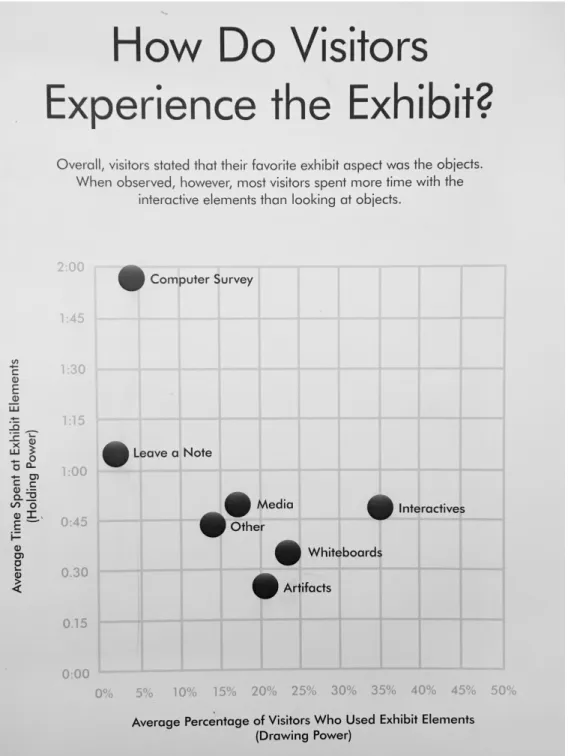
more accessible exhibits. Such dialogue instills feelings of importance and inclusion in museumgoers. Visitors are given a medium to express themselves regardless of their background, expertise, or connection to the museum. For example, in a twelve-month long project entitled Imagine Africa with the Penn
Museum, visitors are given the opportunity to express their feedback regarding
small array of artifacts from the Penn Museum’s permanent African
collection. The museum will then incorporate visitor feedback and community discussions into the re-installation of the African collection into Penn
Museum. This information will be used as a guide map for curators to understand what visitors currently understand about the collection and what they wish to learn in the future. This feedback loop breaks away from previous stagnant models of information exchange by allowing patrons and visitors of the museum to feel a sense of inclusion by directly influencing the goals and agendas of exhibits.
Figure 3. “How Do Visitors Experience the Museum?” An example of visitors’ feedback for the Penn Museum.
Figure 4. “What Did We Miss?” An example of visitors’ feedback for the Penn Museum.
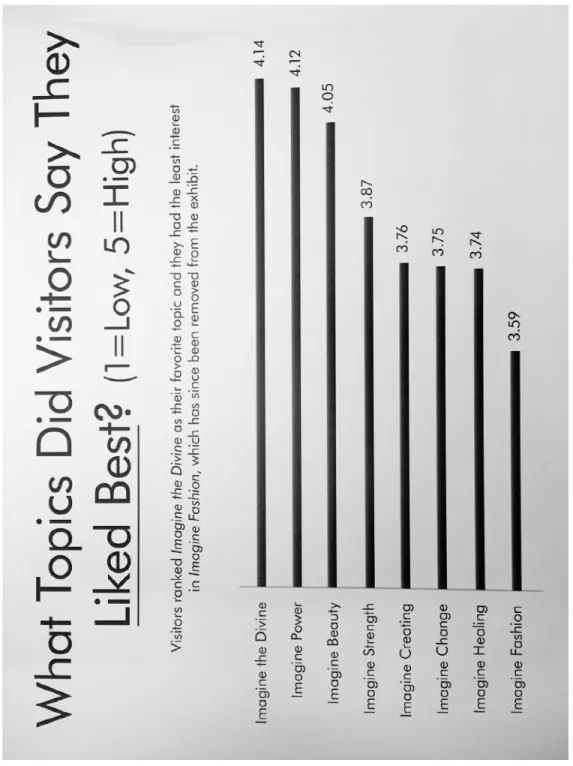
Figure 5. “What Topics Did Visitors Say They Liked Best?” An example of visitors’ feedback for the Penn Museum.
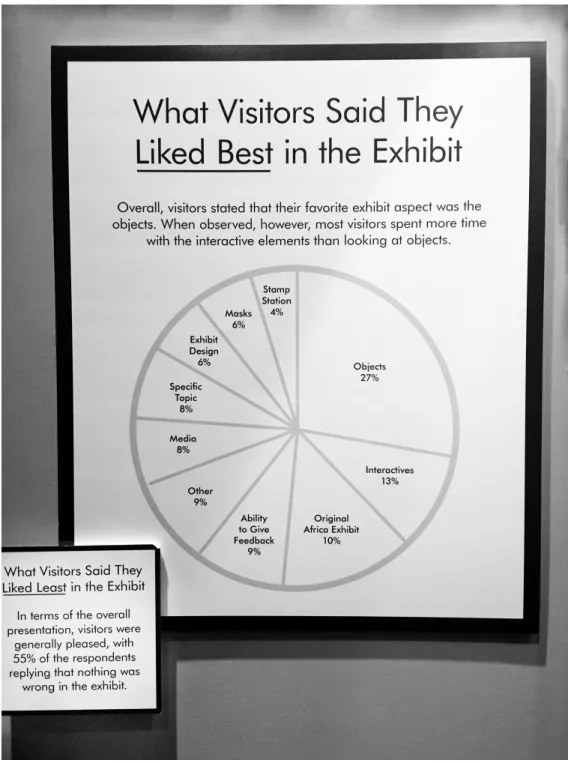
Figure 6. “What Visitors Said They Liked Best in the Exhibit.” An example of visitors’ feedback for the Penn Museum.
Figure 7. “Share Your Ideas!” An example of visitors’ feedback for the Penn Museum.
The Peabody Museum of Archaeology and Ethnology at Harvard University
The Peabody Museum at Harvard University was established in 1866 thanks to self-made businessman George Peabody’s initial endowment of $150,000. This museum was created to provide a safe environment for a wide variety of artifacts obtained in “the heyday of nineteenth-century collecting, when the world was becoming smaller and people of vastly different
backgrounds and cultures were coming into regular contact with each other” (Watson 2001:5). In the early stages of the Peabody Museum’s history, artifacts were arranged rather than exhibited similar to that of a cabinet of curios or oddities. As anthropology became a formal, university-taught discipline in the 1920s, “a rearrangement of the collection on a more modern and scientific system would make the Museum a far more efficient teaching implement—the essential reason for the existence of any university museum” (Reynolds 1928:2). Moving past the previous “library of objects” model, curators began crafting exhibit labels in order for museumgoers to draw scientific conclusions and comparisons. Nowadays, the Peabody Museum at Harvard University:
… engages in, supports, and promotes the study and appreciation of ancient and contemporary peoples from around the world. The Museum collects, preserves, and interprets cultural and related materials and offers unique opportunities for innovative teaching, research, and enrichment at Harvard and with communities worldwide.14
Building from its mission statement, the Peabody Museum employs various methods to enrich and educate those studying the objects and those being studied. One method to increase transparency and bridge the gap between locals and the collections at the Peabody Museum at Harvard is the
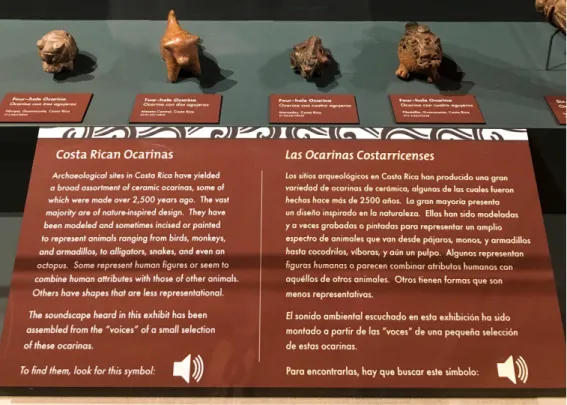
incorporation and use of English and indigenous languages associated with the objects on display. For example, in an exhibit focusing on Costa Rican
archaeological sites, display tags and informational boards are written in both English and Spanish. Indigenous peoples and their descendants are able to understand and interpret their objects without the confines of a European language.
Figure 8. Example of dual language displays at the Peabody Museum at Harvard University.
However, the Peabody Museum at Harvard University, with its close ties with the Department of Anthropology,15 is primarily an educational tool and offers the opportunity for students to display their own research in the form of museum exhibits. As established in the trust given by Peabody, annual lectures are to be delivered by the Peabody Professor and Chairman “under the direction of the government under the university, on subjects connected with said departments of science” (Hanaford 1870:173). Since integrating with the college in 1897, the Peabody Museum “formed the critical teachings and support faculty and staff for the eager and precocious students who were attracted to the rapidly growing scientific community at Harvard” (Browman and Williams 2013:45). For example, Christopher Valenti, Harvard Class of 2016, curated an exhibit entitled “Binary in Yorubaland” in this year in a small display case across the hall of the Department of Anthropology. Such opportunities allow students practical outlets to showcase their research in addition to traditional academic methods of publishing. This example of student engagement is deeply rooted within the founding principles of the museum as a tool for students and faculty to express ideas and converse within the discipline of anthropology.
15 Both the Peabody Museum and the Department of Anthropology are housed in the same building along with the Harvard Museum of Natural History.
Figure 9. The entrance to the Peabody Museum and the Harvard Museum of Natural History located next to the Department of Anthropology.
Figure 10. The Department of Anthropology, housed within the same building as the Peabody Museum and the Harvard Museum of Natural History.
Figure 11. Christopher Valenti, Harvard Class of 2016, presents an exhibit entitled “Binary in Yorubaland” in a small showcase across the hall of the Department of Anthropology.
Figure 12. Students are given the opportunity to showcase their research in exhibits in the Peabody Museum.
The Peabody Museum of Natural History at Yale University
The Peabody Museum of Natural History at Yale University was created in a parallel fashion to the Peabody Museum of Archaeology and Ethnology at Harvard University in 1866. With an equally generous endowment of $150,000 from George Peabody, Yale University created a permanent location to house its natural history collections similar to its Harvard counterpart’s housing of archaeological collections. Peabody, who gave away an estimated $20 million in charitable contributions and
endowments, valued education above all else: “the pain of having lost the opportunity for schooling in his own youth was palpable in the words with which he opened an 1831 letter on the topic: ‘Deprived as I was…’” (Conniff 2016:31). Peabody’s lack of education was the driving force behind his desire to educate others. With such generous funds flowing into the university, James Dwight Dana (1813-1895), a notable Yale geologist, championed for Yale to expand its resources to include libraries, laboratories, and, most importantly, museums. The Yale Peabody Museum “should lecture to the eye, and thoroughly in all the sections represented, so that no one could walk through the halls without profit. It should be a place where the public passing in and out, should gather something of the spirit, and much of the knowledge, of the institution” (Dana 1856:26-27). After roughly 150 years, the Peabody Museum of Natural History at Yale University still possesses the vibrant and enlightened spirit described by Dana and is reflected in its mission statement.
The mission of the Peabody Museum is to serve Yale University by advancing our understanding of earth’s history through geological, biological, and anthropological research, and by communicating the results of this research to the widest possible audience through publication, exhibition, and educational programs.
Fundamental to this mission is stewardship of the Museum’s rich collections, which provide a remarkable record of the history of the earth, its life, and its cultures. Conservation, augmentation and use of these collections become increasingly urgent as modern threats to the diversity of life and culture continue to intensify.16
Like the previous two case studies, the Museum offers a wide variety of educational outreach programs and opportunities. Over 25,000 school children visit and engage in an educational program at the Museum on a yearly basis. First through seventh graders can enroll in summer camps, whereas high school students can participate in free after-school programs such as Evolutions which spotlights science literacy and college preparation or
SciCORPS which emphasizes science career placements. Also, the Peabody
Museum hosts a diverse lecture series covering relevant topics about natural history. This volunteer-run program provides a free and public resource for lifelong learners. Professional development workshops and multi-day summer institutes are also offered for K-12 teachers as well providing additional recourses to local public schools.
While other university museums “have suffered because of their central campus location and a lack of adequate parking” (Conniff 2016:277),
and thus create feelings of exclusion and distance from the general public, the Peabody Museum relocated to a more accessible location for both members of the university and the general public to warder through.
With a massive collection of 13 million objects, it is impossible for one person to view everything in one visit, let alone a lifetime. Thanks to technological advances like online exhibits and an extensive online database, individuals can research and learn from the Peabody Museum’s collections without leaving the comforts of home. Online exhibits mimic the arrangement of a physical exhibit with information such as: background and context of objects, thematic ties to other objects or regions, and in-depth analysis provided by researchers and curators. Some online exhibits even have the option for “visitors” to watch educational films as supplemental material. The Peabody Museum even hosts its own podcast bringing information directly to the ears of lifelong learners.17
http://peabody.yale.edu/peabody-online/video-Online Access and Transparency of Collections
In order to cater to academic and non-academic audiences, each university museum from the three case studies has an electronic database available to anyone with Internet access. The Peabody Museum at Harvard University has established an electronic database with approximately 600,000 database records and over 300,000 associated digital photographs for anyone to access and research. If additional information is needed, researchers are able to request a password for more access to the database from the Peabody Museum’s curatorial department. The Penn Museum’s digital collections include 367,034 object records representing 864,372 objects with 181,475 images. The Peabody Museum at Yale University has five million specimens and objects catalogued online. Students, faculty, researchers, indigenous artists, tribal elders, schoolchildren, teachers, and members of the public can learn from and study the objects for whatever research question they pose. It is nearly impossible for a museum to display its entire collection all at once; this database bridges the gap between materials on display and those in storage creating a level of transparency for the general public.
University museums, I believe, have a special responsibility not only to present their collections to visitors, but also to ground those presentations in the context of new research. University-based museums should not compete with but, rather, complement the work of large public museums by enhancing (and, when appropriate, by challenging) common understandings of how and why research is done [Watson 2001: 15].
Context is just as important if not more than the actual objects on display. With open access and levels of transparency, all members of society can enjoy and benefit from university museums rather than elites associated with the university.
Discussion
Paradigm Shift within University Museums
Concepts of exclusion and inclusion play a major role in shaping programs geared towards specific audiences and community members. The paradigm shift based on the function and purpose of university museums hinges on the audience being served.In “The Structure of Scientific
Revolution,” Thomas Kuhn (1962) argues new epistemologies are punctuated by revolutions rather than created by agents of change and evolution as “one conceptual world view is replaced by another” (1962:10). This metamorphic process allows knowledge production to adapt to rapidly changing social environments with which institutions of higher education engage and interact.
Avoiding major disruptions during times of change, the Association of Academic Museums and Galleries (AAMG) operates on a national level to “insure the best practices for academic museums, galleries and collections through its educational and advocacy efforts.” The mission statement for the AAMG highlights the “the unique opportunities and challenges of its
constituent” and tries to combat potential problems by establishing and supporting “best practices, educational activities and professional
development that enable its member organizations to fulfill their educational missions.” Education constantly remains the primary focus for all university museums.
Founding director of The College of William and Mary’s Muscarelle Museum of Art, Dr. Glenn Lowry, discusses the unique and significant role university museums play in today’s society:
I think university art museums are essential to the cultural fabric of our country. They often serve populations well beyond university communities and they provide a kind of laboratory setting where students and a general public can encounter art and artists in a setting that is often less formal than a metropolitan museum.18
This ability to engage with a wide range of audiences is quintessential to the performance and role university museums. Educating the masses and the elites in one setting creates an equal opportunity for growth and knowledge
production. The rise of lifelong learners in the United States has encouraged this paradigm shift within university museums to encapsulate a multitude of audiences.
18
Conclusion
Since their establishment in the 18th century, university museums have catered to a wide range of audiences ebbing and flowing between academia and the general public. However, the primary role of university museums has remained constant: provide a space for learning. A major reason for the development of university museums and their role of knowledge production can be linked to the rise in post-secondary education in the U.S. As the number of lifelong learners increase, more educational programs catering to a diverse audience are developed. For example, each of the three case studies incorporated summer camps for school children, free lectures for adults, and online databases of the collections as different components of their
overarching goal of reaching and educating diverse audiences.
With the rapid development in technology and overall growth of the number of university museums in the U.S., I foresee further transparency and open access within university museums, thus creating more integration within other disciplines and different types of audiences. This collective learning can foster communities of interest and practice leading to an overall increase in social capital and knowledge production throughout the U.S.
Looking forward, I predict that shifting financial support from donors, affiliated universities, and the public will impact how university museums will rewrite their mission statements and showcase future exhibitions.
Appendix A
Public Four-Year Colleges and Universities with Museums by Type (Independently Gathered Data)
College / University Art Anthropology,
Archaeology
Natural
History STEM History
Alabama State Schools
University of Alabama X X X
Alabama State University X X
Athens State University X X
Auburn University X X
Jacksonville State University X
University of Montevallo X
University of North Alabama X
University of South Alabama X X
Troy University X X
University of West Alabama X X
Alaska State Schools
University of Alaska X X X X X
Arizona State Schools
Arizona State University X
Northern Arizona University X X X
University of Arizona X X X X X
Arkansas State Schools
University of Arkansas X X X X
Arkansas State University X X X
Arkansas Tech University X X
Henderson State University X
Southern Arkansas University X
California State Schools
University of California X X X X
California State University X X X X
Colorado State Schools
Adams State University X X X
University of Colorado X X
Colorado Mesa University X
Colorado School of Mines X
Colorado State University X
Fort Lewis College X X
Metropolitan State University of Denver X
University of Northern Colorado X
Western State Colorado University X
Connecticut State Schools
Delaware State Schools
University of Delaware X X
Delaware State University X
Florida State Schools
Florida A&M University X X
Florida Atlantic University X
Florida Gulf Coast University X X
Florida International University X X X
Florida Polytechnic University X
Florida State University X
New College of Florida X
University of Central Florida X
University of Florida X X X
University of North Florida X
University of South Florida X
University of West Florida X X
Georgia State Schools
Georgia College X X
Georgia Institute of Technology X X X
University of Georgia X X
Georgia State University X
Hawaii State Schools
University of Hawaii X X X
Idaho State Schools
Boise State University X X X
University of Idaho X
Idaho State University X X
Lewis-Clark State College X X
Illinois State Schools
Chicago State University X
Eastern Illinois University X
Governors State University X
Illinois State University X
University of Illinois X X
Northeastern Illinois University X
Northern Illinois University X X
Southern Illinois University X X X
Western Illinois University X X
Indiana State Schools
Ball State University X
Indiana University X X
Indiana State University X
Purdue University X X
Iowa State Schools
University of Iowa X X
Iowa State University X X
University of Northern Iowa X X X X
Kansas State Schools
Emporia State University X X
Fort Hays State University X X
University of Kansas X X
Kansas State University X
Pittsburg State University X
Wichita State University X X
Kentucky State Schools
Eastern Kentucky University X X
University of Kentucky X
Kentucky State University X X X
University of Louisville X X
Morehead State University X X
Murray State University X X X
Northern Kentucky University X X
Western Kentucky University X X X
Louisiana State Schools
Louisiana State University X X X X X
University of Louisiana X X
Southern University X X X
Maine State Schools
Maine Maritime Academy
University of Maine X X
Maryland State Schools
Morgan State University X
St. Mary's College of Maryland X
University of Maryland X X X
Massachusetts State Schools
University of Massachusetts X X
Bridgewater State University X
Fitchburg State University X
Framingham State University X X
Salem State University X
Westfield State University X
Worcester State University X
Massachusetts College of Arts and Design X
Massachusetts College of Liberal Arts X
Massachusetts Maritime Academy
Eastern Michigan University X X
Ferris State University X X X X
Grand Valley State University X
Lake Superior State University X X
University of Michigan X X X
Michigan State University X X X X
Michigan Technological University X X
Northern Michigan University X X X
Oakland University X X
Saginaw Valley State University X
Wayne State University X X X
Western Michigan University X X
Minnesota State Schools
Bemidji State University X X X
Metropolitan State University X
Minnesota State University X
Southwest Minnesota State University X X
St. Cloud State University X
University of Minnesota X X
Winona State University X
Mississippi State Schools
Alcorn State University
Delta State University X X
Jackson State University X X
Mississippi State University X X X X X
Mississippi University for Women X
University of Mississippi X X X X
University of Southern Mississippi X X X
Missouri State Schools
University of Central Missouri X X X X X
Harris-Stowe State University X
Lincoln University of Missouri X
University of Missouri X X X X
Missouri Southern State University X
Missouri State University X X
Missouri Western State University X X
Northwest Missouri State University X X X X
Southeast Missouri State University X X X X
Truman State University X X X
Montana State Schools
Montana State University X X X X X
University of Montana X X X
Nebraska State Schools
Peru State College X
Wayne State College X X
University of Nebraska X X X
Nevada State Schools
Nevada State College X
University of Nevada X X X X X
New Hampshire State Schools
Granite State College X
Keene State College X X
Plymouth State University X X X
University of New Hampshire X X
New Jersey State Schools
The College of New Jersey X X X
Kean University X X
Montclair State University X X
New Jersey City University X X X
New Jersey Institute of Technology X X X
Stockton University X
Rowan University X X X X
Rutgers, The State University of New Jersey X X
William Paterson University of New Jersey X
New Mexico State Schools
University of New Mexico X X X
New Mexico Tech X
New Mexico State University X X X X X
New Mexico Highlands University X
Eastern New Mexico University X X X X X
Western New Mexico University X X X
New York State Schools
State University of New York X X
North Carolina State Schools
University of North Carolina X X X
North Dakota State Schools
North Dakota University X X
Ohio State Schools
University of Akron X X
Bowling Green State University X
Central State University
University of Cincinnati X X X X
Cleveland State University X
Kent State University X X
Miami University X X X
Shawnee State University X
University of Toledo X
Wright State University X
Youngstown State University X X X X
Oklahoma State Schools
Cameron University X
University of Central Oklahoma X X X
East Central University X
Langston University
Northeastern State University X
Northwestern Oklahoma State University X X
University of Oklahoma X X X X X
Oklahoma Panhandle State University X X
Oklahoma State University X
Rogers State University X X
University of Science and Arts of Oklahoma X
Southeastern Oklahoma State University X
Southwestern Oklahoma State University X X
Oregon State Schools
University of Oregon X X X
Oregon Health and Science University X
Oregon State University X X
Portland State University X X
Eastern Oregon University X
Oregon Institute of Technology
Southern Oregon University X X
Western Oregon University X X
Pennsylvania State Schools
Pennsylvania State University X X X X X
Rhode Island State Schools
Rhode Island College X
University of Rhode Island X X
South Carolina State Schools
The Citadel X X
Clemson University X X X
Coastal Carolina University X
College of Charleston X X
Francis Marion University X X
Lander University X
University of South Carolina X X X X
South Carolina State University X
Winthrop University X
South Dakota State Schools
Dakota State University X X X
University of South Dakota X X
South Dakota School of Mines &
Technology X X
South Dakota State University X X X
Tennessee State Schools
Austin Peay State University X X
East Tennessee State University X X X
University of Memphis X X
Middle Tennessee State University X
Tennessee State University X
Tennessee Technological University X
University of Tennessee X X X X
Texas State Schools
University of Houston X
Midwestern State University X
University of North Texas X
Stephen F. Austin State University X X
The University of Texas X X X
Texas A&M University X X X X X
Texas Southern University X
Texas State University X
Texas Tech University X X X X
Texas Woman's University X X
Utah State Schools
Dixie State University X
Southern Utah University X X X
University of Utah X X X
Utah State University X X
Utah Valley University X
Weber State University X X
Vermont State Schools
Castleton University X
Johnson State College X
Lyndon State College X X
University of Vermont X X X
Virginia State Schools
Christopher Newport University X
George Mason University X
James Madison University X X X
Longwood University X
University of Mary Washington X
University of Virginia X X
Virginia Commonwealth University X
Virginia Military Institute X X
Virginia Tech X X X
Virginia State University X
The College of William and Mary X X
Washington State Schools
Central Washington University X X X X
Eastern Washington University X X
The Evergreen State College X X
University of Washington X X X
Washington State University X X X
Western Washington University X
West Virginia State Schools
Concord University X
Fairmont State University X X
Glenville State College X
Marshall University X X X
Shepherd University X
West Liberty University X
West Virginia University X X X
West Virginia State University X
Wisconsin State Schools
University of Wisconsin X X X
Wyoming State Schools
University of Wyoming X X X
Appendix B
Appendix C
Number of University Museums in Other Countries (Source: UMAC Worldwide Database of University Museums & Collections)
Africa-13
Madagascar- 1 Morocco- 1 South Africa- 11
North / South America- 653
Argentina- 20 Brazil- 155 Canada-106 Chile- 2 Colombia- 37 Cuba- 3 Jamaica- 1 Mexico- 77 Peru- 32 Puerto Rico- 2 Trinidad - 1 Venezuela- 1 Asia- 321 Armenia- 1 Bangladesh-1 China- 25 Georgia- 5 India- 1 Iran- 2 Israel- 12 Japan- 58 Jordan- 3 Kazakhstan-1 Lebanon- 1 Malaysia- 2 North Korea- 1 Pakistan- 1 Philippines- 32 Russia- 42 Singapore-1 South Korea- 96 Taiwan- 32 Turkey- 4
Australasia- 331 Australia- 297 New Zealand- 34 Europe- 1,899 Armenia- 8 Austria- 68 Belarus-1 Belgium- 40 Bulgaria- 1 Croatia- 1 Czech Republic- 5 Denmark- 15 Estonia- 7 Finland- 12 France- 78 Germany- 819 Greece- 6 Hungary- 5 Ireland- 4 Italy- 170 Latvia- 3 Lithuania- 2 Netherlands- 63 Norway- 7 Poland- 18 Portugal- 137 Romania- 8 Russia- 106 Slovakia- 3 Slovenia- 1 Spain- 62 Sweden- 21 Switzerland- 51 Turkey- 1 Ukraine- 1
Appendix D
University Museum Collection Types in Other Countries (Source: UMAC Worldwide Database of University Museums & Collections)
Cultural History and Art- 769 Ethnology and Anthropology- 132 General- 91
History and Archaeology- 315 Medicine- 324
Natural History and Natural Science- 1,111 Other- 25