Distributed Computing manuscript No. (will be inserted by the editor)
Distributed Data Clustering in Sensor Networks
Ittay Eyal · Idit Keidar · Raphael RomReceived: date / Accepted: date
Abstract Low overhead analysis of large distributed data sets is necessary for current data centers and for future sensor networks. In such systems, each node holds some data value, e.g., a local sensor read, and a concise picture of the global system state needs to be obtained. In resource-constrained environments like sensor networks, this needs to be done without collecting all the data at any lo-cation, i.e., in a distributed manner. To this end, we address the distributed clustering problem, in which numerous interconnected nodes compute a clustering of their data, i.e., partition these values into multiple clusters, and describe each cluster concisely.
We present a generic algorithm that solves the distributed clustering problem and may be imple-mented in various topologies, using different clus-tering types. For example, the generic algorithm can be instantiated to cluster values according to distance, targeting the same problem as the fa-mous k-means clustering algorithm.
However, the distance criterion is often not suf-ficient to provide good clustering results. We present an instantiation of the generic algorithm that de-scribes the values as aGaussian Mixture (a set of weighted normal distributions), and uses machine learning tools for clustering decisions. Simulations
A preliminary version of this paper appears in the pro-ceedings of the 29th Symposium on Principles of Dis-tributed Computing (PODC) [9].
I. Eyal, I. Keidar, R. Rom
Department of Electrical Engineering, Technion city, Haifa 32000, ISRAEL
Tel.: +972-4-829-{3298,4649, 4830} Fax: +972-4-8295757
E-mail:{ittay@tx, idish@ee, rom@ee}.technion.ac.il
show the robustness, speed and scalability of this algorithm.
We prove that any implementation of the generic algorithm converges over any connected topology, clustering criterion and cluster representation, in fully asynchronous settings.
Keywords Sensor networks, distributed cluster-ing, robust aggregation
1 Introduction
To analyze large data sets, it is common practice to employclustering[6]: In clustering, the data values arepartitioned into severalclusters, and each clus-ter is described concisely using a summary. This classical problem in machine learning is solved us-ing various heuristic techniques, which typically base their decisions on a view of the complete data set, stored in some central database.
However, it is sometimes necessary to perform clustering on data sets that are distributed among a large number of nodes. For example, in a grid computing system, load balancing can be imple-mented by having heavily loaded machines stop serving new requests. But this requires analysis of the load of all machines. If, e.g., half the machines have a load of about 10%, and the other half is 90% utilized, the system’s state can be summa-rized by partitioning the machines into two clus-ters — lightly loaded and heavily loaded. A ma-chine with 60% load is associated with the heav-ily loaded cluster, and should stop taking new re-quests. But, if the cluster averages were instead 50% and 80%, it would have been associated with the former, i.e., lightly loaded, and would keep
serving new requests. Another scenario is that of sensor networks with thousands of nodes moni-toring conditions like seismic activity or temper-ature [1, 21].
In both of these examples, there are strict con-straints on the resources devoted to the clustering mechanism. Large-scale computation clouds allot only limited resources to monitoring, so as not to interfere with their main operation, and sensor net-works use lightweight nodes with minimal hard-ware. These constraints render the collection of all data at a central location infeasible, and there-fore rule out the use of centralized clustering al-gorithms.
In this paper, we address the problem of dis-tributed clustering. A detailed account of previous work appears in Section 2, and a formal definition of the problem appears in Section 3.
A solution to distributed clustering ought to summarize data within the network. There exist distributed algorithms that calculate scalar aggre-gates, such as sum and average, of the entire data set [14, 10]. In contrast, a clustering algorithm must partition the data into clusters, and summa-rize each cluster separately. In this case, it seems like we are facing a Catch-22 [13]: Had the nodes had the summaries, they would have been able to partition the values by associating each one with the summary it fits best. Alternatively, if each value was labeled a cluster identifier, it would have been possible to distributively calculate the sum-mary of each cluster separately, using the afore-mentioned aggregation algorithms.
In Section 4 we present a generic distributed clustering algorithm to solve this predicament. In our algorithm, all nodes obtain a clustering of the complete data set without actually hearing all the data values. The double bind described above is overcome by implementing adaptive compression: A clustering can be seen as a lossy compression of the data, where a cluster of similar values can be described succinctly, whereas a concise summary of dissimilar values loses a lot of information. Our algorithm tries to distribute the values between the nodes. At the beginning, it uses minimal compres-sion, since each node has only little information to store and send. Once a significant amount of infor-mation is obtained, a node may perform efficient compression, joining only similar values.
Our algorithm captures a large family of al-gorithms that solve various instantiations of the problem — with different approaches, clustering values from any multidimensional domain and with
different data distributions, using various summary representations, and running on arbitrary connected topologies. A common approach to clustering is k-means, where each cluster is summarized by its centroid (average of the values in the cluster), and partitioning is based on distance. A k-means ap-proach is a possible implementation of our generic algorithm. The result of this implementation, how-ever, would differ from that of the classical central-ized k-means algorithm.
Since the summary of clusters as centroids is often insufficient in real life, machine learning so-lutions typically also take the variance into ac-count, and summarize values as a weighted set of Gaussians (normal distributions), which is called a Gaussian Mixture (GM) [20]. In Section 5, we present a novel distributed clustering algorithm that employs this approach, also as an instance of our generic algorithm. The GM algorithm makes clustering decisions using a popular machine learn-ing heuristic,Expectation Maximization (EM) [5]. We present in Section 5.2 simulation results demon-strating the effectiveness of this approach. These results show that the algorithm converges with high speed. It can provide a rich description of multi-dimensional data sets. Additionally, it can detect and remove outlying erroneous values, thereby en-abling robust calculation of the average.
The centroids and GM algorithms are but two examples of our generic algorithm; in all instances, nodes independently strive to estimate the clus-tering of the data. This raises a question that has not been dealt with before: does this process con-verge? One of the main contributions of this paper, presented in Section 6, is a formal proof that in-deed any implementation of our generic algorithm converges, s.t. all nodes in the system learn the sameclustering of the complete data set. We prove that convergence is ensured under a broad set of circumstances: arbitrary asynchrony, an arbitrary connected topology, and no assumptions on the distribution of the values.
Note that in the abstract settings of the generic algorithm, there is no sense in defining the desti-nation clustering the algorithm converges to pre-cisely, or in arguing about its quality, since these are application-specific and usually heuristic in na-ture. Additionally, due to asynchrony and lack of constraints on topology, it is also impossible to bound the convergence time.
In summary, this paper makes the following contributions:
– It provides a generic algorithm that captures a range of algorithms solving this problem in a variety of settings (Section 4).
– It provides a novel distributed clustering algo-rithm based on Gaussian Mixtures, which uses machine learning techniques to make clustering decisions (Section 5).
– It proves that the generic algorithm converges in very broad circumstances, over any connected topology, using any clustering criterion, in fully asynchronous settings (Section 6).
2 Related Work
Kempe et al. [14] and Nath et al. [18] present ap-proaches for calculating aggregates such as sums and means using gossip. These approaches cannot be directly used to perform clustering, though this work draws ideas from [14], in particular the con-cept of weight diffusion, and the tracing of value weights.
In the field of machine learning, clustering has been extensively studied for centrally available data sets (see [6] for a comprehensive survey). In this context, parallelization is sometimes used, where multiple processes cluster partial data sets. Paral-lel clustering differs from distributed clustering in that all the data is available to all processes, or is carefully distributed among them, and communi-cation is cheap.
Centralized clustering solutions typically over-come the Catch-22 issue explained in the intro-duction by running multiple iterations. They first estimate a solution, and then try to improve it by re-partitioning the values to create a better clus-tering. K-means [16] and Expectation Maximiza-tion [5] are examples of such algorithms. Datta et al. [4] implement the k-means algorithm distribu-tively, whereby nodes simulate the centralized ver-sion of the algorithm. Kowalczyk and Vlassis [15] do the same for Gaussian Mixture estimation by having the nodes distributively simulate Expecta-tion MaximizaExpecta-tion. These algorithms require mul-tiple aggregation iterations, each similar in length to one complete run of our algorithm. The message size in these algorithms is similar to ours, depen-dent only on the parameters of the dataset, and not on the number of nodes. Finally, they demon-strate convergence through simulation only, but do not provide a convergence proof.
Haridasan and van Renesse [12] and Sacha et al. [19] estimate distributions in sensor networks by estimating histograms. Unlike this paper, these
so-lutions are limited to single dimensional data val-ues. Additionally, both use multiple iterations to improve their estimations. While these algorithms are suitable for certain distributions, they are not applicable for clustering, where, for example, small sets of distant values should not be merged with others. They also do not prove convergence.
3 Model and Problem Definitions 3.1 Network Model
The system consists of a set ofnnodes, connected by communication channels, s.t. each node i has a set of neighbors neighborsi ⊂ {1,· · ·, n}, to which it is connected. The channels form a static directed connected network. Communication chan-nels are asynchronous but reliable links: A node may send messages on a link to a neighbor, and eventually every sent message reaches its destina-tion. Messages are not duplicated and no spurious messages are created.
Time is discrete, and an execution is a series of events occurring at timest= 0,1,2,· · ·.
3.2 The Distributed Clustering Problem
At time 0, each node i takes an input vali — a value from a domainD. In all the examples in this paper, Dis a d-dimensional Cartesian spaceD= Rd (withd ∈N). However, in general, Dmay be any domain.
Aweighted value is a pairhval, αi ∈ D ×(0,1], where α is a weight associated with a value val. We associate a weight of 1 to a whole value, so, for example,hvali,1/2iis half of nodei’s value. A set of weighted values is called acluster:
Definition 1 (Cluster) A cluster c is a set of weighted values with unique values. The cluster’s weight, c.weight, is the sum of the value weights: c.weight=∆ X
hval,αi∈c
α .
A cluster may be split into two new clusters, each consisting of the same values as the origi-nal cluster, but associated with half their origiorigi-nal weights. Similarly, multiple clusters may bemerged to form a new one, consisting of the union of their values, where each value is associated with the sum of its weights in the original clusters.
A cluster can be concisely described by a sum-mary in a domainS, using a functionf that maps
clusters to their summaries:f : (D ×(0,1])∗→ S. The domainS is a pseudo-metric space (like met-ric, except the distance between distinct points may be zero), with a distance functiondS :S2 →
R. For example, in the centroids algorithm, the
function f calculates the weighted average of sam-ples in a cluster.
A clustercmay be partitioned into several clus-ters, each holding a subset of its values and sum-marized separately1. The set of weighted summaries of these clusters is called aclusteringofc. Weighted values in c may be split among clusters, so that different clusters contain portions of a given value. The sum of weights associated with a valueval in all clusters is equal to the sum of weights associ-ated withval in c. Formally:
Definition 2 (Clustering) A clustering C of a clustercintoJclusters{cj}J
j=1is the set of weighted
summaries of these clusters:C={hf(cj), cj.weighti}Jj=1
s.t. ∀val: X hval,αi∈c α = J X j=1 X hval,αi∈cj α .
A clustering of a value set{valj}l
j=1 is a clustering
of the cluster{hvalj,1i}lj=1.
The number of clusters in a clustering is bounded by a system parameterk.
A clustering algorithm strives to partition the samples into clusters in a way that optimizes some criterion, for example, minimizes some distance metric among values assigned to the same clus-ter (as in k-means). In this paper, we are not con-cerned with the nature of this criterion, and leave it up to the application to specify the choice thereof A clustering algorithm maintains at every time ta clusteringclusteringi(t), yielding an infinite se-ries of clusterings. For such a sese-ries, we define con-vergence:
Definition 3 (Clustering convergence) A series of clusterings
n
{hf(cj(t)), cj(t).weighti}Jj=1t o∞
t=1
converges to a destination clustering, which is a set ofl clusters {destx}l
x=1, if for every t∈0,1,2,· · ·
there exists a mappingψtbetween theJt clusters at timetand thel clusters in the destination clus-teringψt:{1,· · · , Jt} → {1,· · · , l}, such that:
1 Note that partitioning a cluster is different from splitting it, because, when a cluster is split, each part holds the same values.
1. The summaries converge to the clusters to which they are mapped byψt:
max j dS(f(cj(t)), f(destψt(j))) t→∞ −−−→0 .
2. For each cluster x in the destination cluster-ing, the relative amount of weight in all clusters mapped toxconverges tox’s relative weight in the clustering: ∀1≤x≤l: P {j|ψt(j)=x}cj(t).weight PJt j=1cj(t).weight t→∞ −−−→ destx.weight Pl y=1desty.weight .
We are now ready to define the problem ad-dressed in this paper, where a set of nodes strive to learn a common clustering of their inputs. As pre-vious works on aggregation in sensor networks [14, 18, 2], we define a converging problem, where nodes continuously produce outputs, and these outputs converge to such a common clustering.
Definition 4 (Distributed clustering)Each node i takes an input vali at time 0 and maintains a clusteringclusteringi(t) at each timet, s.t. there exists a clustering of the input values{vali}ni=1 to
which the clustering in all nodes converge.
4 Generic Clustering Algorithm
We now present our generic algorithm that solves the Distributed Clustering Problem. At each node, the algorithm builds a clustering, which converges over time to one that describes all input values of all nodes. In order to avoid excessive bandwidth and storage consumption, the algorithm maintains clusterings as weighted summaries of clusters, and not the actual sets of weighted values. By slight abuse of terminology, we refer by the term clus-ter to both a set of weighted values c, and its summary–weight pairhc.summary, c.weighti.
A node starts with a clustering of its own input value. It then periodically splits its clustering into two new ones, which have the same summaries but half the weights of the originals; it sends one clus-tering to a neighbor, and keeps the other. Upon re-ceiving a clustering from a neighbor, a node merges it with its own, according to an application-specific merge rule. The algorithm thus progresses as a se-ries of merge and split operations.
We begin with an illustrative example in Sec-tion 4.1 which summarizes clusters as their cen-troids — the averages of their weighted values.
Then, in Section 4.2, we present the generic distributed clustering algorithm. It is instantiated with a domain S of summaries used to describe clusters, and with application-specific functions that manipulate summaries and make clustering deci-sions. We use the centroid algorithm as an example instantiation.
In Section 4.3, we enumerate a set of require-ments on the functions the algorithm is instanti-ated with. We then show that in any instantia-tion of the generic algorithm with funcinstantia-tions that meet these requirements, the weighted summaries of clusters are the same as those we would have ob-tained, had we applied the algorithm’s operations on the original clusters, and then summarized the results.
4.1 Example — Centroids
We begin by considering the example case of cen-troid summaries, where a cluster is described by its centroid and weighthc.µ, c.wi. Initially, the cen-troid is the sensor’s read value, and the weight is 1, so at nodeithe cluster ishvali,1i. A node occasion-ally sends half of its clusters to a neighbor. A node with clusters hc1.µ, c1.wi,hc2.µ, c2.wi would keep
hc1.µ,12c1.wi,hc2.µ,12c2.wiand send to a neighbor
a message with the pairhc1.µ,12c1.wi,hc2.µ,12c2.wi.
The neighbor receiving the message will consider the received clusters with its own, and merge clus-ters with close centroids. Merge is performed by calculating the weighted sum. For example, the merge of two clustershc.µ, c.wiandhd.µ, d.wiis
h 1 2c.w·c.µ+d.w·d.µ 1 2c.w+d.w ,1 2c.w+d.wi .
We now proceed to describe the generic algo-rithm.
4.2 Algorithm
The algorithm for nodeiis shown in Algorithm 1 (at this stage, we ignore the parts in dashed frames). The algorithm is generic, and it is instantiated with the summary domain S and the functions valToSummary, partition and mergeSet. The functions of the centroids example are given in Al-gorithm 2. The summary domainS in this case is the same as the value domain, i.e.,Rd.
Initially, each node produces a clustering with a single cluster, based on the single value it has taken as input (Line 2). The weight of this cluster
is 1, and its summary is produced by the function valToSummary:D → S. In the centroids example, the initial summary is the input value (Algorithm 2, valToSummaryfunction).
A node occasionally sends data to a neighbor (Algorithm 1, Lines 3–7): It first splits its clus-tering into two new ones. For each cluster in the original clustering, there is a matching cluster in each of the new ones, with the same summary, but with approximately half the weight. Weight is quantized, limited to multiples of a system param-eterq(q,2q,3q, . . .). This is done in order to avoid a scenario where it takes infinitely many transfers of infinitesimal weight to transfer a finite weight from one cluster to another (Zeno effect). We as-sume thatqis small enough to avoid quantization errors: q 1
n. In order to respect the quantiza-tion requirement, the weight is not multiplied by exactly 0.5, but by the closest factor for which the resulting weight is a multiple ofq(functionhalfin Algorithm 1). One of the clusters is attributed the result ofhalfand the other is attributed the com-plement, so that the sum of weights is equal to the original, and system-wide conservation of weight is maintained. Note that despite the weight quanti-zation, values and summaries may still be continu-ous, therefore convergence may still be continuous. If the communication topology is dense, it is possible to perform scalable random peer samp-ling [17], even under message loss [11], in order to achieve data propagation guarantees.
The node then keeps one of the new cluster-ings, replacing its original one (Line 6), and sends the other to some neighbor j (Line 7). The se-lection of neighbors has to ensure fairness in the sense that in an infinite run, each neighbor is cho-sen infinitely often; this can be achieved, e.g., us-ing round robin. Alternatively, the node may im-plement gossip communication patterns: It may choose a random neighbor and send data to it (push), or ask it for data (pull), or perform a bi-lateral exchange (push-pull).
When a message with a neighbor’s clustering reaches the node, an event handler (Lines 8–11) is called. It first combines the two clusterings of the nodes into a set bigSet (Line 9). Then, an application-specific functionpartitiondivides the clusters inbigSetinto setsM ={Mx}|xM=1| (Line 10). The clusters in each of the sets in M are merged into a single cluster, together forming the new clus-tering of the node (Line 11). The summary of each merged cluster is calculated by another
application-Algorithm 1: Generic Distributed Data Clustering Algorithm. Dashed frames show auxiliary code .
1 state
2 clusteringi, initially{hvalToSummary(vali),1 , ei i} 3 Periodically doatomically
4 Choosej∈neighborsi (Selection has to ensure fairness)
5 old←clusteringi 6 clusteringi←S
c∈old{hc.summary,half(c.weight) ,
half(c.weight)
c.weight ·c.aux i} 7 send (j,S
c∈old{hc.summary, c.weight−half(c.weight) ,
1−halfc.(c.weightweight)·c.aux i}) 8 Upon receipt ofincomingdoatomically
9 bigSet←clusteringi∪incoming
10 M←partition(bigSet) (The functionpartitionreturns a set of cluster sets) 11 clusteringi←S |M| x=1 hmergeSet S c∈Mx{hc.summary, c.weighti} ,P c∈Mxc.weight , P c∈Mxc.aux i 12 functionhalf(α)
13 return the multiple ofqwhich is closest toα/2.
specific function,mergeSet, and its weight is the sum of weights of the merged clusters.
To conform with the restrictions ofkandq, the partition function must guarantee that (1)|M| ≤
k; and (2) noMxincludes a single cluster of weight
q(that is, every cluster of weightqis merged with at least one other cluster).
Note that the parameter k forces lossy com-pression of the data, since merged values cannot later be separated. At the beginning, only a small number of data values is known to the node, so it performs only a few (easy) clustering decisions. As the algorithm progresses, the number of values de-scribed by the node’s clustering increases. By then, it has enough knowledge of the data set, so as to perform correct clustering decisions, and achieve a high compression ratio without losing valuable data.
In the centroids algorithm, the summary of the merged set is the weighted average of the summaries of the merged clusters, calculated by the implemen-tation of mergeSetshown in Algorithm 2. Merging decisions are based on the distance between clus-ter centroids. Intuitively, it is best to merge close centroids, and keep distant ones separated. This is done greedily by partition (shown in Algo-rithm 2) which repeatedly merges the closest sets, until the k bound is reached. Fork = 1, the algo-rithm is reduced to push-sum.
Algorithm 2: Centroid Functions 1 functionvalToSummary(val) 2 returnval
3 functionmergeSet(clusters)
4 return X havg, mi ∈ clusters m −1 × X havg, mi ∈ clusters m·avg
5 functionpartition(bigSet) 6 M← {{c}}c∈bigSet
7 If there are sets inM whose clusters’ weights areq, then unify them arbitrarily with others 8 while|M|> kdo
9 letMxandMybe the (different) cluster sets inM whose centroids are closest 10 M←M\ {Mx, My} ∪(Mx∪My) 11 returnM
4.3 Auxiliaries and Instantiation Requirements
For the algorithm to perform a meaningful and correct clustering of the data, its functions must respect a set of requirements. In Section 4.3.1 we specify these requirements and in Section 4.3.2 we show that the centroids algorithm described above meets these requirements. In Section 4.3.3 we prove that these requirements ensure that the summaries described by the algorithm indeed represent clus-ters.
4.3.1 Instantiation Requirements
To phrase the requirements, we describe a cluster in hD,(0,1]i∗ as a vector in theMixture Space — the space Rn (n being the number of input val-ues), where each coordinate represents one input value. A cluster is described in this space as a vec-tor whosej’th component is the weight associated with valj in that cluster. For a given input set, a vector in the mixture space precisely describes a cluster. We can therefore redefinef as a mapping from mixture space vectors of clusters to cluster summaries, according to the input setI∈ Dn. We denote this mappingfI :Rn→ S.
We define the distance function dM : (Rn)2→ R between two vectors in the mixture space to be the angle between them. Clusters consisting of similar weighted values are close in the mixture space (according todM). Their summaries should be close in the summary space (according todS), with some scaling factor ρ. Simply put — clus-ters consisting of similar values (i.e., close indM) should have similar summaries (i.e., close in dS). Formally:
R1 For any input value set I,
∃ρ:∀v1, v2∈(0,1]
n :
dS(fI(v1), fI(v2))≤ρ·dM(v1, v2).
In addition, operations on summaries must pre-serve the relation to the clusters they describe. In-tuitively, this means that operating on summaries is similar to performing the various operations on the value set, and then summarizing the results.
R2 Initial values are mapped by fI to their sum-maries:
∀i,1≤i≤n:valToSummary(vali) =fI(ei).
R3 Summaries are oblivious to weight scaling:
∀α >0, v∈(0,1]n:fI(v) =fI(αv).
R4 Merging a summarized description of clusters is equivalent to merging these clusters and then summarizing the result2:
mergeSet [ v∈V h{fI(v),kvk1i} ! =fI X v∈V v ! .
2 Denote bykvkptheLpnorm ofv.
4.3.2 The Centroids Case
We show now that the centroids algorithm respects the requirements. Recall thatfI in this case is the weighted average of the samples, and letdSbe the
L2 distance between centroids. We show that the requirements are respected.
Claim For the centroids algorithm, as described in Algorithm 2, the requirements R1–R4 are re-spected.
Proof Let ρbe the maximal L2 distance between values, and let ˜v be the L2 normalized vector v.
We show that R1 holds with thisρ. dS(fI(v1), fI(v2)) (1) ≤ ρkv1−v2k1 (2) ≤ ρ·n−1/2kv˜1−˜v2k1 (3) ≤ ρkv˜1−˜v2k2 (4) ≤ ρ·dM(˜v1,v˜2) =ρ·dM(v1, v2)
(1) Each value may contribute at mostρthe coor-dinate difference.
(2) The normalization from L1 to L2 may factor
each dimension by no less thann−1/2.
(3) TheL1norm is smaller than √ntimes theL2
norm, so a factor of √n is added that annuls then−1/2factor.
(4) Recall that dM is the angle between the two vectors. The L2 difference of normalized vec-tors is smaller than the angle between them.
It is readily seen that requirements R2–R4 also hold.
4.3.3 Auxiliary Correctness
Returning to the generic case, we show that the weighted summaries maintained by the algorithm to describe clusters that are merged and split, in-deed do so. To do that, we define an auxiliary algo-rithm. This is an extension of Algorithm 1 with the auxiliary code in the dashed frames. Clusters are now triplets, containing, in addition to the sum-mary and weight, the cluster’s mixture space vec-torc.aux.
At initialization (Line 2), the auxiliary vector at nodeiisei(a unit vector whosei’th component is 1). When splitting a cluster (Lines 6–7), the vec-tor is facvec-tored by about 1/2 (the same ratio as the
weight). When merging a set of clusters, the mix-ture vector of the result is the sum of the original clusters’ vectors (Line 11).
The following lemma shows that, at all times, the summary maintained by the algorithm is in-deed that of the cluster described by its mixture vector:
Lemma 1 (Auxiliary correctness)The generic algorithm, instantiated by functions satisfying R2– R4, maintains the following invariant: For any clus-terceither in a node’s clustering (c∈clusteringi) or in transit in a communication channel, the fol-lowing two equations hold:
fI(c.aux) =c.summary (1)
kc.auxk1=c.weight (2)
Proof By induction on the global states of the sys-tem.
Basis Initialization puts at time 0, at every node ithe auxiliary vectorei, a weight of 1, and the summary valToSummary of value i. Require-ment R2 thus ensures that Equation 1 holds in the initial state, and Equation 2 holds since keik= 1. Communication channels are empty. Assumption At timej−1 the invariant holds. Step Transition j may be either send or receive.
Each of them removes clusters from the set, and produces a cluster or two. To prove that at time j the invariant holds, we need only show that in both cases the new cluster(s) maintain the invariant.
Send We show that the mapping holds for the kept clusterckeep. A similar proof holds for
the sent onecsend. Proof of Equation 1:
ckeep.summary line 6 = =c.summary induction assumption = =fI(c.aux) R3 = =fI half(c.weight) c.weight ·c.aux auxiliary line 6 = =fI(ckeep.aux) Proof of Equation 2: ckeep.weight line 6 = =half(c.weight) = = half(c.weight) c.weight ·c.weight induction assumption = = half(c.weight) c.weight · kc.auxk1= = half(c.weight) c.weight ·c.aux 1 auxiliary line 6 = =kckeep.auxk1
Receive We prove that the mapping holds for each of themproduced clusters. Each clus-ter cx is derived from a set Mx. Proof of Equation 1: cx.summary line 11 = =mergeSet [ c∈Mx {hc.summary, c.weighti} !induction assump-tion = =mergeSet [ c∈Mx {hfI(c.aux),kc.auxk1i} ! R4 = =fI X c∈Mx c.aux !auxiliary line 11 = =fI(cx.aux) Proof of Equation 2: cx.weight line 11 = = X c∈Mx c.weight induction assumption = = X c∈Mx kc.auxk1= = X c∈Mx c.aux 1 auxiliary line 11 = =kcx.auxk1 5 Gaussian Clustering
When clustering value sets from a metric space, the centroids solution is seldom sufficient. Consider the example shown in Figure 1, where we need to associate a new value with one of two existing clusters. Figure 1a shows the information that the centroids algorithm has for clustersAandB, and a new value. The algorithm would associate the new value to clusterA, on account of it being closer to
its centroid. However, Figure 1b shows the set of values that produced the two clusters. We see that it is more likely that the new value in fact belongs to clusterB, since it has a much larger variance.
The field of machine learning suggests the heuris-tic of clustering data using a Gaussian Mixture (a weighted set of normal distributions), allowing for a rich and accurate description of multivariate data. Figure 1b illustrates the summary employed by GM: An ellipse depicts an equidensity line of the Gaussian summary of each cluster. Given these Gaussians, one can easily classify the new value correctly.
We present in Section 5.1 the GM algorithm — a new distributed clustering algorithm, imple-menting the generic one by representing clusters as Gaussians, and clusters as Gaussian Mixtures. Contrary to the classical machine learning algo-rithms, ours performs the clustering without col-lecting the data in a central location. Nodes use the popular machine learning tool of Expectation Maximization to make clustering decisions (Sec-tion 5.1). A taste of the results achieved by our GM algorithm is given in Section 5.2 via simula-tion. It demonstrates the clustering of multidimen-sional data and more. Note that due to the heuris-tic nature of EM, the only possible evaluation of our algorithm’s quality is empirical.
5.1 Generic Algorithm Instantiation
The summary of a cluster is a tuple hµ, σi, com-prised of the average of the weighted values in the cluster µ ∈ Rd (where D = Rd is the value space), and their covariance matrixσ∈Rd×d. To-gether with the weight, a cluster is described by a weighted Gaussian, and a clustering consists of a weighted set of Gaussians, or aGaussian Mixture. Letv= (v1,· · ·, vn) be an auxiliary vector; we denote by ˜v a normalized version thereof:
˜
v=Psv j=1vj
Recall that vj represents the weight of valj in the cluster. The centroidµ(v) and covariance ma-trixσ(v) of the weighted values in the cluster are calculated as follows: µ(v) = n X j=1 ˜ vj·valj , and σ(v) = 1 1−Pn k=1˜v2k n X j=1 ˜ vj(valj−µ)(valj−µ)T .
We use them to define the mapping fI from the mixture space to the summary space:
fI(v) =hµ(v), σ(v)i .
Note that the use of the normalized vector ˜vmakes bothµ(v) andσ(v) invariant under weight scaling, thus fulfilling Requirement R3.
We define dS as in the centroids algorithm. Namely, it is theL2distance between the centroids of clusters. This fulfills requirement R1 (see Sec-tion 4.3.2).
The function valToSummary returns a cluster with an average equal toval, a zero covariance ma-trix, and a weight of 1. Requirement R2 is trivially satisfied.
To describe the functionmergeSet we use the following definitions: Denote the weight, average and covariance matrix of clusterxbywx, µx and
σx, respectively. Given the summaries and weights of two clustersaandb, one can calculate the sum-mary of a cluster ccreated by merging the two:
µc= wa wa+wb µa+ wb wa+wb µb σc= wa wa+wb σa+ wb wa+wb σb+ wa·wb (wa+wb)2 ·(µa−µb)·(µa−µb)T
This merging function maintains the average and covariance of the original values [20], therefore it can be iterated to merge a set of summaries and implement mergeSet in a way that conforms to R4.
Expectation Maximization Partitioning
To complete the description of the GM algorithm, we now explain the partition function. When a node has accumulated more than k clusters, it needs to merge some of them. In principle, it would be best to choose clusters to merge according to Maximum Likelihood, which is defined in this case as follows: We denote a Gaussian Mixture of x Gaussians x-GM. Given a too large set of l ≥ k clusters, an l-GM, the algorithm tries to find the k-GM probability distribution for which thel-GM has the maximal likelihood. However, computing Maximum Likelihood is NP-hard. We therefore in-stead follow common practice and approximate it with theExpectation Maximizationalgorithm [16]. Our goal is to re-classifyGMold, anl-GM with
l > k, to GMnew, ak-GM. Denote by V thed
di-mensional space in which the distributions are de-fined. Denote byfX(v) the probability density at
(a) Centroids and a new value (b) Gaussians and a new value
Fig. 1: Associating a new value when clusters are summarized (a) as centroids and (b) as Gaussians.
pointvof distributionX. IfX is a weight distribu-tion such as a Gaussian mixture, it is normalized s.t. it constitutes a probability density.
The likelihood that the samples concisely de-scribed byGMold are the result of the probability
distribution described by (the normalized)GMnew
is: L= X c∈GMnew X g∈GMold Z v∈V wcfc(v)·wgfg(v)dv
The merge employs the Expectation Maximiza-tion algorithm to approximate Maximum Likeli-hood. It arbitrarily groups the clusters in GMold
intoksets, and merges each set into a single Gaus-sian, forming ak-GM GMnew. It then alternately
regroups GMold’s clusters to maximize their
like-lihood w.r.t. GMnew, and recalculates GMnew
ac-cording to this grouping. This process is repeated until convergence.
5.2 Simulation Results
Due to the heuristic nature of the Gaussian Mix-ture clustering and of EM, the quality of their re-sults is typically evaluated experimentally. In this section, we briefly demonstrate the effectiveness of our GM algorithm through simulation. First, we demonstrate the algorithm’s ability to cluster mul-tidimensional data, which could be produced by a sensor network. Then, we demonstrate a possible application using the algorithm to calculate the average while removing erroneous data reads and coping with node failures. This result also demon-strates the convergence speed of the algorithm.
In both cases, we simulate a fully connected network of 1,000 nodes. Like previous works [7, 12], we measure progress in rounds, where in each round each node sends a clustering to one neigh-bor. Nodes that receive clusterings from multiple neighbors accumulate all the received clusters and run EM once for the entire set.
More simulation results and analysis can be found in [8].
5.2.1 Multidimensional Data Clustering
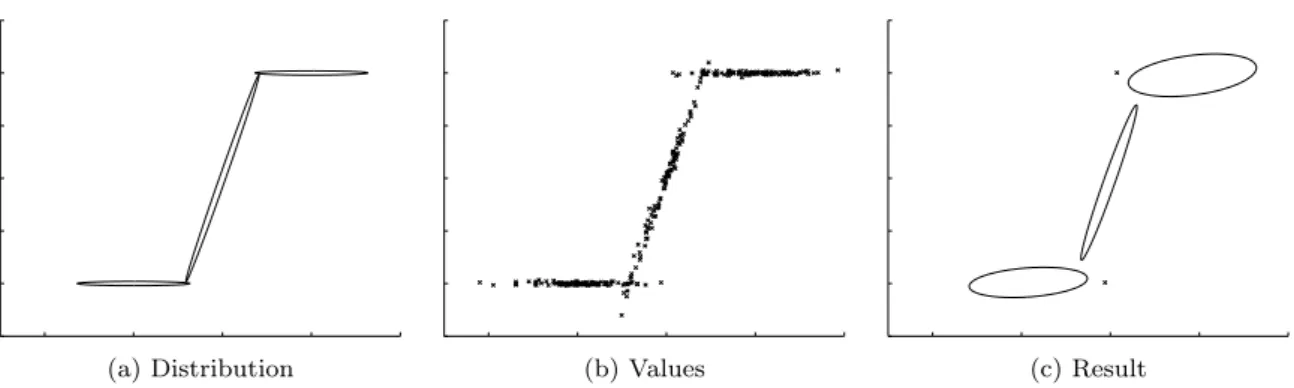
As an example input, we use data generated from a set of three Gaussians inR2. Values are generated according to the distribution shown in Figure 2a, where the ellipses are equidensity contours of nor-mal distributions. This input might describe tem-perature readings taken by a set of sensors posi-tioned on a fence located by the woods, and whose right side is close to a fire outbreak. Each value is comprised of the sensor’s location x and the recorded temperaturey. The generated input val-ues are shown in Figure 2b. We run the GM algo-rithm with this input until its convergence;k= 7 andqis set by floating point accuracy.
The result is shown in Figure 2c. The ellipses are equidensity contours, and the x’s are singleton clusters (with zero variance). This result is visibly a usable estimation of the input data.
5.2.2 Robustness
Erroneous samples removal As an example appli-cation, we use the algorithm to calculate a statisti-cally robust average. We consider a sensor network of 1,000 sensors reading values inR2. Most of these values are sampled from a given Gaussian distribu-tion and we wish to calculate their average. Some values, however, are erroneous, and are unlikely to belong to this distribution. They may be the result of a malfunctioning sensor, or of a sensing error, e.g., an animal sitting on an ambient temperature sensor. These values should be removed from the statistics.
We use 950 values from the standard normal distribution, i.e., with a mean (0,0) and a unit co-variance matrix I. Fifty additional values are dis-tributed normally with covariance matrix 0.1·I and mean (0, ∆), with∆ranging between 0 and 25.
(a) Distribution (b) Values (c) Result
Fig. 2: Gaussian Mixture clustering example. The three Gaussians in Figure 2a were used to generate the data set in Figure 2b. The GM algorithm produced the estimation in Figure 2c.
The distribution of all values is illustrated in Fig-ure 3a.
For each value of ∆, the protocol is run until convergence. We usek= 2, so that each node has at most 2 clusters at any given time — hopefully one for good values and one for the erroneous val-ues.
The results are shown in Figure 3b. The dot-ted line shows the average weight ratio belonging to erroneous samples yet incorrectly assigned to the good cluster. Erroneous samples are defined to be values with probability density lower than fmin= 5×10⁻⁵(for the standard normal
distribu-tion). The other two lines show the error in calcu-lating the mean, where error is the average over all nodes of the distance between the estimated mean and the true mean (0,0). The solid line shows the result of our algorithm, which removes erroneous samples, while the dashed line shows the result of regular average aggregation, which does not.
We see that when the erroneous samples are close to the good values, the number of misses is large — the proximity of the clusters makes their separation difficult. However, due to the small dis-tance, this mistake hardly influences the estimated average. As the erroneous samples’ mean moves further from the true mean, their identification be-comes accurate and their influence is nullified.
Note that even for large ∆’s, a certain num-ber of erroneous samples is still missed. These are values from the good distribution, relatively close to the main cluster, yet with probability density lower thanfmin. The protocol mistakenly
consid-ers these to be good values. Additionally, around ∆ = 5 the miss rate is dropped to its minimum, yet the robust error does not. This is due to the fact that bad values are located close enough to the good mean so that their probability density
Main Cluster Outliers (a) 0 5 10 15 20 25 0 0.2 0.4 0.6 0.8 1 1.2 1.4 Error w/ Classification w/o Classification 0 5 10 15 20 250 20 40 60 80 100 ∆ Missed Outliers [%] Missed Outliers [%] (b)
Fig. 3: Effect of the separation of erroneous sam-ples on the calculation of the average: A 1,000 val-ues are sampled from two Gaussian distributions (Figure 3a). As the erroneous samples’ distribution moves away from the good one, the regular aggre-gation error grows linearly. However, once the dis-tance is large enough, our protocol can remove the erroneous samples, which results in an accurate es-timation of the mean.
is higher than fmin. The protocol mistakes those
to belong tofG and allows them to influence the mean. That being said, for all ∆’s, the error re-mains small, confirming the conventional wisdom that “clustering is either easy or not interesting”.
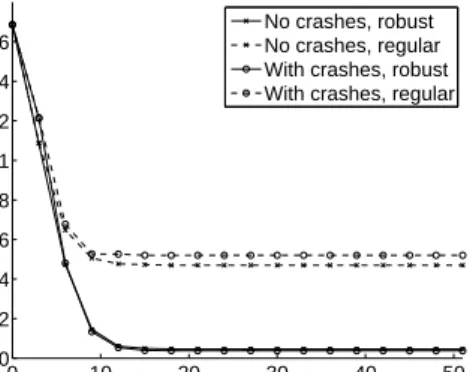
Crash robustness and convergence speed We next examine how crash failures impact the results ob-tained by our protocol. Figure 4 shows that the algorithm is indifferent to crashes of nodes. The source data is similar to the one above, with∆= 10. After each round, each node crashes with prob-ability 0.05. We show the average node estimation error of the mean in each round. As we have seen above, our protocol achieves a lower error then the regular one.
Figure 4 also demonstrates the convergence speed of our algorithm. With and without crashes, the convergence speed of our algorithm is equivalent to that of the regular average aggregation algorithm.
0 10 20 30 40 50 0 0.2 0.4 0.6 0.8 1 1.2 1.4 1.6 Round Average Error No crashes, robust No crashes, regular With crashes, robust With crashes, regular
Fig. 4: The effect of crashes on convergence speed and on the accuracy of the mean.
5.2.3 Scalability
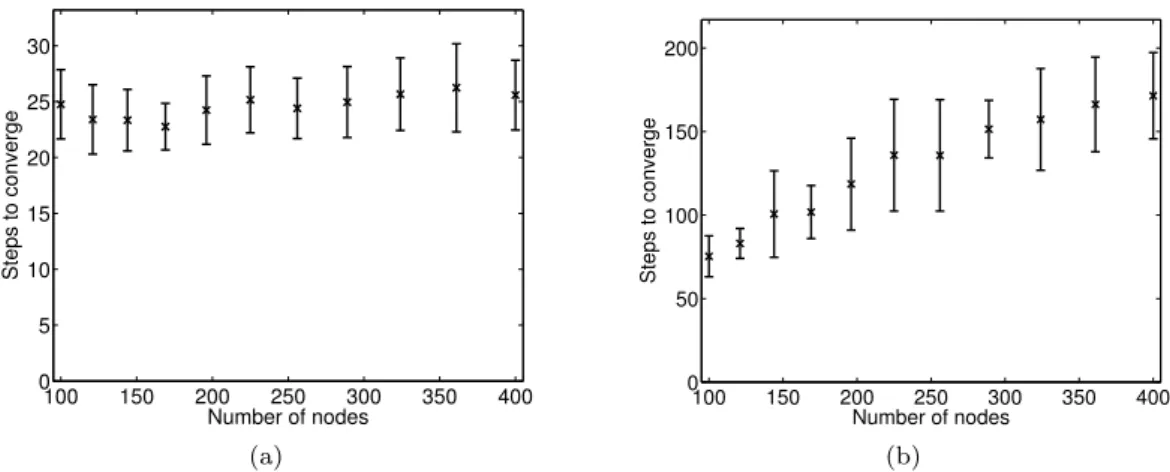
To evaluate convergence time we measure the num-ber of rounds until the estimations at the differ-ent nodes are the same. The samples are taken from a Gaussian mixture of two Gaussians of the same weight with variance 1 at distance 5 from each other. Since there is no scalar convergence value, the ε−δ measure which is used, e.g., for analysing Push-Sum, is not applicable to this sce-nario. Instead, we use the Kolmogorov-Smirnov (KS) statistic as the measure of difference between two distributions3. For a range of network sizes, we let the algorithm run until the maximal KS-statistic between the estimations of any pair of nodes4 falls below an arbitrary threshold of 0.01. The results for a complete topology and a grid topology (with samples taken independently of the grid coordinates) are shown in figures 5a and 5b, respectively. For each network size we show the average convergence time with the 95% confidence interval.
As expected, the scalability in a grid topology is worse than in a complete topology. The trends shown in these figures match those calculated by Boyd et al. [3] for the Push-Sum algorithm.
3 The Kolmogorov-Smirnov statistic for two distribu-tions is the maximal difference between their cumulative distribution functions
4 To shorten simulation time, we calculate the statis-tics for 4nrandom pairs of nodes.
6 Convergence Proof
We now prove that the generic algorithm presented in Section 4 solves the distributed clustering prob-lem. To prove convergence, we consider the pool of all the clusters in the system, at all nodes and communication channels. This pool is in fact, at all times, a clustering of the set of all input values. In Section 6.1 we prove that the pool of all clusters converges, i.e., roughly speaking, it stops changing. Then, in Section 6.2, we prove that the clusterings in all nodes converge to the same destination.
6.1 Collective Convergence
In this section, we ignore the distributive nature of the algorithm, and consider all the clusters in the system (at both processes and communication channels) at time t as if they belonged to a sin-gle multiset pool(t). A run of the algorithm can therefore be seen as a series of splits and merges of clusters.
To argue about convergence, we first define the concept of cluster descendants. Intuitively, fort1≤
t2, a clusterc2∈pool(t2) is a descendant of a
clus-terc1∈pool(t1) ifc2is equal toc1, or is the result
of operations onc1. Formally:
Definition 5 (Cluster genealogy)We recursively define the descendants of a cluster c ∈ pool(t). First, att, the descendant set is simply{c}. Next, considert1> t.
Assume thet1’th operation in the execution is
splitting (and sending) (Lines 3–7) a set of clusters {cx}lx=1 ⊂ pool(t1−1). This results in two new
sets of clusters,{c1
x}lx=1 and{c2x}lx=1, being put in
pool(t1) instead of the original set. If a cluster cx is a descendant of catt1−1, then the clustersc1x andc2
xare descendants ofcat t1.
Assume the t1’th operation is a (receipt and)
merge (Lines 8–11), then somem(1≤m≤k) sets of clusters{Mx}m
x=1⊂pool(t1−1) are merged and
are put inpool(t1) instead of the merged ones. For
every Mx, if any of its clusters is a descendant of
catt1−1, then its merge result is a descendant of
c att1.
By slight abuse of notation, we writev∈pool(t) when v is the mixture vector of a cluster c, and c ∈ pool(t); vector genealogy is similar to cluster genealogy.
We now state some definitions and the lem-mas used in the convergence proof. We prove that, eventually, the descendants of each vector in the
100 150 200 250 300 350 400 0 5 10 15 20 25 30 Number of nodes Steps to converge (a) 100 150 200 250 300 350 400 0 50 100 150 200 Number of nodes Steps to converge (b)
Fig. 5: Convergence time of the distributed clustering algorithm as a function of the number of nodes (a) in a fully connected topology and (b) in a grid topology.
pool converge (normalized) to one destination. To do that, we investigate the angles between a vector v and the axes unit vectors. Note that all angles are between zero and π/2. For i ∈ {1, . . . , d}, we call the angle betweenv and the i’th axisv’si’th reference angle and denote it byϕv
i. We denote by
ϕi,max(t) the maximali’th reference angle over all
vectors in the pool at timet: ϕi,max(t)
∆
= max
v∈pool(t)
ϕvi .
We now show that the i’th reference angle is monotonically decreasing for any 1 ≤ i ≤ n. To achieve this, we use Lemma 2 which states that the sum of two vectors has ani’th reference angle not larger than the larger i’th reference angle of the two. Its proof is deferred to Appendix A. Lemma 2 (Decreasing reference angle) The sum of two vectors in the mixture space is a vector with a smaller i’th reference angle than the larger
i’th reference angle of the two, for any1≤i≤n. We are now ready to prove that the maximal reference angle is monotonically decreasing: Lemma 3 For1≤i≤n,ϕi,max(t)is
monotoni-cally decreasing.
Proof The pool changes in split and merge oper-ations. In case of a split, the new vectors have the same angles as the split one, so ϕi,max is
un-changed. In case of a merge, a number of vectors are replaced by their sum. This can be seen as the result of a series of steps, each of which replaces two vectors by their sum. The sum of two vectors is a vector with a no larger i’th reference angle than the larger of thei’th reference angles of the
two (Lemma 2). Therefore, whenever a number of vectors are replaced by their sum, the maximal reference angle may either remain the same of de-crease.
Since the maximal reference angles are bounded from below by zero, Lemma 3 shows that they con-verge, and we can define
ˆ ϕi,max
∆ = lim
t→∞ϕi,max(t).
By slight abuse of terminology, we say that the i’th reference angle of a vector v ∈ pool(t) con-verges to ϕ, if for every ε there exists a time t0, after which the i’th reference angles of all of v’s descendants are in theεneighborhood ofϕ.
We proceed to show that there exists a time af-ter which the pool is partitioned into clusaf-ters, and the vectors from each cluster merge only with one another. Moreover, the descendants of all vectors in a cluster converge to the same reference angle. More specifically, we show that the vectors in the pool are partitioned into clusters by the algorithm according to thei’th reference angle their descen-dants converge to (for any 1≤i≤n). We further show that, due to the quantization of weight, a gap is formed between descendants that converge to the maximal reference angle, and those that do not, as those that do not remain within some min-imum distanceεfrom ˆϕi,max.
Since thei’th maximal reference angle converges (Lemma 2), for every ε there exists a time after which there are always vectors in the ε neighbor-hood of ˆϕi,max. The weight (sum of L1 norms of
vectors) in this neighborhood changes over time, and due to the quantization of weight there ex-ists a minimal weight qεi such that for every time
tthere exists a timet0 > twhen the weight in the neighborhood isqi
ε.
The following observations immediately follow: Observation 1 For everyε0 < ε, the relationqεi0 ≤
qi
εholds. Moreover,qiε−qεi0 =l·qwithl∈ {0,1,· · · }.
Observation 2 There exists an ε such that for every ε0 < ε, the minimal weight in the ε0 neigh-borhood of ϕˆi,max is the same as for ε. That is,
qi ε=qiε0.
The next lemma shows that vectors from dif-ferent sides of the gap are never merged. Its proof is deferred to Appendix B.
Lemma 4 For anyε, there exists an ε0 < ε such that if a vectorvoutlies outside theε-neighborhood
of ϕˆi,max (i.e., has a reference angle smaller than
ˆ
ϕi,max−ε), and a vector vin lies inside the ε0
-neighborhood (i.e., has a reference angle larger than ˆ
ϕi,max−ε0), then their sum vsum lies outside the
ε0 neighborhood.
We are now ready to prove the that eventually the vectors are partitioned.
Lemma 5 (Cluster formation) For every 1 ≤
i≤n, there exists a timeti and a set of vectors
Vi,max⊂pool(ti)
s.t. thei’th reference angles of the vectors converge to ϕˆi,max, and their descendants are merged only
with one another.
Proof For a giveni, choose anεsuch that for every ε0< εthe minimal weights are the same:qεi =qεi0.
Such anεexists according to Observation 2. According to Lemma 4, there exists an ˜ε s.t. the sum of a vector inside the ˜εneighborhood and a vector outside theεneighborhood is outside the ˜
εneighborhood. Choose such an ˜ε. Denote vin,ε˜ ∆ = X v0∈V in,˜ε v0 , vout,ε ∆ = X v0∈V out,ε v0 .
Since theVout,ε vectors have reference angles out-side the εneighborhood,vout,ε is also outside the
εneighborhood (Lemma 2).vin,ε˜may either be
in-side the ˜ε neighborhood or outside it. If vin,ε˜ is
inside the ˜εneighborhood, then the sumv is out-side theεneighborhood, due to the choice of ˜ε. If it is outside, thenv is outside the ˜εneighborhood (Lemma 2 again).
Choose a ti s.t. ti > tε˜and at ti the ε neigh-borhood contains a weight qε. Since qε = qε˜, the
weight in the ˜ε neighborhood cannot be smaller than qε˜, therefore the weight is actually in the ˜ε
neighborhood.
We now show that all operations afterti keep the descendants of the vectors that were in the ˜ε neighborhood at ti inside that neighborhood, and never mix them with the other vector descendants, all of which remain outside theεneighborhood.
We prove by induction that the descendants of the vectors that were inside the ˜εat ti are always in this neighborhood, and the descendants of the vectors outside theεneighborhood attiare always outside this neighborhood. The assumption holds at ti. Assume it holds at tj. If the step is a send operation (Lines 3–7), it does not change the an-gle of the descendants, therefore the claim holds at tj+1. If the step is a receive operation (Lines 8–11),
then vectors are merged. There is never a merger of vectors from both inside the ˜εneighborhood and outside theεneighborhood, since the result is out-side the ˜εneighborhood, leaving inside it a weight smaller thanq˜ε. Due to the same reason, the sum of vectors inside the ˜εneighborhood is always in-side this neighborhood. Finally, the sum of two vectors outside the ε neighborhood is outside the εneighborhood (Lemma 2).
Due to the choice ofε, for every ε0 < ε˜there exists a time after which there are vectors of weight qε in theε0 neighborhood of ˆϕi,max. According to
what was shown above, these are descendants of the set of vectors Vin,ε˜that are never mixed with
vectors that are not descendants thereof. This set is therefore the requiredVi,max.
We next prove that the pool of auxiliary vectors converges:
Lemma 6 (Auxiliary collective convergence) There exists a time t, such that the normalized descendants of each vector in pool(t) converge to a specific destination vector, and merge only with descendants of vectors that converge to the same destination.
Proof By Lemmas 3 and 5, for every 1 ≤i ≤ n, there exist a maximali’th reference angle, ˆϕi,max,
a time, ti, and a set of vectors,Vi,max ⊂pool(ti), s.t. thei’th reference angles of the vectors Vi,max
converge to ˆϕi,max, and the descendants of Vi,max
are merged only with one another.
The proof continues by induction. Attiwe con-sider the vectors that are not descendants ofVi,max∈
pool(ti). The descendants of these vectors are never merged with the descendants of theVi,maxvectors.
maximali’th reference angle. This can be applied repeatedly, and since the weight of the vectors is bounded from below byq, we conclude that there exists a time t after which, for every vector v in the pool at timet0 > t, thei’th reference ofv con-verges. Denote that timetconv,i.
Next, let tconv= max{tconv,i|1≤i≤n}. After
tconv, for any vector in the pool, all of its reference
angles converge. Moreover, two vectors are merged only if all of their reference angles converge to the same destination. Therefore, attconv, the vectors in
pool(tconv) can be partitioned into disjoint sets s.t.
the descendants of each set are merged only with one another and their reference angles converge to the same values. For a clusterxof vectors whose reference angles converge to (ϕxi)ni=1, its destina-tion in the mixture space is the normalized vector (cosϕx
i)ni=1.
We are now ready to derive the main result of this section.
Corollary 1 The clustering series pool(t)converges. Proof Lemma 6 shows that the pool of vectors is eventually partitioned into clusters. This applies to the weighted summaries pool as well, due to the correspondence between summaries and auxiliaries (Lemma 1).
For a cluster of clusters, define its destination cluster as follows: Its weight is the sum of weights of clusters in the cluster attconv, and its summary
is that of the mixture space destination of the clus-ter’s mixture vectors. Using requirement R1, it is easy to see that after tconv, the clustering series
pool(∗) converges to the set of destination clusters formed this way.
6.2 Distributed Convergence
We show that the clusterings in each node converge to the same clustering of the input values. Lemma 7 There exists a time tdist after which
each node holds at least one cluster from each clus-ter of clusclus-ters.
Proof First note that after tconv, once a node has
obtained a cluster that converges to a destination x, it will always have a cluster that converges to this destination, since it will always have a descen-dant of that cluster — no operation can remove it. Consider a node i that obtains a cluster that converges to a destinationx. It eventually sends a descendant thereof to each of its neighbors due to
the fair choice of neighbors. This can be applied repeatedly and show that, due to the connectiv-ity of the graph, eventually all nodes hold clusters converging tox.
Boyd et al. [3] analyzed the convergence of weight based average aggregation. The following lemma can be directly derived from their results:
Lemma 8 In an infinite run of Algorithm 1, after
tdist, at every node, the relative weight of clusters
converging to a destinationxconverges to the rel-ative weight ofx(in the destination clustering).
We are now ready to prove the main result of this section.
Theorem 1 Algorithm 1, with any implementa-tion of the funcimplementa-tions valToSummary, partition
and mergeSetthat conforms to Requirements R1– R4, solves the Distributed clustering Problem (Def-inition 4).
Proof Corollary 1 shows that pool of all clusters in the system converges to some clustering dest, i.e., there exist mappings ψt from clusters in the pool to the elements in dest, as in Definition 3. Lemma 7 shows that there exists a timetdist, after
which each node obtains at least one cluster that converges to each destination.
After this time, for each node, the mappings ψt from the clusters of the node at t to the dest clusters show convergence of the node’s clustering to the clustering dest(of all input values). Corol-lary 1 shows that the summaries converge to the destinations, and Lemma 8 shows that the relative weight of all clusters that are mapped to a certain cluster xin dest converges to the relative weight ofx.
7 Conclusion
We address the problem of distributed data clus-tering, where nodes obtain values and must calcu-late a clustering thereof. We presented a generic distributed data clustering algorithm that solves the problem efficiently by employing adaptive in-network compression. The algorithm is completely generic and captures a wide range of algorithms for various instances of the problem. We presented a specific instance thereof — the Gaussian Mix-ture algorithm, where clusters are maintained as weighted Gaussians, and merging decisions are done using the Expectation Maximization heuristic. Fi-nally, we provided a proof that any implementation of the algorithm converges.
Acknowledgements We thank Yoram Moses and Nathaniel Azuelos for their valuable advice.
This work was partially supported by the Technion Funds for Security Research, by the Israeli Ministry of Industry, Trade and Labor Magnet Consortium, and by European Union Grant No. 216366.
A Decreasing Reference Angle
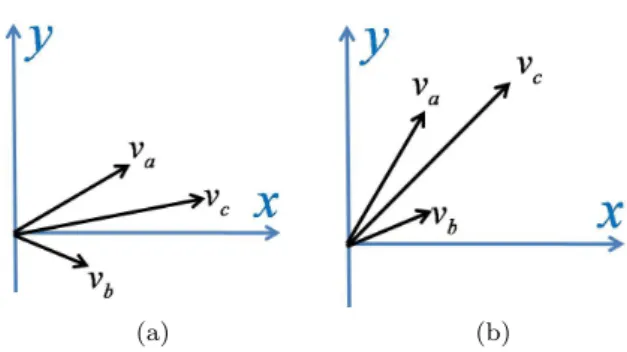
We prove Lemma 2, showing that the sum of two vec-tors results in a vector with a reference angle not larger than those of the original vectors. The proof considers the 3-dimensional space spanned by the two summed vectors and thei’th axis. We show in Lemma 9 that it is sufficient to consider the angles of the two vectors in a 2-dimensional space they span.
Recall we denote by kvkp the Lp norm of v. For simplicity, we denote the Euclidean (L2) norm bykvk. Denote byv1·v2the scalar product of the vectorsv1and
v2. Then the angle between two vectors in the mixture space is: arccos va·vb kvak · kvbk
We now show that we may prove for 2-dimensions rather than 3:
Lemma 9 (Reduction to 2 dimensions)In a 3 dimen-sional space, letvaandvbbe two vectors lying on theXY plane with angles not larger thanπ/2with theX axis, and
va’s angle with theX axis is larger than that ofvb. Letve be a vector in theXZplane whose angle with theX axis is smaller thanπ/2and with theZaxis not larger thanπ/2. Thenvb’s angle withveis smaller than that ofva. Proof Let us express the angle of the vectorva on the
XY plane withveusing the angle of the vector with the
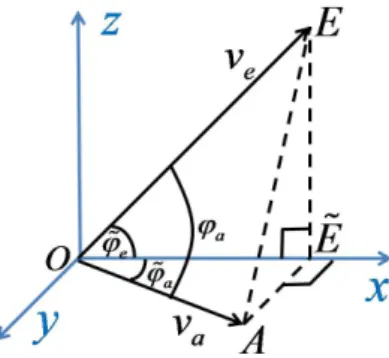
X axis, i.e., with the projection ofve on theXY plane, as shown in Figure 6. Denote the end point of the vector by A, and the origin by O. Construct a perpendicular line to theXaxis passing throughA. Denote the point of intersection ˜E. From ˜Etake a perpendicular line to the
XY plane, until intersectingve. Denote that intersection pointE.OEis the vectoreiandOE˜is its projection on theXY axis. Denote the angleAOEbyϕaandAOE˜by
˜
ϕa. Denote the angleEOE˜by ˜ϕe.
Fig. 6: The angles of the vectorsva andve.
OE˜=|v|cos ˜ϕa
OE= OE˜ cos ˜ϕe
= |v|cos ˜ϕa cos ˜ϕe
EE˜=OE˜tan ˜ϕe=|v|cos ˜ϕatan ˜ϕe
AE˜=|v|sin ˜ϕa
AE=pEE˜2+AE˜2=p
(|v|cos ˜ϕatan ˜ϕe)2+ (|v|sin ˜ϕa)2 Now we can use the law of cosines to obtain:
ϕa= arccos
OA2+OE2−AE2
2·OA·OE = arccos(cos ˜ϕacos ˜ϕe)
(3) Since 0≤ϕ˜a≤π/2 and 0≤ϕ˜e≤π/2, we see that
ϕa is monotonically increasing with ˜ϕa. We use similar notation for the vector b, and since ˜ϕb<ϕ˜a, and both are smaller thanπ/2, then:
cos ˜ϕa≤cos ˜ϕb cos ˜ϕacos ˜ϕe≤cos ˜ϕbcos ˜ϕe arccos(cos ˜ϕacos ˜ϕe)≥arccos(cos ˜ϕbcos ˜ϕe)
ϕa≥ϕb (4) Now we return to thendimensional mixture space. Lemma 2 (restated) The sum of two vectors in the mixture space is a vector with a smalleri’th reference angle than the largeri’th reference angle of the two, for any1≤
i≤n.
Proof Denote the two vectorsvaandvb, and theiri’th reference anglesϕa
i andϕbi, respectively. Assume with-out loss of generality that ϕa
i ≥ ϕbi. Denote the sum vector byvc
It is sufficient to prove the above in the 3 dimen-sional space spanned by va, vb andei. Align theXYZ axes such that va andvb lie on the XY plane and the projection ofeion that plane is on theX axis. The vec-torvclies on theXYplane, as it is a linear combination of two vectors on the plane.
By Lemma 9, It is sufficient to show the angle of
vc with the projection of the reference vector is smaller than the angle ofvawith the projection.
The angle betweenvcand theXaxis is smaller than
va’s angle with it. The only two possible constructions are shown in Figure 7.
Bε0 Exists
Lemma 4 (restated) For anyε, there exists anε0< ε
such that if a vectorvoutlies outside theε-neighborhood of
ˆ
ϕi,max(i.e., has a reference angle smaller thanϕˆi,max−ε), and a vector vin lies inside theε0-neighborhood (i.e., has a reference angle larger thanϕˆi,max−ε0), then their sum
vsumlies outside theε0 neighborhood.
Proof Consider the 3 dimensional space spanned byvin,
voutandei. Align theXYZaxes such thatvinandvout lie on the XY plane and the projection of ei on that plane is aligned with theX axis. Denote this projection by ˜ei.vsumlies on theXYplane, as it is a linear combi-nation of two vectors on the plane. Denote by ˜ϕi
(a) (b)
Fig. 7: The possible constructions of two vectors va and vb and their sumvc, s.t. their angles with theX axis are smaller thanπ/2 and va’s angle is larger thanvb’s angle.
and ˜ϕi
sumthe angles between ˜eiand the vectorsvin,vout andvsum, respectively. Denote by ˜ϕi
eithe angle between
eiand its projection ˜ei.
Consider some ε0 ≤ε/2, so that the angle between
vin andvoutis at leastε/2. Notice that theL2 norms ofvinandvoutare bounded betweenqfrom below and √
s from above. Observing Figure 7 again, we deduce that there is a lower bound on the difference between the angles:
˜
ϕisum<ϕ˜iin−x1 (5) Due to the previous bound, and noting that all angles are not larger thanπ/2, a constantx2exists such that cos ˜ϕiin<cos ˜ϕisum−x2. (6) Since the reference angles ofvin andvoutare different, at least one of them is smaller thanπ/2, therefore ˜ϕi
ei<
π/2 for any such couple. Therefore, cos ˜ϕi
ei is a bounded size, and factoring Inequality 6 we deduce that there exists a constantx3such that
cos ˜ϕiincos ˜ϕiei<cos ˜ϕ i
sumcos ˜ϕiei−x3. (7) We use the inverse cosine function with Inequality 7 to finally deduce that there exists a constantx4 such that arccos(cos ˜ϕiincos ˜ϕiei)>arccos(cos ˜ϕ
i
sumcos ˜ϕiei) +x4 (8)
ϕiin> ϕisum+x4 (9) Therefore, for a givenε, we choose
ε0<min 1 2x4, 1 2ε .
With thisε0, we obtainϕi
sum<ϕˆi,max−ε0, as needed.
References
1. Asada, G., Dong, M., Lin, T., Newberg, F., Pot-tie, G., Kaiser, W., Marcy, H.: Wireless integrated network sensors: Low power systems on a chip. In: ESSCIRC (1998)
2. Birk, Y., Liss, L., Schuster, A., Wolff, R.: A local algorithm for ad hoc majority voting via charge fu-sion. In: DISC (2004)
3. Boyd, S.P., Ghosh, A., Prabhakar, B., Shah, D.: Gossip algorithms: design, analysis and applica-tions. In: INFOCOM (2005)
4. Datta, S., Giannella, C., Kargupta, H.: K-means clustering over a large, dynamic network. In: SDM (2006)
5. Dempster, A.P., Laird, N.M., Rubin, D.B.: Maxi-mum likelihood from incomplete data via the em algorithm. J. Royal Stat. Soc.39(1) (1977). URL http://www.jstor.org/stable/2984875
6. Duda, R.O., Hart, P.E., Stork, D.G.: Pattern Clas-sification, 2nd edn. Wiley-Interscience (2000) 7. Eugster, P.T., Guerraoui, R., Handurukande, S.B.,
Kouznetsov, P., Kermarrec, A.M.: Lightweight probabilistic broadcast. In: DSN (2001)
8. Eyal, I., Keidar, I., Rom, R.: Distributed clustering for robust aggregation in large networks. In: Hot-Dep (2009)
9. Eyal, I., Keidar, I., Rom, R.: Distributed data clas-sification in sensor networks. In: PODC (2010) 10. Flajolet, P., Martin, G.N.: Probabilistic counting
al-gorithms for data base applications. J. Comput. Syst. Sci.31(2) (1985)
11. Gurevich, M., Keidar, I.: Correctness of gossip-based membership under message loss. SIAM J. Comput.39(8), 3830–3859 (2010)
12. Haridasan, M., van Renesse, R.: Gossip-based dis-tribution estimation in peer-to-peer networks. In: International Workshop on Peer-to-Peer Systems (IPTPS 08) (2008)
13. Heller, J.: Catch-22. Simon & Schuster (1961) 14. Kempe, D., Dobra, A., Gehrke, J.: Gossip-based
computation of aggregate information. In: FOCS (2003)
15. Kowalczyk, W., Vlassis, N.A.: Newscast em. In: NIPS (2004)
16. Macqueen, J.B.: Some methods of classification and analysis of multivariate observations. In: Proceed-ings of the Fifth Berkeley Symposium on Mathe-matical Statistics and Probability (1967)
17. Mark Jelasity, M., Voulgaris, S., Guerraoui, R., Ker-marrec, A.M., van Steen, M.: Gossip based peer sampling. ACM Transactions on Computer Systems 25(3)(2007)
18. Nath, S., Gibbons, P.B., Seshan, S., Anderson, Z.R.: Synopsis diffusion for robust aggregation in sensor networks. In: SenSys (2004)
19. Sacha, J., Napper, J., Stratan, C., Pierre, G.: Re-liable distribution estimation in decentralised envi-ronments. Submitted for Publication (2009) 20. Salmond, D.J.: Mixture reduction algorithms for
uncertain tracking. Tech. rep., RAE Farnborough (UK) (1988)
21. Warneke, B., Last, M., Liebowitz, B., Pister, K.: Smart dust: communicating with a cubic-millimeter computer. Computer 34(1) (2001). DOI 10.1109/2.895117