Effect of Total Mixed Ration on Dry Matter Intake, Milk Yield
and Composition of Early Lactating Jersey Cows
Dejene Teshome 1 Lemma Fita2 Fekede Feyissa3 Getu Kitaw3 Zewudie Wondatir3 1. Ethiopian Meat and Dairy Industry Development Institute, P.O.Box: 1573, Bishoftu, Ethiopia
2. Department of Animal Sciences, College of Agriculture and Veterinary Sciences, Ambo University, P.O.Box: 19, Ambo, Ethiopia
3. Holeta Agricultural Research Center P.O.Box: 31, Holeta, Ethiopia Abstract
A study was conducted to investigate the comparative advantages of feeding total mixed ration (TMR) over conventional feeding in terms of dry matter intake, milk yield and milk composition of early lactating Jersey cows at Holeta Research Center. Ten early lactating Jersey cows (5th day after parturitions with more or less similar lactation performance but differing in parity one through five) were subjected to TMR and conventional feeding. Two cows from each parity (parity one to five) were selected and randomly assigned to the two feeding systems in five replicates. The two dietary treatments consisted of the same basal diet and concentrate. Natural grass hay (60%) and concentrate mix 40 %( 25% Wheat barn, 20% Noug seed cake, 16% Cotton seed cake, 36% Molasses, 2% Urea and 1% salt). Natural pasture hay was chopped in to 2-5 cm pieces and properly mixed with formulated dairy concentrate mix to prepare the total mixed ration for the TMR group and Natural pasture hay (basal feeds not chopped) with original size and formulated concentrate mix were separately given for the control group. Significantly higher (P<0.05) DM intake was observed for lactating cows fed TMR compared to cows fed conventional feeds. Significantly higher (P<0.001) daily milk yield was observed for cows fed TMR than cows fed conventional feed while there was no significant difference (P>0.05) in milk composition between the two treatments. The feed conversion ratio was significantly (P<0.05) lower for the TMR group than control group implying that the TMR group consumed less dry matter to produce one liter of milk compared to the control group. Therefore, it is recommended to use TMR for better utilization of low quality feed resources for early lactating Jersey cows to increase milk production on dairy farms.
Keywords: TMR, Jersey cows, concentrate, Natural grass hay, early lactation. 1. INTRODUCTION
Ethiopia, has about 53.9 million cattle, 25.4 million sheep, 24.06 million goats and 0.9 million camels (CSA, 2012/13) excluding livestock population of three zones of Afar and six zones of Somali regions.
Despite the country’s high livestock holding, great potential and development efforts to get the subsector moving forward, productivity has remained low and subsistence oriented in the country (Demissu et al., 2013). Dairy production in Ethiopia is mainly based on low producing indigenous cattle with insignificant contribution to the national economy despite the country`s immense potential for dairying. For example, in 2009 average milk production was estimated at only 1.54 liters/cow per day (CSA, 2009), and the per capita milk consumption was only about 19 kg/year, which is much lower than African and world per capita averages of 27 kg/year and 100 kg/year, respectively(Azage et al., 2013).
A recent report by CSA (2010/11) indicated that the total production of cow milk is about 4.06 billion liters, which translates to an average daily milk production/cow of 1.86 liters/day. The MoA (2012) also reported some improvement in per capita consumption of milk and estimated it at 19.2 kg. Availability of animal feed is one of the greatest constraints to the expansion of the livestock industry in developing countries.
Apart from the high and fluctuating costs and some of the ingredients used in mixed feeds, notably cereal grains are in high demand for human consumption (Anjos et al., 2014). In most tropical regions, majority of animal feed is derived from poor quality crop residues and agro-industrial by-products. Most of the resource poor farmers, which constitute the bulk of the livestock farmers in the tropical regions, are unable to afford good quality feeds due to their high cost, leading to sub-optimal productivity of their animals (FAO, 2012). Conventional feeds are feed stuffs which are commonly utilized by farmers or used as for preparing formulated feed by commercial feed manufacturers. Availability of conventional feed resources is declining due to shirinking grazing lands as a result of expansion of cropping and urbanization. Thus it is difficult for livestock owners to feed their stock and sustain production of less productive land. Hence efforts have been made to evaluate the availability of supplements and the levels at which they can be safely fed to livestock (Sawal et al., 2004).
High cost and non-availability of concentrates and protein source feeds, necessitates the use of locally available supplements for dairy cows. These should be supplied in higher quantities as a replacement to concentrates to reduce the feed cost (Goswami et al., 2013).
cottonseed), grains, protein supplement(s), minerals, and vitamins that have been mixed together to make a balanced ration in which the weight of each ingredient is known (Donna et al., 2002). Feeding a total mixed ration (TMR) helps a dairy cow to achieve maximum performance. This is accomplished by feeding a nutritionally balanced ration at all times, allowing cows to consume as close to energy requirements as possible and maintaining physical or roughage characteristics required for proper rumen function (Donna et al., 2002). Feeding cows with a TMR helps to improve milk production and profitability of the dairy operation. According to Ronaldo, (2006), cows fed on a nutritionally balanced TMR typically produce more milk and milk components than those fed on pasture-based diets. Moreover, feeding TMR helps to reduce feed cost via improving palatability of the feeds (Donna et al., 2002).
With a TMR, a cow eats a nutrient balanced ration in every bite or mouthful she consumes. Cows eat a predetermined amount of forages and concentrates necessary for good production and health. Selective consumption of feeds by cows is minimized. Consuming a mix of feeds and nutrients with every bite will optimize milk production and keep cows healthy (Jim, 2014). Feeding a TMR correctly balanced to nutrient specifications can increase milk production by 1 to 2.5 kg per cow per day for high yielding dairy animals compared to conventional rations (Senani et al., 2013). Milk fat and other components can also increase because of the better rumen fermentation and balance of nutrients being consumed.
There are no studies conducted on TMR feeding of dairy cows in Ethiopian condition and available information in this regard is rare even in Africa. It is in this context that the present study was designed to see the effect of TMR on dry matter intake, milk yield and composition of early lactating Jersey cows.
2. MATERIALS AND METHODS 2.1. Description of the Study Area
The study was conducted at Adea Berga Dairy Farm, one of the sub-center of Holeta Agricultural Research Centers, Ethiopia. Adea Berga wet land is located in the central highlands of Ethiopia at 9016’N latitude and 38023’E longitude,70km west of Addis Ababa and 35km North west of Holetta on the main road to Muger. It lies at an altitude of 2500 meters above sea levels. It is characterized by cool sub-tropical climate with the mean annual temperature and rainfall of 180c and 1225mm, respectively (HARC, 2010).
2.2. Experimental Animals
Ten early lactating Jersey cows (5th day after parturitions with more or less similar lactation performance but differing in parity one through five) were subjected to the experiment. Two cows from each parity (parity one to five) were selected and randomly assigned to the two feeding systems in five replicates. All experimental animals were drenched with broad spectrum anti-helminthes (Albendazole 2500 mg) prior to the commencement of the experiment. The calves were separated from their dams five days after parturition and reared. The cows were placed in an individual pen in a well-ventilated barn with concrete floor and appropriate drainage slope and gutters and stall-fed.
2.3. Experimental Feed Preparation
Chemical analysis and in-vitro digestibility were conducted to determine nutritive values of each feed ingredients. The ration was formulated according to the dry matter requirement of lactating Jersey cows at different physiological states which was again governed by the recommended target body weight and daily milk yield of experimental cows (ARC, 1980). The two dietary treatments consisted of the same basal diet and concentrate. Natural grass hay (60%) and concentrate mix 40 %( 25% Wheat barn, 20% Noug seed cake, 16% Cotton seed cake, 36% Molasses, 2% Urea and 1% salt). Total mixed ration (TMR) was formulated to comprise 60% natural pasture hay, 39% formulated dairy concentrate mix for lactating cows and 1% salt. Using Pearson Square method the TMR was calculated to supply 13% CP to the lactating experimental cows on a daily basis. 2.4. Feeding Management
The animals were subjected to fifteen days acclimatization period to the feeding systems. Individual feeding was practiced for both groups of the animals. Similarly, all the animals had free access to the usual daily feed allowance as the experimental feeds were offered three times per day at 9:00hr, 3:00hr and 9:00hr (the time was in GC). During the experimental period, the treatment groups were fed with TMR while the control groups were subjected to conventional feeding system. Water was available adlibitum to the cows throughout the experimental period.
2.5. Treatments
2.5.1. Treatment one (T1): conventional feeding
The control groups received similar feed ingredients to the TMR but fed in conventional way. Basal diet was offered based on body weight of the animal while the concentrate level (22% CP) was determined based on daily
milk yield of the animal. Natural pasture hay (basal feeds not chopped) with original size and formulated concentrate mix were separately given for the control group. Feeding was continued until 128 days of lactation (early lactation periods).
2.5.2. Treatment two (T2): TMR feeding
The treatment group were fed with Total mixed ration (TMR) that was formulated comprosing 60% natural pasture hay, 39% formulated dairy concentrate mix for lactating cows and 1% salt. Using Pearson Square method the TMR was formulated to supply 13% CP to the lactating experimental cows on daily basis. The natural pasture hay was chopped in to 2-5cm pieces and properly mixed with formulated dairy concentrate mix to prepare the total mixed ration for the TMR group. Similarly, feeding TMR was continued for the first 128 days of lactation (early lactation periods).
2.6. Types of Data Collected
Daily dry matter intake, milk yield and milk composition data from the control and TMR groups were collected. 2.7. Sampling and Measurements
2.7.1. Milk samples
The cows were hand-milked twice a day at approximately 12-hour intervals to determine the daily milk. The morning milk from individual cow from each group was measured, thoroughly mixed and 100ml samples were taken every fortnightly for laboratory analysis to determine milk composition.
2.8. Milk composition 2.8.1. Milk fat
Gerber methods were used to determine the milk fat. Milk samples were kept at 370C for 30 minutes in a water bath to maintain the milk temperature similar to the cow`s normal body temperature. Ten ml of concentrated sulfuric acid was pipetted into butyrometer. Then 11 ml of milk was added using milk pipette into a butyrometer having the sulfuric acid to which 1ml of amyl alcohol was also added. The butyrometer stopper was cleaned, dried and the samples were shaken and inverted several times until all the milk was absorbed/digested by the acid. Then the butyrometer was placed in a water bath at 650C for five minutes. The sample was centrifuged for four minutes at 1100 rpm (rotations per minute). Finally, the sample was taken back to water bath for 5 minutes at 630C and fat percentage was read from the butyrometer (O’Connor CB., 1994).
2.8.2. Total protein
Formaldehyde titration method was used to determine the total protein. 10ml of milk was placed in a white porcelain basin. Then, 0.5 ml of 0.5 percent phenolphethalein indicator and 0.4 ml of 0.4 percent Potassium Oxalate were added into the milk. Then, the sample was titrated with 0.1N NaOH (Sodium Hydroxide). The titration was continued until pink color becomes intense. Finally, the burette reading was recorded. The reading was multiplied by a factor 1.74 (O’Connor CB., 1994) to determine the protein level.
%Protein =1.74 *volume of NaOH consumed. 2.8.3. Total solids
To determine the total solids three grams of milk samples was placed in pre-weighed and dried duplicates of crucibles. The samples were kept at 1020C in a hot air oven for 24 hours. Then, the dried samples were cooled in desiccators and weighed (O’Connor CB., 1994).
100
(
x
weight
Sample
weight
Crucible
weight
sample
dry
oven
weight
Crucible
solids
Total
=
+
−
2.8.4. Total ashThe total ash was determined gravimetrically by igniting the milk samples in a muffle furnace in which the temperature was slowly raised to 550 0c. The sample was ignited until carbon (black color) disappears or until the ash residue becomes white (Michael and Joseph, 2004).
Percent of ash = (weight of residue) × 100 Weight of sample 2.8.5. Lactose
Percent lactose was determined by subtracting the fat, protein and total ash percentages from the total solids (O’Connor CB., 1994).
% Lactose = % Total solid- (% Protein + % Fat +% Ash) 2.9. Statistical Analysis
The data was subjected to analysis of variance (ANOVA) using the model for independent T-test by the SAS procedure (SAS, 2002). Initial body weight was used as covariate for dry matter intake, body weight gain and body condition score of the animals.
The following statistical model was used for the analysis: Yij=µ + ri + b (Xij-X) +eij
Where:
Yij is the dependent variable (feed intake, milk yield, body weight gain and body condition score) µ = Overall mean, ri = effect of treatment, b = regression coefficient
Xij = the record of milk yield, feed and nutrient intake, live weight and body condition of the Jth cow on the ith treatment
X= the overall mean of milk yield/live weight during the initial period eij = random error
3. RESULTS AND DISCUSSION 3.1. Dry matter intake
The mean daily DM intakes of lactating Jersey dairy cows fed roughage to concentrate ratio (60:40%) for conventional and total mixed ration (TMR) are presented in table 1. Significantly higher (P<0.05) DM intake was observed for lactating cows fed TMR compared to cows fed conventional feeds. There was no significant difference (P>0.05) between control and TMR in daily DM intake of natural grass hay, but the values were lower in the control than TMR group. The daily DM intake of concentrate mix was highly significant (P<0.001) between treatments. The variation might be due to voluntary feed intake, amount of water adds in the dry TMR and sorting since chopping was manually done. The dry matter intake of control group was 10.55kg/cow/d while it was 12.82kg/cow /day for the TMR group. Wachirapakorn et al. (1997) compared two feeding regimes (separate and TMR feeding) and found that TMR feeding increased dry matter intake (DMI).
Table1: Mean (± SE) of dry matter intake (kg/d) of early lactating Jersey dairy cows fed total mixed ration and conventional feed
*=p<0.05; ***=p<0.001; ns= non significance; SL=significance level 3.2. Milk Yield and Composition
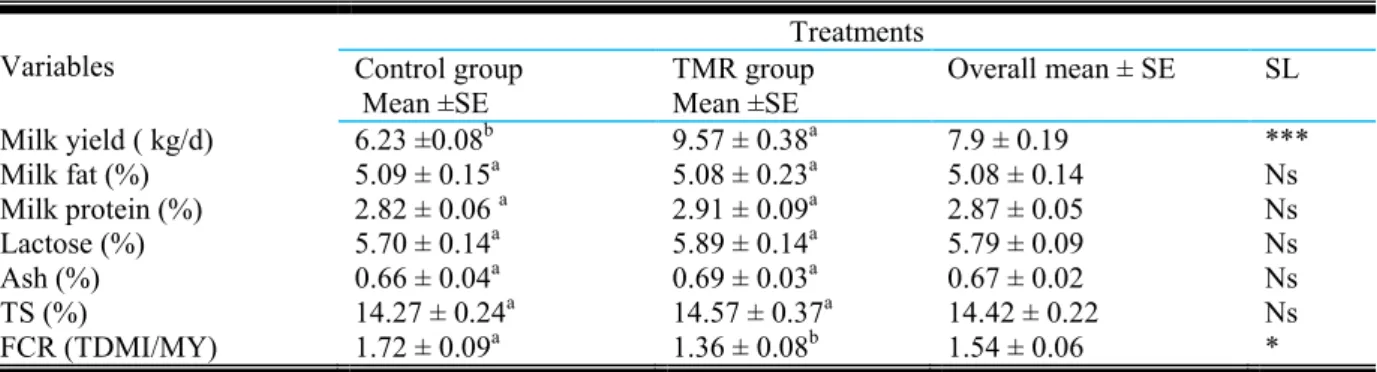
The results of mean daily milk yield and composition of Jersey dairy cows fed TMR and conventional feed are shown in Table 2. Significantly higher (P<0.001) daily milk yield was observed for cows fed TMR than cows fed conventional feed. The cows fed with TMR produced more milk than those in separate diet. In the present finding, TMR increased DMI which resulted in increased CPI and EME compared to the separate feeding diet (control group). The difference in milk yield between treatment groups is attributed to the differences in crude protein and energy intake. The efficiency of concentrate utilization to produced one liter milk (DMI/milk yield) for TMR and conventional feed were 0.53 and 0.50, respectively. This indicates that equal amount of concentrate was utilized to produce one liter of milk for the TMR and separate diet groups but the average milk yield per day per cow for TMR was high when compared with control. The milk yield per cow per day (3.34kg) for the TMR group in the present finding is higher than the values reported by Senani et al. (2013) that stated that TMR correctly balanced to nutrients can increase milk production from 1 to 2.5 kg per cow per day. TMR diet increased feed intake and milk production by 5.2% (O’Connor et al., 1988) and 9% (Teh et al., 1985), respectively and it is lower than the current study. The total daily dry matter intake (DMI) in cows fed TMR increased significantly by 15.92 % than those fed separate diets (Gupt et al., 2014). It was observed that the increase in milk yield per cow per day for cows fed TMR varied from place to place and from country to country which could be related to the difference in ingredients mix, amount of concentrate mix, roughage to concentrate ratio, quality of feed, feed conversion efficiency and breeds of the lactating cows.
Intake Control group TMR group Treatments Overall mean ± SE SL Mean ±SE Mean ±SE
Total dry matter intake(DMI) 10.55 ± 0.51b 12.82 ± 0.56a 11.69 ± 0.38 * Hay dry matter intake(HDMI) 7.43 ± 0.54a 7.69 ± 0.33a 7.56 ± 0.32 Ns Concentrate dry matter intake(CDMI) 3.12 ± 0.04b 5.13 ± 0.22a 4.12 ± 0.11 ***
Table 2: Effects of total mixed ration and conventional feed on milk yield and composition of early lactating jersey dairy cows
Variables
Treatments
Control group TMR group Overall mean ± SE SL
Mean ±SE Mean ±SE
Milk yield ( kg/d) 6.23 ±0.08b 9.57 ± 0.38a 7.9 ± 0.19 *** Milk fat (%) 5.09 ± 0.15a 5.08 ± 0.23a 5.08 ± 0.14 Ns Milk protein (%) 2.82 ± 0.06 a 2.91 ± 0.09a 2.87 ± 0.05 Ns Lactose (%) 5.70 ± 0.14a 5.89 ± 0.14a 5.79 ± 0.09 Ns Ash (%) 0.66 ± 0.04a 0.69 ± 0.03a 0.67 ± 0.02 Ns TS (%) 14.27 ± 0.24a 14.57 ± 0.37a 14.42 ± 0.22 Ns FCR (TDMI/MY) 1.72 ± 0.09a 1.36 ± 0.08b 1.54 ± 0.06 *
*= p<0.05; ***=p<0.001; ns=non significance; Total solid (TS); feed conversion ratio (FCR) =Feed conversion ratio = Total dry matter intake over milk yield (TDMI/MY)
Generally, both the CP and ME intake were sufficient to meet requirement for the observed milk yield. There was no significant difference (P>0.05) in milk composition between the two treatments (Table 2). The current study non significance of milk quality between treatments it might be due to the ratio of rouge to concentrate diets fed. Similarly, Aikman et al. (2008) observed no response in milk fat and milk protein content when dosed to cows consuming either a 60% concentrate diet or a 70% concentrate diet. The other non-significance between treatments expectation of the current finding milk quality might be the quality of feed. The milk from indigenous cows contains 6.1% fat, 3.3% protein, 4.5% lactose and 0.7% ash (Alganesh, 2002).
The feed conversion ratio was significantly (P<0.05) lower for the TMR group than control group implying that the TMR group consumed less dry matter to produce one liter of milk compared to the control group but, it is lower than the value reported by Olorunnisomo and Ibhaze (2013) who noted that the DM intake, milk yield and feed conversion ratio of Sokoto Gudali cows fed Napier grass-cassava peel silage were 13.93 kg/d, 6.7 kg/d and 2.08 DMI/ kg milk yield, respectively. The mean present feed conversion ratio of TMR group (1.36 DMI) to produced one liter of milk was lower when compared to mean control group (1.72 DMI) to produced one liter of milk.
4. CONCLUSIONS
A study was conducted to investigate the comparative advantages of feeding total mixed ration (TMR) over conventional feeding in terms of feed intake, change in body condition score and digestibility on early lactating Jersey cows at Holeta Research Center. Ten early lactating Jersey cows (5th day after parturitions with more or less similar lactation performance but differing in parity one through five) were subjected to the experiment. Two cows from each parity (parity one to five) were selected and randomly assigned to the two feeding systems in five replicates.
Results from analysis of present experimental feeds indicated that Significantly higher (P<0.05) DM intake was observed for lactating cows fed TMR compared to cows fed conventional feeds. significantly higher (P<0.001) daily milk yield was observed for cows fed TMR than cows fed separate feed while there was no significant difference (P>0.05) in milk composition between the two treatments. The feed conversion ratio was significantly (P<0.05) higher for the control group than TMR group. It is concluded that the present study of TMR diets was increased daily dry matter intake and milk yield when it compared to separate feeding for early lactating Jersey cows.
5. REFERENCES
Aikman, P.C., P.H. Henning, A.K. Jones, S. Potteron, J. Siviter, S. Carter, S. Hill, P. Kirton and R. Szoka. 2008. Effect of administration of Megasphaera elsdenii NCIMB 41125 lactate utilising bacteria in early lactation on the production, health and rumen environment of highly productive dairy cows fed a high concentrate diet. KK Animal Nutrition Internal Report.
Alganesh Tola .2002. Traditional milk and milk products handling practices and raw milk quality in Eastern Wollega. M.Sc. Thesis, Alemaya University. Dire Dawa, Ethiopia. 108p.
Anjos, F.R., L.Tivana, J.D.Francisco and M.Kagande .2014. Cassava: An affordable energy source in Dairy rations. J. of Animal and Feed Research, 4(1):10-14.
ARC (Agricultural Research Council) .1980. The Nutrient Requirements of Ruminant Livestock. Commonwealth Agricultural Bureaux, Farnham Royal, UK, pp. 121–166.
Azage T., Berhanu G., Dirk H., Berhanu B. and Yoseph M.2013. Smallholder dairy production and marketing systems in Ethiopia: IPMS experiences and opportunities for market-oriented development. IPMS (Improving Productivity and Market Success) of Ethiopian Farmers Project Working Paper 31. Nairobi:
ILRI.78PP.
CSA (Central Statistical Authority).2012/13. Federal Democratic Republic of Ethiopia Agricultural sample survey. Livestock and livestock characteristics bulletin, Volume II. Addis Ababa, Ethiopia. 2: 9-22. CSA (Central Statistics Authority) .20010/11. Agricultural sample survey 2010/2011.Vol. II.
CSA (Central Statistics Authority). 2009. Agricultural sample survey 2008/09. Report on livestock and livestock characteristics. Statistical bulletin 446. Addis Ababa, Ethiopia: CSA.
Demissu Hundie, Fekadu Beyene and Gemeda Duguma .2013. Early Growth and Reproductive Performances of Horro Cattle and their F1 Jersey Crosses in and around Horro-Guduru Livestock Production and Research Center, Ethiopia. Sci. Technol. Arts Res. J., 2(3): 134-141.
Donna, M., R. Jose and W.T. Larry. 2002. Managing the Total Mixed Ration to Prevent Problems in Dairy Cows. University of Kentucky, pp.1-4.
FAO. 2012. Crop residue based densified total mixed ration – A user-friendly approach to utilise food crop by-products for ruminant production, by T.K. Walli, M.R. Garg & H rinder P.S. Makkar. FAO Animal Production and Health Paper No. 172. Rome, Italy.
Goswami, S.N., A.Chaturvedi, S.Chatterji, N.G.Patil, T.K.Sean, T.N.Hajare and R.S.Gawande .2013. Least cost Diet plan of cows for small Dairy farms. African J. of Agricultural Research, 8(47):5989-5995.
Gupt J.J., A. Dey, B.P. Bhatt, A. Chakrabarti, S. Dayal, Rajani Kumari and S.K. Barari .2014. Performance of lactating crossbred cows fed on forage based total mixed ration. Livestock Research International, 2(2):30-32.
Holetta Agricultural Research Center (HARC) .2010. Agro- Metrology and GIS weather data of west shewa zone for the period of 2001-2010. Holetta Research center, Ethiopia.
Jim, L.2014.Feeding Total Mixed Rations for lactating Dairy cows.pp.3-10.
Michael W. and Joseph F. Frank .2004. Standard methods for the Analysis of Dairy producs. 17th edition, American public Health Association, Washington, D.C., USA.
MoA .2012. Livestock growth strategy and action. Draft discussion paper. Addis Ababa: MoA.
O’connor C.B. 1994. Rural Dairy Technology. ILRI Training Manual1 .1995. ILRI (International Livestock research Institute), Addis Ababa, Ethiopia. pp.133.
O’Connor, A. M., D. K. Beede and C. J. Wilcox .1988. Lactational responses to dietary magnesium, potassium, and sodium during winter in Florida. J. Dairy Sci., 71:971-981.
Olorunnisomo, O. A., and G. A. Ibhaze .2013. Original Research Article Milk Yield and Feed Conversion of Sokoto Gudali Cows Fed Napier Grass Ensiled with Cassava Peel. Agricultura tropica et subtropica, 46(4): 123-128.
Ronaldo. 2006. Performance of Lactating Dairy Cows Fed Varying Levels of Total Mixed Ration and Pasture. An PhD Thesis Presented to the School of Graduate Studies of North Carolina State University. 205p. SAS. 2002. Statistical Analysis System software, Version 9.0, SAS Institute, Inc., Cary, NC, USA.
Sawal, R.K., R.Ratan and S.B.S.Yadan .2004. Mesquite(Prosopis juliflora) pods as a feed Resource for Livestock. J. of Animal sci., 17(5):719-725.
Senani S., A. K. Samanta and Atul P. Kolte .2013. Value Addition of Feed and Fodder for Dairy Cattle. National Institute of Animal Nutrition and Physiology, Bangalore. 142p.
Teh, T. H., R. W. Hemken, and R. J. Harmon. 1985. Dietary magnesium oxide interactions with sodium bicarbonate on cows in early lactation. J. Dairy Sci., 68:881-890.