10 13 A framework for response Competitive intelligence 3 Point of view Appendix 21
Improve IT performance and
value while managing risk
How you can turn your IT governance program from a compliance obligation to a business enabler? Read more to find out.
FSViewpoint | Executive Summary Great by governance: Improve IT performance and value while managing risk
Executive summary
Many executives aren’t getting
the most out of IT governance
because they mistakenly view
it as a control function. A
well-crafted IT governance
model improves collaboration
between the business and IT,
advancing the entire
organization.
Changing times, changing roles. The IT organization used to be viewed as merely a support function within financial institutions: its primary goal was to help the business store information or produce documents more quickly, reliably, and efficiently. Those days are long gone. Now, IT is expected to understand business issues and help the broader organization achieve its goals—reshaping the brand, creating new markets, and outperforming rivals. In our view, formal IT governance is needed to achieve this objective.
Many executives aren’t getting the most out of IT governance because they mistakenly view it as a control or compliance function.
While there are certainly aspects of compliance to it, this view misses both the problems posed by a poorly governed IT function, as well as the power of its solution.
Good IT governance looks at how IT can support the organization’s strategy. It also means knowing how much value IT is creating (and for whom), understanding how it’s performing day-to-day, and improving how IT risks and resources are managed. It keeps business and IT initiatives on track and can affect an organization’s short- and long-term profitability. It is also about providing a
framework for dialogue that links business and technology capabilities, furthering
organization-wide goals.
How does IT governance help?
IT governance helps IT executives understand where the organization wants to go, and aligns the leadership, organizational structures, and processes needed to get there. It provides board members a view of the potential business benefits—and risks—that come with each technology investment.
The building blocks for becoming a strategic business partner.
Let’s be clear—IT governance won’t transform a bad IT strategy into a good one. What it will do is provide a structure to help you:
• Decide who should be involved.
• Present a clear structure for operation and communication.
• Define the included services.
• Get consensus on the measurement tools to be used.
A well-crafted IT governance model improves collaboration between the business and IT, benefiting the entire organization. With the right tools—and change management techniques to support their implementation and adoption—IT can position itself as a valued business partner that brings a unique
perspective by contributing insights and ideas beyond the technology realm.
Having a plan is important. Having the discipline to
follow the plan is much more important.
In 1911, two teams of explorers raced to be the first to reach the South
Pole. Roald Amundsen and Robert Scott, the leaders of the teams, were
both experienced expedition leaders facing the same daunting
challenge. Yet Amundsen's team planted a flag and returned to
accolades, while Scott's team ended in disaster. What went right? What
went so terribly wrong?
As Jim Collins tells the story in
Great by Choice
, Amundsen used
concrete, clear, intelligent, and rigorous performance mechanisms to
keep his team on track.
1He maintained this consistency in the face of
harsh weather. However, to avoid overdoing it, he also applied these
principles on good days, where the team could have pushed themselves
too far.
Collins calls this a paradox of control and non-control. Things will
happen that none of us can control or accurately predict, but at the
same time, by applying discipline to the things where we can make a
difference, we have a dramatic influence on the outcome of an event.
1 Jim Collins, Morten T. Hansen,Great by Choice, October 11, 2011, www.jimcollins.com, accessed July 11, 2014.
FSViewpoint | Point of view Great by governance: Improve IT performance and value while managing risk
If you want your IT
organization to support
your institution's
strategy, you need a
disciplined approach that
helps you thrive in good
times and bad. Good IT
governance provides the
discipline to keep IT and
the business on the same
track.
In theory, an organization's overall strategy and values are aligned with its IT strategy and initiatives. But in
practice, they often diverge. As discussed in our FS Viewpoint
Disconnected, many financial institutions are suffering the negative effects of a disconnect between business strategy and the role of IT.1
This makes life difficult for a CIO, who is already juggling multiple, often competing priorities. The results can be frustrating to customers, inconvenient to internal business partners, irritating to regulators, and costly to fix.
Many institutions have a plan to address this disconnect. But if the plan is not properly aligned, designed, and managed, it can actually obscure underlying problems. Both Amundsen and Scott started off with good plans. Roald Amundsen came home victorious because of the discipline with which he applied the plan, his leadership in getting his team to share his vision, and his creativity in adapting to events beyond his control.
As shown in Figure 1, good IT governance can do the same by transforming IT from a reactive support organization to a strategic partner that influences the business vision and is an agent of change.
1 PwC, “Disconnected: Why fixing the business/IT divide now is the key to survival,” October 2011, www.pwc.com/fsi.
Figure 1: Good IT governance provides the discipline to focus on what matters most.
FSViewpoint | Point of view Great by governance: Improve IT performance and value while managing risk
We see three forces that
make IT governance
particularly important for
financial institutions
today: users’
expectations, regulatory
changes, and evolving
technology.
Business users expect more. Historically, IT organizations were just expected to make sure that everyone’s computer and applications worked. But that isn’t enough anymore. As shown in Figure 2, financial services CEOs expect more impact from technological advances than any other trend. CIOs are expected to partner with the business and bridge the financial and technical worlds. That means IT executives have to adapt to rapidly changing business needs while keeping the company running.
Regulatory expectations have grown. Regulators are increasingly concerned about, and interested in, financial institutions’ operational risk. And IT risk is an ever larger part of that.
In recent years, legislators, regulators, and standards bodies have imposed strict
disclosure standards and other requirements on financial institutions to account for risk (including Basel II, IFRS, the Sarbanes-Oxley Act, and the Dodd-Frank Act). At the same time, they’ve also mandated stricter controls over how consumer data is used and stored (for example, the Gramm-Leach-Bliley Act). The cost of compliance is high, but the cost of non-compliance is even higher. And few financial services CIOs have seen their IT budgets expand at the same rate as regulatory requirements.
Managing and coordinating new
technologies pose a huge challenge for CIOs.
Many financial institutions’ IT organizations have mastered back-end transaction
processing. Now, they are faced with new challenges that demand innovation in the front office as well: integrating cloud computing, taking advantage of Big Data, and coping with BYOD (bring your own device). Changes like these can help financial institutions work more efficiently and make their employees more productive. However, CIOs face considerable challenges when it comes to managing and deploying these technologies.
An IT governance program allows you to respond to these pressures, impose control, and make better decisions. It does so by establishing a single way of looking at your organization’s technology, and how it fits in with the way you do business.
84%
of financial services CEOs say
technological advances will transform
their business over the next five years.
Only 32%
say that their IT functions
are well prepared to respond to these
transformative global trends.
1Figure 2: Financial services CEOs expect more impact from technological advances than any other megatrend.
1 PwC, “PwC’s 17thAnnual Global CEO Survey: Fit for the
Future,” January 2014, www.pwc.com/ceosurvey.
FSViewpoint | Point of view Great by governance: Improve IT performance and value while managing risk
While most financial
institutions agree that IT
governance is important,
we’ve seen few doing it
well.
What’s the hardest part about implementing IT governance?
The biggest challenge financial institutions have when it comes to IT governance isn’t finding a structure—there are several industry-standard, off-the-shelf frameworks, including COBIT and ITIL. The biggest problem is adopting a consistent structure for the whole organization, rather than each department using its own framework. And, crucially, adapting that structure to the organization’s risk culture and the unique challenges it faces. Without that consistent, customized structure for IT governance, you’re likely to find yourself in Robert Scott’s position—leagues behind the competition, just fighting to survive.
What does IT governance look like? In practical terms, formal IT governance means choosing which committees and subcommittees you need, who sits on them, what information they look at, and what
happens as a result of their decisions. This may sound simple, but getting it right is an art. We’ve observed that clients without strong IT governance struggle with:
• Isolated decision-making:People make decisions by relying on coworkers and data that is familiar to them, rather than using a systematic approach. Decision rights are not clearly defined and consistently enforced. • Reactive risk management:Instead of
looking for signs of emerging risks, managers find themselves scrambling to deal with them when they arise.¹
• IT projects that don’t meet business
needs:IT projects frequently tend to be driven by IT needs—such as security and maintenance costs. Meanwhile, business-driven projects often fail to articulate business value and align clearly with technology capabilities. According to Gartner, “studies indicate that
approximately 25% [of projects involving IT] completely fail and an additional 40% are not delivered on time, on budget, or with full functionality and features.”² We discuss measuring the value of IT in more detail in our FS Viewpoint,Return to spender.³
Good IT governance helps
makes sure that IT:
•
Supports the organization’s
strategy.
•
Creates value for the right people
in the organization.
•
Manages risks effectively.
•
Optimizes the use of scarce
resources.
•
Measures performance.
•
Promotes continuous
improvement.
1 PwC, “It takes two to tango: Managing technology risk is now a business priority,” June 2013, www.pwc.com/fsi.
2 Gartner, “IT Governance Must Be Driven by Corporate Governance,” Julie Short & Michael Gerrard, November 17, 2009.
3 PwC, “Return to spender: How financial institutions can better understand their IT investments and get more out of them”, January 2014, www.pwc.com/fsi.
FSViewpoint | Point of view Great by governance: Improve IT performance and value while managing risk
In many financial
institutions, IT
governance has been
overlooked and isn’t seen
as a strategic priority.
How do you get everyone
on board?
IT governance comes in all shapes and sizes.
When it comes to IT governance, leading organizations are diverse. They can be large or small, regional or global, and in any subsector, from commercial banks and insurers to
holding companies with a wider focus.
What’s one thing they all have in common? IT and the business did not just fall into step on their own. Somebody—likely the head of IT, in collaboration with other leaders—made a deliberate effort to put together a structure that enabled clear communication, set shared goals, and regularly assessed progress to see how they were doing.
For an IT governance program to succeed, the CIO needs to get everyone on board—including the CEO, the business, and IT staff.
Organization leaders often see IT governance programs as being about controls and
compliance, rather than a way of making IT a more effective partner for the business. IT management—and especially CIOs—will need to work hard to change the way leaders see IT governance programs, as well as the way they see the IT function as a whole.
These actions will help set the stage for success:
• Show the benefits—Helping executives see the big picture—and the tangible value that IT governance can provide the
business—makes it easier to introduce a program and ultimately get IT to support the business’s objectives.
• Develop a shared vision—IT governance means more effective allocation of
resources, which is in everyone’s interest. But those who do well in the current arrangement often resist change. Getting honest input and making sure governance is fair reassures participants, and can even uncover previously unknown problems. • Create meaningful, transparent
metrics—At the “buy-in” stage, it’s
important to define what success looks like and map the journey. You can reinforce that by measuring and communicating the benefits that the program will bring, right from the initial stages to full
implementation.
• Match the corporate culture—Every organization has a corporate culture that is defined by leadership’s “tone at the top,” the prioritization of investments, how people collaborate across groups, and the incentives that shape behavior. By creating a
governance program that fits in with these cultural expectations, it’s easier for people to adapt to the changes that are needed.
FSViewpoint | Point of view Great by governance: Improve IT performance and value while managing risk
• Think about who should be involved in IT governance— who will sit on the various committees and
subcommittees that we create. Ideally, it will include
individuals from across multiple levels of the IT organization.
• Others that may be involved will depend on the information you’re interested in. Who provides it? Who consumes it? These are the people who should be involved in IT governance, whether they are in the business, or outside it.
• How will those people manage IT governance?
• It’s important to distinguish between governance processes and management processes. A management process might specify how you respond to a cyber incident, for example; management processes are what run the day-to-day operations of your business. • Governance processes are
about when and how often committees meet, what they discuss, how they share information, and what happens as a result of their decisions. This is all about defining the processes that run what we call the organization’s “governance engine.”
• Where are the different areas we’re looking at?
• Some organizations look at their IT in terms of services, like infrastructure
management or end-user computing. Others look at it in terms of domains, like
COBIT’s “plan and organize” or “acquire and implement.” Still others look at it in terms of processes.
• The IT governance model should be structured the same way that the IT organization is.
• Which measures are we going to use in our IT governance? • For each of the services or
domains, you need to define key performance indicators (KPIs) and key risk indicators (KRIs). These are the things that tell you whether this area of governance is going well, or if there are problems.
Getting started means asking four big questions: who, how,
where and what?
FSViewpoint | Point of view Great by governance: Improve IT performance and value while managing risk
Failure IS an option,
but not a particularly
appealing one.
The consequences of inaction aren’t immediate, but can have devastating effects over time.
As we’ve previously observed, financial institutions that don’t get strategic support from their IT function find it harder to
innovate, keep costs in check, adapt quickly to market changes, and achieve their business objectives.1Without proper IT governance,
organizations:
• Run the risk of putting scarce IT dollars and resources in places that the business doesn’t want or need.
• Find it harder to bring in new technology effectively, which can make a huge competitive difference.
• Don’t know how effective their IT is, or how much money they’re spending on it, and so use resources inefficiently.
There’s no single right way to approach IT governance, because every organization’s needs are different. But there is clearly a wrong way to do it: assume that the IT function and business needs will align themselves without anyone making it happen.
As financial institutions struggle to keep pace with technological, regulatory, and strategic change, a strong IT governance program can be the make-or-break difference between those that thrive and those that don’t.
1 PwC, "Disconnected: Why fixing the business/IT divide now is the key to survival,” October 2011,
www.pwc.com/fsi.
Our observations of industry
practices.
FSViewpoint | Competitive intelligence Great by governance: Improve IT performance and value while managing risk
Great IT governance
programs share these
leading practices.
IT governance leading practices
Universal engagement
Leading organizations’ IT governance programs are supported from top to bottom. They invest in the education, processes, and tools needed to promote adoption.
Decision-driven information focus
“Demand-driven” communication limits unnecessary reporting because it is created only on an as-needed basis. It also helps everyone focus on what matters—creating a single source of reliable, up-to-date information.
Metrics that are clearly tied to business priorities
Key performance indicators (KPIs) should track the metrics that support the organization’s strategic goals and the value it’s trying to create. And, naturally, key risk indicators (KRIs) should match the organization’s risks.
Tools and processes to support continuous improvement
It’s easiest to start by manually tracking the information you’re interested in, using simple tools like spreadsheets and database repositories. As processes become more mature, automated tools can help improve efficiency and maintain consistent and accurate reporting.
A standard framework that is broadly accepted by the industry and regulators
Using one of the industry-standard frameworks, such as COBIT 5 or ITIL, makes it easier to have discussions with regulators. In addition, we have observed leading financial institutions focus on a few high-priority areas of the framework to start.
An ability to adjust to emerging technologies
Leading organizations recognize the potentially disruptive impact of emerging technologies. They stay at the forefront of technology trends and make changes to their IT governance structure when needed—whether they are adopting new technologies, or making the decision not to. Investments in IT education can help employees keep up with emerging trends and understand how to adapt.
FSViewpoint | Competitive intelligence Great by governance: Improve IT performance and value while managing risk
We’ve seen what makes strong IT governance stand out—
and what keeps weak ones from having real impact.
Financial institution A Financial institution B Financial institution C Governance
structure
The organization has an enterprise-wide IT governance program that is sponsored by the CIO.
Subcommittee structures exist at the organization for key IT domains such as Information Security and IT architecture.
The organization’s Enterprise Risk Management components are integrated with IT Governance.
Components of IT governance exist within the organization, but only in silos.
Decision-making authority is not well-defined between centralized and decentralized functions, impairing decision-making abilities.
No formal enterprise-wide IT governance exists across the organization, and decisions are made sporadically.
Governance subcommittees don’t exist except for IT architecture.
Processes and frequency
The organization’s governance committee meets at regular intervals to review risks and prioritize initiatives.
The organization’s governance subcommittees meet frequently to align on initiatives across IT domains.
The organization prioritizes IT Initiatives with some business involvement.
There are no defined governance processes, resulting in reactive decision-making rather than proactive management of risks.
Processes for communicating with leadership and between domains are not standardized. Leaders in the organization meet only on an ad hoc basis to respond to crisis events.
Domains or services
The organization follows a customized COBIT framework.
Each IT domain within the organization is mapped to an IT leader.
Operating processes within the organization are defined and managed by individual leaders.
There is no standardization of processes across different service lines, making it difficult to make informed decisions.
IT domains are defined, but the organization lacks standardized processes.
A number of inefficiencies exist at the organization due to redundancies.
KPIs and KRIs Key KPIs and KRIs are defined at subcommittee as well as committee levels.
Management dashboards exist and are reviewed on a quarterly basis at a minimum.
The organization defines control limits for KPIs and KRIs.
The organization does not have a defined framework to drive accountability, resulting in a lack of performance-based
management.
Metrics for measuring the performance of the organization’s IT department are not
articulated.
Leading On par Lagging 12
Our recommended approach
to the issue.
FSViewpoint | A framework for response Great by governance: Improve IT performance and value while managing risk
Your IT rules book
Phases of the framework
Here’s our approach to IT governance. For everything IT, IT governance gives you the rules for what gets done, by whom, how, and when. Our framework considers four key questions:
• Whoshould be involved?
(This sets yourgovernance structure.) • Howwill your committees oversee IT
governance?
(This determines yourgovernance processes and frequency.)
• Whereare you focusing your attention? (This determines thedomains or services
your governance focuses on.) • Whatmeasures will you use?
(This sets thekey performance indicators
(KPIs) andkey risk indicators(KRIs) for each domain or service.)
The answers to these four questions are supported by:
Technology and tools
This includes tools that help you carry out your governance processes efficiently and effectively. It also includes the technology you use to keep track of your KPIs and KRIs, and how you share the decisions made by your IT governance
committees and subcommittees.
Change management
This means getting your top leadership to support the IT governance program. And it means getting everyone involved to understand its benefits, and how to work with it. It involves meetings, written and verbal communications, and training.
Take stock and adapt Design and implement Manage and improve
Assess the structures and
processes that will help IT enable business goals.
Build an IT governance organization that can adapt to changing business priorities.
Promote a culture of learning, accountability, and continuous improvement.
FSViewpoint | A framework for response Great by governance: Improve IT performance and value while managing risk
How do you adapt IT
governance to your
specific needs? Some go
broad, and some go deep.
Shaping the governance structure you need.
As we mentioned earlier, IT governance comes in all shapes and sizes. How do you decide what your structure should look like?
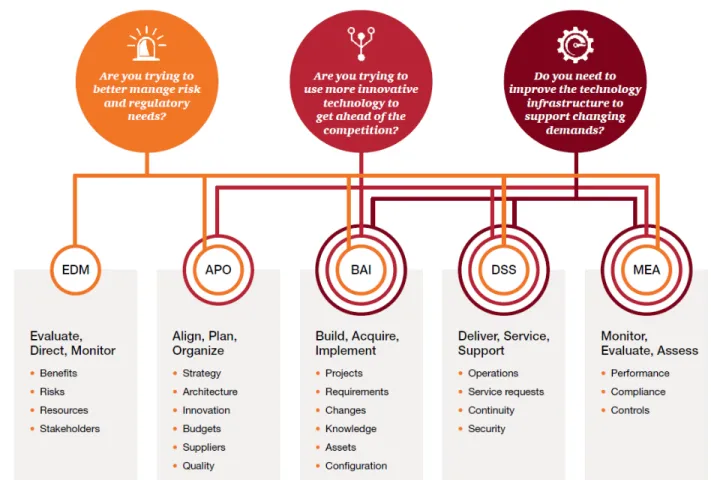
• Think about what you’re trying to get out of your IT governance structure. Are you trying to better manage risk? Or is your top goal to improve the technology infrastructure?
• Depending on what you’re looking to achieve, you may prefer to be comprehensive—and get broad coverage across all IT governance areas—or you may prefer to hone in on specific domains.
Figure 3: Illustrative example showing how an IT governance framework can be adapted to focus on different needs.
FSViewpoint | A framework for response Great by governance: Improve IT performance and value while managing risk
Governance structure
Who should be involved?
The governance structure identifies who provides and consumes information, and who has ultimate decision-making authority. It is usually made up of key executives, committees, and sub-committees. The governance structure should be kept as simple as possible and should be adapted to the organization’s needs. Sometimes, specialized groups may be needed to focus on high-risk and strategic priorities (such as
architecture or cybersecurity).
Take stock and adapt Design and implement Manage and improve
• Decide which areas matter most, making sure your key service areas are covered on your governance committees.
• Think about what works— and doesn’t work—about the current governance structure. Is it helping you deal with pressure points and cope with change? • Consider the challenges
facing the business. Pinpoint what’s getting in the way of successful IT governance, and carry out a gap assessment.
• Define who does what, and what each committee or sub-committee is responsible for.
• Clearly articulate decision rights and align them with business and IT strategies. • Look at what leading
businesses have done to see how you could match their success.
• Finalize the governance structure and share it throughout the
organization to get buy-in.
• Refine your governance structure as needs and challenges change.
FSViewpoint | A framework for response Great by governance: Improve IT performance and value while managing risk
Processes and frequency
How will committees oversee
governance?
This area includes putting together standardized procedures for sharing information and making decisions, and deciding how frequently those actions need to happen. At a high level, the procedures should cover: • How key decisions (for example, initiatives, priorities, risks, action)
will be made and communicated.
• How information will be gathered and shared, through reporting or other means.
• How performance will be measured and monitored. • How issues will be identified and resolved.
• How the governance model will be continuously refined.
Strong processes will enable clear, two-way communication between IT and its stakeholders.
Take stock and adapt Design and implement Manage and improve
• Review how your
governance and frequency plan work now. When and how do committees meet? What do and don’t they discuss? What happens after they make decisions? • Create a draft charter
document using this information.
• Define detailed procedures for how you’ll measure, monitor, and report on IT. • Develop templates and
forms to make that happen efficiently.
• Create a final version of the charter document, share it with the rest of the
business, and get sign-off.
• Refine your policies and processes as your IT governance matures. • Put a process in place for
continuous improvement. Make it clear how you’ll assess performance and decide on changes to the organization, KPIs,
processes, and dashboards.
FSViewpoint | A framework for response Great by governance: Improve IT performance and value while managing risk
Domains or services
Where are you focusing your
attention?
Governance domains or services define the structure of how you look at your IT functions. Many organizations adopt process models like COBIT. Others have service definitions based on IT Service Management (ITSM). Some have a combination of both.
Take stock and adapt Design and implement Manage and improve
• Conduct a workshop to find out which IT domains or services to tackle first. Those that provide more value and are closely tied with business goals should be prioritized.
• Put together a draft domain/service model based on the workshop. Compare this draft to industry frameworks to identify potential gaps.
• Look out for
interdependencies between different domains/services, and make sure that
handoffs between areas are mapped so that things don’t fall between the cracks. • Finalize the domain/service
model that you’ll use to manage IT performance in the future, and share it with the rest of the business to get buy-in.
• Prioritize a set of domains to include in your
governance model.
Figure 4: COBIT5 is used by many financial institutions as the base framework for defining their IT governance model.
FSViewpoint | A framework for response Great by governance: Improve IT performance and value while managing risk
KPIs and KRIs should be identified, agreed on, and monitored from the start. The most effective metrics are demand-driven, actionable, and provide clear expectations to both IT and the business. KPIs should provide true insights into key IT initiatives and align with the
organization’s broader strategic goals. KRIs also help monitor emerging risks and address them in a proactive way.
Take stock and adapt Design and implement Manage and improve
• Review the enterprise and group-level KPIs and KRIs you’re using now. Take a look at the dashboards and supporting technology that are used to monitor and communicate them.
• Define KPIs and KRIs— together with data definitions, data sources, and owners—for high-priority parts of your process.
• Refine the source and quality of the information you’ll use for KPIs and KRIs.
• Share the KPIs and KRIs with IT and the business to confirm that metrics are closely tied to the
performance measures and goals of leaders.
• As your organizational priorities change, review and update your KPIs and KRIs also. Be sure to clearly communicate changes to impacted groups and individuals.
• Where the data or
technology is not available to measure or monitor key metrics, launch separate initiatives to put them in place.
KPIs and KRIs
What are you measuring?
Figure 5: KPIs and KRIs should be identified, agreed on, and monitored from the start.
FSViewpoint | A framework for response Great by governance: Improve IT performance and value while managing risk
Implementing enterprise-wide IT governance is a big change for most organizations and needs to be managed thoroughly. A comprehensive change management program can help reduce the risk of resistance, enhance stakeholder buy-in, and ensure that the organization as a whole is informed and trained on upcoming changes.
Change management and
technology and tools
Change Management
• Make sure the C-suite buys in to your governance structure and process—and tells the rest of the business.
• Develop a communication plan. Use it to communicate with your key stakeholders and management.
• Develop and run training for the rest of the business. • Create a platform for teams to share knowledge.
• Make sure you have a culture of accountability and learning, based on data and analysis.
Technology
• Define the operating model you want for automated information gathering and reporting.
• Define what the automation technology needs to do, and how the user interface works.
FSViewpoint | Appendix—Select qualifications Great by governance: Improve IT performance and value while managing risk
Appendix—Select qualifications
Project and client Issues Approach Benefits
IT governance roadmap development— Global financial services organization
The financial institution recognized that it did not have a standardized enterprise-level IT governance program to align IT and business strategy. IT investments and risks were being managed by various IT departments in isolation, resulting in duplicated efforts in some areas and gaps in others.
PwC helped the client facilitate several workshops to create an IT governance framework based on COBIT5. Through these workshops, PwC helped the client:
• Gain an understanding of COBIT5 and
how it related to the organization’s objectives.
• Develop a practical IT governance
framework, identifying processes to support its business and IT goals.
• Create an enterprise IT dashboard with
selected metrics.
• Develop a prioritized 24-month roadmap,
with action plans and responsible owners, for rolling out the program.
The client benefited in multiple ways:
• Gained buy-in and agreement
from business and IT leaders on the goals, scope, and key components for the enterprise IT governance program.
• Improved understanding of
COBIT5 and how it should be customized for the client’s unique corporate culture and objectives.
• Improved reporting through a
quarterly process with an IT governance scorecard.
• Prioritized plan for addressing IT
gaps and audit items.
Enterprise IT
governance program— Global bank
The bank needed help in accelerating the design, creation, and adoption of its enterprise IT governance program. The bank was looking for a flexible framework that would support information
consistency and accountability across all IT groups.
PwC helped the IT organization to develop a pragmatic IT governance program with both short- and long-term implementation timelines. In collaboration with the bank, the PwC team:
• Conducted a current state assessment to
identify the bank’s strategic priorities.
• Helped establish an IT governance council
with representative members from priority areas.
• Developed the IT governance charter and
framework.
• Developed a two-year implementation
roadmap to roll out the governance program and address strategic priorities.
With a single, integrated view of IT at an enterprise level, the bank has been able to improve transparency and accountability for IT operations. It has also improved its approach for identifying and proactively managing IT risks.
© 2014 PricewaterhouseCoopers LLP, a Delaware limited liability partnership. All rights reserved. PwC refers to the US member firm, and may sometimes refer to the PwC network. Each member firm is a separate legal entity. Please see www.pwc.com/structure for further details. This content is for general information purposes only, and should not be used as a substitute for consultation with professional advisors.
“Great by governance: Improve IT performance and value while managing risk,” PwC FS Viewpoint, November 2014. www.pwc.com/fsi.
www.pwc.com/fsi
To have a deeper conversation, please contact:
Julien Courbe [email protected]
+1 646 471 4771
www.linkedin.com/in/juliencourbe
Vishrut Lugani [email protected]
+1 415 498 5163
www.linkedin.com/pub/vishrut-lugani/0/843/4b3
Yogesh Mishra [email protected]
+1 214 740 6785
www.linkedin.com/in/ypmishra
Burak Emre [email protected]
+1 646 313 0914
www.linkedin.com/in/mburakemre Follow us on Twitter @PwC_US_FinSrvcs
About our Financial Services practice
PwC’s people come together with one purpose: to build trust in society and solve important problems. PwC serves multinational financial institutions across banking and capital markets, insurance, assetmanagement, hedge funds, private equity, payments, and financial technology. As a result, PwC has the extensive experience needed to advise on the portfolio of business issues that affect the industry, and we apply that knowledge to our clients’ individual
circumstances. We help address business issues from client impact to product design, and from go-to-market strategy to human capital, across all dimensions of the organization.
PwC US helps organizations and individuals create the value they're looking for. We're a member of the PwC network of firms in 157 countries with more than 184,000 people. We're committed to delivering quality in assurance, tax, and advisory services. Gain customized access to our insights by
downloading our thought leadership app:PwC's 365™