ITIL Release
Management
ITIL Release
Management
A Hands-on Guide
CRC Press
Taylor & Francis Group
6000 Broken Sound Parkway NW, Suite 300 Boca Raton, FL 33487-2742
© 2010 by Taylor and Francis Group, LLC
CRC Press is an imprint of Taylor & Francis Group, an Informa business No claim to original U.S. Government works
Printed in the United States of America on acid-free paper 10 9 8 7 6 5 4 3 2 1
International Standard Book Number: 978-1-4398-1558-8 (Hardback)
This book contains information obtained from authentic and highly regarded sources. Reasonable efforts have been made to publish reliable data and information, but the author and publisher cannot assume responsibility for the validity of all materials or the consequences of their use. The authors and publishers have attempted to trace the copyright holders of all material reproduced in this publication and apologize to copyright holders if permission to publish in this form has not been obtained. If any copyright material has not been acknowledged please write and let us know so we may rectify in any future reprint.
Except as permitted under U.S. Copyright Law, no part of this book may be reprinted, reproduced, transmit-ted, or utilized in any form by any electronic, mechanical, or other means, now known or hereafter inventransmit-ted, including photocopying, microfilming, and recording, or in any information storage or retrieval system, without written permission from the publishers.
For permission to photocopy or use material electronically from this work, please access www.copyright. com (http://www.copyright.com/) or contact the Copyright Clearance Center, Inc. (CCC), 222 Rosewood Drive, Danvers, MA 01923, 978-750-8400. CCC is a not-for-profit organization that provides licenses and registration for a variety of users. For organizations that have been granted a photocopy license by the CCC, a separate system of payment has been arranged.
Trademark Notice: Product or corporate names may be trademarks or registered trademarks, and are used only for identification and explanation without intent to infringe.
Library of Congress Cataloging-in-Publication Data
Howard, Dave,
1957-ITIL release management : a hands-on guide / Dave Howard. p. cm.
Includes bibliographical references and index. ISBN 978-1-4398-1558-8 (alk. paper)
1. Information technology--Management. 2. Information technology projects--Management. 3. Software support--Management. 4.
Configuration management. I. Title. T58.64H69 2010
004.068--dc22 2009042193
Visit the Taylor & Francis Web site at http://www.taylorandfrancis.com and the CRC Press Web site at http://www.crcpress.com
v
Contents
Introduction ...xi
1 Overview ...1
What Is Release Management? ...1
Information Technology Infrastructure Library (ITIL) Service Management ...2
Financial Benefits...3
Release Management and Project Management ...4
Organizational Readiness ...5
Practical Application ...6
Baseline and Metrics ...6
Concept Review ...7
2 Basic Concepts ...9
Objective and Mission ...9
Release Policy and Procedures ...12
Guidance ...13 Facilitator ...13 Governance...13 Release Standards ...14 Basic Concepts ...14 Release Models ...14 Deployment Considerations ...16 Release Schedules ...17 Naming Conventions ...18 Release Procedures ...21 Emergency Releases ...21
Roles and Responsibilities ...22
Release Lifecycle ...24
Definitive Media Library ...24
vi ◾ Contents
Release Management Activities ...25
Developmental Relationships ...26
Operational Considerations/Total Cost of Ownership ...29
Concept Review ...30
3 Release Management and Project Management: Kissing Cousins ...33
Differences ...33
Similarities and Complementary Likeness ...35
Release Plan and Project Plan ...36
Tying It Together ...36
Software/System Development Lifecycle (SDLC) vs. the Release Lifecycle (RLC) ...39
Alignment Pyramid ...41
Concept Review ...43
4. Release Management Is Not Just for Software Development ...4.5 Holistic Approach ...45
Release Management and the Infrastructure ... 46
New Environment Request Process ... 46
NER Process Description ...48
Step 3.0 New Environment Request Form (NERF) ...49
Step 3.1 NER Review Meeting ...50
Step 3.2 Produce the Infrastructure Design Document ...50
Step 3.3 Design Approval ...51
Step 3.4 Infrastructure Procurement ...52
Step 3.5 Create the Configuration Items ...52
Step 3.6 Build Environment ...53
Step 3.7 Operational Readiness Testing ...53
Step 3.8 Implement and Turnover ...54
Concept Review ...54
5 The Release Lifecycle ...57
Benefits ...57
Implementation Considerations ...58
The Release Lifecycle ...59
Artifacts ...61
Initiation Phase ...62
Step 1.0 Initiation ...62
Step 1.1 Release Review ...63
Step 1.2 Planning Meeting ... 64
Step 1.3 Release Plan ...65
Contents ◾ vii
Benefits ... 66
Artifacts and Documents ... 66
Release Configuration and Build Phase ...67
Step 2.0 Business Requirements and Functional Specifications ...69
Step 2.1 Develop Application ...69
Step 2.2 Code Accepted ...70
Step 2.3 Deliver Code to DML ...70
Step 2.4 Release Validated ...71
Step 2.5 Build and Configure ...71
Benefits ...72
Artifacts/Documents ...72
New Environment Request (NER) Phase ...73
Benefits ...74
Artifacts/Documents ...74
Quality Assurance Phase ...76
Step 4.0 Master Test Plan ... 77
Step 4.1 Release Testing Strategy ... 77
Step 4.2 Test Execution Plan ...78
Step 4.3 Technical Test Execution ...79
Step 4.4 User Acceptance Testing ...80
Step 4.5 QA Acceptance ...81
Benefits ...82
Artifacts/Documents ...82
Operational Readiness Phase ...83
Step 5.0 Operational Readiness Entrance ...83
Step 5.1 Final Operational Readiness Testing (ORT) ... 84
Step 5.2 Final QA Report ...85
Step 5.3 Support, Escalation, and Turnover ...85
Early Life Support ...85
Step 5.4 Master Training Plan ...88
Step 5.5 Service Level Agreement ...88
Step 5.6 IT Service Continuity ...89
Step 5.7 Final Operational Readiness Review ... 90
Benefits ... 90
Artifacts/Documents ...91
Implementation Phase ...92
Step 6.0 Implementation and Back-Out Plan ...92
Step 6.1 Change Management ...93
Step 6.2 Implement Release ...94
Benefits ...94
Artifacts/Documents ...94
Post-Implementation Phase ...95
viii ◾ Contents
Step 7.1 Complete Release Record ...96
Step 7.2 Measure KPIs and Report ...97
Step 7.3 Close Release ...98
Benefits ...98
Artifacts/Documents ...98
Using the RLC ...99
Right Sizing ...99
Service Management Alignment ...101
Change Management ...101
Configuration Management ...102
Availability and Capacity Management ...103
Incident Management/Service Desk ...103
Problem Management ...104
Service Level Management ...104
IT Service Continuity ...104
Continual Service Improvement ...105
IT Security Management ...105
Knowledge Management ...105
Procurement Management ...105
Concept Review ...106
6. Release Measures and Metrics ...107
Setting the Baseline ...107
Value of Measurement ...108
Components of Metrics ...110
Measurement and Metrics ...113
Concept Review ... 115
7 Selling Release Management ...117
Organizational Readiness ... 118 Executive Buy-In... 118 Middle Management ... 119 Grassroots ...120 Bubble-Up Methodology ...121 Return on Investment ...122
Release Management and the Business ...124
Concept Review ...124
Appendix A: Release Policy ...127
Appendix B: RACI Matrix ...153
Appendix C: Release Deliverables Checklist ...159 Appendix D: Master Test Plan ...16.3
Contents ◾ ix
Appendix E: New Environment Request Form (NERF) ...183
Appendix F: Infrastructure Design Document (IDD) ...191
Appendix G: Security Risk Assessment ...201
Appendix H: Functional Specifications...209
Appendix I: Operational Readiness Testing Manual (ORT) ...225
Appendix J: Support and Escalation Turnover Document ...255
Appendix K: Master Training Plan ...271
Appendix L: Service Level Agreement ...277
Appendix M: IT Service Continuity and Recovery Plan ...285
Appendix N: Post-Implementation Review ...305
xi
Introduction
There once was a very successful company that relied on a parent company to supply its information technology (IT) capabilities; the company had an IT operation that was really a simple application-development shop. The company, Acme Finance, a mid-sized financial services company, had different IT needs than the parent company, which was a distribution company. It was determined that this model would not allow Acme to achieve its growth and profitability goals and objectives. As a result, the decision was made to separate IT operations from the parent com-pany. This decision meant that Acme needed to become a full-service IT operation and implement processes that would allow it to design, develop, implement, and operate IT services that would meet the needs of Acme’s business units. After a review of several frameworks it was decided that Acme would use the Information Technology Infrastructure Library (ITIL) framework as the guiding framework on which to base its service delivery model.
As Acme continued through its ITIL journey it came to the point of look-ing at its development processes and how it developed and released new or modified services into operation. Referring to the ITIL framework for direc-tion, Acme started looking at the release management chapter in the service support or “blue book.” What it found was good high-level theory, but it did not find real practical guidance on how to use the concepts discussed in the book. Acme went searching for white papers, books, and any other guidance on how to implement release management, but to its surprise it really didn’t find any tangible guidance; so it was on its own to try to find its way. Acme, like many other companies, learned many lessons and successful concepts through a lot of trial and error and determination, which eventually led to a successful implementation of release management. The purpose of this book is to pro-vide a resource for organizations embarking on the journey of implementing a release management practice. Sharing lessons learned and providing practical process ideas will give the reader a useful resource to successfully implement a release process.
1
1
Chapter
Overview
There are many facets to the successful implementation of a release management process; they range from understanding the basic concepts to the benefits derived for the business user. Managing cultural aspects such as selling the benefits, gaining executive support, and determining organizational readiness are as important as creating good processes. Trying to implement a process without the consideration and balance of all of these factors will not be successful. With all implementations there are some components that are more important than others; however, without some traces of the critical success components the implementation will not be bal-anced. This book will discuss the various components and concepts important to a successful implementation and how they relate to each other.
What Is Release Management?
Release management is a process that describes a controlled method of providing consultative guidance, scheduling, and governance of changes to a specific service or product. Taking into consideration the holistic view of the service, release man-agement, if utilized properly, focuses on ensuring the quality of the service from inception to retirement; this is a “total cost of ownership” approach. By taking this holistic view, the service that is being provided maintains a higher level of avail-ability, costs less to maintain, and increases the overall stability and reliability of the service. When services being provided to the business experience increased avail-ability and stavail-ability, the business has the avail-ability to increase profitavail-ability.
An added benefit of creating a controlled, consistent, and repeatable process that delivers quality releases on time, on budget, and within requirements is improving the image of IT with the business. This is particularly important in today’s world
2 ◾ ITIL Release Management: A Hands-on Guide
as IT becomes more of a commodity every day. Instead of becoming a commodity, using controlled and planned processes that align with the business strategy, IT moves from being a commodity to becoming a strategic asset.
Information Technology Infrastructure
Library (ITIL) Service Management
A book about release management would be incomplete without the mention of Information Technology Infrastructure Library (ITIL) service management and how release management fits within the lifecycle. ITIL service management provides best practice guidance on developing effective service delivery processes. The most recent version of ITIL utilizes a lifecycle approach to provide delivery of services and management of those services. The lifecycle consists of five functions, service strategy, service design, service transition, service operation, and continual service improvement; each function has its distinct role, yet they all relate in some form to the holistic lifecycle. While this book is not about ITIL and familiarity with the framework is not a prerequisite to using the release management concepts discussed in this book, a general understanding of the ITIL lifecycle and how release manage-ment fits within the lifecycle will enhance the level of effectiveness. A general review of the ITIL framework (see Figure 1.1) will provide this understanding.
As with any successful effort, having a sound strategy is the keystone to success, and ITIL is no different; the lifecycle revolves around the Service Strategy function.
Service Strategy Service Design Contin
ual Service Improvement
Ser vic e O pe ra tio n Se rvi ce T ran sitio n
Figure 1.1 The ITIL Service lifecycle. ITIL® is a registered trademark of the Office of Government Commerce (OGC).
Overview ◾ 3
During this phase of the lifecycle, an IT organization needs to understand the strat-egy and objectives of the business and how it can enable them. When IT strategies are aligned to business strategies, IT starts to become a strategic asset and partner to the business. Having an IT strategy that aligns with the business strategy is a key component of executing a successful release management process. Business ser-vices are usually created as enablers for the business. When these serser-vices are built, implemented, and operated, keeping a strategy focus enables quality delivery. This is a primary goal of release management.
Sustaining services and continual improvement is also part of the ITIL lifecycle. A function within the lifecycle called Continual Service Improvement (CSI) focuses on driving these concepts. The continual service improvement process (CSIP) pro-vides a seven-step process to help define this activity. Another part of improving the delivery of services is using the Deming Cycle or the PDCA approach—plan, do, check, act. If the reader is not familiar with PDCA concepts, it is recommended to consult the ITIL books for a better understanding. Many times the CSI function and processes drive the improvements of the services that are developed and imple-mented using the release process.
Release and deployment management can be found in the Service Transition function within the ITIL lifecycle. While this seems like a natural fit for a process that focuses on the development and transition of changes to a service, there are activities that are inputs and outputs to other functions within the lifecycle, such as service operations and CSI. Additionally, a successful release process should be aligned with the nucleus of the lifecycle, service strategy. In Chapter 2, the prin-cipals and concepts of release and deployment management described within the Service Transition function will be discussed and serve as a baseline for under-standing how to practically implement release management.
Financial Benefits
Reducing cost and improving organizational profitability has always been a cor-nerstone of a successful IT operation. Chief information officers (CIOs) have made their careers on being able to reduce IT costs and improve the perfor-mance of their IT operations. Implementing an effective release management process can have a significant impact on the efficiency and the cost of devel-oping, implementing, and delivering services, applications, and infrastructure. One financial benefit that is often overlooked is improved system availability and reduced downtime of IT services realized by utilizing good release practices. The financial benefit gained from increased availability is realized when users are able to utilize the IT services to generate revenue and provide better customer service. When these services are unavailable, users are unable to generate rev-enue. Another aspect of reduced downtime or incidents is the cost of resources expended to restore service. These expenses are generally realized within the
4 ◾ ITIL Release Management: A Hands-on Guide
operational budget and do not add revenue to the bottom line, and therefore should be minimized when possible.
Improved financial transparency can also be achieved through efficient release planning and scheduling. When utilized properly, release schedules and release calen-dars provide transparency to manage release activity cost, resource cost, and procure-ment cost. Being able to plan and manage these expenditures over an extended period of time now moves the IT spending into a strategic position for the organization. Release scheduling has other benefits to the business that will be discussed later.
During the release process, assets such as service level agreements, support documentation, and release notes will be generated. These assets are knowledge capital that are used to deliver and operate the service. The cost to produce these assets can be expensive and are a significant part of the release budget. Once the original release has been created and implemented, these release assets now become the baseline from which the next release is generated; this is when the concept of reusability enters the picture. When the next version of the release is under development, project teams are able to refer to these original assets as a starting point rather than having to start at the beginning and reinvent the assets, which saves time and funding. Additionally, some assets, such as support docu-mentation and service level agreements (SLAs) may not need to be updated since they haven’t changed. This reusability therefore reduces the release cost and the time to delivery.
These factors are not always recognized as financial benefits to the organization since many times the facilities to realize these savings are not in place, or the orga-nization is not mature enough to measure the benefits. It is therefore important to create a baseline so the financial benefits can be forecast and measured; additional discussion of metrics will be covered in Chapter 6.
Release Management and Project Management
When implementing release management there are day-to-day practical challenges that need to be overcome to ensure success. One of the most common issues is the confusion between release management and project management and under-standing the differences. The common cause of this confusion is not aligning the objectives of each and understanding how they relate to each other. While there are similarities between the two, release practices complement project management processes and vice versa, there are also differences between the two. The relation-ship between release management and project management can be a love–hate rela-tionship or they can live in harmony—it is dependent on how both are positioned. The basic difference is that release management takes into consideration the holistic approach of the entire service, and project management has a specific focus with a beginning and an end. This relationship and how to cultivate a positive partnership is the topic of Chapter 3.
Overview ◾ 5
Organizational Readiness
Anytime a new process or an existing process is changed there will always be those who embrace the change and become the biggest advocates and those who have trouble accepting it. While there are steps that can be taken to move the pendulum to the supportive side, there will always be those doubting the validity of the new process. The first hurdle to overcome is the lack of understanding of the goals and objectives of release management. A common mistake that is made is trying to mandate the adoption of the process and its requirements without providing the “whys”—why the new process is being implemented and why the current process is being changed. Another important detail that is overlooked is the “What’s In It For Me” or the WIIFM issue. Generally people are much more receptive to changes if they can understand how it benefits them personally. Once resources understand the what’s in it for me and the whys, they should have a clear understanding of the goals and objectives. The next obstacle is to ensure that any resource involved with the release process understands release concepts and the value these concepts bring to the organization and the operation of the service.
In the real world we have to realize that no matter how good a job is done trying to explain the goals and objectives—the what’s in it for me issue, the whys, and the concepts—there will always be people who are going to be doubters. However, by properly planning and communicating, we can reduce their numbers. A more in-depth discussion of how to move the pendulum and reduce the number of doubters will be covered later in this book.
Organizational readiness can be a bigger hurdle than simply the lack of under-standing and poor communications; it can truly be a factor of organizational matu-rity. A critical error that many make when trying to implement new processes is overestimating the maturity and the readiness of the organization to accept change; in other words, organizations can only assimilate concepts equal to their process maturity. An example of this would be trying to implement a release schedule pro-cess into an organization where the norm is to implement systems at will without having to schedule implementations. This organization doesn’t have any release process and has ungoverned project management guidelines. If all of a sudden it was mandated that a release schedule be used, the organizational push back would be significant since there is no existing process in place and very little governance. Even though the resources agree with the theory of release scheduling, in practical-ity, the organization is not ready or mature enough to execute the idea. Now if the concepts of release management are properly phased into this organization and the benefits of each phase are realized, the concept of a release schedule will be readily accepted when introduced. In fact, if the phasing is in sync with the organization’s maturing, the organization will be asking for the implementation of release sched-uling rather than resisting it.
One of the biggest errors that can be made is to try to push processes on an organization that is not ready for them. The net result will be a lack of acceptance of
6 ◾ ITIL Release Management: A Hands-on Guide
the new processes and the setting up of barriers to future efforts. In an effort to try to avoid this critical error, a readiness assessment should be completed to help set a proper baseline. Carefully planning the pace of the implementation, and actively monitoring the adoption and acceptance of the new process using a plan, do, check, act approach will help to assess whether the pace of implementation is correct.
Practical Application
An issue for many who attempt to implement release management is translating the theoretical concepts into practical application. There is a common misconcep-tion that every aspect of an industry standard, end-to-end release process must be implemented to be successful and to realize the benefits. The end-to-end process implemented must be in strict accordance with the guidelines set fourth within the recognized industry standards. Any variance from these standards means that the process will not be “compliant.” This concept of being compliant and how an organization fits into the cookie-cutter standard can cause many sleepless nights and a lot of gray hair.
In reality, being compliant with industry standards can be a long-term goal, however, it is a goal that should be secondary. The primary goal should be how release management fits into the existing organization and how the greatest benefit can be achieved in the shortest period of time. Realizing the greatest benefits in the shortest amount of time means applying release management concepts in the most practical manner that fits the maturity of the organization. This means understand-ing the good practices that the organization already has and how can they be built on, and taking industry best practices and incorporating them into the organiza-tion practically at the right pace. In the following chapters of this book, how to take industry best practices and apply them practically so as to get the biggest benefit of the organization will be discussed.
Baseline and Metrics
When organizations start down the road of process improvement or implement-ing new processes, the common practice is to do a quick assessment of what’s broken. This quick assessment is usually caused by an isolated incident that caused the organization pain. The normal reaction is “let’s fix it and I know how to do it,” and off they go to come up with a solution to the problem with-out doing the analysis to understand the actual root cause. Sometimes this approach works and sometimes it doesn’t. If it does work, then the question may come, “How do we know we fixed it?” Many times the answer is, “We know it is fixed because it isn’t happening anymore.” If the fix isn’t successful, a differ-ent approach is tried until the right solution is discovered. If the organization
Overview ◾ 7
would have taken the time to do a baseline assessment or measurement, the question, ‘‘How do we know it’s fixed?” could be answered with documented evidence. In the second scenario, the root cause could have been discovered through creating a baseline of the error, which would have allowed a quicker fix to be discovered.
Creating a baseline and using metrics is the only way to demonstrate how effec-tive a process improvement or new process is. As mentioned earlier, to effeceffec-tively sell the implementation of release management or any other process, an under-standing of the benefits derived from the implementation must be understood. Whether these benefits are cycle time reduction, improved availability, or financial, they cannot be articulated unless a baseline is set and measures of improvement are defined. Creating a baseline and release management metrics will be discussed in a later chapter.
Concept Review
This chapter provides a baseline and an understanding of the concepts of release management that will be expanded on in this book. It is important for the reader to understand that implementing release management has many dimensions that need to be considered. Introducing the different facets that need to be considered when implementing release management sets the foundation for further discussion. The high-level concepts discussed in this chapter were:
Defining release management ◾
ITIL service management lifecycle ◾
How release management fits within the lifecycle ◾
Why there is confusion between release management and project management ◾
The financial benefits of release management ◾
Organizational readiness ◾
Practical application ◾
Creating a baseline and how metrics should be used to demonstrate successes ◾
of release management
The following chapters will build on each of these concepts with the objective of gaining a full understanding of release management and taking the theoretical concepts of ITIL and applying them in a practical manner.
9
2
Chapter
Basic Concepts
Understanding the basic concepts of release management will provide the foundation on which the practical utilization of release management will be built. Understanding how release management interfaces with various aspects of service delivery, service operation, and all of the Information Technology Infrastructure Library (ITIL) func-tions within the lifecycle to build a release practice will strengthen the implementa-tion. It is necessary to have a sound understanding of the basic concepts of release management to understand the value they bring to the process. To be effective in practically implementing release management, it is not only important to under-stand the basic concepts, it is also important to underunder-stand the activities that enable them. When implementing an effective release practice there is a need to understand how release activities relate to other developmental processes such as project manage-ment, quality assurance testing, technical architectures, and other supporting tech-nical verticals, and having this understanding strengthens and sustains the practice.
Objective and Mission
The basic definition of release management is ensuring that all aspects that are related within an IT service are considered when creating, building, and imple-menting a new or subsequent release of that service. This definition can also serve as the objective of release management. If this was to be expanded, words such as repeatable, controllable, and scalable could also be used. So if asked what the objec-tive of release management is, the answer would be:
Release management ensures all related components of an IT service are considered when the service is created or modified and provides activities that are repeatable, controllable, scalable, and sustainable.
10 ◾ ITIL Release Management: A Hands-on Guide
This objective will differ from other objectives found for release management in that it gives consideration to the concepts that focus on being able to sustain a quality process, namely reusability, control, and being able to scale release activities. After all, creating a process that cannot be sustained either because it is too com-plex, too laborious, not right sized, or does not have perceived value, is a waste of valuable resources. In addition to reusability, controllability, and scalability being important components of sustainability of the process, they are also important to controlling the cost of release development.
Within the objective, the phrases “ensures that all related components” and “are considered” are key in understanding the role that release management plays within the delivery of quality releases and have an impact on the operational stability of the service. Ensuring that all related IT components of the IT service that are being designed or modified are considered defines release management’s holistic approach to the delivery of services, which enables the business to meet its strategic goals. In a holistic approach, release management functions in several capacities—as an enabler, in a consultative capacity, and through governance; balancing these roles can be different in each organization depending on the cul-ture and maturity. The actual role that release management plays in each organi-zation is one of the first points where there is a departure from the theoretical to the practical.
Creating an organization-based mission statement describes how release man-agement fits within the specific organization. It plays an important role in the assimilation of release management and promotes ownership of the practice. The generic mission statement of release management is:
Delivering quality, operationally ready releases that will improve the day-to-day operations of IT services enabling the business to meet and exceed their strategic goals and objectives.
This mission statement is simple but calls out the need for the delivery of qual-ity and tested releases. It also sets the expectation that a release of existing IT services will be an improvement to existing functionality and must have tangible benefit to the business. In the most simplistic terms, the mission statement sets forth three significant questions that should be asked when considering whether a release should be done.
Is there benefit to the business? Will the release enable the business to accom-plish a strategic goal, increase revenue, improve customer satisfaction, or solve a specific business problem?
Can the release be planned, built, tested, and delivered within the required cost, time, and quality requirements?
Will the new functionality of the IT service improve the day-to-day operation of the business service or will it increase the complexity?
Basic Concepts ◾ 11
If the answer is “no” to any of these three questions, then the organization should take a serious look at why the release is being built. It is not uncommon for an IT organization to continue down the path of implementing new functionality for a service because there is a perception that it is good for the organization with-out really understanding how the service is being used. Simply asking these three simple questions before embarking on the creation of a new release can save a lot of time and money. If the answer to these questions is “yes,” then a more in-depth analysis should be completed to ensure there is enough return on investment (ROI) to proceed with the release.
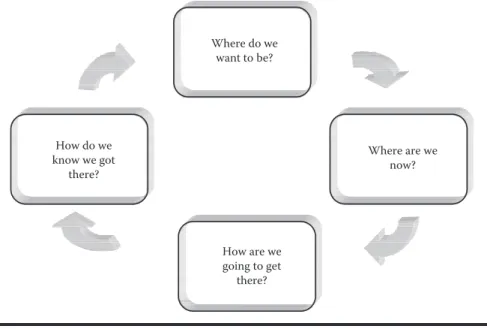
A basic concept in creating a strategy for implementing a release practice is creating a vision of what the end practice will look like once it has been created and how this vision is going to be achieved. ITIL introduces a simple strategy model that uses four questions that should be asked when embarking on creating or improving a process: Where do we want to be? Where are we now? How are we going to get there? How do we know we got there?
The first step of this model (see Figure 2.1) asks “Where do we want to be?” These six simple words should cause the organization to really examine their internal processes and create a vision that will drive the creation of the process. These decisions should be agreed upon by key stakeholders since this will drive strategic decisions and directions. Once this strategic decision has been agreed upon, the mission statement and objective can be created and used to communicate the strategy. The mission statement and objective state-ment should also be used as the guiding principal when creating the process
Where do we want to be? Where are we now? How do we know we got there? How are we going to get there?
12 ◾ ITIL Release Management: A Hands-on Guide
and practice; it should be referred to often to ensure that the developmental activities remain aligned with the organization’s strategy.
Release Policy and Procedures
Organizations embarking on the creation of a release management practice will need to create a documented policy and procedure that resources using the process will be able to reference to understand what is expected and what processes need to be followed. The release policy defines the scope, strategy, and standards of the release practice within the organization; it is the playbook for delivering a quality, operation-ready release. The release policy should be considered a living document and will continue to be revised and improved as the release practice continues to mature and as the organization assimilates the release process. Care should be taken when creating a release policy not to include concepts and standards that cannot be implemented due to lack of organizational maturity or readiness. In the same vein, however, those concepts and standards that need to be implemented must be included within the policy. An example of a release policy can be found in Appendix A.
There is a saying that you don’t want to throw the baby out with the bathwa-ter. Organizations that have successfully or have at some level been successful in delivering releases will have some good release practices that should be retained and incorporated into the release processes being developed. The practices that have been used by the organization may not be consistent or documented. These practices should be reviewed to determine their viability and what value they pro-vide. Once this initial assessment has been done, these existing processes can be the starting point for process development and the basis for the standards that will be documented within the release policy. This is the second part of the strategy model—Where are we now? In addition to creating a basis for the creation of stan-dards, using existing processes in some form will lead to fewer changes and create better acceptance of the new processes being introduced.
When creating a release policy or other deliverables within the process, three questions should be continually asked:
What value does this provide to the user? ◾
Who is going to use the policy? ◾
How is it going to be used? ◾
We have all seen processes that appear to be meaningless and the value they bring is questionable. These processes usually break down and fail. Being able to clearly articulate the value proposition of the process will increase the adoption.
Following this approach, the first thing the release policy must address is the purpose and the value of release management. Being able to document the defined strategy and objective, the guiding mission statement, and the defined scope will
Basic Concepts ◾ 13
set the basis for the policy. The release policy should also include the organizational context for release management; this context will define the role release manage-ment plays within the organization and the developmanage-mental process. There are three roles that release management plays within the organizational context—guidance, facilitator, and governance.
Guidance
One of the primary functions of release management is to define the release pro-cess, manage the release, and provide guidance throughout the development of the planned release cycle. In a later chapter the use of the release lifecycle (RLC) will be introduced and discussed. The release lifecycle is a systematic approach that defines and provides a roadmap of the checkpoints and deliverables that need to be pro-duced to provide a value-added release. Consulting with design teams throughout the delivery process provides for successful releases of applications and associated hardware. Release management works closely with the project management office (PMO) to provide training for the project manager’s processes and the key deliver-ables throughout the RLC.
Facilitator
Once the release process has been established and implemented, there will be mul-tiple checkpoints and deliverable reviews that will take place. These reviews will be managed and conducted by the project manager with release management to ensure the required activities and tasks are being completed to ensure the release schedule is being maintained. These reviews should be focused only on release deliverables and tasks; deliverables required by the PMO should be reviewed by the PMO and excluded from this review. Release management helps to facilitate these reviews and to identify any issues or conflicts between competing releases. Release manage-ment should have an enterprise view of all releases and can facilitate a review with competing project teams to assist with the resolution of any issues arising from scheduling conflicts.
Governance
The governance role within an organization is either a role that everyone wants or no one wants. The role release management plays should be clearly defined within the organization and documented in the release policy to ensure a full understanding. Generally, governance within the release realm pertains to the tasks related to the quality delivery of the release and the ability of the organi-zation to support and operate the service to the designed service levels. These tasks and deliverables include, but are not limited to, different levels of testing,
14 ◾ ITIL Release Management: A Hands-on Guide
support documentation, service level agreements, and service continuity plans. These deliverables and tasks should be right sized for the specific release and described in the RLC.
Another governance role release management can play is in the area of regula-tory compliance. In every industry and in every country there are specific reg-ulations that need to be met, whether it is Sarbanes–Oxley Act (SOX), Health Insurance Portability and Accountability Act (HIPAA), Federal Deposit Insurance Corporation (FDIC), or JSOX, the Japanese version of SOX, just to name a few, and the release process can be designed to assist in complying with these regula-tions. How this can be done will be covered further in the release lifecycle.
Release Standards
The release policy and procedure document should also provide direction on stan-dards and guidelines that need to be followed. The guidelines described in the release policy need to be created to ensure that release development aligns with the goals and objectives of the organization. The document should be generic enough so that it doesn’t have to be revised frequently, but specific enough to provide the user enough information to use the process. These standards, guidelines, and poli-cies must be created to fit the organization where they are being used. Many generic standards and definitions can be found in various publications; however, to be successful they must be tailored to the specific organization. The concept of the release lifecycle, which was introduced earlier in this chapter, will help development teams understand and use the standards, policies, and guidelines documented in the release policy.
Basic Concepts
The basic concepts of release management should be incorporated into the release policy. However, before they can be included in the policy, the concepts need to be customized to fit the specific organization. A basic understanding of these generic concepts is needed: Release models ◾ Release schedules ◾ Naming conventions ◾
Release Models
Being able to classify and categorize different types of releases into release mod-els allows one to determine the types of governance and review that should be completed. It also provides for the right sizing of release structure, deliverables,
Basic Concepts ◾ 15
and promotion and implementation methods for the release. Release models also provide the organization with a common language and provide a connection to the project management methodology.
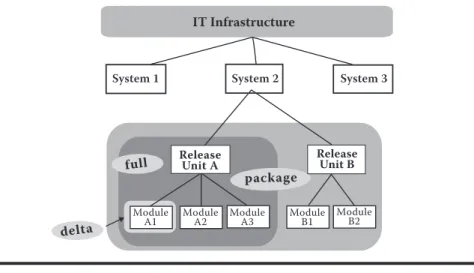
While there are many considerations in developing release models, one of the basic considerations is what Configuration Items (CIs) or parts of the IT service should be released together. Being able to determine the dependencies between CIs within the IT service will determine what parts of the IT service need to be released together and understanding these relationships define the release unit. As illustrated in Figure 2.2, release units can be as small as a single module or as large as the entire IT service. These different types of release units can be separated into three categories: delta, full, and package.
Delta release
◾ —A basic release unit that usually includes a small number of modules or components of the IT service that have changed since the last full or delta release.
Full release
◾ —A release that is comprised of several components of an IT service and may include several delta releases. All of the components are built, tested, and implemented together.
Package release
◾ —When several releases are grouped and implemented together, a package release can be comprised of a full release and delta releases. Another consideration in creating release models is release type. Release types describe the complexity of the actual change or release being implemented. The generic description of release types are: minor, major, and emergency. Organizations should look at their existing methodology to determine if release categorizations
IT Infrastructure
System 1 System 2 System 3
full delta package Module A2 Module
A1 ModuleA3 ModuleB1 ModuleB2 Release
Unit A ReleaseUnit B
16 ◾ ITIL Release Management: A Hands-on Guide
already exist. If so, then consideration should be given to using the existing naming convention. Using existing naming conventions will improve the acceptance of the release methodology. Generic release types are relatively easy to define.
Minor release
◾ —Consists of small enhancements and fixes; some minor releases may have been completed as emergency releases. Minor releases will supersede all previous emergency releases. More frequently done than major releases, minor releases can range from once a month to quarterly.
Major release
◾ —Contains significant or large portions of new functionality, major upgrades, or new service implementations. Major releases will super-sede all minor and emergency releases. Less frequent and requires significant planning and lead times. These are usually done only once a year.
Emergency release
◾ —This type of release is done in response to an incident or significant problem and may be related to the emergency change process. Typically the release is small and similar in nature to a minor release, but is completed in much less time.
Examples of organization-specific release types could include categorizations such as projects and system enhancements rather than major and minor releases. If an organization has classified their release types this way, then this naming conven-tion can be used.
Deployment Considerations
An additional consideration for a release model is the deployment options for the release. The type of deployment model used is dependent on many factors, such as complexity of the release, the impact the implementation will have on busi-ness operations, and resource allocation needed for implementation. When decid-ing which type of deployment model to use, a risk assessment should be done to determine which model presents the least acceptable risk. The various deployment models range from a big bang approach to a phased approach.
Big bang deployment
◾ —The big bang model is the riskiest deployment strat-egy. It is simply implementing the release all at one time for all locations and all users. This presents the greatest risk as it is all or nothing. If issues occur with the release deployment it affects all users in all locations.
Phased deployment
◾ —The phased model still has risk associated with the deployment, however, not as great as the big bang model. The phased deployment model involves creating specific groups of users and deploying the release to each of the groups in a sequential order. The deployment groups can be grouped by types of users, location, or function. A phased deployment can be done over an extended period of time or over a shot period.
Basic Concepts ◾ 17
Phased parallel deployment
◾ —This approach is a variation on the phased deployment mode. The difference is the running of parallel systems during the deployment period. In other words, the legacy system continues to func-tion and the new system is deployed in parallel. This is the most complex approach since there are two systems running, performing the same service. Both systems have to be supported and maintained.
Pilot deployment
◾ —The pilot deployment model presents the least risk of the deployment models. In this approach a pilot group is identified and the release is deployed to this group for a specified period of time. During this period of time, the release is monitored closely to ensure the release is success-ful and addresses any issues that arise. A modified approach is to start with a small alpha group, expand to a larger beta group, and then deploy the release to the targeted group.
The deployment model utilized needs to be considered carefully to ensure the appropriate risk matches the complexity of the release and the risk the organization is willing to accept.
Release Schedules
A key benefit of release management is being able to determine and schedule when a new IT service or enhancement will be implemented into the production environ-ment. Being able to plan and schedule new functionality allows for better resource utilization, increased quality through planned testing, reduced financial cost, and greater implementation success. Another by-product of good release planning is the increase of customer satisfaction with the customer and end user.
There are two types of release schedules. The first is the enterprise release sched-ule, and the second is the release schedule of a specific service; both play a part in creating a successful release practice.
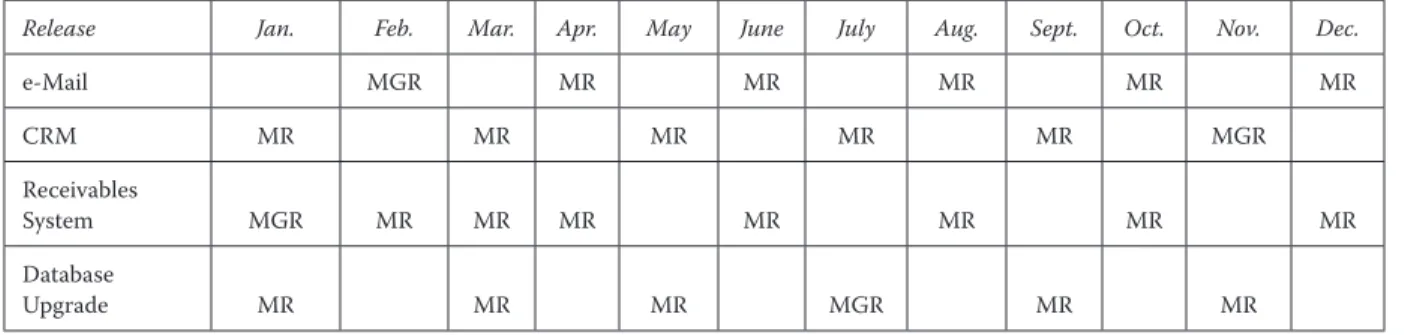
Enterprise release schedules are used to gain a holistic view of when all releases are scheduled within the enterprise. This type of release schedule is used primarily for the scheduling of development resources and financial planning. An enterprise release schedule should include, at minimum, a view of releases that are scheduled for the next twelve months, ideally, eighteen months to twenty-four months. Not only should an enterprise release schedule include releases by service, it should also include releases of cross-functional IT services used to support the business ser-vices and applications. An example of a release schedule would be: version 1.0 of a database is scheduled for May and an upgrade to that database to version 2.0 is scheduled for June of the following year. While this is important for the reasons previously stated, it can be more important for application teams to understand which versions of infrastructure or technology are being used since applications are typically built to use specific versions of technology products. If there is a change in version, the functionality of that technology product may change and the existing
18 ◾ ITIL Release Management: A Hands-on Guide
application functionality may not be able to work properly or may be disabled. Therefore, it is extremely important to understand when the underlying infrastruc-ture of the enterprise is changing.
As illustrated in Figure 2.3, an enterprise release schedule can be as simple as a spreadsheet with products and dates or as complex as detailed release plans.
Release schedules can play an important role in financial and strategic planning in terms of providing a roadmap showing when expenditures will be needed and providing the timing of capitalization of the assets being developed.
The second type of release schedule is related to the individual release of a specific service or application. While the common practice is to relate a release to a specific application or CI, consideration must be given to how that release will affect the specific service and related services. This type of release schedule can be called a service release schedule or a product release schedule. Typically, these types of release schedules contain both major and minor releases of the specific product or service. Major releases are typically scheduled once every twelve to eighteen months and involve significant planning and development. Minor releases can vary when they are scheduled from every thirty days to every six months; much of this is dependent on the stability of the service or product. A newly implemented service will typically require more frequent minor releases and as it becomes more stable, will require fewer minor releases.
When planning a service release schedule, several factors must be con-sidered, including timing, resources, cost, funding, and business need. In some companies, system enhancements are implemented at the whim of the associated business unit or customer and are not scheduled. When this hap-pens, the time to delivery may be quicker, however, typically the delivery cost is increased significantly and the quality is reduced due to inadequate planning and testing.
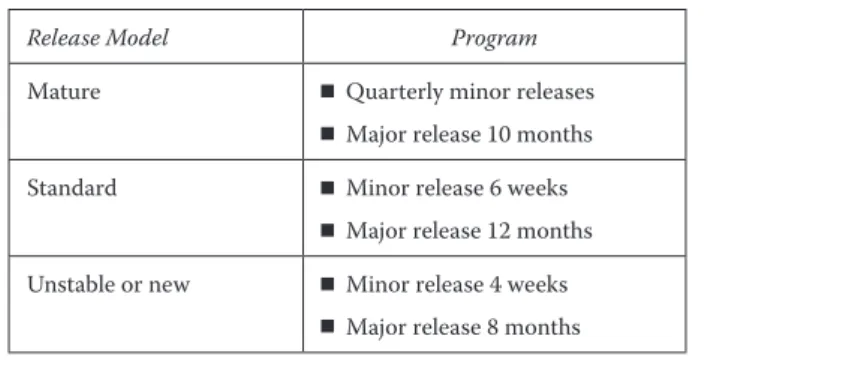
The release policy should include a couple of release schedule models to help the service owners understand the different time frames that could be used in developing their release schedules. Figure 2.4 provides some sample release schedule models.
An enterprise release schedule will be created when the individual service’s sched-ules are rolled up into a holistic schedule for the enterprise. Both will be managed by release management; each at different levels. This is a very simplistic explanation of what a release schedule is, however, it gives the basic premise of understanding and helps to point out that there is no need to overcomplicate the creation.
Naming Conventions
The concept of using a consistent naming convention of release versioning is a sim-ple concept that is sometimes used and sometimes is not, or if used, may be used inconsistently across the enterprise. This is not the use of catchy names to identify the newest application; rather it is the use of a consistent naming approach for ver-sion control. A consistent naming convention allows all resources to understand the
B as ic C o n ce p ts ◾ 19
Release Jan. Feb. Mar. Apr. May June July Aug. Sept. Oct. Nov. Dec.
e-Mail MGR MR MR MR MR MR CRM MR MR MR MR MR MGR Receivables System MGR MR MR MR MR MR MR MR Database Upgrade MR MR MR MGR MR MR MGR - Major Release MR - Minor Release
20 ◾ ITIL Release Management: A Hands-on Guide
status of the product; earlier versions are typically simpler and have fewer features and less functionality than newer versions. Additionally, being able to identify the version of a product allows for an understanding of the features and functionality so other products or services know what that version contains from a developmental perspective.
An organization needs to make a determination of how the nomenclature of the naming convention of versioning will be used. Figure 2.5 is an example of a naming convention schema.
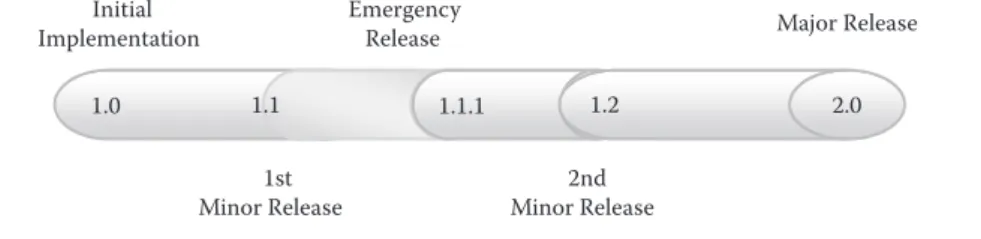
Using the example in Figure 2.6, the initial release of the new enterprise resource planning (ERP) system would be version 1.0. Of course this was a major release since it was the initial release of the product. Since this is a new system, there will be a need to do minor releases more frequently. In this example, minor releases were scheduled every four weeks so bugs can be repaired. The first minor release is scheduled and named, ERP 1.1, within four weeks of the major release. The sec-ond minor release was scheduled eight weeks after the initial implementation and was named ERP 1.2. However, in the sixth week, a major bug was discovered that caused a major incident, and an emergency release was created and implemented; this release was named ERP 1.1.1. Even though an emergency release was imple-mented in week six, work still continued on the minor release that was scheduled for week eight. When week eight arrived, minor release ERP 1.2 was implemented. Finally, twelve months from the original implementation, it was decided that
Release Model Program
Mature Quarterly minor releases
Major release 10 months
Standard Minor release 6 weeks
Major release 12 months Unstable or new Minor release 4 weeks
Major release 8 months
Figure 2.4 Release schedule models.
Naming Convention Designation
1.x Major Release
x.1 Minor Release
x.x.1 Emergency Release
Basic Concepts ◾ 21
significant functionality was going to be added to the original base product, and a major release was scheduled and named 2.0.
Release Procedures
The release policy needs to include operational guidance for the organization’s resources that are using it. The guidance that should be included in the release policy should be focused on providing a high-level roadmap on how to use and navigate the release process. It should include information about the roles and responsibilities of the “actors” involved in the process, such as the release manager, release project manager, the quality assurance resources, and others involved in the release of a service. The release policy should also provide information about the release lifecycle, the roadmap for delivering quality releases. Finally, the release policy should provide instructions on how to or what criteria needs to be followed to execute an emergency release. While the entire release policy is focused on how to deliver a release, the procedures for an emergency release should be clearly under-stood since the planning, governance, and execution may need to be completed in an expedited time frame and my happen outside of normal business hours.
Emergency Releases
There will be situations when it will be necessary to create, build, test, and execute a release outside of the normal release process. Usually this will be in response to an incident where there is a loss of service. It is advantageous to establish a process to maintain the integrity of the IT environment and to ensure that any release implemented maintains the quality standard that has been established through the normal release process. This quality standard can be maintained by creating a process that ensures accurate impact assessment and correct testing prior to imple-mentation. A key part of creating an emergency release process is to understand what level of risk the organization is willing to assume by not following the normal process. This same level of risk acceptance will align with the risk that is acceptable during the emergency change process.
Initial Implementation 1st Minor Release Emergency Release 2nd Minor Release Major Release 2.0 1.2 1.1 1.1.1 1.0
22 ◾ ITIL Release Management: A Hands-on Guide
In normal conditions, a release must be approved though the Release Control Board (RCB); however, during an emergency release, the approval of the release may be delegated to the release manager or other managerial oversight. There should be some type of post-implementation review done and reviewed with the RCB to ensure awareness and after-the-fact approval. Additionally, an acceptable level of testing must be completed prior to implementation. This level of testing will not be as extensive as the normal level of testing would be, but it should be focused to ensure that the emergency release will be successful and not cause additional loss of service.
Although an emergency release will be done in an expedited manner, it is still necessary to understand the impact the release will have on other components within the service being changed. This can be done by reviewing the configura-tion management database (CMDB) or other sources that have service relaconfigura-tionship information. The emergency release must also have a documented implementation plan that includes implementation requirements, tasks, and a back-out plan. These activities should also align with the emergency change process that will also include the preparation of an emergency request for change (RFC).
Roles and Responsibilities
As with any process, to be successful, the roles and responsibilities of the resources involved in planning and executing the process need to be clearly defined and doc-umented, and the release management process is no different. An effective tool used to document the roles and responsibilities is a RACI matrix—responsible, accountable, consulted, and informed. A RACI matrix lists the tasks or activities of the process and the role that will have some type of involvement in performing that task.
R—
◾ Responsible for performing or completing the task or activity. There may
be more than one role that is responsible for completing a task or activity; therefore, there may be more than one “R” listed for the task.
A—
◾ Accountable for the proper execution of the task or activity. The role
des-ignated as an “A” has sole accountability for the activity. There is only one “A” per task.
C—
◾ Consulted during the execution of the task or activity, this role may pro-vide information needed to complete the task. There may be more than one “C” per task.
I—
◾ Informed of the task or activity; purely informational. This role has a need to know the task or activity is occurring, but does not need to be directly involved in the execution of the task. There may be more than one “I” per task in the matrix.
Basic Concepts ◾ 23
When completing a RACI matrix, not all of the roles need to have a designa-tion in the matrix; there will be some tasks in which some roles will not have any involvement. However, there must always be only one “A” per task or activity.
The roles commonly identified in the release process are the release manager, release process manager, release project manager, release coordinator, quality assurance, and release control board. Depending on the maturity of the organiza-tion, other roles that may be included are the service owner, change manager or management, configuration manager or management, and other service delivery roles. If there are roles already established within the organization that do not fit the suggested roles, then it is acceptable to add them to the matrix. It is also acceptable to use a different role name if the activities being performed by a role have a different name. The organization should make the process their own—if using different names will do that, then do it.
Service manager
◾ —Has overall responsibility for the service delivery process and functions. Engages senior management and is the organization’s chief process advocate.
Release manager
◾ —Ensures the release process is executed as designed. Is a “go to” role through which resources performing the release process can gain guidance about the process. Schedules and leads the release control board meeting and other release review meetings. Creates and manages the release schedule.
Release process manager
◾ —Creates, audits, and improves the release pro-cess. Ensures the release process aligns with other development and service delivery processes.
Release project manager
◾ —This can be a dual role played by the project manager that may report to the project management office. Has the respon-sibility for the delivery of the individual release and ensuring that required tasks and deliverables are executed according to the release project plan. Release coordinator(s)
◾ —Assist the release manager in the day-to-day opera-tion of the release process. Can be assigned to a specific release to assist the release project manager with the release deliverables.
Quality Assurance (QA)
◾ —The QA role is responsible for ensuring that the testing strategy is appropriate for the level of release. Ensures that the testing strategy maps back to the business requirements and that the agreed-upon testing requirements have been met.
Release Control Board (RCB)
◾ —Primary role of the RCB is the over-sight of the enterprise release schedule, which includes the approval of releases and the rescheduling and deferring of releases. The RCB can also act as a governing board if there are conflicts in release scheduling. The RCB can work closely with the Change Advisory Board (CAB) or can be the same body.
24 ◾ ITIL Release Management: A Hands-on Guide
The roles of other processes can also be included and the relationships among other service delivery processes will be discussed later in this chapter. A sample RACI chart showing common tasks and roles is located in Appendix B.
Release Lifecycle
At the heart of the release process is the release lifecycle (RLC), which provides the roadmap for delivering successful quality releases into implementation. It begins at the point where a release is approved and provides guidance through several phases that end with a post-implementation review of the implemented release. The release policy should include an overview of the RLC and the purpose of each phase. The different phases of the RLC are:
Initiation ◾
New Environment Request (NER) ◾
Release configuration and build ◾
Quality Assurance (QA) ◾
Operations Readiness (OR) ◾
Implementation ◾
Post-implementation ◾
While different variations of the RLC can be found in other publications, these other publications do not provide an in-depth understanding of how to execute on the RLC. Chapter 5 is dedicated to providing an in-depth view of the RLC and how to use it.
Definitive Media Library
In a good release management practice, original code and copies of software are stored in the definitive media library (DML). The DML can be a combination of logical secure storage, a locked file cabinet, or a combination of both. In today’s environment there are tools available that can be used to store electronic copies of software and data, and copies can be “checked out” or borrowed for use. The idea behind a DML is that a copy of a software can be checked out and worked on; however, the “gold” copy original is still intact in the DML in case anything were to happen to the checked out copy. Once a newer version of the software is released into production, a gold version of that release is also stored in the DML. The release manager is responsible for the DML and development teams should go to the release manager to check out a copy. If a DML exists within the organization, procedures on how to access the DML can be included in the release policy.
Basic Concepts ◾ 25
Measures and Metrics
The release policy should also include information that will be used to measure the success of the process and the success of individual services. The metrics that are used to measure success can vary and should be structured to the needs of the orga-nization. Some organizations may want to measure the time it takes to complete a release, while others may want to measure the quality of the releases being imple-mented. In truth, both of these measures are valuable measurements and some version of these metrics should be used.
Another factor in creating metrics is the need to set a baseline from which a comparison can be drawn; without a baseline, it will be impossible to determine how successful the process has been. Chapter 6 will go into more detail about what type of measurements and metrics can be used in the release process and how to use the metrics once they are captured.
Release Management Activities
Earlier in this chapter the basic concepts of the release lifecycle were introduced; the bases for the release lifecycle are the activities that need to be performed within the release process. These activities, while documented as good practices of ITIL release management, are good practice when applied to any developmental process, whether it is IT related or non-IT related. The activities focus on organization, planning, preparation, quality assurance, and implementation.
Release planning
◾ —Part of the strategy model involves the questions where do we want to be and how do we get there; release planning answers these two questions. Being able to create a sequenced plan of what is to be achieved with the release, what tasks need to be completed, what resources are needed, what the budget is, and how the release fits into the release schedule. Creating a comprehensive project plan for the release is the foundation of a successful release.
Building the release
◾ —The actual building of the release may span many areas of the IT environment depending on the scope of the release being developed. Using the release project plan created in the planning phase, the release project manager can start to execute against the plan. Engaging resources from infrastructure, application, and other technical areas as needed, the release is constructed in a controlled manner. Initial testing is done during this phase to determine the quality of the basics of the release. Ensuring fit for use and purpose
◾ —Fit for use and fit for purpose are key measures of whether the release meets the objectives established during the planning phase. To determine whether the release meets its objectives, a direct mapping of the business requirements to the new functionality should