Tools for Mainstreaming Disaster Risk:
Guidance Notes for Development Organisations
Charlotte Benson
and
John Twigg
with Tiziana Rossetto
Tools for Mainstreaming Disaster Risk:
Guidance Notes for Development Organisations
Mainstreaming Disaster Risk
Reduction into Development:
Challenges and Experience
in the Philippines
Copyright © 2009 by the International Federation of Red Cross and Red Crescent Societies / the ProVention Consortium.
Any part of this publication may be cited, copied, translated into other languages or adapted to meet local needs without prior permission from the International Federation of Red Cross and Red Crescent Societies / the ProVention Consortium, provided that the source is clearly stated. The findings, interpretations and conclusions expressed in this report are those of the authors and do not necessarily represent the views of the International Federation of Red Cross and Red Crescent Societies / the ProVention Consortium.
Cover photo: Knud Falk/Danish Red Cross Design: Pascal Vittoz
Copy-editor: Sue Pfiffner
2009
ProVention Consortium Secretariat PO Box 372
CH – 1211 Geneva 19 Switzerland
E-mail: [email protected]
Contents
Acronyms and abbreviations
3Acknowledgments
5Preface
6Executive summary
71. Introduction
131.1 The case for mainstreaming 13
1.2 Objective of this paper 13
1.3 Disaster risk in the Philippines 14
2. Initial steps in mainstreaming: awareness-raising
162.1 Hazard mapping and physical exposure 16
2.2 Disaster loss data 17
2.3 Socio-economic impact of disasters 18
2.3.1 Macroeconomic impacts 18
2.3.2 Household and community impacts 19
2.4 Appreciation of the scope for enhanced resilience 19
2.5 Accountability 20
2.6 Political champions 21
3. Initial steps in mainstreaming: establishing an enabling environment
233.1 Legislation 23
3.2 Disaster risk management strategy 27
3.3 Institutional arrangements and capacity for disaster risk management 30
3.3.1 National government 30
3.3.2 Local government 31
3.4 Integration of disaster risk reduction into national and local government development planning 32
3.4.1 National Physical Framework Plan 33
3.4.2 National development plans 33
3.4.3 Local planning 35
3.5 Intra-government horizontal and vertical integration 38
3.6 Budgetary considerations 40
3.7 Project appraisal 43
3.8 Beyond platitudes: setting disaster risk reduction goals and related indicators 45
4. Conclusions and recommendations
464.1 Awareness-raising 47
2
2 PROVENTION CONSORTIUM
References
53Figures
Figure 1 Steps to mainstreaming 14
Boxes
Box A Summary recommendations on integrating disaster risk reduction into development
in the Philippines 11
Box 1 Albay provincial government 21
Box 2 Proposed reforms to the broad disaster risk management framework in the Philippines 24
Box 3 Proposed piecemeal disaster risk management-related legislation 25
Box 4 Pending land-use legislation 27
Box 5 Summary recommendations on integrating disaster risk reduction into development
in the Philippines 46
Box 6 Mainstreaming gender concerns into development: the Philippines’ experience 50
Box 7 Climate change adaptation 52
Tables
Acronyms and abbreviations
4PPAP Four Point Plan of Action for Preparedness ADB Asian Development Bank
ADPC Asian Disaster Preparedness Center
APSEMO Albay Public Safety and Emergency Management Office ASEAN Association of Southeast Asian Nations
AusAID Australian Agency for International Development
BMZ (German) Federal Ministry for Economic Cooperation and Development
bn billion
CBDRM community-based disaster risk management CLUP comprehensive land-use plan
DA Department of Agriculture
DBM Department of Budget and Management DCC disaster coordinating council
DENR Department of Environment and Natural Resources DILG Department of Interior and Local Government
DipECHO Disaster Preparedness European Commission Humanitarian Aid Department DND Department of National Defense
DPWH Department of Public Works and Highways DRM disaster risk management
DRMMP disaster risk management master plan DRR disaster risk reduction
ECC environmental compliance certificate
ECLAC Economic Commission for Latin America and the Caribbean (UN) EGGAR engineering geological and geo-hazard assessment report EIA environmental impact assessment
EMI Earthquakes and Megacities Initiative
FY fiscal year
GDP gross domestic product
GFDRR Global Facility for Disaster Reduction and Recovery GIS geographic information system
GoP Government of the Philippines
GSIS–GI Government Service Insurance System General Insurance Group GTZ Deutsche Gesellschaft für Technische Zusammenarbeit, GmbH HFA Hyogo Framework for Action
ICC Investment Coordination Committee LDC local development council
LGU local government unit
m million
MDGs Millennium Development Goals MGB Mines and Geosciences Bureau
MTPDP Medium-Term Philippine Development Plan
NAMRIA National Mapping and Resource Information Authority NAPC National Anti-Poverty Commission
NCDPP National Calamities and Disaster Preparedness Plan NDCC National Disaster Coordinating Council
NEDA National Economic and Development Authority NGO non-governmental organization
OCD Office of Civil Defense
PAGASA Philippine Atmospheric, Geophysical and Astronomical Services Administration PD Presidential Decree
PDIP Provincial Development Investment Plan
PDPFP Provincial Development and Physical Framework Plan PHIVOLCS Philippine Institute of Volcanology and Seismology PhP Philippine peso
PPAs programs, projects and activities
PTFCC Presidential Task Force on Climate Change
RCC–MDRD Regional Consultative Committee on Disaster Management – Mainstreaming Disaster Risk Reduction (program)
READY Hazards Mapping and Assessment for Effective Community-Based Disaster Risk Management (project) SNAP Strategic National Action Plan
UN United Nations
UNDP United Nations Development Programme
UN/ISDR United Nations Inter-Agency Secretariat of the International Strategy for Disaster Reduction US$ United States dollar
PROVENTION CONSORTIUM
4 4
Acknowledgments
Invaluable comments and advice on a previous version of this paper were provided by Michael Siebert, Dr Walter Salzer, Olaf Neussner and Allen Molen, GTZ; Antonia Loyzaga, Manila Observatory; Sanny Jegillos, UNDP; Rodel Lasco, World Agroforestry Centre; and Zoe Trohanis and Brett Jones, World Bank. Particular thanks are extended to Margaret Arnold at the ProVention Secretariat for her support and encouragement.
Financial support from the United Kingdom’s Department for International Development, the Canadian International Development Agency and the Royal Ministry of Foreign Affairs, Norway is gratefully acknowledged.
The opinions expressed are those of the author and do not necessarily represent the views of the ProVention Secretariat or the funding bodies. The author accepts full responsibility for all errors and omissions.
Preface
The ProVention Consortium is a unique partnership on disaster risk reduction that includes international organiza-tions, governments, the private sector, civil society organizations and academic institutions. The Consortium provides a neutral space for these partners to come together for frank dialogue on issues related to risk and for generating cutting-edge ideas and collaborative initiatives aimed at contributing to risk management and poverty reduction in developing countries. Working through its network of partners, ProVention supports innovative research, dialogue and the development of tools for more effective risk reduction at a variety of levels.
A key objective of the ProVention Consortium is to promote the recognition and integration, or ‘mainstreaming,’ of natural hazard risk into development planning and practice. Recent catastrophes and increasing concern related to climate change, unplanned urbanization, rapid population growth and environmental degradation have increased the profile of disaster risk reduction and the need for its consideration as an integral part of development efforts. The past several years have witnessed important commitments by both governments and donor agencies to integrate disaster risk reduction into development frameworks, legislation and institutional structures, sectoral strategies and policies. While policy is a key tool for guiding investment related to disaster risk reduction, successful mainstreaming requires a number of steps, including awareness-raising and the establishment of a sufficient, stable enabling environment. There is a lack of understanding around the incentives and bottlenecks for investing in disaster risk reduction, as well as a disconnect between policy decision-making and practice on the ground. In this connection, we have undertaken a first country case study in the Philippines, which examines progress to date and challenges ahead in achieving these key steps in a country context. We hope that the study will add to the understanding of what contributes to or detracts from the creation of an enabling environment and support country-level efforts to get disaster risk reduction mainstreaming put into practice.
Margaret Arnold
Head, ProVention Consortium
March 2009
PROVENTION CONSORTIUM
6 6
Executive summary
Since the late 1990s, there has been increasing recognition by both governments and donors of the need to main-stream disaster risk reduction into development. This paper is the first in a series of case studies being undertaken by the ProVention Consortium in support of this process, examining experience to date and challenges ahead in main-streaming at a country level. The paper focuses on the first two, and arguably most difficult steps, in mainmain-streaming – awareness-raising and the establishment of a sufficient, stable enabling environment. It is based on experience in the Philippines, focusing on mainstreaming from the government’s perspective. The findings of this and further case stud-ies in the serstud-ies will be drawn together into a brief on essential requisites and related mechanisms, opportunitstud-ies and incentives for effective mainstreaming, including good practice examples.
The Philippines was selected as the first case study country due to its urgent need to address disaster risk within the development agenda and its apparently highly conducive environment for mainstreaming. The Philippines is regard-ed as one of the world’s most hazard-prone countries and has a high incidence of poverty, making mainstreaming of disaster risk reduction into development imperative for the achievement of sustainable growth. The government has undergone a significant degree of devolution, in principle strengthening the links between the needs of local commu-nities, such as risk reduction, and formal development policies and strategies. The country also has a long-established medium-term national planning process, helping to ensure that longer-term concerns such as risk reduction are not overshadowed by more immediately pressing issues, and relative political stability, implying the potential ability to sus-tain long-term programs and initiatives. Indeed, the Philippines is already formally committed to mainstreaming as a signatory of both the Hyogo Framework for Action (HFA) 2005–2015 and the 2007 Delhi Declaration on Disaster Risk Reduction in Asia.
Initial steps in mainstreaming: awareness-raising
Awareness-raising is required in many hazard-prone countries to secure a solid appreciation and understanding of the relevance of disaster risk reduction to sustainable development and poverty reduction. Awareness-raising should be tackled, first and foremost, via the development of a solid, rigorous body of evidence on hazard mapping and physi-cal exposure, on disaster losses, on the socio-economic impact of disasters at national and community levels, and on the scope for enhanced resilience. This body of evidence is required to establish the case for proactive disaster risk management and to develop appropriately risk-sensitive development policies and initiatives. Efforts to define and acknowledge accountability for disaster-related human, physical and economic losses and related areas of responsibil-ity are also required. The pace and success of awareness-raising initiatives can be greatly aided by the emergence of strong political advocates for risk reduction.
In the case of the Philippines, various technical agencies are involved in the generation of hazard information. Historically, data on different types of hazard have often been held by separate agencies and there has been little effort to map vulnerability. However, various initiatives are now underway, particularly at the local level, to address these issues. There have also been significant shortcomings in the damage assessment process and resulting loss data have been incomplete. In 2004, the National Disaster Coordinating Council (NDCC) initiated a process to address this issue by adopting comprehensive damage assessment guidelines developed by the United Nations (UN) Economic Commission for Latin America and the Caribbean (ECLAC). However, progress has been very slow, due to funding constraints.
The broader socio-economic impacts of disasters are frequently acknowledged by the government but rarely substan-tiated with hard data; such statements, therefore, lack resonance. Limited data partly reflect measurement problems relating to the annual occurrence of disasters, which imply that the benefits of a disaster-free year cannot be directly measured. Mutual causal inter-linkages between poverty and vulnerability to natural hazards are similarly broadly rec-ognized but, again, there has apparently been little, if any, systematic analysis of the precise impact of disasters on the poor and near-poor.
In part reflecting this limited knowledge of the direct and indirect impacts of disasters at either a macroeconomic or a household level, current knowledge and understanding of factors underlying vulnerability and the scope for enhanced resilience are also relatively weak in some quarters. However, it is important to recognize that attitudes to risk are
enormously complex and that risk management behavior is not merely a direct reflection of knowledge of the risks faced and the potential for reducing vulnerability but also of other socio-economic, cultural and financial considerations. Finally, it is widely acknowledged that well-placed, high-level political champions with relevant expertise and knowl-edge can play a major role in building commitment to disaster risk reduction and its mainstreaming into broader development. However, political champions of disaster risk reduction have been relatively few and far between in the Philippines and are currently inspired more by climate change than natural hazards.
Initial steps in mainstreaming:
establishing an enabling environment
Legislation.Sufficient, appropriate legislative arrangements for disaster risk management, including the mainstream-ing of disaster risk reduction into development, forms a key component of an enablmainstream-ing environment, providmainstream-ing a pol-icy framework around which disaster risk management strategies can be empowered.
Disaster legislation in the Philippines dates back to 1978 and so is predicated on a primarily reactive approach to dis-asters, focusing heavily on preparedness and response in keeping with prevailing thinking 30 years ago. Since then, there has been a paradigm shift in emphasis internationally from a disaster management to a disaster risk manage-ment approach, with much greater importance given to reducing risk ex ante. There have been some attempts to secure a change in legislation in the Philippines over the past five years or so to reflect this new thinking, but a mul-titude of related Senate bills have detailed somewhat conflicting changes in the current disaster risk management structure and have varied in the extent to which they incorporate principles of mainstreaming. Moreover, as yet, none has been enacted.
Other relevant approved and pending legislation for mainstreaming of disaster risk reduction into development includes that pertaining to land-use controls and building codes. However, building codes are not strictly enforced and zoning ordinances are reported to have been relaxed over time.
Disaster risk management strategy.A comprehensive disaster risk management strategy, actively involving stake-holders at all levels of government as well as the private sector, local communities and civil society, is required to implement the legislative framework and to provide coordination and monitoring mechanisms and arrangements. Individual disaster risk reduction actions and programs need to be located within this strategy, rather than treated as discrete, individual measures. Moreover, the strategy needs to indicate specific entry points and mechanisms for main-streaming disaster risk reduction concerns into both the broader development agenda and the design and implemen-tation of individual development initiatives.
In the case of the Philippines, as already noted, there has been a hiatus in the passage of new legislation replacing the existing primarily reactive framework for disaster risk management. Nevertheless, in recent years various efforts have attempted to ‘leapfrog’ this obstacle by developing more forward-thinking plans of action and strategies, reflecting modern thinking around disaster risk management and, to some degree, embracing principles of mainstreaming. If fully implemented, these plans and strategies could represent considerable progress in mainstreaming at both nation-al and locnation-al levels. In practice, however, progress in implementation has been slow and the plans and strategies have resulted in relatively limited practical steps forward towards mainstreaming. Moreover, the basic institutional arrange-ments for mainstreaming and the practical steps required to achieve successful, comprehensive integration of disaster risk reduction concerns into development across all areas and levels of government require more careful thought. Sector-specific disaster risk management plans of action are also lacking, even in highly disaster-vulnerable sectors such as agriculture, while the broader strategies and plans similarly outline few practical steps into which individual line agencies and local governments can sink their teeth.
More positively, the shift in emphasis in disaster risk management plans and strategies has spawned – or created the justification for – a series of externally supported projects in support of mainstreaming. The international community is keen to move the Philippines government forward away from its traditional focus on relief. Moreover, various steps are being taken, be it sometimes on a piecemeal basis, to reduce disaster risk in certain sectors of government and in some local government units (LGUs).
PROVENTION CONSORTIUM
8 8
Institutional arrangements and capacity for disaster risk management.Individual line agencies and local govern-ments are legally responsible for implementing disaster management, as it is still commonly referred to in department circulars and executive orders, within their own areas of responsibility. In practice, some LGUs have yet to even establish their disaster coordinating councils (DCCs), while those DCCs that have been established vary in quality. In addition, reflecting Presidential Decree (PD) 1566’s reactive approach to disasters (see Section 3.1), DCC meetings are commonly held only on an ad hoc basis, in response to crisis situations, rather than on a more regular basis to discuss ongoing risk reduction initiatives, and DCCs’ risk reduction and mainstreaming capacity and capabilities are often very limited. At a national level, disaster risk reduction is a crosscutting issue that needs to be ‘owned’ by all government agencies rather than by a single department. However, an overarching national agency is required to provide leadership, deter-mine broad disaster risk management policies, oversee implementation and advocate for the inclusion of disaster risk reduction concerns in broader development. The NDCC is the highest policy-making and coordinating body for disas-ter management in the Philippines. However, the Department of National Defense (DND), within which it sits, is far removed from core sustainable development and poverty reduction responsibilities and decision-making. Moreover, reflecting the historically reactive orientation of disaster risk management in the Philippines, the NDCC itself has insuf-ficient capacity and capabilities in areas of disaster risk reduction. As such, it lacks critical insights on opportunities for mainstreaming, from both a risk reduction and a wider development perspective. These constraints necessarily reduce the NDCC’s effectiveness as an advocate and leader for mainstreaming, even if it were to have a legal mandate for risk reduction and related budgetary provision.
Integration of disaster risk reduction into national and local government development planning.A strategic, ‘joined-up’ approach to disaster risk reduction and mainstreaming is an essential component of development plans in hazard-prone countries. From a weak beginning, there has been steady, if slow, progress towards greater consideration of disaster risk management in national Medium-Term Philippine Development Plans (MTPDPs) over the past 20 years. However, successive plans have consistently failed to identify disaster risk as a factor potentially hindering the achieve-ment of economic and developachieve-ment goals or to systematically treat risk reduction as an integrated, cross-sectoral objective. Instead, they have dealt with disaster risk primarily within the very narrow framework of flood control, improved preparedness, relief, rehabilitation and preparedness capabilities and ex post support to vulnerable groups. The latest plan, which runs from 2004 to 2010, does seek to integrate a ‘disaster preparedness and management strat-egy’ in the development planning process at all levels of government. But this laudable goal is only set within the con-text of the environment and natural resources sector while the plan is even explicitly complacent about disaster risk in its discussion of the highly vulnerable agricultural sector. Similarly, successive Millennium Development Goal (MDG) progress reports for the Philippines have paid little regard to disaster risk management or, more specifically, its main-streaming into socio-economic development, despite the fact that disaster events could be a significant obstacle to the achievement of the MDGs.
At the level of local government, various shortcomings in the basic planning process have posed considerable obstacles in effectively mainstreaming disaster risk reduction concerns into sub-national planning, most importantly relating to the fact that development and investment plans are not necessarily in place and, if they are, are not necessarily linked. The record on comprehensive land-use plans (CLUPs) has been slightly better, although far from ideal, and there have been some efforts to strengthen consideration of disaster risk concerns in land-use planning. The recent introduction of year Provincial Development and Physical Framework Plans (PDPFPs) and related six-year Provincial Development Investment Plans (PDIPs) is a welcome development as these plans imply closer integra-tion of spatial and physical consideraintegra-tions and sectoral factors, supporting enhanced disaster risk analysis and the identification of risk reduction needs. The PDIPs will also help ensure that, when funding is allocated, short-term needs do not overshadow longer-term ones. Under a parallel initiative, guidelines explicitly outlining a detailed disaster risk assessment process and the use of resulting risk estimates to enhance planning analyses, decision-making and the incorporation of disaster risk reduction principles and measures into development goals, objectives and strategies in PDPFPs have been prepared. However, as they stand, they entail a lengthy, data-intensive and costly procedure requir-ing considerable technical capacity and related computer equipment. Several other internationally assisted initiatives have also been undertaken or are currently underway in support of the mainstreaming of disaster risk reduction con-cerns into sub-national planning.
Intra-government horizontal and vertical integration.Existing breaks in the planning system between different lev-els of government pose a potential impediment to mainstreaming as they imply that locally identified needs are not nec-essarily reflected in higher-level plans and strategies, while there can be problems in implementing national policies and
regulations at the local level. At the provincial level, the recent introduction of PDPFPs and PDIPs should hopefully help in this regard, however, particularly if these plans include careful consideration of disaster risk reduction concerns. Horizontal integration is required most critically because issues such as flood management and water resource man-agement require careful cooperation and coordination between contiguous LGUs. Horizontal integration between national line agencies is also important given the crosscutting nature of disaster risk and potential implications of deci-sions in one area of government for vulnerability in another. Current levels of horizontal integration are rather patchy, however, and in part hindered by the absence of a comprehensive national disaster risk reduction strategy.
Budgetary considerations.Integration of disaster risk concerns into government budgets should be tackled from two angles, ensuring that levels of public expenditure on risk reduction are sufficient and that there are adequate finan-cial arrangements to manage the residual risk.
In practice, disaster-related budgetary allocations in the Philippines are primarily intended for post-disaster response, in the form of annually appropriated national and local government calamity funds. However, for the country as a whole, these resources may be insufficient even in years of lower loss and, although actual figures are not reported, unplanned reallocations of government budgetary resources are probably the primary source of relief and rehabilita-tion funding in most years.
Similarly, no data are available on total disaster risk reduction expenditure but levels of spending are almost certainly inadequate. Risk reduction activities are implemented through line agencies and regional and local disaster coordinating councils and, by implication, financed through their budgets. However, risk reduction implementation responsibilities are very general and, with the notable exception of specialist technical agencies such as the Philippine Institute of Volcanology and Seismology (PHIVOLCS) and the Philippine Atmospheric, Geophysical and Astronomical Services Administration (PAGASA), national agencies have few explicit disaster risk reduction activities in their programs of work or budgets. Meanwhile, there are neither mandatory requirements relating to LGU expenditure on risk reduc-tion nor any dedicated funding. Instead, LGUs are expected to finance this spending out of other budget heads. LGUs are not required to establish disaster risk management offices either, making it extremely difficult to create budget lines to support the basic functioning of such offices where they exist.
Project appraisal.Consideration of disaster risk concerns as part of the project appraisal process is an essential step in ensuring that development gains from individual projects are sustainable, in ensuring that potential disaster risk reduction benefits both of dedicated risk reduction projects and of other development projects are optimised and in highlighting related issues of responsibility and accountability. Such concerns should be considered in all components of project appraisal, reflecting the fact that vulnerability to natural hazards is complex and multi-faceted and so needs to be viewed from all angles. Specific guidance on this analysis is also important because it entails some distinctive challenges, in particular how to handle uncertainty.
In practice, most current guidelines of the Government of the Philippines (GoP) on project appraisal do not mention disaster risk reduction or longer-term climate change concerns, let alone provide any specific guidance on the issues, although some initial effort is being made to address this shortcoming. Environmental impact assessment (EIA) guide-lines are a notable exception but even these do not provide comprehensive guidance. All projects in environmentally critical areas, including those frequently visited and/or hard-hit by natural hazards, are required to undergo an EIA and data on both climatological and geological hazards should be presented as part of the baseline environmental profile. However, there are no specific requirements or related guidance concerning analysis of the potential impact of clima-tological hazards on a project’s outcome or of the potential disaster risk-related consequences of a project via its impact on the environment.
Beyond platitudes: setting disaster risk reduction goals and related indicators.Capacity to monitor and evaluate disaster risk reduction initiatives, generate hard evidence on related inputs, outputs, results and impacts, and learn les-sons for the future is an essential component of the enabling environment for mainstreaming. In practice, although the importance of monitoring and evaluating disaster risk reduction initiatives is recognized in principle in the Philippines, there is little detailed country-specific guidance on this topic and no overarching national disaster risk reduction goals or related indicators. Moreover, successive MTPDPs have themselves been fairly weak in setting clear monitoring and evaluation targets and related indicators across most parts of the plan and have contained few specif-ic disaster risk reduction indspecif-icators.
PROVENTION CONSORTIUM
1 100
Recommendations
Considerable energy is currently being expended on mainstreaming disaster risk reduction into development in the Philippines, with a number of initiatives underway to get mainstreaming off the ground. Many of these initiatives focus on local government, in keeping with the country’s high level of devolution. The most critical challenge ahead is to ensure that these various initiatives result in concrete, sustained changes in development practice, particularly at the level of local government. In order to achieve this, a number of steps need to be taken both to increase awareness of the need for mainstreaming and to complete the establishment of an appropriate enabling environment. Recommendations are summarized in Box A.
Box A
Summary recommendations on integrating disaster risk reduction
into development in the Philippines
Strategic objective:To ensure that ongoing initiatives to mainstream disaster risk reduction into development are sustained and strengthened, leading to long-term institutional, legislative, judicial and development policy and practice changes, and contributing to poverty reduction and sustainable socio-economic development.
Awareness-raising
Objective:Strengthened understanding and awareness of the need for disaster risk reduction and its mainstream-ing into development, and greater accountability for disaster-related losses.
Priority action
■ Systematic analysis of the interlinkages between poverty and vulnerability to natural hazards.
Medium-term measures
■ Preparation of multi-hazard maps for the whole country and development of an integrated national hazards
data and mapping system.
■ Extensive multi-hazard vulnerability mapping, focusing on individual communities and related
awareness-raising.
■ Improvements in post-disaster damage assessment procedures and practice.
■ Analysis of the long-term macroeconomic and related budgetary impacts of disasters.
Establishment of an enabling environment
Objective:Enhanced enabling environment for mainstreaming of disaster risk reduction concerns into develop-ment.
Priority action
■ Passage of new, comprehensive disaster risk management legislation.
■ Establishment of strong national institutional leadership and oversight mechanisms, and related technical
capa-bilities, for disaster risk management, ideally within the National Economic and Development Authority (NEDA).
■ Creation of disaster risk reduction focal points in individual line agencies.
■ Development of a comprehensive, long-term disaster risk management strategy, incorporating individual
sec-toral strategies, embracing principles of mainstreaming and replete with meaningful monitoring and evalua-tion indicators.
■ Initiation of measures to ensure close collaboration with the climate change adaptation community at
differ-ent levels of governmdiffer-ent. Medium-term measures
■ Establishment of permanent LGU disaster risk management bodies or the integration of disaster risk
manage-ment responsibilities into the duties of pre-existing LGU officers and provision of related technical support to strengthen capabilities.
■ Integration of disaster risk reduction concerns into the MTPDP, including specification of overarching risk
reduction objectives and strategies, mainstreaming principles and linkages into the MTPDP’s key socio-eco-nomic goals and more specific sectoral goals, measures and activities.
■ Integration of disaster risk reduction concerns into local government development plans and the merger of
the recently prepared provincial disaster risk reduction mainstreaming guidelines into the more general PDPFP guidelines.
■ Establishment of a tracking system to monitor levels of expenditure on ex ante risk reduction and ex post
dis-aster response.
■ Development of an explicit disaster response financing strategy.
■ Establishment of dedicated funding lines for disaster risk reduction and, possibly, permanent disaster risk
management offices, at each level of government.
■ Revision of existing EIA and other project appraisal guidelines and procedures to require comprehensive
analysis of both the potential impact of natural hazard events on a project and the potential disaster risk-related consequences of the project.
■ Revision of land-use regulations and building codes and introduction of judicial and other measures to ensure
enforcement.
■ Strengthened vertical and horizontal integration of disaster risk reduction plans between different levels of
government, between various line agencies and between neighboring LGUs.
■ National coordination of sub-national mainstreaming initiatives.
■ Documentation, evaluation and replication of successful local mainstreaming initiatives.
■ Strengthened collaboration between the climate change adaptation and disaster risk reduction communities
via institutional, policy and research coordination and the development of joint strategies to integrate the two issues into national planning processes, strategies and budgets.
PROVENTION CONSORTIUM
1 122
Mainstreaming Disaster Risk Reduction
into Development: Challenges and
Experience in the Philippines
1. Introduction
1.1 The case for mainstreaming
Since the late 1990s, there has been increasing recognition by both governments and donors of the need to ‘mainstream’ disaster risk reduction into development – that is, to consider and address risks emanating from natural hazards in medium-term strategic development frameworks, in legislation and institutional structures, in sectoral strategies and policies, in budgetary processes, in the design and implementation of individual projects and in monitoring and evaluating all of the above (Benson and Twigg, 2007). Mainstreaming requires analysis of both how potential hazard events could affect the performance of policies, programs and projects and the impact of those policies, programs and projects, in turn, on vulnerability to natural hazards. This analysis should lead to the adoption of measures to reduce vulnerability, treating risk reduction as an integral part of the development process rather than as an end in itself. It does not require a re-working of government objectives; instead it seeks to help ensure that these objectives – such as poverty reduction – are both attainable and sustainable. From a disaster risk reduction perspec-tive, mainstreaming supports and encourages the adoption of disaster risk reduction measures by linking it to other development priorities and securing a risk-aware ethos.
This integral approach is considered essential in view of the fact that development initiatives do not necessarily reduce vulnerability to natural hazards but, instead, can unwittingly create new forms of vulnerability or exacerbate existing ones. As the United Nations Development Programme (UNDP, 2004) highlights, disasters are both a cause and a prod-uct of failed development. Indeed, a recent international conference concluded that ‘the development process in many countries is not reducing vulnerability to natural hazards... in fact, in many cases new forms of vulnerability are emerg-ing, impeding efforts to reduce poverty and promote growth’ (Oslo Policy Forum, 2008:4). ‘Win–win’ solutions for secur-ing sustainable development, reducsecur-ing poverty and strengthensecur-ing hazard resilience therefore need to be explicitly and actively sought, particularly as climate change looks set to increase the incidence of droughts and floods and the inten-sity of windstorms (Benson and Twigg, 2007). This process should take account of the impact of climate change on the intensity and frequency of hydro-meteorological events in the future, as well as historical hazard records.
1.2 Objective of this paper
Mainstreaming risk reduction into the development process is one of the ProVention Consortium’s priority initiatives. In close collaboration with international financial institution partners and bilateral donors, ProVention aims to address natural hazard risk within the development context and to ensure that development policies, projects and programs, particularly in high-risk countries, do not unwittingly create new forms of vulnerability.
A number of countries have taken the first steps towards mainstreaming by incorporating disaster risk concerns into poverty reduction strategies and other national development policies. There is also wider international commitment to mainstreaming in the context of the HFA 2005–2015 (see Section 1.3). However, few governments have begun to translate these international and national commitments into practical steps and cross-government buy-in to main-streaming remains weak in many countries. Moreover, there has been little investigation and analysis of the key chal-lenges around mainstreaming or of mechanisms, opportunities and incentives for progress.
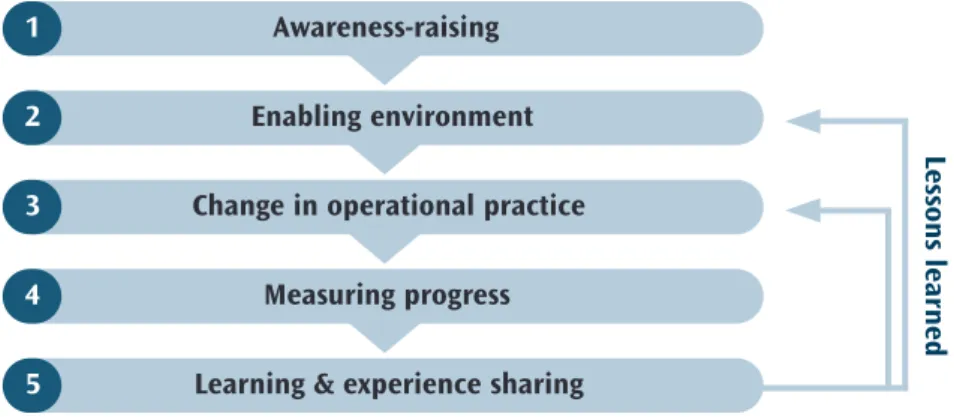
This paper is, therefore, the first in a series of case studies being undertaken by the ProVention Consortium to exam-ine experience and achievements to date and challenges ahead in mainstreaming at a country level. The paper focus-es on the first two, and arguably most difficult steps in mainstreaming – awarenfocus-ess-raising and the focus-establishment of a sufficient, stable enabling environment (see Figure 1). These two steps are fundamental in securing the active
partici-pation of policy- and decision-makers and development practitioners across all areas and all levels of government. It is based on experience in the Philippines, focusing on mainstreaming from the government’s perspective. The Philippines was selected as the first case study country because of both its urgent need to address disaster risk within the development agenda and its apparently highly conducive environment for mainstreaming.
The findings of this and further case studies in the series will be drawn together into a brief on essential requisites and related mechanisms, opportunities and incentives for effective mainstreaming, including good practice examples.
1.3 Disaster risk in the Philippines
The Philippines is widely regarded as one of the world’s most disaster-prone countries.1This reflects both the high inci-dence of natural hazard events, including typhoons, floods, landslides, droughts, volcanic eruptions, earthquakes and tsunamis, and the country’s considerable vulnerability to these events, in turn closely linked to poverty and environ-mental degradation. The Philippines experiences an annual average of 20 typhoons alone in its area of responsibility and many parts of the country are prone to a range of types of hazard. Hazard events contribute to further degrada-tion and poverty, creating a complex vicious cycle of poverty, environmental degradadegrada-tion and natural hazard events. Climate change looks set to exacerbate this cycle, causing more frequent and more intense typhoons, floods and droughts while rapid population growth could expose increasing numbers of people to natural hazards.
Figure 1
Steps to mainstreaming
1 Awareness-raising
2 Enabling environment
3 Change in operational practice
4 Measuring progress
5 Learning & experience sharing
Source: Adapted from Benson and Twigg (2007)
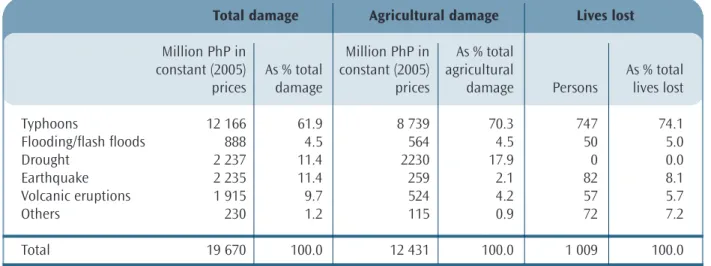
The toll of disasters is already high in the Philippines. Between 1990 and 2006, the country incurred average annual direct damage2of 19.7 billion (bn) Philippine pesos (PhP) per annum, or equivalent to 370 million (m) US dollars (US$), in constant 2005 prices as a direct consequence of reported disasters, equivalent to an average 0.5% of gross domestic product (GDP) each year (see Table 1).3Agricultural damage alone averaged PhP 12.4bn per annum and an average of 1,009 lives were lost every year. Typhoons accounted for 74% of lives lost, 62% of total damage and 70% of agricultur-al damage, reflecting their high, annuagricultur-al frequency.
These direct losses to infrastructure, including social as well as productive infrastructure and standing crops, can lead to a series of indirect impacts relating to the flow of goods and services (e.g., reduced output, loss of earnings and job losses). Collectively, they can result in a number of secondary effects relating to short- and long-term impacts on the overall economy and socio-economic conditions (e.g., fiscal and monetary performance, levels of indebtedness, the distribution of income and the scale and incidence of poverty). Indeed, disasters are persistent, annual events, continually gnawing away at development gains in the Philippines.
PROVENTION CONSORTIUM 1 144 Le ss o n s le a rn e d
1 See World Bank and NDCC (2004) and UN/ISDR (2008) for a fuller discussion. 2 Defined in terms of direct losses to agriculture, infrastructure and the private sector.
3 These figures do not reflect the impacts of a large number of smaller hazard events that are not registered in the statistics, but which have very large impacts at the household level, particularly on poorer families.
Table 1
Average annual disaster losses by hazard type in the Philippines, 1990–2006
Total damage Agricultural damage Lives lost Million PhP in Million PhP in As % total
constant (2005) As % total constant (2005) agricultural As % total
prices damage prices damage Persons lives lost
Typhoons 12 166 61.9 8 739 70.3 747 74.1 Flooding/flash floods 888 4.5 564 4.5 50 5.0 Drought 2 237 11.4 2230 17.9 0 0.0 Earthquake 2 235 11.4 259 2.1 82 8.1 Volcanic eruptions 1 915 9.7 524 4.2 57 5.7 Others 230 1.2 115 0.9 72 7.2 Total 19 670 100.0 12 431 100.0 1 009 100.0
Source: Philippines National Disaster Coordinating Council
In terms of institutional arrangements, the National Disaster Coordinating Council is the coordinating body for disas-ter risk management in the Philippines. The NDCC is located within the Office of Civil Defense (OCD), chaired by the secretary of National Defense, and includes 14 department secretaries as members. The NDCC structure is replicated at the regional, provincial, city, municipal and barangay(district) levels, with local disaster coordinating councils com-posed of representatives of national government agencies operating at local levels and local officials.
At face value, the Philippines would appear a good candidate for mainstreaming. The government has undergone a significant degree of devolution which has been deemed to have ‘broadly worked’ (Balisacan, Hill and Piza, 2006:4), in principle implying a close reflection of the needs of communities, such as risk reduction, in (local) development poli-cies and plans; a long-established medium-term planning process at the national level, in theory helping to ensure that longer-term concerns such as risk reduction are not entirely overshadowed by more immediately pressing issues; and relative political stability, implying the potential ability to sustain the funding and impetus for long-term programs and initiatives. The Philippines also has a high frequency of natural hazard events, as already noted, and has a high incidence of poverty, making mainstreaming of disaster risk reduction into development imperative for the achieve-ment of sustainable growth.
Indeed, the Philippines, along with another 167 nations and multilateral institutions, is formally committed to mainstreaming as a signatory of the HFA 2005–2015. This ten-year framework resolves to reduce disaster losses. It is centered on three principal strategic goals, the first of which is ‘the more effective integration of disaster risk consid-erations into sustainable development policies, planning and programming at all levels, with a special emphasis on disaster prevention, mitigation, preparedness and vulnerability reduction’ (UN/ISDR, 2005:3). The 2007 Delhi Declaration on Disaster Risk Reduction in Asia, adopted at the Second Asian Ministerial Conference on Disaster Risk Reduction and including the Philippines as a signatory country, reiterated the importance of mainstreaming as the second of six key areas of action. Mainstreaming initiatives advocated by the declaration included the mainstreaming of disaster risk reduction into national sustainable development strategies, plans and programs in key sectors and efforts to ensure that development does not create further disasters; further strengthening of the legislative frame-works and institutional mechanisms for disaster risk reduction; the positioning of communities at the center of all aspects of disaster risk management; the conduct of risk assessment as an ongoing process; and the strengthening of financial mechanisms for disaster reduction.
4 Personal communication with GTZ.
1
166 PROVENTION CONSORTIUM
2. Initial steps in mainstreaming: awareness-raising
Awareness-building is required in many hazard-prone countries to secure a solid appreciation and understanding of the relevance of disaster risk reduction to sustainable development and poverty reduction and thus of its fundamen-tal importance to core development goals. Such awareness is most critically essential on the part of planning and finance ministries, key line agencies and local authorities and communities in high-risk areas. However, in view of the holistic, crosscutting nature of disaster risk and potential consequences of decisions in one sector for disaster risk in another, policy- and decision-makers across all areas and levels of government as well as the private sector and civil society also need to be aware of the importance of considering disaster risk as a routine part of their work.
Awareness-raising must be tackled, first and foremost, via the development of a solid, rigorous body of evidence on:
■ Hazard mapping and physical exposure. ■ Disaster losses.
■ The socio-economic impact of disasters at national and community levels and their relevance to the sustainable
development agenda.
■ The scope for enhanced resilience.
This body of evidence, once complete, will both highlight the nature and extent of disaster risk issues faced, establish-ing the case for proactive disaster risk management, and provide the information basis required to develop risk-sensi-tive development policies and initiarisk-sensi-tives. The evidence needs to be maintained in a readily accessible form, regularly updated to capture changes in risk, particularly any newly emerging risk, succinctly summarized and disseminated in relevant, self-explanatory and meaningful formats to key stakeholders.
Indeed, both knowledge-building and awareness-raising should be viewed as continual, ongoing tasks rather than one-off activities. If not, political interest and commitment to disaster risk reduction and the capability to maintain appropriate disaster risk management mechanisms can rapidly wane.
This process needs to be accompanied by efforts to define and acknowledge accountability for disaster-related human, physical and economic losses and related areas of responsibility for risk reduction initiatives. The pace and success of awareness-raising initiatives can also be greatly aided by the emergence of strong political advocates for risk reduction. Political champions with relevant expertise and knowledge can play a major role in building awareness of and com-mitment to disaster risk reduction and its mainstreaming into broader development, particularly within government.
2.1 Hazard mapping and physical exposure
Maps and data on geological features, including fault lines and volcanoes, and areas prone to floods, droughts, tsunamis and landslides and related information on the location of infrastructure are fundamental in mainstreaming disaster risk reduction concerns into land-use planning, building appropriately hazard-resilient infrastructure and targeting vulnerable groups.
Various technical agencies are involved in the generation of hazard information, including geohazard mapping, and related warning systems in the Philippines. These agencies include PAGASA, PHIVOLCS, the National Mapping and Resource Information Authority (NAMRIA), the Mines and Geosciences Bureau (MGB) and the Bureau of Soils and Water Management as well as the privately owned Manila Observatory.
Historically, however, data on different types of hazard have often been held by separate agencies and some issues have arisen around sharing of data and geographic information system (GIS) files, both between technical agencies and with LGUs and civil society. For instance, other government agencies have to purchase PAGASA data at considerable cost should they require it. Moreover, there has been some confusion at the local level in areas where both MGB and PAGASA have developed flood maps, or MGB and PHIVOLCS have produced landslide maps, as the respective maps have differed slightly.4
There has also been little effort to map vulnerability. A World Bank/NDCC report concluded that
there are inadequate reliable data on the type and amount of Philippine economic activity at risk from natural hazards. A fundamental obstacle is the absence of accurate hazard and vulnerability maps. An integrated national natural hazards data and mapping system needs to be designed and implemented.
(World Bank and NDCC, 2004:44)
Various initiatives are underway to redress these shortcomings, including via the Hazards Mapping and Assessment for Effective Community-Based Disaster Risk Management (READY) project, which is supported by the Australian Agency for International Development (AusAID) and UNDP, and jointly implemented by OCD, PAGASA, PHIVOLCS, MGB and NAMRIA. The READY project includes a multi-hazard identification and disaster risk assessment component, under which multi-hazard provincial, municipality, city and barangaymaps are being produced and physical infrastructure, such as school, hospital and residential buildings, plotted against these hazard maps (UNDP, 2006). The project is explicitly intended to initiate risk reduction mainstreaming into local development planning. The first phase of the project, from 2006 to 2010, focuses on 27 priority provinces. It is intended that a further 17 provinces will be included in the second phase. According to NDCC (2007a), the READY project is being complemented by a government-support-ed Harmonization and Prioritization of Hazard Mapping project, covering an additional 16 provinces while the NDCC-led Task Force on Hazard Mapping will also produce a manual on Standard Hazard Mapping.
The German international cooperation enterprise GTZ (Deutsche Gesellschaft für Technische Zusammenarbeit, GmbH) has supported the production of 52 community flood hazard maps, employing a participatory approach. With local residents, commonly flooded areas have been identified and mapped with GPS (global positioning system) and the resulting maps validated by the local community. These maps are in general more detailed than those available from MGB, typically indicating three different water heights.
Other initiatives to generate disaster risk information include the 2002–2004 Metro Manila Earthquake Impact Reduction Study, which was funded by the Japan International Cooperation Agency and generated earthquake hazard and physical infrastructure vulnerability maps for risk identification purposes, and the Manila Observatory’s Mapping Philippine Vulnerability to Environmental Disasters project, which mapped hazards and vulnerability across the coun-try. The recently launched Global Facility for Disaster Reduction and Recovery (GFDRR) project will also include some hazard mapping.
Such efforts need to be continued to cover the whole country and to produce an integrated national multi-hazards data and mapping system, recognizing geological, watershed and other ecosystem boundaries, rather than political and administrative districts. They also need to be further extended to map risk, a considerable challenge according to Loyzaga (2008) due to the existing functional and budgetary compartmentalization between different government departments. Loyzaga comments that
as the determination of impact requires multi-disciplinary approach toward data integration, the READY project, predictably, stops short of mapping vulnerability. The project concludes with overlaying discrete single-hazard datasets from different participating agencies, thereby requiring a separate round of field assessments for vulnerability and adaptation analysis. (Loyzaga, 2008:2)
2.2 Disaster loss data
The Philippines has relatively good historical disaster loss data as compared with many other developing countries. Nevertheless, there have been some significant shortcomings in the damage assessment process, most critically relat-ing to the fact that the country has lacked comprehensive damage assessment guidelines or a standardized method-ology for assessing damage in most sectors (except, apparently, in the area of agriculture). In consequence, damage assessments have been only partial in coverage, focusing on lower income groups and sub-sectors that could be eligi-ble for public assistance, and may vary in accuracy.
In 2004, the NDCC in conjunction with the UN Economic and Social Commission for Asia and the Pacific initiated a process to improve disaster loss assessments by adopting guidelines developed by ECLAC. The ECLAC guidelines are widely regarded as the definitive methodology in this regard (see ECLAC and World Bank, 2003). As part of the same process, the NDCC and World Bank Institute, in partnership with the Earthquakes and Megacities Initiative (EMI),
5 For further information see http://web.worldbank.org/WBSITE/EXTERNAL/WBI/WBIPROGRAMS/CMUDLP/0,,contentMDK:21286950~pagePK:64156158~piPK:641528 84~theSitePK:461754,00.html.
PROVENTION CONSORTIUM
developed an online training course on damage and reconstruction needs assessment based on the ECLAC methodol-ogy specifically for use in the Philippines and conducted some training.5However, due to funding constraints, progress has been very slow and the online course was only launched in May 2008. The NDCC’s plans to apply the ECLAC methodology in selected pilot areas remain on ice.
2.3 Socio-economic impact of disasters
2.3.1
Macroeconomic impacts
In the face of tight budget constraints and many competing demands for public resources, quantitative evidence on the macroeconomic impact of disasters is essential in building commitment to disaster risk reduction objectives and securing related financial resources.
In the case of the Philippines, the broad socio-economic impacts of repeated disaster events have been clearly articu-lated by the NDCC for many years. For instance, the government’s statement of programs planned under the 1990s’ UN International Decade for Natural Disaster Reduction, which began almost 20 years ago, included a sentence to the effect that ‘the Philippines considers natural disasters as one of the major deterrents to economic progress and its development process’ (GoP, undated:2). Some 15 years ago the NDCC similarly stated that losses arising as a conse-quence of natural and technological disasters as well as conflict ‘contribute to the perennial underdevelopment of our economy, as we have to use scarce resources to repair, reconstruct and rehabilitate the damaged facilities, instead of being able to use these resources for further investment towards development’ (NDCC, 1993:1).
However, these statements have rarely, if ever, been substantiated with hard data and, as such, lack resonance. Instead, disaster risk has largely been ignored in detailed economic planning, in economic forecasting and, thus, in the annu-al budgetary planning process into which GDP and gross nationannu-al product forecasts are fed to determine the annuannu-al budgetary envelope (see Benson, 2008).
Limited hard data on the macroeconomic impact of disasters partly reflect measurement problems relating to the annual occurrence of disasters in the Philippines, implying that the benefits of a disaster-free year cannot be directly measured, as well as incomplete physical-loss data. Only severe El Niño episodes (specifically, over the past 30 years, the 1984, 1987 and 1998 events) and major geophysical disasters are generally regarded as economically significant events. Meanwhile, the macroeconomic ramifications of the considerable, cumulative direct damage caused by typhoons each year are ignored except in years of exceptional loss (notably 1987 and 2006) (Benson, 1997; World Bank and NDCC, 2004).
Clear efforts are required to improve analysis of the macroeconomic and related budgetary impacts (see Section 3.6) of disasters in the Philippines. The introduction of the ECLAC approach, once implemented, will help to some degree. Indeed, the methodology has already been used to generate a macroeconomic assessment of the impact of a series of five typhoons in late 2006. The results indicated that the typhoons, together with the postponement of an Association of Southeast Asian Nations (ASEAN) Summit meeting in Cebu, collectively resulted in a 0.4% reduction in GDP in the fourth quarter of 2006 (NEDA, 2006b). However, such analysis needs to be extended to capture the longer-term impacts of disasters. In the case of the 2006 typhoons, their effects are still being felt in, for instance, the form of an ongoing power deficit. The typhoons damaged or toppled 118 power transmission towers in the South Luzon transmission sys-tem and the economic cost of an initial two-day blackout in the South Luzon area and a continuing power deficit in the Bicol region had already exceeded US$ 250m (PhP 10bn) as of late 2007 (World Bank, 2007).
A more disaggregated approach, focusing on the impact of hazard events on particular sectors or regions of the coun-try, would also help shed further light on the economic impact of disasters and help overcome problems relating to analysis at a national level. Certain sectors are potentially particularly vulnerable to natural hazards (e.g., agriculture) while there is considerable regional variation in the incidence of hazards. Analysis exploring the direct impact of nat-ural hazard events on specific sectors or sub-sectors and tracking the indirect and secondary effects through the econ-omy could be highly illuminating in understanding vulnerability and the challenges posed to sustainable development and in identifying opportunities to strengthen resilience both of individual sectors and sub-sectors and of the econo-my more broadly.
1 188
2.3.2
Household and community impacts
The Philippines has a high incidence of poverty, standing at 26.9% of families in 2006, and poverty reduction has con-sistently been a central theme of development policy over the past two decades. In the foreword to the latest MTPDP, the president describes it as the country’s ‘biggest challenge’ (NEDA, 2004:vii).
Two-thirds of the poor are located in rural areas and primarily dependent on agriculture, which in turn is highly vulnerable to natural hazards (ADB, 2007a). The sector accounted for 63% of total reported disaster losses between 1990 and 2006 (see Table 1, Section 1.3). Consequences for the poor are illustrated in the extreme by the fact that much of the increase in pover-ty from 25% in 1997 to 28% in 1998 was attributable to the impact of an El Niño shock on the agricultural sector, rather than to the effects of the concurrent Asian financial crisis, which primarily affected relatively better-off wage earners (World Bank, 2001). The urban poor are also often highly vulnerable to natural hazards, in part as rapid urban growth and lack of tenure have forced many to squat in marginal areas such as river easements – a phenomenon all too apparent in Metro Manila. Mutual causal inter-linkages between poverty and vulnerability to natural hazards are broadly recognized. For instance, the chairman of the NDCC stated in 2007 that ‘we attach particular importance to addressing disaster risk as an integral part of strategies and programs for poverty reduction and sustainable development in the Philippines’ (Ebdane, 2007:1). The links between disasters and poverty were reiterated by the president in August 2007 at the open-ing session of a National Multi-Stakeholder Dialogue on Disaster Risk Reduction when she encouraged ‘due focus to disaster risk reduction and mitigation to protect the poor, the most vulnerable segment of the population, from the onslaught of disasters, both natural and man-made’ (NDCC, 2007b:1).
However, there has apparently been little, if any, systematic analysis of either the precise nature of the linkages between poverty and vulnerability or the impact of disasters on the poor and near-poor. By implication, there is lim-ited related evidence that can be used in support of arguments for risk reduction or its mainstreaming into broader development. Possibly in part reflecting this, the National Anti-Poverty Commission (NAPC), which is invested with an oversight and coordination role on poverty reduction in the Philippines, lacks any distinct disaster risk reduction pro-grams, despite the fact that ‘victims of calamity and disasters’ are one of the groups served by the commission and that there are plans to place NAPC on a newly formed National Disaster Management Council under pending new disaster risk management legislation (see Section 3.1, Senate bill number 1444). Instead, recognized linkages between poverty and vulnerability to natural hazards are currently largely addressed via post-disaster support for the poor. Even this assistance may be far from adequate. For instance, the Asian Development Bank (ADB, 2007a) reported that about half of the average 8 million people annually affected by disasters between 2004 and 2006 received assistance from gov-ernment and private relief institutions. Those assisted received support equivalent to less than 1% of the average income during ‘normal’ times of the poorest 30% of the population.
The gap in knowledge and ex ante action around the linkages between poverty and vulnerability and to natural haz-ards urgently needs to be addressed. As already noted, poverty reduction is the GoP’s single most important goal under its 2004–2010 MTPDP. The contribution that disaster risk reduction could make to the achievement of that goal needs to be carefully drawn out and substantiated with practical evidence, preferably including good-practice examples, and translated into practical action.
2.4 Appreciation of the scope for enhanced resilience
Appreciation of the scope for enhanced resilience is essential in providing crucial meaning to data and information on dis-aster risk, related losses and socio-economic impacts and in triggering impetus for action. There is little point in informa-tion for informainforma-tion’s sake. Policy- and decision-makers as well as the wider society at large require an understanding of the potential scope for using this information to design disaster risk-sensitive development strategies, to identify specific disaster risk reduction needs and to identify relevant and meaningful performance indicators. This, in turn, requires knowl-edge and understanding of the underlying, highly dynamic factors determining levels and forms of vulnerability to natu-ral hazards and how they can be addressed. Indeed, Loyzaga (2008:1) argues that ‘a government’s capability to deconstruct and address socio-economic vulnerability may be considered among the fundamental measures of effective governance.’ In reality, current knowledge and understanding of determinants of vulnerability and the scope for enhanced resilience appears relatively weak in some parts of government in the Philippines (see Section 3.3 for a fuller discus-sion). For instance, there was a flurry of activity in the late 1990s to provide training and related guidance materials to
agricultural officers on measures to mitigate the impact of El Niño and La Niña events. Since then, however, no fur-ther disaster risk reduction training has been provided, implying perhaps considerable potential in some LGUs for strengthening knowledge and understanding in order to support the mainstreaming of disaster risk reduction princi-ples into agricultural plans and projects at the local level (Benson, 2008).
Certain cultural and religious attitudes to disasters may also need to be overcome within some communities to ensure that knowledge on disaster losses is translated into momentum to reduce risk. According to Oxfam, an assessment of participatory capacities and vulnerabilities found that disasters
were perceived as “god’s punishment” or a “fact of life”. Since a disaster was considered to be a “natural phenomenon”, many people expressed doubts that they can actually do something about it. This fatalistic attitude is also reinforced by strong religious beliefs. “Bahala na ang Diyos”(“God will take care of every-thing”) is the usual prayer in the face of an impending disaster in the community. (Oxfam, 2002:66)
At the macroeconomic level, the effective gap in information on the wider consequences of disasters has itself direct-ly limited knowledge of the scope for risk reduction. It has implied that there has been little anadirect-lysis of factors deter-mining the nature and extent of vulnerability and of the scope for influencing it via economic development policies and investments and longer-term strategies. Instead, disasters continue to be perceived primarily as intermittent, external shocks, largely beyond the control of policy-makers
At the same time, a cautionary note is required. Attitudes to risk are enormously complex and behavior is a direct reflec-tion of not only knowledge of the risks faced and the potential for reducing vulnerability but also other socio-econom-ic and financial considerations. For instance, a recent study found that rsocio-econom-ice farmers in the Philippines broadly have a basic understanding of current climate risk but that their knowledge of measures for enhancing resilience to climatic risk is not being fully applied (Benson, 2008). There are likely to be a number of reasons behind this apparent failure to maximize use of risk management knowledge, most importantly – and particularly on the part of poorer farmers – cred-it constraints. Ironically, Llanto (2005) attributes limcred-ited formal financial instcred-itution lending to the rural sector in part to a lack of instruments to mitigate and manage various risks affecting the sector, including weather vagaries. In other words, farmers lack the credit to invest in risk reduction yet will only improve their access to credit by first making that investment. Such findings bring one back to the fact that disaster risk needs to addressed within its broader socio-eco-nomic context and underline the case for mainstreaming disaster risk reduction into development.
2.5 Accountability
This process needs to be accompanied by efforts to define and acknowledge accountability for disaster-related human, physical and economic losses and related areas of responsibility for risk reduction initiatives.
Efforts to strengthen awareness of the level and nature of disaster risk and its relevance to sustainable development and poverty reduction need to be accompanied by the acceptance of accountability for disaster-related losses and related responsibilities for risk reduction initiatives. As regards the rationale for public sector involvement in disaster risk reduction and, latterly, its accountability for losses, some disaster risk reduction measures require public provision on the basis of the fact that they constitute public goods – that is, are non-rival in consumption (users do not reduce the supply available to others) and non-excludable – and so markets fail to provide them. Scientific forecasting and some forms of dissemination of disaster warnings, for instance, can be characterized as such. Others may be justified on grounds of equity. There are additional moral obligations on the part of government to prevent loss of human life, for instance via the establishment of regulatory frameworks and disaster preparedness and response systems. In the case of the Philippines, Loyzaga (2008:2) argues that an extremely resilient social culture entailing a strong sense of community may have ‘inadvertently delay[ed] government’s accountability for failing to anticipate a disaster.’ ‘[S]ocial mobilization in the spirit of bayanihan or “good neighborliness” often seems to outpace institutional efforts towards managing vulnerability and mainstreaming DRR [disaster risk reduction],’ hindering government acceptance of its risk management responsibilities (ibid.:1). Jegillos (2009) makes a similar point, arguing that the patronage sys-tem that forms the socio-cultural foundation of the current disaster management syssys-tem in the Philippines prohibits a risk management ethos and that this state of affairs is reinforced by the fact that local government officials are them-selves often from big landowner families or their proxies.6
PROVENTION CONSORTIUM
2 200
Loyzaga suggests that for reduction policies and programs to be truly effective, clear penalties and legal consequences for non-adherence to government’s responsibility to protect a population need to be introduced and the public edu-cated on the availability of compensation for public or private acts which increase vulnerability by causing injury, death, loss of income and damage to property.
2.6 Political champions
It is widely acknowledged that well-placed, high-level political champions with relevant expertise and knowledge are key in building commitment to disaster risk reduction and its mainstreaming into broader development, particularly within government (e.g., Wilkinson, 2008). It is relatively easy to garner this political interest in the immediate after-math of major disaster events, when their devastating impacts are fresh in people’s minds. However, as is also widely acknowledged, it is far more difficult to turn this interest into a longer-term commitment to reduce risk,