Advanced PID Control Optimisation and
System Identification for Multivariable
Glass Furnace Processes by
Genetic Algorithms
Kumaran Rajarathinam
A thesis submitted in partial fulfillment of the requirements of
Liverpool John Moores University for the degree of
Doctor of Philosophy
To My Parents, Wife and Two Little Angles
Sekaran, Sarojini, Annaletchumy,
Niranjanaa and Hamssini
First and foremost, I would like to extend my gratitude and great appreciation to my first Supervisor, Dr. Barry Gomm for his continual support, guidance and invaluable advice throughout the duration of this PhD project. I would also like to thank my second Supervisor Prof. DingLi Yu for his support and encouragement throughout this research investigation.
Many individuals have unknowingly helped me in my research throughout my PhD and therefore I would like to thank all of my fellow researchers and academics at the Control Research Group at the Liverpool John Moores University for their insight and experience. Without the fantastic research environment created by these individuals, the completion of this project would not have been possible.
I would also like to acknowledge the support and encouragement of my friends for their valuable contributions. Most importantly, my special thanks and deepest appreciation to my parents, wife, children and all my family members. It is a hackneyed theme to thank loved ones for patience and understanding while a project is being undertaken, but now I know why, and do give heartfelt thanks.
Trademarks
MATLAB®is a registered trademark of The MathWorks, Inc. SIMULINK®is a registered trademark of The MathWorks, Inc.
This thesis focuses on the development and analysis of general methods for the design of optimal discrete PID control strategies for multivariable glass furnace pro-cesses, where standard genetic algorithms (SGAs) are applied to optimise specially formulated objective functions. Furthermore, a strong emphasis is given on the real-istic model parameters identification method, which is illustrated to be applicable to a wide range of higher order model parameters identification problems.
A complete, realistic and continuous excess oxygen model with nonlinearity ef-fect was developed and the model parameters were identified. The developed excess oxygen model consisted of three sub-models to characterise the real plant response. The developed excess oxygen model was evaluated and compared with real plant dy-namic response data, which illustrated the high degree of accuracy of the developed model.
A new technique named predetermined time constant approximation was pro-posed to make an assumption on the initial value of a predetermined time constant, whose motive is to facilitate the SGAs to explore and exploit an optimal value for higher order of continuous model’s parameters identification. Also, the proposed predetermined time constant approximation technique demonstrated that the pop-ulation diversity is well sustained while exploring the feasible search region and exploiting to an optimal value. In general, the proposed method improves the SGAs convergence rate towards the global optimum and illustrated the effectiveness.
An automatic tuning of decentralised discrete PID controllers for multivariable processes, based on SGAs, was proposed. The main improvement of the proposed technique is the ability to enhance the control robustness and to optimise discrete
PID parameters by compensating the loop interaction of a multivariable process. This is attained by adding the individually optimised objective function of glass temperature and excess oxygen processes as one objective function, to include the total effect of the loop interaction by applying step inputs on both set points, tem-perature and excess oxygen, at two different time periods in one simulation.
The effectiveness of the proposed tuning technique was supported by a number of simulation results using two other SGAs conventional tuning techniques with 1st and 2nd order control oriented models. It was illustrated that, in all cases, the resulting
discrete PID control parameters completely satisfied all performance specifications. A new technique to minimise the fuel consumption for glass furnace processes while sustaining the glass temperature is proposed. This proposed technique is achieved by reducing the excess oxygen within the optimum thermal efficiency region within 1.7% to 3.2%, which is approximately equal to about 10% to 20% of excess air. Therefore, by reducing the excess oxygen set point within the optimum region, 2.45% to 2%, the fuel consumption is minimised from 0.002942kg/sec to 0.002868kg/sec
while the thermal efficiency of the glass temperature is sustained at the desired set point (1550K).
In addition, a reduction in excess oxygen within methane combustion guidelines will assure that undesirable emissions are in control throughout the combustion process. The efficiencies of the proposed technique were supported by a number of simulation results applying the three SGAs controller tuning techniques. It was illustrated that, in all cases, the fraction of excess oxygen reduction results in a great minimisation of fuel consumption over long plant operating periods.
1 INTRODUCTION – OVERVIEW AND THESIS OUTLINE 1
1.1 Review of Glass Furnace Processes and Control . . . 1
1.2 Problem Statement . . . 3
1.3 Research Novelty and Methodology . . . 3
1.4 Thesis Outline . . . 5
1.5 Dissemination of Research Contributions . . . 8
2 Literature Review of Optimisation and Genetic Algorithms 10 2.1 Introduction . . . 10
2.2 Definition of Optimum . . . 10
2.3 Overview of Optimisation Algorithms . . . 11
2.3.1 Evolutionary Algorithm . . . 15
2.4 Standard Genetic Algorithms . . . 17
2.4.1 Multi-Objective Optimisation by SGAs . . . 19
2.4.2 Premature Convergence . . . 19
2.4.3 SGAs in Model Parameter Identification . . . 22
2.4.4 SGAs in Control Parameter Optimisation . . . 24
2.4.5 An Application of SGAs for Furnace Type Processes . . . 26
2.5 Review of PID Control Strategies . . . 27
2.6 Review of Multivariable PID Tuning Strategies . . . 31
2.7 Why SGAs? . . . 34
2.8 Chapter Summery . . . 35
3 Glass Furnace Modelling Validation 36
3.1 Introduction . . . 36
3.2 Review of Combustion Chamber . . . 36
3.3 Combustion Chamber Modelling Approach . . . 38
3.3.1 Radiative Heat Transfer between Zones . . . 39
3.3.2 Energy Balance Equation . . . 42
3.4 Simulated Combustion Chamber Model . . . 43
3.4.1 Brief Introduction of Glass Furnace . . . 46
3.4.2 Validation of Combustion Chamber Model . . . 47
3.5 Chapter Summary . . . 51
4 Model Parameters Identification of Glass Temperature and Excess Oxygen 53 4.1 Introduction . . . 53
4.2 Model Parameter Identification . . . 54
4.2.1 Primary Elements of SGAs . . . 55
4.2.1.1 Population Initialisation . . . 55
4.2.1.2 Objective Function . . . 56
4.2.1.3 Selection . . . 57
4.2.1.4 Crossover . . . 58
4.2.1.5 Mutation . . . 60
4.2.2 Prior Knowledge of Specific Problem . . . 61
4.2.3 Convergence Constraints by Search Space Boundary . . . 62
4.2.4 Predetermined Time Constant Approximation . . . 63
4.2.5 Application of SGAs in Model Parameters Identification . . . 67
4.3 Glass Temperature (Tg) Model . . . 71
4.3.1 Operating Point Selection of Tg . . . 72
4.3.2 Selection of Genetic Parameters . . . 73
4.3.3 Model Order Selection ofTg . . . 74
4.3.4 Simulation Results of Tg . . . 75
4.3.4.2 Model Parameter Identification forTg by SGAs . . . 75
4.4 Excess Oxygen (EO2) Model . . . 79
4.4.1 Methane Combustion Process . . . 79
4.4.2 Complete EO2 Model Development . . . 83
4.4.3 Operating Point Selection of EO2 . . . 85
4.4.4 Selection of Genetic Parameters . . . 85
4.4.5 Simulation Results of EO2 . . . 85
4.4.5.1 SBO Approximation for EO2 by P T cA Method . . . 86
4.4.5.2 Model Order Selection ofEO2 . . . 90
4.5 Summary . . . 96
5 CONTROL PARAMETERS OPTIMISATION OF GLASS TEM-PERATURE AND EXCESS OXYGEN 98 5.1 Introduction . . . 98
5.2 Brief Introduction of PID Control . . . 99
5.3 Discrete PID Parameters Optimisation . . . 100
5.4 SGAs Configuration for Control Optimisation . . . 101
5.4.1 Selection of Genetic Parameters . . . 103
5.5 Simulation Results of Control Oriented Models . . . 104
5.5.1 Performance Criteria Formulation . . . 105
5.5.2 Objective Function and Boundary Constraint Formulation on EO2 . . . 105
5.5.3 Objective Function and Boundary Constraint Formulation on Tg . . . 109
5.6 Chapter Summary . . . 118
6 Decentralised PID Controller Tuning for Multivariable Glass Fur-nace Process 120 6.1 Introduction . . . 120
6.2 Decentralised PID Control of Multivariable Glass Furnace Process . . 121
6.2.2 Simulation Results of Decentralised Control Oriented Model . 124 6.3 Decentralised PID Control of Realistic Multivariable Glass Furnace
Model . . . 129
6.3.1 Simulation Results of Realistic Multivariable Process Model . 130 6.3.1.1 Control Robustness and Loop Stability . . . 131
6.3.1.2 Minimum Fuel Consumption . . . 134
6.4 Summary . . . 139
7 CONCLUSION – MAIN CONTRIBUTIONS AND FUTURE WORK 141 7.1 Introduction . . . 141
7.2 Summary of Main Contributions . . . 141
7.2.1 Realistic EO2 Model Development . . . 142
7.2.2 P TCAMethod for Higher Order Model Parameters Identification142 7.2.3 Automatic Tuning Technique for Multivariable Processes . . . 143
7.2.4 Reduction of Fuel Consumption for Glass Furnace Process . . 144
7.3 Achieved Objectives . . . 145
7.4 Recommendations for Further Work . . . 146
7.4.1 Comparison of SGAs with other Tuning Approaches . . . 146
7.4.2 Improvement on P TCA Method . . . 147
7.4.3 Automatic Search Space Boundary Resizing . . . 148
7.4.4 Extension of Single Stage Multivariable Process to Multistage Multivariable Process . . . 148
7.5 Summary . . . 150
References 151
1.1 Schematic Flow of Research Methodology . . . 4
2.1 Global and local maxima and minima . . . 11
2.2 Schematic of generalised evolutionary algorithm (Fleming and Purs-house, 2002) . . . 16
2.3 Efficiency of different classes of search techniques across a problem continuum (Goldberg, 1989) . . . 18
2.4 Phenomenon of initial population . . . 20
3.1 3D Furnace Combustion and Zone Divisions (Morris, 2007) . . . 44
3.2 Block Diagram of Multivriable Glass Furnace . . . 47
3.3 Eigenvalues of 24 Original State-Space Variables (Unstable) . . . 48
3.4 Eigenvalues of Corrected 24 State-Space Variables (Stable) . . . 48
3.5 Simulink Diagram of the Subsystem in the Open-Loop Model of Furnace 50 3.6 Step Responses of Glass Temperature of 3 Input Configurations . . . 51
4.1 Schematic diagram of model parameters to be optimised . . . 54
4.2 Gradual fitness improvements by SGAs execution (minimisation) . . . 57
4.3 Stochastic Universal Sampling (SUS) . . . 59
4.4 Single-Point crossover (Binary-Coded) . . . 60
4.5 Single-Point crossover (Real-Coded) . . . 60
4.6 Binary-coded mutation . . . 61
4.7 Real-valued mutation . . . 62
4.8 Schematic diagram of feasible search space boundary region (Xu B. et.al., 2012) . . . 63
4.9 Sub-process of T sp(Initial) identification from dynamic response . . . . 65
4.10 Sub-process of search space boundary optimisation by T sp(Initial) . . . 66
4.11 The principle scheme of SGAs for model parameters estimation (Vladu E. E., 2003) . . . 70 4.12 Control oriented model parameter identification by SGAs . . . 72 4.13 Transient responses of Tg real plant with open-loop technique and
three tuning of SGAs . . . 78 4.14 Step response of real industry response of EO2 . . . 79
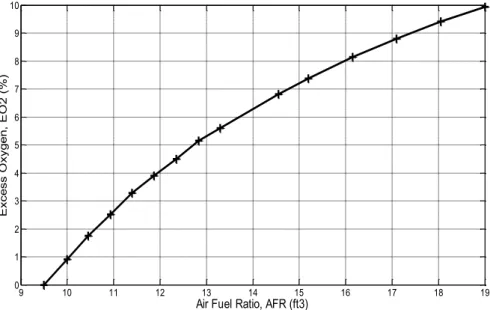
4.15 Stoichiometric combustion processes (Engneeringtoolbox) . . . 81 4.16 Insignificant nonlinear effect of AF R(stoichiometric)(f t3) Vs EO2(%). . . 83
4.17 Block Diagram of Complete Realised EO2 Model . . . 84
4.18 Realistic EO2 model set-up for parameter identification . . . 86
4.19 Control oriented EO2 model set-up for parameter identification . . . 86 4.20 Two global optima of Xi values of S3 for EO2 . . . 88
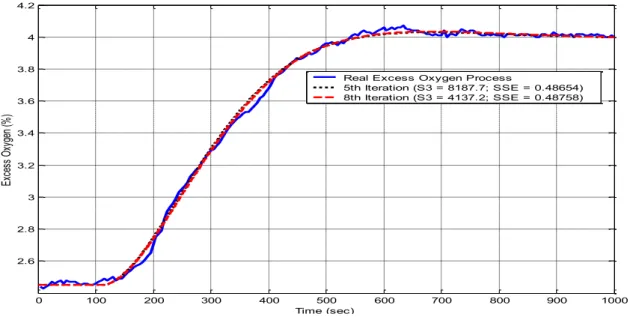
4.21 Transient responses of 2 global optimal Xi with real process of EO2 . 89
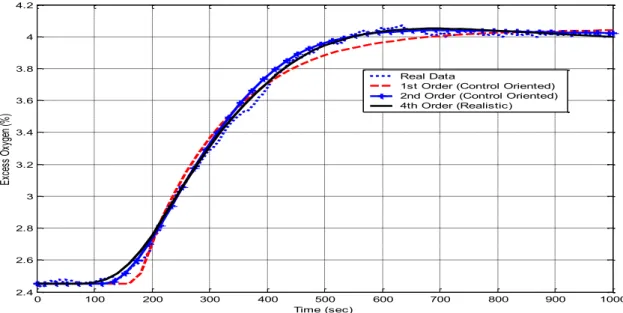
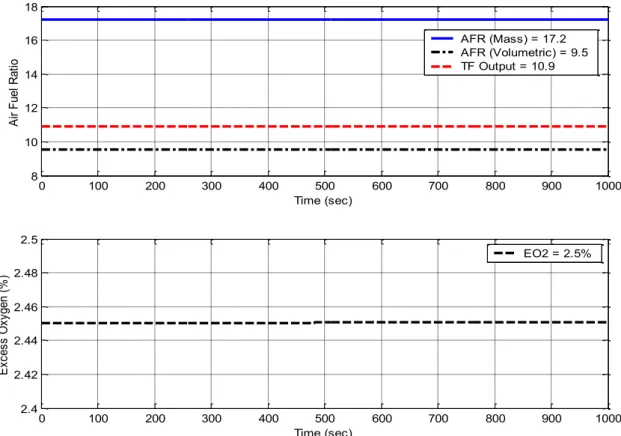
4.22 Control oriented (Linear) and realistic (Nonlinear) model orders with respectiveSSE . . . 92 4.23 Selected Models Order for Realistic and Control Oriented Models . . 94 4.24 Non-Zero Initialised Constant Input of Complete Model Realisation . 95 4.25 Non-zero Initialised Step Responses of Identified EO2 Models . . . . 96
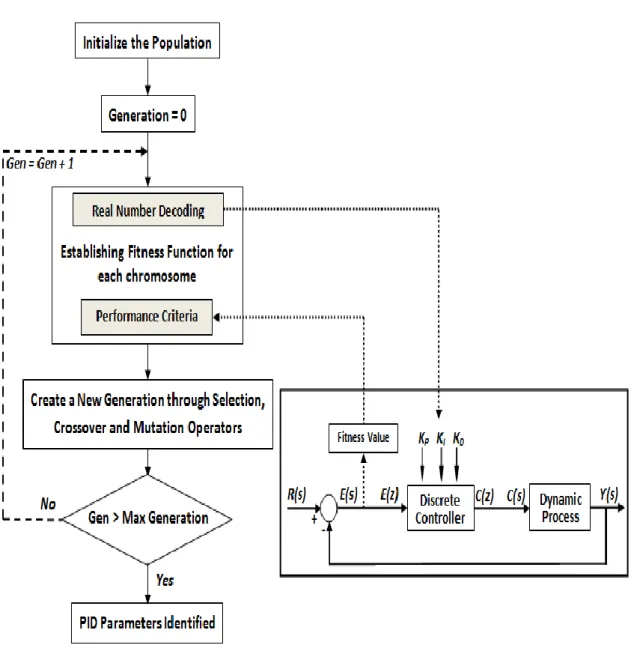
5.1 Schematic diagram of closed-loop negative-feedback control system . . 100 5.2 Flow chart of discrete PID control parameters optimisation by SGAs
(Saad et. al., 2012) . . . 102 5.3 Wide range of search space boundary responses with respective
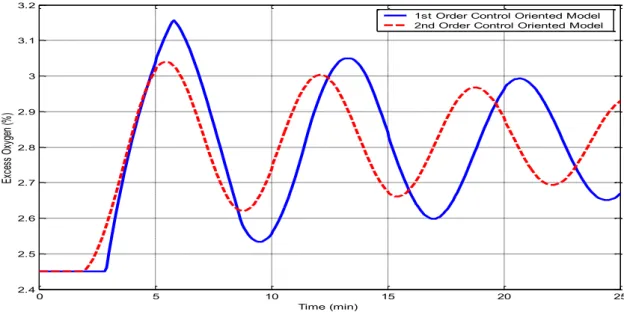
con-trol oriented models by SGA’s . . . 106 5.4 1st order control oriented EO
2 model responses; ZN, DS and SGAs
improved search space boundaries . . . 108 5.5 2nd order control oriented EO2 model responses; ZN, DS and SGAs
5.6 EO2 improved boundaries responses of 1st and 2nd orders control
ori-ented linear models by SGA’s . . . 109 5.7 Improved boundaries and λ of Tg responses by SGA’s with
conven-tional techniques . . . 110 5.8 Effect ofP−termandI−termwithλof modified objective function,
IAE+λISU . . . 112 5.9 Integral output of IAE +λISU objective function with λ = 100 →
850 for Tg . . . 112
5.10 Process output ofIAE+λISU objective function withλ= 100→850 for Tg . . . 113
5.11 Integral output of ISE+λISU objective function with λ = 100 →
5000 for Tg . . . 113
5.12 Process output of ISE +λISU objective function with λ = 100 →
5000 for Tg . . . 114
5.13 Integral output of IAE+λIS∆U objective function with λ= 100→
500000 for Tg . . . 114
5.14 Process output ofIAE+λIS∆U objective function withλ= 100→
500000 for Tg . . . 115
5.15 Integral output of ISE+λIS∆U objective function withλ= 100→
500000 for Tg . . . 116
5.16 Process output of ISE+λIS∆U objective function with λ= 100→
500000 for Tg . . . 117
6.1 2-input, 2-output (TITO) multivariable control oriented model under closed-loop discrete decentralised PID controllers . . . 121 6.2 Transient responses of 1st order control oriented model of EO2 by
three SGAs tuning approaches . . . 126 6.3 Transient responses of Tg with single-loop interaction by 2nd order
control oriented model of EO2 by three SGAs tuning approaches . . . 126
6.4 Transient responses of 2nd order control oriented model of EO 2 by
6.5 Transient responses of Tg with single-loop interaction by 1st order
control oriented model of EO2 by three SGAs tuning approaches . . . 128
6.6 Response ofTg by SGAs-3 to include the total effect of loop
compens-ation in one cost function,Ji(T otal) . . . 129
6.7 2-input, 2-output (TITO) realistic multivariable model under closed-loop discrete decentralised PID control . . . 130 6.8 Comparison of EO2 control responses on 4th order nonlinear realistic
model . . . 131 6.9 Comparison ofTg control responses on 24 state-space realistic model 132
6.10 Tg responses under loop interaction of multivariable process by 1st
order EO2 model’s discrete PID parameters (∆1%(AF R)) . . . 133
6.11 Tg responses under loop interaction of multivariable process by 2nd
order EO2 model’s discrete PID parameters (∆1%(AF R)) . . . 134
6.12 Fuel consumption under loop interaction of realistic multivariable pro-cess by 1st order EO
2 model’s discrete PID parameters (∆1%(AF R)) . 136
6.13 Fuel consumption under loop interaction of realistic multivariable pro-cess by 2nd order EO2 model’s discrete PID parameters (∆1%(AF R)) . 137
6.14 Comparison of steady-state of Tg responses by two set-points of EO2 138
7.1 An extension of 24 state-space combustion chamber models to multistage149
7.2 2 Energy Distributions(1350K(Chamber1) −→1500K(Chamber2)),(1400K(Chamber1) −→
1500K(Chamber2)) . . . 180
7.3 2 Energy Distributions(1450K(Chamber1) −→1500K(Chamber2)),(1500K(Chamber1) −→
2.1 Comparison of the deterministic techniques . . . 14
3.1 Radiation Coefficients of Zone Method . . . 40
3.2 24 State-space Variables of the Simulated Furnace Model . . . 46
4.1 Selection of Operating Point ofTg and u with AF R(M ass) (17.2) . . . 73
4.2 Selected genetic operators ofTg . . . 74
4.3 Model Parameters Identification by SGAs1 Execution . . . 77
4.4 Model Parameters Identification by SGAs2 Execution . . . 77
4.5 Model Parameters Identification by SGAs3 Execution . . . 78
4.6 AF R(stoichiometric)with relativeEA and EO2 . . . 83
4.7 Selected genetic operators ofEO2 . . . 85
4.8 3rdOrder Model Polynomial Coefficient Approximation by SGAs Ex-ecution . . . 88
4.9 EO2 Control Oriented Model’s Parameters (Linear) . . . 89
4.10 EO2 Realistic Model’s Parameters (Nonlinear) . . . 89
4.11 Information Criterion of Model Orders . . . 91
4.12 Roots of Denominator of Model Orders . . . 93
5.1 Selected genetic operators ofTg and EO2 . . . 104
5.2 Control Oriented ofEO2 Model’s PID Parameters . . . 107
5.3 PID parameters for control oriented Tg by different tuning methods . 110 5.4 Weighting factor identification withIAE +λISU . . . 111
5.5 Effect ofλ variations for the modified objective functions . . . 118
6.1 Identified PID parameters forTg and 1st order control oriented model
of EO2 by three SGAs tuning approaches . . . 125
6.2 Identified PID parameters forTg and 2ndorder control oriented model of EO2 by three SGAs tuning approaches . . . 125
6.3 Error criteria with respective cost function by three SGAs tuning approaches . . . 125
6.4 Fuel consumption for multivariable process by 2% of EO2 reduction . 135 6.5 Simulation result of fuel consumption by 2% EO2(Ref) reduction . . . 140
7.1 Energy Distribution, 1350K(Chamber1) −→1500K(Chamber2) . . . 179
7.2 Energy Distribution, 1400K(Chamber1) −→1500K(Chamber2) . . . 179
7.3 Energy Distribution, 1450K(Chamber1) −→1500K(Chamber2) . . . 180
Nomenclature
α1 Gas flame zoneα2 Gas non-flame zone
β1 Glass surface flame zone (half inch thickness)
β2 Glass surface non-flame zone (half inch thickness)
∆GO Genetic operator for convergence precision δ1 Glass volume flame zone (bottom half)
δ2 Glass volume non-flame zone (bottom half)
δ(%) Settling band
εg Emissivity coefficient of real gas ζ Zeta, damping ratio
θi Angle of surface elements, i θj Angle of surface elements, j k Emissivity coefficient of gas
λ Lambda, weighting factor, combustible mixture
ρ Density
σ Stephan-Boltzman constant
φ Equivalent ratio combustible mixture
χ1 Glass volume flame zone (top half)
χ2 Glass volume non-flame zone (top half)
ωn Natural frequency
ωpc Phase crossover frequency Ai Area of surface elementi
Aj Area of surface element j
an...a1 Coefficients of denominator polynomials
ag Gray gases
aj Lower boundary of individual chromosome’s a Time constant
bj Upper boundary of individual chromosome’s Ci Constant by set of initial conditions
Css Zero steady-state
c Specific heat
Dec Decimal value of respective binary string
Ei Black emissive power of surface i Ej Black emissive power of surface j E(s) Control error
Eg,i Black emissive power of gas f Fuel-air ratio
fs Stoichiometric fuel-air ratio
f1 Algebraic expression of fuel controller (kg/s)
f2 Algebraic expression of thermal energy demand (K)
f(t−θ) Input signal or forcing function with time delay
GC(s) Control strategies Gi Heat flux gas zone i Gj Heat flux gas zone j GP(s) System’s process
h Radiation heat transfer coefficient
Ji Performance criterion KD Derivative gain KI Integral gain K Number of parameters Kp Process gain KP Proportional gain
.
m Fuel flow (kg/s)
.
m Fuel flow (kg/s)
M axf uel(constant) Maximum fuel flow (constant) (kg/s)
mj Number of bits of individual chromosome’s
n Sample size
Pf Internal pressure of furnace (psi) Pi Incident power
pi Root of denominator
P Partial pressure of gray gases
Q Generated heat
QiG,jG Heat transfer between gas zonei and gas zonej
QiG,jS Heat transfer between gas zonei and surface zone j
QiS,jS Heat transfer between surface zone i and gas surfacej
qrad, Net rate of heat flow
q Power loss
QF uel Pressurised fuel flow as energy
R Methane gas constant (f t.Ibf /Ibm.R)
R(s) Reference input
rij Size of vector that connects the centres of two elements Si Heat flux surface zone i
Sj Heat flux surface zone j
T1, T2 Absolute temperature of involved regions
ts Settling time
t Time
u Temperature feedback error ¯
V Mean methane temperature (K)
.
V Methane flow rate in volumetric (f t3/hr)
Vi Volume of gas elementi Vj Volume of gas elementj Xi Optimal value
Xi0 Sub-optimal value
Y(s) Controlled output
Y outN(t) Model process output signal
y(t) Output Signal
Y(t) Real process output signal
Abbreviations
AF R Air-fuel ratio
AF R(M ass) Air-fuel ratio in mass (kg)
AF Rstoichiometric) Stoichiometric Air-fuel ratio
AF R(V olumetric) Air-fuel ratio in volumetric (f t3)
AIC Akaike information criterion
AICc Akaike information criterion with correction
BIC Bayesian information criterion
BLT Biggest log modulus
C Carbon
CF D Computational fluid dynamics
Cg Glass temperature control CH4 Methane fuel
CO2 Carbon dioxide
DCSs Distributed Control Systems
DRP Process’s dynamic period DS Direct-Synthesis
EA Excess air
ED Thermal energy demand (K)
EO2 Excess oxygen (%)
EOP Effective open-loop
F OP DT First-order plus dead-time
F P E Akaike’s Final prediction error criterion
H Hydrogen
H2O Hydrogen oxide (Water)
IAE Integral absolute error
IM C Internal model control
ISE Integral sum error
LHV Lower calorific heat value (M J/kg)
M IM O Multiple-input multiple-output
M OEA Multi-objective evolutionary algorithm
M RAC Model reference adaptive control
N2 Nitrogen
O2 Oxygen
P ID Proportional, Integral, Derivative
P LC Programmable Logic Controllers
P OD Proper orthogonal decomposition
P SO Particle swarm optimiser
P T cA Predetermined time constant approximation
RET F Reduced effective transfer function
RGA Relative gain array
S Sulphur
SAE Sum of absolute error
SBLower Lower search boundary
SBO Optimum search boundary
SBU pper Upper search boundary
SGAs Standard genetic algorithms
SISO Single-input single-output
SO2 Sulphur dioxide
SOP DT Second-order plus dead-time
SSE Sum of square error
Tamb Ambient temperature (K) Tg Glass temperature (K)
T IT O Two-input two-output
TSET Primary temperature setting (K)
Algorithm Definitions
F itnV Fitness value, chromosomes evolution
Ggap Generation gap
Lind Length of chromosome Nind Number of individuals
Nkeep Number of selected group of fitter chromosomes Nkeep1 Offspring chromosomes matrix of new population
Npop Number of population size Nva Number of variables
P RECI Precision, number of bits depends on desired accuracy
SEL−F Selection function
Srate Selection rate, fraction of number of population SU S Stochastic universal sampling, selection process
XOV −F Crossover function
INTRODUCTION – OVERVIEW
AND THESIS OUTLINE
This chapter begins with a brief review of the obstacles faced in glass furnace in-dustries to optimise the desire performances. In particular, the tight environmental regulations to control undesirable emissions associated with burning fossil fuels and excess oxygen. Finally, the project scope and the structure of this thesis are outlined.
1.1
Review of Glass Furnace Processes and
Con-trol
Glass manufacturing represents a challenge for automation and for control engin-eers as it is a very complex, long dynamic process with complicated, nonlinear and not completely understood dynamical behaviour. So it is still common that glass furnaces are controlled by simple controllers such as PID regulators or by manual in-terventions of furnace operators. As a result, the process may be kept in suboptimal conditions and acting disturbances may not be effectively rejected.
However, market competition creates a need for tighter control of the process towards optimum. Glass furnaces are usually energised by fossil fuels or electricity. The massive furnaces with multiple port burners cause the glass manufacturing in-dustries to consume high energies in glass production. Most glass inin-dustries are
operating at maximum daily through-put to fulfil the market demand and require-ment. High energy costs and severe competition amongst glass manufacturers has resulted in the emergence of several solutions to reduce the fuel consumption of these furnaces.
Apart from high energy consumption, undesirable emission from glass industries is another setback to consider as the entire world is greatly concerned about green house effects. Tight environmental regulations are now applied to reduce carbon monoxide, sulphur dioxide, nitrogen oxides and particles that are undesirable emis-sions associated with burning fossil fuels. These compounds are toxic, contribute to pollutions and can ultimately cause health problems.
In the USA, federal and state laws govern the permissible emission rates for these pollutants under the guidance of the Clean Air Act and oversight of the fed-eral Environmental Protection Agency (EPA), National Risk Management Research Laboratory, (2004). State and local environmental agencies also exert authority in regulating the emissions of these pollutants.
Globally, 191 states have signed and ratified the Kyoto Protocol (1998) to ex-ecute themselves in a reduction of four green-house gases (carbon dioxide, methane, nitrous oxide and sulphur hexafluoride) which would badly interfere with the global climate system and human health. According to article 2 of the Kyoto Protocol, the reduction of emissions is focused on industrial combustion emission. As a result, the industries which are related to combustion processes are tightly observed by environmental agencies to ensure stabilization of green house gases emission.
To act in accordance with emission guidelines and for clean emission, most process industries are emphasising in reduction of the excess oxygen (EO2) by
controlling the air-fuel ratio (AFR). EO2 is an important element in combustion
products that would lead to formation of sulphur dioxide (SO2) and nitrous oxide
(N O2). According to the combustion emission guideline, the permissibleEO2 is not
more than 3% from combustion, excluding Japan which allows not more than 5% of EO2 from combustion.
1.2
Problem Statement
Literature survey reveals that there has been no research undertaken on EO2
model parameter identification and control parameter optimisation. Also, an insig-nificant number of works has been undertaken on control parameter optimisation for glass furnaces. Further, the glass and other process industries generally operate within emission guidelines which are regulated by environmental agencies (SEPA, 2005). Thus, a necessity of an EO2 model parameters identification has not arisen
and has not been considered. However, at maximum operating conditions with high energy consumption, the probability of producing undesirable emission is high. Any occurrence of sudden undesirable disturbances can cause more problems for existing furnaces which are operating in poor thermal conditions.
Therefore, it is clear that in order to bridge the gap between EO2 and the
glass furnace, a multivariable process with the respective discrete control parameters will be designed to minimise the fuel consumption while sustain the desired glass temperature. The research presented in this thesis is focused on this problem and delivers solutions that satisfy these criteria.
1.3
Research Novelty and Methodology
The primary endeavour of this research is to design a multivariable glass furnace model for fuel consumption minimization and EO2 reduction while sustaining the
desired output. The strategy of this work is developed using standard genetic al-gorithms (SGAs), a heuristic optimisation technique based on Darwin’s theory 1. The developed models and control methods will be evaluated applying simulation and Matlab software.
More specifically, this thesis addresses the distinct objectives below and as
de-1
Darwin’s theory of biological evolution, stating that all species of organisms arise and develop through the natural selection of small, inherited variations that increase the individual’s ability to compete, survive and reproduce
Figure 1.1: Schematic Flow of Research Methodology
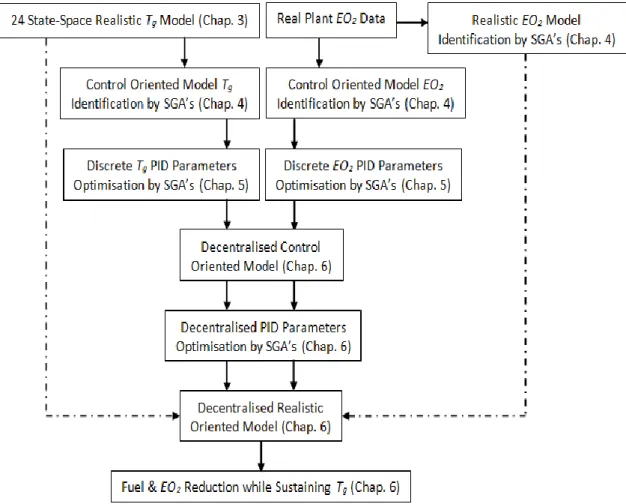
scribed in schematic flow (Figure 1.1):
1. Identify and investigate the dynamic characteristics of a realistic 24 state-space glass temperature (Tg) model. Then, develop a control oriented glassTg
simulation model.
2. Develop and investigate a realistic simulation model with nonlinear effect and a control oriented simulation model without nonlinear effect of excess oxygen (EO2) from numerical data of real plant.
3. Optimise the discrete control parameters according to the performance criteria of Tg and EO2, individually.
4. Develop the discrete decentralised control strategies by control oriented models of Tg and EO2. Then, improve and optimise the dynamic discrete control
5. Implement and evaluate the optimised discrete control strategies on realistic multivariable process for attaining the desired performances.
1.4
Thesis Outline
The structure of this thesis is outlined below. Most of the material contained in chapters 2 and 3 is standard and is only intended as a brief review of the current state of affairs in the field of GAs as function optimisers. The main contributions and novel aspects of this work are contained in chapters 4 to 6 and are summarised in Chapter 7.
Chapter 2 - Literature Review of Standard Genetic Algorithms
This chapter commences with a brief overview of optimisation algorithms as ap-plied to the solution of control engineering problems. Standard Genetic Algorithms (SGAs) as function optimisers are then introduced, focusing on their fundamental differences and advantages over conventional algorithms. The relevance of SGAs to control systems is then illustrated by a number of successful applications in different areas of process modelling and control optimisation. Finally, applications of SGAs for glass furnace and furnace type processes are outlined.
Chapter 3 - Review of Glass Furnace Modelling
This chapter begins with a brief literature review of designing the combustion cham-ber, which is fundamental to the developed methods for the glass furnace models. Computational fluid dynamics method derived from radiative heat transfer were ap-plied here to analyse the temperature distribution within the combustion chamber, which is divided into finite zones. Linearised energy balance equations in steady-state improve the prediction and accuracy of temperature distribution within finite zones. An assessment on the selected glass furnace model, which is designed by a zone method, provides a deeper insight of model understanding and quantitative performance.
Chapter 4 - Model Parameters Identification of Glass Temperature and Excess Oxygen
This chapter is primarily focused on optimal control oriented model’s parameter identification for glass temperature and excess oxygen. A common phenomenon of premature convergence, which is the search space constraint, in SGAs is reviewed. A novel technique, predetermined time constant approximation, is proposed to enhance the search mechanism to optimise the search boundaries to locate optimal values of model parameters. Further, a full scale realistic excess oxygen model which consists of air-fuel ratio conversion model, dynamic transfer function model and excess oxygen look-up table, is developed by using a real plant’s numerical data of excess oxygen.
According to the literature survey, there is no realistic excess oxygen model available for further research. Therefore, the development of a realistic excess oxygen model is essential for further research here. Also, control oriented models of both glass temperature and excess oxygen processes are developed for control parameter optimisation.
Chapter 5 - Control Parameters Optimisation of Glass Temperat-ure and Excess Oxygen
In this chapter, the discrete control (PID) parameters optimisation by SGAs for control oriented models of glass temperature and excess oxygen, which are identified in chapter 4, is primarily focused on. A literature review of PID control strategies and tuning issues are briefly discussed and addressed. The control parameters of both control oriented models are optimised individually without loop interaction according to the desired performance criteria. The improved search space boundaries and modified objective function are subsequently introduced for excess oxygen and glass temperature respectively, to improve the discrete PID parameters to attain the desired dynamic performance criteria.
The search space boundaries are improved by resizing the upper and lower bound-aries with an assist of conventional tuning techniques, Ziegler-Nichols and Direct
Synthesis, for an initial knowledge of PID parameters. For the glass temperature, the objective function is modified by adding a weighting factor with input term to achieve the desired characteristic response. Further, three other modified objective functions are analysed and compared with the selected objective function for better dynamic characteristics of glass temperature response.
Chapter 6 - Decentralised PID Controller Tuning for Multivariable Glass Furnace Process
In this chapter, the decentralised discrete PID control tuning techniques are investig-ated for the multivariable glass furnace process. A literature review of multivariable PID control strategies and tuning issues are briefly discussed and addressed. Three tuning approaches with respective objective functions are investigated to optimise the control performances for control oriented multivariable glass furnace models. An improved and modified objective function which includes the total effect is proposed with other conventional tuning techniques, based on SGAs. This modified objective function is shown to exhibit improved control robustness and disturbance rejection under loop interaction. This is achieved by combining both optimal objective func-tions of Tg and EO2 on control oriented models which were developed individually
in chapter 5.
Further, the set of discrete PID parameters are applied on the multivariable realistic model of Tg and EO2 to optimise fuel consumption reduction and excess
oxygen while sustaining the glass temperature. Simulation results are presented to illustrate the effectiveness of the proposed method.
Chapter 7- Conclusions - Main Contributions and Further Work
The first part of this chapter summarises the key results and main contributions of this research project. A number of recommendations for further work in this direc-tion, which will extend an improvement of SGAs in the area of model parameters identification and state-space model extension with respective thermal energy as input, are given in the second part of this chapter.
1.5
Dissemination of Research Contributions
During this research an endeavour has been made in order to suggest the ideas and methodologies proposed in this thesis to a variety of different audiences through both peer reviewed publications and presentations. The publications made throughout the duration of research are listed below:
Rajarathinam K., Gomm J. B. and Yu D. L, “Identification, Simulation and Control Optimisation of a Glass Furnace by Genetic Algorithm”, Proceeding of the GERI 8thAnnual Research Symposium (GARS 2013), LJMU, UK, 2013,
Rajarathinam K., Gomm J. B., Yu D. L. and Abdelhadi A. S., “Minimisation of Fuel Consumption in a Glass Furnaces Industry by Standard Genetic
Al-gorithms”, Proceeding of the GERI 9th Annual Research Symposium (GARS
2014), LJMU, UK, 2014.
Rajarathinam K., Gomm J. B., Yu D. L. and Abdelhadi A. S., “ Decent-ralised Control Optimisation for a Glass Furnace by SGA’s”, Proceeding of the 15th International Conference on Computer Systems and Technologies (CompSysTech’14), Ruse, Bulgaria, 2014. Also published in ACM Interna-tional Conference Proceeding Series, vol. 883, pp. 248-255, 2014. (Best Paper Award)
Rajarathinam K., Gomm J. B., Yu D. L. and Abdelhadi A. S., “Decentralised PID Control Tuning for a Multivariable Glass Furnace by Genetic Algorithm”, Proceeding of the 20th International Conference on Automation and
Comput-ing (ICAC), Bedfordshire, UK, pp. 14-19, 2014.
Rajarathinam K., Gomm J. B., Yu D. L. and Abdelhadi A. S., “PID Control-ler Tuning for a Multivariable Glass Furnace Process by Genetic Algorithm”, International Journal of Automation and Computing (IJAC), vol. 13 (1), pp. 64-72, 2016. (accepted, June 2015).
Rajarathinam K., Gomm J. B., Yu D. L. and Abdelhadi A. S., “Predetermined Time Constant Approximation Method for Model Identification Search Space
Boundary by Standard Genetic Algorithm”, SIAM Conference on Control and Its Applications, Paris, France, CP22, pp. 73, 2015. (Abstracts accepted).
Rajarathinam K., Gomm J. B. and Yu D. L., “Predetermined Time Constant Approximation Method for Optimising Search Space Boundary by Standard Genetic Algorithm”, Proceeding of the 16thInternational Conference on
Com-puter Systems and Technologies (CompSysTech’15), Dublin, Ireland, 2015. Also published in ACM International Conference Proceeding Series, vol. 1008, pp. 38-45, 2015.
Rajarathinam K., Gomm J. B., Yu D. L. and Abdelhadi A. S., “An Improved Search Space Resizing Method for Model Identification by Standard Genetic Algorithm”, Proceeding of the 21st International Conference on Automation
and Computing (ICAC), Glasgow, UK, pp. 1-6, 2015.
This chapter begins with an overview of challenges that are face by glass furnace in-dustries in higher fuel consumption and undesirable emission. The research method-ologies and the structure of this thesis are outlined, and related research publications are listed.
Literature Review of Optimisation
and Genetic Algorithms
2.1
Introduction
This chapter commences with a brief overview of optimisation algorithms as ap-plied to the solution of control engineering problems. Standard Genetic Algorithms (SGAs) as function optimisers are then introduced, focusing on their fundamental differences and advantages over conventional algorithms. The relevance of SGAs to control systems is then illustrated by a number of successful applications in differ-ent areas of process modelling, control optimisation, multiobjective optimisation and the negative aspect of optimisation by premature convergence factors are reviewed. Further, the single-input single-out and multi-variable PID tuning strategies are re-viewed. Finally, applications of SGAs for glass furnace and furnace type processes are outlined.
2.2
Definition of Optimum
In general, an optimisation is applied to locate the finest promising solutions to a specified difficulty. In the simplest case, an optimisation problem consists of maxim-ising or minimmaxim-ising an objective function, Ji, by systematically selecting the input
variables from within a feasible parameter set depending on the desired criterion.
The generalization of optimization theory and techniques to other formulations com-prises a large area of control theory or applied mathematics.
In mathematics, maxima and minima are the prime values (maximum) or least values (minimum) that a function brought in a point either within a given local minima or on the function domain in its global maximum. Figure 2.1 illustrates the local and global maxima and minima for a random function,f(x) =exp−x.cos(2πx)
for 0.2≤x≤2.7. 0 0.5 1 1.5 2 2.5 3 -0.8 -0.6 -0.4 -0.2 0 0.2 0.4 0.6 Global Maxima Local Maxima Global Minima Local Minima
Figure 2.1: Global and local maxima and minima
Furthermore, the classification of an optimal solution is problem dependent. For instance, single objective optimisation can be classified either minimum or max-imum. Whereas, for multi objective optimisations minimum or maximum percep-tions are rather applied to sets F consisting of n =| F |objective functions fi, each
representing one criterion to be optimised [Kalyanmoy, 2001].
F ={fi :X →Yi : 0< t < n, Yi ⊆R} (2.1)
2.3
Overview of Optimisation Algorithms
It is difficult to visualize the selection of existing computational tasks and the number of algorithms developed to resolve them. In general, the heuristic can be
categor-ised into two groups of techniques; deterministic and probabilistic techniques. The overview begins with deterministic search algorithm. The straightforward searching algorithm is known as exhaustive search, which endeavours all potential solutions from a predetermined set and consequently selects the optimal value.
Local search is an uncomplicated search technique, however with limited search space. This technique is constantly examining the current solution and replacing it if the neighbour’s solution is better than the current one. If the solution is not improved further, the current solution can be considered as a local optimal solution [Kokash and Natallia, 2005]. Popular hill-climbing techniques belong to this class. For instance, heuristics for the problem of intergroup replication for multimedia distribution service based on Peer-to-Peer network is based on a hill-climbing strategy [Xiang et. al., 2004].
Divide & Conquer (D&C)is an algorithm attempt to resolve in effortlessly by partitioning a problem into sub-problems. Subsequently, the resolution of the sub-problems should be combinable to provide a resolution to the original problem. Although this method is an efficient algorithm and applicable for any problems, the shortcoming is that it is time consuming to comprehend and design D&C. Also, it is difficult to partition and combine back the sub-problem in such an approach [Cormen et. al., 2000].
Branch-and-Bound (B&B) is an algorithm design paradigm for discrete and combinatorial optimisation problems. This algorithm consists of a sys-tematic enumeration of candidate solutions by means of state space search, which the set of candidate solutions is thought of as forming a rooted tree with the full set at the root. The algorithm explores branches of this tree, which characterise subsets of the solution set. Before enumerating the can-didate solutions of a branch, the branch is ensured against upper and lower estimated bounds on the optimal solution, and is discarded if it cannot pro-duce a better solution than the best one found so far by the algorithm. But the B&B algorithm is extremely time-consuming if the numbers of nodes in
branches of the tree are large [Kokash and Natallia, 2005].
Dynamic programming (DP) is a very influential algorithmic paradigm in which a problem is solved by identifying a collection of sub-problems and attempting them one at a time. Then using the solution to sub-problems to assist solving larger ones, until the whole problem is solved. The key point for applying this technique is formulating the solution process as a recursion [Bertsekas, 2000]. The biggest drawback of dynamic programming is that is time consuming due to dimensionality. In higher dimensions, a generalized implementation is applied that explicitly checks for legal operators at each node. This introduces a constant factor to the time complexity of DP since processing each node takes longer than it would in an implementation tailored to a specific dimension [Hohwald et. al., 2003].
Greedy algorithmis perhaps the most uncomplicated and influential method that is based on the evident principle of taking the (local) best selection at each stage of the algorithm in order to locate the global optimum of some objective function. For large complex cases this method is time consuming and does not always provide the best solution as its only search and select the best choice from current search state [Cormen et. al., 2000].
The deterministic heuristic techniques are relatively effective but their time-complexity often is too high and unacceptable for NP-complete tasks. Also, the deterministic techniques are tending to premature convergence and generally locate the nearest local optimum which maybe a low quality. The summary of deterministic heuristic techniques are tabulated in table 2.1 for comparison.
The purpose of probabilistic heuristics is to overcome these drawbacks. The comparative studies of probabilistic heuristics are illustrated and simplified in Gamal et. al., (2014).
Evolutionary Algorithms (EAs)are succeeding in evading premature con-vergence by considering a number of solutions simultaneously which will be discussed more elaborately in the next section.
Table 2.1: Comparison of the deterministic techniques
Methods Positive Aspect Negative Aspect Reference Uncomplicated Applicable only
Local search technique, for limited Kokash & Search Move to next state search space Natallia, 2005
if have better solution
Resolve a problem Time consuming,
Divide & by partitioning into Difficult to partition Cormen et. al., Conquer sub-problem, Applicable and combine back 2000
to any problem if problem is complex Explores branch of
tree which characterise
Branch & subset of solution set Extremely Kokash & Bound and discarded if cannot time consuming Natallia, 2005
produce a better solution than the best
Dynamic Solving sub-problems Time consuming Hohwald et. al., Programming one at time to assist due to 2003
solving bigger problem dimensionality Uncomplicated and Time consuming
Greedy influential technique, if problem is Cormen et. al., Algorithm Taking best solution at complex, Always 2000
each stage to locate do not provide global optimum. best solution
Simulated annealing (SA) is a generic probabilistic, meta-heuristic al-gorithm which applies an approach similar to hill-climbing, but irregularly admits solutions that are worse than the present solution. The probability of such admittance is decreasing with time. At each step, the SA heuristic con-siders some neighboring state s0 of the present state s, and probabilistically decides between moving the system to state s0 or staying in state s. These probabilities ultimately lead the system to move to states of lower energy. Typically this step is repeated until the system reaches a state that is good enough for the application [Aydin and Fogarty, 2004].
Tabu searchis another meta-heuristic search method which extends the idea to avoid local optima by using memory structures. The problem of simulated annealing is that after a “jump” the algorithm can simply repeat its own track. Tabu search prohibits the repetition of moves that have been made recently [Battiti, 1996].
Swarm intelligence (SI)is the discipline that deals with natural and artifi-cial systems composed of many individuals that coordinate using decentralized control and self-organization. In particular, the discipline focuses on the col-lective behaviors that result from the local interactions of the individuals with each other and with their environment [Beni and Wang, 1989]. Two of the most successful types of this approach are Ant Colony Optimization (ACO) [Dorigo, 1992] and Particle Swarm Optimization (PSO) [Kennedy and Eber-hart, 1995]. The ACO is inspired by the behavior of ants which is used to find the shortest path from nest to food source. During the foraging process ants move randomly from their nest to food source, during that period the ants leave a chemical substance called pheromone. This pheromone path helps other ants to reach the food source and this repeating process produces a pos-itive feedback and makes a pheromone trail [Bijaya and Gyanesh Das, 2011]. The PSO deals with problems in which a best solution can be represented as a point or surface in an n-dimensional space. The main advantage of swarm intelligence techniques is that they are resistant to the local optima problem.
2.3.1
Evolutionary Algorithm
Evolutionary algorithms (EAs) are techniques that develop ideas of biological evolu-tion for searching the soluevolu-tion of an optimisaevolu-tion problem, founded on the principles of natural selection [Darwin, 1859] and population genetic [Fisher, 1930]. They re-late to the principle of survival on a set of potential solutions to generate gradual approximations to the optimum. A new set of approximations is created by the pro-cess of selecting individuals according to their fitness and breeding them together with operators stimulated from genetic processes. Figure 2.2 illustrates a schematic of generalised EA techniques.
The main loop of EA includes the following steps:
1. Initialize and evaluate the initial population.
3. Apply genetic operators to generate new solutions.
4. Evaluate solutions in the population.
5. Start again from point 2 and repeat until convergence criteria is satisfied or solution is attained.
Figure 2.2: Schematic of generalised evolutionary algorithm (Fleming and Purs-house, 2002)
Therefore, any iterative, population based technique that applies the random variation and selection to produce new solutions can be classified as an EA. The EAs field has its genesis in four landmark evolutionary approaches: evolutionary programming (EP) [Fogel et. al., 1966], evolution strategies (ES) [Rechenberg, 1973], genetic programming (GP) [Koza, 1992] and genetic algorithms (GAs) [Holland, 1975].
Even though EA share a general scheme, evolutionary techniques can be dif-ferentiated according to the implementation and the problems to which they are applied. GP explores for a solution in the form of computer programs. Their fitness is determined by the ability to solve a computational problem. The only difference from EP is that the latter fixes the structure of the program and allows their numer-ical parameters to evolve. ES works with vectors of real numbers as representations of solutions, and applies self-adaptive mutation rates. The most well known and
successful among evolutionary algorithms are genetic algorithms (GAs). They have been explored by John Holland in 1975 and exhibit the necessary effectiveness.
Further, GAs were popularised by Goldberg (1989) and consequently, the ma-jority of control applications are approved and implemented by this approach. GAs are based on the fact that the role of mutation improves the individual quite seldom and, therefore, they rely mostly on applying recombination operators.
2.4
Standard Genetic Algorithms
Standard genetic algorithms (SGAs) are a stochastic global search technique based on the metaphor of natural biological evolution. This technique sustains a set of can-didate solutions to a specified problem, which then evolve applying artificial genetic operators such as selection, crossover and mutation. SGAs work by merging the Dar-winian “survival of the fittest” principle with a probabilistic information exchange approach encouraged by the processes of natural genetics, to form a structured yet randomised search algorithm that assures to be well competent of identifying op-timal, or near-optimal solutions, to a wide range of search, optimisation and machine learning problems.
As discussed earlier, SGAs have been developed by John Holland, his colleagues, and his students at the University of Michigan. Studies by Holland (1975), De Jong (1975), Goldberg (1989), and others have demonstrated its superiority performance of SGAs by theory and experimentation. More information on SGAs and a list of practical applications can be found in Shopova and Vaklieva-Bancheva (2006) Fogel (1994), Goldberg (1994), Randy and Sue (2004) and the introductory textbooks by Goldberg (1989) and Mitchell (1996). Because of their exclusive structure and function, SGAs diverge from more traditional and modern search procedures and algorithms in some very fundamental ways, making them ideal candidates as global function optimisers.
Recent studies illustrated the SGAs performed reasonably well compared to other evolutionary algorithms (Wu and Ji, 2007) (Kachitvichyanukul, 2012) (Silberholz and Golden, 2010) (Adewole et. al., 2012) (Bajeh and Abolarinwa, 2011) (Gamal
et. al., 2014) (Nagaraj and Murugananth, 2010).
Another attribute of SGAs that distinguishes them from most conventional and modern search methods is that they work with a coding of the parameter set and not with the parameters themselves. This gives them direct applicability to an exceptionally wide range of non-numerical, discrete, combinatorial, and mixed op-timisation problems. Kachitvichyanukul (2012) has suggested that SGAs are more suitable for discrete PID optimisation than the PSO and DE, which are suitable for continuous PID optimisation.
Most conventional and modern optimisers based on continuous parameter vari-ations cannot normally be used for the solution of such problems. The influences of SGAs come from the statement that they are robust and thus, have the prospect-ive to apply and solve efficiently many difficult problems without constraints. As expected, SGAs are not certain to locate the globally optimal solution to a specific problem, but are generally excellent in locating reasonably fine solutions to a wide range of problems which is rapidly acceptable.
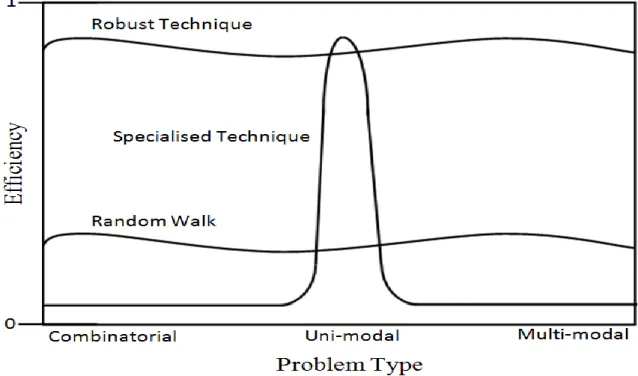
Figure 2.3: Efficiency of different classes of search techniques across a problem continuum (Goldberg, 1989)
Figure 2.3 illustrates the better perception of the significance of robustness in a search technique. According to the figure, the specialised technique is well
per-forming in the problem area it has been designed for, but its efficiency drops rapidly when applied in different problem areas. On the contrary to that, entirely random-ised techniques, such as random walk, are executing consistently in a wide range of problem areas, but their efficiency is in general low. Robust techniques, such as SGAs, unite efficiency with consistency and achieve a suitable performance across a wide range of domains. Even though other specialised techniques are probably perform better than SGAs for solving specific problems but the SGAs can provide a very effective, efficient and fast solution.
2.4.1
Multi-Objective Optimisation by SGAs
Being a population-based approach, SGAs are well suited to solve multi-objective optimization problems. A generic single-objective SGAs can be modified to locate a multiple non-dominated solutions set in a single execution. The ability of SGAs to simultaneously search different regions of a solution space makes it possible to locate a diverse set of solutions for difficult problems with non-convex, discontinuous, and multi-modal solutions spaces. In addition, most multi-objective SGAs do not require the user to prioritize, scale, or weigh objectives. Therefore, SGAs have be en the most popular heuristic approach to multi-objective design and optimization problems.
The first multi-objective SGAs, called vector evaluated SGAs (or VEGA), was proposed by Schaffer (1985). Afterwards, several multi-objective evolutionary al-gorithms were developed including Multi-objective Genetic Algorithm (MOGA) (Fonseca and Fleming, 1995). Since then many research works has been under-taken to improve the MOGA (Fonseca and Fleming, 1998) (Jensen, 2003) (Xiujuan and Zhongke, 2004). However, the MOGA is not considered here as a part of this research work.
2.4.2
Premature Convergence
One of the most general phenomena that encountered in optimisation is premature convergence in modern heuristic algorithm (Vanaret et. al, 2013). A process of
optimisation prematurely converged to a local optimum if the initial population is generated randomly from poorly selected search space region [Ursem, 2003] [Vanaret et. al., 2013] [Chaiwat and Prabhas, 2011]. In another term, if population is not se-lected from optimal search region it becomes complicated to locate the elite solution of the problem whether in the case of initial population selection or the selection of population for the next generation. Figure 2.4 illustrates several common phenom-ena (factors) to take into account when the initial population is generated randomly.
Figure 2.4: Phenomenon of initial population
The search space selection is one of the grounds that lead to premature con-vergence. Well selected search space region will brought the elite group within the feasible region to avoid premature convergence [Rajarathinam et. al., 2015]. In fact, the well selected search space regions will sustain the population diversity. Preservation of search space and population diversity is correlated with sustaining a well balance between exploration and exploitation [Weise, 2009]. An exploration is applied to examine new and unknown region in the search space, and exploitation applies the previously visited and identified information to assist locate the elite solution [Rajarathinam et. al., 2015].
A brief knowledge about variety methods of sustaining the population diversity and selective pressure to avoid the premature convergence were proposed (Deepti and Shabina, 2012). Nakisa et. al., (2014) presented a comprehensive survey of the various PSO-based algorithms such that PSO is a computational search and optim-ization method based on the social behaviours of birds flocking or fish schooling.
Chaiwat and Prabhas (2011) proposed the self-adaption technique to control the population diversity without explicit parameter setting. The technique is based on the competition of preference characteristic in mating. Based on simulation results, the adaptive technique has potential to adapt the diversity of the population for a given problem without the knowledge of correct parameter setting. Also, it has a good performance in finding the solution.
A number of basic variations have been developed due to solve the premature convergence problem and improve quality of solution founded by the PSO. Suri et. al., (2013) proposed that Elitism technique was augmented within Genetic Al-gorithm allowing the best solution from any generation to be carried across the new population allowing it to sustain. Social Disaster Techniques (SDT) was used when premature convergence occurred and the problem of premature convergence may be avoided by creating random offspring and inserting diversity in the population (Ra-madan, 2013). This paper attempted to use the both concepts of Elitism and Social Disaster techniques spanning across various generations. A previous solution was chosen and it has been looked upon how Elitism and Social Disaster techniques fares towards the same problem. Malik and Wadhwa (2014) proposed a collaboration of dynamic genetic clustering algorithm (SGCA) and elitist technique for preventing premature convergence. This proposed technique provides a strong immunity to mutation and crossover operators to be trapped in local optima.
Based on the complex Box technique, a boundary search method for optimisation problems in the case of the optimal solution at the boundary was proposed (Zhu et. al., 1984). It has been demonstrated and verified, if there is an optimal solution at the boundary constraint set. Recently, a modified GAs is applied in solving the n-Queens difficulty in chessboard (Heris and Oskoei, 2014). The holism and random choices cause solving difficulties for SGAs in searching a large space. To improve the solving difficulty, the minimal conflicts algorithm is collaborated with SGAs. The minimal conflicts algorithm gives a partial view for SGAs by a locally searching space. But, the collaboration of algorithms consumed time for searching.
selection within SGAs was proposed (Wu and Simpson, 2002). This approach guides the SGA to preserve around constraint boundaries and improves the efficiency of attaining the optimal or near optimal solution. A technique for resolving the struc-tural optimisation difficulties in quantising the subjective uncertainties of active constraints is proposed by fuzzy logic formulation (Wu and Wang, 1992).
Another method to improve the prematurity and to sustain the diversity popu-lation was proposed by Niche Genetic Algorithm (NGM) associated with isopopu-lation mechanism (Lin et. al., 2000). A comparison study was done on NGM and Anneal-ing Genetic Algorithm where the AnnealAnneal-ing Genetic Algorithm has better premature convergence (Tu and Mei, 2008). However, the Annealing Genetic Algorithm is time consuming by extra procedures.
Another method, named Accelerating Genetic Algorithm (AGM) was proposed to resizing the feasible region into the elite individual’s adjacent region for better local searching and convergence (Jin et. al., 2001). Search space boundary re-duction for the candidate diameter for each link by pipe index vector and critical path method, along with modified genetic operator’s derivatives, was proposed (Ma-hendra et. al., 2008) (Vairavamoorthy and Ali, 2005). Further, an improved AGM based on the saddle distribution by which adding random individuals into the initial population to increase the searching ability of optimal solution was proposed (Xu et. al., 2012).
2.4.3
SGAs in Model Parameter Identification
The SGAs have been employed succesfully in the process model parameter identi-fication of both linear and non-linear system’s models. Kampisios et. al., (2008) applied off-line GAs in identification of linear induction motor electrical parameters in function of flux levels based on experimental transient measurements from a vector controlled induction motor (I.M.) drive. Liu et. al., (2014) demonstrated a para-meter identification for the determination of hydraulic and water quality parapara-meters such as the longitudinal dispersion coefficient, the pollutant degradation coefficient, velocity by coupling the GAs with finite difference method (FDM).
bind-ing sequence representations. The generalized pairs are shown to be more meanbind-ingful than the original transcription factors and transcription factor binding sites (TF-TFBS) binding sequence pairs. The proposed method by GAs assists to extract such many-to-many information from the one-to-one TF-TFBS binding sequence pairs found in the previous study, providing further knowledge in understanding the bindings between TFs and TFBSs.
Kiperwasser et. al., (2013) improved and proposed the dense pixel matching using the GAs in rectifying the image scenario. An elegant approach is allowing, optimising and matching fitness functions has recently shown a 20% of quality im-provement while performing fast convergence. The effectiveness and efficiency of GAs has been well demonstrated by Roeva (2008) and Benjmin et. al., (2008) for model parameters identification of fed-batch cultivation processes. Further, Maria et. al., (2011) applied SGAs and multi-population GAs for a parameter identification of a yeast fed-batch cultivation of S, (cerevisiae).
Mathew et. al., (2014) successfully applied the GAs based a segmentation ap-proach in identification of defects in glass bottles. The GAs has produced high sensitivity, high specificity and high accuracy of 92%, 93% and 93% respectively. The method produced effective results and hence this tool shall be useful for food processing industries for the Quality Inspection of the glass bottles.
Aloysius et. al., (2012) successfully applied the GAs in order to maximize the revenue of airline by optimizing the flight booking and transportation terminal open/close decision system. Gondro and Kinghorn, (2007) aligned the multiple sequence alignment which plays an important role in molecular sequence analysis. An alignment is the arrangement of two (pair-wise alignment) or more (multiple alignment) sequences of ’residues’ (nucleotides or amino acids) that maximizes the similarities between them. Algorithmically, the problem consists of opening and extending gaps in the sequences to maximize an objective function (measurement of similarity). The GAs is well suited for problems of this nature since residues and gaps are discrete units.
biology. Wang et. al., (2007) demonstrated an exploitation of different methods for intergenic distance, cluster of orthologous groups (COG) gene functions, metabolic pathway and microarray expression data. The GAs is applied for integrating the four types of data of predicting operons in prokaryote. Nur et. al., (2012) proposed and demonstrated GAs to estimate the parameter of warranty cost model with warranty claim data collected from Malaysian automotive industry. Further, Scarf and Majid, (2011) introduced the mixed exponential distribution with GAs since zero delay time may occur in some defects. As a result, they found that the mixed exponential models is better than ordinary exponential.
2.4.4
SGAs in Control Parameter Optimisation
Numerous GA-based techniques have been developed for the optimal control design and control parameter optimisation. Altinten et. al., (2008) successfully applied the GAs to optimise the PID parameters for temperature control of a jacketed batch polymerization reactor and to track performance of optimal temperature profile. Further, Altinten et. al., (2010) applied the GAs for self-tuning PID control for the complex semi-batch polymerisation reactor processes. The change of monomer concentration is causing a change in reaction rate varies nonlinearly over the time. The simulation results assured that GAs control the temperature very well.
Slavov and Roeva, (2012) applied binary coded SGAs to optimise the discrete PID parameters for sustaining the glucose concentration during the E. Coli fed-batch cultivation process. Jan et. al., (2008) proposed and demonstrated robust PID control scheme by SGAs for the permanent magnet synchronous motor is im-plemented by a DSP-based fully discrete controller.
Kim et. al., (2008) proposed an improved GAs technique to tune an optimal PID parameter to control the reverse osmosis (RO) plant with minimum overshoot and fast settling time compared with conventional tuning techniques. Yin et. al., (2004) successfully applied GAs to tune PID parameter for low damping and slow response process. Zain et. al., (2009) applied GAs for optimizing PID parameters to control a single-link flexible manipulator in vertical motion. Simulation results
revealed that the optimum PID parameters by GAs enable the system to perform well in reducing vibration at the end-point of the manipulator.
Nithyrani et. al., (2013) applied SGAs to tune an optimal discrete PID paramet-ers for liquid tank process temperature. Simulation reveled that the binary coded SGAs performed well to sustain the liquid temperature and compared with conven-tional techniques. Zhang et. al., (2010) proposed a PID parameter optimization by performance index based on integral of absolute error, rise time, controller output and overshoot. Simulation results indicate that the GAs is a practical and effective method in optimizing the control parameters.
Perez and Basterrechea, (2004) demonstrated an application of SGAs for pre-dicting the far-field radiation of an antenna from synthetic near-field data. Simula-tion results compared and revealed that the binary coded SGAs well performed for large antennas as it applies small population size than real coded genetic algorithms (RCGAs). Gauri and Kulkarni, (2013) well applied the binary coded SGAs to op-timize the discrete PID parameters for missile altitude control system.
Valarmathi et. al., (2012) demonstrated an optimisation of PID parameters by binary coded SGAs for a non-linear liquid conical tank system. Jayachitra and Vinodha, (2014) well applied binary coded SGAs to optimise the discrete PID con-trol for continuous stirred tank reactor (CSTR) process. The concon-trol performance of CSTR process has enhanced by integrating weighting factor with combined con-ventional objective functions. Patrascu et. al., (2011) applied the discrete PID parameters which are optimised by SGAs for non-linear 3D crane input multi-output (MIMO) systems.
In recent years, the GAs is well applied in control strategy for robotics techno-logy. Abo-Hammour et. al., (2011) demonstrated binary coded GAs based control suitability for autonomous selection of a collision free path for the manipulator that minimizes the deviation between the generated and the desired Cartesian path. The control parameters are satisfies the joints limits of the manipulator, and maximize the minimum distance between the manipulator links and the obstacles. Ghanbari and Noorani, (2011) proposed a control technique for a new crawling gait to develop
in a modular robot by GAs. Wang et. al., (2012) proposed a new approach to generate the original motion data for humanoid motion planning by binary coded GAs.
The state generator is developed based on the GAs, which enables users to generate various motion states without using any reference motion data. By spe-cifying various types of constraints such as configuration constraints and contact constraints, the state generator can generate stable states that satisfy the constraint conditions for humanoid robots. Arturo et. al., (2013) proposed a technique of integ-ration of gain-phase margin method with the binary coded GAs for discrete control strategy of industrial robot and computer numerical control (CNC) machines. The proposed technique is performed well as expected and compared with RCGAs and conventional gain-phase margin method. Some other applications to multivariable process control are reviewed in chapter 6.
2.4.5
An Application of SGAs for Furnace Type Processes
Literature survey revealed that not numerous research works has been undertaken on an application of SGAs for the glass furnace or furnace type processes in model parameters identification and control parameters optimisation.
Joao and Pedro, (2003) introduced an architecture for the operation system of industrial recuperative-type glass furnace. The expert control is integrated with GAs for control optimisation and solves the multi-objective optimisation problems, respectively. Zarko et. al., (2010) presented an application of GAs with fuzzy control for optimising PID parameters for fluidized bed combustion (FBC) chamber. The results revealed that the closed-loop systems have a fast rise response with small overshoot.
Srisertpol et. al., (2011) proposed an estimation method for the mathemat-ical model using the open-loop identification for the slab reheating furnace walking hearth type with GAs in heating curve up process. The responses of experimental and simulation are consistent. Liu and Guo, (2013) presented the fuzzy neural net-work temperature control system based on SGAs for resistance furnace which has