BRAC
UNIVERSITY
S
CHOOL OF
E
NGINEERING
D
EPARTMENT OFC
OMPUTERS
CIENCE ANDE
NGEENIRING12-12-2012
“Investigating Cloud Data Storage”
Sumaiya Binte Mostafa (ID – 08301001)
Firoza Tabassum (ID – 09101028)
BRAC University
SUPERVISOR: Dr. Mumit Khan
I
NVESTIGATING
C
LOUD
D
ATA
S
TORAGE
By
SUMAIYA BINTE MOSTAFA
FIROZA TABASSUM
A report
submitted in the partial fulfillment
of the requirements for the degree of
Bachelor of Science in Computer Science & Engineering of
BRAC University
©
2012
Sumaiya Binte Mostafa
Firoza Tabassum
All Rights Reserved
FINAL READING APPROVAL
Thesis Title: Investigating Cloud Data Storage Date of Final Presentation: 12 December, 2012
The final reading approval of the thesis is granted by Dr. Mumit Khan, Supervisor.
Supervisor
__________________________________ Dr Mumit Khan Professor and Chairperson, Department of Computer Science and Engineering,
BRAC University
We would like to thank our supervisor Dr. Mumit Khan for his guidance and support he gave during this exercise. His inspiration and encouragement made it easier for us to finish the thesis work properly in proper time.
A cloud database is a database that typically runs on a cloud computing platform. Of the databases available on the cloud, traditional data model is SQL-based. The recent trend is to move on to NOSQL data model. Now, the question is which database approach is better to choose in this era of ‘Big Data’? SQL databases are difficult to scale, meaning they are not natively suited to a cloud environment, although cloud database services based on SQL are attempting to address this challenge. On the other hand, NOSQL databases are built to service heavy read/write loads and are able scale up and down easily, and therefore they are more natively suited to running on the cloud. Our aim for thesis is to investigate suitable data storage for cloud. Considering the ‘Big Data’ scenario of today’s world, we set forth to choose the NOSQL database model as the preferred solution for cloud computing. This paper aims to show two investigations on different branches of cloud data storage. The first analysis is based on the case study of performance benchmarking on 3 popular NOSQL databases - MongoDB, Cassandra, and HBase. The next part of investigation includes an experiment on the most popular ‘Big Data’ management framework – namely, Hadoop. Hadoop uses MapReduce for parallel computation, but writing MapReduce function is hard for programmers. So, our experiment is to configure HIVE data warehousing system on the top of Hadoop as a wrapper, so that end users gets benefit of using a SQL-like language, which is known as ‘HiveQL’ and provided by HIVE even if with the environment of complex MapReduce function.
i
Contents
1 Introduction 1.1 Background . . . 1 1.2 Motivation . . . 3 1.3 Thesis Outline . . . 42 Cloud Data Storage Models 2.1 Available Cloud Data Storage Models . . . 2.2 Properties of SQL Database . . . 6
2.2.1 Fixed Schema . . . 6
2.2.2 Relational Algebra . . . 6
2.2.3 Query Language – SQL . . . 6
2.3 Properties of NOSQL Database . . . 7
2.3.1 Flexible Schema . . . 7
2.3.2 Non-Relational Database . . . 7
2.3.3 Simple Key-Value Stores . . . 2.4 A Comparison Study – SQL vs. NOSQL . . . 9
2.4.1 1st Issue – Schema . . . 9
2.4.2 2nd Issue – ACID vs. BASE Property . . . 10
2.4.3 3rd Issue – CAP Theorem . . . 13
2.4.4 4th Issue – Scalability . . . 16
2.5 Chosen Database Approach – NOSQL . . . 20 1
5
8 5
3 The NOSQL Movement
3.1 Classification of NOSQL Database Models . . .. . . 21
3.2.1 Key-Value Stores . . . 22
3.2.2 Document Databases . . . 23
3.2.3 Column Family Stores . . . 24
3.2.4 Graph Databases . . . 25
3.2A Case of Study: Evaluating NOSQL Performance using YCSB Benchmark Results . . 26
3.2.1 Test Framework – YCSB . . . 3.2.2 YCSB Benchmark Results . . . 3.2.3 Summary of Benchmark Test Result . . . 31
3.3Benchmark Result Analysis . . . 32
3.3.1 Result Case – 1: ‘Read Only’ and ‘Read & Update’ Operation are much slower than ‘Insert Only’ Operation . . . 32
3.3.2 Result Case – 2: Cassandra Performance – Faster in Writing than Reading . . 36
3.3.3 Result Case – 3: HBase Performance – Faster in Reading than Writing Compared to Cassandra . . . 40
3.3.4 Result Case – 4: MongoDB Performance – Lowest Throughput among the 3 Databases . . . 42
27 29
4 Big Data Analytics:
Hadoop & MapReduce – A New Challenge
4.1 MapReduce . . . 43
4.1.1 Fundamental pieces of MapReduce Query . . . 44
4.1.2 MapReduce Usage . . . 46
4.1.3 Application Development . . . 46
4.2 Hadoop. . . 4.2.1 What is Hadoop Good for . . . . . . 4.2.2 Hadoop Distributed File System . . . 50
4.2.3 MapReduce in Hadoop . . . 52
5 Hive – Data Warehousing Using Hadoop 55
5.1 Hive . . . 56
5.2 Hive Architecture . . . 56 5.3 Hive Data Models . . . 5.4 HiveQL in Hadoop . . . 6 Discussion 49 47 58 59 63 43
Appendix – A
Configuring Virtual Machine with Hadoop . . .
Appendix – B
Testing MapReduce Program . . . Appendix – C Configuring Hive . . . Appendix – D Testing HiveQL . . . List of Figures . . . List of Tables . . . Bibliography . . . 81 79 65 85 87 89 91
Chapter 1
Introduction
The revolutionary prospect of cloud computing is changing the way of people’s thought in IT. Day by day, the amount of data stored at companies like Google, Yahoo, Facebook, Amazon or Twitter has become incredibly huge.The new
challenging requirement of this ‘Big Data’ era make us realize to rethink what we require of a database, and to come up with answers aside from the relational
databases that have served us well for a quarter of century.Thus, web applications and databases in cloud are undergoing major architectural changes to take advantage of the scalability provided by the cloud.
1.1
Background
Only in the last century, data size would have been measured as ‘Gigabytes to Terabytes’. This ‘traditional data’ had been well-managed by popular SQL database (RDBMS – Relational Database Management System). But the scenario has changed dramatically with the advent of ‘Cloud Computing’. The advent of ‘Cloud Computing’ technology has caused a fundamental change to the nature of data. Now, in the 20th
century, data size is measured as ‘Petabytes to Exabytes’ and even with ‘Zettabytes’. One Zettabyte is counted as 1021 bytes [1]. So, it is a huge amount of data.
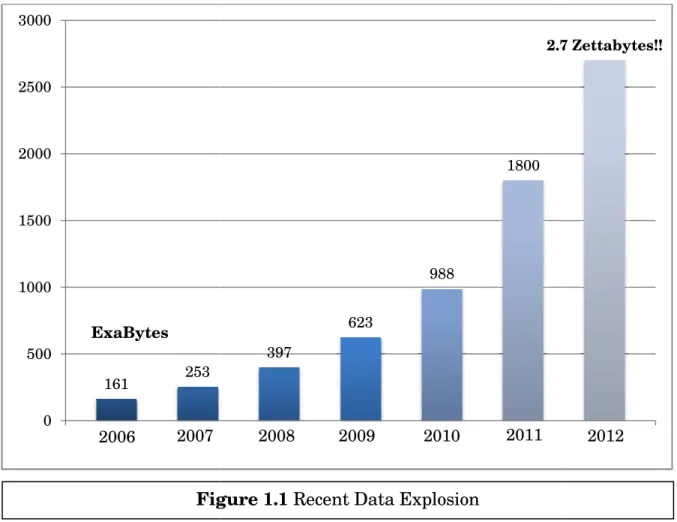
We present a statistic of recent data explosion to have an idea of ‘Big Data’ scenario in today’s world. [2] [3]
Also, to remember, data size is not the only issue to focus on. Instead of structured data, the variety of data types is increasing, namely unstructured text
and semi-structured data like social media data, location data. So, big web enterprises also need a ‘Distributed d
‘Centralized database’. 161 253 0 500 1000 1500 2000 2500 3000 2006 2007 ExaBytes Figure 1.1
tatistic of recent data explosion to have an idea of ‘Big Data’ scenario
Also, to remember, data size is not the only issue to focus on. Instead of structured variety of data types is increasing, namely unstructured text
structured data like social media data, location-based data, and log rises also need a ‘Distributed database’ instead of the
397 623 988 1800 2.7 Zettabytes!! 2008 2009 2010 2011
Figure 1.1 Recent Data Explosion
tatistic of recent data explosion to have an idea of ‘Big Data’ scenario
Also, to remember, data size is not the only issue to focus on. Instead of structured variety of data types is increasing, namely unstructured text-based data based data, and log-file atabase’ instead of the
2.7 Zettabytes!!
1.2 Motivation
The background situation forces big web enterprises to think for a new database solution as traditional SQL database is not natively suited for cloud environment. A popular trend that is named as ‘NOSQL’ is emerging to solve the limits of SQL database. NOSQL breaks the one-eyed rule of relational database.
Also, we find new frameworks and analytic approaches are evolving rapidly. The most popular framework now-a-days is ‘Hadoop’. Another special framework is ‘Hive’, which works as a wrapper on top of ‘Hadoop’.
The evolving technologies motivates us to make research on back-end section of cloud computing.
In this paper, we aim to explore different branches of NOSQL database and make an experiment on ‘Hadoop’ and ‘Hive’ framework.
1.3
Thesis Outline
Chapter 2
This chapter analyzes different characteristics of two main types of cloud databases and conducts a comparison study to choose the better database tool.
Chapter 3
This chapter analyzes different categories of chosen database approach ‘NOSQL’ and presents a case study on performance benchmarking of 3 popular NOSQL databases, namely, MongoDB, Cassandra and HBase.
Chapter 4
This chapter investigates on the best knowing Data Management Framework, namely, Hadoop and its Programming Model – MapReduce.
Chapter 5
This chapter investigates on a Data Warehouse System – Hive, which is known to be used in Facebook which also solves the complex query procedure of Hadoop by using a SQL-like language that is named as HiveQL.
Chapter 6
This chapter summarizes our thesis work and gives an idea about our future plan. Appendix
Appendix points out the implementation and configuration work on Hadoop and Hive.
Chapter 2
Cloud Data Storage Models
In this chapter, we will identify the available cloud data storage models and analyze their characteristics to pick the appropriate database approach for ‘Big Data’
evolution.
2.1 Available Cloud Data Storage Models
We set forth the approaches for cloud database to be counted as two main types –
1. SQL database model or RDBMS (Relational Database Management System) 2. NOSQL database model.
The traditional database model is SQL-based. It is known as RDBMS which has been around for more than 40 years and invented in 1970 by IBMer Edgar Codd. The main property of SQL database is that it uses relational algebra.
The second option for database choice is NOSQL. The acronym ‘NoSQL’ was first coined in 1998 by Carlo Strozzi [4]. NOSQL does not mean “No SQL”; it rather means “Not Only SQL”. And the SQL word represents the relational databases, not the SQL language [5]. The idea for emerging this database is that both technologies can coexist and each has its place.
2.2
Properties of SQL Database
SQL database has 3 major characteristics –
1. Fixed Schema 2. Relational Algebra 3. Query Language – SQL
In the following discussion, we briefly explain each of these properties.
2.2.1 Fixed Schema
SQL database follows a fixed schema condition. The term ‘Fixed Schema’ means - every requirements of database model have to be predefined [6].
2.2.2 Relational Algebra
As we have stated before, this the most import property of SQL database. The Relational Database Model states that - All information must be held in the form of a table. A table describes a specific entity type, and all attributes of a specific record are listed under an entity type. Each individual record is represented as a row, and an attribute as a column. Relations are represented as tables in the database through JOIN operation.
2.2.3 Query Language – SQL
The SQL database uses SQL as query language. SQL states for – Structured Query Language.
Example of SQL databases are: MySQL, Oracle, Microsoft SQL Server, PostgreSQL, IBM etc.
2.3
Properties of NOSQL Database
NOSQL database is quite different from SQL database in some significant ways. We find 4 major characteristics of NOSQL database –
1. Flexible Schema
2. Non-Relational Database 3. Simple Key-Value Stores
In the following discussion, we briefly explain each of these properties.
2.3.1 Flexible Schema
Flexible schema means - the schema can be changed according to the need for design and is defined by the program or data itself. So, conditions need not to predefine. NoSQL database systems are developed to manage large volumes of data. It follows the ‘Flexible Schema’ property.
2.3.2 Non-Relational Database
NOSQL is known as ‘Non-Relational’ database. Here, the term -‘Non-Relational’ does not mean “has no relations” or “cannot be described in terms of relational algebra.” It means - “is not based on Edger Codd’s relational database model”. [7] What a non-relational database does not do is - organize its data in related tables [8]. It does not have any ‘JOIN’ operations or constraints (i.e. NOT NULL) and does not require having ‘Normalizing’ format.
We present an example of ‘Non-Relational Database’ to the contrary of ‘Relational Database’ –
that stores comments. A JOIN is then required to pull out all the comments along with a particular post. Each time, the relational database needs to define the relation through JOIN and other constraints.
On the other hand, NOSQL database does not require defining relations through constraints. With a non-relational database, one “collection” (the non-relational version of a table) would store all of the posts. Each comment associated with a post would be stored as part of that post’s record within the collection. This means that one record (or “document”, in non-relational terms) might contain just the post and no comments, another record might contain a much longer post and hundreds of comments. The benefit is that when we go to retrieve an individual post, we are automatically retrieving all the associated information (e.g., the comments for that post).
2.3.3 Simple Key-Value Stores
NOSQL database is simple Key-Value Stores. It makes the data retrieving more efficient. The Key-Value Store idea is more like ‘Array Indexing’. For example, in a web service, a name is just a key and the whole data can be retrieved according to the name.
Example of NOSQL databases are: MongoDB, Cassandra, HBase etc. So, here we summarized the properties of SQL and NOSQL database.
Now, in our next section, we conduct a comparison study on both database models to find the better suited database approach for cloud computing.
2.4
A Comparison Study – SQL vs. NOSQL
This section analyzes the issues on ‘SQL vs. NOSQL Debate’. We consider 4 issues –
1. Schema
2. ACID vs. BASE Property 3. CAP Theorem
4. Scalability
In the following sub-sections, we made comparison on each issue.
2.4.1 1st Issue – Schema
SQL database follows ‘Fixed Schema’. On the other hand, NOSQL database follows ‘Flexible Schema’.
We find NOSQL database as the preferred solution for cloud computing. Our reasons for supporting NOSQL database are given below –
1. Huge Data Size
This is the era of ‘Big Data’ where size of data is changing rapidly. We can we can think of Twitter as example. When it started out, it just collected bare-bones information with each tweet: the tweet itself, the Twitter handle, a timestamp, and a few other bits. Over its five-year history, though, lots of metadata has been added. A tweet may be 140 characters at most, but a couple KB is actually sent to the server, and all of this is saved in the database [9]. So, preparing a huge and fixed schema is quite impractical in such case.
2. Continuously Changing Data Type
consideration. Modern applications frequently deal with unstructured data: blog posts, web pages, voice transcripts, and other data objects that are essentially text. It is impossible to predict how data will be used, or what additional data these applications will need - as the project unfolds. For example, many applications are now annotating their data with geographic information: latitudes and longitudes, addresses. That almost certainly wasn’t part of the initial data design. So, all these requirements cannot be predefined and thus, flexible schema is suitable in this case.
NOSQL has flexible schema as schema can be changed according to the need for design and is defined by the program or data itself. So, NOSQL is the better choice as database model in this case.
2.4.2 2nd Issue – ACID vs. BASE Property
SQL database has ACID Property. On the other hand, NOSQL database has the BASE property.
First, we describe each property here. ACID Property
ACID stands for Atomicity, Consistency, Isolation and Durability. This property says that database transactions should be –
A
tomic: Everything in a transaction succeeds or the entire transaction is rolled back. [10]
C
onsistent: A transaction cannot leave the database in an inconsistent state.
I
solated: Transactions cannot interfere with each other.BASE Property
BASE stands for Basically Available, Soft State and Eventual Consistency.
•
B
asicA
vailability:This constraint states that the system does guarantee the availability of the data; there will be a response to any request. But, that response could still be ‘failure’ to obtain the requested data or the data may be in an inconsistent or changing state, much like waiting for a check to clear in anyone’s bank account. [11]
•
S
oft-state:The state of the system could change over time, so even during times without input there may be changes going on due to ‘eventual consistency,’ thus the state of the system is always ‘soft.’
•
E
ventual consistency:The system will eventually become consistent once it stops receiving input. The data will propagate to everywhere it should sooner or later, but the system will continue to receive input and is not checking the consistency of every transaction before it moves onto the next one.
The above description summarizes that - ACID compromises with ‘Availability’ for the sake of ‘Consistency’. To the contrary, BASE compromises with ‘Consistency’ for the sake of ‘Availability’.
Now, it depends on the type of application that which property we should give priority. Here, we are considering cloud computing environment where modern applications mostly need ‘Availability’ even if have to compromise with
‘Consistency’. We state an example for better understanding of the scenario – Let’s consider, we run an online book store and proudly display how many of each book we have in your inventory. Every time someone is in the process of
buying a book, we lock part of the database until they finish so that all visitors around the world will see accurate inventory numbers. That works well if we run a small shop but not to run Amazon.com.
Amazon might instead use cached data. Users would not see not the
inventory count at this second, but what it was say an hour ago when the last snapshot was taken. Also, Amazon might violate the “I” in ACID by
tolerating a small probability that simultaneous transactions could interfere with each other. For example, two customers might both believe that they just purchased the last copy of a certain book. The company might risk
having to apologize to one of the two customers (and maybe compensate them with a gift card) rather than slowing down their site and irritating myriad other customers.
So, considering the cloud computing scenario, NOSQL is better over SQL again. A question can arise here that “Why can’t we have both ‘Consistency’ and
‘Availability’ at the same time?” We explain the answer in the next section through CAP theorem.
2.4.3 3rd Issue – CAP Theorem
CAP theorem was first coined by Eric Brewer in the year 2000 [12]. CAP stands for –
•
C
onsistency:All nodes see the same data at the same time.
•
A
vailability:Guarantee that every request receives a response about whether it was successful or failed.
•
P
artition Tolerance:The system continues to operate despite arbitrary message loss or failure of part of the system.So,operations will complete, even if individual
components are unavailable. The theorem states that -
“A distributed system cannot ensure all three of the following properties at once. Web services can pick at most 2 out of these 3 requirements at a time.”
So, there are 3 options to choose for web services –
1. CA – Consistency & Availability
2. CP – Consistency & Partition Tolerance 3. AP –Availability & Partition Tolerance
Here, we analyze each scenario by giving example [13] –
1. Scenario – 1: CA (Sacrificing Partition Tolerance)
On each of the three nodes, we will only store a subset of the user profiles. This is called sharding. Node one will have users A-H, node two I-S, and node three T-Z. As long as each node is up and running, we have achieved a three
times higher throughput than with a single node as each node only server a third of the traffic (assuming of course that user profile querying and
updating is uniformly distributed through the alphabet). Consistency is achieved because immediately after data is written, it is accessible. Availability is achieved because each server is accessible in real time. However, we have lost the concept of partition tolerance as the disabling of one server has rendered a certain section of users unreachable. This carries the notion that upon hardware failure, data could have permanently been lost. All in all, not a good sacrifice under cloud environment.
2. Scenario – 2: CP (Sacrificing Availability)
On each of the three nodes, we will store all the user profiles. And
furthermore, to guarantee data consistency and data loss prevention, we will ensure that every write into the system happens on all three nodes before it is completed. So, if were to update a profile for Bob McBob, any subsequent queries or writes on Bob McBob’s profile would be blocked until the update has completed. Even worse is when one of the nodes is lost but the
requirement of three writes is still required, our entire system is unavailable until it is restored. This means that while our data is consistent and
protected, we have sacrificed the availability of the data. This can be a reasonable sacrifice for cloud environment.
3. Scenario – 3: AP (Sacrificing Consistency)
On each of the three nodes, we will store all the user profiles. However (and different than scenario B), we will acknowledge a completed write
immediately and not wait for the other two nodes. This means that if a read comes in on node two for data written on node one, it may or may not be up-to-date depending on the latency of replication. We are still highly available
and still partition tolerant (with respect to the latency it takes to replicate to another second node). This is also a satisfying scenario under cloud
environment.
Now, our aim was to select either SQL database or NOSQL database. We find that SQL database picks ‘CA’ property following CAP theorem. So, it sacrifices the most important property for a ‘Distributed Database’ that is – ‘Partition Tolerance’. On the other hand, NOSQL database sacrifices either ‘Consistency’ or ‘Availability’ and picks between ‘CP’ and ‘AP’.
Cloud computing technology is built upon the idea of ‘Distributed Database’. So, if ‘Partition tolerance’ is not ensured then cloud technology will not survive. So, ‘CA’ is not a preferred choice for web services and they are forced to choose between ‘CP’ and ‘AP’.
That makes the conclusion that according to CAP theorem; again, NOSQL database wins over SQL database.
2.4.4 4th Issue – Scalability
Scalability means the capability to cope and perform under an increased or expanding workload.
A system that scales well will be able to maintain or even increase its level of performance or efficiency when tested by larger operational demands [14]. That is one of the fundamental requirement of cloud computing. So, ‘Scalability’ is considered as a major issue while choosing cloud database.
We can have 2 types of scalability –
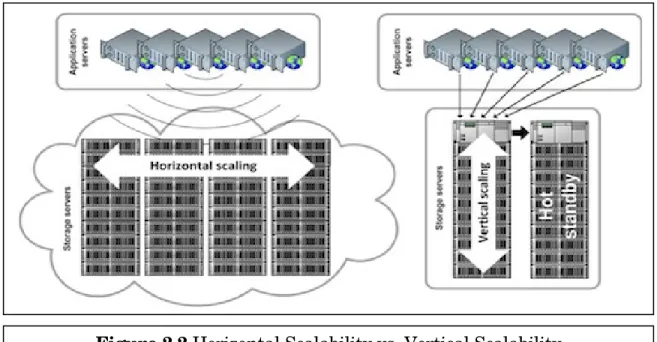
1. Horizontal Scalability or Scale Out
Horizontal Scalability means adding more individual units of resource doing the same job (add an extra node to the cluster).
2. Vertical Scalability or Scale Up
Vertical Scalability means taking a single unit of resource (i.e. RAM) and making it larger.
‘Horizontal Scalability’ is said to be the better scalability option as we can scale indefinitely. On the other hand, ‘Vertical Scalability’ always runs into limits as increasing performance of a single node server has a finite level.
Now, to pick the right database, we analyze the ‘Horizontal Scalability’ performance between SQL and NOSQL database. We find that the fundamental option to gain ‘horizontal scalability’ in a distributed system is – ‘Sharding’. ‘Database Sharding’ can be simply defined as a ‘shared-nothing’ partitioning scheme. If we think of broken glass, we can get the concept of sharding - breaking our database down into smaller chunks called ‘shards’ and spreading those across a number of distributed servers. Sharding can be achieved in 2 ways –
1. Sharding Manually: SQL database shard manually.
2. Sharding Automatically: NOSQL database shard automatically. Figure 2.2 Horizontal Scalability vs. Vertical Scalability
Between the 2 types of sharding, it is found obvious that ‘Automatic Sharding’ is preferred for a distributed system.
1. SQL database cannot shard automatically because of its table In SQL, multiple tables may be locked for modification
those tables are spread across multiple shards/servers, it'll take more time to acquire the appropriate locks, update the data and release the locks. So, scalability is not well achieved in SQL database.
2. To the contrary, a NOSQL datab
does not distribute a logical entity across multiple tables; it’s always stor one place. They do not enforce referential integrity between these logical entities. They only enforce consistency inside a single entity and sometimes not even that.
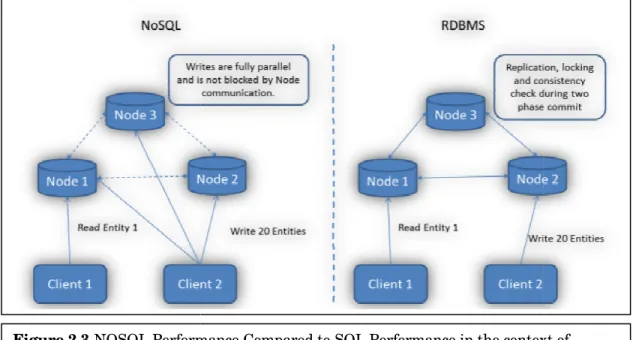
Here, we present an example to show the scenario how ‘Automatic Sharding’ enables NOSQL database to scale in a better way.
If we were to write 20 entities to a database cluster with 3
Figure 2.3 NOSQL Performance Compared to SQL Performance in the context of ‘Relational Property’ of SQL Database
Between the 2 types of sharding, it is found obvious that ‘Automatic Sharding’ is preferred for a distributed system. But –
SQL database cannot shard automatically because of its table-based nature. multiple tables may be locked for modification during transaction
those tables are spread across multiple shards/servers, it'll take more time to priate locks, update the data and release the locks. So, scalability is not well achieved in SQL database.
To the contrary, a NOSQL database shard automatically as this database does not distribute a logical entity across multiple tables; it’s always stor one place. They do not enforce referential integrity between these logical entities. They only enforce consistency inside a single entity and sometimes Here, we present an example to show the scenario how ‘Automatic Sharding’ enables
OSQL database to scale in a better way.
f we were to write 20 entities to a database cluster with 3 nodes [15] –
NOSQL Performance Compared to SQL Performance in the context of ‘Relational Property’ of SQL Database
Between the 2 types of sharding, it is found obvious that ‘Automatic Sharding’ is based nature.
during transaction. If those tables are spread across multiple shards/servers, it'll take more time to
priate locks, update the data and release the locks. So, ase shard automatically as this database does not distribute a logical entity across multiple tables; it’s always stored in one place. They do not enforce referential integrity between these logical entities. They only enforce consistency inside a single entity and sometimes Here, we present an example to show the scenario how ‘Automatic Sharding’ enables
In NoSQL
We can write independently on all three nodes because the database does not need to synchronize between the nodes.
Client 1 might see changes on Node 1 before Client 2 has written all 20 entities because there’s no need for a two-phase commit.
In SQL
A distributed RDBMS solution on the other hand needs to enforce ACID consistency across all three nodes:
RDBMS needs to read data from other nodes in order to ensure referential integrity because of synchronization.
Until all three nodes acknowledged a two phase commit, Client 1 will either not see any or will be blocked until that happened.
All these happens during the transaction and blocks Client 2.
So, it can be concluded that though SQL database can have manual sharding but it does not give good performance because of its table-based nature. On the other hand, NOSQL does not follow ‘Relational’ concept, so, it can provide better performance. So, NOSQL is our preferred choice under the issue of ‘Scalability’.
2.5
Chosen Database Approach – NOSQL
For all the above 4 issues of ‘Schema’, ‘ACID vs. BASE Property’, ‘CAP Theorem’ and ‘Scalability’ we find that NOSQL wins in all cases.
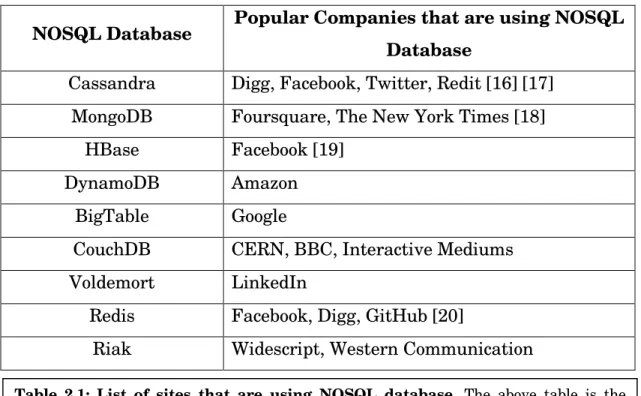
Also, we present a table to show the list of popular big web sites that use NOSQL database as their database approach.
NOSQL Database Popular Companies that are using NOSQL Database
Cassandra Digg, Facebook, Twitter, Redit [16] [17] MongoDB Foursquare, The New York Times [18]
HBase Facebook [19] DynamoDB Amazon
BigTable Google
CouchDB CERN, BBC, Interactive Mediums Voldemort LinkedIn
Redis Facebook, Digg, GitHub [20]
Riak Widescript, Western Communication
Most of the big websites have moved to NOSQL database. So, we select NOSQL as our preferred database approach for cloud computing and aim to make further investigation on NOSQL.
Table 2.1: List of sites that are using NOSQL database. The above table is the mirror reflection of importance of NOSQL database in cloud computing.
Chapter 3
The NOSQL Movement
The comparison study on ‘SQL vs. NOSQL’ leads us to enter into a new world of NOSQL database – a world that is built with non-relational concept. In this chapter, we aim to explore different branches of NOSQL database and show a performance analysis on 3 popular NOSQL databases in the context of cloud computing needs.
3.1 Classification of NOSQL Database Models
To understand the vast arena of NOSQL database concept, we first go through the possible categories of this database model.
NOSQL data stores can be classified into four [21] main categories:
1. Key-value Stores 2. Column Family Stores 3. Document Databases 4. Graph Databases
In the following sub-sections, each category is briefly described in the order of database model concept, example application, available NOSQL databases, strengths and weaknesses.
3.1.1 Key-value Stores
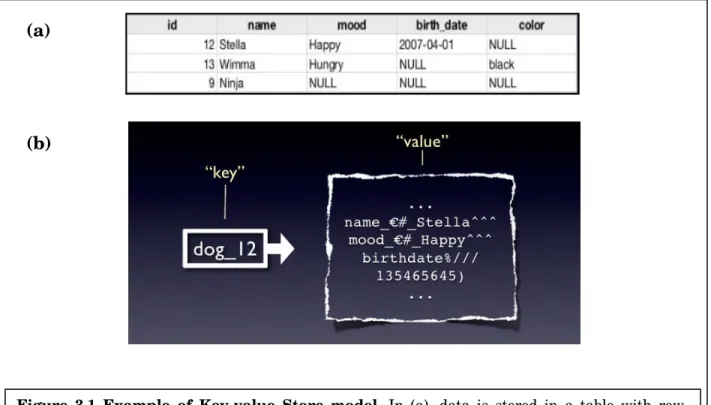
Key-Value stores are considered as the most ubiquitous technology under the NoSQL banner. The main idea here is using a hash table where there is a unique key and a pointer to a particular item of data. [22]
Typical Applications Content caching (Focus on scaling to huge amounts of data, designed to handle massive load), logging, etc. Database Examples DynamoDB,Redis, Voldemort.
Strengths Fast lookups
Weaknesses Stored data has no schema (a)
Figure 3.1 Example of Key-value Store model. In (a), data is stored in a table with row-column property in SQL database. In (b), each value has a unique key to store and retrieve data in Key-value Store database.
(b)
3.1.2 Document Databases
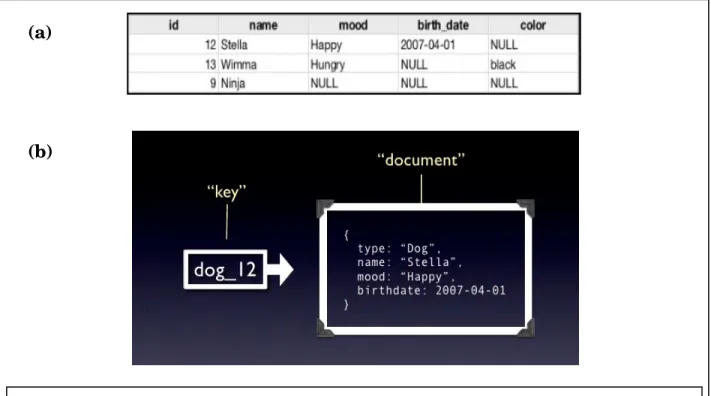
Document databases are essentially the next level of Key/value. The model is basically versioned documents that are collections of other key-value collections. The semi-structured documents are stored in formats like JSON. Document database allows nested values associated with each key that is not done in ‘Key-value Stores’ case. For that advantage, Document databases support querying more efficiently.
Typical Applications Web applications (Similar to Key-Value stores, but the DB knows what the Value is)
Database Examples CouchDB, MongoDB
Strengths Tolerant of incomplete data [23] Weaknesses No standard query syntax
(a)
(b)
Figure 3.2 Example of Document Databases model. In (a), data is stored in a table with row-column property in SQL database. In (b), each unique key stores the whole document with nested collections of key-value.
3.1.3 Column Family Stores
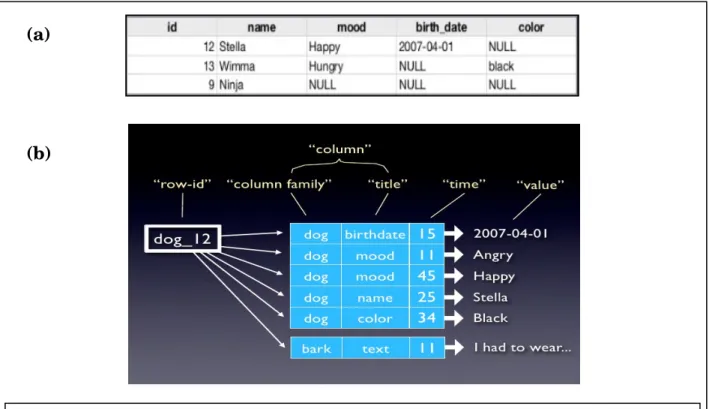
Column Family Stores were created to store and process very large amounts of data distributed over many machines. Like the concept of ‘Key-value Stores’, there are still keys but they point to multiple columns. Then, the columns are arranged by column family.
Typical Applications Distributed file systems
Database Examples Cassandra, HBase, BigTable, HyperTable Strengths Fast lookups, good distributed storage of data Weaknesses Very low-level API
(a)
(b)
Figure 3.3 Example of Column Family Stores model. In (a), data is stored in a table with row-column property in SQL database. In (b), each unique key points to multiple columns.
3.1.4 Graph Databases
“Relational database is a collection loosely connected tables” whereas “Graph is a multi-relational graph.” The main drawback of SQL database is that – each time we have to define relationship between tables by using constraints because of its rigid structure of tables and row-columns. So, relationships are weak in SQL database. Graph databases solve the problem as relationships are first class citizen for these databases. In this category of NOSQL database, a flexible graph model is used which, again, can scale across multiple machines and can map data using relations.
(a)
(b)
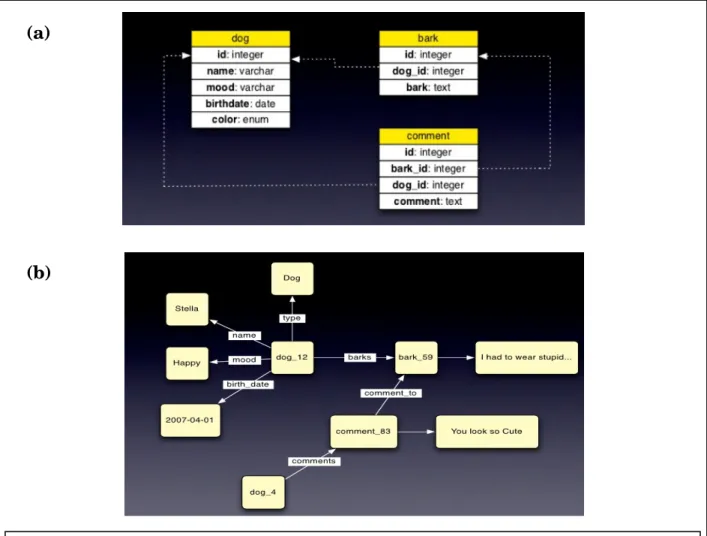
Figure 3.4 Example of Graph Databases model. In (a), a schema for Figure 3.1 (a) is drawn to show the rigid relationship between tables in SQL database. In (b), a Graph database model is drawn to show the flexibility of relationships. [24]
3.2
A Case of Study: Evaluating NOSQL Performance using
YCSB Benchmark Results
In the previous section, we presented a brief introduction on NOSQL database. The immense field of NOSQL technology, coupled with a lack of apples-to-apples performance comparisons, makes it difficult to understand the tradeoffs between systems and the workloads for which they are suited. So, in our case study we aim to measure performance of some selected NoSQL products and to determine the best use cases of each product for different internet services.
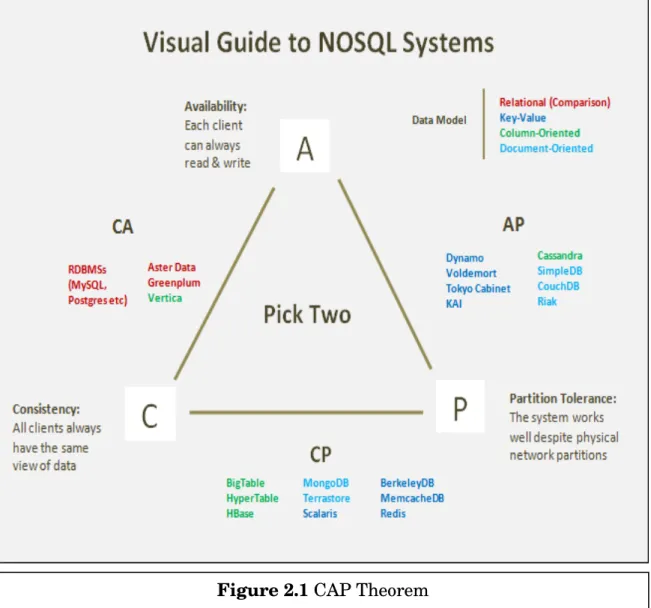
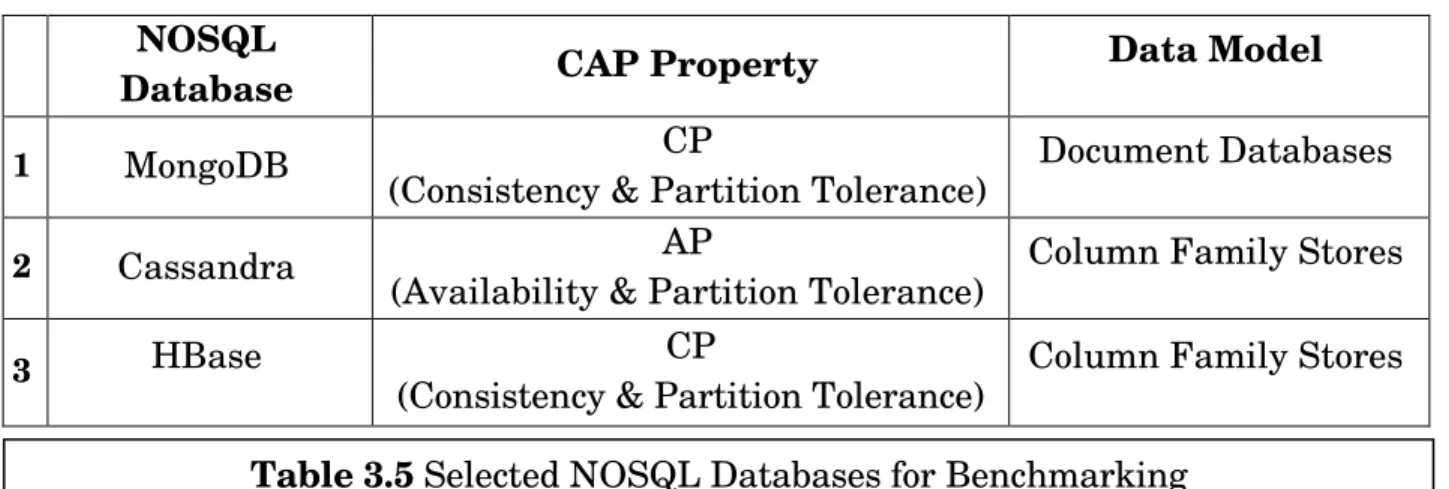
We selected 3 NOSQL databases to conduct study by recollecting popular CAP theorem image by Eric Brewer.
Typical Applications Social networking, Recommendations (Focus on modeling the structure of data – interconnectivity) Database Examples Neo4J, InfoGrid, Infinite Graph
Strengths Graph algorithms e.g. shortest path, connectedness, n degree relationships, etc.
Weaknesses Has to traverse the entire graph to achieve a definitive answer. Not easy to cluster.
NOSQL
Database CAP Property
Data Model
1 MongoDB CP
(Consistency & Partition Tolerance)
Document Databases
2 Cassandra AP
(Availability & Partition Tolerance)
Column Family Stores
3 HBase CP
(Consistency & Partition Tolerance)
Column Family Stores Table 3.4 Graph Databases Use Case
3.2.1 Test Framework: YCSB
To analyze performance of our selected NOSQL databases, we choose to consider the benchmark test results of “Yahoo! Cloud Serving Benchmark” (YCSB) framework. The tool was first invented by 'Yahoo! in the year 2010 [25]. This tool allows benchmarking multiple systems and comparing them by creating “work loads”. Using this tool, one can install multiple systems on the same hardware configuration, and run the same workloads against each system. Then it is possible to plot the performance of each system (for example, as latency versus throughput curves) to see when one system does better than another. [26]
YCSB currently supports - Cassandra, HBase, MongoDB, Voldemort and JDBC. In this section, we give an overview on YCSB work procedure.
YCSB Architecture
The YCSB Client is a Java program for generating the data to be loaded to the database, and generating the operations which make up the workload.
YCSB has four types of operations– 1. Insert
2. Update 3. Read and 4. Scan.
The architecture of the client is shown in Figure 3.5. DB Interface Layer
YCSB Client uses the DB interface layer to send commands to the configured database i.e. Cassandra.
Workload Executor
The Workload defines the data that can be loaded and executed in two executable phases:
1. The Loading phase, which defines the data to be inserted and
2. The Transactions phase, which defines the operations to be executed against the data set. [27]
Interaction between Workload Executor and DB Interface Layer 1. Workload executor drives multiple client threads.
2. Each thread executes a sequential series of operations by making calls to the database interface layer, both to load the database (the load phase) and to execute the workload (the transaction phase).
3. At the end of the experiment, the statistics module aggregates the measurements and reports average, 95th and 99th percentile latencies, and either a histogram or time series of the latencies.
3.2.2 YCSB Benchmark Results
The YCSB Benchmark Test Case that we analyzed has some system specifications. Selected Versions of Databases
1. MongoDB-1.8.1 2. Cassandra-0.7.4 3. HBase-0.90.2
Test Cases
The benchmark is conducted on the basis of three test cases [28] –
1. Insert Only 2. Read Only 3. Read & Update
Test Workload
The test workload is as follows. Insert Only
Enter 50 million 1K-sized records to the empty DB. Read Only
Search the key in the Zipfian Distribution1 for a one hour period on the DB
that contains 50 million 1K-sized records. Read & Update
Conduct ‘Read & Update’ one-on-one instead of ‘Read’ under the identical conditions of ‘Read Only’.
1 The Zipf distribution, sometimes referred to as the zeta distribution, is a discrete distribution commonly used in linguistics, insurance, and the modeling of rare events.
Test Results
The benchmark test results are shown in the
10000 15000 20000 25000 10000 15000 20000 25000 10000 15000 20000 25000
Figure 3.6 YCSB Benchmark Test Results.
In (a), the performance of 3 databases are shown for test case In (b), the performances of 3 databases are shown for test case In (c), the performances of 3 databases are shown for test case
(a) Insert Only
(b) Read Only
(c) Read & Update
results are shown in the following figure.
5663 21179 10783 0 5000 10000 15000 20000 25000 1260 2310 2853 0 5000 10000 15000 20000 25000 281 3224 2389 0 5000 10000 15000 20000 25000
Figure 3.6 YCSB Benchmark Test Results.
In (a), the performance of 3 databases are shown for test case – Insert Only. In (b), the performances of 3 databases are shown for test case – Read Only. In (c), the performances of 3 databases are shown for test case – Read & Update.
MongoDB Cassandra HBase MongoDB Cassandra HBase MongoDB Cassandra HBase Insert Only. Read Only. Read & Update.
3.2.3 Summary of Benchmark Test Result
We summarize the benchmark test result in 3 test cases.
The benchmark test concludes the following comparison results –
1. ‘Read Only’ and ‘Read & Update’ are much slower than ‘Insert Only’ operations in these NoSQL solutions.
2. Cassandra’s performance in ‘Insert Only’ and ‘Read & Update’ was better than the other two products. But Cassandrais slower in reading than writing.
3. HBase’s performance was better than Cassandra in ‘Read Only’. HBase also shows relatively good performance in ‘Insert Only’ and ‘Read & Update’.
4. MongoDB’s throughput in all three conditions was the lowest of the three products.
In the next section, we examine the reason behind the performance variation of each database.
Test Case MongoDB Performance Cassandra Performance HBase Performance 1. Insert Only Satisfactory but lowest amongst 3 databases Outstanding
throughput Relatively Good 2. Read Only
Lowest amongst 3 databases
Relatively Good Highest amongst 3 databases 3. Read & Update
Lowest amongst 3 databases Highest amongst 3 databases Relatively Good Table 3.6 Summary of YCSB Benchmark Test Result
3.3
Benchmark Result Analysis
The benchmark test in the previous section gave different performance result for the three databases and we summarized the result with 4 conclusions. In this section, we aim to analyze each result case in the context of Insert/Write and Read operations for the 3 selected databases – Cassandra, HBase and MongoDB.
3.3.1 Result Case – 1:
‘Read Only’ and ‘Read & Update’ Operation are much Slower than ‘Insert Only’ operation
Both Cassandra and HBase follow Column Family Stores Data model. Internal architecture of these databases is based on Google’s BigTable model, although, Cassandra was directly influenced by Amazon’s Dynamo. So, we analyze this result case in the context of BigTable’s internal structure.
BigTable Data Model
BigTable is a Column
Multidimensional Sorted Map format and has the column key> data structure.
Column family is a basic unit that stores data with column groups that are related to each other.
(i.e. one file per column family), and physically sort the order of data by
column name and timestamp
that a disk block size can store more data. On the other hand, since data within a column family usually has a similar pattern, data compression can be very effective.
Based on this data model, BigTable conducts its Write/Read operations. Now, from the architectural perspective, we identify the reason of performance difference Write/Read operation for Cassandra and HBase.
Figure 3.7 Column
BigTable Data Model
is a Column-Oriented Database that stores data in a Multidimensional Sorted Map format and has the <row key, column family,
data structure.
is a basic unit that stores data with column groups that are related to each other. BigTable store each column family contiguously on disk
one file per column family), and physically sort the order of data by
column name and timestamp. After that, the sorted data will be compressed so that a disk block size can store more data. On the other hand, since data within a column family usually has a similar pattern, data compression can be
Based on this data model, BigTable conducts its Write/Read operations. Now, from the architectural perspective, we identify the reason of performance difference
Cassandra and HBase.
Column-Oriented Database Model of BigTable
that stores data in a <row key, column family,
is a basic unit that stores data with column groups that are contiguously on disk one file per column family), and physically sort the order of data by row id,
. After that, the sorted data will be compressed so that a disk block size can store more data. On the other hand, since data within a column family usually has a similar pattern, data compression can be
Based on this data model, BigTable conducts its Write/Read operations. Now, from the architectural perspective, we identify the reason of performance difference in
Write Operation in BigTable
Figure 3.7 shows the internal structure of Write/Read path in BigTable –
BigTable model is highly optimized for write operation with sequential write. In BigTable, data is written basically with the append method. In other words, when modifying data, the updates are appended to a file, rather than an in-place update in the stored file.
Write operation is completed in 2 steps –
1. When a write operation is inserted, it is first placed in a memory space called memtable. All the latest update therefore will be stored at the
memtable at first.
2. If the memtable is full, then the whole data is stored in a file called
SSTable (Sorted String Table). The table is sorted by String key. Over a period of time there will be multiple SSTables on the disk that store the data.
Read Operation in BigTable
Now, while doing ‘Read’ operation if data is not present in the memtable
1. Whenever a read request is received, the systems will first lookup the Memtable by its ‘row key
2. If not, it will look at the on
We call this the ‘Merged read’ as the system need to look at multiple places for the data. SSTable
detect the absence of the row
returns positive will the system be doing a detail lookup within the SSTable.
Figure 3.8
in BigTable
‘Read’ operation, an extra amount of time is needed because present in the memtable, we need to do ‘Merge Read’
Whenever a read request is received, the systems will first lookup the row key’ to see if it contains the data. [29]
If not, it will look at the on-disk SSTable to see if the row-key is there. We call this the ‘Merged read’ as the system need to look at multiple places
SSTable has a companion Bloom filter such that it can rapidly detect the absence of the row-key. In other words, only when the bloom filter
positive will the system be doing a detail lookup within the SSTable.
Figure 3.8 Read Operation in Google’s BigTable
time is needed because ‘Merge Read’ –
Whenever a read request is received, the systems will first lookup the key is there. We call this the ‘Merged read’ as the system need to look at multiple places
such that it can rapidly the bloom filter positive will the system be doing a detail lookup within the SSTable.
Another concept to improve read efficiency is – ‘Periodic Data Compaction’. As we can imagine, it can be quite inefficient for the read operation when there are too many SSTables scattering around. Therefore, the system periodically merges the SSTable, since, each of the SSTable is individually sorted by key, a simple ‘Merge sort’ is sufficient to merge multiple SSTables into one. The merge mechanism is based on a logarithm property where two SSTable of the same size will be merging into a single SSTable, will doubling the size. Therefore the number of SSTable is proportion to O(logN) where N is the number of rows.
So, we have discussed the issues behind ‘Write’ and ‘Read’ operation. In the case of ‘Write’ operation, at first, data is recorded in the memory and then, moved to the actual disk only after a certain amount has been accumulated. It thus improves the efficiency of ‘Write’ operation. On the other hand, the concept of ‘Merge Read’ and ‘Periodic Data Compaction’ requires extra time to complete ‘Read’ operation.
3.3.2 Result Case – 2:
Cassandra Performance – Faster in Writing than Reading
As we mentioned before, Cassandra additionally uses Amazon’s Dynamo Model along with Google’s BigTable model. Cassandra follows Dynamo’s DHT (distributed hash table) model to partition its data. It is known as ‘Consistent Hashing’.
Through ‘Consistent Hashing’, each machine (node) is associated with a particular id that is distributed in a keyspace (e.g. 128 bit). The entire data element is also associated with a key (in the same key space). The server owns all the data whose key lies between its id and the preceding server's id.
Now, in this analysis, we state the steps that Cassandra goes through to complete ‘Write’ and ‘Read’ operation. Thus, difference between ‘Write’ and ‘Read’
performance will be revealed.
Write Operation in Cassandra
The steps during ‘Write’ operation in Cassandra is as follows
1. Client submits its write request to a single, random Cassandra node. 2. This node acts as a proxy and writes the data to the cluster
of nodes is stored as a “ring” of nodes
3. Now, using the ‘Replication Placement Strategy’ to N nodes. [31]
4. Finally, the node waits for the N successes and the client.
Figure 3.9
n this analysis, we state the steps that Cassandra goes through to complete ’ operation. Thus, difference between ‘Write’ and ‘Read’
performance will be revealed.
Write Operation in Cassandra
The steps during ‘Write’ operation in Cassandra is as follows –
Client submits its write request to a single, random Cassandra node. This node acts as a proxy and writes the data to the cluster
of nodes is stored as a “ring” of nodes.
Replication Placement Strategy’,writes are replicated Finally, the node waits for the N successes and then returns success to the
Figure 3.9 Simple Partition Strategies in Cassandra
n this analysis, we state the steps that Cassandra goes through to complete ’ operation. Thus, difference between ‘Write’ and ‘Read’
Client submits its write request to a single, random Cassandra node. [30] where cluster rites are replicated n returns success to the
In case any node is failed, the write operation can be retried at a later using ‘Hinted handoff’. According to this process, the failed operation will pick a random node as a handoff node and write the request with a hint telling it to forward the write request back to the failed node after it recovers. The
handoff node will then periodically check for the recovery of the failed node and forward the write to it. Therefore, the original node will eventually receive the entire write request.
In this way, Cassandra performs a faster ‘Write’ operation that ensures ‘Availability’ (Figure 2.1: CAP Theorem).
Read Operation in Cassandra
The steps during ‘Write’ operation in Cassandra is as follows – 1. A client makes a read request to a random node. [32]
2. The node acts as a proxy determining the nodes having copies of data. 3. The node requests the corresponding data from each node.
4. Now, while returning data, Cassandra allows the client to select the strength of the read consistency –
Single read: The proxy returns the first response it gets. This can easily return stale data. [33]
Quorum read: The proxy waits for a majority to respond with the same value.
5. Finally, a value will be returned to client and thus, ‘Read’ operation is completed.
In the background, the proxy also performs ‘Read Repair’ on any inconsistent responses. According to that method, when the client performs
a ‘Read’, the proxy node will issue N reads but only wait for R copies of responses and return the one with the latest version. In case some nodes respond with an older version, the proxy node will send the latest version to them asynchronously; hence these left-behind nodes will still eventually catch up with the latest version.
We state an example here. For example, we have a key “A” with a value of “123” in our cluster. Now we update “A” to be “456”. The write is sent to N different nodes, each of which takes some time to write the value. Now we ask for a read of “A”. Some of those nodes might still have “123” for the value while others have “456”. They will all eventually return “456”. This is also known as ‘Eventual Consistency’.
The situation in ‘Quorum Read’ makes it much more difficult to get stale data but this is the reason why ‘Read’ operation in Cassandra tends to be slower than ‘Write’ operation.
So, we have discussed the issues behind ‘Write’ and ‘Read’ operation. Since the success of replicated writing is not guaranteed, the data suitability is checked in the reading stage. That makes Cassandra to give slower performance in ‘Read’ operation than ‘Write’ operation.
3.3.3 Result Case – 3:
HBase Performance – Faster in Reading compared to Cassandra
HBase has the same structure as BigTable. Based on the BigTable, HBase uses the Hadoop Distributed File System (HDFS) as its data storage engine. The advantage of this approach is then HBase doesn't need to worry about data replication, data consistency and resiliency because HDFS has handled it already.
So far we have analyzed that Cassandra is faster in ‘Write’ operation than ‘Read’ operation. But Figure 3.6(b) shows that HBase has better performance in ‘Read’ operation than Cassandra. So, in this section, we aim to identify the reason for what HBase shows the faster performance in ‘Reading’ than Cassandra by analyzing both ‘Write’ and ‘Read’ paths of HBase Memstore.
Write Operation in HBase
The ‘Write’ paths in HBase can be described as follows –
RegionServer (RS) receives write request and it directs the request to specific Region. [34]
Each Region stores set of rows. Rows data can be separated in multiple Column Families (CFs).
Data of particular CF is stored in HStore which consists of Memstore and a set of HFiles.
Memstore is kept in RS main memory, while HFiles are written to HDFS.
When write request is processed, data is first written into the Memstore. Then, when certain thresholds are met (obviously, main memory is well-limited) Memstore data gets flushed into HFile.
Read Operation in HBase Memstore
The reading end things in HBase are simple –
HBase first checks if requested data is in Memstore, then goes to HFiles and returns merged result to the user.
The discussion concludes that HBase only ‘writes’ on a single region in the beginning, and receives requests on only one node. While ‘reading’, HBase only reads data once. On the other hand, Cassandra reads the data three times to check data suitability. So, ‘Reading’ performance of HBase is faster compared to Cassandra.
3.3.4 Result Case – 4:
MongoDB Performance – Lowest Throughput among the 3 Databases
The benchmark test of YCSB in Section 3.2 shows that MongoDB has the lowest performance in all 3 cases among the 3 databases. We identify the reason behind the scenario in this section –
1. Unlike Cassandra and HBase, MongoDB does not follow ‘Column Family Stores’ data model. Rather, MongoDB uses a ‘Document Database’ model. According to this data model, each key is associated with a nested amount of values. So, memory size plays an important role in MongoDB. MongoDB operates on a memory base and places high performance above data scalability. If reading and writing is conducted within the usable memory, then high-performance is possible. However, performance is not guaranteed if operations exceed the given memory. That is the reason why MongoDB shows poor performance in all 3 cases.
2. However, the MongoDB has been found to record greater performance than Cassandra or HBase, if 300 thousand records are taken instead of 50 million as workload.
So, MongoDB can be used quickly, schema-free when using a certain amount of data. To conclude the performance result, each NOSQL database has its distinct functionalities. MongoDB is used in Foursquare, SourceForge, The New York Times [Table 2.1]. Cassandra is used in social websites like Digg, Facebook, Twitter [Table 2.1]. HBase is also used in Facebook [Table 2.1]. So, every database has usage in cloud computing. All we need to pick the appropriate database tool according to the need of application.
Chapter 4
Big Data Analytics:
Hadoop & MapReduce – A New Challenge
Big data is big news and so too analytics on big data. Technologies for analyzing big data are evolving rapidly and there is significant interest in new analytic approaches such as Hadoop and MapReduce [35]. We analyzed a newly evolving NOSQL database in previous chapter. Now, in this chapter, we aim to make investigation on Hadoop and MapReduce.
4.1
MapReduce
MapReduce is a technique popularized by Google that distributes the processing of very large multi-structured data files across a large cluster of machines [36]. High performance is achieved by breaking the processing into small units of work that can be run in parallel across the hundreds, potentially thousands, of nodes in the cluster.
To quote the seminal paper on MapReduce:
“MapReduce is a programming model and an associated implementation for processing and generating large data sets. Programs written in this
functional style are automatically parallelized and executed on a large cluster of commodity machines. This allows programmers without any experience with parallel and distributed systems to easily utilize the resources of a large distributed system.”
The key point to note from this quote is that MapReduce is a programming model, not a programming language, i.e., it is designed to be used by programmers, rather than business users.
So, if we have to then we can define MapReduce in one sentence as –
“MapReduce is a programming model for automating parallel computing.”
4.1.1 Fundamental Pieces of MapReduce query
There are two fundamental pieces of a MapReduce query – Map
The master node takes the input, chops it up into smaller sub-problems, and distributes those to worker nodes [37]. A worker node may do this again in turn, leading to a multi-level tree structure. The worker node processes that smaller problem, and passes the answer back to its master node.
Reduce
The master node then takes the answers to all the sub-problems and combines them in a way to get the output - the answer to the problem it was originally trying to solve.
Programs written in this functional style are automatically parallelized and executed on a large cluster of commodity machines. The runtime system takes care of the details of partitioning the input data, scheduling the program's execution across a set of machines, handling machine failures, and managing the required inter-machine communication. The user of the MapReduce library expresses the computation as two functions: Map and Reduce. Map, written by the user, takes an input pair and produces a set of intermediate key/value pairs. The MapReduce library groups together all intermediate values associated with the same intermediate key I and passes them to the Reduce function. The Reduce function, also written by the user, accepts an intermediate key I and a set of values for that key. It merges together these values to form a possibly smaller set of values. Typically just zero or one output value is produced per Reduce invocation. The intermediate values are supplied to the user's reduce function via an iterator. This allows handling lists of values that are too large to fit in memory.
4.1.2 MapReduce Usage
MapReduce aids organizations in processing and analyzing large volumes of multi-structured data. Application examples include indexing and search, graph analysis, text analysis, machine learning, data transformation, and so forth. These types of applications are often difficult to implement using the standard SQL employed by relational DBMSs.
The procedural nature of MapReduce makes it easily understood by skilled programmers. It also has the advantage that developers do not have to be concerned with implementing parallel computing – this is handled transparently by the system. Although MapReduce is designed for programmers, non-programmers can exploit the value of prebuilt MapReduce applications and function libraries. Both commercial and open source MapReduce libraries are available that provide a wide range of analytic capabilities. Apache Mahout, for example, is an open source machine-learning library of “algorithms for clustering, classification and batch-based collaborative filtering” that are implemented using MapReduce.
4.1.3 Application Development
MapReduce programs are usually written in Java, but they can also be coded in languages such as C++, Perl, Python, Ruby, R, etc. These programs may process data stored in different file and database systems. At Google, for example, MapReduce was implemented on top of the Google File System (GFS).
One of the main deployment platforms for MapReduce is the open source Hadoop distributed computing framework provided by Apache Software Foundation. Hadoop supports MapReduce processing on several file systems, including the
Hadoop Distributed File System (HDFS), which was motivated by GFS. Hadoop also provides Hive and Pig, which are high-level languages that generate
MapReduce programs. Several vendors offer open source and commercially supported Hadoop distributions; examples include Cloudera, DataStax,
Hortonworks (a spinoff from Yahoo) and MapR. Many of these vendors have added their own extensions and modifications to the Hadoop open source platform.
Another direction of vendors is to support MapReduce processing in relational DBMSs. These are implemented as in-database analytic functions that can be used in SQL statements. These functions are run inside the database system, which enables them to benefit from the parallel processing capabilities of the DBMS. Supported in the Teradata Aster MapReduce Platform, the Aster Database provides a number of built-in MapReduce functions for use with SQL. It also includes an interactive development environment, Aster Developer Express, for programmers to create their own MapReduce functions.
4.2
Hadoop
As we have stated before, Google was the first to publicize MapReduce, a system they had used to scale their data processing needs. This system aroused a lot of interest because many other businesses were facing similar scaling challenges, and it wasn't feasible for everyone to reinvent their own proprietary tool. Doug Cutting2
saw an opportunity and led the charge to develop an open source version of this MapReduce system called Hadoop, Yahoo and others rallied around to support this effort. Today, Hadoop is a core part of the computing infrastructure for many web
2
Douglas Read Cutting is an advocate and creator of open-source search technology. He originated
Lucene and, with Mike Cafarella, Nutch, both open-source search technology projects which are now managed through the Apache Software Foundation.
businesses, such as media and telecom, are beginning to adopt this system too. Here, we describe the fundamental idea of Hadoop.
Hadoop is a generic processing framework designed to execute queries and other batch read operations against massive datasets that can be tens or hundreds of terabytes and even petabytes in size. The data is loaded into or appended to the Hadoop Distributed File System (HDFS). Hadoop then performs brute force scans through the data to produce results that are output into other files. It probably does not qualify as a database since it does not perform updates or any transactional processing. Hadoop also does not support such basic functions as indexing or a SQL interface, although there are additional open source projects underway to add these capabilities.
Hadoop operates on massive datasets by horizontally scaling (aka scaling out) the processing across very large numbers of servers through an approach called MapReduce. Vertical scaling (aka scaling up), i.e., running on the most powerful single server available, is both very expensive and limiting. There is no single server available today or in the foreseeable future that has the necessary power to process so much data in a timely manner.