SPARQLGX: Efficient Distributed Evaluation of
SPARQL with Apache Spark
Damien Graux, Louis Jachiet, Pierre Genev`
es, Nabil Laya¨ıda
To cite this version:
Damien Graux, Louis Jachiet, Pierre Genev`
es, Nabil Laya¨ıda. SPARQLGX: Efficient
Dis-tributed Evaluation of SPARQL with Apache Spark. The 15th International Semantic Web
Conference, Oct 2016, Kobe, Japan.
The 15th International Semantic Web Conference,
<
10.1007/978-3-319-46547-0 9
>
.
<
hal-01344915
>
HAL Id: hal-01344915
https://hal.inria.fr/hal-01344915
Submitted on 12 Jul 2016
HAL
is a multi-disciplinary open access
archive for the deposit and dissemination of
sci-entific research documents, whether they are
pub-lished or not.
The documents may come from
teaching and research institutions in France or
abroad, or from public or private research centers.
L’archive ouverte pluridisciplinaire
HAL
, est
destin´
ee au d´
epˆ
ot et `
a la diffusion de documents
scientifiques de niveau recherche, publi´
es ou non,
´
emanant des ´
etablissements d’enseignement et de
recherche fran¸
cais ou ´
etrangers, des laboratoires
publics ou priv´
es.
SPARQLGX: Efficient Distributed Evaluation of
SPARQL with Apache Spark
Damien Graux312, Louis Jachiet312, Pierre Genev`es213, and Nabil Laya¨ıda123
1 inria, France {damien.graux,louis.jachiet,nabil.layaida}@inria.fr 2 cnrs,lig, France [email protected] 3
Univ. Grenoble Alpes, France
Abstract. sparql is the w3c standard query language for querying data expressed in the Resource Description Framework (rdf). The in-creasing amounts ofrdfdata available raise a major need and research interest in building efficient and scalable distributedsparqlquery eval-uators. In this context, we proposesparqlgx: our implementation of a distributed rdfdatastore based on Apache Spark. sparqlgx is de-signed to leverage existing Hadoop infrastructures for evaluatingsparql queries. sparqlgx relies on a translation of sparql queries into exe-cutable Spark code that adopts evaluation strategies according to (1) the storage method used and (2) statistics on data. We show that
spar-qlgxmakes it possible to evaluatesparqlqueries on billions of triples distributed across multiple nodes, while providing attractive performance figures. We report on experiments which show howsparqlgxcompares to related state-of-the-art implementations and we show that our ap-proach scales better than these systems in terms of supported dataset size. With its simple design,sparqlgxrepresents an interesting alterna-tive in several scenarios.
Keywords: rdfSystem, DistributedsparqlEvaluation
1
Introduction
sparqlis the standard query language for retrieving and manipulating data
rep-resented in the Resource Description Framework (rdf) [11].sparqlconstitutes one key technology of the semantic web and has become very popular since it became an officialw3crecommendation [1].
The construction of efficientsparqlquery evaluators faces several challenges. First, rdf datasets are increasingly large, with some already containing more than a billion triples. To handle efficiently this growing amount of data, we need systems to be distributed and to scale. Furthermore, semantic data often have the characteristic of being dynamic (frequently updated). Thus being able to answer quickly after a change in the input data constitutes a very desirable property for a sparqlevaluator. In this context, we proposesparqlgx: an engine designed
to evaluate sparqlqueries based on Apache Spark [21]: it relies on a compiler of sparql conjunctive queries which generates Scala code that is executed by the Spark infrastructure. The source code of our system is available online from the followingurl:
https://github.com/tyrex-team/sparqlgx
The paper is organized as follows: we first introduce the technologies that we consider in Section 2. Then, in Section 3, we describesparqlgxand present additional available tools in Section 4. Section 5 reports on our experimental validation to compare our implementation with other open source hdfs-based
rdf systems. Finally, we review related works in Section 6 and conclude in Section 7.
2
Background
The Resource Description Framework (rdf) is a language standardized byw3c
to express structured information on the Web as graphs [11]. It models knowledge about arbitrary resources represented by uris (Unique Resource Identifiers), Blank Nodes or Literals.rdfdata is structured in sentences, each one having a subject, a predicate and an object.
The sparql standard language has been studied under various forms and fragments. We focus on the problem of evaluating the Basic Graph Pattern fragment (bgp) over a dataset of rdf triples. The bgpfragment is composed of conjunctions of triple patterns (tps). Eachtpexpresses conditions that must be matched by parts of an rdftriple for it to be selected.
Apache Hadoop1is a framework for distributed systems based on the Map-Reduce paradigm. The Hadoop Distributed File System (hdfs) is a popular distributed file system handling the distribution of data across a cluster and its replication [19].
Apache Spark [21] is a MapReduce-like data-parallel framework designed for large-scale data processing running on top of the jvm. Spark can be set up to usehdfs.
3
SPARQLGX: General Architecture
In this Section, we explain how we translate queries from our sparqlfragment into lower-level Scala code [14] which is directly executable with the Spark API. To this end, after presenting the chosen data storage model, we give a translation into a sequence of Spark-compliant Scala-commands for each operator of the considered fragment.
1
3.1 Data Storage Model
In order to process rdf datasets with Apache Spark, we first have to adopt a convenient storage model on thehdfs. From the “raw” storage (writing all the triples in a plain text file) to complex schemes (involving indexes, B-trees, etc.), there are many ways to store rdf data. Any storage choice is a compromise between(1)the time required for converting origin data into the target format,
(2) the total disk-space needed, (3) the possible response time improvement induced.
rdftriples have very specific semantics. In ardftriple (s p o), the predicate
prepresents the “semantic relationship” between the subjectsand the objecto. Thus, there are often relatively few distinct predicates compared to the number of distinct subjects or objects. The vertically partitioned architecture introduced by Abadi et al. in [2] takes advantage of this observation by storing the triple (s p o) in a file namedpwhose contents keeps onlysando entries. Converting
rdfdata into a vertically partitioned dataset is thus straightforward. Each triple
is read once and the pair (subject, object) is appended to the predicate file. For large datasets with only a few predicates, the vertical partitioning pro-vides a good way to minimize the memory footprint and the datasets size on disks, since only twouris are stored instead of three.
Having vertically partitioned data reduces evaluation time of triple patterns whose predicate is a constant (i.e. not a variable): searches are simply limited to the relevant files. In practice, one can observe that mostsparqlqueries have triple patterns with a constant predicate. [7] showed that graph patterns where all predicates are constant represent 77.81% of the queries asked todbpedia and 98.08% of the ones asked toswdf.
Thereby, using the vertical partitioning scheme provides three advantages: first, a fast conversion since it is linear and requires only one dataset traversal; second, a compression of data since the predicate column is removed; third, a slight indexation which reduces response time in some cases since triples are classified by predicates. For all these reasons we believe that vertical partitioning is very well suited forrdf and we adopt it for building our evaluator.
3.2 SPARQL Fragment Translation
To translate a conjunction of triple patterns, several steps are required. We first deal with eachtpto extract relevant data from disk, second we aggregate them according to common variables.
Given atp, we count the number of variables and locate the variable places in the tp. If the predicate is a constant, we open the relevant hdfs file using textFile; if not, we have to open all predicate files. Then, using the constants of thetp, afilterallows to keep only the matching elements. For instance, the followingtp {?s age 21 .}matching people that are 21 is translated into: val tp=sc.textFile("age.txt")
In order to translate a conjunction of tps (i.e. a bgp), the tps are joined. Two tps are joined using their common variables as a key: keyBy in Spark. Joiningtps is then realized withjoin. For example the followingtps{?s age 21 . ?s gender ?g .}are translated into:
val tp1=sc.textFile("age.txt") .filter{case(s,o)=>o==21} .keyBy{case(s,o)=>s} val tp2=sc.textFile("gender.txt") .keyBy{case(s,g)=>s} val bgp=tp2.join(tp1) .values
If there are no common variables we return the cross product (cartesian). Usually, we perform (n−1) joins for a conjunction ofntps.
Finally, to deal with a group of tps,sparqlgxtranslates the first one and then searches for a common variable to make a join. Joins are generated when progressing in the list; the obtained translation (the Scala-code) thus depends on the initial order of tps since the joins will not be perfomed in the same order. This allows us to develop optimizations based on join commutativity such as the ones presented in Section 4.1.
3.3 SPARQL Fragment Extension
Once thetps are translated, we use amapto retain only the desired fields (i.e.the distinguished variables) of the query. At that stage, we can also modify results according to the sparql solution modifiers [1] (e.g. removing duplicates with
distinct, sorting withsortByKey, returning only few lines withtake, etc.)
Furthermore, we also easily translate two additionalsparqlkeywords:union and optional, provided they are located at top-level in the where clauses. Indeed, Spark allows to aggregate sets having similar structures with union and is also able to add data if possible with leftOuterJoin. Thus sparqlgx natively supports a slight extension (unions andoptionals at top level) of the extensively studiedsparqlfragment made of conjunctions of triple patterns.
4
Additional Features
4.1 Optimized Joins With Statistics
The execution order of the query can also have an impact on performance. As described previously, the evaluation process (using Spark) first evaluatestps and then joins these subsets according to their common variables. Thus, minimizing the intermediate set sizes involved in the join process reduces evaluation time (since communication between workers is then faster). Thereby, statistics on data and information on intermediate results sizes provide useful information that we exploit for optimisation purposes.
Dataset Number of Triples Original File Size onhdfs
Watdiv-100M 109 million 46.8 GB Lubm-1k 134 million 72.0 GB Lubm-10k 1.38 billion 747 GB
Table 1: General Information about Used Datasets.
Given anrdfdatasetDhavingT triples, and given a place in anrdfsentence
k ∈ {subj, pred, obj}, we define the selectivity inDof an elementelocated atk
as: (1) the occurrence number ofeaskinDifeis a constant; (2)T ifeis a vari-able. We note itselk
D(e). Similarly, we define the selectivity of atp(a b c.) over
anrdfdataset Das:SELD(a, b, c) = min(selDsubj(a), sel pred D (b), sel
obj D (c)).
Thereby, to rank eachtp, we compute statistics on datasets counting all the distinct subjects, predicates and objects. This is implemented in a compile-time module that sorts tps in ascending order of their selectivities before they are translated.
4.2 SDE: SPARQLGX as a Direct Evaluator
Our tool evaluatessparqlqueries using Apache Spark after preprocessing rdf data. However, in certain situations, data might be dynamic (e.g. subject to updates) and/or users might only need to evaluate a single query (e.g. when evaluation is integrated into a pipeline of transformations). In such cases, it is interesting to limit as much as possible both the preprocessing time and the query evaluation time.
To take the original triple file as source, we only have to modify in our translation process the way we treat tps to change our storage model. Instead of searching in predicate files, we directly use the initial file; and the rest of the translation process remains the same. We call this variant of our evaluator the “direct evaluator” orsde.
5
Experimental Results
In this Section, we present an excerpt of our empirical comparison of our ap-proach with other open source hdfs-based rdf systems. RYA [16] relies on key-value tables using Apache Accumulo2. CliqueSquare [8] converts queries in a Hadoop list of instructions. S2RDF [18] is a recent tool that allow to load
rdf data according to a novel scheme called ExtVP and then to query the
re-lational tables using Apache SparkSQL [4]. Finally, PigSPARQL [17] just trans-latessparqlqueries into an executable PigLatin [15] instruction sequence; and RDFHive3 is a straightforward tool we made to evaluate
sparql conjunctive
2
Apache Accumulo: accumulo.apache.org
3
queries directly on Apache Hive [20] after a naive translation of sparql into Hive-QL.
All experiments are performed on a cluster of 10 Virtual Machines (vm) dis-tributed on two physical machines (each one running 5 of them). The operating system is CentOS-X64 6.6-final. Eachvm has 17 GB of memory and 4 cores at 2.1 GHz. We kept the default setting with whichhdfs is resilient to the loss of two nodes and we do not consider the data import on the hdfs as part of the preprocessing phase.
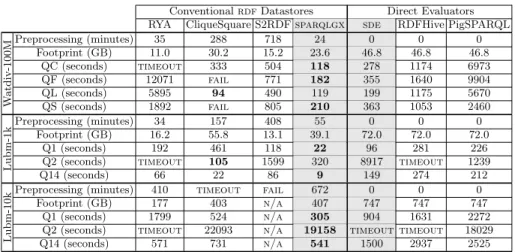
We compare the presented systems using two popular benchmarks: LUBM [9] and Watdiv [3]. Table 1 presents characteristics of the considered datasets. We rely on three metrics to discuss results (Table 2): query execution times, pre-processing times (for systems that need to preprocess data), and disk footprints. For space reasons, Table 2 presents three Lubm queries: Q1 because it bears large input and high selectivity, Q2 since it has large intermediate results while involving a triangular pattern and Q14 for its simplicity. Moreover, we aggregate Watdiv queries by the categories proposed in the Watdiv paper [3]: 3 complex (QC), 5 snowflake-shaped (QF), 5 linear (QL) and 7 star queries (QS). In Ta-ble 2 we indicate “timeout” whenever the process did not complete within a certain amount of time4. We indicate “
fail” whenever the system crashed
be-fore this timeout delay. This regroups several kinds of failure such as unability of evaluating queries and also unability of preprocessing the datasets. We indicate “n/a” whenever the task could not be accomplished because of a failure during the preprocessing phase.
Table 2 shows thatsparqlgxalways answer all tested queries on all tested datasets whereas this is not the case with other conventional rdf datastores which either timeout or fail at some point.
In addition, sparqlgxoutperforms several implementations in many cases (also as shown on Table 2), while implementing a simple architecture exclusively built on top of open source and publicly available technologies. Furthermore, thesdevariant of our implementation, which does not require any preprocess-ing phase offers performances similar to the ones obtained with state-of-the-art implementations that require preprocessing.
6
Related Work
In recent years, many rdf systems capable of evaluatingsparql queries have been developed [12]. These stores can be divided in two categories: centralized systems (e.g. RDF-3X [13] or Virtuoso [5]) and distributed ones, that we fur-ther review. Distributedrdfstores can in turn be divided into three categories. (1) The ad-hoc systems that are specially designed for rdf data and that dis-tribute and store data across the nodes according to custom ad-hoc methods (e.g.4store [10]). (2) Other systems use a communication layer between central-ized systems deployed across the cluster and then evaluate sub-queries on each
4
We set the timeout delay to 10 hours for the query evaluation stage and to 24 hours for the dataset preprocessing stage.
ConventionalrdfDatastores Direct Evaluators RYA CliqueSquare S2RDFsparqlgx sde RDFHive PigSPARQL
W atdiv-100M Preprocessing (minutes) 35 288 718 24 0 0 0 Footprint (GB) 11.0 30.2 15.2 23.6 46.8 46.8 46.8 QC (seconds) timeout 333 504 118 278 1174 6973 QF (seconds) 12071 fail 771 182 355 1640 9904 QL (seconds) 5895 94 490 119 199 1175 5670 QS (seconds) 1892 fail 805 210 363 1053 2460 Lubm-1k Preprocessing (minutes) 34 157 408 55 0 0 0 Footprint (GB) 16.2 55.8 13.1 39.1 72.0 72.0 72.0 Q1 (seconds) 192 461 118 22 96 281 226 Q2 (seconds) timeout 105 1599 320 8917 timeout 1239 Q14 (seconds) 66 22 86 9 149 274 212
Lubm-10k
Preprocessing (minutes) 410 timeout fail 672 0 0 0 Footprint (GB) 177 403 n/a 407 747 747 747
Q1 (seconds) 1799 524 n/a 305 904 1631 2272 Q2 (seconds) timeout 22093 n/a 19158 timeout timeout 18029 Q14 (seconds) 571 731 n/a 541 1500 2937 2525
Table 2: Compared System Performance.
node such as Partout with RDF-3X [6]. (3) Lastly, some rdfsystems [8, 16–18] are built on top of distributed Cloud platforms such as Apache Hadoop. One major interest of such platforms relies on their common file systems (e.g.,hdfs): indeed various applications can access data at the same time and the distribu-tion/replication issues are transparent. These systems [8, 16–18], then evaluate
sparql conjunctive queries using various tools as presented in Section 5 (e.g.
Accumulo, Hive, Spark, etc.). To set up appropriate tools for pipeline applica-tions, we choose to distribute data with a Cloud platform (hdfs) and evaluate queries using Spark. We compared the performances of sparqlgxwith the most closely related implementations in Section 5.
Finally, it is worthwhile to notice thatsparqlis a very expressive language which offers a rich set of features and operators. Most evaluators based on Cloud platforms focus on the restricted sparql fragment composed of conjunctive queries. sparqlgx also natively supports a slight extension of this fragment withunionandoptionaloperators at top level.
7
Conclusion
We proposedsparqlgx: a tool for the efficient evaluation ofsparqlqueries on distributedrdf datasets. sparql queries are translated into Spark executable code, that attempts to leverage the advantages of the Spark platform in the specific setting ofrdfdata.sparqlgxalso comes with a direct evaluator based on the same sparql translation process and called sde, for situations where preprocessing time matters as much as query evaluation time. We report on practical experiments with our systems that outperform several state-of-the-art Hadoop-reliant systems, while implementing a simple architecture that is easily deployable across a cluster.
References
1. SPARQL 1.1 overview (March 2013), http://www.w3.org/TR/sparql11-overview/ 2. Abadi, D.J., Marcus, A., Madden, S.R., Hollenbach, K.: Scalable semantic web data management using vertical partitioning. In: Proceedings of the 33rd international conference on Very large data bases. pp. 411–422. VLDB Endowment (2007) 3. Alu¸c, G., Hartig, O., ¨Ozsu, M.T., Daudjee, K.: Diversified stress testing of RDF
data management systems. In: ISWC. pp. 197–212. Springer (2014)
4. Armbrust, M., Xin, R.S., Lian, C., Huai, Y., Liu, D., Bradley, J.K., Meng, X., Kaf-tan, T., Franklin, M.J., Ghodsi, A., et al.: Spark SQL: Relational data processing in spark. In: SIGMOD. pp. 1383–1394. ACM (2015)
5. Erling, O., Mikhailov, I.: Virtuoso: RDF support in a native RDBMS. In: Semantic Web Information Management, pp. 501–519. Springer (2010)
6. Galarraga, L., Hose, K., Schenkel, R.: Partout: A distributed engine for efficient rdf processing. In: WWW Companion. pp. 267–268 (2014)
7. Gallego, M.A., Fern´andez, J.D., Mart´ınez-Prieto, M.A., de la Fuente, P.: An em-pirical study of real-world SPARQL queries. In: 1st International Workshop on Usage Analysis and the Web of Data at the 20th International World Wide Web Conference (2011)
8. Goasdou´e, F., Kaoudi, Z., Manolescu, I., Quian´e-Ruiz, J.A., Zampetakis, S.: Cliquesquare: Flat plans for massively parallel RDF queries. In: ICDE. pp. 771– 782. IEEE (2015)
9. Guo, Y., Pan, Z., Heflin, J.: LUBM: A benchmark for OWL knowledge base sys-tems. Web Semantics: Science, Services and Agents on the World Wide Web 3(2), 158–182 (2005)
10. Harris, S., Lamb, N., Shadbolt, N.: 4store: The design and implementation of a clustered RDF store. SSWS (2009)
11. Hayes, P., McBride, B.: RDF semantics. W3C Rec. (2004)
12. Kaoudi, Z., Manolescu, I.: RDF in the clouds: A survey. The VLDB Journal 24(1), 67–91 (2015)
13. Neumann, T., Weikum, G.: RDF-3X: a RISC-style engine for RDF. Proceedings of the VLDB Endowment 1(1), 647–659 (2008)
14. Odersky, M.: The scala language specification v 2.9 (2014)
15. Olston, C., Reed, B., Srivastava, U., Kumar, R., Tomkins, A.: Pig latin: a not-so-foreign language for data processing. In: SIGMOD. pp. 1099–1110. ACM (2008) 16. Punnoose, R., Crainiceanu, A., Rapp, D.: Rya: a scalable RDF triple store for the
clouds. In: International Workshop on Cloud Intelligence. p. 4. ACM (2012) 17. Sch¨atzle, A., Przyjaciel-Zablocki, M., Lausen, G.: PigSPARQL: Mapping SPARQL
to pig latin. In: Proceedings of the International Workshop on Semantic Web In-formation Management. p. 4. ACM (2011)
18. Sch¨atzle, A., Przyjaciel-Zablocki, M., Skilevic, S., Lausen, G.: S2RDF: RDF query-ing with SPARQL on spark. VLDB pp. 804–815 (2016)
19. Shvachko, K., Kuang, H., Radia, S., Chansler, R.: The hadoop distributed file system. In: Mass Storage Systems and Technologies (MSST). pp. 1–10. IEEE (2010) 20. Thusoo, A., Sarma, J.S., Jain, N., Shao, Z., Chakka, P., Anthony, S., Liu, H., Wyckoff, P., Murthy, R.: Hive: a warehousing solution over a map-reduce frame-work. Proceedings of the VLDB Endowment 2(2), 1626–1629 (2009)
21. Zaharia, M., Chowdhury, M., Das, T., Dave, A., Ma, J., McCauley, M., Franklin, M.J., Shenker, S., Stoica, I.: Resilient distributed datasets: A fault-tolerant abstrac-tion for in-memory cluster computing. In: NSDI. pp. 2–2. USENIX Associaabstrac-tion (2012)