Hélder de Almeida Marques
Licenciado em Engenharia Informática
Towards an Algorithmic Skeleton Framework
for Programming the Intel
RXeon Phi
TMProcessor
Dissertação para obtenção do Grau de Mestre em Engenharia Informática
Orientador :
Hervé Paulino, Prof. Auxiliar,
Universidade Nova de Lisboa
Júri:
Presidente: Prof. Doutor Miguel Pessoa Monteiro Universidade Nova de Lisboa
Arguente: Prof. Doutor Nuno Roma Universidade de Lisboa
Vogal: Prof. Doutor Hervé Miguel Cordeiro Paulino Universidade Nova de Lisboa
iii
Towards an Algorithmic Skeleton Framework for Programming the IntelR
Xeon PhiTMProcessor
Copyright cHélder de Almeida Marques, Faculdade de Ciências e Tecnologia, Univer-sidade Nova de Lisboa
A Faculdade de Ciências e Tecnologia e a Universidade Nova de Lisboa têm o direito, perpétuo e sem limites geográficos, de arquivar e publicar esta dissertação através de ex-emplares impressos reproduzidos em papel ou de forma digital, ou por qualquer outro meio conhecido ou que venha a ser inventado, e de a divulgar através de repositórios científicos e de admitir a sua cópia e distribuição com objectivos educacionais ou de in-vestigação, não comerciais, desde que seja dado crédito ao autor e editor.
Acknowledgements
I would like to start by thanking so much to my adviser Hervé Paulino for all the sup-port, availability and constant meetings throughout the course of this thesis that really helped me a lot to develop this work. I would like to thank the department of Com-puter Sciences of Faculdade de Ciências e Tecnologias da Universidade Nova de Lis-boa, for the facilities and its constant availability to always have a friendly environment to work. Also, thanks to the projects PTDC/EIA- EIA/113613/2009 (Synergy-VM) and PTDC/EEI-CTP/1837/2012 (SwiftComp) for financing the purchase of the IntelRXeon
PhiTM, without which I could not certainly have carried out this project.
I want to thank professor Pedro Medeiros for the assistance with the problems that would appear with the machine used to develop the work done. I would like to specially thank all my colleagues that shared with me many hours on the same room, questioning why the code did not work, providing fun moments to relax and re-organizing ideas and giving support to never give up, namely, Catarina Gralha, Diogo Cordeiro, Gabriel Marcondes, Gonçalo Tavares, João Claro, Sara Gonçalves, Hélder Gregório. To the others that sometime passed by to cheer up, also thank you. I would like to thank my friends from Scouts that always gave me support to keep going, thank you Patrícia Correia, Sara Silva and João Silva.
I want to give a very big thank you to Joana Coelho for the constant support and motivation, and for always being there when things did not work so well.
Finally I want to thank my parents for all the support and for always believing in my capabilities.
Abstract
The IntelR Xeon PhiTMis the first processor based on Intel’s MIC (ManyIntegrated
Cores) architecture. It is a co-processor specially tailored for data-parallel computations, whose basic architectural design is similar to the ones of GPUs (Graphics Processing Units), leveraging the use of many integrated low computational cores to perform par-allel computations. The main novelty of the MIC architecture, relatively to GPUs, is its compatibility with the Intel x86 architecture. This enables the use of many of the tools commonly available for the parallel programming of x86-based architectures, which may lead to a smaller learning curve. However, programming the Xeon Phi still entails as-pects intrinsic to accelerator-based computing, in general, and to the MIC architecture, in particular.
In this thesis we advocate the use of algorithmic skeletons for programming the Xeon Phi. Algorithmic skeletons abstract the complexity inherent to parallel programming, hiding details such as resource management, parallel decomposition, inter-execution flow communication, thus removing these concerns from the programmer’s mind. In this context, the goal of the thesis is to lay the foundations for the development of a simple but powerful and efficient skeleton framework for the programming of the Xeon Phi processor. For this purpose we build upon Marrow, an existing framework for the orchestration of OpenCLTMcomputations in multi-GPU and CPU environments. We ex-tend Marrow to execute both OpenCL and C++parallel computations on the Xeon Phi.
We evaluate the newly developed framework, several well-known benchmarks, like Saxpy and N-Body, will be used to compare, not only its performance to the existing framework when executing on the co-processor, but also to assess the performance on the Xeon Phi versus a multi-GPU environment.
Keywords: Many Integrated Cores architectures, IntelR Xeon PhiTM, Parallel
Resumo
O IntelR Xeon PhiTMé o primeiro processador baseado na arquitecturaMany Integra-ted Coresda Intel. O seu propósito é ser usado como um co-processador para a unidade de processamento central para as computações de dados em paralelo. Os pricípios bási-cos de desenho arquitectual são semelhantes aos usados nas unidades de processamento gráfico (GPU), tirando proveito do uso de muitos núcleos de poder computacional menor para efectuar computações paralelas. A grande novidade da arquitectura MIC, relativa-mente aos GPUs, é a sua compatibilidade com a arquitectura x86, o que permite o uso de muitas das ferramentas mais comuns utilizadas em computação paralela, o que pode levar a uma menor curva de aprendizagem. No entanto, o uso do Xeon Phi em aplicações comuns ainda requer o conhecimento geral de programação baseada em aceleradores e, em particular, da arquitectura MIC.
Nesta tese, advogamos o uso de esqueletos algorítmicos para a programação do Xeon Phi. Esqueletos algorítmicos abstraem a complexidade inerente à programação paralela, escondendo detalhes como a gestão de recursos, decomposição paralela, ou a comuni-cação com a camada subjacente, removendo assim estas preocupações da mente do pro-gramador. Neste contexto, o nosso objectivo é oferecer as bases para o desenvolvimento de uma ferramenta simples mas poderosa e eficiente, para a programação do Xeon Phi. Como este propósito vamos trabalhar sobre o Marrow, uma ferramenta existente para a orquestração de computações OpenCLTMem ambientes CPU e multi-GPU. Nós
adapta-mos o Marrow para executar computações paralelas tanto em OpenCL como em C++. A nova versão é avaliada, usando vários testes bem conhecidos como o Saxpy ou on N-Body, para comparar, não só o seu desempenho com a actual versão do Marrow quando executada no co-processador, mas também para medir o desempenho num am-biente com multi-GPUs e Xeon Phi.
Palavras-chave: Arquitecturas Many-Core, IntelR Xeon PhiTM, programação paralela,
Contents
1 Introduction 1 1.1 Motivation . . . 1 1.2 Problem . . . 2 1.3 Proposed Solution. . . 3 1.4 Contributions . . . 4 1.5 Document Structure . . . 52 The IntelR Xeon PhiTMProcessor and its Programming 7 2.1 IntelR Xeon PhiTM’s Architecture. . . 7
2.1.1 Cores . . . 9
2.1.2 Cache. . . 11
2.1.3 PCIe . . . 11
2.2 Programming the IntelR Xeon PhiTM . . . 11
2.2.1 Native model . . . 13
2.2.2 Offload model . . . 18
2.3 Preliminary Results . . . 23
2.4 Conclusions . . . 26
3 The Marrow Algorithmic Skeleton Framework 27 3.1 Architecture . . . 28
3.2 Programming Model . . . 29
3.3 Execution Model . . . 31
4 Marrow on Xeon Phi 33 4.1 OpenCL Version . . . 33
4.2 C++Version . . . 35
4.2.1 Programming Model . . . 35
4.2.2 Execution Model . . . 35
xiv CONTENTS
4.2.4 Offloading the Computation Tree. . . 40
4.2.5 Efficient memory transfer . . . 41
4.3 Adding Data-flow Support. . . 42
4.4 From a Single Backend to a Multiple Backend Marrow Framework . . . . 44
5 Experimental Results 47 5.1 Metrics and Methodology . . . 47
5.1.1 Benchmarks . . . 47
5.2 IntelR Xeon PhiTMvs GPU . . . 49
5.2.1 Results . . . 50
5.2.2 Conclusions . . . 53
5.3 C++vs OpenCLTMon IntelR Xeon PhiTM . . . 54
5.3.1 Results . . . 54
5.3.2 Conclusions . . . 56
6 Conclusion 59 6.1 Future Work . . . 60
A Examples 67 A.1 For-loop parallelism in OpenMP . . . 67
A.2 Fork-Join parallelism in OpenMP . . . 67
A.3 For-Loop parallelism in CilkTMPlus . . . 69
A.4 Fork-Join parallelism in CilkTM . . . 69
A.5 For-Loop parallelism in IntelR TBB . . . 71
A.6 Flow graph in IntelR TBB 4.0 . . . 71
A.7 OpenCLTM . . . 73
A.8 IntelR Compiler pragmas . . . 74
List of Figures
1.1 Offloading the computation tree to the Xeon Phi . . . 4
2.1 Available models of the Xeon Phi co-processor . . . 8
2.2 Diagram of the Xeon Phi’s architecture [GH13] . . . 9
2.3 Diagram of the cores’ micro-architecture [JR13] . . . 10
2.4 Xeon Phi’s different execution models . . . 12
2.5 Transfer times with different technologies . . . 23
2.6 Execution times of integer matrix multiplication with different technologies 24 2.7 Execution times of the N-Body problem with different technologies . . . . 24
2.8 Speedup of the OpenMP versions of the IS, FT, SP and EP benchmarks relatively to their OpenCL versions, in Intel Xeon Phi . . . 25
3.1 Marrow’s architecture . . . 29
3.2 Marrow’s execution model . . . 31
4.1 New Runtime with allExecutionPlatforms. . . 34
4.2 Class diagram of the multipleExecutionPlatforms . . . 34
4.3 Computation tree of a two stagePipelinewith twoMaps . . . 37
4.4 Speedup obtained from each optimization. . . 40
4.5 Speedup obtained from the usage of#pragma offload_transfer. . . 42
4.6 Example of theworking_unit’s received by thePipeline, the stage 1 and the stage 2 . . . 44
4.7 Class diagram after the framework generalization . . . 45
5.1 Image pipeline benchmark on various GPUs and the Xeon Phi . . . 50
5.2 Slowdown of the N-Body benchmark on various GPUs and the Xeon Phi, relative to the fastest time . . . 51
5.3 Saxpy benchmark on various GPUs and the Xeon Phi . . . 51
xvi LIST OF FIGURES
5.5 Slowdown of the Series benchmark on various GPUs and the Xeon Phi , relative to the fastest time . . . 52
5.6 Slowdown of the Solarize benchmark on various GPUs and the Xeon Phi , relative to the fastest time . . . 53
5.7 Comparison of the various stages between OpenCL and the optimized C++version on Xeon Phi with a communication bound application . . . 54
5.8 Comparison of the various stages between OpenCL and the optimized C++version on Xeon Phi with a computation bound application . . . 55
5.9 Saxpy benchmark between OpenCL and the optimized C++ version on Xeon Phi . . . 55
5.10 Segmentation benchmark between OpenCL and the optimized C++ ver-sion on Xeon Phi . . . 56
5.11 Solarize benchmark between OpenCL and the optimized C++version on Xeon Phi . . . 56
5.12 Series benchmark between OpenCL and the optimized C++ version on Xeon Phi . . . 57
Listings
3.1 Image filter pipeline using the Marrow framework . . . 30
4.1 Tree allocation with Functor class . . . 36
4.2 Functor class example for the Saxpy problem . . . 36
4.3 Kernel example from the Saxpy problem. . . 36
4.4 Example of how parallelization is achieved . . . 38
4.5 Interface to offload skeletons to the co-processor . . . 40
4.6 Example of how to get the pointer to a function defined on the co-processor 41 4.7 Structure of aworking_unit. . . 43
A.1 Example of vector dot product with OpenMP . . . 68
A.2 Example of recursive parallelization with OpenMP[Col13] . . . 68
A.3 Example of vector dot product with array annotation [MRR12]. . . 69
A.4 Example of vector dot product withcilk_for[MRR12] . . . 69
A.5 Example of use of#pragma simdand elemental functions [MRR12] . . . 70
A.6 Example of recursive parallelization with Cilk [Col13] . . . 70
A.7 Example of vector dot product in TBB . . . 71
A.8 Example of a flow graph in TBB[Int13c] . . . 72
A.9 Kernel function in OpenCL to calculate the addition of two arrays . . . 72
A.10 Example of an OpenCL application . . . 74
A.11 Example of asynchronous computation [Int13a] . . . 75
1
Introduction
1.1
Motivation
Over the years, the magnitude of the problems addressed with the help of computational resources has consistently grown at a exponential rate. This is true for both the scien-tific computing and the information technology fields. An example of the former is the experiments that take place at CERN’s Large Hadron Collider1. At peak rates, about 10 gigabytes of data are generated every second. This amount of data needs to be processed quickly to assess its importance and determine if it is worth storing and so the data must be processed in parallel in order to increase the throughput of the algorithms. On the information technology end, the generalized use of the World Wide Web as a vehicle to transmit both public and personal information. For instance, the amount of data gen-erated by social networks grow exponentially over time. As a result, there are many companies, such as Google, that are inferring information from this unstructured data2. For that purpose, they need to find efficient ways to process all that information.
In this context, accelerator-based computing in general, and GPU computing in par-ticular, is establishing itself as an consolidated field. The massive adoption of this model is evident in the list of the current top 500 supercomputers, where the two fastest ones, by June 2014, feature accelerators in their configuration3. Recent proposals explore the use of many-core processors as dedicated co-processors to provide a tool with a great computational power but also, power efficient. Examples are AMD’s APUs [AMD] and IntelR’s Xeon PhiTM[Int]. In this dissertation we are particularly interested in the latter.
1http://home.web.cern.ch/about/computing
2http://www.ams.org/samplings/feature-column/fcarc-pagerank 3http://www.top500.org/lists/2014/06/
1. INTRODUCTION 1.2. Problem
Xeon Phi is the first product based on the MIC (ManyIntegratedCore) architecture [Sei+08], being announced in November 2012. This co-processor features a large number of cores (starting at 57 cores) and is attached to the host computer via a PCIe interface. Its main advantages are the high degree of parallelism that offers and, opposing to GPUs, its compatibility with the x86 architecture, which means that existing tools for x86-based sys-tems are supported, moving away from the low level programming required by GPUs. Additionally, it is also more power efficient [Abd+13] since only the cores actually be-ing used consume significant amounts of power. Performance-wise, the efficiency of this product was demonstrated by the first place in the list of supercomputers offering most FLOPS (Floating-pointOperationsPerSecond) per Watt by the time of its launch4. The promise of the co-processor is evinced by its use on the fastest supercomputer by June 2014.
In sum, Xeon Phi embodies the new kind of general-purpose accelerators, which seems to be a first step towards a widespread adoption of accelerator-based computing.
1.2
Problem
Xeon Phi is the first commercial product based on the MIC architecture, and so, due to its tender age, there are still many challenges to address when trying to efficiently program this kind of architectures. Due to its compatibility with x86, many of the existing tools, like OpenMP [Ope13b], CilkTM[Int13b], OpenCLTM[Khr13], MPI [For12] or Intel TBB [Int13c], can be directly used in the programming of Xeon Phi. Nevertheless, the programmer is still faced with many details intrinsic to accelerator-based computing, such as:
• The explicit management of multiple disjoint address spaces;
• The orchestration of data transfers and computation;
• The overhead of the communication between the host device and the accelerator.
Beyond that, there is the need to understand the implications that the particular nature of the Xeon Phi architecture can have on the application, specially because of its high level of parallelism, due to the 240 threads available. This understanding is important to take advantage of the full potential of the co-processor and to avoid the under utilization of the resources available [Joh+13; Sch+13]. In fact, although Xeon Phi grows from x86 cores, there is some debate concerning the ease of use of this co-processor. Some opinions are in favor of GPUs stating that, in order to fully use the co-processor to its maximum, the effort needed in programming is the same as the one needed in programming a GPU, but the results are much better on a GPU [Hem13;Nvi]. To this extent, raising the degree of abstraction in the programming of this kind of architectures is a relevant research topic.
1. INTRODUCTION 1.3. Proposed Solution
The Xeon Phi processor has become available to the general community very re-cently, thus only now the community is gathering efforts to address the aforementioned challenges. Examples are the porting of MapReduce [Lu+13], parallel libraries [Cla+13;
Dok+13;Pot+] and compilers [PM12].
Research groups with experience on the GPGPU (General-Purpose computing on Graphics Processing Units) field are directing the knowledge gathered in the accelera-tor computing field to the Xeon Phi, extending existing frameworks to tackle the chal-lenges associated with this platform [Lim+13; Men+13]. The approach of the work to be developed in the context of this dissertation takes a similar approach. We will build on previous knowledge acquired in the development of an algorithmic framework for general-purpose computing on GPUs, the Marrow framework [AMP13;AMP14;Mar+13;
SAP14], and apply it in the construction of a similar framework for the programming of the Xeon Phi.
In what concern structured parallel programming, to the best of our knowledge, the adaptation of MapReduce to Xeon Phi proposed in [Lu+13] is the only work to port known algorithmic skeletons to Xeon Phi. As such, Marrow’s features, namely a library of multiple skeletons that can be combined to build complex, compound, behaviors, are new to the field.
The challenges that we will face are:
• to subsume all communication with the device, and between the multiple concur-rent computations that be encased in an skeleton, for instance in a pipeline;
• to transparently and efficiently manage the orchestration of the computation to be offloaded to the device, this includes understanding when to move the data, do-ing it efficiently over the PCIe bus and when to reuse data already residdo-ing on the device’s memory;
• to efficiently execute this computation on the device. This includes paralelizing the code given by the programmer, how many threads to spawn, where to place them and how to exploit vectorization.
1.3
Proposed Solution
The Marrow framework is a library that provides algorithmic skeletons to orchestrate compound OpenCL computations in heterogeneous environments with multiple CPUs and GPUs. This framework steps away from other GPU programming frameworks by offering both task- and data-parallel skeletons and by supporting skeleton nesting in this type of environments. Currently Marrow supports theMapandMapReducedata-parallel skeletons and thePipelineandLooptask-parallel skeletons.
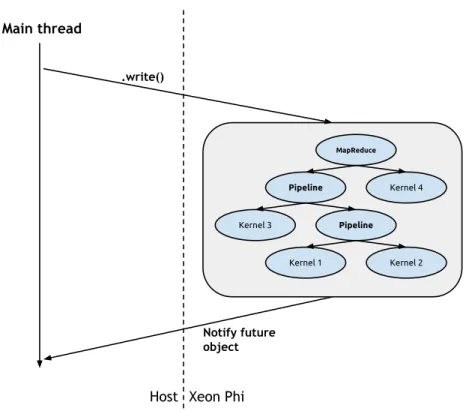
The goal of this thesis is to leverage Marrow’s structured programming model in the programming of the Xeon Phi processor. For that purpose, we intend to initially develop
1. INTRODUCTION 1.4. Contributions
Host Xeon Phi
MapReduce Pipeline Kernel 4 Kernel 3 Pipeline Kernel 1 Kernel 2 Main thread .write() Notify future object
Figure 1.1: Offloading the computation tree to the Xeon Phi
a Xeon-specific OpenCL back-end, so that the framework can efficiently execute trees of nested OpenCL applications on this device, as shown in Figure1.1.
On a second phase, we want to adapt the framework with the purpose of supporting different technologies, besides OpenCL. For that, the framework will be generalized to hide all mechanisms intrinsic to OpenCL and the runtime will be extend with a new back-end to support the execution of kernels expressed as C++functions, expressing the sequential behavior that each thread running on the Xeon Phi must execute. The parallel execution of such code is managed by the framework.
In sum, the goal of this thesis is to offer both task- and data-parallel skeletons to execute efficiently on the Intel Xeon Phi, and therefore, in heterogeneous environments with CPU, GPU and Xeon Phi.
1.4
Contributions
The presented work will provide the following contributions:
1. A comparative study about the performance of multiple technologies used for pro-gramming the Xeon Phi (OpenMP, Cilk Plus and OpenCL);
2. An OpenCL back-end to add support for the Xeon Phi to the Marrow framework and the corresponding performance evaluation against GPU and CPU environ-ments;
1. INTRODUCTION 1.5. Document Structure
3. A new runtime layer for the Marrow framework to support the execution of kernels expressed as C++functions, leaving for the framework the task of executing them in parallel;
4. The evaluation of the performance of the new runtime layer relatively to the pre-vious version by measuring the execution time of different benchmarks when exe-cuting on the Xeon Phi, using both the OpenCL and the chosen technologies. Part of the work developed in the scope of this thesis was presented via a poster com-munication in INForum 2014, the 6th edition of the portuguese conference in computer science, that took place at Universidade do Porto.
1.5
Document Structure
This document has the following structure:
Chapter2 starts with state of the art by the time prior to the work presented on this the-sis. It starts by the architecture of the co-processor, highlighting the important features to consider when using this device, and then, it details the models used in the programming of the co-processor as well as some tools available to achieve those models.
Chapter3 provides an overall description of the Marrow framework, the starting point for this thesis. It presents the framework’s programming and execution models, as well as its architecture.
Chapter4 presents the work developed in the scope of this thesis, namely the imple-mentation of the Xeon Phi OpenCL Marrow back-end, the full support for the execution of C++ instantiated Marrow skeletons on the Xeon Phi, and the changes performed on the Marrow framework in order to efficiently and seamlessly support both the OpenCL and C++ versions.
Chapter5 shows the tests performed to evaluate the performance of the newly devel-oped framework and how it compares to the previous version. The tests were divided into two stages, the comparison between the Xeon Phi and GPUs using OpenCL and the comparison of the OpenCL and C++versions running exclusively on the Xeon Phi.
Chapter6 pose the conclusions derived from the work performed and discusses open issues that may be carried out in future work.
2
The Intel
R
Xeon Phi
TM
Processor
and its Programming
The Intel Xeon Phi co-processor is the first commercial product to use Intel MIC architec-ture, based on the Larrabee [Sei+08] microarchitecture. In order to introduce the reader to its key features, we present a general overview of its architecture in Section2.1and of programming tools offered by Intel for its programming in Section2.2. Furthermore, we present an initial performance comparison of some of these tools in Section2.3, to guide us in the choice of which technologies to use in our work. The research presented in this chapter was supported by the following literature: [JR13], [Col13] and [Rah13].
2.1
Intel
RXeon Phi
TM’s Architecture
The Xeon Phi is available in two form factors, shown in Figure2.1, with passive or ac-tive cooling. The co-processor features multiple Intel x86 cores, up to eight memory controllers and a PCI Express system interface to communicate with the host device. Al-though based on the Intel ia-64 architecture, the cores featured in a Xeon Phi processor are simpler versions of the ones currently featured in the current Intel-compatible multi-core CPUs. Consequently, they are smaller in size, a fact that contributes for more of them to be packed in a single processor. Given that all these cores are identical, the Xeon Phi falls into the category ofhomogeneous many-core architecture.
We begin by giving a general overview of the Xeon Phi’s architecture, detailing sub-sequently its main components.
2. THEINTELR XEONPHITMPROCESSOR AND ITSPROGRAMMING 2.1. IntelR Xeon PhiTM’s Architecture
(a) Model with passive cooling (b) Model with active cooling
Figure 2.1: Available models of the Xeon Phi co-processor
Co-processor cores These are based on P54c (Intel Pentium from 1995) cores with ma-jor modifications including Intel 64 ISA, 4-way SMT, new vector instructions, and increased cache sizes.
Vector Processing Unit The VPUs are part of the core and capable of performing 512-bit vector operations on 16 single-precision or 8 double-precision floating-point arith-metic operations as well as integer operations.
Cache All cores have full coherent L2 caches.
Tag directories (TD) Components used to look up cache data distributed among the cores and keep coherency.
Ring interconnect The interconnect between the cores and the rest of the co-processor’s components.
Memory controller (MC) Interface between the ring and the graphics double data rate (GDDR5) memory.
PCIe interface Used to connect with PCIe bus and the host.
The topology used to interconnect all the cores in the system is a bidirectional in-terconnect ring (Figure 2.2). This bus is also used by the cores to access data from the main memory through the memory controllers also connected to the ring. There are eight memory controllers with two channels, each communicating with GDDR5 memory at 5.5 GT/s (Giga transfers per second) having a theoretical memory bandwidth of 352 GB/s. The movement of data between the host’s memory and the Intel Xeon Phi’s memory is made through DMA (DirectMemoryAccess) enabling the independence from the host intervention in some cases. One key requirement to allow the usage of the co-processor is the BIOS support for memory mapped I/O address ranges above 4GB.
To manage all the hardware, one of the cores executes a micro-OS, based on Linux, that is read at boot-time from an on-board flash.
2. THEINTELR XEONPHITMPROCESSOR AND ITSPROGRAMMING 2.1. IntelR Xeon PhiTM’s Architecture
Figure 2.2: Diagram of the Xeon Phi’s architecture [GH13]
With respect to reliability features, there is parity support in the L1 cache, error cor-rection code (ECC) on L2 and memory transactions, cyclic redundancy code (CRC) and command and address parity on the memory I/O. The co-processors also implement ex-tended machine check (MCA) features to help the software detect imminent failure.
2.1.1 Cores
Each core is an in-order processor that features four hardware threads that are used to mask the latencies inherent to in-order micro-architectures. The choice of this type of processor relates to the fact that it is much simpler and more power efficient, as opposed to the highly speculative out-of-order type, widely used on Intel Xeon processors. The multi-threading is done by using the time-multiplexing mechanism.
Inside the core, there are also the L1 and L2 caches, shared by the hardware threads, along with an L2 cache hardware prefetcher (HWP) that can detect sixteen, forward or backward, sequential data accesses to determine the direction of the stream and then is-sue multiple prefetch requests to keep the data flow. Figure2.3shows a simple overview of each core’s micro-architecture.
Instruction execution within a core is structured in only 5 pipeline stages, unlike most modern processors, which makes the execution of an instruction to be much faster there-fore improving the overall performance of the system. The architecture used is a su-perscalar architecture, with two different pipelines on the chip, known as the U and V pipelines, enabling that two instructions are at the execution stage at the same clock cy-cle. Integer operations and mask instructions are single-cycy-cle. Most vector instructions have a four-cycle latency and single-cycle throughput, so the concurrent execution of four threads will not reveal the vector unit latency if all of them are executing vector instructions.
There is also a turbo mode that, if the available power allows, increases the frequency of the cores in order to boost performance.
2. THEINTELR XEONPHITMPROCESSOR AND ITSPROGRAMMING 2.1. IntelR Xeon PhiTM’s Architecture LbtTLBtand 3AKB CVode Cache TLB Miss Handler LAtTLB CodetCachetMiss TLBMiss T5tIP TbtIP TAtIP T3tIP Decode 47Threads In7Order uCode LA Ctl HWP b6BUCycletSAdtIPCR Pipet5 Pipetb ScalartRF X87tRF x87 VPU 5bAbtSIMD ALU5 LbtTLBtandt3AKB DatatCache ALUb VPUtRF 5bAtKB LAtCache TotOn7DietInterconnect TLBtMiss DCachetMiss
Figure 2.3: Diagram of the cores’ micro-architecture [JR13] Vector Processing Unit
The vector processing unit (VPU) used is 512 bit wide. This means that it can operate over 16 single-precision floats or 32-bit integers at a time. It implements a novel ISA (Instruction Set Architecture), with 218 new instructions compared with those imple-mented in the Xeon family of SIMD instruction sets. The instructions are received from the core’s ALU (ArithmeticLogicUnit) and the data is received from the L1 cache by a dedicated 512-bit bus. Most of the VPU instructions are issued from the core through the U-pipe. Some of the instructions can be issued from the V-pipe and can be paired to be ex-ecuted at the same time with instructions in the U-pipe. These instructions are computed using quadratic minimax polynomial approximation and use a lookup table to provide a fast approximation to the transcendental functions. The vector architecture supports a coherent memory model in which the Intel-64 instructions and the vector instructions operate on the same address space. The instructions support the following native data types:
• Packed 32-bit integers (or dword)
• Packed 32-bit single-precision FP values
• Packed 64-bit integers (or qword)
• Packed 64-bit double-precision FP values
The ISA supports the proposed standard IEEE 754-2008 floating-point instruction rounding mode requirements. Each VPU consists of eight master ALUs, each contain-ing two SP (Scontain-ingle-Precision) and one DP (Double-Precision) ALU with independent pipelines, thus allowing sixteen SP and eight DP vector operations.
2. THEINTELR XEONPHITMPROCESSOR AND ITSPROGRAMMING 2.2. Programming the IntelR Xeon PhiTM
2.1.2 Cache
Many changes were made to the original 32-bit P54c architecture to make it into an Intel Xeon Phi 64-bit processor. The data cache was modified to non-blocking by implement-ing thread-specific flush, which means that, when there is a cache miss, only the pipeline of the thread that caused the miss will be flushed, preventing the other threads from also being blocked. When the data is available to the thread that had a cache miss, that thread is then woken up.
The L1 cache consists of 8-way set-associative 32 kB L1 instruction and data caches, separately, having an access time of approximately 3 cycles. The L2 cache is also 8-way set-associative and 512 kB in size. Although, unlike the L1 caches, this one is unified, in the sense that it is used to cache both data and instructions. The latency of these caches can be as small as 14-15 cycles.
The L1 cache is inclusive to the L2 cache. It can deliver 64 bytes of read data to corresponding cores every two cycles and 64 bytes of write data every cycle. Both caches use pseudo-LRU implementation as a replacement algorithm.
To maintain the coherence of all L2 caches a modified MESI [PP84] protocol using a TD-based GOLS (GloballyOwned,LocallyShared) protocol is used.
2.1.3 PCIe
The system interface of the chip supports PCI Express 2.0 interface x16 lanes with 64- to 256-byte packets, peer-to-peer read/writes. The peer-to-peer interface allows two Intel Xeon Phi cards to communicate with each other without host intervention. The clock system uses a PCI Express 100 MHz reference clock and includes on-board 100 MHz±
50 ppm reference.
2.2
Programming the Intel
RXeon Phi
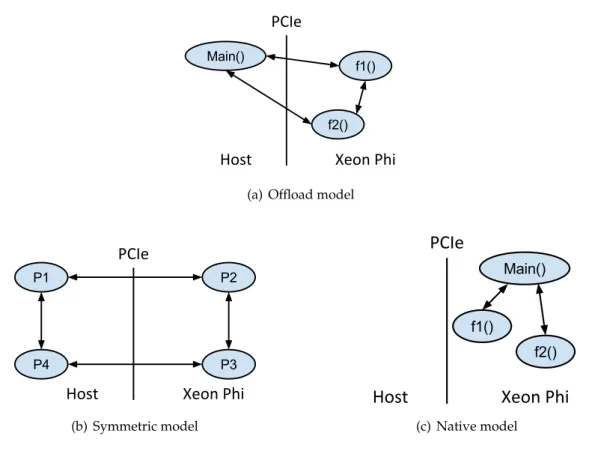
TMDue to its high number of logical cores, Xeon Phi is specially tailored for HPC (High Performance Computing) applications. It requires the installation, on the host, of the drivers, also known as MPSS (Many-CorePlatformSoftwareStack package), making it visible to the host as a co-processor connected via a network interface. The usage of the co-processor may be summarized in the three execution models depicted in Figure2.4: thenative model, theoffload modeland thesymmetric model.
The native model consists in running the main application directly on the co-processor. This is possible due to the micro OS running on the co-processor, allowing it to be con-sidered as a node in a cluster, therefore, being able to run applications independently. In this case, first, the code that is to be executed by the co-processor needs to be compiled for the processor’s architecture and then, the generated binary must be sent to the co-processor using some network tools such assecure copy(scp). The application can then
2. THEINTELR XEONPHITMPROCESSOR AND ITSPROGRAMMING 2.2. Programming the IntelR Xeon PhiTM
(a) Offload model
(b) Symmetric model (c) Native model
Figure 2.4: Xeon Phi’s different execution models
be subsequently executed directly on the processor, requiring only some kind of remote shell, typicallysecure shell(ssh).
The symmetric model leverages the fact that the co-processor features a TCP/IP stack and thus may be viewed as a network node. As such, the application may be composed of multiple, independent, modules deployed at each end of the platform composed by the host and the Xeon Phi. The coordination of these modules is performed through some message-passing interface. In this model there is also the need to generate a binary specific for the co-processor and execute it like the native model.
Finally, in the offload execution model, the main application is executed on the host-ing machine, offloadhost-ing computations to the co-processor. These computations can be executed both synchronous or asynchronously with respect to the issuing thread. With this model, the application just has to annotate the regions that are to be offloaded, so that the compiler knows exactly which code to compile for the co-processor. After it has been compiled, the application is executed on the host, disregarding any additional ef-fort. The parallel execution model associated with this execution model is the Fork-Join. This model of parallelism creates a new task (forks) when there is the need to do some new computation in parallel with the main thread and terminates it (joins) when the computation is done.
2. THEINTELR XEONPHITMPROCESSOR AND ITSPROGRAMMING 2.2. Programming the IntelR Xeon PhiTM
for programming multi-core systems can be used to exploit the parallelism of the co-processor. Regarding the native mode, all parallel programming tools that have been, or may be, compiled to the Xeon phi architecture can be used, such as Intel CilkTMPlus [Int13b;Lei09], OpenMP (Version 3.1) [Ope11] or Intel Threading Building Blocks [Int13c] libraries. These tools can also be used on the remaining models to program the code sections destined to run on the co-processor. As for the offload model, the tools available to send a computation to the co-processor are the language extensions provided by the Intel compiler, the OpenMP 4.0 [Ope13b] and OpenCLTM[Khr13] libraries. As previously
mentioned, in order for the modules executing both on the host and the co-processor to communicate between each other, a library like MPI [For12] can be used.
The next sections will detail some of the tools aforementioned to understand the effort required to use them, and, for each one, some historical context is given as well as its basics and some of the most usual patterns of how they are used are explained. Some examples on how they can be used are presented in AppendixA.
2.2.1 Native model
Given that the tools used in the native model can also be used for the remaining models, this section will provide a general overview of state of the art of programming tools for the Xeon Phi.
2.2.1.1 OpenMP
OpenMP (Open Multi-Processing) is an API for the development of parallel applications in a wide range of processors architectures and operating systems. It was developed by the nonprofit technology consortium OpenMP Architecture Review Board (OpenMP ARB) in the year of 1997 for Fortran and in 1998 forC/C++. The programming model is based on a set of compiler directives (pragmas) and a library of routines available to the programmer to query and tune some aspects of the execution environment.
The specification is currently in its 4.0 version. However, only version 3.1 is widely supported by GNU’s, Oracle’s and LLVM’s compilers. The compiler provided by Intel for generating code for the Xeon Phi architecture is one of tools that already include support for some of the OpenMP 4.0 features.
OpenMP provides constructs for parallel sections and loops, tune the scheduling mechanism, task creation, nested parallelism, operations to avoid race conditions and reducing the results of multiple threads to a single one.
The execution model used by OpenMP is based on the Fork-Join pattern. The se-quential parts of the program are executed by a single thread whilst the parallel parts are executed by multiple threads. The upper limit for the number of threads can be tuned by changing the environment variableOMP_NUM_THREADSor by using the routine
omp_set_num_threads(). As for the memory model, there are two types of memory:
2. THEINTELR XEONPHITMPROCESSOR AND ITSPROGRAMMING 2.2. Programming the IntelR Xeon PhiTM
OpenMP helps the implementation of two of the most common models of parallelism, the Loop-centric and the Fork-Join models [Col13].
For-loop parallelism in OpenMP A very large number of parallel applications are based on for-loops in which the same code is executed for the multiple pieces of data available. Such loops can be easily parallelized with OpenMP through the #pragma
omp parallel for.
Theparallel fordirective may be complemented with several clauses, with the
purpose of fine tuning parallelization parameters or strategies, such as scheduling model, variable privacy among threads or reduction of the intermediate results of each iteration.
Fork-Join parallelism in OpenMP Recursive problems that cannot be trivially trans-formed into for-loops may be coded as Fork-Join computations. These computations are based in tasks, that are assigned to the available threads, to be executed in parallel. The expressing of such tasks in OpenMP requires the use of#pragma omp taskto denote the task’s code: a function call or a block comprising multiple function calls.
The clauses associated to this pragma can be used to specify, like in the for-loop mech-anism, the privacy of the variables but also the stop condition to prevent the runtime from spawning too much threads.
A second directive that can be used to express task parallelism is the#pragma omp
section. All of this tasks must be inside a#pragma omp sectionsblock so that the
code that is after this block is only executed after all units of work complete.
A common practice in fork-join parallelism is to allow the main thread to also con-tribute in the execution of the spawned tasks and, with that, the main thread is not blocked waiting for all spawned functions but also is one less thread that needs to be spawned.
2.2.1.2 IntelR CilkTMPlus
Cilk Plus is an open specification released by Intel that extends the linguistic and runtime technology for algorithmic multi-threaded programming named Cilk [Blu+95] with fea-tures for vector parallelism. Cilk was developed at MIT in 1994, based on ANSI-C with the addition of Cilk specific keywords. After acquiring the Cilk trademark in 2009, Intel released the commercial version, Cilk Plus, in 2010. The current version of this frame-work is 1.2.
This specification aims at addressing some shortcomings of template libraries, such as support for the C language, and not onlyC++, as well as for vector parallelism and finally that, because it is implemented at the compiler level, there are more opportunities for optimization. One important feature of this specification is that it guarantees that the serialized code, i.e. removing/replacing the Cilk keywords from the code, has the same results as the parallel code.
2. THEINTELR XEONPHITMPROCESSOR AND ITSPROGRAMMING 2.2. Programming the IntelR Xeon PhiTM
The model of execution is based only on work-stealing scheduling [BL99], which gives a good, out of the box, performance to Cilk programs but provides less tuning capabilities to the programmer.
For-loop parallelism in CilkTM The ability to have parallel for-loops is also available with Cilk Plus. These for-loops are constructed by simply changing the keywordfor
withcilk_forbut have some restrictions like the impossibility to usebreak/return
inside the loop, the independence between loop iterations and, to make the calculation of the number of iterations possible, the creation of only one control variable as well as the inability to change it or the condition expression inside the loop. The use ofcilk_for
does not mean necessarily that the loop will be executed by multiple threads in parallel. Since the creation of threads has some overhead, the runtime system decides if the body of the loop pays off the creation of a new thread, if not, is the main thread that executes all iterations. It is also possible to do some basic computations with arrays, without the need to use for-loops, by using the array annotations and the reducers available.
The array annotations are used to perform simple operations over multiple arrays with the same range. The operations can also include scalars which are converted to ar-rays of replicated copies of the scalar with the same length as the range specified with the annotation. The full version of specifying a section of an array is by indicating the index at which the section begins, the length of the section and the step between con-secutive indexes ([first:length:step]). If the step is omitted then the default step considered is1. There is a short version to specify that the section is composed of all the elements of the array, omitting all arguments ([:]). Most scalar operations can be used in array sections, including the assign operator. The operation is applied element-wise to all elements of the sections and the result has the same length as the involved sections, which must all have the same length.
To use a reducer function there is only the need to call it with a section as argument and the return is the corresponding reduction. As for the reducer variables, the variable is defined using the constructor of the reducer operation that is needed, specifying the type of the variable and, optionally, indicating the initial value. The variable can only be affected inside acilk_forloop and using the corresponding operations of the reducer. Outside the loop the variable can only be modified or read using theset_value and
get_valuefunctions, respectively. The various reducers include addiction/subtraction,
minimum/maximum, binary operations and string concatenation.
Regarding parallel for-loops there are still the #pragma simdand elemental func-tions. Likecilk_for, the use of#pragma simdacts only has a hint to the compiler to execute the loop with vectorization. The vectorization is performed in small chunks of data whose size will depend on the vector width of the machine making the code portable as opposed to manual vectorization.
2. THEINTELR XEONPHITMPROCESSOR AND ITSPROGRAMMING 2.2. Programming the IntelR Xeon PhiTM
The elemental functions are functions that are annotated so that the compiler can com-pile multiple versions of the function optimized to evaluate multiple iterations in paral-lel. The annotation is__declspec(vector)with some optional clauses,uniform(a)
andlinear(a:k). Theuniformclause is used when an argument is constant between
multiple iterations and the linearclause states that the argument a will step by k in consecutive calls to the function. If k is omitted then the default step is 1. A function can be marked as elemental even if it is defined in a different module. This mechanism of annotating functions is very important in situations where the functions are complex and the compiler cannot analyze them properly in order to make optimization.
Fork-Join parallelism in CilkTM The original programming model for which Cilk was developed is the Fork-Join parallelism since the first specification only featured the defi-nition of thecilk_spawnandcilk_synckeywords. The execution model is based on work-stealing schedule so the loop parallelism is based on spawning multiple threads and then create a queue from where the threads steal work to do.
This model is very simple to use in Cilk, to execute a function by a different thread in parallel, simply precede the function call with the keywordcilk_spawn. This can be used not only in functions that returnvoidbut also on an assignment to some variable. The assignment occurs when the function returns so, after spawning the function, if the caller uses the variable, it implicitly waits for the result to be available. Thecilk_sync
keyword is used to explicitly make the thread wait for all spawned functions inside the current block (function,try/catchorcilk_for). An implicit sync is made at the end of each spawning block, only waiting for functions spawned within the block.
2.2.1.3 IntelR TBB
IntelR TBB (ThreadingBuildingBlocks) was developed by Intel in 2006, as a proprietary
library but becoming open-source in version 2.0 including a GPL v2 a year later, and it is a library that provides a set of solution for programming with tasks inC++.
The approach of TBB is to deal with tasks instead of threads and let the run-time system assign the tasks to the available threads. The library consists in a col-lection of generic parallel algorithms (parallel_foror parallel_pipeline), syn-chronization primitives (atomic operations and mutual exclusion), concurrent contain-ers (concurrent_hash_map or concurrent_queue), scalable memory allocation
(scalable_mallocandscalable_free) and a task scheduler to manage the creation
and activation of tasks. The underlying scheduling system is, like Cilk Plus, based on a work-stealing strategy guaranteeing that the load is fairly distributed among all threads. The use of an atomic variable to store the result guarantees that there are no data races when multiple threads try to update the variable. Beyond the usual operators to assign a variable, atomic variables also provide thefetch_and_add,fetch_and_storeand
2. THEINTELR XEONPHITMPROCESSOR AND ITSPROGRAMMING 2.2. Programming the IntelR Xeon PhiTM
TBB 4.0
The 4.0 version of this library added the flow graph feature. This feature enables the creation of a dependency graph to specify the computation and the flow of messages between the nodes.
The mostly common used nodes are the broadcast_node, the function_node
and thejoin_node. Abroadcast_nodesimply forwards every incoming message to all its successors. Thefunction_nodeis used when a function must be applied to the incoming messages so the type of the incoming and outgoing messages must match the type of the function. In addition to the function, the level of concurrency must be speci-fied to state the maximum number of parallel calls that can be made. In case the function must be called serially the special valueserialcan be used and, on the other hand, if the function can be called concurrently as many times as wanted the valueunlimited
can be used. When a node receives multiple values at once from its predecessors a
join_node must be used to combine the values from all of its inputs and broadcast
to all successors a tuple with the values received. The buffering policy isqueueingso that a tuple is only emitted when there are values available in every incoming port.
After creating the nodes, the edges between them are defined using themake_edge
routine. To start the computation and feed the nodes with values the methodtry_putis invoked and then the methodwait_for_allof the graph is called to wait for all nodes to finish their computations.
Summary
Regarding the ability to program the devices, the existing technologies for shared mem-ory programming on multi-cores may be directly used, namely OpenMP, Cilk Plus and Intel TBB. One advantage of using these technologies is that, because the co-processor is composed by x86 cores, there are no special concerns when using them, unless some fine tuning is desired, then requiring the understanding of the underlying architecture.
As mentioned before, since version 3.1 is the most widely supported version, the native and symmetric models can be used to develop, more easily, parallel applications but there is the overhead to compile the program, send it to the co-processor and then execute it there which does not give the transparency or usability of the offload model.
The Cilk framework has no construct available to use the Xeon Phi as an extra execut-ing unit, disregardexecut-ing the offload execution model, and takexecut-ing advantage of the vector units in each core. To use the co-processor features, other tools must be used to offload some computation that has Cilk constructs, therefore taking advantage of the high num-ber of cores and the vector units available in the co-processor. Since the computation is offloaded to the co-processor all data needed must be transferred using the available di-rectives and clauses. Due to the simplicity of this framework, and its goal to parallelize a program with the least changes possible, the constructors available to spawn threads or to parallelize for-loops do not have any clauses. This prevents the possibility to perform
2. THEINTELR XEONPHITMPROCESSOR AND ITSPROGRAMMING 2.2. Programming the IntelR Xeon PhiTM
any optimization, making this framework the one with the least chance of tuning but providing good performance out of the box.
The Cilk programming model is tailored for task parallelism, while OpenMP is spe-cially directed for data parallelism. Hence, to express fork-join computations in Cilk is much more simpler than in OpenMP.
Like some of the previous frameworks, TBB does not have any mechanism to use the co-processor as an auxiliary device. Because of this, the application must run in native mode on the co-processor or an offload construct from other framework must be used to send some computation that uses the TBB library to the co-processor.
2.2.2 Offload model
The previous section focused on tools that can be used to program the Xeon Phi just like a multi-core processor. This section will now focus on how both data and computation can be transferred between the host and the co-processor.
2.2.2.1 IntelR Compiler
The Intel compiler generates both offload and cross-compiled code for the Intel Xeon Phi. As expected, the offload mode is used to compile programs that offload computation to the co-processor, whilst the cross compile mode is for generating code for applications to be executed on native mode. This compiler is an augmented version of the traditional In-tel compiler featuring new additions to enable the code offloading and compiler options to generate MIC-specific code, with the-mmicflag, and to perform code optimization.
Compiler Pragmas for offloading computation
The pragmas introduced to support the offload of computation were the #pragma
offload, #pragma offload_attribute, #pragma offload_transfer and
#pragma offload_wait.
The#pragma offloadis used to offload a given computation to the co-processor.
The code delimited by an offload block is compiled for both the host CPU and the Xeon Phi, so that the former can execute the block when there are no co-processors available.
This pragma is always followed by the clause target to specify the co-processor to which the computation is to be offloaded to in the form
of target(mic[:target_number]) where target_number, if >= 0, is
used to select the nth co-processor when multiple are available, being n =
target_number mod nr_co_processors. If value -1 is assigned, then the selection
process is delegated onto the runtime system, which will fail the execution of the block if no co-processor is available. When the target number is not specified, the runtime proceeds as if the value was −1 but, instead of the application failing, the computation is executed by the host processor in the absence of available co-processors.
2. THEINTELR XEONPHITMPROCESSOR AND ITSPROGRAMMING 2.2. Programming the IntelR Xeon PhiTM
When the code is compiled, there is the need to know which sections need to be specifically compiled for the co-processor so all global variables as well as user-defined functions that are used inside an offload block must be prefixed by
__attribute__(target(mic)). To prevent the need to write the attribute for
every variable and function, the #pragma offload_attribute directive can be used. There are some arguments for this directive, two to start the declaration block
(#pragma offload_attribute(push, target(mic))) and one to end the block
(#pragma offload_attribute(pop)). An #include can even be used between
these pragmas to compile a whole module for the co-processor. It should be noted that only bitwise copyable variables flow between the host and the co-processor makingC++ classes impossible to be sent to the co-processor. However, if a class is defined inside the pragmas, an instance of such class can be created and used inside the offload region.
When an computation is offloaded, all local and non pointer-based variables in the lexical scope of the block are sent to the co-processor before the beginning of the com-putation, and retrieved back to the host when the computation ends. The remainder variables must be explicitly copied through the four existing clauses, namelyin, out,
inoutand nocopy. The first three state that the variables specified should be copied
between the host and co-processor (to, from or both). The last one is used to allow the reuse of a previously copied variable without being sent back to/from the co-processor. By default, the space needed for the variables is allocated before the computation and is freed after the computation has ended. To enable the reuse of allocated space, the clauses to copy data have two arguments, thealloc_ifand thefree_if, to which is passed a boolean expression to state if the space is to be allocated/freed or not.
The#pragma offload_transferdirective was designed to permit the transfer of
data between the host and the co-processor even when there is no computation to be executed. This directive also accepts thetargetand the data transfer clauses available to theoffloaddirective.
The last directive, #pragma offload_wait, is used to wait for the completion of some computation or data transfer previously started. The asynchronous compu-tation and/or data transfer occurs by using the signal clause in the offload and
offload_transferdirectives.
MYO (Virtual-Shared) Memory Model
Some of the drawbacks of using the offload model is the need to explicitly transfer data between the host and the co-processor, as well as the impossibility of transferring com-plex structures that are not bitwise copyable. To resolve these issues there is an alter-native to the offload model, based in virtual shared memory, the MYO (Mine Yours Ours) model. The idea behind this model is to delegate on the runtime system the job of keeping all variables shared between the host and the co-processor coherent. The syn-chronization happens at the beginning and at the end of offload statements and only
2. THEINTELR XEONPHITMPROCESSOR AND ITSPROGRAMMING 2.2. Programming the IntelR Xeon PhiTM
affects the changed variables. The keyword extensions available to use this model are:
_Cilk_sharedand_Cilk_offload.
_Cilk_sharedmay be applied to both variables and functions. Shared variables are
assigned the same virtual address on the host as on the co-processor. They are allocated dynamically in the virtual shared space by the host, which means that, when the pro-gram is compiled, the code for the allocation of the shared variables is generated in the host’s compiled code only. Because of that, if shared variables are defined only on the co-processor’s code, by using an#ifdef __MIC__ directive, their allocation code will not be generated, causing an runtime error when accessed. _Cilk_sharedannotated functions are defined both on the host and the co-processor.
The allocation of shared memory must be made using the functions
_Offload_shared_malloc and _Offload_shared_aligned_malloc
and the respective de-allocation with the _Offload_shared_free and
_Offload_shared_aligned_free functions. As for shared classes the placement
version of the operatornew must be used along with the_Offload_shared_malloc
function.
Shared pointers to shared data, private pointers to shared data and shared pointers to private data are allowed with this memory model. This last case is used to have persistent data between offloads calls that do not need to be shared with the host. The allocation of the memory is made using the traditionalmallocfunction and the address is stored in the shared variable so that distinct offload regions have access to the allocated space. This type of pointer must be used carefully because, since the memory was not allocated in the virtual shared memory an invalid de-referenciation can occur.
OpenMP 4.0
Up to version 3.1, the threads collaboratively executing an OpenMP computation had to share a common addressing space. This is guaranteed in machines with shared memory and can be emulated by software in a distributed environment, although the approaches proposed along the years never were widely adopted due to the overhead introduced being too high [BME07]. Beyond that, there was no support to express computations that should be executed by external devices, such as co-processors. Given the incremental use of co-processors in general purpose computing, the 4.0 version of the OpenMP spec-ification includes built-in support, namely the #pragma omp target, that allows the computation to be offloaded to a device instead of being executed by the main processor. By the date of writing of this document, there is not support for GPUs yet. These external devices are often referred to as accelerators because of their optimized architecture to do some type of computation which can offer some improvement to the performance of a program. Since the accelerator is a device independent from the host, possibly having a different instruction set or even be programmable in a different language, and by having its own memory it is considered an heterogeneous device in relation to the host.
2. THEINTELR XEONPHITMPROCESSOR AND ITSPROGRAMMING 2.2. Programming the IntelR Xeon PhiTM
The changes made for this version were based on other API created to help develop parallel programs that offload computation to an accelerator, the OpenACC API [Ope13a;
Wie+12]. The design of the OpenACC directive set always took into consideration a future integration in OpenMP. In fact, some of the people that worked on OpenACC’s specification were members of the OpenMP ARB.
With the concept of accelerator, the notion of teams was added to aggregate multiple threads, with the #pragma omp teamsdirective. The approach enables a more com-plex distribution of work among all teams, and the threads that compose them, with the
#pragma omp distributedirective. Also the memory model had to be changed to
also take into account the accelerator’s memory. To ease the mapping from the host’s memory and the accelerator’s memory, new clauses were added to the #pragma omp
targetdirective: the map clauses. These clauses enable the programmer to specify if
a host’s variable is to be copied from/to the accelerator or just to allocate space in the accelerator for some variable.
In addition to the support for accelerators, the last version of OpenMP adds SIMD constructs, task enhancements, thread affinity (via environment variables), and user-defined reductions, through the#pragma omp declare reduction. TheSIMD con-structs added are the#pragma omp simddirective, that annotates a loop to be auto-matically vectorized, so that its execution makes use ofSIMDlanes, the #pragma omp
declare simddirective, to explicitly state that the target function can be called from a
SIMDloop, and the#pragma omp parallel for simddirective, that marks a loop be executed by multiple threads, like the #pragma omp parallel for, but also to make use of theSIMDlanes.
The task enhancements made were the ability to stop an ongoing task or a group of tasks and possibility to have task dependencies between tasks.
2.2.2.2 OpenCLTM
OpenCL (Open ComputingLanguage) is a specification developed in 2008, initially by AppleR Inc. and then taken by the Khronos Group, to be used in writing of parallel
applications on an heterogeneous system consisting of CPUs, GPUs, FPGAs and other processors. The latest version of the specification is 2.1 but the version supported by IntelR’s compiler is 1.2. This framework is very focused in data parallelism since it was
initially designed to work with the GPU architecture in mind, which allow the execution of the same instructions over multiple data at once.
The platform model in OpenCL consists of a host connected to multiples compute devices, or OpenCL devices, with their own memory, which in turn are composed of compute units that will execute processing elements. The processing elements are in-stances of kernels, defined in OpenCL C, that are applied to some portion of data. Each instance of a kernel is also known as work item and can be grouped into work groups. The set of all work items is known as NDRange (N-DimensionalRange) and can have
2. THEINTELR XEONPHITMPROCESSOR AND ITSPROGRAMMING 2.2. Programming the IntelR Xeon PhiTM
up to three dimensions. An example of an one dimensional range is the vector addiction where work itemihas to compute the sum of the elements in positioniof the input ar-rays. A two dimensional range can be used in matrix multiplication where work item (i, j)computes the position(i, j)of the result. The value of the indexes can be obtained with theget_global_id(x)wherexis the order of the index.
The memory objects available in OpenCL are only buffer and image objects. The buffers are one dimensional collections of scalars or user-defined structures and are ac-cessed in kernels via pointers. The image objects are 2D or 3D textures, frame-buffers or images and can only be accessed through built-in functions. The kernels are imple-mented considering a local view of a thread, as opposed to the other frameworks that are based on a global view.
In addition to the memory objects, there are other entities that need to be created when developing an OpenCL application. The first one is acl_context. This entity is used by the OpenCL runtime all the remaining entities. Next, to compile the program for the devices specified in thecl_context, thecl_programthat contains the kernels to be used in the application must be created, providing its source code or the file con-taining it. After thecl_programis created, an entity for each kernel must be created, a
cl_kernel, indicating thecl_programand the name of the kernel. Finally, all the
com-mands for creating, writing and reading buffers or for executing a kernel must be issued
to a cl_command_queue. When a command to execute a kernel is issued, it executes
asynchronously with the host, not guaranteeing that it will start immediately.
2.2.2.3 Summary
The directives supported by the Intel compiler, OpenMP 4.0 and OpenCL, all feature con-structs to offload computations to the co-processor. However, to make use of Xeon Phi’s offload model, the host side orchestration must be explicitly managed by the program-mer. This is particularly noticeable when in the presence of compound computations, such as pipelines. An alternative is MPI, which allows for message-passing communica-tion between threads running in the host CPU and in the co-processor, being important for the symmetric model. Nonetheless, MPI’s API is known to be low-level and cumber-some. Thus, the programmer is still burden with low-level details.
Several of the features incorporated in OpenMP 4.0, such as task affinity, multiple teams and theSIMDconstructs, complemented by the clauses to specify byte alignments or work distribution among teams, provide a tuning framework for exploiting the ad-vantages of the multiple cores and theSIMDlanes present on the Intel Xeon Phi.
The support of these technologies for the Xeon Phi appears to still be very primitive, but we personally assessed it doing some experimental tests.
2. THEINTELR XEONPHITMPROCESSOR AND ITSPROGRAMMING 2.3. Preliminary Results
2.3
Preliminary Results
After the initial research for the tools available to program the Xeon Phi, a comparison between their performance was conducted to choose the technology that would be used in the scope of this thesis. The results of that comparison are presented in this section.
There were two important aspects that we wanted to measure, the performance of memory transfers, and the performance of the execution itself disregarding the commu-nication overhead.
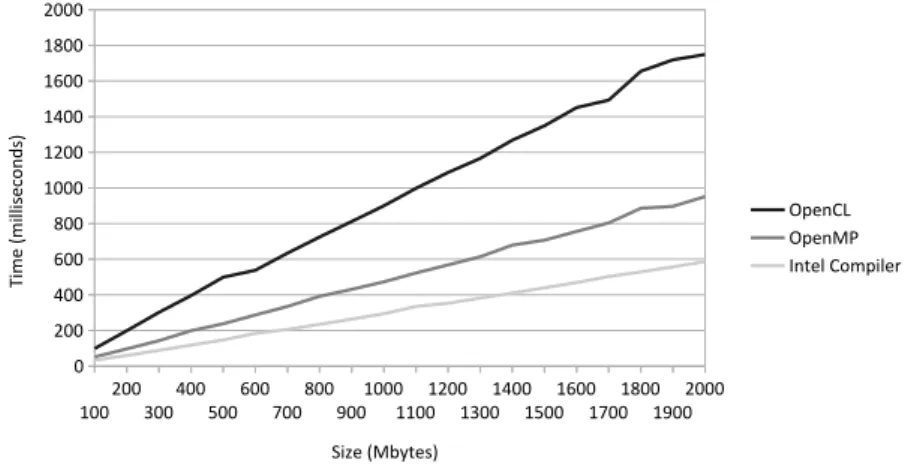
The first test consisted in allocating an array ofcharelements, fill it with randomly generated values and then measure the time required to transfer the data in and out of the co-processor. For each technology there were executed 20 tests, from 100 Mbytes to 2 Gbytes of data with a step of 100 MBytes. In Figure2.5are depicted the results obtained and it can be observed that with both OpenMP and Cilk the data transfer is faster,52% and61%, respectively. 100 200 300 400 500 600 700 800 900 1000 1100 1200 1300 1400 1500 1600 1700 1800 1900 2000 0 200 400 600 800 1000 1200 1400 1600 1800 2000 OpenCL OpenMP IntelsCompiler Sizes(Mbytes) Times (milli seconds)
Figure 2.5: Transfer times with different technologies
After the evaluation of the performance of data transfers, the performance of common applications was measured. For that, the first application was the well known matrix multiplication. The method use to perform this calculation was to assign to each thread an element of the resulting matrix, so, the thread that needs to compute the value of the position i, j, has to transverse the row i from the first input matrix and the column j
from the second input matrix. In the case of the column the naive approach would use the original matrix which would result on the values being dispersed by the input struct. To prevent this, and with the goal of taking advantage of theSIMDlanes available, the second matrix is transposed so that the values from the same column are contiguous. The results obtained are presented in Figure2.6. These results show that, if the potential of the hardware is fully used, the performance can be tweaked to be better when compared with tools that do not offer such freedom.
The previous example was already really promising, however, the scope of applica-tion of Marrow is not limited to these simple computaapplica-tions. Hence, we also evaluated the relative performance of OpenCL, OpenMP and Cilk Plus when thread communication is
2. THEINTELR XEONPHITMPROCESSOR AND ITSPROGRAMMING 2.3. Preliminary Results 1000 2000 3000 4000 5000 6000 7000 8000 9000 10000 . 20 40 60 80 100 120 OpenCL OpenMP Cilk Matrix)size)(n*n) Time) (seconds)
Figure 2.6: Execution times of integer matrix multiplication with different technologies
required. In this case, the example that was used was the N-Body problem. As it can be observed, in the results presented in Figure2.7, both OpenMP and Cilk Plus have a better performance, of approximately less 50%of execution time, than OpenCL. These results support the hypothesis that with tools that provide more control over the runtime, like OpenMP, it is possible to achieve a better performance than with specialized tools like OpenCL, since the mechanisms can be fine tuned for each case.
10000 20000 30000 40000 50000 . 100 200 300 400 500 600 OpenCL OpenMP Cilk NumberTofTparticles TimeT (seconds)
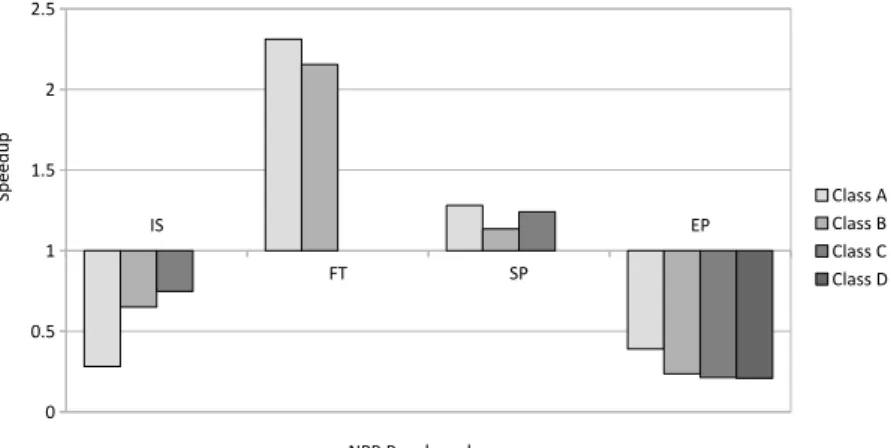
Figure 2.7: Execution times of the N-Body problem with different technologies At this point, there were good results already favoring the use of the OpenMP tech-nology but, given that all the previous tests were performed using applications devel-oped by ourselves, we wanted to use a set of examples that were specially develdevel-oped to measure the performance of a device with highly parallel applications. For that, we re-sorted to an OpenCL and OpenMP adaption of the NPB benchmark suite [SJL11], a suite of parallel benchmarks, originally developed by NASA1, to evaluate the performance of parallel supercomputers, implemented in OpenMP and OpenCL.
In order to execute the benchmarks on the Xeon Phi, the OpenCL versions did not require any modifications because they were already adapted to receive as an argument

![Figure 2.2: Diagram of the Xeon Phi’s architecture [GH13]](https://thumb-us.123doks.com/thumbv2/123dok_us/1355092.2681300/27.892.219.712.126.362/figure-diagram-xeon-phi-s-architecture-gh.webp)
![Figure 2.3: Diagram of the cores’ micro-architecture [JR13]](https://thumb-us.123doks.com/thumbv2/123dok_us/1355092.2681300/28.892.171.681.130.478/figure-diagram-of-the-cores-micro-architecture-jr.webp)