ERP System Implementation in Small and
Medium-Sized Enterprises
Ondřej Zach
ERP System Implementation in Small and
Medium-Sized Enterprises
Doctoral Dissertation
University of Agder
Faculty of Economics and Social Sciences Department of Information Systems
Doctoral Dissertations at the University of Agder 51
ISSN: 1504-9272
ISBN: 978-82-7117-714-0
Ondřej Zach, 2012
Printed by the Printing Office, University of Agder Kristiansand
Acknowledgement
First of all, I would like to thank my two supervisors, Bjørn Erik Munkvold and Dag Håkon Olsen, for their guidance throughout the PhD project. I am grateful for the countless constructive comments, inspiring discussions, and co-authorship of articles. My special thanks go to Bjørn Erik for his support and insightful comments on various issues I faced during the entire journey.
I also thank the University of Agder for the opportunity to conduct the PhD studies in Kristiansand. I enjoyed the working environment at the department. With this regard I would like to thank the former department head, Carl Erik Moe, for his inspiring enthusiasm and motivating attitude. I am particularly grateful to Moutaz Haddara, Devinder Thapa, and Arto Lanamäki for being excellent colleagues and good friends. I also thank other colleagues for contributing to the pleasant working environment. All this made the work at the department special.
I also thank my family and friends. I would like to thank my parents for their support over the years. My very best thanks go to my beloved fiancée, Kristýna. Without her support, patience, and understanding I may not be writing these words here today. She has always encouraged me in my research endeavor and supported me in the difficult times.
I am also grateful to the informants in the four case companies for sharing their valuable experience and knowledge with me.
Abstract
This thesis presents a study of Enterprise Resource Planning (ERP) system implementation in small and medium-sized enterprises (SMEs). Compared to large enterprises, SMEs represent fundamentally different environments, with a number of characteristics typifying the SME context. Because of these distinguishing differences, the findings from studies of ERP implementation in large enterprises cannot be fully applied to SMEs. The purpose of this research project is to explore the influences of the SME context on the ERP system implementation, addressing the following overall research question: How does the SME context affect ERP system implementation? The implementation term in this thesis refers to the entire ERP life-cycle, denoting the complete implementation process.
A qualitative exploratory research approach is applied to answer the research question. The research is conducted through a combination of literature review and case study research. The empirical part comprises a multiple case study of ERP implementation in four SMEs. All four case organizations are privately owned SMEs in the Czech Republic.
The research strategy applied is to investigate influences of the contextual factors on various activities across the ERP life-cycle. A list of characteristics, which typify the SME context and could potentially influence on ERP implementation, is synthesized from relevant literature. The SME characteristics are grouped into three contextual dimensions: organizational, environmental, and technological. Then, the influences of the SME characteristics on various activities across the ERP life-cycle are explored. To organize the findings, a six stage model of the ERP-life cycle is adopted. A detailed cross-case analysis is conducted, identifying similar and contrasting findings between the cases.
The research results are presented in five articles published in international conference proceedings and journals. The purpose of this thesis summary is to integrate and discuss the results presented in the publications in a coherent way.
The thesis contributes to four research areas. First, the study contributes to the research stream on contextual influences on ERP system implementation, with particular focus on the influence of the SME context. The ownership type and limited resources were identified as the most influential characteristics of the SME context. Furthermore, an early stage of organizational growth and obsolete legacy systems influenced several issues.
Second, by exploring ERP outcomes the study contributes to the area of ERP implementation evaluation and the impact of ERP systems on organizations. In total, 26 ERP outcomes were identified. The findings were compared with the measurement tool by Gable et al. (2003), indicating potential refinement of their framework. The new outcomes identified in this study may be integrated into the framework to reflect the unique conditions of SMEs.
Third, the study contributes to the research on ERP system customization. The findings provide evidence of a high level of ERP system customization applied by the case SMEs. By investigating the reasons for ERP system customization, the thesis contributes to better understanding of this subject in SMEs. Seven reasons for ERP system customization were identified, of which ownership type and stage of organizational growth of the SMEs are reasons which have not been covered in extant research.
Finally, by analyzing the characteristics of the case SMEs, the study also contributes to the more general research on IS in SMEs. The findings indicate a need for a more nuanced view on what should be considered ‘general’ SME characteristics. While SMEs are often characterized in terms of low level of IS knowledge, simple business processes and operations limited to local markets, this was not supported by this study. In addition to what is reported in former literature, the stage of organizational growth has been identified as an important contextual factor in SMEs.
In general, the findings demonstrate that the SME context influences ERP system implementation and thus should be taken into consideration in future research and practice. For SME managers, the study findings can be useful for increasing their understanding of the concerns related to ERP system implementation. In particular, SMEs need to improve their strategic planning of IS utilization. Furthermore, the findings indicate that SMEs should emphasize a thorough business process analysis, and increase their attention to outcome evaluation of the ERP system. Also, the vendors need to consider the SME context when implementing an ERP system in this type of organizations. The study documents that ERP system customization may be favoured by SMEs, but the reasons for ERP system customization need to be better understood. The role of owner-managers, unique business processes, and stage of organizational growth are important aspects concerning ERP system implementation in SMEs.
This study relates the identified influences to the different phases and activities in the ERP life-cycle. It thus provides a more complete picture of the ERP implementation
process, compared to earlier studies usually focusing only on one particular phase. Further research may follow the research direction proposed in this thesis. In particular, the applied strategy of investigating influences of SME characteristics on activities within the ERP life-cycle may serve as a useful perspective for further studies on ERP system implementation in SMEs.
Table of Contents
1 INTRODUCTION ... 1
2 RELATED RESEARCH ... 4
2.1 DEFINING THE SME CONTEXT ... 4
2.2 ERP IMPLEMENTATION RESEARCH ... 15
2.3 THE RESEARCH PERSPECTIVE APPLIED IN THIS STUDY ... 23
3 RESEARCH APPROACH ... 26 3.1 RESEARCH DESIGN ... 26 3.2 DATA COLLECTION ... 32 3.3 DATA ANALYSIS ... 36 3.4 VALIDITY ISSUES ... 39 4 RESEARCH PUBLICATIONS ... 44
4.1 EXPLORING EXISTING RESEARCH ON ERP IN SMES ... 44
4.2 INVESTIGATING ERPSYSTEM IMPLEMENTATION IN MAKE-TO-ORDER SMES ... 46
4.3 UNDERSTANDING OF ERPSYSTEM OUTCOMES IN SMES ... 47
4.4 ANALYZING ERPSYSTEM CUSTOMIZATION IN SMES ... 48
4.5 EXPLORING THE INFLUENCES OF THE SMECONTEXT... 50
5 CONTRIBUTIONS ... 52
5.1 INFLUENCES OF SME CHARACTERISTICS ON ERP IMPLEMENTATION... 52
5.2 ERP IMPLEMENTATION EVALUATION ... 56
5.3 ERP SYSTEM CUSTOMIZATION ... 58
5.4 SME CONTEXT ... 59
6 CONCLUSION ... 62
6.1 IMPLICATIONS FOR PRACTICE ... 62
6.2 IMPLICATIONS FOR FURTHER RESEARCH ... 64
REFERENCES ... 66
APPENDIX A – INTERVIEW GUIDE ... 78
APPENDIX B – CODING EXAMPLE ... 81
List of Figures
FIGURE 2.1.THE TOE FRAMEWORK ... 6
FIGURE 2.2.THE ESS MODEL... 19
FIGURE 2.3.ERP LIFE-CYCLE FRAMEWORK ... 21
FIGURE 2.4.RESEARCH FRAMEWORK... 24
FIGURE 2.5.CHARACTERISTICS OF THE SME CONTEXT ... 25
FIGURE 3.1.OVERVIEW OF RESEARCH ACTIVITIES ... 27
FIGURE 3.2.RESEARCH DESIGN ... 38
List of Tables
TABLE 2.1.SME CHARACTERISTICS ... 9TABLE 2.2.ERP LIFE-CYCLE ACTIVITIES ... 23
TABLE 3.1.CHARACTERISTICS OF THE CASE COMPANIES AND ERP IMPLEMENTATION PROJECTS ... 30
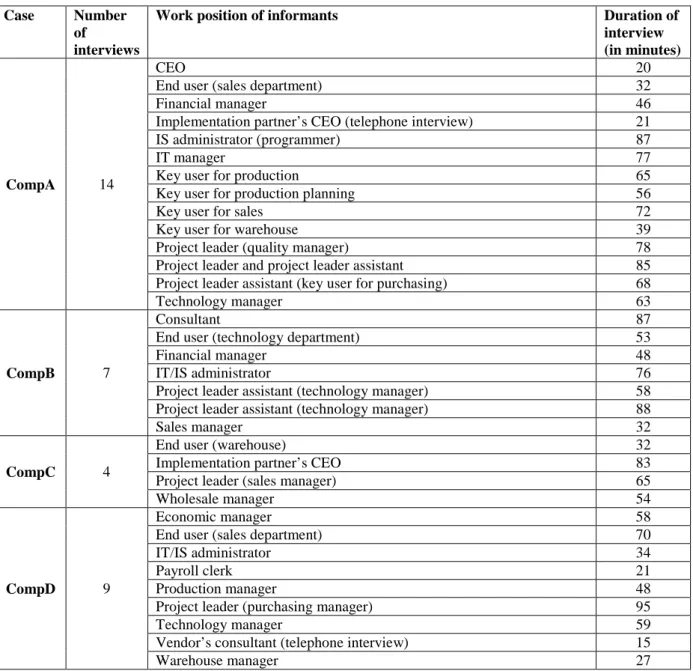
TABLE 3.2.OVERVIEW OF INTERVIEWS IN THE FOUR CASES ... 34
TABLE 3.3.ASSESSMENT OF INTERNAL VALIDITY ISSUES ... 40
TABLE 4.1.OVERVIEW OF RESEARCH PUBLICATIONS ... 44
TABLE 5.1. INFLUENCE OF SME CHARACTERISTICS ON THE ERP LIFE-CYCLE ACTIVITIES ... 55
TABLE 5.2.INFLUENCE OF SME CHARACTERISTICS ON THE ERP LIFE-CYCLE PHASES ... 56
TABLE 5.3.ERP SYSTEM OUTCOMES IN SMES ... 57
TABLE 5.4.REASONS FOR ERP SYSTEM CUSTOMIZATION ... 59
1 Introduction
This PhD thesis focuses on Enterprise Resource Planning (ERP) system implementation in small and medium-sized enterprises (SMEs). The purpose of the thesis is to investigate the influences of the SME context on ERP system implementation and contribute to a better understanding of this topic. The motivation for this research project has both a scientific and a practical background, as explained in the following.
Since there exist various definitions of ERP system in the literature, and some researchers use the terms ERP system and enterprise systems interchangeably (e.g., Davenport, 1998; Gable et al., 2003), the perception employed by this study needs to be introduced at this point. This thesis, in line with Markus and Tanis (2000), perceives enterprise systems as a more generic term, hence considering ERP systems as a subset of this generic group of systems. The thesis follows the definition portrayed by several ERP studies, defining an ERP system as: “a comprehensive, packaged software solution seeking to integrate the complete range of a business's processes and functions in order to present a holistic view of the business from a single information and IT architecture” (Klaus et al., 2000, p. 141).
Furthermore, to delineate the scope of this research, a definition of an SME needs to be introduced. This thesis adopts the EU definition of SME as an enterprise with fewer that 250 employees and annual turnover less than 50 million euro (European Commission, 2005). SMEs play an essential role in any economy in the world and embody the economic backbone (Tan et al., 2010). By providing jobs and contributing to the socio-economic development, small businesses represent an important segment of economies (Wolcott et al., 2008). In the European economy, SMEs are a major source of employment, entrepreneurial skills and innovation (European Commission, 2005). In 2007, SMEs constituted 98,8 % of the almost 19 million enterprises in the 27 EU countries’ non-financial business economy (Eurostat, 2008). SMEs represent fundamentally different environments, with a number of characteristics distinguishing them from large enterprises (Doukidis et al., 1996). Examples of these distinctive characteristics include market orientation, culture, structure, and ownership type (Ghobadian and Gallear, 1997; Wong and Aspinwall, 2004).
Enterprises worldwide have adopted ERP systems in order to leverage business performance (Beheshti and Beheshti, 2010), and ERP systems have become one of the most widespread IT solutions in organizations (Al-Mashari et al., 2003). In recent
years, with ERP vendors moving their attention towards the SME market, SMEs are now frequently adopting ERP systems (Snider et al., 2009). However, even though midrange and less complex ERP systems have been designed especially for SMEs (Koh and Simpson, 2007), ERP system implementation remains a challenge for many SMEs (Malhotra and Temponi, 2010; Olson and Staley, 2012).
With regard to the issue of IT/IS adoption, SMEs have been found to be constrained by limited resources, limited IS knowledge, and lack of IT expertise (Cragg and King, 1993; Levy and Powell, 2000; Thong, 2001). Because of these constraints an investment in IT innovation is a critical issue for SMEs. Wrong IT investment decisions can have a huge impact on the enterprise’s business results. This applies particularly to an ERP system due to its complex implementation process and high resource requirements. Due to their limited resources, SMEs might have greater difficulties in overcoming an ERP implementation failure compared to large enterprises (Muscatello et al., 2003; Poba-Nzaou and Raymond, 2011).
The perceptions on the term ‘implementation’ vary in the literature. From a technological diffusion perspective, IT implementation can be defined as: “an organizational effort directed toward diffusing appropriate information technology within a user community” (Cooper and Zmud, 1990, p. 124). ERP studies have employed various stage models, representing the ERP life-cycle, in order to investigate the ERP system implementation. However, the term implementation has been used both to denote the complete process, and a limited part of the ERP life-cycle (e.g., phase three in the framework by Esteves and Pastor, 1999). The implementation term in this thesis is used to refer to the entire ERP life-cycle.
Recognizing the importance and significance of ERP systems, a substantial body of knowledge has been accumulated by the ERP research field (Esteves and Bohorquez, 2007; Moon, 2007; Schlichter and Kraemmergaard, 2010). However, most of the ERP literature is based on findings from large enterprises (Muscatello et al., 2003; Loh and Koh, 2004). Because of the fundamental differences between large enterprises and SMEs, the findings from studies of ERP implementation in large enterprises cannot be fully applied to SMEs (Mabert et al., 2003; Buonanno et al., 2005; Laukkanen et al., 2007). Although a number of researchers have focused on the issue of ERP in SMEs, based on our thorough literature review (Haddara and Zach, 2011), we have identified a need for more research to gather sufficient knowledge about this phenomenon. In particular, extant research provides only scarce findings about the effect of the SME characteristics on ERP system implementation. Yet, it is important to recognize the
distinguishing characteristics of SMEs and consider how these influence the ERP implementation issues faced by SMEs (Gable and Stewart, 1999).
Given the motivation presented, this thesis aims to explore ERP system implementation in SMEs and shed light on the issues affecting this endeavor. In particular, the research aims to identify how specific characteristics of SMEs affect the implementation of ERP systems. Accordingly, the thesis addresses the following overall research question:
• How does the SME context affect ERP system implementation?
In addition to this main research question, the study investigates a number of sub-questions. These address various aspects of the phenomenon under study and are presented later.
The empirical basis for the thesis is a multiple case study of ERP implementations in four SMEs in the Czech Republic. The results from this research are presented and discussed in five research publications (see Appendix C). The purpose of this thesis summary is to integrate the publications and present the research findings in a coherent way.
The rest of the thesis is organized as follows. Chapter 2 introduces different research perspectives on the concept of ERP system implementation and presents the perspective applied in this thesis. In chapter 3 the applied research approach is described, including research design, data collection, and overview of the cases studied. Chapter 4 provides an overview of the five research publications, summarizing the individual papers and their findings. The research contributions are presented in chapter 5. Chapter 6 summarizes the research outcomes, indicates research limitations and reflects on the implications for further research and practice.
2 Related research
This chapter provides an overview of literature related to the research presented in this thesis. As outlined in the introduction, the phenomenon of interest is ERP system implementation in the context of SMEs. There exists a substantial body of scientific literature related to the area of ERP systems, as well as literature about the general relationship between IS and organizations. This review does not intend to cover all existing literature within these two domains, but rather concentrates on the issues relevant for the present research.
In section 2.1, I start with defining the SME context. The purpose of the section is to elicit the characteristics which typify the SME context, and could potentially influence on ERP implementation. Based on a review of relevant research I present a summary of SME characteristics, which represent the SME context studied in my research. The section is organized as follows. I start with a brief discussion of context in IS research (2.1.1). Then I present a review of literature on contextual influences in SMEs (2.1.2). The review covers general literature exploring the influence of the SME context on organizational initiatives, research on the contextual influences on adoption of IT/IS in SMEs, as well as contextual influences on ERP implementation in SMEs. Finally, a summary of SME characteristics is discussed in detail (2.1.3).
In section 2.2, I present and discuss different perspectives on ERP system implementation. The purpose of the section is to provide an overview and understanding of the state-of-the-art in ERP implementation literature, with particular focus on the issues relevant for my research. I organize the section according to the two theoretical approaches of ERP implementation research, i.e. variance research (2.2.1) and process research (2.2.2).
In section 2.3, I position my study in relation to the presented literature. I introduce the research perspective applied and present a research framework.
2.1 Defining the SME context
2.1.1 Context in IS researchThe importance of context has been emphasized in the IS literature (e.g., Avgerou, 2001): “It could be argued that all information systems studies are contextual, as they address issues of technology implementation and use within organizational rather than in a laboratory setting. Thus, by the nature of the object of its study, information
systems research considers a changing entity within its environment.” (Avgerou, 2001, p. 44).
However, conceptualizations of the term context differ among studies. With regard to the boundaries of contextualist studies, three levels of context may be identified (Avgerou, 2001):
• Organization
• Organization’s environment
• National and international environment
Early IS research focused largely on intra-organizational IT innovation, and the contextual factors were thus usually considered within the boundaries of an organization (e.g., Ein-Dor and Segev, 1978; Raymond, 1990). A number of IS studies have extended the focus beyond the single organization and included aspects of the organization’s environment into consideration, highlighting the existence of competitive pressures on organizations. Increasingly, national and international aspects have also been introduced in research on IT innovations (Avgerou, 2001). The study presented in this thesis regards context mainly in terms of the first two bullet points listed above, while some aspects of national environment are also discussed.
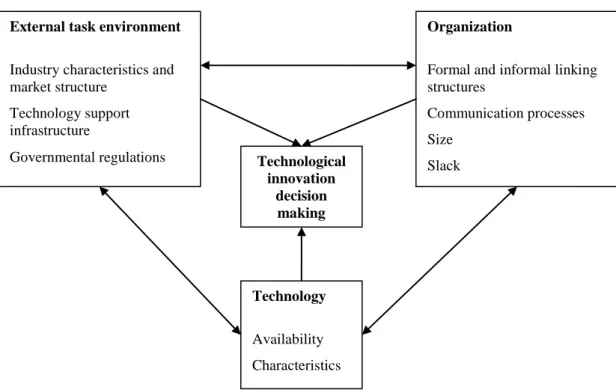
Several frameworks and models have been employed to capture the contextual influences on IS. A number of studies have adapted the technology-organization-environment (TOE) framework by Tornatzky and Fleischer (1990) to explain IT innovation (e.g., Chau and Tam, 1997; Zhu and Kraemer, 2005; Zhu et al., 2006), including studies on ERP system adoption and implementation (e.g., Kouki et al., 2006; Pan and Jang, 2008; Kouki and Pellerin, 2010).
The TOE framework defines three elements of a firm’s context influencing the process of adoption and implementation of technological innovation: organizational context, technological context, and environmental context. These three contextual dimensions are discussed in the following and the TOE framework is illustrated in Figure 2.1.
• Characteristics of the organizational context typically include firm size, centralization and formalization, complexity of managerial structure, quality of human resources, the amount of slack resources, decision making, and internal communication.
• The environmental context represents the arena in which a firm conducts its business, such as industry, competitors, access to recourses supplied by others, and governmental regulations.
• Characteristics of the technological context are defined in terms of all internal and external technologies relevant to the firm. The technological context is considered separately from the rest of the context in order to focus attention on influences of the technology on the adoption and implementation process (Tornatzky and Fleischer, 1990).
Important for the focus of this study, the TOE framework has been tested and validated by studies on IT adoption and assimilation in SMEs (e.g., Thong, 1999; Iacovou et al., 1995; Kuan and Chau, 2001; Scupola, 2003; Raymond et al., 2005). Also several studies investigating ERP adoption in SMEs have employed the framework (e.g., Ramdani and Kawalek, 2007; Raymond and Uwizeyemungu, 2007; Ramdani et al., 2009; Poba-Nzaou and Raymond, 2011). These studies successfully utilized the framework to organize selected contextual factors, and found it to be a relevant framework that can be used to study SMEs’ adoption of enterprise systems (Ramdani and Kawalek, 2007).
Figure 2.1. The TOE framework (adopted from Tornatzky and Fleischer, 1990) External task environment
Industry characteristics and market structure
Technology support infrastructure
Governmental regulations
Organization
Formal and informal linking structures Communication processes Size Slack Technology Availability Characteristics Technological innovation decision making
Based on the successful use of the TOE framework in former research, I have adopted the framework in my research. I organize the SME characteristics according to the three contextual dimensions of the TOE framework. The following section presents a review of literature to identify characteristics which typify the SME context, and that could potentially influence ERP implementation.
2.1.2 Contextual influences in SMEs
This section introduces an overview of relevant literature on contextual influences in SMEs. The review particularly focuses on studies conducted in the field of IS and ERP, as these are of the highest relevance for the thesis. Since the characteristics of the SME context originate from reference disciplines within organizational research (e.g., management, organizational design, and organizational behavior), I perceived it valuable to review this broader literature as well. Thus, in addition to the literature on IS and ERP in SMEs, I reviewed studies investigating the influence of SME characteristics on various organizational initiatives. In this, rather than aiming for a comprehensive review, I focused on identifying frequently cited studies used as references for illustrating distinguishing characteristics of the SME context.
Two studies were identified to be particularly relevant, as they provide a comprehensive overview of inherent characteristics distinguishing SMEs from large enterprises. The studies explore the SME context with relation to Total Quality Management (TQM) (Ghobadian and Gallear, 1997) and Knowledge Management (KM) (Wong and Aspinwall, 2004).
The study by Ghobadian and Gallear (1997) explored the differences between large enterprises and SMEs, and analyzed the relationship between the SME characteristics and TQM practices. Based on a literature review, the authors compiled an extensive list of issues distinguishing SMEs from large enterprises, grouped into six areas:
structure, procedures, behavior, processes, people, and contacts. The influence of these issues on TQM implementation practices was investigated through four exploratory case studies, resulting in a framework for successful implementation of TQM in SMEs.
In the study characterizing KM in a small business environment, Wong and Aspinwall (2004) looked at specific SME characteristics and the key problems and issues associated with KM. Inspired by Ghobadian and Gallear (1997), based on a literature review the authors proposed a list of SME characteristics which can have an influence on the implementation of KM. The characteristics were classified into six groups:
ownership and management; structure; culture and behavior; systems, processes and procedures; human resources; customs and market. This conceptual paper concludes that recognition of these elements is crucial in order to provide a compatible KM approach for SMEs.
Several studies have investigated various factors affecting IT/IS adoption in SMEs (e.g., Thong and Yap, 1995; Thong, 1999; Sharma, 2009), such as CEO characteristics, employees’ IS knowledge, information intensity, and competition. The studies have identified several barriers to IT adoption in SMEs, including resource constraints (Blili and Raymond, 1993; Cragg and King, 1993; Levy and Powell, 2000; Thong, 2001), limited internal IT/IS expertise (Blili and Raymond, 1993; Cragg and King, 1993; Cragg and Zinatelli, 1995; Iacovou et al., 1995; Fink, 1998; Levy and Powell, 2000; Thong, 2001), and limited IS knowledge (Cragg and King, 1993; Cragg and Zinatelli, 1995; Levy and Powell, 2000).
Among the aforementioned studies on IT/IS adoption, the study by Blili and Raymond (1993) stands out in terms of its coverage of SME characteristics and its emphasis on the importance of SME environment specificity. The authors investigated the threats and opportunities of SMEs during IT adoption, and developed a schematic summary of the unique SME characteristics with respect to strategic information systems. The SME specificity features were classified into five areas: environmental specificity, organizational specificity, decisional specificity, psycho-sociological specificity, and information systems specificity. The study provides a framework for analyzing the threats and opportunities formed by IT in SMEs.
In a similar vein, several studies investigated the influence of various factors on ERP system adoption in SMEs, such as business size (Raymond and Uwizeyemungu, 2007; Ramdani et al., 2009; Chang and Hung, 2010), CEO characteristics (Shiau et al., 2009; Chang and Hung, 2010), industry type (Ramdani et al., 2009; Chang and Hung, 2010), competitive pressure (Ramdani et al., 2009; Chang and Hung, 2010), employees’ competence of IS (Chang and Hung, 2010), and availability of resources (Raymond et al., 2006; Raymond and Uwizeyemungu, 2007; Seethamraju and Seethamraju, 2008). These studies provide valuable findings about the influence of particular factors on the adoption of an ERP system. However, few studies have examined the influence of the unique SME characteristics distinguishing them from large enterprises. Moreover, most of the studies focus on adoption of the ERP system, limiting the scope to a single phase of the ERP life-cycle.
An exception to this is an article by Gable and Stewart (1999), focusing on implementation issues in SMEs adopting SAP R/3. They distinguish between four dimensions of SME specificity (organizational, decisional, psycho-sociological, and information systems specificity) and discussed the application of these in the context of ERP systems implementation. However, their paper only presents a tentative model describing interacting variables, with no empirical data. Unfortunately, no follow-up empirical study has been published.
2.1.3 Overview of SME characteristics
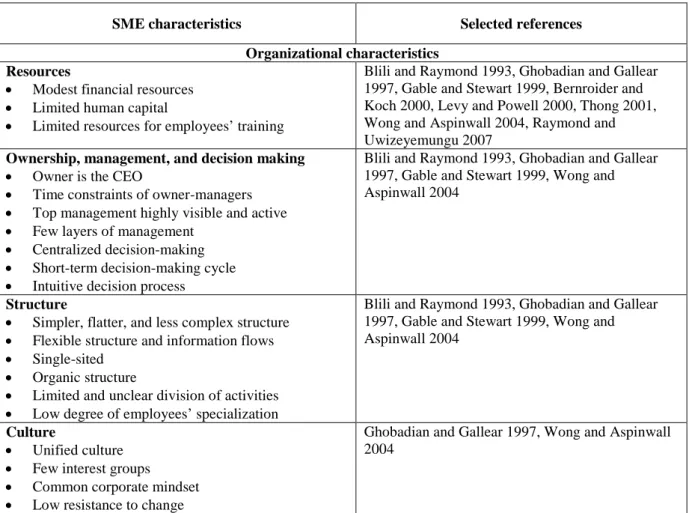
Based on the literature review, Table 2.1 lists the identified SME characteristics that could potentially influence on ERP implementation. The overview is largely based on four summative studies which I found particularly relevant for the purpose of the thesis (i.e., Blili and Raymond, 1993; Ghobadian and Gallear, 1997, Gable and Stewart, 1999; Wong and Aspinwall, 2004). The SME characteristics are grouped according to the three contextual dimensions of the TOE framework: organizational characteristics, environmental characteristics, and IS characteristics. Selected key references are included for each characteristic.
Table 2.1. SME characteristics
SME characteristics Selected references
Organizational characteristics Resources
• Modest financial resources • Limited human capital
• Limited resources for employees’ training
Blili and Raymond 1993, Ghobadian and Gallear 1997, Gable and Stewart 1999, Bernroider and Koch 2000, Levy and Powell 2000, Thong 2001, Wong and Aspinwall 2004, Raymond and Uwizeyemungu 2007
Ownership, management, and decision making • Owner is the CEO
• Time constraints of owner-managers • Top management highly visible and active • Few layers of management
• Centralized decision-making • Short-term decision-making cycle • Intuitive decision process
Blili and Raymond 1993, Ghobadian and Gallear 1997, Gable and Stewart 1999, Wong and Aspinwall 2004
Structure
• Simpler, flatter, and less complex structure • Flexible structure and information flows • Single-sited
• Organic structure
• Limited and uncleardivision of activities • Low degree of employees’ specialization
Blili and Raymond 1993, Ghobadian and Gallear 1997, Gable and Stewart 1999, Wong and Aspinwall 2004
Culture
• Unified culture • Few interest groups • Common corporate mindset • Low resistance to change
Ghobadian and Gallear 1997, Wong and Aspinwall 2004
• Organic and fluid culture • Influenced by owner-managers Processes and procedures
• Smaller and less complicated processes • More flexible and adaptable processes • Informal rules and procedures
• Low degree of standardization and formalization
Ghobadian and Gallear 1997, Wong and Aspinwall 2004
Environmental characteristics Market, customers
• Mostly local and regional market
• Normally dependent on a small customer base • Affected by powerful partners in their supply chain
Blili and Raymond 1993, Ghobadian and Gallear 1997, Wong and Aspinwall 2004, Seethamraju and Seethamraju 2008
Uncertainty
• High level of environmental uncertainty • Uncertain and unstable environment
Blili and Raymond 1993, Gable and Stewart 1999, Seethamraju and Seethamraju 2008
Information Systems characteristics IS knowledge
• Limited knowledge of IS • Modest managerial expertise • Limited management attention to IS • Lack of strategic planning of IS
Blili and Raymond 1993, Cragg and Zinatelli 1995, Levy and Powell 2000, Levy et al. 2001, Shiau et al. 2009, Chang and Hung 2010
IT technical expertise
• Limited IT/IS in-house technical expertise • Emphasis on packaged applications • Greater reliance on third party
Raymond 1985, Blili and Raymond 1993, Cragg and Zinatelli 1995, Iacovou et al. 1995, Fink 1998, Gable and Stewart 1999, Levy and Powell 2000, Thong 2001, Shiau et al. 2009, Chang and Hung 2010
IS function, IS complexity • IS function in its earlier stages
• Subordinated to the accounting function
Blili and Raymond 1993, Gable and Stewart 1999
In the following I present each of the SME characteristics in more detail, based on the literature referenced in Table 2.1. It should be noted that some of the literature on IT/IS in SMEs is relatively old and not specifically related to ERP systems. Hence, one of the aims of this study is also to investigate whether the assumptions about SME characteristics in extant research also hold for contemporary ERP system implementations.
Organizational characteristics
Resources. SMEs have been found to be constrained in terms of their financial as well as human resources. They usually do not dispose of a capacity to develop and manage their own IS and thus they are likely to rely on third parties such as vendors and consultants. This might lead to limited control over the information resources and may thus increase the level of risk. In addition, because of the resource constraints SMEs have been reported to invest less in employees’ training, as opposed to large enterprises which usually have resources to develop customized training and educational programs.
The research on selection of ERP systems shows that affordable cost and short implementation time are among the most important selection criteria in SMEs. With limited resources available, the enterprises were less disposed to the adoption of an ERP system, and financial constraints were identified as the main cause of non-adoption of ERP systems among SMEs.
Ownership, management, and decision making. The CEOs of SMEs are usually owners who have the ultimate power of control and commonly oversee every aspect of the business. Often they are the only ones with responsibility for and access to the information needed to identify opportunities for using IT for strategic or competitive purposes. The owner-managers usually do not have enough time to reflect on strategic issues, as they are busy with day to day operations and their attention is more on core business operations.
Decision-making is SMEs has been reported as generally centralized with fewer layers of management and decision makers. The centralized decision-making implies that the CEO can either be the main obstruction or the main catalyst for change. Furthermore, the decision-making cycle is usually short-term. In addition, the decision process in SMEs has been found to be more intuitive and based on experience, as a limited number of formal information and decision models are employed.
Structure. Compared to large enterprises, SMEs have been in general reported having a simpler, flatter, and less complex structure. A simpler structure facilitates a change initiative across the organization. As a result of a flat structure in SMEs, the working environment is more flexible, and the communication process is likely to be less complex and easier to manage. Moreover, SMEs have been found to often operate on a single site. In addition, SMEs are also likely to have an organic structure. Workers in small firms often perform a variety of tasks, implying a low degree of specialization in the employees’ jobs.
Culture. Culture in SMEs has been reported as unified, with few interest groups. Employees have usually been characterized as having a corporate mindset emphasizing the company as a single entity. The unified culture may provide SMEs with a strong foundation for change, as employees easily understand what the company is trying to achieve. In addition, compared to large enterprises, culture in SMEs has been characterized as more organic and fluid. In the same time, as a result of the strong dominance of owner-managers in SMEs, culture is easily shaped and influenced by their personality and outlook.
Processes and procedures. The operations and processes in SMEs are usually characterized as smaller in scale and less complicated than those in large enterprises. Moreover, the processes in SMEs are also often more flexible and adaptable to changes taking place around them. Therefore, SMEs are likely to be more adaptable to implementing new initiatives, as they are less likely to be “locked-in” to their existing processes. One implication of the need to react quickly is that that most of the activities in SMEs are governed by informal rules and procedures, with low degree of standardization and formalization.
On the other hand, several ERP studies reported importance of SME idiosyncratic processes and a need for preserving these (e.g., Bernroider and Koch, 2001; Vilpola and Kouri, 2005; Quiescenti et al., 2006; Snider et al., 2009). Business processes in SMEs were also reported to have a low degree of standardization and formalization.
Environmental characteristics
Market and customers. The market encompassed by SMEs has mostly been reported as local, having limited international range. In general, SMEs are characterized as dependent on a small customer base with frequent and close contacts with customers. Major customers or suppliers, who are typically powerful in their supply chain, may force SMEs to adopt a system compatible with their extant solution and thus influence ERP system implementations in these organizations.
Uncertainty. SMEs are typically characterized by a high level of environmental uncertainty. The uncertain and unstable environment influences any long term investments in information technologies. Uncertainty relating to the technological environment and the competition is likely to significantly affect IS implementation in SMEs.
Information Systems characteristics
IS knowledge. SMEs have been reported having limited IS knowledge, as there is usually not sufficient managerial expertise available to plan, organize, and direct the use of information resources. Traditionally, most CEOs in SMEs focus on management issues and pay less attention to technology. The lack of IS knowledge may lead to insufficient attention by management to IS and in turn to a lack of strategic planning of IS implementation and use.
In a similar vein, a recent study assessing ERP adoption in SMEs concluded that lack of IS knowledge may inhibit SMEs from adopting ERP systems (Shiau et al., 2009).
The findings showed that the more IS knowledge CEOs have, the more they are inclined to adopt ERP systems. Also the results by Chang and Hung (2010) indicated a positive influence of the CEO’s IS knowledge as well as employees’ IS knowledge on ERP system adoption.
IT technical expertise. SMEs are also often reported being constrained by limited internal IT/IS technical expertise. Many SMEs possess insufficient level of in-house IT/IS expertise necessary for successful IS adoption, and are thus more likely to purchase a packaged software instead of developing a system in-house.
This argument has been supported by a recent study of ERP system adoption in SMEs (Chang and Hung, 2010), which reported lack of IT/IS professionals and a shortage of developing resources. Also, Shiau et al. (2009) indicated that SMEs do not have the technical IT expertise to evaluate information systems. On the other hand, the studies by Olsen and Sætre (2007b, 2007a) propose in-house development of ERP systems as the best alternative for SMEs, stating that nowadays SMEs may have sufficient IT competence. Similar, a study by Olson and Staley (2012) reported in-house development of an ERP system as an option considered by the case SME, as the company had experience in software engineering.
IS function, IS complexity. The IS function in most SMEs is typically perceived to be in its early stage of evolution. However, more recent studies indicate a need for nuancing this view. For example, a study evaluating readiness of SMEs for ERP adoption recognized that most of the studied SMEs used quite complex IS solutions (Raymond et al., 2006).
Stage of growth
In addition to the SME characteristics identified from the literature review, I discuss
stage of organizational growth as an organizational characteristic which may distinguish SMEs from large enterprises, and which has not been sufficiently covered by the reviewed literature. In SMEs, often being in an early stage of organizational growth, the change dynamics are often relatively greater than in large enterprises. This does not imply that large enterprises do not grow, but the argument made is that the character of SMEs’ businesses is often more dynamic, with changes occurring more frequently and faster compared to large enterprises.
A large volume of scientific literature is dedicated to mapping organizational growth patterns, and various perspectives have surfaced over time. One of the predominant perspectives is the organizational life-cycle, describing organizations as passing
through a series of stages (Churchill and Lewis, 1983). This perspective continues to be widely used in academic and practitioner literature (Phelps et al., 2007). Several models of organizational stage of growth have been developed (e.g., Churchill and Lewis, 1983; Hanks et al., 1993; Greiner, 1998). Their purpose is to explain the dynamism of organizational growth processes, but they differ in the number of proposed stages (McMahon, 1998). The models are often focusing on SMEs, as the growth aspect is of high importance in these organizations (Dobbs and Hamilton, 2007).
The model by Churchill and Lewis (1983) derives a life-cycle with five stages of small business growth (existence, survival, success, take-off, and resource maturity). Each phase is characterized by the following features: organizational size, diversity, complexity, management style, organizational structure, extent of formal systems, major strategic goals, and the owner’s involvement in the business.
While the stage approach has received criticism due to its limitations in terms of explanatory power, underpinning assumptions about linear sequential growth, and limited supporting evidence (Dobbs and Hamilton, 2007; Phelps et al., 2007), this perspective is useful in framing the general processes of organizational evolution and continuous change over time (Hite and Hesterly, 2001), and for understanding the organizational aspects of what should change in a business (Street and Meister, 2004). The organizational life-cycle perspective has also been applied in IS research, and refined models of IS planning and IS strategy change have been presented in the IS literature (e.g., Doukidis, 1996; Levy et al., 2001).
A distinction should be made between stage of growth and another contextual characteristic, organizational maturity. Organizational maturity is defined as “the degree to which organizational processes are systematized and formalized through rules, procedures, and management practices” (Raymond, 1990, p. 7). Among the numerous models developed for assessing the maturity level, the Process and Enterprise Maturity Model by Hammer (2007) is well recognized. A common dimension of organizational maturity is the level of formalization (Raymond, 1990). Hence, organizational maturity is related to the level of maturity of organizational processes, in this study captured in the “processes and procedures” characteristic. These two characteristics of organizational context are often interrelated, as organizational growth may impose changes and improvements in business processes. Higher organizational growth stages are also often characterized by increased level of process formalization. But this does not always hold true. Hypothetically, an
organization with stable size/growth can develop from immature to mature in its business processes, and vice versa, a company can grow without increasing its level of maturity.
2.2 ERP implementation research
Numerous studies addressing various topics and issues of the ERP phenomenon have been conducted over the years (Botta-Genoulaz et al., 2005; Moon, 2007; Esteves and Bohorquez, 2007; Schlichter and Kraemmergaard, 2010; Grabski et al., 2011). A recent literature review by Schlichter and Kraemmergaard (2010) distinguished between the following eight research topics covering the range of aspects published within the ERP field: implementation, optimization of ERP, management and ERP issues, the ERP tool, ERP and supply chain management, studying ERP, ERP and education, and the ERP market and industry. According to the results of their literature review, 80 percent of the reviewed articles fall into the first four research topics. The implementation aspect was reported as a predominant subject counting for 30 percent of the studies.
Naturally, ERP research builds on more general IS research. A large body of knowledge has been accumulated in the IS research field over time, and various taxonomies to classify different types of IS research have been proposed. A classic example is the typology introduced by Orlikowski and Baroudi (1991), classifying IS research as positivist, interpretive and critical research based on ontological and epistemological assumptions. Another common perspective for classifying IS research is the distinction between variance and process theories, based on Mohr (1982). This perspective was first introduced in IS by Markus and Robey (1988) and has since then received considerable recognition. Variance theories are concerned with: “predicting levels of outcomes from levels of contemporaneous predictor variables” (Markus and Robey, 1988, p. 589), while process theories are concerned with: “explaining how outcomes develop over time” (Markus and Robey, 1988, p. 589).
A substantial part of IS research has focused on the notion of IS implementation, and numerous theories and models of IS implementation have surfaced over the years, varying in research approaches and methods of investigation applied. Due to a multitude of such contributions, IS implementation theory has been characterized as quite diverse (Marble, 2000). Also the conceptualizations of implementation itself differ in literature. My intention here is not to provide a thorough overview of the theories and conceptualizations applied, for this I rather refer to former meta-analysis
studies of IT/IS implementation research (e.g., Tornatzky and Klein, 1982; Kwon and Zmud, 1987; Alavi and Joachimsthaler, 1992; Marble, 2000; Premkumar, 2003). This thesis adopts the definition of IT implementation as: “an organizational effort directed toward diffusing appropriate information technology within a user community”
(Cooper and Zmud, 1990, p. 124).
A general trend has been a move towards more focus in IS implementation research (Marble, 2000), with studies focusing on individual factors significant in the implementation, special types of systems, or specific types of organizations. Due to the uniqueness of SMEs, a number of studies have focused on IS implementation in this context. A good overview of this research stream is provided by Premkumar (2003).
ERP implementation has received great attention in the research literature, and several perspectives to study this phenomenon have been developed. These are introduced in the rest of this section. In line with Robey et al. (2002), I organize the ERP implementation literature according to the two theoretical approaches introduced above: variance and process research. Each sub-section discusses a particular topic in a general way, followed by a focus on research in SMEs.
2.2.1 Variance research on ERP implementation
The focus of ERP studies within the variance research stream includes three particular aspects: contextual factors, critical success factors, and ERP effects.
Contextual influences on ERP implementation
Studies investigating the influences of various contextual factors on ERP system implementation can be categorized in the variance research stream. As discussed in section 2.1.2, this research focuses on investigating influences of various factors on the adoption of an ERP system, thus restricting the scope to a limited part of the ERP life-cycle. Moreover, few studies have examined the influence of the unique SME characteristics.
Various theoretical perspectives to investigate influences of contextual factors on ERP system implementation have been applied. One of the common approaches employed is the concept of fit, originated from contingency theory (Lawrence and Lorsch, 1967; Donaldson, 2001). The fundamental perspective of contingency theory is that organizational effectiveness is achieved by fitting organizational characteristics to contingencies, when a contingency is defined as “any variable that moderates the effect of an organizational characteristic on organizational performance” (Donaldson
2001, p.7). The contingency theory has been widely utilized in IS research (e.g., Khazanchi, 2005; Khalifa and Shen, 2008; Raymond and Bergeton, 2008), and the concept of fit has also been applied in ERP research (e.g., Hong and Kim, 2002; Morton and Hu, 2008; Ifinedo and Nahar, 2009). The concept of fit within the ERP context can be defined as “the congruence between the original artifacts of ERP and its organizational context” (Hong and Kim 2002, p.27). The contingency theory was considered as a potential theoretical lens in the beginning of this research project (Zach, 2009). However, I found this perspective too static and narrow in scope, ignoring the richness and complexity of ERP implementation, and hence did not follow this path further.
Critical success factors
The studies on ERP critical success factors (CSFs) represent the predominant research stream adopting a variance approach. The term CSF was coined by Rockart (1979), defined as “the limited number of areas in which results, if they are satisfactory, will ensure successful competitive performance for the organization” (Rockart, 1979, p.85). In terms of ERP research, CSFs are factors that should be present or fulfilled in order to guarantee ERP implementation success (Robey et al., 2002; Nandhakumar, 2005).
Numerous studies have investigated CSFs of ERP system implementation (e.g., Holland and Light, 1999; Nah et al., 2001; Somers and Nelson, 2001; Akkermans and van Helden, 2002; Al-Mashari et al., 2003). The findings vary to some extent, but the commonly articulated ERP CSFs are top management support, project team competence, project management, clear goals and vision, project champion, user involvement, use of consultant, business process reengineering, and minimal system customization.
CSFs have also been investigated by studies in SMEs (e.g., Loh and Koh, 2004; Reuther and Chattopadhyay, 2004; Sun et al., 2005; Snider et al., 2009; Doom et al., 2010; Kale et al., 2010; Malhotraa and Temponi, 2010; Upadhyay and Dan, 2010). The studies discovered that most of the general ERP CSFs apply to SMEs (e.g., Doom et al., 2010), while some studies also found CSFs unique for SMEs (e.g., Snider et al., 2009). For further discussion I refer to the literature review conducted in article 1 (see Appendix C).
Here I briefly discuss one particular CSF, namely minimal ERP system customization. A number of studies identified minimal ERP customization as one of the CSFs for
ERP system implementation (Nah et al., 2001; Somers and Nelson, 2001), including research in SMEs (Upadhyay et al., 2011). In contrast, some studies have documented failed ERP projects applying customization (Kholeif et al., 2007; Hawari and Heeks, 2010). In particular, research on ERP system implementation in SMEs indicates that SMEs may rather choose to adapt ERP systems to the business processes (Snider et al., 2009; Poba-Nzaou and Raymond, 2011), since system flexibility is important for these organizations (van Everdingen et al., 2000; Bernroider and Koch, 2001). This issue exemplifies that the CSFs from large enterprises may not apply to SMEs. The issue of ERP system customization has been further discussed in article 4 (see Appendix C).
ERP effects
Variance research also includes studies of ERP effects, focusing on the outcomes of ERP implementation (Robey et al., 2002). This issue has received substantial attention and the ERP literature includes numerous studies investigating ERP system outcomes. Over the years, various approaches to ex-post evaluation of ERP system outcomes have been developed. These include studies employing ERP success assessment tools (Tan and Pan, 2002; Gable et al., 2003; Ifinedo, 2006a), ERP benefit frameworks (Shang and Seddon, 2000; Shang and Seddon, 2002; Staehr, 2007; Williams and Schubert, 2010), and ERP balanced scorecard frameworks (Chand et al., 2005; Velcu, 2007; Uwizeyemungu and Raymond, 2009).
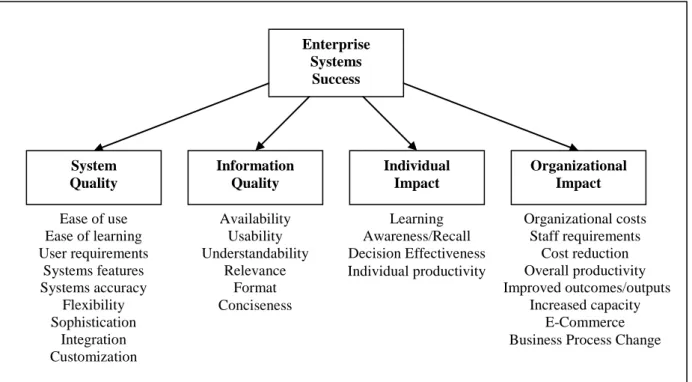
A significant contribution in this area is the model for Enterprise Systems1
The ESS model builds on the models by DeLone and McLean (1992) and Myers et al. (1997), with the success dimensions and measures revised to meet the ERP characteristics. The model involves 27 measures of ERP success grouped into four dimensions: information quality, system quality, individual impact, and organizational impact. Information quality is a measure of the quality of the information the ERP system produces. System quality includes measures of the ERP system performance from a technical and design perspective. Individual impact measures the extent to which the ERP system has influenced the capabilities and effectiveness of workers. The Organizational impact dimension captures the extent to which the ERP system Success (ESS) measurement developed by Gable et al. (2003). This model is selected as a framework for investigating ERP outcomes in this study (see article 3 in Appendix C). I present the ESS model in more detail in the following.
1
has promoted improvements in organizational results and capabilities (Gable et al., 2008).
The model is presented in Figure 2.2. It is purely a measurement tool for assessing the ERP success, and it does not propose any causality effects between the dimensions (Gable et al., 2003). The model gained considerable recognition and has been further employed in several studies (e.g., Sedera et al., 2003; Sedera and Gable, 2004; Sehgal and Stewart, 2004; Ifinedo, 2006a; Gable et al., 2008). Petter et al. (2008) in their thorough literature review found the ESS model to be the most comprehensive tool for IS success measurement. They state one of its strengths to be that it avoids overlap between the constructs and measures.
Figure 2.2. The ESS model (adapted from Sedera et al., 2004)
A limited number of studies have focused on ERP system outcomes in SMEs. Esteves (2009) conducted a survey to investigate ERP benefits realization in SMEs, applying the ERP benefit framework by Shang and Seddon (2000). The study determines a link between the benefits and the point in time when the various benefits are expected to materialize, resulting in a benefit realization road-map for ERP usage in SMEs.
Another study reporting ERP outcome assessment in SMEs was conducted by Federici (2007, 2009). The author aimed at a post-introduction assessment of ERP outcomes in SMEs. Interestingly, the study also investigated factors influencing the outcomes. A list of the five most cited benefits that were promised to large companies by ERP adoptions was adopted. The results of a survey of 50 SMEs showed that the most
Enterprise Systems Success Ease of use Ease of learning User requirements Systems features Systems accuracy Flexibility Sophistication Integration Customization Availability Usability Understandability Relevance Format Conciseness Learning Awareness/Recall Decision Effectiveness Individual productivity Organizational costs Staff requirements Cost reduction Overall productivity Improved outcomes/outputs Increased capacity E-Commerce Business Process Change System Quality Information Quality Individual Impact Organizational Impact
common benefits were procedure simplification, easier information retrieval, improved performance management, and production efficiency improvements. The most influential factors observed were depth of organizational change and type of chosen ERP producer.
Recently, Kale et al. (2010) investigated performance evaluation of ERP implementation in Indian SMEs. Nineteen ERP benefits were studied through a survey of 130 SMEs. The findings indicated that SMEs benefited mainly by reduced need for support, improved customer services, and improved communication.
Although these studies used data from SMEs, they did not examine in detail the specificity of the SME environment. Moreover, by basing the studies on existing frameworks or lists of ERP outcomes, the studies do not exploit the potential to identify and explore new outcomes which might be specific for SMEs.
2.2.2 Process research on ERP implementation
In contrast to variance research, process research seeks to explain how changes emerge over time. This perspective builds on the more general IS implementation research pursuing the process view (Markus and Robey, 1988; Newman and Robey, 1992). In this theoretical perspective, IS implementation is typically considered as a sequence of stages. As an example, Kwon and Zmud (1987) developed a six stage model of the implementation process, building on diffusion of innovation (DOI) theory (Rogers, 2003). The model has later been refined by Cooper and Zmud (1990), consisting of the following six phases: initiation, adoption, adaptation, acceptance, routinization, and infusion.
In ERP research, various stage models representing the ERP life-cycle have been developed. These usually differ in the number of stages they encompass, distinguishing between three (Parr and Shanks, 2000), four (Markus and Tanis, 2000), five (Ross and Vitale, 2000; Chang et al., 2008), and six phases (Esteves and Pastor, 1999).
The framework by Markus and Tanis (2000) has been employed by a number of ERP studies (e.g., Kumar et al., 2002). The model consists of four phases, characterized by key players, typical activities, characteristic problems, appropriate performance metrics, and range of possible outcomes. The phases are: project chartering, the project, shakedown, and the onward and upward phase.
• Project chartering includes the activities before the official start of the project. These include the organizational decision about an investment in a new IS solution, mapping of existing business processes, analysis of potential benefits and limitations, specification of functionality needed, and system selection.
• The project phase encompasses all activities between the system selection and “going- live”. It comprises activities such as project team building, business process modeling and reengineering, system customization and configuration, end user training, data conversion, testing and debugging, and rollout.
• Shakedown is defined as the period between “going-live” and the time when operations get into routine use. During this phase the system performance is tuned, bugs are fixed, and additional training is conducted if needed. The end users are getting familiar with the system and operations are becoming “normal.”
• The onward and upward phase is defined as the period since “normal” operations to when the system is replaced by an upgraded version or a different system. Typical activities involved are additional user skill building, continuous business improvement, and benefits and success assessment.
In contrast, Esteves and Pastor (1999) developed a six stage ERP life-cycle framework. The authors mapped the research issues that can be analyzed within an ERP life-cycle process, and categorize them into the following phases: adoption decision, acquisition, implementation, use and maintenance, evolution, and retirement (see Figure 2.3). Each of the phases involves several issues and activities typical for a particular phase. These are briefly discussed in the following.
Figure 2.3. ERP life-cycle framework (adapted from Esteves and Pastor, 1999)
• During the adoption decision phase organizations recognize their need for a new ERP system. This phase comprises activities such as definition of system requirements, its goals and benefits, and an analysis of the intended ERP system impact.
• The acquisition phase includes selection of the product that best fits the selection criteria. Also, an implementation partner is selected based on factors such as price,
Adoption Decision
Acquisition Implementation Use and Maintenance
vendor location, maintenance services, etc. This phase may also include appointing a selection team, analysis of the return on investment (ROI), and reference visits. • The implementation phase in the framework consists of activities such as ERP
system customization, business process management, and user training. In the beginning of the phase an implementation team is usually appointed. Also, the actual technical installation when an ERP system “goes-live”, is carried out during this phase. This task is usually carried out by a vendor or consulting company, and can be done via various implementation methodologies.
Here I need to point out that the terminology used by the Esteves and Pastor differs from the terminology used in this thesis. As emphasized in the introduction, I use the implementation term to refer to the full ERP life-cycle. The Esteves and Pastor model exemplifies how the term ‘implementation’ can be used to denote a limited part of the implementation process (phase three in the framework).
• The use and maintenance phase includes activities such as system utilization, user acceptance and satisfaction, and benefits realization. After “going-live”, the system also needs to be maintained, malfunctions need to be corrected, and special optimization requests need to be met.
• The evolution phase involves extensions of the ERP system through integration of additional applications (e.g., CRM, Business Intelligence, etc.), and identification of possible new benefits.
• Finally, in the retirement phase the ERP system is substituted by a new ERP system or other IS approach.
Table 2.2 provides an overview of possible issues and activities experienced during the various phases of the ERP life-cycle. Naturally, not all the stated activities need to take place in a single project, and additional activities may also appear. Moreover, not all ERP projects will necessarily progress through the same life cycle stages (Robey et al., 2002).
Table 2.2. ERP life-cycle activities (adapted from Esteves and Pastor, 1999) Adoption
decision
Acquisition Implementation Use and maintenance Evolution Retirement Needs recognition - motivation (adoption drivers) ERP system selection Implementation team composition Use of the system Integration of more capabilities into the ERP ERP system abandonment System requirements specification Implementation partner selection System customization
Maintenance New benefits Substitution of the ERP system Goals and benefits definition Selection criteria Business process management Debugging ERP system impact analysis
Reference visits Users training Upgrades
Selection team composition Technical installation User acceptance and satisfaction Selection decision Implementation methodology ERP outcomes (benefits realization) ROI analysis Data conversion
2.3 The research perspective applied in this study
Despite the prevalence of variance studies in IS literature, limitations of this research stream have been expressed (Newman and Robey, 1992; Robey et al., 2002). The variance studies have been criticized for their lack of understanding of implementation process features (Newman and Zhao, 2008), and thus being too simplistic (Newman and Robey, 1992). Already Kwon and Zmud (1987) called for integration of the two approaches by exploring “the impact of multiple contextual factors on multiple implementation stages” (Kwon and Zmud, 1987, p.125). Thus, their model of the implementation process can be seen as a combination of the variance and process approach, as they argue that the influences of the different factors can be expected to vary across the different stages (Munkvold, 1998).
Some ERP studies have also applied a combination of the variance and process approach. While exploring CSFs of ERP implementation, Somers and Nelson (2001) related the identified CSFs of ERP implementation to the phases of the process model by Cooper and Zmud (1990). In a similar vein, Nah et al. (2001) classified the CSFs according to the Markus and Tanis (2000) ERP life-cycle model. The phases of the Markus and Tanis model were also used to link with critical elements for a successful ERP implementation in SMEs (Loh and Koh, 2004). Esteves (2009) classified the ERP benefits found along three ERP usage phases (stabilise, synthesise, and synergise).
Some researchers have argued that variance and process theories should not be combined (Seddon, 1997; Markus and Robey, 1998), resulting from the assumption that variance theories are positivist and process theories are interpretive (Burton-Jones et al., 2004). Burton-Jones et al. (2004) question this assumption and claim that:
“there is no necessary relationship between one’s choice of theoretical approach and one’s choice of positivist or interpretive assumptions” (Burton-Jones et al., 2004, p. 22). The authors furthermore state that employing a “pure” variance or “pure” process approach drastically limits the flexibility to explore certain phenomena, and they encourage employment of combined theoretical approaches. A combination of the variance and process approaches can provide a more comprehensive explanation of IS implementation issues, as the approaches can complement each other (Burton-Jones et al., 2004).
In the light of the aforementioned, this thesis employs a combination of both variance and process theoretical approaches to study the influence of the SME context on ERP system implementation. The variance approach is embodied by the SME characteristics, representing the contextual factors studied. The stage model of the ERP life-cycle embodies the process approach, representing various stages of the implementation process. Hence, the aim is to investigate influences of SME characteristics on various ERP life-cycle phases and their activities (see Figure 2.4).
Figure 2.4. Research framework
The SME context studied in this thesis is formed by the SME characteristics introduced in section 2.1. Thus, the terms SME characteristics and SME context are used interchangeably in the thesis. Figure 2.5 summarizes the identified dimensions of the SME context. The SME characteristics are organized according to the three contextual dimensions of the TOE framework (presented in Figure 2.1): organizational, environmental, and information systems characteristics.
Adoption Decision
Acquisition Implementation Use and Maintenance
Evolution Retirement SME Context
Figure 2.5. Characteristics of the SME context
The study investigates influences of the SME context on various stages of the ERP life-cycle. The Markus and Tanis model was utilized in the beginning of my research project, and was applied in article 2. However, this study showed that it was difficult to distinguish between the two last phases of the model: project shakedown, and onward and upward phase. We found it hard to determine when the operations had become “normal.” Therefore, for the rest of the project, I decided to adopt the ERP life-cycle framework by Esteves and Pastor (1999).
The main reason why I have adopted this framework is that it applies a more granular approach compared to other models. It provides more detailed understanding of the ERP life-cycle and thus a better classification of the implementation activities. In particular, the framework clearly distinguishes between system adoption and acquisition, as these are two diverse phases which are usually merged in other models. The framework is used in order to systematically organize the activities of the ERP life-cycle. Organizational characteristics • Resources • Ownership, management and decision making • Structure • Culture • Processes and procedures • Stage of growth Environmental characteristics • Market, customers • Uncertainty Information system characteristics • IS knowledge • IT technical experience • IS function, IS complexity SME context
3 Research approach
This PhD research project applied a qualitative exploratory research approach. The research has been conducted through a combination of literature review and case study research. The empirical part comprises a multiple case study of four SMEs. The unit of analysis for the case studies is the ERP system implementation in an SME.
A case study is defined as “an empirical inquiry that investigates a contemporary phenomenon in depth and within its real-life context, especially when the boundaries between phenomenon and context are not clearly evident” (Yin, 2009, p.18). With regard to the purpose of the research to identify new insights within the context of ERP system implementation in SMEs, case study served as an appropriate research approach.
The research applied a multiple case study design (Yin, 2009). A multiple case design may be preferred over a single case design, as analytic conclusions independently arising from two (or more) cases will be more powerful than those coming from a single case alone (Yin, 2009). Moreover, multiple cases strengthen the precision and validity of the findings (Miles and Huberman, 1994).
Case studies have been widely utilized in ERP research (Schlichter and Kraemmergaard, 2010), and the multiple case study approach has been applied in a number of recent ERP studies (e.g., Rothenberger et al., 2009; Snider et al., 2009; Poba-Nzaou and Raymond, 2011).
The main reason for choosing a multiple case study in this research was to enable a cross-case comparison and thus to enable identifying findings common for all cases as well as findings specific for particular contexts. The selected research approach formed the basis for the research design, case selection, data collection and data analysis. These aspects are further presented in the following sections.
3.1 Research design
Research design can be defined as “a logical plan for getting from here to there, where ‘here’ may be defined as the initial set of questions to be answered, and ‘there’ is some set of conclusions (answers) about these questions. Between ‘here’ and ‘there’ may be found a number of major steps, including the collection and analysis of relevant data.” (Yin, 2009, p.26).
The research design in this study comprised several activities. An overview of the research activities is depicted in Figure 3.1. The letters indicate data collection in the