Otterbein University
Otterbein University
Digital Commons @ Otterbein
Digital Commons @ Otterbein
Business, Accounting and Economics Faculty
Scholarship
Business, Accounting and Economics
3-6-2014
Predicting mobile app usage for purchasing and
Predicting mobile app usage for purchasing and
information-sharing
sharing
Michael Levin
Otterbein UniversityFollow this and additional works at: https://digitalcommons.otterbein.edu/bus_fac
Part of the Accounting Commons
Repository Citation
Repository Citation
Levin, Michael, "Predicting mobile app usage for purchasing and information-sharing" (2014). Business, Accounting and Economics Faculty Scholarship. 4.
https://digitalcommons.otterbein.edu/bus_fac/4
This Article is brought to you for free and open access by the Business, Accounting and Economics at Digital Commons @ Otterbein. It has been accepted for inclusion in Business, Accounting and Economics Faculty Scholarship by an authorized administrator of Digital Commons @ Otterbein. For more information, please contact [email protected].
Predicting mobile app usage
for purchasing and
information-sharing
David G. Taylor
John F. Welch College of Business, Sacred Heart University, Fairfield,
Connecticut, USA, and
Michael Levin
Department of Business, Accounting, Economics, Otterbein University,
Westerville, Ohio, USA
Abstract
Purpose– Mobile applications, or apps, are an increasingly important part of omnichannel retailing. While the adoption and usage of apps for marketing purposes has grown exponentially over the past few years, there is little academic research in this area. The purpose of this paper is to examine how the mobile phone platform (Android vs Apple iOS), interest in the app and recency of store visit affect consumers’ likelihood to use the apps for purchasing and information-sharing activities.
Design/methodology/approach– The paper tests a model by analysing survey data collected from customers of a major US retailer using partial least squares regression.
Findings– The analysis finds that the level of interest in a retail app is positively related to the consumer’s intention to engage in both purchasing and information-sharing activities. In addition, the recency of the consumer’s last visit to the retail store has a moderating effect on both types of activities; the more recent the last visit, the larger the effect-size of interest in the app on intention to share information and make a purchase.
Practical implications – While marketing and advertising managers may have suspected that Apple iOS users are more receptive to retail mobile apps, this study provides empirical support for the proposition. In addition, the moderating effect of recency of visit suggests that in-store promotions may be effective in increasing usage of the retailer’s mobile apps.
Originality/value– This study is among the first in the academic literature to examine predictors of mobile app usage for purchasing and information sharing. It fills a gap in the literature, while at the same time providing actionable information for practitioners.
Keywords Retail, Purchasing, Mobile commerce, Omnichannel, Mobile apps, Information-sharing
Paper type Research paper
1. Introduction
Mobile applications, or “mobile apps,” are transforming the retail world. In this new environment, “unless conventional merchants adopt an entirely new perspective – one that allows them to integrate disparate channels into a single seamless omnichannel experience – they are likely to be swept away” (Rigby, 2011, p. 26). Aubrey and Judge (2012) see “smartphone-enabled, connected consumers” as the drivers of the omnichannel, noting that “they do not care whether they buy online, via mobile or in-store as long as they get the product they want, when they want it at the right price” (p. 33). Thus, understanding the intersection between the physical store and smartphone apps is key to understanding and adapting to the technology-driven customer in the omnichannel. For retailers, these smartphone-enabled mobile apps represent a growing opportunity in the omnichannel. According to industry researchers, smartphone penetration in the USA and UK reached 44 and 43 percent, The current issue and full text archive of this journal is available at www.emeraldinsight.com/0959-0552.htm Received 27 November 2012 Revised 24 January 2013 31 July 2013 28 November 2013 6 December 2013 Accepted 6 March 2014
International Journal of Retail & Distribution Management Vol. 42 No. 8, 2014 pp. 759-774 rEmerald Group Publishing Limited 0959-0552 DOI 10.1108/IJRDM-11-2012-0108
759
Predicting
mobile app
usage
respectively, in 2012 (Google, 2012). A smartphone is defined here as a mobile phone with an operating system (e.g. Apple iOS, Android, Windows Mobile, Palm or Blackberry) that offers internet connectivity and allows the user to install apps, or small-sized applications. The “apps culture”, as one industry watcher explains, is growing to the point that “if you haven’t embraced it yet, you probably will, since ultimately every smartphone user on the planet is expected to buy into it” ( Johnson, 2010, p. 24).
According to a recent industry study, 38 percent of smartphone shoppers had used a mobile app to make a purchase from a retailer, and 56 percent said they planned to make a purchase with a retailer app in the next year (Adobe, 2013). A retailer app represents a self-contained software program dedicated solely to that retailer. By analogy, a mobile app is akin to a virtual store dedicated to that specific retailer.
The mobile app developer can decide what features the program will offer. For example, the retailer can decide if the mobile app should only allow customers to complete a purchase, share information about a possible purchase or offer both features. In this fashion, a mobile app could decide a tension described by Doherty and Ellis-Chadwick (2010) over the future of electronic commerce by retailers.
In this tension, retailers will be tempted to collect as much information created by customers through web sites. This information would add to retailer’s CRM and one-to-one marketing efforts (Doherty and Ellis-Chadwick, 2010). Customers, conversely, will desire opportunities to engage in word of mouth activities related to the potential or actual purchase (Brownet al., 2007). A retailer’s mobile app solves this tension by allowing for both outcomes. That is, retailers can gather information related to one-to-one marketing while customers could share information with other customers. Given this possibility, retailers’ interest in mobile apps would appear natural, especially by those retailers who rely on technology as a source of competitive advantage (Bennett and Savani, 2011). The use and adoption of retailers’ mobile apps remain largely unexamined in the academic literature. Using customer data obtained from a major US-based retailer, the present study aims to fill part of this gap by posing three research questions that are vital to retailers who are beginning to invest in app development and plan marketing efforts around them:
RQ1. Does the operating system on consumers’ smartphones influence their interest in a retailer’s mobile app?
RQ2. Does a relationship exist between consumers’ interest in a retailer’s app and their intention to engage in purchasing and/or information-sharing activities? RQ3. Does the recency of the consumer’s last visit to the retailer’s store have any effect on the relationship between interest and purchasing and/or information-sharing activities?
The goal of this study is to provide marketers with empirically based answers to these research questions that can then inform their strategic and tactical decision making. As Aubrey and Judge (2012) note, retailers must define “the role that the physical channel plays alongside other ecommerce channels” (p. 34). When defining the roles of the physical retail environment and mobile apps, retailers will likely find the relationship between interest in apps and their purchase or information-sharing activities vital. Additionally, a linkage between recency of visit and the usage of apps
760
IJRDM
42,8
for purchasing or information sharing would have strong implications for not only segmentation, but also types of promotions to support app usage. In addition to the practitioner applications, the study will test the boundaries of theories linking attitudes and usage, as well as applying these theories to the context of mobile app usage.
2. Literature review and hypothesis development
A number of studies have examined the adoption of mobile commerce, or m-commerce, generally defined as the use of wireless devices such as mobile phones to conduct electronic business transactions (Ting-Peng and Chih-Ping, 2004; Chiang and Li, 2010). An early framework of m-commerce behaviours centred around the use processes, i.e. the experience and outcome, which were in turn influenced by contextual and user characteristics (Sarker and Wells, 2003). Similarly, Ktoridouet al. (2008) propose that adoption of m-commerce is influenced by a combination of cultural and technological factors, and Lee and Lee (2010) suggest gender and ethnicity could play a role in m-commerce adoption. Mort and Drennan (2007) find that consumers’ intention to use mobile advertising services is influenced by involvement and innovativeness, supported by similar findings from Roach (2009), who suggest a relationship between innovation attributes, as well as involvement, and acceptance of mobile advertising. Jin and Villegas (2008) note that mobile phone users are motivated by needs related to escape, information, socialization and economic factors, while Phau and Teah (2009) suggest convenience, economic motives and social involvement influenced young consumers’ acceptance of short messaging service advertising via their mobile devices. A study of Spanish consumers (Bigne´et al., 2007) finds that age, length and frequency of mobile use and affinity towards m-commerce are the primary predictors of adoption behaviours.
Technology use research often focuses on the antecedents associated with intention to use a specific technology, or the actual use of such technology. Theories developed to explain this phenomenon include the technology acceptance model (Davis, 1989), the theory of reasoned of action (Ajzen and Fishbein, 1980; Fishbein and Ajzen, 1975), the theory of planned behaviour (Ajzen, 1991). More recent efforts reflect an attempt to apply these theories in an m-commerce setting. For example, Rao and Troshani (2007) develop a model of adoption intentions based on perceived usefulness and perceived ease of use, along with user predisposition and social influence. Maity (2010) extracts TAM-related factors, i.e. perceived usefulness and ease of use, as well as subjective norms, behavioural controls, self-efficacy and the role of alternate channels, from qualitative data on m-commerce usage. Khalifa and Shen (2008) apply the theory of planned behaviour – an extension of the theory of reasoned action – to develop an m-commerce framework, with adoption as the behavioural outcome predicted by perceived consequences of adoption, attitude and subjective norms. These studies, though, examine the antecedents of technology use without considering how respondents expect the technology to perform specifically.
Rather than treating adoption as the behavioural outcome, the present study examines the consumer’s interest in the mobile app as an attitudinal predictor of two behavioural outcomes (i.e. the use of the app for shopping and/or information-sharing). That is, the model tested in this paper considers the relationship between intention to download a retailer’s mobile app and the outcomes associated with using a retailer’s mobile app. Applying this framework to the present research questions, a discussion of the rationale for each hypothesized relationship follows.
761
Predicting
mobile app
usage
2.1 Mobile operating systems
Mobile apps rely on the smartphone’s native code, creating a self-contained user interface, whereas mobile web sites rely on HTML (Charland and Leroux, 2011). Apps “move e-commerce off the Web and onto a more secure mobile Internet platform. They cut through the clutter of domain-name servers and uncalibrated information sources, taking the user straight to the content he or she already values” ( Johnson, 2010, p. 24). Compared to traditional mobile web sites, mobile apps provides several advantages for marketers because mobile apps offer greater security features as well as allow consumers by pass competitors’ information and go directly to the marketer’s self-contained environment.
Among the marketplace leaders for smartphone operating systems – Apple’s iOS and Google’s Android – roughly 68 percent and 60 percent, respectively of users report downloading and using an app within the last 30 days (Nielsenwire, 2011b). Based on device sales, the three most common operating systems are Apple’s iOS for its iPhone, the Blackberry OS used on Blackberry devices and Google’s Android OS, which is used on a variety of manufacturers’ phones. As of September 2012, Apple’s iOS accounted for 50 percent of smart phone operating systems in the USA, while Android comprised 41 percent and Blackberry a distant third place, with 3 percent (StatCounter, 2012). The remainder of the market is fragmented between Windows, Symbian and other operating systems, with only Windows holding more than 1 percent.
The Apple iPhone offers the most apps available for download with an estimated 350,000 in early 2011, compared to 90,000 for Android platform (Lookout Mobile Security, 2011). Apple was an early pioneer of what some have termed “apps culture” ( Johnson, 2010), providing the firm with a significant head-start among its users. Although the number of Android apps has been predicted, based on the rate of growth, to surpass the number of iPhone apps sometime in 2012 (Lookout Mobile Security, 2011), the “apps culture” appears more common among iPhone users. A recent study finds that Apple iOS users had an average of 48 apps, while Android users had, on average, only 35 (Nielsenwire, 2011a). Moreover, another study indicates iOS users average 105.3 minutes each month using mobile commerce apps, while Android users averaged only 87.6 minutes (Arbitron, 2013). Although the “apps culture” exists in the Android user environment to a lesser extent than in the iPhone user environment, it still exceeds that of Blackberry and the other OSs, which offer only limited selections of apps. For example, the average Palm OS user has only 21 apps, with Windows Mobile users averaging only 17 apps and Blackberry OS just 15 (Nielsenwire, 2011a). Thus, the OS environment becomes one of the contextual factors that have been shown to affect the consumer’s likelihood to adopt m-services (e.g. Sarker and Wells, 2003; Ktoridouet al., 2008), which presumably includes apps. Because familiarity and length of usage are positive antecedents of acceptance and usage (Bigne´et al., 2007), it is proposed that iPhone OS users – being more acclimated to the “apps” culture – will be more likely to express interest in a retail app than Android users, users of other mobile OS such as Windows CE, Palm and Blackberry. Formally:
RQ4. Users of OS platforms including iPhone, Android and other will exhibit different acclimation towards intent to download a retailer’s app and the outcomes associated with using a retailer’s app.
2.2 Behavioural outcomes of interest in application
As explained by the theory of reasoned action and its derivative theories, there is a strong correlation between attitude and the intention to engage in a behaviour that has
762
IJRDM
42,8
been empirically supported in a variety of contexts, including coupon usage (Shimp and Kavas, 1984; Bagozzi et al., 1992), financial service retailers (McKechnieet al., 2006), online shopping (Yohet al., 2003), online purchasing of goods (Korzaan, 2003; Njite and Parsa, 2005; Barkhi et al., 2008), retail innovations (Chiu et al., 2010) and services (Njite and Parsa, 2005).
Attitude towards activity could be characterized as interest in a particular behaviour or occasion (Sheppardet al., 1988). In the context of a retailer’s mobile app, the focal attitude becomes interest in the application. Before a retailer allocates resources towards the development and support of a mobile app, then an understanding of consumers’ interest in such an app seems warranted. Without a favourable attitude towards the retailer’s mobile app, the consumer could appear reluctant to download and/or use the retailer’s mobile app.
It is proposed that this attitude will be a significant predictor of intent to engage in two related behaviours: purchasing activities and information-sharing activities. The former includes those activities related to engaging in a purchase transaction (e.g. receiving discount coupons or shopping/purchasing items), while the latter refers to more search-related behaviours (e.g. viewing videos and photos of products). Finally, it would be expected that as users engage in search-related behaviours then users would be more likely to complete the purchase because users would have received some feedback to assist the user in deciding to complete the purchase:
H1. Interest in the retailer’s mobile app is positively related to intent to engage in purchasing activities.
H2. Interest in the retailer’s mobile app is positively related to intent to engage in information-sharing activities.
H3. Information-sharing activities is positively related to purchasing activities. 2.3 Time since last visit
It is further hypothesized that the effect of the attitude on behavioural intentions will be moderated by the time elapsed of the consumer’s last visit to the retail store. Mort and Drennan (2007) suggest a relationship between a consumer’s product involvement and acceptance of mobile advertising and marketing communications, a category that includes the information-sharing activities described in this study. Prior research demonstrates an interaction between involvement and attitudes in predicting purchase intentions (e.g. Wuet al., 2011), as well as between commitment and attitudes in predicting word-of-mouth activities (e.g. Brown et al., 2007). Consumers who visit a retailer more frequently and/or more recently are likely to maintain higher levels of both product-category involvement and commitment to the retailer; thus, recency of visit could serve as a proxy for involvement and/or commitment. Further, an interaction between relationship quality and recency of prior buying behaviour exists (De Cannie`re et al., 2009). With regard to intent to engage in purchasing activities, it is reasonable to predict a similar interaction with the attitude when predicting intentions to engage in both purchasing and information-sharing activities. Finally, consumers who have visited the store more recently could exhibit a greater relationship between sharing information and completing a purchase compared to consumers who have not recently visited the
763
Predicting
mobile app
usage
store because consumers who have more recently visited the store could be considering the actual purchase:
H4A. The relationship between interest in the retailer’s mobile app and consumers’ purchasing activities is moderated by the consumer’s time since last visit to the retail store.
H4B. The relationship between interest in the retailer’s mobile app and information-sharing activities is moderated by the consumer’s time since last visit to the retail store.
H4C. The relationship between information-sharing activities and purchasing activities is moderated by the consumer’s time since last visit to the retail store.
3. Research design
3.1 Survey design, participants and procedure
A US-based retailer that focuses on women’s fashion, which includes a mixture of e-commerce and traditional commerce, internally designed the survey (see Appendix). The survey was developed to gauge interest in and uses of possible application for use on a personal digital assistant (e.g. mobile device, smartphone). A link to the survey was posted to the retailer’s blog and Facebook page. The survey was available for three days.
Although more than 400 woman started the survey, 345 completed surveys were submitted. Respondents did not receive any form of compensation for completing the survey. Respondents were screened for ownership of a smartphone. Those respondents who lacked such a device were not shown the remainder of the survey.
3.2 Measures
Interest in retailer’s potential application (i.e. app) was measured initially as a five-point modified Likert scale (end points: 1¼very interested to 5¼very disinterested). For the analysis, this item was recoded (end points: 1¼very disinterested to 5¼very interested). Possible features were measured as a five-point modified Likert scale (end points: 1¼not important at all to 5¼extremely important). Respondents then marked nine possible features for the retailer’s potential application. Finally, respondents were asked about the time since last visit to the retailer’s physical location. The scale item was measured as a three-point ordinal scale. For the analysis, this item was converted to a dichotomous variable (end points: 1¼within the past month to 2¼more than the past month).
Respondents were coded based on mobile device ownership (i.e. Apple OS device owner; Android OS device owner; etc.) (see Table I). Because of the few respondents for mobile devices that were based on an operating system other than iOS or Android, these respondents were coded as Other.
3.3 Analysis: partial least squares
Given that the purpose of this study was to simultaneously test multiple theorized causal relationships among the constructs, the data were analysed using partial least squares regression (Diamantopoulos and Winklhofer, 2001; Levinet al., 2012) using SmartPLS software (Ringleet al., 2005) for a number of reasons. Partial least squares regression is preferable to estimate a path dependent model when the following
764
IJRDM
42,8
conditions exist (which is the case here): the hypothesized model includes formative constructs; assumptions about normality do not hold (Chin and Newsted, 1999).
Partial least squares regression also requires a sample size with at least ten times the number of predictor variables that influence a criterion variable (Wixom and Watson, 2001). For the hypothesized model shown in Figure 1, the criterion variable, purchasing activities, had the most predictor variables with two. Thus, the minimum sample for this model was 20. The sample size for this paper, 345 completed responses, exceeded the necessary minimum value.
Scores for the moderating variable, which was converted from an ordinal scale to a dichotomous scale, time since last visit to the physical location multiplied by interest in the application score and, separately, by information-sharing activities score, was calculated following Chinet al.(2003).
Finally, the two dependent variables, purchasing activities and information-sharing activities, were developed using principal component analysis with a Varimax rotation. Items were refined consistent with theory. Based on the two-factor solution (see Table II), items related to purchasing activities as well as items related to information-sharing activities were summated.
The analysis followed the two stage approach (Lohmo¨ller, 1989). In the first stage, latent construct scores are estimated through an iterative process. For the first stage, the iterative estimation process continues until the changes in the sum of the outer weights are sufficiently low. Hairet al.(2011) offer 105as a suggested low value.
Mobile OS platform Frequency
Apple iOS 131 Android 134 Other 80 Total 345 Table I. Frequency of PDA ownership Time Since Last Visit Interest in Application Purchasing Activities Time Since Last Visit Information -Sharing Activities Time Since Last Visit H4B H2 H3 H1 H4A H4C Figure 1. Hypothesized model
765
Predicting
mobile app
usage
In the second stage, using ordinary least squares for each partial regression in the model, the final estimates of the coefficients are determined. This stage provides the path coefficients for the structural model.
4. Results
4.1 Structural models and test of hypothesis
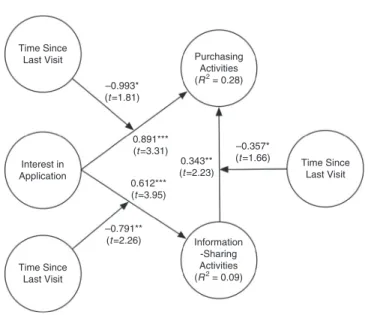
Figure 2 contains the standardized path coefficients,t-values andR2values to indicate predictive ability of the interest in the retailer’s application and the two criterion variables (e.g. Macmillan et al., 2005). Because partial least squares regression as a distribution-free technique relies on the bootstrapping resampling technique to determine path significance, 5,000 resamples were taken to perform the bootstrap (Levinet al., 2012).t-values were computed based on the bootstrapping procedure and their significance levels were determined using a two-tailed distribution with 344 degrees of freedom (Ringleet al., 2005).
In the initial model interest in application is positively related to purchasing activities (path coefficient¼0.484;t¼6.28; po0.01) and to information-sharing activities (path coefficient¼0.291;t¼5.21; po0.01) to supportH1andH2. However, the relationship
Item Information-sharing activities Purchasing activities
View different videos 0.873
View interviews 0.876
View photoshoots 0.832
View current clothing collections/new arrivals 0.823
Shop and purchase products 0.781
Receive sales and coupon alerts 0.777
Table II.
Factor analysis
Notes:t=1.65, *p<0.1; t=1.96, **p<0.05; t=2.58, ***p<0.01
Time Since
Last Visit Purchasing
Activities (R2 = 0.28) Interest in Application Time Since Last Visit Information -Sharing Activities (R2 = 0.09) Time Since Last Visit –0.357* (t=1.66) 0.343** (t=2.23) 0.612*** (t=3.95) –0.791** (t=2.26) 0.891*** (t=3.31) –0.993* (t=1.81) Figure 2. Measurement model
766
IJRDM
42,8
between information-sharing activities and purchasing activities is not statistically significant. Hence,H3is not supported.
These results appear consistent when considering differences among OS users. However, examining the results multigroup analysis where thebcoefficients of each group for each path is tested, there are no statistically significant differences between OS users. Hence, there is no support for the research question.
Examining the hypothesized moderated effect, we note that the b coefficient between interest in the application and purchasing activities improves from 0.484 (po0.01) without the moderator in the model (not shown in Figure 2) to 0.891 (po0.01) with the time since last visit moderator in the model (as shown in Figure 1). Similarly, thebcoefficient between interest in the application and information-sharing activities improves from 0.291 (po0.01) without the moderator in the model to 0.612 (po0.01) with the time since last visit moderator in the model. This improvement in the b coefficient suggests the time since last visit moderator should be included in the model. Furthermore, the R2 of purchasing activities increases from 0.26 without the moderating effect to 0.28 with the inclusion of the moderating effect. Similarly, theR2of information-sharing activities increases from 0.08 without the moderating effect to 0.09 with the inclusion of the moderating effect. Finally, the presence of the time since last visit moderator changes the relationship from information-sharing activities to purchasing activities appears statistically signification. A moderating effect is evidenced by a change in the path weight as the amount of variance explained in the latent construct, or a path is statistically significant with the presence of the moderator as compared to a lack of statistical significance without the presence of the moderator (Henseleret al., 2009). Hence,H4A,H4BandH4Care supported.
The negative values of the moderator suggests that people who have been to store more recently are more likely to use the application to complete a purchase, and share information. The presence of the moderator suggests that consumers who have been to the store more recently continue to consider the purchase as compared to consumers who have not.
Chin (1998) argues that the endogenous latent variables can be described as substantial, moderate or weak based onR2values of 0.67, 0.33 or 0.19, respectively. Information-sharing activities (R2¼0.09) and purchasing activities (R2¼0.28) could be described as weak.
Henseleret al.(2009) suggests that effect size could be thought of as small, moderate and large based onf2values of 0.02, 0.15 and 0.35, respectively. By comparing theR2 values for purchasing activities and information-sharing activities with and without the presence of the moderating variable, then the effect size for purchasing activities (f2¼0.285) could be described as moderate while the effect size for information-sharing activities (f2¼0.561) could be described as large.
Therefore, the moderating variable improves both the explanatory variance, as shown byR2, and the predictiveness, as shown byf2, in the relationship between interest in a retailer’s app and information-sharing activities. The moderating variable has less explanatory variance and predictiveness on the relationship between interests in a retailer’s app and purchasing activities. In both paths, the moderating variable – time since last visit – amplifies the relationship between interest in the application and the two dependent variables, purchasing activity and information-sharing activity. The moderating effect is stronger in the later compared to the former.
The correlation values as shown in Table III provide additional insight. The relationship between interest in retailer’s mobile app and purchasing activities could be
767
Predicting
mobile app
usage
characterized as moderate while the relationship between interest in retailer’s mobile app and information-sharing activities could be thought of as weak.
5. Discussion
This study provides interesting and actionable insights for both academics and practitioners into the behaviour of mobile app users. First, the study finds strong correlations between interest in the retailer’s mobile app and intention to engage in purchasing and information-sharing activities. This finding is particularly important to retail marketing and advertising managers, who are facing increasing constraints on their advertising and promotion budgets. This study provides empirical support for the return on investment on the development of app because it finds a significant relationship between retail mobile apps and desired customer behaviour. As they find themselves required to justify all expenditures, managers will benefit from the knowledge that their investment in mobile apps is likely to provide a real and measurable financial benefit. From a theoretical perspective, the study lends further support to the extant literature on the correlation between attitudes and behaviours.
Second, the model presented in this survey provides insights into what users expect a retailer’s mobile app to do. That is, users desire a retailer’s mobile app that aids the user in completing a transaction. For example, retailers could provide coupons that are available only through the mobile app and/or allow users to complete the purchase for merchandise viewed at the store or through the mobile app. Correspondingly, the retailer’s mobile app could contain fewer features related to information sharing. Consumers seem to desire less of these features such as posting pictures and sharing comments on Facebook and blogs.
Finally, the results of this study suggest an interaction between the time since a customer’s last visit to a retailer and that customer’s behaviours related to retail apps, providing support to the notion that in the omnichannel, offline and online channels are inexorably intertwined. The amount of time since the last visit appears to exert a negative moderating effect between interest in the app and the two behavioural outcomes (i.e. purchasing activities and information-sharing activities, as well as moderating the effect of information-sharing activities on purchasing activities. In essence, the less time that has passed since the customer’s last visit, the stronger the effect. The strength of this moderation is particularly strong in the relationship between interest in the application and purchasing activities (bcoefficient¼ 0.993, po0.1).
Again, this provides vital and actionable insight for the marketing managers for retailers. These results suggest that mobile apps will produce the most return on investment for recent customers or shoppers. These managers may wish to act on this information by promoting their apps through in-store promotions, point-of-purchase displays or mailings to members of loyalty/frequent shopper programs. Conversely,
1 2 3 1. Interest in application 1 2. Purchasing activities 0.507*** 1 3. Information-sharing activities 0.291*** 0.218*** 1 Notes:t¼1.65, *po0.1;t¼1.96, **po0.05;t¼2.58, ***po0.01 Table III. Interitem correlation values
768
IJRDM
42,8
it suggests that retailers might increase the likelihood of app users making a purchase or sharing information by incentivizing them to visit the store.
This conclusion argues for a relationship between physical location and social media activities. The two behaviours – visiting a store and using an application – are not separate or distinct behaviours. Rather, these behaviours are linked through the omnichannel. Given the same level of interest in a retail app, the customer who has recently visited the store remains more likely to then use the app to engage in purchasing or information-sharing activities than the customer who has not recently visited the store.
From a theoretical standpoint, this study confirms the relationship between attitudes and behaviours and extends the theory of reasoned action and its derivatives to the context of mobile commerce. By expanding technology adoption attitudes beyond the constructs of the technology acceptance model, it provides an alternative framework that incorporates a richer set of behavioural outcomes than simple adoption, as well as being more relevant to the retail environment than the TAM constructs. By focusing on the most highly desired outcomes of mobile retail apps, the model used in this study may provide a template for studying the effect of other retail technologies on these important behaviours.
6. Limitations and directions for future research
As with any study, there are several caveats and limitations. First, the survey data were collected by a retailer as part of its research into mobile app development, so the researchers were limited to the existing questions. Thus, the attitudinal and behavioural messages were not as deep as would be preferred. However, the ability to access a sample of actual customers for a major retailer does offset some of this weakness. Second, the measures are all self-reported, and no actual behaviours are measured. Finally, generalizability may be limited, as this study focused on a single retailer in the USA with a demographically homogenous customer base. Nevertheless, it provides valuable theoretical and managerial insights that may be expanded upon in future research.
This study suggests a number of opportunities for further examination. First and foremost, this model should be expanded to include more channels of the omnichannel – web sites, catalogues, call centres, etc. Also, this model should be tested in other contexts. For example, would a similar model yield similar results from a men’s fashion retailer? The attitudinal construct of “interest in the app” should be expanded upon to determine the various dimensions of interest to provide a richer understanding of the attitudinal determinants of the focal behaviours. In addition, this study was limited to interest in the app’s effect on behavioural constructs. The model could be expanded to include attitudinal constructs such as attitude towards the brand, loyalty towards the brand, satisfaction with the shopping experience and/or enjoyment of the shopping experience, as well as other behavioural constructs.
The growth of mobile app adoption among consumers suggests that research in this area will be increasingly important. Smartphones now account for approximately ten percent of web site traffic (Monetate, 2012). A recent study indicated that 69 percent of retailers intended to increase their expenditures on mobile commerce (Brohan, 2012), so any research that assists retailers in allocating these dollars should be considered valuable. Furthermore, the emergence of an “apps culture” and retail omnichannel provides a rich new context in which to study consumers, their preferences and behaviours. This study provides some interesting directions for mobile app research.
769
Predicting
mobile app
usage
References
Adobe (2013), “Mobile shopping: retail app usage on the rise”, Adobe Digital Publishing Blog, available at: http://blogs.adobe.com/digitalpublishing/2013/01/mobile-shopping-retail-app-usage-on-the-rise.html (accessed 21 July 2013).
Ajzen, I. (1991), “The theory of planned behavior”,Organizational Behavior and Human Decision Processes, Vol. 50 No. 2, pp. 179-211.
Ajzen, I. and Fishbein, M. (1980), Understanding Attitudes and Predicting Social Behavior, Prentice-Hall Inc., Englewood Cliffs, NJ.
Arbitron (2013), “iPhones trump Androids for mobile commerce app usage,” PR Newswire, April 15, available at: http://online.wsj.com/article/PR-CO-20130415-907188.html (accessed June 30, 2014).
Aubrey, C. and Judge, D. (2012), “Re-imagine retail: why store innovation is key to a brand’s growth in the “new normal”, digitally connected and transparent world”,Journal of Brand Strategy, Vol. 1 No. 1, pp. 31-39.
Bagozzi, R.P., Baumgartner, H. and Youjae, Y. (1992), “State versus action orientation and the theory of reasoned action: an application to coupon usage”,Journal of Consumer Research, Vol. 18 No. 4, pp. 505-518.
Barkhi, R., Belanger, F. and Hicks, J. (2008), “A model of the determinants of purchasing from virtual stores”,Journal of Organizational Computing & Electronic Commerce, Vol. 18 No. 3, pp. 177-196.
Bennett, R. and Savani, S. (2011), “Retailers’ preparedness for the introduction of third wave (ubiquitous) computing applications”, International Journal of Retail & Distribution Management, Vol. 39 No. 5, pp. 306-325.
Bigne´, E., Ruiz, C. and Sanz, S. (2007), “Key drivers of mobile commerce adoption. An exploratory study of spanish mobile users”,Journal of Theoretical and Applied Electronic Commerce Research, Vol. 2 No. 2, pp. 48-60.
Brohan, M. (2012), “The internet retailer survey: mobile commerce”,Internet Retailer, October, available at: www.internetretailer.com/2012/10/01/internet-retailer-survey-mobile-commerce (accessed November 24, 2012).
Brown, J., Broderick, A.J. and Lee, N. (2007), “Word of mouth communication within online communities: conceptualizing the only social network”,Journal of Interactive Marketing, Vol. 21 No. 3, pp. 2-20.
Charland, A. and Leroux, B. (2011), “Mobile application development: web vs. native”, Communications of the ACM, Vol. 54 No. 5, pp. 49-53.
Chiang, W.K. and Li, Z. (2010), “An analytic hierarchy process approach to assessing consumers’ distribution channel preference”, International Journal of Retail & Distribution Management, Vol. 38 No. 2, pp. 78-96.
Chin, W.W. (1998), “Issues and opinions on structural equation modeling”,MIS Quarterly, Vol. 22 No. 1, pp. 7-16.
Chin, W.W. and Newsted, P.R. (1999), “Structural equation modeling analysis with small samples using partial least squares”, in Hoyle, R. (Ed.), Statistical Strategies for Small Sample Research, Sage, Thousand Oaks, CA, pp. 295-336.
Chin, W.W., Marcolin, B.L. and Newsted, P.R. (2003), “A partial least squares latent variable modeling approach for measuring interaction effects: results from a monte carlo simulation study and an electronic-mail emotion/adoption study”,Information Systems Research, Vol. 14 No. 2, pp. 189-217.
Chiu, Y., Fang, S. and Tseng, C. (2010), “Early versus potential adopters: exploring the antecedents of use intention in the context of retail service innovations”, International Journal of Retail & Distribution Management, Vol. 38 No. 3, pp. 443-459.
770
IJRDM
42,8
Davis, F.D. (1989), “Perceived usefulness, perceived ease of use, and user acceptance of information technology”,MIS Quarterly, Vol. 13 No. 3, pp. 318-340.
De Cannie`re, M.H., De Pelsmacker, P. and Geuens, M. (2009), “Relationship quality and the theory of planned behavior models of behavioral intentions and purchase behavior”,Journal of Business Research, Vol. 62 No. 1, pp. 82-92.
Diamantopoulos, A. and Winklhofer, H.M. (2001), “Index construction with formative indicators: an alternative to scale development”,Journal of Marketing Research, Vol. 38 No. 2, pp. 269-277. Doherty, N.F. and Ellis-Chadwick, F. (2010), “Internet retailing: the past, the present and the future”,International Journal of Retail & Distribution Management, Vol. 38 Nos 11/12, pp. 943-965.
Fishbein, M. and Ajzen, I. (1975),Belief, Attitude, Intention, and Behavior: An Introduction to Theory and Research, Addison-Wesley, Reading, MA.
Google (2012), “Our mobile planet”, available at: www.thinkwithgoogle.com/mobileplanet/en/ (accessed January 20, 2013).
Hair, J.F., Ringle, C.M. and Sarstedt, M. (2011), “PLS-SEM: indeed a silver bullet”,Journal of Marketing Theory and Practice, Vol. 19 No. 2, pp. 139-151.
Henseler, J., Ringle, C.M. and Sinkovics, R.R. (2009), “The use of partial least squares path modeling in international marketing”, in Sinkovics, R.R. and Ghauri, P.N. (Eds),Advances in International Marketing, Emerald, Bingley, pp. 277-320.
Jin, C.H. and Villegas, J. (2008), “Mobile phone users’ behaviors: the motivation factors of the mobile phone user”,International Journal of Mobile Marketing, Vol. 3 No. 2, pp. 4-14. Johnson, R. (2010), “Apps culture reinventing mobile internet”,Electronic Engineering Times,
No. 1588, pp. 24-30.
Khalifa, M. and Shen, K.N. (2008), “Drivers for transactional B2C m-commerce adoption: extended theory of planned behavior”,Journal of Computer Information Systems, Vol. 48 No. 3, pp. 111-117.
Korzaan, M.L. (2003), “Going with the flow: predicting online purchase intentions”,Journal of Computer Information Systems, Vol. 43 No. 4, pp. 25-31.
Ktoridou, D., Epaminonda, E. and Kaufmann, H.R. (2008), “Technological challenges and consumer perceptions of the use of mobile marketing: evidence from cyprus”,International Journal of Mobile Marketing, Vol. 3 No. 2, pp. 34-43.
Lee, H. and Lee, S. (2010), “Internet vs mobile services: comparisons of gender and ethnicity”, Journal of Research in Interactive Marketing, Vol. 4 No. 4, pp. 346-374.
Levin, M.A., Hansen, J.M. and Laverie, D.A. (2012), “Toward understanding new sales employees’ participation in marketing-related technology: motivation, voluntariness, and past performance”,Journal of Personal Selling & Sales Management, Vol. 32 No. 3, pp. 379-393. Lohmo¨ller, J.-B. (1989), Latent Variable Path Modeling With Partial Least Squares, Physica,
Heidelberg.
Lookout_Mobile_Security (2011), “App genome report”, Lookout Mobile Security, available at: www.lookout.com:resources/reports/appgenome#platform-wars (accessed June 20, 2014). McKechnie, S., Winklhofer, H. and Ennew, C. (2006), “Applying the technology acceptance model
to the online retailing of financial services”,International Journal of Retail & Distribution Management, Vol. 34 Nos 4/5, pp. 388-410.
Macmillan, K., Money, K., Money, A. and Downing, S. (2005), “Relationship marketing in the not-for-profit sector: an extension and application of the commitment-trust theory”,Journal of Business Research, Vol. 58 No. 6, pp. 806-818.
Maity, M. (2010), “Critical factors of consumer decision-making on m-commerce: a qualitative study in the united states”,International Journal of Mobile Marketing, Vol. 5 No. 2, pp. 87-101.
771
Predicting
mobile app
usage
Monetate (2012), “Ecommerce quarterly (EQ3)”, available at: http://resources.monetate.com/ios/ images/profile/real_images/47646231book47646231.pdf (accessed November 23, 2012). Mort, G.S. and Drennan, J. (2007), “Mobile communications: a study of factors influencing
consumer use of m-services”,Journal of Advertising Research, Vol. 47 No. 3, pp. 302-312. Nielsenwire (2011a),Generation App: 62% of Mobile Users 25-34 Own Smartphones, Nielsenwire, New York, NY, available at: http://blog.nielsen.com/nielsenwire/online_mobile/generation-app-62-of-mobile-users-25-34-own-smartphones/ (accessed November 26, 2011).
Nielsenwire (2011b),Consumers and Mobile Apps in the US.: All About Android and Apple iOS, Nielsenwire, New York, NY, available at: http://blog.nielsen.com/nielsenwire/online_mobile/ consumers-and-mobile-apps-in-the-u-s-all-about-android-and-apple-ios/ (accessed November 26, 2011).
Njite, D. and Parsa, H.G. (2005), “Structural equation modeling of factors that influence consumer internet purchase intentions of services”,Journal of Services Research, Vol. 5 No. 1, pp. 43-59. Phau, I. and Teah, M. (2009), “Young consumers’ motives for using SMS and perceptions towards
SMS advertising”,Direct Marketing: An International Journal, Vol. 3 No. 2, pp. 99-108. Rao, S. and Troshani, I. (2007), “A conceptual framework and propositions for the acceptance of
mobile services”,Journal of Theoretical and Applied Electronic Commerce Research, Vol. 2 No. 2, pp. 61-73.
Rigby, D. (2011), “The future of shopping”,Harvard Business Review, Vol. 89, No. 12, pp. 64-75. Ringle, C.M., Wende, S. and Will, A. (2005),SmartPLS, 2.0 (beta) ed. SmartPLS.de, Hamburg. Roach, G. (2009), “Consumer perceptions of mobile phone marketing: a direct marketing
innovation”,Direct Marketing, Vol. 3 No. 2, pp. 124-138.
Sarker, S. and Wells, J.P. (2003), “Understanding mobile handheld device use and adoption”, Communications of the ACM, Vol. 46 No. 12, pp. 35-40.
Sheppard, B.H., Hartwick, J. and Warshaw, P.R. (1988), “The theory of reasoned action: a meta-analysis of past research with recommendations for modifications and future research”,Journal of Consumer Research, Vol. 15 No. 3, pp. 325-343.
Shimp, T.A. and Kavas, A. (1984), “The theory of reasoned action applied to coupon usage”, Journal of Consumer Research, Vol. 11 No. 3, pp. 795-809.
StatCounter (2012), “Statcounter global stats”, available at: http://gs.statcounter.com/ (accessed November 24, 2012).
Ting-Peng, L. and Chih-Ping, W. (2004), “Introduction to the special issue: mobile commerce applications”,International Journal of Electronic Commerce, Vol. 8 No. 3, pp. 7-17. Wixom, B.H. and Watson, H.J. (2001), “An empirical investigation of the factors affecting data
warehousing success”,MIS Quarterly, Vol. 25 No. 1, pp. 17-41.
Wu, C., Jang, L. and Chen, C. (2011), “Assessing the role of involvement as a mediator of allocentrist responses to advertising and normative influence”, Journal of Consumer Behaviour, Vol. 10 No. 5, pp. 255-266.
Yoh, E., Damhorst, M.L., Sapp, S. and Laczniak, R. (2003), “Consumer adoption of the internet: the case of apparel shopping”,Psychology & Marketing, Vol. 20 No. 12, pp. 1095-1118. Further reading
Chiu, H.-C., Hsieh, Y.-C., Kao, Y.-H. and Lee, M. (2007), “The determinants of email receivers’ disseminating behaviors on the internet”,Journal of Advertising Research, Vol. 47 No. 4, pp. 524-534.
Tenenhaus, M., Vinzi, V.E., Chatelin, Y.-M. and Lauro, C. (2005), “PLS path modeling”, Computational Statistics & Data Analysis, Vol. 48 No. 1, pp. 159-205.
772
IJRDM
42,8
Appendix
1. Do you currently own a mobile device (e.g. Smartphone, iPad) that can download “apps”? a. Yes
b. No (thank you and terminate)
2. When was the last time you visited a (the retailer’s) store? a. Within the past month
b. 1-3 months ago c. 4 months ago or longer d. Don’t know/I can’t remember
3. What type of mobile device(s) do you currently use? Please select all that apply. a. Motorola Android
b. Apple iPhone c. Windows Phone
d. Blackberry (Torch, Storm, Pearl, Style, Curve, Bold, Tour) e. Palm Pre
f. Palm Pixi g. Apple iPad h. Apple iPod Touch i. Samsung Moment j. HTC 6277
k. T-Mobile myTouch 3G l. Motorola MB200/Cliq m. T-Mobile G1 n. Other (please specify)
4. How interested would you be in trying (the retailer’s) shopping app? a. Extremely interested
b. Somewhat interested
c. Neither interested nor disinterested d. Somewhat disinterested
e. Extremely disinterested
5. Imagine you could create your own (retailer’s) shopping app. Using a scale from 1 to 5, please rate how important each the following features are to you (1 means not important at all and 5 means extremely important).
a. View different videos b. View interviews c. View photoshoots
d. View current clothing collections/new arrivals e. Post to Facebook (the retailer’s blog), Twitter f. Shop and purchase products
g. Receive sales and coupon alerts h. Receive styling tips and tricks i. View products reviews About the authors
Dr David G. Taylor is an Assistant Professor of Marketing in the John F. Welch College of Business at the Sacred Heart University. His areas of expertise and interest include digital marketing, consumer/brand relationships and online word-of-mouth. His research has been published inJournal of Business Research,Journal of Advertising Research,Electronic Commerce Research, Journal of Consumer Behaviour and a number of other outlets.
773
Predicting
mobile app
usage
He holds a PhD from the University of North Texas. Dr David G. Taylor is the corresponding author and can be contacted at: [email protected]
Dr Michael Levin is an Assistant Professor of Marketing in the Business, Accounting, and Economics Department at the Otterbein University. His areas of expertise and interests include technology, motivations and market orientation. His research has been published in the Journal of Personal Selling & Sales Management,International Journal of Retail and Distribution Management, Marketing Management Journal and other journal and conference outlets. He holds a PhD from the Texas Tech University.
To purchase reprints of this article please e-mail:[email protected] Or visit our web site for further details:www.emeraldinsight.com/reprints
774
IJRDM
42,8
This article has been cited by:
1. Seeun Kim University of Tennessee Knoxville United States Tae Hyun Baek University of Kentucky Lexington United States Youn-Kyung Kim University of Tennessee Knoxville United States Kyunga Yoo KT Corporation Seoul Korea (the Republic of ) Debra Zahay St. Edward's University Austin United States . 2016. Factors affecting stickiness and word of mouth in mobile applications. Journal of Research in Interactive Marketing10:3. . [Abstract] [PDF]
2. Gwarlann de Kerviler, Nathalie T.M. Demoulin, Pietro Zidda. 2016. Adoption of in-store mobile payment: Are perceived risk and convenience the only drivers?. Journal of Retailing and Consumer Services 31, 334-344. [CrossRef]
3. Jihyun Kim, Kim H.Y. Hahn. 2015. The effects of self-monitoring tendency on young adult consumers’ mobile dependency. Computers in Human Behavior50, 169-176. [CrossRef]
4. Vanessa Ratten La Trobe University, Melbourne, Australia . 2015. A cross-cultural comparison of online behavioural advertising knowledge, online privacy concerns and social networking using the technology acceptance model and social cognitive theory. Journal of Science and Technology Policy Management6:1, 25-36. [Abstract] [Full Text] [PDF]
5. Dong-Hee Shin, Yong-Moon Kim. 2014. Activation Strategies of the Disaster Public-Apps in Korea. The Journal of the Korea Contents Association14:11, 644-656. [CrossRef]
6. 2014. Customers happy to buy apps. Strategic Direction30:11, 16-18. [Abstract] [Full Text] [PDF]