Adoption of e-business functions and migration from EDI-based to
XML-based e-business frameworks in supply chain integration
Juha-Miikka Nurmilaakso
*BIT Research Centre, Helsinki University of Technology Abstract
This paper explores how organizational and technological factors explain the adoption of e-business functions in 4570 European companies and the migration from EDI-based to XML-based e-business frameworks in 329 European companies. According to a linear regression model, a company with a wider scope, having more enterprise information systems or exchanging standardized data has more e-business functions in supply chain integration. A logistic regression model implies that a larger company or a company with higher skills or having more e-business functions is more likely to replace EDI-based with XML-based e-business frameworks in supply chain integration.
Keywords: E-business; EDI; Information sharing; Supply chain; XML
1. Introduction
Since the early 1980s supply chain management (SCM) has received the attention of practitioners and academics (Cooper et al., 1997). A supply chain is a bidirectional flow of information, products and money between the initial suppliers and final customers through different organizations. SCM is about planning, implementing and controlling this flow. Its goal can be to improve organizational competitiveness (Wacker, 2004). The supply chain, particularly SCM, contains different business functions, such as sales, purchases, demand forecasting and resource management. Supply chain integration is about information sharing within and between companies (Nurmilaakso and Kotinurmi, 2004). Information sharing covers exchange of business documents in business processes. Supply chain integration is an important part of SCM. It aims to ease the flow between all organizations in the supply chain (Naylor et al., 1999). Companies are increasingly aware of the strategic importance of supply chain integration because it affects operational performance (Bagchi et al., 2005).
Information systems have a tremendous influence on achieving effective SCM (Gunasekaran and Ngai, 2004). Since the late 1960s companies have used information systems to exchange standardized data with their business partners (Hayes, 2002). When the data are processed and communicated electronically, printing and re-keying of the data can be reduced. Therefore, information sharing using information and communication technologies (ICT) can be faster and less error prone than information sharing by meetings, mails, phone calls, faxes or e-mails. ICTs can save both time and money (Malone et al., 1987). In electronic commerce (e-commerce), companies utilize ICTs in sales with their customers or in purchases with their suppliers (Laudon and Laudon, 2006). Business-to-business (B2B) e-commerce is a part of electronic business (e-business), in which companies use ICTs in all kinds of collaborations with their business partners (Laudon and Laudon, 2006). E-business includes not only sales and purchases but also e.g. demand forecasting
*
Address: P.O. Box 5500, 02015 TKK, Finland E-mail: [email protected] (J.M. Nurmilaakso)
and resource management. Supply chain integration and e-business are interrelated with each other in these collaborations. An e-business function, such as online sales, purchases, demand forecasting or resource management, is a business function in the supply chain in which a company shares information with its business partners through computer-mediated networks, such as the Internet or value-added networks (VAN). There is a large variety of initiatives ranging from simple supply chain integration between organizational units within the same company to complex supply chain integration between different companies in the supply chain network. In addition, companies have invested heavily in information systems, particularly in enterprise resource planning (ERP), SCM and customer relationship management (CRM) systems (Falk, 2005; Laudon and Laudon, 2006). Unfortunately, supply chain integration is not easy. Information systems are not interoperable due to differences between any two companies
There would be fewer problems in supply chain integration if all companies used the same information systems, similar meanings for terms and similar modes of operations. Organizational units within a company may also face integration problems. Although many differences between business partners are inevitable, standards can bring order by reducing the complexity and uncertainty. Standardization of business documents, business processes and messaging leads to harmonization of meanings for terms, modes of operations and messaging interfaces. An e-business framework is a standard for information sharing within and between companies that enables the exchange of standardized data, e.g. in the Electronic Data Interchange (EDI) or Extensible Markup Language (XML) formats (Nurmilaakso and Kotinurmi, 2004). Companies can more easily use different information systems as long as they use the same e-business frameworks in the same way. Nowadays, it is clear that EDI is no longer limited to the VANs but it can also be implemented over the Internet (Angeles, 2000).
This paper explores how organizational and technological factors explain the adoption of e-business functions, especially online sales, purchases, product design, demand forecasting and resource management, as well as the migration from EDI-based to XML-based e-business frameworks in supply chain integration. A linear regression analysis (Greene, 2003) is used to study the adoption and a logistic regression analysis (Menard, 2002) to study the migration. Instead of testing prior hypotheses, the paper is exploratory in order to obtain a clearer understanding on the e-business adoption and migration in supply chain integration. The independent and control variables are often entered into the linear combination when the adoption or migration is the dependent variable in a regression model (e.g. Hong and Zhu, 2006; Prosser and Nickl, 1997; Zhu et al., 2003). For these reasons, the regression models are simple in this paper. The paper proceeds by first introducing supply chain integration, e-business functions and e-business frameworks as well as reviewing the the adoption and migration. Next, the paper presents the research approach. Then, the adoption and migration models are estimated and their findings are compared to the findings presented in the literature. Finally, the paper discusses the implications, limitations and further research and presents the conclusions.
2. Backgrounds
2.1. Supply chain integration
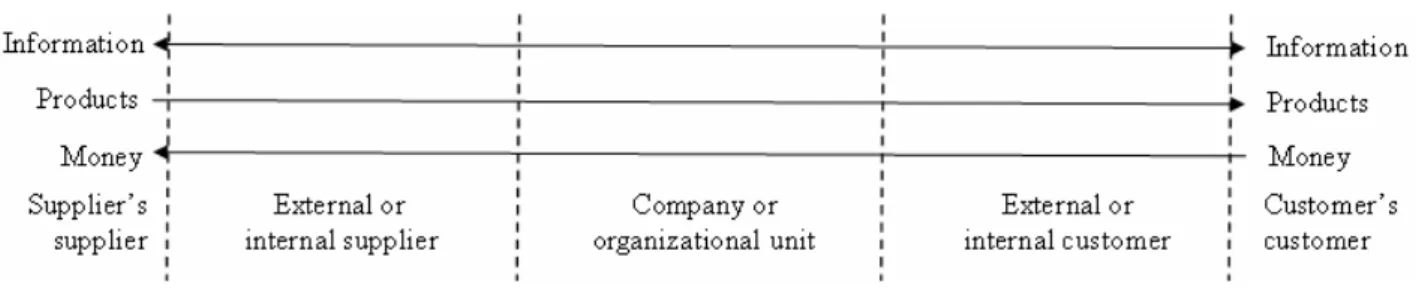
Before products can flow from the initial suppliers to the final customers and money from the final customers to the initial suppliers, the business partners have to share information. The business partners are not only different companies but they are often different organizational units within the same company. Fig. 1 presents how a bidirectional flow of information, products and money is related to the external and internal supply chain.
Fig 1. A bidirectional flow of information, products and money.
Perhaps the most important problem encountered in the supply chain occurs when information about the final customers’ demand for any product becomes increasingly distorted as this information moves toward the initial suppliers in the supply chain (Lee et al., 1997). Information distortion leads to inaccurate demand forecasts and inefficient resource allocations that result in high costs and long lead times. Reducing this distortion requires fast and accurate information sharing between business partners in the supply chain. Information sharing is a necessary rather than sufficient requirement for efficient SCM (Nurmilaakso and Kotinurmi, 2004).
Like SCM (e.g. Wacker, 2004) and integration (e.g. Gulledge, 2006), supply chain integration has many definitions. According to Trent and Monczka (1998), the first type of integration involves the forward coordination of the physical flow from the suppliers to the customers, whereas the second type of integration involves the backward coordination of the information flow from the customers to the suppliers. In this paper, supply chain integration means the exchange of business documents between the business partners in the business processes. These business partners can be different organizational units within the same company or different companies. Supply chain integration is categorized in the following way:
• Manual supply chain integration means human-to-human information sharing. Information sharing takes place, e.g. by phone calls, faxes or e-mails. Human intervention is necessary at both ends.
• Semi-automation in supply chain integration is based on human-to-system information sharing. At one end, it is performed by an information system, e.g. through a web portal. At the other end, human intervention is necessary.
• Full-automation in supply chain integration focuses on system-to-system information sharing. This happens between information systems, e.g. through middleware systems. No or minimal human intervention is needed.
The exchange of business documents does not work well if the business partners do not integrate the related business processes. Automation often requires business process re-engineering (e.g. Riggins and Mukhopadhyay, 1994) and enterprise application integration (e.g. Gulledge, 2006). For example, business rules for automatic order processing have to be defined and a middleware system or a web portal has to be integrated with an ERP system before online sales can be supported. 2.2. E-business functions
How are sales, purchases, product design, demand forecasting and resource management functions placed in the supply chain? The Supply Chain Operations Reference (SCOR) model (Supply-Chain Council, 2005) is a process reference model that links the process elements, metrics, best practice and features associated with the supply chain. In Fig. 2, sales, purchases, product design, demand forecasting and resource management functions are placed in the SCM processes described in the SCOR model:
Fig 2. The chosen business functions in the SCM processes.
• The plan process consists of business functions that balance aggregated demand and supply. This process covers the demand forecasting function, e.g. to send strategic forecasts to suppliers, and the resource management function, e.g. to receive inventory reports from customers.
• The source process contains business functions to procure products that meet the planned or actual demand. The source process includes the purchases function, e.g. to send purchase orders to suppliers.
• The make process includes business functions that transform products to a finished state to meet the planned or actual demand. In the SCOR model, this process seems to be most suitable for the product design function, e.g. to exchange engineering changes with customers or suppliers. Although product development has not been traditionally associated with SCM, the supply chain encloses product development (Tan et al., 2000).
• The deliver process consists of business functions to provide finished products that meet the planned or actual demand. The deliver process contains the sales function, e.g. to send purchase order responses to customers.
• The return process deals with managing a reverse flow of materials and information related to defective, surplus, maintenance, repair or operating products.
2.3. E-business frameworks
What are e-business frameworks? Since business partners have to know what, when and how information should be shared, data formats, such as XML, are useful in syntactic interpretation but insufficient in semantic interpretation (Nurmilaakso and Kotinurmi, 2004). Full-automation in supply chain integration requires standards that answer the questions what, when and how. Before the late 1990s, these standards were called EDI standards. Shim et al. (2000) have used the term B2B frameworks, Medjahed et al. (2003) B2B interaction standards and Nurmilaakso and Kotinurmi (2004) e-business frameworks. An e-business framework is a standard that limits the syntax but extends the semantics of the data format in the business context. The e-business frameworks specify business documents, business processes and messaging for exchange of standardized data (Nurmilaakso and Kotinurmi, 2004):
• For business documents, the e-business framework specifies the data structures, data elements and their meanings in business documents. For example, if a customer sends a purchase order to its supplier, the purchase order includes the customer’s and the supplier’s name and address.
• For business processes, the e-business framework can specify the exchange of business documents. For example, if the supplier has received a purchase order from its customer, the supplier sends a purchase order response to the customer in the order management process.
• For messaging, the e-business framework can define the transportation, packing and security standards to be used in the exchange of business documents in the business processes.
An e-business framework always has a certain scope. A cross-industry e-business framework aims to cover all industries, whereas an industry-specific e-business framework focuses on one or few industries. Accredited Standards Committee (ASC) X12 and EDI for Administration, Commerce and Transportation (EDIFACT) are data formats as well as EDI-based cross-industry e-business frameworks. XML is not only a data format but also a metalanguage for electronic document management and web publishing. EDI-based industry-specific e-business frameworks, such as EANCOM, are mostly modified subsets of ASC X12 and EDIFACT. In addition, there are a number of XML-based cross-industry e-business frameworks, such as Commerce XML (cXML) and Universal Business Language (UBL), and XML-based industry-specific e-business frameworks, such as RosettaNet.
2.4. E-business related adoption and migration
Why is ICT, especially EDI, important? Malone et al. (1987) present that ICT decreases coordination costs because the essence of coordination involves communicating and processing information. The electronic integration effect saves time and avoids errors. This shifts economic activities from companies to markets. Gurbaxani and Whang (1991) argue that by reducing both external and internal coordination costs, ICT supports vertically small companies that may be horizontally large. There is evidence that investments in ICT have decreased the average firm size (Brynjolfsson et al., 1994). These investments are found to be associated with substantial decreases in vertical integration and larger increases in related diversification than in unrelated diversification (Dewan et al., 1998; Hitt, 1999). The use of ICT together with highly educated employees leads to higher productivity than its use alone (Black and Lynch, 2001; Hempell, 2005). In fact, companies that use ICT tend to have more highly educated employees (Bresnahan et al., 2002).
Although EDI does not necessarily increase sales (e.g. Mukhopadhyay and Kekre, 2002; Venkatraman and Zaheer, 1990), its use can reduce operating costs (e.g. Mukhopadhyay et al., 1995). The use of EDI can also speed up and reduce errors in information sharing (Banerjee and Golhar, 1994; Mukhopadhyay and Kekre, 2002; Riggins and Mukhopadhyay, 1994; Srinivasan et al., 1994). However, the use of EDI has concentrated on larger companies (Banerjee and Golhar, 1994; Hill and Scudder, 2002; Premkumar et al., 1997; Stefansson, 2002). Smaller companies often use EDI only because of pressure from their business partners or competitors (Chwelos et al., 2001; Iacovou et al., 1995; Premkumar et al., 1997). Compared to company-specific EDI, generic EDI reduces asset-specificity and makes additional business partners available but its use alone does not reduce mutual dependence (Prosser and Nickl, 1997).
There are few papers studying the adoption of commerce or the migration to Internet-based e-commerce. Zhu et al. (2003) analyze facilitators and inhibitors of e-business adoption based on the technology-organization-environment (TOE) framework. The sample includes 3552 companies from eight countries in Europe. The firm size, firm scope and technology competence are significant facilitators, whereas a lack of business partner readiness is a significant inhibitor of e-business adoption. Based on 6165 establishments of the companies over three years period, Forman
(2005) studies Internet application adoption, including e-commerce. The firm size and firm scope increase the likelihood of Internet application adoption. Hong and Zhu (2006) assess Internet-based e-commerce adoption drawing on the TOE framework. The usable sample covers 627 companies from the US and Canada. The web functionalities and technology integration are significant drivers in Internet-based e-commerce adoption. The firm size is found to affect this adoption negatively. Based on 239 companies, Hong and Zhu (2006) also present that the web functionalities and integration of externally-oriented enterprise information systems, such as SCM and CRM, are significant drivers in Internet-based e-commerce migration. The firm size and VAN usage are found to affect this migration negatively. Zhu et al. (2006) investigate the migration to more open interorganizational systems (IOS), i.e. information systems connected through the Internet, from less open IOSs, i.e. information systems connected through the VANs. The sample consists of 1394 companies from ten countries. The expected benefits are significant drivers in the migration to more open IOSs. In addition, the costs are a more significant barrier for users of less open IOSs than for others.
Finally, XML has been regarded as more flexible and less expensive to implement and use than EDI in many papers (e.g. Hsieh and Lin, 2004; Power, 2005; Reimers, 2001), whereas the benefits of XML do not outweigh its costs according to some papers (e.g. Kanakamedala et al., 2003). Unfortunately, the comparison between EDI and XML is not straightforward. This comparison should not be between the VANs and Internet but between the EDI and XML formats or EDI-based and XML-based e-business frameworks.
3. Research approach
3.1. Data
The data were based on two e-business surveys that are dated 2003 and 2005, respectively. These surveys were carried out by Business W@tch that was launched to monitor the maturity of e-business across different sectors in the EU, EEA and Accession countries in 2001 by the European Commission. The second part of the e-Business Survey 2003 (e-Business W@tch, 2004) consisted of 4570 telephone interviews with companies from 25 European countries within ten sectors. It was carried out in November 2003 using computer-aided telephone interview (CATI) technology. The first part of the survey was excluded because it did not deal with XML-based e-business frameworks. The e-Business Survey 2005 (e-Business W@tch, 2005) had a scope of 5218 telephone interviews with companies from seven EU countries within ten sectors. It was carried out in January and February 2005 using CATI technology. The respondents in these surveys were mainly IT managers in larger companies and general managers in smaller companies. The following observations were included to the sample:
• A company has access to the Internet.
• A company does business in the food and beverages (NACE code: 15.1-9), textile, footwear and leather (17.1-7, 18.1-2, 19.3), publishing and printing (22.1-3), chemicals and chemical products (24.1-6, 25.1-2), machinery and equipment (29.1-5), electrical machinery and electronics (30.01-02, 31.1-2, 32.1-3), transport equipment (34.1-3, 35.1-5), construction (45.1-5), retail (52.11-12, 52.4), ICT services (64.2, 72.1-6) or business services (74.1-8) sector.
• A company does business in Austria, Belgium, Cyprus, Czech Republic, Denmark, Estonia, Finland, France, Germany, Greece, Hungary, Ireland, Italy, Latvia, Lithuania, Netherlands, Norway, Poland, Portugal, Slovak Republic, Slovenia, Spain, Sweden or UK.
If some observations are dependent, it is impossible to make a difference between correlated variables and correlated observations. To ensure that each observation is sampled independently, i.e. it is not a repeated measure, an observation was excluded if a company did business in the textile, footwear and leather (17.1-4, 17.6-7, 18.1-2) or construction (45.2-4) sector in Germany, France, Italy, Poland, Spain or UK in 2003 or in the chemicals and chemical products (24.4-5), transport equipment (34.1-3, 35.3) or ICT services (72.1-6) sector in Czech Republic or Poland in 2003. Before the statistical analysis, observations with missing values were removed by listwise deletion so that only complete observations were used. These exclusions left 4570 useable observations for the adoption model and 329 for the migration model.
3.2. Dependent variables
The variable Adoption is a dependent variable in the adoption model but also an independent variable as a technological factor in the migration model. The binary variable Migration is a dependent variable in the migration model. Descriptive statistics of these dependent variables is presented in Table 1.
Table 1. Descriptive statistics of dependent variables (adoption/migration). Dependent variable Mean Standard deviation Min Max Adoption 0.639/1.386 1.027/1.375 0/0 5/5 Migration /0.21 /0.41 /0 /1
• Adoption: “Does a company sell or purchase products online on the Internet or through other computer-mediated networks or does it use online technologies other than e-mail to collaborate with business partners in the design of new products, to forecast product demand or to manage capacity or inventory?” This variable aggregates the number of the following e-business functions in the company: online sales, purchases, product design, demand forecasting and resource management. The main e-business applications support one or more of these business functions (Gunasekaran et al., 2002).
• Migration: “Does a company intend to replace EDI-based with XML-based e-business frameworks within the next 24 months in 2003 or within the next 12 months in 2005?” This binary variable is relevant only if the company uses EDI-based e-business frameworks.
3.3. Independent variables
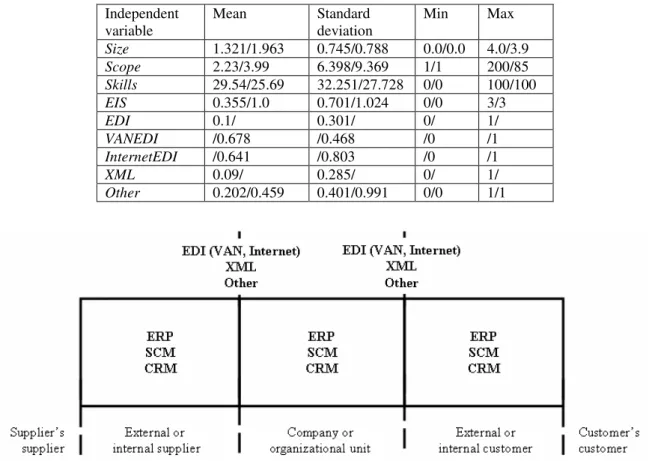
The variables Size, Scope and Skills are organizational factors and the variables EIS, EDI, VANEDI, InternetEDI, XML and Other are technological factors. In Table 2, descriptive statistics of these independent variables is presented. Fig. 3 illustrates how technological factors are related to the supply chain.
Table 2. Descriptive statistics of independent variables (adoption/migration). Independent variable Mean Standard deviation Min Max Size 1.321/1.963 0.745/0.788 0.0/0.0 4.0/3.9 Scope 2.23/3.99 6.398/9.369 1/1 200/85 Skills 29.54/25.69 32.251/27.728 0/0 100/100 EIS 0.355/1.0 0.701/1.024 0/0 3/3 EDI 0.1/ 0.301/ 0/ 1/ VANEDI /0.678 /0.468 /0 /1 InternetEDI /0.641 /0.803 /0 /1 XML 0.09/ 0.285/ 0/ 1/ Other 0.202/0.459 0.401/0.991 0/0 1/1
Fig 3. Technological factors in the supply chain.
• Size: “How many employees does a company have in the country?” The base-10 logarithm of the number of employees can be used as a proxy for the firm size (Child, 1973; Zhu et al., 2003). A logarithmic transformation is used to reduce the variance of the firm size.
• Scope: “How many sites does a company have in the country?” Since a site means a single organizational unit at a particular address, the number of sites measures the geographical rather than operational firm scope (Child, 1973; Zhu et al., 2003).
• Skills: “What is the percentage of employees with a college or university degree in a company?” The percentage can be used as a proxy for the skills (Bresnahan et al., 2002; Hempell, 2005).
• EIS: “Does a company have ERP, SCM or CRM systems?” This variable aggregates the number of the following enterprise information systems in the company: ERP, CRM and SCM. These enterprise information systems play a key role in e-business (Falk, 2005; Gunasekaran and Ngai, 2004; Ingram et al., 2002; Laudon and Laudon, 2006).
• EDI: “Does a company use EDI-based e-business frameworks, such as ASC X12, EANCOM or EDIFACT, to exchange standardized data?” This binary variable is used in the adoption model.
• VANEDI: “Does a company use EDI-based e-business frameworks over the VANs?” This binary variable is relevant only in the migration model if the company uses EDI-based e-business frameworks.
• InternetEDI: “Does a company use EDI-based e-business frameworks over the Internet?” This binary variable is relevant only in the migration model if the company uses EDI-based
e-• XML: “Does a company use XML-based e-business frameworks, such as cXML, RosettaNet or UBL, to exchange standardized data?” This binary variable is used in the adoption model.
• Other: “Does a company use Standard Exchange for Product Data (STEP), technical specifications agreed between the company and its business partner or any other technical standards to exchange standardized data?” This variable is binary.
3.4. Control variables
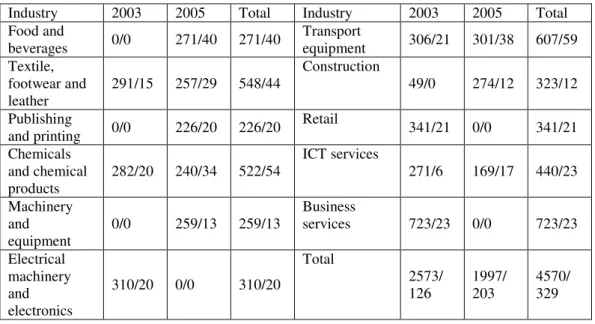
Some variations can be explained only if control variables are appropriately applied. In this paper, it is necessary to control the year, country and industry effects. It is common to use dummies, i.e. binary variables, to control these effects. This paper uses one year dummy to control longitudinal variations and 22-23 country dummies and 10 industry dummies to control cross-sectional variations. Tables 3 and 4 present the number of observations from different countries and industries taking into account the year. This sample represents a large number of companies, which increases the generalizability of the findings.
Table 3. Observations from different countries (adoption/migration). Country 2003 2005 Total Country 2003 2005 Total
Austria 46/3 0/0 46/3 Latvia 47/0 0/0 47/0 Belgium 181/10 0/0 181/10 Lithuania 32/1 0/0 32/1 Cyprus 33/2 0/0 33/2 Netherlands 151/5 0/0 151/5 Czech Republic 49/4 245/25 294/29 Norway 56/5 0/0 56/5 Denmark 34/6 0/0 34/6 Poland 126/9 236/14 362/23 Estonia 226/2 0/0 226/2 Portugal 208/10 0/0 208/10 Finland 139/13 0/0 139/13 Slovak Republic 132/5 0/0 132/5 France 77/8 331/57 408/65 Slovenia 110/3 0/0 110/3 Germany 72/2 290/37 362/39 Spain 82/0 287/31 369/31 Greece 157/2 0/0 157/2 Sweden 219/18 0/0 219/18 Hungary 152/11 0/0 152/11 UK 68/0 223/27 291/27 Ireland 109/5 0/0 109/5 Italy 67/2 385/12 452/14 Total 2573/ 126 1997/ 203 4570/ 329 Table 4. Observations from different industries (adoption/migration). Industry 2003 2005 Total Industry 2003 2005 Total Food and beverages 0/0 271/40 271/40 Transport equipment 306/21 301/38 607/59 Textile, footwear and leather 291/15 257/29 548/44 Construction 49/0 274/12 323/12 Publishing and printing 0/0 226/20 226/20 Retail 341/21 0/0 341/21 Chemicals and chemical products 282/20 240/34 522/54 ICT services 271/6 169/17 440/23 Machinery and equipment 0/0 259/13 259/13 Business services 723/23 0/0 723/23 Electrical machinery and electronics 310/20 0/0 310/20 Total 2573/ 126 1997/ 203 4570/ 329
4. Analysis
4.1. Adoption
The adoption model is based on the linear regression
ε + + + + + + + + + + + =
∑
∑
= = 10 1 23 1 j Industry α Country α Year α Other α XML α EDI α EIS α Skills α Scope α Size α α Adoption j I j i i C i Year Other XML EDI EIS Skills Scope Size , (1)where Adoption is a dependent variable,
α
s are coefficients, Size, Scope, Skills, EIS, EDI, XML and Other are independent variables, Year, Countryi and Industryj are control variables andε
is an errorterm. The linear regression model (1) should be examined for multicollinearity and heteroscedasticity (Greene, 2003). High multicollinearity is a problem because the relative importance of the independent variables is unreliable. This can be assessed by the variance inflation factor (VIF). If the VIF of an independent variable is larger than four or the VIF of a control is larger than ten, there is multicollinearity. The independent variable EIS had the largest VIF 1.439 and the control variable of Italy 5.542. This confirmed that there is no problem with high multicollinearity. Due to heteroscedasticity of the variance of the error term, ordinary least squares (OLS) estimators are unbiased and consistent but not efficient. This can affect the statistical significance of the independent variable. The White test can be applied to detect heteroscedasticity. This test has the null hypothesis that the variance of the error term is homoscedastic. Since the null hypothesis was rejected (NR2 = 422.325, p = 0.0), this variance is heteroscedastic. Instead of OLS estimators, White estimators were used in the linear regression model. The results of the linear regression (1) are reported in Table 5.
Table 5. Adoption of e-business functions. Variable α -coefficient Standard error p-value Constant 0.911 0.122 0.0 Size -0.002 0.022 0.929 Scope 0.008 0.003 0.007 Skills 0.0004 0.0005 0.375 EIS 0.337 0.029 0.0 EDI 0.365 0.064 0.0 XML 0.477 0.072 0.0 Other 0.421 0.044 0.0
The value of R2 0.267 indicates that the independent and control variables can explain 26.7% of the variance of the dependent variable in the linear regression model. This model fit is satisfactory. According to Table 5, all the variables related to technological factors but only the variable Scope related to organizational factors are statistically significant at the level 0.01 (p < 0.01). The significant variables lead to three findings.
Finding 1. A company with a wider scope has more e-business functions (
α
Scope > 0).Finding 1 is consistent with the positive effects of the firm scope on the adoption (Forman, 2005; Zhu et al., 2003). Gurbaxani and Whang (1991) argue that the geographic scope decreases the average operating costs and increases internal coordination costs but its impacts on external coordination costs are ambiguous. E-business functions can be important in internal supply chain integration because they also reduce internal coordination costs. Although many papers stress the firm size, the variable Size is not statistically significant. Forman (2005) and Zhu et al. (2003)
that the firm size has a negative effect. Following Black and Lynch (2001), Bresnahan et al. (2002) and Hempell (2005), the skills should be positively associated with the adoption. However, the variable Skills is not statistically significant. In all, the adoption of e-business functions is not limited to larger companies and companies with higher skills.
Finding 2. A company having more enterprise information systems has more e-business functions (
α
EIS > 0).Finding 3. A company exchanging standardized data has more e-business functions (0 <
α
EDI ≤α
Other≤α
XML).Findings 2 and 3 support relatively well the positive effects of technology competence (Zhu et al., 2003), web functionalities and technology integration on the adoption (Hong and Zhu, 2006). In fact, both enterprise information systems and exchange of standardized data play a major role in the adoption. This is consistent with the need for technological readiness that the use of EDI requires (Chwelos et al., 2001; Iacovou et al., 1995). The aggregate and each of the enterprise information systems have a significant effect. In addition, XML-based e-business frameworks, such as RosettaNet, have larger effects and EDI-based e-business frameworks, such as EDIFACT, have smaller effects on the adoption of e-business functions than other standards, such as STEP. However, the differences in these effects are not statistically significant. The Wald test did not reject the null hypothesis (W = 1.347, p = 0.51) that the restriction
α
EDI =α
XML =α
Other holds. Thisdoes not disprove that the XML format enables more flexible or less expensive exchange of standardized data than the EDI formats (e.g. Chiu and Chen, 2005; Goutsos and Karacapilidis, 2004; Nurmilaakso et al., 2002). In fact, XML-based e-business frameworks seem to support the adoption of a larger number of e-business functions than EDI-based e-business frameworks. The data can be expected to convey richer information in product design, demand forecasting and resource management functions than in sales and purchases functions. For example, the exchange of purchase orders is relatively easy, whereas information concerning engineering changes can be very complex.
4.2. Migration
The migration model relies on the logistic regression
(
)
(
)
ε + + + + + + + + + + + + = = =∑
∑
= = 10 1 22 1 ,.., | 0 ,.., | 1 ln j j I j i i C i Year Other DI InterneetE VANEdI EIS Adoption Skills Scope Size j j Industry β Country β Year β Other β I InternetED β VANEDI β EIS β Adoption β Skills β Scope β Size β β Industry Size Migration Ρ Industry Size Migration Ρ , (2)where
Ρ
() is a conditional probability, Migration is a dependent variable,β
s are coefficients, Size, Scope, Skills, Adoption, EIS, VANEDI, InternetEDI and Other are independent variables, Year, Countryi and Industryj are control variables andε
is an error term. The control variable of Latviawas omitted because there were no observations from Latvia. The logistic regression was performed to estimate a model with no migration (Migration = 0) and migration (Migration = 1) as the dependent variable. Logistic regression was chosen over linear regression because the dependent variable follows a nominal rather than interval scale. The logistic regression model (2) should be examined for multicollinearity and goodness of fit (Menard, 2002). The diagnostic for multicollinearity can be obtained by a linear regression model using the same dependent, independent and control variables that are used in a logistic regression model. By examining VIFs, the independent variable VANEDI had the largest VIF 1.723 and the control variable of France 9.455. For this reason, there was no high multicollinearity. The Hosmer-Lemeshow test can be utilized to assess the goodness of fit. This test has the null hypothesis that the logistic regression
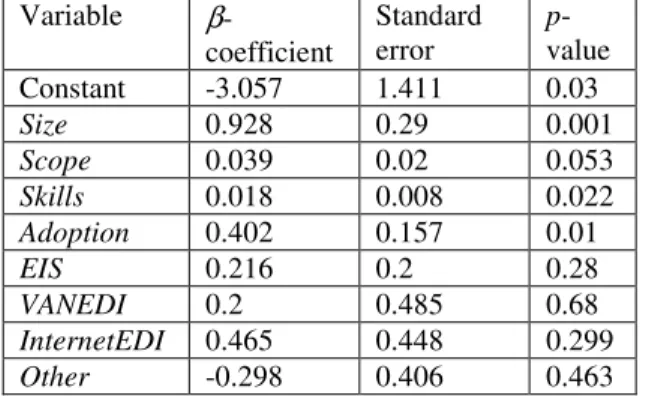
model does not predict values significantly differently from the observed values. Since the null hypothesis was not rejected (Ĥ = 3.66, p = 0.886), there is no difference between the observed and predicted values. Maximum likelihood estimators were used in the logistic regression model. The results of the logistic regression (2) are presented in Table 6.
Table 6. No migration versus migration from EDI-based to XML-based e-business frameworks. Variable β -coefficient Standard error p-value Constant -3.057 1.411 0.03 Size 0.928 0.29 0.001 Scope 0.039 0.02 0.053 Skills 0.018 0.008 0.022 Adoption 0.402 0.157 0.01 EIS 0.216 0.2 0.28 VANEDI 0.2 0.485 0.68 InternetEDI 0.465 0.448 0.299 Other -0.298 0.406 0.463
The value of Nagelkerke R2 0.457 does not measure the explained percent of the variance of the dependent variable but it approximates R2 in the logistic regression model. The model fit is good. The variables Size and Skills associated with organizational factors and the variable Adoption associated with technological factors are statistically significant at the level 0.05 (p < 0.05) in Table 6. These significant variables result in three findings.
Finding 4. A larger company is more likely to replace EDI-based with XML-based e-business frameworks (
β
Size > 0).Finding 5. A company with higher skills is more likely to replace EDI-based with XML-based e-business frameworks (
β
Skills > 0).Finding 4 does not uphold that the firm size affects the migration negatively (Hong and Zhu, 2006). This is no surprise because the use of EDI is more common in larger companies (Banerjee and Golhar, 1994; Hill and Scudder, 2002; Premkumar et al., 1997). Since bringing a new e-business framework into use requires investments, larger companies often have the resources to do this. In addition, the larger companies can often utilize an e-business framework to such an extent that the benefits from the new e-business framework justify the investments in external supply chain integration (Stefansson, 2002). Finding 5 is consistent with Bartel and Lichtenberg (1987) who present that highly educated employees have a comparative advantage with respect to the implementation of new technologies. A possible explanation is that companies with higher skills have better learned how to bring an e-business framework into use successfully. These companies are also more willing to replace EDI-based with XML-based e-business frameworks. The variable Scope is not statistically significant. If internally-oriented enterprise information systems, especially ERP, reduce more internal coordination costs than e-business frameworks, e-business frameworks play a minor role in internal supply chain integration. Therefore, the firm scope should not affect the migration. In contrast to the adoption of e-business functions, larger companies and companies with higher skills are more likely to migrate from EDI-based to XML-based e-business frameworks.
Finding 6. A company having more e-business functions is more likely to replace EDI-based with XML-based e-business frameworks (
β
Adoption > 0).Finding 6 confirms to some extent that web functionalities influence the migration positively (Hong and Zhu, 2006). Only the number of the e-business functions adopted has a significant effect on the
frameworks work so well with e-business functions that there is no reason to use both EDI-based and XML-based e-business frameworks. The update and use of multiple e-business frameworks is more costly, especially if these e-business frameworks are based on different data formats. On the other hand, some companies have strong expectations that XML-based e-business frameworks will support e-business functions much better than EDI-based e-business frameworks. The variables EIS, VANEDI, InternetEDI and Other are not statistically significant. This contradicts the findings that externally-oriented enterprise information systems, such as SCM and CRM, are positively (Hong and Zhu, 2006) and VAN usage is negatively related to the migration (Hong and Zhu, 2006; Zhu et al., 2006). The use of enterprise information systems is independent on the use of a certain e-business framework. In addition, other standards or EDI-based e-e-business frameworks over the VANs do not significantly slow down the migration to XML-based e-business frameworks. The Internet gives globally available immediate access independent of place and time and lowers the information processing and communication costs (Manecke and Schoensleben, 2004). However, EDI-based e-business frameworks over the Internet do not speed up the migration.
5. Discussion
5.1. Implications
This paper provides four important implications. Firstly, companies must pay attention to their technological capability to adopt e-business functions. This capability constitutes enterprise information systems, such as ERP, and exchange of standardized data using, e.g. EDIFACT or RosettaNet. Even companies that have a smaller number of employees are able to adopt e-business functions if they have sufficient technological capability. Secondly, companies that have a large number of sites at different addresses should pursue more proactively the adoption of e-business functions given the greater potential to achieve benefits from e-business functions.
Thirdly, companies need to assess the appropriateness of the migration from EDI-based to XML-based e-business frameworks to certain organizational characteristics, such as a large number of or highly educated employees, as suggested by findings. Finally, companies that have adopted a large number of e-business functions should migrate from EDI-based to XML-based e-business frameworks. Findings suggest that XML-based e-business frameworks provide a better support for e-business functions and VAN usage does not cause a significant lock-in to EDI-based e-business frameworks.
5.2. Limitations and further research
This paper has three potential limitations. Firstly, some important organizational and technological factors, such as the numbers of customers and suppliers and the use of product data management systems, were ignored due to a lack of data. The chosen factors are not latent but they measure organizations and technologies at the general level. This is also one reason why the regression models are simple in this paper. Secondly, the data did not contain observations from some important countries, such as the US, and industries, such as financial services. This may limit the generalizability of the findings. Finally, the data were self-reported, which can cause reporting errors. It is unavoidable in telephone interviews that there is no ideal respondent. For example, the general manager may not be aware of the use of the enterprise information systems and the IT manager may not know the education of the employees. However, a large survey sample can reduce the effects of reporting errors. For further research, an important subject is to analyze how the adoption of e-business functions and the migration from EDI-based to XML-based e-business frameworks affect business performance, such as return on sales, return on assets and selling, general and administrative costs. At the moment, such analyses seem to be missing.
6. Conclusions
A linear regression analysis of 4570 European companies points out that the firm scope (the number of organizational units), enterprise information systems (ERP, SCM and CRM), and exchange of standardized data (e.g. EDIFACT, RosettaNet or STEP), influence positively the adoption of e-business functions (online sales, purchases, product design, demand forecasting and resource management) in supply chain integration. A logistic regression analysis of 329 European companies presents that the firm size (the base-10 logarithm of the number of employees), skills (the percentage of employees with a college or university degree) and e-business functions have positive effects on the migration from EDI-based to XML-based e-business frameworks in supply chain integration. Technological factors seem to play a more important role in the adoption and organizational factors in the migration.
With regard to organizational factors, not only larger companies and companies with higher skills adopt e-business functions although they are more willing to migrate from EDI-based to XML-based e-business frameworks. Larger companies and companies with higher skills may be the first movers but also other companies adopt e-business functions.
Focusing on technological factors, XML-based e-business frameworks seem to have more influence on the adoption of e-business functions than EDI-based e-business frameworks. This indicates that XML-based e-business frameworks have some advantages over EDI-based e-business frameworks. In addition, if the company has adopted more e-business functions, it will migrate more likely from EDI-based to XML-based e-business frameworks. The companies may have good experience or strong expectations that e-business functions work better with XML-based e-business frameworks than EDI-based e-business frameworks. Finally, the use of EDI-based e-business frameworks over the VANs does not weaken the intentions to switch over to XML-based e-business frameworks.
Acknowledgements
This paper was written when the author was at the Software Business and Engineering Institute, Helsinki University of Technology. The author thanks the Graduate School for Electronic Business and Software Industry for the financial support as well as e-Business W@tch and the European Commission for the e-business survey data. The author also wants to thank Kasimir Kaliva for advice in the regression analyses.
References
Angeles, R., 2000. Revisiting the role of Internet-EDI in the current electronic commerce scene. Logistics Information Management 13 (1-2), 45-57.
Bagchi, P.K., Chun, B., Skjoett-Larsen, T., Soerensen, L.B., 2005. Supply chain integration: A European survey. International Journal of Logistics Management 16 (2), 275-294.
Banerjee, S., Golhar, D.Y., 1994. Electronic data interchange: Characteristics of users and nonusers. Information & Management 26 (1), 65-74.
Bartel, A.P., Lichtenberg, F.R., 1987. The comparative advantage of educated workers in implementing new technology. Review of Economics and Statistics 69 (1), 1-11.
Black, S.E., Lynch, L.M., 2001. How to compete: The impact of workplace practices and information technology on productivity. Review of Economics and Statistics 83 (3), 434-445.
Bresnahan, T.F., Brynjolfsson, E., Hitt, L., 2002. Information technology, workplace organization, and the demand for skilled labor: Firm-level evidence. Quarterly Journal of Economics 117 (1), 339-376.
Brynjolfsson, E., Malone, T.W., Gurbaxani, V., Kambil, A., 1994. Does information technology lead to smaller firms? Management Science 40 (12), 1628-1644.
Chwelos, P., Benbasat, I., Dexter, A.S., 2001. Empirical test of an EDI adoption model. Information Systems Research 12 (3), 304-321.
Child, J., 1973. Predicting and understanding organization structure. Administrative Science Quarterly 18 (2), 168-185.
Chiu, R.K., Chen, J.C.H., 2005. A generic service model for secure data interchange. Industrial Management & Data Systems 105 (5), 662-681.
Cooper, M.C., Lambert, D.M., Pagh, J.D., 1997. Supply chain management: More than a new name for logistics. International Journal of Logistics Management 8 (1), 1-14.
Dewan, S., Michael, S.C., Min, C., 1998. Firm characteristics and investments in information technology: Scale and scope effects. Information Systems Research 9 (3), 219-232.
e-Business W@tch, 2004. The European E-business Report 2004 Edition: A Portrait of E-business in 10 Sectors of the EU Economy. Office for Official Publications of the European Communities, Luxembourg.
e-Business W@tch, 2005. The European E-business Report 2005 Edition: A Portrait of E-business in 10 Sectors of the EU Economy. Office for Official Publications of the European Communities, Luxembourg.
Falk, M., 2005. ICT-linked firm reorganisation and productivity gains. Technovation 25 (11), 1229-1250.
Forman, C., 2005. The corporate digital divide: Determinants of Internet adoption. Management Science 51 (4), 641-654.
Goutsos, S., Karacapilidis, N. 2004. Enhanced supply chain management for e-business transactions. International Journal of Production Economics 89 (2), 141-152.
Greene, W.H., 2003. Econometric Analysis. Prentice-Hall, Upper Saddle River, NJ.
Gulledge, T., 2006. What is integration? Industrial Management & Data Systems 106 (1), 5-20. Gunasekaran, A., Marri, H.B., McGaughey, R.E., Nebhwani, M.D., 2002. E-commerce and its impact on operations management. International Journal of Production Economics 75 (1-2), 185-197.
Gunasekaran, A., Ngai, E.W.T., 2004. Information systems in supply chain integration and management. European Journal of Operational Research 159 (2), 269-295.
Gurbaxani, V., Whang, S., 1991. The impact of information systems on organizations and markets. Communications of the ACM 34 (1), 59-73.
Hayes, F., 2002. The story so far: E-commerce. ComputerWorld 36 (25), 24.
Hempell, T., 2005. Does experience matter? Innovations and the productivity of information and communication technologies in German services. Economics of Innovation and New Technology 14 (4), 277-303.
Hill, C.A., Scudder, G.D., 2002. The use of electronic data interchange for supply chain coordination in the food industry. Journal of Operations Management 20 (4), 375-387.
Hitt, L.M., 1999. Information technology and firm boundaries: Evidence from panel data. Information Systems Research 10 (2), 134-149.
Hong, W., Zhu, K., 2006. Migrating to Internet-based e-commerce: Factors affecting e-commerce adoption and migration at the firm level. Information & Management 43 (2), 204-221.
Hsieh, C.T., Lin, B., 2004. Impact of standardization on EDI in B2B development. Industrial Management & Data Systems 104 (1), 68-77.
Iacovou, C.L., Benbasat, I., Dexter, A.S., 1995. Electronic data interchange and small organizations: Adoption and impact of technology. MIS Quarterly 19 (4), 465-485.
Ingram, T.N., LaForge, R.W., Leigh, T.W., 2002. Selling in the new millennium: A joint agenda. Industrial Marketing Management 31 (7), 559-567.
Kanakamedala, K., King, J., Ramsdell, G., 2003. The truth about XML. McKinsey Quarterly (3), 9-12.
Laudon, J.P., Laudon, K.C., 2006. Essentials of Business Information Systems. Prentice-Hall, Upper Saddle River, NJ.
Lee, H.L., Padmanabhan, V., Whang, S., 1997. Information distortion in a supply chain: The bullwhip effect. Management Science 43 (4), 546-558.
Malone, T.W., Yates, J., Benjamin, R.I., 1987. Electronic markets and electronic hierarchies. Communications of the ACM 30 (6), 484-497.
Manecke, N., Schoensleben, P., 2004. Cost and benefit of Internet-based support of business processes. International Journal of Production Economics 87 (3), 213-229.
Medjahed, B., Benatallah, B., Bouguettaya, A., Ngu, A.H.H., Elmagramid, A.K., 2003. Business-to-business interactions: Issues and enabling technologies. VLDB Journal 12 (1), 59-85.
Menard, S., 2002. Applied Logistic Regression Analysis. Sage Publications, Thousand Oaks, CA. Mukhopadhyay, T., Kekre, S., 2002. Strategic and operational benefits of electronic integration in B2B procurement processes. Management Science 48 (10), 1301-1313.
Mukhopadhyay, T., Kekre, S., Kalathur, S., 1995. Business value of information technology: A study of electronic data interchange. MIS Quarterly 19 (2), 137-156.
Naylor, J.B., Naim, M.M., Berry, D., 1999. Leagility: Integrating the lean and agile manufacturing paradigms in the total supply chain. International Journal of Production Economics 62 (1-2), 107-118.
Nurmilaakso, J.M., Kettunen, J., Seilonen, I., 2002. XML-based supply chain integration: A case study. Integrated Manufacturing Systems 13 (8), 586-595.
Nurmilaakso, J.M., Kotinurmi, P., 2004. A review of XML-based supply-chain integration. Production Planning & Control 15 (6), 608-621.
Power, D., 2005. Supply chain management integration and implementation: A literature review. Supply Chain Management: An International Journal 10 (4), 252-263.
Premkumar, G., Ramamurthy, K., Crum, M.R., 1997. Determinants of EDI adoption in the transportation industry. European Journal of Information Systems 6 (2), 107-121.
Prosser, A., Nickl, A., 1997. The impact of EDI on interorganizational integration. International Journal of Production Economics 52 (3), 269-281.
Riggins, F.J., Mukhopadhyay, T., 1994. Interdependent benefits from interorganizational systems: Opportunities for business partner reengineering. Journal of Management Information Systems 11 (2), 37-57.
Shim, S.S.Y., Pendyala, V.S., Sundaram, M., Gao, J.Z., 2000. Business-to-business e-commerce frameworks. IEEE Computer 33 (10), 40-47.
Srinivasan, K., Kekre, S., Mukhopadhyay, T., 1994. Impact of electronic data interchange technology on JIT shipments. Management Science 40 (10), 1291-1304.
Stefansson, G., 2002. Business-to-business data sharing: A source for integration of supply chains. International Journal of Production Economics 75 (1-2), 135-146.
Supply-Chain Council, 2005. Supply-Chain Operations Reference-Model Version 7.0 (http://www.supply-chain.org).
Tan, G.W., Shaw, M.J., Fulkerson, B., 2000. Web-based supply chain management. Information Systems Frontiers 2 (1), 41-55.
Trent, R.J., Monczka, R.M., 1998. Purchasing and supply management: Trends and changes throughout the 1990s. International Journal of Purchasing and Materials Management 34 (4), 2-11. Venkatraman, N., Zaheer, A., 1990. Electronic integration and strategic advantage: A quasi-experimental study in the insurance industry. Information Systems Research 1 (4), 377-393.
Wacker, J.G., 2004. A theory of formal conceptual definitions: Developing theory-building measurement instruments. Journal of Operations Management 22 (6), 629-650.
Zhu, K., Kraemer, K.L., Gurbaxani, V., Xu, S., 2006. Migration to open-standard interorganizational systems: Network effects, switching costs, and path dependency. MIS Quarterly 30 (3), 515-539.
Zhu, K., Kraemer, K., Xu, S., 2003. Electronic business adoption by European firms: A cross-country assessment of the facilitators and inhibitors. European Journal of Information Systems 12 (4), 251-268.