Printed copies are not controlled. Confirm version status through the F4E document management system (idm@F4E) Generated on 24-Jul-2012
idm@F4E UID / VERSION
22MD99 / 2.0
VERSION CREATED ON / STATUS
20 Jul 2012 / APPROVED
EXTERNAL REFERENCE
(F4EDocs: N22010)
Quality Procedures
F4E-QA-010 - QUALITY CLASSIFICATION
This document describes the quality classification process being applied in Fusion for Energy projects. In particular it covers the procedures to be followed for determining a graded application of the QA Program.
Approval Process
Name Action Affiliation
Author Rodrigues D. 20-Jul-2012:signed F4E-000
CoAuthor Reviewers Andrade J. Annino C. Batista R. Brescan C. Casci F. 23-Jul-2012:recommended 24-Jul-2012:recommended 23-Jul-2012:recommended 23-Jul-2012:recommended 23-Jul-2012:recommended F4E-A100 F4E-A100 F4E-A100 F4E-A100 F4E-A100
Approver Briscoe F. 24-Jul-2012:approved F4E-000
RO: Rodrigues Diogo (F4E)
Read Access LG: Procurement, LG: Management, LG: INDRA_team, LG: IAS, LG: Magnets QA, LG: Administration, AD: IDM-A10_HEAD, AD: IDM-A11 Magnet Group, AD: IDM-A34 CODAC Group, AD: IDM-A41 Drawing Office Group CAD, AD: IDM_F4E, AD: F4E-A40_HEAD, AD: F4EN-A90, AD: I-CODAC, AD: IDM IE-MG-00-00 Magnet, AD: IDM IE-TS-CO-00 CODAC, AD: IDM IE-TS-DO-00 Drawing Office-CAD, GG: PO_Project Management, project administrator, RO, LG: External_Consultants, LG: External_Users, LG: F4E_QAO, LG: Support_to_the_Owner
Change Log
Title (Uid) Version Latest Status Issue Date Description of Change
F4E-QA-010 - Quality Classification (22MD99_v2_0)
v2.0 Approved 20 Jul 2012 Updated to reflect IO Procedure Update: - Format update with cover page // - Clarified Quality Class criteria // - Inspection Requirements in Table2 relaxed F4E-QA-010 - Quality Classification (22MD99_v1_3) v1.3 Approved 04 Feb 2011
Adopted comments of previous version (by F. Casci)
Added SRA's and QA-013 as reference document. F4E-QA-010 - Quality
Classification (22MD99_v1_2)
v1.2 Signed 03 Feb
2011
Updated to new IO Quality Classification
Determination (division of SIC into SIC1 and SIC2) F4E-QA-010 - Quality
Classification (22MD99_v1_1)
v1.1 Signed 17 Jun 2010 Updated reference to idm@F4E system and the correct version
This version has been approved by the DIRECTOR F4E-QA-010 - Quality
Classification (22MD99_v1_0)
v1.0 In Work 11 May
F4E_D_22MD99 v2.0 Quality Classification Page 1/5
Printed copies are not controlled. Confirm version status through the F4E document management system (idm@F4E) Unlimited
QUALITY PROCEDURE
Control Page
idm@F4E ref: F4E_D_22MD99 v2.0 Document title: Quality Classification
Areas and functions
Policy ownership: Director Area(s) concerned: All F4E
Function(s) concerned: All Operational and Administrative Roles
Purpose
A Quality classification is introduced to provide a basis upon which a grade approach is used to implement the Quality Program requirements. This document defines the quality classes and specifies the procedure for assigning quality classes.
Scope
Classification applies to Structures, Systems and Components (SSC) necessary for the Project operation or for supporting its operation, safety related or non-safety related.
Table of contents
I. Definition of Classes...2
II. Responsibilities...3
III. Determining Quality Class and Requirement ...3
Table 1. Determination of quality class...4
Table 2. Actions appropriate to quality class ...4
Reference documents
[1] F4E-QA-115 – Supplier Quality Requirements (F4E_D_22F8BJ, external access) [2] F4E-QA-100 - Quality Graded Application (F4E_D_22EPT2)
[3] F4E-QA-013 - Safety Arrangements Follow-Up (F4E_D_23CA9U) [4] ITER Quality Classification Determination (ITER_D_24VQES v4.1)
Key Definitions
Contract The Contract can be:
the supply or service Contract as result of a procurement, or
the Grant Agreement
Fusion for Energy The European Joint Undertaking for ITER and the Development of Fusion Energy. ITER IO The ITER International Organization
The term ITER used alone does not indicate the organisation but the project itself. Supplier The Supplier is an economic operator that is:
- the Contractor as defined in the supply or service Contract, or - the Beneficiary as defined in the Grant Agreement.
I. Definition of Classes
(a) Defining Quality Classes is a function of the Project Structures, Systems and Components end use as items classified by the project as Nuclear Safety Important (SIC), Safety Related (SR) or Non-Safety Related (NSR) but affecting the performance, cost or reliability of the Project facility. (b) They are defined on the basis of:
(i) Safety Importance Class assigned to the item,
(ii) Anticipated impact of item failure or malfunction on Machine availability, (iii) Maturity and complexity related to a risk of failure or malfunction.
(c) Safety Important Class (SIC) is classified in two categories:
SIC-1 Those SIC components required to bring to and to maintain the Project in a safe state.
SIC-2 Those SIC components used to prevent, detect or mitigate incidents or accidents, but not required for the project to reach a safe state.
(d) Items may belong to one of four (4) quality classes, defined as follows: Class Criteria
1 Any SIC-1 Item OR any item (SIC-2, SR, NSR) whose failure/malfunction could result in LARGE impact
2 Any safety important class 2 Item (SIC-2), safety related Item (SR) or non safety related item (NSR) whose failure could result in ADVERSE impact.
3 Any safety related Item (SR) or non safety related item (NSR) whose failure could result in MODERATE impact
4 Items whose failure has no safety, operational, cost or schedule impact.
No specific Quality Plan required. A Certificate of Conformity (CoC) is required on delivery. (e) Commercial Grade or Proprietary Items (excluding base materials like pipes and plates), that are purchased using a manufacturer’s catalogue or other commercially available documentation (without the need to provide an engineering specification) that have been assessed as QC 1, 2 or 3, need only be supplied with a manufacturer’s “Certificate of Conformity”.
(f) Modified commercial or proprietary items shall conform to [1] (QA-115).
(g) Factors to be considered when assessing potential downtime duration would include: (i) ease of replacement/repair,
(ii) ease of fault/malfunction detection, (iii) ease of identification of defective part, (iv) availability of spare part,
(v) availability of qualified personnel.
(h) Factors to be considered when assessing the risk of failure or malfunction would include: (i) degree of design innovation,
(ii) complexity or uniqueness of the item,
(iii) design, performance and manufacturing margins, (iv) involvement of innovative processes,
F4E_D_22MD99 v2.0 Quality Classification Page 3/5
Printed copies are not controlled. Confirm version status through the F4E document management system (idm@F4E) Unlimited
(vi) involvement of processes which cannot be fully verified by inspection or test, (vii) degree to which functional compliance can be demonstrated by inspection or test, (viii) quality history and degree of standardization of the item.
II. Responsibilities
(a) (Technical) Project Officers are required to indicate the classes relevant to the items placed under their technical responsibility.
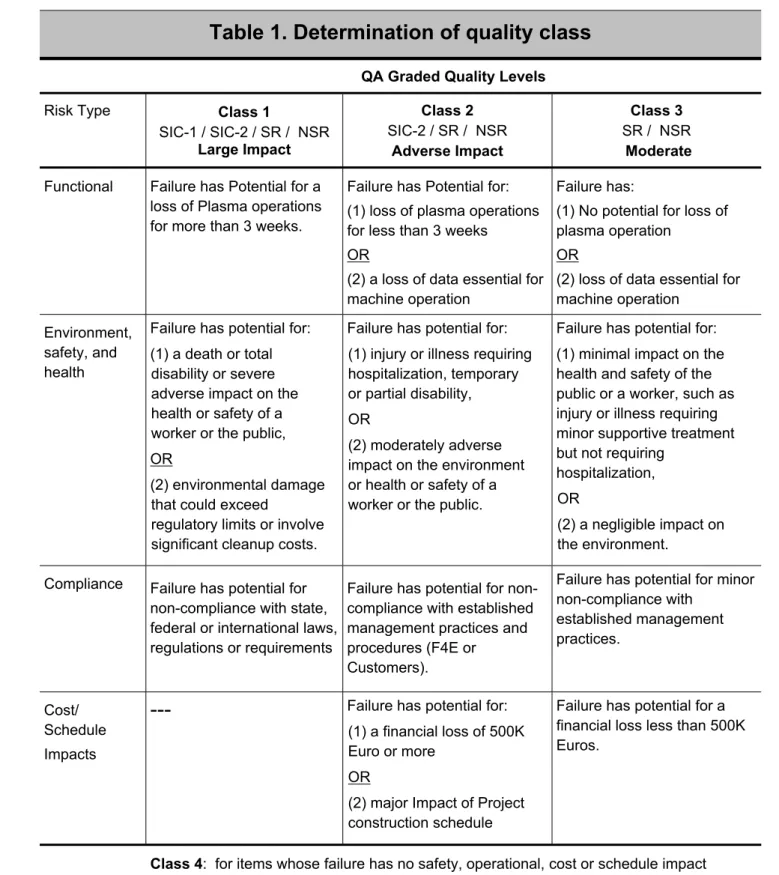
(b) The selection of quality classes and the grading of the QA requirements shall be in accordance with tables 1 and 2.
(c) Rationale and adequacy of the assigned class shall be reviewed as part of the item design review and recorded properly by Technical Project Officers.
(d) Suppliers may grade the quality classification down to the component levels (some of which may be lower than the related system classification), however they will be responsible for ensuring the correct classification is applied.
III. Determining Quality Class and Requirement
(a) Preparation:
(i) Define plan/develop activity scope of work to a sufficient level of detail so that quality requirements can be identified.
(ii) Identify any specified regulatory requirements.
(iii) Decide whether the activity will be used in or to support Project structures, systems, or components (SSC).
(iv) Request assistance from a QAO if you have any questions on preparations. (b) Determine Quality Class:
(i) If the activity will be used in or to support Project Structures, Systems, Components, determine Quality Class in accordance with tables 1 and 2.
(ii) Technical Project Officers responsible for the SSC are responsible for making the Class determination.
(iii) QAO assist in the determination as appropriate so that quality class is assigned to individual parts and the item/activity does not receive a “blanket assignment” of one quality class. (iv) For ITER tasks, in case of conflict between this classification and the ITER classification
(ITER Quality Classification Determination ITER_D_24VQES), the ITER Quality Classification will prevail. Define plan/develop activity scope of work to a sufficient level of detail so that quality requirements can be identified.
(c) Determine Quality Requirements:
(i) The application of the Quality Requirements shall follow the indications of table 2 and the graded application described in FE-QA-100. Define plan/develop activity scope of work to a sufficient level of detail so that quality requirements can be identified.
Table 1. Determination of quality class
QA Graded Quality Levels
Risk Type Class 1
SIC-1 / SIC-2 / SR / NSR Large Impact Class 2 SIC-2 / SR / NSR Adverse Impact Class 3 SR / NSR Moderate Functional Failure has Potential for a
loss of Plasma operations for more than 3 weeks.
Failure has Potential for: (1) loss of plasma operations for less than 3 weeks
OR
(2) a loss of data essential for machine operation
Failure has:
(1) No potential for loss of plasma operation
OR
(2) loss of data essential for machine operation
Environment, safety, and health
Failure has potential for: (1) a death or total disability or severe adverse impact on the health or safety of a worker or the public, OR
(2) environmental damage that could exceed
regulatory limits or involve significant cleanup costs.
Failure has potential for: (1) injury or illness requiring hospitalization, temporary or partial disability,
OR
(2) moderately adverse impact on the environment or health or safety of a worker or the public.
Failure has potential for: (1) minimal impact on the health and safety of the public or a worker, such as injury or illness requiring minor supportive treatment but not requiring
hospitalization, OR
(2) a negligible impact on the environment.
Compliance Failure has potential for non-compliance with state, federal or international laws, regulations or requirements
Failure has potential for non-compliance with established management practices and procedures (F4E or
Customers).
Failure has potential for minor non-compliance with established management practices. Cost/ Schedule Impacts
---
Failure has potential for:(1) a financial loss of 500K Euro or more
OR
(2) major Impact of Project construction schedule
Failure has potential for a financial loss less than 500K Euros.
Class 4: for items whose failure has no safety, operational, cost or schedule impact No QA Program applicability or specific quality requirements.
F4E_D_22MD99 v2.0 Quality Classification Page 5/5
Printed copies are not controlled. Confirm version status through the F4E document management system (idm@F4E) Unlimited
Table 2. Actions appropriate to quality class
Quality
Classification(a)
Class 1
Class 2
Class 3
Allowed Safety Class SIC-1 / SIC-2 / SR / NSR SIC-2 SR / NSR SR NSR Design Design controls including design reviews
and independent b verifications
Design controls including design reviews and verifications
No design review required, unless otherwise agreed between the parties Software Acceptance of Software used for Design
and Operation, including life cycle management
Identify and validate software usage No requirement, unless otherwise agreed Minimum Documents and Records to be delivered
Quality Plans, Control Plans (MIP), Procedures, calculation note (where design is involved), working instructions, Special Process Qualifications (if applicable), Operator Qualifications, ‘As Built drawings’, Release Note, Certificate of Conformity. Material certification and inspection documents according to EN 10204 Type 3.1 (or equivalent) traceable to the component part and equipment.
Quality Plans, Control Plans (MIP), Release Note, ‘As Built drawings’, material certification and inspection documents acc. to EN 10204 Type 3.1 (or equivalent) traceable to the component part/equipment.
Quality Plans, Control Plans, Certificate of Conformity according to EN 10204 Type 2.1 (or equivalent) Monitoring of performers
Audit of performers including qualification and surveillance
Limited on-site reviews No Monitoring, unless otherwise agreed between the parties Measurements and
Test Equipments Controlled calibrated measuring and test equipment (M&TE)
Controlled M&TE for validation processes Inspection(c,d,e) 100% visual, surface and
volumetric inspection 100% visual, surface and 20% volumetric inspection 100% visual, surface and 10% volumetric inspection Special processes
Personnel
Qualifications and Training (i.e. welding, brazing, N.D.E.)
Documented personnel qualifications and training
QA requirements QA representative approvals of
documents related to special processes and inspections are required
QA representative consultations on special processes and
inspections are required
QA consultations on as-needed basis
Safety Related
Activities (SRA) [3] For SIC (1 and 2): Assessment, Surveillance and Follow-up of the SRA Limited Monitoring No Monitoring, unless otherwise agreed between the parties
a For systems and component parts of class 4: no specific QA requirements.
b‘Independent’ means individual, groups, divisions, departments who were not involved in the original design.
‘Independent’ can also mean a Third Party organization
cThese requirements only apply where no construction code or other F4E approved document is specified in the Contract Technical
Requirements
d:When joining processes are used and the required volumetric inspection is not practicable, Production Proof Sampling shall be used
and the implementation agreed with the F4E Technical Officer.
ePermanent lifting attachments if welded must be 100% inspected using N.D.E. before and after lifts (d)