DOI: 10.1542/peds.2010-3841
; originally published online September 26, 2011;
Pediatrics
Rebecca M. Puhl, Jamie Lee Peterson and Joerg Luedicke
Parental Perceptions of Weight Terminology That Providers Use With Youth
http://pediatrics.aappublications.org/content/early/2011/09/21/peds.2010-3841
located on the World Wide Web at:
The online version of this article, along with updated information and services, is
of Pediatrics. All rights reserved. Print ISSN: 0031-4005. Online ISSN: 1098-4275.
Boulevard, Elk Grove Village, Illinois, 60007. Copyright © 2011 by the American Academy published, and trademarked by the American Academy of Pediatrics, 141 Northwest Point publication, it has been published continuously since 1948. PEDIATRICS is owned, PEDIATRICS is the official journal of the American Academy of Pediatrics. A monthly
Providers Use With Youth
WHAT’S KNOWN ON THIS SUBJECT: Language that providers use to describe excess weight can have pejorative connotations, reinforce weight-based stigma, and jeopardize discussions about health with overweight patients. However, few researchers have examined parental perceptions of weight-based terminology in the context of childhood obesity.
WHAT THIS STUDY ADDS: In discussions of excess weight with youth, parents prefer that doctors use the terms “weight” and “unhealthy weight” rather than “fat,” “obese,” and “extremely obese.” Parents perceive the latter terms as stigmatizing and blaming and least likely to motivate youth to lose weight.
abstract
OBJECTIVES:Little research has been performed to examine patient perceptions of weight-related language, especially related to child-hood obesity. In this study we assessed parental perceptions of weight-based terminology used by health care providers to describe a child’s excess weight and assessed perceived connotations associated with these terms including stigma, blame, and motivation to reduce weight. METHODS:A national sample of American parents with children aged 2 to 18 years (N⫽445) completed an online survey to assess their perceptions of 10 common terms to describe excess body weight in youth (including “extremely obese,” “high BMI,” “weight problem,” “un-healthy weight,” “weight,” “heavy,” “obese,” “overweight,” “chubby,” and “fat”). Parents were asked to use a 5-point rating scale to indicate how much they perceived each term to be desirable, stigmatizing, blaming, or motivating to lose weight.
RESULTS:Regression models revealed that the terms “weight” and “unhealthy weight” were rated as most desirable, and “unhealthy weight” and “weight problem” were rated as the most motivating to lose weight. The terms “fat,” “obese,” and “extremely obese” were rated as the most undesirable, stigmatizing, blaming, and least moti-vating. Parents’ ratings were consistent across sociodemographic variables, body weight, and child’s body weight.
CONCLUSIONS:The results of this study have important implications for the improvement of health care for youth with obesity; it may be advanta-geous for health care providers to use or avoid using specific weight-based language during discussions about body weight with families. Pediatricians play a key role in obesity prevention and treatment, but their efforts may be undermined by stigmatizing or offensive language that can hinder impor-tant discussions about children’s health.Pediatrics2011;128:e786–e793
AUTHORS:Rebecca M. Puhl, PhD, Jamie Lee Peterson, MA, and Joerg Luedicke, MS
Rudd Center for Food Policy and Obesity, Yale University, New Haven, Connecticut
KEY WORDS
obesity, overweight children, parental attitudes, stereotyping, physician-patient/parent communication
ABBREVIATION
SSI—Survey Sampling International
Dr Puhl conceptualized the project and design, interpreted findings, and led the writing; Ms Peterson reviewed relevant literature, contributed to study measures, managed data collection, and contributed to article drafts and revisions; and Mr Luedicke analyzed the data, interpreted results, created tables, and contributed to writing.
www.pediatrics.org/cgi/doi/10.1542/peds.2010-3841 doi:10.1542/peds.2010-3841
Accepted for publication Jun 7, 2011
Address correspondence to Rebecca M. Puhl, PhD, Rudd Center for Food Policy and Obesity, Yale University, 309 Edwards St, New Haven, CT 06511. E-mail: [email protected]
PEDIATRICS (ISSN Numbers: Print, 0031-4005; Online, 1098-4275). Copyright © 2011 by the American Academy of Pediatrics
FINANCIAL DISCLOSURE:The authors have indicated they have no financial relationships relevant to this article to disclose.
Youth who are overweight or obese are vulnerable to frequent stigmatiza-tion because of their weight.1–7
Stigma-tization poses numerous conse-quences for youth with obesity, including negative psychological out-comes,3,8–11maladaptive eating
behav-iors,3,12,13and avoidance of physical
ac-tivity.14,15There is increasing reason to
be concerned about weight stigmatiza-tion in the health care setting. Physi-cians and other health care providers have been documented as common sources of weight bias toward patients with obesity.16–23Although parents
re-port that the physician’s office is the best place to seek treatment for their child’s weight,24,25 some parents also
report feeling blamed by providers for their children’s excess weight and be-ing provided with vague advice or un-helpful suggestions.26,27
Given providers’ attitudes toward pa-tients with obesity, challenges re-ported by providers in discussing weight, and vulnerabilities of youth with obesity to stigma, it is critical to identify strategies to improve provider-patient discussions about overweight and obesity in youth, and to ensure that these discussions are pos-itive, productive, and free of bias. An important first step in these efforts is to identify appropriate and nonstigma-tizing language that providers can use in conversations about weight with youth with obesity and their families. In 2010, the British public health min-ister announced that health providers in Britain should call their patients with obesity “fat” to motivate them to lose weight.28,29Some research results
suggest that the term “fat” is per-ceived to be pejorative or judgmental, and can increase anxiety and depres-sion in those who are labeled this way.30Thus, this type of
recommenda-tion from a public health official may reinforce weight-based stigma and in-terfere with quality of care.31
Little research has been performed to examine patient perceptions of weight-related language. Two studies of adults seeking treatment for over-weight and obesity revealed that “obese” and “fat” were rated as unde-sirable terms, and “weight” and “BMI” were preferred.32,33 Others studies
have revealed that “obese” may be per-ceived as a negative term,34,35perhaps
because of implications of more seri-ous medical consequences and a sense of confusion it may invoke.30
Among parents, in 1 qualitative study parents were found to prefer that phy-sicians call their children “over-weight” and “obese” instead of more colloquial terms (eg, “chubby” or “plump”),36 and another reported
study “obese” and “fat” were found to be parents’ least preferred terms.24
However, this issue remains poorly un-derstood in the context of childhood obesity. Parental perceptions of spe-cific weight terms, and whether these evoke positive or negative reactions, are issues that have not been quantita-tively assessed. In the current study we aimed to examine parents’ prefer-ences for terms that doctors use to de-scribe a child’s weight, and to assess parents’ perceived connotations asso-ciated with these terms, including stigma, blame, and motivation to re-duce weight.
METHODS
Sample and Study Design
The study sample was made up of indi-viduals recruited through a survey panel administered by Survey Sam-pling International (SSI) during a 1-week period (October 28 to Novem-ber 2) in 2010. Online recruitment was derived from⬎3400 sources by use of targeted approaches (eg, banner ads, key words, search links, e-mail, online invitations) to achieve demographic and psychographic diversity within the online population. SSI data
aggrega-tors reach millions of users, carefully screen panelists, and employ valida-tion processes that compare respon-dent demographic characteristics to multiple databases. SSI provides a va-riety of incentives (including research feedback, charitable donations, and monetary and points rewards) for par-ticipation, which is entirely voluntary. For recruitment onto our study, panel-ists who identified themselves as par-ents, and who chose to participate, were directed to the online survey. Of participants who chose to participate, 84% (521) completed the survey. All participants provided informed con-sent, and the study was approved by the institutional review board at Yale University.
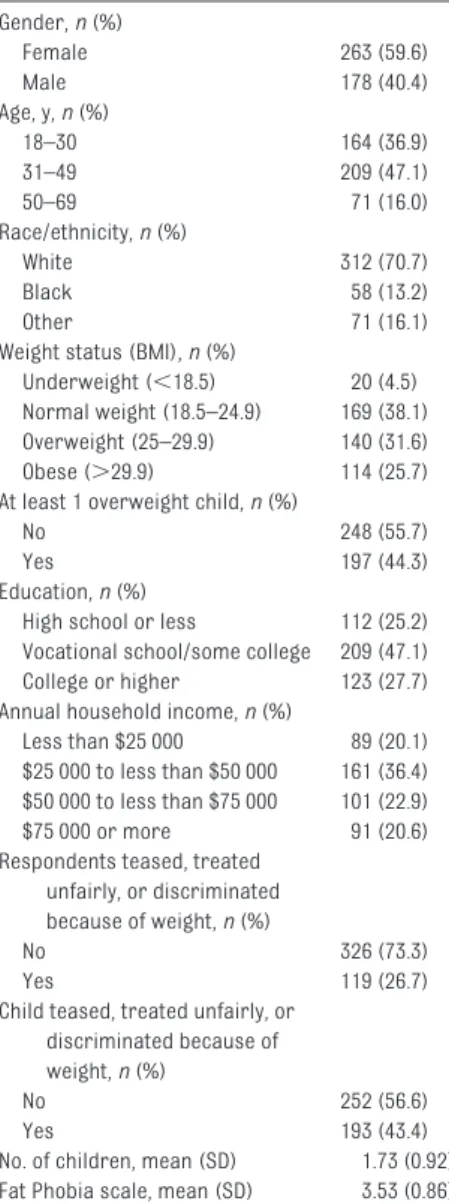
Table 1 lists characteristics of the study participants. Of the initial sam-ple (N⫽521), 85% of parents reported having a child between the ages of 2 to 18 years. Those with children outside this age range were excluded from analyses, which yielded a final sample of 445 parents. Parents’ BMI was strat-ified by using clinical guidelines for the classification of overweight and obe-sity in adults by the National Heart, Lung, and Blood Institute of the National Institutes of Health.37 This
stratification revealed that 38% of the parents were normal weight (BMI: 18.5–24.9), 32% were overweight (BMI: 25.0 –25.9), and 26% were obese (BMI: ⱖ30). This distribution of body weight is representative of the general population.38 For youth, BMI-for-age
percentiles were calculated and plot-ted on the Centers for Disease Control and Prevention 2000 gender-specific growth curves.39According to recently
established definitions of childhood obesity and overweight, youth with BMI values at the ⬎85th percentile but ⬍95th percentile are considered over-weight, and those with a BMI at the ⬎95th percentile are considered obese.40 The mean score on the Fat
Phobia scale was 3.53, which reflects moderate weight bias and is similar to scores reported for previous re-search.21,41,42The racial distribution of
the sample closely resembled that of US Census data, and the household in-come distribution approximated na-tional percentages.43,44
Measures
Demographic and Weight Information
Participants reported their age, gen-der, ethnicity, highest level of educa-tion completed, annual household in-come, height, and weight. Parents were also asked to report their chil-dren’s age, gender, height, and weight.
questionnaire by Wadden and Didie33
that read:
Imagine you have brought your child to the doctor for a routine checkup. The nurse has measured your child and found that he/she is significantly above his/her recommended weight. Your doc-tor will be in shortly to speak with you and your child. You have a good relation-ship with your doctor, who is committed to the health and well-being of you and your child. Doctors can use different terms to describe body weight. Please indicate how desirable or undesirable you would find each of the following terms if your doctor used it in referring to your child’s weight.
Participants rated the following 10 terms (presented in random order) by using a 5-point scale (1, very desirable, to 5, very undesirable) regarding how desirable each term would be if a doc-tor used it to refer to their weight: ex-tremely obese, high BMI, weight prob-lem, unhealthy weight, weight, heavy, obese, overweight, chubby, and fat. These terms were derived from previ-ous research that reflects commonly used medicalized and colloquial lan-guage.24,33,36 Participants then rated
the degree to which they believed each of the 10 weight terms (1) was stigma-tizing, (2) blames a child for their weight, and (3) motivates a child to lose weight. All terms were rated on a 5-point scale (eg, 1, not at all stigmatiz-ing, to 5, very stigmatizing), with the midpoint (numerical response 3) in-terpreted as neutrality in attitudes.
Reactions to Stigmatizing Language From Providers
Participants were asked: “If your doc-tor referred to your child’s weight in a way that makes you feel stigmatized, how would you react?” On a 5-point scale (1, unlikely, to 5, very likely) par-ticipants rated 7 options for how they would react (eg, talk to the doctor, avoid future medical appointments, encourage their child to lose weight).
sess participants’ attitudes about obese persons, expressed by use of 14 pairs of adjectives (eg, “lazy” versus “industrious”) on a 5-point scale. Par-ticipants selected a point on the scale that best described their feelings about obese persons for each adjec-tive pair. Scores above 2.5 indicate more negative attitudes toward obese people. Cronbach’s ␣ value for this study was .88.
History of Weight-Based Victimization
Participants were asked 4 forced-choice questions to assess whether they or their child had been teased, treated unfairly, or discriminated against because of their weight. Statistical Analysis
Response percentages and mean rat-ings of the weight-related terms are presented, including 95% confidence intervals. Multiple ordinary least squares regression models were con-ducted to examine the relationship be-tween demographic characteristics of parents and their children, and parental preferences for weight-based terms. To ease interpretation of coefficients, all 6 variables were z standardized. Where appropriate, marginal means, as esti-mated from the models, are reported with respect to the original scale, to specify the location of differences in means. Latent class analyses45for
cate-gorical data were conducted to examine different response patterns of items used in the regression models. Analyses were conducted using Stata 11.1 (Stata Corp, College Station, TX) and Mplus 6.1 (Seoul, Korea).
RESULTS
Parental Ratings of Weight-Based Terminology
Table 2 lists the mean ratings of all weight-based terms in regard to the Female 263 (59.6) Male 178 (40.4) Age, y,n(%) 18–30 164 (36.9) 31–49 209 (47.1) 50–69 71 (16.0) Race/ethnicity,n(%) White 312 (70.7) Black 58 (13.2) Other 71 (16.1) Weight status (BMI),n(%)
Underweight (⬍18.5) 20 (4.5) Normal weight (18.5–24.9) 169 (38.1) Overweight (25–29.9) 140 (31.6) Obese (⬎29.9) 114 (25.7) At least 1 overweight child,n(%)
No 248 (55.7)
Yes 197 (44.3)
Education,n(%)
High school or less 112 (25.2) Vocational school/some college 209 (47.1) College or higher 123 (27.7) Annual household income,n(%)
Less than $25 000 89 (20.1) $25 000 to less than $50 000 161 (36.4) $50 000 to less than $75 000 101 (22.9) $75 000 or more 91 (20.6) Respondents teased, treated
unfairly, or discriminated because of weight,n(%)
No 326 (73.3)
Yes 119 (26.7)
Child teased, treated unfairly, or discriminated because of weight,n(%)
No 252 (56.6)
Yes 193 (43.4)
No. of children, mean (SD) 1.73 (0.92) Fat Phobia scale, mean (SD) 3.53 (0.86)
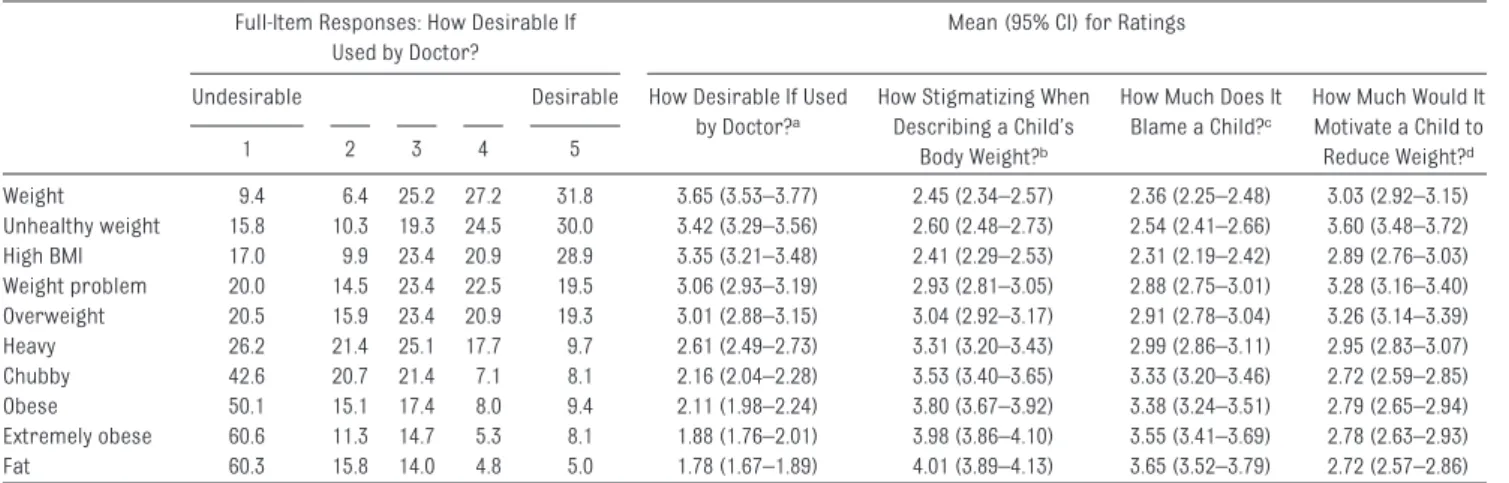
extent that each term was desirable, stigmatizing, blaming, or motivating to their child to lose weight. Full item de-scriptions are provided for desirability ratings (for other item descriptions, see Supplemental Table 5). Parents rated “weight” as the most desirable term to describe their child’s weight, fol-lowed by “unhealthy weight,” “high BMI,” and “weight problem.” The most undesir-able terms were “chubby,” “obese,” “ex-tremely obese,” and “fat,” all of which were rated as significantly more unde-sirable than the remaining 6 terms. The same pattern of results emerged for parents’ perceptions of the extent to which weight-based terms stigma-tize and blame a child for his or her excess weight. Specifically, parents
rated the terms “chubby,” “obese,” “ex-tremely obese,” and “fat,” to be the most stigmatizing and blaming. Terms rated to be the least stigmatizing and blaming were “weight,” “high BMI,” and “unhealthy weight.” Similarly, terms that were rated by parents as most motivat-ing for a child to lose weight were, in order, “unhealthy weight,” “weight prob-lem,” “overweight” and “weight.” The terms rated as least motivating were “chubby,” “obese,” “extremely obese,” and “fat.” Motivational ratings did not dif-fer between participants with or without overweight/obese children. However, analysis of variance results revealed that participants who were overweight and had children with normal weight rated the terms “heavy” (F2,409 ⫽ 2.8;
P⬍ .05;2⫽ 0.02) and “overweight”
(F3,410⫽2.9;P⬍.05;2⫽0.02) as more
motivating than overweight who were overweight participants with children who were overweight and nonover-weight participants with or without chil-dren who were overweight. However, ef-fect sizes were small.
Table 3 lists the parents’ reactions if they perceived their child to be stigma-tized about his/her weight by a doctor. There were no significant differences in reactions among parents of chil-dren who were overweight/obese ver-sus parents with children who were not overweight. For this reason per-centages for the total sample are psented. Although 68% of parents re-ported that they would react by encouraging their child to lose weight, 50% reported they would request the doctor to use more sensitive language when discussing weight with their child, 37% would feel upset and embar-rassed, 36% would put their child on a strict diet, 35% would seek a new pro-vider, and 24% would avoid future medical appointments.
Latent Class Analysis
In addition to the analysis of mean rat-ings, a latent class analysis (LCA) for TABLE 2 Parental Ratings of Weight-Based Terms as Being Desirable, Stigmatizing, Blaming, or Motivating to a Child to Lose Weight
Full-Item Responses: How Desirable If Used by Doctor?
Mean (95% CI) for Ratings
Undesirable Desirable How Desirable If Used by Doctor?a
How Stigmatizing When Describing a Child’s
Body Weight?b
How Much Does It Blame a Child?c
How Much Would It Motivate a Child to Reduce Weight?d 1 2 3 4 5 Weight 9.4 6.4 25.2 27.2 31.8 3.65 (3.53–3.77) 2.45 (2.34–2.57) 2.36 (2.25–2.48) 3.03 (2.92–3.15) Unhealthy weight 15.8 10.3 19.3 24.5 30.0 3.42 (3.29–3.56) 2.60 (2.48–2.73) 2.54 (2.41–2.66) 3.60 (3.48–3.72) High BMI 17.0 9.9 23.4 20.9 28.9 3.35 (3.21–3.48) 2.41 (2.29–2.53) 2.31 (2.19–2.42) 2.89 (2.76–3.03) Weight problem 20.0 14.5 23.4 22.5 19.5 3.06 (2.93–3.19) 2.93 (2.81–3.05) 2.88 (2.75–3.01) 3.28 (3.16–3.40) Overweight 20.5 15.9 23.4 20.9 19.3 3.01 (2.88–3.15) 3.04 (2.92–3.17) 2.91 (2.78–3.04) 3.26 (3.14–3.39) Heavy 26.2 21.4 25.1 17.7 9.7 2.61 (2.49–2.73) 3.31 (3.20–3.43) 2.99 (2.86–3.11) 2.95 (2.83–3.07) Chubby 42.6 20.7 21.4 7.1 8.1 2.16 (2.04–2.28) 3.53 (3.40–3.65) 3.33 (3.20–3.46) 2.72 (2.59–2.85) Obese 50.1 15.1 17.4 8.0 9.4 2.11 (1.98–2.24) 3.80 (3.67–3.92) 3.38 (3.24–3.51) 2.79 (2.65–2.94) Extremely obese 60.6 11.3 14.7 5.3 8.1 1.88 (1.76–2.01) 3.98 (3.86–4.10) 3.55 (3.41–3.69) 2.78 (2.63–2.93) Fat 60.3 15.8 14.0 4.8 5.0 1.78 (1.67–1.89) 4.01 (3.89–4.13) 3.65 (3.52–3.79) 2.72 (2.57–2.86)
All weight-based terms were rated on a 5-point Likert scale from 1-5.
aa1⫽Undesirable, 5⫽Desirable.
bb1⫽Not at all stigmatizing, 5⫽Very stigmatizing. c1⫽Not at all blaming, 5⫽Very blaming. d1⫽Not at all motivating, 5⫽Very motivating.
TABLE 3 Potential Reactions After Feeling Stigmatized by Child’s Doctor: Percentage of Parents Who Answered “Likely” or “Very Likely”
Reactions Total (N⫽427), % (95% CI) No Child Is Overweight/ Obese (n⫽237), % (95% CI) At Least 1 Child Is Overweight/Obese (n⫽190), % (95% CI) Encourage child to lose weight 68.6 (64.2–73.0) 66.2 (60.2–72.3) 71.6 (65.1–78.1) Talk to doctor 50.6 (45.8–55.3) 48.5 (42.1–54.9) 53.2 (46.0–60.3) Be upset/embarrassed 36.8 (32.2–41.4) 36.3 (30.1–42.5) 37.4 (30.4–44.3) Have my child go on a strict diet 35.8 (31.3–40.4) 33.8 (27.7–39.8) 38.4 (31.4–45.4) Seek a new doctor 34.7 (30.1–39.2) 33.3 (27.3–39.4) 36.3 (29.4–43.2) Avoid future appointments with doctor 23.9 (19.8–27.9) 22.4 (17.0–27.7) 25.8 (19.5–32.1) Do nothing 14.1 (10.7–17.4) 15.2 (10.6–19.8) 12.6 (7.9–17.4)
There was no significant difference between the group of parents who had at least 1 overweight/obese child and parents who did not (Pearson2,P⬍.05). CI indicates confidence interval.
categorical data were conducted to ex-plore possible latent response pat-terns across desirability ratings (Sup-plemental Fig 1). The items use the same dependent variables as in the re-gression analyses reported below, and include 6 of the original 10 weight-based terms: 2 terms that were rated, on average, as most undesirable (“ex-tremely obese,” “fat”); 2 terms that were rated as most desirable (“weight,” “unhealthy weight”), and 2 terms that were closest to neutral rat-ings (“weight problem,” “overweight”). The LCA revealed 4 qualitatively differ-ent response patterns.46 However,
those response patterns (ie, latent
classes) did not differ in their demo-graphic composition with respect to our observed covariates, as we deter-mined by using a multinomial logistic regression.
Regression Analyses
Regression results are listed in Table 4. No significant differences among participants’ gender or weight status was observed. One age effect emerged, which indicated that older parents (aged ⱖ50 years) rated the term “weight” as less desirable (predicted mean value: 3.80, original scale) than younger parents (aged 18 –30 years) (predicted mean value: 3.22), which
amounted to almost half of an SD. In addition, the terms “fat” and “weight problem” were rated by parents as slightly more desirable with increas-ing age of their children. Finally, black parents rated the term “fat” as less undesirable than did white parents, which corresponded to a difference of approximately one-third of an SD. No other patterns were observed across other demographic characteristics. Similar regression models were esti-mated to examine parents’ percep-tions of weight-based terms as stigma-tizing, blaming, or motivating for a child to lose weight. Overall, the pat-Extremely Obese Fat Weight Problem Overweight Unhealthy Weight Weight Gender
Male ⫺0.033 0.014 ⫺0.021 ⫺0.170 ⫺0.099 0.048
Age (reference: 18–30 y), y
31–55 ⫺0.016 0.081 0.092 0.022 0.056 ⫺0.072
56–88 ⫺0.031 0.010 ⫺0.156 ⫺0.103 ⫺0.260 ⫺0.460a
Race/ethnicity (reference: white)
Black 0.167 0.345b 0.072 0.072 0.109 0.211
Other ⫺0.016 0.066 ⫺0.100 ⫺0.036 ⫺0.047 0.130
Weight status (BMI) (reference: normal weight)
Underweight (⬍18.5) ⫺0.271 ⫺0.131 ⫺0.398 0.041 0.108 0.052 Overweight (25–29.9) ⫺0.049 0.110 ⫺0.100 0.126 0.175 0.204c
Obese (⬎29.9) ⫺0.041 0.040 ⫺0.134 0.021 0.175 0.133
At least 1 child overweight/obese ⫺0.079 0.020 0.125 ⫺0.015 ⫺0.033 ⫺0.196c Children’s gender (reference: all female)
Mixed, male and female ⫺0.077 ⫺0.147 ⫺0.078 ⫺0.021 0.020 0.003
All male ⫺0.001 ⫺0.128 0.038 0.185 0.096 ⫺0.040
Children’s average age 0.012 0.019b 0.040d 0.014 0.009 0.003 Education (reference: high school or less)
Vocational school/some college ⫺0.057 0.038 ⫺0.031 0.025 ⫺0.011 0.169
College or higher 0.020 0.065 ⫺0.185 0.112 0.095 0.168
Annual household income (reference: less than $25 000)
$25 000 to less than $50 000 ⫺0.179 ⫺0.312b ⫺0.114 0.053 0.026 ⫺0.162 $50 000 to less than $75 000 ⫺0.180 ⫺0.182 ⫺0.016 ⫺0.184 ⫺0.189 ⫺0.083 $75 000 or more ⫺0.108 ⫺0.225 ⫺0.065 ⫺0.256 ⫺0.397b ⫺0.193 Respondents teased, treated unfairly, or discriminated
because of weight
Yes ⫺0.073 ⫺0.200c ⫺0.203 0.055 0.049 ⫺0.046
Child teased, treated unfairly, or discriminated because of weight
Yes ⫺0.053 ⫺0.068 0.050 ⫺0.012 ⫺0.057 ⫺0.030
Fat Phobia scale ⫺0.066 ⫺0.092c ⫺0.011 0.057 0.093c 0.058
Constant 0.143 ⫺0.058 ⫺0.262 ⫺0.186 ⫺0.066 0.002
N 411 411 411 411 411 411
Data were compared to ordered logit models and yielded the same results. Linear models are presented to facilitate clearer presentation and interpretation of mean ratings.
aP⬍.01. bP⬍.05. cP⬍.1. dP⬍.001.
tern of results remained consistent across sample characteristics, with several exceptions. First, parents who had experienced weight-based stigma-tization rated 8 of the 10 weight-based terms as more stigmatizing (with the exceptions of “high BMI” and “weight”) compared with those who did not re-port such experiences, and also con-sidered 4 terms to be more blaming of children (“extremely obese,” “high BMI,” “obese,” and “overweight”). Sec-ond, compared with parents with no children who were overweight/obese, parents with at least 1 child who was overweight/obese perceived the terms “unhealthy weight,” “heavy,” and “over-weight” to be less motivating for weight loss. Third, parents who en-dorsed antifat attitudes rated the terms “extremely obese,” “obese,” “chubby,” and “fat” as more stigmatiz-ing and blamstigmatiz-ing of children compared with parents with more favorable atti-tudes. All effects pertaining to the Fat Phobia Scale ranged between 13% and 23% of an SD in the ratings for a 1-SD difference in the Fat Phobia scale. Finally, 4 terms (“heavy,” “obese,” “chubby,” and “fat”) were rated as less stigmatizing with increasing age of the parents’ children. The coefficients ranged from 2% to 4% of an SD in rat-ings per increasing year in children’s age. The term “fat” was rated as less stigmatizing by black parents com-pared with white parents, which corre-sponds to a difference of approxi-mately one-third of an SD. All of these effects were statistically significant at the 95% level.
DISCUSSION
This study was the first, to our knowl-edge, to systematically assess paren-tal perceptions of weight-based termi-nology to describe excess weight in youth. Findings show that most par-ents rated “weight” and “unhealthy weight” to be the preferred terms for doctors to describe their child’s
ex-cess weight, and that “fat,” “extremely obese,” and “obese” were the least de-sirable terms. These findings were sim-ilar to preferences documented among treatment-seeking adults with over-weight and obesity.32,33Our findings
re-mained consistent across sociodemo-graphic variables, including gender, race, income, education, and parent and child’s body weight. The age ef-fects observed indicate the need for additional research to clarify whether preferences of weight-based language shift as parents (and their children) become older.
Our findings indicate that the terms “fat,” “extremely obese,” and “obese” are perceived by many parents to be the most stigmatizing and blaming terms, and the least motivating terms to encourage weight loss. These find-ings challenge recommendations made by the British public health min-ister who encouraged health care pro-viders to call their patients “fat” to in-still sufficient motivation to lose weight.28,29 Instead, most parents in
this study reported that the terms “un-healthy weight,” “weight problem,” or “overweight” to be most motivating for weight loss.
In response to weight stigmatization by providers, our findings suggest that parents may react in ways that could have harmful implications for chil-dren’s health. Thirty-six percent of par-ents reported they would put their child on a strict diet in response to weight stigma from a provider. This finding is cause for concern in light of increasing research results that docu-ment the health consequences and fu-tility of severe calorie restriction and strict dieting in efforts to achieve long-term, significant weight loss.47–49Given
that 35% of parents would seek a new doctor, and 24% would avoid future medical appointments in response to weight stigmatization by providers, it is also possible that health care
utiliza-tion could be adversely affected by per-ceived weight stigma from doctors. Our findings have several implications for improving health care for youth with overweight and obesity. Pediatri-cians play a key role in obesity preven-tion and treatment, but their efforts may be undermined if they use stigma-tizing language that can hinder impor-tant discussions about children’s health. The use of weight-based termi-nology that patients find desirable and motivating, and avoidance of language that patients perceive to be stigmatiz-ing and blamstigmatiz-ing, is an important first step in the facilitation of positive, pro-ductive discussions about health with families. Rather than making assump-tions about weight-based language to use with patients, providers should ask parents and children about pre-ferred weight-based terminology they would feel comfortable using in patient-provider discussions. It will also be helpful for providers to recog-nize families that may have heightened sensitivity to weight-based language, such as parents who themselves have been targets of weight stigmatization. More broadly, careful consideration of weight-based terminology is needed for obesity programs targeting youth, to ensure that the health messages communicated are nonstigmatizing, respectful, and motivating. The use of preferred language may be especially important in motivational interviewing interventions for pediatric obesity to sustain child and parental engage-ment, and for perceived intervention-ist empathy, and to increase intrinsic motivation (see Mehlenbeck and Wem-ber50). It may be useful for future
re-search to address weight-based lan-guage to help identify strategies that motivate health behavior changes among patients who are most in need. Several limitations of our study should be noted. First, parental perceptions were assessed by using hypothetical
quantitative and qualitative research methodologies to allow for in-depth ex-amination of nuanced responses by patients. Second, all data were self-report, including weight and height of participants and their children. Third, although we examined 10 common weight-based terms, this list is not ex-haustive and there may be other termi-nology that should be examined. In ad-dition, although parents reported their intended reactions if a doctor stigma-tized their child because of his/her weight, it is important to assess actual patient outcomes to determine if the use of nonstigmatizing language by providers may lead to improved out-comes related to health care
utiliza-this research in ethnically diverse samples will also be important, espe-cially given high rates of childhood obesity in ethnic minorities.51Finally,
although our sample approximates na-tional demographics, lack of random sampling or sample bias may limit gen-eralizability to individuals who have the time, resources, and Internet access to participate in online surveys. However, the Internet may be more effective for surveys than are telephones,52,53 and
similar studies have published data from the SSI panel.42,54,55
CONCLUSIONS
The rising numbers of youth with obe-sity and their vulnerability to
victimiza-this population. Although prevention and treatment of childhood obesity pose numerous challenges for health providers, patient-provider discus-sions about weight should not be among these obstacles. By using weight-based language that families find supportive and motivating, and avoiding labels that instill stigma and shame, providers can help empower families in their efforts to improve health.
ACKNOWLEDGMENT
Research and project support were provided by the Rudd Center for Food Policy and Obesity.
REFERENCES
1. Puhl RM, Latner JD. Stigma, obesity, and the health of the nation’s children.Psychol Bull. 2007;133(4):557–580
2. Griffiths LJ, Wolke D, Page AS, Horwood JP; ALSPAC Study Team. Obesity and bullying: different effects for boys and girls.Arch Dis Child. 2006;91(2):121–125
3. Neumark-Sztainer D, Falkner N, Story M, Perry C, Hannan PJ, Mulert S. Weight-teasing among adolescents: correlations with weight status and disordered eating behaviors.Int J Obes Relat Metab Disord. 2002;26(1):123–131
4. Hayden-Wade HA, Stein RI, Ghaderi A, Sael-ens BE, Zabinski MF, Wilfey DE. Prevalence, characteristics, and correlates of teasing experiences among overweight children vs. non-overweight peers. Obes Res. 2005; 13(8):1381–1392
5. Pearce MJ, Boergers J, Prinstein MJ. Ado-lescent obesity, overt and relational peer victimization, and romantic relationships.
Obes Res. 2002;10(5):386 –393
6. Janssen I, Craig WM, Boyce WF, Pickett W. Associations between overweight and obe-sity and bullying behaviors in school-aged c h i l d r e n . P e d i a t r i c s. 2 0 0 4 ; 1 1 3 ( 5 ) : 1187–1193
7. Sweeting H, Wright C, Minnis H. Psychoso-cial correlates of adolescent obesity, “slim-ming down” and “beco“slim-ming obese.”J Ado-lesc Health. 2005;37(5):409
8. Davison KK, Birch LL. Weight status, parent
reaction, and self-concept in five-year-old girls.Pediatrics. 2001;107(1):46 –53 9. Tiggemann M. Body dissatisfaction and
ad-olescent self-esteem: prospective findings.
Body Image. 2005;2(2):129 –135
10. Wardle J, Cooke L. The impact of obesity on psychological well-being. Best Pract Res Clin Endocrinol Metab. 2005;19(3):421– 440 11. Eisenberg ME, Neumark-Sztainer D, Story M.
Associations of weight-based teasing and emotional well-being among adolescents.
Arch Pediatr Adolesc Med. 2003;157(8): 733–738
12. Neumark-Sztainer DR, Wall MM, Haines J, Story M, Sherwood NE, Van den Berg P. Shared risk and protective factors for over-weight and disordered eating in adoles-cents.Am J Prev Med. 2007;33(6):359 –369 13. Haines J, Neumark-Sztainer D, Eisenberg
ME, Hannan PJ. Weight teasing and disor-dered eating behaviors in adolescents: lon-gitudinal findings from Project EAT (Eating Among Teens). Pediatrics. 2006;117(2): 209 –215
14. Storch EA, Milsom VA, DeBraganza N, Lewin AB, Geffken GR, Silverstein JH. Peer victim-ization, psychosocial adjustment, and phys-ical activity in overweight and at-risk-for-overweight youth.J Pediatr Psychol. 2007; 32(1):80 – 89
15. Faith MS, Leone MA, Ayers TS, Moonseong H, Pietrobelli A. Weight criticism during physi-cal activity, coping skills, and reported physical activity in children. Pediatrics.
2002;110(2). Available at: www.pediatrics. org/cgi/content/full/110/2/e23
16. Puhl RM, Brownell KD. Confronting and cop-ing with weight stigma: an investigation of overweight and obese adults.Obesity. 2006; 14(10):1802–1815
17. Ferrante JM, Piasecki AK, Ohman-Strickland PA, Crabtree BF. Family physicians’ prac-tices and attitudes regarding care of ex-tremely obese patients.Obesity. 2009;17(9): 1710 –1716
18. Price JH, Desmond SM, Krol RA, Snyder FF, O’Connell JK. Family practice physicians’ be-liefs, attitudes, and practices regarding obesity.Am J Prev Med. 1987;3(6):339 –345 19. Schwartz MB, Chambliss HO, Brownell KD,
Blair SN, Billington C. Weight bias among health professionals specializing in obesity.
Obes Res. 2003;11(9):1033–1039
20. Teachman BA, Brownell KD. Implicit anti-fat bias among health professionals: is anyone immune?Int J Obes Relat Metab Disord. 2001;25(10):1525–1531
21. Puhl RM, Wharton C, Heuer CA. Weight bias among dietetics students: implications for treatment practices.J Am Diet Assoc. 2009; 109(3):438 – 444
22. Puhl RM, Heuer CA. The stigma of obesity: a review and update. Obesity. 2009;17(5): 941–964
23. Neumark-Sztainer D, Story M, Harris T. Be-liefs and attitudes about obesity among teachers and school health care providers
working with adolescents. J Nutr Educ. 1999;31(1):
24. Eneli IU, Kalogiros ID, McDonald KA, Totem D. Parental preferences on addressing weight-related issues in children.Clin Pedi-atr (Phila). 2007;46(7):612– 618
25. Hernandez RG, Cheng TL, Serwint JR. Par-ents’ healthy weight perceptions and pref-erences regarding obesity counseling in preschoolers: pediatricians matter.Clin Pe-diatr (Phila). 2010;49(8):790 –798 26. Edmunds LD. Parents’ perceptions of health
professionals’ responses when seeking help for their overweight children. Fam Pract. 2005;22(3):287–292
27. Mikhailovich K, Morrison P. Discussing childhood overweight and obesity with parents: a health communication dilemma.
J Child Health Care. 2007;11(4):311–322 28. Tell people they are fat, says health
minis-ter. Available at: www.telegraph.co.uk/ health/healthnews/7914686/Tell-people-they-are-fat-says-health-minister.html. Accessed November 12, 2010
29. Martin D. Obese? Just call them fat: plain-speaking doctors will jolt people into losing weight, says minister. Available at: www. dailymail.co.uk/news/article-1298394/Call- overweight-people-fat-instead-obese-says-health-minister.html. Accessed November 29, 2010
30. Tailor A, Ogden J. Avoiding the term “obe-sity”: an experimental study of the impact of doctors’ language on patients’ beliefs. Pa-tient Educ Couns. 2009;76(2):260 –264 31. Puhl RM, Heuer CA. Obesity stigma:
impor-tant considerations for public health.Am J Public Health. 2010;100(6):1019 –1028 32. Dutton GR, Tan F, Perri MG, et al. What words
should we use when discussing excess weight?J Am Board Fam Med. 2010;23(5): 606 – 613
33. Wadden TA, Didie E. What’s in a name? Pa-tients’ preferred terms for describing obe-sity.Obes Res. 2003;11(9):1140 –1146 34. Vartanian LR. “Obese people” vs “fat
peo-ple”: impact of group label on weight bias.
Eat Weight Disord. 2010;15(3):e195– e198 35. Ward SH, Gray AM, Paranjape A. African
Americans’ perceptions of physician at-tempts to address obesity in the primary care setting.J Gen Intern Med. 2009;24(5): 579 –584
36. Bolling C, Crosby L, Boles R, Stark L. How pediatricians can improve diet and activity for overweight preschoolers: a qualitative study of personal attitudes.Acad Pediatr. 2009;9(3):172–178
37. Centers for Disease Control. Defining over-weight and obesity. Available at: www.cdc. gov/nccdphp/dnpa/obesity/defining.htm. Accessed November 18, 2008
38. Ogden CL, Carroll MD, Curtin LR, McDowell MA, Tabak CJ, Flegal KM. Prevalence of over-weight and obesity in the United States, 1999 –2004.JAMA. 2006;295(13):1549 –1555 39. Ogden CL, Kuczmarski RJ, Flegal KM, et al. Centers for Disease Control and Prevention 2000 growth charts for the United States: improvements to the 1977 National Center for Health Statistics version.Pediatrics. 2002;109(1):45– 60
40. Nihiser AJ, Lee SM, Wechsler H, et al. Body mass index measurement in schools.J Sch Health. 2007;77(10):651– 671
41. Bacon JG, Scheltema KE, Robinson BE. Fat phobia scale revisited: the short form.Int J Obes Relat Metab Disord. 2001;25(2): 252–257
42. McClure K, Puhl RM, Heuer CA. Obesity in the news: do photographic images of obese persons influence anti-fat attitudes? J Health Commun. 2011;16(4):359 –371 43. US Census Bureau. Money income of
house-holds: percent distribution by income level, race, and Hispanic origin in constant (2008) dollars: 1980 –2008. Available at: www. census.gov/compendia/statab/2011/ tables/11s0689.pdf. Accessed March 25, 2010
44. US Census Bureau. General demographic characteristics. Available at: http:// factfinder.census.gov/servlet/QTTable?-ds_ name⫽PEP_2009_EST&-qr_name⫽PEP_
2 0 0 9 _ E S T _ D P 1 & - g e o _ i d⫽0 1 0 0 0 U S . Accessed March 25, 2011
45. McCutcheon AC.Latent Class Analysis. Bev-erly Hills, CA: Sage; 1987
46. Schwarz G. Estimating the dimension of a model.Ann Stat. 1978;6:461– 464
47. Franz MJ, VanWormer JJ, Crain AL, et al. Weight-loss outcomes: a systematic review and meta-analysis of weight-loss clinical tri-als with a minimus 1-year follow-up.J Am Diet Assoc. 2007;107(10):1755–1767 48. Tsai AG, Wadden TA. Systematic review: an
evaluation of major commercial weight loss programs in the United States.Ann Intern Med. 2005;142(1):56 – 66
49. Goodrick GK, Poston WS, Foreyt JP. Methods for voluntary weight loss and control: up-date 1996.Nutrition. 1996;12(10):672– 676 50. Mehlenbeck RS, Wember YM. Motivational
interviewing and pediatric obesity. In: Jela-lian E, Steele RG,Handbook of Childhood and Adolescent Obesity. New York, NY: Springer; 2009:405– 424
51. Ogden CL, Carroll M.Prevalence of Obesity Among Children and Adolescents: United S t a t e s , T r e n d s 1 9 6 3 – 1 9 6 5 T h r o u g h 2007–2008. Atlanta, GA: Centers for Disease Control and Prevention; 2010. Available at: www.cdc.gov/nchs/data/hestat/obesity_ child_07_08/obesity_child_07_08.htm. Ac-cessed August 31, 2011
52. Keeter S. How serious is polling’s cell-only problem? Available at: http://pewresearch. org/pubs/515/polling-cell-only-problem. Ac-cessed August 31, 2011
53. Wright KB. Researching Internet based populations: advantages and disadvan-tages of online survey research.J Comput Mediat Comm. 2005;10(3):11
54. Puhl RM, Heuer CA. Public opinion about laws to prohibit weight discrimination in the United States. Obesity. 2011;19(1): 74 – 82
55. Goren A, Harris JL, Schwartz MB, Brownell KD. Predicting support for restricting food marketing to youth.Health Aff (Millwood). 2010;29(3):419 – 424
DOI: 10.1542/peds.2010-3841
; originally published online September 26, 2011;
Pediatrics
Rebecca M. Puhl, Jamie Lee Peterson and Joerg Luedicke
Parental Perceptions of Weight Terminology That Providers Use With Youth
Services
Updated Information &
/peds.2010-3841
http://pediatrics.aappublications.org/content/early/2011/09/21 including high resolution figures, can be found at:
Supplementary Material
/peds.2010-3841.DC1.html
http://pediatrics.aappublications.org/content/suppl/2011/09/16 Supplementary material can be found at:
Permissions & Licensing
ml
http://pediatrics.aappublications.org/site/misc/Permissions.xht tables) or in its entirety can be found online at:
Information about reproducing this article in parts (figures,
Reprints
http://pediatrics.aappublications.org/site/misc/reprints.xhtml Information about ordering reprints can be found online:
rights reserved. Print ISSN: 0031-4005. Online ISSN: 1098-4275.
Grove Village, Illinois, 60007. Copyright © 2011 by the American Academy of Pediatrics. All and trademarked by the American Academy of Pediatrics, 141 Northwest Point Boulevard, Elk publication, it has been published continuously since 1948. PEDIATRICS is owned, published, PEDIATRICS is the official journal of the American Academy of Pediatrics. A monthly