Procedia Engineering 75 ( 2014 ) 24 – 28
1877-7058 © 2013 The Authors. Published by Elsevier Ltd.
Selection and/or peer-review under responsibility of the scientific committee of Symposium [Advanced Structural and Functional Materials for Protection] – ICMAT.
doi: 10.1016/j.proeng.2013.11.005
ScienceDirect
MRS Singapore - ICMAT Symposia Proceedings
7th International Conference on Materials for Advanced Technologies
Mechanical Characterization of Monel 400 and 316 Stainless Steel Weldments
Debidutta Mishra, M.K. Vignesh , B. Ganesh Raj, Pruthvi Srungavarapu, K. Devendranath
Ramkumar, N. Arivazhagan, S. Narayanan
School of Mechanical & Building Sciences, VIT University, Vellore 632014, IndiaAbstract
Dissimilar combinations of Monel 400 and austenitic stainless steel AISI 316 is widely used in the petrochemical, nuclear industries where the weldments are usually subjected to hot corrosion. This paper deals with the assessment of metallurgical and mechanical properties of these bimetallic joints obtained by Gas Tungsten Arc Welding process using ERNiCrMo-3 filler metal. A detailed structure-property relationship was made on these bimetallic joints using the combined techniques of optical microscopy, SEM/EDAX analysis. © 2013 The Authors. Published by Elsevier Ltd.
Selection and/or peer-review under responsibility of the scientific committee of Symposium [Advanced Structural and Functional Materials for Protection] – ICMAT.
.
Keywords: Gas Tungsten Arc Welding; Monel 400; Austenitic Stainless Steel, AISI 316; Mechanical properties;
1.Introduction
Dissimilar joints of Monel 400 and AISI 304 are widely used in chemical, petrochemical, nuclear industries whose environments demand heat resistance, corrosion resistance, tolerance to thermal cycles and creep, and good mechanical properties. Apart from these requirements, the dissimilar welds result in saving of novel and expensive materials reducing cost thereby. Monel 400 - AISI 316L bimetallic joints were employed in the Umbilical Interface Assembly of NASA for carrying high pressure oxygen gas during service [1]. It was reported by Sadek et al. [2] that the dissimilar combinations of Monel 400 and low carbon steel has been employed in oil gasification plants where the weldments are vulnerable to high temperature corrosion. Devendranath et al. [3] investigated the performance of Monel 400 and AISI 304 weldments exposed in the high temperature environments at 600 °C. Further the authors employed gas tungsten arc welding process for joining these dissimilar metals using filler wires such as ER309L and ERNiCu-7.
It was reported that if the selection of filler wire and welding process is not appropriate, some weld defects such as segregation, secondary phase formation, dilutions and cracks will generate in the weldment [3]. The choice of filler materials for dissimilar welding of the samples were based on the properties of toughness, thermal fatigue resistance and resistance to hot cracking tendency [2]. During welding of dissimilar metals, the migration of elements is one of the major concerns which affects the mechanical, metallurgical and corrosion properties of the dissimilar weldment [4]. It was also reported by Vijay et al. [5] and Oates et al. [6] that the occurrence of carbon migration in Cr-Mo weldments is primarily driven by elemental differences, especially in chromium content, between the weld metal and base metal. These authors further concluded that the carbon diffuses from the lower-chromium base metal to the higher chromium weld metal side and forms chromium carbide adjacent to the weld interface.
Sadek et al. [2] recommended the use of Nb rich filler wire such as ERNiCrFe-3 for getting the improved hot cracking resistance in the welds. Naffakh et al. [7] reported that the presence of iron in nickel based superalloys lowers the niobium solubility in austenite phase and the presence of Niobium not only lowers the melting point constitutionally, but also forms © 2013 The Authors. Published by Elsevier Ltd.
Selection and/or peer-review under responsibility of the scientific committee of Symposium [Advanced Structural and Functional Materials for Protection] – ICMAT.
low-melting carbide-austenite eutectics during solidification. Shah Hosseini et al. [8] reported the formation of austenitic weld microstructures while employing the filler wires such as Inconel 82, Inconel 617 and 310SS for welding Inconel and stainless steel. The authors further reported that the presence of 3% Nb stabilizes the austenitic matrix. Du Pont et al. [9] reported the formation of migrated grain boundaries (MGBs) which are most prevalent in fully austenitic weld metals. As reported by other researchers that weld metals employing Ni rich filler wire, Ductility Dip Cracking (DDC) always occurs along migrated grain boundaries (MGBs). These are crystallographic, high-angle boundaries that have migrated away from their parent solidification grain boundaries during cooling below the solidification temperature range and/or during reheating in multi-pass welds. It was then recommended based on the experimental studies to employ Nb and Mo rich filler wire in addition to Nickel to improve the DDC resistance.
As evident from literatures, joining of Monel 400 and AISI 316 has wide applications in various engineering sectors. However limited work has been reported so far. This paper investigates the weldability, assessment of metallurgical and mechanical properties of these dissimilar metals obtained by GTA welding process employing Ni rich filler wire with the constituents of Nb and Mo.
2.Experimental Work
The chemical composition of the base metals Monel 400, AISI 316 and filler metal ERNiCrMo-3 employed in this study is represented in Table 1. The as-received candidate metals were sliced to the dimensions of 100 mm x 50 mm x 5 mm. Samples were made as per the standard V-groove butt configurations with a root face of 1 mm, included angle of 30° and the land face of 2 mm. These dissimilar samples were welded by GTA welding process. These samples were clamped firmly in the fixture designed with a copper back plate so as to avoid distortions and bending during welding. The process parameters were established from the open literatures as well as from the trial and error studies and represented in Table 2.
Followed by welding, the weldments were cut into different coupons using wire cut EDM (Electrical Discharge Machining) for further metallurgical and mechanical investigations. Metallographic examination was done on the composite region (which has the dimensions of 30 mm x 10 mm x 5 mm), covering all the zones including parent metals, heat affected zones (HAZ) and weld. Standard metallographic procedures were followed to reveal the microstructure of the various zones of the weldments. The composite region of
the weldments were polished using the emery sheets of SiC with grit sizes varying from 220 to 1000 and followed by disc polishing using alumina to obtain a mirror finish of 1μ accuracy. Marble’s reagent (10 g of CuSO4; 50 ml HCl and 50 ml distilled water) is employed to examine the microstructure of the parent metal, HAZ of Monel 400 side and weld zone whereas a mixture containing 15cc HCl, 10 cc HNO3 and 10 cc CH3COOH is used on the AISI 316 side.
Tensile studies were performed on the ASTM E8 standard samples of the weldments. Three trials were conducted to ensure the reproducibility of the results. A strain rate of 2 mm/min. was employed in the tensile studies. The fractured samples were characterized to understand the mode of fracture by SEM analysis. Hardness studies were conducted on the composite region of the weldment by keeping weld as centre using Vicker’s Microhardness tester. The test employs a load of 500 gf and 10 s dwell time and the measurements are carried out at regular intervals of 0.25 mm. Further the SEM/EDS analysis was performed on the various zones of the weldments to determine the presence of various elements and also helpful to assess the structure - property correlations. The following chapter addresses the results and discussions of the experimental work.
Table 1. Chemical Composition of the Base/Filler metals
Base/Filler Metal Chemical Composition (% Weight)
Ni C Si Mn Cu Fe Cr Others
Monel 400 65.4 0.1 0.4 1.64 Bal 2.11 --- ---
AISI 316 8.13 0.06 0.39 1.64 --- Bal 18.1 1.9 (Mo); 0.002 (P)
ENiCrMo-3 Bal 0.1 0.5 0.5 0.5 5.0 21.5 9.0(Mo); 9.0 (Co); 3.6 (Nb); 0.4 (Al);
0.4 (Ti);0.022 (P); 0.005 (S); Monel 400
AISI 316
ERNiCrMo-3 GTA weld
Fig. 1 Macro-photograph of the GTA weldments of Monel 400 and AISI 316
Table 2. Process Parameters employed in GTA welding
Welding technique Voltage (Volts) Current (Amps) Shielding gas flow rate (lpm)
No, of Passes Filler wire diameter (mm)
GTAW (Filler) 12.5 130-140 15 3 2.4
3.Results
3.1.Macro and Microstructure Studies
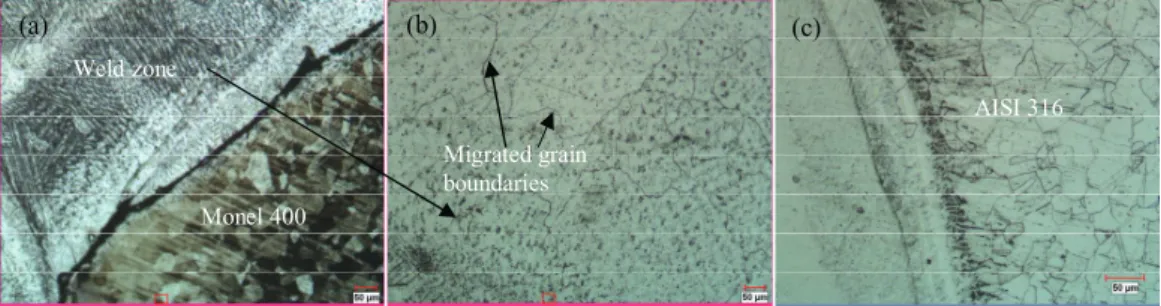
It is well observed from the macrostructure examination [Fig.1] that there were no observable macro/micro-scale deficiencies and was confirmed from the NDT analysis. Microstructure studies shown in Fig. 2 revealed the formation of coarse grains of Ni-Cu phases at the HAZ of Monel 400. The weld region has interdendritic network of the elements consisting of Ni, Cr, Fe, Cu and Nb. Also migrated grain boundaries were observed at the weld zone.
3.2.Mechanical Characterization of the weldments 3.2.1. Hardness Measurement
Hardness profile on the dissimilar weldments of Monel 400 and AISI 316 employing ERNiCrMo-3 filler wire clearly epitomized that the maximum hardness was found to be at the weld zone. The average hardness at the weld zone was found to be 194.3 HV whereas the average hardness value at the Monel 400 side was 189.5 HV and 150.3 HV at AISI 316 side.
3.2.2.Tensile Properties of the weldments
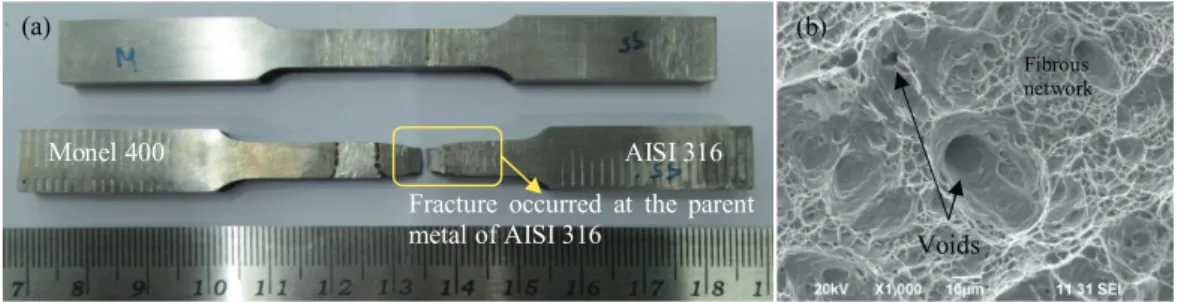
Tensile studies were conducted on the ASTM E8 standard samples to assess the mechanical properties of the dissimilar weldments. In all the cases, the failure occurred at the parent metal of AISI 316. Before fracture, the weldments had undergone significant amounts of plastic deformation contributed for the ductile mode of failure. This could also be inferred
Monel 400 Weld zone AISI 316 Migrated grain boundaries (a) (b) (c)
Fig. 2 Microstructure examination of the weldments showing (a) Weld zone - HAZ of Monel 400 (b) Weld zone - Migrated Grain Boundaries (MGBs) at 100x (c) Weld - HAZ of AISI 316
Weld zone Monel 400
AISI 316
from the SEM fractography studies, indicating the presence of voids and dimples spread across the fibrous network. The average tensile properties obtained from the studies include the tensile strength of 544.3 MPa with a ductility of 31.45%.
3.2.3.SEM/EDAX analysis of the weldments
SEM/ EDAX analysis on the GTA weldments employing with filler wire ERNiCrMo-3 is represented in Fig. 5. The EDAX analysis on the HAZ of Monel 400 clearly showed the presence of considerable amounts of Ni, Cu and Nb. In the weld zone, the presence of Ni, Cr, Fe, Nb and Mo was found to be in greater amounts and the HAZ of AISI 316 was found to have Fe, Cr, Ni and Mo in richer amounts. Dendritic growth was clearly observed at the weld zone. Table 3 represents the EDAX point analysis of the dissimilar weldments of Monel 400 and AISI 316.
Table 3. EDAX analysis (wt %) on Monel 400 and AISI 316 dissimilar weldments
Zones Element Composition (%) Ni Cu C Nb Fe Mo Mn Cr Al Others HAZ Monel 400 55.6 27.5 11.6 10.3 1.97 - 0.9 0.09 0.43 0.18 (Ti); 0.07 (Si) 0.04 (P); 0.04 (S)
Weld Zone 43.1 2.10 12.2 10.3 9.8 5.33 0.22 16.1 0.33 0.18 (Ti); 0.15 (S)
HAZ AISI 316 7.45 - 23.38 - 53.22 1.76 0.93 13.0 - 0.25 (Si)
4.Discussions
It is inferred from the macrostructure studies that successful joints of Monel 400 and AISI 316 could be obtained from the GTA welding process employing ERNiCrMo-3. Microstructure studies clearly attributed to the formation of migrated grain boundaries at the weld zone. It was reported by Du Pont et al. [9] that migration of the boundary is possible during reheating, such as during multipass welding. In these studies, multipass GTA welding is employed for joining these metals which normally yields higher heat input which could cause the migration of grain boundaries. However ductility dip cracking is not being witnessed due to the presence of higher amounts of Nb and Mo. As evident from the SEM/EDAX analysis shown in Fig.5, the weld zone is completely austenitic that could even favor for the MGBs as reported by other researchers [9]. It is also inferred from the hardness studies that the weld zone has maximum hardness as compared to other zones of the weldment. This could be attributed to the presence of phases such as NbC, (Nb, Ti)C as evident from SEM/EDAX analysis, which normally pinned the grain boundaries and provide mechanical locking thereby preventing the grain boundary sliding. It was reported that the addition of alloying elements, such as Nb, that promote the formation of carbides at the end of solidification appear to be an effective method of improving DDC resistance in Ni - base filler metals. It was noticed in all the trials that the tensile fracture occurred at the parent metal of AISI 316 side. This could be attributed to the greater hardness persisting in the weld zone due to the presence of the metallic carbides which enhanced the strength of the weldments. Hence the hardness results are well in agreement with the tensile results and could be inferred from the SEM/EDAX analysis [Fig.5].
Conclusions
Based on the current studies, the major conclusions drawn from this study are reported as follows:
1. GTA welding could be employed to join Monel 400 and AISI 316 employing ERNiCrMo-3 filler wire
2. Migrated grain boundaries were found at the weld zone; however MGBs didn’t contribute for DDC as the filler wire is enriched with Nb and Mo
Monel 400 AISI 316
Fracture occurred at the parent metal of AISI 316
(a) (b)
Voids Fibrous network
Fig. 4 (a) ASTM E8 standard tensile samples and the fracture sample (b) SEM fractograph of the fractured sample
3. Tensile failure occurred at the parent metal of AISI 316 in all the trials of the dissimilar weldments
References
[1] John Figert, Dan Rybicki. Developing a Welding Procedure for joining Monel 400 to 316L Stainless Steel. NASA M&P Update (NMPU), NASA M&P Update Newsletter 1998; 2(1).
[2] Alber Sadek A., Mahmoud Abass, Bahaa Zaghloul, Ahmed Elrefaey, Masao Ushio. Investigation of dissimilar Joints between Low Carbon steel and Monel 400. Trans, JWRI 2000; 29(1): 21-28
[3] Devendranath Ramkumar K., Arivazhagan N., Narayanan S. Effect of filler materials on the performance of Gas Tungsten arc welded AISI 304 and Monel 400. Materials & Design, 2012; Vol. 40: 70–79
[4] Arivazhagan N, Singh Surendra, Prakash Satya, Reddy GM. Investigation on AISI 304 austenitic stainless steel to AISI 4140 low alloy steel dissimilar joints by gas tungsten arc, electron beam and friction welding. Mater Des 2011;32:3036–50.
[5] Vijay Ukadgaonker G, Bhat Sunil, Jha M, Deasai PB. Fatigue crack growth towards the weld interface of alloy and maraging steels. Int J Fatigue 2008;30:689–705.
[6] Oates WR, Saitta AM. Welding handbook. Materials and applications, vol.4. American Welding Society Miami; 1998. p. 59. [7] Naffakh, H., Shamanian, M., Ashrafizadeh, F., 2009. Journal of Mater. Proc. Tech. 209, p.3628
[8] Shah Hosseini, H., Shamanian, M., Kermanpur, A., 2011. Mater. Charact. J 62 , p.425
[9] John N DuPont, John C Lippold, Samuel D. Kiser, 2009. Welding metallurgy and weldability of Nickel base alloys, John Wiley & Sons, Inc., Hoboken, New Jersey
2 4 6 8 10 12 14 16 18 20 keV 0 2 4 6 8 10 12 cps/eV Ni Ni Cu Cu C O Fe Fe Mn Mn Al Nb Nb Nb Cr Cr Si P S S 2 4 6 8 10 12 14 16 18 20 keV 0 2 4 6 8 10 12 cps/eV Ni Ni Cu Cu C O Fe Fe Mn Mn Al Nb Nb Nb Cr Cr Si P S S 0 2 4 6 8 10 12 14 16 18 keV 0 2 4 6 8 10 12 14 16 cps/eV Fe Fe Cr Cr C Ni Ni Mo Mo Mo Mn Mn Si
Fig. 5 SEM/EDAX analysis of the GTA weldments of Monel 400 and AISI 316 (as welded conditions)
HAZ - Monel 400
Weld Zone