The higher value chain of eLearning
paper for
E-Learning Workshop Hannover, September 2004 by
Erik Wallin, Stefan Henningsson, and
Martin Möller
Lund University
Department of Informatics, School of Economics and Management Ole Römers väg 6, 223 63 Lund,
Tel. +852-2788-7555, Fax. +852-2788-8694,
Email {erik.wallin; stefan.henningsson; martin.moller} @.ics.lu.se
Abstract
In this paper we explore the full eLearning process cycle as a business value chain. We make a constructive critique of the conventional value-concept in traditional value-chain models and propose an extended set of valuetypes that are crucial for business modelling of eLearning processes when higher education and academia are involved in the learning process. The types of value selected for discussion of eLearning as business are based on Jean Baudrillard´s four valuetypes: Use Value, Exchange Value, Sign Value and Symbol
Value. Our investigation of the full eLearning process cycle and the value adding that occurs in different phases of the cycle indicates that its is very meaningful to proceed further with this framework for the analyis and design of value chains for eLearning. In fact it seems quite reasonable to discuss four different business models that together can build up a collaborative business community for eLearning where each “company” can be strong in its key value adding capacity. The more detailed discussion of such a business eco-system for eLearning is only indicated in this paper.
The full eLearning cycle
This paper is based upon the view of eLearning as an iterative, ongoing process. We call it the full eLearning life cycle. It starts with the generation of a course idea and terminates with evaluation and revision. In between these endpoints there are a number of more or less integrated activities that contribute to the overall learning results. The cycle consists of four phases: Design, Construction, Learning and Evaluation. These phases are illustrated below as a set sequentially following discrete step (Figure 1). However, it is clear that the steps are neither completely separate nor carried out in a strictly sequential order.
The first phase (I) is the design phase, where learning scenarios and learning situations are designed based on course ideas. Course objectives, pedagogical foundation, literature, cases, and assessment forms are now decided on. Most active during this phase are the authors and instructional designers with knowledge about the subject matter and the topic. In the second phase (II), the main focus shifts to implementation of the course modules and components, such as graphics and simulations. Ideas about learning scenarios are formalized and means for publication and distribution are defined. During the third phase (III) learners and instructors are working together to realise the course objectives, taking use of the course material produced and the technical infrastructure available. Finally the learning processes ends up in a number of results (IV) that should be assessed and evaluated. This is made both with formal tests and through learners applications of their new knowledge in the real world. Information from the evaluation and revision is then used as input to the next generation of the life cycle. Adjustments to existing courses, decisions to implement new ones or even decisions to drop the course may be the result of such a revision.
Phase II - Construction • Configuration of learning scenarios
• Construction and courseware production
• Publishing and distribution
Phase III - Learning • Management of learners
• Learning process monitoring
• Progress tracking
Phase IV - Evaluation • Assignment and assessment
• Application of knowledge
• Evaluation and revision
Phase I - Design • Generation of course idea
• Authoring and learning scenarios
• Design of learning acts
eLearning as a value-adding process
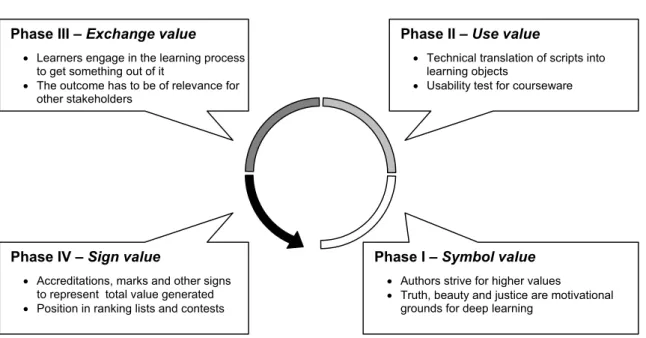
Throughout the eLearning life cycle new valuse are continuously added to the process. We have found that Jean Baudrillard’s (Marchand, 1982) value theory is of high relevance for discussing the value adding in the different phases. This value framework consists of four different value types:
• Use value represents the usefulness of an object, such as readibility of a textbook. The use value varies from person to person and depends on the situational
context. Learning how to drive a car is less useful for someone who does not own a car than for someone who does and depends on the availability of roads to drive on.
• The exchange value is most commonly expressed in monetary instruments. Exchange value possess some kind of objectivity as it is the value that may be compared to the value of other similar objects. However, an exchange value is only viable for one specific market, and it is only some goods or services that legitimately can be exchanged or acquired by money. To some extent learning outcomes can be converted into exchange values as a new skill may trigger a salary-raise that generates money to the learner.
• Sign value bears witness to the position of its owner. The outcome of a learning process could be the right to represent and articulate a higher value such as The Truth, i.e. the social rank is increased. For some learners the sign value generated by being approved by some organization may be the principle outcome desired: to get the ring or the title, such as Dr instead of Mr.
• Symbol value is the most complex value type. It is acting unconsciously and can explain why some people are mysteriously attracted to some places and buildings while others are not. Of the four value types, it is only a symbol value that people are willing to risk their lives for. A symbol value is often connected with attitudes, ethics and moral and often indicates membership in a higher complex, such as a nation state (with the flag as a symbol).
I) Authors and the task of learning design is said to represent symbolic value. Truth, justice, beauty and other higher values are motivational forces for learners to try to achieve. But as they are impossible to achieve fully, there are plenty of rooms for lifelong and lifewide learning. Sign value induced into the courseware can only be measured on a nominal scale (i.e. conceptual and linguistic).
II) During the translation of learning objectives into eLearning objects modern ICT technology is used to make learning effective and efficient according to learning objectives set up. The delivery platform to be used in eLearning online mode must be seriously taken into account because it supports a hidden agenda for the learners. The use values can be measured in many ways, but often on a binominal scale (i.e. have/have not this and that feature).
III) A learner that engages himself in a learning process is normally not doing it for the cause of the sake itself, but for being able to use the new knowledge. For him, what is learnt has little value in its own, but has an exchange value in that the new knowledge can lead to higher salary or even a new job. This is an increment in the value of the human capital. The exchange values can be measured in different monetary currencies, but it should be noted that there are no exchange rate established between the awarded academic credits, such as ECTS units, and units of money, such as USD.
IV) Users of the new knowledge achieved, for example an employer or the learner himself, need some valuation of the new competence. True value can only be described with a mapping to the reality and is restricted to a certain situation. It is impossible to
Phase II – Use value
• Technical translation of scripts into learning objects
• Usability test for courseware
Phase III – Exchange value • Learners engage in the learning process
to get something out of it
• The outcome has to be of relevance for other stakeholders
Phase IV – Sign value
• Accreditations, marks and other signs to represent total value generated
• Position in ranking lists and contests
Phase I – Symbol value • Authors strive for higher values
• Truth, beauty and justice are motivational grounds for deep learning
value competence in general terms, but valuation institutions such as universities tries to label achieved knowledge levels such as the ECTS scale. These sign values can only be measured on the ordinal scale (i.e. “1” or “A” instead of “2” or “B” etc.).
Business models for the eLearning life cycle
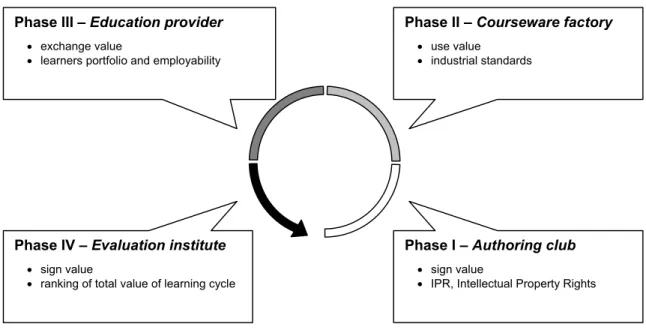
A business model serves as a more formal specification of the business logic and its value creating process, enabling discussion and development of the value adding processes. Within the proposed eLearning life cycle a set of business models can be recognized. I) In the design phase, where symbol value is added to the process, the business logic can be effectuated by an association of authors or an authoring club. The generation of new ideas, production of literature, customization of texts and updating of old literature is done within a network of collaborating experts. In order to support collaboration work between the authors there is a need for formalized authoring tools and a shared
framework for the whole learning process cycle, i.e. design, construction, learning and evaluation. Value generated in the following phases can be shared by the authors,
considered as inventors and creators of original work. The authoring club should be good to manage IPR, Intellectual Property Rights, because that’s the kind of capital the
authoring club will harvest from by inducing not-easily copied higher scientific, cultural and academic symbol values in the design.
II) In this phase the input comes from the authors and experts in the authoring club and the output should be a set of learning objects and executable learning acts to be
performed by targeted learners later on. The customers to the learning object factory are education providers, schools and other edcuational service providers (in next phase). In conventional language, the output could be called courseware and can be considered as products produced by a kind of courseware factory . The factory should be good to manage modern ICT and industrial standards for Instructural Design in terms of reusable and shareable learning objects. That would be the key business competence to generate revenue from, i.e. by high use value of produced learning objects.
III) A course is the offering provided by a university or training company. The typical organization to add value in this phase could be called an education provider. A course can be seen either as a product or a service, or both. Not many learners are paying their attention to education offers or learning acts as such, but as a means to achieve something else, such as higher competence. This outcome is expected to be achieved by “taking the course”. In that sense, an expected exchange value is generated during this phase and the value is basically holded by the learners themselves, i.e. the human capital owners in class. The increase in value of their human capital as salary increase or similar is the key issue to manage in this phase. The Swedish system for Advanced Vocational Education is a case in point, where the whole idea of the course should be to employ the learners as new labour in participating companies, i.e. to generate an exchange of new applicable competence for a reasonable increase of salary.
IV) Assessment and evaluation of learners are made by both the education provider and the employers and other stakeholders on the labour market. In this phase, all the values that have been added during th eLearning process cycle will now have to show up in more concrete things and some questions have to be asked:
WHY did they learn the things they learnt (perhaps not what the Author´s Club intended)?
HOW did they learn it (perhaps not in the way the Courseware factory had in mind)?
WHAT did they learn in reality (perhaps not what the Education provider intended)?
The total accumulated value is very difficult to measure in absolute terms (depending on the different types of values involved and the corresponding ontological transformations of values from one phase to the next). Instead a relative ranking of the results must be made by comparison to other eLearning offers. A dedicated evaluation institute should be good at that by setting up evaluation criteria and making advanced judgments of the benefits and costs involved in comparison with other similar process. In this phase the
sign value is therefore the key value to measure and manage. Ranking lists of MBA programs are exemples of this. It is also natural that this kind of evaluation should preferable be made by a party that do not have any vested interest in the eLearning process cycle as such. Only then will the measured rank be respected.
Phase II – Courseware factory • use value
• industrial standards
Phase III – Education provider • exchange value
• learners portfolio and employability
Phase IV – Evaluation institute • sign value
• ranking of total value of learning cycle
Phase I – Authoring club • sign value
• IPR, Intellectual Property Rights
Discussion
Of course the framework presented above can be questioned in many ways. But it can also be developed further into an experimental business model for eLearning. This is currently what we are trying to do in a “collaboratory” set up for this purpose. The emerging business model will be further developed and tested in a EU-project in the coming years according to a project plan set up for a new European Virtual Campus called European Conversity®. More information about that can be found at our website at http://ec.ics.lu.se
References
Gould, P, Olsson, G. (ed.) (1982) A search for common ground. London: Pion Limited. Marchand, B. (1982) Dialectical use of value: the example of Los Angeles. In Gould & Olsson (1982).
Wallin, Erik (1999a): "A business model for an online learning community – the case of Busy City", Proceedings from 4th Online Learning Conference Euro´99, Cloucestershire Business School, Cheltenham, UK.
Wallin, Erik (1999b): "Busy City - On the design of a collaborative learning environment", in Proceedings of WebNet-99, Association for the Advancement of Computing in Education (AACE), Charlottesville, USA.
Wallin, E, Henningsson, S, Zander, P-O (2003): “A Framework for eLearning”, Report from a commissioned R&D project, Fachhocshule Luebeck, Germany (restricted distribution).