WHIP, PISTOL, AND HOOD:
KU KLUX KLAN VIOLENCE IN THE CAROLINAS DURING RECONSTRUCTION
Bradley David Proctor
A dissertation submitted to the faculty of the University of North Carolina at Chapel Hill in partial fulfillment of the requirements for the degree of Doctor of Philosophy
in the Department of History.
Chapel Hill 2013
© 2013
ABSTRACT
Bradley David Proctor: Whip, Pistol, and Hood: Ku Klux Klan Violence in the Carolinas during Reconstruction
(Under the direction of W. Fitzhugh Brundage)
After the American Civil War destroyed racial slavery, the United States South was faced with the prospect of reconstructing its political, economic, and social systems. Many southerners, white as well as black, embraced the opportunity to establish a democratic biracial political system grounded in black citizenship. More conservative white southerners, however, rejected the idea that African Americans could be equal participants in the body politic. Rather than seeking to recreate slavery, they desired a new kind of racial hierarchy, one that still put white over black but which had new codes of racial behavior and mechanisms through which racial oppression operated.
To achieve this goal, thousands of conservative white southern men across the South joined the Ku Klux Klan, which had been founded in Tennessee in 1866. As Republican power increased, and as black citizenship was secured through constitutional amendments, members of the Ku Klux Klan began committing acts of vigilante violence against those people—black and white, men and women—they saw as violating the racial behavior that would define the new racial hierarchy they wanted to replace the system of slavery.
This dissertation uses the case studies of North and South Carolina to analyze the men who joined the Ku Klux Klan, the violence they committed, and the new racial order they sought to build. It asserts that membership in the Klan served as a crucible within which many
wanted race to function in postemancipation America. Simultaneously, membership in the Klan acclimated those men to the use of vigilante violence as the chief means of enforcing their ideas about race. The violence they committed against hundreds of victims in the Carolinas had lasting political, economic, and social consequences, working to prefigure the system of racial
ACKNOWLEDGEMENTS
I am not unique in having a large host of people to thank for help in the completion of this project. It is almost a trope to contrast the seemingly individual endeavor of doing
scholarship in the humanities with the reality that any academic undertaking is, at its heart, communal. But I would venture to say that I am unusually lucky for the friendship and support I have gotten from a wide range of wonderful people. I realize I am undoubtedly going to forget to thank all who deserve it. So to those I omit to name, I ask forgiveness—and to you, I thank.
Formal thanks must first go to Fitz Brundage, my advisor. I owe an enormous amount to his grounded, invaluable feedback on both my ideas and my writing, as well as his unflagging support when roadblocks arose. I came to him time and time again for advice large and small. Not only did he never turn me away, he always gave the right suggestion. I could not have hoped for a better advisor and mentor.
and more direct in my own analysis—have fueled me throughout the process. I have learned more about the nineteenth century from Bill Barney than anyone else. His unparalleled
knowledge and sharp eye have been invaluable. Finally, Tom Holt has written the most incisive and inspiring work on how race has functioned in America that I have encountered. Getting his expertise on Reconstruction has been a privilege, and I owe a great deal to his keen interest in ensuring that I ground this project with specifics about these historical actors.
One of the benefits of working at the University of North Carolina has been the
superabundance of world-class scholars I have gotten to know on the faculty. I am particularly grateful to Joseph Glatthaar, who walked me through methods of demographic analysis and tipped me to the IPUMS database, and Harry Watson, who helped me figure out the percentage of slaveholding white households in the Carolinas. Especial thanks also go to Kathleen DuVal, Jacquelyn Hall, Lisa Lindsay, John Sweet, and Heather Williams.
I am also very grateful to all the scholars who have offered mentorship and advice. John Inscoe, Crystal Feimster, and Kidada Williams all commented upon various pieces of the work in conference presentations, and their comments helped me sharpen my analysis. Thomas Brown and Mark Schultz have long served as unofficial champions. Bill Blair, Kat Charron, Bobby Donaldson, Carole Emberton, Paul Escott, Greg Mixon, Scott Nelson, Elaine Parsons, Hannah Rosen, Michael Vorenberg, and countless others whom I have undoubtedly forgotten to name have been gracious enough to offer advice, formal or informal, about southern history in general and this project in particular, and to all of them I owe thanks.
of South Carolina this dissertation could not have been completed. I was lucky to receive the Lewis P. Jones Fellowship from the South Carolinana Library at the University of South Carolina the summer I most needed to do archival research, and I am particularly grateful to Allen Stokes for his support. The South Caroliniana Library quickly became my favorite place in the world to research southern history, and that is in large part to Graham Duncan, Brian
Cutthrell, and Henry Fuller, the generous and friendly archivists there. Closer to my own backyard, the archivists at the Southern Historical Collection were also amazingly helpful. Special thanks go to Laura Clark Brown, Matt Turi, and Holly Smith. Jennifer Doty, from the Department of City and Regional Planning, was invaluable in helping me design and build my database of Klansmen and victims. The Odum Institute helped me learn STATA and crunch the data on average white southerners from the IPUMS dataset.
Many people have been generous enough to put me up on couches, air mattresses, and sleeping bags—and, in a few rare instances, spare beds—when I traveled for research or
conferences. David Williard has been a stalwart archival companion and my favorite person with whom to talk about the nineteenth century. Mark Slagle and Sarah Barksdale (and the Fuzz) hosted me in D.C. while researching at the National Archives. Kerry Taylor showed me great hospitality in Charleston. Caitlin Verboon and Chris Bonner took me in to their apartment in New Haven, twice. Caitlin also hosted me in Columbia in 2012, and I would undoubtedly not enjoy that city nearly as much as I do without her friendship. Lindsay O’Leary (and Eli) put me up in Pittsburgh for the 2012 ASALAH conference.
more about writing from reading student papers than I ever have writing on my own, and there is nothing like a college classroom for reminders that one can simultaneously be an expert and a total novice. I owe special thanks to the wonderful students in “Violence in Nineteenth-Century America,” the seminar I taught at Bates College in 2012. Together we explored how to actually go about understanding violence in its historical context and writing about it historically and humanely. The extent to which this dissertation does so at all successfully owes a great deal to their ideas. I was also lucky to advise four senior theses while at Bates, and I hope Brian
Goldberg, Neal Goldberg, Kyle Philbrook, and Ben Williams learned from me half as much as I did from them in our conversations. Brian and Neal both read drafts of Chapter 4 and provided invaluable feedback about tone, clarity, and argument. It was a pleasure to get their insights.
about interracial marriage, the Republican Party, and the Fourteenth Amendment. My deep and immediate friendship with Micah Pawling, now at the University of Maine, was an unexpected highlight, and I know we will be historical partners in crime for years to come.
I have benefited immensely from the structure and support of two fantastic writing groups. To the Bates College Humanities Rock Stars—Mollie Godfrey, Erin Hourigan, Ruth Lexton, Beata Niedzialkowska, Therí Pickens, Matthew Pettway, and Lauren Vedal—I give great thanks. We became close friends as well as scholarly partners. Conversations with Matt and Therí reminded me time and again of the challenges and stakes of this research. Here at UNC, I am a Writer, Prize-Fighter alongside Anna Krome-Lukens, Liz Lundeen, and Jessie Wilkerson. I am eternally grateful for their friendship, our broad conversations about writing, their specific suggestions about my work, and our unfettered discussions of the profession and the past.
Indeed, from the members of Team Delusion my first year to the many friends I have picked up along the way, the graduate student community at the University of North Carolina has been a great place to study history. This is the one section where naming everyone would result in a list well over one hundred names long, so I must beg forgiveness for turning to a blanket acknowledgement. To my fellow graduate students at the UNC History Department, past, present, and future, I give thanks. I want to make a special note of acknowledgment to the
members of the Triangle African American History Colloquium (TAAHC). I could not imagine a friendlier or more collaborative scholastic community.
Lyford, Jay Kempen, Leslie Wilson, Patrick Gibson (and Junior Brown), John Robertson, Patrick Tobin, Kelly Morrow, Kim Kutz, Rob Ferguson, David Palmer, Catherine Conner, Ben Reed, Jen Lynn, Joseph Bryan, Zach Smith, Lesley Graybeal, Christina Carroll, Anna Gutman, and so many others. I also want to thank those friends who have become my family: the Chews, the Morrow-Howells, the Stepletons, Mike Silver, and Todd Owyoung.
My whole family, Proctors and Knisleys, has always loved me regardless of my academic achievements (or struggles). In lessons explicit and implicit, they have taught me the importance of fairness and kindness. I have been overwhelmed by the love and support shown from my immediate family. No one is ever more excited to see me than Beauregard. And to Mom, Dad, and Anne, I owe absolutely everything. Thank you.
TABLE OF CONTENTS
List of Tables and Figures………...x
Introduction……….……….1
Chapter One: “A Perfect Military Organization”: The Rise, Spread, ………..30
and Methods of the Ku Klux Klan. Chapter Two: Ku Klux Klan Membership………....83
Chapter Three: “In the Lower Orders of Life”: Conflicts and………109
Fractures Within the Klan Chapter Four: Remaking a “White Man’s Government”: Electoral………...131
Politics and Klan Violence Chapter Five: Constructing “Negro Domination”: Klan Violence……….205
and Local Politics Chapter Six: Private Lives and Public Violence: The Politics………...268
of the Household Conclusion……….338
Appendix A: Demographic Research Methodology………..362
Appendix B: County Demographics………..368
LIST OF TABLES AND FIGURES
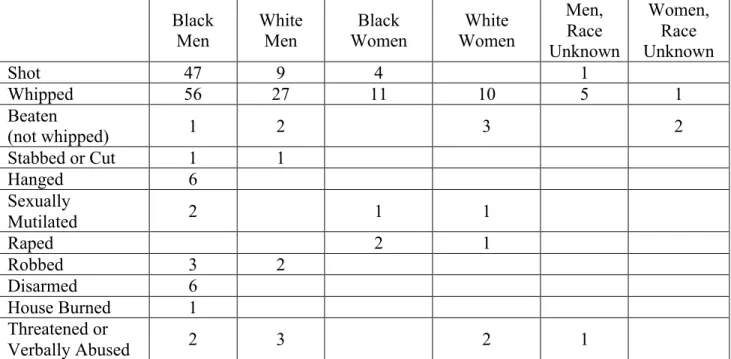
Table 1.1 – Known Klan violence in the Carolinas by………59 gender and race of victim
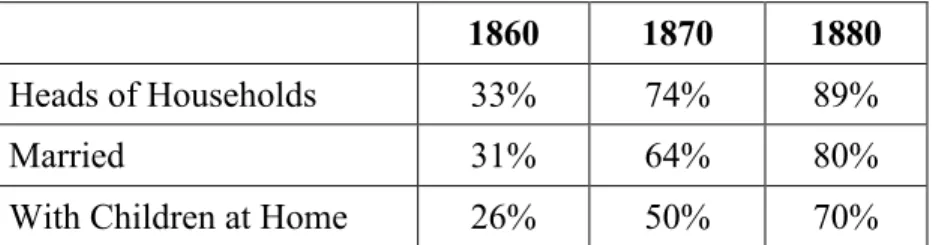
Table 2.1 – Klan households………92 Table 2.2 – Average white male households………93 Table 2.3 – Slave ownership, Klansmen compared to average………97 white households, 1860
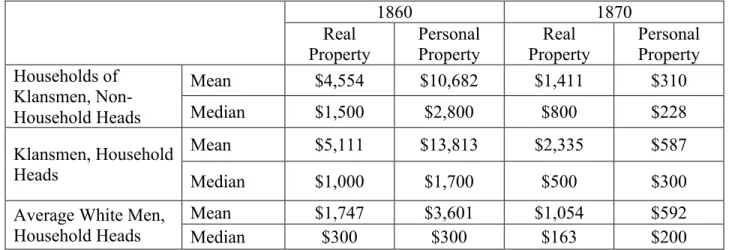
Table 2.4 – Property ownership, Klansmen compared to………99 average white men
Table B.1 – North Carolina counties with Klan activity………369 Table B.2 – South Carolina counties with Klan activity………370
INTRODUCTION
On a moonlit winter night in 1870, Essic Harris was suddenly woken by his wife Anne. Essic, Anne, and their six children lived in rural Chatham County, North Carolina. Times had not been easy. Essic had been employed in railroad construction in the winter months when there was less work to be done for the old white farmer from whom he rented land. The end of slavery had brought Essic and Anne a measure of autonomy, and five of their six children had been born after emancipation. But freedom also brought new threats. On this night, Essic had gone to bed early, tired from clearing ground for the railroad. It was a few days before Christmas—a Wednesday, he later remembered.1
Sometime just before midnight there was a knock on the door. Before Harris was fully awake, about fifteen white men, wearing masks and white robes trimmed in red, broke through the door and entered his small house. “Have you ever seen the Ku Klux?” one of the white men asked. Harris said no, and one responded, “Here they are; we are the Ku Klux.” They demanded his gun—a shotgun with which Harris hunted small game—and took his powder and shot, then left without saying much else. Harris later heard they visited other African Americans that night,
1 Report of the Joint Select Committee to Inquire into the Condition of Affairs in the Late Insurrectionary States,
taking their weapons too and raping a young black girl who lived nearby. Essic purchased another shotgun and continued working at the railroad. But a week or two later, in early January 1871, Anne again woke him late at night.
His dog was barking. His dog rarely barked at strangers, but this night the Ku Klux Klan had returned. Essic and his family were more prepared. He doused the fire, barricaded the door, and grabbed his new gun. Anne hid under one bed, their six children under the other. Before Essic could shoot, the Klansmen began breaking the windows of the house and firing into it. Bullets and shot tore into the wooden walls of the cabin and rained splinters down on Anne and the children, who miraculously remained unharmed. Essic was not so lucky; he was hit nine times, sustaining injuries in his foot, leg, shoulder, and arm. But he still had his gun.
After shooting into the cabin for what seemed to Harris to be well over an hour, the Klansmen assumed they had succeeded in killing the cabin’s inhabitants. The raid’s leaders chose two younger Klansmen, Joe Clark and Barney Burgess, to enter the house and remove the bodies. Joe Clark was twenty-four, an illiterate farm laborer and illegal whiskey distiller; Barney Burgess was slightly older at thirty-one, but lived on his mother’s farm and also peddled bootleg whiskey.2 They began breaking down the door.
Harris’s gun was loaded with a light load for killing squirrels, but he cocked and aimed it at the door as it split open and Clark and Burgess entered. Fear flashed through Harris’s mind. He later recounted that “They always said in my country that a man could not kill a Ku-Klux; they said that they could not be hit; that if they were, the ball would bounce back and kill them. I thought though that I would try it, and see if my gun would hit one.”3 As the door opened, he
2 1870 Census, Series M593, Roll 1129, Page 110, and Series M593, Roll 1129, Page 180B, Image: 369.
3 Testimony of Essic Harris, KKC NC, 89-90. Throughout this dissertation I have retained all spelling and
pulled the trigger. “When I shot the man the fire blazed up in his face as clear as you ever saw a match blaze up,” he recalled.4 The squirrel-shot hit Clark in the chest and Burgess in the eye. The mob of Klansmen fled, startled by Harris’s resistance, taking the injured men with them.
In some ways the story of the Harris family was atypical of the racial violence endemic after the American Civil War. Targets of Klan violence often fought back, but Harris was more successful than most. Victims frequently survived their attacks, but rarely forced Klansmen to flee. Most Klansmen escaped prosecution, but Clark and Burgess were arrested a few days after the attack, identified by their wounds. Whereas most Klan attacks generated few accounts by their survivors, Harris traveled to Washington, D.C., in the summer of 1871 to testify to a Joint Select Committee of the U.S. Congress about the attack on his family.
But in other regards the attacks upon Essic Harris were quite typical of the violence committed by members of the Ku Klux Klan during Reconstruction. White southerners opposed to racial equality attacked many southerners who supported it, white and black, and the Ku Klux Klan was the largest and most infamous organization of vigilante violence. Klansmen attacked countless black families and disarmed many black men. Most attacks took place late at night. Targets were often caught unawares, in their nightclothes and in bed. Just as Harris was scarred for life by his wounds, few survivors of Klan raids escaped unscathed. Most survivors could also identify some of their attackers. Harris later attested to having “bought many a quart of whisky” from Burgess, and estimated that most of the men who attacked him lived no farther than four
texts. In many passages errors are prevalent enough that the use of “sic” would seem distracting and perhaps even condescending. Given that many of the words quoted within this dissertation are those of Klansmen or those sympathetic to them, I believe it important to show the range of literacy they had and the specific language choices they used. An effect of this choice is that some of the words of African Americans were recorded in dialect, particularly in interviews conducted by the Federal Writers’ Project in the 1930s. That dialect reflected at least as much how white audiences expected black voices to sound as how the people themselves spoke. Nevertheless, I consider the advantages of retaining all original language, errors or dialect included, to outweigh the disadvantages of either selectively revising or including “sic” to denote errors. Any errors in unquoted text, obviously, are mine.
miles away.5 And many Klansmen, like Clark and Burgess, were middling white farmers in their twenties or thirties; some were also bootleggers.
The American South experienced considerable political instability and widespread racist violence between the Civil War and the turn of the twentieth century. Of the numerous atrocities white southerners committed, the violence committed by members of the Ku Klux Klan remains the most infamous. But too often the larger purposes of the violence Klansmen committed during Reconstruction have remained hidden behind their hoods and masks, seemingly as inarticulate as the men who twice attacked Harris’s house. At a superficial level Klansmen seem unknowable, obscured behind masks and hoods. And yet most historical accounts depict them as single-minded and direct in their intentions—another way Klansmen desired to be seen. But their violence was anything but simple.
This dissertation analyzes the violence committed by members of the Ku Klux Klan during the period of Reconstruction in North and South Carolina. It strives to unmask Klansmen, analyzing not just what prompted them to commit violence but also the lasting effects of that violence alongside the terror experienced by its individual survivors. Members of the Ku Klux Klan were not aberrant or marginal members of white southern society; they were normal, everyday white southerners—if anything more privileged than most other southerners, white or black. And Klansmen’s goals were not mysterious, though they were more complex than historians have typically credited. Klansmen were engaged in a campaign of racial terror, but instilling fear in African Americans was just one facet of their larger project. In addition to traumatizing their victims and survivors, the violence Klansmen committed changed how white southerners thought about race at the same time that it shaped the ways southern society was
structured around race—socially, politically, and economically—during a critical period of transition after the end of slavery.
It is well understood that race is historically constructed. Rather than being a firm biological category, race has been created and recreated through the repeated, conscious decisions of people in the past. A corollary, but one that we can be less apt to analyze, is that racism—the idea that differences in skin color do or ought to translate to differences in social, political, and personal power—is also historically constructed. No less than race, even more than race, racism has to be remade in and reconfigured to new historical contexts.6
Racism can seem to be a causative force, and some historians have used racism as an ultimate explanation for the actions of people in the past. There can be a certain utility in doing so: Klansmen were racist in their belief that black people ought to have no political, social, and economic power in the American South, and this conviction caused them to commit violence against black people and those white people who supported equality. But racism is more than just sentiment. It manifests itself in social and political power. Similarly, racism is not timeless or static. New historical contexts have forced the contours of racism to shift.
6 There is a host of writings on race’s social construction. For influential works by historians, see Barbara Fields,
Reconstruction, in particular, involved a radical reshaping of American racism. Before the Civil War, slavery had been the chief mechanism of racial oppression in the American South, and it had been buttressed by a racist ideology that had developed alongside it. An economic dependence upon the slave economy and growing challenges to slavery by abolitionists had both hardened white southerners’ ideological commitment to slavery to the point where they were brought up to believe, in the words of one white South Carolinian, that “slavery was ordained by God in perpetuity,” and that “that the Southern States could not prosper, if indeed they could exist, with the negroes emancipated.”7
But the Civil War killed slavery. After emancipation, proslavery ideology could not be applied wholesale to a new historical context. Once slavery had been destroyed by slave
resistance, war, and constitutional amendment, many white southerners still wanted a system of racial oppression to place white over black—politically, economically, and socially. But those agents of racial oppression could not use the laws, practices, and justifications that had
previously supported slavery. Sustained political activism by African Americans, alongside
white Republicans’ commitment to racial equality, led to African Americans gaining full citizenship and African American men gaining the right to vote. The new laws and political reality of Reconstruction forced racist white southerners to rework how inequalities would be defined and enforced. Klan violence was a testament to some white southern men’s hatred of black people, but it was more than that. Klan violence also shaped the ideas used to justify the creation of a new racial hierarchy that came to replace the dead hierarchy of slavery.
7 Robert Wallace Shand, “Incidents In the Life of a Private Soldier in the War Waged by the United States against
A racial hierarchy is more than just one group being privileged and another group oppressed. Hierarchies also involve the mechanisms through which power is wielded and the ideas given to justify and explain them. Their contours, boundaries, and definitions matter at least as much as which group has power and which is disfranchised, because those mechanisms and limits are what give hierarchies life. Too often we can be concerned with the static nature of who had power without investigating the many ways in which the lived experiences of the people within those hierarchies varied. To properly analyze the ways racism operated in the American South and the effects it had on the lives of people in the past, we must not only acknowledge the constancy of white people’s oppression of black people but also analyze both changes to the ideological underpinnings of that oppression and the mechanisms by which oppression operated.
The Ku Klux Klan was one of the chief organizations through which white conservative southerners figured out and enforced a new ideology of race after emancipation.8 There were few other groups suited to such work. White men who favored a racial hierarchy did not have
complete political control in the way they had had in the antebellum period, when slavery had
8 In this dissertation, I use the word “conservative” not as an adjective for people’s personal behavior but as a means
of describing the political affiliation of white southerners during Reconstruction who opposed racial equality, principally because they used the term to describe themselves. This was a slight change from the period immediately before the Civil War when “conservative” was used to describe people committed to racial slavery but hesitant about secession. Opposition to Unionists and Republicans and the unpopularity of the Democratic Party, blamed for the Civil War, led many white southerners to collectively call themselves conservatives during Reconstruction. C. Vann Woodward has noted that “so repugnant had the marriage with their old enemies been to the [former] Whigs that it was not until eight years after the war that the very name ‘Democratic’ was avowed by the Conservative party of North Carolina,” in Origins of the New South, 1877-1913 (Louisiana State University Press, 1971), 2. In contrast, Joel Williamson, in his seminal study of racial ideologies, identified what he called three mentalities of race— distinct ideologies or attitudes southern whites held towards African Americans after emancipation: liberal, conservative, and radical. Using his rubric, members of the Ku Klux Klan might be said to have a radical ideology of race, which Williamson defines as a mentality that allowed for “no place for the Negro,” and one that was ascendant from 1889-1915, in The Crucible of Race: Black-White Relations in the American South Since
been firmly buttressed by the law and political structures. During Reconstruction, southern state
legislatures included Republicans who forged viable biracial political alliances between newly enfranchised black men and poorer white men who blamed the planter elite for secession and war. Newspapers and print culture reflected the racial views of white conservatives and to some extent helped to give shape and meaning to new ideas about race. But those voices said little about how their ideas were received by everyday white southerners, nor did they have nearly the effect upon people’s lives that violence did.
In order to understand how racism changed in nineteenth-century America, we must understand the Ku Klux Klan. It was the preeminent organization within which conservative white southern men worked out a new ideology of racial oppression after emancipation, and through which they attempted to enforce that hierarchy. As many as twenty to thirty thousand white conservative men joined in North and South Carolina. Membership in the Klan allowed those white men a space to define and codify new rules of behavior around race and the definitions of a new, postemancipation racial hierarchy.
Klansmen then used violence to try to inscribe that new hierarchy upon the South by punishing those people, white as well as black, whose behavior somehow violated or challenged the new racial order. Violence reflects the social and cultural contexts in which it arises and thus provides us with a lens through which to see values of the time and place within which it arose— particularly those values that were in conflict. Simultaneously, violence is itself generative of meaning and shapes the context within which it takes place. By attacking, or even threatening, those people with whom they disagreed, Klansmen affected how people acted around, and consequently thought about, race and power in the postemancipation South.9
9 My understanding of violence as simultaneously reflective of and generative of meaning has been influenced by
Furthermore, the Klan’s use of widespread vigilante violence to define and enact the boundaries of a racial hierarchy was something new. The Klan did not invent white southern vigilantism. Violence by white mobs, slave patrols, and vigilance committees had been scattered across the antebellum South.10 But those groups had existed alongside of and worked in support of slavery. The vast majority of antebellum southern violence was not committed by white vigilantes upon free citizens. Violence had been pervasive throughout slavery and was a principal method of enforcing slavery’s rules, but that violence had been legally sanctioned, being committed by slave owners and overseers against enslaved people over whom they had complete legal authority.11
1880-1930 (Urbana and Chicago: University of Illinois Press, 1993); Crystal Feimster, Southern Horrors: Women and the Politics of Rape and Lynching (Cambridge, Massachusetts, and London, England: Harvard University Press, 2009); Michel Foucault, Discipline & Punish: The Birth of the Prison translated from the French by Alan Sheridan (New York: Vintage Books, 1977); Thavolia Glymph, Out of the House of Bondage: The Transformation of the Plantation Household (Cambridge; New York: Cambridge University Press, 2008); Hannah Rosen, Terror in the Heart of Freedom: Citizenship, Sexual Violence, and the Meaning of Race in the Postemancipation South (Chapel Hill: University of North Carolina Press, 2008); and Kidada E. Williams, They Left Great Marks on Me: African American Testimonies of Racial Violence from Emancipation to World War I (New York and London: New York University Press, 2012).
10 Stephen A. West has asserted that antebellum vigilantism, in the form of vigilance committees and slave patrols,
served to unite slaveowners and nonslaveowning whites in the South Carolina upcountry by targeting suspected abolitionists, in From Yeoman to Redneck in the South Carolina Upcountry, 1850-1915 (Charlottesville and London: University of Virginia Press, 2008), 46-65. Though these groups might be seen as anticipating the Klan, these groups did not practice widespread violence against enslaved African Americans, and were more likely to threaten violence than actually whip and murder. They had a greater similarity to postbellum councils of safety, as discussed in Chapter One. For more on slave patrols, see Sally E. Hadden, Slave Patrols: Law and Violence in Virginia and the Carolinas (Cambridge, Massachusetts; London, England: Harvard University Press, 2001). On other forms of violence in the antebellum South, such as dueling, fighting, and mobs, see Betram Wyatt-Brown, Honor and Violence in the Old South (New York; Oxford: Oxford University Press, 1986) and Edward L. Ayers, Vengeance and Justice: Crime and Punishment in the 19th-Century American South (New York; Oxford: Oxford University Press, 1984).
11 There is a deep literature on the violence of slavery. In particular see Deborah Gray White, Ar’n’t I a Woman:
The Ku Klux Klan institutionalized vigilante violence as the principal means by which conservative white southerners would enforce racial oppression after the end of slavery. It was after the Civil War that vigilante violence became the principal method of enforcing racial oppression in the American South. In the second half of the nineteenth century and well into the twentieth, the chief means by which white southerners enforced their ideas about race were lynch mobs, paramilitary political groups, or, after 1915, the reborn Ku Klux Klan. The Reconstruction Klan had developed the precedence of vigilantism from which those groups would all draw. Unlike the violence of slavery, postbellum vigilante violence was not sanctioned by the state. Unlike much interpersonal violence, vigilantism was premeditated and intentionally undertaken with an eye to an audience beyond its particular victims. Vigilante violence, furthermore, could be committed upon African Americans against the wishes of their white employers, who were often their former owners. It was also used against those white southerners who supported racial equality or whose behavior challenged the social rules about race that conservative white
southerners were trying to codify.12
This dissertation explores how the Ku Klux Klan helped to develop the rules of a new racial hierarchy and then naturalized white conservative southern men to the process of enforcing it through violence. It can be difficult to see the process by which Klansmen used violence to develop a new ideology of race in individual incidents like the attack upon Essic Harris. Because
enslaved people. After the State of North Carolina vs. Mann decision in North Carolina in 1929, essentially no violence against a slave was illegal.
12 In some ways the story of the Ku Klux Klan challenges the model presented by Michel Foucault in Discipline and
Punish, where Foucault asserted that modernizing societies shift violence that serves the state from sudden, public, and spectacular incidents of violence to more hidden and institutionalized forms like the prison system. But the violence of the slave society of the antebellum South, though not using the prison systems of an incarceral state, was in many ways significantly less intentionally spectacular or open to mass white participation than was the
white conservatives used a wide constellation of violence and rhetorical strategies to accomplish their goals, no single instance can illustrate the full process in action. Additionally, the ideology itself was in development and was not easily articulated. Furthermore, Klansmen shared a commitment to secrecy, and in trying to obscure their identities they desired to make their violence seem both justified and natural. But the details and textures of specific incidents of violence are critically necessary for seeing the various pieces of the larger political project white conservatives used to reconfigure racism. This dissertation therefore combines an intellectual history of the ideas Americans in the South during Reconstruction had about race with a social history of the men who joined the Ku Klux Klan and the violence they committed.
* * * * *
Historians have long emphasized that Reconstruction entailed intertwined crises of politics, race, and gender.13 Similarly, scholars have demonstrated that a new form of racial oppression developed in the late nineteenth-century South. Though some have claimed that this system was virtually identical to the racism of slavery, more nuanced studies have shown that the spatial separation and electoral disfranchisement of Jim Crow segregation developed in the specific time and place of the late-nineteenth and early-twentieth century American South. By 1900, a new form of racism had blossomed.14
13 Previous historians have well established that the Civil War and Reconstruction prompted intertwined crises of
race and gender; see, among others, LeeAnn Whites, The Civil War as a Crisis in Gender: Augusta, Georgia, 1860-1890 (Athens: University of Georgia Press, 1995); Laura Edwards, Gendered Strife and Confusion; Martha Hodes, White Women, Black Men: Illicit Sex in the Nineteenth-Century South (New Haven and London: Yale University Press, 1997); and Rosen, Terror in the Heart of Freedom.
14 There is a strong literature on the changes and development of white supremacy from the late nineteenth into the
But relatively few historians have connected the conflicts of Reconstruction to the later development of segregation. Fewer still have explored how the violence committed by the Ku Klux Klan shaped how white conservative southerners understood the role vigilante violence was to play in defining and enforcing the racial hierarchy that replaced slavery. Historians of the Reconstruction-era Klan have already suggested that the Klan was an alliance of white southern men who spanned the class spectrum.15 Though some scholars have depicted the Klan as little more than a wing of the Democratic Party that functioned to reverse Republican political power, others—particularly historians of women and gender—have been more nuanced, demonstrating that the Klan committed violence against a wide range of victims for purposes that could transcend purely partisan politics.16 But rather than looking at what Klansmen built with their violence, most previous studies have typically focused on the roots of the organization, exploring
Jim Crow (Urbana: University of Illinois Press, 2005); and Jennifer Ritterhouse, Growing Up Jim Crow: How Black and White Children Learned Race (Chapel Hill: University of North Carolina Press, 2006).
15 Allen Trelease has asserted that “during Reconstruction, white men of all classes shared in the persecution of
Negroes,” in White Terror, xx. See also Paul D. Escott, Many Excellent People: Power and Privilege in North Carolina: 1850-1900 (Chapel Hill & London: University of North Carolina Press, 1985); Scott Reynolds Nelson, Iron Confederacies: Southern Railways, Klan Violence, and Reconstruction (Chapel Hill & London: the University of North Carolina Press, 1999); and Rene Hayden, “Root of Wrath: Political Culture and the Origins of the First Ku-Klux Klan in North Carolina, 1830-1875” (PhD Dissertation, University of California, San Diego, 2003).
16 Some historians who have approached the Klan as strictly instrumentalist in their violence include Allen Trelease,
who argued that the Klan became “a terrorist organization aiming at the preservation of white supremacy,” in White Terror, xi, and George C. Rable, who asserted that “Frustrated at their inability to bring their states back to
either its antebellum antecedents or how contemporary popular culture influenced its practices.17 Consequently, most historians of the Reconstruction-era Klan have argued that Klansmen only tried to recreate the power they held in slavery.18
Similarly, historians of the Reconstruction period who do not focus upon the Klan often overlook the extent to which the violence its members committed had impacts beyond those immediately suffered by its victims. Even in some of the best political histories of
Reconstruction, much of the widespread violence of the period takes place offstage, almost as a matter of secondary importance.19 In contrast, scholars of gender or women’s history have explored how violence played a central role in reworking how race and gender were to function in the postemancipation South.20 Those works have focused more on the victims and survivors of violence than on the perpetrators, thus unintentionally overlooking the extent to which the
hierarchy that white conservative men built through violence was new. And though some historians have asserted that white conservative resistance to Reconstruction was a shared
17 Rene Hayden, in “Root of Wrath,” and Elaine Frantz Parsons, in “Midnight Rangers: Costume and Performance
in the Reconstruction-Era Ku Klux Klan,” The Journal of American History (December 2005), 811–836, both argued that Klansmen were attempting to resurrect the authority they had during slavery. Allen Trelease also asserted that “the Ku Klux Klan… institutionalized a white vigilantism which long preceded and followed it,” in White Terror, xxii, overstating the extent to which vigilante violence was institutionalized in the antebellum South.
18 For example, Paul Escott has written that “The old, formerly established elite organized the Klan and directed its
violence to accomplish one central purpose: to reestablish the hierarchy and control to which they were
accustomed,” in Many Excellent People, 154. Kidada Williams, in a study of how African Americans responded to the violence committed by white southerners both within and separate from the Klan, argued that the major thing southern whites attempted to achieve with violence was “a subjugated black population,” because “some whites were reluctant to give up the control over African Americans that they enjoyed before the war,” in They Left Great Marks on Me, 38 & 48. And Allen Trelease explicitly claimed that “physical intimidation and violence… were not new to the South during Reconstruction. The Old South had emphasized individualism and self-reliance in personal relationships, but it also had demanded conformity of ideas,” White Terror, xli.
19 For example, Eric Foner writes about Klan violence in his path-breaking Reconstruction: America’s Unfinished
Revolution, 1863-1877 (New York: Harper & Row, 1988), but analyzes it as an issue essentially separate from the political struggles between Republicans and Democrats.
20 See in particular Edwards, Gendered Strife and Confusion, Rosen, Terror in the Heart of Freedom, and Williams,
counterrevolution, few have provided enough evidence of the connections and conscious efforts Klansmen used to coordinate their attacks.21
Thus we often assume that the Civil War shattered everything except a static desire by white conservatives to restore or resurrect the same power they had had in slavery. Previous accounts make it sometimes seem that a shared commitment to white supremacy was lifted wholesale from the antebellum South through Reconstruction to the early twentieth century, without noting the myriad ways in which white supremacy’s contours, forms, and means of enforcement changed. The phrase “white supremacy” can often be used as if it were self-evident or a phrase without a history.22 Consequently, the Ku Klux Klan has most often been rendered as a short-lived but intense expression of an unchanging southern white male commitment to the mastery they claimed before emancipation.
21 W.E.B. DuBois called the efforts to reverse Reconstruction a “counter-revolution of property,” but lacked
conclusive evidence of coordination between those counter-revolutionaries, in his foundational work Black
Reconstruction in America, 1860-1880 (New York; London; Toronto; Sydney: The Free Press, 1998 [1935]. George C. Rable made a similar assertion in But There Was No Peace.
22 For example, Allen Trelease, in White Terror, asserted that the Klan “was soon transformed into a terrorist
organization aiming at the preservation of white supremacy,” but did not define or analyze white supremacy. More recently, Christopher Waldrep, in analyzing the language Klansmen used, argued that “Most whites supported white supremacy, but a significant number preferred to maintain white control without vigilante violence,” in “The Politics of Language,” in Winfred B. Moore, Jr., Kyle S. Sinisi, and David H. White, Jr. eds., Warm Ashes: Issues in Southern History at the Dawn of the Twenty-First Century (Columbia, S.C.: University of South Carolina Press, 2003), 141. Waldrep is correct that it is important to differentiate between white southerners who joined the Klan and those who did not, but his assertion that most supported white supremacy takes for granted what “white supremacy” itself meant. Similarly, Lisa Cardyn, in “Sexual Terror in the Reconstruction South,” seemed to assume that constructing white supremacy would only entail violence against African Americans, writing “But these avowed white supremacists did not confine themselves to molesting women of the supposedly inferior race; while victims were predominantly black, white women also suffered their depredations,” in Battle Scars, 145. One notable exception is the work of George M. Fredrickson, who has attempted to define and analyze the concept of “white supremacy.” His more nuanced definition contended that “white supremacy refers to the attitudes, ideologies, and policies associated with the rise of blatant forms of white or European dominance over ‘nonwhite’ populations. In other words, it involves making invidious distinctions of a socially crucial kind that are based primarily, if not exclusively, on physical characteristics and ancestry;” in White Supremacy: A Comparative Study in American and South African History (Oxford; London; Glasgow: Oxford University Press, 1981),xi. Another significant
exception to this trend is the work of Julie Novkov, in Racial Union: Law, Intimacy, and the White State in Alabama, 1865-1954 (Ann Arbor: The University of Michigan Press, 2008). She has argued that “While the term
Such assertions overlook how the Ku Klux Klan was a crucible within which white southern men worked out the new ways they wanted southern society to be structured around race, and also overlook the extent to which the violence Klansmen committed served to enforce and define that new racial hierarchy. That violence did not accomplish all of their goals, and it prompted a sustained—and somewhat successful—campaign by Republicans to stop what were called Klan outrages. Alongside laws that criminalized the use of disguises and participation in secret political organizations, widespread arrests of Klansmen by federal troops broke the backbone of the Klan. In late 1871 the organization went underground, ceased committing violence, and eventually disappeared. But the effects of the violence remained. So did the work of Klansmen in figuring out the new racial hierarchy that white conservatives would use to structure southern society. Though of course nothing that happened after the end of
Reconstruction was predetermined by Reconstruction’s course, the violence used by members of the Klan prefigured most, if not all, of the forms racial oppression took after Reconstruction. * * * * *
Just as racism is too often considered a sufficient explanation for people’s behaviors, too often we think that racial oppression manifests itself in identical and predictable ways. But by reviewing what happened after Reconstruction, we can better see the extent to which Klan violence reshaped American racism and the ways in which the new racial hierarchy they tried to build was different from the oppression of slavery. The period between the end of
Reconstruction and the turn of the twentieth century was no less fraught and contested than Reconstruction itself. African American men retained the right to vote but voter intimidation and electoral fraud began to substantially limit black voting. Biracial political alliances arose
conservative control (with varying degrees of electoral success).23 White conservatives
responded to those threats with a wide slate of strategies to disfranchise African American men (and to some extent those poorer white people who made common cause with African
Americans) despite the Fourteenth and Fifteenth Amendments. The efforts were highly
successful, resulting in near total disfranchisement of African Americans in the South by 1900.24 Simultaneous to their exclusion in the political sphere, African Americans were
increasingly restricted in public spaces. Predicated on the false premise that separate might be equal, segregation worked to visibly inscribe a hierarchy of white over black upon the landscape of the towns and cities of the South.25 Segregation spawned separate schools, businesses, and public accommodations like trains and streetcars. Racist violence also flourished. Thousands of African Americans were lynched during and after the 1880s. Many were never even accused of having committed a crime, but publicly white southerners defended the practice by claiming that lynchings were necessary to prevent black men from raping white southern women.26 Lynchings were not the only form of racist violence. Bands of armed white men varyingly called Red Shirts,
23 The Virginia Readjuster movement of the 1880s was one of the most successful such initiatives; see Jane Dailey,
Before Jim Crow. North Carolina saw a biracial political alliance with the Fusion movement of the 1890s. South Carolina did not have a successful biracial political movement after Reconstruction, but Democrats there frequently courted the black vote until disfranchisement. See William J. Cooper, Jr., The Conservative Regime: South Carolina, 1877-1890 (Columbia: University of South Carolina Press, 2005.
24 J. Morgan Kousser,
The Shaping of Southern Politics: Suffrage Restrictions and the Establishment of the One-Party South (New Haven & London: Yale University Press, 1974).
25 Howard N. Rabinowitz, “From Exclusion to Segregation: Southern Race Relations, 1865-1890,” The Journal of
American History Vol. 63, No. 2 (September 1976), 325-350; Williamson, The Crucible of Race:. As Mark Schultz has noted in The Rural Face of White Supremacy, spatial segregation was far less common in the rural South, where white supremacy was more flexible, permissive, and interpersonal—though no less oppressive.
26 Brundage, Lynching in the New South; Jacquelyn Dowd Hall, Revolt Against Chivalry: Jessie Daniel Ames and
White Cappers, or White Liners openly terrorized African Americans, and race riots in numerous southern cities killed countless African Americans.
These phenomena—electoral disfranchisement, spatial segregation, the constant threat of violence, and public incidents of violence—constituted the mechanisms by which white
southerners defined and enforced a new racial hierarchy called Jim Crow, named after a
character from blackface minstrelsy. The South became a bastion of Democratic political power, known during the twentieth century as the “Solid South” because the Republican Party
effectively ceased to exist. But Jim Crow required constant maintenance, and white southerners continued to use violence in response to sustained activism by African Americans.
Jim Crow was interchangeably known as “white supremacy,” also a term used to describe the ideology that buttressed it. Conservative white southerners used “white supremacy” as a political slogan as well as a reference to what they saw as a self-evident truth that white people were better than black people.27 The term had not been very widespread before the Civil War but was used with increasing frequency in the second half of the nineteenth century.28 With slavery destroyed, “white supremacy” referred to the ideas that justified a new racial hierarchy.
Segregation was most prevalent in the American South, but its foundations were national. It first originated in the urban North after northern states abolished slavery earlier in the
27 W. Fitzhugh Brundage has defined white supremacy as “a vague folk concept used to describe varied patterns of
behavior and belief,” arguing that “it is an inadequate explanation for such a multifarious and inconsistent phenomenon as southern mob violence;” in Lynching in the New South, 12. Similarly, Stephen Kantrowitz has contended that “‘white supremacy,’ more than a slogan and less than a fact, was a social argument and a political program,” in Ben Tillman, 2.
28
nineteenth century.29 Similarly, the codification of racial hierarchies is one of the major mechanisms by which nation states are formed, matured, and maintained.30 The Confederate nation state had been based upon racial slavery, but its destruction was accompanied by and accomplished through the destruction of slavery.31 During Reconstruction, in effect, Klansmen were men at odds with their nation, especially as Republicans established laws to defend racial equality and attempted to use state power to reduce violence. But Republicans’ commitment to racial equality had limits, and after Reconstruction politicians of both parties throughout the United States legalized racial hierarchies. The Supreme Court solidified segregation through a series of important cases. By the turn of the twentieth century, most white people in the United States were committed to colonialism overseas and racial oppression at home.32
It is important to emphasize the differences between the racial hierarchy of slavery from the racial hierarchy that white conservatives explicitly called “white supremacy” in the last decades of the nineteenth century. Both placed white over black; in both hierarchies, African Americans were subjected to political, social, economic, and personal oppression by white
29 John Wood Sweet’s Bodies Politic: Negotiating Race in the American North, 1730-1830 (Philadelphia: University
of Pennsylvania Press, 2003) explored how racial categories hardened and “whites, blacks, and Indians also began to move apart,” in the North in the early Republican period, 5. See also C. Vann Woodward, The Strange Career of Jim Crow, 3rd ed. (New York: Oxford University Press, 1974).
30 Edmund Morgan, in American Slavery and American Freedom: The Ordeal of Colonial Virginia (New York;
London: W.W. Norton & Company, 1975) asserted that American national identity was refracted through and indeed inseparable from the system of slavery. One of the best explorations of the ways that the formation of racial categories gives coherence to the formation of nation states is Tiya Miles’s Ties That Bind: The Story of an Afro-Cherokee Family in Slavery and Freedom (Berkeley; Los Angeles; London: University of California Press, 2005), which analyzes how “Cherokees adopted black slavery in part to demonstrate their level of ‘civilization’” and thus became both “a core feature of their national character and a key sign of their sovereign rights,” 4-5. Anthony Marx, in Making Race and Nation: A Comparison of the United States, South Africa, and Brazil (Cambridge: Cambridge University Press, 1998) compared the intertwined processes of the development of racial hierarchies and modern nation states in the United States, South Africa, and Brazil.
31 Stephanie McCurry, Confederate Reckoning: Power and Politics in the Civil War South (Cambridge,
Massachusetts; London, England: Harvard University Press, 2010).
southerners. But the two systems had some critically different features. Whereas slavery had been based upon the legal ownership of African Americans by white southerners, after
emancipation African Americans were legally recognized citizens, and white southerners had to negotiate ways to strip them of the privileges and immunities of American citizenship. During slavery, white and black southerners had lived and worked closely together; postbellum white supremacy most often took the form of segregation, a supposedly strict spatial separation between white and black. In slavery owners had had complete authority to visit violence upon their slaves, but their profit motive gave them incentive to prevent other white southerners from attacking their own property. In Jim Crow, no such incentives existed, and lynch mobs attacked African Americans without restraint of social convention. However, African Americans were citizens after the passage of the Fourteenth Amendment and thus supposedly legally protected from violence, and police officers and state officials would occasionally try to prevent mob violence. Whereas in slavery black workers had had no claim to that which they produced, postbellum white supremacy emphasized keeping black wages as low as possible and ensnaring African Americans in a system of debt peonage. During slavery, nonconsensual interracial sex was common between white slave owners and enslaved women. But during segregation, those rapes were rarer; instead white southerners inverted historical realities by manufacturing a shared paranoia that black men would rape white women if not prevented by the threat of lynching.33
The differences and nuances between slavery and Jim Crow are essential for several reasons. First, they illustrate how mechanisms of racial oppression differ. During slavery, racial oppression had been supported by a mature and deep body of laws that had developed, with few legal challenges, to ensure the absolute power of white owners as well as define enslaved status
by blackness.34 By contrast Jim Crow was grounded in legal decisions that twisted and sidestepped constitutional amendments and national laws that were to prevent racial
oppression.35 Racial oppression had a significantly less secure legal foundation but was by no means absent between slavery and Jim Crow.
Second, the differences between these systems of racial oppression also highlight the various ways African Americans fought oppression, how some white Americans (to a lesser extent) supported some semblance of racial equality, and the myriad new opportunities that arose for more democratic and equitable politics. The enfranchisement of black men during
Reconstruction and the establishment of birthright citizenship regardless of race upended a decades-long history wherein access to political power had been confined to white men and black people could only exercise political power outside of the traditional electoral sphere.36 Furthermore, southern states drafted constitutions during Reconstruction that eliminated the last vestiges of property requirements for voting and made local offices elected rather than appointed.
Additionally, focusing on the differences between slavery and Jim Crow help highlight what historian C. Vann Woodward famously termed the “forgotten alternatives” of southern history.37 Conflating the oppression of white supremacy with the oppression of slavery risks
34 Morgan, American Slavery, American Freedom; Winthrop Jordan, White Over Black: American Attitudes
Toward the Negro, 1550-1812 (Baltimore, Maryland: Penguin Books, 1968).
35 Pamela Brandwein, Rethinking the Judicial Settlement of Reconstruction (Cambridge; New York: Cambridge
University Press, 2011).
36 Steven Hahn, A Nation Under Our Feet: Black Political Struggles in the Rural South From Slavery to the Great
Migration (Cambridge, Massachusetts; London, England: Belknap Press of Harvard University, 2003).
37 Woodward, Strange Career. Other scholars, such as Joel Williamson, Howard Rabinowitz, and Leon Litwack
have preferred to emphasize the longstanding continuity of racial oppression and instead asserted that the dominant theme of the history of race in the nineteenth-century South is one of relatively stable oppression of African
overlooking the conscious decisions some white southerners made to develop a new system of racial oppression after the Civil War. Such an omission can take for granted the racism of white southerners and foster the presumption that racial oppression in the South was predestined.
That is why Reconstruction was so critical. It was then that laws guaranteeing citizenship for African Americans were passed and when sustained activism, political and personal, by black southerners enabled them to secure, if tenuously, their rights. White conservative southerners opposed to those changes did not passively wait for a new racial order to develop; they organized in opposition. The development of Jim Crow was by no means predestined after Reconstruction, and it took a national commitment to white supremacy to secure it in the South.38 But the
violence of the Ku Klux Klan introduced conservative white southerners to the use of vigilante violence as the primary means of enforcing the boundaries of acceptable racial behavior. Klan violence also helped Democrats wrest political control of the South from Republicans. As a result, Reconstruction’s reversal was the fulcrum of the shift from emancipation to Jim Crow.
Of white conservative efforts to rework the racial landscape of the South after the Civil War, then, the Ku Klux Klan was the most organized, the most clandestine, the most violent, and in some ways the most efficacious. A central component of the racism that emerged with and through Klan violence was the definition of African Americans as outside of the category of full personhood. Klansmen would sometimes name white victims they targeted and then add that some “niggers” were also attacked. Similarly, Klansmen in some dens promised to monitor “radicals and niggers”—as if African Americans were of a category separate from white people,
38 William Gillette, Retreat from Reconstruction, 1869-1879 (Baton Rouge: Louisiana State University Press, 1979);
who were raceless.39 Similarly, white people who supported black equality were also excluded from full personhood—or rather were accused of having abdicated their whiteness.40
The tenor of Klansmen’s delineation of black and white as inherently separate and oppositional was new in texture to the postemancipation South.41 Slavery was of course built upon and justified through white southerners’ disdain for African Americans and their conviction that African Americans were innately inferior. The laws that buttressed slavery also defined African Americans as a separate kind of people, destined for enslavement. But the lived experience of slavery put white and black in close social and personal contact, and proslavery ideology was suffused with patronizing contentions that white southerners liked and cared for the people they enslaved. Though proslavery white southerners had long believed that northern abolitionists were in some ways inferior to the white people of the South and had abdicated the privileges of their whiteness, the South had had very few white inhabitants actively advocating for political racial equality until Reconstruction.
The racism of the Ku Klux Klan lacked pretensions to close personal contact with and care for African Americans. What took root instead was a widespread conviction in the necessity for separating black and white, personally and politically. Plato Durham, a Klansman from western North Carolina and a member of the 1868 North Carolina constitutional convention,
39 See, for example, deposition of Wiley C. West, in J. S. M. Evans to A.T. Ackerman, November 24, 1871, Letters
Received by the Department of Justice From the State of North Carolina, 1871-1884, Microfilm M1345, Roll 1, Record Group 60, General Records of the Department of Justice, National Archives and Records Administration, College Park, Maryland [subsequently cited as RG 60, NARA]; and Oath of the Chester Conservative Clan, June 28, 1868, Iredell Jones Papers, SCL.
40 For example, Klansmen in Sampson County, North Carolina were required to pledge their allegiance with one
hand upon a human skull when joining the order; some claimed it was the skull of an eighteen-year-old black boy who had been killed by a member in a fight, but others said it was that of a “Yankee” soldier recently dug up from a grave. One said “as it was a Yankee’s it would answer the same purpose as a niggars.” Deposition of Wiley C. West, in J. S. M. Evans to A.T. Ackerman, November 24, 1871, M1345, RG 60, NARA.
41 Julie Novkov has charted a similar trend in the hardening of racial categories after emancipation, but argued that
proposed a series of resolutions early in those constitutional proceedings, declaring the intention to return North Carolina to the federal union but also stating:
…That the white and black races are distinct by nature, and that any and all efforts to abolish or abridge such distinction, and to degrade the white to the level of the black race, are crimes against the civilization of the age and against God.
… That the Government of the United States and of the Southern States were instituted by white men, and that while the lives, liberty and property of the black race should be protected by just laws, these governments ought to be controlled by white men only.42 White conservatives accompanied this desire for a strict separation of white and black with a hopeful belief that perhaps African Americans would eventually die out without slavery. Newspaper articles in conservative white southern papers would sometimes print projections of population decline, with one South Carolina paper declaring in 1869 that “there are 10,000 more negro deaths than white deaths every year,” thus concluding that “it will take ten years to remove the present majority and make the numbers of the two races equal.”43
In part because of the new political order of Reconstruction, Klansmen and the white conservatives sympathetic to them saw black and white in binary opposition, especially when it came to political power. Though southern politics had long been structured around the
oppression of African Americans through slavery, it was only in Reconstruction that a viable biracial political alternative to the slave system existed. White conservatives saw that prospect not as a new political challenge, but as a winner-take-all struggle between two inherently separate races that could not share power. White conservatives admitted that slavery was dead just as they perceived the new political landscape of Reconstruction to be one wherein any piece of political power that black men gained came at the direct expense of white men; any political
42 Journal of the Constitutional Convention of the State of North-Carolina, at Its Session 1868 (Raleigh: Joseph W.
Holden, Convention Printer, 1868), 33 [subsequently cited as 1868 NC Convention].
43
rights for African Americans meant total “Negro Domination” over white people. That conviction fueled the violence of the Ku Klux Klan.44
In addition to inaugurating the use of vigilante violence to police racial behavior, the Ku Klux Klan also provided white southerners the ability to excuse the use of or deny the very existence of that violence.45 Though proslavery ideology had frequently denied that violence in slavery was as bad as abolitionists made it seem, no white slaveowning southerners claimed that they did not in fact own slaves. But many, perhaps most, Klansmen claimed not to have been Klan members. Their hoods and masks were intended to obscure their identity, both to avoid being prosecuted as well as to suggest that the violence they committed came from a faceless, uniform white population. Furthermore, conservative whites sympathetic to the Klan denied that they participated in—or even approved of—the violence while at the same time reaping its benefits. The ability to excuse the extent and obscure the purposes of vigilantism were essential parts of white conservative public reactions to violence after Reconstruction.
Klansmen themselves as well as those white men sympathetic to it acknowledged that the Klan’s work prefigured Jim Crow. A Mississippi Klansman, in his memoirs, gave
thanks and all praise to the Ku Klux Klan… today, after the lapse of near fifty years, socially the negro is kept aloof, and has long since learned to move in his own sphere. In the South the Ku Klux taught and convinced him that “he is not a bird of our feather.”
44 For example, Reverdy Johnson, a defense attorney in the trials of Klansmen in South Carolina, originally from
Maryland, defended the actions of his clients by saying that “The black man, it is conceded, is a freeman,” but then said that “In the name of justice and humanity, in the name of those rights for which our fathers fought, you cannot subject the white man to the absolute and uncontrolled dominion of an armed force of a colored race;” Proceedings in the Ku Klux Trials at Columbia, S.C. in the United States Circuit Court, November Term, 1871 (Columbia, S.C.: Republican Printing Company, State Printers, 1872) [subsequently cited as SC Trials], 151.
45 Elaine Frantz Parsons has explored how “the persistence of skepticism about the Klan represented the success of a
Politically, today we have the solid Democratic South. Under our state laws very few negroes are qualified voters; in fact the very fewest number even care to vote.46
Simultaneous to the violence, conservative white men constructed narratives that attempted to excuse and justify it.47 In so doing, they further demonstrated that though Klan violence was far from being the only violence committed during Reconstruction, it especially functioned to craft Jim Crow.
* * * * *
This dissertation’s primary goal, then, is to explore how white conservative men, organized as members of the Ku Klux Klan, used violence to establish a new system of racial oppression to replace slavery. It analyzes the violence committed by the Ku Klux Klan during Reconstruction in two parts. The first, comprising the first three chapters, is an analysis of the Klan as an organization and the men who joined it. Chapter One charts out the timing and nature of the Klan’s rise, detailing the ways the Klan functioned. It highlights that the Klan was not a diffuse, scattered expression of shared cultural tropes but a coordinated, regional organization of racial violence—one strikingly new in its spread and connections. Chapter Two analyzes the men who joined the Klan, uncovering how the Klan drew from a wide range of white southern men who shared little in terms of demographic features beyond their sex and their whiteness. Chapter Three details fractures and splits that developed in the edifice of the organization of the Klan, partially as a result of the relative diversity of men who had joined the Klan. These chapters together demonstrate that the men who joined the Klan and committed violence did so in the
46
J. E. Robuck, My Own Personal Experience and Observation as a Soldier in the Confederate Army During the Civil War, 1861-1865, Also during the Reconstruction (Memphis, Tennessee: Burke’s Book Store, 1986 [1911]), 126-127.
47 Hannah Rosen has argued that it is essential to analyze both violence as well as how narratives help to shape
service of an ideological project. Not driven by exclusively materialist causes, and not sharing many demographic similarities beyond their gender and race, the white men who joined the Klan wanted to create a new racial hierarchy and joined a clandestine, regional organization
committed to violence to do so.
The newness of that postemancipation racial hierarchy, and the ways it suggested the later structure of Jim Crow, can be seen in the outlines of the specific forms of violence
Klansmen committed. The second part of this dissertation analyzes the various spheres in which Klan violence operated, demonstrating the multiple intentions with which Klansmen were committing violence. Chapter Four explores the realm of electoral politics. Whereas during slavery African Americans were explicitly denied any rights of citizenship, in Reconstruction black men could vote, testify in court, serve on juries, and hold political office. In response, Klansmen attacked a range of people from everyday voters to Republican politicians in the attempt to create what they called “a white man’s government.” Chapter Five analyzes the local politics of community organizations, economics, and the legal system to show how any
kind of white masculinity through the organization of the Klan. And white conservative southern women, though they did not themselves join the Klan or commit violence, worked to support the work of Klansmen in building a new form of white patriarchal masculine power.
Together these two halves show how Klansmen were conscious in their choices to participate in Klan violence and did so with a complex variety of goals. The result of that
violence was not only a terrorized, destabilized South, but the outline of a new structure of racial oppression. Though they did not create segregation, Klansmen helped to reshape what became known as white supremacy during the latter half of the nineteenth century. Though they were to a large extent successful in undermining Republican power and changing how race was
perceived to function, a sustained investigation into the Klan resulted in it being disbanded throughout the South, as the conclusion details.
Throughout this dissertation is an analysis of the activism of African Americans, who seized the opportunity of Reconstruction to rebuild their families and shape the course of the politics of Reconstruction. With new citizenship rights as well as an economy remade after the abolition of slavery, black southerners asserted a new autonomy and independence. Some scholars have posited that the Klan arose as a reaction to this political and social activism by African Americans.48 The argument that the Klan was purely reactionary is interesting but
ultimately insufficient. Klansmen were using violence not merely to put down black assertions of autonomy, but to define something new, as evidenced by the widespread violence used against white southerners who also violated Klansmen’s standards of behavior. Telling this story
necessitates telling the story of how African Americans tried to assert new citizenship rights after
48 Most notably, Steven Hahn argued that the Klan arose directly as a response to the Union League, in A Nation