SUBJECT CLITICS IN CHILD FRENCH
Megan Kathryn Gotowski
A thesis submitted to the faculty at the University of North Carolina at Chapel Hill in partial fulfillment of the requirements for the degree of Master of Arts in the Department of Linguistics.
Chapel Hill 2014
© 2014
ABSTRACT
Megan Kathryn Gotowski: Subject Clitics in Child French (Under the direction of Misha Becker)
There has been debate over whether French subject clitics are affixes denoting agreement (Legendre et al. (2010); Culbertson 2010), or syntactic arguments (de Cat 2005). The analysis of clitics as affixes has been motivated by "subject doubling," in which a strong pronoun or full DP precedes a subject clitic, in child French. In this thesis, I will address these two previous
interpretations of clitics, and I will offer an alternative analysis; French-speaking children may initially represent clitics as affixes as a result of competing grammars. As they acquire the target grammar, they will then reanalyze clitics as arguments. Subject doubling may therefore
ACKNOWLDGEMENTS
First, I would like to give special thanks to my academic advisor, Misha Becker, for her support, encouragement, and guidance during my time here at UNC, and for constantly inspiring me to be a better linguist. I appreciate all of the help that you have given me, including reading over countless drafts and answering numerous questions. I have truly enjoyed being able to discuss this research with you, and your feedback has been invaluable.
I would also like to thank the other members of my thesis committee, Randy Hendrick and Mike Terry, for providing me with useful feedback along the way as well, and for helping me develop my ideas. I appreciate all of your suggestions.
Thank you to Kline Gilbert and Emily Moeng for sharing advice about the thesis-writing process with me, and for being so supportive.
TABLE OF CONTENTS
I. INTRODUCTION...1
1.1 Previous Research...3
1.2 Research Goals and General Results...4
II. GENERAL PROPERTIES OF CLITICS...7
III. FRENCH PROCLITICS...16
3.1 Strong Pronouns before Proclitics...20
IV. THE STATUS OF FRENCH SUBJECT CLITICS...23
4.1 A Syntactic Interpretation...23
4.2 A Morphological Interpretation...26
4.3 An Alternative Interpretation: The Developmental Hypothesis...28
4.4 Theoretical Questions and Competing Hypotheses...36
V. CORPUS ANALYSIS #1: SUBJECT DOUBLING IN CHILD FRENCH...38
5.1 Palasis Corpus and Subjects...38
5.2 Coding...39
5.3 Analysis...43
5.4 Results...44
5.4.1 First Person Singular...45
5.4.3 Third Person Masculine Singular...48
5.4.4 Third Person Feminine Singular...50
5.5 Discussion...52
VI. CORPUS ANALYSIS #2: SYNTAX OF CHILD FRENCH...56
6.1 Palasis Corpus and Subjects...56
6.2 Negation...56
6.2.1 Coding...57
6.2.2 Analysis...58
6.2.3 Results...59
6.3 Inversion...59
6.3.1 Coding...60
6.3.2 Analysis...62
6.3.3 Results...64
6.4 Discussion...64
VII. CONCLUSIONS AND SUGGESTIONS FOR FUTURE RESEARCH...67
7.1 Evaluation of the Syntactic Analysis...67
7.2 Evaluation of the Morphological Analysis and Support for a Stage in Development...68
7.2.1 French as a Null-Subject Language?...69
7.2.2 Difference in Rates of Production...73
7.2.3 Non-Obligatory "Doubling" and the Consequences of an Affixal Interpretation...74
CHAPTER 1: INTRODUCTION
In French, subject pronouns are often clitic pronouns, as in (1), and may replace of a full DP as in (2). These subject clitics form a kind of unit with a finite verb and rely on that verb as a "host." They are unable to stand alone, and thus responses to questions like that in (3) are
ungrammatical.The French subject clitics are listed in Table 1. (1) Je dessine une image.
SCL.1SG draw.PRES.1SG a picture 'I draw a picture.'
(2) Jacques aime le dessin. / Il aime le dessin. Jacques like.PRES.3SG the-drawing/ SCL.3SG like.PRES.3SG the-drawing 'Jacques likes the drawing/He likes the drawing.'
(3) "Qui veut une pomme?"
who want.PRES.3SG an apple
'Who wants an apple?' "*Je."
SCL.1SG ('I.')
Table 1 French Subject Clitics
Person Singular Plural
First Je Nous
Second Tu Vous
Third Il, Elle, On Ils, Elles
morphological interpretation. The claim that subject clitics are affixes is supported by finding constructions in which there are strong pronouns and full DPs placed directly before the clitic pronoun, as in (4) and (5). Legendre et al. (2010) and Culbertson (2010) have found that these constructions are regularly attested in child French in the corpora (Champaud, Pauline, and York) on CHILDES that they consulted (MacWhinney 2000).
(4) Moi je danse.
PRON.1SG SCL.1SG dance.PRES.1SG '(Me) I dance.'
(5) Antoine il joue le foot.
DP SCL.3SG play.PRES.3SG the football (soccer). '(Antoine) he plays soccer.'
The strong pronouns and DPs in these constructions could theoretically be analyzed as the overt syntactic argument instead of the clitic. These constructions have specifically been referred to as instances of subject doubling, because there is both a strong pronominal element and a subject clitic before the verb. It should be noted that these constructions have also been referred to as examples of left-dislocation by those who argue for a traditional analysis of clitics as syntactic arguments. For the purpose of this research, however, I will refer to the production of any strong pronoun or full DP before a subject clitic as "doubling."
The purpose of this research is to follow up on this debate in an attempt to determine the status of the subject clitic in (Colloquial) child French. The research questions motivating this research are the following: (1) Do French-speaking children frequently produce strong pronouns and full DPs before subject clitics (i.e. am I able to replicate the findings of Legendre et al. (2010) and Culbertson (2010))? (2) How might this reveal how subject clitics are represented? And how does the syntactic analysis of clitics bear on other aspects of French syntax? And most importantly, (3) do children have a different representation of subject clitics than adults?
not attempted to provide an answer to the third question. This last question will be the focus of the research to be presented here.
1.1 Previous Research
There are two contrasting interpretations that have been proposed, one that asserts that subject clitics are syntactic arguments (Kayne 1969; de Cat 2005; 2007), and another that claims that they are inflectional affixes (Miller 1992; Bonami & Boyé 2007; Culbertson 2010; Legendre et al. 2010). The former interpretation corresponds to how subject clitics have been traditionally analyzed in the literature, and is supported by de Cat (2005, 2007), who maintains that strong pronouns and full DPs before subject clitics are dislocated subjects found in Topic position. This view is known as the syntactic analysis of subject clitics (de Cat 2005). In contrast, Culbertson (2010) and Legendre et al. (2010) argue that doubled constructions reinforce an affixal
interpretation, in which the clitic is considered to be a verbal affix denoting agreement (whereas the strong pronoun or DP would be the syntactic argument instead). This view is known as the morphological analysis (Legendre et. al. 2010).
These two interpretations make predictions not only about the rates of doubling, but also about other aspects of French syntax. In particular, Legendre et al. (2010), Culbertson (2010), and de Cat (2005, 2007) have all investigated ne-retention in negation and subject-verb inversion in questions. The ne marker is believed to be a clitic, so if it intervenes between the subject clitic and the verb, this discredits the morphological analysis and supports the syntactic analysis. De Cat (2005, 2007) claims that ne is still retained, as in (6). Conversely, Legendre et al. (2010) and Culbertson (2010) claim that ne is rarely retained in Colloquial French, as in (7).
(7) Il veut pas un poire. SCL.3SG want.PRES.3SG not a pear 'He doesn't want a pear.'
The subject clitic is also not expected to move from its position in the clause and invert with the verb if it is an inflectional affix; high rates of subject-verb inversion would then weaken the morphological analysis, but strengthen the syntactic analysis. De Cat claims that inversion is still attested, as in (8), whereas Legendre et al. and Culbertson argue that rates of inversion are low, resulting in yes/no questions like (9).
(8) Peux-tu voir l'écran? able.PRES.2SG-SCL.2SG see.INF the-screen 'Can you see the screen?
(9) Tu peux voir l'écran? SCL.2SG able.PRES.2SG see.INF the-screen 'Can you see the screen?
Previous research has relied on child French to support the status of clitic pronouns in the language as a whole. By framing the debate in this way, a third possibility has seemingly been overlooked: French-speaking children may have a different interpretation of subject clitics than adults. It could be that the reason that the child data suggests an affixal interpretation (following Legendre et al. (2010) and Culbertson (2010)) is because children do in fact represent clitic pronouns as affixes; however, instead of this being an indication that French subject clitics are affixes in the adult grammar, it may indicate that French-speaking children pass through a stage in the acquisition process in which they analyze them as such. This possibility is the focus of the research, and will be outlined in more detail in section 4.3.
1.2 Research Goals and General Results
French, and to examine other aspects of both grammars (namely ne-retention and subject-verb inversion) to find how syntactic structure reveals how French clitic pronouns function.
As noted above, previous research has framed the debate in a way that suggests children and adults have the same representation of clitics. The problem with this approach is that it assumes that child French is indicative of adult French. However, it is known that children pass through several stages in acquisition in which their grammar deviates from the target grammar. Children are sensitive to the input that they receive, and this input shapes their grammar. While the status of the clitic is a matter of debate, it is known that French clitics have properties that are associated with both arguments and affixes. This implies that children are presented with rather conflicting evidence as to how to interpret these elements. The alternate hypothesis that I propose is that children pass through a stage in acquisition in which they analyze subject clitics as affixes before they learn that these clitics are syntactic arguments in adult French. I am claiming that child and adult French differs in respect to the representation of subject clitics. Specifically, I argue that children are in the process of analyzing competing grammars, one in which the clitic is an affix, and the other (the target grammar), in which the clitic is an argument. In this respect, I am following the variational model of language acquisition, as developed by Yang (2002, 2004).
low rate of subject-verb inversion; nevertheless, there are other characteristics that indicate that subject clitics are indeed functioning as arguments in the adult grammar. For one, adult French is still behaving like a non-null subject language; if clitics were affixes, a strong pronoun or DP would be expected to be found with every clitic (qua affix), as an overt subject is required. This has not been substantiated through these analyses. In addition, the rate of doubling with strong pronouns is rather low for the adult, in comparison to the rate for the children. This is not
CHAPTER 2: GENERAL PROPERTIES OF CLITICS
The term clitic pronoun is difficult for linguists to define because it is linked to several distinct grammatical elements (Nevis et al. 1994). In general, a clitic is an element that forms a syntactic or phonological unit with a word, its "host;" clitics are not selective as to what that host must be, but rather attach to whatever word it is adjacent to, regardless of grammatical category, within a given phrase (Zwicky 1977; Sportiche 1995, 1996; Spencer & Luís 2012). If a clitic attaches to the left of its host, it is known as a proclitic. If it attaches to the right, it is an enclitic. If it is inserted within its host, then it is known as an endoclitic (Spencer & Luís 2012). Because they attach to a host, they behave phonologically like affixes. However, because they attach to any adjacent word, they do not behave like affixes, morphologically. It is also possible for clitics to appear in clusters; more than one clitic may attach to a single host.
Clitics may function as a type of pronoun. There are both strong and "deficient" personal pronouns, the latter including weak pronouns as well as clitic pronouns (Cardinaletti 1999; Cardinaletti & Starke 1999). According to Cardinaletti (1999), strong pronouns behave like full noun phrases (DPs), which are able to stand alone, without a host, whereas deficient pronouns are not independent entities.
The main divide is whether or not clitics are moved into their structural position or base-generated (Manzini & Savoia 2004). Kayne (1975) argues that clitics are base-generated in an argument position and then moved to adjoin to the verb, or moved to a functional head (Kayne 1989, 1991, 1994). Rizzi (1986), and Brandi and Cordin (1989) believe that clitics are functional heads and are base-generated in this position. In both of these accounts, however, the subject clitic is argued to be located in [spec, IP], the same position as a full DP subject, as in (10).
(10)
While the purpose of this research is not to determine which model is best, these approaches will be referenced as representative of a syntactic analysis of clitic pronouns (see section 4.1), as they have been referred to rather often in recent research on subject clitics in child French (cf. de Cat 2005, 2007).
Because of the properties that clitics exhibit, it is difficult to determine how to distinguish a clitic pronoun from other weak pronouns and affixes.1 Zwicky and Pullum (1983) proposed several criteria intended as a method to determine whether or not a given element is best treated as a clitic or as an affix. The following are their criteria.
(11) Zwicky-Pullum Clitic Criteria:
A. Clitics can exhibit a low degree of selection with their hosts, while affixes exhibit a high degree of selection with respect to their stems.
B. Arbitrary gaps in the set of combinations are more characteristic of affixed words than of clitic groups.
C. Morphophonological idiosyncrasies are more characteristic of affixed words than of clitic groups.
D. Semantic idiosyncrasies are more characteristic of affixed words than of clitic groups. E. Syntactic rules can affect words, but cannot affect clitic groups.
F. Clitics can attach to material already containing clitics, but affixes cannot.
The Zwicky-Pullum criteria are certainly helpful in determining what constitutes a clitic, as opposed to an affix, but these are only guidelines that reflect general characteristics that clitics typically have; the criteria are not intended to be applied as a diagnostic with guaranteed results (Spencer & Luís 2012, henceforth S& L 2012). This is because there are clitics that behave like affixes, in that they do not meet some of the Zwicky-Pullum criteria.
This is not to imply that all clitics are ambiguous. There are several examples of clitics and affixes that, to a greater or lesser extent, fit the aforementioned criteria. For example, the weak form of the copula in the third person singular ('s) behaves like a "standard" clitic in that it satisfies all of the criteria. The first criterion (A) states that clitics are not selective; they will attach to an adjacent word regardless of its grammatical category. This is the case with this verbal form; the weak form attaches to whatever word is at the periphery. Consider the sentences in (12-16).
(12) John's an athlete. (13) The door's open.
(14) Where's the classroom?
(15) The guy over there's my friend. (16) The person beside him's a linguist.
that the phoneme /z/ becomes [s] after a voiceless non-sibilant, but this reflects general English allomorphy, so it is thus not a true idiosyncrasy; the morpheme /s/ is pronounced as a [z] in this environment. There are also no known semantic idiosyncrasies, as mentioned in (D). The strong form and the weak form of the copula have the same meaning; (17) is equivalent to (18).
(17) John is an athlete. (18) John's an athlete.
The weak form of the copula is dependent on its host; it cannot be separated from it and stand alone, nor may material intercede between it and its host. As it forms a cohesive syntactic unit with its host, it is not affected by separate syntactic rules. It does not act like a freestanding word, in this regard, and satisfies criterion (E).
The weak form of the copula does not attach to other known clitic pronouns, but it may attach to known affixes, thus respecting the last criterion specified in (F). In sentence (19), for example, the copula is attached to the gerund 'singing', which contains the affix -ing.
(19) The singing's good.
By the Zwicky-Pullum criteria, therefore, the weak form of the copula is best classified as a clitic and not as an affix. The only feature this clitic pronoun has in common with affixes is the fact that it may not stand alone, but clitic pronouns and affixes behave alike in this respect; criterion (E) is not the most reliable in distinguishing clitics from affixes (S & L 2012). In sum, there is every reason to believe that the copula has a clitic form. This conclusion is not controversial, but an example of how clitics are "expected" to behave in their traditional form.
like an affix in this respect. It only attaches to inflected modal and non-modal auxiliaries. Thus, (20) is possible, but (21) is not.
(20) You don't like clams. (21) *He liken't the book.
Moreover, the contraction n't displays arbitrary gaps characteristic of affixes (Zwicky & Pullum 1983). It does not attach to all inflected auxiliaries systematically; there are a few forms that prohibit its attachment and refuse to serve as a host. For instance, the auxiliary am does not take n't; (22) is ungrammatical.
(22) *I amn't going to school.
This type of gap is typically found in affixes, and not clitics. Zwicky and Pullum (1983) also claim that n't has morphophonological idiosyncrasies and thus, according to (C), behaves like affixes in this respect as well. The vowel in the auxiliary verb may change when n't is attached. Consider (23), which lists the phonetic transcriptions of the auxiliary do with and without n't. There are also auxiliaries that experience a more dramatic transformation, in which sounds are deleted and substituted as in (24).
(23) do [du] don't [dont] (24) will [wil]
won't [wont]
In regard to (D), this negative marker in English has a specific reading, and is thus more narrowly construed than when the full form not is used instead. Zwicky and Pullum (1983) give the following example, (25).
(25) a. A good Christian can nót attend church and still be saved. b. A good Christian cánnot attend church and still be saved.
(25a) implies that church attendance is not required to be saved, whereas in (25b) the opposite is implied; the contracted form is only associated with the latter meaning. This indicates that the full form and the contracted form of not are not always synonymous and may be associated with different meanings, which explains the distinction between (25a) and (25b). This is not expected if n't is a clitic.
Lastly, the weak form of not needs to attach directly to the inflected auxiliary, and not to a clitic (Zwicky & Pullum 1983); (26) is possible, but (27) is not.
(26) I wouldn’t’ve been late, but the traffic was horrible. (27) *I would'ven't been late, but the traffic was horrible.
The strict ordering that n't obeys also recalls the behavior of affixes. Therefore, based on these criteria, Zwicky and Pullum (1983) determined that n't behaves like an affix, and not like a type of enclitic.
Table 2 Italian Clitic Template
personal locative reflexive accusative impersonal partitive mi (1PS)
ti (2PS) gli (3PS masc.)
le (3PS- fem.)
ci (1PP) vi (2PP)
ci si lo (masc. sing.) li (masc. pl.) la (fem. sing.)
le (fem. pl.)
si ne
Not all clitic systems show a strict ordering preference, however. In Polish, clitics are considerably less restricted in their positioning, especially in comparison to clitics in other Slavic languages (Migdalski 2006). Polish dative clitics may precede the accusative clitics, or they may be placed after them, in reverse order. Despite being classified as clitic pronouns, they do not always attach to their host, a verb, and in fact they are only ever adjacent to the verb when they are in a post-verbal position. In this respect, they have a significant degree of autonomy, despite being categorized as clitic pronouns.
noted that these are gaps in regard to how clitic pronouns may attach with other clitic pronouns, and not gaps in regard to what verbs the clitic pronouns select.
Adding to the difficulty of analyzing clitics is the fact that there are "mixed systems," in which the weak pronoun behaves like a clitic sometimes and like an affix at other times (S & L 2012). An example comes from European Portuguese; pronominal forms behave like clitics when they are in a pre-verbal position, but like affixes when they are in a post-verbal position (S & L 2012). Other languages have mixed systems as well, including Udi, a member of the
Northeast Caucasian languages. This language makes use of different person markers; those that appear on the right edge of the verb behave as enclitics, while all others behave like affixes (Harris 2000, 2002; S & L 2012).
Table 3 Upper Necaxa Totonac (UNT) Clitic Template
CHAPTER 3: FRENCH PROCLITICS
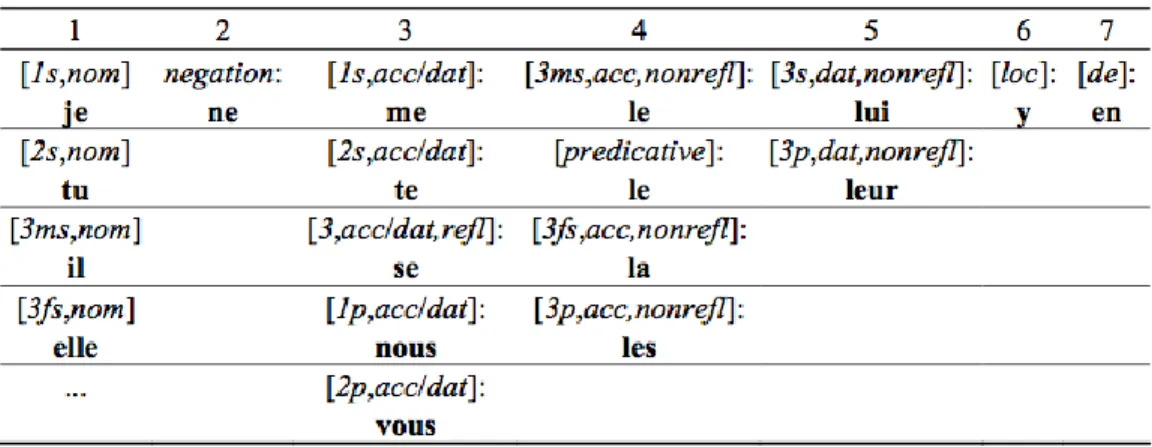
In French, there are several syntactic elements that have traditionally been identified as clitic pronouns. They follow positioning rules, as has been observed with other clitic systems, and they are accordingly organized in a template with seven position classes. The following table, which has been reproduced from Bonami and Boyé (2007), lists the French proclitics. Table 4 French Clitic Template
This research is primarily focused on subject clitics, i.e. those forms that are specified as nominative position in the template. These proclitics are placed adjacent to the verb, on its left edge. As may be expected, they form a phonological unit with the verb, at times even contracting with the verb. For instance, the first person subject clitic has both a non-contracted form (28) as well as a contracted form (29).
(28) Je mange une fraise. SCL.1SG eat.PRES.1SG a strawberry 'I am eating a strawberry.'
(29) J'étudie le français. SCL.1SG-study.PRES.SG the French 'I study French
Kayne (1969) identified several properties that apply to French proclitics, although these are characteristics that, according to Cardinaletti (1999), apply to deficient pronouns in general. Kayne (1969) noticed that material cannot come between the subject clitic and the verb (with the exception of other clitics) and that clitics have a fixed order within a phrase (as indicated in the aforementioned template). He also determined that French subject clitics cannot be stressed (as in 30) or conjoined (as in 31a), although Sportiche (1995) contends that (31b) would be
acceptable. These specific properties are indeed characteristic of clitic pronouns, not affixes, and they invoke criterion (E), "syntactic rules can affect words, but cannot affect clitic groups," and criterion (F), "clitics can attach to material already containing clitics, but affixes cannot" from the Zwicky-Pullum (1983) criteria.
(30) *Je gagne le jeu. SCL.1SG win.PRES.1SG the game ('I win the game.')
(31a) *Tu et je sommes heureux. SCL.2SG and SCL.1SG be.PRES.1PL happy ('You and I are happy.')
(31b) Il et elle sont amis. SCL.3SG and SCL.3SG be.PRES.3PL friends 'He and she are friends.'
French proclitics need a host and may only attach to that host and other proclitics also paired with that host. They also stand in direct contrast with strong pronouns, which may in fact be stressed and conjoined, as in (32) and (33), respectively.
(33) Toi et moi, nous sommes heureux. PRON.2SG and PRON.1SG SCL.1PL be.PRES.1PL happy 'You are I (we) are happy.'
However, Bonami and Boyé (2007) found that French proclitics also display properties that are characteristic of affixes, and of inflectional morphology in particular. They claim that French proclitics display arbitrary gaps, certain "positional effects," and morphophonological idiosyncrasies. French proclitics are also, to some degree, selective in only choosing a verb as a host; recall prototypical clitics are indiscriminate about what they will attach to (see chapter 2).
There are a few apparent gaps in the French proclitic system, which are suggestive of affixes (see criterion (B)), both in terms of restrictions that prohibit the co-occurrence of several forms, and in terms of clitics that may be omitted entirely.2 For example, Bonami and Boyé (2007) explain that a clitic pronoun from the third position class is not permitted to be paired with one from the fifth position class. An example, (34), is taken from Bonami & Boyé (2007).
(34) *Paul se lui présentera. Paul REFL.3SG DAT.3SG present-FUT.3SG ('Paul will present himself to her.')
French proclitics may be dropped at times, specifically those from the forth position class when they are adjacent to one from the fifth position class. Both the direct and indirect objects in (35a) may be replaced by object clitics, as in (35b), and the dative clitic may be dropped, as in (35c).
(35a) Je donne le stylo à Marc. SCL.1SG give.PRES.1SG the pen to Marc 'I gave the pen to Marc.'
(35b) Je le lui donne.
SCL.1SG ACC.3SG DAT.3SG give.PRES.1SG 'I give it to him.'
(35c) Je le donne.
SCL.1SG ACC.3SG give.PRES.1SG 'I give it (to him).'
Another example of affixal behavior comes from position class effects. For example, reflexive clitic pronouns and dative clitic pronouns, which are both from the third position class (see Table 4), and are not allowed to co-occur (Bonami & Boyé 2007). For this reason, Bonami and Boyé (2007) explain that French proclitics are competing for a certain position in a phrase, and such positional effects are typical of inflectional morphology, as opposed to clitic systems.
Bonami and Boyé (2007) have also identified certain morphophonological and semantic idiosyncrasies associated with French proclitics. They claim that a clitic pronoun is sometimes able to fuse with its host, a finite verb, so that the clitic only appears in a phonologically abbreviated form. However, not all verbs "trigger" this fusion. Bonami and Boyé provide the following example, (36a), which features a first person subject clitic that is not fused to the verb; with the proclitic in this form, this phrase has two possible interpretations. The verb in this example may be either a conjugated form of être 'to be' or suivre 'to follow,' as these verbs are homophonous. When the clitic pronoun is fused to the verb, as in (36b), however, it the verb can only be être, and only one interpretation is possible (Bonami & Boyé 2007).
(36a) [ʒə sɥi yn fij] je suis une fille
'I am a girl.'/'I follow a girl.' (36b) [ʃɥiynfij]
je suis une fille
'I am a girl.'/*'I follow a girl.'
3.1 Strong Pronouns before Proclitics and Subject Doubling
As previously indicated, just as there are "deficient pronouns," including clitics, there are also strong pronouns (Cardinaletti & Starke 1999). These strong pronouns function as full words that are able to stand alone. Unlike clitics, they are not dependent on a host. French has a set of strong pronouns that corresponds with its subject pronouns. The following table lists the French strong pronouns.
Table 5 French Strong and Clitic Pronouns
Person Strong Pronoun Subject Clitic
1PS moi je
2PS toi tu
3PS lui (m), elle (f), soi il, elle,
1PP nous nous
2PP vous vous
3PP eux (m), elles (f) ils, elles
These full forms are not in contrastive distribution with the clitic pronouns. The subject clitics are generally not able to be replaced with a strong pronoun, or an ungrammatical phrase results (as in 38).
(37) Je vais au cinéma. SCL.1SG go. PRES.1SG to.the movies 'I am going to the movies.'
(38) *Moi vais au cinéma. PRON.1SG go.PRES.1SG to.the movies ('Me am going to the movies.')
(39) %Lui aime le potage. PRON.3SG like.PRES.3SG the soup 'He likes the soup.'
(40) ?Toi et moi sommes étudiants. PRON.2SG and PRON.1SG be.PRES.1PL students 'You and me are students.'
(41) Toi et moi, nous sommes étudiants. PRON.2SG and PRON.1SG SCL.1PL be.PRES.1PL students 'You and me, we're students.'
The strong pronouns may also function as the object of a preposition, as seen in (42). The strong pronoun could not be replaced with a clitic, whether or not it is in nominative or objective form, as the clitic pronoun needs a verbal host. Thus, (43) and (44) are ungrammatical.
(42) Je vais au cinéma avec toi.
SCL.1SG go.PRES.1SG to-the movies with PRON.2SG 'I am going to the movies with you.'
(43) *Je vais au cinéma avec tu. SCL.1SG go.PRES.1SG to-the movies with SCL.2SG ('I am going to the movies with you.')
(44) *Je vais au cinéma avec te. SCL.1SG go.PRES.1SG to-the movies with OCL.2SG ('I am going to the movies with you.')
The full form may also be a dislocated object pronoun, which may be used for emphasis, as in example (45).
(45) Lui, je joue au foot avec lui. PRON.3SG SCL.1SG play.PRES.1SG to.the soccer with PRON.3SG 'Him, I play soccer with him.'
Strong pronouns may also be dislocated from the phrase, as in (46- 47). In this case, the pronoun is either left or right-dislocated from the clause containing the subject clitic.
(47) J'aime les pommes, moi. SCL.1SG-like.PRES.SG the apples PRON.1SG 'I like apples, (personally)/ I like apples.'
The strong pronoun in Topic position stresses the subject clitic. It is for this reason that strong pronouns have been referred to as emphatic pronouns (Tallerman et al. 2009).
De Cat (2007) acknowledges that dislocation is common in Colloquial French. However, it is not expected that a strong pronoun will surface with every subject clitic. In other words, the presence of a subject clitic alone should not necessitate the inclusion of a strong pronoun; these pronouns should only be included if a Topic reading is intended. As a consequence, there should be a difference in meaning between phrases without a dislocated strong pronoun or full DP and those with one. Consider (48) and (49).
(48) Je veux le livre. SCL.1SG want.PRES.1SG the book 'I want the book.'
(49) Moi, je veux le livre. PRON.1SG SCL.1SG want.PRES.1SG the book (As for) me, I want the book.'
In (48), there is no emphasis on the subject. In (49), however, there is emphasis on the subject; the subject of this phrase is being singled out as the topic.
As previously indicated, however, it is has been claimed that these strong pronouns and full DPs are now regularly included before a subject clitic and, moreover, incorporated into the main clause in Colloquial French, as in (50) and (51) (Tallerman et al. 2009).
(50) Moi j'aime les pommes. PRON.1SG SCL.1SG-like.PRES.SG the apples '(Me) I like apples.'
CHAPTER 4: THE STATUS OF FRENCH CLITICS
As mentioned, there have been two main analyses of French subject clitics: the syntactic interpretation and the morphological interpretation. In section 4.1 and 4.2, I provide a brief overview of these analyses. In section 4.3, I provide an alternate explanation of subject clitics. 4.1 A Syntactic Interpretation
The syntactic interpretation claims that French subject clitics are elements with θ-roles, located in the canonical subject position within a phrase (Rizzi 1986). Again, following the syntactic framework presented in chapter 2, the clitic is found in the [spec, IP] subject position in this analysis (de Cat 2005). They would be represented in the syntax with the same structure as in (10), reproduced as (52) below.
(52)
is the fact that clitics are absent in certain contexts, such as when indefinite pronouns or
quantifiers are used. For example, sentences like (53) are acceptable in French; the presence of a clitic would actually make them ungrammatical, as in (54).
(53) Personne veut lire. no one want.PRES.3SG read.INF 'No one wants to read.'
(54) *Personne il veut lire no one SCL.3SG want.PRES.3SG read.INF 'No one he wants to read.'
Another complication is the observation that other preverbal material (specifically other clitics) may intervene between the subject clitic and its verb (Kayne 1969; de Cat 2005). Zwicky and Pullum (1983) have argued that "clitics can attach to material already containing clitics, but affixes cannot" (emphasis added). In sentences like (55), the subject clitic does not come directly before the verb and, as a result, is claimed to be distinct from an affix. 4
(55) Je t'aime.
SCL.1SG OCL.2SG-love.PRES.1SG 'I love you.'
The negative element ne is also able to intercede between the subject clitic and the verb, as in (56); the negative element is not claimed to be an affix because it is structurally determined, and thus its position indicates the scope of negation (de Cat 2005).
(56) Je ne mange pas de pain. SCL.1SG NEG eat.PRES.SG not of bread 'I do not eat bread.'
De Cat (2005), Legendre et al. (2010), and Culbertson (2010) all agree that ne is not an affix. The disagreement stems from whether or not ne is still robustly attested in spoken French.
3This is, of course, assuming that the morphological paradigm is "rich" enough to provide information about agreement. The attrition of the morphological paradigm would be an argument against the apparent redundancy.
If it is no longer attested, the idea that the subject clitic is actually an affix receives support, as non-prefixal material should not be able to occur there under such an interpretation. However, if it is still used productively in Colloquial French, then the syntactic analysis of subject clitics is supported, as the negative element intervenes between the clitic and the verb phrase. While de Cat (2005) argues that the York and Cat corpora provide evidence that ne is still used frequently, Augur (1994) and Culbertson (2010) found the opposite in the corpora that they consulted (see section 4.2 for more information).
In addition, subject clitics can be inverted with the verb in a matrix clause, and de Cat (2005) maintains that inversion is an instance of movement that should only be able to occur with autonomous syntactic elements, not affixes or individual bound morphemes. Thus, the fact that both sentence (57) and (58) are grammatical in French indicates that subject clitics behave like DPs, not agreement markers. Once again, there is debate as to whether or not inversion is still robustly attested in Colloquial French, with de Cat (2005) arguing that it is still found, and Culbertson (2010) claiming that conversational French generally lacks inversion.
(57) Tu aimes les pommes? SCL.2SG like.PRES.SG the apples 'Do you like apples?'
(58) Aimes-tu les pommes? like.PRES.2SG-SCL.2SG the apples 'Do you like apples?'
4.2 A Morphological Interpretation
Those that subscribe to a morphological interpretation (Miller 1992; Bonami & Boyé 2007; Culbertson 2010; Legendre et al. 2010) claim that French subject clitics are best analyzed as inflectional markers indicating agreement, and not as syntactic arguments (however, Legendre et al. (2010) and Culbertson (2010) claim that they only behave as such in Colloquial French, as opposed to Standard/Formal French). As inflectional affixes, they would be located in INFL, and not in the canonical subject position, as seen in (59), taken from Culbertson (2010).
(59)
In addition to the general affixal properties that French clitics exhibit, there are additional aspects of French syntax that support a morphological interpretation. Legendre et al. (2010) and Culbertson (2010) argue that ne is not a problem for this analysis if this negative element is often dropped in conversation. Despite de Cat (2005)'s claims, Legendre et al. (2010) and Culbertson (2010) found that children in the Lyon corpus (Demuth & Tremblay 2008) often omitted ne when they produced a subject clitic. When a DP subject is used, the children included ne 83.3% of the time, but when they used a subject clitic, they only included ne 6.7% of the time; this is an asymmetry that is not easily explained with the syntactic interpretation (Culbertson 2010).
problem if inversion is still frequently attested in Colloquial French. Culbertson (2010) found that, in the Lyon corpus (Demuth & Tremblay 2008), a rather insignificant 0.1% of yes/no questions, and only 1.4% of wh-questions featured inversion. Similar results have also been found by de Cat (2007) and Coveney (2002).
Perhaps the greatest argument against the syntactic analysis is the frequent use of subject doubling. Those who claim that French subject clitics are syntactic arguments should expect subject doubling to be limited if these constructions are only triggered by pragmatic conditions (i.e. topicalization). Augur (1994), Legendre et al. (2010), and Culbertson (2010), however, have found the exact opposite; subject doubling is quite common in Colloquial French. Legendre et al. (2010) investigated the speech of five French children using CHILDES and discovered that rates of constructions in which a DP and a third person subject clitic were placed to the right and to the left of the verb were incredibly high for all children; Camille used a DP with a third person subject clitic 100% of the time, Pierre 96% of the time, Pauline 81% of the time, Anne 91% of the time, and Grégoire 94% of the time.5 In addition, Fonseca-Greber and Waugh (2002) conducted similar corpus analyses and have not found any instances of spontaneous speech in which a strong pronoun is used without a subject clitic.
There is an additional component to Legendre et al. (2010) and Culbertson (2010)'s argument, however. They claim that subject pronouns used to function as pronominal clitics in French, but have evolved so that they are no longer syntactic arguments in Colloquial French; they stipulate that they are nevertheless still analyzed as such in Standard French. The assertion is that subject clitics have transformed to become a class of verbal affixes. This differs from previous claims that French subject pronouns have been simply misanalysed as arguments, and
have always functioned as affixes (see Miller (1992) and Bonami & Boyé (2007)). It is known that diachronic change is responsible for changes in French verbal morphology, and even the rise of overt subject clitics can be attributed to language change (Legendre et al. 2010; Sprouse & Vance 1999). For instance, Middle French licensed null subjects, but Modern French requires overt subjects in the standard dialect; although the attrition of the inflectional paradigm is not the only catalyst for this change, there is a relationship between overt subjects and verbal forms with less distinguishable inflectional endings (Sprouse & Vance 1999). It seems reasonable to assume that the attrition of the inflectional paradigm could have implications for French syntax based on what is known about language change, and morphophonological attrition in the French language. Nevertheless, the language evolution process is gradual, and it is often difficult to discern the nature of the change as it is occurring (Deutscher 2005). Moreover, while doubling in child French could potentially indicate diachronic change, there is no reason to assume that subject doubling in child French necessitates that the syntax of the adult grammar is transforming. This issue will be addressed in more detail in chapter 7.
4.3 An Alternative Interpretation: The Developmental Hypothesis
syntactic argument, and the subject clitic as an inflectional affix. This will be referred to as the developmental hypothesis.
The reason for assuming a disconnect between child and adult French is that children are sensitive to the input that they receive, and they seem to be presented with conflicting evidence as to how to interpret subject clitics. The behavior of French proclitics indicates that they are not prototypical examples of either clitic pronouns or affixes following the Zwicky-Pullum criteria. As a result of their hybrid nature, French-speaking children are repeatedly presented with
evidence from the input that supports both the syntactic and morphological interpretations. If we adopt the variational model of language acquisition (cf. Yang 2002, 2004), then we may assume that there are actually two distinct representations of subject pronouns (i.e. the argument and affix representations) that are competing with each other in child French.
The variational model is designed to capture the idea of competition between grammars, or parameters, by viewing child language as a "population of hypotheses" that are licensed within Universal Grammar (Yang 2002, 2004; Legate & Yang 2007). The framework of the variational model, then, is still consistent with UG, in specifying that children have access to an innate set of constraints that guide linguistic development and competence. The hypotheses that "compete," and which the child evaluates during the acquisition process, are all permissible and reflect the natural (cross-linguistic) variations that are found in human language. In this respect, Yang (2002) claims that child language and adult language differ, not because the child has an
the input. The child is continuously presented with evidence from the input that rewards or punishes any given grammar, even the target grammar. The child will eventually receive enough input that, of all of the competing grammars, one is rewarded more often and associated with the greatest probability; the grammar with the greatest probability "wins out" over the others. This model is represented in (60), which is taken from Yang (2002).
(60) For an input sentence s, the child
a. with probability Pi selects a grammar Gi, b. analyzes s with Gi
c. if successful, reward Gi by increasing Pi
otherwise punish Gi by decreasing Pi
The variational model assumes that the transition from one stage to the next is a gradual process, during which several hypotheses are being considered. As Yang (2002), explains, the child must have some confidence in a given hypothesis, so that he does not abandon his confidence in a grammar too easily; this is especially important as the child may be presented with conflicting information as to how the target grammar is characterized. This is certainly the case with French, as there are characteristics of subject clitics that support both the syntactic and the morphological interpretations of them (see chapter 3). As both of these interpretations are possible within UG (i.e. there are languages in which such preverbal elements are classified as clitics and others in which they are classified as affixes), the child is faced with two possibilities. In this case, the child must determine which interpretation is more probable based on the
properties of French subject clitics.
is [-Tense]. French is a language that provides relatively minimal evidence for the [+Tense] feature. Most of the present tense forms in French, in fact, reinforce the [-Tense] grammar, as they are either phonologically indistinguishable from each other and resemble bare stems
(consider danse (1SG) and danses (2SG), which are both pronounced as the stem dans- [dãs]), or they are indistinguishable from the infinitive or the past participle (consider dansez (2PL),
danser (INF) and dansé (PP), all pronounced [dãse]) (Legate & Yang 2007). French children pass through an RI stage, and must determine if their language marks tense. An interesting component of the French RI stage is that children never use clitic pronouns with RIs. This has been taken as an indication that "subject clitics and weak pronouns are licensed by the agreement feature (emphasis added)" (Guasti 2002).
Interestingly, French-speaking children's knowledge of tense may factor into their production of subject doubling, which in turn may also be explained by the variational model of language learning. French-speaking children associate subject clitics with verbal agreement, as they only produce clitic pronouns with finite verbs, whereas strong pronouns may be used with both finite and nonfinite verbs (Guasti 2002). If children have learned that tense must be overtly specified, and associate the clitic with verbal agreement, they may represent these pronouns as verbal affixes. As they pass from the RI stage to a stage in which they have acquired more of the adult morphosyntax, it is possible that they may still interpret the subject clitic as an indication of finiteness.
The developmental hypothesis assumes that subject clitics are arguments in adult French and, as in the syntactic analysis proposed by de Cat (2005, 2007), that strong pronouns and full DPs before subject clitics are dislocated subjects (or objects); this is the only possible
alternative hypothesis differs, however, in that it predicts that child French differs from adult French in regard to the classification of subject clitics. This hypothesis predicts that children, having categorized subject clitics as affixes, will therefore represent strong pronouns and DPs that precede them as syntactic arguments.
This hypothesis assumes that adult French is a non-null subject language, and that the children in this corpus are past the early null subject stage associated with child language; this assumption is based on the high rates of subject doubling in child French, which will be
presented in chapter 5. If children believe that French is a non-null subject language, but fail to represent clitics as syntactic arguments, they may search for an overt subject. Consequently, they may include a strong pronoun or full DP before the subject clitic, as the syntactic argument instead, and create a doubled construction as a result. In other words, if children represent subject clitics as verbal affixes, they may include a strong pronoun of other full DP to satisfy the
Extended Projection Principle (EPP). However, it should be noted that it is difficult to determine whether or not French-speaking children assume that French is a non-null subject or a null subject language.6 It is possible that children continue to assume that French is a null-subject language, and produce doubled constructions only when they want to include an overt subject. This alternate theory will be discussed in more detail in the discussion, in chapter 7. For now, the former hypothesis will be adopted and it will be assumed that children are motivated to produce doubled constructions in order to comply with the EPP.
Nevertheless, in either case, both of the competing grammars are expected to influence child French. The transition between an initial state and the target grammar is supposed to be gradual, and this competition between grammars is expected to result in the production of forms consistent with both the child and the adult (target) grammar. This implies that children may occasionally represent subject clitics as arguments, and thus that children are not expected to produce subject doubling 100% of the time. This is the same reason that children produce both RIs and finite verb phrases during the RI stage. In other words, there is every reason to expect "competition" between forms in child French.
(62) Je regarde le film. SCL.1SG watch.PRES.1SG the film 'I am watching the film.'
the argument instead. After the target grammar is assigned the greatest probability, and children learn that subject pronouns are clitic pronouns in adult French, it is predicted that they will only produce doubled (i.e. dislocated) constructions when they are licensed by pragmatics.
4.4 Summery of Theoretical Questions and Competing Hypotheses
As indicated, the objective of the research to be presented here is to analyze the status of subject clitics, by researching the production of subject doubling, ne-retention, and subject-verb inversion, in child and adult French with the Palasis corpus found on CHILDES. There are three competing hypotheses concerning the production of subject clitics by the children in this corpus, each based on the interpretation (syntactic, morphological, or developmental) that is adopted. Hypothesis (1)- Syntactic Interpretation: Subject clitics are syntactic arguments. It is predicted that children and adults will produce a similar, or equivalent rate, of subject doubling. These rates should also be relatively low if strong pronouns and DPs are dislocated subjects, and not obligatory thematic arguments. Both inversion and negation with ne should be attested. Hypothesis (2)- Morphological Interpretation: Subject clitics are inflectional affixes. This hypothesis predicts that the children and the adult will have equivalent rates of doubling and that this rate will be elevated. Moreover, subject doubling is not only expected, but seemingly
specific interpretation adopted, children and adults should be producing relatively equal rates of doubling; the exact rate may be dependent on the classification of French as a non-null subject or null subject language, however the overall production by the children should nevertheless
correspond to the target grammar. It is also predicted that neither inversion nor negation with ne will be regularly attested.
Hypothesis (3)- Doubling as a Stage in Development: Subject clitics are initially analyzed as affixes in child French, whereas subject clitics are arguments in adult French. French-speaking children are expected to produce higher rates of strong pronouns and DPs before subject clitics, and the contrast between their rates and those for the adult is expected to reach significance. Accordingly, it is also predicted that French-speaking children in this corpus will have low rates of ne-retention and subject-verb inversion compared to those same rates for the adult; this
CHAPTER 5: CORPUS ANALYSIS #1: SUBJECT DOUBLING IN CHILD FRENCH The first analysis presented here is an attempt to determine if French-speaking children are producing doubled constructions, and if so, if they are producing these constructions more often than adults. To my knowledge, there has not been any research conducted on this topic with the Palasis corpus (Palasis 2010), and it is this corpus that I will be using to evaluate claims of subject doubling in child French. In addition, much of the focus of previous research has been on DPs before clitic pronouns, and consequently on the third person. This research will analyze the first, second and third person subject clitics.
5.1 Palasis Corpus and Subjects
For the purpose of this analysis and the next, the Palasis corpus found on CHILDES will be used (MacWhinney 2000; Palasis 2010). This corpus contains 121 files, but nine of the files had no transcript, so those were excluded from the analysis. Therefore, a total of 112 files were included in this research. The Palasis corpus features twenty-two children, from the same preschool class in the South of France, and three adults with whom they interacted during the recorded sessions. However, the speech of only one adult, Katerina, was analyzed because the other two adults rarely produced any utterances. Two of the children are not native French speakers (Rita and Eliza), and their speech was excluded from the analysis as well. The corpus also lists UNI (child) as a participant in some of the files in this corpus. This does not refer to an additional child, but refers to one of the twenty-two children in the corpus who could not be identified for some reason; as it is not known which child this label is picking out (and
the speech from UNI was also excluded. The children were recorded for approximately twenty hours over the course of thirteen sessions from November 2006 to June 2007. The children range in age from 2;05 to 3;09 over the course of the recordings, with some children being slightly older than others by a few months. The speech in these files is conversational, and consists of interactions between the children and Katerina.
5.2 Coding
The focus of this analysis is on the production of strong pronouns, full DPs, and subject clitics, both in isolation (as in (63)) and in "doubled" constructions (as in (64) and (65)).
(63) Je cours.
SCL.1SG run.PRES.1SG 'I run.'
(64) Moi je cours.
PRON.1SG SCL.1SG run.PRES.1SG 'I run.'
(65) Michel il aime le foot.
Michel SCL.3SG like.PRES.3SG the football (soccer) 'Michel he likes soccer.'
In order to find any and all instances of strong pronouns, DPs, and subject clitics in this corpus, I hand-coded all of the files that I used for this research. I decided to restrict this research to
Table 6 Strong Pronouns and Subject Clitics
Person Strong Pronoun Subject Clitic
First Moi Je
Second Toi Tu
Third (M) Lui Il
Third (F) Elle Elle
After the files were coded, I performed CLAN searches to find and record doubled and non-doubled constructions, i.e. subject clitics with and without either a strong pronoun or DP beforehand. Moreover, only the utterances that feature a strong pronoun or DP directly before the subject clitic were considered to be doubled constructions. Therefore, if any material interceded between the strong pronoun or full DP and the subject clitic, the utterance would be taken as a non-doubled utterance. For example, (66) is not considered an instance of doubling, but of the clitic in isolation.
(66) Moi, alors, je veux le livre. PRON.1SG well SCL.1SG want.PRES.1SG the book Me, well, I want the book.
In addition, I examined the utterances that featured strong pronouns, full DPs, and subject clitics and disregarded any that matched the following descriptions, found in (67-72):
(67) The pronoun before the subject clitic is ambiguous.
(67a) Attends moi je veux finir l’histoire.
(67b) Attends, moi je veux finir l'histoire. wait.PRES.1SG PRON.1SG SCL.1SG want.PRES.1SG finish.INF the-story 'Wait, me I want to finish the story.'
(67c) Attends-moi, je veux finir l'histoire. wait.PRES.1SG-PRON.1SG SCL.1SG want.PRES.1SG finish.INF the-story 'Wait for me, I want to finish the story.'
(68) The subject clitic is preceded by an unknown element, which is represented by X's in the transcripts.
The subject clitics in this case may or may not have been preceded by a strong pronoun or full DP, and because this information could not be ascertained with any certainty, they were
discarded. An example, taken from the corpus, is found in (68a). An exception, however, comes from (68b), in which the unknown element is the name of a town, and thus it is known that the strong pronoun 'moi' is not the element in question.
(68a) xxx il [le requin] nous fait mal. (NIN, 2-7). SCL.3SG [the shark] OCL.1PL make.PRES.3SG bad
'xxx it [the shark] hurts us.'
(68b) Ben à xxx [= town] [/] j'ai été à Paris. (WIL, 13-48a). uh at xxx [= town] [/] SCL.1SG-have.PRES.1SG was.PP at Paris
'Uh at xxx [= town] [/] I was in Paris.'
However, if the strong pronoun is preceded by an unknown element, it was still included in the calculations, unless the context is in some way ambiguous (as explained in (69)).
(69) The strong pronoun, DP, or subject clitic is part of a quotation.
(70) The strong pronoun, DP, or subject clitic is being perseverated as the child or adult is in the process of finishing his or her utterance.
to this perseveration were only counted once. Thus, in (70a), only one instance of the subject clitic would be included in the calculations.
(70a) Tu as... Tu as le livre. SCL.2SG have.PRES.2SG SCL.2SG have.PRES.2SG the book 'You have...you have the book.'
However, if a child or the adult repeated the entire clause (no perseverating), then each utterance was included and counted individually. I elected to include repetitions because it is natural for children and adults to repeat themselves in the course of a conversation. An example from the corpus of a repetition that was included in the analysis is found in (70b).
(70b) J'ai peur. J'ai peur. (ENZ, 7-27b) SCL.1SG-have.PRES.1SG fear. SCL.1SG-have.PRES.1SG fear
'I'm scared. I'm scared.' (71) The DP is a dislocated object.
The placement of a dislocated object before a subject clitic resembles doubled structures, but are not actually instances of subject doubling. In this case, the DP object is not a repetition of the subject clitic. As far as I know, these instances of dislocation are not disputed; the morphological analysis does not claim that dislocation is not possible in French. An example of an utterance with a dislocated object is found in (71a). In this case, it is known that the DP is a dislocated object because it corresponds to the object pronoun, and not the subject of the clause.
(71a) Le pull il l'a mis. (KAT, 4-16) the sweater SCL.3SG OCL- have.3SG put-on.PP.
'The sweater he put it on.'
(72) The subject clitic is an expletive subject.
However, all other instances of subject clitics, either with or without a strong pronoun or DP beforehand, were deemed to be relevant and included in the results.
5.3 Analysis
After all of the searches on CLAN were performed, and any utterances that met the aforementioned criteria were discarded, I was left with a considerable sample of subject clitics to analyze for doubling. Table 7 lists the total number of tokens of first, second, and third person masculine and feminine subject clitics, doubled and non-doubled, taken from the Palasis corpus. Table 7 Corpus for Analysis #1
First Person Second Person Third Person (Masc.)
Third Person (Fem.)
Children 2368 531 1469 413
Adult 507 2684 519 369
Through the use of the program CLAN, I calculated the number of times each child and adult produced the first, second, and third person subject clitic, with and without a strong pronoun or DP, for every file that had been included in this research. I recorded these counts for each individual and each file. The number of tokens of subject clitics, either isolated or doubled, that I recorded were then totaled for each individual. The same counts for the adult were
calculated following the same methods. The rates of doubling were determined by taking the number of doubled constructions per subject clitic (i.e. first, second, third) and dividing that by the total number of tokens of that particular subject clitic. The rates for the children were
and serves as the null hypothesis; that is, if the children are behaving like Katerina, they should produce an average proportion of doubled constructions that is around the same as hers. If the proportion produced by the children is significantly different (as determined by the p-value), then they are not behaving like her. This finding would confirm the alternate hypothesis, then, that children are producing doubling at a rate that is statistically different from the adult.
5.4 Results
Overall, the results of this analysis reveal that the children in the Palasis corpus produced strong pronouns or full DPs with subject clitics more often than the adult, Katerina. The children produced doubled constructions around 26% of the time, whereas the adult did so only around 5% of the time, as is found in Table 8 below. The contrast in these rates is statistically significant (t=12.7537, p < 0.001).
Table 8 Overall Rates of Doubling
Non-Doubled Subjects Doubled Subjects Total Rate of Doubling
Children 1256 3,537 4,793 26.2%
Adult 231 4,141 4,372 5.3%
The individual rates for the children are found below in Table 9. There is some variation, but the rates of doubling produced by the children are all consistently higher than the rate produced by the adult. The highest rate of subject doubling was produced by Victor (VIC), with a rate of 42%, and the lowest was produced by Lisa (LIZ), with a rate of 12%. The range for the children's rates is 30%.
Table 9 Children's Overall Rates of Doubling Child Doubled
Subjects
Non-Doubled Subjects
Total Rate of Doubling
CAR 4 12 16 25%
LUS 183 566 749 24%
MAS 63 153 216 29%
LAN 18 94 112 16%
MAI 102 378 480 21%
SAR 51 106 157 32%
NIN 153 416 569 27%
VIC 129 177 306 42%
LSN 50 77 127 39%
LIN 38 93 131 29%
ELE 14 36 50 28%
ENZ 51 119 170 30%
KEL 27 63 90 30%
LOU 7 30 37 19%
LIZ 6 43 49 12%
KLE 10 19 29 34%
MAT 101 221 322 31%
WIL 135 538 673 20%
DYL 82 271 353 23%
However, the analysis also highlighted noticeable person effects; the children's rate of subject doubling with the first person and third person masculine is noticeably different (i.e. higher) than the adult's rate, but both the children and the adult have a similarly low rate of doubling with the second person. Interestingly, the rate for the third person feminine is high for both the children and for Katerina; this elevated rate for Katerina appears to be an anomaly, as her rates of doubling with other persons are consistently low.
5.4.1 First Person Singular
Table 10 Average Rates of Doubling with the First Person
Moi Je Je Total % of 'Moi Je'
Children 896 1478 2374 37.7%
Katerina (KAT) 49 459 508 9.6%
There is variance between the children in the corpus, as illustrated in Table 11. The children with the highest rate of doubling are Lou (LOU) and Lucien (LSN). They produce constructions in which the strong pronoun precedes the subject clitic 54% of the time. The child with the lowest rate is Lisa (LIZ), with a rate of 21%. The range for these rates, among the children, is 33%. Even the lowest rate produced by the children (21%) is much higher than that for Katerina. This suggests that children are behaving differently than the adult in regard to production of first person pronouns and subject clitics.
Table 11 Children's Individual Rates of Doubling with the First Person
Child Moi Je Je Total Rate of Doubling
CAR 3 7 10 30%
LUS 138 230 368 38%
KLO 17 15 32 53%
MAS 43 56 99 43%
LAN 12 33 45 27%
MAI 57 128 215 27%
SAR 40 50 90 44%
NIN 93 181 274 34%
VIC 120 110 230 52%
LSN 45 39 84 54%
LIN 22 21 43 51%
ELE 6 15 21 29%
ENZ 39 48 87 45%
KEL 19 22 41 46%
LOU 7 6 13 54%
LIZ 5 19 24 21%
KLE 10 13 23 43%
MAT 72 99 171 42%
WIL 85 265 350 24%
5.4.2 Second Person Singular
Neither the children nor the adult produced a strong pronoun before the second person singular pronoun often. The contrast in rates of doubling for the second person is not significant. In fact, the children produced only 26 tokens of the strong pronoun- subject clitic combinations, which comprise less than 5% of their utterances in the second person. Katerina produced 70 tokens of this same construction, but she produced a total of 2,620 utterances featuring the second person. These results are found in Table 12. The rate of strong pronouns before subject clitics for both the children and adults is low, below 5%, and indeed children's production is not statistically significant (t = 0.6624, p = 0.5157).
Table 12 Average Rates of Doubling with the Second Person
Toi Tu Tu 'Toi Tu' + Tu % of 'Toi Tu'
Children 26 507 533 4.9%
KAT 70 2620 2690 2.6%
As previously mentioned, Katerina used the second person more often than the children, but the rate of doubling for all children are actually quite similar to hers (2.6%). There are, however, three children who had elevated rates of doubling for the second person compared to the rest of the children: Sara (SAR), with a rate of 17%, Enzo (ENZ), with a rate of 32%, and Mathilde (MAT), with a rate of 14%. Nevertheless, the overall rate for doubled constructions in the second person is low, suggesting that doubling with the second person may not be common. The range is 32%, as the highest rate is 32% and the lowest is 0% (no doubling). If the three highest proportions are treated as outliers and excluded, then the range is only 6%.
Table 13 Children's Individual Rates of Doubling with the Second Person
Child Toi Tu Tu Total Rate of Doubling
CAR 0 1 1 0%
KLO 2 33 35 6%
MAS 0 9 9 0%
LAN 0 7 7 0%
MAI 4 45 49 8%
SAR 3 15 18 17%
NIN 1 43 44 2%
VIC 1 30 31 3%
LSN 0 10 10 0%
LIN 0 29 29 0%
ELE 0 2 2 0%
ENZ 7 15 22 32%
KEL 0 15 15 0%
LOU 0 9 9 0%
LIZ 0 3 3 0%
KLE 0 0 0 0%
MAT 5 32 37 14%
WIL 1 92 93 1%
DYL 1 51 52 2%
5.4.3 Third Person Masculine Singular
Table 14 Average Rates of Doubling with the Third Person Masc. (Strong Pronoun + Clitic)
Lui Il Il Lui Il + Il % of 'Lui Il'
Children 43 1252 1295 3.3%
KAT 2 767 769 0.3%
Table 15 Average Rates of Doubling with the Third Person Masc. (DP + Clitic)
DP Il Il DP Il + Il % of 'DP Il'
Children 178 1252 1430 12.4%
KAT 38 767 805 4.7%
Table 16 Overall Rates of Doubling with the Third Person Masculine
Lui/DP Il Il Lui/DP + Il % of 'Lui/DP Il'
Children 221 1252 1473 15%
KAT 40 767 807 5%
Once again, there is variation among the children, with some children producing zero instances of doubling with the third person masculine (see Table 17). However, out of the 20 children included in this analysis, 17 of them produced doubled constructions. In addition, all but four of the children in the Palasis corpus produced a rate of doubling that is greater than that produced by Katerina. Lina (LIN) produced the highest overall rate of doubling with the third person (31%), while her peers Carla (CAR), Lou (LOU), and Chloé (KLE) produced the lowest rate, 0%. The range then is 31%. Some of the children in this corpus produced rates more than five times as great as Katerina's rate of 5%.
Table 17 Children's Individual Rates of Doubling with the Third Person Masculine Child DP/LUI IL IL Total Rate of Doubling
CAR 0 0 0 0%
LUS 29 221 250 12%
KLO 12 72 84 14%
MAS 16 70 86 19%
MAI 23 178 201 11%
SAR 5 31 36 14%
NIN 31 154 185 17%
VIC 2 24 26 8%
LSN 3 23 26 12%
LIN 9 20 29 31%
ELE 4 12 16 25%
ENZ 2 44 46 4%
KEL 6 22 28 21%
LOU 0 13 13 0%
LIZ 1 20 21 5%
KLE 0 6 6 0%
MAT 15 56 71 21%
WIL 45 154 199 23%
DYL 13 81 94 14%
5.4.4 Third Person Feminine Singular
The use of strong pronouns and full referential DPs before third person feminine singular subject clitics is particularly revealing. Neither the children nor Katerina preferred to include a strong pronoun before the subject clitic. Katerina did not include the strong pronoun before the third person feminine subject clitic, and only three tokens could be found for the children in the entire corpus. These results are found in Table 18. As neither the children nor the adult produced these constructions often, the contrast in the rates of production for the children and Katerina is not significant (t = 0.5962, p > 0.005).