Preoperative Bowel Preparation Prior to Elective Bowel
Resection or Ostomy Closure in the Pediatric Patient Population
Has No Impact on Outcomes. A Prospective Randomized Study
Mansi Shah, MD1, Clayton T. Ellis, MD1, Michael R. Phillips, MD1, Amy Marzinsky, BSN, RN,
OCN1, William Adamson, MD1, Timothy Weiner, MD1, Kimberly Erickson, MD1, Sang Lee,
MD1, Patricia A. Lange, MD2, and Sean E. McLean, MD1
1Department of Surgery, Division of Pediatric Surgery, University of North Carolina, Chapel Hill,
NC
2Department of Surgery, Division of Pediatric Surgery, Children’s Hospital of Richmond at Virginia
Commonwealth University, Richmond, VA
Introduction
In the adult patient population, the standard of care classically for elective colon and rectal operative procedures has been to perform a preoperative bowel preparation in attempt to decrease the risk of post-operative complications1. There are a multitude of bowel
preparation options, and surgeon preference generally guides which preparation is used2,3. However, over time, more and more data has revealed that there is not enough evidence to support the use of preoperative bowel preparation to decrease the risk of postoperative complications in the adult patient population4,5,6. Furthermore, many meta-analyses have suggested that the use of preoperative bowel preparation should be eliminated from routine clinical use and instead be used in select cases only7,8,9.
Furthermore, years of data from traumatic colonic injuries has shown that primary colonic repair can be performed safely, despite the lack of preoperative bowel preparation in this patient population10. Indeed, now it has been shown that in hemodynamically stable patients, primary repair or resection with anastomosis can be safely performed in patients with traumatic colon injury, and after confirmation by a number of prospective randomized studies, this is now the standard of care at many institutions10,11,12,13,14,15,16.
The data in the pediatric literature with regards to preoperative bowel preparation is much more limited. Although it has been shown to be safe to use Golytely, a bowel preparation comprised of polyethylene glycol and electrolytes, in children and infants17, its use is still rather challenging. Poor acceptance, difficulty with compliance and tolerance, and inability for children to understand the need for the prep make appropriate administration difficult18, and often make the use of nasogastric tubes (NGT) for administration necessary2.
Correspondence and requests for materials should be sent to: Sean E. McLean, MD, Department of Surgery, Division of Pediatric
HHS Public Access
Author manuscript
Am Surg. Author manuscript; available in PMC 2016 December 20.
Published in final edited form as:
Am Surg. 2016 September ; 82(9): 801–806.
A
uthor Man
uscr
ipt
A
uthor Man
uscr
ipt
A
uthor Man
uscr
ipt
A
uthor Man
uscr
Furthermore, there is a wide variance in the use of bowel preparation as well as the type of bowel preparation if used amongst clinicians19. Despite these challenges, there are a few studies that suggest that preoperative bowel preparation for elective colorectal surgery in pediatric patients does not affect the incidence of infectious complications20,21.
The aim of this study was to determine whether there is difference in outcomes between pediatric patients receiving preoperative bowel preparation and those with no bowel preparation that have a diet restricted to clear liquids prior to undergoing elective bowel resection or ostomy closure. The primary outcomes measured by the study were differences in morbidity and mortality between pediatric patients undergoing bowel preparation and those with no bowel preparation. Secondary outcomes examined were difference in the occurrence of specific morbidities between the two groups, including wound infection, abdominal abscess, sepsis, anastomotic leakage, ileus/bowel obstruction, or extra-abdominal complications.
Methods
This is a prospective randomized study. A total of 32 patients were recruited between October 2009 and March 2013. Patients were deemed eligible if they were aged three months to 18 years, undergoing an elective bowel resection or ostomy closure, and had a parent or guardian that was capable of giving consent on the patient’s behalf. Patients were excluded if they were undergoing an emergent procedure, required a diverting proximal ostomy, had a known intra-abdominal infection, required an intra-operative colonoscopy, had a malignancy, had known allergies to the bowel preparation ingredients, or had a medical condition that would contraindicate a bowel preparation, as deemed by the treating physician.
Patients were deemed eligible for the study by a physician, nurse, or advanced care practitioner and informed consent was obtained. The patient was then randomized to either the bowel preparation group (bowel prep) or the no bowel preparation group (no bowel prep). Patients in the bowel prep group began a clear liquid diet at home at noon on the day before surgery. They were then admitted to the hospital the day before surgery and initiated on intravenous fluids at a weight based maintenance rate. Golytely prep was initiated at 4 pm on the day prior to surgery at a rate of 25 mL/kg/hr (maximum 1L/hr) for four hours. If the patient was unable to complete the prep orally, a nasogastric tube (NGT) was placed to administer the Golytely. If the rectal effluent contained solid material after four hours, the prep was continued for another two hours. If the rectal effluent still contained solid material at this point, warm saline enemas at 10 mL/kg were administered every two hours for a total of three enemas. Patients remained NPO 2–6 hours prior to surgery in accordance with anesthesia protocol.
Patients in the no bowel prep group remained at home to begin a clear liquid diet at noon on the day prior to surgery. They remained NPO 2–6 hours before surgery in according to anesthesia protocol. Weight based maintenance intravenous fluids were started on the day of surgery in the preoperative holding area or in the operating room. For both groups,
preoperative antibiotics were administered within 30 minutes of skin incision and re-dosed if
A
uthor Man
uscr
ipt
A
uthor Man
uscr
ipt
A
uthor Man
uscr
ipt
A
uthor Man
uscr
necessary based on the length of the operation. Cefazolin (20–30 mg/kg) and Metronidazole (10 mg/kg) were used, and if a patient was allergic to these, Clindamycin (15 mg/kg) was used alternatively.
The patients then underwent either elective bowel resections or ileostomy or colostomy closures. A few patients also underwent pull-through procedures. In accordance with the eligibility criteria, there were no patients that underwent emergent procedures or had an intra-operative colonoscopy.
Postoperatively, physician judgement dictated the removal of the NGT (if present) and advancement of diet. Any complications or morbidities were noted at the time of discharge. Initial follow up was scheduled at two weeks, either by phone interview or clinic
appointment. At 3–5 weeks postoperatively the patient was evaluated in clinic to determine postoperative progress and to assess for any complications (Figure 1).
Data analysis was performed using Fischer’s Exact Test and T-test with Microsoft Excel and STATAv13 software. The study was designed to test non-inferiority between the bowel prep and no bowel prep groups. P-values less than 0.05 were considered statistically significant. This study was approved by the University of North Carolina Institutional Review Board.
Results
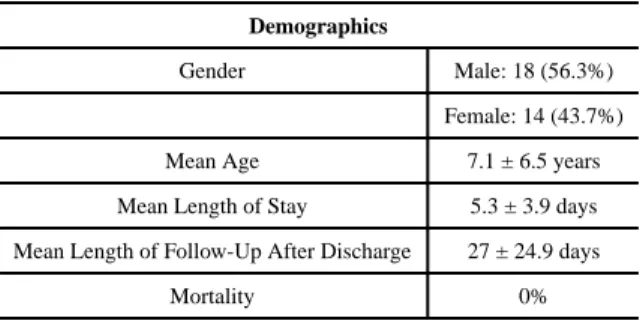
A total of 32 patients were recruited, 18 randomized to the bowel prep group and 14 to the no bowel prep group. 14 (43.7%) patients were female and 18 (56.3%) were male. The mean age was 7.1 ± 6.5 years. Mean length of stay (LOS) was 5.3 ± 3.9 days. There was no in-hospital or out-of-in-hospital mortality, with a mean length of follow-up of 27 ± 24.9 days post-discharge (Table 1).
Most common preoperative diagnoses included anorectal malformation, six (33.3%) in the bowel prep group and four (28.6%) in the no bowel prep group, ulcerative colitis, one (5.6%) and five (35.7%), respectively, and Hirschsprung’s disease, four (22.2%) and one (7.1%), respectively (Table 2). Most common procedures performed included ileostomy takedown, six (33.3%) in the bowel prep group and seven (50%) in the no bowel prep group, and colostomy takedown, seven (38.9%) and four (28.6%), respectively, followed by bowel resection and pull-through procedures (Table 3). The quality of the bowel preparation was noted in each of the 18 patients in the bowel prep group, all with satisfactory preps. Only three (16.7%) patients were able to complete the prep orally, the remainder requiring placement of NGTs for administration of the Golytely solution. 12 (66.7%) had rectal effluent containing solid material after administration of Golytely and therefore required rectal enema administration.
There was no statistically significant difference in overall complication rates between the bowel prep and no bowel prep groups (p=0.47), with five post-operative complications in each group, (27.7% bowel prep, 35.7% no bowel prep). There was also no statistically significant difference in individual complication rates between the two groups. Two (11.1%) patients in the bowel prep group suffered from post-operative wound infections, compared to three (21.4%) in the no bowel prep group (p=0.63). There were no intraabdominal abscesses
A
uthor Man
uscr
ipt
A
uthor Man
uscr
ipt
A
uthor Man
uscr
ipt
A
uthor Man
uscr
in the bowel prep group, and one (7.1%) in the bowel prep group, requiring percutaneous drainage (p=0.44). Both groups had one episode of sepsis, 5.6% and 7.7%, respectively (p=1.00). Only one (5.6%) anastomotic leak was found and this was in the bowel prep group (p=1.00). Finally, there were three (16.7%) bowel obstructions in the bowel prep group, compared to one (7.1%) in the no bowel prep group (p=0.613). There were no extra-abdominal complications in either of the groups (Figure 1).
Of note, there was no difference in age between patients that had post-operative complications and those that did not, 7.8 ± 7.14 years vs. 6.7 ± 6.3 years, respectively (p=0.67). There was a longer length of stay associated with those that suffered from a complication, 8.1 ± 5.9 days vs. 3.9 ± 1.5 days, respectively (p=0.004). Furthermore, among the patients that suffered post-operative complications, two required an ICU stay of at least one day and three required additional procedures or operative procedures. All except one had a documented intraoperative complication, for example, a small enterotomy during colostomy takedown in a patient that later developed a wound infection, and spillage of stool after a small opening in the ileum during a bowel resection for Crohn’s disease resulting in intra-abdominal abscess requiring percutaneous drainage. This is in comparison to the patients that had no post-operative complications, where only one required an ICU stay (readmission for non-surgery related issue), there were no additional procedures required, and only one had a documented intraoperative complication (serosal tear during an ileostomy takedown for ulcerative colitis).
Discussion
After many years of classic guidelines suggesting preoperative bowel preparation be used for elective colon and rectal operative procedures in adults, recent data has shown that
preoperative bowel preparation does not decrease the risk of postoperative complications in the adult population4,5,6. However, the question in the pediatric population still remains. There remains a paucity of data in the pediatric literature to guide the standard of care, and the use and type of preoperative bowel preparation in infants and children remains largely up to physician discretion19.
A few recent studies do suggest, however, that in pediatric patients undergoing elective colorectal surgery, the use of a preoperative bowel preparation does not affect the incidence of complications. These retrospective reviews and randomized prospective pilot studies compared clear liquid diet alone to clear liquid diet plus bowel preparation and suggested that omission of a preoperative bowel preparation does not lead to an increased risk of infection or anastomotic complications20,21. In this study we therefore attempted to address this problem by performing a randomized prospective controlled study to test the non-inferiority of preoperative use of clear liquid diet only (no bowel prep) compared to clear liquid diet with preoperative bowel preparation in pediatric patients undergoing elective bowel resection or ostomy closure.
The benefits of this study include the randomized prospective nature of the study design. Also, despite the inclusion of multiple pediatric surgeons, the type of preoperative bowel preparation and preoperative antibiotics was standardized. Furthermore, rectal effluent was
A
uthor Man
uscr
ipt
A
uthor Man
uscr
ipt
A
uthor Man
uscr
ipt
A
uthor Man
uscr
monitored with an inclusion of rectal enemas to the study protocol if needed to ensure and document adequacy of the bowel preparation. This addition was important, as the majority of our patients did not have clear rectal effluent at the conclusion of Golytely administration. In this manner we were able to show that there was no significant difference in overall complication rates between the patients that received a preoperative bowel preparation and those who did not. Furthermore, there was no significant difference in specific complication rates between the two groups, including wound infection, abdominal abscess, sepsis, anastomotic leak, bowel obstruction, or extra-abdominal complications. We therefore demonstrate no inferiority with the use of clear liquid diet alone preoperatively in the pediatric patient population undergoing elective bowel resection or ostomy closure. This is in congruence with published reports in the adult population4 and pilot studies performed in the pediatric patient population20,21.
The finding of no difference in outcomes between those receiving a bowel prep and those not receiving a bowel prep is potentially significant. There is a definite convenience, safety, and cost benefit associated with a clear liquid diet only preoperatively. Patients avoiding a preoperative bowel preparation can conduct a clear liquid diet comfortably in their own home without a need for hospital admission the day before surgery. Furthermore, we found that the majority of our patients were unable to tolerate the bowel prep orally, necessitating placement of an NGT. The elimination of a bowel prep removes this inconvenience, as well as saving time and money for families by avoiding preoperative hospital admissions. Furthermore, although it has been shown to be safe to use Golytely in infants and children17, there is still an added risk of dehydration and electrolyte imbalance with the use of a bowel prep22. The elimination of a preoperative bowel prep eliminates the risk of iatrogenic complications associated with the prep itself.
Unfortunately this study is limited by its small sample size. In order to achieve adequate power, this study needed recruitment of 100 patients. We were unable to do this due to the difficulty in finding patients agreeable to entering the study. Despite this, based on the number of patients we were able to recruit, we are still able to show that preoperative use of clear liquids only is not inferior the use of a preoperative bowel preparation. This provides further support to the need of further, larger studies investigating clear liquids only as a preoperative alternative to bowel preparation. This may be best performed in a randomized prospective multi-institutional setting.
Finally, there has been evidence in the adult literature that suggests the combination of preoperative bowel preparation and oral antibiotics is associated with favorable outcomes, such as reduced surgical site infection rates, anastomotic leak, and ileus with associated shorter length of stay and fewer readmissions23,24. This has yet to be investigated in the pediatric patient population, and may be an avenue for future study in attempt to decrease the morbidity, mortality, and stress on the health care system associated with post-operative complications.
A
uthor Man
uscr
ipt
A
uthor Man
uscr
ipt
A
uthor Man
uscr
ipt
A
uthor Man
uscr
Conclusion
Recent studies have refuted the classic use of preoperative bowel preparation in elective colon and rectal surgeries in the adult population, proving no increase in infectious complications with the elimination of bowel preparation4. There is limited data in the pediatric patient population with regards to this problem, and so the question still remains as to whether preoperative bowel preparation is necessary in infants and children. Initial studies have shown that there is no difference in complication rates in pediatric patients that receive a bowel prep and those who do not21. In this randomized prospective study, we show that there was no statistically significant difference in overall complication rates or rates of wound infection, intra-abdominal abscess, anastomotic leak, sepsis, bowel obstruction or extra-abdominal complications when comparing the use of preoperative bowel preparation versus no bowel preparation with diet restriction to clear liquids in pediatric patients undergoing elective bowel resection or ostomy closure. These findings support the need of larger, potentially multi-institutional, studies investigating clear liquids only as a suitable alternative to preoperative bowel preparations in the pediatric patient population.
References
1. Engum SA, Carter ME, Murphy D, et al. Home bowel preparation for elective colonic procedures in children: cost savings with quality assurance and improvement. J Pedatr Surg. 2000; 35:232–234. 2. Dahshan A, Lin CH, Peters J, et al. A randomized, prospective study to evaluate the efficacy and
acceptance of three bowel preparations for colonscopy in children. Am J Gastroenterol. 1999; 94:3497–3501. [PubMed: 10606310]
3. Barrish JO, Gilger MA. Colon cleanout preparations in children and adolescents. Gastroenterol Nurs. 1993; 16:106–109. [PubMed: 8286425]
4. Zmora O, Mahajna A, Bar-Zakai B, et al. Colon and rectal surgery without mechanical bowel preparation: a randomized prospective trial. Ann Surg. 2003; 237:363–367. [PubMed: 12616120] 5. Saha AK, Chowdhury F, Jha AK, et al. Mechanical bowel preparation versus no preparation before
colorectal surgery: A randomized prospective trial in a tertiary care institute. J Nat Sci Biol Med. 2014 Jul; 5(2):421–4. [PubMed: 25097427]
6. Kim YW, Choi EH, Kim IY, et al. The impact of mechanical bowel preparation in elective colorectal surgery: a propensity score matching analysis. Yonsei Med J. 2014 Sep; 55(5):1273–80. [PubMed: 25048485]
7. Zhu QD, Zhang QY, Zeng QQ, et al. Efficacy of mechanical bowel preparation with polyethylene glycol in prevention of postoperative complications in elective colorectal surgery: a meta-analysis. Int J Colorectal Dis. 2010 Feb; 25(2):267–75. Epub 2009 Nov 19. [PubMed: 19924422]
8. Cao F, Li J, Li F. Mechanical bowel preparation for elective colorectal surgery: updated systematic review and meta-analysis. Int J Colorectal Dis. 2012 Jun; 27(6):803–10. Epub 2011 Nov 23. [PubMed: 22108902]
9. Güenaga KF, Matos D, Wille-Jørgensen P. Mechanical bowel preparation for elective colorectal surgery. Cochrane Database Syst Rev. 2011
10. Miller PR, Fabian TC, Croce MA, et al. Improving outcomes following penetrating colon wounds: application of a clinical pathway. Ann Surg. 2002; 235:775–781. [PubMed: 12035033]
11. Sasaki LS, Allaben RD, Golwala R, Mittal VK. Primary repair of colon injuries: a prospective randomized study. J Trauma. 1995; 39:895–901. [PubMed: 7474005]
12. Chappuis CW, Frey DJ, Dietzen CD, et al. Management of penetrating colon injuries. A prospective randomized trial. Ann Surg. 1991; 213:492–497. [PubMed: 2025069]
13. Gonzalez RP, Merlotti GJ, Holevar MR. Colostomy in penetrating colon injury: is it necessary? J Trauma. 1996; 41:271–275. [PubMed: 8760535]
A
uthor Man
uscr
ipt
A
uthor Man
uscr
ipt
A
uthor Man
uscr
ipt
A
uthor Man
uscr
14. Shannon FL, Moore EE. Primary repair of the colon: when is it a safe alternative? Surgery. 1985; 98:851–860. [PubMed: 4049258]
15. Conrad JK, Ferry KM, Foreman ML, et al. Changing management trends in penetrating colon trauma. Dis Colon Rectum. 2000; 43:466–471. [PubMed: 10789740]
16. Curran TJ, Borzotta AP. Complications of primary repair of colon injury: literature review of 2,964 cases. Am J Surg. 1999; 177:42–47. [PubMed: 10037307]
17. Tuggle DW, Hoelzer DJ, Tunnell WP, Smith EI. The safety and cost-effectiveness of polyethylene glycol electrolyte solution bowel preparation in infants and children. J Pediatr Surg. 1987; 22:513– 515. [PubMed: 3112357]
18. Donahue MC, Evangelista JK, Shamberger RC. Effect of Golytely on serum electrolytes and hydration status of infants. J Pediatr Surg. 1994; 29:1095–1096. [PubMed: 7965513]
19. Feng C, Sidhwa F, Anandalwar S, et al. Contemporary practice among pediatric surgeons in the use of bowel preparation for elective colorectal surgery: A survey of the American Pediatric Surgical Association. J Pediatr Surg. 2015 Oct; 50(10):1636–40. [PubMed: 26054862]
20. Aldrink JH, McManaway C, Wang W, Nwomeh BC. Mechanical bowel preparation for children undergoing elective colorectal surgery. J Pediatr Gastroenterol Nutr. 2015 Apr; 60(4):503–7. [PubMed: 25825853]
21. Leys CM, Austin MT, Pietsch JB, et al. Elective intestinal operations in infants and children without mechanical bowel preparation: a pilot study. J Pediatr Surg. 2005 Jun; 40(6):978–81. discussion 982. [PubMed: 15991181]
22. Nagler J, Poppers D, Turetz M. Severe hyponatremia and seizure following a polyethylene glycol-based bowel preparation for colonoscopy. J Clin Gastroenterol. 2006; 40:558–9. [PubMed: 16825941]
23. Morris MS, Graham LA, Chu DI, et al. Oral Antibiotic Bowel Preparation Significantly Reduces Surgical Site Infection Rates and Readmission Rates in Elective Colorectal Surgery. Ann Surg. 2015; 261(6):1034. [PubMed: 25607761]
24. Kiran RP, Murray AC, Chiuzan C, et al. Combined preoperative mechanical bowel preparation with oral antibiotics significantly reduces surgical site infection, anastomotic leak, and ileus after colorectal surgery. Ann Surg. 2015; 262(3):416. [PubMed: 26258310]
A
uthor Man
uscr
ipt
A
uthor Man
uscr
ipt
A
uthor Man
uscr
ipt
A
uthor Man
uscr
Figure 1.
Study plan. PIV=peripheral IV; IVF=intravenous fluids (administered at weight based maintenance rate)
A
uthor Man
uscr
ipt
A
uthor Man
uscr
ipt
A
uthor Man
uscr
ipt
A
uthor Man
uscr
Figure 2.
Number of patients suffering from overall complications and individual complications in the no bowel prep and bowel prep groups
A
uthor Man
uscr
ipt
A
uthor Man
uscr
ipt
A
uthor Man
uscr
ipt
A
uthor Man
uscr
A
uthor Man
uscr
ipt
A
uthor Man
uscr
ipt
A
uthor Man
uscr
ipt
A
uthor Man
uscr
ipt
Table 1
Overall patient demographics
Demographics
Gender Male: 18 (56.3%)
Female: 14 (43.7%)
Mean Age 7.1 ± 6.5 years
Mean Length of Stay 5.3 ± 3.9 days
Mean Length of Follow-Up After Discharge 27 ± 24.9 days
A
uthor Man
uscr
ipt
A
uthor Man
uscr
ipt
A
uthor Man
uscr
ipt
A
uthor Man
uscr
ipt
Table 2
Admission diagnoses of patients undergoing elective bowel resection or ostomy closure, based on study group. Of note, the patient with perforated appendicitis had received an ileostomy during an earlier admission and subsequently presented for elective ileostomy takedown.
Preoperative Diagnosis Based on Study Group
Bowel Prep No Bowel Prep
# of patients (%) # of patients (%)
Anorectal Malformation 6 (33.3) 4 (28.6)
Ulcerative Colitis 1 (5.6) 5 (35.7)
Hirschsprung’s Disease 4 (22.2) 1 (7.1)
Crohn’s Disease 2 (11.1) 2 (14.3)
Familial Adenomatous Polyposis 4 (22.2) 0 (0)
Trauma 1 (5.6) 0 (0)
Rectal Duplication Cyst 0 (0) 1 (7.1)
A
uthor Man
uscr
ipt
A
uthor Man
uscr
ipt
A
uthor Man
uscr
ipt
A
uthor Man
uscr
ipt
Table 3
Operative procedures performed for patients with elective bowel resection or ostomy closure based on study group
Procedure Performed Based on Study Group
Bowel Prep No Bowel Prep
# of patients (%) # of patients (%)
Ileostomy Takedown 6 (33.3) 7 (50)
Colostomy Takedown 7 (38.9) 4 (28.6)
Pull Through 3 (16.7) 1 (7.1)