THE PROSODY-SYNTAX INTERACTION IN THE “YI-BU-QI-BA” RULE: A MORPHOLOGICALLY CONDITIONED TONE CHANGE IN MANDARIN CHINESE
C.-M. Bonnie Wang
A thesis submitted to the faculty at the University of North Carolina at Chapel Hill in partial fulfillment of the requirements for the degree of Master of Arts in the Department of Linguistics.
Chapel Hill 2014
ABSTRACT
C.-M. Bonnie Wang: The Prosody-Syntax Interaction in the “yi-bu-qi-ba” Rule: A Morpheme Specific
Tone Change in Mandarin Chinese (Under the direction of Katya Pertsova)
This thesis investigates the prosody-syntax interaction in morpheme specific tone change, presents a systematic comparison between tone Sandhi and tone change, and proposes a new rule-based analysis for the Mandarin “yi-bu-qi-ba” rule.
The empirical data is the comparison between Mandarin 3rd Tone Sandhi (3TS) of numeral morpheme wu (‘five’) and yi (‘one’) tone change (YTC). Data shows that syntax and prosody do not function the same way in predicting 3TS and YTC. The basic domain of 3TS is a foot whereas the domain of YTC is a phonological word (pword).
This thesis also contributes a new analysis for the “yi-bu-qi-ba” rule, with three major claims:
(1) YTC only applies when yi is the first element of a pword except in the string of digits. (2) BTC only applies when bu is the first element of a pword.
ACKNOWLEDGEMENTS
My deepest gratitude goes first to my advisor Dr. Katya Pertsova, for her inspiring guidance and invaluable encouragement. She has not only walked me through all the stages of writing this thesis, but also led me to the formal field in the study of linguistics.
This thesis could not have been accomplished without the illuminating advices by my committee members, Dr. Jennifer Smith and Dr. Randall Hendrick. I would also like to acknowledge my debt to my professors, Dr. Michael Terry, Dr. Elliot Moreton and Dr. Misha Becker, for their profound knowledge and enlightening lectures in the past two years.
I am indebted to the Department Linguistics at UNC Chapel Hill, where my research interests were originated. I have obtained insightful feedback by discussing my coursework and research papers at Linguistics Spring Colloquium and P-side Group. I am grateful to the friendship with my enthusiastic grad fellows, Jen Griffin, Amy Reynolds, Jessica Slavic, Caleb Hicks, Anna Powers, Rachel Broad, Emily Moeng, Kline Gilbert, Kayla Vix, Zachary Wilkins, Megan Gotowski, and Si-Yun Juliet Zhu.
outstanding representatives of UNC faculty with professional teaching and researching spirits.
TABLE OF CONTENTS
LIST OF TABLES ……….ix
LIST OF FIGURES ………....x
LIST OF ABBREVIATIONS……….xi
CHAPTER 1 MOPHOLOGICALLY CONDITIONED TONE CHANGE.……….. 1
Introduction………..1
Section 1.1 Tone Change vs. Tone Sandhi………...1
Section 1.2 The Mandarin yi-bu-qi-ba Rule……….2
1.2.1 Yi -Overview………...2
1.2.2 Bu -Overview………..4
1.2.3 Qi & Ba………...6
CHAPTER 2 3TS (3RD TONE SANDHI) VS. YTC (YI TONE CHANGE) ………..7
Introduction………..7
Section 2.1 Mandarin 3rd Tone Sandhi……….7
Section 2.2 Comparison between 3TS and YTC………10
2.2.1 Systematic Comparison………...…..………...10
Similarities………...…..………10
Differences………...…..………11
2.2.2 The Data: yi vs. wu………14
Introduction………....19
Section 3.1 The Prosodic Hierarchy………...19
Section 3.2 The Prosodic and Syntactic Structures in Mandarin Chinese……….20
3.2.1 The Syllable………..20
3.2.2 The Foot and Foot Formation Rule………...21
3.2.2.1 The Minimal and Maximal Foot………21
3.2.2.2 The Foot Formation Rule (FFR)………....22
3.2.3 The Phonological Word (PW) and PW Formation Rule………..23
3.2.3.1 The ALIGN Constraints and Cliticization ………24
3.2.3.2 The PW Formation Rule...26
3.2.4 The Prosody-syntax Mapping………...27
CHAPTER 4 PAST ANALYSIS ………..30
Introduction………....…30
Section 4.1 Chang’s (1992) Analysis……….…30
Section 4.2 Limitations………...32
CHAPTER 5 NEW ANALYSIS ………..34
Introduction………....34
Section 5.1 General Claims and the Hypotheses………...34
Section 5.2 The New Analysis: A Rule-based Approach………..34
5.2.1 YTC Rule Application...36
5.2.2 BTC Rule Application...45
CHAPTER 6 CONCLUSION ………..47
LIST OF TABLES
Table
1.1 Mandarin Tone Inventory...2
1.2 The Tone Alternation of yi...3
1.3 The Tone Alternation of bu...5
2.1 3TS- Sensitivity to Syntactic Bracketing...9
2.2 Similarity between 3TS and YTC in Morpho-syntax...10
2.3 The Role of Syntactic Bracketing in 3TS and YTC...12
2.4 3TS and YTC between Two Syntactic Binary Branches...13
2.5 Differences between 3TS and YTC...14
2.6 Comparison between yi and wu...16
LIST OF FIGURES
Figure 3.1 The Prosodic Hierarchy...20
Figure 3.2 Foot Structure in MC...21
Figure 3.3 PW Formation based on ALIGN2...25
Figure 4.1 Chang’s (1992, p.169) data of the “yi-bu-qi-ba” rule...31
LIST OF ABBREVIATIONS
3TS 3rd Tone Sandhi in Mandarin Chinese YTC yi Tone Change in Mandarin Chinese NumP Numeral Phrase
CL Classifier OD Ordinal Marker MC Mandarin Chinese
Pword Phonological word or prosodic word PhP Phonological phrase
ComplexNum A type of pword with the structure of complex numeral expression Num-CL A type of pword with the structure “Numeral-Classifier”
CHAPTER 1: MOPHOLOGICALLY CONDITIONED TONE CHANGE
Introduction
In this Chapter, I will start by introducing the key term of my thesis project: morphologically conditioned tone change. In Mandarin Chinese there is one specific phenomenon, known as the “yi-bu-qi-ba” rule, in which four morphemes undergo a series of peculiar tone changes that are different from typical Mandarin tone Sandhi. I will briefly explain the tone change rules of these four morphemes and explain how yi is the most complicated case, thus making it the focus of this project.
1.1 Tone Sandhi vs. Tone Change
1.2 The Mandarin “yi-bu-qi-ba” Rule
In Mandarin, there is a morpheme specific tone change rule named “yi-bu-qi-ba” rule (Chao, 1968). According to this rule, there are four morphemes that are subject to tone change rules that are completely different from tone Sandhi. I will illustrate the “yi-bu-qi-ba” rule morpheme by morpheme since each of them has distinctive characteristics.
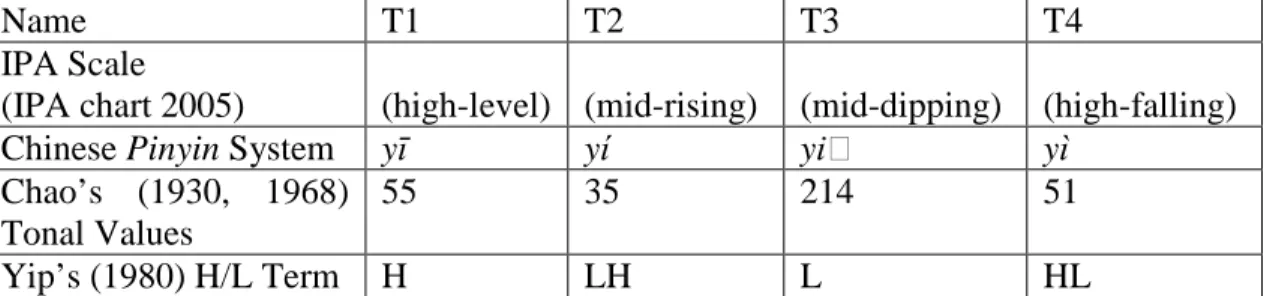
There are many ways of representing a tone, all of which illustrate the pitch level and contour. In Table 1.1, I have listed four ways of how tones are classified in Mandarin: IPA scale based on 2005, Pinyin (Chinese Romanized spelling system), Chao’s letters, as well as Yip’s (1980) H/L term.
Table 1.1. Mandarin Tone Inventory
A combination of the last two methods will be used throughout my thesis. I will mark Chao’s letter as the superscripts of Pinyin, but will refer to Yip’s H/L system when tone itself is analyzed. For example, yi55 refers to the morpheme yi that carries a H tone with a 55 tonal value.
1.2.1 Yi -Overview
Consider the tone of the Mandarin morpheme yi (meaning “the number one” or “a”) in some morphological environments presented in Table 1.2, shown below.
Name T1 T2 T3 T4
IPA Scale (IPA chart 2005)
(high-level)
(mid-rising)
(mid-dipping)
(high-falling)
Chinese Pinyin System yī yí yi yì
Chao’s (1930, 1968) Tonal Values
55 35 214 51
Yi has the citation high tone (marked as 55 in Chao’s letter) and its tone will usually change
to either a rising tone (marked as 35, see example c) or a high falling tone (marked as 51, see example b) depending on the tone carried by the syllable that follows it.
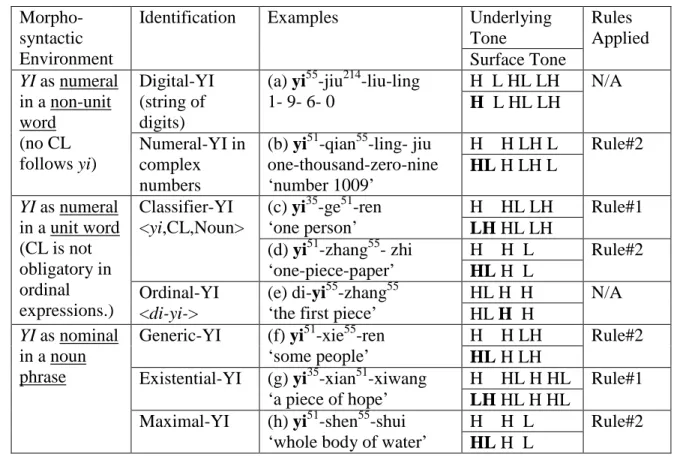
Two tone change rules1 applying to yi are generalized as follows:
Rule#1: H LH /_HL Rule#2: H HL /_{L, LH, H}
However, there are two situations in which yi does not change its tone. One of them is presented in (a) in Table 1.2, when yi is in a string of digits. The other case is shown in (e), when there is an ordinal marker di preceding yi, forming an ordinal expression di-yi- ‘the first sth.’
Table 1.2. The Tone Alternation of yi
Morpho-syntactic Environment
Identification Examples Underlying
Tone
Rules Applied Surface Tone
YI as numeral
in a non-unit word (no CL follows yi) Digital-YI (string of digits)
(a) yi55-jiu214-liu-ling 1- 9- 6- 0
H L HL LH N/A H L HL LH
Numeral-YI in complex numbers
(b) yi51-qian55-ling- jiu one-thousand-zero-nine ‘number 1009’
H H LH L Rule#2 HL H LH L
YI as numeral
in a unit word (CL is not obligatory in ordinal expressions.)
Classifier-YI <yi,CL,Noun>
(c) yi35-ge51-ren ‘one person’
H HL LH Rule#1 LH HL LH
(d) yi51-zhang55- zhi ‘one-piece-paper’
H H L Rule#2 HL H L
Ordinal-YI <di-yi->
(e) di-yi55-zhang55 ‘the first piece’
HL H H N/A
HL H H
YI as nominal
in a noun phrase
Generic-YI (f) yi51-xie55-ren ‘some people’
H H LH Rule#2 HL H LH
Existential-YI (g) yi35-xian51-xiwang ‘a piece of hope’
H HL H HL Rule#1 LH HL H HL
Maximal-YI (h) yi51-shen55-shui ‘whole body of water’
H H L Rule#2 HL H L
1
In this table and henceforth, “CL” stands for the “classifier,” also named the “measure word,” that “denotes some salient perceived or imputed characteristic of the entity to which the associated noun refers” (Allan, 1977, p. 285). Mandarin Chinese is one of the “numeral classifier languages” in which the classifiers are obligatorily with a number and/or a demonstrative, or certain quantifiers before a noun’’ (Li & Thompson, 1981, p. 104). The classifiers “carry out a quantifying role by providing additional semantic information” (H. Zhang, 2007, p. 57).
The paradigm combination in the Mandarin numeral classifier structure is: Quantifier + Classifier + Noun.
In Table 1.2, ge in (c) and zhang in (d, e) are both classifiers.
In (b), qian (‘thousand’) is not a CL but yi in this case functions as a quantifier. Some (N. Zhang, 2013) believes that morphemes following quantifiers such as xie, xian, shen in (f, g, h) are “CL-like” elements sharing the similar syntactic feature with CL.
All the examples in this chart can be divided in two groups referring to the rule application. In (b, c, d, f, g, h), tone change rules always apply. In (a) and (e), tone change rules do not apply. Some implications can be also concluded. First of all, the tone change of yi cannot be predicted by the phonological environment (i.e. the tone carried by the following syllable) or the morpho-syntactic structure only. For example, in (c) and (e), both instances of yi are numeral and can precede a classifier in a noun phrase. (c) has tone change rule #1 applied but (e) does not have any tone changing process.
1.2.2 Bu -Overview
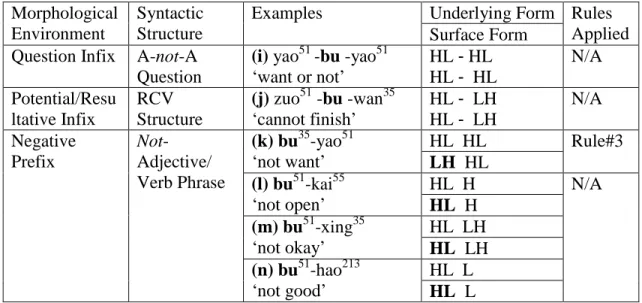
(‘eight’), all of which are numerals. Bu can serve as (i) a question marker in the “A-not-A” questions, which includes three types: “VP-not-VP” “V-not-VP” and “VP-not-V” (Zhu, 1991; Huang, 1988, 1991; Huang, Li, & Li, 2009), (ii) a potential/resultative infix inserted between the two elements of Resultative Compound Verb (RCV) structure (V1-not-V2), or (iii) a negative marker (prefix) in the negation structure (“not-Adjective/Verb Phrase”).
In the A-not-A and RCV structures, bu is usually considered to be toneless (marked by “-” in Table 1.3) therefore does not follow the tone change rule.
Only one tone change rule applies to bu when it functions as a negative prefix: Rule#3: HL LH /_HL
Table 1.3. The Tone Alternation of bu Morphological
Environment
Syntactic Structure
Examples Underlying Form Rules
Applied Surface Form
Question Infix A-not-A Question
(i) yao51 -bu -yao51 ‘want or not’
HL - HL HL - HL
N/A Potential/Resu
ltative Infix
RCV Structure
(j) zuo51 -bu -wan35 ‘cannot finish’
HL - LH HL - LH
N/A Negative Prefix Not-Adjective/ Verb Phrase
(k) bu35-yao51 ‘not want’
HL HL Rule#3
LH HL (l) bu51-kai55
‘not open’
HL H N/A
HL H (m) bu51-xing35
‘not okay’
HL LH HL LH (n) bu51-hao213
‘not good’
HL L HL L
factor triggering tonal process, such as the Mandarin 3rd tone Sandhi, which will be introduced in the next chapter.
1.2.3 Qi & Ba
CHAPTER 2: Mandarin 3TS (3RD TONE SANDHI) VS. YTC (YI TONE CHANGE)
Introduction
This chapter systematically illustrates the comparison between Mandarin 3TS (3rd tone Sandhi) and YTC (yi tone change) along with supportive data. I will first introduce the phonological tone modification process known as tone Sandhi. 3rd tone Sandhi (3TS) encountered in Mandarin Chinese will be used as an example of tone Sandhi as a whole. Since there is a great deal of literature written on the subject of 3TS, I will only cover some of the basic ideas that are central to my thesis. The numeral morpheme wu (‘five’) is chosen as an example of 3TS and compared to yi (‘one’), which is affected by the unique tone change rules. Relevant examples are provided to present the differences in surface patterns between 3TS and YTC. This section is the central part of my thesis and leads into my main claims in Chapter 5.
2.1 The Mandarin 3rd Tone Sandhi (3TS)
In Mandarin Chinese, there is a phonological tone Sandhi rule named 3rd Tone Sandhi (3TS), not allowing two adjacent mid-dipping tones (“3rd Tone”) to occur within a foot. When it happens, the first dipping tone is realized as a rising tone. This tone Sandhi can be explained by the general phonological condition Obligatory Contour Principle (OCP).
In summary, 3TS can be presented as: L LH/_L
This rule is obligatory to the head syllable (typically the left syllable) within the foot domain and optional across the foot boundary. Moreover, 3TS applies to cyclically starting with the innermost minimal foot, proceeding outwards as long as the conditions for the rule are met.
Based on the rule, the Sandhi process in a disyllabic foot will be like: /L. L/ [LH. L] Due to the cyclic and optional properties, it can be predicted that in a trisyllabic maximal foot with all the elements carrying the L tone, there will be two surface patterns:
/L. L. L/ [L. LH. L] or [LH. LH. L]
Although the second syllable is not the head of this trisyllabic foot, it has obligatorily changed from L to LH. To explain the reason, the process of 3TS application is demonstrated step by step in the outward order of the foot structure.
Maximal foot 1:
UR: ((L. L) L)
(LH. L) L 3TS applies to the head of the minimal foot ((LH. LH) L) L must change before L
SR: (LH. LH. L)
Maximal foot 2:
UR: (L. (L. L)
(L. (LH. L)) 3TS applies to the head of the minimal foot (L. (LH. L)) L optionally change before LH that came from L SR: (LH. LH. L) or (L. LH. L)
expressions contain same morphemes but in different orders, resulting different syntactic structures. All the three morphemes have citation L tones. The different minimal feet are caused by the foot formation rule (i) with respect to morpho-syntax.
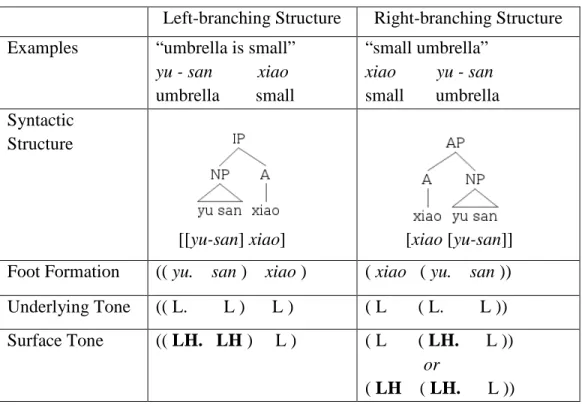
As shown below, different syntactic bracketing affects the 3TS application. In the left-branching structure, 3TS here is obligatory to both the first and the second syllables. The right-branching structure can have more than one surface pattern.
Table 2.1. 3TS -Sensitivity to Syntactic Bracketing (Shih, 1986)
Left-branching Structure Right-branching Structure Examples “umbrella is small”
yu - san xiao
umbrella small
“small umbrella”
xiao yu - san
small umbrella Syntactic
Structure
[[yu-san] xiao] [xiao [yu-san]] Foot Formation (( yu. san ) xiao ) ( xiao ( yu. san )) Underlying Tone (( L. L ) L ) ( L ( L. L )) Surface Tone (( LH. LH ) L ) ( L ( LH. L ))
or
( LH ( LH. L ))
morpho-syntax function the same way in this morpheme specific tone change? If not, what will be the prosody-syntax interaction in YTC? The first question will be clearly answered in the next section. The nature of YTC, however, needs more detailed analyses, which will be presented in the next two chapters.
2.2 Comparison between 3TS and YTC
2.2.1 Systematic Comparison
In this comparison, most of the properties of 3TS are concluded from previous analyses (Kaisse, 1985; Z. Zhang, 1988) based on Duanmu’s summary (2000, p. 238-239). In order to compare 3TS and YTC in a systematic way, I will present the features of YTC based on the data in this present paper.
Similarities
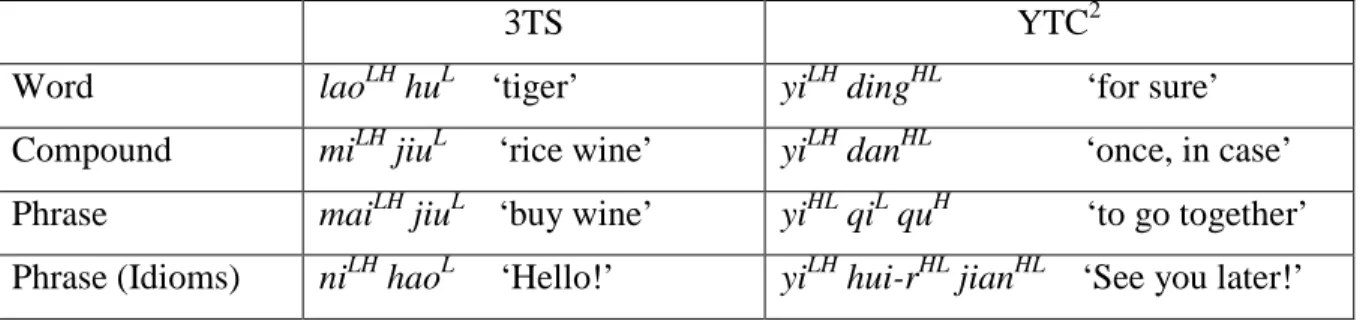
Table 2.2. Similarity between 3TS and YTC in Morpho-syntax
3TS YTC2
Word laoLH huL ‘tiger’ yiLH dingHL ‘for sure’ Compound miLH jiuL ‘rice wine’ yiLH danHL ‘once, in case’ Phrase maiLH jiuL ‘buy wine’ yiHL qiL quH ‘to go together’ Phrase (Idioms) niLH haoL ‘Hello!’ yiLH hui-rHL jianHL ‘See you later!’
2
In word yi-ding ‘for sure,’ yi does not mean ‘one,’ but a bound root.
First, both of them can apply in any syntactic structure (a word, a compound, or a phrase). In Table 2.2, some examples are listed to show this similarity. Only surface tones are indicated in the table. All the morphemes in 3TS examples have citation L tones.
Second, both 3TS and YTC are sensitive to syntax since the prosodic domain (either foot or pword) is determined by syntax. The role of syntax in 3TS and YTC, however, are largely distinguishing. The differences will be demonstrated in Table 2.3 and 2.4.
Differences
Following from above, the first difference between 3TS and YTC is the role of syntax. The sensitivity to syntax of 3TS can be seen in two examples:
(1) The role of syntactic bracketing: 3TS can have more than one surface pattern in right-branching syntactic structure but not in left-right-branching structure. See Table 2.3.
(2) The optionality of 3TS in some certain syntactic structures: one famous condition is “between two binary branches of a syntactic tree” (Kaisse, 1985; Duanmu, 2000). I will show this property in Table 2.4.
On the other hand, YTC is also sensitive to the syntax because the domain of the rule application depends on morpho-syntactic structure. But there is no alternative pattern in YTC case. The relevant examples I deliberate for YTC are also presented in the following tables.
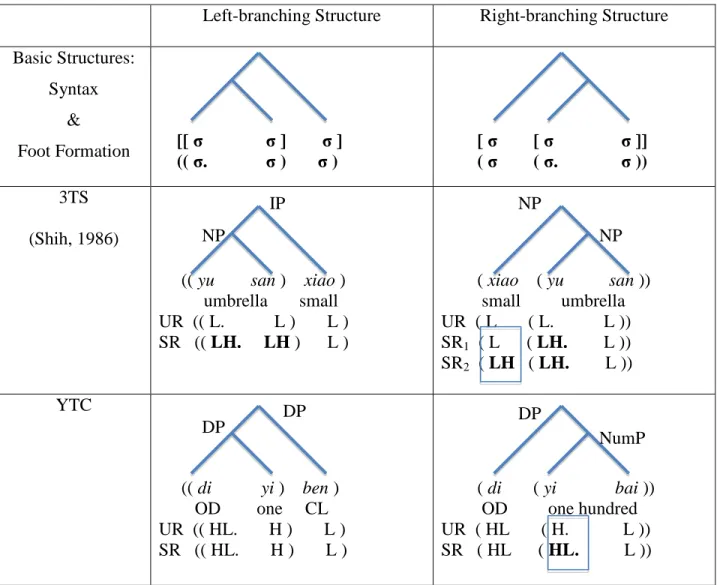
The 3TS and YTC rules applications are presented in details in Table 2.3. The framed tones are the ones undergoing tone Sandhi or tone change. In the right-branching structure, although 3TS and YTC both apply to the designated morpheme, 3TS shows alternative surface forms.
The DP syntactic trees of ordinal expressions di yi ben (‘the first CL’), di yi bai (‘the 100th’), and di yi ben shu (‘the first book’) in these two tables are explicitly explained on p.15 of this thesis.
Table 2.3. The Role of Syntactic Bracketing in 3TS and YTC
Left-branching Structure Right-branching Structure Basic Structures:
Syntax &
Foot Formation [[ σ σ ] σ ] (( σ. σ ) σ )
[ σ [ σ σ ]] ( σ ( σ. σ ))
3TS (Shih, 1986)
(( yu san ) xiao ) umbrella small UR (( L. L ) L ) SR (( LH. LH ) L )
( xiao ( yu san ))
small umbrella UR ( L ( L. L )) SR1 ( L ( LH. L )) SR2 ( LH ( LH. L )) YTC
(( di yi ) ben ) OD one CL UR (( HL. H ) L ) SR (( HL. H ) L )
( di ( yi bai ))
OD one hundred UR ( HL ( H. L )) SR ( HL ( HL. L ))
NP NP NP IP NumP DP
The syntactic trees of YTC in this chapter are not considering the influence from the functional morphemes (clitics). In the two disyllabic feet (di. yi) and (yi. bai), the left edges of the feet happens to coincide with the equivalent pword boundaries. The tone change in these cases should not be interpreted as the rule application in the foot domain.
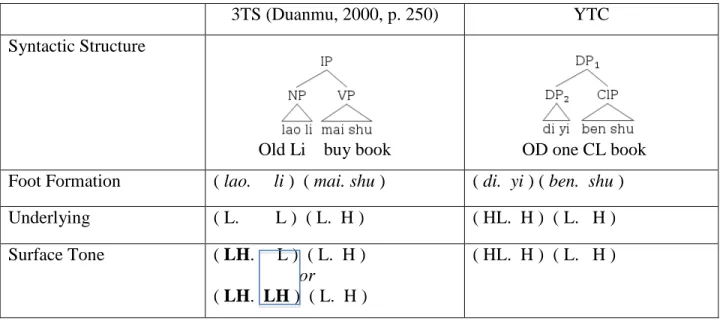
Table 2.4 shows 3TS is optionally applied to the nominal morpheme Li (‘person’s last name’) that is between two binary syntactic branches. However, in YTC example, yi between the two binary branches does not change its tone.
Table 2.4. 3TS and YTC between Two Syntactic Binary Branches
3TS (Duanmu, 2000, p. 250) YTC
Syntactic Structure
Old Li buy book OD one CL book Foot Formation ( lao. li ) ( mai. shu ) ( di. yi ) ( ben. shu ) Underlying ( L. L ) ( L. H ) ( HL. H ) ( L. H ) Surface Tone ( LH. L ) ( L. H )
or
( LH. LH ) ( L. H )
( HL. H ) ( L. H )
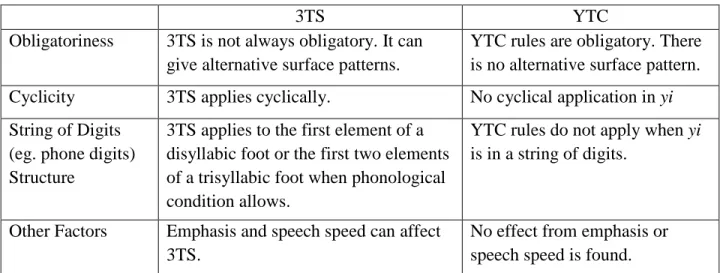
Table 2.5. Differences between 3TS and YTC
3TS YTC
Obligatoriness 3TS is not always obligatory. It can give alternative surface patterns.
YTC rules are obligatory. There is no alternative surface pattern. Cyclicity 3TS applies cyclically. No cyclical application in yi String of Digits
(eg. phone digits) Structure
3TS applies to the first element of a disyllabic foot or the first two elements of a trisyllabic foot when phonological condition allows.
YTC rules do not apply when yi is in a string of digits.
Other Factors Emphasis and speech speed can affect 3TS.
No effect from emphasis or speech speed is found.
In addition to the differences compared to 3TS above, YTC has its arbitrary nature that can be investigated in three perspectives:
(1) This phenomenon is morpheme-specific as a whole. (2) The tone changing rules seem phonetically arbitrary.
(3) Obligation of the YTC application is arbitrary. There is no alternation of the surface patterns allowed.
From all the differences illustrated above, the fundamental reason 3TS and YTC distinguish from each other is the distinct domains of rule application. The domain of 3TS is a foot, whereas the domain of YTC is a phonological word. This statement will be addressed in Section 2.2.2 and supported by the examples throughout Chapter 5.
2.2.2 The Data: yi vs. wu
tone is selected to compare with yi. If syntax/prosody functions the same way in these two processes, YTC and 3TS will happen in the same phonological and morpho-syntactic environment.
On the other hand, if phonological and morpho-syntactic environment are same, but only one of the two rules takes place but not the other, the role that prosodic and syntactic factors are playing in the two tonal processes ought to be different.
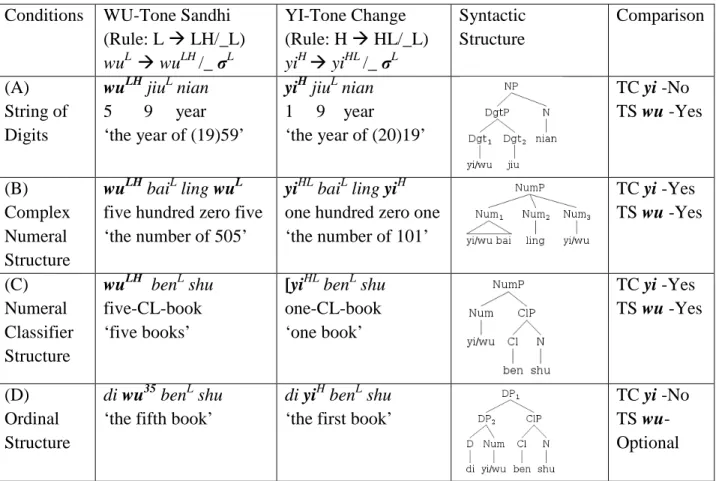
Since wu does not have the non-numeral use (eg. generic use) as yi has, the morpho-syntactic conditions for both wu and yi include only four cases: the string of digits, the complex number, the numeral classifier phrase, and the ordinal word. Tone Sandhi rule of wu is the Mandarin 3TS: L LH/_L. To ensure that the two morphemes have similar phonological environment (with a L tone followed), I choose one of the tone-changing rules “H HL/_L, H, LH” instead of the other one “H LH/_HL” and narrowed the rule to a specific condition: H HL/_L. Therefore the phonological environment of these two morphemes looks alike: the following tone of yi and wu will be all L tones. When yi and wu change their tones based on the rule, it will be realized as yìHL and wúLH.
Table 2.6 illustrates in detail how YTC (yi) and 3TS (wu) apply, and the comparison between them. The two morphemes are in bold and only the surface form of their tones is shown in the table.
forming a DP (Tsai, 2011). I will not discuss in detail that how these theories differ from each other here. Instead of choosing one term, I will illustrate the simplest syntactic construction and name each of the branches after their heads, to be convenient for my analysis. For example, I will name the structure [classifier noun] a ClP for “Classifier Phrase” following Wu and Bodomo’s (2009) claim, although it has been proposed to be a DP in L. Cheng and Sybesma’s (2012) recent work. More tree representations are available in Chapter 5.
Table 2.6. Comparison between yi and wu Conditions WU-Tone Sandhi
(Rule: L LH/_L)
wuL wuLH /_ σL
YI-Tone Change (Rule: H HL/_L)
yiH yiHL /_ σL
Syntactic Structure Comparison (A) String of Digits
wuLH jiuL nian
5 9 year ‘the year of (19)59’
yiH jiuL nian
1 9 year
‘the year of (20)19’
TC yi -No TS wu -Yes
(B) Complex Numeral Structure
wuLH baiL ling wuL
five hundred zero five ‘the number of 505’
yiHL baiL ling yiH
one hundred zero one ‘the number of 101’
TC yi -Yes TS wu -Yes
(C) Numeral Classifier Structure
wuLH benL shu
five-CL-book ‘five books’
[yiHL benL shu
one-CL-book ‘one book’
TC yi -Yes TS wu -Yes
(D) Ordinal Structure
di wu35 benL shu
‘the fifth book’
di yiH benL shu
‘the first book’
TC yi -No TS wu- Optional
As shown in the “comparison” column, tone change of yi and tone Sandhi of wu do not always happen in the same phonological and morpho-syntactic conditions. For example, when
wu changes its tone in the ordinal phrase di wuLH benL shu (‘the fifth book’), yi remains its
The prosodic parsing of the entire example above should be the same for yi and wu. There will be a tri-syllabic unit as one prosodic unit in (A) and (C), and two disyllabic feet in (B) and (D). However, the results show that these prosodic structures cannot explain the different application of the tone Sandhi or tone change rules.
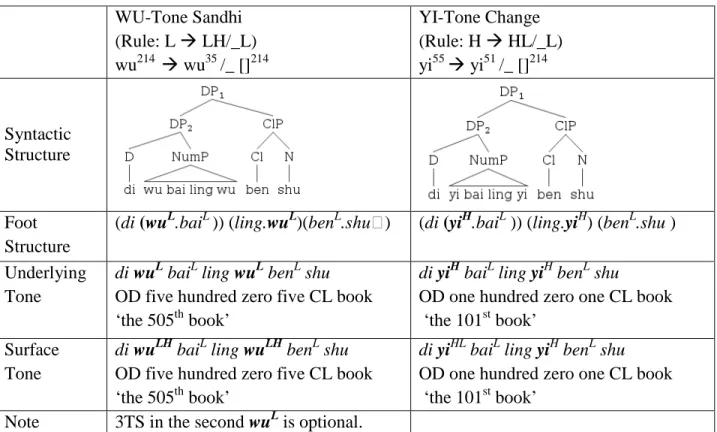
The difference between YTC and 3TS in the string of digits has been seen in Table 2.6. Another important difference is the cyclic property of the rule application. Examples in Table 2.7 is established from Table 2.6, forming two new ordinal phrases with complex numbers and classifiers inserted -‘the 101st book’ and ‘the 505th book.’ The reason of analyzing ‘the 101st book’ instead of the original ‘the 1st book’ is to detect a cyclic process of rule application at different pword levels. I have discussed the cyclic property of 3TS rule application in Section 2.1. However, in YTC, this cyclic feature is not observed.
Table 2.7. Difference in yi and wu Cont’d WU-Tone Sandhi
(Rule: L LH/_L) wu214 wu35 /_ []214
YI-Tone Change (Rule: H HL/_L) yi55 yi51 /_ []214
Syntactic Structure
Foot Structure
(di (wuL.baiL )) (ling.wuL)(benL.shu) (di (yiH.baiL )) (ling.yiH) (benL.shu )
Underlying Tone
di wuL baiL ling wuL benL shu
OD five hundred zero five CL book ‘the 505th book’
di yiH baiL ling yiH benL shu
OD one hundred zero one CL book ‘the 101st book’
Surface Tone
di wuLH baiL ling wuLH benL shu
OD five hundred zero five CL book ‘the 505th book’
di yiHL baiL ling yiH benL shu
OD one hundred zero one CL book ‘the 101st book’
CHAPTER 3: PROSODY AND SYNTAX IN MANDARIN CHINESE
Introduction
To help the readers understand the nature of the “yi-bu-qi-ba” rule, the general patterns of prosodic and syntactic structures are introduced in this chapter. Particular prosodic patterns in Mandarin Chinese are discussed with respect to Universal Prosodic Hierarchy (Selkirk, 1978, 1984), Prosodic Morphology Theory (McCarthy & Prince, 1986, 1993a), as well as some other claims by Shih (1986), Chen (1979, 1980), L. Cheng (1987), Duanmu (1990, 1999, 2000) and Feng (2002). These claims are important for analyzing both tone Sandhi and tone change. My proposal in Chapter 5 is based on what I will present here.
3.1 The Prosodic Hierarchy
Figure 3.1 illustrates a universal prosodic hierarchy that was first proposed by Selkirk (1978) and then gradually modified by others (Selkirk, 1984; Nespor & Vogel, 1986; Beckman & Pierrehumbert, 1986; Pierrehumbert & Beckman, 1988; Hayes, 1989; McCarthy & Prince, 1986, 1993a).
Figure 3.1. The Prosodic Hierarchy
Intonational Phrase Level 6 IP
Phonological Phrase Level 5 PhP
Phonological Word Level 4 PW
Foot Level 3 Φ
Syllable Level 2 σ
Mora Level 1 µ … …
In this thesis, I will mostly focus on Level 4 (phonological word) downwards to Level 2 (syllable). They are important to investigate rather than other levels because the tone is carried by the syllable and tone Sandhi or tone change rules apply at the foot level. Besides these three levels, phonological phrase level will be referred to frequently as well, since it is the prosodic domain of phonological rules at the phrasal level.
3.2 The Prosodic and Syntactic Structures in Mandarin Chinese
3.2.1 The Syllable
Each syllable corresponds to a morpheme in Chinese (Duanmu, 1990). They can be either stressed (full syllables) or unstressed (weak syllables). Stressed syllables carry lexical tones, namely tone-bearing units (Chen, 1979; Bao, 1999; Duanmu, 2008).
compound or a reduplicative compound is often unstressed. The unstressed conditions in this paper are presented in Table 1.3 (i) and (j), infix bu in the A-not-A question and RCV structure. Except the functional bu, all other examples in this paper have been selected deliberately without unstressed syllables.
3.2.2 The Foot and Foot Formation Rule
3.2.2.1 The Minimal and Maximal Foot
A foot is the suprasyllalbic unit that has been proposed to vary in size in Mandarin. It could consist of one, two, or three syllables (Feng, 1998; Duanmu, 1999; Chen, 2000). Taken from the claims made by Chen (1979, 1980) and Feng (2002), the “minimal foot” must be disyllabic, while the trisyllabic “maximal foot” is possible in Mandarin. This “maximal foot” phenomenon has also been observed in Japanese prosodic structure (Ito & Mester, 2010).
Figure 3.2. Foot Structure in MC
Minimal foot (ft): Maximal foot (Ft):
ft. Ft. or Ft.
(σ. σ) ((σ. σ) σ) (σ (σ. σ))
The process of foot formation is based on the Relative Prominence Principle (Liberman & Prince, 1977) and Foot Binarity Principle (McCarthy & Prince, 1986, 1993a).
3.2.2.2 The Foot Formation Rule (FFR)
Foot structure in Mandarin plays a prominent role in conditioning tone Sandhi. This foot formation process (i-iii) is adopted from previous analyses on 3TS by Chen (1996), Shih (1997), and Duanmu (2000). I added more details to (iii) making it more explicit.
(i) Lowest Footing: Form disyllabic feet when there is a disyllabic morphological word or compound, or a disyllabic XP. These disyllabic morpho-syntactic constituents will be the minimal feet in this step.
(ii) Left-to-right Footing: From left to right, form disyllabic feet when there are adjacent syllables which are not footed at step (i).
(iii) Left-to-right Joining: If there are any remaining syllables that are not footed at steps (i) and (ii), from left to right, form a trisyllabic “maximal foot” by joining the adjacent monosyllable and disyllabic foot together. There could be two situations. If there is remaining unfooted syllable at the leftmost position, join this syllable to the following disyllabic foot. If there is no disyllabic foot preceding the first unfooted monosyllable, join the monosyllable to the preceding foot.
(or even longer than 3 syllables) appears, (i) will not affect the foot forming. The trisyllabic XP will break into the monosyllabic structure in the next steps and feet are formed by (ii) and (iii).
For example, a disyllabic NP ping-guo (‘apple’) and a trisyllabic VP chi-ping-guo (‘to eat apple’) will follow the steps (i) – (iii) as the illustration below.
Foot Formation Morpho-syntactic Structure
‘apple’ ping-guo (i) Lowest Footing (ping.guo)
(ii) Left-to-right Footing N/A ping guo (iii) Left-to-right Joining N/A ‘apple’
“to eat apple” chi-ping-guo (i) Lowest Footing chi. (ping.guo) (ii) Left-to-right Footing N/A
(iii) Left-to-right Joining (chi. (ping. guo)) chi ping guo ‘to eat’ ‘apple’
3.2.3 The Phonological Word (“pword”) and PW Formation Rule
A phonological word (henceforth “pword”) is a “word-size entity” defined phonologically, functioning as the domain of phonological rules (Hall, 1999; Packard, 2000), phonotactic generalizations (Nespor & Vogel, 1986), or minimality constraints (Dixon, 1977a, 1977b; McCarthy & Prince, 1986, 1990).
The pword does not need to coincide with a grammatical word (Matthews, 2007). For example, in English I’m is considered to be one single pword but two separate grammatical words (I and am). However, pword boundaries directly correspond the ones of morpho-syntactic structures. Therefore, the concept of a phonological or prosodic word represents the interaction between phonology and morphology (Julien, 2002).
3.2.3.1 The ALIGN Constraints and Cliticization
Formulated from Prosodic Morphology theory (McCarthy & Prince, 1986, 1993a) and edge-based theory (Chen, 1987; Selkirk, 1986; among others), Feng (2002) proposed a series of alignment constraints and rules that predict pword in Chinese morphology. I summarize his main ideas and examples in (I) - (III) below:
(I) ALIGN1 : [ ]Comp = [ ]PW
For lexical idioms such as compounds, the left and right edges of the compound must coincide with the left and right edges of a pword.
(II) ALIGN2 : [ ]Foot = [M ... M]
For non-compounds, first identify the foot structure based on ALIGN2: the left and right edge of a morpheme must coincide with the left and right edge of a foot. In other words, a foot must both begin and end with a morpheme.
(III) ALIGN3-L : [PW = [PW
When one pword is formed on top of another, the left edge of a pword must coincide with left edge of another pword.
These Alignment constraints make the connection between the morpho-syntactic categories (“morpheme M”) and prosodic categories (“syllable σ” and “Foot”) to determine a pword.
Figure 3.3. PW Formation based on ALIGN2 XP
Y X 1) When XP is a disyllabic structure, each node contains a monosyllabic word. (σ. σ)
[Foot ]Foot This pword contains one disyllabic foot.
XP
Y X 2) When X is a disyllabic structure while Y is monosyllabic.
σ. (σ. σ)
[Foot ]Foot This pword contains one disyllabic foot.
XP
Y X 3) When Y is a disyllabic structure while X is monosyllabic.
(σ. σ) σ
However, Feng’s analysis does not take functional morphemes into account. When there are functional morphemes (i.e. “clitics”) appears, the surface structure need to be “rebracketed” through cliticization process (Chen, 2000).
Clitics are bound morphemes and lack prosodic independence. They must attach to a neighboring “lexical host” to form a phonological constituent (Chen, 2000 p. 398). There are three types of clitics: (i) bare roots that must combine with an affix or another root morpheme in order to form a “free-standing word” (eg. when numeral root meets classifier affix). (ii) Bound word-level affixes (eg. the ordinal number prefix di-, progressive suffix –zhe, potential/resultative infix –bu-), and (iii) a “tertium quid” between words and affixes (eg. prepositions). When forming a pword, the bare roots will combine with the related morphemes. Bound prefixes must attach to the following “phonological host” and suffixes should attach to the preceding host obligatorily. Infix will combine the preceding and following syllables together in order to form a pword. Common clitics in Chinese include prepositions, classifiers or measure words, and object pronouns (Chen, 2000, p. 400-403).
3.2.3.2 The PW Formation Rule
To capture the pwords in a structure consisting of both content and functional morphemes, I combine Feng and Chen’s proposals and finalize new PW Formation Rule.
PW Formation Rule:
(B) If there is clitics,
i) Cliticization: rebracketing the surface structure by grouping one clitic to the preceding
host, the (host-clitic) then becomes a pword
ii) Foot Formation: forming new foot structures based on the new syntactic bracketing
after cliticization;
iii) PW Formation: form pwords based on the ALIGN constraints.
These PW Formation Rules are operated right after Foot Formation Rules (i-iii). Different ALIGN constraints will be selected depending on the certain cases. I will demonstrate these rules step by step with sufficient examples to support my hypothesis in Chapter 5.
3.2.4 The Prosody-Syntax Mapping
From the rules I addressed above, it is obvious that neither prosody nor syntax could independently predict the footing at pword domain. There is a close relation between prosodic parsing and morpho-syntactic structure. Has been proposed by Selkirk (1972, 1974, 1978) and confirmed in some Romance languages by Nespor and Vogel (1979, 1982), among others, prosodic structure is projected from syntactic structure but they are not isomorphic. Morpho-syntactic influence has been previously discussed with respect to tone Sandhi (Shih, 1986; Chen, 1992, 2000). In this project, I am presenting the domain of YTC is also constructed depending on morpho-syntax.
Level 2 -Syllable σ
Individual morphemes yīH(‘one’), chǎngL (‘classifier for situation’), yǔL (‘rain’)
Level 3 -Foot Φ
Foot Formation Morpho-syntactic Structure
(i) Lowest Footing yi. (chang. yu) (ii) Left-to-right Footing N/A
(iii) Left-to-right Joining (yi (chang. yu)) Level 4 -Pword
! Classifier chang is a clitic
(iv) Cliticization [yi-chang] yu Attaching clitic to the host (v) Foot Formation ((yi.-chang) yu)
(vi) ALIGN2 [Foot ]Foot
ALIGN3 [PW[PW Forming two PWs PW Formation PW2{ PW1{(yiH changL)}PW1 yuL}PW2
Rule Application PW2{ PW1{(( yiHL changLH )}PW1 yuL)}PW2
Foot domain: 3TS rule applies in the maximal foot PW domain: YTC rule applies in the pword Surface Tones yiHL. changLH. yuL
At the syllable level, there are three tone-bearing units, all of which carry the citation tones,
yiH, changL and yuL.
At the foot level, three syllables form a maximal foot containing a minimal foot. The foot formation relies on the syntactic structure. However, since classifier chang is a clitic, which should attach to the preceding numeral yi. During the cliticization step, yi-chang forms one pword, thus changing the syntactic bracketing. In the maximal foot, changLchangLH is the consequence of 3TS rule. YTC applies earlier in the minimal pword domain yi-chang, altering the H tone to a high falling HL.
CHAPTER 4: PAST ANALYSIS
Introduction
In this chapter, I will introduce an earlier analysis of the “yi-bu-qi-ba” rule by Chang (1992) that focused on discussing the stress pattern in the foot domain. However, this analysis lacks reference to syntax. In order to truly understand the nature of the “yi-bu-qi-ba” rule, far more has to be considered on the prosodic word level. Pointing out the limitations is helpful for establishing a new proposal in the next chapter.
In Chapter 5, I will state my general claims and present my own analysis of the yi tone change, which mainly focuses on the prosody-syntax interaction and how it plays an important role in yi tone change.
4.1 Chang’s (1992) Analysis
Figure 4.1. Chang’s (1992) data of the “yi-bu-qi-ba” rule (p. 169)
yī55 bù51
[yì51 -zhāng55] ‘one sheet (of paper)’ [bù51 -tōng55] ‘unworkable’ [HL H] [HL H]
[yì51 -rén35] ‘one person’ [bù51 -xíng35] ‘not allowed’ [HL LH] [HL LH]
[yì51 -dǎ214] ‘one dozen’ [bù51 -hǎo214] ‘not good’ [HL L] [HL L]
[yí35 -yàng51] ‘the same’ [bú35 -qù51] ‘wont go’ [LH HL] [LH HL]
A simplest observation that she proposed is that tone change rule in bu seems to be “adopted” by yi. Based on this hypothesis, she discussed two main questions regarding the yi and
bu tone change:
(Q1) In bu, the tone change seems to be a dissimilation process, however “the cause is not explained.”
(Q2) Both yi and bu are high frequency morphemes. It is not clear why yi does not retain the underlying tone following by H, LH, and L.
Chang claimed that the tonal alternations seen in these examples involve two things: “a preferred stress pattern for a disyllabic prosodic foot in Beijing Mandarin”, and “a special status of HL in determining stress prominence” (p. 169-170). She gave the answers to the previous questions and I generalize them as below:
(A1) Since HL on the second syllable has more metrical prominence (high falling tone HL, was proposed to be the “strongest tone on the stressability hierarchy”), the preceding syllable with a lesser degree of stress would tend to undergo tonal change.
of a trochaic foot (cf. lexical stress pattern [Strong. Weak]) in Mandarin.
Figure 4.2. Chang’s (1992) analysis of “yi-bu-qi-ba” tonal alternations (p. 170) a. Lexical Stress: * .
[σ1 σ2]
unless [σ1 σ2] HL prominence . * HL --- > [σ1 σ2] HL
b. [bu- X]: . . * ---- > [σ1 [σ1 σ2] LH c. [yi- X]: * . * ---- > σ . * ---- > [σ1 σ HL [σ1 σ2] LH
In Chang’s analysis, stress pattern has been considered crucially in the prominence shifting of the high falling tone HL. When the prominent HL appears on the second syllable of a foot structure, the lexical stress pattern [Strong. Weak] ([* .]) will change into [W. S] ([. *]), where the weakened syllable will not carrying HL anymore. Instead, the weakened syllable on the left side of a foot will have a LH.
4.2 Limitations
First of all, Chang only investigated the tone changing but not tone preserving of yi. As I introduced before (refer to Table 1.2), yi remains its underlying tone when it is in a string of digits or in an ordinal word. Chang did not take these conditions into account. All the examples she took are the numeral-classifier cases.
different. The tone change of bu relies on the following tone except when it is a toneless infix, whereas yi does not have to consider the phonological environment in some cases (such as a string of digits).
Finally, the reason why LH is taking over when the stress shifting appears has not been answered clearly. This has to be analyzed through a series of phonological constraints.
CHAPTER 5: NEW ANALYSIS
5.1 General Claims and The Hypotheses
Based on the discussion in previous sections, I put forth two general claims:
Claim 1: Within the “yi-bu-qi-ba” rule, the tone change of yi and bu should be treated separately
since they have different requirements for phonological environment.
Claim 2: From the comparison in Chapter 3, it is obvious that YTC and 3TS have different
natures, and thus, YTC needs a new analysis.
One observation about YTC is the generalized rules do not apply in the string of digits structure, for unknown reason. With this restriction, the hypotheses I propose for YTC rules are:
(H1) YTC only apply when the morpheme yi appears as the initial element of a pword except in the string of digits.
(H2) This pword domain could be applicable to bu: BTC (bu tone change) rule applies when the morpheme bu appears at the initial element of a pword.
5.2 The New Analysis: A Rule-based Approach
(i) Lowest Footing: Form disyllabic feet when there is a disyllabic morphological word or compound, or a disyllabic XP. These disyllabic morpho-syntactic constituents will be the minimal feet in this step.
(ii) Left-to-right Footing: From left to right, form disyllabic feet when there are adjacent syllables which are not footed at step (i).
(iii) Left-to-right Joining: If there are any remaining syllables that are not footed at step (i) and (ii), from left to right, form a trisyllabic “maximal foot” by joining the adjacent monosyllable and disyllabic foot together. There could be two situations. if there is remaining unfooted syllable at the leftmost position, join this syllable to the following disyllabic foot. If there is no disyllabic foot preceding the first unfooted monosyllable, join the monosyllable to the preceding foot.
(iv) PW Forming:
(iv-a) If all morphemes are content morpheme, form pwords based on the selected ALIGN constraints and FAR (Foot Assignment Rule).
(ALIGN1 : [ ]Comp = [ ]PW, ALIGN2 : [ ]Foot = [M ... M] , ALIGN3-L : [PW = [PW ) (iv-b) If there is clitics,
1) Cliticization: rebracketing the surface structure by grouping one clitic to the
preceding host, the (host-clitic) then becomes a pword;
2) Foot Formation: forming new foot structures based on the new syntactic bracketing
after cliticization;
3) PW Formation: form pwords based on the ALIGN constraints.
5.2.1 YTC Rule Application
All of the examples are divided into four groups based on their syntactic structures. This classification also corresponds to Table 3.3. Group A is the string of digits condition that has been observed as the exceptional condition. Group B, C, and D altogether are predicted by (H1). The tone-changed morphemes are marked by the rectangular frame, eg. yiHL.
Group A: String of Digits
Unlike 3TS, YTC does not apply in the string of digits. In (Eg.1), yi remains in its citation H tone, even though there is a L tone syllable following after. If the digits along with the year/month/date are altogether treated as one pword, or string of digits as a whole pword, (H1) does not apply to the first morpheme yi in either case. I currently do not have any convincing argument to explain the reason. Therefore I place this group into an exceptional condition.
(Eg. 1) ‘the year of 1960’
yiH jiuL liu ling nian
1 9 6 0 year ‘the year of 1960’
Group B: Complex Number Structure
Chinese numerals are content morphemes and usually considered as bound roots that need to combine with a classifier. When numerals are in the specialized context of serial counting, they could be treated as “free” morphemes (Packard, 2000, p. 75). In the latter sense, complex numeral expressions are formed naturally as a morphological word.
Chinese complex cardinals are multiplicatives and can be formed by the process of compounding. The syntactic structure of a complex number looks like a compound word, see the tree structure in (Eg. 2). ALIGN3 predicts that the complex cardinal number itself is a pword no matter how many feet it contains like a lexical idioms. As the complex number being expanded, the pword is extended as well.
(Eg. 2) ‘111’
yi bai yi shi yi
one hundred one ten one
Syntactic Structure Prosodic Structure
(ii) Left-to-right Footing (yi. bai) (yi. shi) yi (iii) Left-to-right Joining (yi. bai) ((yi. shi) yi)
(iv) PW Forming PW{(yi. bai) ((yi. shi) yi)}PW ALIGN1 : [ ]Comp = [ ]PW
(Eg. 3) ‘1111’
yi qian yi bai yi shi yi
one thousand one hundred one ten one
Syntactic Structure Prosodic Structure
(ii) Left-to-right Footing (yi. qian) (yi. bai) (yi. shi) yi (iii) Left-to-right Joining (yi. qian) (yi. bai) ((yi. shi) yi)
(iv) PW Forming PW{(yi. qian) (yi. bai) ((yi. shi) yi)} PW ALIGN1
Underlying Tone {(yiH. qianH) (yiH. baiL) ((yiH. shiLH) yiH)} (v) YTC Applying {(yiHL. qianH) (yiH. baiL) ((yiH. shiLH) yiH)} Surface Tone yiHL. qianH. yiH. baiL. yiH. shiLH. yiH
The complex number can be expanded as long as possible “11…111,” but the outcome will be the same: only the initial yi changes its tone. Compare the different tone of yi in the same word yi-bai (‘one hundred’), but located in different position of a complex number. In (Eg. 2), the surface tone is yiHL-baiL, but the citation tone is realized as in yiH-baiL of the example (3). Instead of the foot, the pword is clearly the prosodic domain of YTC.
(Eg. 4) ‘111 books’ vs. ‘1 book’
{ yiHL baiL yiH shiLH yiH benL shuH }
one hundred one ten one CL book ‘111 books’
As introduced in Section 3.2.3.1, numerals and classifiers are bound roots thus they always need to be combined to form a pword. This explains that in (Eg. 4), each of the expression is a pword.
Yi-ben-shu (‘one CL book’) has the same PW formation process as yi-chang-yu (‘one CL
rain’) discussed in Section 3.2.4 on p. 25-26. The reason that yi-bai-yi-shi-yi-ben-shu (‘111 books’) is also a pword because of the cliticization, ben is attached to the complex numeral expression, foot assignment rule determines the pword has the same right edge as the last element. ALIGN3 requires the left edge of the pword corresponds to the smaller pword.
yi-bai-yi-shi-yi ben shu
Cliticization: Num-CL Pword
{yi-bai-yi-shi-yi-ben} shu
Rebracketing: [[yi-bai-yi-shi-yi-ben] shu]
Re-applying FFR:
(i)Lowest Footing (yi.bai) (yi.shi) yi.ben.shu (ii) Left-to-right Footing (yi.bai) (yi.shi) (yi.ben) shu (iii) Left-to-right Joining: (yi.bai) (yi.shi) ((yi.ben) shu) PW Formation:
FAR [Foot ]Foot ALIGN3 [PW[PW
PW Spelling out: PW2 { PW1{yi-bai-yi-shi-yi-ben} PW1 shu} PW2
Underlying Tone {{ yiH baiL yiH shiLH yiH benL }shuH } YTC Applying {{ yiHL baiL yiH shiLH yiH benL }shuH } Surface Tone {{ yiHL baiL yiH shiLH yiH benL }shuH }
More evidence supporting the hypothesis has been provided in Group C and D –Numeral Classifier phrase, and Ordinal Numeral phrase. In these groups, all of the examples have clitics (ordinal prefix di-, numerals, classifiers) therefore cliticization re-bracket the syntactic surface structure. I will no longer discuss the original syntactic trees for simplification. The FFR and PW Formation presented in (Eg. 5 -9) below are as explicit as possible. The prosodic structure only shows the largest pword of the given syntactic expression, even though there are smaller pwords contained within.
Group C: Numeral Classifier Phrase “yi + CL + Noun”
(Eg. 5) ‘one book’
yi ben shu one CL book
Original Syntactic Structure Prosodic Structure
Cliticization: {yi-ben} shu Num-CL Pword
Rebracketing: [[yi-ben] shu]
Re-applying FFR:
(i) Lowest Footing (yi.ben) shu (iii) Left-to-right Joining: ((yi.ben) shu) PW Formation:
FAR [Foot ]Foot
Underlying Tone {{ yiH benL }shuH } YTC Applying {{ yiHL benL }shuH } Surface Tone {{ yiHL benL }shuH }
Since classifiers are clitics, therefore need to be attached to the neighboring lexical host leftwards to form pword. However, the classifier and the noun are within the same foot based on syntactic constituent. Pword should contain at least one foot and its boundary shall correspond with the morpho-syntactic boundary.
(Eg. 6) ‘11 books’
shi yi ben shu
ten one CL book
Original Syntactic Structure Prosodic Structure
Cliticization: {shi-yi-ben} shu Num-CL Pword
Rebracketing: [[shi-yi-ben] shu]
Re-applying FFR:
(i) Lowest Footing (shi. yi) ben shu (iii) Left-to-right Footing (shi. yi) (ben. shu) PW Formation:
FAR [Foot ]Foot
ALIGN3 [PW[PW ALIGN3 refers to smaller pword PW Spelling out: PW2 { PW1{ shi-yi-ben} PW1 shu} PW2
Underlying Tone {{ shiLH yiH benL }shuH }
YTC Applying N/A yi is not the first element of any pword Surface Tone {{ shiLH yiH benL }shuH }
(Eg. 7) ‘101 books’
yi bai ling yi ben shu
one hundred zero one CL book
Original Syntactic Structure Prosodic Structure
Cliticization: {{yi-bai-ling-yi}ben} shu Complex-Num Pword
Num-CL Pword Rebracketing: [[[yi-bai-ling-yi ]ben] shu]
Re-applying FFR:
(i)Lowest Footing (yi.bai) ling. yi. ben.shu (ii) Left-to-right Footing (yi.bai) (ling.yi) (ben.shu) PW Formation:
FAR [Foot ]Foot
ALIGN3 [PW[PW ALIGN3 refers to smaller pwords PW Spelling out: PW2 { PW1{yi-bai-ling-yi-ben} PW1 shu} PW2
Underlying Tone {{{ yiH baiL lingLH yiH }benL }shuH } YTC Applying {{{ yiHL baiL lingLH yiH}benL }shuH } Surface Tone {{{ yiHL baiL lingLH yiH}benL }shuH }
pword is “numeral-classifier” structure, sometimes there is a bigger pword “numeral-classifier-noun (monosyllabic)”.
Group D: Ordinal Phrase ‘di-’
(Eg. 8) ‘the 1st book’
di yi ben shu Ordinal one CL book
Original Syntactic Structure Prosodic Structure
Underlying Tone {(di. yiH)(benL. shu)}
(v) YTC Applying N/A Surface Tone di. yiH . benL. shu
Cliticization: {di-yi-ben} shu OD-Num-CL Pword
Rebracketing: [[di-yi-ben] shu]
Re-applying FFR:
(ii) Left-to-right Footing (di. yi) ben shu (iii) Left-to-right Joining (di. yi) (ben. shu) PW Formation:
FAR [Foot ]Foot
ALIGN3 [PW[PW ALIGN3 refers to smaller pword PW Spelling out: PW {di-yi-ben- shu} PW
Underlying Tone { diHL yiH benLshuH }
YTC Applying N/A yi is not the first element of any pword Surface Tone { diHL yiH benLshuH }
In an “ordinal-numeral-classifier” expression, all three elements are clitics. None of them can freely stand by itself. Ordinal prefix di- needs to attach to the following numeral root. Num-CL is one clitic group. These clitics behaviors will result a new pword “OD-Num-CL.”
(Eg. 9) ‘the 111st book’
di yi bai yi shi yi ben shu
OD one hundred one ten one CL book
Original Syntactic Structure Prosodic Structure
Cliticization: {di-{yi-bai-yi-shi-yi}-ben} shu Complex-Num Pword
OD-Num-CL Pword Rebracketing: [di-[yi-bai-yi-shi-yi]-ben] shu]
Re-applying FFR:
(i) Lowest Footing di (yi.bai) (yi.shi) yi. ben.shu (ii) Left-to-right Footing di (yi.bai) (yi.shi) (yi.ben) shu (iii) Left-to-right Joining (di (yi.bai)) (yi.shi) ((yi.ben) shu) PW Formation:
FAR [Foot ]Foot
Underlying Tone {{di {yiH. baiL yiH. shiLH yiH} benL} shu}
YTC Applying {yiHL. baiL yiH. shiLH yiH} only at smallest PW Surface Tone di. yiHL. baiL. yiH. shiLH. yiH. benL. shu
Suggested by the hypothesis, YTC only applies to the first element of PW1, which is the first morpheme of yi-bai-yi-shi-yi (number ‘111’). No application happens in PW2 and PW3 since YTC is not applied cyclically.
5.2.2 BTC Rule Application
If the pword domain in (H1) can explain bu case, there will be the statement:
Bu Tone Change (BTC) only applies when the morpheme bu appears as the initial element
of a phonological word.
There are two conditions can be tested by this hypothesis.
On one hand, when bu functions as an infix in the “A-not-A” or RCV structure, it always appears between content words as a clitic and attaches to the neighboring lexical host. Since there is always a content word preceding bu in these structures. Bu will never be at the initial position of a pword. According to (H2), BTC will not apply since bu is not at the initial position of a pword. This result is consistent with the fact that infix bu never undergoes the BTC rule.
In conclusion, (H2) focusing on BTC has also been tested following the same pword domain proposed by (H1). I recapitulate that nearly all morpheme specific tone changing problems involving yi and bu are predictable, based on these proposed rules:
(1) Yi Tone Change (YTC) rules only apply when the morpheme yi appears as the initial element of a phonological word except in the string of digits.
CHAPTER 6 CONCLUSION
6.1 Summary of yi and bu
I have defined the Mandarin yi-bu-qi-ba rule as a form of morphologically conditioned tone change, containing a set of three different morpheme-specific tone change rules. The different morphological properties of each morpheme determine their various natures.
By stating these differences in Chapter 1, I have clarified that the tone changing of yi and bu are triggered by different phonological and morpho-syntactic environments.
On the other hand, the question of yi tone change is more complicated. Analyzing this through a rule-based approach, and applying the rule to bu case, I have concluded that TC rules only apply when yi/bu is at the initial position of any phonological word except in a string of digits.
6.2 The Historical Change of qi and ba
The reason why the morphemes qi (‘seven’) and ba (‘eight’) are exceptions to this general morphological tone change rule is not cleared. There are at least two possible explanations:
(ii) Although the tone change rules of qi and ba have been removed from the most recent edition (the 5th edition, 2005) of the Xian-dai Han-yu Ci-dian (“Modern Chinese Dictionary”), the “standard manual” of spoken and written Mandarin Chinese, the tone change still remains in the speech of many elderly Chinese, and in some of the regional dialects in northeastern China. The social and regional status in these speakers’ mind triggers the preservation of these tone change rules. In most of these cases, in order to remain a “standard” and well-educated form of speech, Mandarin speakers tend to maintain the citation tone of each syllable thus deny the tone change.
APPENDIX: DATA IN CHINESE
This appendix shows the original orthography (“Chinese characters”) of all the data used in the analysis. Simplified characters are presented in this appendix.
Pinyin (w/o tone markers) Chinese Character Meaning Individual
Morphemes
Yi 一 ‘one, a’
Bu 不 ‘not’
Qi 七 ‘seven’
Ba 八 ‘eight’
Wu 五 ‘five’
Group B: Complex Numeral Phrases
yi bai yi shi yi 一百一十一 ‘one hundred and eleven’
yi qian yi bai yi shi yi 一千一百一十一 ‘one thousand one
hundred and eleven’
yi bai ling yi 一百零一 ‘one hundred and one’
wu bai ling wu 五百零五 ‘five hundred and five’
Group C: Numeral Classifier Phrases
yi ben shu 一本书 ‘a book’
yi bai ling yi ben shu 一百零一本书 ‘101 books’
wu bai ling wu ben shu 五百零五本书 ‘505 books’
Group D: Ordinal Phrases
di yi ben shu 第一本书 ‘the first book’
di yi bai ling yi ben shu 第一百零一本书 ‘the 101st book’
di wu bai ling wu ben shu 第五百零五本书 ‘the 505th book’