ARTICLE
Evaluating the Clinical Validity of Gene-Disease
Associations: An Evidence-Based Framework
Developed by the Clinical Genome Resource
Natasha T. Strande,
1,14Erin Rooney Riggs,
2,14Adam H. Buchanan,
3Ozge Ceyhan-Birsoy,
4,5,6,7Marina DiStefano,
4Selina S. Dwight,
8Jenny Goldstein,
1Rajarshi Ghosh,
9Bryce A. Seifert,
1Tam P. Sneddon,
8Matt W. Wright,
8Laura V. Milko,
1J. Michael Cherry,
8Monica A. Giovanni,
3Michael F. Murray,
3Julianne M. O’Daniel,
1Erin M. Ramos,
10Avni B. Santani,
11,12Alan F. Scott,
13Sharon E. Plon,
9Heidi L. Rehm,
4,5,6,7Christa L. Martin,
2,3,*
and Jonathan S. Berg
1,*
With advances in genomic sequencing technology, the number of reported gene-disease relationships has rapidly expanded. However, the evidence supporting these claims varies widely, confounding accurate evaluation of genomic variation in a clinical setting. Despite the critical need to differentiate clinically valid relationships from less well-substantiated relationships, standard guidelines for such evaluation do not currently exist. The NIH-funded Clinical Genome Resource (ClinGen) has developed a framework to define and eval-uate the clinical validity of gene-disease pairs across a variety of Mendelian disorders. In this manuscript we describe a proposed frame-work to evaluate relevant genetic and experimental evidence supporting or contradicting a gene-disease relationship and the subsequent validation of this framework using a set of representative gene-disease pairs. The framework provides a semiquantitative measurement for the strength of evidence of a gene-disease relationship that correlates to a qualitative classification: ‘‘Definitive,’’ ‘‘Strong,’’ ‘‘Moder-ate,’’ ‘‘Limited,’’ ‘‘No Reported Evidence,’’ or ‘‘Conflicting Evidence.’’ Within the ClinGen structure, classifications derived with this framework are reviewed and confirmed or adjusted based on clinical expertise of appropriate disease experts. Detailed guidance for utilizing this framework and access to the curation interface is available on our website. This evidence-based, systematic method to assess the strength of gene-disease relationships will facilitate more knowledgeable utilization of genomic variants in clinical and research settings.
Introduction
The human genome comprises approximately 20,000
pro-tein-coding genes (see OMIM website in
Web Resources),
of which about 3,000 have been reported in association
with at least one Mendelian disease.
1Roughly half
1of
these gene-disease relationships have been identified over
the last decade, as technological advances have made it
possible to use sequence information from small families
or even single individuals to discover new candidate
gene-disease relationships.
2,3However, there is substantial
variability in the level of evidence supporting these claims,
and a systematic method for curating and assessing
evi-dence is needed.
Despite this variability, clinical laboratories may include
genes with preliminary evidence of a gene-disease
relation-ship on disease-targeted panels or in results returned from
exome or genome sequencing. Some of the gene-disease
re-lationships are either unable to be confirmed for many
years or are ultimately proven wrong.
4Evaluating the
clin-ical impact of variants identified in genes with an unclear
role in disease is exceedingly difficult and could lead to
incorrect diagnoses, preventing further evaluations and/or
resulting in errant management of the affected individual
and their families. This scenario highlights the need for a
standardized method to evaluate the evidence implicating
a gene in disease and thereby determine the clinical
valid-ity
2of a gene-disease relationship.
The NIH-funded Clinical Genome Resource (ClinGen)
5is creating an open-access resource to better define
clini-cally relevant genes and variants based on standardized,
transparent evidence assessment for use in precision
med-icine and research. Our group has developed a method that
(1) qualitatively defines gene-disease clinical validity using
a classification scheme based on the strength of evidence
supporting the relationship and (2) provides a
standard-ized semiquantitative approach to evaluate available
evi-dence and arrive at such a classification. Currently, this
framework is optimized for genes associated with
mono-genic disorders following autosomal dominant,
auto-somal-recessive, or X-linked inheritance. Future iterations
will expand the framework to consider other modes of
1Department of Genetics, School of Medicine, University of North Carolina at Chapel Hill, Chapel Hill, NC 27514, USA;2Autism & Developmental
Med-icine Institute, Geisinger Health System, Danville, PA 17837, USA;3Genomic Medicine Institute, Geisinger Health System, Danville, PA 17822, USA;4
Lab-oratory for Molecular Medicine, Partners Personalized Medicine, Boston, MA 02139, USA;5The Broad Institute of Harvard and MIT, Cambridge, MA 02142, USA;6Harvard Medical School, Boston, MA 02115, USA;7Department of Pathology, Brigham & Women’s Hospital, Boston, MA 02115, USA;8Department
of Genetics, Stanford University, Stanford, CA 94305, USA;9Department of Pediatrics, Baylor College of Medicine, Houston, TX 77030, USA;10National
Human Genome Research Institute, NIH, Bethesda, MD 20892, USA;11Department of Pathology and Laboratory Medicine, Perelman School of Medicine,
University of Pennsylvania, Philadelphia, PA 19104, USA;12Division of Genomic Diagnostics, Children’s Hospital of Philadelphia, Philadelphia, PA 19104,
USA;13McKusick-Nathans Institute of Genetic Medicine, Johns Hopkins University School of Medicine, Baltimore, MD 21287, USA 14These authors contributed equally to this work
*Correspondence:[email protected](C.L.M.),[email protected](J.S.B.)
inheritance, such as mitochondrial, and diseases with
more complex genomic etiologies, including oligogenic
or multifactorial conditions. Our approach is intended to
neither define multifactorial disease risk nor to be a
sub-stitute for well-established statistical thresholds used for
genome-wide association studies.
6,7This novel framework classifies gene-disease
relation-ships by the quantity and quality of the evidence
support-ing such a relationship. It builds on efforts to catalog
gene-disease associations, such as the Online Mendelian
Inheritance in Man (OMIM) and OrphaNet (see
Web
Re-sources), by systematically organizing the supporting and
refuting evidence and then categorizing the strength of
ev-idence supporting these relationships. The resulting
clin-ical validity classifications are valuable to both clinicians
and clinical laboratories. First, they provide insight into
the strength of clinical associations for clinicians
interpret-ing genetic test results for clinical care. Second, they serve
to guide clinical genetic testing laboratories as they
develop disease-specific clinical genetic testing panels or
interpret genome-scale sequencing tests. By including
only those genes with established clinical validity, the
possibility of returning ambiguous, incorrect, or
uninfor-mative results is reduced, improving the quality of
inter-pretation of genomic data.
Material and Methods
Qualitative Description: Clinical Validity Classifications
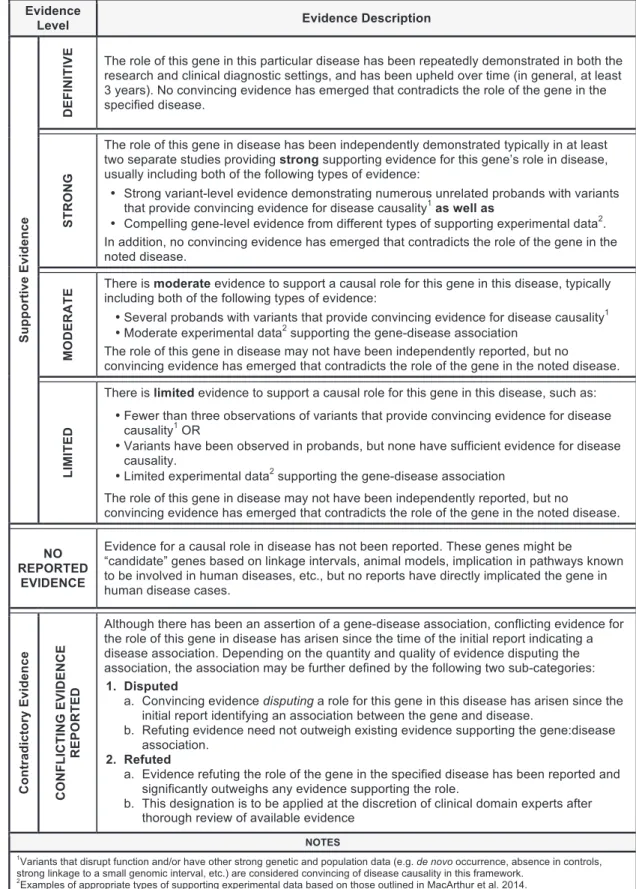
The ClinGen Gene Curation Working Group (GCWG) is comprised of medical geneticists, clinical laboratory diagnosti-cians, genetic counselors, and biocurators with broad experience in both clinical and laboratory genetics. Over the course of 3 years, this group convened bi-monthly to develop the described frame-work for assessing gene-disease clinical validity through expert opinion and working group consensus. We first defined six classes to qualitatively describe the strength of evidence supporting a gene-disease association (Figure 1). The amount and type of evi-dence required for each clinical validity classification builds upon that of the previous classification level. Evidence used within this framework to assign a classification to a gene-disease pair is divided into two main types: genetic evidence and experi-mental evidence (described below). As evidence is likely to change over time, any given classification is representative only of the level of evidence at the time of curation.
The classification ‘‘No Reported Evidence’’ is used for genes that have not yet been asserted to have a causal relationship with a hu-man monogenic disorder but may have some experimental data (e.g., model system data) suggesting a potential role for that gene in disease. The ‘‘Limited’’ classification requires at least one variant, asserted to be disease causing, to have plausible genetic ev-idence to support the association with human disease with or without gene-level experimental data. ‘‘Moderate’’ classification encompasses additional clinical evidence (e.g., multiple unrelated probands harboring variants with potential roles in disease) and supporting experimental evidence, all of which may be provided by multiple studies or a single robust study. Replication of the gene-disease association in subsequent independent publications and additional substantial genetic and experimental data are
crit-ical factors for the ‘‘Strong’’ classification. Finally, the hallmark of a ‘‘Definitive’’ gene-disease association is that, in addition to the accumulation of convincing genetic and experimental evidence, the relationship has been replicated and ample time has passed since the initial publication (in general, greater than 3 years) for any conflicting evidence to emerge. It is important to highlight that these classifications do not reflect the effect size or relative risk attributable to variants in a particular gene, but instead the strength of the evidence. For example, a definitive gene-disease as-sociation does not imply that a pathogenic variant in that gene confers 100% penetrance of the phenotype. This metric is not in-tended to assess the penetrance or risk to develop a disease outcome.
A gene-disease relationship can be determined to have one of the above classifications provided no substantial relevant and valid contradictory evidence exists to call the gene-disease tionship into question. If such evidence emerges, then the rela-tionship is described as ‘‘Conflicting Evidence Reported.’’ Types of contradictory evidence may come from population studies (such as ExAC8), attempts to experimentally validate the
gene-dis-ease association, or re-analysis of the original family or cohort that was previously studied. Although the role of a specificvariantin a given disease may be called into question by new evidence, this may not be sufficient to invalidate the role of thegenein that dis-ease. Thorough evaluation by experts in the particular disease area is recommended to determine whether the contradictory evidence outweighs the existing supportive evidence to classify a gene into either a ‘‘Disputed’’ or ‘‘Refuted’’ category (seeFigure 1for addi-tional details).
Semi-Quantitative Assessment of Evidence
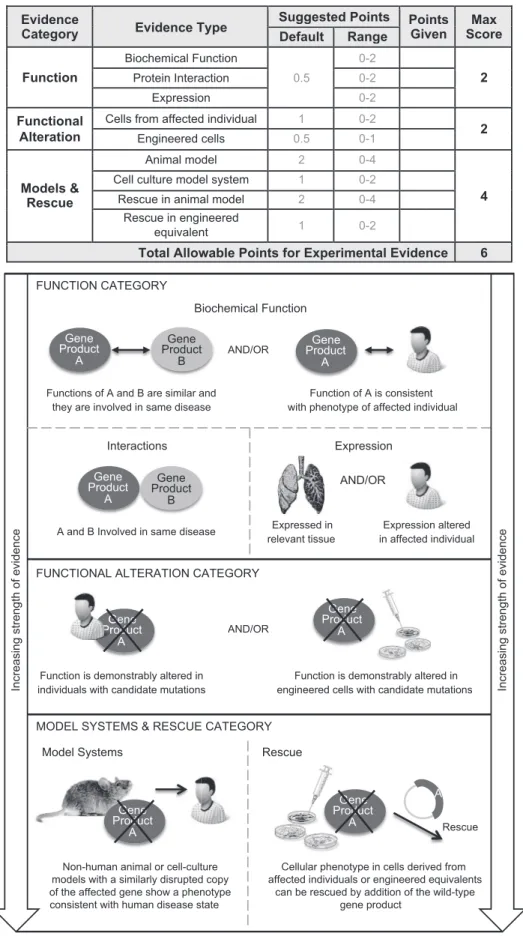
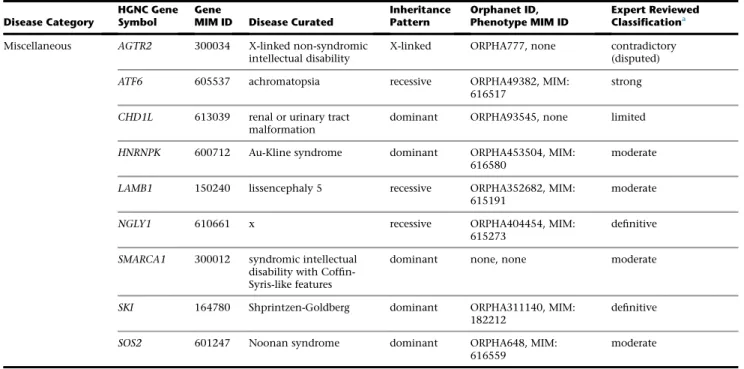
Assigning a clinical validity classification to a gene-disease pair re-quires assessment of the evidence supporting the association. We developed a semiquantitative approach to evaluate both genetic (Figure 2) and experimental (Figure 3) evidence in a standardized manner that promotes consistent collection and weighting of ev-idence (a detailed standard operating procedure is available on the ClinGen website; seeWeb Resources). Development of the quanti-tative aspect of this framework was based on the qualiquanti-tative de-scriptions outlined inFigure 1. Both the qualitative classifications and their quantitative counterparts were determined by consensus of the ClinGen Gene Curation Working Group members comprised of a diverse group of genetics experts and professionals with additional input from experts in multiple clinical domains. Throughout development of the framework, several gene-disease pairs (seeTable 1) were iteratively curated as benchmarks with a known ‘‘anticipated classification’’ to determine appropriate scores and assigned ranges (e.g.,FGFR3[MIM: 134934]:achondro-plasia [MIM: 100800]).
Figure 1. ClinGen Clinical Validity Classifications and Qualitative Descriptions
Genetic Evidence
For the purposes of scoring, genetic evidence is divided into two categories: case-level data and case-control data (Figure 2). Studies describing individuals or families with genetic variants are scored as case-level data, while studies using statistical analyses to compare variants in case and control subjects are scored as case-control data. When case-level and case-case-control data are present in a single publication, points can be assigned in each category, but the same piece of evidence should not be counted more
than once. For example, an individual case that is also included within a case-control cohort should not be given points in both the ‘‘case-level data’’ and ‘‘case-control data’’ categories. In this sce-nario, points should be assigned to the most compelling and infor-mative evidence.
Assessing case-level data requires consideration of the inheri-tance pattern and evaluation of the individual variants identified in each case. Within this framework, a case should be counted to-ward supporting evidence only if the reported variant has some Figure 2. Classes of Genetic Evidence and Their Relative Weights Used in the ClinGen Clinical Validity Framework
Figure 3. Types of Gene-Level Experimental Evidence and Their Relative Weights Used in the ClinGen Clinical Validity Framework Experimental evidence types used in the ClinGen gene curation framework are modified from MacArthur et al.9Evidence types are
divided into three categories based on their relative contribution to the overall clinical validity of a gene-disease pair, giving more weight to in vivo data. Each category is assigned a range of points with a maximum score that can be achieved, allowing more weight to be given
indication of a potential role in disease (e.g., impact on gene func-tion, recurrence in affected individuals, etc.), does not have evi-dence that would contradict pathogenicity (e.g., population allele frequency), and is of the type consistent with the assumed disease mechanism (e.g., truncating variant for loss of function). Unless otherwise noted, the term ‘‘qualifying variant’’ implies that these criteria are met. In addition, points are assigned separately for segregation data to reflect the statistical probability that the locus is implicated in the disease.Figures 2andS1provide guidance on the number of points that should be considered for segregation ev-idence by LOD score; if a LOD score is not provided within the publication being evaluated, an estimated LOD score may be calculated in certain scenarios, as described in the standard oper-ating procedure document provided on the ClinGen website.
Each study categorized as ‘‘case-control data’’ should be inde-pendently assessed to evaluate the quality of the study design (seeFigure 2). Consultation with a clinical domain expert group (such as those affiliated with ClinGen) is recommended. For the purposes of this framework, studies are classified based on whether they include single-variant analysis or aggregate variant analysis. Single-variant analyses are those in which individual var-iants are evaluated for statistical enrichment in case subject compared to control subjects. More than one variant may be analyzed, but the variants have been independently assessed with appropriate statistical correction for multiple testing. Aggre-gate variant analyses are those in which the total number of var-iants is assessed for enrichment in case subjects compared with control subjects. This comparison is typically accomplished by sequencing the entire gene in both case and control subjects and demonstrating an increased ‘‘burden’’ of variants of one or more types.
Experimental Evidence
The experimental data scoring system is presented inFigure 3. The gene-level experimental data used in this framework to assess a gene-disease association are consistent with those proposed by MacArthur and colleagues to implicate a gene in disease.9The
following experimental evidence types are used: biochemical function, experimental protein interactions, expression, func-tional alteration, phenotypic rescue, and model systems (Figure 3, bottom). These categories capture the most relevant types of experimental information necessary to determine whether the function of the gene product is at least consistent with the disease with which it is associated, if not causally implicated.
Contradictory Evidence
While curators are encouraged to seek out and document (via qual-itative description) conflicting evidence, no specific points are as-signed to this category. The types of valid contradictory evidence and their relative weights will be unique to each gene-disease pair, and it would be misleading to attempt to uniformly quantify this type of negative evidence against the reported positive evi-dence. If there is substantial conflicting evidence, manual review and expert input is required to evaluate the strength of the contra-dictory evidence, determine whether it outweighs any available supporting evidence, and, if so, decide whether the gene-disease association should be classified as ‘‘Disputed’’ or ‘‘Refuted.’’
Summary and Final Matrix
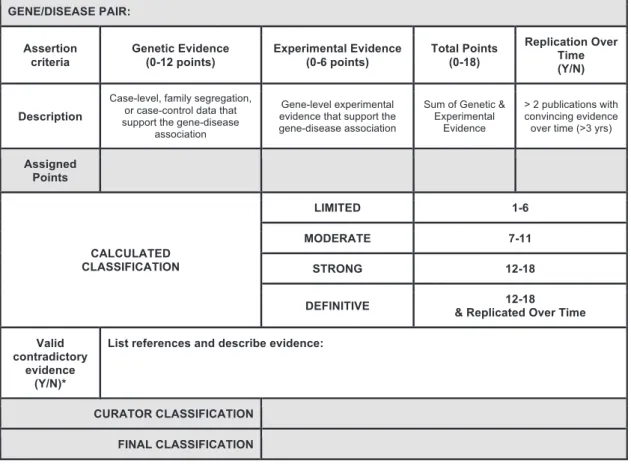
The scores assigned to both genetic and experimental evidence are tallied to generate a total score (ranging from 1 to 18) that corre-sponds to a preliminary clinical validity classification (Figure 4). The system provides a transparent method for summarizing and assessing all curated evidence for a gene-disease pair, encouraging consistency between curators. While the summary matrix facili-tates a preliminary assessment of the gene-disease relationship, the initial curator or expert reviewer may adjust the classification, supplying a specific rationale for the change. Final classifications are determined in collaboration with disease experts, who review the preliminary classification and supporting evidence and work to come to a consensus with the preliminary curators. In the event that the disease experts and preliminary curators disagree on a final classification, a senior member of the ClinGen Gene Cura-tion Working Group may be brought in to facilitate a final classi-fication, erring toward the more conservative classification if consensus cannot be achieved. It should be noted that experi-mental data alone cannot justify a clinical validity classification beyond ‘‘No Reported Evidence,’’ and at least one human genetic variant with a plausible causal association must be present to attain ‘‘Limited’’ classification. The difference between ‘‘Limited,’’ ‘‘Moderate,’’ and ‘‘Strong’’ gene-disease classifications is justified by the quality and quantity of evidence; it is expected that valid gene-disease associations will gradually accumulate enough supporting evidence and be replicated over time to attain a ‘‘defin-itive’’ classification. This framework relies predominantly on evi-dence obtained from published primary literature, identified through resources such as PubMed and OMIM (see Web Re-sources), and independently assessed by curators; however, if necessary, unpublished information available from publicly acces-sible resources, such as variant databases,10,11may be used as long
as some supporting evidence is provided.
Results
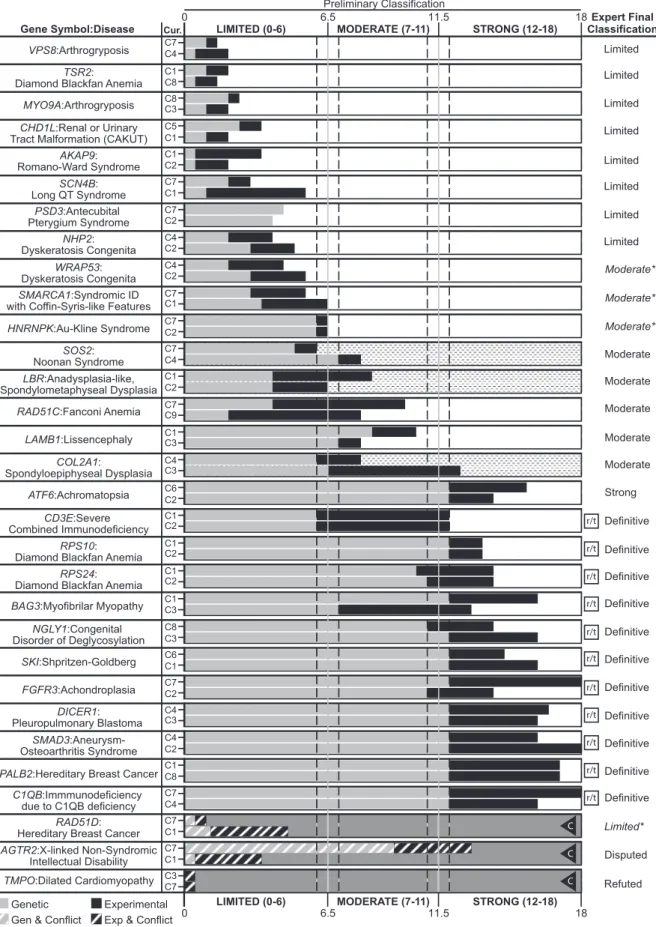
With this framework, we evaluated 33 gene-disease pairs
representing a variety of disease domains and spanning
the spectrum of clinical validity classifications (see
Table 1).
These pairs were intentionally chosen to be representative
of the diversity in monogenic disorders with regards to
inheritance patterns, disease prevalence, and levels of
evi-dence to support a relationship. To assess the
reproduc-ibility of our scoring metric, each gene-disease pair was
evaluated by two independent curators; paired curators
reached concordant clinical validity classifications in 29
of the 31 (93.5%) gene-disease pairs with available
pub-lished evidence (Figure 5; associations classified as ‘‘No
Reported Evidence’’ were excluded). All major
discrep-ancies between curators were discussed and resolved
when possible prior to review by clinical domain experts
(either
ClinGen
Clinical
Domain
Working
Group
[CDWG] members or ad hoc disease experts mentioned
Table 1. Categorization of Gene-Disease Pairs Used to Validate the Gene-Validity Framework
Disease Category
HGNC Gene Symbol
Gene
MIM ID Disease Curated
Inheritance Pattern
Orphanet ID, Phenotype MIM ID
Expert Reviewed Classificationa
Bone marrow failure NHP2 606470 dyskeratosis congenita recessive ORPHA1775, MIM: 613987
limited
RAD51C 602774 Fanconi anemia recessive ORPHA84, MIM:
613390
moderate
RPS10 603632 Diamond-Blackfan
anemia
dominant ORPHA124, MIM: 613308
definitive
RPS24 602412 Diamond-Blackfan
anemia
dominant ORPHA124, MIM: 610629
definitive
TSR2 300945 Diamond-Blackfan anemia with mandibulofacial dysostosis
X-linked ORPHA124, MIM: 300946
limited
WRAP53 612661 dyskeratosis congenita recessive ORPHA1775, MIM: 613988
moderate
Cardiovascular disorders
AKAP9 604001 Romano-Ward syndrome dominant ORPHA101016, MIM:
611820
limited
SCN4B 608256 long QT syndrome dominant ORPHA768, MIM:
611819
limited
SMAD3 603109 Loeys-Dietz type 3 dominant ORPHA284984, MIM:
613795
definitive
TMPO 188380 familial or idiopathic dilated cardiomyopathy
dominant ORPHA154, MIM:
613740b contradictory (refuted)
Hereditary cancer DICER1 606241 pleuropulmonary blastoma
dominant ORPHA64742, MIM: 601200
definitive
PALB2 610355 hereditary breast cancer dominant ORPHA227535, MIM: 114480
definitive
PMS2 600259 hereditary pancreatic cancer
N/A N/A no reported
evidence
RAD51D 602954 hereditary breast cancer dominant ORPHA227535, MIM: 614291
limited
Immune disorders C1QB 120570 immunodeficiency due to C1Q deficiency
recessive ORPHA169147, MIM: 613652
definitive
CD3E 186830 severe combined immunodeficiency
recessive ORPHA183660, MIM: 615615
definitive
Skeletal dysplasia ARSD 300002 chondrodysplasia punctata
N/A N/A no reported
evidence
COL2A1 120140 spondyloepiphyseal dysplasia (Stanescu type)
dominant ORPHA94068, MIM: 616583
moderate
FGFR3 134934 achondroplasia dominant ORPHA15, MIM:
100800
definitive
LBR 600024 anadysplasia-like, spontaneously remitting spondylometaphyseal dysplasia
recessive ORPHA448267, none moderate
Neuromuscular disorders
BAG3 603883 myofibrillar myopathy dominant ORPHA593, MIM: 612954
definitive
MYO9A 604875 arthrogryposis recessive ORPHA109007, none limited
PSD3 614440 antecubital pterygium syndrome
dominant ORPHA2987, none limited
VPS8 N/A arthrogryposis recessive ORPHA109007, none limited
in the
Acknowledgments); experts agreed with the
prelim-inary classifications for 87.1% (27/31) of the gene-disease
pairs with published evidence (Figure 5). The four
discrep-ancies between the expert and curator classifications were
each different by only a single category (e.g., limited versus
moderate). Of note, the original classifications for
HNRNPK
(MIM: 600712) and
SMARCA1
(MIM: 300012) were at the
border between limited and moderate (6.5 points); in
each case, the preliminary curators’ lack of specific clinical
expertise led to uncertainty regarding the scoring of
evi-dence requiring such knowledge. Consulting with clinical
experts in the disease resolved these issues, resulting in
both genes being upgraded to moderate. In the case of
WRAP53
(MIM: 612661), the expert was aware of
addi-tional published experimental evidence that when
included increased the classification from limited to
moder-ate. Upon reviewing the curated evidence for
RAD51D
(MIM: 602954) and breast cancer (MIM: 614291), the
domain expert upgraded the classification from disputed
to limited (with the approval of the GCWG) due to the
spec-ificity of the experimental evidence and insufficient power
of the current studies to rule out a role for
RAD51D
in breast
cancer (Figure 5). Details and references for each curation
are provided in supplemental figures (Figures S2–S65).
Discussion
The evidence-based framework described here
qualita-tively defines clinical validity classifications for
gene-dis-ease associations in monogenic conditions and provides
a systematic framework for evaluating key criteria required
for these classifications. This method is intentionally
flex-ible to accommodate curation of a wide spectrum of genes
and conditions by curators with varying levels of expertise.
The semiquantitative scoring system combined with the
qualitative classification scheme guides curators through
the preliminary decision-making process, while the
expert-level review provides disease-specific experience to
weigh in on the final classification.
This effort to create a generalized framework may result
in some specific challenges due to the heterogeneity of
ge-netic conditions, in both phenotype and prevalence. For
example, conditions that span a large phenotypic
spec-trum may pose a challenge when defining what constitutes
a condition and what is most relevant for curation
pur-poses. In general, ClinGen encourages its expert curation
groups to focus on disease associations that have been
as-serted in the literature or in other authoritative sources
(e.g., OMIM, Orphanet Disease Ontology). Expert
re-viewers may find it useful in certain scenarios to curate
both a syndromic disease association as well as an
iso-lated/non-syndromic disease association limited to a
particular sub-phenotype, for example, when a disease
entity encompasses sub-phenotypes that are caused by
different mutational mechanisms. This is a topic of
continued discourse within the ClinGen working groups
and will be incorporated into future manuscripts that
will focus on the curation approach for individual ClinGen
disease-focused expert groups.
Table 1. Continued
Disease Category
HGNC Gene Symbol
Gene
MIM ID Disease Curated
Inheritance Pattern
Orphanet ID, Phenotype MIM ID
Expert Reviewed Classificationa
Miscellaneous AGTR2 300034 X-linked non-syndromic intellectual disability
X-linked ORPHA777, none contradictory (disputed)
ATF6 605537 achromatopsia recessive ORPHA49382, MIM: 616517
strong
CHD1L 613039 renal or urinary tract malformation
dominant ORPHA93545, none limited
HNRNPK 600712 Au-Kline syndrome dominant ORPHA453504, MIM:
616580
moderate
LAMB1 150240 lissencephaly 5 recessive ORPHA352682, MIM:
615191
moderate
NGLY1 610661 x recessive ORPHA404454, MIM:
615273
definitive
SMARCA1 300012 syndromic intellectual disability with Coffin-Syris-like features
dominant none, none moderate
SKI 164780 Shprintzen-Goldberg dominant ORPHA311140, MIM: 182212
definitive
SOS2 601247 Noonan syndrome dominant ORPHA648, MIM: 616559
moderate
Abbreviations: N/A, not applicable.
aAll gene-disease classifications are accurate as of January 2017.
Ultra-rare disorders may have a relatively small number of
probands described in the medical literature, thus limiting
their potential to achieve a high genetic evidence score
within this matrix. This obstacle is mostly circumvented
by allowing compelling pieces of genetic evidence to score
the maximum number of points (for example, see
CD3E
[MIM: 186830] and severe combined immunodeficiency
[MIM: 615615] in
Figures S14
and
S15). When substantial
experimental evidence is also available, these conditions
can attain a ‘‘Strong’’ or ‘‘Definitive’’ classification. On the
opposite end of the spectrum are conditions that occur
commonly in the general population, such as cancer, where
the predominant etiology is multifactorial rather than
monogenic. In the less common Mendelian cancer
predis-position syndromes, incomplete penetrance is a typical
feature that can lead to confounding factors in family
ge-netic studies such as apparently non-penetrant family
members who carry a disease-associated variant and
pheno-copies among family members without a disease-associated
variant. For such conditions, case-control data may provide
more compelling evidence to support the gene-disease
asso-ciation (see
Figures S36
and
S37
for
PALB2
[MIM: 610355]
and hereditary breast cancer [MIM: 114480] as an example).
One limitation of any such system is the challenge of
balancing thorough literature curation and practical time
commitment. This system can accommodate an
exhaus-tive literature review, but in most cases will require
curating only the amount of information sufficient to
reach the maximum number of points in the matrix. In
some scenarios this method may fail to include pertinent
information, which could impact the classification (e.g.,
omission of contradictory evidence). Another potential
limitation is the subjective nature of certain evidence types
(e.g., experimental), which may lead to variability between
different groups assessing evidence. However, due to the
transparency of the evidence base, the incorporation of
expert review, and the ability to reassess classifications
over time, such drawbacks are likely to be self-limiting.
Figure 4. Final Summary Matrix Used to Provisionally Classify Gene-Disease Associations
A summary matrix was designed to generate a ‘‘provisional’’ clinical validity assessment using a point system consistent with the qual-itative descriptions of each classification. Genetic evidence: total number of points (not exceeding 12) obtained using the scoring metric inFigure 2. If no human variants associated with disease have been reported in the literature, then the default classification is ‘‘No Re-ported Evidence.’’ Experimental evidence: total number of points (not exceeding 6) derived from each of the experimental categories in
Figure 5. Comparison of Provisional Clinical Validity Classifications and Associated Matrix Scores for Selected Gene-Disease Pairs Evaluated by Multiple Curators
Of the 33 gene-disease pairs (y axis) curated to validate the clinical validity curation framework, 31 were classified using the summary matrix (two gene-disease pairs,PMS2:pancreatic cancer andARSD:chondrodysplasia punctata, were classified as ‘‘No evidence reported’’
ClinGen’s ultimate goal is to enhance the incorporation
of genomic information into clinical care, an important
component of the Precision Medicine Initiative.
12The
im-plementation of this framework will be supported by an
open-access ClinGen curation interface (under
develop-ment) that will guide curators through the curation
process and will serve as a platform for extension to the
community. In essence, this framework aims to provide a
systematic, transparent method to evaluate a gene-disease
relationship in an efficient and consistent manner suitable
for a diverse set of users. A detailed standard operating
pro-cedure for this framework is available on the ClinGen
website. All curated evidence, including clinical validity
as-sessments, will also be made readily accessible to clinical
laboratories, clinicians, researchers, and the community
via our website. Additionally, for community members
that wish to contribute papers of interest and/or request
curation of a gene-disease pair, a ‘‘reporter’’ form is
avail-able on the ClinGen website.
Carefully evaluated gene-disease clinical validity
classifica-tions, as provided by this framework, will be useful to clinical
laboratories as they evaluate genes for inclusion on
disease-targeted panels, or as they decide how to categorize,
priori-tize, and return results from exome/genome sequencing.
Clinicians may choose to use these types of gene-disease
clas-sifications as they interpret laboratory results for the
individ-uals they care for; for instance, they may choose not to adjust
medical management based on variants in genes of limited
clinical validity. Researchers could also utilize this
frame-work to evaluate the clinical validity of their own newly
discovered associations and identify promising target genes
for future work in order to augment the currently available
evidence and attain a ‘‘Strong’’ or ‘‘Definitive’’ classification.
In addition, professional societies and regulatory bodies may
utilize these clinical validity assessments when making
rec-ommendations or guidelines for clinical genetic testing.
Ultimately, our systematic, evidence-based method for
eval-uating gene-disease associations will provide a strong
foun-dation for genomic medicine.
Supplemental Data
Supplemental Data include 65 figures and can be found with this article online athttp://dx.doi.org/10.1016/j.ajhg.2017.04.015.
Acknowledgments
This work was supported by grants U41 HG006834-01A1, U01 HG007437-01, and U01 HG007436-01 from the National Human
Genome Research Institute (NHGRI), the Eunice Kennedy Shriver National Institute of Child Health and Human Development (NICHD), and through contract HHSN261200800001E from the National Cancer Institute (NCI). ClinVar is supported by the Intramural Research Program of the NIH, National Library of Medicine. We would like to thank the following groups and in-dividuals for contributing their disease expertise to review the examples included in this manuscript: Alan Beggs, Alison Ber-tuch, Rebecca H. Buckley, Eugene Chung, Bill Craigen, Jennifer M. Puck, Sharon A. Savage, Fergus J. Couch, the ClinGen Hered-itary Breast and Ovarian Cancer gene curation working group, Birgit H. Funke and the ClinGen Cardiomyopathy gene curation working group, and the ClinGen RASopathy curation working group. Input on the framework was also provided by the ClinGen Hereditary Breast and Ovarian Cancer gene curation working group and Ray Hershberger, Mike Gollob, and the ClinGen Chan-nelopathy gene curation working group. We would also like to thank Scott Goehringer for his invaluable help in preparing the curated examples for the ClinGen website and supplemental figures.
Received: February 22, 2017 Accepted: April 26, 2017 Published: May 25, 2017
Web Resources
ClinGen,https://www.clinicalgenome.org/
ClinGen Gene Curation, https://www.clinicalgenome.org/ working-groups/gene-curation/
ClinGen Gene Curation SOP, https://www.clinicalgenome.org/ working-groups/gene-curation/projects-initiatives/
gene-disease-clinical-validity-sop/
ClinGen Knowledge Base, https://search.clinicalgenome.org/kb/ agents/sign_up
OMIM,http://www.omim.org/
Orphanet,http://www.orpha.net/consor/cgi-bin/index.php
References
1. Chong, J.X., Buckingham, K.J., Jhangiani, S.N., Boehm, C., So-breira, N., Smith, J.D., Harrell, T.M., McMillin, M.J., Wiszniew-ski, W., Gambin, T., et al.; Centers for Mendelian Genomics (2015). The genetic basis of Mendelian phenotypes: discov-eries, challenges, and opportunities. Am. J. Hum. Genet.97, 199–215.
2. Haddow, J., and Palomacki, G. (2003). ACCE: a model process for evaluating data on emerging genetic tests. In Human Genome Epidemiology: A Scientific Foundation for Using Ge-netic Information to Improve Health and Prevent Disease, M. Khoury, J. Little, and W. Burke, eds. (Oxford University Press), pp. 217–233.
3. Wilfert, A.B., Chao, K.R., Kaushal, M., Jain, S., Zo¨llner, S., Adams, D.R., and Conrad, D.F. (2016). Genome-wide signifi-cance testing of variation from single case exomes. Nat. Genet.
48, 1455–1461.
4. Eisenberger, T., Di Donato, N., Baig, S.M., Neuhaus, C., Beyer, A., Decker, E., Mu¨rbe, D., Decker, C., Bergmann, C., and Bolz, H.J. (2014). Targeted and genomewide NGS data disqualify mutations in MYO1A, the ‘‘DFNA48 gene’’, as a cause of deaf-ness. Hum. Mutat.35, 565–570.
5. Rehm, H.L., Berg, J.S., Brooks, L.D., Bustamante, C.D., Evans, J.P., Landrum, M.J., Ledbetter, D.H., Maglott, D.R., Martin, C.L., Nussbaum, R.L., et al.; ClinGen (2015). ClinGen–the Clinical Genome Resource. N. Engl. J. Med.372, 2235–2242. 6. Lander, E., and Kruglyak, L. (1995). Genetic dissection of
com-plex traits: guidelines for interpreting and reporting linkage re-sults. Nat. Genet.11, 241–247.
7. Sham, P.C., and Purcell, S.M. (2014). Statistical power and sig-nificance testing in large-scale genetic studies. Nat. Rev. Genet.
15, 335–346.
8. Lek, M., Karczewski, K.J., Minikel, E.V., Samocha, K.E., Banks, E., Fennell, T., O’Donnell-Luria, A.H., Ware, J.S., Hill, A.J., Cummings, B.B., et al.; Exome Aggregation Consortium (2016). Analysis of protein-coding genetic variation in 60,706 humans. Nature536, 285–291.
9. MacArthur, D.G., Manolio, T.A., Dimmock, D.P., Rehm, H.L., Shendure, J., Abecasis, G.R., Adams, D.R., Altman, R.B., Anto-narakis, S.E., Ashley, E.A., et al. (2014). Guidelines for investi-gating causality of sequence variants in human disease. Nature
508, 469–476.
10. Landrum, M.J., Lee, J.M., Riley, G.R., Jang, W., Rubinstein, W.S., Church, D.M., and Maglott, D.R. (2014). ClinVar: public archive of relationships among sequence variation and hu-man phenotype. Nucleic Acids Res.42, D980–D985. 11. Fokkema, I.F., Taschner, P.E., Schaafsma, G.C., Celli, J., Laros,
J.F., and den Dunnen, J.T. (2011). LOVD v.2.0: the next gener-ation in gene variant databases. Hum. Mutat.32, 557–563. 12. Collins, F.S., and Varmus, H. (2015). A new initiative on