Further Evidence for Bats as the
Evolutionary Source of Middle East
Respiratory Syndrome Coronavirus
S. J. Anthony,
a,b,cK. Gilardi,
dV. D. Menachery,
eT. Goldstein,
dB. Ssebide,
fR. Mbabazi,
fI. Navarrete-Macias,
aE. Liang,
a,cH. Wells,
aA. Hicks,
aA. Petrosov,
aD. K. Byarugaba,
g,hK. Debbink,
eK. H. Dinnon,
eT. Scobey,
iS. H. Randell,
jB. L. Yount,
eM. Cranfield,
d,eC. K. Johnson,
dR. S. Baric,
eW. I. Lipkin,
a,bJ. A. K. Mazet
dCenter for Infection and Immunity, Mailman School of Public Health, Columbia University, New York, New York, USAa; Department of Epidemiology, Mailman School of Public Health, Columbia University, New York, New York, USAb; EcoHealth Alliance, New York, New York, USAc; One Health Institute and Karen C. Drayer Wildlife Health Center, School of Veterinary Medicine, University of California, Davis, California, USAd; Department of Microbiology and Immunology, University of North Carolina School of Medicine, Chapel Hill, North Carolina, USAe; Gorilla Doctors, c/o MGVP, Inc., Davis, California, USAf; Makerere University Walter Reed Project, Kampala, Ugandag; Makerere University, College of Veterinary Medicine, Kampala, Ugandah; Department of Epidemiology, University of North Carolina School of Medicine, Chapel Hill, North Carolina, USAi; Department of Cell Biology and Physiology and Marsico Lung Institute/Cystic Fibrosis Center, University of North Carolina School of Medicine, Chapel Hill, North Carolina, USAj
ABSTRACT
The evolutionary origins of Middle East respiratory syndrome (MERS)
coronavirus (MERS-CoV) are unknown. Current evidence suggests that insectivorous
bats are likely to be the original source, as several 2c CoVs have been described
from various species in the family
Vespertilionidae
. Here, we describe a MERS-like
CoV identified from a
Pipistrellus cf. hesperidus
bat sampled in Uganda (strain
PREDICT/PDF-2180), further supporting the hypothesis that bats are the evolutionary
source of MERS-CoV. Phylogenetic analysis showed that PREDICT/PDF-2180 is closely
related to MERS-CoV across much of its genome, consistent with a common
ances-try; however, the spike protein was highly divergent (46% amino acid identity),
sug-gesting that the two viruses may have different receptor binding properties. Indeed,
several amino acid substitutions were identified in key binding residues that were
predicted to block PREDICT/PDF-2180 from attaching to the MERS-CoV DPP4
recep-tor. To experimentally test this hypothesis, an infectious MERS-CoV clone expressing
the PREDICT/PDF-2180 spike protein was generated. Recombinant viruses derived
from the clone were replication competent but unable to spread and establish new
infections in Vero cells or primary human airway epithelial cells. Our findings
sug-gest that PREDICT/PDF-2180 is unlikely to pose a zoonotic threat. Recombination in
the S1 subunit of the spike gene was identified as the primary mechanism driving
variation in the spike phenotype and was likely one of the critical steps in the
evolu-tion and emergence of MERS-CoV in humans.
IMPORTANCE
Global surveillance efforts for undiscovered viruses are an important
component of pandemic prevention initiatives. These surveys can be useful for
find-ing novel viruses and for gainfind-ing insights into the ecological and evolutionary
fac-tors driving viral diversity; however, finding a viral sequence is not sufficient to
de-termine whether it can infect people (i.e., poses a zoonotic threat). Here, we
investigated the specific zoonotic risk of a MERS-like coronavirus (PREDICT/PDF-2180)
identified in a bat from Uganda and showed that, despite being closely related to
MERS-CoV, it is unlikely to pose a threat to humans. We suggest that this approach
constitutes an appropriate strategy for beginning to determine the zoonotic
poten-tial of wildlife viruses. By showing that PREDICT/PDF-2180 does not infect cells that
Received4 March 2017Accepted9 March 2017 Published4 April 2017
CitationAnthony SJ, Gilardi K, Menachery VD, Goldstein T, Ssebide B, Mbabazi R, Navarrete-Macias I, Liang E, Wells H, Hicks A, Petrosov A, Byarugaba DK, Debbink K, Dinnon KH, Scobey T, Randell SH, Yount BL, Cranfield M, Johnson CK, Baric RS, Lipkin WI, Mazet JAK. 2017. Further evidence for bats as the evolutionary source of Middle East respiratory syndrome coronavirus. mBio 8:e00373-17.https://doi.org/10.1128/ mBio.00373-17.
EditorStacey Schultz-Cherry, St. Jude Children's Research Hospital
Copyright© 2017 Anthony et al. This is an open-access article distributed under the terms of theCreative Commons Attribution 4.0 International license.
Address correspondence to S. J. Anthony, [email protected].
R.S.B., W.I.L., and J.A.K.M. contributed equally to this work.
crossm
express the functional receptor for MERS-CoV, we further show that recombination
was likely to be the critical step that allowed MERS to emerge in humans.
KEYWORDS
bat, MERS coronavirus, spike, Uganda, zoonoses
I
n 2012, Middle East respiratory syndrome (MERS) emerged in Saudi Arabia. Clusters
of fatal pneumonia in adults were determined to be caused by a novel lineage C
betacoronavirus (2c CoV), termed MERS-CoV (1). This was the first 2c CoV known to
cause disease in humans and at the time of its discovery was most closely related to
two known bat coronaviruses (2), raising the possibility that bats were a reservoir and
source for the virus. Concurrently, epidemiologists identified an association between
MERS infections in patients and their contact with dromedary camels (3, 4). MERS-CoV
was subsequently detected in camels at a farm linked to two human cases in Qatar (5)
and in camels in Egypt (6), followed by surveys that demonstrated widespread
expo-sure to the virus in the Middle East and in North and East Africa as early as the 1980s
(7–10). It is now clear that camels play an important role in the transmission of
MERS-CoV to people (11), with seroprevalence highest among those who have had
contact with camels (12).
While camels are thought to be important for the transmission of MERS-CoV, bats
are widely considered to be the evolutionary source of the virus. Several 2c CoVs have
now been described in bats, including HKU4 from
Tylonycteris pachypus
(13), HKU5 from
Pipistrellus abramus
(13), and the recently identified NeoCoV from
Neoromicia capensis
(14). NeoCoV is the closest relative yet discovered (85% identical to MERS) and shares
sufficient genetic similarity in the replicase genes to be considered part of the same
viral species (15); however, despite being closely related across much of the genome,
the S1 subunit of the spike gene is highly divergent as a result of a prior recombination
event. Recombination in the spike gene is particularly significant because the derived
protein is responsible for host receptor recognition and membrane fusion (16) and thus
is central in determining host specificity. The S1 subunit contains the receptor binding
domain and therefore has a specific role in defining host tropism (17). Other processes
are also important, such as the activation of the spike protein by host proteases (18),
but the ability of S1 to bind with a host receptor is a critical step in the emergence
pathway—and it can be quickly altered by a single recombination event. The sequence
variation in the S1 region of MERS-CoV and NeoCoV could therefore indicate differences
in host binding preferences.
Predicting the interactions of virus binding domains with a particular host receptor
(for example, the human MERS-CoV receptor DPP4) is possible through the use of
structural modeling and the generation of infectious clones. Protein-protein
interac-tions can be modeled using a related homologous complex (19, 20) while reverse
genetic strategies can test the permissiveness of human or other primate cells for
infectious clones expressing the novel receptor binding domains or complete spike
glycoprotein (21–24). Pseudotyped lentivirus systems have also been used, for example,
to show that DPP4 is the receptor for HKU4 but not for the closely related HKU5 (25, 26).
And while pseudotypes are not always accurate predictors of spike glycoprotein
function (23), these findings indicate that multiple cell-entry strategies could exist for
2c viruses and that not all MERS-like CoVs pose an equal risk of zoonotic emergence.
Here, we investigated the receptor binding properties of a new strain of MERS-like
CoV found in a bat from Uganda. This virus (PREDICT/PDF-2180) shares the same
putative S1 subunit recombination that was observed in NeoCoV, allowing us to also
consider whether the spike recombination was critical for the emergence of MERS-CoV
in humans.
RESULTS
of villages comprising approximately 15,000 inhabitants adjacent to the southwestern
boundary of Bwindi Impenetrable National Park. Communities include subsistence
farmers growing small crops, with some members working inside the national park or
supporting tourism-related businesses. Livestock, including cattle, pigs, sheep, goats,
and poultry, are present in the village and are raised on a small scale primarily for local
consumption.
The sampled bat weighed 3.0 g and had a forearm length of 25 mm (Fig. 1). It was
identified as
Pipistrellus cf. hesperidus
based on 95% sequence identity in the
cyto-chrome
b
(Cytb) gene. The cytochrome oxidase subunit 1 (CO1) was also sequenced,
but no corresponding CO1 sequences for
P. hesperidus
were available in GenBank for
comparison. We therefore relied on the Cytb sequence for species identification.
Discovery and sequence characterization.
The oral swab, rectal swab, and whole
blood of bat OTBA03-20130220 were assayed for the presence of coronavirus by
consensus PCR (cPCR). Two separate assays were used, each targeting a different region
of the ORF1b RNA-dependent RNA polymerase (RdRp). Bands of the expected size were
amplified from the rectal swab (PDF-2180) by both assays and confirmed to represent
viral products by traditional Sanger dideoxy sequencing. Both fragments showed
⬎
98% amino acid sequence identity to MERS-CoV, prompting further characterization
of the virus. The oral swab and blood were negative.
The near-full-length genome (identified as PREDICT/PDF-2180) was assembled from
100-nucleotide (nt) Illumina single-end reads at an average depth of 26
⫻
. Only the 5=
and 3=
noncoding regions were left incomplete. The order of all predicted open reading
frames (ORFs) was consistent with MERS-CoV and with the recently described NeoCoV
(KC869678) identified in a bat from South Africa. Similarly, the hexanucleotide
tran-scription regulatory sequence (AACGAA) was conserved and found in the same position
as both MERS and NeoCoV upstream of each predicted ORF.
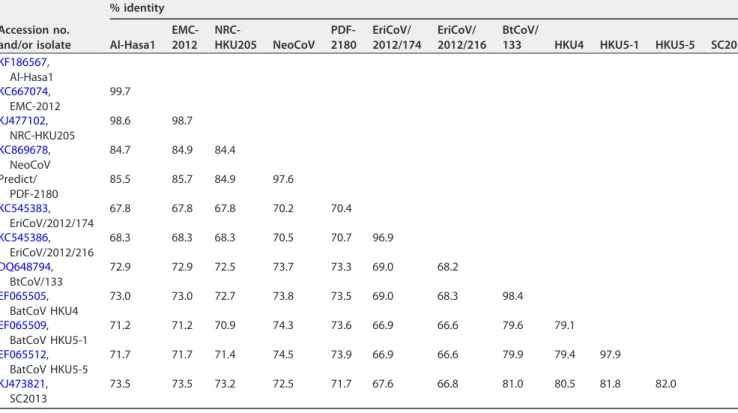
Amino acid identity could be as high as 97% to both MERS-CoV and NeoCoV in ORF1b
or as low as 45% to MERS-CoV in subunit 1 of the spike protein. For the full spike
protein, identity was 94% to NeoCoV and 63% to MERS-CoV. Percent sequence identity
of the spike protein (subunits 1 and 2) to other 2c viruses is shown in Tables 1 and 2,
respectively. Based on the current criteria for species demarcation established by the
International Committee for the Taxonomy of Viruses (
⬎
90% amino acid sequence
identity in the replicase proteins), PREDICT/PDF-2180 shares sufficient genetic identity
to MERS-CoV to be considered a member of the
MERS-like Coronavirus
species.
Phylogenetic analysis.
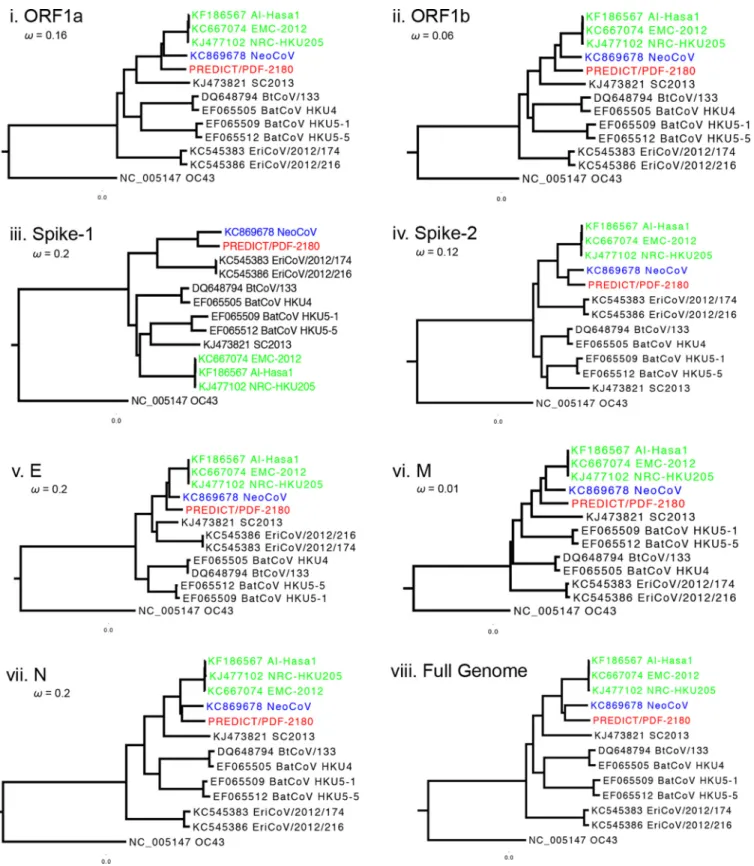
Maximum likelihood phylogenetic reconstructions showed
that PREDICT/PDF-2180 is most closely related to NeoCoV (Fig. 2). The two viruses were
basal or formed sister clades to MERS-CoV in all genes except subunit 1 of the spike. The
full-genome alignment was scanned for recombination using seven different
algo-rithms (RDP, GENECONV, Bootscan, MaxChi, Chimaera, SiScan, and 3seq) implemented
in RDP v4.46. A single recombination event was detected within the spike gene by RDP,
Bootscan, MaxChi, Chimaera, SiScan, and 3seq (Bonferroni-corrected
P
of
⬍⬍
0.001),
suggesting that the incongruent phylogenies observed between spike subunit 1 and
the rest of the genome are the result of recombination. Attempts to date the
diver-gence of these two viruses to estimate the “minimum” number of years since this
recombination were prevented by evidence of strong negative (purifying) selection
across the genome (Fig. 2). Given that purifying selection can confound true
phyloge-netic depth, we felt that attempts to estimate the number of years to common ancestry
were inappropriate and would result in artificially “recent” dates.
Zoonotic potential of PREDICT/PDF-2180.
The high genetic variability in subunit
1 suggests that human and bat strains of MERS have different receptor binding
properties. To investigate this, we modeled the specific affinity of the
PREDICT/PDF-2180 spike protein for the human MERS-CoV receptor DPP4 (27). We utilized the crystal
structure of the MERS-CoV spike binding domain in complex with DPP4 to create a
homology model for the comparable region of the PREDICT/PDF-2180 spike (Fig. 3).
Previous work has demonstrated 11 specific amino acid residues in MERS-CoV that
TABLE 1 Pairwise amino acid sequence identity of subunit 1 of spike protein of 2c CoVs
Accession no. and/or isolate
% identity for subunit 1 (% identity for receptor binding domain)
NeoCoV PDF-2180
EriCoV/ 2012/174
EriCoV/ 2012/216
BtCoV/
133 HKU4 HKU5-1 HKU5-5 SC2013
EMC-2012
Al-Hasa1
NRC-HKU205
KC869678, NeoCoV Predict/
PDF-2180
91.0 (93.1)
KC545383, EriCoV/2012/ 174
54.7 (59.7) 54.3 (60.4)
KC545386, EriCoV/2012/ 216
54.9 (59.7) 54.4 (60.4) 99.9 (100)
DQ648794, BtCoV/133
45.1 (42.5) 45.5 (42.5) 43.9 (50.0) 44.0 (50.0)
EF065505, BatCoV HKU4
45.1 (41.8) 45.7 (41.8) 44.3 (50.0) 44.4 (50.0) 95.6 (96.2)
EF065509, BatCoV HKU5-1
47.8 (46.3) 47.7 (47.0) 45.8 (53.7) 45.9 (53.7) 57.7 (63.4) 58.4 (63.4)
EF065512, BatCoV HKU5-5
47.4 (45.5) 47.8 (46.3) 44.6 (50.7) 44.7 (50.7) 56.3 (61.8) 56.7 (61.8) 90.1 (93.9)
KJ473821, SC2013
45.5 (42.5) 46.2 (44.0) 45.8 (55.2) 45.9 (55.2) 59.7 (57.5) 59.7 (56.7) 63.7 (73.9) 64.1 (73.1)
KC667074, EMC-2012
43.5 (40.3) 44.4 (41.0) 43.9 (47.8) 44.1 (47.8) 61.2 (64.9) 61.1 (63.4) 56.5 (63.4) 56.7 (61.1) 61.4 (61.2)
KF186567, Al-Hasa1
43.5 (40.3) 44.4 (41.0) 43.9 (47.8) 44.1 (47.8) 61.4 (65.6) 61.2 (64.1) 56.5 (63.4) 56.7 (61.1) 61.4 (61.2) 99.9 (99.2)
KJ477102, NRC-HKU205
facilitate binding interactions with the human DPP4 (28). Of these residues, only one is
conserved for PREDICT/PDF-2180. To determine whether the binding interactions may
be conserved between DPP4 and PREDICT/PDF-2180 regardless of the differences in
amino acid residues at these positions, we analyzed the predicted interactions between
PREDICT/PDF-2180 and DPP4, compared to MERS-CoV and DPP4. Overall, we found a
global reduction in predicted hydrogen bonding interactions in the DPP4-PREDICT/
PDF-2180 binding interface compared with DPP4-MERS-CoV (Fig. 3). While the
inter-actions in conserved residue Y499 were maintained, DPP4 interinter-actions with PREDICT/
PDF-2180 residues 501, 502, 510, 511, 513, 539, and 542 were disrupted. The interaction
between DPP4 Y322 and MERS D510 is abolished in the PREDICT/PDF-2180 prediction,
where D510 is replaced by K510. This is a charge change from negative to positive.
Interestingly, a change from R511 in MERS to D511 in PREDICT/PDF-2180 facilitates a
potential interaction with Y322 to replace the hydrogen bond lost with K510.
Regard-less, due to the predicted loss of the majority of the DPP4 binding interactions, the
model predicts that PREDICT/PDF-2180 will not bind to DPP4.
To confirm these results
in vitro
, a recombinant MERS-CoV cDNA clone was
con-structed containing the PREDICT/PDF-2180 spike gene in the context of the full-length
MERS-CoV backbone. The chimeric virus maintains the entire ectodomain of the
PREDICT/PDF-2180 spike with the exception of the first 20 amino acids of the 5=
end,
which were taken from wild-type MERS-CoV. Similarly, the transmembrane domains
(TMDs) and cytoplasmic tail of the chimeric virus used the wild-type MERS-CoV
se-quence in order to minimize incompatibility in virion formation. Following transfection
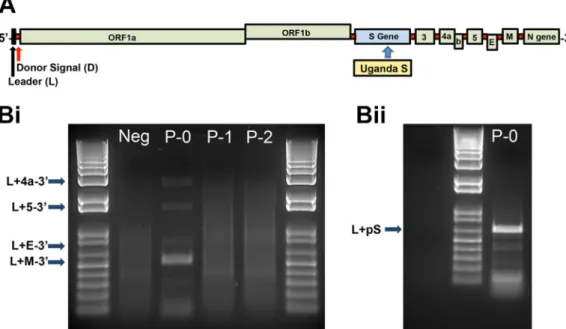
into Vero cells, PCR amplification of leader-containing transcripts for all of the expected
nested subgenomic (sg) mRNAs (including the sg spike mRNA) confirmed replication of
the recombinant virus (Fig. 4). However, subsequent passages by supernatant transfer
to uninfected monolayers failed to reproduce the infection, suggesting that the
PREDICT/PDF-2180 spike protein is unable to mediate cell entry in Vero cells as seen
with wild-type MERS-CoV (Fig. 4).
TABLE 2 Pairwise amino acid sequence identity of subunit 2 of spike protein of 2c CoVs
Accession no. and/or isolate
% identity Al-Hasa1
EMC-2012
NRC-HKU205 NeoCoV PDF-2180
EriCoV/ 2012/174
EriCoV/ 2012/216
BtCoV/
133 HKU4 HKU5-1 HKU5-5 SC2013
KF186567, Al-Hasa1 KC667074,
EMC-2012
99.7
KJ477102, NRC-HKU205
98.6 98.7
KC869678, NeoCoV
84.7 84.9 84.4
Predict/ PDF-2180
85.5 85.7 84.9 97.6
KC545383, EriCoV/2012/174
67.8 67.8 67.8 70.2 70.4
KC545386, EriCoV/2012/216
68.3 68.3 68.3 70.5 70.7 96.9
DQ648794, BtCoV/133
72.9 72.9 72.5 73.7 73.3 69.0 68.2
EF065505, BatCoV HKU4
73.0 73.0 72.7 73.8 73.5 69.0 68.3 98.4
EF065509, BatCoV HKU5-1
71.2 71.2 70.9 74.3 73.6 66.9 66.6 79.6 79.1
EF065512, BatCoV HKU5-5
71.7 71.7 71.4 74.5 73.9 66.9 66.6 79.9 79.4 97.9
KJ473821, SC2013
Supernatant from the transfected Vero cells (passage 0 [P0]) was also used to infect
primary human airway epithelial (HAE) cells, which were derived from lung donors with
no preexisting chronic disease. These well-differentiated primary cells are grown on an
air-liquid interface and represent an important model for viral infection of the human
MERS-CoV induces robust replication as measured by plaque assay and
viral-leader-containing transcripts. Together, the results indicate that the PREDICT/PDF-2180 spike
is not likely to efficiently replicate in the human airway without further adaptation.
DISCUSSION
The discovery of PREDICT/PDF-2180 in Uganda adds to the growing number of
group C betacoronaviruses that have now been identified in bats. These include
NeoCoV from South Africa (15), Mex_CoV-9 from Mexico (29), BatCoV/KW2E from
Thailand (30), P.pipi/VM314 from the Netherlands (31), H.sav/206645-40 from Italy (32),
and BetaCoV/SC2013, HKU4, and HKU5, all from China (33). Collectively, these examples
demonstrate that the MERS-related CoVs are highly associated with bats and are
geographically widespread.
FIG 4 Uganda spike protein does not permit entry into Vero cells. (A) Genome organization of MERS-CoV encoding the Uganda spike glycoprotein. (Bi) Reverse transcription-PCR detection of leader-containing nested subgenomic mRNAs encoding the nucleocapsid transcript, E transcript, and ORF5 and ORF4a transcripts (p0, RNA-transfected cells; p1, passage 1; p2, passage 2). (Bii) Reverse transcription-PCR amplification of leader-containing mRNA 2 containing the Uganda S gene. Note the loss of the leader-containing transcripts in p1 and p2, demonstrating the loss of infectivity associated with insertion of the Uganda S gene. Ladder, 1 kb.
The group 2c viruses appear to have a particular, though not exclusive, association
with vespertilionid bats, which form a highly diverse and widely distributed family
within the
Microchiroptera
. NeoCoV, SC2013, HKU4, HKU5, H.sav/206645-40, P.pipi/
VM314, and PREDICT/PDF-2180 were all found in species belonging to this family. If the
full diversity of 2c viruses reflects the number of vespertilionid species described (
n
⫽
475 species), there is potential for a substantial diversity of MERS-related viruses to be
circulating in bats.
Our data suggest that PREDICT/PDF-2180 cannot infect humans and is not likely to
pose a threat to human health, at least in its current form. The spike protein of this virus
is distinct from the MERS-CoV spike, sharing only 46% amino acid identity, and it
appears unable to enter cells that express the functional receptor used by MERS-CoV
(DPP4)— or any other receptor expressed by either primate Vero cells or human airway
epithelial cells. Importantly, failure to assemble and release viral particles from the
initial infection could also explain our results; however, we suggest that receptor
incompatibility is more likely given the steps taken to minimize particle disruption (see
Materials and Methods). These results suggest that adaptation of the spike would be
required to permit PREDICT/PDF-2180 replication in human airways. While we did not
examine the specific binding properties of the related virus NeoCoV, the high amino
acid sequence identity with PREDICT/PDF-2180 indicates that it shares a similar
phe-notype and is most likely also refractory for human infections.
Our data suggest that RNA recombination is the mechanism that underlies the
observed difference in receptor binding. Recombination can occur at high frequency
during mixed coronavirus infection, allowing different viral lineages to exchange
specific functional motifs or even entire genes (22, 34, 35). Phylogenetic incongruence
was noted in subunit 1 of the spike protein, and breakpoints were observed in this
same region by multiple recombination detection algorithms. It is also parsimonious
with the high purifying selection observed across the genome of 2c viruses (which
argues against receptor adaptation via drift or selection) and with previous reports
citing recombination in association with host switching for other coronaviruses (36–38).
Given that the recombination is observed in both PREDICT/PDF-2180 and NeoCoV, we
support the previous suggestion by Corman et al. (15) that it was the MERS-CoV that
acquired a new spike. Given also that the PREDICT/PDF-2180 spike does not use DPP4
and is seemingly not competent for human infection, we further suggest that the
recombination event was the critical factor driving the emergence of MERS-CoV.
What is less clear is whether this recombination occurred in bats or an intermediate
host. Lineage 2c strains that use DPP4 have been reported in bats (25, 26), and there
is also evidence of positive selection in the bat DPP4 that would indicate the existence
of a large diversity of (as-yet-unknown) DPP4-competent strains (39). Just as detailed
metagenomics studies have revealed the presence of several severe acute respiratory
syndrome (SARS)-like bat CoVs that can use the human angiotensin converting enzyme
2 receptor and/or replicate efficiently in human cells (23, 24, 40–42), it seems likely that
subsets of diverse MERS-CoV-like bat coronaviruses will also exist which are
prepro-grammed to efficiently use the human DPP4 receptor. This would support the
hypoth-esis that the recombination occurred in bats; however, the MERS-CoV spike seems to
have adapted and acquired a preference for human DPP4 over the bat homologue (26,
43) making it difficult to conclude with certainty that the MERS-CoV spike has bat
origins. Increased surveillance will be required to understand the full diversity of spike
phenotypes circulating in bats or in intermediate hosts such as camels.
characterizing the zoonotic potential of viral sequences detected in wildlife. Doing so
on a large scale (for example, as part of projects like USAID PREDICT) will also provide
critical information on host and geographic variation in key viral traits, like potential
host tropism, which are currently missing from most risk-based models forecasting hot
spots of disease emergence.
MATERIALS AND METHODS
Sampling.A bat (ID OTBA03-20130220) was trapped on 20 February 2013 in the Nkuringo area of Kisoro District in southwestern Uganda. The bat was caught with a mist net (3.8-mm mesh; Avinet, Inc.) according to established protocols and was released unharmed postsampling. Standard morphometric measurements (weight and forearm length) and photographs were obtained to aid species identification, which was confirmed by DNA barcoding of the cytochromeb(Cytb) and cytochrome oxidase subunit 1 (CO1) mitochondrial DNA genes (52). Approximately 200l of whole blood was collected into EDTA. Oral and rectal swabs were also collected in duplicate (one into viral transport medium and one dry). Specimens were stored temporarily on gel packs and frozen in liquid nitrogen in the field within 4 h of collection and then transferred to⫺80°C for storage until testing. Samples were transferred to the Center for Infection and Immunity at Columbia University for viral discovery and characterization.
Coronavirus discovery by consensus PCR.Total nucleic acid (TNA) was extracted using the Roche MagNA Pure 96 platform according to the manufacturer’s instructions. TNA was reverse transcribed into cDNA using SuperScript III (Invitrogen) according to the manufacturer’s instructions. Two broadly reactive consensus PCR assays targeting partial and nonoverlapping regions of the coronavirus ORF1b (containing the RdRp) were performed (53, 54). Bands of the expected size were excised from 1% agarose, cloned into Strataclone PCR cloning vector, and sequenced to confirm detection.
Sequencing and bioinformatic processing.Total RNA extract was DNase treated (DNase I; Ambion, Life Technologies, Inc.) and reverse transcribed using SuperScript III (Invitrogen, Life Technologies, Inc.) with random hexamer primers. The cDNA was RNase H treated before second-strand synthesis with Klenow fragment (3=to 5=exonuclease) (New England Biolabs). The resulting double-stranded cDNA was sheared to 200-bp (average) fragments using a Covaris focused ultrasonicator E210, according to the manufacturer’s standard settings, and used for library construction using the Kapa Hyper library preparation kit (Kapa Biosystems, Roche), again according to the manufacturer’s instructions. The final library was quantified using an Agilent Bioanalyzer 2100 and pooled to allocate 20 million reads on the Illumina HiSeq 2500 platform.
The Q30-filtered FastQ files were used to generate quality control reports using PRINSEQ software (v0.20.2) (55) and were further filtered and trimmed. Host background levels were determined by mapping the filtered reads against a bat reference database using Bowtie2 mapper (v2.0.6,http://bowtie -bio.sourceforge.net) (56). The host-subtracted reads werede novoassembled using MIRA assembler (v4.0) (57). Contigs and unique singletons were subjected to homology search using MegaBlast against the GenBank nucleotide database. Sequences that showed poor or no homology at the nucleotide level were screened by BLASTX against the viral GenBank protein database. Viral sequences from BLASTX analysis were subjected to another round of BLASTX homology search against the entire GenBank protein database to correct for biased E values and taxonomic misassignments. The genome of PREDICT/PDF-2180 was mapped with Bowtie2 against the filtered data set to visualize depth and coverage in Integrated Genomics Viewer.
Genetic and phylogenetic analyses.Sequences were analyzed and edited using Geneious (version 6.0.3). Full genome and individual gene sequences were aligned with ClustalW, and maximum likelihood phylogenetic trees were constructed in PAUP*(500 bootstraps). Models of nucleotide substitution were selected using jModelTest. Nucleotide sequence similarity between MERS-like viruses was assessed using Simplot v3.5.1 (58) with a sliding window size of 500 bp, a step size of 50 nucleotides, and 1,000 bootstrap replicates using gap-stripped alignments and the F84 (maximum likelihood) distance model. The full-genome alignment was scanned for recombination using seven different algorithms (RDP, GENECONV, Bootscan, MaxChi, Chimaera, SiScan, and 3seq) implemented in RDP (v4.46) (59).
Structural modeling.Predicted binding differences between DPP4 and either MERS or Uganda were determined by structural analysis. The crystal structure demonstrating the interactions between DPP4 and MERS spike binding domain has previously been reported (28), and the crystal structure is PDB ID 4KR0. We created a homology model of the region of the Uganda spike protein homologous to the MERS spike binding domain based on the4KR0structure in association with DPP4. We first aligned the amino acid sequences for4KR0(28) and the Uganda spike using Clustal Omega (60). We then used MODELLER (61) to create predicted structural coordinates for the Uganda spike based on the coordinates of4KR0. Because MODELLER requires the two sequences to be the same length, we introduced gaps in the sequences where appropriate to maintain the best sequence identity between the 2 amino acid sequences. Numbering is based on MERS-CoV amino acid residues. We then imported the predicted crystal structure for Uganda and the known DPP4-MERS structure into PyMOL (62) for visualization and comparative analysis. Hydrogen bonding interactions were predicted by selecting the known DPP4 and 4KR0or the homologous DPP4 and Uganda interaction sites and using the “find polar interactions” function within PyMOL.
and ORF2 overlap, so to maintain a functional replicase sequence and signal sequence for spike, the first 20 amino acids of the MERS spike were retained and the PREDICT/PDF-2180 sequence was fused in frame downstream of the MERS-CoV S glycoprotein signal peptidase domain beginning at its 24th amino acid. In short, the sequence of the MERS spike coding for amino acids 21 to 1306 was replaced with the sequence of the PREDICT/PDF-2180 spike coding for amino acids 24 to 1298, so that following process-ing, an intact spike glycoprotein was expressed during virus infection. The E and F plasmids were sequence verified prior to the assembly of full-length recombinant DNAs.
The MERS A through F inserts (containing the Uganda S gene) were restriction digested, resolved on 0.8% agarose gels, visualized, excised, and purified using a QIAquick gel extraction kit (Qiagen). The MERS A to F inserts were mixed and ligated overnight at 4°C, phenol-chloroform extracted, and precipitated under isopropyl alcohol. Full-length T7 transcripts were generatedin vitroas described by the manu-facturer (Ambion; mMessage mMachine) with certain modifications (63). For MERS-CoV N transcripts, 1g of plasmid DNA containing the N gene (amplified using forward primer 5=-ATTTAGGTGACACTAT AGATGGCATCCCCTGCTGCACC-3=and reverse primer 5=-TTTTTTTTTTTTTTTTTTTTTTCTAATCAGTGTTAACA TCAATCATTGG-3=) was transcribed by SP6 RNA polymerase with a 4:1 ratio of cap analog to GTP. RNA transcripts were added to 800l of Vero cell suspension (8.0⫻106cells) in an electroporation cuvette,
and four electrical pulses of 450 V at 50F were delivered with a Gene Pulser II electroporator (Bio-Rad). The transfected Vero cells were allowed to recover for 10 min at room temperature and then incubated at 37°C for 2 to 4 days in a 75-cm2flask. Virus progeny were then passaged several times in Vero cells
or primary human airway epithelial cells for 48 h to detect viable viruses. All viruses were maintained under biosafety level 3 (BSL3) conditions with redundant fans, and personnel used powered air-purifying respirators (PAPRs) and Tyvek suits.
To detect leader-containing RNAs, intracellular RNA from wild type and recombinant MERS-CoV-Uganda (rMERS-CoV-MERS-CoV-Uganda) was reverse transcribed with a primer at the 3=end of the genome and cDNA was isolated for PCR using a reverse primer located in ORF5 and a forward primer located in the leader RNA sequence at the 5= end of the genome (5=-CTATCTCACTTCCCCTCGTTCTC-3=). Leader-containing amplicons were sequenced as previously described (64). The cDNA products were separated and visualized in 0.8% agarose gels.
Viruses, cells, and infection.Wild-type and chimeric CoVs were cultured on Vero E6 cells, grown in Dulbecco modified Eagle medium (DMEM) (Gibco, Carlsbad, CA) and 5% fetal clone serum (HyClone, South Logan, UT) along with antibiotic-antimycotic (anti-anti; Gibco, Carlsbad, CA). Growth curves in Vero and primary human airway epithelial cells were performed as previously described (65, 66). Human lungs were procured under University of North Carolina at Chapel Hill Institutional Review Board-approved protocols.
Biosafety and biosecurity.Reported studies were initiated after the NIH and the University of North Carolina Institutional Biosafety Committee approved the experimental protocol (project title, Generating Infectious Clones of Bat SARS-like CoVs; lab safety plan ID, 20167715; schedule G ID, 19982).
Accession number(s).The near-complete genome sequence for PREDICT/PDF-2180 has been de-posited in GenBank under accession number KX574227.
ACKNOWLEDGMENTS
We thank Nancy Simmons (American Museum of Natural History) and Carlos
Zam-brana (EcoHealth Alliance) for help with species identification. We also thank Komal Jain
for bioinformatic assistance (Columbia University) and Bernard Erima, Titus Tugume,
and Raymond Mayanja (all from Makerere University) for processing samples.
This study was made possible by the support of the American people through the
United States Agency for International Development (USAID) Emerging Pandemic
Threats PREDICT project (cooperative agreement number GHN-A-OO-09-00010-00) and
by support from the National Institutes of Allergy and Infectious Disease (AI109761 and
AI110700) and Aging (K99AG049092). Human airway epithelial cell cultures were
supported by the National Institute of Diabetes and Digestive and Kidney Diseases
(DK065988).
REFERENCES
1. Zaki AM, van Boheemen S, Bestebroer TM, Osterhaus AD, Fouchier RA. 2012. Isolation of a novel coronavirus from a man with pneumonia in Saudi Arabia. N Engl J Med 367:1814 –1820.https://doi.org/10.1056/ NEJMoa1211721.
2. Woo PC, Lau SK, Li KS, Tsang AK, Yuen KY. 2012. Genetic relatedness of the novel human group C betacoronavirus to Tylonycteris bat corona-virus HKU4 and Pipistrellus bat coronacorona-virus HKU5. Emerg Microbes Infect 1:e35.https://doi.org/10.1038/emi.2012.45.
3. Reusken CB, Haagmans BL, Müller MA, Gutierrez C, Godeke GJ, Meyer B, Muth D, Raj VS, Smits-De Vries L, Corman VM, Drexler JF, Smits SL, El Tahir YE, De Sousa R, van Beek J, Nowotny N, van Maanen K, Hidalgo-Hermoso E, Bosch BJ, Rottier P, Osterhaus A, Gortázar-Schmidt C, Dro-sten C, Koopmans MP. 2013. Middle East respiratory syndrome
corona-virus neutralising serum antibodies in dromedary camels: a comparative serological study. Lancet Infect Dis 13:859 – 866.https://doi.org/10.1016/ S1473-3099(13)70164-6.
4. Azhar EI, El-Kafrawy SA, Farraj SA, Hassan AM, Al-Saeed MS, Hashem AM, Madani TA. 2014. Evidence for camel-to-human transmission of MERS coronavirus. N Engl J Med 370:2499 –2505. https://doi.org/10.1056/ NEJMoa1401505.
6. Chu DK, Poon LL, Gomaa MM, Shehata MM, Perera RA, Abu Zeid D, El Rifay AS, Siu LY, Guan Y, Webby RJ, Ali MA, Peiris M, Kayali G. 2014. MERS coronaviruses in dromedary camels, Egypt. Emerg Infect Dis 20: 1049 –1053.https://doi.org/10.3201/eid2006.140299.
7. Reusken CB, Messadi L, Feyisa A, Ularamu H, Godeke GJ, Danmarwa A, Dawo F, Jemli M, Melaku S, Shamaki D, Woma Y, Wungak Y, Gebremedhin EZ, Zutt I, Bosch BJ, Haagmans BL, Koopmans MP. 2014. Geographic distri-bution of MERS coronavirus among dromedary camels, Africa. Emerg Infect Dis 20:1370 –1374.https://doi.org/10.3201/eid2008.140590.
8. Corman VM, Jores J, Meyer B, Younan M, Liljander A, Said MY, Gluecks I, Lattwein E, Bosch BJ, Drexler JF, Bornstein S, Drosten C, Müller MA. 2014. Antibodies against MERS coronavirus in dromedary camels, Kenya, 1992–2013. Emerg Infect Dis 20:1319 –1322.https://doi.org/10.3201/ eid2008.140596.
9. Müller MA, Corman VM, Jores J, Meyer B, Younan M, Liljander A, Bosch BJ, Lattwein E, Hilali M, Musa BE, Bornstein S, Drosten C. 2014. MERS coronavirus neutralizing antibodies in camels, eastern Africa, 1983–1997. Emerg Infect Dis 20:2093–2095.https://doi.org/10.3201/eid2012.141026. 10. Alagaili AN, Briese T, Mishra N, Kapoor V, Sameroff SC, Burbelo PD, de Wit E, Munster VJ, Hensley LE, Zalmout IS, Kapoor A, Epstein JH, Karesh WB, Daszak P, Mohammed OB, Lipkin WI. 2014. Middle East respiratory syndrome coronavirus infection in dromedary camels in Saudi Arabia. mBio 5:e00884-14.https://doi.org/10.1128/mBio.00884-14.
11. Azhar EI, Hashem AM, El-Kafrawy SA, Sohrab SS, Aburizaiza AS, Farraj SA, Hassan AM, Al-Saeed MS, Jamjoom GA, Madani TA. 2014. Detection of the Middle East respiratory syndrome coronavirus genome in an air sample originating from a camel barn owned by an infected patient. mBio 5:e01450-14.https://doi.org/10.1128/mBio.01450-14.
12. Müller MA, Meyer B, Corman VM, Al-Masri M, Turkestani A, Ritz D, Sieberg A, Aldabbagh S, Bosch B, Lattwein E, Alhakeem RF, Assiri AM, Albarrak AM, Al-Shangiti AM, Al-Tawfiq JA, Wikramaratna P, Alrabeeah AA, Drosten C, Memish ZA. 2015. Presence of Middle East respiratory syndrome coronavirus antibodies in Saudi Arabia: a nationwide, cross-sectional, serological study. Lancet Infect Dis 15:559 –564.https://doi .org/10.1016/S1473-3099(15)70090-3.
13. Woo PC, Lau SK, Li KS, Poon RW, Wong BH, Tsoi HW, Yip BC, Huang Y, Chan KH, Yuen KY. 2006. Molecular diversity of coronaviruses in bats. Virology 351:180 –187.https://doi.org/10.1016/j.virol.2006.02.041. 14. Ithete NL, Stoffberg S, Corman VM, Cottontail VM, Richards LR,
Schoe-man MC, Drosten C, Drexler JF, Preiser W. 2013. Close relative of huSchoe-man Middle East respiratory syndrome coronavirus in bat, South Africa. Emerg Infect Dis 19:1697–1699.https://doi.org/10.3201/eid1910.130946. 15. Corman VM, Ithete NL, Richards LR, Schoeman MC, Preiser W, Drosten C, Drexler JF. 2014. Rooting the phylogenetic tree of Middle East respira-tory syndrome coronavirus by characterization of a conspecific virus from an African bat. J Virol 88:11297–11303.https://doi.org/10.1128/JVI .01498-14.
16. Gallagher TM, Buchmeier MJ. 2001. Coronavirus spike proteins in viral entry and pathogenesis. Virology 279:371–374.https://doi.org/10.1006/ viro.2000.0757.
17. Lu G, Wang Q, Gao GF. 2015. Bat-to-human: spike features determining “host jump” of coronaviruses SARS-CoV, MERS-CoV, and beyond. Trends Microbiol 23:468 – 478.https://doi.org/10.1016/j.tim.2015.06.003. 18. Millet JK, Whittaker GR. 2015. Host cell proteases: critical determinants of
coronavirus tropism and pathogenesis. Virus Res 202:120 –134.https:// doi.org/10.1016/j.virusres.2014.11.021.
19. Martí-Renom MA, Stuart AC, Fiser A, Sánchez R, Melo F, Sali A. 2000. Comparative protein structure modeling of genes and genomes. Annu Rev Biophys Biomol Struct 29:291–325.https://doi.org/10.1146/annurev .biophys.29.1.291.
20. Szilagyi A, Zhang Y. 2014. Template-based structure modeling of protein-protein interactions. Curr Opin Struct Biol 24:10 –23.https://doi .org/10.1016/j.sbi.2013.11.005.
21. Rockx B, Sheahan T, Donaldson E, Harkema J, Sims A, Heise M, Pickles R, Cameron M, Kelvin D, Baric R. 2007. Synthetic reconstruction of zoonotic and early human severe acute respiratory syndrome coronavirus isolates that produce fatal disease in aged mice. J Virol 81:7410 –7423.https:// doi.org/10.1128/JVI.00505-07.
22. Becker MM, Graham RL, Donaldson EF, Rockx B, Sims AC, Sheahan T, Pickles RJ, Corti D, Johnston RE, Baric RS, Denison MR. 2008. Synthetic recombinant bat SARS-like coronavirus is infectious in cultured cells and in mice. Proc Natl Acad Sci U S A 105:19944 –19949.https://doi.org/10 .1073/pnas.0808116105.
23. Menachery VD, Yount BL, Debbink K, Agnihothram S, Gralinski LE, Plante
JA, Graham RL, Scobey T, Ge XY, Donaldson EF, Randell SH, Lanzavecchia A, Marasco WA, Shi ZL, Baric RS. 2015. A SARS-like cluster of circulating bat coronaviruses shows potential for human emergence. Nat Med 21:1508 –1513.https://doi.org/10.1038/nm.3985.
24. Menachery VD, Yount BL, Sims AC, Debbink K, Agnihothram SS, Gralinski LE, Graham RL, Scobey T, Plante JA, Royal SR, Swanstrom J, Sheahan TP, Pickles RJ, Corti D, Randell SH, Lanzavecchia A, Marasco WA, Baric RS. 2016. SARS-like WIV1-CoV poised for human emergence. Proc Natl Acad Sci U S A 113:3048 –3053.https://doi.org/10.1073/pnas.1517719113. 25. Wang Q, Qi J, Yuan Y, Xuan Y, Han P, Wan Y, Ji W, Li Y, Wu Y, Wang J,
Iwamoto A, Woo PC, Yuen KY, Yan J, Lu G, Gao GF. 2014. Bat origins of MERS-CoV supported by bat coronavirus HKU4 usage of human receptor CD26. Cell Host Microbe 16:328 –337.https://doi.org/10.1016/j.chom .2014.08.009.
26. Yang Y, Du L, Liu C, Wang L, Ma C, Tang J, Baric RS, Jiang S, Li F. 2014. Receptor usage and cell entry of bat coronavirus HKU4 provide insight into bat-to-human transmission of MERS coronavirus. Proc Natl Acad Sci U S A 111:12516 –12521.https://doi.org/10.1073/pnas.1405889111. 27. Raj VS, Mou H, Smits SL, Dekkers DHW, Müller MA, Dijkman R, Muth D,
Demmers JAA, Zaki A, Fouchier RAM, Thiel V, Drosten C, Rottier PJM, Osterhaus ADME, Bosch BJ, Haagmans BL. 2013. Dipeptidyl peptidase 4 is a functional receptor for the emerging human coronavirus-EMC. Nature 495:251–254.https://doi.org/10.1038/nature12005.
28. Lu G, Hu Y, Wang Q, Qi J, Gao F, Li Y, Zhang Y, Zhang W, Yuan Y, Bao J, Zhang B, Shi Y, Yan J, Gao GF. 2013. Molecular basis of binding between novel human coronavirus MERS-CoV and its receptor CD26. Nature 500:227–231.https://doi.org/10.1038/nature12328.
29. Anthony SJ, Ojeda-Flores R, Rico-Chávez O, Navarrete-Macias I, Zambrana-Torrelio CM, Rostal MK, Epstein JH, Tipps T, Liang E, Sanchez-Leon M, Sotomayor-Bonilla J, Aguirre AA, Ávila-Flores R, Medellin RA, Goldstein T, Suzán G, Daszak P, Lipkin WI. 2013. Coronaviruses in bats from Mexico. J Gen Virol 94:1028 –1038. https://doi.org/10.1099/vir.0 .049759-0.
30. Wacharapluesadee S, Sintunawa C, Kaewpom T, Khongnomnan K, Olival KJ, Epstein JH, Rodpan A, Sangsri P, Intarut N, Chindamporn A, Suksawa K, Hemachudha T. 2013. Group C betacoronavirus in bat guano fertilizer, Thailand. Emerg Infect Dis 19:1349 –1351. https://doi.org/10.3201/ eid1908.130119.
31. Reusken CBEM, Lina PHC, Pielaat A, de Vries A, Dam-Deisz C, Adema J, Drexler JF, Drosten C, Kooi EA. 2010. Circulation of group 2 coronavi-ruses in a bat species common to urban areas in Western Europe. Vector Borne Zoonotic Dis 10:785–791.https://doi.org/10.1089/vbz.2009.0173. 32. Lelli D, Papetti A, Sabelli C, Rosti E, Moreno A, Boniotti MB. 2013. Detection of coronaviruses in bats of various species in Italy. Viruses 5:2679 –2689.https://doi.org/10.3390/v5112679.
33. Woo PCY, Wang M, Lau SK, Xu H, Poon RW, Guo R, Wong BH, Gao K, Tsoi HW, Huang Y, Li KS, Lam CS, Chan KH, Zheng BJ, Yuen KY. 2007. Comparative analysis of twelve genomes of three novel group 2c and group 2d coronaviruses reveals unique group and subgroup features. J Virol 81:1574 –1585.https://doi.org/10.1128/JVI.02182-06.
34. Baric RS, Fu K, Schaad MC, Stohlman SA. 1990. Establishing a genetic recombination map for murine coronavirus strain A59 complementation groups. Virology 177:646 – 656. https://doi.org/10.1016/0042 -6822(90)90530-5.
35. Banner LR, Keck JG, Lai MM. 1990. A clustering of RNA recombination sites adjacent to a hypervariable region of the peplomer gene of murine coronavirus. Virology 175:548 –555. https://doi.org/10.1016/0042 -6822(90)90439-X.
36. Du J, Yang L, Ren X, Zhang J, Dong J, Sun L, Zhu Y, Yang F, Zhang S, Wu Z, Jin Q. 2016. Genetic diversity of coronaviruses in Miniopterus fuligi-nosus bats. Sci China Life Sci 59:604 – 614. https://doi.org/10.1007/ s11427-016-5039-0.
37. Lau SK, Feng Y, Chen H, Luk HK, Yang WH, Li KS, Zhang YZ, Huang Y, Song ZZ, Chow WN, Fan RY, Ahmed SS, Yeung HC, Lam CS, Cai JP, Wong SS, Chan JF, Yuen KY, Zhang HL, Woo PC. 2015. Severe acute respiratory syndrome (SARS) coronavirus ORF8 protein is acquired from SARS-related coronavirus from greater horseshoe bats through recombina-tion. J Virol 89:10532–10547.https://doi.org/10.1128/JVI.01048-15. 38. Woo PC, Lau SK, Huang Y, Yuen KY. 2009. Coronavirus diversity,
phylog-eny and interspecies jumping. Exp Biol Med (Maywood) 234:1117–1127. https://doi.org/10.3181/0903-MR-94.
emer-gence of Middle East respiratory syndrome coronavirus. Virol J 10:304. https://doi.org/10.1186/1743-422X-10-304.
40. Zeng LP, Gao YT, Ge XY, Zhang Q, Peng C, Yang XL, Tan B, Chen J, Chmura AA, Daszak P, Shi ZL. 2016. Bat severe acute respiratory syndrome-like coronavirus WIV1 encodes an extra accessory protein, ORFX, involved in modulation of the host immune response. J Virol 90:6573– 6582.https://doi.org/10.1128/JVI.03079-15.
41. Yang XL, Hu B, Wang B, Wang MN, Zhang Q, Zhang W, Wu LJ, Ge XY, Zhang YZ, Daszak P, Wang LF, Shi ZL. 2015. Isolation and characteriza-tion of a novel bat coronavirus closely related to the direct progenitor of severe acute respiratory syndrome coronavirus. J Virol 90:3253–3256. https://doi.org/10.1128/JVI.02582-15.
42. Ge XY, Li JL, Yang XL, Chmura AA, Zhu G, Epstein JH, Mazet JK, Hu B, Zhang W, Peng C, Zhang YJ, Luo CM, Tan B, Wang N, Zhu Y, Crameri G, Zhang SY, Wang LF, Daszak P, Shi ZL. 2013. Isolation and characteriza-tion of a bat SARS-like coronavirus that uses the ACE2 receptor. Nature 503:535–538.https://doi.org/10.1038/nature12711.
43. Barlan A, Zhao J, Sarkar MK, Li K, McCray PB, Perlman S, Gallagher T. 2014. Receptor variation and susceptibility to Middle East respiratory syndrome coronavirus infection. J Virol 88:4953– 4961.https://doi.org/ 10.1128/JVI.00161-14.
44. PREDICT Consortium. 2014. Reducing pandemic risk, promoting global health. One Health Institute, University of California, Davis, CA. 45. Anthony SJ, Epstein JH, Murray KA, Navarrete-Macias I,
Zambrana-Torrelio CM, Solovyov A, Ojeda-Flores R, Arrigo NC, Islam A, Ali Khan S, Hosseini P, Bogich TL, Olival KJ, Sanchez-Leon MD, Karesh WB, Goldstein T, Luby SP, Morse SS, Mazet JA, Daszak P, Lipkin WI. 2013. A strategy to estimate unknown viral diversity in mammals. mBio 4:e00598-13. https://doi.org/10.1128/mBio.00598-13.
46. Anthony SJ, Islam A, Johnson C, Navarrete-Macias I, Liang E, Jain K, Hitchens PL, Che X, Soloyvov A, Hicks AL, Ojeda-Flores R, Zambrana-Torrelio C, Ulrich W, Rostal MK, Petrosov A, Garcia J, Haider N, Wolfe N, Goldstein T, Morse SS, Rahman M, Epstein JH, Mazet JK, Daszak P, Lipkin WI. 2015. Non-random patterns in viral diversity. Nat Commun 6:8147. https://doi.org/10.1038/ncomms9147.
47. Wacharapluesadee S, Duengkae P, Rodpan A, Kaewpom T, Maneeorn P, Kanchanasaka B, Yingsakmongkon S, Sittidetboripat N, Chareesaen C, Khlangsap N, Pidthong A, Leadprathom K, Ghai S, Epstein JH, Daszak P, Olival KJ, Blair PJ, Callahan MV, Hemachudha T. 2015. Diversity of coronavirus in bats from Eastern Thailand. Virol J 12:57.https://doi.org/ 10.1186/s12985-015-0289-1.
48. Seimon TA, Olson SH, Lee KJ, Rosen G, Ondzie A, Cameron K, Reed P, Anthony SJ, Joly DO, Karesh WB, McAloose D, Lipkin WI. 2015. Adeno-virus and herpesAdeno-virus diversity in free-ranging great apes in the Sangha region of the Republic of Congo. PLoS One 10:e0118543.https://doi.org/ 10.1371/journal.pone.0118543.
49. Hu B, Chmura AA, Li J, Zhu G, Desmond JS, Zhang Y, Zhang W, Epstein JH, Daszak P, Shi Z. 2014. Detection of diverse novel astroviruses from small mammals in China. J Gen Virol 95:2442–2449.https://doi.org/10 .1099/vir.0.067686-0.
50. Daszak P, Lipkin WI. 2011. The search for meaning in virus discovery. Curr Opin Virol 1:620 – 623.https://doi.org/10.1016/j.coviro.2011.10.010. 51. Morse SS, Mazet JA, Woolhouse M, Parrish CR, Carroll D, Karesh WB,
Zambrana-Torrelio C, Lipkin WI, Daszak P. 2012. Prediction and preven-tion of the next pandemic zoonosis. Lancet 380:1956 –1965.https://doi .org/10.1016/S0140-6736(12)61684-5.
52. Townzen JS, Brower AV, Judd DD. 2008. Identification of mosquito bloodmeals using mitochondrial cytochrome oxidase subunit I and
cytochromebgene sequences. Med Vet Entomol 22:386 –393.https:// doi.org/10.1111/j.1365-2915.2008.00760.x.
53. Quan P-L, Firth C, Street C, Henriquez JA, Petrosov A, Tashmukhamedova A, Hutchison SK, Egholm M, Osinubi MOV, Niezgoda M, Ogunkoya AB, Briese T, Rupprecht CE, Lipkin WI. 2010. Identification of a severe acute respiratory syndrome coronavirus-like virus in a leaf-nosed bat in Nige-ria. mBio 1:e00208-10.https://doi.org/10.1128/mBio.00208-10. 54. Watanabe S, Masangkay JS, Nagata N, Morikawa S, Mizutani T, Fukushi S,
Alviola P, Omatsu T, Ueda N, Iha K, Taniguchi S, Fujii H, Tsuda S, Endoh M, Kato K, Tohya Y, Kyuwa S, Yoshikawa Y, Akashi H. 2010. Bat corona-viruses and experimental infection of bats, the Philippines. Emerg Infect Dis 16:1217–1223.https://doi.org/10.3201/Eid1608.100208.
55. Schmieder R, Edwards R. 2011. Quality control and preprocessing of metagenomic datasets. Bioinformatics 27:863– 864. https://doi.org/10 .1093/bioinformatics/btr026.
56. Langmead B, Salzberg SL. 2012. Fast gapped-read alignment with bow-tie 2. Nat Methods 9:357–359.https://doi.org/10.1038/nmeth.1923. 57. Chevreux B, Wetter T, Suhai S. 1999. Genome sequence assembly using
trace signals and additional sequence information, p 45–56.In Wingen-der E (ed), Computer science and biology: proceedings of the German Conference on Bioinformatics, GCB ’99; October 4 – 6, 1999, Hannover, Germany.
58. Lole KS, Bollinger RC, Paranjape RS, Gadkari D, Kulkarni SS, Novak NG, Ingersoll R, Sheppard HW, Ray SC. 1999. Full-length human immunode-ficiency virus type 1 genomes from subtype C-infected seroconverters in India, with evidence of intersubtype recombination. J Virol 73:152–160. 59. Martin DP, Murrell B, Golden M, Khoosal A, Muhire B. 2015. RDP4: detection and analysis of recombination patterns in virus genomes. Virus Evol 1:vev003.https://doi.org/10.1093/ve/vev003.
60. Sievers F, Wilm A, Dineen D, Gibson TJ, Karplus K, Li W, Lopez R, McWilliam H, Remmert M, Söding J, Thompson JD, Higgins DG. 2011. Fast, scalable generation of high-quality protein multiple sequence alignments using Clustal Omega. Mol Syst Biol 7:539.https://doi.org/10 .1038/msb.2011.75.
61. Webb B, Sali A. 2014. Comparative protein structure modeling using MODELLER. Curr Protoc Bioinformatics 47:5.6.1–5.6.32.https://doi.org/ 10.1002/0471250953.bi0506s47.
62. Schrödinger LLC. 2015. The PyMOL molecular graphics system, version 1.8. Schrödinger LLC, New York, NY.
63. Scobey T, Yount BL, Sims AC, Donaldson EF, Agnihothram SS, Menachery VD, Graham RL, Swanstrom J, Bove PF, Kim JD, Grego S, Randell SH, Baric RS. 2013. Reverse genetics with a full-length infectious cDNA of the Middle East respiratory syndrome coronavirus. Proc Natl Acad Sci U S A 110:16157–16162.https://doi.org/10.1073/pnas.1311542110.
64. Yount B, Roberts RS, Lindesmith L, Baric RS. 2006. Rewiring the severe acute respiratory syndrome coronavirus (SARS-CoV) transcription circuit: engineering a recombination-resistant genome. Proc Natl Acad Sci U S A 103:12546 –12551.https://doi.org/10.1073/pnas.0605438103.
65. Sims AC, Tilton SC, Menachery VD, Gralinski LE, Schäfer A, Matzke MM, Webb-Robertson BJ, Chang J, Luna ML, Long CE, Shukla AK, Bankhead AR, Burkett SE, Zornetzer G, Tseng CT, Metz TO, Pickles R, McWeeney S, Smith RD, Katze MG, Waters KM, Baric RS. 2013. Release of severe acute respiratory syndrome coronavirus nuclear import block enhances host transcription in human lung cells. J Virol 87:3885–3902.https://doi.org/ 10.1128/JVI.02520-12.
![FIG 1 Map showing the distribution of Pipistrellus hesperidus (based on International Union for Conservation of Nature [IUCN] data) and the location of the bat sampled for the study.](https://thumb-us.123doks.com/thumbv2/123dok_us/8287256.2194554/3.877.74.538.105.531/showing-distribution-pipistrellus-hesperidus-international-conservation-nature-location.webp)