THE THERMONUCLEAR RUNAWAY AND THE CLASSICAL NOVA OUTBURST
S. STARRFIELD1, C. ILIADIS2, W. R. HIX3
1
School of Earth and Space Exploration, Arizona State University, Tempe, AZ 85287-1404: [email protected] 2Department of Physics and Astronomy, University of North Carolina, Chapel Hill, NC27599-3255: [email protected] 3
Physics Division, Oak Ridge National Laboratory, Oak Ridge, TN 37831-6354 & Department of Physics and Astronomy, University of Tennessee, Knoxville, TN 37996-1200: [email protected]
ABSTRACT
Nova explosions occur on the white dwarf component of a Cataclysmic Variable binary stellar system that is accreting matter lost by its companion. When sufficient material has been accreted by the white dwarf, a thermonuclear runaway occurs and ejects material in what is observed as a Classical Nova explosion. We describe both the recent advances in our understanding of the progress of the outburst and outline some of the puzzles that are still outstanding. We report on the effects of improving both the nuclear reaction rate library and including a modern nuclear reaction network in our one-dimensional, fully implicit, hydrodynamic computer code. In addition, there has been progress in observational studies of Supernovae Ia with implications about the progenitors and we discuss that in this review.
1. INTRODUCTION
The Classical Nova (CN) outburst is one consequence of the accretion of hydrogen-rich material onto a white dwarf (WD) in a close binary system. Over long periods of time, the material being accreted from the secondary star forms a layer of nuclear fuel on the WD. The bottom of this layer is gradually compressed by the surface gravity of the WD and ultimately it becomes electron degenerate. The degeneracy of the material acts to prevent the material from expanding even as the temperatures increase from both compression and nuclear fusion. Once the temperature at the bottom of the accreted layer reaches the Fermi temperature (∼7×10⁷K) the material can expand but by this time the temperature is increasing so rapidly that a thermonuclear runaway
(TNR) results. As a result the temperatures in the nuclear burning region will exceed 108K for the lowest mass WDs (∼0.6M) and possibly reach∼4×10⁸K for WDs near the Chandrasekhar Limit. Further, a major fraction of the nuclei in the envelope
capable of capturing a proton (CNONeMg...) are transformed intoβ+-unstable nuclei (13N,14O,15O,17F). Theβ+-decay time scales limit nuclear energy generation on the dynamical timescale of the TNR (a few hundred seconds) and their decays at late times produce extremely non-solar CNO isotopic abundance ratios in the ejected gases.
Observations of the outburst show that a CN explosively ejects metal enriched gas and this material is a source of heavy elements for the Interstellar Medium (ISM). In some CNe grains form in the ejecta once the expanding gas has cooled to temper-atures of∼1500K some 50 to 100 days into the outburst (Starrfield et al. 1997;Gehrz et al. 1998;José et al. 2004). The observed amount of metal enrichment in the ejected gases demands that mixing of the accreted material with core material occur at some time during the evolution of the outburst. The velocities measured for CN ejecta exceed, in many cases, 103km s−1so that this
material is rapidly mixed into the diffuse interstellar gas and then incorporated into molecular clouds before being formed into young stars and planetary systems during star formation. Therefore, CNe contribute to Galactic chemical evolution. They are predicted to be the major source of13C,15N and17O in the Galaxy and may contribute to the abundances of other isotopes in the intermediate mass range (Gehrz et al. 1998).
Infrared observations have confirmed the formation of carbon, SiC, hydrocarbons, and oxygen-rich silicate grains in CN ejecta, suggesting that some fraction of the pre-solar grains identified in meteoritic material (Zinner 1998; Amari et al. 2001) and anomalous interplanetary grains (Pepin et al. 2011) may come from novae (Starrfield et al. 1997;Gehrz et al. 1998;José et al.
2004;Pepin et al. 2011). Observations imply that the mean mass ejected during a CN outburst is∼2×10⁻⁴M
(Gehrz et al.
1998). Using the observed CN rate of 35±11 per year in our Galaxy (Shafter 1997, 2002)1, it follows that they introduce ∼7×10⁻³M
yr−1of processed matter into the ISM. However, this value may be a lower limit (Saizar & Ferland 1994;Gehrz
et al. 1998).
1Shafter (2015, priv. comm.) now believes that this number is a lower limit and∼50 is more reasonable.
In the next section (2), we describe how the TNR is initiated and follow that with sections on: (3) the initial conditions, (4) the effects of new reaction rates, (5) multidimensional studies of the TNR, (6) nucleosynthesis and the ejecta mass discrepancy, and (7) the proposed relationship of CNe to the progenitors of Supernovae of Type Ia. We end with a Summary and Discussion.
2. INITIATING THE THERMONUCLEAR RUNAWAY
Hydrodynamic studies have shown that the consequences of accretion from the secondary is a growing layer of hydrogen-rich gas on the WD. When both the initial WD luminosity and the rate of mass accretion onto the WD are sufficiently low (L≤10−2L
and ˙M≤10−9M
yr−1) a layer of unburned hydrogen-rich gas (∼10−4 M to∼10−6 M, a decreasing function of increasing WD mass) can accumulate on the WD surface. Both compressional heating and the energy released by nuclear fusion (once the temperatures at the bottom of the accreted layers have reached a few million degrees) heat the accreted material. Since the deepest layers of the accreted material have become both hot and electron degenerate, the temperatures will rise with little or no expansion of these layers. At a temperature of∼7×10⁷K the degeneracy becomes unimportant and the layers can begin to expand. However, by this time the temperature is increasing so rapidly a TNR occurs and it takes only a few hundred seconds or less for the temperatures to reach a peak value which depends on the mass of the WD.
For the physical conditions of temperature and density that occur in this environment, nuclear processing proceeds by hydrogen burning, first from the proton-proton chain [including thepepreaction: p+e−+p→d+ν(Schatzman 1958;Bahcall & May 1969) which plays a significant role (Starrfield et al. 2009)] and, subsequently, via the CNO cycles. If there are heavier nuclei present in the nuclear burning shell, then they will contribute significantly to the nucleosynthesis. The range of peak temperatures typically sampled in CN outbursts (108K to∼4×10⁸K depending on WD mass) gives rise to significant energy production.
The proton-proton chain is important during the main accretion phase of the outburst when the amount of mass accreted prior to the TNR is determined. It is the CNO-cycle reactions, however, and, ultimately, the hot CNO cycles that power the final stages of the TNR and the evolution to the peak of the explosion. Energy production and nucleosynthesis associated with the CNO cycles impose important constraints on the energetics of the runaway. In particular, the rate of nuclear energy generation at high temperatures (T>108 K) is limited by the timescales of the slower, temperature insensitive,β+-decays, particularly13N (τ
1/2
= 598 s),14O (τ1/2 = 71 s),15O (τ1/2 = 122 s), and17F (τ1/2= 64 s). The behavior of theβ+-decaying nuclei holds important
implications for the nature and consequences of CN outbursts. For example, significant enrichment of CNO nuclei in the nuclear burning regime is required to insure high levels of energy release on a hydrodynamic timescale (seconds for WDs) and thus produce a violent outburst (Starrfield 1989;Starrfield et al. 1998b;José & Hernanz 1998;Yaron et al. 2005;Starrfield et al. 2008,
2009).
The large abundances of these positron emitters, at the peak of the outburst, have important consequences for the evolution:
• When temperatures in the nuclear burning region significantly exceed 108K, proton captures transform CNO nuclei to the
positron emitters13N,14O,15O, and17F.
• Since the energy production in the CNO cycle comes from proton captures, followed byβ+-decays, the rate of nuclear energy generation, at temperatures exceeding 108K, depends only on the half-lives of the positron emitters and the numbers
of CNONeMg nuclei initially present in the envelope.
• At temperatures exceeding 108K, the convective region ranges from the bottom of the nuclear burning region up to nearly the surface of the accreted envelope bringing unburned CNONeMg nuclei into the nuclear burning region when the tem-perature is rising extremely rapidly. This process keeps the nuclear reactions operating far from equilibrium.
• Since the convective turn-over time scale can range from 10 to 102s near the peak of the TNR, a significant fraction of the radioactive nuclei reach the surface of the WD. Their decays at the surface yields a nuclear energy generation rate of 1013
to 1015erg g−1s−1(depending upon the enrichment).
• Their half-lives are longer than the hydrodynamic expansion time of the outer layers and thus the radioactive nuclei decay when the temperatures in the envelope have declined to values that are too low for any further proton captures to occur, yielding isotopic ratios in the ejected material that are distinctly different from the ratios predicted from the equilibrium operation of the CNO cycles.
• The decays of the radioactive nuclei provide an intense heat source throughout the envelope that flattens the temperature gradient and ultimately shuts off convection.
Hydrodynamic studies of CN explosions show that, if core material is mixed into the accreted material, then sufficient energy is produced during the evolution described above, to eject material with expansion velocities that agree with observed values. Further, the predicted bolometric light curves for the early phases are in reasonable agreement with the observations (Starrfield
1989;Starrfield et al. 1998b;Gehrz et al. 1998) as are the nucleosynthesis predictions (José & Hernanz 1998;José et al. 2004;
Starrfield et al. 2009). The hydrodynamic studies also show that at least three of the observational behaviors of the CN outburst
are strongly dependent upon the interaction between nuclear fusion and convection that occurs during the final minutes of the TNR. These are: (1) the early evolution of the observed light curves of CNe on which their use as “standard candles” is based. (2) The observed peak luminosity of fast novae which is typically super-Eddington (in some cases for as long as two weeks; see,
e.g., Schwarz et al. 2001; Quataert et al. 2015). (3) The composition of matter ejected in a CN outburst which depends on the amount and composition of the material dredged up from the underlying CO or ONe WD core. We emphasize that the existence of this mixing is demanded by observations of CNe ejecta (Gehrz et al. 1998;José et al. 2004;Downen et al. 2012).
Predicting the ejecta composition is also critical to questions concerning the possibility of observing nuclear decayγ-rays (from7Be and/or22Na) from nearby CNe (Hernanz 2008), and the contributions of CNe both to Galactic chemical evolution and to the isotopic anomalies observed in some pre-solar grains (Amari et al. 2001;José et al. 2004;José & Hernanz 2007), and Anomalous Interplanetary Particles (Pepin et al. 2011). Moreover, the amount of core matter in the ejecta implies that the WD in a CN system is losing mass as a result of continued outbursts, and thus it has been argued that a CN system cannot be a SN Ia progenitor (MacDonald 1984;Starrfield et al. 2000). This, however, may not be the case for typical Cataclysmic Variables in which the accreted material does not appear to be mixing with core material (Starrfield 2014)
As already mentioned, theβ+-decay heating of the outermost regions of the nova envelope reduces the temperature gradient and, in turn, reduces convection in the surface layers around the time of peak temperature in the TNR. The growth of convection from the burning region to the WD surface and its subsequent retreat in mass, as the envelope relaxes from the peak of the TNR on a thermal timescale, implies that considerable variations in the elemental and isotopic abundances should exist in the ejected gases. Observations that provide either abundance gradients or isotopic abundances in CN ejecta can critically constrain our knowledge of both the amount of mixing and the history of convection during the TNR.
3. THE PHYSICAL PROCESSES THAT AFFECT THE AMOUNT OF ACCRETED MATERIAL
The history of the TNR hypothesis for the CN outburst was described inStarrfield(1989), and will not be repeated here. One of the important developments since that review was published were the various calculations of the amount of hydrogen-rich material required to trigger the TNR. In the 1980’s, there were both analytic (Fujimoto 1982a,b) and semi-analytic (MacDonald 1983) calculations to determine the amount of material. Since that time, there have been a number of studies of accretion onto WDs using Lagrangian hydrodynamic computer codes to follow the evolution of the material as it is accreted onto the WD
(Starrfield et al. 1998b;José & Hernanz 1998;Starrfield et al. 2000;Yaron et al. 2005, and references therein). These calculations
show that the amount of material accreted onto the WD depends on the WD mass, the WD luminosity, the composition of the accreted matter, and the rate of mass accretion.
Theoretical studies have also shown that the characteristics of the outburst also depend on the initial luminosity and thermal structure of the WD (Townsley & Bildsten 2004) and a higher initial luminosity results in less mass being accreted. Repeated outbursts on a WD can also change the thermal structure affecting the amount of accreted material and, therefore, the evolutionary history of the WD is a fifth parameter that is important in understanding the CN outburst. If mixing of accreted material with core material occurs during the accretion phase, then the opacity in the nuclear burning region increases and traps more heat in this region than if no mixing has occurred. As a result, the temperature in the nuclear burning region increases rapidly, reduces the time to TNR and thereby the total amount of accreted and ejected material (Starrfield et al. 1998b). We note, however, that recent multi-dimensional studies imply that the mixing does not occur until close in time to the peak of the TNR (José 2014). Since the amount of accreted material directly affects the characteristics of the outburst, a single valued “maximum magnitude rate of decline” (MMRD) relationship does not exist as is shown by observations (Kasliwal et al. 2011).
Given that the evolution begins with a WD, that has a surface layer rich in helium remaining from previous outbursts (Shara
1989;Krautter et al. 1996;Starrfield et al. 1998b) most of the time is spent, and most of the mass is accreted, during the phase
when the principle energy production mechanism is the proton-proton chain (Starrfield et al. 1998b,2000,2009). During this evolutionary phase, there is a competition between the energy production, which has an X2T4−6dependence (X is the hydrogen
mass fraction), degenerate electron conduction into the interior, and radiative diffusion to the surface. Since the thickness of the surface layers is small and convection is not yet important, most of the energy produced at the bottom of the accreted layers is transported to the surface and radiated, while only a small fraction is transported into the interior. Therefore, the temperature in the nuclear burning region increases slowly as mass is accreted. However, the inclusion of thepepreaction (p+e−+p→d+ν:
Schatzman(1958);Bahcall & May(1969)) increases the rate of energy generation at a given temperature and density so that less
WD reduces the accreted mass by∼30% (Tpeakis reduced by∼8%) and∼10% on a 1.35MWD (Tpeakis reduced by∼11%).
The amount of mass accreted during proton-proton chain burning also depends on the metallicity of the material. Increasing the metallicity of the accreting material results in an increase in the opacity. The increased opacity results in more heat, produced by compression and nuclear burning in the deeper layers of the accreted material, being trapped in the region where it is produced so that the temperature increases faster per unit accreted mass than in a simulation with a lower metallicity and opacity (Starrfield
et al. 1998b;José et al. 2007). In contrast, lowering the metallicity by accreting material representative of the LMC (one-third
Solar metallicity or less), reduces the opacity and increases the rate of radiative heat transport out of the nuclear burning layers. As a result, the temperature increases more slowly than for higher metallicity material and more material is accreted. A more massive accreted layer implies a higher density at the bottom and a more violent explosion (Starrfield et al. 1998a,1999;Yaron
et al. 2005;José et al. 2007). This result is in agreement with the observations of CNe in the LMC (della Valle et al. 1992,1994;
Schwarz et al. 2001).
If, the accreted material mixes with core material during the proton-proton chain burning phase, either by shear mixing (Kutter
& Sparks 1987;Sparks & Kutter 1987;Rosner et al. 2001;Alexakis et al. 2004) or by elemental diffusion (Prialnik & Kovetz
1984;Kovetz & Prialnik 1985;Yaron et al. 2005) then the heavy nuclei will be enriched in the accreted layers and, in turn, the
opacity in the nuclear burning layers will increase. This enrichment will reduce the amount of material accreted before the onset of the TNR and, thereby, the amount of material ejected during the outburst. Given that the theoretical predictions of the amount of material ejected during the outburst are lower then observed, increasing the amount of metals in the accreted layers by early mixing exacerbates this disagreement arguing for mixing to occur late in the accretion phase. In fact, the multi-dimensional studies of mixing at a late stage in the evolution to the TNR when convection is already important, (seeJosé 2014, and references therein) are sufficient to produce the amount of core material in the ejecta and, because the mixing occurs late in the evolution, the amount of metals in the nuclear burning region have no affect on the amount of accreted material. In this case the studies of the accretion of Solar material are relevant to the amount of material accreted by the WDs of various massesStarrfield(2014).
There is an interesting corollary to this discussion. As the opacities have been improved (more levels, better line profiles, more elements included, better equations-of-state) by the various groups working in this area (see, for example:Rogers & Iglesias 1994;
Iglesias & Rogers 1996;Rogers & Nayfonov 2002), they have also increased for a given temperature and density irrespective
of the metallicity. We have found that the amount of accreted material has decreased with the inclusion of modern opacities. Therefore, even without mixing core material with accreted material or changing the metallicity of the accreting material, recent simulations have increased the discrepancy between theory and observation with respect to the amount of ejected mass (Starrfield
et al. 2000,2009).
In order to better study this effect, we updated and improved, NOVA, our 1D, hydrodynamic, evolution code by including the latest OPAL opacities (Rogers & Iglesias 1994; Iglesias & Rogers 1996;Rogers & Nayfonov 2002). We calculated new evolutionary sequences for 1.25M WDs, in an attempt to simulate the outburst of V1974 Cyg (Starrfield et al. 1998b). The revised opacities had profound effects on the simulations. Because the modern opacities were larger than those we had been using [the Iben(1982) fit to the Cox & Stewart (1970a,b) and the Cox & Tabor (1976) opacities], we found that our new simulations ejected a factor of ten less mass than was inferred from observations of the outburst of V1974 Cyg (Starrfield et al.
1998b;Vanlandingham et al. 2005). This discrepancy was also found in a study of accretion onto ONe WDs (José et al. 1997;
José & Hernanz 1998). In Starrfield et al.(1998b), we proposed a possible solution to this problem. As already mentioned,
the WD spends a major fraction of time during the accretion phase generating energy from the proton-proton chains for which
nuc≈X2T4−6. Any change in the physical conditions that lengthens the time spent in this phase will increase the accreted mass.
Mixing of the accreting hydrogen-rich material into a residual helium enriched shell (the remnant of previous outbursts:Krautter
et al. 1996) would reduce both the hydrogen mass fraction and the opacity slowing the rise in temperature and allowing more
mass to be accreted.
Prialnik et al.(1982) were the first to show a strong effect of the rate of mass accretion on the ignition mass. They reported that
increasing the rate of mass accretion increased compressional heating and, thereby, caused the temperature in the accreted layers to rise more rapidly (per unit accreted mass) than for lower mass accretion rates. We have found that mass accretion rates of
∼10−9M
yr−1(Townsley & Bildsten 2004;Starrfield et al. 2008) result in smaller amounts of material being accreted compared
to simulations where the rate of mass accretion has been reduced by a factor of 10-100. We also find that increasing the mass accretion rate above 10−9M
yr−1, onlowluminosity (L≤10−2L) and lower mass WDs (M∗≤1 M), causes weak flashes
(Starrfield et al. 2012a;Starrfield 2014;Hillman et al. 2015). In this case, the large amount of heat released by compression keeps
the degeneracy low and the TNR only reaches temperatures of∼108K.
this heat source becomes less important for the accreted layers. In addition, a cooler interior implies cooler surface layers so that nuclear reactions begin later in the evolution of the TNR. Once the WD has undergone a series of outbursts, then its luminosity is determined by the average rate of mass accretion (Townsley & Bildsten 2004).
The discussion up to this point is most relevant forlowluminosity WDs. If the luminosity of the WD is higher, because either the WD is less evolved or it has not yet reached quiescence after a CN explosion, then the temperatures in the surface layers are sufficiently high for nuclear burning to occur in the accreting material shortly after it arrives on the surface. The early nuclear burning drives the WD to an earlier TNR with a smaller amount of accreted mass and a less violent outburst. More importantly, at some mass accretion rate independent of the WD luminosity, the infalling material is predicted to burn at the rate it is accreted and no TNR results.Paczynski & Zytkow(1978);Sion et al.(1979);Fujimoto(1982a,b) andIben(1982) introduced the idea of
Steady Burningwhich is accretion at a high rate onto WDs. The Steady Burning mass accretion rate depends on WD mass but
typically is a few times 10−7M
yr−1.
Steady burning is important in trying to understand the properties of the Super Soft X-ray Binaries (SSS). The SSS were discovered by the Einstein satellite (two members are CAL 83 and CAL 87:Long et al. 1981) but they were not identified as a stellar class until the ROSAT survey of the LMC (Trümper et al. 1991). SSS are luminous, L∼1037 erg s−1, with surface
temperatures ranging from 30 to 50 eV or higher (van den Heuvel et al. 1992;Kahabka & van den Heuvel 1997). Optical studies show that they are close binaries containing a WD (Cowley et al. 1998).van den Heuvel et al.(1992) proposed that steady burning of the hydrogen-rich material accreted from the secondary was occurring on the surface of the WD component of the SSS binary. As a result, no TNR would occur, no mass would be ejected, and the mass of the WD could grow to the Chandrasekhar Limit.
Starrfield et al.(2004) tested their prediction with a series of evolutionary sequences accreting at high rates but found that steady
burning occurred only forhot, luminousWDs.
Nomoto et al.(2007), then investigated this problem but used a static method devised bySienkiewicz(1980) that is not suitable
for evolutionary studies. Shen & Bildsten(2007) used steady state envelopes and neither set of authors could verify the results
ofStarrfield et al.(2004). Further studies, however, suggested thatStarrfield et al.(2004) used too large zone masses for the
outermost layers of their calculations and would have obtained TNRs for smaller zone masses. This study is now being redone (Starrfield et al. 2016 in preparation) because, as yet, there are no evolutionary results that reproduce the observed behavior of the SSS. More recently, hydrodynamic simulations of accretion of solar material onto WDs also show that steady burning, as proposed byNomoto et al.(2007) andShen & Bildsten(2007), does not occur (Starrfield 2014, and references therein). In fact, as reported byNewsham et al.(2014) andStarrfield(2014), the accretion of solar material results in TNRs with only small amounts of mass ejected (see below) so that the WD is growing in mass for a large range of WD masses and mass accretion rates. Another parameter which affects the amount of material that is accreted prior to the TNR is the mass of the WD. The amount of material accreted, all other parameters held constant, is inversely proportional to the mass of the WD (see, for example
MacDonald et al. 1985, and references therein). Specific values of the amount of accreted material as a function of WD mass are
given inStarrfield(1989). The ignition mass can be estimated from
Pcrit=
GMWDMign
4πR4 WD
(1)
Pcritis assumed to be∼1020dyne cm−2and a mass-radius relation for WDs gives the ignition mass, Mign. Equation 1 is obtained
by realizing that a critical pressure must be achieved at the bottom of the accreted layers before a TNR can occur (Fujimoto
1982a,b;Gehrz et al. 1998). However, the actual value of the critical pressure is also a function of the WD composition and rate
of accretion (Starrfield 1989). If one assumes the above numerical value for the pressure, then the amount of accreted mass can range from less than 10−5M
for WDs near the Chandrasekhar Limit to values exceeding 10−3Mfor 0.5 MWDs. In addition, because the surface gravity of a low mass WD is smaller than for a massive WD, the bottom of the accreted layers is considerably less degenerate when the TNR occurs. Therefore, the peak temperature, for a TNR on a low mass WD, may not even reach 108 K and little nucleosynthesis will occur. In contrast, the peak temperature on a 1.35 MWD can exceed 4×10⁸K (see Figure 1).
4. THE EFFECTS OF NUCLEAR REACTION RATES ON THE OUTBURST
The behavior of the TNR depends critically both on the nuclear reactions considered and on the values of the reaction rates used in the simulations. It is the operation of the CNO reactions at high temperatures and densities that imposes severe constraints on the energetics and nucleosynthesis of the outburst.Starrfield et al.(2009) presented a study of the impact of steadily improving reaction rate libraries which included the results of ongoing efforts by the nuclear experimentalist community over the past 20 years. We briefly summarize their results here.
An additional and important part ofStarrfield et al.(2009) was a switch in the nuclear reaction rate solver used in, NOVA, their 1-dimensional hydrodynamic code, fromWeiss & Truran(1990) to the more modern nuclear reaction network solver ofHix
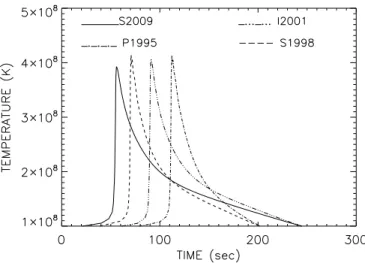
Figure 1. The variation with time of the temperature in the deepest hydrogen-rich zone around the time when peak temperature occurs. We have plotted the results for four different simulations on a 1.35 MWD. The identification with a specific library is given on the plot: P1995 is the library used inPolitano et al.(1995), S1998 is that used inStarrfield et al.(1998b), I2001 was described inIliadis et al.(2001) and used inStarrfield(2001), and S2009 is the library used inStarrfield et al.(2009). The temperature declines more rapidly for the sequence computed with the oldest reaction library (Politano et al. 1995) because it exhibited a larger release of nuclear energy throughout the evolution, which caused the overlying zones to expand more rapidly and the nuclear burning layers to cool more rapidly. In contrast, using the newest library yields the smallest expansion velocities and the nuclear burning layer cools slowly.
format and perform their temporal integration using the Backward Euler method introduced byArnett & Truran(1969), there are two important differences. First,Weiss & Truran(1990) implemented a single iteration, semi-implicit Backward Euler scheme, which had the advantage of a relatively small and predictable number of matrix solutions, but allowed only heuristic checks that the chosen time step provided a stable and accurate solution. In contrast,Hix & Thielemann(1999) implemented an iterative, fully implicit scheme, repeating the Backward Euler step until convergence was achieved. The iterations provided both a measure of the stability and accuracy of the solution.
Second, theHix & Thielemann(1999) network solver employs automated linking of reactions in the data set to the species being evolved. This is in contrast to the manual linking employed byWeiss & Truran(1990) and many older reaction networks. This automated linking helps to avoid implementation mistakes, as was discovered while performing tests of NOVA in order to understand the source of differences in the results of the simulations between the versions of the code, which used the same reaction rate library but different nuclear reaction solvers. We found that the REACLIB dataset used in prior studies included the pepreaction (p+e−+p→d+ν: Schatzman(1958);Bahcall & May(1969)), but it was not linked to either the abundance changes or the energy generation in theWeiss & Truran(1990) network. While for solar models the energy generation from thepepreaction is unimportant (but not the neutrino losses:Rolfs & Rodney 1988), in the WD envelope the density can reach, or exceed, values of 104g cm−3, which increases the rate of energy generation compared to the simulations done without the
pepreaction included (Starrfield et al. 2009). The increased energy generation reduces the amount of accreted material since the temperature rises faster per gram of accreted material. Given a smaller amount of accreted material at the time when the steep temperature rise of the TNR begins, the nuclear burning region is less degenerate and, therefore, the peak temperatures are lower when compared to models evolved with the nuclear reaction rate library used in our previous studies.
Using theHix & Thielemann(1999) nuclear reaction solver,Starrfield et al.(2009) used 4 different libraries:
• The first library was originally used inPolitano et al.(1995) and obtained its rates fromCaughlan & Fowler(1988) and
Thielemann et al.(1986,1988). The library was provided by F. Thielemann and also used in the calculations reported in
Weiss & Truran(1990).
• Starrfield et al.(1998b,2000) used an updated reaction rate library which contained new rates calculated, measured, and
compiled by F. Thielemann and M. Wiescher. A discussion of the improvements overPolitano et al.(1995) is provided in
Starrfield et al.(1998b).
• The fourth library was a compilation by Iliadis (2005, priv. comm.) and was current as of August 2005. It was a major update to the library described inIliadis et al.(2001).
A detailed discussion of the improvements sinceIliadis et al.(2001) appeared inStarrfield et al.(2009), so we only provide a summary here. In total, the rates of 11 and 33 proton-induced reactions were adopted fromAngulo et al.(1999) andIliadis
et al.(2001), respectively. For 17 proton-induced reactions, new rates were evaluated based on new experimental information.
Those included, for example, the (p,γ) and (p,α) reactions on17O,18F, and23Na. A number of rates forα–particle induced
reactions, including those for14O(α,p), 18Ne(α,p), and 15O(α,γ), which are important for following breakout during the hot
CNO-cycles, were also updated. The ground and isomeric state of26Al were treated as separate nuclei (Ward & Fowler 1980) and the communication between those states through thermal excitations involving higher–lying excited26Al levels was taken
explicitly into account. The requiredγ-ray transition probabilities were adopted fromRunkle et al.(2001).
Starrfield et al.(2009) evolved seven different evolutionary sequences for WD masses of 1.25 Mand 1.35 M. Here we only
report on the results for the more massive WD since the differences are more extreme for this mass. We assumed an initial WD luminosity of∼4×10⁻³L
and a mass accretion rate of 2×10⁻¹⁰Myr−1(1016g s−1). This mass accretion rate is 5 times lower than the lowest rate used inStarrfield et al.(1998b) and was chosen to maximize the amount of accreted matter given the increase in energy generation caused by including thepepreaction. We used the same composition for the accreting material as used and described inPolitano et al.(1995),Starrfield et al.(1998b),Starrfield et al.(2000), andStarrfield(2001): a mixture of half-solar and half-ONeMg (a mixing fraction of 50%). By using this composition, we assumed that core material mixed with accreted material from the beginning of the evolution. Using this composition also effects the amount of accreted mass at the peak of the TNR since the opacity is higher when compared to simulations that assume no mixing.
The results of the evolutionary sequences for WDs with masses of 1.35 Mshow that because the WD mass is larger and the radius is smaller, they reach higher densities and higher peak temperatures than the sequences at lower WD mass (Starrfield 1989). Figure 1 shows the variation of temperature with time for the deepest hydrogen-rich zone for four of the 1.35 Mevolutionary sequences. In this figure, and all other figures in this article, we only plot the simulations done with thepepreaction included (i.e., with theHix & Thielemann(1999) network). The specific evolutionary sequence is identified on the plot and the time coordinate is arbitrary and chosen to clearly show each curve on the plot. On this plot and each of the following plots (Figures 1 to 5), the designation refers to the reaction rate library that was used for the sequence. They are P1995 (Politano et al. 1995), S1998 (Starrfield et al. 1998b), I2001 (Iliadis et al. 2001;Starrfield 2001), and S2009 (Starrfield et al. 2009). We see differences between the four simulations since, as we use a more modern nuclear reaction library, the peak temperature drops from 4.13×10⁸
K to 3.92×10⁸K.
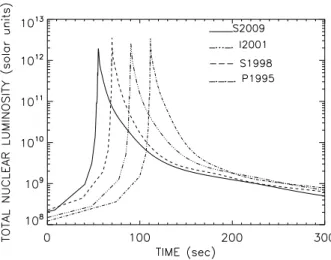
The total nuclear luminosity (in units of L/L) as a function of time is shown in Figure 2 for 1.35 M. The time coordinate is the same as in Figure 1. At 1.35 M the maximum luminosity found for the latest library is smaller than found using the earlier libraries. The improvements in the libraries are more important for the heavier isotopes and become even more important as higher temperatures are reached. The isotopic predictions for the ejected material in all the sequences are given inStarrfield
et al.(2009)
Figure 3 shows the variation of the effective temperature with time as the layers begin their expansion. We have plotted the results on the same time scale as in Figure 1 and Figure 2 and the plots show how rapidly the energy and theβ+-unstable nuclei reach and heat the surface layers. The large amplitude oscillations seen in the sequences using the two oldest libraries, but not seen in the simulations from the two more recent libraries, originate from the intense heating at the surface causing the layers to expand rapidly, cool and collapse back onto the surface, and then expand again. The peak temperatures and luminosities reached in these CN simulations are sufficiently large that an all-sky X-ray detector would detect them if it were sensitive enough.
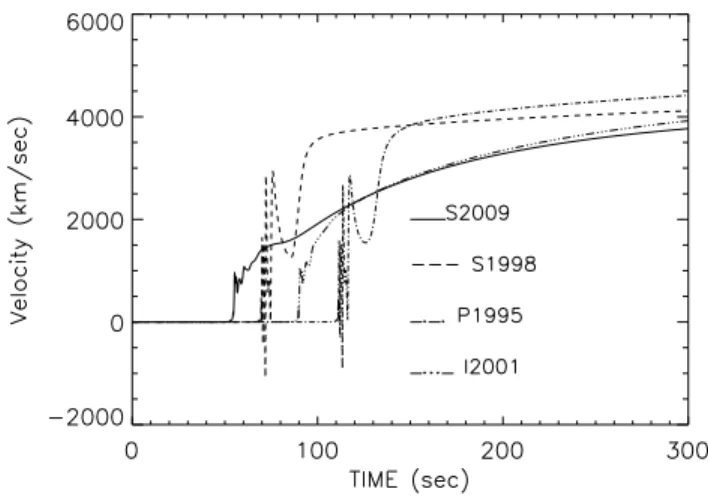
The oscillations can be seen more vividly in Figure 4, which shows the velocity of the outermost layers as a function of time near the peak of the TNR. At the beginning of the oscillations, almost no expansion has occurred and the “quasi”-period is determined by the free-fall time for the underlying WD. The intense heating from theβ+-decays causes the luminosity to quickly become super-Eddington and the layers begin expanding. However, they are still deep within the potential well of the WD and oscillate for a few seconds before reaching and then exceeding escape velocity at which time the oscillations cease. The oscillations are not present in the latest sequence because surface heating is less important. The outburst evolves more gradually and the star has already begun expanding when theβ+-unstable nuclei reach the surface. As a result, the oscillations occur but are of much smaller amplitude.
Figure 2. The variation with time of the total nuclear luminosity (L/L) around the time of peak temperature during the TNR on a 1.35M WD. We integrated over all zones taking part in the explosion. The identification with each library is given on the plot. The time coordinate is the same as for Figure 1.
Figure 3. The variation with time of the effective temperature around the time when peak temperature is achieved in the TNR for the sequences on the 1.35 MWD. The time-scale is identical to Figure 1 and shows how rapidly the nuclear burning products are transported from the depths of the hydrogen burning shell to the surface. The different evolutionary sequences are given on the plot.
this time, the layers continue expanding and cooling until a radius of about 1012 cm is reached. The effective temperature has
decreased to a value where most of the radiation is being emitted in the optical and visual maximum occurs.
As reported inStarrfield et al.(2009), including only the sequences computed with thepepreaction, if we examine the abun-dance predictions for the 1.25 Msequences, we see that the differences caused by improving the reaction rate library are small except for a few nuclides. For example, the abundance of12C varies by about a factor of two,14N by less than a factor of two, and16O by about a factor of 1.5. The low mass odd-A isotopes (13C,15N, and17O) all vary by about a factor of two. However,
both12C and13C are depleted in the latest sequence as is15N, while17O is enriched when using the latest reaction rate library.
The more massive nuclides ejected in the 1.25 Msimulation,22Na,26Al, and27Al, are depleted, while32S is enhanced in the simulation done with the most modern library. Tabulations of the ejecta abundances are given inStarrfield et al.(2009). Some of these abundances are in good agreement with those measured in the Anomalous Interplanetary Particles as reported inPepin
et al.(2011).
Figure 4. The variation with time, over the first 300 s of the outburst, for the velocity of the surface zone using the four different reaction libraries. We have offset the time on thePolitano et al.(1995) sequence to make the curves more visible.
Figure 5. The variation in time, over the first 11 hours of the outburst, of the surface luminosity using the four different reaction libraries. The label which identifies each different sequence is given in the legend. Note that as the nuclear physics input has improved, the peak luminosity and the luminosity at later times has decreased.
is hardly any difference in the abundances as a function of WD mass, except for14N, which is lower by about a factor of 3 at
1.35M. We also find that the abundance of22Na is lowest in the calculations done with the latest library. However, it is still a factor of about 5 more abundant at 1.35 M than at 1.25 M. The abundances of both26Al and27Al increase slightly from 1.25Mto 1.35 M. A similar result is seen inJosé & Hernanz(1998) although their ejecta abundances are smaller than ours because of the difference in initial abundances and peak temperatures. A detailed study of the formation of both26Al and27Al can
be found inJosé et al.(1999) who consider the abundances, reactions, and reaction rates that take part in forming these nuclei.
InStarrfield et al.(1998b,2000) we reported that the abundance of26Al declined as the WD mass increased. The simulations
presented in those papers used older reaction rate libraries and did not include thepepreaction so the temperature and isotopic evolution were different. Finally, the abundance of32S is largest using the 2005 library at 1.35 M. In fact, it reaches 4% by mass of the ejected material. This result may, in part, explain the large sulfur abundance found for V838 Her (Vanlandingham
et al. 1996).
In all four sequences the ejected total oxygen abundance exceeds the carbon abundance as found in our earlier studies. This result continues to be puzzling in light of the production of carbon rich dust in CN ejecta. As described inGehrz et al.(1998)
N/O O/S S/Al 10-1
100 101 102
Elemental Abundance
1.25 MSol 1.30 MSol 1.35 MSol V838 Her
Figure 6. Abundance ratios of the nuclear thermometers N/O, O/S, and S/Al, for V838 Her. The circles in color are from model simulations involving different WD masses, and the purple diamonds show the observed values. The results show that V838 Her involved a WD with a mass close to 1.35 M.
the CO molecule forms in the ejecta and is very stable. This implies that it is only the left over carbon that is available for grain formation. On the other hand, if O>C, then the leftover oxygen goes to form oxides and silicates. Yet, some of the deep dust forming novae form all types of dust since C, SiC, and hydrocarbons were identified early in the observed outburst, and O-rich silicate grains later in the outburst, for both QV Vul and V705 Cas (Gehrz et al. 1998;Woodward & Starrfield 2011), which suggests that distinct regions with O>C and O<C can occur in the ejecta of the same CN (Rawlings & Evans 1995,2002).
This question has also been investigated by bothShore & Gehrz(2004) andJosé et al.(2004).Shore & Gehrz(2004) investi-gated the effects of the UV radiation field on grain formation and suggested “a possible formation mechanism for large grains: ionization-mediated kinetic agglomeration of atoms onto molecules and small grains through induced dipole interactions."José
et al.(2004) reported on the results from 1-D hydrodynamic simulations of CN outbursts and then used their isotopic results in
calculating thermodynamic equilibrium condensation sequences for the ejecta. They studied both CO novae and ONe novae and, in some detail, the influence of other elements such as Al, Ca, Mg, and Si. Interestingly, they found that SiC grains are likely to condense in ONe novae. However, their results for CO novae show that SiC grains do not form in the ejecta and therefore these novae do not contribute to pre-solar grains. They also regard the formation of carbon dust in CO novae as still a puzzle although they state that it is possible to form carbon rich grains even in an environment with O>C. Further work in this area is warranted. SinceStarrfield et al.(2009) was published, further improvements to calculate nuclear reaction rates useful for astrophysics have been done by Iliadis and collaborators, as summarized in the paper introducing STARLIB (Sallaska et al. 2013). STARLIB is a tabular, stellar reaction rate library that includes neutrons, protons,α-particles,γ-rays, and nuclides ranging from Z = 1 to 83. All available experimental nuclear physics information is used to compute the rates. The structure of STARLIB rests on a Monte Carlo method to quantitatively define reaction rate uncertainties (Longland et al. 2010;Iliadis et al. 2010c,a,b). The method uses experimentally determined nuclear physics quantities (resonance strengths and energies, S-factors, partial widths, etc.) as inputs to a Monte Carlo algorithm. Full details of the Monte Carlo method can be found inSallaska et al.(2013, and references therein) andIliadis et al.(2015). Here we only highlight the basics of the procedure. All the measured nuclear physics (input) properties entering into the reaction rate calculation are randomly sampled according to their individual probability density functions. The sampling is repeated many times and thus provides the Monte Carlo reaction rate (output) probability density. Finally, the associated cumulative distribution is determined and is used to define reaction rates and their uncertainties with a precise statistical meaning (i.e., a quantifiable coverage probability). For example, for a coverage probability of 68%, the low, recommended, and high Monte Carlo rates can be defined as the 16th, 50th, and 84th percentiles, respectively, of the cumulative reaction rate distribution.
STARLIB contains experimental Monte Carlo rates for 62 charged-particle nuclear reactions on A = 14 to 40 target nuclei
(Iliadis et al. 2010c). InSallaska et al.(2013) seven updated Monte Carlo rates were reported, plus one entirely new rate. What
is interesting for CN simulations is that experimental Monte Carlo rates are available for almost all reactions participating in the TNR. The situation is drastically different from other stellar explosions, such as supernovae, where the rates of most reactions are based on nuclear theoretical models such as Hauser-Feshback.
et al.(2013) generated a series of new classical nova simulations using SHIVA (José & Hernanz 1998) with reaction rates adopted from STARLIB. Evolutionary sequences were generated for WD masses ranging from 1.15 Mto 1.35 M, and the parameters describing both the initial models and evolutionary results were given in the paper. They adopted the temperature-density-time trajectories from the hydrodynamic calculations and post-processed them with an extended nuclear reaction network. Their sequences reached peak temperatures ranging from 2.28×10⁸K to 3.13×10⁸K, depending upon WD mass. These temperatures
are thought to be typical for simulations of TNRs involving ONe WDs, but are lower than the peak temperatures reached in the sequences reported inStarrfield et al.(2009) and shown in Figure 1. This difference in peak temperatures is caused by the lower initial12C abundance used inStarrfield et al.(2009).
Carbon initiates CNO burning, because the12C(p,γ) rate is considerably faster than either the14N(p,γ) rate or the16O(p,γ) rate
(higher Coulomb penetrability), so a larger initial carbon abundance causes the TNR to occur earlier with less material accreted and a lower electron degeneracy (José & Hernanz 1998, Starrfield et al. 2016, in preparation). Downen et al.(2013) assumed a mixing fraction of 50% between accreted matter of Solar composition (Lodders & Palme 2009) and WD core material prior to the outburst. The abundances of core matter are taken from the evolution of a 10Mstar from the main sequence to the end of core carbon burning (Ritossa et al. 1996) and are reported in Table 3 ofDownen et al.(2013). We also note thatDownen et al.(2013) provided an updated table of observed abundances for ONe novae, since the last detailed table of classical nova abundances was provided inGehrz et al.(1998).
Downen et al.(2013) used the post-processing results to compute a number of elemental abundance ratios that they could
compare to the observed abundances of several well-studied novae. As shown in Figure 6, they used the N/O and O/S ratios from their post-processing to predict that the peak temperature in V838 Her was∼3×10⁸K and the WD mass in this system
was∼1.35 M. For V382 Vel, they predicted a peak temperature∼2.3×10⁸K and a WD mass of∼1.2 M. However the results for the other novae that they studied (V693 Aql, LMC 1990#1, V1065 Cen, and QU Vul) were less clear and no significant predictions could be made. They concluded that the elemental ratios N/O, N/Al, O/Na, and Na/Al are robust in that they do not depend significantly on uncertain reaction rates.
Kelly et al.(2013) continued these studies by varying the amount of mixing of accreted with core material from values of
25% to 75%. They used the same 4 WD masses as before but the highest peak temperature, 3.44×10⁸K, was achieved in the
simulation that assumed 75% mixing of WD core material into the accreted envelope on a WD with a mass of 1.35 M. Instead of varying reaction rates one-by-one, they employed a Monte Carlo reaction network method, where many reaction network samples were computed. For each calculation the rates of all reactions were randomly sampled, according to their probability densities listed in STARLIB. This method is described in more detail inLongland(2012) andIliadis et al.(2015). They again searched for those elemental abundance ratios that could be used to determine the amount of mixing of accreted with WD core matter. As seen in Figure 7, using the ratios of Ne/H, Mg/H, and Al/H they found for V838 Her, V4160 Sgr, and V1974 Cyg that
∼25% of outer WD core matter was mixed into the envelope prior to the TNR, contrary to the most common assumption of a 50% mixing fraction. They find roughly the same percentage for LMC 1990#1 and V693 CrA. For V1065 Cen, a larger ratio of 50% may apply. In contrast, the results for V382 Vel and V1974 Cyg are in poor agreement with any of the predicted elemental ratios. They also found poor agreement between observed and predicted abundances for other ONe novae, e.g., V838 Her and QU Vul. Their results suggest that new studies of TNRs for ONe novae should be done with smaller values for the amount of core material mixed into accreted material. This result is supported by the multi-D models of pre-outburst mixing (Casanova
et al. 2010,2011b) which mix 30% of core material into the envelope.
5. MULTIDIMENSIONAL STUDIES OF THE THERMONUCLEAR RUNAWAY
Despite great efforts over the past several decades, two interconnected problems continue to plague our understanding of thermonuclear processes in the CN outburst. They are (1) how does the convective region grow and develope in response to the TNR, and (2) how and when are the WD core nuclei mixed into the accreted matter? As already shown in the one dimensional hydrodynamic calculations, the transport of heat andβ+-decay nuclei to the surface by convection, as the TNR rises to its peak, is extremely rapid and may influence a number of observable features of the CN outburst that can be used both to guide and constrain new simulations. The first is the early evolution of the visual light curves of fast CNe on which their use as “standard candles” is based. During this phase the bolometric luminosity of a nova can remain more than an order of magnitude above the Eddington luminosity for several days (observed for LMC 1991 by Schwarz et al. 2001). The second is the composition of matter ejected by a nova as a function of time. It is possible that material ejected early in the outburst may not have the same composition (isotopic or elemental) as material ejected later. Both of these features depend on the amount, timing, and composition of the material dredged up from the underlying CO or ONe WD core.
It has now become possible to treat convection at or near the peak of the TNR in both two and three dimensions. This is possible for CN studies since the relevant timescales are all on the order of seconds. For example, the dynamical timescaleτhyd,
Ele
me
nt
al
Ab
un
da
nc
e
-4 10 -3 10 -2 10 -1 10 1 10 V1974 CygH
CNO
Σ
H
Ne
H
Mg
Ele me nt al Ab un da nc e -4 10 -3 10 -2 10 -1 10 1 10 H CNO Σ H Ne H Mg H Al H Si Ele me nt al Ab un da nc e -4 10 -3 10 -2 10 -1 10 1 10 75% 50% 25% H CNO Σ H Ne H Mg H Al H SiEl
e
me
n
ta
l Ab
u
n
d
a
n
ce
Ele me nt al Ab un da nc e -4 10 -3 10 -2 10 -1 10 1 10H
CNO
Σ
H
Ne
H
Mg
H
Al
H
Si
Ele me nt al Ab un da nc e -4 10 -3 10 -2 10 -1 10 1 10 75% 50% 25%H
CNO
Σ
H
Ne
H
Mg
H
Al
H
Si
El
e
me
n
ta
l Ab
u
n
d
a
n
ce
Figure 7. Abundance ratios of the mixing meters CNO/H, Ne/H, and Mg/H for V1974 Cyg. The circles in color correspond to model simulations for different degrees of pre-enrichment (25%, 50%, 75%). The black symbols show the observed values. The results indicate that 25% of ONe WD core matter was mixed into the envelope for this outburst.
temperature rises above 108K, until constrained by theβ+-decay lifetimes. Finally, the convective turn-over timescale is of order of seconds near the peak of the runaway (Starrfield et al. 1998b).
Fryxell & Woosley(1982) first discussed the importance of multidimensional effects for TNRs that occurred in thin stellar
shells. For CNe, they assumed initiation at a point and calculated the lateral burning velocity of the deflagration front that spread the burning along the surface. Subsequently, Shankar et al.(1992) andShankar & Arnett (1994) carried out two dimensional hydrodynamic calculations of this problem. They restricted their survey to strong, instantaneous, temperature fluctuations that developed on a dynamical time scale. However, they found that the initially intense burning at a point extinguished on a short timescale, as the perturbed region rapidly rose, expanded, and cooled.
Glasner et al.(1997) explored the consequences of thermonuclear ignition and explosive hydrogen burning in CNe with a two
dimensional, fully implicit hydrodynamic code. They followed the evolution of a convectively unstable hydrogen-rich envelope accreted onto a CO WD at a time close to the peak of the TNR and found a flow pattern that effectively dredged up sufficient material from the core to explain the observed levels of heavy element enrichment in CNe ejecta (∼30% to 40% by mass:Gehrz
et al. 1998;Downen et al. 2012). The redistribution of nuclear energy generation over the envelope, caused by the outward
transport of short livedβ+-decay nuclei, was also found to play a significant role in the outburst. In a complementary study,
Kercek et al.(1998) examined the early stages of the evolution, using the same initial model asGlasner et al.(1997) but with an
explicit, Eulerian, hydrodynamic code. While their simulations confirmed the finding ofGlasner et al.(1997), mixing was not as strong and occurred over a longer timescale.
Kercek et al.(1999) then performed two and three dimensional studies, using the same input model and physics as before, but
with improved resolution. Their results displayed less mixing with core material and a completely different flow structure, which cast doubts on this mixing mechanism.Glasner et al.(2005), however, analyzed the effects of the surface boundary condition on the multidimensional calculations and concluded that Lagrangian simulations, where the mass of the envelope matter is conserved and which allowed the outer boundary to expand, resulted in explosions. In contrast, Eulerian methods, where material is allowed to flow off the numerical grid, did not result in explosions. However,Casanova et al.(2010,2011a,b) used FLASH (Fryxell et al. 2000), an Eulerian, explicit code, to study mixing in 3 dimensions and did find explosions in which the ejecta were enriched by
∼30% in core matter.Glasner & Truran(2012) performed 2-dimensional calculations on WDs with different core compositions and again found mixing via convective dredge-up.
Earlier, however,Rosner et al.(2001) re-examined shear mixing (Kippenhahn & Thomas 1978;Sparks & Kutter 1987;Kutter &
Sparks 1987) during the accretion phase and suggested, based on semi-analytical and timescale arguments plus two dimensional
Walder et al.(2008) using their own code (Walder & Folini 2000), which is “a parallel, block-structured, adaptive mesh re-finement (AMR) hydrodynamical code using Cartesian meshes and multidimensional high-resolution finite-volume integration”, followed the 3-D evolution of both the accretion and explosion phase of RS Oph. This system consists of a WD exploding inside the outer layers of a red giant and their work provided a detailed look at the external shock moving through the red giant atmosphere. Based on their simulations, they concluded that the WD in RS Oph was increasing in mass and evolving toward a SN Ia explosion.
As already mentioned above, the most recent multidimensional studies of the CN outburst were performed byCasanova et al.
(2010,2011a,b), who re-investigated the 2-D simulations originally reported byKercek et al.(1999) andGlasner et al.(1997) and
continued with 3-D simulations. They used the FLASH code (Fryxell et al. 2000) and showed that an Eulerian formulation, with sufficient resolution and the proper boundary conditions, produced sufficient mixing to agree with the observations. Casanova
et al.(2011b) reported that the mixing occurred from the action of the Kelvin-Helmholtz instability driving mixing across the
accreted material core boundary. Therefore, the 3-D studies reported inCasanova et al.(2011b) showed conclusively that the only way to treat convective mixing is in 3-D and they described in detail why 2-D simulations of convection are “unrealistic”(see
alsoArnett et al. 2014,2015). A recent summary of their findings is given inJosé(2014).
Given these calculations, the general inferences that can be drawn from the existing multidimensional calculations are that: (1) the amount of mixing occurring prior to the onset of convection in the TNR is negligible; (2) the amount of convective mixing occurring during the early stages of the TNR is a sensitive function of the degree of degeneracy; (3) Kelvin-Helmholtz driven convective mixing dredges-up sufficient CO- or ONe-rich matter from the underlying WD core to produce the observed enrichments of nova ejecta (José 2014); and (4) Since the heavy element enrichment of the envelope via dredged up material, does not occur until after convection has been initiated in the nuclear burning regime, late in the evolution of the TNR, the envelope composition during accretion is that of the material being transferred by the secondary. This keeps core material out of the accreted layers until the peak of the TNR, the opacity stays low, and the amount of accreted material is increased (Starrfield
et al. 1998b).
6. NUCLEOSYNTHESIS DURING THE TNR AND THE MASS OF THE EJECTA
The measured abundances for CN ejecta confirm the levels of enrichment required by the theoretical studies to reproduce the dynamic features of CNe outbursts and, in addition, establish that both CO and ONe WDs occur in cataclysmic variable binary systems (Gehrz et al. 1998;Starrfield et al. 1998b,2008). Further, the significant enhancements of heavy elements in CN ejecta, taken together with the observational determinations of the masses of their ejecta, confirm that CNe contribute significantly to the Galactic abundances of some CNO isotopes. Finally, possible signatures of nova processing have already been identified in pre-solar grains found in meteorites (Amari et al. 2001;José et al. 2004) and in the Anomalous Interplanetary Particles (Pepin
et al. 2011).
The extensive database of atmospheric and nebular elemental abundances for CNe ejecta (Gehrz et al. 1998;Starrfield et al.
1998b;Downen et al. 2013) constitutes a powerful tool both for constraining the modeling of their outbursts and for determining
their contributions to Galactic chemical evolution. The degree to which elements such as silicon, sulfur, and argon are enriched, according to previous nucleosynthesis studies, is a sensitive function of the temperature history of the burning shell as are the abundances of22Na and26Al (José et al. 1997;José & Hernanz 1998;José et al. 1999,2001;Starrfield 2001;Iliadis et al. 2002;
Hix et al. 2003;Parete-Koon et al. 2003;Yaron et al. 2005;Starrfield et al. 2009). Finally, the abundance of7Be in CN ejecta is
sensitive to the rate at which it is transported to the surface regions prior to its decay to7Li. Until recently the CN contributions to
the abundance of7Li in the Galaxy (Starrfield et al. 1978;Hernanz et al. 1996), and expectations for the detection ofγ-rays from
7Be decay in CN ejecta, remained open questions (Romano et al. 1999;Romano & Matteucci 2003a,b). However, the advent of
high dispersion spectroscopy of CN early in the outburst has resulted in the discovery of7Be in V339 Del (Tajitsu et al. 2015)
and7Li in V1369 Cen (Izzo et al. 2015). The abundance of7Li as measured byIzzo et al.(2015) results in a lithium mass of a few times 10−10M
from a single nova and they suggest “that this amount solves the origin of the overabundance of lithium observed in young stellar populations.”
Since both CO and ONe WDs are found in CN systems, it is crucial to calculate evolutionary sequences for consistent choices of WD mass, envelope mass, thermal structure, and composition (CO or ONe) that can be compared directly to observed CN systems. While we have evolved one dimensional sequences designed to fit the observed properties of the ONe nova V1974 Cyg
(Starrfield et al. 2000), these simulations predicted sufficient22Na production that itsγ-ray emission should have been detected
by the Imaging Compton Telescope (COMPTEL), but it was not detected (Shrader et al. 1994; Iyudin et al. 1995; Leising
1997a,b). Another discrepancy was that comparison of the abundance predictions with observations suggested that theStarrfield
et al.(1998b) simulations were over-producing nuclides in the mass region past magnesium. One source of these discrepancies
composition is implemented, then a lower level of 22Na production is obtained and there is no contradiction with the lack of detection ofγ-rays from22Na decays (José & Hernanz 1998;Starrfield et al. 2000,2009). However, while nuclear decayγ-rays
have not been seen, theFermi/Large Area Telescope (LAT) has discovered that four CNe, areγ-ray sources at E>100 MeV (V959 Mon 2012, V1324 Sco 2012, V339 Del 2013, V1369 Cen 2013) in the earliest stages of their outbursts (Ackermann et al.
2014).
Another long-standing problem is the discrepancy between observations and predictions of the amount of mass ejected in the outburst (Warner 1995; Starrfield et al. 1998b, 2000). IR and radio analyses, combined with optical and UV studies of nebular emission lines, provide estimates of the ejected mass (Warner 1995;Gehrz et al. 1998). In contrast to the observationally determined masses, numerical simulations of TNRs on both CO and ONe WDs predict ejecta masses that can be smaller by up to a factor∼10 (Prialnik & Kovetz 1995;José et al. 1999;Starrfield et al. 1998b,2000;Yaron et al. 2005;Starrfield et al. 2009). There are two reasons that the cause of this ejecta mass discrepancy must be determined. First, a solution should provide an improved understanding of the development of the CN outburst; and second, most estimates of the contributions of CNe to Galac-tic chemical evolution use ejecta masses determined from the theoreGalac-tical predictions. If the masses inferred from observations are used in the chemical evolution studies, then CNe become even more important for production of the odd isotopes of the light elements in the Galaxy (particularly13C,15N, and17O) than currently believed.
7. CAN CLASSICAL NOVAE BE PROGENITORS OF TYPE IA SUPERNOVAE?
Supernovae of Type Ia (SNe Ia) are those supernovae in which neither hydrogen nor helium is seen in any of the spectra obtained during the outburst. However, the large sample size of recent SN surveys have revealed that there are occasional events that are otherwise SN Ia but, in fact, they do show small amounts of H in their spectra. SN Ia have light curves that can be calibrated (Phillips 1993), making them excellent standardizable distance indicators to z>1(Filippenko 1997;Howell 2010). Thus, they have become extremely important tools to determine the structure and evolution of the Universe (Leibundgut 2000,
2001, and references therein). SN Ia are also important because they contribute a major fraction of the iron group elements to the Galaxy. In the past few years, a tremendous effort has gone into studies of their observed properties (cf.,Hillebrandt &
Leibundgut 2003;Howell 2010;Maoz et al. 2014;Ruiz-Lapuente 2014). Nevertheless, the progenitor(s) of SN Ia explosions are,
as yet, unknown.
Whelan & Iben(1973) proposed that the explosion involved a CO WD which accreted material from a binary companion until
its mass approached the Chandrasekhar Limit and a carbon deflagration/detonation occurred (Nomoto et al. 1984;Branch et al.
1995;Hillebrandt & Niemeyer 2000). Typical CN systems can be excluded as SN progenitors because the WD is thought to be
decreasingin mass as a result of repeated nova explosions and cannot be growing toward the Chandrasekhar Limit (MacDonald
1984;Gehrz et al. 1998;Starrfield et al. 2000). In addition, the absence of hydrogen and helium in the spectra of a SN Ia rules out
most other Cataclysmic Variable (CV) systems since the WDs are accreting hydrogen- and helium-rich material. If the WD were to explode, then the accreted envelope would be carried along with the supernova ejecta and be seen in the spectrum (Marietta
et al. 2000;Starrfield 2003).
Nevertheless, one suggestion for the progenitors of SN Ia explosions is the transfer of matter from a non-degenerate secondary onto a WD in a close binary system. If a sufficient amount of the accreted material remains on the WD, during the accretion process and its mass can gradually grow close to the Chandrasekhar Limit, then the explosion should resemble a SN Ia. This hypothesis is referred to as the single degenerate scenario (SD). It is one of the two major suggestions for possible progenitors of SN Ia explosions, the other being the double degenerate (DD) scenario. In the SD scenario, as the WD in a close binary system approaches the Chandrasekhar Limit, it first convectively “simmers” in the core and then the explosion occurs. In contrast, the double degenerate scenario (DD) requires the merger or collision of two WDs to produce the observed explosion. While there are now major efforts to better understand the DD scenario, the SD scenario is capable of explaining most of the observed properties of the SN Ia explosion via the delayed detonation hypothesis (Khokhlov 1991;Kasen et al. 2009;Woosley & Kasen
2011;Howell et al. 2009, and references therein). Reviews of the various proposals for SN Ia progenitors (Branch et al. 1995),
and the implications of their explosions can be found inHillebrandt & Niemeyer(2000),Leibundgut(2000,2001),Nomoto et al.
(2003), andHowell(2010). Recent reviews of the observations can be found inMaoz et al.(2014) andRuiz-Lapuente(2014). New evidence in favor of the SD scenario comes from observations of SN 2011fe in M101. They imply that the exploding star was likely a CO WD (Nugent et al. 2011) with a companion that was probably on or near the main sequence (Li et al. 2011;
Bloom et al. 2012). However, EVLA (Chomiuk et al. 2012) and optical (Bloom et al. 2012) observations may have ruled out many
types of CVs. In addition, HST studies of the spatial region from which SN 2011fe exploded, suggest that the progenitor had a luminosity less than∼1034 erg s−1(Graur et al. 2014), andLundqvist et al.(2015) find no evidence for a remnant companion
in late time observations of SN 2011fe and SN 2014J. While this rules out typical Supersoft X-ray sources (Kahabka & van den
Heuvel 1997), recent studies suggest that a CV progenitor could be fainter than that value (Newsham et al. 2014;Starrfield et al.
Moreover,Dilday et al.(2012) claim that PTF 11kx was a SN Ia that exploded in a Symbiotic Nova system. Finally, we note that the “zoo” of SNe Ia types is increasing as surveys find more and more members (e.g.,White et al. 2015). The most recent results (Cao et al. 2015;Olling et al. 2015),in the same issue of Nature, both favor and disfavor the SD scenario. Therefore, since the existence of “Super-Chandra” Ia’s suggests that DD mergers are required for these extreme explosions, these studies taken together suggest that there are multiple channels that can produce SN Ia explosions including the SD channel.
Further support for the SD channel, comes from the observations of V445 Pup (Nova 2000). There were no signs of hydrogen in the spectrum at any time during the outburst, especially just after discovery, but there were strong lines of carbon, helium, and other elements in the optically thick spectra (Wagner et al. 2001a,b;Henden et al. 2001;Lyke et al. 2001;Woudt & Steeghs
2005;Woudt et al. 2009). Unfortunately, no one has done an abundance analysis of the spectra, obtained early in the outburst, to
determine an upper limit to the amount of hydrogen that could be hidden. Nevertheless, it is probably extremely small. Because it was extremely luminous before the outburst, the secondary is thought to be a hydrogen deficient carbon star (Woudt et al. 2009). Since one of the defining characteristics of a SN Ia explosion is the absence of hydrogen or helium in the spectrum at any time during the outburst or decline, the existence of V445 Pup implies that mass transferring binaries exist in which hydrogen is absent at the time of the explosion and most of the helium is converted to carbon during the nova phase of evolution. The latest spectra show that this system is still in outburst and, therefore, it has not been possible to study the underlying system(Tomov
et al. 2015).
In order to simulate the properties of the Super Soft X-ray Sources and determine if they could be SN Ia progenitors,Starrfield
et al.(2004) used NOVA to study accretion onto hot, luminous WDs and found that hydrogen burns to helium (and helium to
carbon and oxygen) in the surface layers for a broad range of mass accretion rates. They reported that accretion, (from 1.6×10⁻⁹
Myr−1<M˙ <8×10⁻⁷Myr−1), onto hot (2.3×10⁵K), luminous (30 L), massive (1.25 M, 1.35 M) CO WDs could burn matter at rates both lower and higher than the single value assumed in the canonical Steady Burning scenario. In addition, because of the energy release from hydrogen burning near the surface,Starrfield et al.(2004) found that the helium layer remained hot, and helium steadily burned to carbon, oxygen, and more massive nuclei without experiencing a TNR. No mass was ejected and the WD grew in mass toward the Chandrasekhar Limit. Some sequences were evolved for more than 106yr. Since most of the
hydrogen and helium accreted from the secondary burned to carbon and oxygen, there would be almost no hydrogen or helium present in the ejecta (and spectrum) if the WDs exploded as a SN Ia. In addition, the luminosities and effective temperatures of their evolutionary sequences fit the observations of the Super Soft X-ray Sources such as CAL 83 and CAL 87.
In addition, because the multidimensional studies imply that mixing of core with accreted material does not occur until after convection is occurring just prior to the peak of the TNR (José 2014, and references therein), we have also investigated the accretion of Solar material onto WDs of various masses and mass accretion rates (Starrfield et al. 2012a,b;Newsham et al. 2014). We found that in all cases the simulation evolves to a TNR but only a small amount of accreted material is ejected and the WDs are growing in mass. These studies used both NOVA and MESA (Paxton et al. 2011,2013,2015) and show that the evolutionary sequences exhibit theSchwarzschild & Härm(1965) thin shell instability, which implies that steady burning does not occur. An expanded study of the stability of thin shells can be found inYoon et al.(2004), who investigated the accretion of hydrogen-rich material onto WDs. Using their results, we find that our sequences begin in their stable region, but with continued accretion, evolve into instability. The high mass WDs do eject a small fraction of the accreted material (a maximum of∼4% for the 1.25M sequences, but only∼0.1% for the 0.7Msequences). We identify these systems with those CVs (dwarf, recurrent, symbiotic novae) that show no core material either on the surface of the WD or in their ejecta. Our results could explain the findings of
Zorotovic et al.(2011), who report that the WDs in CVs are growing in mass. In addition, the best studied dwarf novae have
WD masses larger than the canonical value of∼0.6M. These are U Gem (1.2M:Echevarría et al. 2007), SS Cyg (0.8M:
Sion et al. 2010), IP Peg (1.16M:Copperwheat et al. 2010), and Z Cam (0.99M:Shafter 1983). Therefore, it seems possible
that some Dwarf Novae could be SN Ia progenitors if there is some means to prevent convection from mixing accreted with WD core material. For example, a thick helium layer from previous outbursts could act as a barrier to this mixing. Further work is warranted.
8. SUMMARY AND DISCUSSION