Temperature Regimes Impact Coral
Assemblages along Environmental Gradients
on Lagoonal Reefs in Belize
Justin H. Baumann1*, Joseph E. Townsend1, Travis A. Courtney1,2,3, Hannah
E. Aichelman1, Sarah W. Davies1,2, Fernando P. Lima4, Karl D. Castillo1
1University of North Carolina at Chapel Hill, Department of Marine Sciences, 3202 Murray and Venable Halls, Chapel Hill, NC, 27599–3300, United States of America,2Northeastern University, Department of Marine and Environmental Sciences; 430 Nahant Rd, Nahant, MA, United States of America,3Scripps Institution of Oceanography, University of California San Diego, 9500 Gilman Dr., La Jolla, CA, 92093–0202, United States of America,4CIBIO/InBIO, Centro de Investigacao em Biodiversidade e Recursos Geneticos, Universitdade do Porto, Campus Agrário de Vairão, Vairão, Portugal
Abstract
Coral reefs are increasingly threatened by global and local anthropogenic stressors such as rising seawater temperature, nutrient enrichment, sedimentation, and overfishing. Although many studies have investigated the impacts of local and global stressors on coral reefs, we still do not fully understand how these stressors influence coral community structure, partic-ularly across environmental gradients on a reef system. Here, we investigate coral commu-nity composition across three different temperature and productivity regimes along a nearshore-offshore gradient on lagoonal reefs of the Belize Mesoamerican Barrier Reef System (MBRS). A novel metric was developed using ultra-high-resolution satellite-derived estimates of sea surface temperatures (SST) to classify reefs as exposed to low (lowTP),
moderate (modTP), or high (highTP) temperature parameters over 10 years (2003 to 2012).
Coral species richness, abundance, diversity, density, and percent cover were lower at highTPsites relative to lowTPand modTPsites, but these coral community traits did not differ
significantly between lowTPand modTPsites. Analysis of coral life history strategies
revealed that highTPsites were dominated by hardy stress-tolerant and fast-growing weedy
coral species, while lowTPand modTPsites consisted of competitive, generalist, weedy, and
stress-tolerant coral species. Satellite-derived estimates ofChlorophyll-a(chl-a) were obtained for 13-years (2003–2015) as a proxy for primary production.Chl-aconcentrations were highest at highTPsites, medial at modTPsites, and lowest at lowTPsites. Notably,
ther-mal parameters correlated better with coral community traits between site types than pro-ductivity, suggesting that temperature (specifically number of days above the thermal bleaching threshold) played a greater role in defining coral community structure than pro-ductivity on the MBRS. Dominance of weedy and stress-tolerant genera at highTPsites
sug-gests that corals utilizing these two life history strategies may be better suited to cope with warmer oceans and thus may warrant protective status under climate change.
a11111
OPEN ACCESS
Citation:Baumann JH, Townsend JE, Courtney TA, Aichelman HE, Davies SW, Lima FP, et al. (2016) Temperature Regimes Impact Coral Assemblages along Environmental Gradients on Lagoonal Reefs in Belize. PLoS ONE 11(9): e0162098. doi:10.1371/ journal.pone.0162098
Editor:Heather M. Patterson, Department of Agriculture and Water Resources, AUSTRALIA
Received:March 4, 2016
Accepted:August 17, 2016
Published:September 8, 2016
Copyright:© 2016 Baumann et al. This is an open access article distributed under the terms of the
Creative Commons Attribution License, which permits unrestricted use, distribution, and reproduction in any medium, provided the original author and source are credited.
Data Availability Statement:All data are archived on PANGAEA at the following DOI: doi.pangaea.de/
10.1594/PANGAEA.859972.
Funding:This work was supported by the Rufford Foundation (http://www.rufford.org) Small Grant to JHB (15802-1); National Science Foundation (Oceanography) (nsf.gov) to KDC (OCE 1459522); Department of Defense NDSEG fellowship to JHB.
Introduction
Coral reefs are threatened locally and globally by anthropogenic stressors such as warming induced by increasing greenhouse gas emissions, excessive nutrients from runoff and sewage effluent, overfishing, and habitat destruction [1–3]. Of particular concern are increasing green-house gas emissions that continue to cause warming of the global oceans [1,4]. This warming trend is especially troubling in the Caribbean Sea, where rates of warming are higher than in many other tropical basins [5], and where coral cover has declined by up to 80% in recent decades [6]. Elevated sea surface temperature (SST) is the major cause of the breakdown of the essential coral-algal symbiosis, which if widespread results in mass coral bleaching [7,8]. In Belize, the 1998 El Niño bleaching event was the most significant bleaching induced mass coral mortality event on lagoonal reefs over the last 3000 years [9]. These large-scale coral bleaching events are projected to increase in frequency and severity as the climate continues to warm [4,
10]. In fact, if ocean warming persists, corals in the Caribbean Sea are predicted to bleach bian-nually within the next 20–30 years [11], with annual bleaching events occurring as soon as 2040 [12]. Caribbean-wide and global-scale bleaching events are predicted to continue unless corals can increase their thermal tolerance at a rate of 0.2–1.0°C per decade [4].
Annual and daily thermal variability have recently been identified as important factors influencing coral thermal tolerance [13–15]. Indeed, previous exposure to thermally variable environments increases a coral’s tolerance to future temperature stress [14,16–18], and research suggests that Pacific and Red Sea corals living in areas with high summer maximum SST are less susceptible to bleaching [19,20]. Along the Belize Mesoamerican Barrier Reef Sys-tem (MBRS) and on Pacific Atolls, corals historically exposed to less thermal variability exhib-ited slower growth rates and/or greater susceptibility to bleaching in response to SST increases [17,18]. In the Florida Keys, coral growth rates and coral cover were higher in nearshore envi-ronments exposed to more variable seawater temperatures than on deeper reefs experiencing more stable temperatures [21]. In contrast, while many studies suggest that high temperature variability leads to higher coral resilience [14–16], there is also evidence that corals experienc-ing moderate long term temperature variability (either annual or daily variation) are better able to cope with stress [13]. Collectively, these studies emphasize the importance of thermal variability on the response of corals to environmental stress, and highlight its capacity to shape coral community composition across a reef system.
Multi-species coral assemblages have recently been proposed to comprise four major life history guilds: competitive (large, fast growing, broadcast spawning, e.g., CaribbeanAcropora spp.), weedy (small, opportunistic colonizers of recently disturbed habitat, e.g., Caribbean Por-ites spp.), stress-tolerant (massive, slow growing, broadcast spawning, e.g.,Siderastrea siderea), and generalist (share traits characteristic of all three other groups, e.g.,Orbicella spp.) [22]. Grouping species by life history strategy allows for prediction of responses to disturbance (e.g., temperature stress) as life history strategies are trait based [23]. Additionally, each guild is expected to be differentially impacted by stressors and life histories predict coral community response to multiple stressors [24]. Therefore, life history strategies offer a more elegant and predictive alternative to traditional genus or species level analysis.
Weedy and stress tolerant corals have been shown to be more resilient than competitive and generalist species [22,24], and are hypothesized to dominate warmer and more impacted reefs (e.g., reefs closer to the shore). A shift from dominance of competitive and generalist species to weedy and stress tolerant species occurred on Okinawan reefs following the 1998 El Niño bleaching event [29,30] and an overall decline in coral cover and abundance currently occur-ring in the Caribbean has been coupled with an increase in abundance of weedy species [27,
31]. Interestingly, fossil assemblages from excavated pits on reefs in Panama reveal that mortal-ity and changes in reef communities caused by anthropogenic impact (such as land clearing and overfishing) predate mass bleaching events, indicating that other sub-lethal stressors can impact coral community structure [32–34]. Collectively, evidence suggests that differential responses between coral species to increasing anthropogenic stressors may lead to community scale shifts in reef composition from dominance of competitive and generalist species to domi-nance of stress tolerant and weedy species.
The purpose of the current study was to investigate the impact of thermal regimes on pres-ent day coral community composition (coral abundance, species richness, diversity, percpres-ent cover, density, and life history strategies) of lagoonal reefs (i.e., region extending from the bar-rier reef’s crest to the mainland) across the Belize MBRS. A novel GIS-based metric was devel-oped to characterize lagoonal reefs across this reef system into three thermally distinct regimes. Within these three regimes, thirteen reef sites were identified and benthic surveys were con-ducted to quantify coral community composition. These thermal regimes exist along a near-shore-offshore productivity gradient, which may also influence coral community structure. Quantifying coral community differences among these thermally distinct reefs will help us bet-ter predict how coral community structure may be impacted by climate change. Identifying which areas and species are best able to cope with environmental stress (and which are least able) may allow for more targeted management strategies, as it is important to protect both high-risk and low-risk reef sites to improve our chances of conservation success [35].
Materials and Methods
Site identification
SST Estimate Assembly. Daily 1-km horizontal resolution SST estimates were acquired from the Jet Propulsion Laboratory’s Multi-Scale High Resolution SST (JPL MUR SST) records via the Physical Oceanography Distributed Active Archive Center (PO.DAAC) at the NASA JPL, Pasadena, CA (http://podaac.jpl.nasa.gov). Conventional 1-km resolution satellite-derived SST measurements (infrared, IR) are contaminated by clouds, creating data-void areas. Microwave (MW) data sets can penetrate clouds to gain better temporal coverage, but with a much coarser spatial resolution (25 km) [36]. MUR combines these two datasets to present a more comprehen-sive and complete SST product. It employs multi-resolution variational analysis (MRBA) as an interpolation method to combine high resolution datasets with more conventional datasets, gen-erating a product that contains no cloud contamination [36]. MUR reports estimates of founda-tion SST, or SST at the base of the diurnal thermocline (~5-10m depth). Comparison of in-situ temperature (recorded by HOBO1v2 data loggers), MUR, and other SST products revealed that MUR outperforms other products in estimating in-situ temperature, although it also under-estimates the temperature corals experience at depth (S1 Fig). However, due to its temporal cov-erage and temporal resolution, high spatial resolution, lack of cloud contamination, and smaller method error compared to similar products such as Group for High Resolution SST (GHRSST), MUR was determined to be the ideal SST product for use in the current study.
between the barrier reef’s crest and the mainland, and therefore do not include the seaward fac-ing fore-reef. Instead, lagoonal reefs include nearshore reefs, patch reefs, and the back reef. Four thermal parameters produced distinct environments for the reef sites across the Belize MBRS: average annual maximum temperature (S2A Fig), average annual temperature range (S2B Fig), average annual number of days above the regional bleaching threshold of 29.7°C [9] (S2C Fig), and average annual consecutive days above the regional bleaching threshold (i.e., longest potential thermal stress events) (S2D Fig). A metric that combined all four thermal parameters was generated using ArcGIS in order to assess thermal environments across the Belize MBRS. Data from each of the four parameters in the metric (Table 1) were divided into 8–10 bins (0.5 standard deviations (SD) of the mean) and overlaid on a map of the Belize MBRS. Reefs were not present in areas where the value of any single variable was<1 SD below or>2 SD above the mean (across the entire data set from 2003–2012). For all four parameters, areas that were classified in bins1 SD above the mean were designated high temperature parameter (highTP) sites (Fig 1). Moderate temperature parameter (modTP) sites were classified
as areas where all values were 0.5 to 1 SD above the average annual temperature range and the average annual maximum temperature, and within 1 SD of the average annual consecutive days and the average annual number of days above the regional bleaching threshold (Fig 1). Low temperature parameter (lowTP) sites were classified as bins that were 0.5 SD above the
average to 2 SD below the average for annual temperature range and annual maximum temper-ature, and below the average for consecutive and annual days above the regional bleaching threshold (Fig 1). Using the metric presented inFig 1, fifteen sites were identified, thirteen of which were visited and surveyed in November 2014 (the two northernmost highTPsites were
not surveyed as corals were not located within the marked geographic area) (Table 1,Fig 1).
Benthic surveys
In November 2014, benthic surveys were performed at the thirteen reef sites. Depth of each reef site was standardized to 3-5m. Reef types surveyed included back reefs, patch reefs, and nearshore reefs. A team of three divers surveyed six belt transects (dimension 6 x 10 m) at each site following Atlantic and Gulf Rapid Reef Assessment (AGRRA) methodology [37]. Briefly, a diver classified the genus and species of every coral>6cm2within 1m of the transect line along a 10m transect. The number and size (length, width, and height) of individual colonies of each coral species were recorded on underwater data sheets. The collected data were used to calcu-late coral species diversity, abundance, richness, and coral life history (following Darlinget al. [22]) for each site.
Additionally, six video belt transects (1 x 20m) were also performed at each site using GoPro1cameras attached to PVC stabilizing apparatuses allowing each diver to stabilize the camera while surveying transects. Video transects were analyzed at the University of North Table 1. Thermal Parameters Used For Site Classification.
Factor Min Mean Max SD lowTPSites modTPSites highTPSites
Mean Annual Max Temp 30.2°C 30.6°C 31.3°C 0.27°C 30.2–30.8°C 30.8–30.9°C 30.9–31.3°C Mean Annual Temp Range 4.4°C 5.2°C 7.1°C 0.69°C 4.4–5.5°C 5.5–5.9°C 5.9–7.1°C Mean Annual Days Above Bleaching Threshold 20.0 days 40.1 days 78.4 days 14.3 days 20.0–40.1 days 40.1–54.4 days 54.4–78.4 days Mean Consecutive Days Above Bleaching Threshold 3.0 days 4.8 days 7.5 days 0.92 days 3.0–4.8 days 4.8–5.7 days 5.7–7.5 days
Values for the four thermal parameters included in site selection metrics. Values are all averages from 2003–2012 and include measurements for minimum, mean, maximum, and standard deviation (SD) for each thermal parameter. The range at which each factor was classified as lowTP, modTP, or highTPsite is
also shown.
Carolina at Chapel Hill (UNC-Chapel Hill) in a manner similar to the AGRRA method used in the field, except two additional parameters (percent coral cover and coral density) were calcu-lated. Results of the diver and video transect surveys were not significantly different
(p= 0.300). As a result diver and video survey data were pooled at each site when possible. Full details and a comparison of the methods employed are available inS1 Appendix.
Coral life history
Coral species were grouped into four life history strategies as previously described by Darlinget al. 2012 [22]. In their study, Darlinget al. 2012 identified four life history guilds for corals based on Fig 1. Thermal Regimes and Site Locations.The Belize Mesoamerican Barrier Reef System (MBRS) classified by site type based on four thermal parameters. Blue, green and red regions represent lowTP,
modTP, and highTPareas across the reef system. Stars indicate surveyed sampling sites.
multivariate trait analysis: competitive, weedy, stress-tolerant, and generalist [22]. The four guilds are primarily separated by colony morphology, growth rate, and reproductive rate. The classifica-tion was based on a thorough sampling of global Scleractinian coral diversity. Each coral that is included in a guild in Darlinget al. 2012 [22] was classified into the appropriate guild for this study and comparisons of life history strategies between sites and site types were made.
Chlorophyll-a
Eight-day composite 4-km horizontal resolutionchlorophyll-a(chl-a) estimates over the inter-val 2003–2015 were obtained from NASA’s Moderate Resolution Imaging Spectroradiometer (AQUA MODIS) via NOAA’s Environmental Research Division’s Data Access Program (ERDDAP) [38]. Eight-day composite data were selected in order to minimize gaps in data from cloud cover. Unlike the MUR SST data used for temperature calculations, there is no inte-grated, high-resolution product forchl-a. Similar to temperature calculations, monthly and yearly averagechl-avalues were calculated for each survey site (S2E Fig).Chl-ais a widely used proxy for primary productivity and nutrient delivery in seawater [39,40], as it is the main pho-tosynthetic pigment present in phytoplankton which can often quickly deplete nutrient con-centrations below detectable limits. It has been shown that remotely sensed data, such aschl-a concentration, yields better metrics for water quality than traditional measures such as distance from shore and distance from the nearest river [41]. Here,chl-adata are used as a proxy for pri-mary production across the Belize MBRS.
Statistical analysis
Standard deviations used for temperature bins and site classification were calculated in ArcGIS. All other statistical analysis were carried out in R 3.2.2 [42]. Transect averaged survey data for species richness, abundance, Shannon diversity, coral cover, coral density, and log-transformed chl-adata were analyzed using analyses of variance (ANOVA). Three fixed factors were included in the ANOVA (survey method, site, and site type) for species richness, abundance, and Shannon diversity. Only two fixed factors (site and site type) were included in the ANOVA for coral cover and coral density, since only data from video surveys were used to calculate these averages. Two fixed factors (site and site type) were included in the ANOVA forchl-aconcentrations since they were calculated using satellite estimates and survey type was not a factor.
If factors were significant (p<0.050), a post-hoc Tukey’s HSD test was used to evaluate the significance of each pair-wise comparison. Spatial autocorrelation was evaluated using Moran’s I [43]. Significantp-valuesfor Moran’s I (p<0.050) indicate an effect of spatial autocorrelation. Spatial autocorrelation was only a factor for coral cover (p= 0.040). To correct for the effect of spatial autocorrelation, the cut-off value for significance within the ANOVA for coral cover was decreased top<0.010, following Dale and Fortin [44].
To visualize coral community differences between site types, non-metric multidimensional scaling (NMDS) ordination was implemented using Bray-Curtis similarity coefficients in the vegan package in R [45]. An optimal stress test was performed to determine the optimal k value (k = 20). Resulting NMDS scores were visualized in two-dimensional ordination space. A PERMANOVA test was performed to analyze the site type differences using theadonis func-tion in the vegan package in R [45].
Ethics statement
All research related to this projected was completed under official permit from the Belize Fish-eries Department (#000045–14).
Results
Coral community composition
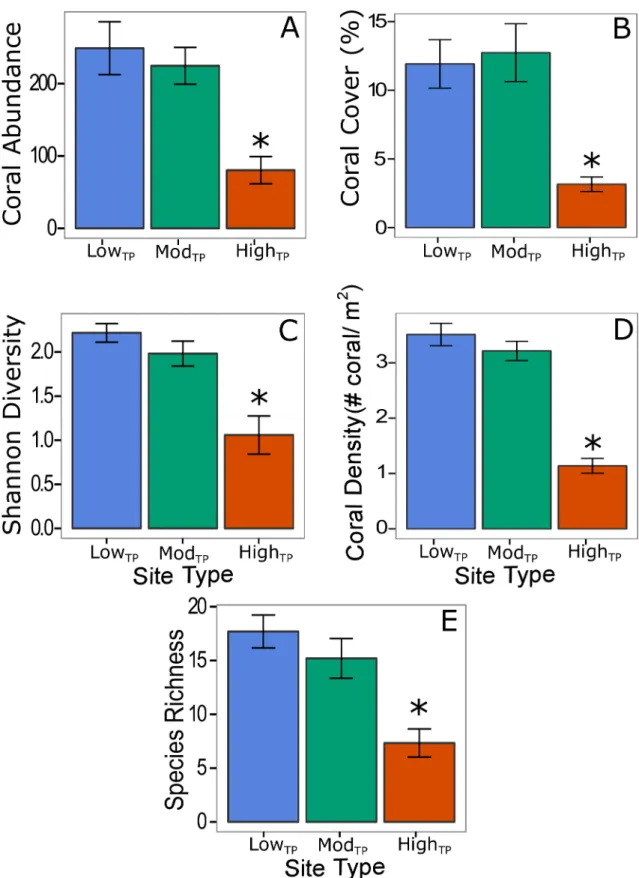
Combined results of AGRRA diver surveys and GoPro1video surveys for all thirteen sites revealed that coral species richness varied as a function of site location (p<0.001) as well as site type (p =0.002). Coral abundance was significantly lower at highTPsites compared to lowTP
(p= 0.005) and modTP(p= 0.020) sites, but was not significantly different between lowTPand
modTPsites (Fig 2A). Coral cover, Shannon diversity, coral density, and species richness also
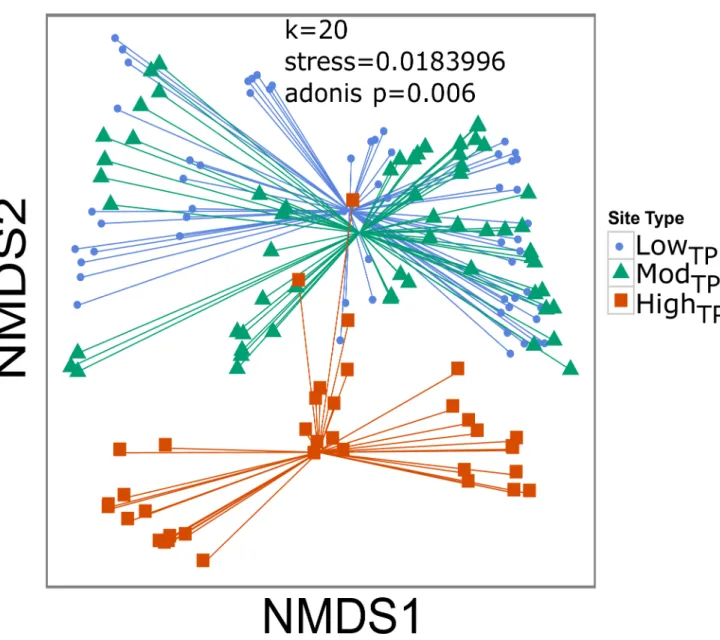
followed these same patterns (p0.020;Fig 2B–2E). NMDS analysis of the ecological parame-ters showed that community structure was significantly different (stress = 0.018, adonis test p= 0.006) between highTPsites and lowTP/modTPsites along the NMDS2 axis, but was not
dif-ferent between lowTPand modTPsites (p>0.050) (Fig 3). The most dominant taxa at lowTPand
modTPsites wereOrbicella spp.,Porites spp.,Undaria spp.,S.siderea, andPseudodiploria spp,
while at highTPsites they wereSiderastrea spp.,P.astreiodes, andPseudodiploria spp. Variation
along the NMDS1 axis represents within site type differences while variation along the NMDS2 axis represent between site type differences (Fig 3).
Linear modeling of temperature and productivity parameters against NMDS1 and NMDS2 revealed that average annual maximum temperature, average annual temperature range, aver-age annual days above the bleaching threshold, and averaver-age annual consecutive days above the bleaching threshold all had significant effects on the NMDS1 variation. All four temperature parameters, as well aschl-a, also had significant effects on NMDS2 variation (S2 Table;S3 Fig). Average annual consecutive days above the bleaching threshold explained the most variation for NMDS1 and NMDS2 (R2= 0.1026, 0.604 respectively;p<0.001 for both;S2 Table;S3 Fig).
Linear regressions of temperature parameters andchl-awithin site types along NMDS1 revealed significant effects (p<0.050) of average annual maximum temperature, average annual days above the bleaching threshold, and average annual consecutive days above the bleaching threshold for all site types, average annual temperature range for modTPand highTPsites, and
chl-afor highTPsites only (S3 Table;S3 Fig). Average annual days above the bleaching
thresh-old yielded the highest R2for lowTPand modTPsites, while average annual temperature range
yielded the highest R2for highTPsites (S3 Table;S3 Fig).
Coral life history
Site exhibited a significant effect on the number of corals in each of the four coral life history guilds [22] (p<0.001). The distribution of coral life history strategies differed significantly between lowTPand highTPsite types (p= 0.049;Fig 4), while modTPsites did not differ from
lowTPor highTPsites (Fig 4). Overall, there appears to be a pattern of lower abundances of all
life history guilds at highTPsites compared to lowTPsites. Competitive species were not present
and generalist species were only present in very small number at highTPsites.
Chlorophyll-a
Annual averagechl-aconcentrations varied over time and differed by site type (p<0.001), but were consistently lowest at lowTPsites and highest at highTPsites regardless of year (Fig 5A).
Fig 2. Differences in coral community structure across site type.Average coral abundance (A), percent coral cover (B), coral species diversity (C), coral density (D), and coral species richness (E) at each site type. Statistically significant differences (p<0.05) are marked with an*. Blue, green, and red bars (±1 SE) represent lowTP, modTP, and highTP,
respectively.
concentrations. ModTPsites exhibited average 13-yearchl-aconcentrations that were
signifi-cantly higher than lowTPsites, but significantly lower than highTPsites. HighTPsites exhibited
significantly higher average 13-yearchl-avalues than both lowTPand modTPsites (p<0.001 in
all cases,Fig 5B). The pattern seen inchl-aconcentrations is positively correlated with the pat-terns seen in all temperature parameters (chl-aand temperature parameters are lowest at lowTP
sites and highest at highTPsites) (Fig 1,S2 Fig).
Discussion
Coral community composition
Coral species richness, abundance, diversity, density, and percent cover were all lower at highTP
sites compared to lowTPand modTPsites (Fig 2). Differences in coral community composition
between highTPsites and lowTP/modTPsites are historically explained by more stressful
Fig 3. NMDS of coral community variables by site type.Nonmetric multidimensional scaling (NMDS) plot of coral community differences clustered by site type. Blue circles, green triangles, and red squares represent lowTP, modTP, and highTPsite types, respectively.
conditions nearshore and less stressful conditions offshore [46,47]. These nearshore stressors include, but are not limited to temperature, eutrophication, sedimentation, and wave energy [46,47]. Our findings suggest that lower coral species richness, diversity, abundance, percent cover, and density at highTPsites may be driven by high thermal variability, elevated maximum
temperatures, and prolonged duration of exposure to temperatures above the bleaching thresh-old; three variables that have been shown to cause coral community decline [13,29,48–50]. These temperature parameters were more strongly correlated with changes in coral community composition between site types than withchl-a(S3 Fig), indicating that they likely play a Fig 4. Coral life history strategy by site type.Abundance (count) of corals (±1 SE) grouped by life history (from Darlinget al. 2012). Letters‘a’and‘b’show significant differences between site types (p<0.050) acquired from post hoc Tukey tests.
doi:10.1371/journal.pone.0162098.g004
Fig 5. Averagechl-aby site type.Chl-aconcentration by site type (±SE) Annual averagechl-afor lowTP(blue), modTP(green), highTP(red) site types over
the interval 2003–2013 (A).Chl-aconcentrations averaged over the 13-year interval (B). Letters x, y, and z indicate results of post hoc Tukey tests showing significant differences in 13-yearchl-aconcentrations across site types (p<0.050).
greater role in determining coral community composition than productivity. High weekly ther-mal variability has also been shown to correlate with low coral cover on nearshore reefs in the Florida Keys [13]. Therefore, differences in thermal variability observed across site types may have influenced coral community composition in Belize.
Our findings are contrary to the results of Sotoet al. (2011) [13], which showed that reef sites with moderate temperature variability (equivalent to modTPsites in the current study) in
Florida had higher coral cover than sites exposed to low (offshore deep reefs) or high tempera-ture variability. Sotoet al. (2011) [13] suggests that corals exposed to moderate weekly thermal variation are able acclimatize to a wide range of environmental conditions, making them more resilient than corals that experience less variation. At the same time, corals exposed to
extremely high thermal variation generally do not survive[13]. Our results may contrast with that of Soto et al. (2011) because fore reef locations were not included in the present study (i.e., lowTPsites are located in the back reef). Our highTPsites follow the same pattern seen in Soto
et al. (2011) [13] as they have lower coral cover than modTPsites (Fig 2).
Our results also contrast those of Lirman and Fong (2007) [21], which showed that near-shore reefs (equivalent to our highTPsites) exhibited higher coral cover and growth rates than
offshore reefs (equivalent to our lowTPsites) in the Florida Keys. Interestingly, these nearshore
Florida reefs also experienced lower water quality than the offshore reefs [21]. The authors hypothesized that higher coral cover and growth rates on nearshore reefs were due to the ability of some corals to switch trophic mode under adverse conditions [21], a pattern that has been observed in previous studies, but was not quantified in the current study [51,52]. Differences in coral community composition between the Florida Reef tract and the Belize MBRS may explain our contrasting results in coral cover as nearshore patch reefs in Florida appear to have relatively high numbers ofOrbicella spp. [21], whereas highTPsites in Belize were almost void
of this species.
Life history strategies
In the current study, highTPsites contained no competitive species, few generalists, and were
dominated by stress-tolerant and weedy genera, while both lowTPsites and modTPsites
con-tained all 4 life history types (Fig 4). LowTPsites contained all four life history strategies in
roughly equal proportions. ModTPsites were similar but with fewer competitive species than
lowTPsites, and highTPsites had comparatively fewer of all four life histories, but were
domi-nated by weedy and stress tolerant genera. Shifts toward weedy and stress tolerant genera under climate change conditions were predicted by Darlinget al. (2012) [22], and have been recorded in many areas of the world [29,53], including the Caribbean [25,31,54]. Even in the face of region-wide decline in coral cover and decrease in abundance of competitively domi-nant species [6], some weedy species, such asPorites astreoides, are actually increasing in prev-alence within the Caribbean [31]. This weedy coral species is likely able to succeed in high stress environments due to its ability to brood and mature quickly, which allows it to rapidly colonize a recently disturbed area [22,31].
In contrast, a stress-tolerant species such asS.sidereais likely able to survive in highTP
envi-ronments due to its massive size and long life span, which allows it to sustain a population in the absence of successful recruitment. This can increase the long-term survival potential of this species in harsh conditions [55]. These two contrasting strategies seem most effective in highTP
the bleaching event these same types of coral continued to dominate. However, some branch-ing species recovered and increased in abundance [56]. In the current study, branching species were almost non-existent in highTPsites, which indicates that these sites have experienced a
recent thermal stress event or are exposed to chronic stress (e.g., temperature, eutrophication) that prevents such species from succeeding in these environments. It is also possible that highTPsites are more frequently disturbed than both lowTPand modTPsites. Disturbances such
as bleaching events, eutrophication, sedimentation, and overfishing are known to cause declines in coral cover, species richness, and diversity [29,30]. These more disturbed or impacted reefs can then become dominated by stress-tolerant corals and corals that quickly colonize areas after a perturbation (i.e., weedy corals) [13,29,30,57], as observed in the current study (Fig 4). Historical and/or geological investigation of reef assemblages (i.e., through pit excavating or coring of reef framework [9,32,34]) would be a useful next step, as it would allow insight into how reef communities within the three thermal regimes have changed after disturbances and over long periods of time.
Influence of primary productivity on coral community composition
Cross-reefchl-aconcentrations follow the same patterns as temperature (elevated nearshore and decreasing with increasing distance from the Belize coast) (Fig 1,S2 Fig). This means that reefs with higherchl-aconcentrations have lower coral species richness, abundance, diversity, density, and percent cover. This supports a previous finding that shows a strong negative rela-tionship betweenchl-aand coral cover, species richness, and abundance at nearshore reefs on the Great Barrier Reef (GBR) [58]. However, our results reveal thatchl-aconcentrations are not strongly correlated (R2= 0.040) with changes in coral community structure (e.g., percent cover, abundance, diversity, species richness, and density) across site types (S3J Fig), suggesting thatchl-aconcentrations may not best explain differences in community composition between site types in Belize. This may be due to spatial scale (e.g., we focused on nearshore, patch reef, and back reef sites as opposed to exclusively nearshore sites) [58], or the coarse scale of the chl-adataset (4 km x 4 km grid; each survey site is<1 km). Focusing on variation within nearshore (highTP) sites, we do see a correlation betweenchl-aand changes in coral community structure(S3E Fig), which supports results from previous work [58,59].
Other potential factors influencing coral community structure across reef
types
Eutrophication. Eutrophication has led to local degradation of reefs [60–62]. However, larger scale (regional) reef degradation due to nutrients alone has not been quantitatively shown [63]. Wooldridge (2009) [64] demonstrates that lower water quality (e.g., higher nutri-ent concnutri-entrations) are linked to lower bleaching thresholds on nearshore reefs in Australia. If bleaching thresholds are depressed at highTPsites for some species, it may help explain lower
diversity measured at these sites, as they experience warmer temperatures and spend more time above the regional bleaching threshold than do modTPand lowTPsites (S2 Fig). While
chl-adoes not correlate well with changes in coral community structure in this study (S3 Fig), it should be noted thatchl-ais an estimate of nutrient delivery and primary productivity, not a measurement of the concentration of any one nutrient pool. Due to this limitation, manipula-tive field experiments such as Vega-Thurber et al. (2014)[65] and Zaneveld et al. (2016)[66] are needed to understand the influence of nutrients on coral community structure and bleaching thresholds at local scales.
plumes originating from larger watersheds in Honduras and Guatemala [67,68]. It has been previously shown thatOrbicella faveolatacorals on reefs with higher sedimentation rates exhibited suppressed skeletal extension rates for a longer duration than corals on reefs with lower sedimentation rates following the 1998 bleaching event in Belize [69]. In contrast, increased sedimentation did not affect skeletal extension ofS.sidereaorP.astreoidescorals in Puerto Rico [70]. The results of these two studies suggest that there may be species-specific responses to increased sedimentation rates. In Barbados, reefs with high sedimentation rates were dominated by coral species with high recruitment and high natural mortality (e.g.,P. astreoides) and reefs with lower sedimentation rates were dominated by coral species with lower recruitment and low natural mortality (e.g., boulder corals) [71]. As sedimentation rate was not quantified in this study, the impacts of sedimentation on coral community structure are not clear.
Circulation and wave energy. The Belize MBRS lies west of the Honduras Gyre, a hydraulic feature that recirculates water inside the Cayman basin [72]. The coastal waters of northern Belize are influenced by the Cayman and Yucatan currents, which move water northwest up the coastline toward Mexico [72–75]. In central and southern Belize, current velocities are lower and dominant circulation patterns are less consistent throughout the year [74]. However, currents appear to bring water and potentially pollution, nutrients, or sedi-ment plumes from coastal Honduras and Guatemala west to southern Belize where they recirculate before slowly moving northward [67,68,74–78]. These circulation patterns have the potential to influence the stress tolerance of corals across sites and latitude in the current study. Our results reveal no spatial autocorrelation between sites for any of our measured variables with the exception ofchl-asuggesting that the influence of these currents may be minimal. Additionally, wave energy may play a role in shaping coral communities. Wave energy may be elevated at lowTPsites as they are located near channels in the fore reef and
may not be as sheltered by the reef crest as other modTP. Similarly, wave energy may be
ele-vated at highTPsites due to the large fetch between the reef crest and nearshore reefs and the
prevailing wind direction from offshore to inshore.
Light. Irradiance (light intensity) has been shown to decrease along an offshore-nearshore gradient on the GBR aschl aconcentrations increase [79].Chlorophyll-aconcentrations increase with proximity to shore in Belize (Fig 1), so this pattern of decreasing light intensity towards the nearshore likely holds for Belize as well. However, in southern Belize offshore reefs (and nearshore reefs) are subject to seasonal sedimentation and runoff from larger rivers in Honduras and Guatemala [77,78]. Irradiance is a known stressor, proven to cause coral bleaching alone or in consort with elevated temperatures [80]. Although depth was held con-stant in the present study, it is possible that differing light levels both between site types and between individual sites may influence coral community composition across the site types investigated in the current study.
Proximity to human populations. Declining health of coral reefs worldwide has been linked to land-based stressors including nutrients and human use and exploitation (e.g., over-fishing) [60,80,81] as well as proximity to sources of these stressors (e.g., major human popu-lation centers) [82]. However, not all reefs that are near to or influenced by land-based stressors are unhealthy [21,83]. Some of the study sites were within close proximity to a major human population center, particularly the highTPsites (populations of major towns and cities
in Belize can be seen inS4 Table). Analysis of spatial autocorrelation revealed no significant differences between highTPsites or between highTPsites and sites that were further offshore,
Conclusions
HighTPreefs exhibit lower coral diversity, abundance, species richness, and cover than do
lowTPand modTPreefs in Belize. These highTPreefs are exposed to higher annual temperatures,
greater temperature variability, more time above the regional bleaching threshold, elevated chl-aconcentrations, and likely increased sedimentation rates and lower flow than lowTPand
modTPreefs. Temperature parameters, most notably time spent above the bleaching threshold,
correlate best with differences in coral community structure. In addition, stress-tolerant and weedy coral life history strategies dominate at highTPreefs. Due to exposure to generally more
stressful environmental conditions, highTPreefs may offer a snapshot into the projected future
of coral reefs as they become increasingly exposed to local (pollution, runoff, land-use change, and overpopulation) and global (warming and acidification) stressors. Previously, such reefs have been suggested as possible refugia against climate change [84]. Globally, this would mean a shift towards dominance of stress-tolerant and weedy corals [53]. Such a shift would dramati-cally impact the structure and function of reefs, essentially creating novel ecosystems [85]. HighTPreefs should be protected in addition to more pristine reefs in order to improve
conser-vation success [35]. More pristine reefs should be protected as they contain more diversity and provide more ecosystem services than do highTPreefs [86]. However, highTPreefs host coral
holobionts that may be best suited to survive in future ocean conditions. To ensure survival and future success of reefs while maintain current diversity both heavily impacted and pristine ecosystems must be protected. The results of the current study highlight the need to better pro-tect and understand impacted nearshore reef systems, including investigations into what con-ditions allow more sensitive species (e.g., competitive and generalist) to survive and persist on nearshore reefs.
Supporting Information
S1 Appendix. Additional detail of AGGRA and video survey methods.
(DOCX)
S1 Fig.In situtemperature versus satellite SST products.A comparison ofin situ tempera-ture and MUR SST.In situloggers were collected from 6 sites along the BBRS (site numbers are listed in the gray headers above each panel). Each panel shows a month by month compari-son ofin situlogger measurements and SST products. Zero on the y-axis represents the average value for the Hobo Pro V2 loggers at each site. Red errors bars the standard deviation over a month for each logger. Gray squares show average values for an additionalin situlogger that was placed at the site (± 1 standard deviation). Blue, green, and black symbols show monthly average values for various SST products (± 1 standard deviation).
(TIF)
S2 Fig. Temperature parameter andchl-amaps.Maps showing the 4 parameters used to cal-culate site type: yearly maximum temperature (A), Mean annual temperature range (B), Annual mean number of days above the bleaching threshold (C),Annual mean consecutive days above the bleaching threshold (D), and 13 year meanchl-aconcentration from 2002– 2015 (E). Maps generated from means calculated from daily satellite measurements taken from Jan 2003-Dec 2012.
(TIF)
bleaching threshold (D, I), andChl-a(E, J) vs. NMDS1 and NMDS2 by site type. R2values are included for each regression that yielded a significant slope (p<0.05).
(TIF)
S1 Table. Site locations.Summary of survey sites, how they were classified, and where they were located (latitude/ longitude).
(PDF)
S2 Table.p-values and R2from Linear Regression of Physical Parameters vs. NMDS1 and NMDS2.Summary ofpand R2values for physical parameters vs. NMDS1 and NMDS 2. Sig-nificantp-values are in bold.
(PDF)
S3 Table.p-values and R2for Linear Regression of Physical Parameters vs. NMDS1 by Site Type.Summary ofpand R2values for physical parameters vs. NMDS1 by site type. Significant p-values are in bold.
(PDF)
S4 Table. Population of major towns in Belize.Populations of major towns in Belize from 2010–2015. Data source: Statistical Institute of Belize.
(PDF)
Acknowledgments
We thank D. Hoer, L. Speare, and A. Knowlton for laboratory assistance, P. McDaniel for pro-viding GIS expertise, and C. Berger and S. Hackerott for assistance with coding. We also thank NASA JPL for access to MUR SST data used in this paper, NOAA ERDAAP for access tochl-a and temperature data, Belize Fisheries Department for issuing permits that has allowed this research to occur, and Garbutt’s Marine for providing local expert guides and boats for field research. The authors declare that no conflict of interests exists.
Author Contributions
Conceptualization:JHB TAC FPL KDC.
Data curation:JHB FPL.
Formal analysis:JHB JET TAC SWD.
Funding acquisition:JHB KDC.
Investigation:JHB JET TAC HEA SWD KDC.
Methodology:JHB JET TAC HEA SWD FPL KDC.
Project administration:JHB.
Resources:JHB FPL KDC.
Software:JHB JET TAC SWD.
Supervision:JHB KDC.
Validation:JHB JET.
Visualization:JHB.
Writing–review & editing:JHB JET TAC HEA SWD FPL KDC.
References
1. Hughes TP, Baird AH, Bellwood DR, Card M, Connolly SR, Folke C, et al. Climate change, human impacts, and the resilience of coral reefs. Science. 2003; 301(5635):929–33. PMID:
ISI:000184755900027.
2. Hoegh-Guldberg O, Mumby PJ, Hooten AJ, Steneck RS, Greenfield P, Gomez E, et al. Coral Reefs under Rapid Climate Change and Ocean Acidification. Science. 2007; 318(5857):1737–42. PMID: 18079392
3. Frieler K, Meinshausen M, Golly A, Mengel M, Lebek K, Donner SD, et al. Limiting global warming to 2°C is unlikely to save most coral reefs. Nature Climate Change. 2013; 3(2):165–70.
4. Donner SD, Skirving WJ, Little CM, Oppenheimer M, Hoegh-Guldberg O. Global assessment of coral bleaching and required rates of adaptation under climate change. Glob Change Biol. 2005; 11 (12):2251–65. doi:10.1111/j.1365-2486.2005.01073.xPMID:WOS:000234087300015.
5. Chollett I, Mumby PJ, Muller-Karger FE, Hu CM. Physical environments of the Caribbean Sea. Limnol Oceanogr. 2012; 57(4):1233–44. doi:10.4319/lo.2012.57.4.1233PMID:WOS:000307269300026. 6. Gardner TA, Cote IM, Gill JA, Grant A, Watkinson AR. Long-term region-wide declines in Caribbean
corals. Science. 2003; 301:958–60. PMID:12869698
7. Jokiel PL, Coles SL. Response of Hawaiian and other Indo-Pacific reef corals to elevated temperature. Coral Reefs. 1990; 8:155–62.
8. D'Croz L, Mate JL, Oke JE. Responses to elevated sea water temperature and UV radiation in the coral Porites lobata from upwelling and non-upwelling environments on the Pacific coast of Panama. Bull Mar Sci. 2001; 69(1):203–14. PMID:WOS:000171653300013.
9. Aronson R, Precht W, Toscano M, Koltes K. The 1998 bleaching event and its aftermath on a coral reef in Belize. Marine Biology. 2002; 141(3):435–47.
10. Wooldridge S, Done T, Berkelmans R, Jones R, Marshall P. Precursors for resilience in coral communi-ties in a warming climate: a belief network approach. Marine Ecology Progress Series. 2005; 295:157– 69.
11. Donner SD, Knutson TR, Oppenheimer M. Model-based assessment of the role of human-induced cli-mate change in the 2005 Caribbean coral bleaching event. Proceedings of the National Academy of Sciences of the United States of America. 2007; 104(13):5483–8. doi:10.1073/pnas.0610122104 PMID:WOS:000245331700042.
12. van Hooidonk R, Maynard JA, Liu Y, Lee S-K. Downscaled projections of Caribbean coral bleaching that can inform conservation planning. Global Change Biology. 2015:n/a-n/a. doi:10.1111/gcb.12901 13. Soto I, Muller Karger F, Hallock P, Hu C. Sea surface temperature variability in the Florida Keys and its
relationship to coral cover. Journal of Marine Biology. 2011; 2011.
14. Oliver TA, Palumbi SR. Do fluctuating temperature environments elevate coral thermal tolerance? Coral Reefs. 2011; 30(2):429–40. doi:10.1007/s00338-011-0721-yPMID:WOS:000290327000019. 15. Barshis DJ, Ladner JT, Oliver TA, Seneca FO, Traylor-Knowles N, Palumbi SR. Genomic basis for
coral resilience to climate change. Proceedings of the National Academy of Sciences. 2013; 110 (4):1387–92.
16. Pineda J, Starczak V, Tarrant A, Blythe J, Davis K, Farrar T, et al. Two spatial scales in a bleaching event: Corals from the mildest and the most extreme thermal environments escape mortality. Limnol Oceanogr. 2013; 58(5):1531–45. doi:10.4319/lo.2013.58.5.1531PMID:WOS:000327393800001. 17. Castillo KD, Ries JB, Weiss JM, Lima FP. Decline of forereef corals in response to recent warming
linked to history of thermal exposure. Nature Climate Change. 2012; 2(10):756–60.
18. Carilli J, Donner SD, Hartmann AC. Historical temperature variability affects coral response to heat stress. Plos ONE. 2012; 7(3):e34418. doi:10.1371/journal.pone.0034418PMID:22479626 19. van Woesik R, Houk P, Isechal AL, Idechong JW, Victor S, Golbuu Y. Climate-change refugia in the
sheltered bays of Palau: analogs of future reefs. Ecol Evol. 2012; 2(10):2474–84. doi:10.1002/ece3. 363PMID:WOS:000312451300010.
20. Fine M, Gildor H, Genin A. A coral reef refuge in the Red Sea. Glob Change Biol. 2013; 19(12):3640–7. doi:10.1111/gcb.12356PMID:WOS:000326836000008.
22. Darling ES, Alvarez‐Filip L, Oliver TA, McClanahan TR, Côté IM. Evaluating life‐history strategies of reef corals from species traits. Ecology Letters. 2012; 15(12):1378–86. doi:10.1111/j.1461-0248.2012. 01861.xPMID:22938190
23. Grime JP, Pierce S. The evolutionary strategies that shape ecosystems: John Wiley & Sons; 2012. 24. Darling ES, McClanahan TR, Côté IM. Life histories predict coral community disassembly under
multi-ple stressors. Global Change Biology. 2013; 19(6):1930–40. doi:10.1111/gcb.12191PMID:23504982 25. Alvarez-Filip L, Dulvy NK, Côté IM, Watkinson AR, Gill JA. Coral identity underpins architectural
com-plexity on Caribbean reefs. Ecological Applications. 2011; 21(6):2223–31. PMID:21939056
26. Greenstein B, Curran H, Pandolfi J. Shifting ecological baselines and the demise of Acropora cervicor-nis in the western North Atlantic and Caribbean Province: a Pleistocene perspective. Coral Reefs. 1998; 17(3):249–61.
27. Buglass S, Donner SD, Alemu JB. A study on the recovery of Tobago's coral reefs following the 2010 mass bleaching event. Marine Pollution Bulletin. 2016; 104(1):198–206.
28. Alvarez-Filip L, Dulvy NK, Gill JA, Côté IM, Watkinson AR. Flattening of Caribbean coral reefs: region-wide declines in architectural complexity. Proceedings of the Royal Society of London B: Biological Sci-ences. 2009:rspb20090339.
29. Loya Y, Sakai K, Yamazato K, Nakano Y, Sambali H, van Woesik R. Coral bleaching: the winners and the losers. Ecology Letters. 2001; 4:122–31.
30. Van Woesik R, Sakai K, Ganase A, Loya Y. Revisiting the winners and the losers a decade after coral bleaching. Mar Ecol Prog Ser. 2011; 434:67–76.
31. Green D, Edmunds P, Carpenter R. Increasing relative abundance of Porites astreoides on Caribbean reefs mediated by an overall decline in coral cover. Marine Ecology Progress Series. 2008; 359:1–10. doi:10.3354/meps07454
32. Cramer KL, Jackson JB, Angioletti CV, Leonard‐Pingel J, Guilderson TP. Anthropogenic mortality on coral reefs in Caribbean Panama predates coral disease and bleaching. Ecology Letters. 2012; 15 (6):561–7. doi:10.1111/j.1461-0248.2012.01768.xPMID:22462739
33. Cramer K, editor Changes in coral communities and reef environments over the past few centuries in Caribbean Panama. Proceedings from the 2010 AGU Ocean Sciences Meeting; 2010: American Geo-physical Union, 2000 Florida Ave., N. W. Washington DC 20009 USA.
34. Cramer KL, Leonard-Pingel JS, Rodríguez F, Jackson JB. Molluscan subfossil assemblages reveal the long-term deterioration of coral reef environments in Caribbean Panama. Marine Pollution Bulletin. 2015; 96(1):176–87.
35. Game ET, McDonald‐Madden E, Puotinen ML, Possingham HP. Should we protect the strong or the weak? Risk, resilience, and the selection of marine protected areas. Conservation Biology. 2008; 22 (6):1619–29. doi:10.1111/j.1523-1739.2008.01037.xPMID:18759769
36. Chin TM, Vazquez J, Armstrong E. A multi-scale, high-resolution analysis of global sea surface temper-ature. Algorithm Theoretical Basis Document, Version. 2013; 1:13.
37. Ginsburg R, Lang J. Status of coral reefs in the western Atlantic: Results of initial surveys, Atlantic and Gulf Rapid Reef Assessment(AGRRA) program. Atoll Research Bulletin. 2003; 496.
38. Simons R. ERDDAP–The Environmental Research Division’s Data Access Program.’. Pacific Grove CA: NOAA/NMFS/SWFSC/ERD; 2011.
39. Bell P. Eutrophication and coral reefs—some examples in the Great Barrier Reef lagoon. Water Research. 1992; 26(5):553–68.
40. Bell PRF, Elmetri I, Lapointe BE. Evidence of Large-Scale Chronic Eutrophication in the Great Barrier Reef: Quantification of Chlorophyll a Thresholds for Sustaining Coral Reef Communities. AMBIO. 2014; 43(3):361–76. doi:10.1007/s13280-013-0443-1PMID:24114070
41. Polónia ARM, Cleary DFR, de Voogd NJ, Renema W, Hoeksema BW, Martins A, et al. Habitat and water quality variables as predictors of community composition in an Indonesian coral reef: a multi-taxon study in the Spermonde Archipelago. Science of The Total Environment. 2015; 537:139–51. doi: 10.1016/j.scitotenv.2015.07.102PMID:26282748
42. Team RC. R: A language and environment for statistical computing. R Foundation for Statistical Com-puting, Vienna, Austria, 2012. ISBN 3-900051-07-0; 2014.
43. Gittleman JL, Kot M. Adaptation: statistics and a null model for estimating phylogenetic effects. System-atic Biology. 1990; 39(3):227–41.
44. Dale MR, Fortin M-J. Spatial autocorrelation and statistical tests in ecology. Ecoscience. 2002:162–7. 45. Oksanen J, Blanchet FG, Kindt R, Legendre P, Minchin PR, O’Hara R, et al. Package‘vegan’. R
46. Cortés J. The coral reefs of Golfo Dulce, Costa Rica: distribution and community structure: Citeseer; 1990.
47. Done TJ. Patterns in the distribution of coral communities across the central Great Barrier Reef. Coral Reefs. 1982; 1(2):95–107.
48. McClanahan T, Maina J. Response of coral assemblages to the interaction between natural tempera-ture variation and rare warm-water events. Ecosystems. 2003; 6(6):551–63.
49. Thompson D, Van Woesik R. Corals escape bleaching in regions that recently and historically experi-enced frequent thermal stress. Proceedings of the Royal Society of London B: Biological Sciences. 2009; 276(1669):2893–901.
50. McClanahan TR, Ateweberhan M, Omukoto J. Long-term changes in coral colony size distributions on Kenyan reefs under different management regimes and across the 1998 bleaching event Marine Biol-ogy. 2008; 153(5):755–68.
51. Grottoli AG, Rodrigues LJ, Palardy JE. Heterotrophic plasticity and resilience in bleached corals. Nature. 2006; 440(7088):1186–9. doi:10.1038/nature04565PMID:ISI:000237080000044.
52. Anthony K. Coral suspension feeding on fine particulate matter. Journal of Experimental Marine Biology and Ecology. 1999; 232:85–106.
53. McClanahan TR, Graham NA, Darling ES. Coral reefs in a crystal ball: predicting the future from the vul-nerability of corals and reef fishes to multiple stressors. Current Opinion in Environmental Sustainabil-ity. 2014; 7:59–64.
54. Aronson RB, Macintyre IG, Wapnick CM, O'Neill MW. Phase shifts, alternative states, and the unprece-dented convergence of two reef systems. Ecology. 2004; 85(7):1876–91.
55. Hughes TP, Tanner JE. Recruitment failure, life histories, and long-term decline of Caribbean corals. Ecology. 2000; 81(8):2250–63.
56. Wild C, Hoegh-Guldberg O, Naumann MS, Colombo-Pallotta MF, Ateweberhan M, Fitt WK, et al. Cli-mate change impedes scleractinian corals as primary reef ecosystem engineers. Marine and Freshwa-ter Research. 2011; 62(2):205–15.http://dx.doi.org/10.1071/MF10254.
57. Alvarez-Filip L, Carricart-Ganivet JP, Horta-Puga G, Iglesias-Prieto R. Shifts in coral-assemblage com-position do not ensure persistence of reef functionality. Scientific reports. 2013; 3.
58. Van Woesik R, Tomascik T, Blake S. Coral assemblages and physico-chemical characteristics of the Whitsunday Islands: evidence of recent community changes. Marine and Freshwater Research. 1999; 50(5):427–40.
59. West K, Van Woesik R. Spatial and temporal variance of river discharge on Okinawa (Japan): inferring the temporal impact on adjacent coral reefs. Marine Pollution Bulletin. 2001; 42(10):864–72. PMID: 11693640
60. Fabricius KE. Effects of terrestrial runoff on the ecology of corals and coral reefs: review and synthesis. Marine Pollution Bulletin. 2005; 50(2):125–46. PMID:15737355
61. Marubini F, Atkinson MJ. Effects of lowered pH and elevated nitrate on coral calcification. Marine Ecol-ogy Progress Series. 1999; 188:117–21.
62. Wooldridge S. A new conceptual model for the enhanced release of mucus in symbiotic reef corals dur-ing‘bleaching’conditions. Marine Ecology Progress Series. 2009; 396:145–52. doi:10.3354/
meps08310
63. Szmant AM. Nutrient enrichment on coral reefs: is it a major cause of coral reef decline? Estuaries. 2002; 25:743–66.
64. Wooldridge SA. Water quality and coral bleaching thresholds: Formalising the linkage for the inshore reefs of the Great Barrier Reef, Australia. Marine Pollution Bulletin. 2009; 58(5):745–51. doi:http://dx. doi.org/10.1016/j.marpolbul.2008.12.013PMID:19230930
65. Vega Thurber RL, Burkepile DE, Fuchs C, Shantz AA, McMinds R, Zaneveld JR. Chronic nutrient enrichment increases prevalence and severity of coral disease and bleaching. Global Change Biology. 2014; 20(2):544–54. doi:10.1111/gcb.12450PMID:24277207
66. Zaneveld JR, Burkepile DE, Shantz AA, Pritchard CE, McMinds R, Payet JP, et al. Overfishing and nutrient pollution interact with temperature to disrupt coral reefs down to microbial scales. Nature com-munications. 2016; 7.
67. Paris CB, Cherubin LM. River-reef connectivity in the Meso-American Region. Coral Reefs. 2008; 27 (4):773–81.
69. Carilli JE, Norris RD, Black BA, Walsh SM, McField M. Local stressors reduce coral resilience to bleaching. Plos ONE. 2009; 4(7):e6324. doi:10.1371/journal.pone.0006324PMID:19623250 70. Torres JL, Morelock J. Effect of terrigenous sediment influx on coral cover and linear extension rates of
three Caribbean massive coral species. Caribbean Journal of Science. 2002; 38:222–9.
71. Hunte W, Wittenberg M. Effects of eutrophication and sedimentation on juvenile corals. Marine Biology. 1992; 114(4):625–31. doi:10.1007/bf00357259
72. Carrillo L, Johns EM, Smith RH, Lamkin JT, Largier JL. Pathways and Hydrography in the Mesoameri-can Barrier Reef System Part 1: Circulation. Continental Shelf Research. 2015; 109:164–76.http://dx. doi.org/10.1016/j.csr.2015.09.014.
73. Sheng J, Tang L. A numerical study of circulation in the western Caribbean Sea. Journal of Physical Oceanography. 2003; 33(10):2049–69.
74. Tang L, Sheng J, Hatcher BG, Sale PF. Numerical study of circulation, dispersion, and hydrodynamic connectivity of surface waters on the Belize shelf. Journal of Geophysical Research: Oceans. 2006; 111(C1).
75. Sheng J, Tang L. A two-way nested-grid ocean-circulation model for the Meso-American Barrier Reef System. Ocean Dynamics. 2004; 54(2):232–42.
76. Paris CB, Chérubin LM, Cowen RK. Surfing, spinning, or diving from reef to reef: effects on population connectivity. Marine Ecology Progress Series. 2007; 347:285–300.
77. Andrefouet S, Mumby PJ, Mcfield M, Hu C, Muller-Karger RE. Revisiting coral reef connectivity. Coral Reefs. 2002; 21:43–8.
78. Prouty N, Hughen K, Carilli J. Geochemical signature of land-based activities in Caribbean coral sur-face samples. Coral Reefs. 2008; 27(4):727–42.
79. Cooper TF, Uthicke S, Humphrey C, Fabricius KE. Gradients in water column nutrients, sediment parameters, irradiance and coral reef development in the Whitsunday Region, central Great Barrier Reef. Estuarine, Coastal and Shelf Science. 2007; 74(3):458–70.http://dx.doi.org/10.1016/j.ecss. 2007.05.020.
80. Brown BE. Coral bleaching: causes and consequences. Coral Reefs. 1997; 16 suppl:s129–s38. 81. Jackson JB, Kirby MX, Berger WH, Bjorndal KA, Botsford LW, Bourque BJ, et al. Historical overfishing
and the recent collapse of coastal ecosystems. Science. 2001; 293(5530):629–37. PMID:11474098 82. Burke LM, Maidens J, Spalding M, Kramer P, Green E. Reefs at Risk in the Caribbean: World
Resources Institute Washington, DC; 2004.
83. Perry C, Larcombe P. Marginal and non-reef-building coral environments. Coral Reefs. 2003; 22 (4):427–32.
84. Woesik R, Houk P, Isechal AL, Idechong JW, Victor S, Golbuu Y. Climate‐change refugia in the shel-tered bays of Palau: analogs of future reefs. Ecology and evolution. 2012; 2(10):2474–84. doi:10.1002/ ece3.363PMID:23145333
85. Graham NAJ, Cinner JE, Norström AV, Nyström M. Coral reefs as novel ecosystems: embracing new futures. Current Opinion in Environmental Sustainability. 2014; 7:9–14.http://dx.doi.org/10.1016/j. cosust.2013.11.023.