MODELS FOR RETAIL INVENTORY MANAGEMENT
WITH DEMAND LEARNING
Zhe Wang
A dissertation submitted to the faculty of the University of North Carolina at Chapel Hill in partial fulfillment of the requirements for the degree of Doctor of Philosophy in the Kenan-Flagler Business School, Operations Area.
Chapel Hill 2015
Approved by:
Adam J. Mersereau (Chair) Li Chen
Vinayak Deshpande Nur Sunar
©2015 Zhe Wang
ABSTRACT
ZHE WANG: Models for Retail Inventory Management with Demand Learning (Under the direction of Dr. Adam J. Mersereau)
Matching supply with demand is key to success in the volatile and competitive retail
business. To this end, retailers seek to improve their inventory decisions by learning demand
from various sources. More interestingly, retailers’ inventory decisions may in turn obscure
the demand information they observe. This dissertation examines three problems in retail
contexts that involve interactions between inventory management and demand learning.
First, motivated by the unprecedented adverse impact of the 2008 financial crisis on retailers,
we consider the inventory control problem of a firm experiencing potential demand shifts
whose timings are known but whose impacts are not known. We establish structural results
about the optimal policies, construct novel cost lower bounds based on particular information
relaxations, and propose near-optimal heuristic policies derived from those bounds. We
then consider the optimal allocation of a limited inventory for fashion retailers to conduct
“merchandise tests” prior to the main selling season as a demand learning approach. We
identity a key tradeoff between the quantity and quality of demand observations. We also
find that the visibility into the timing of each sales transaction has a pivotal impact on
the optimal allocation decisions and the value of merchandise tests. Finally, we consider a
retailer selling an experiential product to consumers who learn product quality from reviews
generated by previous buyers. The retailer maximizes profit by choosing whether to offer
the product for sale to each arriving customer. We characterize the optimal product offering
policies to be of threshold type. Interestingly, we find that it can be optimal for the firm to
withhold inventory and not to offer the product even if an arriving customer is willing to
buy for sure. We numerically demonstrate that personalized offering is most valuable when
ACKNOWLEDGEMENTS
The completion of this dissertation would not have been possible without the support,
advice, and encouragement from a wide community of mentors, colleagues, friends, and
family.
I would like to express my deepest gratitude and appreciation to my advisor, Adam J.
Mersereau, for his unreserved patience, tolerance, guidance, and support in completing this
research and my PhD program. He has devoted countless hours of his time and effort in
helping me become not only a good researcher, but also a good person. He has served not
only as a trusted mentor, but also a trusted friend. I am privileged and blessed to be able
to have worked with him and to model my career and life after him for many years to come.
I would like to thank the other committee members, Li Chen, Vinayak Deshpande, Nur
Sunar, and Serhan Ziya for their time and effort in supporting the completion of this research
and for their helpful discussions and constructive feedback. A special thank goes to Li Chen
for his invaluable support both inside and outside research.
I would like to thank the Kenan-Flagler Business School community as I have been
blessed by the many people and resources available to me during my PhD Program. I would
like to thank all of the faculty in the Operations area for their advice on research, career,
and life. I would like to thank my fellow PhD Students, Hyun Seok Lee, Yen-Ting Lin,
Vidya Mani, Karthik Natarajan, Adem Orsdemir, Aaron Ratcliffe, Gang Wang, Ying Zhang,
whose friendship is among the greatest gifts I have received during my PhD life. I would also
like to thank Holly Guthrie, Erin Leach, and Sharon Parks for their assistance throughout
the program.
Finally, I give thanks to my family. My thanks go to my parents, Chengji Wang and
Xiaorong Wang, for their unconditional love. I give thanks to my wonderful girlfriend,
Shuxin Hong, for her support, tolerance, smile, and love that have carried me through the
TABLE OF CONTENTS
LIST OF TABLES . . . x
LIST OF FIGURES . . . xi
1 Introduction . . . 1
2 Bayesian Inventory Management with Potential Change-Points in Demand . . . 7
2.1 Introduction . . . 7
2.2 Literature Review . . . 10
2.3 Model and Analysis . . . 12
2.3.1 Inventory Management Following a Single Potential Change-point . . . . 12
2.3.2 Discussion of our Demand Model . . . 14
2.3.3 Structure of the Optimal Policy . . . 16
2.3.4 Monotonicity Properties of Optimal Base-Stock Levels . . . 17
2.4 Bounds and Policies . . . 20
2.4.1 Bounds for Expected Cost . . . 21
2.4.1.1 The Mixture Lower Bound. . . 21
2.4.1.2 The Independentized Lower Bound. . . 22
2.4.1.3 Penalties. . . 25
2.4.2 Heuristic Policies . . . 26
2.5 Numerical Analysis . . . 27
2.5.1 The Gamma-Gamma Demand Model . . . 28
2.5.2 Applying the Independentized Lower Bound to a Classical Problem . . 29
2.6 Parameter Estimation and Sensitivity . . . 32
2.7 Conclusions . . . 36
3 Optimal Merchandise Testing with Limited Inventory . . . 37
3.1 Introduction . . . 37
3.2 Literature Review . . . 41
3.3 Model . . . 44
3.3.1 Types of Demand Observations in Period 1 . . . 46
3.3.2 Marginal Value of Learning of an Additional Unit of Test Inventory . . 47
3.4 With Timing Information . . . 48
3.4.1 Identical Stores . . . 48
3.4.2 Non-Identical Stores . . . 51
3.4.3 The Max-Sales Heuristic . . . 54
3.5 Without Timing Information . . . 55
3.5.1 Identical Stores . . . 55
3.5.2 Identical Stores: Numerical Illustration . . . 58
3.5.3 The Service-Priority Heuristic . . . 61
3.6 Performance of Heuristic Policies . . . 62
3.6.1 Optimal Test Inventory Allocations . . . 63
3.6.2 Performance of the Max-Sales Heuristic . . . 64
3.6.3 Performance of the Service-Priority Heuristic . . . 64
3.6.4 Three-Store Instances . . . 66
3.7 Concluding Remarks . . . 67
4 Optimal Personalized Offering when Customer Reviews Influence Demand . . . 70
4.1 Introduction . . . 70
4.2 Literature Review . . . 73
4.3.1 Consumers . . . 75
4.3.2 The Firm . . . 78
4.4 Analysis . . . 79
4.4.1 Unobservable Customer Preference Information – A Benchmark . . . 79
4.4.2 Observable Customer Preference Information . . . 79
4.5 Limited Inventory . . . 83
4.6 Numerical Analysis . . . 86
4.6.1 Parameter Settings . . . 86
4.6.2 The Value of Personalized Offering . . . 87
4.7 Concluding Remarks . . . 90
A Proofs of Results in Chapter 2 . . . 92
A.1 Proof of Proposition 2.2 . . . 92
A.2 Proof of Proposition 2.3 . . . 93
A.3 Proof of Lemma 2.1 . . . 94
A.4 Proof of Proposition 2.6 . . . 94
A.5 Proof of Proposition 2.8 . . . 98
B Proofs of Results in Chapter 3 . . . 100
B.1 Proof of Lemma 3.1 . . . 100
B.2 Proof of Proposition 3.1 . . . 102
B.3 Proof of Proposition 3.2 . . . 103
B.4 Proof of Proposition 3.3 . . . 105
B.5 Proof of Proposition 3.4 . . . 106
B.6 Proof of Proposition 3.5 . . . 112
B.7 Proof of Proposition 3.6 . . . 114
C Appendix for Chapter 4 . . . 116
C.1 Proof of Lemma 4.1 . . . 116
C.3 Proof of Proposition 4.1 . . . 116
C.4 Proof of Proposition 4.3 . . . 117
C.5 Proof of Proposition 4.4 . . . 118
C.6 Proof of Proposition 4.6 . . . 119
C.7 Bayesian Updating Accounting for Selection Biases . . . 119
LIST OF TABLES
2.1 Mean percentage gaps for moderate change cases, averaged over
parameter levels. . . 32
2.2 Mean percentage gaps for extreme change cases, averaged over
LIST OF FIGURES
1.1 Organization of the dissertation. . . 2
2.1 Examples of potential change-points in demand include (a) the terrorism events of September 2001 and (b) the Lehman Brothers
bankruptcy in September 2008. (Source: U.S. Census Bureau) . . . 10
2.2 Illustration of behavior of various Bayesian demand learning models
for two demand paths. . . 15
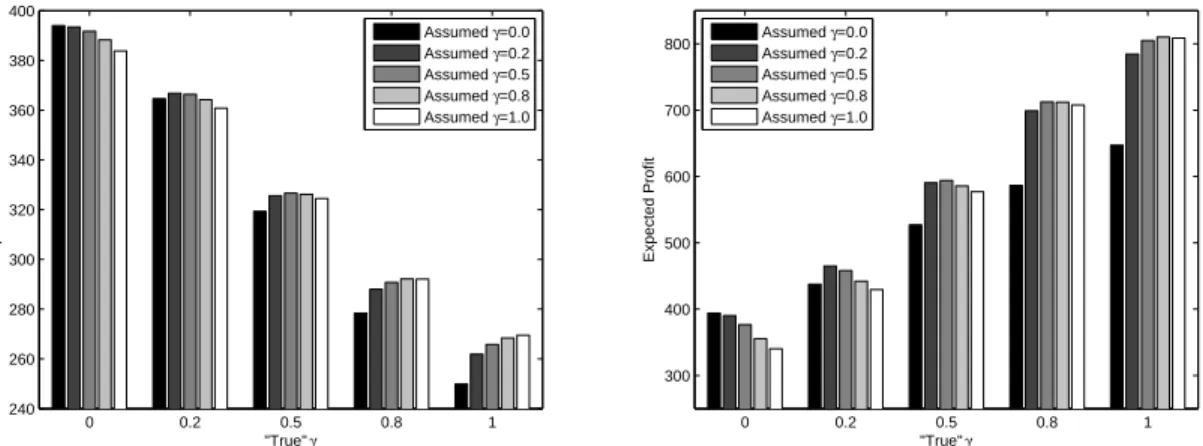
2.3 Sensitivity to misspecification of the change probabilityγ when the change prior represents a moderate decrease (left) and moderate increase (right) in demand. The bars in each chart represent expected profits when the manager assumesγ = 0.0 (white), 0.2, 0.5, 0.8, and
1.0 (black). . . 34
3.1 Ex-ante expected profit Π(q1, Q−q1|α, β) as a function ofq1 in a two-identical-store example under Poisson demand with a gamma
prior when Q= 5,10,15. . . 58 3.2 Ex-ante expected profit in a three-identical-store example as a
func-tion of total test inventory Qunder various allocation policies. . . 60 3.3 Comparison of the optimal test inventory allocation policies for the
cases with and without timing information (N = 2). . . 63 3.4 Comparison of the heuristic and the optimal allocation policies (N = 2). . . 64 3.5 Optimality gaps of the Service-Priority policy with various values of
target service level r when timing information is unobservable (N = 2). . . 65 3.6 Optimality gaps under heuristic test inventory allocation policies
(N = 3). . . 67
4.1 Percentage profit gain from personalized offering. . . 88
4.2 Optimal offering thresholdθT∗(ˆq,0). . . 88
A.1 An example showing that Proposition 2.3(b) may not hold iff(·|θ)
CHAPTER 1
Introduction
Retail, the business of selling goods and services to end consumers, is one of the most
important industries in the U.S, and has a significant impact on the U.S. economy. A 2011
report from the National Retail Federation reveals that in 2009, the retail industry ranked
third among all industries by directly adding$1.2 trillion to GDP, accounting for 8.5% of the U.S. GDP; it was also the largest private-sector employer in the country, directly providing
28.1 million full-time and part-time jobs, accounting for 24.1% of total national employment.
The retail business is challenging given its highly volatile and competitive nature. Success
in retail requires successfully matching supply with demand. On the demand side, learning
customer demand is crucial and has become increasingly challenging in a fluctuating economy
with shortened product life cycles, prolonged lead times, and rapidly changing consumer
behaviors. On the supply side, efficient and effective management of inventory, the single
largest asset for most retailers, is at the heart of retail operations.
Demand learning and inventory management are intricately interrelated. On one hand,
optimization of inventory decisions relies on information gathered from demand learning; on
the other hand, the ultimate goal of demand learning is to minimize profit losses, including
inventory costs, that are attributed to demand uncertainty. What further complicates the
relationship between the two is the fact that retailers’ inventory decisions may in turn
obscure their demand observations, as retailers typically do not observe lost sales due to
stockouts. This thesis focuses on the interactions between demand learning and inventory
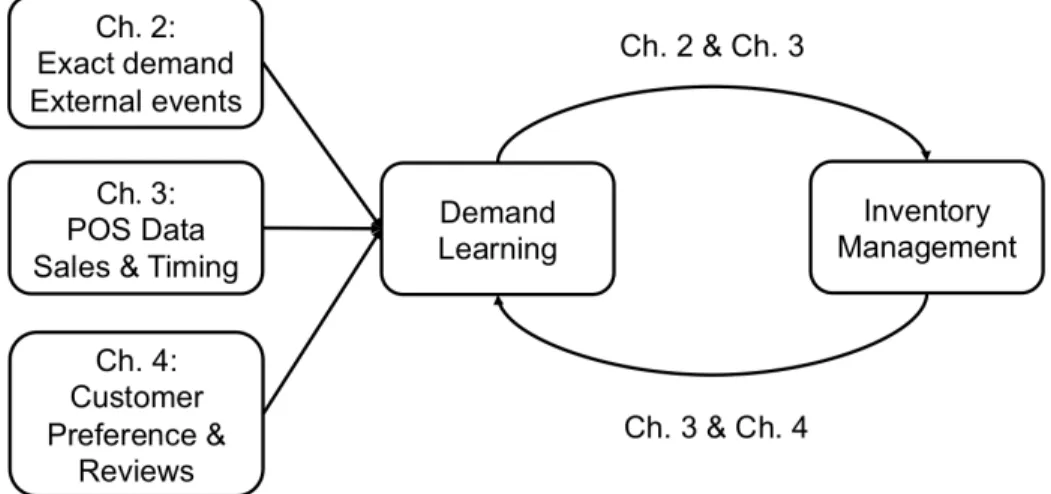
management in retail contexts (see Figure 1.1). In one direction, this dissertation examines
Figure 1.1: Organization of the dissertation.
(Chapter 2 and 4). In the other direction, we study the impact of inventory decisions on the
effectiveness of demand learning (Chapter 3 and 4).
Demand learning also involves making the best use of available data. In response to rising
trends towards business analytics and big data, this dissertation examines various sources
of data for demand learning. In addition to historical demand, Chapter 2 incorporates
information on past events as indicators for potential demand changes. Chapter 3 discusses
the use of granular timing information of transactions on top of aggregate sales data.
Chapter 4 involves learning demand from consumer-generated product reviews and from
customers’ personal characteristics and preference data.
We provide below an overview of Chapters 2 through 4 of this thesis. In Chapter 2, we
study inventory management following a potential shift in the demand regime. The problem
was motivated by the unprecedented adverse impact of the financial crisis started in 2008,
which put retailers in uncharted territory in terms of revenue declines, credit availability,
and demand forecasting. To analyze how retailers should manage inventory adaptively
under such unpredictable circumstances, we consider a situation in which a firm is aware
that the demand regime may (or may not) have changed due to some notable event and
hopes to efficiently manage its inventory while also learning the actual demand trend. In
the periods soon after such events, the manager can rely on historical demand to carefully
estimate possibly obsolete demand parameters, discard the historical demand data and
between. The tradeoff inherent to this problem is between the precision brought by a long
(but possibly out-of-date) history and the responsiveness that comes from relying on a recent
(but limited) history.
We formulate the problem as a multi-period Bayesian inventory model with a mixture of
two priors—one summarizes the inventory manager’s historical demand information and the
other reflects the manager’s belief on the potential demand change. Although a theoretical
characterization of some structural properties of the optimal inventory policy is possible,
computing the exact policy remains challenging. As an alternative approach, we construct
bounds on the optimal costs and develop associated heuristics. Constructing the lower
bounds involves finding an “information relaxation” (Brown et al., 2010) that strikes a
balance between the amount of information to relax and the computational complexity
of the problem after the relaxation. In deriving a new “independentized” lower bound,
we consider a novel auxiliary version of the problem that relaxes the natural dependence
between demand signals and inventory trajectories that makes the inventory optimization
difficult. The result is a tractable, meaningful bounding approach.
An extensive numerical study not only demonstrates the performance of the bounds
and heuristics but also reveals the following key insights. Managers should remain wary of
potential shifts in demand, as a demand forecast that fails to account for potential demand
changes can be costly. When potential demand changes are moderate, a myopic policy
may be sufficiently good, suggesting that managers may prioritize demand estimation over
forward-looking inventory optimization in these cases. When extreme demand changes are
possible, managers may need to use sophisticated inventory policies that jointly consider
demand estimation and inventory dynamics.
Chapter 3 focuses on the practice of “merchandise testing” in the retailing of fashion
products. This chapter investigates the role of inventory allocation decisions in demand
learning across multiple locations. “Merchandise testing,” first documented and studied by
Fisher and Rajaram (2000), is a strategy adopted by fashion retailers to reduce demand
uncertainty caused by short product life cycles and/or long lead times. In a merchandise
test, a chain retailer allocates inventory to selected stores in its network to gather test sales
more accurate demand forecast for the entire chain, thereby improving its ordering decisions
for the main selling season.
At its core, a merchandise test involves simultaneous demand learning across multiple
locations. We formulate the merchandise testing problem as a stylized, two-period, multi-store
Bayesian inventory model. In the presence of a limited quantity of overall test inventory and
demand censoring (i.e., the retailer does not observe lost sales due to stockouts), our analysis
reveals a unique tradeoff between the quantity and the quality of demand observations
collected during a test. Our results on this tradeoff contribute to the literature on Bayesian
inventory control with demand censoring, which mostly considers single-location settings.
This chapter also examines the implication of increased visibility into demand information,
which is relevant to the increased attention being paid to analytics in the retail industry.
In particular, we consider cases in which the retailer does, or does not, observe the timing
of each sales transaction, following a recent work by Jain et al. (2015). This sales timing
information is usually available from point-of-sale systems equipped by most modern retailers.
The characterization of the optimal test inventory allocations involves combining classic
operations theories with the statistical literature on comparisons of experiments (Blackwell
1953). We also develop two near-optimal heuristics for computing test inventory allocations
under general demand processes. Among many other analytical and numerical results, the
key findings of this chapter are:
• The allocation of test inventory can significantly impact the value of demand learning through a merchandise test;
• The retailer’s visibility into demand information has a pivotal impact on test inventory allocation decisions: when sales timing information is observable, retailers’ priority is
to achieve as many sales as possible during the test; When sales timing information
is unobservable, retailers should maintain a sufficiently high service level in each test
store before seeking to increase the number of stores to test.
In Chapter 4, we consider the problem of personalized offering when consumers generate
offerings, and to collect and monitor consumer-generated product reviews The fact that an
online retailer cannot offer customers with hands-on product information before purchases
amplifies the importance of customer reviews. We aim to answer the fundamental research
question of how a retailer should dynamically offer its inventory for sale to individual
customers whose product reviews may influence future demand. This chapter incorporates
two central elements: the consumers’ ability to collectively learn product quality through
reviews generated by their peers, and the firm’s ability to personalize product offering based
on its knowledge about individual customers’ preferences.
In particular, we consider a firm that sells an experiential product at an exogenous,
constant price over a finite selling season. For each customer, the gross utility from consuming
the product comprises two parts—anex anteobservable part that we refer to as customer
preference and anex post observable part that we refer to as product quality. The quality of
the product is known to the firm but is unknown and learned by customers. The customer
base is heterogeneous and customers’ preferences for the product follow a random distribution.
We assume the firm may be able to identify the preference of an arriving customer (by
analyzing the customer’s past purchasing and online behaviors) and choose whether to offer
the product to that particular customer without incurring additional costs. Once offered,
the customer purchases a unit if herex anteexpected net utility is positive.
We model consumers’ review generation and quality learning process by a stylized
quasi-Bayesian social learning process. Consumers form a belief on the unknown quality
of the product and update it as they observe reviews posted by previous buyers. Each
arriving customer bases their purchasing decision on their ex ante expected net utility.
Once they purchase, customers generate reviews based on theirex post net utilities, namely,
utilities received after they have purchased and experienced the product. Customers are
not fully rational and are subject to selection biases: they update their belief in a Bayesian
fashion except that they ignore the potential selection biases and treat reviews as if they
are randomly sampled from the entire population, instead of those who purchase.
We formulate the firm’s personalized offering problem as a finite-horizon dynamic
program. We show that the optimal product offering policy is a threshold-type policy—
preference. We demonstrate that it can be optimal for the firmnotto offer the product to an
arriving customer with a low preference in order to avoid a bad review that will negatively
impact future sales, even when it is certain that the customer will buy the product if offered.
While our base model assumes no capacity or inventory constraints, we extend our analysis
to the setting in which the firm has a limited inventory upfront.
We study in a numerical analysis the impact of price and consumers’ mean belief and
uncertainty about product quality on the firm’s optimal product offering decisions and on
the potential value of personalized offerings. We find that compared with a benchmark policy
that offers the product to every arriving customer who is willing to purchase, personalized
offering may significantly improve profit, especially in settings in which the product price is
CHAPTER 2
Bayesian Inventory Management
with Potential Change-Points in Demand
2.1
Introduction
In most real-world inventory control problems, demand changes over time and the true
underlying demand distribution is never fully known to the inventory manager. The manager
makes dual use of historical demand data to populate the current demand distribution and
also to detect fundamental changes in the demand-generating process.
We provide two data examples in Figure 2.1 to illustrate the complexity of the manager’s
task. Figure 2.1(a) shows seasonally adjusted monthly sales by motor vehicle dealers in
the United States before and after September 2001. Imagine the situation faced by an
automobile dealer in the autumn of 2001. While a reasonable dealer would expect the
September 2001 attacks to impact consumer demand for automobiles, the direction and
magnitude of the impact would have been difficult to predict from data available at the
time. In October 2001 sales spiked substantially, but was this just a temporary surge or an
indicator of a new regime in automobile sales? Was pre-October historical data still useful
for understanding demand in October and beyond? History shows that demand eventually
fell back close to its pre-September levels, but this might have been unclear at the time.
Figure 2.1(b) shows seasonally adjusted monthly sales for U.S. women’s clothing stores in
2008 and 2009. Uncertainty in the financial markets reached a crescendo in September 2008
with the backruptcy of investment bank Lehman Brothers. Even if a women’s clothing retailer
at the time anticipated a negative impact on garment sales, the magnitude and persistence
clothing demand bottomed out in December 2008 and stayed close to its December 2008
levels for over a year afterwards. In hindsight, we see that the Lehman Brothers bankruptcy
marked a distinct change in women’s clothing demand that rendered the previous demand
history unsuitable for understanding new demand levels.
These two examples illustrate what we believe is a common challenge faced by retail and
other managers, namely how to respond to external events that have the potential to change
the demand environment. While September 2001 and the Lehman Brothers bankruptcy
are well-known events that impacted many firms across many industries, demand-changing
events can also be local. For example, the start of a new marketing campaign, the entrance
of a new competitor, the release of a new product version, and the opening of a nearby
attraction can all potentially usher in new demand regimes for a firm. The introduction
of a new product could also be interpreted as a potential demand-changing event when
historical demand or sales data from a similar product are available for generating a reference
forecast. All of these events have in common that their timing is known but their impact is
not. In the periods soon after such events, the manager can rely on historical demand to
carefully estimate possibly obsolete demand parameters, discard the historical demand data
and instead re-estimate demand parameters based on a limited history, or do something
in between. The tradeoff inherent to this problem is between the precision brought by a
long (but possibly out-of-date) history and the responsiveness that comes from relying on a
recent (but limited) history.
We refer to such events aspotential change-points in demand, and we present and analyze
an inventory control model that explicitly allows for potential change-points. We focus on
the case in which there is a single potential change-point in the recent past, which is relevant
to the examples of Figure 2.1 and to other examples in which change-points occur relatively
infrequently. We seek to understand the structure and behavior of the optimal policy, and
we look for computationally tractable bounds and heuristics.
We model the evolution of the manager’s belief on the demand process using a Bayesian
framework, extending the model pioneered by Scarf (1959) to allow for an unknown demand
parameter to be distributed according to a mixture of a “historical” prior distribution and a
the effects of observed demand and the manager’s belief on the optimal (state-dependent)
base-stock levels.
The optimal policy remains challenging to compute. Scarf (1959) and Azoury (1985)
show that the stationary Bayesian inventory problem can be solved efficiently using a
dimensionality reduction approach for particular assumptions on the prior and demand
distributions, but these assumptions do not hold when the unknown parameter is described
by a mixture of distributions. We pursue heuristic policies coupled with cost lower bounds
specific to our setting. Our most sophisticated bounding approach is novel in its formulation
of an “independentized” problem that relaxes the dependence between physical demand and
demand signals. A particular information relaxation of the demand signal information yields
efficient subproblems that are solutions to stochastic multiperiod inventory problems with
known demand distributions. In contrast to the dimensionality reduction approach of Scarf
and Azoury, this approach can be applied for a broad set of belief and demand distributions.
An extensive numerical analysis reveals that this bound and a look-ahead policy derived
from it achieve small gaps. The numerical study also reveals that a myopic policy that
accounts for potential change-points (but that ignores future inventory dynamics) works
well except in extreme instances.
We also consider the sensitivity of our inventory policies to misspecification of the
parameters of the manager’s Bayesian prior. Taking a maximin profit perspective, we show
that a conservative manager worried about profit downside will follow a policy that assumes
the smallest prior (in a sense we will make precise) among a set of candidates.
The remainder of this chapter is organized as follows. We review related literature in
§2.2. In§2.3, we formulate our Bayesian demand model and associated inventory control problem, and we present structural properties of the optimal inventory policy. In §2.4, we develop lower bounds for the optimal expected cost, and we introduce heuristic policies
derived from these lower bounds. We numerically study these bounds and policies and
50,000 55,000 60,000 65,000 70,000 75,000 80,000 J a n . 2 0 0 1 Fe b . 2 0 0 1 M a r. 2 0 0 1 Ap r. 2 0 0 1 M a y 2 0 0 1 J u n . 2 0 0 1 J u l. 2 0 0 1 Au g . 2 0 0 1 Se p . 2 0 0 1 O c t. 2 0 0 1 Nov . 2 0 0 1 Dec . 2 0 0 1 J a n . 2 0 0 2 Fe b . 2 0 0 2 M a r. 2 0 0 2 Ap r. 2 0 0 2 M a y 2 0 0 2 J u n . 2 0 0 2 J u l. 2 0 0 2 Au g . 2 0 0 2 Se p . 2 0 0 2 O c t. 2 0 0 2 Nov . 2 0 0 2 Dec . 2 0 0 2
Adjusted Monthly Sales (in millions of dollars): Automobile and other motor vehicle dealers in the US
(a) 2,900 2,950 3,000 3,050 3,100 3,150 3,200 3,250 3,300 3,350 3,400 J a n . 2 0 0 8 Fe b . 2 0 0 8 M a r. 2 0 0 8 Apr. 2 0 0 8 M a y 2 0 0 8 J u n . 2 0 0 8 J u l. 2 0 0 8 Au g . 2 0 0 8 Sep . 2 0 0 8 O c t. 2 0 0 8 Nov . 2 0 0 8 Dec . 2 0 0 8 J a n . 2 0 0 9 Fe b . 2 0 0 9 M a r. 2 0 0 9 Ap r. 2 0 0 9 M a y 2 0 0 9 J u n . 2 0 0 9 J u l. 2 0 0 9 Au g . 2 0 0 9 Sep . 2 0 0 9 O c t. 2 0 0 9 Nov . 2 0 0 9 Dec . 2 0 0 9
Adjusted Monthly Sales (in millions of dollars): Women's Clothing Stores in the US
(b)
Figure 2.1: Examples of potential change-points in demand include (a) the terrorism events of September 2001 and (b) the Lehman Brothers bankruptcy in September 2008. (Source: U.S. Census Bureau)
2.2
Literature Review
This chapter relates to the inventory control literature dealing with nonstationary and/or
partially observed demand processes. For situations in which the demand is nonstationary but
the demand distributions are known, Karlin (1960) analyzes a dynamic inventory system in
which demands are stochastic and may vary from period to period and proves the optimality of
state-dependent base-stock policies. Song and Zipkin (1993, 1996) propose a continuous-time
Markov-modulated Poisson demand framework to model inventory management problems in
fluctuating demand environments. They assume that the demand distribution changes regime
according to a known Markov chain and that the demand distribution in each regime is
also fully known. Under these assumptions, they establish the optimality of state-dependent
(s, S) policies. Sethi and Cheng (1997) show similar results in a generalized discrete-time inventory model with Markov-modulated demands. Graves (1999) characterizes the behavior
of an adaptive base-stock policy under an ARIMA demand process. Iida and Zipkin (2006)
and Lu et al. (2006) study approximate solutions for inventory planning problems with
demand forecasting based on the martingale model of forecast evolution (MMFE).
Using a Bayesian framework, Scarf (1959) pioneers the study of optimal inventory policies
under a stationary demand process with an unknown demand distribution parameter. Our
structure. Scarf (1960) and Azoury (1985) provide conditions under which the dimensionality
of the problem can be reduced and the optimal base-stock levels can be obtained by solving
a one-dimensional dynamic program. Our heuristics make possible the computation of
approximate solutions to problems with more general prior and demand distributions.
Azoury and Miyaoka (2009) study a Bayesian inventory problem where demand in each
period depends on side information through a linear regression model. All of these works
assume, as we do, that demand is fully observable and backlogged. There is another stream
of research on inventory management problems when lost sales are unobserved and demand
is therefore censored, assuming stationary demand. See, for example, Lariviere and Porteus
(1999), Ding et al. (2002), Chen and Plambeck (2008), Bensoussan et al. (2007, 2008), Chen
(2010), and Huh et al. (2011). Chen and Mersereau (2015) include a survey of this literature.
The demand process we consider is also related to that of Treharne and Sox (2002),
who assume a Markov-modulated demand process in which state transitions are unobserved
but the manager knows the transition probability matrix and maintains a belief of the
underlying Markov state. They evaluate several heuristics, including limited lookahead
policies, numerically. Brown et al. (2010) apply information relaxation bounds to an extended
version of Treharne and Sox (2002)’s model with non-stationary cost parameters. Our model
differs from these in two important respects. First, we assume a single potential shift in
the past. This simplification yields structure that we exploit in deriving new results and
bounds. Second, we model component demand distributions that are learned over time,
whereas Treharne and Sox (2002) assume the demand distribution within each Markov state
is known and fixed. We believe that our model brings distinct advantages in flexibility and
parsimony. For further discussion, see§2.3.2. While the bounds we develop in§2.4 make use of results in Brown et al. (2010), we believe our “independentized” bound to be new.
Inasmuch as our work considers a change in demand regime, it also relates to Besbes
and Zeevi (2011), in which a decision-maker seeks to detect and exploit a potential change
in customers’ willingness-to-pay distribution through dynamic pricing.
Our work is also related to a large stream of the statistics literature on change-point
detection — detecting departures of a stochastic process from a known model by monitoring
(1993), Lai (1995), and the recent text Tartakovsky et al. (2015). This literature most
commonly seeks to identifywhena change occurs, focusing on the tradeoff between detection
delay and the risk of false alarm. Our interest is not in declaring when a change-point occurs;
rather, we formulate a dynamic optimization problem built on a stochastic model involving
a potential change-point. Our model specializes typical sequential change-point formulations
in that we assume that the timing of our potential change-point is known. In our model, a
key unknown is whether or not the change actually occurs.
2.3
Model and Analysis
In this section we model an inventory management problem over a finite horizon following a
potential change in the demand process. We present several structural properties, including
certain structure inherited from well-studied inventory problems, which we use in our
algorithm development in §2.4.
2.3.1 Inventory Management Following a Single Potential Change-point
Consider a single-item,T-period inventory system. At the beginning of periodt, the decision maker (DM) observes the inventory position,xt, and can place an order to bring the inventory
position up to yt ≥xt at a linear purchasing cost c ≥0. We assume zero lead time such
that the order is instantaneously delivered. Demand, denoted by a random variable Dt with
realized valuedt, is then realized and satisfied by the inventory on hand. If at the end of
the period the DM still has leftover inventory, i.e., yt−dt>0, a linear holding cost h is
charged; otherwise (i.e.,yt−dt≤0), the excess demand is fully backlogged and incurs a
linear shortage costp. The discount factor is α∈(0,1] each period. We assumep > c(1−α) to avoid trivial solutions. The salvage value for leftover inventory at the end of period T is assumed to be zero. We shall omit the subscript twhenever it is clear from the context.
We assume the DM fully observes past demands without censoring, as does Scarf (1959).
This assumption is driven in part by analytical tractability (as is our assumption of inventory
backlogging), but we believe it is reasonable in practice when changes in demand are likely
example, for the September 2001 and Lehman Brothers bankruptcy contexts described in
§2.1. In such cases, the firm can use data across stock-keeping units to correct for demand censoring.
We extend the Bayesian framework of Scarf (1959). The distinctive feature of our model
is how we model the demand process. We assume that the demands Dt are independently
drawn according to a density function f(·|θ), where θ∈Θ is an unknown parameter. The DM has a historical priorπh (h stands for “history”) onθwhich reflects his prior knowledge
of the demand parameter based on historical information. Apotential changepoint occurs in
period 1; thereafter, the DM is uncertain about whether the historical prior πh continues to apply or whether the demand process has changed. The DM has a second prior distribution
πc on θ conditional on a change occurring (the superscript c stands for “change”). The change probabilityγ represents the DM’s initial belief that a change has indeed occurred in period 1.
In practice, it is reasonable for the DM to estimate the historical prior using historical
demand. However, it may be less obvious how to estimate the change prior πc and the
probabilityγ. We provide a full discussion of this in§2.6, where we perform a sensitivity analysis and suggest robust choices for these parameters.
Let πt denote the DM’s prior belief on the unknown parameter θ at the beginning
of period t, then π1(θ) = (1−γ)πh(θ) +γπc(θ) by definition, and πt+1 is the posterior distribution obtained by updatingπt based on dt, the demand realization in periodt, using
Bayes rule. That is,
πt+1(θ|πt, Dt=dt) =
f(dt|θ)πt(θ)
R
Θf(dt|ω)πt(ω)dω
. (2.1)
We will show in §2.3.4 that this update has a particular structure that enables our anal-ysis. The predictive demand density in period t given belief πt is defined by φ(ξ|πt) =
R
Θf(ξ|θ)πt(θ)dθ. A natural generalization of our model allows for multiple change priors. Most of our results directly extend to this case. (The main exception is Proposition 2.4 in
The DM’s objective is to minimize the Bayesian expected discounted total cost over a
finite horizon based on his prior belief on the demand process by choosing an order quantity
in each period. We use (a)+ to denote max{a,0} for a real number a. Given inventory positiony after ordering and a demand realizationd, the holding and shortage cost incurred in a single period is
l(y, d) =h(y−d)++p(d−y)+,
and the expected cost in period twith initial inventory positionx and beliefπt is given by
EDt|πt[c(y−x) +l(y, Dt)] =c(y−x) +L(y|πt),
where L(y|πt) :=EDt|πt[l(y, Dt)] =
R∞
0 l(y, ξ)φ(ξ|πt)dξ.
LetCt(x|πt) be the optimal expected cost for periods t, t+ 1, . . . , T. We can formulate
the problem as a Bayesian dynamic program with the following optimality equations for
t= 1, . . . , T:
Ct(x|πt) = min
y≥x{c(y−x) +L(y|πt) +αEDt|πt[Ct+1(y−Dt|πt◦Dt)]}, (2.2)
whereπt◦Dt:=πt+1(·|πt, Dt) as defined by (2.1). The terminal cost is given byCT+1(·|·) = 0.
2.3.2 Discussion of our Demand Model
Our choice of a mixture model as a prior distribution for the unknown demand parameter
is driven by our interest, as discussed in§2.1, in situations in which the DM has reason to believe a change in demand regimemayhave just occurred but is uncertain about whether
a fundamental change has really transpired and, if so, about its extent. Our mixture model
explicitly models this uncertainty. Such problems are most relevant and interesting in the
few periods just after the potential change, and our choice of a parametric Bayesian model
permits meaningful demand learning even with a few observations.
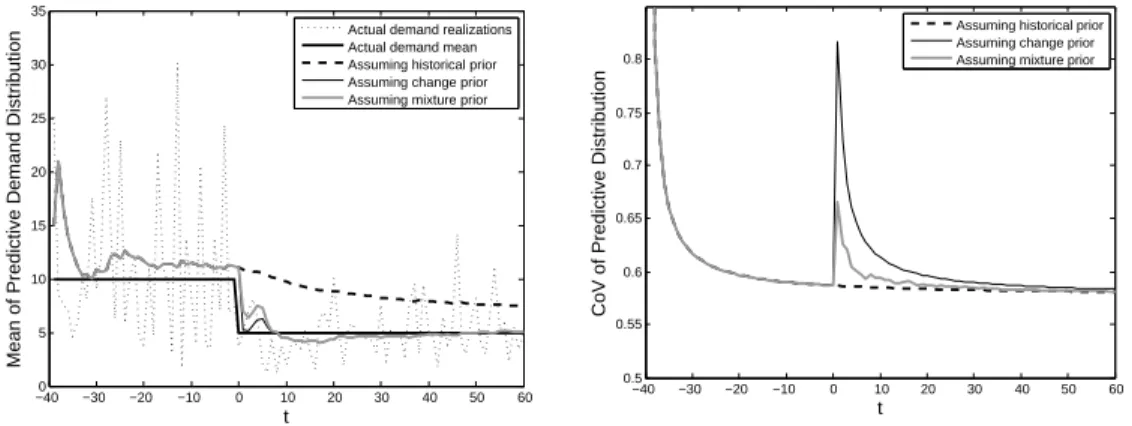
We use our model to illustrate numerically in Figure 2.2 the core demand learning
−400 −30 −20 −10 0 10 20 30 40 50 60 5
10 15 20 25 30 35
t
Mean of Predictive Demand Distribution
Actual demand realizations Actual demand mean Assuming historical prior Assuming change prior Assuming mixture prior
−40 −30 −20 −10 0 10 20 30 40 50 60 0.5
0.55 0.6 0.65 0.7 0.75 0.8
t
CoV of Predictive Distribution
Assuming historical prior Assuming change prior Assuming mixture prior
Figure 2.2: Illustration of behavior of various Bayesian demand learning models for two demand paths.
path involving a change in the demand mean from 10 to 5 occuring at time t= 0, while the right panel corresponds to a demand path drawn from a stationary demand process
with demand mean 10 units.1 The gray curves show statistics of the predictive demand
distribution under our mixture model. For comparison, we also plot predictive demand
statistics for models that use the historical prior alone and the change prior alone from time
t= 0 on.
In the left-hand plot, we see that the mixture model more quickly learns the changed
demand mean compared with the model using the historical prior alone, while (as expected)
not quite as quickly as the model that assumes a change definitely occurred. In the
right-hand plot, we see that the coefficient of variation (CoV) for our mixture model jumps
considerably less and stabilizes more quickly than the model that relies on the change prior
alone. We conclude that our “mixture” model of demand learning achieves a robust balance
of responsiveness (in the event a change actually occurs) and stability (in the event no
change occurs).
Further testing (omitted to conserve space) shows the necessity of allowing for the
component distributions (in particular, the change distribution) to be learned from data
rather than fixed a priori in situations where the DM has uncertainty around the
post-1
The specific instance is similar to those in§2.5.3 (i.e., gamma demand distribution). Using notation to be introduced later, we assume an initial change prior ofγ0= 0.5, we assume a known “shape” parameterk= 3
for gamma demand, and we assume a “change” gamma prior withac= 3,Sc= 5. The “historical” gamma
change demand parameter. Fixing and mis-specifying θ may prevent the mixture model from converging to the true mean and variance of demand.
Finally, we have considered alternative modeling approaches for modeling change-points.
Hypothesis testing-based approaches to change-point detection (e.g., Tartakovsky et al.,
2015) do not naturally lead to forward-looking distributional forecasts that we require for
multiperiod inventory control. Non-parametric methods (e.g., Huh et al., 2011) offer no
concise state representation for use in a forward-looking dynamic optimization formulation.
2.3.3 Structure of the Optimal Policy
Although the demand process described in§2.3.1 is complicated by the potential change-points, it is still independent of the ordering decisions. Because of this, the cost functions are
convex and a state-dependent base-stock policy is optimal. We state the following result for
completeness, but we omit the proof because the result can be obtained by a straightforward
modification of proofs in Scarf (1959) and Treharne and Sox (2002).
Proposition 2.1. (a) Ct(x|πt) is a convex function of x for all πt.
(b) The optimal policy takes the form of a state-dependent base-stock policy. There exists a
sequence of nonnegative functions {y∗
t(πt)} such that it is optimal for the DM to order
min{y∗
t(πt)−xt,0} at the beginning of periodt given inventory positionxt and belief πt.
We do not have closed-form expressions for the optimal policy, and given previous
research it is unlikely that the optimal policy can be easily computed, much less simply
expressed. We discuss the computability of the optimal policy in§2.4. However, as is often possible in finite horizon, non-stationary inventory problems (see Theorem 9.4.2 of Zipkin,
2000; also Karlin, 1960; Morton and Pentico, 1995), we are able to bound the optimal
base-stock levels by easily computed myopic base-base-stock levels, which has the potential to reduce
the search space for an optimal policy. The myopic policy is one in which the DM considers
neither the evolution of future demand forecasts nor the carry-over of inventory across
periods. The DM therefore treats each period as a single-period newsvendor problem. In our
case, let Φ(·|πt) be the cumulative distribution function representing the DM’s prediction of
for periodtunder a myopic policy is given byytM(πt) such that
Φ(ytM(πt)|πt) =
p−c(1−α)
p+h , t= 1, . . . , T −1, p−c
p+h , t=T.
(2.3)
The following proposition shows that this myopic policy upper-bounds the optimal policy.
Proofs appear in an appendix unless otherwise indicated.
Proposition 2.2. For all t= 1,2, . . . , T, yMt (πt)≥yt∗(πt).
We remark that both Proposition 2.1 and 2.2 extend to models with multiple potential
change-points in both the past and future, as long as the timing of the potential change-points
and their associated change priors and change probabilities are all known to the DM. Chen
and Plambeck (2008) also show that a DM may want to stock less than the myopic inventory
level when inventory is perishable, albeit in a different Bayesian inventory setting than ours
(with stationary demand and censored observations).
2.3.4 Monotonicity Properties of Optimal Base-Stock Levels
We explore in this subsection some monotonicity properties of the optimal base-stock levels
with respect to demand history, the historical and change priors, and the change probability.
Some definitions are needed here before we proceed.
Likelihood Ratio Order. Let f(·) and g(·) be two probability density functions. f
is larger than g in the likelihood ratio order, denoted by f ≥lr g, if for all d1 > d2,
f(d1)/g(d1)≥f(d2)/g(d2).
Monotone Likelihood Ratio Property (MLRP). A distribution family f(·|θ) with a parameter θ ∈ Θ is said to have the Monotone Likelihood Ratio Property (MLRP) if
f(·|θ1)≥lrf(·|θ2) for allθ1 ≥θ2. Many common distributions, such as normal with known variance, binomial, Poisson, gamma, and Weibull, have MLRP (see Karlin and Rubin, 1956).
Hereafter we assume that the demands are independent and from a distribution family
the MLRP assumption is that if a larger demand occurs, it becomes more likely that the
underlying demand distributionf(·|θ) has a higher θparameter.
Scarf (1959) shows a monotonicity result in his setting with respect to the observed
demand history. Specifically, the optimal base-stock level is increasing in the demand
observation if the underlying demand process is stationary and the demand distribution
f(·|θ) is from the exponential family of the form f(ξ|θ) =β(θ)e−θξr(ξ) (with r(ξ) = 0 for
ξ <0). We can view our single change-point model as a variant of Scarf’s model with MLRP demand and an initial prior being a mixture of distributions. The following proposition
shows that we inherit Scarf’s monotonicity result by generalizing his result to the case of
MLRP demand.
Proposition 2.3. Let yt∗(πt) be the optimal base-stock level in period t (t= 1, . . . , T) given
belief πt, where πt (t ≥2) is updated over πt−1 based on demand realization dt−1. If the demand distribution familyf(·|θ) has MLRP, then the following hold:
(a) yt∗(πt)≤y∗t(πt0) for πt≤lrπ0t;
(b) yt∗(πt) is increasing in dτ, for all t≥2, τ < t.
Proposition 2.3(a) characterizes the behavior of the optimal base-stock level with respect
to the DM’s belief on the demand process. Intuitively, a larger (smaller) belief (in the
likelihood ratio ordering) indicates a larger (smaller) demand parameter, which further
implies a stochastically higher (lower) demand, which finally leads to a higher (lower) optimal
base-stock level. Proposition 2.3(a) paves the way for establishing monotonicity properties of
the optimal base-stock levels with respect toπc, πh, andγ in what follows. We use a closely related result when deriving the independentized lower bound in§2.4.1.2. Proposition 2.3(b) guarantees that it is always optimal to order more (less) in the next period if a higher (lower)
demand is observed during the previous periods. We note that these results do not require
specific assumptions on the initial beliefπ1; it need not have a mixture form and can be any general distribution over the parameter space Θ. We present an example in Appendix A.2
As mentioned previously, our model is distinguished by its particular prior structure.
The prior is a mixture of two distinct distributions. The following lemma establishes that
this structure survives the DM’s belief updating procedure.
Lemma 2.1. In the single potential change-point problem, let dt = (d1, . . . , dt) be any
demand history up to period t, t= 1, . . . , T. πt(·|dt−1) is then given by
πt(θ|dt−1) = (1−γt(dt−1))πth(θ|dt−1) +γt(dt−1)πtc(θ|dt−1),
where πth(·|dt−1) is updated over πh based on dt−1, πct(·|dt−1) is updated over πc based on
dt−1, and γt(·) is a function ofdt−1.
Lemma 2.1 shows that the belief updating procedure can be decomposed into two parts:
one separately updates the beliefs conditioned on there being a change and on there being
no change; the other updates the change probability. The belief is still in the form of a linear
mixture distribution of those two updated beliefs, with the updated change probability as
the weight. The following Proposition 2.4 uses this result to establish a relationship between
the corresponding optimal base-stock levels. In§2.4 we will use the structure in Lemma 2.1 to derive an easily computed cost lower bound.
Proposition 2.4. In the single potential change-point problem, let yt∗(πt) be the optimal
base-stock level in period t(t= 1, . . . , T). Let yht(πth) (ytc(πtc))be the corresponding optimal base-stock level when the change probabilityγ = 0 (respectively, γ = 1). The following hold:
(a) If πh ≤lr πc, yht(πth) ≤ yt∗(πt) ≤ yct(πtc); otherwise if πc ≤lr πh, yct(πtc) ≤ y∗t(πt) ≤ yth(πth);
(b) If πh ≤lr πc, y∗t(πt) is increasing in γ; otherwise if πc≤lr πh,yt∗(πt) is decreasing in γ.
Proof. We only show the proofs of the first parts of (a) and (b). The proofs of the second
parts follow from a straightforward modification.
It is easy to verify that ifπh ≤lrπcandπ1(θ) = (1−γ)πh(θ) +γπc(θ) for someγ ∈[0,1], then πh≤lrπ1≤lrπc. Lemma 2(c) of Chen (2010) further guarantees that πth ≤lr πt≤lrπtc
Now defineγ0 such thatγ < γ0 ≤1, and letπ01(θ) = (1−γ0)πh(θ) +γ0πc(θ). Because we can write π10 as a convex combination ofπh and πc, it follows thatπ1 ≤lrπ10, and thus πt≤lrπ0t
for all t. The desired resultyt∗(πt)≤yt∗(π0t) then follows from Proposition 2.3(a).
Proposition 2.4 provides sufficient conditions for the optimal base-stock levels of the
single potential change-point problem to be bounded by those of the two degenerate problems
— one withγ = 0 and the other withγ = 1. The result is intuitive: if an increase in demand is possible, the DM should order more than if the demand remains stable, and less than if
the demand is guaranteed to increase. Moreover, the DM should order more as the change
probability increases.
Proposition 2.4 may reduce the search space for optimal policies. It also motivates simple
and computable heuristic ordering policies. In particular, for certain choices ofπh and πc, the optimal solutions to the two degenerate problems can easily be computed by applying
the dimensionality reduction technique in Scarf (1960) and Azoury (1985). A base-stock
level in the form of a convex combination of these two solutions is an appealing heuristic
policy. We have found such a policy to perform reasonably well, though we do not pursue it
in the following section because it is outperformed by a related policy, which is greedy with
respect to a convex combination of cost-to-go functions for the two degenerate problems.
2.4
Bounds and Policies
The usual approach to evaluate the performance of an inventory policy is to compare its
expected cost with that of the optimal policy. However, the complexity of the Bayesian
inventory control problem with potential change-points makes it intractable to compute
optimal solutions. The dimensionality reduction technique in Scarf (1959) and Azoury (1985)
is in general not applicable for our model with potential change-points. The conditions for
applying the technique are:
1. Suppose thatStis a sufficient statistic for demand observations up to periodt. There is
a functionqt(St) such thatφ(ξ|St) = (1/qt(St))ψt(ξ/qt(St)), whereψt(·) is a probability
2. The function qt(St) satisfies qt+1(St◦d) =qt(St)Ut+1(d/qt(St)) for some continuous
real valued functionUt+1 such that
R∞
0 Ut+1(u)ψt(u)du <∞, where St◦ddenotes an update of Stbased on demand observationd.
However, since the beliefs in our problem are linear mixtures of distributions, there do
not exist qt functions that can serve as such scale parameters for the predictive demand
distributions. Therefore, it is computationally impractical to obtain the optimal policy or
the optimal expected cost.
Treharne and Sox (2002) face a similar issue with an adaptive inventory control problem
with similarities to our own. They point out the difficulty of computing an optimal policy
even with an understanding of the policy structure, and they turn to heuristic policies. As
an alternative approach, we develop lower bounds for the expected cost. Coupled with
ordering heuristics derived from these bounds, we seek to bound the optimal cost as tightly
as possible.
2.4.1 Bounds for Expected Cost
We develop two lower bounds in this subsection. The first makes use of the decomposition of
Lemma 2.1, while the second makes use of a novel relaxation we call the “independentized”
problem. Both make use of the “information relaxation” framework outlined in Brown et al.
(2010).
2.4.1.1 The Mixture Lower Bound.
Lemma 2.1 implies that the DM’s belief in a period can be decomposed as a convex
combination of the beliefs implied by two “degenerate” information structures in which a
change is known to have occurred or known not to have occurred. If the degenerate problems
are easily solved (e.g., if the historical priorπh and change prior πcsatisfy the conditions of Azoury, 1985), then the solutions can be easily employed to form an expected cost lower
bound. Imagine an oracle who reveals to the DM whether or not a change has occurred.
It is intuitive that the expected cost utilizing the oracle information would lower bound
information revealed by the oracle can only help achieve lower cost.) This is the content of
the following proposition.
Proposition 2.5. Let dt−1,πt(·|dt−1),πht(·|dt−1),πct(·|dt−1) and γt(dt−1) be defined as in Lemma 2.1. For all t= 1, . . . , T, define the mixture lower bound LBtM(xt|dt−1) by
LBtM(xt|πt(·|dt−1)) = (1−γt(dt−1))Ct(x|πht(·|dt−1)) +γt(dt−1)Ct(x|πct(·|dt−1)),
thenLBMt (xt|πt(·|dt−1))≤Ct(xt|πt(·|dt−1)).
Proof. The intuition behind the result is given above. The oracle information can be viewed
as an information relaxation. Therefore, the proposition follows from Lemma 2.1 in Brown
et al. (2010).
2.4.1.2 The Independentized Lower Bound.
When implementing an inventory policy with demand learning, the DM uses demand
realizations in two ways: to calculate inventory positions and to update demand beliefs. We
construct a lower bound using the notion of information relaxations (Brown et al., 2010) by
relaxing only the information available to the DM for belief updating.
To motivate this, write as Dt= ( ˆDt, Dt) the DM’s observation of demand in period t,
where we artificially distinguish between the physical demand ˆDt that impacts inventory
positions and the demand signalDt that the DM uses to update his beliefs aroundθ. In the
original problem, the physical demand and demand signal are one and the same and are
therefore perfectly correlated. We writeDot for the original problem as Dot = (Dt, Dt). For
the purpose of constructing a bound, we consider an “independentized” problem in which
the physical demand and the demand signal are assumed to be independent of each other.
We writeD⊥t = (Dt⊥, Dt) where both D⊥t and Dt have a marginal densityφ(·|πt), which is
the predictive demand density implied by the beliefπt, but Dt⊥ and Dt are independent,
conditional onπt.
Let Ct(xt|πt) and Ct⊥(xt|πt) be the optimal expected costs of the original and the
xt and belief πt. Then we have
Ct(xt|πt) = min y≥xt
n
c(y−xt) +L(y|πt) +αEDo
t=(Dt,Dt)|πt[Ct+1(y−Dt|πt◦Dt)] o
,
Ct⊥(xt|πt) = min y≥xt
n
c(y−xt) +L(y|πt) +αED⊥t =(D⊥t ,Dt)|πt h
Ct⊥+1(y−Dt⊥|πt◦Dt)
io
,
with terminal values CT+1(·|·) =CT⊥+1(·|·) = 0.
With the notation above, we have the following proposition which shows that the optimal
expected cost of the independentized problem serves as a lower bound for that of the original
problem.
Proposition 2.6. Ct⊥(xt|πt)≤Ct(xt|πt) for allxt, πt, and t= 1, . . . , T.
The proof, in Appendix A.4, shows that the cost-to-go function, as a function of both
the physical demand realization d⊥t and demand signal realization dt, is supermodular and
thatD⊥t = (Dt⊥, Dt) is less than Dot = (Dt, Dt) in the supermodular ordering. High-level
intuition is as follows. In the original problem, a small demand observation hurts the DM
because it yields low revenues in the current period, but also because it implies a high
end-of-period inventory position at the same time that demand forecasts are lowered. This
combination of high inventory position and low demand forecast accentuates the possibility
of inventory overage in the original problem. In the independentized problem, the correlation
between high inventory positions and lowered demand forecasts is removed. In particular,
high inventory positions and low demand forecasts are less likely to occur together.
Unfortunately, the independentized problem is not necessarily easier to solve than the
original problem. To cope with this, we use the information relaxation approach proposed by
Brown et al. (2010) to construct a lower bound for the expected cost of the independentized
problem. The basic idea is the following. At each decision point t we assume that an oracle reveals the entire future path of demand signals (dt, . . . , dT) to the DM. With this
extra information and his current belief πt, the DM is able to compute his future beliefs
˜
πt+1, . . . ,π˜T recursively through
˜
Let ˜Ct⊥(xt|πt; (dt, . . . , dT)) be the optimal expected cost-to-go at period tgiven inventory
position xt, beliefπt and future demand signals (dt, . . . , dT). The independentized problem
after relaxing future demand signals reduces to
˜
Ct⊥(xt|πt; (dt, . . . , dT)) = ˜Ct⊥(xt|π˜t, . . . ,π˜T)
= min
y≥xt n
c(y−xt) +L(y|π˜t) +αED⊥
t |˜πt h
˜
Ct⊥+1(y−D⊥t |π˜t+1, . . . ,π˜T)
io
,
with ˜CT⊥+1(·|·) = 0. This is in fact a stochastic inventory problem with nonstationary, known demand distributions, the solution to which can easily be obtained as the solution to a
(fully observed) MDP with a one-dimensional state space. Because the oracle information is
impermissible in the independentized problem, the optimal expected cost of the reduced
problem will be lower than that of the independentized one.
We formally state the independentized lower bound as follows.
Proposition 2.7. Let (Dt, . . . , DT) denote the random demand signals in the
independen-tized problem for periods t, . . . , T. For all t= 1, . . . , T, define the independentized lower bound LBIt(xt|πt) by
LBIt(xt|πt) =E(Dt,...,DT)|πt h
˜
Ct⊥(xt|πt; (Dt, . . . , DT))
i
,
thenLBIt(xt|πt)≤Ct⊥(xt|πt)≤Ct(xt|πt).
Proof. The first inequality is an application of Lemma 2.1 in Brown et al. (2010). The
second inequality follows from Proposition 2.6.
We estimate LBtI(xt|πt) in the numerical results using the following procedure. In
an outer simulation, we randomly generate full demand signal paths (d1, . . . , dT) and
calculate predictive demand distributions, (φ1, . . . , φT), based on the generated demand
signal paths. We then solve for each sequence of predictive demand distributions an inner
optimization problem which is an inventory control problem with nonstationary, known
straightforward backwards induction. The average of the resulting expected costs estimates
the independentized lower bound.
To our knowledge, the “independentized” approach to bounding inventory problems with
demand learning has not previously been used in the literature. An advantage of the approach
over the mixture lower-bounding approach of§2.4.1.1 is that it requires efficient solutions only for inventory subproblems with known demand distributions, not for subproblems
involving demand learning as required in§2.4.1.1. This widens its applicability. A drawback of the approach is that it is estimated via simulation. Due to estimation error, this means
that technically we do not have a provable bound if it is based on a finite number of sample
paths. In our numerical results, we estimate the bound based on a large number (100,000)
of sample paths.
The approach may be useful for inventory problems involving demand learning beyond
the one considered in this chapter. It is clearly applicable for other generalizations of the Scarf
(1959) model. Azoury (1985) shows that Scarf’s model can be efficiently solved, but only for
certain assumptions on the demand distribution. Without these assumptions, the optimal
policy remains difficult to compute. In §2.5.2 we demonstrate that the independentized information relaxation is capable of meaningful bounds for the classic Scarf (1959) problem,
for which we can generate the optimal costs for comparison.
2.4.1.3 Penalties.
The information relaxation approach of Brown et al. (2010) also allows for the assignment of
a penalty on each sample path, which potentially tightens the bound by penalizing the use of
“impermissible” information in solving the inner problems. The lower bound for the optimal
expected cost of the original problem is obtained by either simulation or analytical expression
of the minimum expected value of the cost of the relaxed problem plus the penalty.
Unfortunately, we do not find computationally viable penalties for the two relaxations we
have proposed. For the mixture lower bound, any natural penalty destroys the decomposition
exploited by the information relaxation, and the inner problem becomes as difficult to solve
as the original problem. For the independentized lower bound, limited-lookahead methods
to compute for the continuous prior and demand distributions we consider. As a result, in
general we impose a zero penalty on our inner problems for computing the lower bounds.
We leave further investigation of penalties for future work. Even with zero penalties, we see
meaningfully tight bounds in our numerical results.
2.4.2 Heuristic Policies
We develop three heuristic policies for the single potential change-point problem: a myopic
policy, a look-ahead policy based on the mixture lower bound, and a look-ahead policy based
on the independentized lower bound. In§2.5 we evaluate these heuristics using the lower bounds in§2.4.1.
Myopic Policy. Each period the DM updates his belief based on the observed demand and
then uses the single-period newsvendor solution as the base-stock level. This policy therefore
forecasts demand using the potential change-point model but is not forward looking in its
inventory optimization.
Look-Ahead Policy Based on Mixture Lower Bound (LA-M). This policy takes
advantage of the mixture lower bound (LBM) we have developed in the previous subsection. For each period t, the DM uses LBtM+1 as an approximation for the optimal cost-to-go function in periodt+ 1,Ct+1(·|·), and solves the following problem:
CtM(xt|πt) = min y≥xt
c(y−xt) +L(y|πt) +αEDt|πt
LBtM+1(y−Dt|πt◦Dt) .
Of course, the LA-M policy is only implementable if the LBtM+1 lower bound is simple to compute. Therefore, this policy is only attractive for instances in which the degenerate
“change” (i.e.,γ = 1) and “no change” (i.e., γ = 0) problems are easy to solve; e.g., when they conform to the assumptions of Scarf (1960) or Azoury (1985).
Look-Ahead Policy Based on Independentized Lower Bound (LA-I). This policy
is very similar to the LA-M policy except that it uses the independentized lower bound
More specifically, in each periodt the DM solves the following problem:
CtI(xt|πt) = min y≥xt
{c(y−xt) +L(y|πt) +αEDt|πt
LBtI+1(y−Dt|πt◦Dt)
},
where LBtI+1(·|·) is estimated using Monte-Carlo simulation as described in §2.4.1.2. This LA-I policy can be applied to the single change-point problem with any belief and demand
distribution; however, the computation effort grows as more sample paths are used to
estimate the LBI lower bound.
2.5
Numerical Analysis
In this section we conduct numerical analyses to demonstrate the performance of the
lower bounds and heuristics proposed in§2.4. Without loss of generality we normalize the purchasing cost cto zero and the unit holding costh to one. We also assume no discounting (α = 1) throughout the section. We have also run our experiments with discount factor
α= 0.8 and found that the results do not change qualitatively.
We make use of the gamma-gamma conjugate pair as our model of demand in our
numerical results. This demand structure is amenable to the dimensionality reduction
technique of Scarf (1960) and Azoury (1985) for stationary versions of our problem. Given
this demand structure we can therefore easily compute the degenerate problems required to
evaluate the LA-M bound.
We will first review the gamma-gamma demand model and its relevant properties in
§2.5.1. We will then test the independentized lower bound against Scarf (1960)’s Bayesian inventory problem with gamma-gamma demand in§2.5.2. Unlike the potential change-point problem, we are able to solve Scarf’s problem optimally and compare our bound against the
2.5.1 The Gamma-Gamma Demand Model
The gamma-gamma demand model is a common one for the study of inventory management
with demand learning (e.g., Azoury, 1985; Scarf, 1960; Chen, 2010) because of its versatility
and ease of updating. Assume that demand follows a gamma density with known shape
parameterk and unknown scale parameterθ:
f(ξ|θ) = θ
kξk−1e−θξ
Γ(k) .
We assume an initial gamma prior with parameters (a, S) around the unknown scale parameterθ:
π1(θ) =π(θ|a, S) = S
aθa−1e−Sθ
Γ(a) .
Given this information structure and demand observations (d1, . . . , dt−1), it is well-known that sufficient statistics for Bayes updating are
at=at−1+k=a+k(t−1) and St=St−1+dt−1 =S+
t−1 X
i=1
di.
Furthermore, the updated distribution aroundθ at the beginning of period tis
πt(θ) =π(θ|at, St) = Sat
t θat−1e−Stθ
Γ(at) ,
and the predictive demand density can be written as
φ(d|πt) =φ(d|at, St) =
1
St φt
d St
,
where φt(u) = Γ(Γ(aatt)Γ(+kk))uk−1(1 +u)−(at+k). A result of Scarf (1960), extended in Azoury
(1985), is that the optimization (2.2) can be written as a one-dimensional dynamic program:
vt(x) = min y≥x
c(y−x) +Lt(y) +α
Z ∞
0
(1 +u)vt+1
y−u
1 +u
φt(u)du