Europe’s Failure to Harmonize:
A Qualitative Exploration of the Factors Contributing to the Impotence of the Common European Asylum System
Jennifer Gardella
A thesis submitted to the faculty of the University of North Carolina at Chapel Hill in partial fulfillment of the requirements for the degree of Master of Arts in the Department of Political
Science, Concentration European Governance.
Chapel Hill 2013
Approved by:
Donald Searing, Director
Gary Marks, Reader
ABSTRACT
JENNIFER GARDELLA: Europe’s Failure to Harmonize: A Qualitative Exploration of the Factors Contributing to the Impotence of the Common European Asylum System
(Under the direction of Donald Searing)
Despite the completion of two phases spanning nearly fourteen years, the Common European Asylum System (CEAS) has yet to result in a real, tangible, and widespread improvement of the outcomes for asylum seekers who petition for protective status in the European Union
(EU). Efforts to harmonize the national asylum policies of the individual EU Member States
along a uniform set of basic, minimum standards of protection have stalled, and asylum
seekers continue to be denied the protection guaranteed to them under international
TABLE OF CONTENTS
LIST OF TABLES...iv
LIST OF FIGURES...v
Section I. INTRODUCTION...1
II. BACKGROUND...2
Post-Geneva: A Brief History of Asylum Policy in the EU...2
The CEAS: Efforts to Harmonize Asylum Policy at the EU Level...4
III. METHODOLOGY...7
Definition of Key Concepts...7
Identification of Independent Variables...9
Case Selection...9
Limitations...10
IV. ANALYSIS OF CASES...10
Spain...10
Germany...19
Denmark...28
V. DISCUSSION...35
LIST OF TABLES
Table
LIST OF FIGURES Figure
INTRODUCTION
Following the aftermath of the Second World War, at the 1951 United Nations Convention Relating to the Status of Refugees in Geneva, representatives from twenty-four nations unanimously ratified an international agreement reiterating the right to seek asylum from persecution for those who required protection as a result of events occurring specifically before 1 January 1951. A 1967 Protocol broadened the scope of the original convention by effectively removing the temporal and geographic constraints.
As changes in migrant flows emerged over the past several decades since the
Convention, the European Union (EU) and its Member States have adjusted policy
orientations accordingly to manage these influxes in petitions for protection. Many of these
early policies at the national level were overtly deterrent in nature, indicating a primacy
placed on border control and security rather than on humanitarian concerns. The EU
Commission, in recognition of disharmony among the national asylum systems (in terms of
quality, efficiency, and burden) and in response to further changes in migration patterns,
sought to install a common asylum scheme to overcome disparities in the sovereign asylum
regimes of its Member States. The move towards establishing a European-wide standard for
asylum policy, initiated by the Treaty of Amsterdam in 1999 in the form of the Common
European Asylum System (CEAS), signaled a welcomed shift in the rhetoric, away from the
antagonistic policies of the early nineties and toward a policy configuration more in line with
Now, more than sixty years after the entry into force of the 1951 Convention and over
a decade since the initial mandate of the CEAS, people seeking asylum in the EU are still not
being uniformly afforded their rights to protection. Asylum seekers continue to receive and
experience differential treatment depending on which Member State handles their claim to
protection despite the implementation of the CEAS, indicating that the efforts to harmonize
asylum policy have yet to result in a real, tangible, and widespread improvement of the
outcomes for people who petition for protective status in the EU. Why is the treatment of
asylum seekers so varied across the Member States of a political union that claims to adhere
to a basic and uniform set of minimum standards of protection? This paper aims to explore
some of the contextual factors, both domestic and external, that contribute to the persistent
differences in treatment of asylum seekers across the EU. BACKGROUND
I. Post-Geneva: A Brief History of Asylum Policy in the EU
The late 1980s saw a significant increase in the number of people seeking asylum in Europe, particularly from Central and Eastern Europe, prompting European-level discussion
regarding management of asylum applications and migration flows. Several policy developments stand out as particularly restrictive, but it is fair to say that the overall sentiment of national governments across the continent was one of concern with the increasing number of cases, and that an implicit policy goal of this era was to reduce the number of asylum applications and positive recognitions – even if these goals were met at the expense of human rights.
1990, the strategy allows national asylum systems to streamline their procedural burdens and relieve pressure by issuing a ‘safe status’ to certain countries that meet select criteria,
including human rights record, government stability, and the presence of genuine democratic institutions. (Martenson and McCarthy, 1998) Though it originally intended to serve as a screening process to reduce application backlogs, utilization of ‘safe country of origin’ practices effectively allows these national asylum systems to place a generalized label of ‘safe’ on particular countries and determine all subsequent asylum applications to be either unserious or even disingenuous. A similar policy can be viewed as an extension of the ‘safe country of origin’ concept to countries of transit, which allows for the rejection of asylum seekers who pass through a ‘third’ country that is considered by the EU as safe. (Martenson and McCarthy, 1998) This return is predicated on the assumption that the claim to asylum will be fully investigated by this safe transit country, and that the asylum seeker’s
fundamental rights will be respected during processing time.
II. The CEAS: Efforts to Harmonize Asylum Policy at the EU Level
The crisis in Kosovo and the subsequent influx of petitions for protection received in the EU redirected attention once again to the asylum issue in the late nineties. After 1998, EU Member States were faced with the reality that their asylum policy structures were ill
equipped to manage the more than half million people that fled the Balkans. (Nickels, 2007) In order to address both the lack of harmonization of national asylum policies and the
absence of true oversight by authorities at the supranational level, the EU began the development of a Common European Asylum System under the mandate of the Treaty of Amsterdam, which entered into force in 1999. The overarching goal of the first phase was the harmonization of national asylum policies via the establishment of basic minimum standards and protocols. The second phase, beginning in 2005 and originally projected to continue through 2012, focuses on the development of practical mechanisms for further and more efficient harmonization of policies and procedures in order to create a truly functional CEAS.
The First Phase: 1999-2005
In its Policy Plan on Asylum (2008), the Commission identifies four primary legislative developments that occurred during this first phase of establishing the CEAS. The directive on reception conditions for asylum seekers refers to the comparability of reception
status to an applicant. ("Policy plan on asylum," 2008) The directive on asylum procedures requires that Member States adhere to minimum safeguards for asylum applicants to
guarantee fair and efficient treatment while still retaining national sovereignty. ("Policy plan on asylum," 2008)
The fourth legislative measure identified by the Commission is the Dublin Regulation, which serves as a mechanism for one state to take responsibility for
investigating an asylum claim, diminishing duplicate applications (termed asylum shopping) and increasing processing efficiency. ("Policy plan on asylum," 2008) The assumption of the Dublin Regulation is that the initial country of entry will investigate an asylum claim; this state also has the obligation of taking back asylum applicants who move throughout the EU without proper permissive documentation.
The Second Phase: 2005 – 2012
Various evaluations conducted by the Commission on the quality of EU-wide application of the stipulations outlined in the directives showed very persistent disparities in reception conditions and asylum decision trends, even among Member States with comparable systems and similar caseloads. In 2008, the Commission released a Policy Plan on Asylum intended to serve as a roadmap for the second phase of establishing the CEAS, with a projected completion date of the end of 2012. The goals for this second phase were essentially reiterations of the goals outlined in the first phase.
The Policy Plan proposed a three-pronged (or ‘pillared’) strategy in order to reach these target goals. The first pillar – harmonization – acknowledged the need for even further alignment of national asylum policies and the creation of common minimum
support for the establishment of a centralized European Asylum Support Office (EASO). ("Policy plan on asylum," 2008) The third pillar – responsibility and solidarity – focused on issues of responsible and unified action on the part of EU Member States and third-party countries. The major policy change proposed in this third pillar is an amendment to the Dublin Regulation and called for a community mechanism to allow a suspension of the Dublin agreement if the reception conditions of the country of entry are not adequate to deal with high influxes of asylum seekers.
Current Assessment of the Implementation of the CEAS
According to the official rhetoric of the EU, the uniform protocols outlined above were intended not only to increase the efficiency of granting asylum in the EU but also to enhance the overall quality of protection and make Europe a real place of refuge for those who seek it. However, the Commission’s 2012 benchmark for the realization of these goals passed
without a major harmonization of the capacities of the Member States to provide appropriate standards of protection for asylum seekers within their borders. Though EU Commissioners and representatives from the United Nations High Commission for Refugees (UNHCR) have acknowledged that the EU has made positive strides with the CEAS in theory, the practical implementation of the policy scheme is still sorely lacking and disparities continue to persist. (European Policy Center, 2012)
been in some way sabotaged or blocked by various factors at play internally and externally, and within and across, national contexts. This paper endeavors to explore some of these potential factors that contribute to the differential treatment of asylum seekers in a small selection of EU Member States.
METHODOLOGY
In furtherance of the exploration of the research question at hand, three EU Member States
were selected for in-depth qualitative analysis in the form of within-country,
theory-generating case studies and subsequent cross-country comparisons. In addition to presenting
country profiles through descriptive narratives, various causal process mechanisms will be
explored through process tracing – a procedure whose goal is to “identify processes linking a
set of initial conditions to a particular outcome” – in order to shed light on any patterns
observed. (Vennesson, 2008; 224)
I. Definition of Key Concepts
Who Qualifies for Protective Status?
This is perhaps the easiest concept to define for this scholastic endeavor, as there is a sound
legal basis for the definition in international human rights law. When making reference to
asylum seekers1 in the EU, this paper will adhere to the language put forth by the 1951 United Nations Convention in Geneva, which ultimately resulted in the following definition:
“A [refugee is any] person who owing to a well-founded fear of being persecuted for reasons of race, religion, nationality, membership of a particular social group or political opinion, is outside the country of his nationality and is unable or, owing to such fear, is unwilling to avail himself of the protection of that country; or who, not having a nationality and being outside the country of his former habitual residence as a result of such events, is unable or, owing to such fear, is unwilling to return to it…” (UN Convention and Protocol, 1951)
Underpinning this definition are several basic doctrines inherent to human rights law that are also essential to highlight before exploring the research question posed. The principle of non-discrimination regardless of race, religion, political orientation, country of origin and the like are self evident in the criteria outlined above; subsequent developments in international law have required that the non-discrimination principle be applied to cases of persecution due to sex, gender, age, disability and sexuality.
Additionally, the Convention identifies the principle of non-refoulement as fundamental to the assurance of protection. Non-refoulement refers to the prohibition of returning an individual “in any manner whatsoever to the frontiers of territories where his life or freedom would be threatened” on account of any quality or trait defined within the non-discrimination criteria. (UN Convention, 1951) This stipulation places the onus on the receiving nation to ensure that no asylum-seeker is penalized for illegal entry, as they must frequently break immigration law in order to make their asylum claims, and to properly investigate all claims to international protection before any action towards deportation is taken.
Defining the “Treatment” Variable
The treatment of refugeesrefers generally to the ways in which refugees and asylum seekers
are managed upon arrival to the EU. In order to examine how and why the treatment of
asylum seekers and refugees varies across EU contexts, a more nuanced understanding of
what exactly constitutes such treatment is of utmost importance. In the following analysis,
the most basic assessment of treatment will be presented in the form of simple raw,
descriptive data on Convention status recognition rates2
; high recognition rates imply that a
national asylum system functions efficiently and places a primacy on the welfare of
individuals seeking asylum, whereas low recognition rates might suggest any number of
problems within a given Member State’s asylum scheme. Additional modes of
operationalization will include real application processing times, assessments of the reception
conditions in detention and processing centers, access to interpreters and legal counsel,
instances of refoulement, access to welfare and the labor market, and the nature of any direct interaction of government entities with asylum seekers (e.g. interactions and treatment at the
border, within detention centers, during sea-arrivals, etc).
II. Identification of Independent Variables
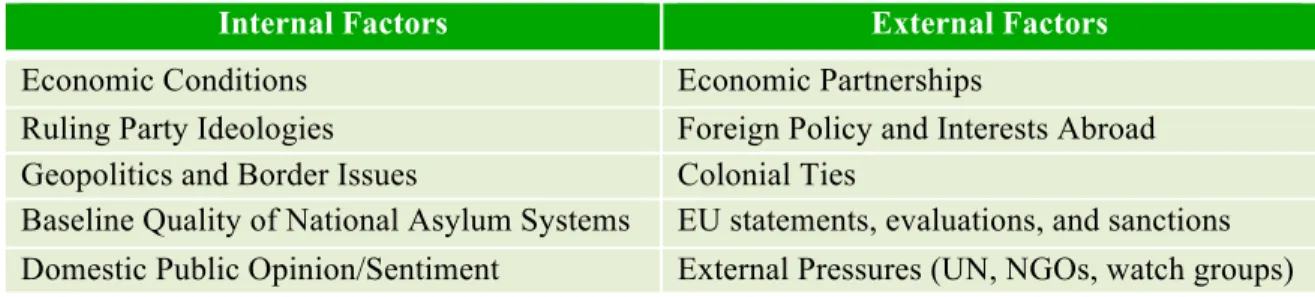
The purpose of this paper is to explore some of the factors that result in disparate treatment
of asylum seekers in the EU; as such, the analysis to follow will pay particular attention to
the following factors along which ‘treatment’ may vary:
Figure 1. List of Internal and External Factors under Examination
Internal Factors External Factors
Economic Conditions Economic Partnerships
Ruling Party Ideologies Foreign Policy and Interests Abroad
Geopolitics and Border Issues Colonial Ties
Baseline Quality of National Asylum Systems EU statements, evaluations, and sanctions
Domestic Public Opinion/Sentiment External Pressures (UN, NGOs, watch groups)
III. Case Selection
The analysis of the treatment of asylum seekers and adherence to CEAS protocol for all twenty-seven EU Member States is beyond the scope of this project; consequently, the nations of Spain, Germany, and Denmark have been selected for close examination. These
cases were chosen due to their variance on the internal and external factors outlined in the
above section, with the intention that this variance would lend some degree of
and analysis of the treatment of asylum seekers in these three EU Member States will be
limited to the period identified by the Commission as the second phase of the implementation
of the CEAS: 2005 to 2012.
IV. Limitations
As with any cross-case, comparative study in political science scholarship, there are of
course many limitations to the following qualitative examinations. Comprehensive and
reliable data on migration issues generally is difficult to come by in the European context;
quality data concerning the asylum issue – an arguably small niche within migration studies –
is even more rare. Beyond the raw numbers measuring recognition rates and petition
processing times, it is difficult to find or create valid measurements for the treatment
variable, which could mask real disparities or point to ones that are not actually there.
Additionally, the case studies will face the inherent problem of infinite causality
during narrative building and process tracing; though the period under study has definitive
temporal bounds, the causal mechanisms that might be uncovered during in-depth
exploration of the individual cases can very likely be traced much farther back in time and
perhaps conflate with one another, making it difficult to unpack the historical chain that led
to the present national contexts.
ANALYSIS OF CASES
The following sections provide a detailed account of the treatment of asylum seekers in the
selected countries, as well as a description of the political, economical, and social contexts in which the national asylum environments are couched.
Spain
From 2004 through 2012, Prime Minister José Luis Rodríguez Zapatero of the Spanish
Socialist Workers’ Party (Partido Socialista Obrero Español; PSOE) was the head of the
Spanish government; for the period under study, Spain was under the control of a center-left,
social democratic party. Mariano Rajoy recently replaced him in December, initiating a
political shift to the right with the entrance into power of the Popular Party (Partido Popular;
PP). It is, of course, too early to tell what kind of effect this change will have on the asylum
issue in Spain.
An immigration policy scheme was not incorporated into Spanish national law until
1985, when the Ley de Extranjería (Law on the Rights and Freedoms of Foreigners in Spain)
was enacted. (Office for Democratic Institutions and Human Rights, 2013) The relatively recent timing of the ratification of this law is likely due to Spain’s late transition to
democracy after the end of the Franco regime, as well as the country’s entry into the
European Community in 1986, which required that an immigration regulation framework be in place. As such, the first migration and asylum reception centers in Spain were not
constructed until 1987; in 2005, Spain’s twenty-four reception centers cumulatively offered
space for only one thousand asylum seekers. (van de Wetering, 2005)
The most up-to-date asylum legislation mandates that petitions filed in Spain must
undergo a preliminary evaluation to determine admissibility into the formal asylum
determination procedure; all decisions must be rendered within sixty days of initial
submission. During this time, applicants must be provided with free access to legal counsel
and interpreters. If the petition is deemed admissible, the application moves into the formal
asylum determination procedure and the person attached to the application is provided with
seekers remain entitled to aid from legal counsel and interpreters, and they have access to
basic social and medical care. A decision on whether or not to grant protective status to a
petitioner should be rendered within six months, but can be extended up to one year. Options
for accelerated processing are available for cases deemed to necessitate urgent action.
Currently, Spain has no formal agreements stipulating annual quotas of positive asylum
decisions or refugee resettlements.
II. Treatment of Asylum Seekers in Spain
Regardless of its apparent draw as an entry point for migrants, during the period under study,
Spain boasted one of the lowest asylum recognition rates in the entire EU. (Amnesty
International, 2010) The recognition rates from 2006 through 2012 are presented below:
Table 1. Recognition Rates in Spain
Year 2006 2007 2008 2009 2010 2011 2012
Recognition Rate* 3.9% 4.4% 2.9% 3.8% 10.2% 9.8% 9.5%
*Positive decisions granting UN Convention Status as a percentage of total decisions. Sources: UNCHR Statistical Yearbook, 2006-2011; Bitoulas, 2012; Eurostat, 2012.
Despite the jump in positive decisions after 2009, as a very basic indicator, this trend of
persistently and markedly low recognition rates (relative to the rates of other EU countries)
provides some suggestion that the national asylum system is not functioning to capacity.
Several other indicators suggest that the system is subpar and not meeting standards set forth
by the CEAS, but these are best presented via illustrative descriptions of the nature of the
operations and conduct of Spanish immigration, asylum, and border control officials, both at
border points and at sea.
Ceuta and Melilla: Seeking Asylum in the Spanish Enclaves
who find themselves in reception centers in the enclaves face unhygienic, overcrowded detention rooms, nutritionally poor and infrequent meals, brutality at the hands of guards, and little or no access to health care or legal aid. (Amnesty International, 2006) Asylum seekers are not regularly informed of their rights or the progression of their cases, and often are not provided with lawyers or qualified interpreters.
Excessive use of force by border control authorities is a major point of concern for NGOs and humanitarian rights groups monitoring the situation in the enclaves. In one incident, thirteen migrants were killed while attempting to cross the borders from Morocco into the enclaves over the course of several days in September and October of 2005. Some of the migrants who were killed were fatally shot with live ammunition, while others died of injuries sustained from falling off the barbed border fences, which are “made of wires and stakes and when the migrants fall from a six-meter height [they] are torn to pieces.”
(Amnesty International, 2006) Though this particular instance is notable for the high number of deaths over a span of only a few days, asylum seekers dying or suffering critical injuries during attempts to cross into the enclaves is not an uncommon occurrence.
Along a similar vein, expulsions perpetrated by the Spanish Guardia Civíl in conjunction with the Moroccan authorities are often unjust, unlawful, and accompanied by severe human rights abuses, making them another major source of concern. In some cases, these deportations occur before an individual is granted the opportunity to claim asylum; in others, border control officials routinely tear up documents granted by the UNHCR
The Canary Islands: More of the Same
Due to increasingly vigorous patrols in the Mediterranean during the 2000s, migration routes
shifted and adjusted, and more asylum seekers found themselves undertaking the longer and
arguably more treacherous journey from the West African Coast to the Canary Islands. In
2006, the number of migrants (over 31,200 – asylum seekers included) arriving to the
Canaries by boat was nearly seven times higher than the previous year. (Amnesty
International, 2008) This sudden influx of arrivals to the Canary Islands placed an obvious
strain on already insufficient reception and status determination procedures. Regional
authorities corralled all undocumented migrants – asylum seekers, unaccompanied minors,
and members of vulnerable groups alike – into makeshift detention centers, where severe
overcrowding exacerbated an already unsanitary, tense, and occasionally violent
environment. (Amnesty International, 2008) Once a petitioner has entered the formal asylum
determination phase, processing and decision times at reception facilities in the Canaries
average a staggering two to three years – a far cry from the six-month time frame given by
the legislation on asylum; processing times are similar at reception centers in the enclaves as
well as on the Spanish mainland. (van de Wetering, 2005)
Spain and NATO: Inaction in the Mediterranean
On 26 March 2011, a dinghy packed over capacity with 76 asylum seekers set sail out of Tripoli with hopes of reaching Lampedusa, Italy. Shortly thereafter, the migrant boat fell under distress due to poor weather conditions and a lack of proper navigation equipment. The migrant boat was identified and located by the coast guards of several European
migrants still alive; those ten were promptly arrested and placed in a detention center by Gaddafi loyalists, where one later died.
Following the incident, the Council of Europe launched a nine-month investigation to determine whether every appropriate action was taken to rescue the passengers of the vessel and – if not – where the responsibility lies. The investigation identified the Spanish frigate Méndez Núñez as the particular vessel that had the highest capacity to assist but willfully
ignored the opportunity to answer the distress calls and come to the aid of the migrant boat. Despite notification of and its proximity to the boat in distress (under eleven nautical miles away), the Méndez Núñez made no attempts at rescue. In its report, the Council of Europe lambasted Spain for failing “to act in accordance with [its] search and rescue obligations.” (Martínez de Rituerto, 2012)
Other Instances of Refoulement
The inaction of the Spanish crew in the incident described above effectively resulted in the
‘return’ of the migrant boat to Libya at the hands of the Mediterranean currents – an implicit
case of what can be called willfully negligent refoulement to a territory where the lives of
asylum seekers are jeopardized. However, there are countless other deportation cases where
the refoulement was more deliberate. In an especially troubling case from September 2007,
guilty of violating several articles of the Convention against Torture as well as the Ley de Extranjería, which stipulate that officials are responsible for the safety of intercepted persons and must ensure that such persons be afforded judicial protection and access to the asylum system. (Statewatch, 2012) Returning the men to Moroccan waters and forcing them to jump into the sea without flotation devices precluded them from lodging official asylum claims and amounted to both refoulement into unsafe territory and cruel and inhumane treatment, ultimately resulting in loss of life.
Asylum Policy Reforms
In response to criticism, the Spanish government has taken steps to improve upon asylum procedures and conform to standards set by the CEAS. Amendments to several laws in 2010 expanded officially recognized grounds for protection from persecution to include sexual orientation and gender, bringing the legislation in line with the 1967 Protocol to the UN Convention. (Amnesty International, 2011) Additionally, the Spanish government granted NGOs and other monitoring groups broadened access to migration detention centers, thereby increasing the transparency of reception and processing protocols. However, these
advancements were overshadowed by additional ‘reforms’ that increases the permitted maximum detention periods and prohibits asylum seekers from lodging claims at Spanish embassies abroad.
III. Analysis
Subpar conditions in reception facilities, protracted determination procedures, inadequate
provision of legal, health and social services, immediate and unlawful expulsions, the use of
excessive force, and flagrant violations of the non-refoulement principle indicate a systematic
explore some of the possible factors that contribute to the dire state of the Spanish asylum
system.
Insufficient Resources
The on-going economic crisis has without question taken its toll on Spain – one of the EU
Member States that is widely considered to be one of the hardest hit. Since most sectors of
the Spanish government and society at large were impacted by the crisis, it would be
reasonable to surmise that it has also had an effect on the operational reality of the country’s
reception facilities. A lack of physical and financial resources, combined with Spain’s
general unpreparedness to absorb changes in migration patterns, has likely contributed to
some degree to the poor conditions in the overcrowded and unsanitary centers where asylum
seekers await the decisions on their protection petitions. However, while the conditions at
reception centers and severely delayed processing times might arguably be caused in part by
the widespread effects of the economic crisis, the blatant human rights abuses detailed in the
sections above cannot be attributed to – nor excused by – any financial woes facing the
Spanish asylum system. Other factors must be explored.
Relationship with Morocco
Spain’s returns agreement with the Moroccan government allows Spanish border authorities
to send back migrants upon determining that they entered Spanish territory from Morocco.
However, asylum seekers subjected to returns to Morocco are placed at significant risk of ill
treatment, further refoulement (to Algeria, for instance), torture, and death. Additionally,
though Morocco is a signatory to the UN Convention, the country has neither a formal
asylum system policy scheme nor any legislation regarding the treatment of asylum seekers
be a safe third country and the Spanish authorities that refoule potential asylum seekers to
Morocco do so without respecting the UN Convention or its own domestic asylum
legislation.
Why, then, does Spain continue to violate proper asylum procedure during its border
control operations with Morocco? Days after the deaths of the thirteen migrants at the
Spanish/Moroccan borders at the enclaves, the Spanish government granted approval for
sending 10.5 million euros in aid to Morocco in order to enhance border control measures
near Ceuta and Melilla. (Amnesty International, 2008) This readmission agreement is based
on the promise of international aid in return for cooperation on securing the borders and
migration routes between the two countries using any means possible, without providing
adequate assurances for the prevention of human rights abuses and compliance with
international law. The relationship between Spain and Morocco, which places a primacy on
secure borders and allows abuses to go unpunished and poorly investigated, promotes a
climate of impunity and places those who seek asylum in Spain at risk.
Geopolitics
Of the three country cases to be examined in this paper, Spain’s geopolitical position on the
Mediterranean border is unique and notable. As a signatory to the Schengen Agreement, the
Spanish border is not only the entrance into Spain but also serves as a gateway into the entire
EU. As such, due to its particular geopolitical position as a EU border state and its status as a
favored entry point for both asylum seekers and irregular migrants alike, Spain faces a
particular kind of pressure to secure its border from illegal migration of any kind. As a result,
and Spain’s capability (and perhaps willingness) to be a proper place of refuge for asylum
seekers suffers for it.
Xenophobia
The failure of those aboard the Méndez Núñez to respond to the distress calls of the migrant
boat in 2011 at its core reflects a general disregard for the lives of migrants. The incident
points to not only a complete lapse of moral judgment, but also to flagrant non-compliance
with international humanitarian law. Tineke Strik, the Dutch author of the Council of
Europe’s report lambasting Spain’s inaction and member of the committee on migration,
refugees and displaced persons, touches on a probable root cause underlying this incident
when he writes:
"We can talk as much as we want about human rights and the importance of complying with international obligations, but if at the same time we just leave people to die – perhaps because we don't know their identity or because they come from Africa – it exposes how meaningless those words are…" (Shenker, 2012; emphasis added)
Strik’s words are provocative and acknowledge that xenophobia is an underlying cause of
this tragedy, placing at least part of the blame on the undercurrent of uneasiness and hostility
that characterize the actions of Spain regarding the treatment of asylum seekers who flee
from countries of origin deemed undesirable.
Germany
I. Country Profile: 2005-2012
Angela Merkel, the party leader of the center-right Christian Democratic Union (CDU), has
held the position of the Chancellor of Germany (equivalent to the title of Prime Minister in
other countries) since the 2005 elections. For the period under examination, the head of
government has remained under Christian Democratic control despite major changes in
immigration, favoring both integration policies for those already residing in the country and
strict border control and vetting procedures for would-be immigrants to Germany. (Evans,
2010)
In Germany, the Federal Office for the Recognition of Foreign Refugees is the
authoritative body that renders the decisions to grant asylum. Upon initial submission of a
petition, asylum seekers are placed in reception centers while their cases are preliminarily
evaluated; the maximum stay in these centers is three months. (van Gelder, 2003) Individuals
whose cases are approved for entry into the formal asylum determination process are
transferred to longer-term accommodation centers. The province in which the center is
located is responsible for the allocation of funding, resulting in centers of varying quality.
(van Gelder, 2003) Applicants are entitled to the services of an interpreter during any
hearings or interviews that take place during the evaluations of their applications, but access
to legal counsel tends to be limited to only the most destitute of asylum seekers. (van Gelder,
2003) While awaiting decisions on their petitions, asylum seekers are prohibited from
traveling around the country and are mandated to remain in the region in which they are
registered; violation of this rule subjects an asylum seeker to fines, prison, or deportation.
(Kriesch, 2012) Asylum seekers were granted the right to work in Germany in 2001,
provided that no German national or permanent resident can fill the job and that the asylum
seeker has been in the country awaiting his or her decision for one year or more. (van Gelder,
2003) Special accelerated decision processes exist for airport arrivals without valid travel
documents wherein the status of an application must be decided within two days; appeals to
any negative decisions in such cases must be lodged within three days to avoid detention or
II. Treatment of Asylum Seekers in Germany
Before the refugee crisis spawned by the Arab Spring, Germany tended to average around
30,000 petitions for asylum per year. In 2011, however, the country received just shy of
45,000 applications. The numbers for 2012 were even higher, closing in on 65,000 petitions,
amounting to a 41 percent increase from the previous year. (“Germany records big increase,”
2013) Though these are among the higher averages in the EU, it is still much lower than
Germany’s asylum load during the early nineties, when the country faced an annual average
around 100,000 petitions. (“Germany records big increase,” 2013) The available recognition
rates as a proportion of total petitions received from 2006 through 2012 are presented below:
Table 2. Recognition Rates in Germany
Year 2006 2007 2008 2009 2010 2011 2012
Recognition Rate* 4.3% 25.1% 35.0% 36.5% 15.9% 17.6% 16.5%#
*Positive decisions granting UN Convention Status as a percentage of total decisions.
#Only data for the first Quarter of 2012 is presently available. Sources: UNCHR Statistical Yearbook,
2006-2011; Bitoulas, 2012; Eurostat, 2012.
Several domestic NGOs have called upon the government to admit more asylum seekers by
increasing the number of positive decisions in proportion to the rise in petitions, citing the
especially acute situation of asylum seekers (particularly those from North Africa and the
Middle East) in recent years. (“Germany records big increase,” 2013)
This uptick in petitions has done no favors for the processing times and determination
procedures. Decisions are usually rendered after many months of uncertainty for the
petitioner (who is often not kept informed of his or her status), but interviews with asylum
seekers with pending applications have revealed processing times of over ten years, due to
continual case deferrals. (Taube, 2012) In addition to administrative backlogs and
the hands of police, immigration authorities, and the system at large; the following sections
will explore these realities.
Instances of Ill-Treatment by Police
The circumstances surrounding the following instances reveal several questionable practices
of the German police and point to a climate of fear and a lack of sensitivity towards the
vulnerability of asylum seekers in Germany. On the morning of 7 January 2005, police
detained Oury Jalloh, a documented asylum seeker from Sierra Leone, after he allegedly
verbally harassed several women while under the influence of alcohol. A doctor on staff at
the Dessau police station recommended that Jollah be restrained so he would not injure
himself in his inebriated state; two officers brought him down to a cell in the basement and
tied him to a cot, securing him by his wrists and ankles, and returned upstairs. (Unknown
Assailant Amnesty International, 2010) Around noon, a fire alarm sounded from the
basement, but an officer on duty turned it off, supposing a malfunction. The officer made a
phone call to his superior, searched for the keys for the wrist and ankle restraints, and sought
out another officer to accompany him before heading downstairs to investigate. By the time
the two officers reached the cell, the fire and smoke had already spread throughout the cell.
Ultimately, Jollah died from intense heat and smoke inhalation. (Amnesty International,
2010)
Though Jalloh’s death did not occur in a reception facility specifically designed to
hold asylum seekers, the restraint methods used by the officers and their lackadaisical
response to the situation are disturbing and relevant to understanding the nature of the
treatment of asylum seekers in Germany. By leaving an individual tied to a cot in the
protocol that stipulates that an individual who is physically restrained must never be left
unsupervised. (Amnesty International, 2010) They also deliberately ignored signs of trouble
by lowering the volume of the intercom to mask Jollah’s shouting and failing to react quickly
after the fire alarm sounded. This behavior, at the very least, shows a disregard for human
life and suggests that the nature of the interaction between police and asylum seekers leaves
much to be desired.
Ill-treatment of asylum seekers by police sometimes manifests in the form of
intimidation as well as physical abuse, as demonstrated by the case of an asylum seeker from
Chechnya identified in legal documents only as “A.” On 16 February 2005, the owner of a
small shop in Chemnitz called the police on suspicion that “A” was attempting to shoplift.
According to statements made after the incident, responding officers, dressed in full riot
uniforms and helmets, beat “A” to the floor with kicks and batons. (Amnesty International,
2010) After the assault and subsequent interrogation, the officers dropped him off on the road
about 100 meters away from the asylum seeker reception center where he had been staying.
“A” was immediately transferred to the hospital, where he remained for one week due to
broken ribs and internal bleeding. He declined to give any statements implicating the
officers, citing that they “know where [he] live[s]” and feared repercussions; this fear likely
stems from his prior imprisonment and torture in Chechnya, which made up the foundation
of his claim to asylum in Germany, and an ensuing diagnosis of post traumatic stress
disorder. (Amnesty International, 2010) Without his or any other witness statement, the
investigation into the assault was terminated.
The Dublin II regulation, which tends to unfairly place a large burden on EU Member States
due to their geographical position on the continent, has been lambasted as one of the most problematic elements of the CEAS. In 2010, after finding significant variance in the way that asylum procedures are implemented across the EU, the European Court of Human Rights
(ECtHR) issued orders to Member States to suspend Dublin returns to Greece, whose asylum
system was found to be especially dysfunctional. (Human Rights Watch, 2011) Despite this,
Germany transferred 55 asylum seekers to Greece in 2011. (Amnesty International, 2012)
Breaches of the Non-Refoulement Principle
Failure to uphold the non-refoulement principle is one of Germany’s most consistent and
egregious violations of CEAS and UN Convention standards. Forced returns to Eritrea –
where being a practicing member of certain banned religions, speaking out against the
government, evading military service, and seeking asylum in other countries are considered
criminal and often result in torture and indefinite incommunicado detentions – were of
primary concern for the UNHCR, which had issued a statement strongly discouraging any
returns of rejected asylum seekers to Eritrea, since the very act of seeking asylum jeopardizes
the safety of an Eritrean national. (Amnesty International, 2008) Despite this
recommendation, Germany continued deportations of rejected Eritrean asylum seekers to
Eritrea. In one instance in May 2008, German immigration officials forcibly deported two
Eritrean nationals after the rejection of their asylum applications; neither man has been seen
since the plane landed in Asmara, and it is likely that the men are being unlawfully detained
and subjected to torture as punishment for what is perceived by the Eritrean government to
Germany has also come under fire from the UNHCR and various NGOs for forced
returns and refoulements to Iraq. In 2007, Germany systematically began to withdraw
previously approved protective status from Iraqis, which invalidated their residency permits
and placed them at risk for deportation; this decision came in conjunction with a formal
announcement from then-Interior Minister Wolfgang Schäuble that the Federal Agency for
Migration and Refugees were permitted to issue deportation orders for asylum seekers to
northern Iraq – a region of the country specifically identified as being notoriously unsafe.
(Amnesty International, 2008)
Response to Criticism
Germany has been relatively receptive to criticism of its asylum system and the behavior of
its immigration officials and has taken several steps toward improving the quality of
protection provided, including the reconsideration of questionable returns practices. In 2008,
the German Federal Office for Migration and Refugees repealed its decision to forcibly
return Eritrean national Mohamed Abdelrahman Ferah and granted him the opportunity to
reapply for asylum without further risk of deportation. (Amnesty International, 2008)
Additionally, as of January 2012, Dublin returns to Greece have been suspended for a
minimum period of one year. (Amnesty International, 2012) Germany forcibly returned a
large number of Syrian asylum seekers after signing a readmission agreement with the Assad
regime. However, due to the ongoing political unrest in Syria, Germany recently placed a
moratorium on this practice and began granting automatic subsidiary protective status (not
Convention status) to Syrian asylum seekers. (Human Rights Watch, 2012)
Germany has also recognized its failure to provide asylum seekers with adequate
refugees (€224 per month; 47% lower than those received by citizens and permanent
residents) had remained unchanged and unadjusted for inflation for nearly a decade.
(“German court decision,” 2012) In 2012, the Federal Constitutional Court ruled that these
benefits do not “correspond to the fundamental right to a humane level of subsistence” and
must be increased to match the benefits received by citizens, as asylum seekers are “equally
entitled” to a dignified standard of living. (Spiegel, 2012)
III. Analysis
Germany has acknowledged that its asylum procedures were falling short of acceptable
standards. Though this might suggest that the climate for asylum seekers might be shifting in
a more positive direction, Germany still allows many worrisome practices to continue. Why
do these practices persist when Germany has committed to making progress on the asylum
issue?
Media Coverage and Official Government Rhetoric
A notable trend in the German media, which actually dates back to the inflammatory media
coverage of resettled refugees in the 1990s, is the blanket portrayal of asylum seekers to
Germany as ‘bogus.’ (Nickels, 2007) A fair portion of the coverage conflates the issues of
asylum with economic migration by suggesting that many asylum seekers to Germany are
free riders, knowing their claims of well-founded fear are unjustified and only seek to take
advantage of “free accommodation and some pocket money.” (EurActiv, 2012) This
generalized accusation likely perpetuates antagonism towards asylum seekers in the minds of
media consumers.
This sentiment is also blatantly echoed in the official rhetoric of members of the
economic migrants posing as asylum seekers in need of protection and vowed to “ensure that
[the German] asylum system is not subject to abuse so that those who are genuinely
vulnerable can find protection.” (“Germany records big increase,” 2013) Though this implies
humanitarian intentions, the widespread use of the terms ‘bogus’ or ‘fake’ to describe asylum
seekers and the suggestion that many of these individuals are disingenuous in their claims is
damaging and cultivates an environment of mistrust, speculation, and insensitivity.
Racism and Xenophobia
The portrayal of asylum seekers in the media has likely contributed in some way to the
undeniable xenophobia expressed by both the government and the public. Thomas Fabian, a
local official in Leipzig and an advocate for the rights of asylum seekers, encountered this
first-hand among his constituents when he attempted to garner support for an initiative to
accommodate asylum seekers with pending applications in several rental properties. Though
the project was initially met with support, local residents began to voice emphatic opposition
to the project when it became clear that their towns would be included in the implementation.
Fabian stated that he was “quite shocked by the sometimes very strong prejudices expressed
against asylum seekers and refugees” and acknowledged that the resistance and retraction of
support stems from the general perception of asylum seekers as “synonymous with crime and
social problems.” (Kriesch, 2012)
German authorities and members of government are not immune to displays of
prejudice, discrimination and xenophobia. After Oury Jalloh’s death, the doctor who
recommended the use of restraints was (administratively) reprimanded for lamenting that he
can “never find a vein with dark-skinned” after being informed by one of the officers that he
2009, then-Interior Minister Schäuble formally announced a new proposal that only asylum
applications from Christian Iraqis would be considered in Germany’s new approach to
handling the wave of protection petitions from Iraq. (Amnesty International, 2010) This is
supported by UN investigations that concluded persistent racism and widespread xenophobia
negatively impact asylum seekers in Germany, especially regarding freedom of movement,
access to employment and education, and standard of living. (Human Rights Watch, 2011)
Though xenophobia of any kind adds a troubling layer of complexity to the asylum issue in
Germany, it is all the more damaging when individuals in a position of power and authority
publically articulate such sentiments, and it sets a very low standard for the entire national
asylum system.
Denmark
I. Country Profile
For the majority of the period of examination, the major center-right Venstre party held
control of the Danish government under the Prime Ministries of Anders Fogh Rasmussen
(2001-2009) and Lars Løkke Rasmussen (2009-2011). Over its decade of leadership,
The Danish asylum system is procedurally rather similar to those of other EU
Member States. An individual seeking asylum must present themselves to the police to lodge
their claim; the office of the National Commissioner of the Police handles identification
determination procedures in order to ensure that the claim in Denmark is not invalidated
under the Dublin Regulation or any safe country policies. (van Gelder, 2003) An asylum
seeker may only be detained for up to one week during the admissibility assessment, upon
which time he or she will be transferred to an accommodation center if the claim is found to
be valid. All asylum seekers with pending applications are entitled to some social security
benefits to cover food, clothing, and a small allowance. According to the legislation, the
reception centers must provide children with education in several basic subjects
corresponding to their age and rough grade level, whereas adults are entitled to take classes
to expand their professional skill set. (van Gelder, 2003) Interviews are conducted with the
assistance of interpreters in order to elaborate on the circumstances under which the asylum
seeker is claiming well-founded fear of persecution; decisions are meant to be rendered
within three months, but can sometimes be deferred an additional ninety days. (van Gelder,
2003) If an application is rejected, deportation orders are immediately issued. There is an
appeals process available at every step of the application cycle.
II. Treatment of Asylum Seekers in Denmark
Recent trends in asylum applications and decisions are preliminary indicators that something
might be amiss within Denmark’s asylum system. Recently, the UNHCR noted a 23 percent
drop in total applications lodged in Denmark in 2011 compared to the figures for 2010.
(Stanner, 2012) This drop in applications in Denmark occurred as the European Union
which is not a government body but rather an independent human rights watch group, attributed this mysterious and sudden drop to the perception that Denmark is “a difficult place to be granted asylum.” (Stanner, 2012) The recognition rates from 2006 through 2012 are presented in the table below:
Table 3. Recognition Rates in Denmark
Year 2006 2007 2008 2009 2010 2011 2012
Recognition Rate* 12.3% 11.6% 20.5% 22.2% 18.5% 20.6% 17.8%#
*Positive decisions granting UN Convention Status as a percentage of total decisions.
#
Only data for the first Quarter of 2012 is presently available. Sources: UNCHR Statistical Yearbook, 2006-2011; Bitoulas, 2012; Eurostat, 2012.
Though there is not enough data to establish a solid pattern, for the past five years, Denmark
seems to grant UN Convention status to around 20 percent of the asylum applicants whose
decisions are heard each year. Within the context of the Danish asylum load, the percentages
are not extremely encouraging, but they’re also certainly not low enough in comparison to
other Member States’ proportionate recognition rates to warrant the perception that attaining
protective status in Denmark is exceedingly difficult. Denmark’s poor reputation as far as
the asylum issue is concerned more likely stems from the practices outlined in the following
sections.
Forced Returns to Iraq
By far the most worrisome practice of the Danish government is the refoulement of Iraqis.
Since 2009, the number of pending Iraqi asylum cases in Denmark has dropped significantly,
due in large part to the government’s deportation of asylum seekers whose claims for
protection have been rejected. (Wenande, 2012) Denmark has consistently acted in defiance
of guidelines and warnings issued by the UNHCR and human rights groups regarding forced
returns to Iraq, including to provinces considered to be especially unsafe such as Mosul, Al
International, 2009); in 2011, Denmark deported sixty-two. (Amnesty International, 2012)
Information unearthed in a subsequent probe into Denmark’s infractions suggests that at least
500 rejected asylum seekers have been refouled to Iraq since 2004, despite awareness of the
likelihood of facing torture upon their returns. (Amnesty International, 2013)
Even the Iraqi government itself has expressed disapproval of Denmark’s systematic
repatriation of rejected asylum seekers by refusing to admit returned applicants into the
country upon their arrival at customs; officials have additionally threatened to levy massive
fines against the airlines that partake in the returns as an added deterrent to the practice.
(Wenande, 2012) Iraq has also taken action by refusing to issue passports to Iraqi asylum
seekers without travel documentation from the embassy in Copenhagen.
Interaction between Authorities and Asylum Seekers
The actions of Danish immigration officials and police toward asylum seekers are at best
negligent and insensitive; at worst, they amount to callous and deliberate human rights
abuses. In one January 2009 incident, a squad Copenhagen riot police conducted a raid on a
church that was a suspected refuge for asylum seekers who had been forced out of
overcrowded reception centers after their decisions were deferred for upwards of ten years.
The explicit intentions of this raid were to locate, detain, and deport seventeen previously
rejected asylum seekers who were, coincidentally, Iraqi nationals. (Amnesty International,
2009) The conduct of these officers was an offensive display of insensitivity toward the
asylum seekers in that the raid, which was carried out at night by police in full riot gear, was
likely triggering for individuals who have previously been subjected to torture in their
countries of origin. During the raid, police used excessive force against the asylum seekers
protest and were recording the violence on film. (Amnesty International, 2009) After their
arrests, the asylum seekers were taken to a detention center, described by Amnesty
International observers as prison-like, in Sandholm.
Unreliable Commitments to Reform
Denmark has failed to measure up to several commitments to change its approach to
implementing asylum procedures. Although the Danish government formally pledged to
observe the absolute nature of the non-refoulement principle in 2011 – which would include
halting forced returns to Iraq – deportations of Iraqi nationals continued in 2012, when at
least 43 returns were carried out. (Amnesty International, 2011) Furthermore, despite
assurances that detention of asylum seekers would only be used as a last resort, current
Danish immigration law not only calls for the detention of asylum seekers while their
applications are pending or after they have been rejected, but it also does not set a maximum
permissible length of detention and thus leaves room for abuse. (Amnesty International,
2011) The detention of the seventeen Iraqi nationals after the Copenhagen church raid
suggests otherwise. Denmark’s continual failure to honor its commitments casts a pall of
unreliability over the word of its officials and suggests that any future commitments lack
credibility and should be suspect to skepticism.
III. Analysis
While the section above suggest that Denmark’s reputation as one of the EU Member States
with the harshest asylum systems has been well earned, the following sections will identify
some of the factors that contribute to and perpetuate the ill-treatment of asylum seekers.
The most obvious factor contributing to the unsympathetic nature of the Danish asylum
system is the fact that Denmark elected to “opt out” of all EU asylum laws during
negotiations of the Maastricht Treaty and is not formally bound by any clauses relating to the
CEAS. Though this opt-out does not preclude Denmark from aligning some or all of its
policies and practices, the government has specifically and continually refused to be a party
to the CEAS and incorporate any of its harmonization initiatives into the domestic asylum
policy scheme. One of the most troubling consequences of this decision has been the explicit
rejection of the Qualification Directive, which expands the criteria for a justified claim of
well-founded fear to include persecution on the grounds of gender identity or sexuality and
provides guidelines for ensuring the treatment of unaccompanied minors. (European Council
on Refugees and Exiles, 2012) By specifically electing to reject this particular directive,
Denmark willfully creates an asylum environment that is hostile to the protection needs of
women, individuals identifying as LGBTQ, and children.3
Denmark’s qualification criteria
have also been identified as following an “unduly restrictive interpretation of the 1951
Refugee Convention,” to which it is a signatory. (Amnesty International, 2009) Denmark
has clearly placed primacy on the maintenance of its national sovereignty over its asylum
system, rather than on the quality of that system; that this is extremely problematic in the
quest for harmonization of asylum policy and ensuring the commitment to offering protection
from persecution across the EU is self-explanatory.
Xenophobia and the Radical Right
3Recently, Denmark has expressed some willingness to consider incorporating some of the standards on reception
Perhaps this “opt-out” from the directives stipulating the adherence to basic minimum
standards to guarantee the protection of asylum seekers in the EU is unsurprising when
considering Danish party politics. As mentioned previously, the leaders of the Venstre party,
the most prominent Danish party of the center-right, occupied the position of Prime Minister
for the majority of the period covered in this analysis. During its decade at the helm of the
Danish government, Venstre was lent significant support from the right wing, populist – and
decidedly anti-immigrant and xenophobic – Danish People’s Party (DF). This gesture of
support did not come without a price, as the DF made its continued backing of Venstre
contingent upon the adoption of anti-immigrant policies at the national level. (Dencker and
Ramser, 2011) Several laws were pushed through to approval by the close cooperation
between the parties in the early 2000s, including mechanisms facilitating the rejection and
deportation of asylum seekers. (Danish Aliens Consolidation Act, 2006) The strong
leverage held by such a hard-line anti-immigrant party over the Danish government for a
decade undoubtedly played a key role in the tightening of the country’s ever-restrictive and
abusive asylum policies and procedures.
Though reviled by some, the DF enjoyed enthusiastic support from many Danes and
grew to be the third largest political party in the country. (Dencker and Ramser, 2011) By
pandering to an uneasy public with appeals to the preservation of “Danish values,”
complicity in the spread of Islamophobic propaganda (most notoriously in the form of
cartoons satirizing the Muslim prophet Muhammad), and launching successful campaigns to
block the construction of mosques and Muslim cemeteries, the DF was able to increase its
applications to its membership registery seventeenfold. (Day, 2006) Furthermore, its
educated. (Demir and Altinas, 2012) Considering its wide reach, it is unsurprising that these
xenophobic sentiments have trickled down to the general public, creating a hostile
environment for asylum seekers in Denmark at every societal level.
DISCUSSION
The treatment conditions across the various Member States are only disparate in the sense that some national asylum systems are less broken than others. None of the cases in this study stands out as an exemplary model, and the overall quality of care and protection offered leaves much to be desired and requires immediate attention.
It is important to note that, with the obvious exception of Denmark, the asylum legislation of the other country cases do in fact align with CEAS mandates. The problem is not that the asylum policy schemes of the Member States diverge so greatly from the standards of protection outlined in the CEAS and international human rights law, but rather that the implementation and enforcement of these standards and protocols fails on the national and supranational levels. Multiple national context factors, both domestic and external, do appear to be convalescing in such a way that has rendered the CEAS rather impotent. Though its capacity for generalization to the entire EU is limited, the analysis points to several factors that contribute to the failure of the CEAS to progress in a meaningful
way and opens up several avenues for further scholastic exploration.
human rights is an obvious signal that national and foreign policy interests have a negative impact on asylum policy. However, due to governmental inefficiency and geographic
proximity to many refugee-producing regions, the relatively young Spanish asylum system is underfinanced and overburdened, making asylum procedures geared toward deterrence in Spain’s interest; in this case, geopolitics combined with the Dublin Regulation exacerbates an already broken national asylum system. It would be worth exploring if geopolitics and bilateral immigration agreements hold similar explanatory power in other EU Member States.
A common thread among the three countries examined in this study is the detrimental effect of pervasive xenophobic sentiments. The willingness on the parts of the media and the government to make and perpetuate xenophobic or racist remarks – most fiercely expressed in Denmark but also present in Germany and Spain – reflects widespread antagonism
towards asylum seekers at all societal levels and makes the subpar quality of asylum schemes in these nations unsurprising. It is imperative to assess the extent to which this factor might be operating within other Member States’ national contexts, as the subsequent policy recommendations would be much more complicated than administrative or financial reform and would have to target attitudes.
Denmark’s refusal to align its national asylum policy to the standards and oversight mechanisms provided by the CEAS is an extreme but illustrative example of the damaging effect that jealously guarded national sovereignty has had on harmonization efforts. Though most EU Member States have not taken such a radical stance (only the United Kingdom and Ireland have also opted out of parts of the CEAS), the unwillingness of national governments to transfer competency and sovereignty to the EU level poses a challenge to the
Member States are completely sovereign over their domestic asylum policies, and in some cases are even granted permission to opt out of the entire initiative? So long as Member States retain full sovereignty over their domestic asylum systems, efforts to harmonize will remain stalled and the EU’s normative orientation as a place of refuge for asylum seekers will remain, to some extent, largely hollow.
The clash over sovereignty leads to a final point: that poor enforcement at the EU level has as much to do with the unsuccessful implementation of the CEAS as do the strong national interests of its Member States. The response of the EU to the crises in the Middle East and North Africa over the past several years has been almost exclusively to secure and
militarize its land and sea borders, and since the nineties it has prioritized taking a securitarian stance on migration and asylum policy rather than a humanitarian one.
(Amnesty International, 2005; Boswell, 2003) This tension between migration control and
asylum policy exposes the inability (or unwillingness) of the EU to reconcile its rhetoric with
its actions and severely discredits its legitimacy as a global promoter of human rights.
The CEAS, despite the completion of two phases spanning nearly fourteen years, has failed to overcome the legacy of the nineties, when asylum policy was focused on the
deterrence and prevention of asylum seekers entering the EU rather than the human rights abuses they endure at the hands of their persecutors and the EU itself. So long as the
References
Amnesty International. (2005, October 7). Eu member states threatening the integrity of the international refugee protection system. Retrieved from
http://www.amnesty.org/en/library/asset/EUR45/039/2005/en/6df8e79b-d49f-11dd-8a23-d58a49c0d652/eur450392005en.html
Amnesty International. (2006). Rabat conference: Tackle causes, not people - amnesty international eu office press release (EUR 01/016/2006). Madrid: Amnesty International Spanish Office.
Amnesty International. (2006). Spain and morocco: failure to protect the rights of migrants - ceuta and melilla one year on (EUR 41/009/2006). London: Amnesty international
publications.
Amnesty International. (2008). Further information on ua 194/08 (eur 23/001/2008 4 july 2008) fear of forcible return/fear of torture or ill-treatment (EUR 23/002/2008)
Amnesty International. (2008). Germany - amnesty international report 2007: Human rights in federal republic of germany. Retrieved from
http://www.amnesty.org/en/region/germany/report-2007
Amnesty International. (2008). Spain - amnesty international report 2007: Human rights in kingdom of spain. Retrieved from http://www.amnesty.org/en/region/spain/report-2007
Amnesty International. (2008). UA 145/08 fear of torture or ill-treatment/ incommunicado detention/ forcible return (AFR 64/002/2008). Retrieved from website:
http://www.amnesty.org/en/library/asset/AFR64/002/2008/en/f7b8671a-2d94-11dd-a96c-df479ae1e786/afr640022008eng.html
Amnesty International. (2009, August 14). Denmark: Arrest of iraqi asylum- seekers during raid. Retrieved from http://www.amnesty.org/en/for-media/press-releases/denmark-arrest-iraqi-asylum-seekers-during-raid-20090814
Amnesty International. (2010). Germany - amnesty international report 2009: Human rights in federal republic of germany. Retrieved from