M A R I N E E C O L O G Y 2016 © The Authors, some rights reserved; exclusive licensee American Association for the Advancement of Science. Distributed under a Creative Commons Attribution NonCommercial License 4.0 (CC BY-NC).
Virus-mediated archaeal hecatomb in the deep seafloor
Roberto Danovaro,1,2* Antonio Dell’Anno,1Cinzia Corinaldesi,1,3Eugenio Rastelli,1,2
Ricardo Cavicchioli,4Mart Krupovic,5Rachel T. Noble,6Takuro Nunoura,7David Prangishvili5
Viruses are the most abundant biological entities in the world’s oceans, and they play a crucial role in global biogeo-chemical cycles. In deep-sea ecosystems, archaea and bacteria drive major nutrient cycles, and viruses are largely re-sponsible for their mortality, thereby exerting important controls on microbial dynamics. However, the relative impact of viruses on archaea compared to bacteria is unknown, limiting our understanding of the factors controlling the functioning of marine systems at a global scale. We evaluate the selectivity of viral infections by using several independent approaches, including an innovative molecular method based on the quantification of archaeal versus bacterial genes released by viral lysis. We provide evidence that, in all oceanic surface sediments (from 1000- to 10,000-m water depth), the impact of viral infection is higher on archaea than on bacteria. We also found that, within deep-sea benthic archaea, the impact of viruses was mainly directed at members of specific clades of Marine Group I Thaumarch-aeota. Although archaea represent, on average, ~12% of the total cell abundance in the top 50 cm of sediment, virus-induced lysis of archaea accounts for up to one-third of the total microbial biomass killed, resulting in the release of ~0.3 to 0.5 gigatons of carbon per year globally. Our results indicate that viral infection represents a key mechanism controlling the turnover of archaea in surface deep-sea sediments. We conclude that interactions between archaea and their viruses might play a profound, previously underestimated role in the functioning of deep-sea ecosystems and in global biogeochemical cycles.
INTRODUCTION
Viruses are the most abundant biological entities in the global ocean and are believed to infect all living organisms (1–5). By killing their hosts, viruses can manipulate marine environments, terminating phytoplankton blooms (6) and controlling the dynamics and biodiversity of their hosts, thereby playing key roles in carbon and nutrient cycling (particularly N and P) as well as ecosystem functions (1–4). Deep-sea ecosystems cover >65% of the world’s surface and represent >90% of the global biosphere volume, and microbial communities in the surface sediment (to a depth of 50 to 100 cm) are fundamentally important for nutrient regeneration and therefore vital for sustaining oceanic production (7). Viral infec-tions in surface deep-sea sediments are responsible for the abatement of up to ~80% of the overall heterotrophic carbon production by bacteria and archaea (below 1000-m depth), causing the release of ~0.37 to 0.63 gigatons of carbon (GtC) year−1on a global scale, suggest-ing that viruses can influence global biogeochemical cycles in funda-mental ways (5).
Although bacteria tend to outnumber archaea in the world’s oceans, archaea make an important contribution to microbial biomass in deep waters (with abundances equivalent to those of bacteria at depths >1000 m) (8) and in marine subsurface sediments (that is, >1-m depth below the sediment surface) (9,10). With a few exceptions (that is, hydrothermal vents, cold seeps, and anoxic ecosystems), archaea in surface deep-sea sediments are mainly represented by taxa belonging to the Thaumarch-aeota (11–13), which play important roles in biomass production and nutrient cycling (14–16). Not unexpectedly, viruses infecting archaea have been identified from a wide range of environments, including
ma-rine ecosystems (17–19). Despite increasing recognition of the crucial importance of archaea in biogeochemical and ecological processes (15,16,20–22), the extent to which viral infection influences archaea in the oceans is unknown (23). This gap in knowledge limits understanding of the overall microbial dynamics and, hence, the ability to completely comprehend ecological processes and biogeochemical cycles occurring in the oceans.
Here, to discriminate between viral killing of archaea and bacteria, we applied and compared independent methods based on (i) the quan-tification, by real-time quantitative polymerase chain reaction (qPCR), of the number of 16Sribosomal RNA (rRNA) genes released from bacteria and archaea after viral lysis of the host cells, and (ii) the quan-tification of the number of 16SrRNA genes of bacteria and archaea after the selective inhibition of archaeal or both archaeal and bacterial metab-olism. All determinations were carried out by multiple experiments per-formed both in mesocosms and in the field on deep-sea sediment samples from the Atlantic Ocean, Arctic Ocean, and Pacific Ocean and the Mediterranean Sea. Further high-throughput sequencing analy-ses were carried out on the DNA released following viral lysis and on the benthic viruses to identify the most affected archaeal taxa and the ar-chaeal viruses causing their mortality.
RESULTS AND DISCUSSION
Deep-sea sediment samples spanning depths from ca. 1000 to 10,000 m and covering a wide range of bottom-water temperatures and envi-ronmental conditions (table S1) were collected. Overall, we conducted more than 35 independent in situ and laboratory experiments and ana-lyzed more than 480 sediment samples. To the best of our knowledge, the interactions between viruses, bacteria, and archaea in benthic deep-sea ecosystems have not previously been investigated using the high level of replication and geographic coverage of the present study.
In the top 50 cm of the sediments, fluorescence in situ hybridization analyses targeting rRNA (table S2) revealed that the number of archaea was lower than that of bacteria at all sampling sites (Fig. 1, A and B), representing 5 to 32% of the total microbial (archaeal and bacterial)
1
abundance (on average 12%) and 5 to 23% of the total biomass (on av-erage 11%; fig. S1). Massive sequencing of 16SrRNA genes of these ar-chaea and bacteria (ca. 2,700,000 sequences obtained after cleaning; table S3) revealed that archaeal sequences were almost entirely affiliated with Marine Group I (MG-I) Thaumarchaeota, whereas bacterial se-quences were mainly affiliated with unclassified proteobacterial groups (fig. S2). Rarefaction curves for both bacterial and archaeal 16SrRNA genes indicated that the sequencing depth was adequate to capture the diversity present in each sample (fig. S3). Notably, archaeal rarefaction curves reached less clear asymptotes, potentially indicating diversifica-tion levels for archaea (and especially, MG-I Thaumarchaeota) in deep-sea samples even higher than what was reported here.
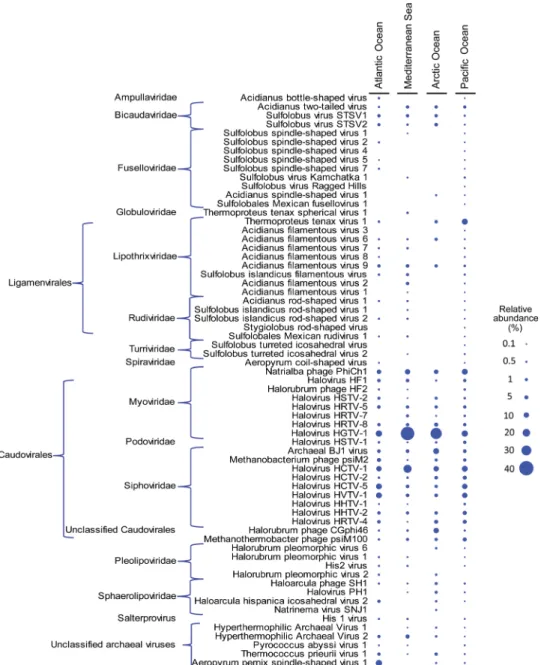
Irrespective of water column depth, viral abundance in the top 50 cm of surface sediments was high (range, 6.9 × 10¹²to 36.4 × 10¹²viruses m−2; Fig. 1C), and a range of archaeal viruses were present (that is, iden-tified through metagenomic analyses of viromes; Fig. 2), suggesting that viruses can infect archaea inhabiting benthic deep-sea ecosystems. Viral infection of marine microorganisms (including archaea and bacteria)
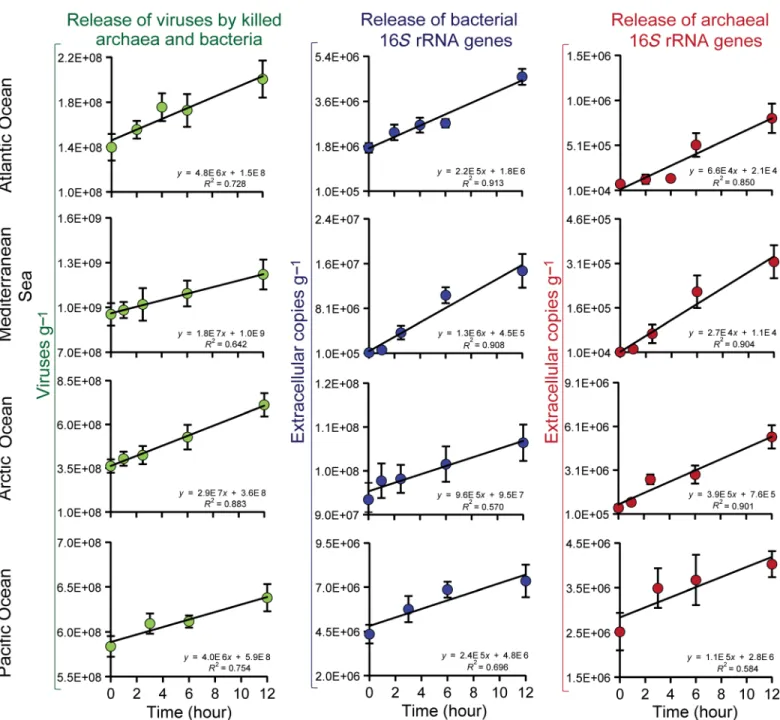
that we used exploits this property and, to the best of our knowledge, the first time permits quantification of and discrimination between the impact of viral infection on either archaea or bacteria, with a sensitivity much higher than that possible based on cell counts by fluorescence in situ hybridization. To do so, we determined, by real-time qPCR, the number of archaeal and bacterial 16SrRNA genes in the DNA released after cell lysis (Fig. 3), using primers and probes selected for consistency with pre-vious studies investigating archaeal and bacterial dynamics in deep-sea sediments conducted worldwide (25,26). We found that the higher the production rate of viruses, the higher the release of 16SrRNA gene copies in the extracellular DNA fraction (fig. S4).
To test the assumption that factors other than viruses were negligible in causing cell lysis and in releasing 16SrRNA genes, additional experiments based on the use of selective inhibitors of bacterial and ar-chaeal metabolism were conducted. These experiments demonstrated that the inhibition of viral replication blocked the release of archaeal or bacterial 16SrRNA genes (Fig. 4 and table S4). Moreover, the use of an archaeal-specific protein synthesis inhibitor (22) resulted in the complete cessation of virus-mediated archaeal lysis and of the accom-panying release of archaeal 16SrRNA genes, with no effects on the viral lysis of bacteria (Fig. 5 and table S5). Overall, the experiments of inhi-bition of bacterial and/or archaeal metabolism indicated that nonviral causes of mortality were negligible during the short-time incubations we performed. Nonetheless, to exclude potential biases due to natural cell death over time, potentially causing release of 16SrRNA genes not due to viral infections, we recommend avoiding incubation lasting more than 12 hours when using cell metabolism inhibitors.
In addition to the findings obtained from the study of the bacterial and archaeal cell metabolism, independent evidence of the importance of archaeal viruses in infecting and killing archaea was provided by the increase over time in the relative abundance of DNA sequences of ar-chaeal viruses, including sequences affiliated to the known putative viruses infecting MG-I Thaumarchaeota (for example, Thaumarchaeo-ta phage AAA160-J20 and thaumarchaeal puThaumarchaeo-tative virus Oxic1_7) (fig. S5 and Supplementary Methods) (27,28). All of these results support the contention that viruses are a major cause of mortality for benthic deep-sea archaea and bacteria (5). However, we also note that adequate precautions should be taken and controls performed when analyzing natural systems using our newly developed approach, particularly when bacterial and archaeal mortality might be caused by other factors.
The accuracy of quantitative estimates of 16SrRNA gene copies of natural microbial assemblages could be affected by selective amplification of PCR products (29). To minimize the effect of primer selectivity, we used primer sets with the widest coverage for bacterial and archaeal taxa (table S2) (30). Moreover, the diversity of 16SrRNA genes contained within the intracellular and extracellular DNA was similar (figs. S2 and S6, A and B) as well as the diversity of the bacterial and archaeal sequences contained within these two metagenomes (that is, the intracellular and
extracellular DNA pools; fig. S6, C and D). This indicated that we were assessing the same components of the intracellular and extracellular DNA pools and could make reliable estimates of the diversity and the number of 16SrRNA genes released by viral lysis. The presence of multiple genomes per cell (polyploidy), documented in certain bacteria (31) and archaea (Euryarchaeota) (32), should also be taken into ac-count to accurately convert the number of 16SrRNA gene copies into cell abundance. However, in our samples Euryarchaeota had a negligible representation, thereby indicating that polyploidy did not have a signif-icant effect on the estimates of virus-induced archaeal mortality.
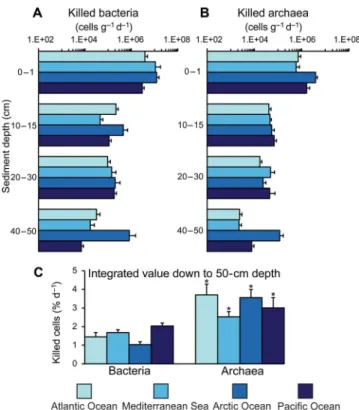
We estimated that viral infections were responsible for the abate-ment of 1.0 to 2.2% day−1(on average 1.6% day−1) of the bacterial abun-dance and 2.3 to 4.3% day−1(on average 3.2% day−1) of the archaeal abundance in deep-sea sediments (Fig. 6). Therefore, despite the
num-ber of archaea in the sediments being much lower than that of bacteria, the impact of viruses on archaea was on average significantly higher. These findings were consistent along the vertical profile of the sedi-ments down to 50-cm depth, across all oceanic regions investigated, and were not affected by pressure conditions (fig. S7). These values, once combined, are consistent with estimates of the overall virus-induced mortality rates determined at similar depths worldwide (5). The overall mortality rates of archaea plus bacteria (on average 2.6 ± 0.6 × 10⁶killed cells per gram per day) were very similar to those ob-tained by dividing the viral production by the average burst size reported for deep-sea sediments (that is, 45 viruses released per lysed cell, result-ing in 2.1 ± 0.4 × 10⁶killed cells per gram per day) (5). Moreover, the viral production divided by the rates of lysis we derived from the release of 16SrRNA gene copies resulted in values of burst size (mean, 48;
range, 17 to 187) almost identical to those previously reported by Danovaroet al. (5), providing further evidence of the reliability of the results presented here.
To be sustainable over time, the rates of virus-induced mortality of bacteria and archaea should be balanced by cellular turnover. The turnover times of archaea and bacteria determined on the basis of C production rates (fig. S8 and table S6) were similar (11 to 23 days for archaea and 12 to 27 days for bacteria). These values were unaffected by pressure conditions (fig. S9) and were consistent with results available from deepwater masses (range, 20 to 100 days) (33) and deep-sea
sedi-ments (range, <2 to 67 days) (22). Notably, the turnover times of ar-chaea, estimated by dividing the virus-induced cell mortality rates by the abundance of archaeal cells (12 to 22 days), were roughly equivalent to those determined by the radiolabeling experiments. In contrast, the turnover times of bacteria estimated from virus-induced mortality rates were significantly longer (31 to 52 days) than those calculated on the basis of radiolabeled substrate incorporation. This means that viral in-fection is responsible for the abatement of almost the entire biomass production of benthic archaea, whereas factors other than viruses (for example, predation or grazing by benthic consumers) may be responsible
for the removal of a larger fraction of the biomass produced by bacteria than by archaea.
Our results, based on massive sequencing analyses of the 16SrRNA genes released by lysed bacteria and archaea, provided new insight on the role of viral infections in the microbial biodiversity and functioning of the deep oceans (5,34). We found that, in all investigated deep-sea ecosystems, the viral impact occurred primarily on specific taxa belonging to MG-I Thaumarchaeota (fig. S10), suggesting that the viral impact is highest on the most represented archaeal group inhabiting surface deep-sea sediments (11–13).
Our findings also indicated that C production of benthic bacterial assemblages was almost entirely due to heterotrophic metabolism, whereas more than 60% of the C production of benthic archaeal assem-blages was due to chemosynthetic processes (fig. S8). In oxygenated sur-face deep-sea sediments, chemosynthesis is largely dependent on the oxidation of ammonia (1 mol of CO2fixed to 10 mol of NH4+oxidized) (20), which is supplied by microbial heterotrophic metabolism (22,35). In line with this, we found a significant relationship between chemo-autotrophic and heterotrophic C production (Fig. 7A). In turn, our results confirm previous evidence (5) that the labile organic C released by virus-induced cell lysis can stimulate the heterotrophic metabolism of uninfected deep-sea archaea and bacteria in the deep sea (Fig. 7B). These findings provide new evidence for a possible link between viral
infections and chemoautotrophic production in the microbial food web. Viral-mediated mortality of bacteria and archaea may stimulate hetero-trophic metabolism. This, in turn, may enhance nitrogen regeneration processes, supporting ammonia-dependent chemoautotrophic produc-tion. This biological feedback could have important consequences for C and N cycling. Assuming that the entire organic matter pool released by viral lysis is used by heterotrophic metabolism, and considering that 1 mol of ammonia is produced for every 4 mol of CO2released (based on archaea and bacteria C/N ratio of 4:1), our results suggest that this process can provide 30 to 60% of the ammonia required to sustain chemoautotrophic C production of archaea. The relevance of this pro-cess indicates that viral infections can be one of the main drivers of chemoautotrophic production in deep-sea sediments, but it can also be hypothesized that a large fraction of ammonia, as well as other compounds supporting archaeal metabolism, derives from other het-erotrophic processes (for example, from benthic fauna).
Despite the numerical dominance of bacteria, the C released by virus-killed archaea contributes 15 to 30% of the total C released by viral lysis in surface deep-sea sediments. Viral lysis of archaea and bacteria is estimated to release 0.37 to 0.63 GtC year−1globally (5). The viral lysis of archaea alone is equivalent to ~0.08 to 0.14 GtC year−1(in the top 1 cm), reaching ~0.3 to 0.5 GtC year−1(in the top 50 cm of the sediments) when extrapolated to a global scale. We show here for the first time the crucial
Fig. 4. Effect of the inhibition of archaeal and bacterial metabolism.Reported are, from left to right, viral abundance, bacterial 16SrRNA gene copies in the extracellular DNA, and archaeal 16SrRNA gene copies in the extracellular DNA, during time-course incubations of untreated (control, blue bars) and treated (light blue bars, following addition of GC7 plus antibiotics to inhibit archaeal and bacterial metabolism) deep-sea sediment samples. Reported are average values and SDs. Asterisks indicate the significant increase (**P< 0.01) in the abundance of viruses and the number of bacterial or archaeal 16SrRNA gene copies after 12 hours of incubation in untreated (control) samples. ns, no significant differences occurring over time in treated samples; rDNA, ribosomal DNA.
At each sampling station, surface (the top 1 cm) and subsuperficial sed-iment samples, down to 50-cm depth, were collected from independent cores (n= 3) using either multiple corers or a remotely operated vehicle (ROV). The experimental setup, which was used for all of the sampling areas investigated, consisted of 12-hour incubations of mesocosms maintained in the dark and in situ temperature conditions. Additional parallel incubations at in situ pressure were also carried out.
Abundance of bacteria, archaea, and viruses and viral production
The abundance of bacteria and archaea was determined by epifluores-cence microscopy using the CARD-FISH technique (36), whereas viral abundances were determined after staining with SYBR Green I (37). The viral production in the deep-sea sediment samples was determined by the dilution technique (that is, a dilution-based procedure) through the measurement of the increase in viral abundance over time (5,38,39). This technique is the most widely used for benthic environments (thus enabling a comparison with available data), and it has the advantage of minimizing the impact of protozoa and/or fauna grazing on bacteria and archaea during the incubations (5,38,39). Details are reported in the Sup-plementary Materials.
Viral impact on archaea and bacteria
The same experimental mesocosms used for the determination of viral production were used to selectively quantify the number of archaea and/ or bacteria killed by viruses, as follows. Sediment subsamples were in-cubated in the dark at the in situ temperature and collected at the beginning and after 1 to 3, 3 to 6, and 12 hours of incubation. Extra-cellular DNA was recovered from sediments collected at each time in-terval of incubation (40). Real-time qPCR analyses were used to quantify the number of 16SrRNA gene copies contained in the recov-ered extracellular DNA fraction for each time interval of incubation. The quantification of archaeal and bacterial 16SrRNA gene copies con-tained within the extracellular DNA was performed using primers and probes selectively targeting archaea (41) or bacteria (table S2 and Sup-plementary Materials) (42). The number of copies of 16SrRNA genes was calculated on the basis of the template length in base pairs (bp) and an average weight of 650 Da bp−1. The rates of release of 16SrRNA gene copies from archaea and bacteria killed by viruses were determined in the extracellular DNA pools from the linear regression analysis of the number of 16SrRNA gene copies over time. These rates were then converted into bacterial and archaeal cells killed by viruses assuming a value of 1.7 copies of 16SrRNA genes per cell, both for bacteria and ar-chaea. This conversion factor represented the average number of 16SrRNA gene copies per archaeal cell provided by the Ribosomal RNA operon copy number Database (rrnDB) (http://rrndb.umms.med.umich.edu/) (43). This value was lower than the 16SrRNA gene copy number of bacteria (on av-erage 4.2 copies per cell considering all bacterial genomes in the rrnDB) and slightly higher than that of all currently known Thaumarchaeota, including
Fig. 6. Virus-induced mortality of bacteria and archaea.Reported are average values and SDs of the virus-induced mortality of bacteria (A) and archaea (B) along vertical profiles at depth intervals of 0 to 1, 10 to 15, 20 to 30, and 40 to 50 cm, and the integrated values for the top 50 cm (C), of deep-sea sediments collected from Arctic Ocean, Atlantic Ocean, and Pacific Ocean and Mediterranean Sea. Asterisks indicate significantly higher (*P< 0.05) virus-induced mortality rates of archaea as found for all the oceanographic regions investigated.
those inhabiting deep-sea sediments (1 copy per cell) (16,43,44). Thus, our estimates of the mortality rates of archaea were conservative, be-cause the relative impact of viruses on archaea could be even higher using one copy per cell as a conversion factor.
To test the hypothesis that the 16SrRNA gene release into the ex-tracellular DNA pool was related to the possibility that metabolically active bacterial and archaeal cells were infected and lysed by viruses, additional time-course experiments were conducted by incubating deep-sea sediment samples with GC7 (N1-guanyl-1,7-diaminoheptane; final concentration of 1 mM) to selectively inhibit archaeal metabolism (22,45–47) or with GC7 plus different antibiotics [chloramphenicol (0.3 mg ml−1), tetracycline (0.05 mg ml−1), rifampicin (0.05 mg ml−1), and streptomycin (1 mg ml−1)] to also inhibit bacterial metabolism (47–49). These concentrations were sufficient to inhibit both archaeal and bacterial metabolism, as revealed by synoptic incorporation exper-iments with radiolabeled substrates (both3H-leucine and14C-bicarbonate).
Bacterial and archaeal metabolism using radiolabeled substrates
For heterotrophic or chemoautotrophic C production determinations, sediment subsamples were added with 0.2-mm prefiltered seawater (collected at the sediment water interface of each station), containing 3H-leucine (68 Ci mmol−1; final concentration of 0.5 to 1.0mM) or 14C-bicarbonate (58 mCi mmol−1; final concentration of 12mCi ml−1), re-spectively (5,22). The relative contribution of bacteria and archaea to the overall heterotrophic and chemoautotrophic C production was assessed by parallel experiments using selective inhibitors of microbial metabolism (see the Supplementary Materials).
Effects of pressure on the estimates of archaeal and bacterial mortality
Analyses of viral and archaeal plus bacterial production in deep-sea sed-iment samples collected from the Mediterranean Sea were conducted at both in situ and atmospheric (that is, 0.1 MPa) pressure to test for dif-ferences in the estimates of virus-induced mortality of archaea and bacteria. Moreover, we independently checked for the presence of pos-sible artifacts due to the manipulation of the sediment during the sampling by determining the ratios between the numbers of copies of 16SrRNA genes recovered in the extracellular DNA pool and the total archaeal plus bacterial abundance for all sediment samples collected at the different depths.
Identification of archaea lysed by viruses and viruses responsible for their mortality
To identify the main taxa of archaea lysed by viruses at each sampling site, 16SrRNA gene sequences contained within the extracellular DNA pools at the beginning and after 12 hours of incubation were analyzed by high-throughput sequencing. The bacterial and archaeal 16SrRNA genes contained within the extracellular DNA pools were amplified (30) and sequenced on a 454 FLX Titanium platform. Metagenomic analyses conducted on the free viruses recovered from deep-sea sediment samples at the beginning of the time-course experiments and after 12 hours (that is, after the viral infection events) were used to identify archaeal viruses causing cell mortality. Viruses were dislodged from the sediment using a physical-chemical procedure (50), and viral DNA, which was extracted and purified according to standard protocols, was sequenced on a 454 FLX Titanium platform (see the Supplementary Materials).
SUPPLEMENTARY MATERIALS
Supplementary material for this article is available at http://advances.sciencemag.org/cgi/ content/full/2/10/e1600492/DC1
Supplementary Methods
fig. S1. Bacterial and archaeal biomass in deep-sea sediments.
fig. S2. Diversity of bacterial and archaeal 16SrRNA genes in deep-sea sediments. fig. S3. Rarefaction curves.
fig. S4. Rates of lytic infections versus 16SrRNA genes released from lysed hosts. fig. S5. Viruses responsible for archaeal mortality identified by metagenomics.
fig. S6. Similarity between bacterial and archaeal assemblage composition in intracellular and extracellular DNA pools.
fig. S7. Effect of pressure on viral production, DNA release, and cell burst. fig. S8. Heterotrophic and chemoautotrophic C production.
fig. S9. Effect of pressure on C production.
fig. S10. Impact of viruses on MG-I Thaumarchaeota in surface deep-sea sediments. table S1. Details on the deep-sea sampling areas investigated.
table S2. Output of the in silico analyses dealing with the specificity and the coverage of oligonucleotides targeting 16SrRNA used in the present study.
table S3. Number of 16SrDNA sequences obtained before and after the cleaning process. table S4. Output of the statistical tests for the experiments of inhibition of bacterial and archaeal metabolism.
table S5. Output of the statistical tests for the experiments of selective inhibition of archaeal metabolism.
table S6. Details on14C analyses.
References (51–71)
REFERENCES AND NOTES
1. J. A. Fuhrman, Marine viruses and their biogeochemical and ecological effects.Nature
399, 541–548 (1999).
2. M. G. Weinbauer, Ecology of prokaryotic viruses.FEMS Microbiol. Rev.28, 127–181 (2004). 3. C. A. Suttle, Review viruses in the sea.Nature437, 356–361 (2005).
4. C. A. Suttle, Marine viruses—Major players in the global ecosystem.Nat. Rev. Microbiol.5, 801–812 (2007).
5. R. Danovaro, A. Dell’Anno, C. Corinaldesi, M. Magagnini, R. Noble, C. Tamburini, M. Weinbauer, Major viral impact on the functioning of benthic deep-sea ecosystems.
Nature454, 1084–1087 (2008).
6. F. Rohwer, R. V. Thurber, Review viruses manipulate the marine environment.Nature459, 207–212 (2009).
7. J. J. Middelburg, F. J. R. Meysman, Burial at sea.Science316, 1294–1295 (2007). 8. M. B. Karner, E. F. DeLong, D. M. Karl, Archaeal dominance in the mesopelagic zone of the
Pacific Ocean.Nature409, 507–510 (2001).
9. J. S. Lipp, Y. Morono, F. Inagaki, K.-U. Hinrichs, Significant contribution of Archaea to extant biomass in marine subsurface sediments.Nature454, 991–994 (2008). 10. S. Xie, J. S. Lipp, G. Wegener, T. G. Ferdelman, K.-U. Hinrichs, Turnover of microbial lipids
in the deep biosphere and growth of benthic archaeal populations.Proc. Natl. Acad. Sci. U.S.A.110, 6010–6014 (2013).
11. A. M. Durbin, A. Teske, Microbial diversity and stratification of South Pacific abyssal marine sediments.Environ. Microbiol.13, 3219–3234 (2011).
12. S. L. Jorgensen, B. Hannisdal, A. Lanzén, T. Baumberger, K. Flesland, R. Fonseca, L. Øvreås, I. H. Steen, I. H. Thorseth, R. B. Pedersen, C. Schleper, Correlating microbial community profiles with geochemical data in highly stratified sediments from the Arctic Mid-Ocean Ridge.Proc. Natl. Acad. Sci. U.S.A.109, E2846–E2855 (2012).
13. T. Nunoura, M. Nishizawa, T. Kikuchi, T. Tsubouchi, M. Hirai, O. Koide, J. Miyazaki, H. Hirayama, K. Koba, K. Takai, Molecular biological and isotopic biogeochemical prognoses of the nitrification-driven dynamic microbial nitrogen cycle in hadopelagic sediments.Environ. Microbiol.15, 3087–3107 (2013).
14. Y. Takano, Y. Chikaraishi, N. O. Ogawa, H. Nomaki, Y. Morono, F. Inagaki, H. Kitazato, K.-U. Hinrichs, N. Ohkouchi, Sedimentary membrane lipids recycled by deep-sea benthic archaea.Nat. Geosci.3, 858–861 (2010).
15. B. N. Orcutt, J. B. Sylvan, N. J. Knab, K. J. Edwards, Microbial ecology of the dark ocean above, at, and below the seafloor.Microbiol. Mol. Biol. Rev.75, 361–422 (2011). 16. K. G. Lloyd, L. Schreiber, D. G. Petersen, K. U. Kjeldsen, M. A. Lever, A. D. Steen, R. Stepanauskas, M. Richter, S. Kleindienst, S. Lenk, A. Schramm, B. B. Jørgensen, Predominant archaea in marine sediments degrade detrital proteins.Nature496, 215–218 (2013).
17. F. Angly, B. Felts, M. Breitbart, P. Salamon, R. A. Edwards, C. Carlson, A. M. Chan, M. Haynes, S. Kelley, H. Liu, J. M. Mahaffy, J. E. Mueller, J. Nulton, R. Olson, R. Parsons, S. Rayhawk, C. A. Suttle, F. Rohwer, The marine viromes of four oceanic regions.PLOS Biol.4, e368 (2006). 18. M. Krupovic, D. Prangishvili, R. W. Hendrix, D. H. Bamford, Genomics of bacterial and
25. A. Schippers, L. N. Neretin, Quantification of microbial communities in near-surface and deeply buried marine sediments on the Peru continental margin using real-time PCR.
Environ. Microbiol.8, 1251–1260 (2006).
26. K. G. Lloyd, M. K. May, R. Kevorkian, A. D. Steen, Meta analysis of quantification methods shows archaea and bacteria have similar abundances in the subseafloor.Appl. Environ. Microbiol.79, 7790–7799 (2013).
27. C. E. T. Chow, D. M. Winget, R. A. White III, S. J. Hallam, C. A. Suttle, Combining genomic sequencing methods to explore viral diversity and reveal potential virus-host interactions.Front. Microbiol.6, 265 (2015).
28. J. M. Labonté, B. K. Swan, B. Poulos, H. Luo, S. Koren, S. J. Hallam, M. B. Sullivan, T. Woyke, K. E. Wommack, R. Stepanauskas, Single-cell genomics-based analysis of virus-host interactions in marine surface bacterioplankton.ISME J.9, 2386–2399 (2015). 29. M. T. Suzuki, S. J. Giovannoni, Bias caused by template annealing in the amplification of
mixtures of 16S rRNA genes by PCR.Appl. Environ. Microbiol.62, 625–630 (1996). 30. A. Klindworth, E. Pruesse, T. Schweer, J. Peplies, C. Quast, M. Horn, F. O. Glöckner,
Evaluation of general 16S ribosomal RNA gene PCR primers for classical and next-generation sequencing-based diversity studies.Nucleic Acids Res.41, e1 (2013). 31. V. Pecoraro, K. Zerulla, C. Lange, J. Soppa, Quantification of ploidy in proteobacteria
revealed the existence of monoploid, (mero-)oligoploid and polyploid species.PLOS ONE
6, e16392 (2011).
32. J. Soppa, Ploidy and gene conversion in archaea.Biochem. Soc. Trans.39, 150–154 (2011). 33. G. J. Herndl, T. Reinthaler, E. Teira, H. van Aken, C. Veth, A. Pernthaler, J. Pernthaler,
Contribution ofArchaeato total prokaryotic production in the deep Atlantic Ocean.
Appl. Environ. Microbiol.71, 2303–2309 (2005).
34. K. Anantharaman, M. B. Duhaime, J. A. Breier, K. A. Wendt, B. M. Toner, G. J. Dick, Sulfur oxidation genes in diverse deep-sea viruses.Science344, 757–760 (2014).
35. J. J. Middelburg, Chemoautotrophy in the ocean.Geophys. Res. Lett.38, L24604 (2011). 36. E. Teira, T. Reinthaler, A. Pernthaler, J. Pernthaler, G. J. Herndl, Combining catalyzed
reporter deposition-fluorescence in situ hybridization and microautoradiography to detect substrate utilization by bacteria and archaea in the deep ocean.Appl. Environ. Microbiol.70, 4411–4414 (2004).
37. R. Danovaro, A. Dell’Anno, A. Trucco, S. Vannucci, Determination of virus abundance in marine sediments.Appl. Environ. Microbiol.67, 1384–1387 (2001).
38. A. Dell’Anno, C. Corinaldesi, M. Magagnini, R. Danovaro, Determination of viral production in aquatic sediments using the dilution-based approach.Nat. Protoc.4, 1013–1022 (2009).
39. E. Rastelli, A. Dell’Anno, C. Corinaldesi, M. Middelboe, R. T. Noble, R. Danovaro, Quantification of viral and prokaryotic production rates in benthic ecosystems: A methods comparison.Front. Microbiol.7, 1501 (2016).
40. C. Corinaldesi, R. Danovaro, A. Dell’Anno, Simultaneous recovery of extracellular and intracellular DNA suitable for molecular studies from marine sediments.Appl. Environ. Microbiol.71, 46–50 (2005).
41. K. Takai, K. Horikoshi, Rapid detection and quantification of members of the archaeal community by quantitative PCR using fluorogenic probes.Appl. Environ. Microbiol.66, 5066–5072 (2000).
42. M. A. Nadkarni, F. E. Martin, N. A. Jacques, N. Hunter, Determination of bacterial load by real-time PCR using a broad-range (universal) probe and primers set.Microbiology148, 257–266 (2002).
43. S. F. Stoddard, B. J. Smith, R. Hein, B. R. K. Roller, T. M. Schmidt,rrnDB: Improved tools for interpreting rRNA gene abundance in bacteria and archaea and a new foundation for future development.Nucleic Acids Res.43, D593–D598 (2015).
44. S.-J. Park, R. Ghai, A.-B. Martín-Cuadrado, F. Rodríguez-Valera, W.-H. Chung, K. Kwon, J.-H. Lee, E. L. Madsen, S.-K. Rhee, Genomes of two new ammonia-oxidizing archaea enriched from deep marine sediments.PLOS ONE9, e96449 (2014).
45. B. P. M. Jansson, L. Malandrin, H. E. Johansson, Cell cycle arrest in archaea by the hypusination inhibitorN1-guanyl-1, 7-diaminoheptane.J. Bacteriol.182, 1158–1161
(2000).
46. H. A. Levipan, R. A. Quiñones, H. Urrutia, A time series of prokaryote secondary production in the oxygen minimum zone of the Humboldt current system, off central Chile.Prog. Oceanogr.75, 531–549 (2007).
52. J. C. Fry, inMethods in Aquatic Bacteriology, B. Austin ed. (John Wiley & Sons, 1990), pp. 27–72.
53. M. Molari, E. Manini, Reliability of CARD-FISH procedure for enumeration of Archaea in deep-sea surficial sediments.Curr. Microbiol.64, 242–250 (2012).
54. S. A. Bustin, V. Benes, J. A. Garson, J. Hellemans, J. Huggett, M. Kubista, R. Mueller, T. Nolan, M. W. Pfaffl, G. L. Shipley, J. Vandesompele, C. T. Wittwer, The MIQE guidelines:Minimum
information for publication ofquantitative real-time pcrexperiments.Clin. Chem.55, 611–622 (2009).
55. Y. Cao, J. F. Griffith, S. Dorevitch, S. B. Weisberg, Effectiveness of qPCR permutations, internal controls and dilution as means for minimizing the impact of inhibition while measuringEnterococcusin environmental waters.J. Appl. Microbiol.113, 66–75 (2012). 56. K. G. Lloyd, B. J. MacGregor, A. Teske, Quantitative PCR methods for RNA and DNA in
marine sediments: Maximizing yield while overcoming inhibition.FEMS Microbiol. Ecol.
72, 143–151 (2010).
57. R. Schmieder, Y. W. Lim, F. Rohwer, R. Edwards, TagCleaner: Identification and removal of tag sequences from genomic and metagenomic datasets.BMC Bioinf.11, 341 (2010). 58. R. Schmieder, R. Edwards, Quality control and preprocessing of metagenomic datasets.
Bioinformatics27, 863–864 (2011).
59. P. D. Schloss, D. Gevers, S. L. Westcott, Reducing the effects of PCR amplification and sequencing artifacts on 16S rRNA-based studies.PLOS ONE6, e27310 (2011). 60. P. D. Schloss, S. L. Westcott, T. Ryabin, J. R. Hall, M. Hartmann, E. B. Hollister, R. A. Lesniewski,
B. B. Oakley, D. H. Parks, C. J. Robinson, J. W. Sahl, B. Stres, G. G. Thallinger, D. J. Van Horn, C. F. Weber, Introducing mothur: Open-source, platform-independent, community-supported software for describing and comparing microbial communities.Appl. Environ. Microbiol.75, 7537–7541 (2009).
61. F. Meyer, D. Paarmann, M. D’Souza, R. Olson, E. M. Glass, M. Kubal, T. Paczian, A. Rodriguez, R. Stevens, A. Wilke, J. Wilkening R. A. Edwards, The metagenomics RAST server—A public resource for the automatic phylogenetic and functional analysis of metagenomes.BMC Bioinf.9, 386 (2008).
62. R. C. Edgar, Search and clustering orders of magnitude faster than BLAST.Bioinformatics
26, 2460–2461 (2004).
63. R. C. Edgar, MUSCLE: Multiple sequence alignment with high accuracy and high throughput.Nucleic Acids Res.32, 1792–1797 (2004).
64. S. Guindon, O. Gascuel, A simple, fast, and accurate algorithm to estimate large phylogenies by maximum likelihood.Syst. Biol.52, 696–704 (2003).
65. R. V. Thurber, M. Haynes, M. Breitbart, L. Wegley, F. Rohwer, Laboratory procedures to generate viral metagenomes.Nat. Protoc.4, 470–483 (2009).
66. J. Sambrook, T. Maniatis,Molecular Cloning: A Laboratory Manual(Cold Spring Harbor Laboratory Press, 2001).
67. S. Roux, M. Faubladier, A. Mahul, N. Paulhe, A. Bernard, D. Debroas, F. Enault, Metavir: A web server dedicated to virome analysis.Bioinformatics27, 3074–3075 (2011). 68. F. E. Angly, D. Willner, A. Prieto-Davó, R. A. Edwards, R. Schmieder, R. Vega-Thurber,
D. A. Antonopoulos, K. Barott, M. T. Cottrell, C. Desnues, E. A. Dinsdale, M. Furlan, M. Haynes, M. R. Henn, Y. Hu, D. L. Kirchman, T. McDole, J. D. McPherson, F. Meyer, R. M. Miller, E. Mundt, R. K. Naviaux, B. Rodriguez-Mueller, R. Stevens, L. Wegley, L. Zhang, B. Zhu, F. Rohwer, The GAAS metagenomic tool and its estimations of viral and microbial average genome size in four major biomes.PLOS Comput. Biol.5, e1000593 (2009). 69. D. H. Parks, R. G. Beiko, Identifying biologically relevant differences between
metagenomic communities.Bioinformatics26, 715–721 (2010).
70. K. R. Clarke, R. N. Gorley, User manual/tutorial. PRIMER-E Ltd., Plymouth, 93 (2006). 71. A. Pusceddu, A. Dell’Anno, M. Fabiano, R. Danovaro, Quantity and bioavailability of
sediment organic matter as signatures of benthic trophic status.Mar. Ecol.: Prog. Ser.375, 41–52 (2009).
contract no. I31J10000060001) and by the European Commission Seventh Framework Program Project MIDAS (Managing Impacts of Deep-seA reSource exploitation; grant no. 603418). We would like to thank the captain and crew of theR/V Kaireiand operation team of ROV Automatic Bottom Inspection and Sampling Mobile onboard Japan Agency for Marine-Earth Science and Technology cruise KR11-11. The research performed by R.C. was supported by the Australian Research Council.Author contributions:R.D., A.D., C.C., and R.N. conceived the work and experimental approach. A.D., C.C., E.R., M.K., D.P., and T.N. contributed to the laboratory/bioinformatic analyses and experimental work. R.D., E.R., A.D., C.C., R.C., M.K., and D.P. contributed to data elaboration. All authors discussed and wrote the manuscript and commented on the paper.Competing interests:The authors declare that they have no competing interests.Data and materials availability:All data needed to evaluate the conclusions in the paper are present in the paper and/or the Supplementary Materials. Additional data related to this paper may be requested from the authors. The sequences of the
viromes and of the ribosomal genes analyzed in this paper have been deposited in MetaVir (metavir-meb.univ-bpclermont.fr) and in MG-RAST (metagenomics.anl.gov), respectively, within the project EXPLODIVE (virome IDs: Med_Vir, Arct_Vir, Atl_Vir, Pac_Vir; ribosomal genes IDs: Med_1-6, Arct_1-6, Atl_1-6, Pac_1-6).
Submitted 8 March 2016 Accepted 11 September 2016 Published 12 October 2016 10.1126/sciadv.1600492