Volume 14, E36 APRIL 2017
COMMUNITY CASE STUDY
Recruiting Community Partners for Veggie
Van: Strategies and Lessons Learned From
a Mobile Market Intervention in North
Carolina, 2012–2015
Gina L. Tripicchio, MS, MSEd1,2; Jacqueline Grady Smith2;
Janelle Armstrong-Brown, MPH, PhD3; Jared McGuirt, PhD2;
Lindsey Haynes-Maslow, MHA, PhD4; Sarah Mardovich2; Alice S. Ammerman, DrPH1,2;
Lucia Leone, PhD5
Suggested citation for this article: Tripicchio GL, Grady Smith J, Armstrong-Brown J, McGuirt J, Haynes-Maslow L, Mardovich S, et al. Recruiting Community Partners for Veggie Van: Strategies and Lessons Learned From a Mobile Market Intervention in North Carolina, 2012–2015. Prev Chronic Dis 2017;14:160475. DOI: https://doi.org/10.5888/pcd14.160475.
PEER REVIEWED
Abstract
Background
Food access interventions are promising strategies for improving dietary intake, which is associated with better health. However, studies examining the relationship between food access and intake are limited to observational designs, indicating a need for more rigorous approaches. The Veggie Van (VV) program was a cluster-randomized intervention designed to address the gap between food access and intake. In this article, we aim to describe the approaches involved in recruiting community partners to parti-cipate in VV.
Community Context
The VV mobile market aimed to improve access to fresh fruits and vegetables by providing subsidized, high-quality, local produce in low-resource communities in North Carolina. This study de-scribes the strategies and considerations involved in recruiting community partners and individual participants for participation in the VV program and evaluation.
Methods
To recruit partners, we used various strategies, including a site screener to identify potential partners, interest forms to gauge fu-ture VV use and prioritize enrollment of a high-need population, marketing materials to promote VV, site liaisons to coordinate community outreach, and a memorandum of understanding between all invested parties.
Outcome
A total of 53 community organizations and 725 participants were approached for recruitment. Ultimately, 12 sites and 201 parti-cipants were enrolled. Enrollment took 38 months, but our ap-proaches helped successfully recruit a low-income, low-access population. The process took longer than anticipated, and funding constraints prevented certain strategies from being implemented.
Interpretation
Recruiting community partners and members for participation in a multi-level, community-based intervention was challenging. Strategies and lessons learned can inform future studies.
Background
ac-cess, preparation time, knowledge, and transportation are com-mon barriers (8). Therefore, interventions aiming to improve ac-cess to affordable, healthy food might be a promising strategy for improving health in these populations (9,10). Understanding the relationship between access to healthy food and intake is import-ant, but most studies are limited to cross-sectional observational data (11) and literature on the effect of interventions to modify ac-cess and intake is generally lacking (12). The Veggie Van (VV) program was designed to address this gap and evaluate a food ac-cess program using a rigorous multilevel, randomized design.
To reach communities with limited access, the VV program aimed to establish partnerships with community organizations for the in-tervention. “Limited access” refers to communities in which high-quality, affordable, fresh fruits and vegetables are not readily available. Community sites, such as schools, faith-based organiza-tions, health clinics, worksites and community centers, are effect-ive places to reach groups of people for health interventions (13). Community leaders have institutional knowledge and expertise in working with priority populations (14), and their involvement can help cultivate community members’ trust (15). Despite the neces-sity of community engagement in recruitment processes, the strategies, challenges, and considerations involved in recruiting community partners and individual study participants are underre-ported. Thus, this study aims to describe the approaches involved in recruiting community partners and individual study participants for a cluster-randomized food access intervention.
Community Context
The VV program was implemented in collaboration with organiza-tions in communities in North Carolina that lack access to afford-able, fresh fruits and vegetables. Organizations serving low-in-come, diverse populations were identified as the priority for re-cruitment because of significantly lower rates of fruit and veget-able consumption among these groups in North Carolina. Accord-ing to the most recent report, only 15.2% of low-income adults in North Carolina (ie, annual household income of ≤$15,000) con-sume 5 or more servings of fruits and vegetables per day, com-pared with 25.0% of adults who make $50,000 or more (16). The goal of VV was to improve fruit and vegetable access and intake among participants at partner organizations receiving the interven-tion. The purpose of our community engagement efforts was to 1) enroll community organizations to receive the VV mobile market program and participate in the study, and 2) identify potential VV customers and recruit them to participate in the study.
Methods
The VV program was a mobile market, which provided local North Carolina produce to community sites at a subsidized cost and also aimed to provide nutrition education, cooking demonstra-tions, and seasonal recipes (17). “Mobile market” generally refers to the selling of fresh produce via portable means. The VV mobile market sold produce shares, similar to a community-supported ag-riculture program, as well as individual items, and was operated once per week at each community site. Before starting VV, mem-bers of low-income communities participated in focus groups and provided information on barriers and perceptions related to fruit and vegetable access in their communities (8,18). This informa-tion was used to guide the development of the VV program, and community partners were engaged in the implementation of the VV mobile market at their specific location.
The study was a randomized controlled trial designed to assess the impact of VV on individual fruit and vegetable access and con-sumption. The recruitment team, which consisted of study re-searchers and program staff, searched for potential partners through established community relationships and by identifying organizations that served the target population and met study cri-teria. Potential partners were eligible to participate if they 1) had a person willing to act as a site liaison, 2) were willing to be ran-domized as part of the research study, 3) could recruit at least 30 interested community members to participate in the study, and 4) had space to accommodate the VV mobile market weekly (indoor and outdoor). Site liaisons were responsible for promoting the VV program, coordinating recruitment efforts, and acting as the sup-port for the duration of the program. A description of the site liais-on roles and their community organizatiliais-on are presented in Table 1.
After screening potential partners for eligibility, forms were col-lected to assess interest among individuals in the community. For potential partners to become a study site, a minimum of 30 com-munity members needed to express interest in using VV. The first question on the interest form asked potential participants about their interest in using a mobile market program. Only those who were interested were contacted for study enrollment. This was im-portant in a pilot study because the research team could not test ef-ficacy of the program if no one in the study actually used the pro-gram. We also asked about receipt of government assistance (eg, Supplemental Nutrition Assistance Program [SNAP], Special Sup-plemental Nutrition Program for Women, Infants, and Children [WIC]), barriers to fruit and vegetable intake (eg, cost, access, time to prepare), number of children in the household, and weekly spending on fruits and vegetables. The forms were available in both Spanish and English, but participants needed to be able to write and speak in English to be eligible for the study. Therefore, only participants who completed forms in English were contacted for study enrollment.
Various strategies were used to inform participants about the pro-gram and collect interest forms. First, marketing materials were created and efforts were made to create transparent, informative communication. Materials were available in both English and Spanish. The marketing materials were designed to recruit study participants, but they were also used to promote use of the VV mobile market program. Therefore, we wanted materials to be ac-cessible to both English- and Spanish-speaking populations. Sites were diverse in the populations they served, and most requested materials in different formats (eg, brochures, flyers, posters). The recruitment team participated in special community events and alongside regularly scheduled activities where they conducted cooking demonstrations, distributed healthy recipes, collected in-terest forms, and answered questions about VV. Community part-ners often organized the special community events (eg, Unity in the Community event, annual fundraisers) and invited VV to at-tend as a community partner. Materials were also distributed through web-based platforms (eg, email, Facebook, Twitter) and by posting information on bulletin boards and in community news-letters. Community engagement efforts were time intensive, so a part-time recruitment coordinator was hired to manage the out-reach and communication efforts between the recruitment team and the potential community partners. Having a coordinator to maintain communications, develop materials, and oversee timelines was essential to community-based recruitment.
After enough interest forms were collected, a memorandum of un-derstanding (MOU) was signed and the information on the forms was used to contact and enroll study participants. Community sites were then matched as pairs and randomized to the intervention or delayed intervention control group. All participants provided in-formed consent, and the institutional review board at the Uni-versity of North Carolina at Chapel Hill approved the study.
Outcome
Recruitment of community partners and participants for a site-ran-domized trial was challenging. The process took more time and re-sources than we originally anticipated on the basis of our format-ive research. Each site required a tailored approach, and develop-ing consistent branddevelop-ing, messagdevelop-ing, and information for use across multiple community sites was challenging. Adjustments and tradeoffs were made to balance enrollment goals and study timelines. Lessons learned about community and participant re-cruitment strategies are described in more detail below and in Ta-ble 2.
Community site recruitment
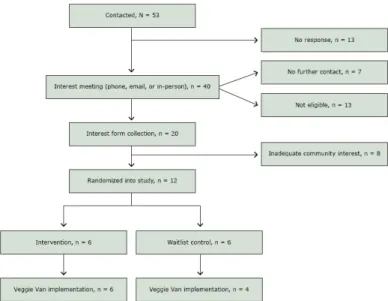
These organizations had access to smaller communities and were overburdened, making it a challenge to provide additional pro-grams and services. However, leaders of faith-based and childcare centers can cultivate consistent and strong relationships with com-munity members, and future studies should consider ways in which researchers could alleviate potential burdens on such organ-izations to broker more efficient recruitment (19).
Figure 1. Recruitment and randomization of community sites, Veggie Van Mobile Market Intervention, North Carolina, 2012–2015.
The randomized study design added complexities to the entire re-cruitment process. Potential partners had difficulty understanding why there was a research component associated with the program. Others were resistant to the idea of being a control site, and others perceived timelines associated with research as a barrier to partici-pation. Providing research training for site liaisons could have provided transparency and made partners feel more engaged in both the program and research components. Additionally, match-ing sites for randomization resulted in delays between assessmatch-ing interest and enrolling participants into the study. We could have randomized community sites before enrolling participants, but we would have risked low enrollment and threats to study validity. Also, a goal of the study was to meet the needs of the community and its members, and therefore buy-in on both levels (individual and community) was important before initiating the program. Col-lecting qualitative data on why potential sites and participants were not interested in the study could have provided more insight. Anecdotally, it was very challenging to get people interested in a program that did not yet exist, and generally people seemed resist-ant to the idea of research.
In total, site recruitment for this 12-site RCT took 38 months. Re-cruitment started in August 2012, and all sites were successfully recruited and randomized by October 2015. Site descriptions and recruitment characteristics are presented in Table 1. Across 12 study sites, individual recruitment ranged from 4.2 to 22.5 months, with an average of 10 months per site. Partner organizations were highly variable in the time each phase of recruitment lasted (Fig-ure 2).
Figure 2. Timelines associated with each phase of site recruitment, by site number, Veggie Van Mobile Market Intervention, North Carolina, 2012–2015. Abbreviations: MOU, memorandum of understanding; NA, not applicable.
Administrative and organizational issues, specifically those associ-ated with the execution of the MOU, hindered the recruitment pro-cess at some sites. Although recruitment materials were explicit and meetings were organized to expedite this process, busy sched-ules and organizational hierarchy slowed the process significantly. The screener questionnaire was also not as helpful at identifying potential partners as anticipated, and we eventually stopped using it. Site liaisons seemed to facilitate recruitment efforts, and we made finding motivated, engaged site liaisons a priority.
out-reach if resources were available. A core principle of community-based participatory research is equitable collaboration and the in-tegration of community members, and paid staff would not only have bolstered recruitment but could have improved overall com-munity engagement and program success (20). In this study, it was important to approach all relationships carefully to avoid making promises to vulnerable communities that might not be upheld if partnerships were not solidified. The need for community engage-ment had to be balanced with timelines and funding, and trust and transparency around research protocols and processes needed to be fostered. Again, putting more resources into hiring community members to foster trust might have improved our success.
Participant recruitment
A total of 725 interest forms were collected and served multiple purposes including screening community members to gauge in-terest in VV, obtaining consent for study participation, and collect-ing data to prioritize recruitment of high-need populations. Most interest forms were collected directly by site liaisons; attending community events (special one-time events and regularly sched-uled events) was the least effective strategy. We were hopeful that attending these events would demonstrate investment in partner organizations and provide an opportunity to share information with potential study participants, in person. However, given that these events required staff, volunteers, and materials, there was little benefit when only a few community members were engaged or completed forms.
Language was also a barrier, as we received a fair amount of in-terest forms in Spanish. Unfortunately, we did not have the pro-gram staff or research approval to include Spanish-speaking parti-cipants in the study and this could have improved recruitment ef-forts. Surprisingly, online interest forms were more successful than anticipated. We did not think online forms would be effect-ive for reaching low-income, low-access populations. However, we added online forms as an option to decrease the time between interest form completion and enrollment. Community members from 6 of the 12 sites used the online form and had a higher en-rollment rate than the in-person forms. Additionally, online forms eliminated the potential for illegible handwriting and incomplete forms, which were issues with the handwritten forms.
From the initial forms (N = 725), 71.2% (n = 516) indicated an in-terest in participating in VV and were contacted for enrollment. Reaching participants by telephone presented some challenges; of-ten telephone numbers were incorrect or disconnected. Ultimately, a little more than half (58.7%, n = 303) of potential participants were reachable by telephone; of those, 96.0% (n = 291) were eli-gible on the basis of inclusion criteria. To improve enrollment, we could have considered implementing in-person eligibility
screen-ings where participants were consented, enrolled, and scheduled for a survey at the time of interest form completion. Although this approach may have improved recruitment and facilitated reliable data collection, it is time- and resource-intensive and perhaps not realistic for most large randomized trials.
After initial eligibility and screening, 90 participants became un-reachable and did not complete the baseline survey. The final baseline study sample included 201 participants, indicating that, on average, for every 4 interest forms collected, 1 participant was enrolled. To prioritize enrollment of a low-income, low-access population, participants were categorized into blocks on the basis of self-report of 1) receipt of government assistance, 2) barriers to fruit and vegetable intake (but no government assistance), and 3) no receipt of government assistance or barriers. Recruitment rates by priority group are shown in Table 3. Of all interested potential participants (N = 516), most (50.8%, n = 262) reported receiving government assistance, followed by those who reported barriers to fruit and vegetable intake (25.6%, n = 132) and those reporting neither (19.6%, n = 101). A small percentage of participants (4%, n = 21) were not classified at all. Assigning potential participants to blocks for recruitment did help successfully enroll a low-in-come, low-access priority population.
Interpretation
Despite the difficulties discussed, we successfully recruited low-income, low-access participants for a food access intervention in North Carolina and learned lessons that can help future com-munity-based trials. Strategies included engaging and supporting community partners, using unique strategies such as interest forms, and maintaining communication throughout the recruit-ment process. Hiring a site recruitrecruit-ment coordinator to organize re-cruitment efforts was essential. However, hiring community mem-bers as part of the research team may also have increased parti-cipant recruitment and decreased recruitment time.
Clearly communicating timelines and expectations, establishing strong community partnerships, and implementing effective re-cruitment strategies are critical for program success. Despite more rigorous outcomes, a randomized design could have deterred the willingness and investment of community partners. Thus, future studies should aim to expand literature on this topic, especially for multilevel, randomized, community-based trials. By presenting successes, challenges, and timelines associated with this interven-tion, we are hopeful that our findings may be beneficial for both investigators and community health practitioners aiming to imple-ment community-based food access initiatives.
Acknowledgments
We acknowledge the support of the National Cancer Institute (no. 1R21CA173042). In addition, some of Dr Leone’s effort was sup-ported by the Cancer Health Disparities Training Program (no. 1T32CA128582) and the 3E program on Built Environment, Health Behavior, and Health Outcomes at the University at Buf-falo. Dr Haynes-Maslow’s effort was supported by a Health Care Quality and Patient Outcomes Pre-doctoral Fellowship (no. 2T32NR008856). We also thank all the community partners and participants who made this study possible.
Author Information
Corresponding Author: Gina L. Tripicchio, MS, MSEd, Department of Nutrition, Gillings School of Global Public Health, 2224 McGavran-Greenberg Campus, Box No. 7461, University of North Carolina at Chapel Hill, Chapel Hill, NC 27599-7461. Telephone: 856-430-0643. Email: [email protected].
Author Affiliations: 1Department of Nutrition, Gillings School of
Global Public Health, University of North Carolina at Chapel Hill, Chapel Hill, North Carolina. 2Center for Health Promotion and
Disease Prevention, University of North Carolina at Chapel Hill, Chapel Hill, North Carolina. 3RTI International, Research Triangle
Park, North Carolina. 4Department of Agricultural and Human
Sciences, North Carolina State University, Raleigh, North Carolina. 5Department of Community Health and Health Behavior,
University at Buffalo-SUNY, Buffalo, New York.
References
Boeing H, Bechthold A, Bub A, Ellinger S, Haller D, Kroke A, et al. Critical review: vegetables and fruit in the prevention of chronic diseases. Eur J Nutr 2012;51(6):637–63.
1.
Bazzano LA, He J, Ogden LG, Loria CM, Vupputuri S, Myers L, et al. Fruit and vegetable intake and risk of cardiovascular disease in US adults: the first National Health and Nutrition Examination Survey Epidemiologic Follow-up Study. Am J Clin Nutr 2002;76(1):93–9.
2.
Grimm KA, Foltz JL, Blanck HM, Scanlon KS. Household income disparities in fruit and vegetable consumption by state and territory: results of the 2009 Behavioral Risk Factor Surveillance System. J Acad Nutr Diet 2012;112(12):2014–21. 3.
Savica V, Bellinghieri G, Kopple JD. The effect of nutrition on blood pressure. Annu Rev Nutr 2010;30(1):365–401.
4.
Chen ST, Maruthur NM, Appel LJ. The effect of dietary patterns on estimated coronary heart disease risk: results from the Dietary Approaches to Stop Hypertension (DASH) trial. Circ Cardiovasc Qual Outcomes 2010;3(5):484–9.
5.
Astrup A, Dyerberg J, Selleck M, Stender S. Nutrition transition and its relationship to the development of obesity and related chronic diseases. Obes Rev 2008;9(s1,Suppl 1):48–52.
6.
Key TJ, Allen NE, Spencer EA, Travis RC. The effect of diet on risk of cancer. Lancet 2002;360(9336):861–8.
7.
Haynes-Maslow L, Parsons SE, Wheeler SB, Leone LA. A qualitative study of perceived barriers to fruit and vegetable consumption among low-income populations, North Carolina, 2011. Prev Chronic Dis 2013;10:120206.
8.
Leone LA, Beth D, Ickes SB, Macguire K, Nelson E, Smith RA, et al. Attitudes toward fruit and vegetable consumption and farmers’ market usage among low-income North Carolinians. J Hunger Environ Nutr 2012;7(1):64–76.
9.
Harvey JR, Ogden DE. Obesity treatment in disadvantaged population groups: where do we stand and what can we do? Prev Med 2014;68:71–5.
10.
Caspi CE, Sorensen G, Subramanian SV, Kawachi I. The local food environment and diet: a systematic review. Health Place 2012;18(5):1172–87.
11.
Brug J, Kremers SP, Lenthe F, Ball K, Crawford D. Environmental determinants of healthy eating: in need of theory and evidence. Proc Nutr Soc 2008;67(3):307–16. 12.
Thi CA, Horton KD, Loyo J, Jowers EM, Rodgers LF, Smiley AW, et al. Farm to Work: development of a modified community-supported agriculture model at worksites 2007–2012. Prev Chronic Dis 2015;12:150022.
13.
Dankwa-Mullan I, Rhee KB, Williams K, Sanchez I, Sy FS, Stinson N Jr, et al. The science of eliminating health disparities: summary and analysis of the NIH summit recommendations. Am J Public Health 2010;100(S1,Suppl 1):S12–8.
Belone L, Lucero JE, Duran B, Tafoya G, Baker EA, Chan D, et al. Community-based participatory research conceptual model: community partner consultation and face validity. Qual Health Res 2016;26(1):117–35.
15.
Centers for Disease Control and Prevention, National Center for Chronic Disease Prevention and Health Promotion, Division of Population Health. BRFSS Prevalence and Trends Data; 2015. http://www.cdc.gov/brfss/brfssprevalence/. Accessed August 30, 2016.
16.
Leone L, Haynes-Maslow L, Ammerman A. Veggie Van pilot study: impact of a mobile produce market for underserved communities on fruit and vegetable access and intake. J Hunger Environ Nutr 2016;1–12.
17.
Haynes-Maslow L, Auvergne L, Mark B, Ammerman A, Weiner BJ. Low-income individuals’ perceptions about fruit and vegetable access programs: a qualitative study. J Nutr Educ Behav 2015;47(4):317–24.
18.
Story M, Kaphingst KM, Robinson-O’Brien R, Glanz K. Creating healthy food and eating environments: policy and environmental approaches. Annu Rev Public Health 2008; 29(29):253–72.
19.
Minkler M. Community-based research partnerships: challenges and opportunities. J Urban Health 2005;82(2,Suppl 2):ii3–12.
Tables
Table 1. Characteristics of Study Sites and Corresponding Site Liaison Roles, Enrollment Rates, and Recruitment Timelines, Veggie Van Mobile Market Intervention, North Carolina, 2012–2015
Site Type of Organization Site Liaison Role
Interest Form Enrollment Rate, %
Recruitment Timea, Months
1 Recreation center Employee 19.2 5.6
2 Employee 41.3 4.3
3 Employee 26.7 12.6
4 Housing community Volunteer/after school coordinator 50.0 7.7
5 Health department/health clinic Employee 34.6 9.5
6 Employee 26.1 9.7
7 Employee 35.7 9.4
8 Employee 28.8 16.3
9 Community center Director/community leader 18.2 22.5
10 Director/community leader 19.6 15.4
11 Public library Employee 35.2 5.9
12 Nonprofit community organization Employee 25.7 4.9
Table 2. Recruitment Strategies, Issues and Challenges Encountered, and Guidance for Future Researchers, Veggie Van Mobile Market Intervention, North Caro-lina, 2012–2015
Recruitment
Strategy Description
Level of
Recruitment Issues/Challenges Encountered Guidance for Future Investigators
Site screener A screener questionnaire used to determine if sites could meet goals for community engagement and study implementation
Community site The screener was not as useful as intended for identifying potential partners; use of the screener was discontinued half-way through the study, and site liaisons were prioritized as a more promising strategy for getting sites enrolled.
Another strategy for identifying potential partners would be more effective than a screener questionnaire.
Site liaison A person within a community organization designated as the main point of contact for the recruitment, VV program, and research teams
Community site Site liaisons were volunteers or employees who worked directly with our priority population but were not always members of the community themselves; motivated site liaisons were able to expedite requirements for site recruitment, but all site liaisons had difficulty engaging community members.
Future studies should consider hiring a community member to act as liaison for engagement and recruitment.
Marketing materials Materials created to advertise the VV program
Community sites and participants
Marketing materials needed to be customized based on the audience (ie, community partners and study participants); community partners had different outlets for relaying information to members including brochures, flyers, email, online platforms, and in person meetings.
Identify preferred languages of target communities and ensure that there are resources for creating materials for all audiences; create a common marketing message and create consistent program branding regardless of advertising outlet.
Interest forms Forms used to screen participant eligibility, gauge interest in the VV program, prioritize enrollment of high-need participants, and obtain consent for study
participation
Participant On average, every 4 forms collected yielded 1 enrolled study participant.
The use of forms to prioritize enrollment did help us successfully enroll a low-income, low-access sample; online forms were used and could provide additional recruitment success in future studies.
Memorandum of Understanding (MOU)
An agreement of terms signed between the community partner organization, the VV program team, and the research team
Community site The execution of the MOU took much longer than desired at some sites because of bureaucratic issues.
All sites enrolled in the study signed the MOU; this was a necessary entity, especially for organizations that required board or legal approval of their own.
Block enrollment Participants’ self-reporting receipt of government assistance was prioritized for recruitment first, followed by those self-reporting barriers to fruit and vegetable intake. Participants who did not report either were recruited last.
Participant Because of an overall lack of forms, eventually all eligible potential participants were contacted, regardless of block.
The block enrollment approach helped us to successfully enroll a low-income, low-access population, but this also could have been a result of our targeted recruitment efforts since all participants who completed forms eventually needed to be contacted for enrollment.
Table 3. Rates of Participant Baseline Recruitment, by Priority Block, Veggie Van Mobile Market Intervention, North Carolina, 2012–2015
Blocka All (N = 516) Enrolled (n = 201) % Enrolled
Government assistance 262 95 36.3
Barriers to fruit and vegetable intake 132 53 40.2
No government assistance or barriers to fruit and vegetable intake 101 39 38.6
No block identified 21 14 66.7