
i
COMPARATIVE ANALYSES OF SPATIAL COGNITION IN FROGS
Yuxiang Liu
A dissertation submitted to the faculty at the University of North Carolina at Chapel Hill in partial fulfillment of the requirements for the degree of Doctor of Philosophy in the department of Biology in the
College of Arts and Sciences.
Chapel Hill 2017
Approved by:
ii
©2017
Yuxiang Liu
iii
ABSTRACT
Yuxiang Liu: COMPARATIVE ANALYSES OF SPATIAL COGNITION IN FROGS
(Under the direction of Sabrina S. Burmeister)
Efficient navigation through space is important for animal survival and reproduction. Adaptive hypothesis argues that sex and species with higher levels of cognitive challenge imposed by the
environment should outperform others. To date, major efforts to understand animal spatial cognition have focused on mammals and birds. As the branch with the most primitive traits of all tetrapods, the
iv
and reversal training (Chapter 5). Both of sexes and species comparisons are consistent with adaptive hypotheses of spatial cognition. To understand the neurogenomic mechanisms behind the cognitive differences, I compared hippocampal transcriptomes between the two species. I found that genes related to learning and memory, neurogenesis, and synaptic plasticity were upregulated in poison frogs, while genes related to apoptosis and negative regulation of biosynthesis and metabolism were upregulated in túngara frogs. Therefore, species differences in place learning of frogs may, in part, result from
differential expression of those genes in hippocampus. To determine if these species have advanced level of cognitive ability which is comparable to mammals in place learning, I trained poison frogs in a serial reversal task and a modified version of the Morris water maze. The results showed that poison frogs could use a rule-based strategy and cognitive map to learn the serial reversal task and Morris water maze
v
vi
ACKNOWLEDGEMENTS
First of all, I would like to thank my advisor, Sabrina Burmeister, and her funds from the University of North Carolina. Thanks for her patient when I made slow progress in both of my research and language at the beginning of my Ph.D. study. Instead of pushing, Sabrina showed her understanding of my slow transition from Chinese academic environment to American style. I am also benefited from talking with her about my projects in the way to rationally think about scientific questions and how to get resources to solve problems. She is well knowledgeable in the field I am working on and provided lots of direct help to my projects. She is pretty open to my ideas and enough me learn anything new in field which is out of her scope. And many thanks to her help on each of grant writing, I am pretty sure she completely devoted to help me writing proposal for HHMI, DDIG, and NESCent/TriCEM. Thank you Sabrina.
Thank you to Keith Sockman for his advisers to my experimental design. Keith can always think about some problems which are easy to be ignore in experiments, and he gave me many important suggestion when I did my maze test on frogs. I really appreciate his seminar class which showed me how to effectively learn from each other and leading a discussion. Thank you to Kenneth Lohmann to give me comments on my experiments and manuscript. I still remember his adviser for me to write a
vii
I want to thank Lainy Day for advice during development of two-arm maze and modification of Morris water maze. She also gave me lots of useful comments on my manuscript. I want to thank Corbin Jones and Erich Jarvis for his advisers on analysis of transcriptome data. Thanks to Terry Furey to let me sit in his class for bioinformatics. Thanks to Michael Ryan and Marcos Gridi-Papp for the experiment animals, Dr. Molly Cummings for consultation on frog colour vision and the optomotor experiment.
Thank you to fellow graduate students in UNC-Chapel Hill. Anais Monroy-Eklund helped me in RNA extraction and purification, and she also helped me on de novo assembly of transcriptomes. Kayla Peck provided help to use R for data analysis. Nicholas Garcia, Susan Lyon, Rob Aldredge provided thoughtful comments on my experiment. Robert Ventura provided great feedbacks on my presentation. Thank you to UNC undergraduate students, Casey Clements, Sam Lucier, Jennifer Ruff, and Marshall Phillips, for help in behavior data collection. In addition, I want to thanks Eli Hornstein for his help in taking care of frogs, and my cousin Wenxiang Liu for his expertise to help me build the modified version of Morris water maze.
At last, I want to thank my families for their continuous support. My parents never adopted their expectation to me, so I could pursue my dream freely. It is a big challenge for them stay so far away from me for my whole Ph.D. period. However, they did not say anything but support. My wife took care of my life for two years. Even after she started her Ph.D. work in Virginia, she played the main role in family business.
viii
TABLE OF CONTENTS
TABLE OF CONTENTS ... viii
LIST OF TABLES... xii
LIST OF FIGURES ... xiii
CHAPTER 1: INTRODUCTION ... 1
REFERENCES ... 8
CHAPTER 2: SEX DIFFERENCES DURING PLACE LEARNING IN THE TÚNGARA FROG ... 13
Summary ... 13
Introduction ... 13
Materials and methods ... 15
(a) Animals ... 15
(b) Apparatus ... 16
(c) Colour preference and test of discriminability ... 16
(c) Procedure ... 17
(d) Analysis and Statistics ... 19
Results ... 20
(a) General Performance ... 20
ix
(c) Left-turn Bias ... 21
(d) Effect of Egocentric Cues ... 22
Discussion... 23
REFERENCES ... 26
CHAPTER 3: LEARNING TO LEARN: ADVANCED BEHAVIOURAL FLEXIBILITY IN A POISON FROG ... 35
Summary ... 35
Introduction ... 35
Materials and methods ... 37
(a) Animals ... 37
(b) Apparatus ... 38
(c) Procedure ... 39
(d) Error Analysis ... 41
Results ... 42
Discussion... 42
REFERENCES ... 45
CHAPTER 4: A MODIFIED MORRIS WATER MAZE PROVIDES EVIDENCE FOR COGNITIVE MAP IN POISON FROGS ... 52
Summary ... 52
Introduction ... 53
Materials and Methods ... 55
x
(b) Apparatus ... 56
(c) Procedure ... 56
(d) Pathway analysis ... 58
Results ... 59
Discussion... 60
CHAPTER 5: HIPPOCAMPAL TRANSCRIPTOMES ARE ASSOCIATED WITH PLACE LEARNING ABILITY IN FROGS ... 81
Summary ... 81
Introduction ... 82
Animals ... 84
Experiment I: Local cues provided ... 85
(a) Materials and methods ... 85
(b) Results ... 86
Experiment II: Landmark cues provided ... 86
(a) Materials and methods ... 86
(b) Results ... 87
Experiment III: Hippocampal transcriptome comparison ... 87
(a) Materials and methods ... 87
(b) Results ... 90
Discussion... 91
(a) Learning strategy ... 91
xi
REFERENCES ... 95
CHAPTER 6: SYNTHESIS ... 111
xii
LIST OF TABLES
Table 2.1. Optokinetic response to a drum with yellow-red stripes ... 29
Table 3.1. Choice matrix to categorize the choice pair of every two successive trials within individuals ... 48
Table 4.1. Orientation analysis of first successful trial of each frog ... 70
Table 4.2. Orientation analysis of last successful trial of each frog ... 71
Table 4.3. Orientation analysis of all successful trials of each frog in asymptote ... 72
Table 5.1. GO enrichment analysis of upregulated genes in túngara frog ... 99
xiii
LIST OF FIGURES
Figure 2.1. Schematic drawing of the two-arm maze ... 30
Figure 2.2. The success rate during acquisition of túngara frogs ... 31
Figure 2.3. Channel preferences during the probe trials ... 32
Figure 2.3. Channel preferences during the probe trials ... 33
Figure 2.5. The effect of egocentric cues on performance ... 34
Figure 3.1. Schematic drawing and photos of the two-arm maze ... 49
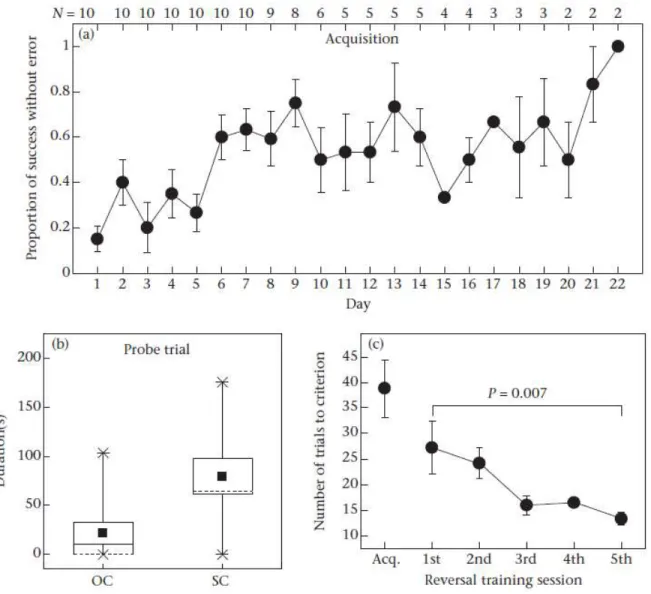
Figure 3.2. Variation in the proportion of successful trials without error over successive days for individual frogs during the acquisition training period ... 50
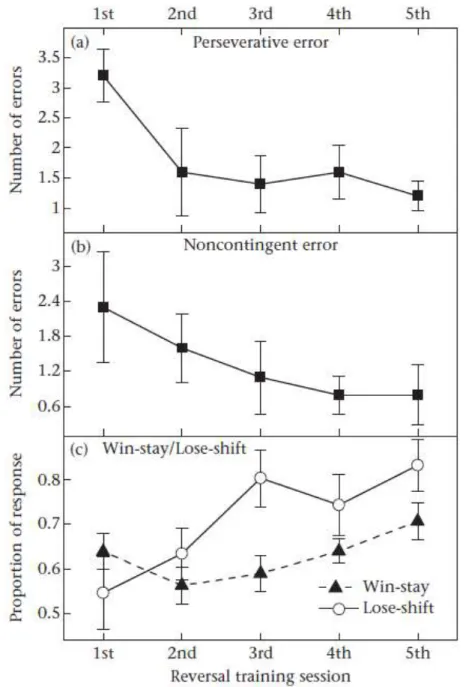
Figure 3.3. Error analysis of poison frogs in serial reversal learning ... 51
Figure 4.1. Diagram of the modified Morris water maze during training... 75
Figure 4.2. Quantification of orientation within single trial/pathway ... 76
Figure 4.3. Performance of poison frogs in modified Morris water maze ... 77
Figure 4.4. Probe trial of poison frogs in Morris water maze ... 78
Figure 4.5. Pathway analysis of first and last success trials... 79
Figure 4.6. Pathway analysis of success trials in last three training days ... 80
Figure 5.1. The success rate of poison frog and túngara frog during acquisition of experiment I .... 103
Figure 5.2. Duration that frogs spent in the arms during probe trials of experiment I ... 104
Figure 5.3. Variation proportion of successful trials without error over successive days during the acquisition and reversal training of experiment II ... 105
Figure 5.4. Comparison of errors between túngara frog and poison frog in experiment II ... 106
Figure 5.5. Slide of cross section of túngara frog forebrain... 107
Figure 5.6. Flow diagram of bioinformatics pipeline ... 108
Figure 5.7. Differentially expressed genes with known functional categories... 109
1
CHAPTER 1: INTRODUCTION
Navigating through space in search of the resources necessary to survive and reproduce is an essential function of animal behavior. It is important for homing, migration, locating resources (e.g. food), defending territories, and reproduction. The study of spatial cognition has made significant
contributions to a wide range of biological disciplines including behavior (Morris, 1984), ecology (Fagan et al., 2013), evolution (Gaulin, 1992; Rodrıguez et al., 2002), neuroanatomy (Krebs, Sherry, Healy, Perry, & Vaccarino, 1989), neurophysics (Fyhn, Molden, Witter, Moser, & Moser, 2004; O'Keefe & Nadel, 1978), pharmacology (Olton, 1987) and neurogenetics (Geary, 1995). However, most of these studies focused on mammals and birds, and my knowledge of other animal groups is quite limited. This is especially true of amphibians.
Amphibians were once thought to lack the ability to modify their behavior in a flexible manner (Hodos & Campbell, 1969; Thorpe, 1956). This claim has been countered by studies in which amphibians have demonstrated learning abilities in the context of various artificial tasks (Ellins, Cramer, & Martin, 1982; Schmajuk, Segura, & Reboreda, 1980). However, a consensus has remained that amphibians are hard to train due to their sedentary nature and to the difficulty of finding appropriate stimuli to motivate learning (Schmajuk et al., 1980; Sinsch, 2014). Recent progress on training amphibians in various tasks has caused people to question the consensus on amphibian place learning and spatial cognition
2
the neuroanatomical and neurophysiological mechanisms underpinning the evolution of spatial cognition. Amphibians have a relatively small and simple forebrain, prompting the question of how it can code for mammal-like spatial abilities.
A key starting point for the study of spatial cognition is to understand how animals use different cues to code for locations. Cues can be classified into different categories. In psychology, cues are mainly distinguished as egocentric and allocentric according to the source of cues (Shettleworth, 2009).
Egocentric cues are generated by internal organs (e.g. proprioceptive and vestibular systems) of the animals themselves (Maaswinkel & Whishaw, 1999; McNaughton et al., 1996). This type of cue contains vector information (direction and/or distance) between the animal and the goal (Burgess, 2006; Müller & Wehner, 1988). Allocentric cues include any cues that are generated by the external world, and can be further classified into different sensory modalities (Burgess, 2006).
3
Although allocentric cues may include any sensory modality, visual cues are the most commonly studied type of allocentric cues. Herein, I will mainly focus on visual cues to introduce strategies which employ allocentric cues. A cue-taxis strategy allows animals to use features of the goal itself to approach the goal (Day et al., 2003; Shettleworth, 2009), for example animals learn to use color of doors to exit a T maze. In a landmark strategy, animals learn a vector between a single cue and the goal (Day et al., 2003; Shettleworth, 2009), for example rats always use an object which is closest to goal for locating. Both cue-taxis and landmark strategies exist broadly in vertebrates (Cheng & Spetch, 1998; Daneri, Casanave, & Muzio, 2011; Lopez et al., 2000; Sovrano, Bisazza, & Vallortigara, 2007). A geometric strategy enables animals to associate shapes that are generated by a particular space with locations in that space (Cheng, 1986; Kelly, Spetch, & Heth, 1998). For example in a rectangular arena without any cue, if reward is associated with one corner, animals will learn to visit the reward corner and its diagonal corner in equal and higher frequency since the two corners are geometrically equal in the rectangular arena. While a geometric strategy has been well documented in mammals and birds, it has been largely ignored in other taxa. Recently, it was demonstrated that the Argentine toad can use the geometric shape of a rectangular space to locate a water resource (Sotelo, Bingman, & Muzio, 2015). A cognitive map strategy enables animals to learn the spatial relationships among multiple cues and then configure the shortest pathway from a random position to a destination (O'Keefe & Nadel, 1978; Shettleworth, 2009; Tolman, 1948). So far, convincing evidence for a cognitive map has only been found in mammals and birds (Jacobs, 2003; Shettleworth, 2009).
Although different types of cues and strategies have been distinguished, they also work together, or compete with one another, during place learning. For example, route learning requires animals to associate a series of landmarks (allocentric cues) with a corresponding set of correct directions
4
Cue conflict experiments are designed to determine whether animals always select one cue or strategy over another. A conservative tendency across vertebrates is to use body turn strategy rather than cue-taxis strategy when the two strategies point to different locations (Daneri et al., 2011; Maaswinkel & Whishaw, 1999). Animals that have more navigational demands (e.g., territoriality, food caching) are more likely to use spatial relationships between cues and goals rather than a cue-taxis strategy for place learning (Brodbeck, 1994). This phenomenon has been found in both mammals and birds, but it is not clear if amphibians also share similar tendencies.
5
experiment did not learn the Morris water maze task due to the lack of a cognitive map or to a mismatch between the presentation of the maze task and the perceptual expectations of this species. My pilot work on training poison frogs in the classic Morris water maze found that they also showed strong thigmotaxis to the maze wall and neglected the visual cues when placed in the maze, swimming with their heads underwater (Liu, Day, Summers, & Burmeister, 2012). Thus, valid tests for the presence of a cognitive map requires an appropriate maze design is congruent with the perceptual requirements of amphibians.
The study of spatial cognition is focused on understanding how animals navigate through the environment and the mechanisms underlying those abilities. However, environments in the natural world are not constant. Behavioral flexibility is the ability of animals to change what they learned based on changes in the environment (Coppens, de Boer, & Koolhaas, 2010). It has been demonstrated in a number of species that animals facing more complex physical and/or social environments show higher behavioral flexibility, compared to species that do not face similar levels of environmental variation or complexity (Bond, Kamil, & Balda, 2007). Behavioral flexibility, which is generally measured by reversal learning (reward contingency reversal) in a discrimination task, has been demonstrated in some amphibians (Daneri et al., 2011; Ellins et al., 1982). A more broadly accepted measurement of behavioral flexibility is serial reversal learning, in which reward contingencies are reversed sequentially, each time an animal demonstrates learning. The hallmark that provides clear evidence for serial reversal learning is
6
amphibians showed that they learned the task by increasing proactive interference, which is defined as the process of forgetting previously-learned associations in order to facilitate future learning (Elepfandt, 1985; Ellins et al., 1982). It is still not clear whether amphibians are able to accomplish rule-based learning.
Compared to the few studies on behavior of spatial cognition, there is a complete lack of studies on the neural mechanism of spatial cognition in amphibians. A fundamental key to understand the neural mechanism is the study of gene expression in the corresponding brain regions responsible for spatial navigation abilities. The hippocampus has been demonstrated to play an essential role in the spatial memory and behavioral flexibility of mammals and birds (Morris, Garrud, Rawlins, & O'Keefe, 1982; Sherry & Vaccarino, 1989). Comparative anatomy and embryonic development suggest that the neuroanatomy of this brain region is highly conserved across vertebrates (Butler & Hodos, 2005; Rodrıguez et al., 2002; Striedter, 2015). In amphibians, the medial pallium is considered to be the homologous brain region of the mammalian hippocampus (Butler & Hodos, 2005; Roth, Laberge, Mühlenbrock-Lenter, & Grunwald, 2007). Studying the hippocampal transcriptome provides a window into functional categories and co-expression networks of genes that are responsible for spatial cognition. So far, hippocampal gene expression profiles have only been studied in mammals and birds (Colangelo et al., 2002; Pravosudov et al., 2013), so we know nothing about the neurogenomics of spatial cognition in amphibians.
In my dissertation I studied the spatial cognition of amphibians by asking the following questions: what kind of cues and learning strategies do amphibians use during place learning? How flexible is their place learning? What are the neurogenomic mechanisms of spatial cognition in
7
8
REFERENCES
Bennett, A.T. 1996. Do animals have cognitive maps? Journal of Experimental Biology199: 219-224. Bilbo, S.D., L.B. Day and W. Wilczynski. 2000. Anticholinergic effects in frogs in a Morris water maze
analog. Physiology and Behavior69: 351-357.
Blodgett, H.C., K. McCutchan and R. Mathews. 1949. Spatial learning in the T-maze: the influence of direction, turn, and food location. Journal of Experimental Psychology39: 800-809.
Bond, A.B., A. Kamil and R.P. Balda. 2007. Serial reversal learning and the evolution of behavioral flexibility in three species of North American corvids (Gymnorhinus cyanocephalus, Nucifraga columbiana, Aphelocoma californica). Journal of Comparative Psychology121: 372-379. Brandeis, R., Y. Brandys and S. Yehuda. 1989. The use of the Morris water maze in the study of memory
and learning. International Journal of Neuroscience48: 29-69.
Brodbeck, D.R. 1994. Memory for spatial and local cues: A comparison of a storing and a nonstoring species. Animal Learning & Behavior22: 119-133.
Broglio, C., I. Martín-Monzón, F. Ocaña, A. Gómez, E. Durán, C. Salas and F. Rodríguez. 2015.
Hippocampal pallium and map-like memories through vertebrate evolution. Journal of Behavioral and Brain Science5: 109-120.
Brown, M.F. 1992. Does a cognitive map guide choices in the radial-arm maze? Journal of Experimental Psychology: Animal Behavior Processes18: 56-66.
Burgess, N. 2006. Spatial memory: how egocentric and allocentric combine. Trends in Cognitive Sciences10: 551-557.
Butler, A.B. and W. Hodos. 2005. Comparative vertebrate neuroanatomy: evolution and adaptation. John Wiley & Sons, Hoboken, NJ.
Cheng, K. 1986. A purely geometric module in the rat's spatial representation. Cognition23: 149-178. Cheng, K. and M.L. Spetch. 1998. Mechanisms of landmark use in mammals and birds. In Spatial
representation in animals, (ed. S. Healy), pp. 1-17. Oxford University Press, New York, NY. Colangelo, V., J. Schurr, M.J. Ball, R.P. Pelaez, N.G. Bazan and W.J. Lukiw. 2002. Gene expression
profiling of 12633 genes in Alzheimer hippocampal CA1: Transcription and neurotrophic factor down‐regulation and up‐regulation of apoptotic and pro‐inflammatory signaling. Journal of Neuroscience Research70: 462-473.
Coppens, C.M., S.F. de Boer and J.M. Koolhaas. 2010. Coping styles and behavioural flexibility: towards underlying mechanisms. Philosophical Transactions of the Royal Society of London B:
Biological Sciences365: 4021-4028.
9
Day, L.B., N. Ismail and W. Wilczynski. 2003. Use of position and feature cues in discrimination learning by the whiptail lizard (Cnemidophorus inornatus). Journal of Comparative Psychology 117: 440-447.
Elepfandt, A. 1985. Naturalistic conditioning reveals good learning in a frog (Xenopus laevis). Naturwissenschaften72: 492-493.
Ellins, S.R., R.E. Cramer and G.C. Martin. 1982. Discriminaton reversal learning in newts. Animal Learning & Behavior10: 301-304.
Etienne, A.S. and K.J. Jeffery. 2004. Path integration in mammals. Hippocampus14: 180-192. Fagan, W.F., M.A. Lewis, M. Auger‐Méthé, T. Avgar, S. Benhamou, G. Breed, L. LaDage, U.E.
Schlägel, W.w. Tang and Y.P. Papastamatiou. 2013. Spatial memory and animal movement. Ecology Letters16: 1316-1329.
Fyhn, M., S. Molden, M.P. Witter, E.I. Moser and M.B. Moser. 2004. Spatial representation in the entorhinal cortex. Science305: 1258-1264.
Gaulin, S.J. 1992. Evolution of sex difference in spatial ability. American Journal of Physical Anthropology35: 125-151.
Geary, D.C. 1995. Sexual selection and sex differences in spatial cognition. Learning and Individual Differences7: 289-301.
Hodos, W. and C. Campbell. 1969. Scala naturae: Why there is no theory in comparative psychology. Psychological Review76: 337.
Jacobs, L.F. 2003. The evolution of the cognitive map. Brain, Behavior and Evolution62: 128-139. Jacobs, L.F. and F. Schenk. 2003. Unpacking the cognitive map: the parallel map theory of hippocampal
function. Psychological Review110: 285-315.
Kelly, D.M., M.L. Spetch and C.D. Heth. 1998. Pigeons'(Columba livia) encoding of geometric and featural properties of a spatial environment. Journal of Comparative Psychology112: 259-269. Kevany, K., D. Huisingh, F.J. Lozano García, N. Lourdel, N. Gondran, V. Laforest, B. Debray and C.
Brodhag. 2007. Sustainable development cognitive map: a new method of evaluating student understanding. International Journal of Sustainability in Higher Education8: 170-182.
Krebs, J.R., D.F. Sherry, S.D. Healy, V.H. Perry and A.L. Vaccarino. 1989. Hippocampal specialization of food-storing birds. Proceedings of the National Academy of Sciences86: 1388-1392.
Liu, Y., L.B. Day, K. Summers and S.S. Burmeister. 2012. Spatial navigation strategies of green poison dart frogs in a Morris Water Maze task. Integrative and Comparative Biology52: E285.
Lopez, J., F. Rodriguez, Y. Gomez, J. Vargas, C. Broglio and C. Salas. 2000. Place and cue learning in turtles. Animal Learning & Behavior28: 360-372.
10
Maaswinkel, H. and I.Q. Whishaw. 1999. Homing with locale, taxon, and dead reckoning strategies by foraging rats: sensory hierarchy in spatial navigation. Behavioural Brain Research99: 143-152. Mackintosh, N.J. 2002. Do not ask whether they have a cognitive map, but how they find their way about.
Psicológica23: 165-185.
Mackintosh, N.J., B. McGonigle and V. Holgate. 1968. Factors underlying improvement in serial reversal learning. Canadian Journal of Psychology22: 85-95.
McNaughton, B., C. Barnes, J. Gerrard, K. Gothard, M. Jung, J. Knierim, H. Kudrimoti, Y. Qin, W. Skaggs and M. Suster. 1996. Deciphering the hippocampal polyglot: the hippocampus as a path integration system. Journal of Experimental Biology199: 173-185.
Mingers, J. 2003. A classification of the philosophical assumptions of management science methods. Journal of the Operational Research Society54: 559-570.
Mittelstaedt, H. and M.L. Mittelstaedt. 1982. Homing by path integration. In Avian navigation, (ed. F. Papi & H.G. Wallraff), pp. 290-297. Springer Berlin Heidelberg, Berlin, German.
Morris, R. 1984. Developments of a water-maze procedure for studying spatial learning in the rat. Journal of Neuroscience Methods11: 47-60.
Morris, R., P. Garrud, J. Rawlins and J. O'Keefe. 1982. Place navigation impaired in rats with hippocampal lesions. Nature297: 681-683.
Müller, M. and R. Wehner. 1988. Path integration in desert ants, Cataglyphis fortis. Proceedings of the National Academy of Sciences85: 5287-5290.
O'Keefe, J. and L. Nadel. 1978. The hippocampus as a cognitive map. Clarendon Press, Oxford, UK. Olton, D.S. 1987. The radial arm maze as a tool in behavioral pharmacology. Physiology & Behavior 40:
793-797.
Parker, M.O., J. Gaviria, A. Haigh, M.E. Millington, V.J. Brown, F.J. Combe and C.H. Brennan. 2012. Discrimination reversal and attentional sets in zebrafish (Danio rerio). Behavioural Brain Research232: 264-268.
Pašukonis, A., M. Ringler, H.B. Brandl, R. Mangione, E. Ringler and W. Hödl. 2013. The homing frog: high homing performance in a territorial Dendrobatid frog Allobates femoralis (Dendrobatidae). Ethology119: 762-768.
Pravosudov, V.V., T.C. Roth, M.L. Forister, L.D. Ladage, R. Kramer, F. Schilkey and A.M. Linden. 2013. Differential hippocampal gene expression is associated with climate-related natural variation in memory and the hippocampus in food-caching chickadees. Molecular Ecology22: 397-408.
Randall, C.K. and T.R. Zentall. 1997. Win-stay/lose-shift and win-shift/lose-stay learning by pigeons in the absence of overt response mediation. Behavioural Processes41: 227-236.
11
Rodriguez, F., E. Duran, J.P. Vargas, B. Torres and C. Salas. 1994. Performance of goldfish trained in allocentric and egocentric maze procedures suggests the presence of a cognitive mapping system in fishes. Animal Learning & Behavior22: 409-420.
Rodrıguez, F., J. López, J. Vargas, C. Broglio, Y. Gómez and C. Salas. 2002. Spatial memory and hippocampal pallium through vertebrate evolution: insights from reptiles and teleost fish. Brain Research Bulletin57: 499-503.
Roth, G., F. Laberge, S. Mühlenbrock‐Lenter and W. Grunwald. 2007. Organization of the pallium in the fire‐bellied toad Bombina orientalis. I: Morphology and axonal projection pattern of neurons revealed by intracellular biocytin labeling. Journal of Comparative Neurology501: 443-464. Ruvinsky, I. and L.R. Maxson. 1996. Phylogenetic relationships among bufonoid frogs (Anura:
Neobatrachia) inferred from mitochondrial DNA sequences. Molecular Phylogenetics and Evolution5: 533-547.
Ryan, M.J. 1985. The túngara frog: a study in sexual selection and communication. University of Chicago Press, Chicago, IL.
Schmajuk, N.A., E.T. Segura and J.C. Reboreda. 1980. Appetitive conditioning and discriminatory learning in toads. Behavioral and Neural Biology28: 392-397.
Sherry, D.F. and A.L. Vaccarino. 1989. Hippocampus and memory for food caches in black-capped chickadees. Behavioral Neuroscience103: 308-318.
Shettleworth, S.J. 2009. Cognition, evolution, and behavior. Oxford University Press, Oxford, UK. Sinsch, U. 2014. Movement ecology of amphibians: from individual migratory behaviour to spatially
structured populations in heterogeneous landscapes. Canadian Journal of Zoology92: 491-502. Sotelo, M.I., V.P. Bingman and R.N. Muzio. 2015. Goal orientation by geometric and feature cues:
spatial learning in the terrestrial toad Rhinella arenarum. Animal Cognition18: 315-323.
Sovrano, V.A., A. Bisazza and G. Vallortigara. 2007. How fish do geometry in large and in small spaces. Animal Cognition10: 47-54.
Stach, W., L. Kurgan, W. Pedrycz and M. Reformat. 2005. Genetic learning of fuzzy cognitive maps. Fuzzy Sets and Systems153: 371-401.
Strang, C.G. and D.F. Sherry. 2014. Serial reversal learning in bumblebees (Bombus impatiens). Animal Cognition17: 725-734.
Striedter, G.F. 2015. Evolution of the hippocampus in reptiles and birds. Journal of Comparative Neurology524: 496-517.
Stynoski, J.L. 2009. Discrimination of offspring by indirect recognition in an egg-feeding dendrobatid frog, Oophaga pumilio. Animal Behaviour78: 1351-1356.
12
Summers, K. 1990. Paternal care and the cost of polygyny in the green dart-poison frog. Behavioral Ecology and Sociobiology27: 307-313.
13
CHAPTER 2: SEX DIFFERENCES DURING PLACE LEARNING IN THE TÚNGARA
FROG
1Summary
The adaptive specialization hypothesis states that sex differences in cognition are shaped by differences in cognitive demands to solve ecological problems. While it is widely accepted that female mate choice can lead to the evolution of exaggerated male traits, mate choice might also select for different cognitive abilities in males and females. In the túngara frog, males call from a fixed position in breeding ponds while females visit multiple males before returning to the preferred mate. Thus, I predicted that females have better place memory than males. I tested this prediction in a place-learning task in which the rewarded arm of a maze was associated with a visual cue. I found that females were able to use the visual cue to solve the task while males were not, even though both males and females could discriminate the cues in an optomotor test. In contrast, males attempted to solve the task using egocentric cues (remember body-turn direction) in spite of the fact that my training procedure interrupted their use of such cues. Finally, I found that males and females had similar motivation to solve the task but females showed a greater ability to inhibit incorrect responses, leading to improved learning. My finding that females could use a visual cue to remember locations in space is consistent with the idea that place memory could improve sequential mate assessment in túngara frogs.
Introduction
The adaptive specialization hypothesis suggests that sex differences in cognition are shaped by differences in cognitive demands to solve ecological problems (Dalla & Shors, 2009; Geary, 1995; Jonasson, 2005; Jozet-Alves, Modéran, & Dickel, 2008). For example, in meadow voles, males show an
14
advantage in spatial memory likely because of selection for males who could hold bigger home-ranges (Gaulin & Fitzgerald, 1989), while in cowbirds, females show an advantage likely because the breeding success of females relies on their ability to relocate hosts’ nests (Guigueno, Snow,
MacDougall-Shackleton, & Sherry, 2014; Sherry, Forbes, Khurgel, & Ivy, 1993). In addition, mice show task-specific sex advantages due to differentially perceived information between males and females in appetitive and avoidance tasks (Dalla & Shors, 2009; Mishima, Higashitani, Teraoka, & Yoshioka, 1986).
One of the most important evolutionary processes for producing sex differences is mate choice (Andersson, 1994; Andersson & Simmons, 2006). In order to process, compare, and remember the information contained in the complex signals of males, it is expected that females should evolve correspondingly robust cognitive abilities (Ryan, Akre, & Kirkpatrick, 2009). Although this hypothesis has not been tested extensively, it has been suggested by a number of studies (Keagy, Savard, & Borgia, 2009, 2011; Minter, 2015) and cognitive ability has been confirmed as a trait under selection by mate choice (Boogert, Fawcett, & Lefebvre, 2011). Túngara frogs (Physalaemus = Engystomops pustulosus) mate in a lek-like breeding system in which males call from a fixed position within a breeding pond and females visit multiple males before choosing a mate (Ryan, 1985), a behaviour that likely depends on memory for the location, and/or displays, of particular males. Females use both acoustic and visual cues when evaluating (Lea & Ryan, 2015; Taylor, Klein, Stein, & Ryan, 2011; Taylor & Ryan, 2013) and locating males (Cummings, Bernal, Reynaga, Rand, & Ryan, 2008; Farris, Rand, & Ryan, 2002) and have been shown to remember the location of calls (Akre & Ryan, 2010). Thus, according to the adaptive specialization hypothesis, I hypothesized that female mate choice in túngara frogs has selected for place memory in females.
15
rather than a visual cue when the two are in conflict (Daneri et al., 2011). Some anurans can use more complex visual cues (e.g., geometric cues (Sotelo, Bingman, & Muzio, 2015) and spatial cues (Liu, Day, Summers, & Burmeister, 2016). In túngara frogs, the ability of females to return to a preferred mate when sequentially assessing males (Ryan, 1985) is predicted to be improved by learning a simple association between a cue (e.g., the male’s call or other cue in the environment) and the male’s location (Akre & Ryan, 2010; Ryan et al., 2009). This type of strategy is considered a cue-taxis strategy for place learning (Day, 2003; O'Keefe & Nadel, 1978). Thus, I chose to test my hypothesis in a simple place-learning task in which the rewarded arm of a maze was associated with a visual cue. If female mate choice has selected for better place memory in túngara frogs, I predict that females would outperform males in this task. In contrast, if males have been selected to have better place memory (e.g., through stronger selection for remembering pond location) then I would predict that males would outperform females.
Materials and methods
(a) Animals
Túngara frogs are distributed in lowland neotropical forests of Central and South America (Ryan, 1985). Because they are not commercially produced, the availability of túngara frogs for laboratory study is limited. For my two-arm maze and colour preference tests, I used seven females and six males. For my optomotor test (described below), I gained access to an additional 10 females and 10 males. All my animals were sexually mature and were one or two generations derived from populations in Gamboa Panama. In addition, the frogs were naïve for any experiment.
16 (b) Apparatus
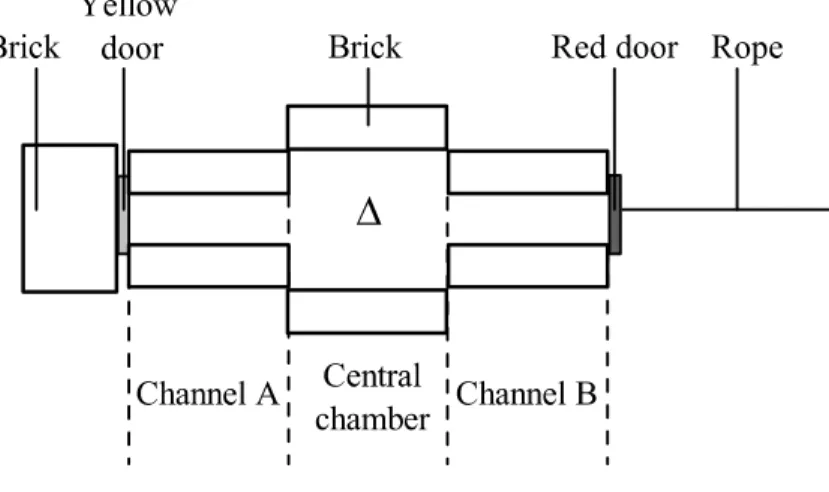
I used a two-arm maze composed of six bricks that were painted white (Figure 2.1). The maze was 9.5 cm high and consisted of a central starting chamber (18 × 18 cm) and two channels (A and B, each 18 cm × 6.5 cm). I blocked the exits at the end of the channels with a red or yellow poster board to serve as doors, only one of which could be opened. I blocked the incorrect door from behind with a brick, which was not visible to the frog in the maze. The correct door could be opened with a rope attached to its reverse side. To prevent the frogs from escaping, I covered the maze with glass. I covered the floor of the maze with absorbent paper that I replaced every other day. I surrounded the maze with a 1.4 m-high white curtain in order to isolate other visual cues in the room. To motivate the frogs to locate the maze exit in order to be returned to their home cage, I created a bright, hot (37° C), and dry (10% RH) environment inside the maze. To maintain the maze temperature, I placed a heater along one longer side of the arena. (c) Colour preference and test of discriminability
I selected the door colours based on the results of a preference test. I tested two pairs of colour: yellow vs. dark blue and yellow vs. red. In the preference test, I allowed each frog to approach one of the colours that were placed at the end of the two channels (Figure 2.1) after being released in the starting chamber with orientation perpendicular to the two arms. I did two trials to test each colour pair for each individual, alternating the location of the colours. The first colour that a frog touched was counted as the preferred colour for that trial. I assigned each frog a score (0, 1, or 2) based on the number of times the frog chose yellow in the two trials, and I used a one sample t-test assuming the frogs would select yellow once (half the trials) if there were no preference. When compared to yellow, the frogs preferred the dark blue door (yellow:blue = 3:10, blue:yellow = 11:2; t12= 2.9, P = 0.014), while there was no preference between yellow and red (yellow:red = 7:8, red:yellow = 6:5; t12= 0.43, P = 0.673). Thus, I chose the yellow and red as the door colours for my place-learning task.
17
capitalized on the optokinetic response of vertebrates, including túngara frogs (Cummings et al., 2008), in which an animal will move its head and body position to adjust its eye orientation coincident with moving visual stimuli (i.e., the animal moves in the direction of the moving stimuli). The optokinetic response is elicited in an optomotor test in which a spinning drum is lined with alternating panels. If the frogs are capable of discriminating the red and yellow poster board, I reasoned that an optomotor test with alternating red and yellow panels should elicit an optokinetic response. If the colours cannot be discriminated, then it would not be possible for them to elicit an optokinetic response.
The túngara frogs in the optomotor test were different from individuals in the two-arm maze and colour preference test. My optomotor device was based on one previously used to test túngara frogs (Cummings et al., 2008). I lined the spinning drum with 1.5-cm wide strips of the yellow and red poster boards that were the same as those I used for the maze doors. After allowing the frogs (n = 10 males and 10 females) to dark-adapt for 60 min, I adapted them in the optomotor device (stationary) for 5 min in the lighting conditions used in the place-learning task. Next, I tested each individual in two successive trials (2 min each) in which I assigned the drum spinning direction of one trial as clockwise and the other as counter clockwise in a pseudorandom manner. I quantified the angle moved in either direction (drum spinning direction or counter drum spinning direction) in each trial and averaged the moving angles of the two trials for each frog.
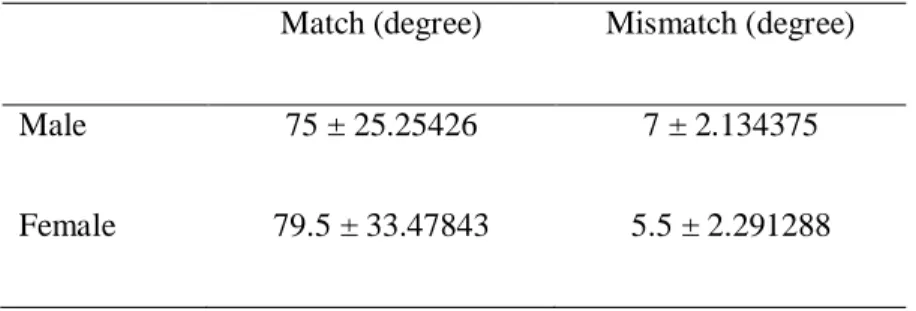
Túngara frogs demonstrated an optokinetic response to the yellow-red stripes by moving more in the drum spinning direction than the counter drum spinning direction (direction: F1,36 = 11.4, P = 0.002; Table 2.1). There was no evidence for a sex difference (sex: F1,36 = 0.03, P = 0.87; direction x sex: F1,36 = 0.11, P = 0.74; Table 2.1). Thus, males and females appear to have similar abilities to discriminate the red and yellow doors under the conditions tested in my task.
(c) Procedure Acclimation
18
of the starting chamber, with the frog oriented 90° to the channels leading out of the maze. I alternated initial orientations in the two trials. All frogs exited the maze in a short time (mean ± SD: 137 ± 29). Once each frog exited the maze, I returned it to its home cage.
Acquisition
I closed the exits of the maze by placing the yellow and red doors at the end of channel A and B, respectively (Figure 2.1). During acquisition, the red door (correct door) could be opened while the yellow one was blocked. I trained the frogs in two trials per day for nine successive days with an inter-trial interval greater than 1 h. In the first inter-trial of the day, I placed the frog in the starting chamber oriented perpendicularly to the two arms, with the direction determined pseudorandomly, and then alternated their orientation 180° for the second trial of that day, in order to prevent them from solving the task by
remembering turning direction (i.e., egocentric cues). I defined the trial as successful if the frog knocked down the correct door directly, touched the correct door, or sat very close (less than 0.5 cm) to the correct door within three minutes. In the latter case, I pulled the rope to open the door. If the frogs failed to complete the task after three minutes, I defined it as a non-successful trial. Then I opened the door and allowed them to exit. In all cases, I returned the frogs to their home cage upon exiting the maze. Reversal learning
During reversal learning, I used the same maze and procedure as acquisition, except that the red door was blocked while the yellow door could be opened. Hence, it required the frogs to reverse the associations they had learned during acquisition.
Running speed
I estimated velocity of movement speed by dividing the sum of visits to each area (channel A, B, starting chamber) with latency. Before learning has occurred, movement speed reflects baseline
19 Probe trials
I conducted two identical probe trials immediately after acquisition and reversal. Each probe trial consisted of one 3-min trial in which the doors were switched location and neither could be opened. I began the probe trials with initial random orientation perpendicular to the channels. Because door colour was confounded with place during training, the probe trials enabled me to determine which cues were used to navigate to the correct exit (e.g., door colour or some other unintended cue).
(d) Analysis and Statistics
I quantified behaviour from video recordings. I used success rate (mean number of successful trials per day) as the primary measure of learning across days. Because success rate is a proportion, I used an arcsine transformation on the data before analysis. I also recorded latency to exit the maze, but I do not report those data because, in all cases, they replicate success rate. To determine whether there was a sex difference in learning, I used repeated measures ANOVAs to examine the interaction between day and sex on success for all training days. I used within-subjects contrast (linear trend) for the effect of day on success for each sex separately to ask whether success rate improved. I used ANOVA to test for a sex difference in movement speed.
For probe trials, I quantified the duration frogs spent in each channel as a measure of channel preference. I used Wilcoxon signed-ranks test to determine if the frogs were using colour of the door to learn the task. A paired t-test produced identical conclusions.
20
the tendency to turn left or the probability of first visiting the correct channel changed over training or differed between the sexes (interaction between sex and day and effects of day within each sex). Because left turn rate and rate of initially correct channel are proportions, I used an arcsine transformation on the data before analysis.
Finally, I examined whether the frogs tried to use egocentric cues (remember last turn direction) to solve the maze by capitalizing on an unintended feature of my training protocol. I intended to prevent the use of egocentric cues by randomly determining initial orientation of release for the first trial of a day and then switching the orientation for the second trial that day. However, because the orientation of the first trial of a day was randomly determined, across days (trial 2 of previous day and trial 1 of current day), there were some pairs of trials in which release orientations were the same (and the frogs could potentially remember their previous turn direction) and some trials in which release orientations were different. If frogs were using egocentric cues, they should perform better in trials in which release orientation was previously the same compared to trials in which release orientation was different. [Note, this is independent of whether the correct channel was on the left.] I used repeated measures ANOVA to determine the effect of relative position of initial orientation (same or different than previous trial) on success rate and to determine if there was a sex difference in this effect (i.e. interaction between sex and effect of relative position on success rate).
All of the statistics were run in SPSS (v. 20, IBM, Armonk, NY). Results
(a) General Performance
21
= 0.6, P = 0.78). In fact, even after nine days of reversal, females continued to visit the previously correct channel (red channel) at a similar rate as during acquisition (see result of probe trial).
During acclimation, latency to exit the maze was similar for males and females (sex: F1,11 = 0.19, P = 0.68), indicating similar levels of motivation in the task. In addition, on the first day of acquisition, males and females had similar movement speeds (sex: F1,11 = 0.056, P = 0.82). However, females
increased their movement speeds across acquisition (linear trend: F1,6 = 6.5, P = 0.04), while males did not (linear trend: F1,5 = 0.27, P = 0.63). This increased movement speeds during learning suggests that
females were developing a greater familiarity with the task - that is, an understanding that the task is to approach the door in order to exit. However, during reversal learning, movement speeds remained steady for both males and females (male: linear trend: F1,5 = 1.60, P = 0.26; female: linear trend: F1,6 = 0.04, P = 0.85) and overall velocity was similar between males and females (sex: F8,4 = 0.84, P = 0.61). This supports the interpretation that motivation was similar between the sexes and that the increased movement speed of females during acquisition reflected learning.
(b) Probe Trials
During the first probe trial I switched the red (previously correct) and yellow doors so that they were now associated with different channels of the maze. During the probe, females spent significantly more time in the channel with the red door (T = 1, N = 7, P < 0.05; Figure 2.3a), indicating that they had learned to associate the red door with the exit, and not other place cues. In contrast, males did not show a preference for either channel (T = 8, N = 6, P > 0.05; Figure 2.3b), which is further indication that they failed to associate the red door with the exit.
The second probe trial followed reversal, during which the yellow door (channel B) was correct. In spite of nine days of reversal training, during the probe trial, females still preferred the channel
associated with the red door (T = 2, N = 7, P = 0.05; Figure 2.3a), while male did not have a preference (T = 10, N = 6, P > 0.05; Figure 2.3b). This finding suggests that one reason for the failure of females to reverse their associations was an inability to extinguish what they had previously learned.
22
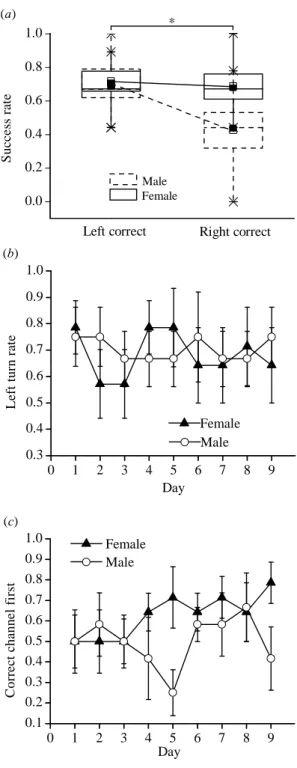
Túngara frogs showed a strong tendency to turn to their left side. Eleven of 13 of them made a left turn as their first action in the first trial of the experiment. There was no evidence of a sex difference in the left-turn bias (Fisher exact probability test: P = 0.731). Generally, success rate was significantly higher when the correct door was on the frog’s left side compared to the right (side: F1,11 = 17.2, P = 0.002), indicating that they tended to enter the first channel they saw. However, this left-turn bias influenced the success of males more than females (sex x side: F1,11 = 6.8, P = 0.025; Figure 2.4a).
Given the strong effect of the turning bias on success, I asked whether females learned to solve the maze by modifying their first turn direction. In fact, females continued to turn left as their initial action across acquisition (day: F8,48 = 0.41, P = 0.55; linear trend: F1,6 = 0.03, P = 0.88; Figure 2.4b). In addition, there was no sex difference in the left turn tendency across training (sex x day: F8,88 = 0.53, P = 0.83; Figure 2.4b) or within males across days (day: F8,40 = 0.14, P = 0.99; linear trend: F1,5 = 0.09, P = 0.77; Figure 2.4b), indicating that differences in learning were not due to differences in the tendency to turn left. However, although they showed no plasticity in their left-turn rate, females appeared to be able to suppress the tendency to first visit the left channel (day: linear trend: F1,6 = 6.0, P = 0.05; Figure 2.4c). In other words, females increased the likelihood of first visiting the correct channel, even when it was on their right, in spite of turning left initially. In contrast, males showed no evidence of such plasticity (day: linear trend: F1,5 = 0.32, P = 0.59; Figure 2.4c).
(d) Effect of Egocentric Cues
Finally, although I interrupted the frogs’ ability to use egocentric cues (remember last turn direction) to solve the maze, I found evidence that males tried to use such cues. In trials when the orientation of release was the same as the previous trial, males performed better than when the relative orientations differed, while female performed equally well in both situations (sex x relative orientation:
F1,11 = 8.1, P = 0.02; Figure 2.5). In fact, when males were able to use egocentric cues, they performed as
23 Discussion
I found that female túngara frogs were able to use a visual cue to remember the location of the maze exit while males were not. However, females were unable to reverse these learned associations because they could not extinguish what they had learned during acquisition. Both males and females showed a tendency to initially explore their left side in the maze and while there was no initial sex difference on this tendency, this left-turn bias influenced the performance of males more strongly than females. Finally, although I prevented frogs from using egocentric cues to solve this maze, I found males still tried to use these cues.
The sex difference in performance in my two-arm maze could have emerged from sex differences in sensory abilities. I tested for the ability to discriminate the two doors in an optomotor test and found no evidence for a sex difference in discriminability in the lighting conditions used during training.
Furthermore, there is no evidence to date for sex differences in visual sensitivity (Cummings et al., 2008), or any evidence from their natural history (Ryan, 1985) to suggest a sex difference in vision. Yet, I cannot strictly rule out the possibility that the doors, within the context of the maze, had differential
discriminability by males and females. Nonetheless, give current evidence, this seems an unlikely explanation for the sex differences I observed.
Differences in performance could also be caused by differences in motivation to solve the task (Wise, 2004; Wulf & Lewthwaite, 2016). I used latency during acclimation and initial movement speed during acclimation as an estimate of the frogs’ general motivation (Olarte-Sánchez, Valencia-Torres, Cassaday, Bradshaw, & Szabadi, 2015; Vorhees & Williams, 2006), and found no evidence for a sex difference. A sex difference in movement speed only emerged when females were learning the task, which likely reflects increased familiarity with the goal of the task.
24
channel) after being released in the starting chamber. Males, in contrast, were unable to do so. The ability of females to inhibit incorrect responses may reflect greater behavioural flexibility (Floresco, Zhang, & Enomoto, 2009; Ragozzino, 2007) or lower levels of impulsivity (Anderson & Platten, 2011; Reynolds, Ortengren, Richards, & de Wit, 2006). Regardless, the ability to inhibit this tendency may have enabled females to associate the visual cue with the correct channel of the maze. In contrast, males relied more on egocentric cues (remember last turn direction) and they failed to associate the visual cue with the correct channel. This dependence on egocentric cues is reminiscent of findings from Argentine toads (Daneri et al., 2011), and suggest a significant difference in cue use in male and female túngara frogs. Overall, the evidence suggests that, compared to males, females have greater learning abilities in a visually-cued place learning task and that these abilities were related, at least in part, to less impulsivity or greater behavioural flexibility. Whether the sex differences in learning I observed can be generalized to other cognitive tasks or to place learning tasks that involve other cues (e.g., egocentric cues) will require further study,
particularly given the relatively small sample sizes in my study. Given the apparent preference of males to use egocentric cues, it will be of particular interest to know whether the sex differences in learning persist when egocentric cues are associated with the maze exit.
Mate choice decisions can have a direct effect on reproductive success. In frogs, females
generally prefer male calls with lower fundamental frequencies (Ryan, 1980) which, in turn are associated with larger male body size and, consequently, higher fertilization rates (Gibbons & McCarthy, 1986; Kruse, 1981). Thus, a female’s ability to remember the location and/or calls of a preferred male could directly affect her reproductive success. In contrast, there is no evidence to date that male túngara frogs experience selection for place memory, such as during pond selection, migration, or competitive
interactions with other males. However, it is important to acknowledge that little is currently known about the spatial ecology of túngara frogs and the strength of my interpretation is limited by that lack of
knowledge.
25
26 REFERENCES
Akre, K.L. and M.J. Ryan. 2010. Complexity increases working memory for mating signals. Current Biology20: 502-505.
Anderson, C. and C.R. Platten. 2011. Sleep deprivation lowers inhibition and enhances impulsivity to negative stimuli. Behavioural Brain Research217: 463-466.
Andersson, M.B. 1994. Sexual selection. Princeton University Press, Princeton, NJ.
Andersson, M.B. and L.W. Simmons. 2006. Sexual selection and mate choice. Trends in Ecology & Evolution21: 296-302.
Bisazza, A., C. Cantalupo, A. Robins, L.J. Rogers and G. Vallortigara. 1996. Right-pawedness in toads. Nature379: 408.
Boogert, N.J., T.W. Fawcett and L. Lefebvre. 2011. Mate choice for cognitive traits: a review of the evidence in nonhuman vertebrates. Behavioral Ecology22: 447-459.
Brattstrom, B.H. 1990. Maze learning in the fire-bellied toad, Bombina orientalis. Journal of Herpetology 24: 44-47.
Cummings, M.E., X.E. Bernal, R. Reynaga, A.S. Rand and M.J. Ryan. 2008. Visual sensitivity to a conspicuous male cue varies by reproductive state in Physalaemus pustulosus females. Journal of Experimental Biology211: 1203-1210.
Dalla, C. and T.J. Shors. 2009. Sex differences in learning processes of classical and operant conditioning. Physiology & Behavior97: 229-238.
Daneri, M.F., E. Casanave and R.N. Muzio. 2011. Control of spatial orientation in terrestrial toads (Rhinella arenarum). Journal of Comparative Psychology125: 296-307.
Day, L.B. 2003. The importance of hippocampus-dependent non-spatial tasks in analyses of homology and homoplasy. Brain, Behavior and Evolution62: 96-107.
Farris, H.E., A.S. Rand and M.J. Ryan. 2002. The effects of spatially separated call components on phonotaxis in túngara frogs: evidence for auditory grouping. Brain, Behavior and Evolution60: 181-188.
Floresco, S.B., Y. Zhang and T. Enomoto. 2009. Neural circuits subserving behavioral flexibility and their relevance to schizophrenia. Behavioural Brain Research204: 396-409.
Gaulin, S.J. 1992. Evolution of sex difference in spatial ability. American Journal of Physical Anthropology35: 125-151.
Gaulin, S.J. and R.W. FitzGerald. 1986. Sex differences in spatial ability: an evolutionary hypothesis and test. American Naturalist127: 74-88.
27
Geary, D.C. 1995. Sexual selection and sex differences in spatial cognition. Learning and Individual Differences7: 289-301.
Gibbons, M.M. and T. McCarthy. 1986. The reproductive output of frogs Rana temporaria (L.) with particular reference to body size and age. Journal of Zoology209: 579-593.
Guigueno, M.F., D.A. Snow, S.A. MacDougall-Shackleton and D.F. Sherry. 2014. Female cowbirds have more accurate spatial memory than males. Biology Letters10: 1-4.
Halpern, D.F. 2013. Sex differences in cognitive abilities. Psychology press.
Jenkin, S.E. and F. Laberge. 2010. Visual discrimination learning in the fire-bellied toad Bombina orientalis. Learning & Behavior38: 418-425.
Jonasson, Z. 2005. Meta-analysis of sex differences in rodent models of learning and memory: a review of behavioral and biological data. Neuroscience & Biobehavioral Reviews28: 811-825.
Jones, C.M., V.A. Braithwaite and S.D. Healy. 2003. The evolution of sex differences in spatial ability. Behavioral Neuroscience117: 403-411.
Jozet-Alves, C., J. Modéran and L. Dickel. 2008. Sex differences in spatial cognition in an invertebrate: the cuttlefish. Proceedings of the Royal Society of London B: Biological Sciences275: 2049-2054.
Keagy, J., J.-F. Savard and G. Borgia. 2009. Male satin bowerbird problem-solving ability predicts mating success. Animal Behaviour78: 809-817.
Keagy, J., J.-F. Savard and G. Borgia. 2011. Complex relationship between multiple measures of
cognitive ability and male mating success in satin bowerbirds, Ptilonorhynchus violaceus. Animal Behaviour81: 1063-1070.
Kruse, K.C. 1981. Mating success, fertilization potential, and male body size in the American toad (Bufo americanus). Herpetologica37: 228-233.
Lea, A.M. and M.J. Ryan. 2015. Irrationality in mate choice revealed by túngara frogs. Science349: 964-966.
Liu, Y., L.B. Day, K. Summers and S.S. Burmeister. 2016. Learning to learn: advanced behavioural flexibility in a poison frog. Animal Behaviour111: 167-172.
Minter, R. (2015). The role of cognition in sexual signals and mate choice decisions. (Doctoral dissertation), University of Denver, Denver, CO.
Mishima, N., F. Higashitani, K. Teraoka and R. Yoshioka. 1986. Sex differences in appetitive learning of mice. Physiology & Behavior37: 263-268.
O'Keefe, J. and L. Nadel. 1978. The hippocampus as a cognitive map. Clarendon Press, Oxford, UK. Olarte-Sánchez, C., L. Valencia-Torres, H.J. Cassaday, C. Bradshaw and E. Szabadi. 2015. Quantitative
28
Ragozzino, M.E. 2007. The contribution of the medial prefrontal cortex, orbitofrontal cortex, and dorsomedial striatum to behavioral flexibility. Annals of the New York Academy of Sciences 1121: 355-375.
Reynolds, B., A. Ortengren, J.B. Richards and H. de Wit. 2006. Dimensions of impulsive behavior: Personality and behavioral measures. Personality and Individual Differences40: 305-315. Ryan, M.J. 1980. Female mate choice in a neotropical frog. Science209: 523-525.
Ryan, M.J. 1985. The túngara frog: a study in sexual selection and communication. University of Chicago Press, Chicago, IL.
Ryan, M.J., K. Akre and M. Kirkpatrick. 2009. Cognitive mate choice. Cognitive Ecology2: 137-155. Schmajuk, N.A., E.T. Segura and J.C. Reboreda. 1980. Appetitive conditioning and discriminatory
learning in toads. Behavioral and Neural Biology28: 392-397.
Sherry, D.F., M. Forbes, M. Khurgel and G.O. Ivy. 1993. Females have a larger hippocampus than males in the brood-parasitic brown-headed cowbird. Proceedings of the National Academy of Sciences 90: 7839-7843.
Sotelo, M.I., V.P. Bingman and R.N. Muzio. 2015. Goal orientation by geometric and feature cues: spatial learning in the terrestrial toad Rhinella arenarum. Animal Cognition18: 315-323. Taylor, R.C., B.A. Klein, J. Stein and M.J. Ryan. 2011. Multimodal signal variation in space and time:
how important is matching a signal with its signaler? Journal of Experimental biology214: 815-820.
Taylor, R.C. and M. Ryan. 2013. Interactions of multisensory components perceptually rescue túngara frog mating signals. Science341: 273-274.
Vorhees, C.V. and M.T. Williams. 2006. Morris water maze: procedures for assessing spatial and related forms of learning and memory. Nature Protocols1: 848-858.
Wise, R.A. 2004. Dopamine, learning and motivation. Nature Reviews Neuroscience5: 483-494. Wulf, G. and R. Lewthwaite. 2016. Optimizing performance through intrinsic motivation and attention
29
Table 2.1. Optokinetic response to a drum with yellow-red stripes as measured by mean (± SE) degree of movement. Match refers to movements that were in the same direction as the spinning drum. Mismatch refers to movements that were in the opposite direction as the spinning drum.
Match (degree) Mismatch (degree)
Male 75 ± 25.25426 7 ± 2.134375
30
31
32
Figure 2.3.Channel preferences (duration) during the probe trials in (a) females and (b) males. Stars represent maximum and minimum values, the upper and lower border of the rectangles represent the standard error, solid squares represent the mean, and horizontal lines represent the median. The asterisk indicates significant differences of Wilcoxon test (P < 0.05) in time spent in the two channels.
0 20 40 60 80 100 120 140 160
(b) Male
D u ra ti o n ( s) * * * (a) Female
0 20 40 60 80 100 120 140
160 Red channel
33
Figure 2.4. The effect of body turn tendency on performance. (a) The effect of initial orientation on success rate in males and females; left correct refers to trials in which the correct channel was on the animals’ left side. Stars represent maximum and minimum values, the upper and lower border of the rectangles represent the standard error, solid squares represent the mean, and horizontal lines represent the median. The asterisk indicates a significant interaction between sex and initial orientation (P < 0.05). (b) Variation in left turn rate (mean ± SE) during the acquisition. (c) Variation in the rate of visiting the correct channel first (mean ± SE) during the acquisition.
0.0 0.2 0.4 0.6 0.8 1.0 S u c c e ss r a te
Left correct Right correct *
Female Male
0 1 2 3 4 5 6 7 8 9
0.3 0.4 0.5 0.6 0.7 0.8 0.9 1.0 Female L e ft t u rn r a te Day Male (b)
(a)
(c)
0 1 2 3 4 5 6 7 8 9
34
Figure 2.5. The effect of egocentric cues on success rate in male and female túngara frogs. The role of egocentric cues was assessed by comparing trials when a release orientation was different or the same compared to the preceding trial. When release orientation was the same as the preceding trial, an animal could potentially remember the previous turn direction (i.e., use egocentric cues). Stars represent
maximum and minimum values, the upper and lower border of the rectangles represent the standard error, solid squares represent the mean, and horizontal lines represent the median. The asterisk indicates a significant interaction between sex and relative orientation (P < 0.05).
0.0 0.2 0.4 0.6 0.8 1.0
Relative orientation of release Same
S
u
c
ce
ss
r
at
e
Different
Female
*
35
CHAPTER 3: LEARNING TO LEARN: ADVANCED BEHAVIOURAL FLEXIBILITY
IN A POISON FROG
2Summary
Behavioural flexibility is essential for survival in a world with changing contingencies and the evolution of behavioural flexibility is linked with complex physical and social environments. Serial reversal learning, in which reward contingencies change frequently, is a key indicator of behavioural flexibility. While many vertebrates are capable of serial reversal learning, only birds and mammals have previously been shown to use rule-based decision strategies (e.g., win-stay/lose-shift) to become better at learning changes in reward contingencies across reversals. While the lifestyles of many amphibians have a degree of complexity, the evidence to date suggests limited levels of behavioural flexibility. Here, I show that the poison frog Dendrobates auratus, which has evolved complex parental behaviours that likely depend on remembering locations in a flexible manner, can use a win-stay/lose-shift strategy to increase their behavioural flexibility across sequential changes in the reward contingencies in a visual discrimination task. Furthermore, probe trials demonstrate that the frogs used the provided visual cues to spatially orient in the maze in a manner reminiscent of complex spatial cognition. My study provides the first evidence of serial reversal learning in frogs and is the first to demonstrate the use of a rule-based learning strategy in a non-avian, non-mammalian species.
Introduction
Behavioural flexibility is the ability to change one’s behaviour according to variation in the environment, and it can enable animals to increase survivorship and reproductive success (Fagen, 1982;
36
Snell-Rood, 2013). For example, species with greater levels of behavioural flexibility are more like to successfully invade a new environment (Tebbich, Sterelny, & Teschke, 2010; Wright, Eberhard, Hobson, Avery, & Russello, 2010). Serial reversal learning, in which animals progressively improve their
performance in a task with frequently changing reward contingencies, is a standard laboratory method for measuring behavioural flexibility (Bitterman, 1965; Roth & Dicke, 2005), and the ability to perform serial reversals is more often found in animals that live in complex physical and social environments (Bond, Kamil, & Balda, 2007; de Waal & Tyack, 2003; Godfrey-Smith, 2002).
There are several mechanisms that allow animals to learn serial reversal tasks (Gonzalez,
Behrend, & Bitterman, 1967; Mackintosh, 1974; Parker et al., 2012; Shettleworth, 2009; Strang & Sherry, 2014). Among them, lower-order processes, such as proactive interference (Bitterman, 1965; Mackintosh, 1974), involve involuntary learning and hence are thought to represent a lower level of behavioural flexibility (Parker et al., 2012; Shettleworth, 2009). These mechanisms have been discovered across a broad range of vertebrate taxa (Gaalema, 2011; Gonzalez et al, 1967; Mackintosh, McGonigle, & Holgate, 1968). In contrast, rule-based strategies, which indicate the ability of an animal to learn and use the underlying rule of the reversal task, represent a greater degree of behavioural flexibility (Parker et al., 2012; Shettleworth, 2009). For example, using a win-stay/lose-shift rule requires animals to make their current choice based on the reward from their previous choice (Mackintosh et al., 1968; Shettleworth, 2009). The optimal outcome of this strategy is the one-trial reversal in which animals make an error on the first trial of a reversal followed by all correct choices on subsequent trials of that reversal (Mackintosh et al., 1968). This type of rule-based strategy has only previously been found in mammals and birds (Mackintosh et al., 1968; Rayburn–Reeves, Stagner, Kirk, & Zentall, 2013; Rumbaugh, Savage‐
Rumbaugh, & Washburn, 1996; Shettleworth, 2009).
Amphibians, which include both aquatic and terrestrial lifestyles in their lifecycle, have to handle environments with a high degree of complexity. Yet, they were once thought to lack behavioural
37
can solve mazes using local visual cues (i.e., visual cues that are directly associated with goal or are part of the goal), and body-centred motor strategies (remembering a place by learning to turn left or right), and geometric cues (i.e., the shape of the space) (Daneri, Casanave, & Muzio, 2011; Ellins, Cramer, &
Martin, 1982; Sotelo, Bingman, & Muzio, 2015; Crane & Mathis, 2011; Heuring & Mathis, 2014). Furthermore, in simple discriminations, amphibians are capable of single reversals (Daneri et al., 2011; Ellins et al., 1982; Schmajuk, Segura, & Reboreda, 1980). Nonetheless, I still know relatively little about the cognitive strategies used by amphibians in reversal tasks and whether they are capable of the types of behavioural flexibility observed in mammals and birds.
While many frogs have relatively simple social behaviours, the poison frogs (Dendrobatidae) have evolved complex social and spatial behaviours reminiscent of many mammals and birds (Summers, 1989; Summers & Tumulty, 2013): they are territorial, show mate guarding and pair bonding (some are even monogamous; Brown, Morales, & Summers, 2010), and the parents of some species transport tadpoles to deposition sites (small pockets of water) in the forest canopy after hatching. Some species show homing abilities in the field that suggest advanced spatial cognition (Pasukonis, Warrington, Ringler, & Hödl, 2014). However, whether poison frogs can use spatial cues in a flexible manner and whether they use cognitive strategies similar to birds and mammals is unknown
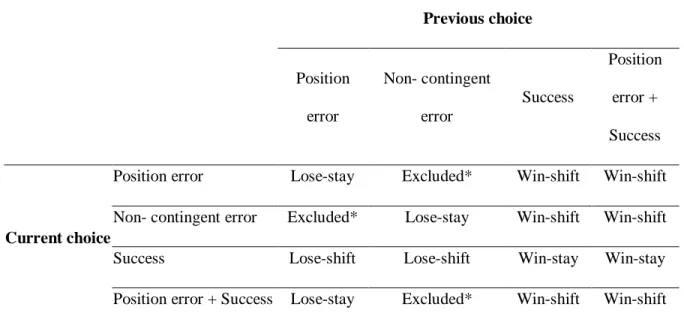
I trained the poison frog Dendrobates auratus in a two-arm maze in which the position of the correct arm was associated with visual cues in the starting chamber. The visual cues could be reliably associated with the goal based on spatial relationships, but could not be used for direct guidance (e.g., an animal could not simply approach the visual cues to locate the goal). My study was designed to: 1) determine whether poison frogs could use visual cues to learn a complex spatial discrimination task; 2) investigate whether poison frogs are capable of serial reversal learning; and 3) identify the behavioural mechanisms underlying improvement during serial reversal.
Materials and methods
38
I used ten (four male, six female) sexually mature D. auratus that were bred in captivity and were likely several generations removed from the wild (Indoor Ecosystems, LLC). In this species, males maintain territories and provide parental care (egg attendance, tadpole transport); females maintain territories and perform mate guarding, but do not provide parental care (Summers, 1989). I maintained the animals under conditions that approximated their natural habitat: 25° C, 80% relative humidity (RH), 12:12 light:dark cycle (lights on at 07:00 h). I housed the frogs individually in terraria and fed them fortified fruit flies three times per week. The University of North Carolina’s Institution for Animal Use and Care Committee approved all procedures (protocol 14-026).
(b) Apparatus



![Figure 3.1. Schematic drawing of the two-arm maze [54 cm (L) x 18 cm (W) x 9.5 cm (H)] and photos of the visual cues on the interior walls of the starting chamber](https://thumb-us.123doks.com/thumbv2/123dok_us/8271208.2190755/62.918.219.698.105.573/figure-schematic-drawing-photos-visual-interior-starting-chamber.webp)
![catena Poly[diaquacadmium(II) μ (diethyl dichloromethylenebisphosphonato) κ3O,O′:O′′ tetraaquacadmium(II) μ (diethyl dichloromethylenebisphosphonato) κ3O:O′,O′′]](data:image/gif;base64,R0lGODlhAQABAIAAAP///wAAACH5BAEAAAAALAAAAAABAAEAAAICRAEAOw==)