
Lorrie A. Straka
7, Andy D. Biggs
2, Donald G. York
8, Bruno Milliard
11 Aix Marseille Universit´e, CNRS, LAM (Laboratoire d’Astrophysique de Marseille) UMR 7326, 13388, Marseille, France. 2 European Southern Observatory (ESO), Karl-Schwarzschild-Str.2, D-85748 Garching b. M¨unchen, Germany.
3 Centre for Extragalactic Astronomy, Durham University, Department of Physics, South Road, Durham DH1 3LE, UK. 4 GEPI, Observatoire de Paris, PSL Universit´e, CNRS, 5 Place Jules Janssen, 92190 Meudon, France.
5 Institute of Astronomy, University of Cambridge, Madingley Road, Cambridge CB3 0HA, UK. 6 Dept. of Physics and Astronomy, Univ. of South Carolina, Columbia, SC 29208, USA. 7 Sterrewacht Leiden, Leiden University, PO Box 9513, NL-2300 RA Leiden, the Netherlands.
8 Dept. of Astronomy and Astrophysics and The Enrico Fermi Institute, University of Chicago, 5640 S. Ellis Ave, Chicago, IL 60637, USA.
Accepted 2019 January 16. Received 2018 December 07; in original form 2018 August 1.
ABSTRACT
Galaxy halos appear to be missing a large fraction of their baryons, most probably hiding in the circumgalactic medium (CGM), a diffuse component within the dark matter halo that extends far from the inner regions of the galaxies. A powerful tool to study the CGM gas is offered by absorption lines in the spectra of background quasars. Here, we present optical (MUSE) and mm (ALMA) observations of the field of the quasar Q1130−1449 which includes a log [N(HI)/cm−2]=21.71±0.07 absorber
at z=0.313. Ground-based VLT/MUSE 3D spectroscopy shows 11 galaxies at the redshift of the absorber down to a limiting SFR>0.01 Myr−1 (covering emission
lines of [Oii], Hβ, [Oiii], [Nii] and Hα), 7 of which are new discoveries. In particular, we report a new emitter with a smaller impact parameter to the quasar line-of-sight (b=10.6 kpc) than the galaxies detected so far. Three of the objects are also detected in CO(1–0) in our ALMA observations indicating long depletion timescales for the molecular gas and kinematics consistent with the ionised gas. We infer from dedicated numerical cosmological RAMSES zoom-in simulations that the physical properties of these objects qualitatively resemble a small group environment, possibly part of a filamentary structure. Based on metallicity and velocity arguments, we conclude that the neutral gas traced in absorption is only partly related to these emitting galaxies while a larger fraction is likely the signature of gas with surface brightness almost four orders of magnitude fainter that current detection limits. Together, these findings challenge a picture where strong-N(H I) quasar absorbers are associated with a single bright galaxy and favour a scenario where the Higas probed in absorption is related to far more complex galaxy structures.
Key words: galaxies: kinematics and dynamics – galaxies: abundances – galaxies:
ISM – quasars: absorption lines – intergalactic medium
? Based on observations collected at the European Organisation
for Astronomical Research in the Southern Hemisphere under ESO programme(s) 67.A-0567, 69.A-0371 and 096.A-0303.
† e-mail:[email protected]
1 INTRODUCTION
Baryons are missing from galaxies in what is known as the galaxy halo missing baryon problem (McGaugh 2008). In-deed, galaxy halos appear to be missing approximately 60% of their baryons compared to expectations from the cosmo-logical mass density, suggesting that these are structures
c
2016 RAS
2
C´
eline P´
eroux et al.
nearly devoid of baryons both in mass and spatial extent. It has become apparent that galaxies also exhibit a diffuse baryonic component within the dark matter halo that ex-tends far from the inner regions to the virial radius and be-yond. This halo gas or circumgalactic medium (CGM) has been partly detected in the hot gas emitted around galaxies and detected in the X-rays regime (e.g. Anderson & Breg-man 2010; BregBreg-man et al. 2018; Nicastro et al. 2018) as well
as in Ly-α(e.g. Wisotzki et al. 2016; Leclercq et al. 2017;
Wisotzki et al. 2018). On the other hand, a powerful tool to study the cooler gas is offered by absorption lines in the spectra of background quasars as it allows us to study under-dense gas regions with a sensitivity independent of redshift (e.g. Morris et al. 1993; Tripp, Lu & Savage 1998). Observa-tions of redshifted UV absorption lines have indeed revealed much lower temperature and density gas in the CGM (Stei-del et al. 2010; Rudie et al. 2012; Werk et al. 2013; Turner et al. 2014).
A remaining challenge is to relate the gas traced in ab-sorption to the galaxy properties. A particularly powerful technique to bridge the gas component and stellar content of galaxies has come from integral field spectroscopy (IFS). Over the past few years, this technique has been used to study the CGM of high-redshift galaxies using near-infrared Integral Field Units (IFUs) by successfully detecting the
galaxies responsible for strong H i absorbers at redshifts
z ∼1 and z ∼2 in Hαand [Nii] emission (Bouch´e et al.
2007; P´eroux et al. 2011a,b; Rudie, Newman & Murphy
2017). Together with long slit spectroscopy follow-up, these observations have enabled us to map the kinematics, star formation rate, and metallicity of this emission-line gas, and
to estimate the dynamical masses of these galaxies (Bouch´e
et al. 2012; P´eroux et al. 2012; Bouch´e et al. 2013; P´eroux,
Kulkarni & York 2014). As optical IFUs became available, the study of the CGM using absorption techniques has
ex-panded (Schroetter et al. 2015; Bielby et al. 2016; Bouch´e
et al. 2016; Fumagalli et al. 2016; Bielby et al. 2018) to also
include lower-redshift objects (P´eroux et al. 2017; Klitsch
et al. 2018; Rahmani et al. 2018a; P´eroux et al. 2018).
Here, we present results from new MUSE and ALMA
observations of the field of background quasar Q1130−1449
with a strong Hiabsorber at zabs=0.313. The manuscript is
organised as follows: Section 2 presents the observational set-up and data reduction. Section 3 details the analysis and results derived from these data, while Section 4 sum-marises our findings. Throughout this paper we adopt an
H0 = 70 km s−1 Mpc−1, ΩM = 0.3, and ΩΛ = 0.7
cosmol-ogy. At the redshift of the absorber, 1 arcsec corresponds to 4.6 kpc.
2 OBSERVATIONS OF THE Q1130−1449 FIELD 2.1 Quasar Spectroscopy: Absorption Properties
The zQSO =1.189 (V=16.9 mag) quasar (J2000
coordi-nates: 113007.05–144927.38; alternative name: PKS B1127–
145) sightline intersects three Mg ii absorption systems:
zabs =0.191 (Kacprzak, Murphy & Churchill 2010), 0.313
(Bergeron & Boisse 1991) and 0.328 (Narayanan et al. 2007). We here concentrate on the middle redshift absorber, while Hamanowicz et al. (in prep) presents the other two systems.
From a HST/Faint Object Spectrograph (FOS) UV
spectrum, thezabs =0.313 absorber was determined to be
a damped Lyα(DLA) system with a large Hicolumn
den-sity of neutral gas: log [N(HI)/cm−2]=21.71±0.07 (Lane
et al. 1998). Lane et al. (1998) also detected 21cm
absorp-tion spanning FWHM=42.1±2.7 km s−1 at the redshift of
that absorber with the Westerbork Synthesis Radio Tele-scope (WSRT). This was later confirmed by Kanekar et al.
(2009) who derived a spin temperature Tspin=820±145K
and covering factor, f=0.9 from Very-long-baseline inter-ferometry (VLBI) observations. Bechtold et al. (2001) ad-ditionally reported strong X-ray absorption in excess of the Galactic value in the Chandra quasar spectrum which they interpreted as associated with that absorber. Based on this assumption, they derived the abundance of the oxy-gen group elements, independently of dust depletion, of 23% solar. Kanekar et al. (2014) computed the zinc metallicity
to be [Zn/H]=−0.80±0.16 relative to solar (i.e. the
neu-tral gas metallicity is 16% solar) from a medium-resolution
HST/STIS spectrum. Guber, Richter & Wendt (2018) used
the VLT/UVES spectrum of the quasar to fit the multi-component profile in Ti, Mn and Ca which are likely
de-pleted into dust grains. In addition, they estimated the Hi
column density of each component from the observed Caii
column density pattern, assuming a constant Caii/Hi
ra-tio. Interestingly, the thus estimated Hicolumn density for
each component, on its own, exceeds the canonical DLA
def-inition (log [N(HI)/cm−2]>20.3).
We obtained the VLT/UVES reduced quasar spectra
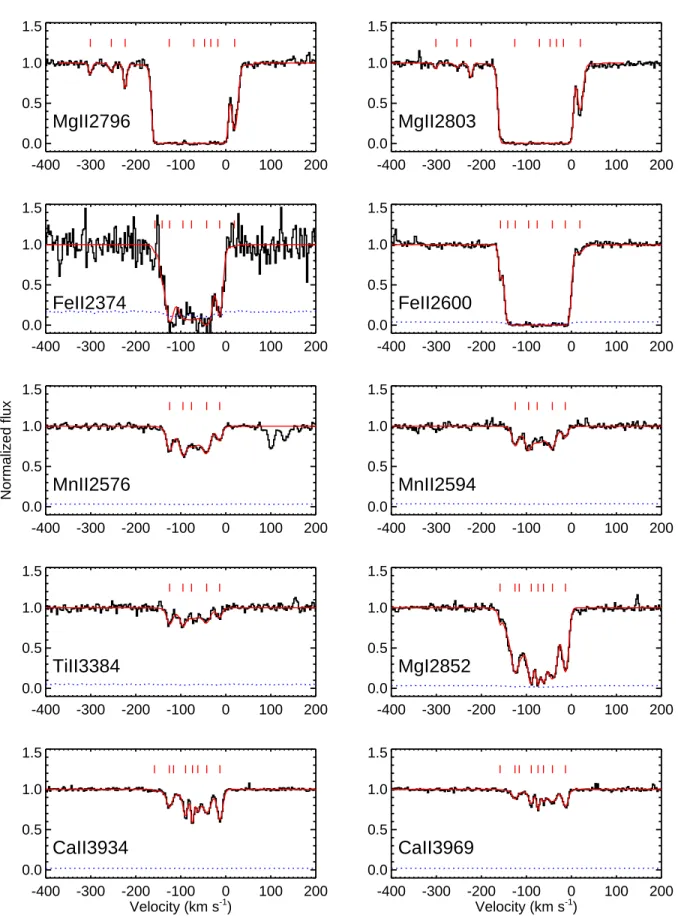
from the ESO advanced data products archives1. Fig.A1 of
the appendix A presents our independent fit to the metal absorption profiles, which is consistent with findings from
Guber, Richter & Wendt (2018), adding lines from Fe ii,
Mg i and the saturated Mg ii doublet. The zero velocity
in the figure is set to the systemic redshift of galaxy G0,
zG0=0.31305 (see later section). Most of the absorption lies
blueward of this systemic redshift.
2.2 Field Imaging: Identifying Absorbing Galaxies
2.2.1 New MUSE Observations
We report new MUSE medium-deep (5-hours on source) ob-servations of this field. The obob-servations were carried out in service mode (under programme ESO 96.A-0303, PI: C.
Per-oux) during the nights of 7–8 Dec 2015 (Texp=4×960s), 5–6
March 2016 (4×1200s) and 19–20 Feb 2017 (8×1200s). The
seeing constraint for these observations was < 0.8 arcsec
and natural seeing mode was used. The field was rotated by 90 degrees between exposures. These were further divided into two equal sub-exposures, with an additional field rota-tion of 90 degrees and sub-arcsec dithering offset in 2-step pattern to minimise residuals from the slice pattern. The
field of view is 60 arcsec×60 arcsec, corresponding to a
0.2 arcsec/pixel scale. We used the ”nominal mode”
result-ing in a spectral coverage of∼4800-9300 ˚A. At the redshift
of the target (zabs =0.313), the data cover emission lines
from [O ii] λλ3727,3729 to Hα. The spectral resolution is
1 http://archive.eso.org/cms.html
c
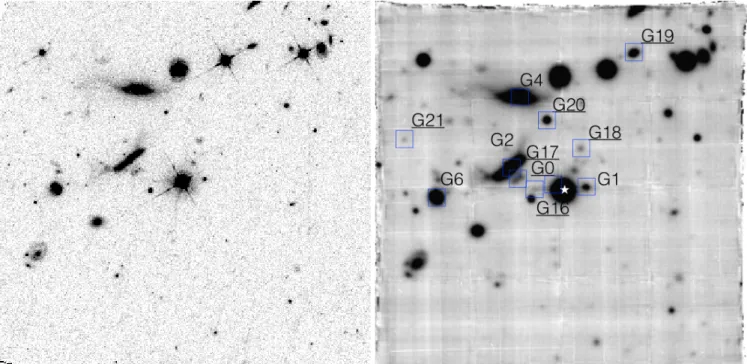
Figure 1. HST/WFPC2 F814W image of the quasar field (left panel) and MUSE white light image (right panel) showing objects with bright continua.The exposure time for the HST image is 4400 s, while for MUSE it is 14400 s. The quasar is at the center of the image. North is up, East to the left. The fields-of-view are∼1×1’. MUSE observations additionally provide spectroscopic and kinematic information for the majority of the objects in the field. The quasar is shown as a white star and the positions of the galaxies associated with the quasar absorber are marked with light-blue squares. Four of the galaxies previously identified are detected (namely G1, G2, G4 and G6) and their numbering system follows Kacprzak, Murphy & Churchill (2010). The other 7 objects (G0 and>G16, underlined) are new identifications at zabs=0.313. Some objects are bright in the continuum but undetected in pseudo narrow-band images because of weak emission lines (i.e. G4, G20 and G21).
R=1770 at 4800 ˚A and R=3590 at 9300 ˚A resampling the
whole spectrum to a spectral sampling of 1.25 ˚A/pixel.
The ESO MUSE pipeline (Weilbacher 2015) version v1.6 was used to reduced the data together with additional external routines for sky subtraction and extraction of the 1D spectra. We used master bias, flat field images and arc lamp exposures from observations taken closest in time to the science frames to correct each raw cube. We processed
the raw science data with thescibasicandscipost recipes,
correcting the wavelength calibration to a heliocentric ref-erence. The wavelength solutions were checked using the known wavelengths of the night-sky OH lines and were found
to be accurate within 15 km s−1. We centered the individual
exposures with theexp alignrecipe using the point sources
in the field to ensure accurate relative astrometry. We com-bined the individual exposures into a single data cube using the exp combine recipe. We measured the seeing of the fi-nal combined data from the quasar and other bright point sources in the cube. We calculated that the point spread
function (PSF) has a full width at half maximum of 0.76
arc-sec. Finally, to estimate the flux uncertainty, we compared the flux calibration with the R magnitude of the quasar and a bright star in the field. We computed the MUSE broad-band fluxes in the R-broad-band filter. We determined the flux
error to be±25%.
The removal of OH emission lines from the night sky was accomplished with an additional purpose-developed
code. The scipost recipe was performed with sky-removal
method turned off. After selecting sky regions in the field,
we created PCA components from the spectra which were further applied to the science datacube to remove sky line
residuals (Husemann et al. 2016; P´eroux et al. 2017). The
re-sulting MUSE white-light image is shown on the right panel of Fig. 1. We retrieved HST/WFPC2 F814W image of the field from the HST archive, and we show it on the left panel of Fig. 1.
2.2.2 New ALMA Observations
The field of Q1130−1449 was observed with ALMA in Band
3 to cover the CO(1-0) emission lines at the redshift of the
zabs = 0.313 absorber (under programme 2016.1.01250.S,
PI: C. Peroux) on 4, 8, and 15 Dec 2016. The precipitable water vapour (PWV) varied between 1.5 and 5.4 mm and the
total on-source observing time wasTexp = 3.6 hrs. A
com-pact antenna configuration (C40-3) resulted in an angular
resolution 1.2×1.8”. One of the four spectral windows was
centred on the redshifted CO(1-0) line frequency of 87.8 GHz and used the high spectral resolution mode, providing 3840 channels of each 0.488 MHz wide. The other three spectral windows were set to low spectral resolution mode and were used for continuum observations of the field. The quasars
J1058+0133 and J1139−1350 were used as amplitude and
phase calibrators, respectively.
We started the data reduction with the pipeline-calibrated uv-data sets, as delivered by ALMA. Additional data reduction steps were carried out with the Common Astronomy Software Applications (CASA) software package
c
4
C´
eline P´
eroux et al.
version 4.7.0. Minor manual flags were added to remove some uv-data points with strongly outlying amplitudes. Next, we applied two cycles of self-calibration on the data. The quasar in the centre of our science field is very bright at mm
fre-quencies (∼800 mJy), which makes the field very suitable
for self-calibration of both the phases and amplitudes.
First, we used the tclean recipe to Fourier-transform
the uv-data into a continuum image. The self-calibration
procedure was performed using the tasks gaincal and
ap-plycal on individual measurement sets to create corrected
uv-data, after which the data were re-imaged to create an improved continuum map. We applied one round of phase calibration and one round of amplitude and phase self-calibration.The next step was to subtract the bright
con-tinuum source from the field using the taskuvsub. We then
built a cube with the tclean task, setting the pixel size to
0.2”, so as to oversample the beam sufficiently, and using a ’robust’ weighting scheme with a Briggs parameter of 0.5. One of the four spectral windows was centred on the red-shifted CO(1-0) line frequency of 87.8 GHz and used the high spectral resolution mode, using a binning of 8, pro-viding 3840 channels of each 3.906 MHz wide. We applied a spectral binning of seven channels to achieve a velocity
resolution of 53 km s−1. We removed remaining continuum
signatures around the imperfectly subtracted quasar with
theuvcontsubtask. Lastly, we produced a cube corrected for
the primary beam using thepbcortask. The final rms noise
level of the cube is 0.11 mJy/beam per 53 km s−1 channel,
and the angular resolution is 1.4”×1.3”, corresponding to
6 kpc at the redshift of the target. We note that the resulting FWHM of the primary beam of ALMA in band 3 is about 60”, conveniently matching the MUSE field-of-view.
In addition, we created a small cube around the quasar
with the highest spectral resolution (∼7 km s−1) to search
for absorption lines, but do not detect the CO(1–0) absorp-tion line at the absorber redshift in the spectrum of the back-ground quasar. Given the rms, we compute an optical depth
limit ofτ=0.0125 km s−1 at 5-σassuming a 10 km s−1wide
absorption line following Zwaan et al. (2015) calculation.
Assuming the excitation temperature equates theTCMB at
z=0.313, we derive a stringent limit on the CO column
den-sity of N(CO)<2×1013cm−2(Mangum & Shirley 2015).
Us-ing the mean CO/H2 column density ratio of 3×10⁻⁶ from
Burgh, France & McCandliss (2007), this results in a limit
of N(H2)<7×1018cm−2.
3 ANALYSIS AND RESULTS
3.1 The Environment of zabs∼0.3 Hi-rich Absorbers
3.1.1 Galaxies at zabs=0.313 in the Field of Q1130−1449
The field is part of an observing campaign targeting quasar
absorbers whose redshifts allow detection of Hαwith MUSE,
with measured N(H I) from HST UV spectroscopy and
a known associated galaxy. On top of this, the field of
Q1130−1449 has been the target of a number of
observ-ing programs in the past which we summarise here. We use the numbering system introduced by Kacprzak, Murphy & Churchill (2010) when relevant and add to it for the new de-tections. Fig. 1 illustrates this naming scheme. Bergeron &
Boisse (1991) first reported emission (and absorption) lines at the redshift of the absorber in two objects (G2 and G4). Deharveng, Buat & Bergeron (1995) had successfully
de-tected Hβ(but no Ly-α) in G2 fromHST/FOS spectroscopy.
Lane et al. (1998) later obtained a spectroscopic redshift of another galaxy (G1) which is also consistent with the absorption redshift. Kacprzak, Murphy & Churchill (2010) spectroscopically identified two additional galaxies (G6 and G14), the latter of which is outside our MUSE field.
Here, we used the HST images as a prior to extract
spectra from the MUSE cube. To this end, we used
Sextrac-torto identify and deblend faint objects in the broad band
WFPC2 image. Using thempdaf2 routine (Piqueras et al.
2017), we extract the pixels at these coordinates above a
0.75-σ threshold. We then reviewed the extracted spectra
to identify those matching zabs=0.313. In some cases, no
emission lines were detected, but strong Ca ii absorption
lines and a Balmer break matching zabs=0.313 were
identi-fied (e.g. G20). In addition, we made pseudo narrow-band images of the MUSE cube at the expected position of the emission lines. An example of this is shown in Fig. 2 (top
panel) for [O iii] 5007 ˚A and Fig. 4 (top panel) for Hα.
This approach reveals additional objects which remain un-detected in the HST image because of their faint continuum level (e.g. G0, G16 and G17).
In particular, we discovered a faint object, G0, closer to
the quasar at impact parameterb= 2.3arcsec(10.6 kpc).
We note that it is not matched by any object detected in Gemini AO-images by Chun et al. (2006) because of the ferent wavelength coverage (optical versus H-band) and dif-ferent sensitivity (emitters versus continuum objects). While the object lies under the quasar PSF, several emission lines are clearly identified in the MUSE spectrum. In the follow-ing analysis, we use the systemic redshift of G0 as refer-ence for the analysis of the absorption profile plotted in velocity (see appendix A) simply because it has the small-est impact parameter to the quasar of all objects spectro-scopically detected in the field. In essence, this system is like the ”Galaxies with background QSOs” searches which have found quasars shining through low redshift, foreground
galaxies at small impact parameters (<10 kpc) within the
SDSS fibers (York et al. 2012; Straka et al. 2013; Straka et al. 2015; Joshi et al. 2017). These, together with recent findings of low impact parameter objects in high spatial res-olution HST imaging (i.e. Augustin et al. 2018), provide observational evidence to the postulate of York et al. (1986) that ”some quasar absorption-line systems may arise when a quasar sight line intersects a Magellanic-type irregular galaxy (i.e., a gas-rich dwarf)”. Fig. 1 (right panel) sum-marises the numbering system of the new identifications. The corresponding MUSE spectra are displayed in Fig. 5. In total, we report 11 objects at the redshift of the absorber in our MUSE data, 7 of which are new discoveries.
Similarly, we identified the galaxies at the absorber
red-shift in the ALMA observations by running theDuchamp3
source finder (version v1.6.2) which performs a three-dimensional search via wavelet reconstruction with a
detec-tion threshold of 5-σon the cube before primary beam
cor-2 http://mpdaf.readthedocs.io/en/latest/index.html
3 https://www.atnf.csiro.au/people/Matthew.Whiting/Duchamp/
c
Figure 2. Galaxies at zabs=0.313 in the Field of Q1130−1449.Top panel:Continuum-subtracted MUSE pseudo narrow-band filter around [Oiii]λ5007 at the redshift of the absorber. The quasar is shown as a white star and the positions of the galaxies are marked with light-blue squares. Galaxies G4, G20 and G21 have no [Oiii]λ5007 emission lines but are detected in continuum. We report also low surface-brightness regions of diffuse gas around G2 and G4 showing all the prominent emission lines such as [O II], Hβ, [O III], Hαand [N II].Bottom panel:ALMA Band 3 CO(1-0) 0th moment map of the same field on the same scale. We report three CO (1-0) emission detections matching MUSE galaxy positions (G2, G4 and G6).
c
6
C´
eline P´
eroux et al.
Figure 3. ALMA CO(1–0) contours overlaid on HST im-age. The contours show the –3, 3, 5 and 7-σ levels, where the dashed negative contours above G6 reflect the noise level in the cube. The hatched ellipse shows the ALMA synthesized beam.
rection. We find three secure emitters associated with galax-ies G2, G4 and G6, respectively. Fig. 3 shows the CO(1–0) contours overlaid on the background HST image. In addi-tion, we performed a visual inspection of the cube at the redshifted frequency of the CO(1–0) line. We detect a fourth emission line, 26.4 arcsec south of the quasar. The MUSE spectrum shows a featureless continuum object consistent with either CO(2–1) at z=1.614 or CO(3–2) at z=2.921 (a
higher CO transition would have matching Ly-αline in the
MUSE spectrum). Interestingly, one of the continuum spec-tral window also reveals an emission line at 101.4 GHz which is identified as CO(2–1) at z=1.274 thanks to the detection
of the [Oii] doublet in the corresponding MUSE spectrum.
These findings illustrate the power of combining ALMA with MUSE observations to securely assess the redshift of single
line mm detections. Fig. 2 (bottom panel) shows the 0th
mo-ment map of the field. The spectra are extracted within the CASA software and shown in Fig. B2. We also built a con-tinuum image of aggregate bandwidth to check for possible detection of the galaxies in continuum. None of the objects
are detected in the map with rms=6µJy, corresponding to
a 5-σcontinuum flux limit of 30µJy.
3.1.2 Cosmological zoom-in Simulations
In order to reproduce the typical environment of
z∼0.3 quasar absorbers, we turn to cosmological
hydro-simulations. Our calculations are based on dedicated RAM-SES Adaptive Mesh Refinement (AMR) simulations with a total run time of 1.3 million CPU hrs (Frank et al. 2012). We zoomed on a region around the most massive halo with
a box of size of∼14 Mpc/h. The higher-level of refinement
allows us to reach a spatial resolution of∼380pc/h
(comov-ing) at z=0. In short, the simulations include non-thermal supernova feedback with ”on-the-fly” self-shielding option (Teyssier et al. 2013). With the goal of reproducing the ex-pected surface brightness in the CGM regions of galaxies,
we have post-processed the simulations taking into account gravitational cooling due to collisional ionisation of accreting gas, photo-ionisation by external UV sources and scattering from star forming regions. Details of the simulation are pre-sented in an upcoming paper (Augustin et al. submitted).
Current observations find that the star formation rate
(SFR) of strong H i-absorbers at z∼0.3 is just below 1
M/yr (Rahmani et al. 2016), while their typical stellar
masses are measured with values up to 1011M(Augustin
et al. 2018) and their halo mass 1012 M
(P´eroux et al.
2013). To best match these observable constraints, we picked a typical z=0.3 halo in the zoom-in simulations which best
mimics the properties of Hiabsorbers: a SFR=1 M/yr),
Mstar=1011 Mand MDM=1012 M (Rvir=200 kpc/h
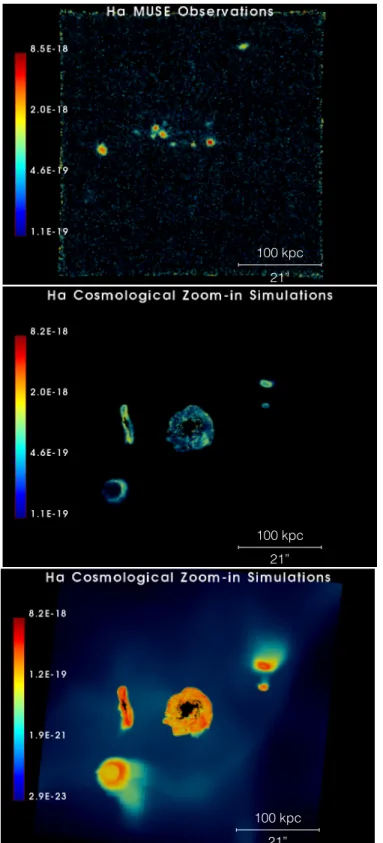
co-moving). Fig. 4 presents a MUSE-size FoV Hα emission
surface brightness map of that simulated halo in units of
erg s−1 cm−2 arcsec−2. These simulations show the
pres-ence of multiple galaxies at the same redshift, typical of a small group. The group members have a broad range of masses so that some of these objects will remain un-detected in current state-of-the-art observations. While the simulated objects appear more extended, the predicted sur-face brightnesses from the simulations are comparable to
our HαMUSE observations. The robustness of the surface
brightnesses prediction is a remarkable achievement which indicates that collisional and photo-ionisation in combina-tion can be the physical processes at the origin of the emis-sion seen in the observations. In addition, this demonstrates that the brightest components of the CGM of low-redshift galaxies can be probed with current observations. Another important feature of the simulated cube is the presence of faint low surface-brightness gas with large sky cross-section in between galaxies.
3.1.3 The Typical Environment of low-redshift Absorbers
Over the years, there has been mounting evidence that bright galaxies can be found at the redshift of quasar ab-sorbers (see Krogager et al. 2017, for a recent review). Tremendous progress has come from IFU observations in particular which have provided a robust means to remove the bright quasar contamination and reach low impact
pa-rameters (Bouch´e et al. 2012; P´eroux et al. 2012; Schroetter
et al. 2016). At low redshifts, however, it is becoming clear that the picture is more complex than a simple one-to-one correspondence between a single galaxy and a quasar ab-sorber. Thanks to the MUSE wide FoV, it is now possible to survey a large portion of sky in one observational set-up, with physical sizes (300 kpc across) typical of the CGM of galaxies (Steidel et al. 2010). Clearly, the case presented here does not contain the typical isolated galaxy-absorber match often reported in past searches for absorber counterparts. In part, this is due to deeper data as we are reaching limits of
SFR>0.01 Myr−1, i.e. an order of magnitude deeper than
similar z∼1 studies. In addition, we report the detection of
passive galaxies whose redshift estimate comes solely from Ca H&K absorption features and Balmer breaks detected in their continuum. While galaxies at these low redshifts will be more clustered, finding simlar objects at higher redshifts is challenging as the continuum flux gets fainter.
While we note the possible alignments of the objects in what could be a filament with a north-west to south-east
c
100 kpc
21”
100 kpc
21”
100 kpc 21”
Figure 4. The environment of zabs ∼0.3 galaxies. Top panel: MUSE observations of Hα emission surface brightness (in erg s−1 cm−2 arcsec−2) at z=0.313 in the field of Q1130−1449. Every coloured object in this (continuum-subtracted) MUSE pseudo narrow-band image indicates Hαemission at the redshift of the absorber.Middle panel:RAMSES AMR cosmological zoom-in hydrody-namical simulations post-processed with photo-ionisation models (Augustin et al., submitted). This MUSE-size field (1×1’, i.e. 300 kpc at z=0.313) of Hαemission surface brightness (in erg s−1 cm−2 arcsec−2) shows a halo with a SFR, stellar and halo masses typical of strong Hiquasar absorbers. The flux colour-bar matches the MUSE observations.Bottom panel:Same figure with the minimum flux cut-off almost 4 orders of magnitude fainter than in the middle panel. The simulations show the presence of multiple galaxies at the same redshift with a broad range of masses as observed in the field of Q1130−1449. In addition, the predicted surface brightness from the simulations is comparable to our HαMUSE observations indicating that collisional and photo-ionisation in combination can be the physical processes at the origin of the emission seen in the observations. These results demonstrate that the brightest components of the CGM of low-redshift galaxies can be probed with current observations of the emission, while the diffuse gas in between objects is at present best traced in absorption. These findings add to the paradigm shift where our former view of strong-N(H I) quasar absorbers being associated with a single bright galaxy changes towards a picture where the Higas probed in absorption is related to far more complex galaxy structures.c
8
C´
eline P´
eroux et al.
0.2
0.4
G0
0
20
G1
H ,[NII]
[OIII] doublet
H
[OII]
0
10
G2
CaII H&K
[SII]
0
5
G4
0
10
G6
0
1
Flu
x [
x 1
0
17
er
g/
s/c
m
2
/Å
]
G16
0
5
G17
0.0
0.5
G18
0.0
2.5
G19
0
1
G20
5000 5500 6000 6500 7000 7500 8000 8500 9000
Observed Wavelength [Å]
0.0
0.5
G21
G22
G21
G19
Figure 5. MUSE spectra of the galaxies at the redshift of thelog[N(HI)/cm−2]=21.71±0.07 quasar absorber (z
abs=0.313). The panels for G1 and G2 show key emission and absorption lines (at redshifted wavelengths), which lines can also be noted in galaxies plotted below. In some cases, no emission lines were detected, but strong Caiiabsorption lines and a Balmer break matching zabs=0.313 were identified (e.g. G20). The spectrum of G21 is smoothed with a 3-pixel boxcar. In other cases, the galaxies have strong emission lines but faint continuum level (e.g. G0, G16 and G17) so that such objects would not appear in broad band imaging. In particular, we discovered a faint galaxy closer to the quasar G0 at impact parameterb= 2.3arcsec(10.6 kpc). While the object lies under the quasar PSF, several emission lines are clearly identified in the MUSE spectrum. In total, we report 11 objects at the redshift of the absorber in our MUSE data, 7 of which are new discoveries.
c
-400 -300 -200 -100 0 100 200 Velocity (km s-1)
0.0 0.5 Normalized flux 20 40 MgI2852 G0 G1 G2 G16 G17 G18
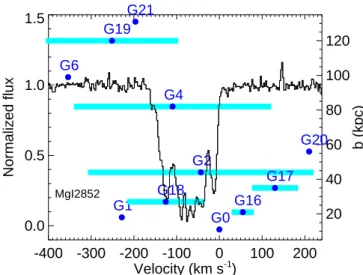
Figure 6. Impact parameters and velocities of galax-ies relative to the quasar absorber profile. Normalised VLT/UVES quasar spectrum of Mgi2852 line atzabs=0.31305. The systemic redshift of galaxy G0 is used as zero velocity refer-ence. The galaxies are ordered from bottom to top as a function of impact parameter to the quasar line-of-sight (see right y-axis for values in kpc). The light blue horizontal lines indicate theVmax extent for galaxies exhibiting ordered rotation. The overlap in ve-locity space with the closest galaxies is somewhat limited, and much of the absorption bluewards of G0 could be related to the low surface brightness tidal gas predicted in our simulations to be 4 orders of magnitude below the current detection threshold.
orientation (Møller & Fynbo 2001; Fumagalli et al. 2016;
P´eroux et al. 2017), it is also possible that these objects are
part of a galaxy group. Assuming G2 as the central member galaxy, we note that G6, G4, G19 and G21 (lying to the north) are at velocity positions blueshifted with respect to G2 while G0, G16 and G17 (lying to the south) are red-shifted with respect to G2. This alignment shows an overall direction of rotation in the halo of the group. The velocity
dispersion of the system is ∼170 km s−1 which is in the
range of small galaxy groups. Based on such dispersion and assuming a virialised spherical system, we obtain a virial
radius of 420 kpc so that the MUSE FoV probes 1/3rd of
the virial radius of the group. The virial mass for such
sys-tem will be 2.9×10¹²M. A number of studies have already
reported several counterparts to low-redshift strong-Hi
ab-sorbers (P´eroux et al. 2017; Bielby et al. 2017; Rahmani
et al. 2018a; Klitsch et al. 2018; Rahmani et al. 2018b; Kl-itsch et al. 2019; Borthakur et al. 2018) possibly tracing small groups.
In fact, these findings are in line with predictions from most recent numerical simulations of galaxy formation. At redshift z=3, cosmological simulations have demonstrated the connection of quasar absorbers with large central halos (Bird et al. 2014; Rahmati & Schaye 2014). The column den-sities observed also fall in the range expected from accretion occurring in the form of cold flows (Keres et al. 2005; Nelson et al. 2013). Similarly, galactic winds could produce some of this gas, where the most energetic systems will have the higher sky coverage. Recently, several groups have presented zoom-in hydrodynamical simulations which focus more
res-bris from previous interactions between the main galaxy and other smaller satellite galaxies. Indeed, the selection of ab-sorbing systems on the basis of their sky coverage will favour interacting systems that have spread their gas around. The MUSE white light image (Fig. 1) shows clear indications of extended gas around G2 and G4 in particular.
This lay-out bears resemblance to cold gas streams sim-ilar to the Magellanic Stream (Richter et al. 2014). Low-redshift analogues of such groups include the M81 (NGC 3031)/M82 (NGC 3034)/NGC 3077 complex where opti-cal observations tracing starlight indicate well-separated
ob-jects. Twenty-one cm maps however show Higas distributed
in between these objects dominated by filamentary struc-tures, clearly demonstrating the violent disruption of this system by tidal interaction (Yun, Ho & Lo 1993, 1994). Sim-ilarly, de Blok et al. (2014) report the detection of a cloud of neutral gas with admittedly lower column density outside
the main H idisk of NGC2403 which they argue could be
either accreting from the intergalactic medium, or the result of a minor interaction with a neighbouring dwarf galaxy.
In-terestingly, they note that the velocities of the Hiin NGC
2366 in the same group completely overlap with those of the
Hiin NGC 2403, which would make their absorption
signa-ture indistinguishable in the spectrum of a background ob-ject. Twenty five years ago, Morris & van den Bergh (1994)
had already calculated that the space density of Ly-α
ab-sorbers and local small groups matched, thus proposing that quasar absorbers can be produced by tidal debris in groups of galaxies.
These results pose a new challenge to the interpretation of the neutral gas probed in absorption. Indeed, most studies of the absorbing galaxies have concentrated on the bright-est objects which are likely to be the main group member. Others have reasonably argued that the absorption is likely to arise from the galaxy with the smallest impact parameter to the quasar line-of-sight. Indeed, we note that lower-mass galaxies such as G0 revealed here by the new MUSE
observa-tions of Q1130−1449 are expected to be one of the main
con-tributors to galactic winds, given that the gas can more eas-ily escape the galaxies’ smaller potential wells. Fig. 6 shows the galaxies’ positions with respect to the absorption profile in velocity space. The galaxies are ordered from bottom to top as a function of impact parameter to the quasar line-of-sight (see right y-axis for values in kpc). The light blue
horizontal lines indicate theVmaxextent for galaxies
indicat-ing rotation. The overlap in velocity space with the closest galaxies is somewhat limited, and much of the absorption bluewards of G0 could be related to the low surface bright-ness tidal gas predicted in our simulations to be four orders of magnitude below the current detection threshold. These results strenghten previous reports of low-redshift
strong-H i absorbers associated with groups (P´eroux et al. 2017;
c
10
C´
eline P´
eroux et al.
Bielby et al. 2017; Rahmani et al. 2018a; Klitsch et al. 2018; Rahmani et al. 2018b; Klitsch et al. 2019; Borthakur et al. 2018). Altogether, these findings add to the paradigm shift
where our former view of strong-N(H I) quasar absorbers
being associated to a single bright galaxy changes towards
a picture where the Higas probed in absorption is related
to far more complex galaxy structures. Since both winds and interactions are predicted to be enhanced in the distant Universe, these factors will likely become more important at higher redshifts but harder to discern.
3.2 Physical Properties of the Galaxy Group
The MUSE observations provide a wealth of information on the stellar properties of the galaxies in the group. Accu-rate redshifts are determined from multiple lines detected in the 1D MUSE spectra calibrated in air. We measured the emission fluxes from a Gaussian fit to the nebular lines.
The 3σupper limits for non-detection are computed for an
unresolved source spread over 6 spatial pixels and spectral
FWHM = 2.4 pixels = 3 ˚A. We followed the method
de-scribed in P´eroux, Kulkarni & York (2014) based on Hαand
Hβ to estimate moderate E(B-V) and further correct the
observed fluxes for dust attenuation. The resulting fluxes
are tabulated in Table 1. The SFR with 1σ uncertainties
were estimated from these Hαfluxes following the relation
of Kennicutt (1998). The emission line galaxies have values of SFR ranging from 0.1 to a few solar masses per year (see Table 2).
Following the methodology of P´eroux et al. (2017), the
HII region metallicities were measured from the strong-line
indices (N2, O3N2 and R23 most relevant branch)
follow-ing prescription by Kobulnicky, Kennicutt & Pizagno (1999) and the mean value of each of these was computed. Our estimates agreed within the errors with earlier measure-ments of G2 and G6 metallicities by Kacprzak, Murphy & Churchill (2010). The metallicity of the galaxies in the
group ranges from [X/H]=−0.57±0.17 to 0.09±0.16. The
total metallicity of the neutral gas probed in absorption,
[Zn/H] =−0.80±0.16, is therefore consistent within the
er-ror bars with the lowest of the metallicities found in the galaxies in the MUSE image.
While metallicity gradients in galaxies could partly rec-oncile these measurements (Carton et al. 2018), we note that the low dust-corrected abundances measured in absorption resemble the properties of the extragalactic diffuse gas pro-duced in our numerical simulations. Furthermore, the neb-ular emission line ratios place all but one galaxy into the star-forming region of the BPT diagram (Baldwin, Phillips & Terlevich 1981). Galaxy G1 shows evidence for ionisation
by an AGN with [Oiii]/Hβ=5.45 and [Nii]/Hα=0.07. The
galaxy emission properties are listed in Table 2.
We used the ALMA observations to constrain the molecular gas content of the galaxy group. We measured the flux density in the lines by integrating the CO(1–0) emission lines in the extracted spectra (Fig. B2). We then computed the corresponding luminosities using the
follow-ing formula: LCO= (3.25×10⁷×dL [Mpc]2×Fint) / (fobs
[GHz]2 ×(1+z)3), where dL is the luminosity distance, Fint
the flux density and fobs=87.8GHz is the observed frequency
(Solomon, Downes & Radford 1992). Because we observe the CO(1-0) transition directly, our data naturally overcome
un-certainties related to unknown CO line ratios. Estimates of
the corresponding H2 molecular masses however rely on the
rather uncertain CO-H2 conversion factor (Bolatto, Wolfire
& Leroy 2013). Previous works have used Galactic CO-H2
conversion factor ofαCO=4.6 M(K km/s pc2)−1. Recent
results by Klitsch et al. (2019) find that this is not always appropriate for absorbing-galaxies so that here we opt to
express the molecular masses as a function ofαCO. The
re-sulting molecular masses range fromMmol= (1.00±0.05) to
(3.16±0.07)×(αCO/1 K km/s pc2)×109Mand are listed
Table 3.
The ALMA observations indicate substantial cold gas reservoirs in three of the galaxies in the group. These molec-ular masses are large in comparison with the typical stel-lar mass of absorbing galaxies (Augustin et al. 2018). In fact, a number of recent works have reported CO associated with quasar absorbers from ALMA observations with a high rate of incidence and derived equally high molecular masses (Neeleman et al. 2016; Møller et al. 2018; Neeleman et al. 2018; Kanekar et al. 2018; Klitsch et al. 2018; D’Odorico et al. 2018; Klitsch et al. 2019). However, it is unclear why
Hi-rich absorbing galaxies should have large reservoir of H2
gas. At first sight, this might appear at odds with searches
for H2rotational and vibrational transitions at UV restframe
wavelengths which have only reported both low incident
rates (10%) and low molecular gas content (fmol 6 0.01)
with respect to the neutral gas (Ledoux, Petitjean & Sri-anand 2003; Noterdaeme et al. 2008). While the most
abun-dant molecule after H2, CO is known to be less abundant
with a CO/H2 column density ratio ranging from 10−7 to
10−5 and a mean value of 3×10⁻⁶ (Burgh, France &
Mc-Candliss 2007). However, it must be borne in mind that the neutral atomic phase of the gas traces significantly lower gas densities than the molecular gas traced by CO (Snow & McCall 2006). Indeed the observations of nearby galaxies
indicate that Hiand H2 are not co-spatial (Schruba et al.
2011), with the molecular gas concentrated in the central
part of galaxies so that the detection of H2in absorption at
an impact parameter distance at the edges of galaxies is less likely (Zwaan & Prochaska 2006; Obreschkow & Rawlings 2009).
In the field of Q1130−1449, we detected three objects in
CO at the absorber redshift, two of which have large impact
parameters (b>50 kpc). The objects close to the quasar (i.e.
G0 and G1) do not show CO(1–0) emission, although G1 is the most actively star-forming member of the group. We cal-culated the molecular depletion times for the three objects
detected with ALMA following: τdepl=MH2/SFR=1/SFE,
where SFE is the star formation efficiency. To compute the
depletion time scale, we assumed a Galactic CO-H2
conver-sion factor ofαCO=4.6 M(K km/s pc2)−1. We deriveτdepl
ranging from 1.7±0.5 to 12±5 Gyr (see Table 3). The gas
de-pletion times are long compared to the timescales of the pro-cesses driving the evolution of the interstellar medium state (Leroy et al. 2013). Semenov, Kravtsov & Gnedin (2017) argue that star-forming gas converts only a small fraction
(∼1%) of its mass into stars while most of it (∼90%) is
dis-persed by dynamical and feedback processes. Selection based
on strong H i-absorbers thus possibly preferentially finds
galaxies with large molecular gas reservoirs (at given SFR) which inefficiently convert their gas into stars (Kanekar et al. 2018).
c
G17 70.9±17.7 35.3±8.8 42.8±10.7 135.7±38.4 200.4±50.1 22.1±5.5 G18 6.8±1.7 3.5±0.9 2.4±0.6 9.7±2.4 21.7±5.4 3.8±0.9 G19 25.6±6.4 9.2±2.3 6.0±1.5 16.7±4.2 72.0±18.0 12.5±3.1 G20b <0.4 <0.2 <0.2 <0.2 <0.3 <0.3
G21b <0.4 <0.3 <0.3 0.7±0.2 0.7±0.2 <0.7
Note:aGalaxies showing NaID absorption features in their spectra.bThe flux limits are not corrected for dust.
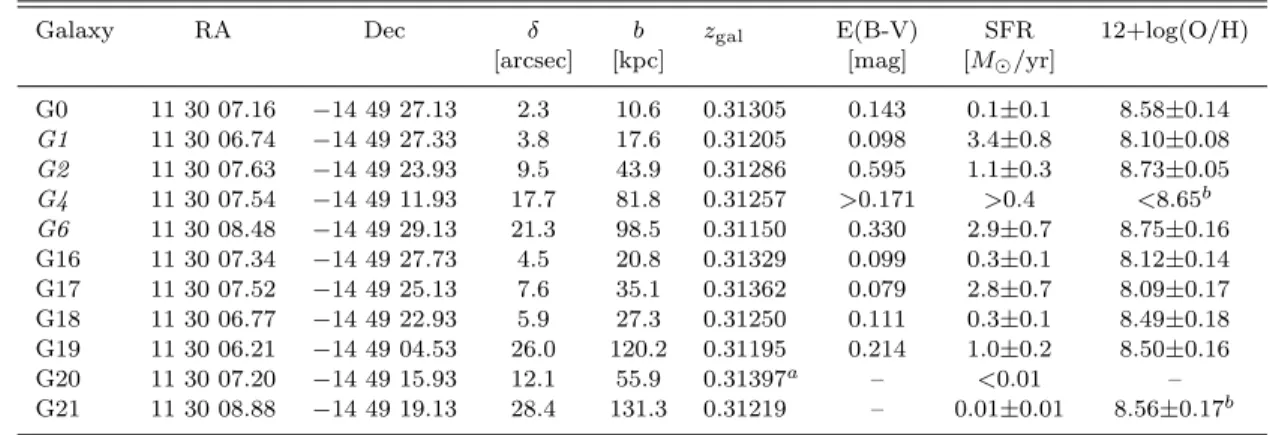
Table 2. Ionised gas properties of the galaxies detected at the redshift of the zabs=0.313 absorber in the MUSE
observations. We use the numbering system introduced by Kacprzak, Murphy & Churchill (2010) when relevant and extend it for the seven new detections.δis the angular distance from the quasar in arcsec andbis the impact parameter in kpc. SFR estimates are dust-corrected. G20 and G21 have no, or weak, emission lines. Galaxies G1 to G6 (shown in italics) were previously identified.
Galaxy RA Dec δ b zgal E(B-V) SFR 12+log(O/H)
[arcsec] [kpc] [mag] [M/yr]
G0 11 30 07.16 −14 49 27.13 2.3 10.6 0.31305 0.143 0.1±0.1 8.58±0.14
G1 11 30 06.74 −14 49 27.33 3.8 17.6 0.31205 0.098 3.4±0.8 8.10±0.08
G2 11 30 07.63 −14 49 23.93 9.5 43.9 0.31286 0.595 1.1±0.3 8.73±0.05
G4 11 30 07.54 −14 49 11.93 17.7 81.8 0.31257 >0.171 >0.4 <8.65b
G6 11 30 08.48 −14 49 29.13 21.3 98.5 0.31150 0.330 2.9±0.7 8.75±0.16 G16 11 30 07.34 −14 49 27.73 4.5 20.8 0.31329 0.099 0.3±0.1 8.12±0.14 G17 11 30 07.52 −14 49 25.13 7.6 35.1 0.31362 0.079 2.8±0.7 8.09±0.17 G18 11 30 06.77 −14 49 22.93 5.9 27.3 0.31250 0.111 0.3±0.1 8.49±0.18 G19 11 30 06.21 −14 49 04.53 26.0 120.2 0.31195 0.214 1.0±0.2 8.50±0.16 G20 11 30 07.20 −14 49 15.93 12.1 55.9 0.31397a – <0.01 –
G21 11 30 08.88 −14 49 19.13 28.4 131.3 0.31219 – 0.01±0.01 8.56±0.17b
Note:aRedshift based on Ca
iiabsorption features in the galaxy spectrum.bMetallicity based on N2 indicator only.
3.3 Morphological and Kinematical Properties of Group Members
MUSE and ALMA observations of the field are also com-plementary in that they both provide information on the kinematics of the stars and molecular gas respectively. We performed a 3-dimensional morpho-kinematic analysis of the objects detected in MUSE and ALMA, using the method
described in P´eroux et al. (2017). In brief, we used the
GalPak3D algorithm (Bouch´e et al. 2015) which compares
directly the data cube with a parametric model mapped inx, y, λ coordinates. The algorithm uses a Markov Chain Monte Carlo (MCMC) approach with a proposed distribu-tion of the parameters in order to efficiently probe the pa-rameter space. The code has the advantages that it fits the galaxy in 3-d space and provides a robust description of the morpho-kinematics of the data. We assessed the quality of
the fit from a χ2 minimisation as well as the inspection of
the residual maps. We mostly used the brightest [Oiii] 5007
˚
A line to perform the analysis. Our results are tabulated in
Table 4 and illustrated in Fig. B1 and B2 in appendix B for the MUSE and ALMA detections respectively. The CO velocity fields are well resolved in our ALMA observations.
As expected, the stellar sizes as measured by r1/2 are larger
than the molecular gas sizes. Our analysis further provides a determination of the inclination and position angle (PA)
of the galaxies. In cases where GalPak3Ddid not converge
(namely for G0, G1, G6, G20 and G21), we useSextractorto
derive these parameters from the broad band HST/WFPC2 image.
The analysis of galaxy G0 is hampered by the proximity to the bright quasar (2.3 arcsec). G1 shows no indication of a velocity shear notwithstanding the bright emission lines in the object and a favourable inclination parameter (i=51 deg) as measured in the HST/WFPC2 broad band image. Indeed, the nebular emission line ratios in the object show evidence
for ionisation by an AGN with Hαemission produced in the
central engine (Baldwin, Phillips & Terlevich 1981). G2 is
a large galaxy (half-light radius r1/2=14±2 kpc) dominated
c
12
C´
eline P´
eroux et al.
Table 3. CO emitters at zabs=0.313 in the ALMA observations. Flux densities, velocity widths, CO luminosities, molecular masses expressed in units ofαCOand depletion timescales are provided for each detected galaxy.
Galaxy RA Dec δ b SCO FWHM LCO Mmol×(αCO/1 K km/s pc2) τdepl
[”] [kpc] [Jy km/s] [km/s] [K km/s pc2] [×109 M
] [Gyr]
G2 11 30 07.66 −14 49 23.41 9.7 44.8 0.63±0.01 250±50 (3.1±0.1)×109 3.16±0.07 13±5 G4 11 30 07.62 −14 49 11.44 18.0 83.2 0.42±0.03 535±50 (2.1±0.1)×109 1.99±0.15 <23 G6 11 30 08.53 −14 49 28.54 21.5 99.4 0.20±0.01 205±50 (1.0±0.1)×109 1.00±0.05 1.5±0.5
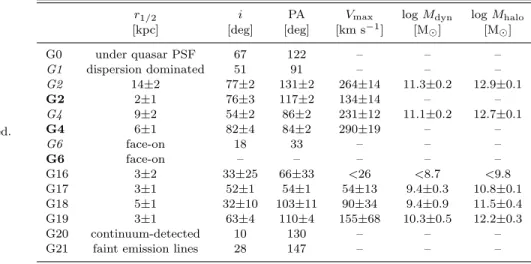
Table 4. Nebular emission lines and cold molecular gas (bold) morpho-kinematic properties.The results of the 3-dimensional MCMC forward modelling of the morphological and kinematical parameters listed are all inclination corrected. Inclination and PA (NoE) are derived from aSextractorfit to the broad band HST/WFPC2 image when the algorithm did not converge. When the object is detected in both MUSE and ALMA, i.e. G2, G4 and G6, the kinematic models (bold) are sometimes found to be in good agreement indicating a relation between the stellar content and the molecular gas in some of these galaxies
. The maximum velocity of the disks are used to derive the dynamical and halo masses. Galaxies G1 to G6 (shown in italics) were
previously identified.
r1/2 i PA Vmax logMdyn logMhalo
[kpc] [deg] [deg] [km s−1] [M
] [M]
G0 under quasar PSF 67 122 – – –
G1 dispersion dominated 51 91 – – –
G2 14±2 77±2 131±2 264±14 11.3±0.2 12.9±0.1
G2 2±1 76±3 117±2 134±14 – –
G4 9±2 54±2 86±2 231±12 11.1±0.2 12.7±0.1
G4 6±1 82±4 84±2 290±19 – –
G6 face-on 18 33 – – –
G6 face-on – – – – –
G16 3±2 33±25 66±33 <26 <8.7 <9.8 G17 3±1 52±1 54±1 54±13 9.4±0.3 10.8±0.1 G18 5±1 32±10 103±11 90±34 9.4±0.9 11.5±0.4 G19 3±1 63±4 110±4 155±68 10.3±0.5 12.2±0.3
G20 continuum-detected 10 130 – – –
G21 faint emission lines 28 147 – – –
by rotation in both [Oiii] and CO as indicated by the
dis-persion velocity for G2 peaking in the center of the system beyond beam smearing. A smaller nearby galaxy, G17, pre-sumably interacts with this system. The MUSE white light image (Fig. 1) also shows extended gas around the galaxy.
For galaxy G4, we used the Hαemission line rather than the
fainter [Oiii] 5007 ˚A. The ALMA observations of G4
indi-cate two, spectrally and spatially well-separated components (Fig. 3) clearly seen in the spectrum (Fig. B2) with wide
FWHM=530±50 km s−1. This is reflected in the
kinemat-ics analysis where we derive a largeVmax=290±4 km s−1for
this system. We tentatively interpret these characteristics as a signature of merging and note extended diffuse gas is also present in the MUSE white light image (Fig. B1). Galaxy G6 is almost face-on (i=18 deg) hindering the kinematical analysis of this system. An inspection of the velocity field
of G16 reveals that it has yet to converge to itsVmax value,
which should be taken as an upper limit. The faint galaxy G17 on the other hand has a well-converged velocity field as illustrated in Fig. B1. Our detection of galaxy G19 indicates
that our observations have not fully reachedVmaxeither,
al-though rotation can be securely reported. Galaxy G20 is a continuum-detected object while G21 has faint emission lines thus precluding further kinematic analysis. Overall, the
model converges for most galaxies. While not a unique solu-tion, these findings indicate that the emission lines are well described by disk rotation. However, such an analysis might be rather insensitive to interactions of large objects with lower mass galaxies (say, as in the case of G2 and G17).
We derived the dynamical mass of each galaxy from
the enclosed mass: Mdyn = Vmax2 r1/2 / G (P´eroux et al.
2011b). Assuming a spherical virialised collapse model (Mo & White 2002), we further computed the halo mass related
to each object:Mhalo = 0.1Ho−1G
−1Ω−0.5
m (1 +z)
−1.5V3
max.
The highest of these values are representative within the er-rors of our estimate of the halo mass of the whole group
(logMhalo=12.5 M). For one of these objects (G1),
Chris-tensen et al. (2014) performed a Spectral Energy Distribu-tion (SED) fit to the optical and near-infrared magnitudes
and derived a low stellar mass of log M∗=8.29±0.09 M.
When an object is detected from its nebular emission lines and in CO(1–0), i.e. G2, G4 and G6, both the ionised gas traced by nebular lines and the CO molecular line widths
(FWHM=200–530 km s−1) are significantly broader than
the neutral gas traced by absorption at some distance from
the galaxies (∼150 km s−1) and especially the 21cm line
ab-sorption (FWHM=42.1±2.7 km s−1). The kinematics of the
stars and molecular gas in terms of orientation (PA) deviate
c
gas unlike what we observe in the case of galaxy G2.
4 CONCLUSION
In this paper, we have presented deep MUSE and ALMA
ob-servations of the field of the QSO Q1130−1449 which shows
a log [N(HI)/cm−2]=21.71±0.07 damped Lyα system at
zabs= 0.313. Our main findings can be summarised as
fol-low:
• Our MUSE observations cover 11 galaxies at the
red-shift of the absorber, 7 of which are new discoveries. In par-ticular, we report a new object with the smallest impact parameter to the quasar line-of-sight (b=10.6 kpc). Three of the objects are also detected in CO(1–0) in our ALMA observations.
• Using dedicated numerical cosmological simulations, we
infer that the physical properties of these galaxies qualita-tively resemble a small group environment, possibly part of a filamentary structure.
• Based on metallicity and velocity arguments, we
con-clude that the neutral gas traced by strong Hiabsorbers is
only partly related to these emitting galaxies while a larger fraction is likely the signature of low surface brightness emit-ting gas four orders of magnitude fainter than the current detection limits outside the Local Group.
• We report large molecular gas reservoirs with long
depletion timescales in the three galaxies detected with ALMA. These results together with other reports of large
molecular masses in strong Hi-absorption systems indicate
that selection based on absorption preferentially picks galax-ies which inefficiently convert their gas into stars.
• Detailed kinematics analysis of both the ionised and
molecular component of these galaxies shows signatures of past interactions and possible merging between vari-ous members of the group. While the stellar component is spatially more extended, the resolved molecular lines are broader in velocity space.
• Together with other similar reports, our findings
chal-lenge a picture where strong-N(H I) quasar absorbers are
associated with a single bright galaxy and favour a scenario
where the Higas probed in absorption is related to far more
complex galaxy structures.
ACKNOWLEDGEMENTS
We thank Thomas Ott, Nicolas Bouch´e and Jean-Charles
Lambert for developing and distributing the QFitsView,
GalPak3D and glnemo software, respectively. We thank
Chian-Chou Chen (TC) for help with the CO column den-sity calculation. The authors wish to thank the anonymous
NASA/Space Telescope Science Institute support for Hub-ble Space Telescope programs GO-13733 and 13801. LAS acknowledges support from ERC Grant agreement 278594-GasAroundGalaxies. This work has been carried out thanks to the support of the OCEVU Labex (ANR-11-LABX-0060) and the A*MIDEX project (ANR-11-IDEX-0001-02) funded by the ”Investissements d’Avenir” French government pro-gram managed by the ANR.
We are grateful to the Paranal and Garching staff at ESO for performing the observations in service mode and the instrument team for making a reliable instru-ment. This paper makes use of the following ALMA data: ADS/JAO.ALMA#2016.1.01250.S. ALMA is a partnership of ESO (representing its member states), NSF (USA) and NINS (Japan), together with NRC (Canada), NSC and ASIAA (Taiwan), and KASI (Republic of Korea), in coop-eration with the Republic of Chile. The Joint ALMA Ob-servatory is operated by ESO, AUI/NRAO and NAOJ.
REFERENCES
Anderson M. E., Bregman J. N., 2010, ApJ, 714, 320 Augustin R. et al., 2018, MNRAS
Baldwin J., Phillips M., Terlevich R., 1981, PASP, 93, 5 Bechtold J., Siemiginowska A., Aldcroft T. L., Elvis M.,
Dobrzycki A., 2001, ApJ, 562, 133
Bergeron J., Boisse P., 1991, A&A, 234, 344
Bielby R., Crighton N. H. M., Fumagalli M., Mor-ris S. L., Stott J. P., Tejos N., Cantalupo S., 2016, arXiv:1607.03386
Bielby R., Crighton N. H. M., Fumagalli M., Morris S. L., Stott J. P., Tejos N., Cantalupo S., 2017, MNRAS, 468, 1373
Bielby R. M. et al., 2018, ArXiv e-prints
Bird S., Vogelsberger M., Haehnelt M., Sijacki D., Genel S., Torrey P., Springel V., Hernquist L., 2014, MNRAS, 445, 2313
Bolatto A. D., Wolfire M., Leroy A. K., 2013, ARAA, 51, 207
Borthakur S., Momjian E., Heckman T. M., Catinella B., Vogt F. P. A., Tumlinson J., 2018, arXiv e-prints
Bouch´e N., Carfantan H., Schroetter I., Michel-Dansac L.,
Contini T., 2015, ASCL, 2015ascl.soft01014B
Bouch´e N. et al., 2016, ApJ, 820, 121
Bouch´e N., Murphy M., P´eroux C., Contini T., Martin C.,
Dessauges-Zavadsky M., 2013, Sci, 341, 50
Bouch´e N. et al., 2012, MNRAS, 419, 2
Bouch´e, N. N., Murphy M., P´eroux C., Davies R.,
Eisen-hauer F., Forster-Schreiber N., Tacconi L., 2007, ApJ, 669, L5
c
14
C´
eline P´
eroux et al.
Bregman J. N., Anderson M. E., Miller M. J., Hodges-Kluck E., Dai X., Li J.-T., Li Y., Qu Z., 2018, ArXiv e-prints
Burgh E. B., France K., McCandliss S. R., 2007, ApJ, 658, 446
Carton D. et al., 2018, MNRAS
Christensen L., Møller P., Fynbo J. P. U., Zafar T., 2014, MNRAS, 445, 225
Chun M., Gharanfoli S., Kulkarni V., Takamiya M., 2006, AJ, 131, 686
de Blok W. J. G. et al., 2014, AaP, 569, A68
Deharveng J., Buat V., Bergeron J., 1995, A&A, 298, 57 D’Odorico V. et al., 2018, Apjl, 863, L29
Frank S. et al., 2012, MNRAS, 420, 1731
Fumagalli M., Cantalupo S., Dekel A., Morris S. L., O’Meara J. M., Prochaska J. X., Theuns T., 2016, MN-RAS, 462, 1978
Guber C. R., Richter P., Wendt M., 2018, AAp, 609, A85 Hummels C. B. et al., 2019, arXiv e-prints
Husemann B., Bennert V. N., Scharw¨achter J., Woo J.-H.,
Choudhury O. S., 2016, MNRAS, 455, 1905
Joshi R., Srianand R., Petitjean P., Noterdaeme P., 2017, mnras, 471, 1910
Kacprzak G. G., Murphy M. T., Churchill C. W., 2010, MNRAS, 406, 445
Kanekar N. et al., 2018, ApJl, 856, L23 Kanekar N. et al., 2014, MNRAS, 438, 2131
Kanekar N., Smette A., Briggs F. H., Chengalur J. N., 2009, ApJL, 705, L40
Kennicutt R., 1998, ARAA, 36, 189
Keres D., Katz N., Weinberg D., Dav´e R., 2005, MNRAS,
363, 2
Klitsch A., P´eroux C., Zwaan M. A., Smail I., Oteo I., Biggs
A. D., Popping G., Swinbank A. M., 2018, MNRAS, 475, 492
Klitsch A. et al., 2019, mnras, 482, L65
Kobulnicky H., Kennicutt R., Pizagno J., 1999, ApJ, 514, 544
Krogager J.-K., Møller P., Fynbo J. P. U., Noterdaeme P., 2017, MNRAS, 469, 2959
Lane W., Smette A., Briggs F., Rao S., Turnshek D., Mey-lan G., 1998, ApJ, 116, 26
Leclercq F. et al., 2017, AAp, 608, A8
Ledoux C., Petitjean P., Srianand R., 2003, MNRAS, 346, 209
Leroy A. K. et al., 2013, AJ, 146, 19 Levy R. C. et al., 2018, ApJ, 860, 92
Mangum J. G., Shirley Y. L., 2015, PASP, 127, 266 McGaugh S. S., 2008, in IAU Symposium, Vol. 244, Dark
Galaxies and Lost Baryons, Davies J. I., Disney M. J., eds., pp. 136–145
Mo H. J., White S. D. M., 2002, MNRAS, 336, 112 Møller P. et al., 2018, MNRAS, 474, 4039
Møller P., Fynbo J. U., 2001, AAp, 372, L57 Morris S. L., van den Bergh S., 1994, ApJ, 427, 696 Morris S. L., Weymann R. J., Dressler A., McCarthy P. J.,
Smith B. A., Terrile R. J., Giovanelli R., Irwin M., 1993, ApJ, 419, 524
Narayanan A., Misawa T., Charlton J. C., Kim T.-S., 2007, ApJ, 660, 1093
Neeleman M., Kanekar N., Prochaska J. X., Christensen L., Dessauges-Zavadsky M., Fynbo J. P. U., Møller P., Zwaan
M. A., 2018, ApJl, 856, L12
Neeleman M. et al., 2016, ApJl, 820, L39
Nelson D., Vogelsberger M., Genel S., Sijacki D., Kereˇs D.,
Springel V., Hernquist L., 2013, MNRAS, 429, 3353 Nicastro F. et al., 2018, Nature, 558, 406
Noterdaeme P., Ledoux C., Petitjean P., Srianand R., 2008, A&A, 481, 327
Obreschkow D., Rawlings S., 2009, MNRAS, 394, 1857 Peeples M. S. et al., 2019, arXiv e-prints
P´eroux C., Bouch´e N., Kulkarni V., York D., 2013,
MN-RAS, 436, 2650
P´eroux C., Bouch´e N., Kulkarni V., York D., Vladilo G.,
2011a, MNRAS, 410, 2237
P´eroux C., Bouch´e N., Kulkarni V., York D., Vladilo G.,
2011b, MNRAS, 410, 2251
P´eroux C., Bouch´e N., Kulkarni V., York D., Vladilo G.,
2012, MNRAS, 419, 3060
P´eroux C., Kulkarni V. P., York D. G., 2014, MNRAS, 437,
3144
P´eroux C., Rahmani H., Arrigoni Battaia F., Augustin R.,
2018, MNRAS, 479, L50
P´eroux C. et al., 2017, MNRAS, 464, 2053
Piqueras L., Conseil S., Shepherd M., Bacon R., Leclercq F., Richard J., 2017, ArXiv e-prints
Rahmani H. et al., 2018a, MNRAS, 474, 254 Rahmani H. et al., 2018b, MNRAS, 480, 5046 Rahmani H. et al., 2016, MNRAS
Rahmati A., Schaye J., 2014, MNRAS, 438, 529
Richter P., Fox A. J., Ben Bekhti N., Murphy M. T., Bo-mans D., Frank S., 2014, Astronomische Nachrichten, 335, 92
Rudie G. et al., 2012, ApJ, 750, 67
Rudie G. C., Newman A. B., Murphy M. T., 2017, ApJ, 843, 98
Schroetter I., Bouch´e N., P´eroux C., Murphy M., Contini
T., Finley H., 2015, ApJ, 804, 83 Schroetter I. et al., 2016, ApJ, 833, 39 Schruba A. et al., 2011, AJ, 142, 37
Semenov V. A., Kravtsov A. V., Gnedin N. Y., 2017, ApJ, 845, 133
Sk´ulad´ottir ´A., Salvadori S., Pettini M., Tolstoy E., Hill V.,
2018, ArXiv e-prints
Snow T. P., McCall B. J., 2006, ARAA, 44, 367
Solomon P. M., Downes D., Radford S. J. E., 1992, ApJL, 398, L29
Steidel C., Erb D., Shapley A., Pettini M., Reddy N., Bo-gosavljevic M., Rudie G., Rakic O., 2010, ApJ, 717, 289 Straka L., Whichard Z., Kulkarni V., Bishof M., Bowen D.,
Khare P., York D., 2013, MNRAS, 436, 3200 Straka L. A. et al., 2015, MNRAS, 447, 3856
Suresh J., Nelson D., Genel S., Rubin K., Hernquist L., 2019, arXiv e-prints
Teyssier R., Pontzen A., Dubois Y., Read J. I., 2013, MN-RAS, 429, 3068
Tripp T. M., Lu L., Savage B. D., 1998, ApJ, 508, 200 Turner M. L., Schaye J., Steidel C. C., Rudie G. C., Strom
A. L., 2014, MNRAS, 445, 794
van de Voort F., Springel V., Mandelker N., van den Bosch F. C., Pakmor R., 2019, mnras, 482, L85
Weilbacher P., 2015, in Science Operations 2015: ESO/ESA Workshop, ESO Garching, id.1, p. 1
Werk J., Prochaska J., Thom C., Tumlinson J., Tripp T.,
c
Zwaan M. A., Prochaska J. X., 2006, ApJ, 643, 675 ∼
components at −350 < v < −200 km s−1 only seen in
Mg ii 2796,2803. We modelled the absorption lines with
Voigt profiles usingVPFIT5 v10.0. The resulting
metallic-ity derived from all Feii, Mniiand Tiiiare consistent with
each other leading to [X/H]=−1.94±0.08 or 1% solar. This
is significantly lower than the measurement based on Zn
from HST/STIS, [Zn/H]= −0.80±0.16 (16% solar). This
would conventionally be explained by postulating a mod-est amount of dust along this line-of-sight, which would not affect Zn but only refractory elements such as Fe, Mn, Ti
and Ca. We note however recent work by Sk´ulad´ottir et al.
(2018) who warn that stars in the Sculptor dwarf spheroidal galaxy indicate that Zn and Fe do not trace all the same nucleosynthetic production channels, so that a direct com-parison might not be appropriate. It is also important to
note that the [Zn/H] measurement is based onHST/STIS
which have a significantly lower spectral resolution than the VLT/UVES spectrum studied here.
APPENDIX B: MORPHO-KINEMATICS ANALYSIS OF GALAXIES IN THE FIELD
The section displays the flux and velocity maps of individual
galaxies observed atzgal=0.313 with MUSE and ALMA.
4 http://archive.eso.org/cms.html
5 http://www.ast.cam.ac.uk/ rfc/vpfit.html
c
16
C´
eline P´
eroux et al.
-400 -300 -200 -100 0 100 200 0.0
0.5 1.0 1.5
MgII2796
-400 -300 -200 -100 0 100 200 0.0
0.5 1.0 1.5
MgII2803
-400 -300 -200 -100 0 100 200 0.0
0.5 1.0 1.5
FeII2374
-400 -300 -200 -100 0 100 200 0.0
0.5 1.0 1.5
FeII2600
-400 -300 -200 -100 0 100 200 0.0
0.5 1.0 1.5
Normalized flux
MnII2576
-400 -300 -200 -100 0 100 200 0.0
0.5 1.0 1.5
MnII2594
-400 -300 -200 -100 0 100 200 0.0
0.5 1.0 1.5
TiII3384
-400 -300 -200 -100 0 100 200 0.0
0.5 1.0 1.5
MgI2852
-400 -300 -200 -100 0 100 200 Velocity (km s-1)
0.0 0.5 1.0 1.5
CaII3934
-400 -300 -200 -100 0 100 200 Velocity (km s-1)
0.0 0.5 1.0 1.5
CaII3969
Figure A1. VLT/UVES normalised spectrum of quasar Q1130−1449.The zero velocity is set to the systemic redshift of galaxy G0zgal=0.31305. Most of the absorption lies bluewards of this systemic redshift. Voigt profile fits to the absorption profile are shown in red and the fitted components are shown as tick marks above the spectrum. The error array is shown as a dotted blue line. Mgiiand Feiilines are saturated, but a good fit could be obtained from weaker elements like Mnii, Tiiiand Caii.
c
0
10
20
x [kpc]
0
10
20
y [kpc]
G2 - OIII Velocity Map
200 100 0 100 200
Velocity [km/s]
0 10 20
x [kpc]
0 10 20
y [kpc]
G4 - MUSE H-alpha
0
10
20
x [kpc]
0
10
20
y [kpc]
G4 - H-alpha Velocity Map
200 100 0 100 200
Velocity [km/s]
Figure B1. Gas content of individual galaxies detected in MUSE at zabs=0.313.Postage stamps of the stellar continuum observed withHST/WFPC2 (left), nebular emission of [Oiii] or Hαfrom MUSE narrow-band images (center) and modeled velocity
maps convolved with the instrumental PSF (right). North is up, east to the left. The signal in galaxy G0 panel is dominated by the bright nearby quasar (slightly off-center to the West). While the object lies under the quasar PSF, several emission lines are clearly identified in the MUSE spectrum after quasar spectral-PFS subtraction (see Fig. 5). Some object are bright in continuum but have weak or undetected emission lines (e.g. G20) so that they are apparent in the HST data but weak in MUSE narrow-band. Conversely, some objects show strong emission lines with faint continuum (e.g. G0 and G16).
c
18
C´
eline P´
eroux et al.
0
10
x [kpc]
0
10
y [kpc]
G16 - MUSE OIII 5008
0
10
x [kpc]
0
10
y [kpc]
G16 - OIII Velocity Map
200 100 0 100 200
Velocity [km/s]
0
10
20
x [kpc]
0
10
20
y [kpc]
G17 - OIII Velocity Map
200 100 0 100 200
Velocity [km/s]
0
10
20
x [kpc]
0
10
20
y [kpc]
G18 - MUSE OIII 5008
0
10
20
x [kpc]
0
10
20
y [kpc]
G18 - OIII Velocity Map
200 100 0 100 200
Velocity [km/s]
Figure B1.continued
c
0 10 20
x [kpc]
0
0
0
10
x [kpc]
20
2000
10
20
x [kpc]
0
10
20
y [kpc]
G21 - MUSE OIII 5008
Figure B1.continued
c
20
C´
eline P´
eroux et al.
1000 500 0 500 1000
Velocity [km/s]
0.50.0 0.5 1.0 1.5 2.0 2.5 3.0
Flux [mJy]
CO(1-0) - G2
1000 500 0 500 1000
Velocity [km/s]
0.40.2 0.0 0.2 0.4 0.6 0.8 1.0 1.2
Flux [mJy]
CO(1-0) - G4
1000 500 0 500 1000
Velocity [km/s]
0.500.25 0.00 0.25 0.50 0.75 1.00 1.25 1.50
Flux [mJy]
CO(1-0) - G6
Figure B2. Molecular gas content of individual galaxies detected in ALMA at zabs=0.313. The CO(1-0) emission line map (left), modeled velocity maps convolved with the instrumental PSF (center) and extracted 1D CO(1-0) spectra (right) are shown. The grey ellipse on the left column indicates the ALMA beam size. The results of the morpho-kinematic analysis of G2 and G4 are qualitatively similar to the MUSE ones.
c
![Figure 2. Galaxies at z abs =0.313 in the Field of Q1130−1449. Top panel: Continuum-subtracted MUSE pseudo narrow-band filter around [O iii] λ5007 at the redshift of the absorber](https://thumb-us.123doks.com/thumbv2/123dok_us/8271305.2190780/5.918.208.672.145.1011/figure-galaxies-field-continuum-subtracted-pseudo-redshift-absorber.webp)

![Figure 5. MUSE spectra of the galaxies at the redshift of the log[N (HI)/cm −2 ]=21.71±0.07 quasar absorber (z abs =0.313).](https://thumb-us.123doks.com/thumbv2/123dok_us/8271305.2190780/8.918.130.721.134.1042/figure-muse-spectra-galaxies-redshift-quasar-absorber-abs.webp)
![Figure B1. Gas content of individual galaxies detected in MUSE at z abs =0.313. Postage stamps of the stellar continuum observed with HST/WFPC2 (left), nebular emission of [O iii] or Hα from MUSE narrow-band images (center) and modeled velocity maps convol](https://thumb-us.123doks.com/thumbv2/123dok_us/8271305.2190780/17.918.81.797.170.1057/individual-galaxies-detected-postage-continuum-observed-emission-velocity.webp)
