M.S. in L.S. degree. April, 2018. 67 pages. Advisor: Chad Haefele.
Following the understanding that perception affects use, this research paper contributes to library assessment literature and investigates patron perceptions of libraries. Since
undergraduates make up a majority of the UNC student body, the focus of this paper is on them and their levels of library engagement. A survey of undergraduates was conducted to better understand their perceptions of the UNC libraries and how those perceptions affect library use. The survey found that many students use the library as a place for studying and view it as both a building and as a community. Implications for library practice are examined, and it was found that the libraries could work to improve study areas in the library and improve outreach.
Headings:
Academic Libraries
Academic Library Use Studies Surveys – Undergraduate Students
UNDERGRADUATE PERCEPTIONS OF THE UNC LIBRARIES
by Ellen F. Cline
A Master’s paper submitted to the faculty of the School of Information and Library Science of the University of North Carolina at Chapel Hill
in partial fulfillment of the requirements for the degree of Master of Science in
Library Science.
Chapel Hill, North Carolina April 2018
Approved by
Acknowledgements
Table of Contents
Introduction ……….. 3
Literature Review ……….. 6
Methods ……….. 17
Results ……….. 19
Discussion ……….. 29
Conclusions ……….. 35
References ……….. 36
Appendices Appendix A: Survey Questions ………. 40
Introduction
From complex research needs to simple directional queries, working at a library reference desk and in library instruction sessions can mean answering a wide variety of questions. I always find myself curious about those who inquire about library services and resources (ranging from the collections to physical spaces in the library). Questions of this sort have run the gamut from “am I allowed to check out books?” and “I’m not an Art major, but can I study in the Art Library?” to “are there books in the library?” and “is the librarian there?” (innocently asked during the workday in a large library where several librarians work). In the wake of these and similar queries, one begins to wonder what our patrons’ perceptions of the libraries and the work that goes on in them are. Without this kind of guidance from library users, I often find myself wondering which library services to discuss when teaching library instruction sessions to undergraduates, trying to balance what I think they already know with what I think may be of use to their research projects and to their student careers.
Where do patron perceptions of the library and actual library use intersect? Past studies have explored a range of topics related to the image of libraries and librarians in a variety of settings and through a variety of lenses. Many which focus on academic
totality (at smaller institutions) of a college or university’s student body, ensuring that they have a good understanding of their campus library and the resources it offers them is crucial not only to student success but to the success of the academic library as well.
Any academic library represents great potential value for its college students (Menchaca, 2014). Confusion about the library’s role in student and campus life may hinder this potential and even contribute to library anxiety, a phenomenon where students feel particularly nervous or stressed when in library settings (Mellon, 1986). In these cases and others, user assessment can offer valuable insight into how the libraries should proceed, be it in the context of provision of services, how those services are promoted, among others.
There are many significant studies that look at how undergraduates utilize their campus libraries (Datig, 2014; Long, 2011; Kim, 2017; Whitmire, 2006; Xie & Sun, 2015). However, few have been conducted into the notion of undergraduate perceptions of the library itself, particularly with regard to the work that goes on in an academic library or the resources and services available to them as college students. In fact, the few studies that have looked at undergraduate perceptions of the academic library have
Carolina at Chapel Hill (UNC), however, has not yet put together a general survey aimed at undergraduates and their perceptions of the UNC libraries.
The goals of this study are threefold:
discover what UNC undergraduates think of the UNC libraries,
examine those perceptions for effect on library usage, and
discuss what the results mean for library practice.
First, an online survey will be conducted to gain insight into what undergraduate students at UNC think of and about the UNC libraries, particularly with regard to library services, resources, associated restrictions and/or permissions for use, and the work that goes on in those libraries. The survey will also aid in examining what effect, if any, these
perceptions have on undergraduate library use at UNC. The responses to the
Literature Review
Librarians have long been interested in what their patrons think of their profession and the library itself (Keer & Carlos, 2015). However, only a handful of studies have focused on student perception of the academic library and specific academic library services. Collecting and analyzing opinions about the libraries on any university’s campus can be useful for better understanding the library’s role in student life and success, as well as for continuing to put library patrons first. UNC is no different. Library Value and Undergraduate Learning
Libraries hold a special place of honor in society. Although pinpointing a clear definition of value can be difficult, some researchers have agreed that library value can be seen as a combination of library use, return on a library’s investment, measurement of the library’s impact on a particular community, investigation of competing alternatives, and a mixture of other intangible factors (Oakleaf, 2010). Indeed, the American Library
Association’s webpage on the social impact of libraries gives evidence of numerous ways in which libraries contribute to individuals, communities, and society as a whole
(American Library Association, 2017). Academic libraries in particular have long “enjoyed their status as the heart of the university,” whether they are seen primarily as places to read, study, teach, learn, socialize, or play (Oakleaf, 2010).
libraries must maximize their contributions to student learning” (2010, p. 37), but it is also true that libraries have always passively supported student achievement (Oakleaf, 2010). Through many services such as library instruction, research consultations, reference work, and more, libraries and librarians seek to aid students in their quests for better research, better data, more results, and better understanding of the results they find. The fact that libraries impact skills such as “critical thinking and analytical thinking skills...ability to analyze and solve complex problems...and the ability to locate, organize, and evaluate information from multiple sources” that are sought after by employers is another indicator of the importance of a good library education (Oakleaf, 2010, p. 27).
Many researchers chose to focus on first-year undergraduates, following past studies which have shown that “each successive year [shows] a significant increase in library use; that is, seniors (fourth year) use the library more than juniors (third year), who use the library more than sophomores (second year), who use the library more than freshman (first year)” (Munde and Marks, 2009, p. 148). This is particularly evident in a study done by Project Information Literacy. Head (2013) spoke to college freshman to better understand their feelings about college-level research and academic libraries. She found that many of them were surprised at the size of campus libraries, and quickly became overwhelmed or “intimidated by the plethora of print and online sources their college libraries offered and uncertain how to access or use them” (Head, 2013, p. 2). This is a typical response to information overload, explained in full by Mellon (1986) and categorized as “library anxiety.” Head goes on to explain how college libraries can
instruction: emphasizing critical thinking, exploring different databases and search engines, and more (2013).
Dempsey & Jagman conducted a similar study, analyzing reflective essays about library experiences written by first-year students as part of a course on academic skills (2016). They frame their findings in the larger ACRL information literacy framework for higher education (ACRL, 2016) and demonstrate how individual exploration coupled with library guidance led the students to begin understanding themselves and their work within a few frames of the information literacy structure (Dempsey and Jagman, 2016). Academic Libraries & Assessment
In this era of budget cuts and increased accountability, where once academic libraries could count on stakeholders believing in their inherent worth, those same libraries are now being asked to prove that worth to university councils, leaders, and others (Menchaca, 2014; Oakleaf, 2010). Whether this pressure originates from external forces (for example, national or university politics) or internal desires to document improvement, libraries are turning to methods of assessment to showcase contributions to student learning, to the campus environment, and to the college or university’s reputation (Oakleaf, 2010).
which participatory library instruction can better impart important information literacy concepts to students. A study done at Indiana University of Pennsylvania libraries tackled the problem of students not understanding what the library had to offer them and
partnered with other university departments to improve students’ information literacy skills (Ackermann, 2015). Librarians at Dalhousie University studied research assistance courses and noted the importance of human connections to students, particularly those students who are struggling in school (Ackermann, 2015). Others like Emmons &
Wilkinson (2011) found that increasing staff in an academic library had a positive impact on important factors such as student graduation and retention, at least in the institutions they studied (p. 145).
All of these previous studies are indicative of a more user-centric academic library atmosphere. Where once collections were a benchmark of success, now library value is being measured in terms of services offered (Oakleaf, 2010). Seeking to hear and understand student perceptions of the academic library is a further step in the
user-oriented direction, following the recognition that perception has an effect on use. To make use of a library’s services, any patron must:
know that the library is there,
have some knowledge of the services offered by the library and how those services can be of help to the patron’s specific needs, and
Academic Libraries & Image
Keer and Carlos argue that librarians have been interested in public perceptions of their profession for nearly a century (2015). Certainly, many studies over the years have analyzed representations of librarians in literature, with particular concern for how fictional characters might reflect positive (smiling, helpful librarian) or negative (stern, oppressive librarian) stereotypes. Yontz, for example, studied representations of librarians in children’s literature over the course of nearly the entire 20th century (2002). Many other researchers have focused on librarians in the workplace, soliciting opinions from the public about the library building, library services, and the librarians themselves. Perhaps the largest and most well-documented of them is De Rosa et al.’s 2005 OCLC report “Perceptions of Libraries and Information Sources,” and their 2010 follow up “Perceptions of Libraries: Context and Community.” They contracted with marketing and public relations experts to survey thousands of library patrons across the US, Canada, the UK, India, Australia, and Singapore. Their results in both years showed that the public has a mixed view of many library staples: the librarian (customer service), and library offerings (the collection), but the one brand item associated with all libraries regardless of type was the word “books” (De Rosa et al., 2005; OCLC, 2010).
individuals who do not experience library anxiety may hesitate to ask for help, feeling that “information-finding is an individual responsibility, or perhaps they don’t know there is expertise available to solve complex information problems” (Fagan, 2003, p. 133).
Image has broad implications for libraries: it can impact things like use of library resources or even the recruitment of future professionals to work in the world of library and information science. Following Oakleaf’s line of thinking that measurement of use is one of the pieces that make up the difficult-to-define notion of library value, one can begin to see how perception can have an impact on assessment activities meant to demonstrate worth (2010). As far back as 1985, a survey of librarians showed they were worried enough about the public’s perception of themselves and their work that they thought the entire profession needed to do something to improve their public image (Fagan, 2003).
Past Studies of Undergraduate or other Perceptions of an Academic Library Although there have been many significant studies that look at how
Studies of specific populations of undergraduates and their perceptions. While both 2005 and 2010 OCLC reports on perceptions of library spaces emphasize the overarching and recurring theme of “books,” academic libraries seem to fall into a
strange space. This is seen in Long’s 2011 work with undergraduates of Hispanic heritage at a large research university, seeking to better understand how they saw their campus library and its associated services. She notes how they struggled to reconcile their fond memories of school and public libraries with their timidity or uncertainty about their university library. Many began to use the library on campus only after being introduced to it by a friend or colleague later in their college career, since several of the
undergraduates were intimidated by the size, scope, and number of libraries on campus (Long, 2011).
Whitmire observed how African-American undergraduates understand and use their academic libraries in her 2006 paper, focusing on the services that those students appreciated the most. Xie and Sun (2015) narrowed their focus to the reference desk and studied how “Chinese undergraduates perceive, understand, and use the reference service [at Chinese academic libraries]” (p. 228). And Datig (2014) spent time interviewing new international undergraduate students at NYU Abu Dhabi either before the beginning of the school year or just after its start. Datig juxtaposed their past experiences with
hometown or school libraries with their immediate perceptions of their academic library and academic librarians. While the library itself was largely a motivational or
All four studies (Datig, 2014; Long, 2011; Whitmire, 2006; Xie and Sun, 2015) found a large variety of opinions about the academic libraries and academic librarians studied. Only Datig (2014) focused on first-year undergraduates; others spoke to students of varying academic level about what the library meant to them. Overarching themes discovered included, among others, positive feelings about libraries in general, but a mix of surprise, excitement, and uncertainty when it came to academic libraries in particular.
A handful of university libraries have conducted student surveys in the past. Duke University Libraries recently administered a survey centered around materials and
services in their libraries, with the aim of better understanding the attitudes of these library users when it came to thinking about and using their university libraries (Assessment & User Experience Department, 2016). Still others have incorporated further elements of assessment into their studies. The University of Washington libraries are known for their triennial survey of students and faculty, first conducted in 1992, which was had far reaching implications for library assessment (Murphy, 2014).
Potential for UNC University Libraries
The University of North Carolina at Chapel Hill (UNC) has not attempted a student survey of similar scale to Duke (with 1500 respondents) or UW (with 5300 respondents). However, such an undertaking can be useful for better understanding the library’s role in student life, how undergraduates see the libraries on campus, and what implications those data have for future library practice.
UNC student body and libraries. UNC is a public university in Chapel Hill, North Carolina. In fall 2016, there were 18,523 undergraduates enrolled. Some 10,946 graduate and professional students make the total student body population 29,469 (UNC Office of Institutional Research and Assessment, 2017). UNC has several libraries equipped to serve different parts of its large student body. Some, like Walter Royal Davis Library (Davis) and Robert B. House Undergraduate Library (the UL), serve a huge range of students and are centrally located on campus. Others are more specialized: the Health Sciences Library (HSL) and Katherine R. Everett Law Library, for example, have more specific parameters for their collections and services but are nevertheless open to all, in keeping with the public mission of UNC. Louis Round Wilson Library (Wilson) houses UNC’s special collections and hosts five separate units (the Rare Book Collection, the Southern Historical Collection, the Southern Folklife Collection, the University Archives, and the North Carolina Collection) that provide assistance to undergraduates, graduates, professors, and scholars. Services offered range from circulation and reference to
UNC libraries and outreach. Partially because of the multiple libraries on UNC’s campus, some are administered separately by their affiliated schools within UNC, but many fall under the UNC University Library umbrella. All work to promote their services to the larger student body, from social media accounts to stress-relief events during exams and even themed scavenger hunts designed to help players get to know the libraries a little better.
Possible Impact of Surveying UNC Undergraduates about the Libraries
In concordance with the library’s mission statement, which states that one of the UNC libraries’ guidelines is to “identify users’ needs, measure the impact of library services on users, and use results to improve student, faculty, and library performance” (UNC University Libraries, 2017), it is hoped that collecting data pertaining to
undergraduate perceptions of the UNC libraries will help librarians understand how students perceive and use the facilities and services offered to them.
Methods
The discovery of undergrad perceptions of the UNC libraries was facilitated with the use of an online survey. Surveys, particularly online surveys, can be a powerful assessment tool. Large amounts of data can be collected and automatically retrieved for analysis with little cost to the researcher or institution, and Dillman, Smyth, and Christian note that surveys allow researchers to “generalize results with great precision,” even for those that only have input from a select number of participants (2014, p. 2). Not only is this an excellent method for data collection, Wildemuth explains that surveys, thanks to their popularity, are very familiar to the general public and require little explanation of how to use them (2017).
Survey Recruitment & Parameters
Qualitative data pertaining to UNC undergraduate perceptions of the UNC libraries was collected with the use of a Qualtrics online survey. Participants were recruited via flyers placed strategically around campus, and via a mass email message sent to all UNC undergraduate students who indicated they were open to receiving mass mail messages. Incentive was offered in the form of a drawing for one of three Amazon gift certificates to those who completed the survey. It was hoped that the provision of incentive would increase the response rate, as explained in Wildemuth (2017).
Survey Specifics
Results
Over the data collection period of approximately one month, 44 students
responded to either the flyers or to email recruitment messages. Of those, 43 individuals completed the survey and their responses were logged in the survey instrument. Only one of those 43 responses was invalidated (due to the student not being a UNC
undergraduate), resulting in 42 valid responses for analysis. No other identifying factors (year in college, gender, race/ethnicity, etc) were collected.
Coding and Implications
Soliciting opinions in this manner provided a small collection of responses that ranged from short, one-word answers, to longer sentences and explanations. Since this study is primarily exploratory in nature, no framework was applied to the responses; they were coded instead for themes apparent in the data. These themes aided in answering the following research questions:
What are undergraduate opinions of the UNC libraries, particularly with regard to services, resources, and accompanying permissions and restrictions?
How do those perceptions affect undergraduate use of the libraries here at UNC?
What are the implications for library practice?
General Library Knowledge and Use
Several questions were asked to ascertain each participant’s basic knowledge of the libraries on campus and how they used them. These ranged from little quizzes on library names to questions about library use, many with open-ended answers that allowed each participant to provide as much or little information as they saw fit.
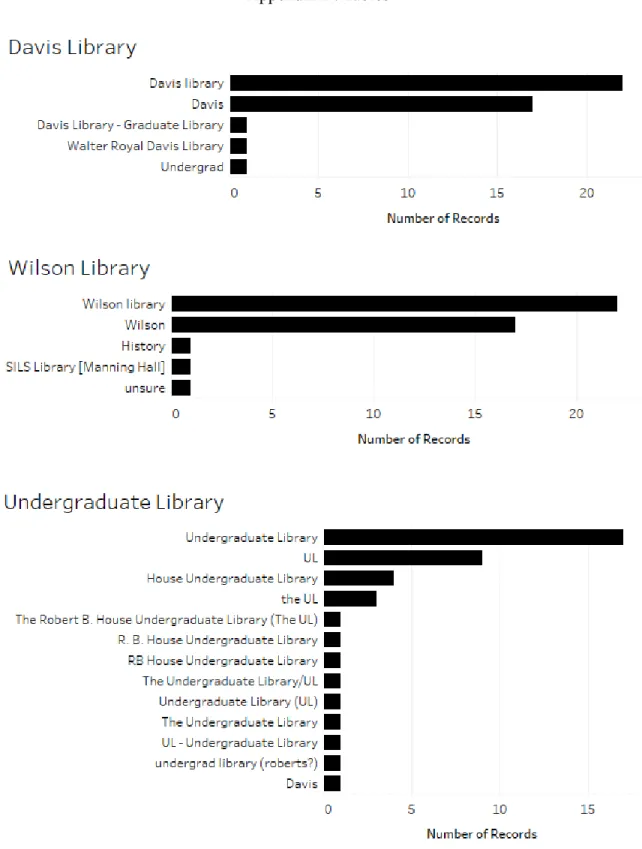
Library buildings and names. In three of these questions, participants were shown a picture of the front of one of the three main library buildings (the UL, Davis, and Wilson) and were asked to name the library pictured. 41 of 42 participants correctly named the Undergraduate Library and Davis Library (97.6%), and 39 out of 42
participants (92.9%) correctly named Wilson Library when shown each picture. A large amount of variation occurred in the way that participants answered each question (“the UL” vs “House Undergraduate Library;” “Davis Library” vs “Davis”), but nearly all respondents were able to correctly determine which library was shown. The UL got the greatest amount of variation in responses, and Wilson got the least amount of variation in correct responses. All results for these three questions are shown in Table 1 (Appendix B).
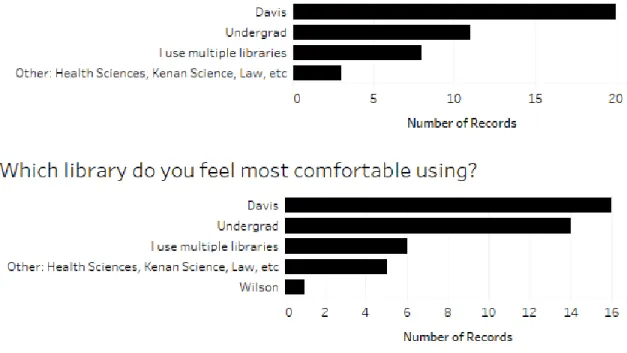
libraries but specified which they were most comfortable in in the second question. Only two survey takers indicated they used one library more often but preferred another in terms of comfort.
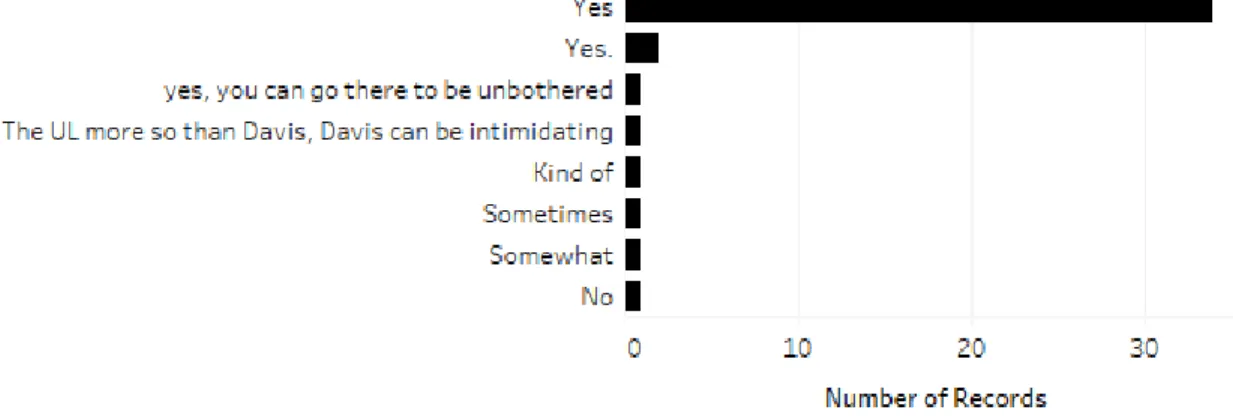
Follow-up questions asked whether or not participants considered the libraries a safe space, defined by Merriam-Webster’s Online Dictionary as a space that is “free of bias, conflict, criticism, or potentially threatening actions, ideas, or conversation” (n.d.), and whether or not participants considered the libraries a welcoming space. In both cases, the majority of responses were positive. Thirty-nine (92.9%) undergraduates wrote that they did consider the libraries a safe space, with the other three either writing a mostly positive response (“yes although…”), a neutral response (“somewhat”), or a negative response (“no, it's just a place for silence or group study sessions”). Thirty-seven
undergraduates (88.1%) also wrote that they considered the libraries a welcoming space, and responses that were not simply positive included neutral answers (“kind of,”
“sometimes,” “somewhat”), singling out one library over another (“The UL more so than Davis, Davis can be intimidating”), and one negative response (“no”). Responses to all four questions are contained in Table 2 and Table 3.
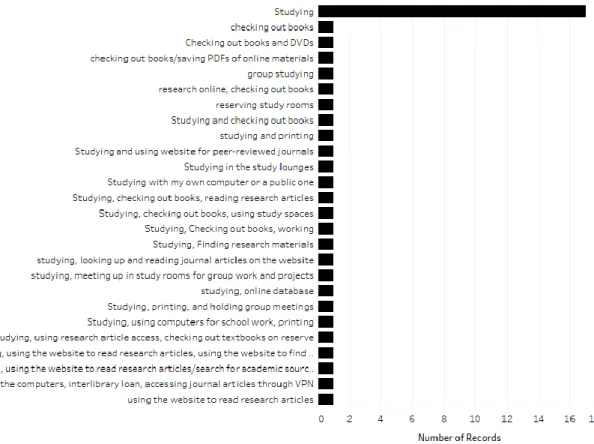
Library activities and use. After answering questions about library resources and services (discussed below), participants were asked to indicate which activity or activities best described their time spent in campus libraries. All answers, once coded, related back to the general concept of studying, whether explicitly (“studying”) or implied (e.g. “checking out books,” “reading research articles”). Activities are shown in Table 5.
Collections, librarians, and policies. Participants were given the chance to answer six true/false questions: four about library policies, one specifically about
librarians, and one about library collections. All respondents, or 100%, answered the first correctly, stating that their OneCards, or UNC student ID cards, were indeed their library cards. All respondents also answered correctly that the library collections were not restricted to items that were old or out of date. From there, however, opinions began to differ.
Most people were aware that the libraries were open to the public, but a handful were not sure. And the last, which asked if there was a rule that dictated levels of quiet based on floor level in the libraries, was a mix: 33 thought this was true, nine identified it as false. A few were unsure about who was allowed in each library (were students who were not enrolled in the Law School permitted to use the Law Library): another nine thought this was true, while 33 argued it was false. The question about librarians asked whether there was more than one librarian in a given campus library: 18 said yes; 24 said no. All results are shown in Tables 6 and 7.
of responses were coded into several themes: the library as a community, the library as a building, the library as a place of quiet or silence, the library as a study area, and the library as a place of rules.
The library as a community and the library as a building. Many of the open-ended answers in these questions and throughout the survey fell into two categories: one where the “library” was perceived as a community, certain type of environment, or group of individuals, and another where the “library” was perceived as a physical building. Ex-amples of the first included students who stated they liked that the library was a “commu-nity (can ask people to watch your stuff while you grab food so you don't lose your table) and calming,” those who found the library had a “warm and studious atmosphere” and praised the “helpful and knowledgeable librarians and staff,” but also those who were concerned that the environment of the library “can be intimidating,” and one student who said that “Davis [was] imposing.” Examples of the second (the library as a building as opposed to an environment or group of people) included location and amenity complaints like “most are not open late enough; need more colour printers; mire [sic.] libraries to-wards South campus” and “can be loud, not very up to date/renovated” but also delight at the resources available in the building; many mentioned the availability of “study rooms and book rentals” as a positive thing. There was praise for the “Quiet work spaces” and simultaneous dismay at the silence of the library: “too quiet (studying with a friend is nearly impossible without a group study room booked),” as well as the remarks that took in both (“Davis is either too loud or to quiet, no in between”). Interestingly, both groups were fairly evenly distributed throughout the results.
preferences for activities in the library (which they practiced most), many participants talked about the library as an area to study or focus in both positive and negative terms. One person noted that their negative impressions of the library were tied to “midterms and finals.” Another lamented the lack of variety of type of study room in Davis, and a third asked for better “lighting to study in some areas” but did not specify which area of the library. However, study areas were also a part of the positive feelings students had about the library: “dedicated study time,” “good study environment,” and more. This is in league with the findings that nearly 70% of undergraduates found the ability to reserve a study room or area “useful,” which is discussed later.
The library as a quiet place. Many students talked in positive, negative, and neu-tral terms about the silence in the library (or lack thereof). One student mentioned they enjoyed the “peacefulness” of the quiet library atmosphere. Many made reference to their primary use of the library (studying) by talking about the library as a “Quiet place to study,” or “quiet place to get work done,” or as a provider of “quietness to focus.” Others who discussed silence in their negative impressions of the library often mentioned the lack of silence from others – “can be too loud,’ “aren’t entirely silent (HSL and Under-grad).” Next to mentions of studying or working, quiet or silence in the library was the second most mentioned theme.
work. A few participants said that it was good that in the libraries one “can choose level of quietness” to best suit one’s needs, which shows that they believe there are rules about types of noise in the library. Another similar response was that of an undergraduate who wrote that they “can’t talk much, can’t be loud” in the library, which seems to state that if they are not silent, some consequence would occur. The rest of the responses pertained to the hours of the library (“most are not open late enough”).
Knowledge and Use of Library Resources and Services
Results were mixed for the series of questions that asked about the usefulness of various services/resources the libraries offer and about participants’ level of confidence in using them. Eight resources and services were identified:
borrowing physical materials (such as books or DVDs),
meeting with a librarian for a research consultation,
using e-resources (such as library databases),
borrowing and/or using other library technology or equipment (such as computer chargers or library software),
using Interlibrary Loan,
reserving a study room or study space,
using citation functions on the library website, and
using a course guide or LibGuide.
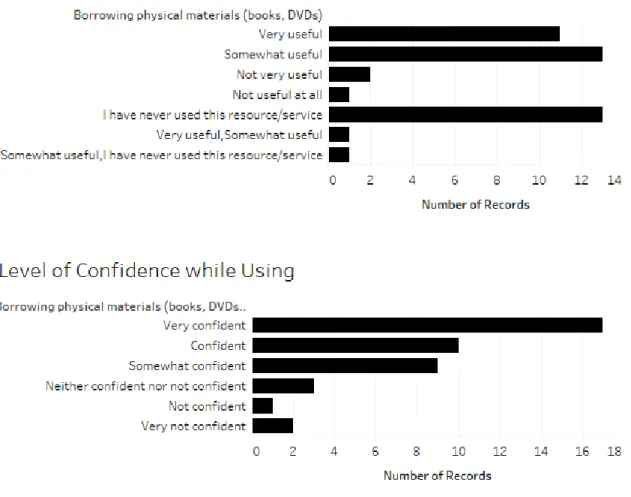
Borrowing physical materials. Thirteen participants (about 31%) replied that they found the fact that they could borrow books and other items from the UNC libraries “somewhat useful,” while another 33.3% (14 individuals) said that they “had never used this resource/service.” A slightly smaller amount (11, or 26.2%) responded that this service was, in fact, “very useful” to them and to their studies. These results are shown in Table 8. Interestingly, out of the 14 undergraduates who wrote that they had never
borrowed print or other physical materials from the libraries, nine indicated that they still felt “somewhat confident,” “confident,” or even “very confident” in their ability to use that same service. Most users (40.5%), regardless of their response to whether or not they considered borrowing books useful or not, wrote that they were “very confident” in their ability to find and read materials.
Meeting with a librarian for a research consultation. Only a handful of undergraduates (14 out of 42) reported that they considered research consultations “very useful” or “somewhat useful” – many more (50%) had never used the service. Another 11% was unaware the libraries offered such a service. Percentages were fairly evenly split among levels of confidence in using this service: 21.4% said they were “confident” in doing so, but another 21.4% said they were “neither confident nor not confident.” A slightly smaller 19.1% indicated they were “not confident” in using such a service. Of the half who reported they had never used the service, 20 individuals wrote that they were either neutral (“neither confident nor not confident”) in confidence level or had doubts about their confidence in using this service. Results are shown in Table 9.
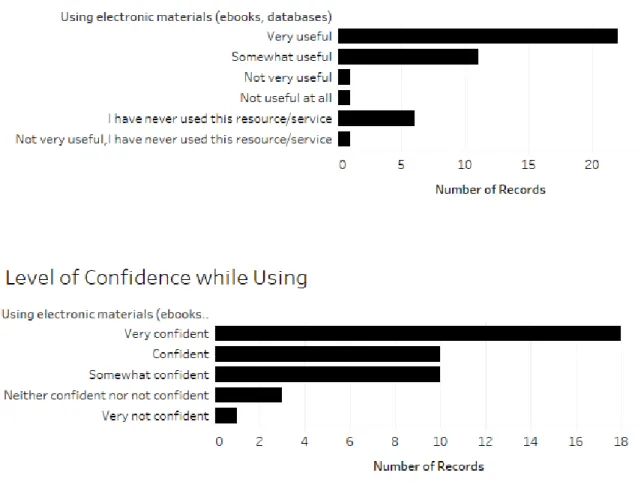
useful.” Only seven had “never used” this service, and the remaining two considered this “not very” or “not at all” useful to them and to their studies. Thirty-eight people wrote they were varying levels of “confident” in their ability to use this service, and nearly all (6 of 7) those who wrote that they had never used e-resources were confident enough in their ability to use them – only one wrote that their level of confidence was anything less than “somewhat confident.” These results are shown in Table 10.
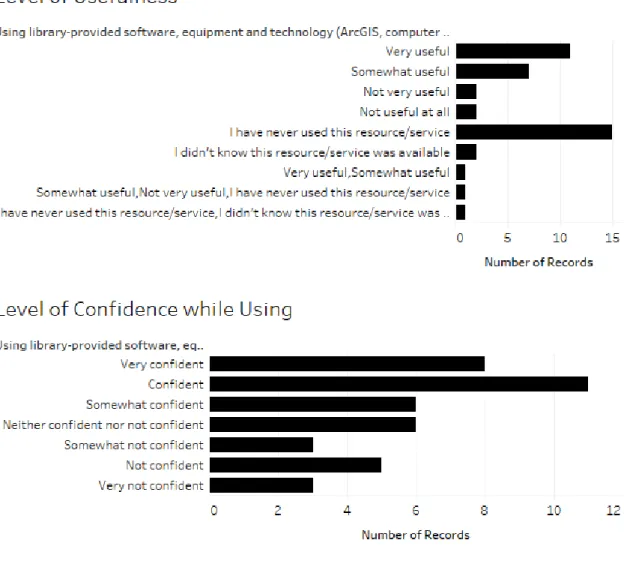
Other library technology, equipment, or software. This was a broad category, with examples of library technology like “3D printing” or examples of software like “ArcGIS” embedded in the question (see Appendix A for this and other survey questions). However, 12 participants still said it was “very useful” to them, and nine said it was “somewhat useful.” On the other hand, 17 students (40.5%) reported never having used it. Of these, four said they were confident in some way in their ability to use this service; the rest said they were neutral about their ability or had moderate to severe doubts about their ability to use this service. Still, just over half (22 out of 42) said they were confident in using library technology and equipment themselves. Results are depicted in Table 11.
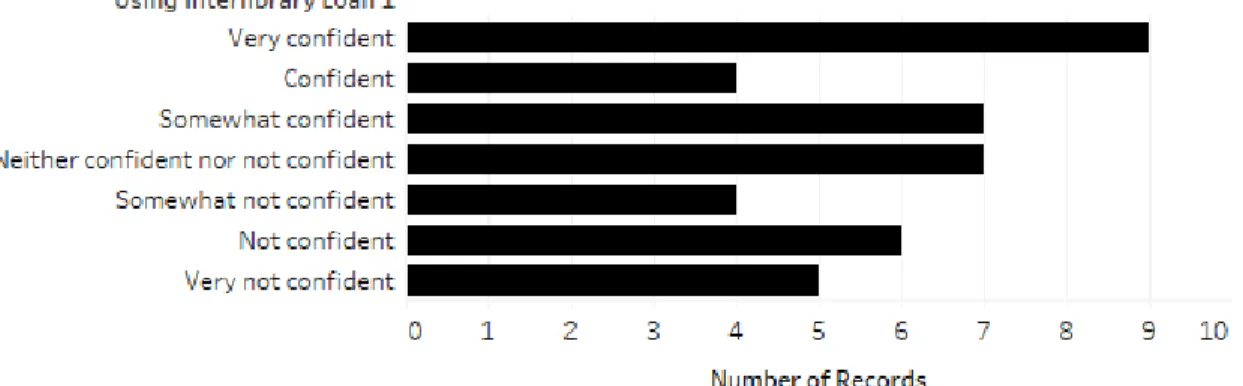
Interlibrary loan. Few people said they had used Interlibrary Borrowing
Reserving study areas. The popularity of study rooms is hardly surprising, since so many students put it as their top library activity. 69.1% of participants said the ability to reserve study rooms or study cubes was “very useful.” This corresponds with the 71.4% who were “very confident” in their ability to reserve an area of the library for their own studying. These results are shown in Table 13.
Using citation functions on the library website. The library website and catalog contains a Citation Builder, which some undergraduates rated as “very useful” (8 out of 42), but more (16 of 42) said they had never used and another seven did not know existed. Of those 23 who either hadn’t used or didn’t know about the citation builder service, 65.2% said they were not confident in their ability to use this tool. These results and others are displayed in Table 14.
Discussion
The majority of participants showed they used the library to study, and used a variety of services/resources in different ways. Nearly all participants said they felt safe and welcome in the UNC libraries, and nearly all reported that they used the library that they felt the most comfortable in. Most said and proved that they were moderately to well familiar with the libraries themselves, though this was shown to be understood very differently with regard to the wide range of services the libraries offer. Curiously, of the three participants who made a mistake in identifying each main library building (either by typing “unsure” in the name box or giving a different library name entirely), two of them explained that they nevertheless considered themselves “very well” informed about the UNC libraries (the third acknowledged that they were “not well at all” informed). Perceptions Affecting Use
the most-used library activity, the accompanying popularity of study rooms above all else is hardly surprising. Although some undergraduates found the diverse services the UNC libraries offer very useful, many more were still unsure of them. However, this may be due to the fact that undergraduates (particularly those in their first year of college) might not have had the chance to take advanced classes which would necessitate the discovery and use of these services.
Other instances of perceptions affecting use include students frequenting those campus libraries that they felt comfortable in. Interestingly, only two students said that there was a difference between the library they used the most often (both said Davis) and the library they were most comfortable in (Undergrad). One of them explained that they found “the UL more [welcoming] than Davis, Davis can be intimidating,” but did not explain why they held Davis in this light.
The library as a place of community comes across as an encouraging note. Some participants talked about a love of the quiet in the library, of the library environment (“calming,” “warm and studious atmosphere”), and/or an appreciation of the people who work in the library (“helpful and knowledgeable librarians and staff”). Even though many students seemed to both enjoy that the library was there to help them manage their
coursework, many of the same students seemed to only associate the library with the woes of studying. Nevertheless, the fact that students identified a few rules about the library of their own accord is telling. Although there is no library policy that asks for the upper levels of the building to be quieter than the lower, several patrons discussed this in the open-ended questions and identified it as a correct statement in the true/false
all ways in which students make the library theirs while using it and also make others aware that it is a community space. Browndorf (2014) discusses the benefits of this idea of psychological library ownership and how it can contribute to student engagement in the libraries. Regardless, students seem comfortable using the libraries in their own way, whether or not they are aware of everything that is happening behind the scenes.
Librarians in the Library
There was some uncertainty about the duties of a librarian; again, 11% of undergraduates were not aware that librarians held research consultations and 50% had never availed themselves of the service. Coupled with the confusion in the statement “each campus library has one accompanying librarian” (42.9% thought this was correct, but 57.1% correctly identified it as false), it is clear that, as Datig (2014) and Fagan (2003) showed, more work needs to be done to communicate to students and patrons what a librarian’s role in the library is.
Implications
unspoken rule of not speaking too loud in the library. In this manner, students would benefit from increased study space and increased variety in study space, and librarians would benefit by helping their patrons better achieve their library goals.
If some students dislike the fact that they are stuck in the library studying, perhaps some of the study areas could be designated group study areas with the addition of a sign or a whiteboard. Librarians could let students lead study groups and advertise for
different courses and exam study sessions. A smaller version of this is already active in the libraries: there are movable whiteboards in Davis that small groups sometimes use for group review sessions. Some of the study rooms in Davis and many in the UL have whiteboard where students can write and work together, but the library community students spoke of in their responses might be better fostered through the provision of larger study areas in this design.
It is clear that students do not have the whole picture of UNC’s university
libraries and their services, but given their responses it seems that the majority of students function well in the libraries even without it. Students who said that they had never borrowed a book or other item from the libraries nevertheless wrote that they were still fairly confident in their ability to do so (presumably without the help of a librarian or staff member). This bodes well for user-driven library discovery, but services and resources that do not have a presence in the public area of the library (for example, research consultations are often held in offices, and while Interlibrary Borrowing has a welcoming sign on their office door, it is still located in an easily missed area) could still remain hidden. The libraries would do well to better market their services to
Limitations
This study had several limitations. Fewer people responded to the survey than expected, resulting in low response rate. Of the 18,523 undergraduates enrolled in fall 2016 (UNC Office of Institutional Research and Assessment, 2017), the barest fraction of them answered either of the two recruitment messages. It is also possible that those who did respond were more likely to hold the library in high regard than those who did not.
The survey itself also contained questions that could have been better explained or answer choices that offered too much explanation. Many of the survey questions asked participants to rank their level of interest or use of services in the libraries. With different scales in choice (one offered four different levels: “very useful,” “somewhat useful,” “not very useful,” and “not at all useful” as well as alternative options: “I have never used this resource/service” and/or “I did not know this resource/service existed”; another offered seven options for confidence), it is possible that participants were given too much choice and found it difficult to respond. The questions about use and confidence in use also did not provide an escape for participants who had already indicated that they had never used a given service. Regardless of choice, the survey then required them to rate how
confident they were in using that service. Although this provided some interesting answers, better wording could have given participants who had never used a service the option to skip the later question about confidence.
Questions for Future Research
Conclusions
Following the understanding that perceptions affect use, academic libraries around the country are working to ensure the voices and opinions of their patrons are heard, understood, and incorporated into library practice. This is particularly important for undergraduate students, for whom an understanding of libraries and research is crucial for success in college. The UNC student body and libraries are no different. This online survey was conducted of undergraduates at UNC to better understand what they thought of the libraries and how they used them. Although there was a low response rate, it found that most students use the library for studying, have a generally neutral to good
References
Ackermann, E. (2015). Putting assessment into action : selected projects from the first cohort of the Assessment in Action Grant. Chicago, Illinois: Association of College and Research Libraries.
American Library Association. (2017). Social Role of the Library. Retrieved October 10, 2017, Retrieved from
http://www.ala.org/tools/research/librariesmatter/taxonomy/term/143
Assessment and User Experience Department. (2016). 2016 Student Survey | Duke University Libraries. Retrieved September 24, 2017, from
https://library.duke.edu/about/depts/assessment-user-experience/student-survey
Belanger, J., Faber, M., Hiller, S. (2017). University of Washington Libraries 2016 Triennial Survey Report. Retrieved from
https://digital.lib.washington.edu/researchworks/handle/1773/39170.
Browndorf, M. (2014). Student Library Ownership and Building the Communicative Commons. Journal of Library Administration, 54(2): 77-93.
Datig, I. (2014). What is a Library?: International College Students’ Perceptions of Libraries. Journal of Academic Librarianship, 40(3–4), 350–356.
https://doi.org/10.1016/j.acalib.2014.05.001
Dempsey, P., & Jagman, H. (2016). "I Felt Like Such a Freshman": First-Year Students Crossing the Library Threshold. Libraries & The Academy, 16(1),
De Rosa, C., Cantrell, J., Cellentani, D., Hawk, J., Jenkins, L., & Wilson, A. (2005). Perceptions of Libraries and Information Resources. Retrieved from
http://www.oclc.org/reports/2005perceptions.htm
Dillman, D. A., Smyth, J. D., & Christian, L. M. (2014). Internet, phone, mail, and mixed-mode surveys : the tailored design method. Retrieved from
https://ebookcentral-proquest-com.libproxy.lib.unc.edu
Emmons, M., & Wilkinson, F. C. (2011). The Academic Library Impact on Student Persistence. College & Research Libraries, 72(2), 128–149.
https://doi.org/10.5860/crl-74r1
Fagan, J. (2003). Students’ Perceptions of Academic Librarians. The Reference Librarian, 37(78), 131–148. https://doi.org/10.1300/J120v37n78_09
Head, A. J. (2013). Learning the Ropes: How Freshmen Conduct Course Research Once They Enter College. SSRN Electronic Journal, 1–35.
https://doi.org/10.2139/ssrn.2364080
Keer, G., & Carlos, A. (2015). The Stereotype Stereotype. Retrieved September 24, 2017, from https://americanlibrariesmagazine.org/2015/10/30/the-stereotype-stereotype/.
Kim, J.-A. (2017). User Perception and Use of the Academic Library: A Correlation Analysis. The Journal of Academic Librarianship, 43(3), 209–215. doi:10.1016/j.acalib.2017.03.002
Mellon, C. (1986). Library Anxiety: A Grounded Theory and its Development. College & Research Libraries, 47(2), 160-165.
Menchaca, F. (2014). Start a New Fire : Measuring Learning. Libraries and the Academy, 14(3), 353–367. https://doi.org/10.1353/pla.2014.0020
Munde, G., & Marks, K. (2009). Surviving the future : academic libraries, quality, and assessment. London: Chando Pub.
Murphy, S. A. (2014). The quality infrastructure : measuring, analyzing, and improving library services. Chicago: American Library Association.
Oakleaf, M. (2010). Value of Academic Libraries: A Comprehensive Research Review and Report. Chicago: Association of College and Research Libraries. Retrieved from http://www.ala.org/acrl/sites/ala.org.acrl/files/content/issues/value/val_report.pdf
OCLC (2010). Perceptions of Libraries, 2010: Context and Community. A Report to the OCLC Membership. Retrieved September 17, 2017, from
http://www.oclc.org/en/reports/2010perceptions.html
Principato, A. (2017). Perspectives on Presentation and Perception of UNC Libraries on Admissions Campus Tours (master’s paper). University of North Carolina at Chapel Hill, Chapel Hill, North Carolina.
Safe Space. (n.d.) In Merriam-Webster’s Online Dictionary. Retrieved from
https://www.merriam-webster.com/dictionary/safe%20space.
UNC Office of Institutional Research and Assessment. (2017). Fact Book, 2016-2017. Retrieved from https://oira.unc.edu/files/2017/08/Fact-Book-16-17_20170828.pdf
Whitmire, E. (2006). African American Undergraduates and the University Library. The Journal of Negro Education, 75(1): 60-66.
Wildemuth, B. M. (2017). Applications of social research methods to questions in information and library science. Santa Barbara, California: Libraries Unlimited.
Xie, J., & Sun, L. (2015). Exploring Chinese Students' Perspective on Reference Services at Chinese Academic Libraries: A Case Study Approach. The Journal of Academic Librarianship, 41(3): 228-235.
Appendix A: Survey Instrument
Library Survey
Welcome to the UNC library survey! This is a research study (IRB 17-3170, reviewed on 2/12/18), the purpose of which is to better understand the perceptions undergraduates have about the libraries here on campus. You will be asked several multiple-choice and open-ended questions. The survey will take around 10-15 minutes to complete.
Your participation in this survey is entirely voluntary. You may decide to stop taking the survey at any time. You may also choose to not answer any questions you do not wish to answer.
Answers are anonymous, and no identifying information will be collected, save an email address at the end if you would like to be entered in a drawing for a $25 Amazon gift card. Email addresses will not be attached to other response data in any way, and they will not be saved after the drawing is finished.
If at any time you feel that you are not comfortable continuing the survey, simply exit the instrument. Answers will be saved only at the submission of the survey, at the very end. If you have questions, comments, or concerns, you may contact the principal investigator at [email protected] or speak to the IRB directly at 919-966-3113.
Participation is limited to individuals who are at least 18 years old. If you are younger than 18, please stop now.
Please indicate whether you are:
o
18 years old or older. (1)o
Under 18. (2)Please indicate whether you are:
1. The following is a picture of one of the libraries on campus, taken of the front of the library building. Please write the name of the library under the appropriate picture. If you are not sure which library is pictured, please type "unsure" or leave the box blank.
Which library is pictured above?
________________________________________________________________
2. The following is a picture of one of the libraries on campus, taken of the front of the library building. Please write the name of the library under the appropriate picture. If you are not sure which library is pictured, please type "unsure" or leave the box blank.
Which library is pictured above?
3. The following is a picture of one of the libraries on campus, taken of the front of the library building. Please write the name of the library under the appropriate picture. If you are not sure which library is pictured, please type "unsure" or leave the box blank.
Which library is pictured above?
4. Of the libraries pictured on the previous pages, which do you use the most often?
o
Davis (1)o
Undergrad (2)o
Wilson (3)o
Other: Health Sciences, Kenan Science, Law, etc (4)o
I use multiple libraries (5)o
I don't use any of the libraries (6)5. Of the libraries pictured on the previous pages, which do you feel the most comfortable using?
o
Davis (1)o
Undergrad (2)o
Wilson (3)o
Other: Health Sciences, Kenan Science, Law, etc (4)o
I use multiple libraries (5)o
I don't use any of the libraries (6)6. How well informed do you feel about the UNC libraries and the services they offer?
o
Extremely well (1)o
Very well (2)7. Do you consider the libraries to be a safe space?
________________________________________________________________
8. Do you consider the libraries to be a welcoming space?
________________________________________________________________
9. Please list two positive associations with the UNC libraries.
________________________________________________________________
10. Please list two negative associations with the UNC libraries.
________________________________________________________________
11. The following are resources and services offered at the UNC libraries. Please indicate their level of usefulness to you and your studies.
Level of Usefulness Very useful (1) Somewhat useful (2) Not very useful (3) Not useful at all (4)
I have never used this
resource/service (5)
I didn't know this
Borrowing physical materials (books, DVDs) (1)
▢
▢
▢
▢
▢
▢
Research Consultations (meeting with a librarian to discuss research) (2)▢
▢
▢
▢
▢
▢
Using electronic materials (ebooks, databases) (3)▢
▢
▢
▢
▢
▢
Using library-provided software, equipment and technology (ArcGIS, computer chargers, 3D printers) (4)▢
▢
▢
▢
▢
▢
Using a library guide to a subject or course (5)Reserving a study room/cube to study (8)
▢
▢
▢
▢
▢
▢
12. The following are resources and services offered at the UNC libraries. Please indicate how confident you are in navigating the given resource or using the given service.
Borrowing physical materials (books, DVDs) (1)
o
o
o
o
o
o
o
Research Consultations (meeting with a librarian to discuss research) (2)
o
o
o
o
o
o
o
Using electronic materials (ebooks, databases) (3)
o
o
o
o
o
o
o
Using library-provided software, equipment and technology (ArcGIS, computer chargers, 3D printers) (4)
o
o
o
o
o
o
o
Using a library guide to a subject or course (5)
o
o
o
o
o
o
o
Using Interlibrary Loan (6)
o
o
o
o
o
o
o
Using the library website’s citation builder (7)
Reserving a study room/cube to study (8)
o
o
o
o
o
o
o
13. Please indicate which library activities best describe your interaction with the library (studying, checking out books, using the website to read research articles, etc):
Please indicate whether the following library-related statements are true or false, to the best of your knowledge:
14. My OneCard is my UNC library card.
o
True (1)o
False (2)15. The UNC Libraries are open to the public.
o
True (1)o
False (2)16. The branch libraries (for example, the Law Library) on campus are reserved for students enrolled in that program and/or school.
o
True (1)o
False (2)17. The libraries only keep old books on the shelves, nothing current or new.
o
True (1)o
False (2)18. Each campus library has one accompanying librarian.
o
True (1)o
False (2)19. In each campus library, as you climb the stairs to higher floors, there should be increased levels of quiet.
Thank you for your answers!
If you would like to be entered in a drawing for a $25 Amazon gift card, please select "yes." This will take you to a new Qualtrics page that will ask you to submit an email address. The only thing the email addresses will be used for is randomly selecting a gift card winner, after which all addresses will be deleted.
20. If you would rather not be entered in the drawing, and/or you would prefer not to submit an email address, please select "no."
Appendix B: Tables
Table 3. Responses showing whether or not participants perceive the libraries as a safe space and as a welcoming space.