A REVIEW OF CURRENT PROGRAMS
AND RECOMMENDATIONS FOR STATE GOVERNMENTS
by
Transportation: A Review of Current Programs and Recommendations for State Governments. (Under the Direction of Dr. Richard N.L. Andi ews)
This report describes national problems associated with highway shipments of hazardous materials and hazardous wastes, evaluates the federal role in regulating these shipments, and
identifies regulatory and enforcement methods which may be used by state officials to improve the
safety of shipments moving through their state. Limitations in the federal regulations and
enforcement practices are outlined, and current state regulations and enforcement activities are reviewed. Legal restraints on state regulatory programs are then examined, particularly in regards to the U.S. Department of Transportation's preemptive powers. A description of feasibleoptions for regulating hazardous chemical shipments follows. These options include the permitting
and registration of hazardous materials and hazardous waste transporters, the use of computerized
data management systems for managing transporter information, and the coordination of
regulatory and enforcement activities with intrastate and interstate agencies. Other recommended
actions are the establishment of driver training and certification programs, the designation of
hazardous chemical routes, and the assessment of stiff penalties to violators of the transportation
I. INTRODUCTION I
II. PROBLEM IDENTIFICATION 3
III. THE FEDERAL ROLE
The U.S. Department of Transportation 7 The U.S. Environmental Protection Agency 9
IV. LIMITATIONS IN THE U.S. DOT REGULATIONS 12
STATE REGULATORY PROGRAMS 21
Registration, Permits, and Licenses 27 Financial Responsibility 32 Emergency Response 34
Prenotification 38
Routing 39 Vehicle Marking 42 Driver Training 45
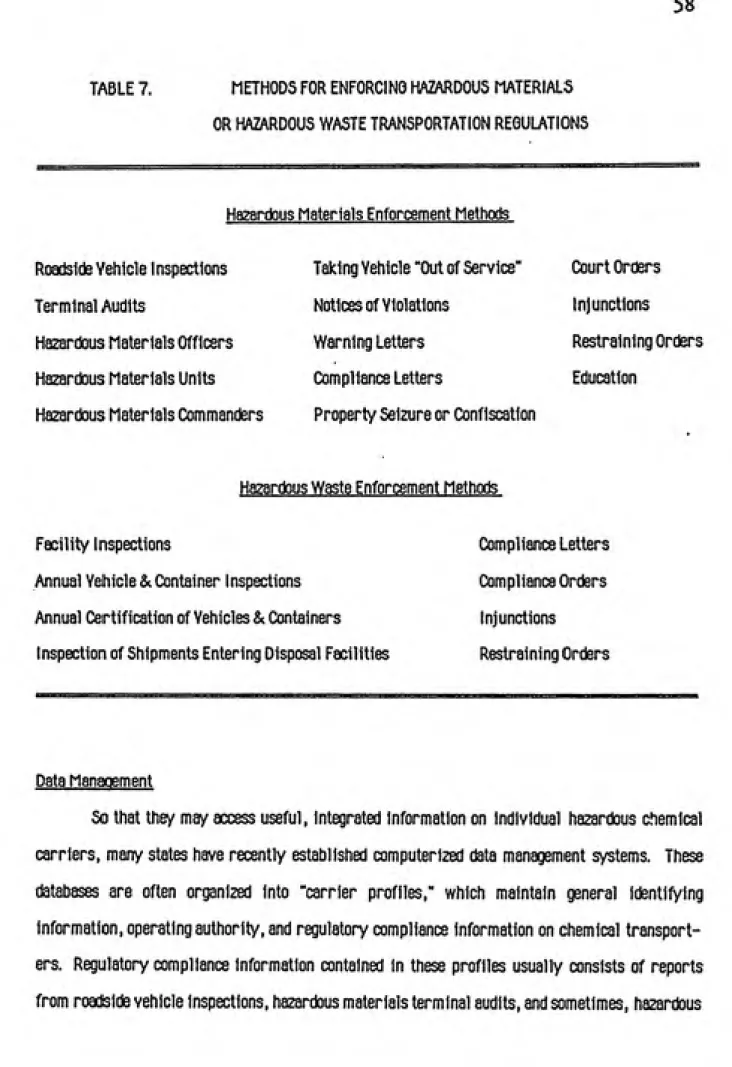
VI, STATE ENFORCEMENT PROGRAMS 52 Enforcement Methods 54 Data Management 58
Penalties 60 Coordination 65 Funding 70
VII. FEDERAL PREEMPTION OF STATE AND LOCAL REGULATIONS 74 Hazard Class Definitions 80 Packaging Requirements 81
Hazard Communication 81
Shipping Dxuments 82 Emergency Response 83 Incident Reporting 83 Shipment Routing 84
Restricted Shipment Hours 90
Shipment Bans 90
Financial Responsibility 91
Penalties 92
VIII. SUMMARY 93
IX. RECOMMENDATIONS 97
X. CONCLUSION 109
NOTES
BIBLIOGRAPHY
APPENDIX A - U.S. DOT Hazard Classification System for Hazardous Materials
Meeting the Definition of More Than One Hazard ClassAPPENDIX B - State Regulations for the Transportation of Hazardous Materials
and Hazarckjus WasteAPPENDIX C - Fecteral Financial Responsibility Requirements for Highway Motor Carriers
APPENDIX D - State Enforcement Programs for the Transportation of Hazarctous
Materials and Hazardous WasteAPPENDIX E - U.S. Department of Transportation Rulings on State Regulations
for Hazardous Materials TransportationAPPENDIX F - Flow Sheet for Testing Acceptability of State or Local Hazardous
Materials Transportation R^ulationsAPPENDIX G - Criteria for Determining if Preemption of an Inconsistent
Regulation May Be Waived By A Non-Preemptive Determination
Table
1 Regulatof7 Authority of State Agencies Surveyed 25
2 Number of States Which Require Registration, Permitting, or 29
Licensing of Ha^rdous Materials or Hazardous Waste Transporters
3 Emergency Response Requirements for Hazardous Chemical Transporters 37
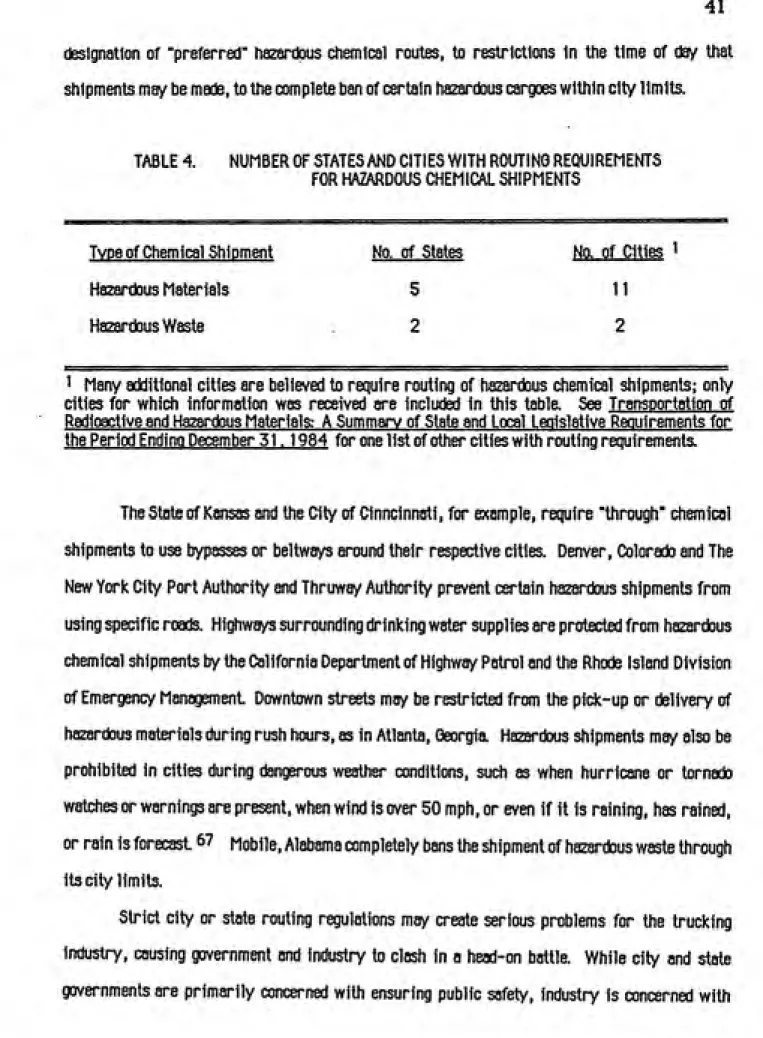
4 Number of States and Cities with Routing Requirements for 41
Hazardous Chemical Shipments
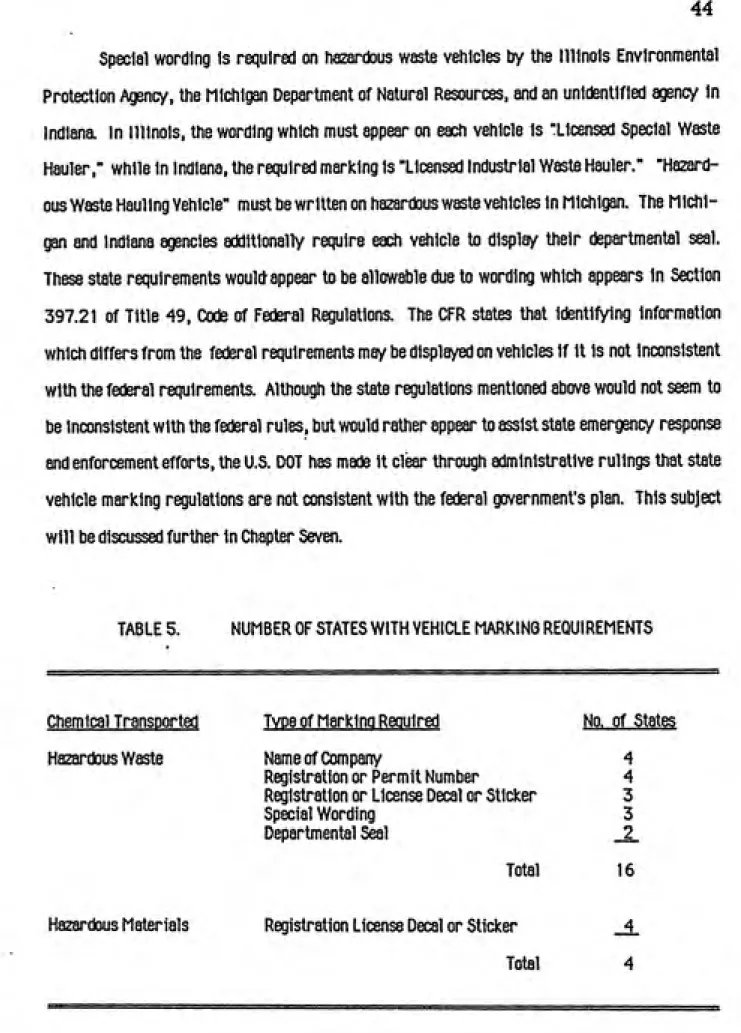
Number of States with Vehicle Marking Requirements 44
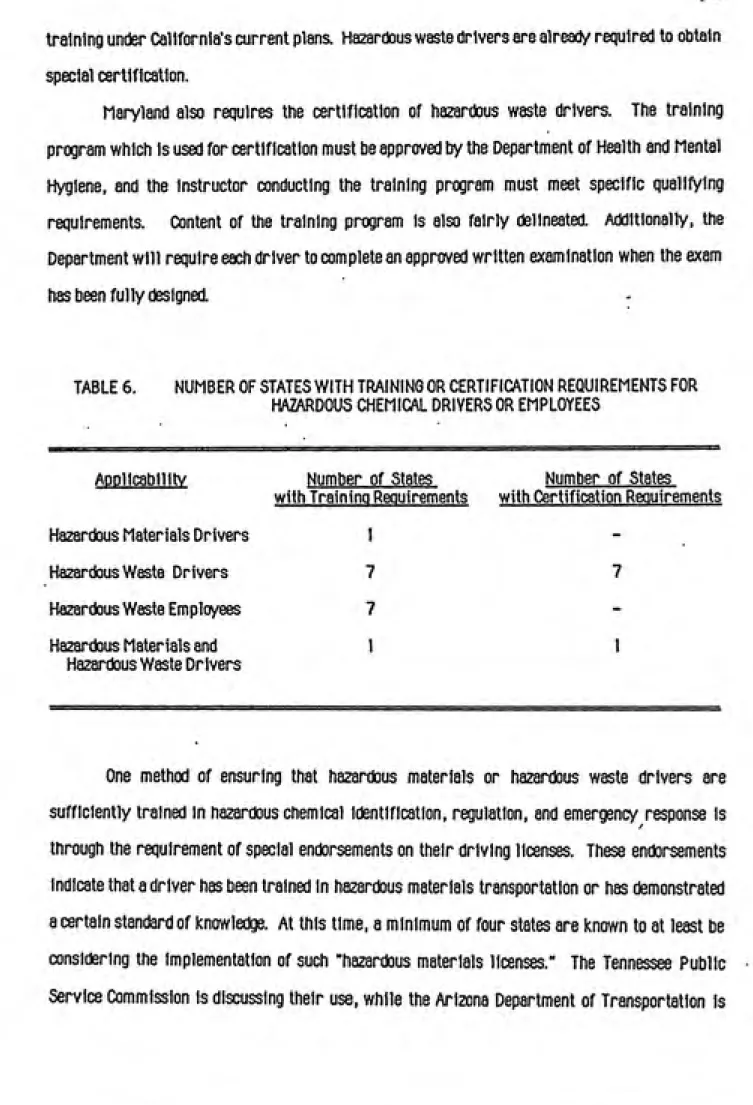
6 Number of States with Training or Certification Rajulrements for 50 Hazardous Chemical Drivers or Employees
Methods for Enforcing Hazardous Materials or Hazardous Waste 58 Transportation Regulations
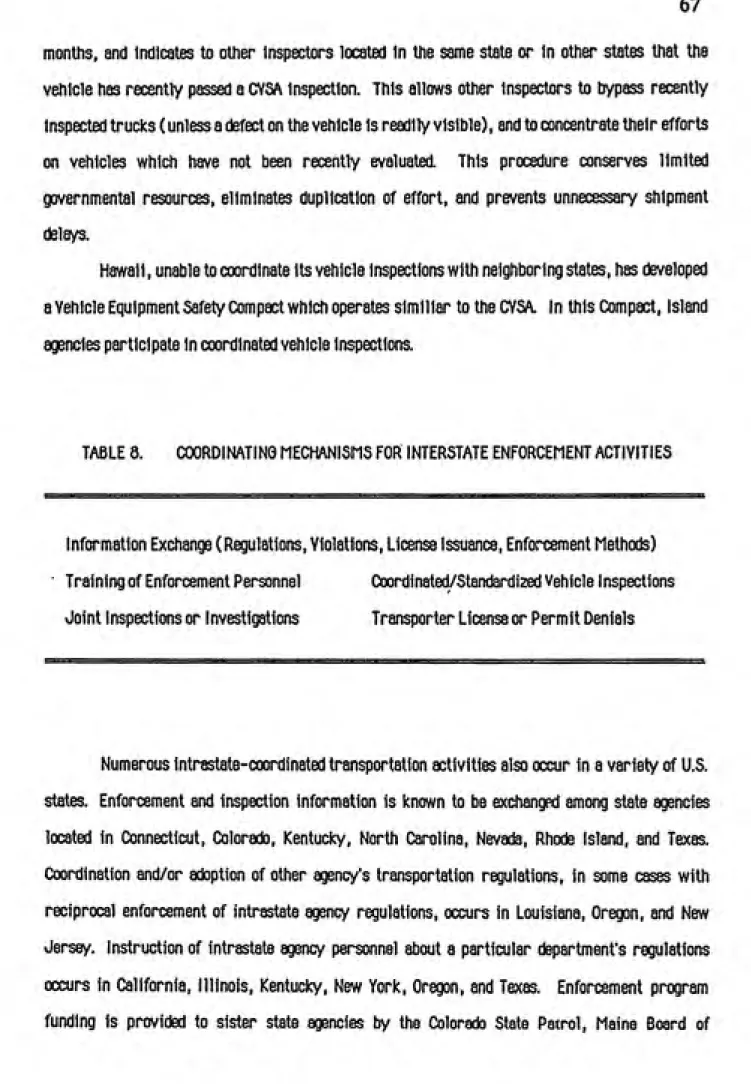
8 Coordinating Mechanisms for Interstate Enforcement Activities 67
9 Coordinating Mechanisms for I ntrastate Enforcement Activities 69
10 Coordinating Mechanisms for Federal-State Enforcement Activities 70
Numerous people provided me with valuable assistance in conducting this study and writing this report. Foremost among them is Dr. Pete Andrews, Director of the Institute for Environmental Studies and chairman of my graduate rammittee at the University of North Carolina
in Chapel Hill (UNO. Dr. Andrews contributed significant amounts of time and advice to the
study, assisted me in framing transportation problems and policy recommendations, and provided me with continual encouragement.
Special thanks also go to Mr. Phil Lee of the North Carolina Department of
Transportation, Division of Motor Vehicles, who supplied me with valuable, up-to-ttete
information on hazardous materials regulations and legislation, as well as technical assistance in interpreting and understanding federal regulatory requirements. Useful information on ha^rdous waste transportation was donated by Dr. Alvis Turner, chairman of the Environmental Management
and Protection Program at UNO.
Further, I would like to express my gratitude to the North Carolina Governor's Waste
Management Board, who asked me to conduct this stud/ and who provided funding for the project. Dr. Linda Little, Executive Director of the Board, deserves particular acknowledgment for her direction and assistance. Finally, I would like to thank my husband, Fred, who contributed
editorial and moral support throughout the entire project.
Hazardous materials transportation is a widely publicized topic which draws much public
attention and fear. Because of their catastrophic nature, hazardous chemical accidents receive a
great deal of media coverage. The prevention of such accidents, however, does not receive a
comparable amount of attention from state or federal regulatory agencies. This study was designed
to define the problems encountered in regulating hazardous chemical shipments, to evaluate
regulatory and enforcement programs currently used by state governments, and to identify the
most feasible management options which are available to states within legal and economic
restraints. Only highway shipments of hazardous chemicals are considered in this report.Information on transportation regulatory problems was compiled for this study from numerous state and federal government dxuments, as well as from the author's own experience in working with state and federal highway transportation officers. Information on Individual state regulatory and enforcement programs was obtained by sending a request for Information to
hazardous waste and hazardous materials transportation agencies across the United States.
Approximately 145 agencies were contacted, with 115 responses received between March andAugust of 1986. Information was supplied by forty-nine states and the District of Columbia.
Many unsolicited responses were additionally received due to agency referral of the Inquiry letter.
A number of informative replies by city governments resulted from such referrals.
Legal restraints on state and city highway transportation programs were identified by
shipments, with a description of some of the contributing factors. The role played by the U.S.
Department of Transportation and the U.S. Environmental Protection Agency (EPA) in managing
hazardous chemical shipments is explained In Chapter Three; Chapter Four outlines deficiencies in the DOT regulations.
Information on state and local regulatory programs appears in Chapter Five, with a
description of regulatory requirements listed by topic within Individual subchapters. A
compilation of these regulatory requirements, by state, is also provided in Appendix B. Enforce¬ ment methods employed by state and local governments are organized similiarly in Chapter Six,
with Appendix D containing a listing of enforcement activities by state. Chapter Seven, "Federal Preemption of State and Local Regulations," describes the legal limitations to state regulatory and enforcement programs. A listing of DOT'S preemptive rulings is shown in Appendix E; flow charts
which reflect the criteria used by DOT in making its preemptive determinations are displayed in
appendices F and 6. Chapter Eight summarizes the regulatory and enforcement methods employed
by state and local governments, and identifl^ whether the activities are or are not acceptable to
theDOT.
Hazardous materials are ubiquitous in the United States. They are used In nearly every
industry and every home. Hazardous materials range from such common items as cleaning
compounds, paint, kerosene, batteries, and firecrackers to publicly feared items such as PCBs,
methyl isocyanate(MIC), toxic waste, and spent nuclear fuel. A hazardous material is defined by
the Transportation Safety Act of 1974 as "a substance or material which has been determined by
the Secretary of Transportation to be capable of posing an unreasonable risk to health, safety or
property when transported in commerce." These chemicals are identified In several ways. Over
2400 hazardous materials are listed in the "Hazardous Materials Tables," located In Part172.101 of the Code of Federal Regulations (CFR). Definitions for nine hazard classes are also
contained within the CFR, and any material which meets the criteria specified for a particularclass (even if it is not listed In the Hazardous Material Tables) is subject to regulation when
transported in interstate commerce. Examples of these hazard classes are explosives, compressed gases, flammable liquids, corrosives, poisons, oxidizers, and radioactive materials.Hazardous wastes and hazardous substances are also considered hazardous materials.
Hazardous wastes are discarded chemicals which pose a substantial present or potential hazard to
human health or the environment when Improperly treated, stored, or disposed of. ' H^ardous
substances are specific chemicals identified in various environmental acts as presenting
substantial dan^r to public health or the environment when they are released into the
environment. 2 Both hazardous wastes and hazardous substances are thus regulated as hazardous
materials because they may cause harm to people or the environment when spilled during
Approximately one-half of these shipments are carried by truck; m estimated 250,000 ship¬
ments travel over U.S. highways per day. 3 The U.S. Department of Transportation estimates that
at any given time, between five and fifteen percent of all trucks on the road are carrying hazardous
materials. Four hundred and thirteen thousand tank trucks alone have been identified to be
transporting hazardous materials (bulk liquids) on a regular basis. ^
An annual average of 11,462 accidents involving shipments (all modes of carriage) of
hazardous materials were reported to the U.S. DOT during the period 1973-1983. Although this
number is high, the actual rate of reported highway incidents is only 1.25 per 10,000 chemical
shipments. 5 Even with a low accident rate, then, the high volume of hazardous chemical
shipments translates into a large number of accidents. ^ Further, hazardous materials incidents
may be catastrophic in their effect, causing millions of dollars in property losses, contamination
of municipal drinking water supplies, degradation of sensitive environmental areas, or human
injury or death, "^he DOT itself states that "The potential for death, injury and property loss is
present in any [hazardous materials] incident - no matter how small it may be." 7
Costs associated with hazardous materials transportation accidents have been reported to
average $ 10,000 per event. 8 Annual average damages for hazardous materials incidents which
were reported to DOT between 1973 and 1983 equalled $13 million (all transportation modes),
but this figure is considered low by a factor of as much as 10 5 due to the fact that not all accident
costs are reported. 5 Additionally, DOT's hazardous materials incident statistics do not include
chemical releases by intrastate carriers, nor spills of paint, batteries, or certain types of
consumer goods. The Department's national analyses of hazardous materials incidents are thus
believed to result in a low estimate of accident occurrence and annual property damage.
The number of transportation accidents involving a particular hazardous material
generally corresponds to the number of shipments made per year. For example, petroleum based
products, the most frequently transported hazardous materials in the United States, account for
Flammable liquids and combustible liquids, the hazard classes for petroleum products, accounted
for 66.7 percent of Oregon spills in 1984. ** In Illinois, flammable liquids were found to be
involved in fifty percent of the highway accidents reported to the U.S. DOT; these liquids
corresponded to approximately fifty percent of the hazardous materials shipped within the state.
'2 Furthermore, Illinois discovered that bulk shipments accounted for the most injuries and
accidents involving the public. This finding Is not surprising, considering that 413,000 tank
trucks are estimated to be travelling U.S. highways daily. ^ Additionally, many of these trucks
operate in close contact with the public when they travel city streets to deliver chemical
shipments (for instance, gasoline) to local businesses.
The number of highway incidents may also be influenced by the type of motor carrier
which transports hazardous chemicals. According to Frank Holscher, Chairman of Thurston Motor
Lines in Charlotte, North Carolina, and former president of the North Carolina Motor Carrier
Assalation, the majority of trucking accidents are caused by unsafe vehicles operated by
Independent, for-hire truckers who cannot afford proper vehicle maintenance. ^^ Bill Hawkins,
U.S. DOT in Raleigh, North Carolina, agrees. He reported in a March 1986 conversation with the
author that it is companies who operate on narrow profit margins which pose the greatest safety
problems in hazardous materials highway transportation. The tighter the company's profit
margin, he explained, the less likely it is for the company to comply with driving or vehicle safety
requirements. This can result in serious consequences: trucking companies with records of
serious fateral safety violations have recently been found to have three times as many accidents
per mile travelled as companies with good compliance records. ^"^
The broader class of interstate, for-hire carriers has also been implicated in a majority
of highway accidents. A 1980 Department of Transportation table of hazardous materials incidents
reveals that for-hire carriers have been involved in over thirty times more hazardous materials
accidents than private highway carriers. ^5 a recent computer analysis of national truck accident
differing statistics. In Oregon, accident rates per million miles of highway driven were found to
be nearly identical for intrastate and interstate for-hire carriers. '^ In Illinois, private
intrastate carriers were involved in three-fourths of the hazardojs materials accidents recorded
in the State even though the/ accounted for only one-third of the mileage driven. '"7 These state
reports thus conflict not only with each other but also with the national DOT statistics. One explanation for the different findings is that the type and number of incidents reported to each state may vary (for instance, some states may have more access to federal incident data on interstate carriers who are from outside of their state). Also, as mentioned earlier, intrastatecautiously-The Department of TransDortation (DOT)
The U.S. Department of Transportation Is the faJeral regulator of hazardous materials
transportation in the United States. DOT'S authority is primarily vested in the Hazarctous
Materials Transportation Act (HMTA) of 1975. The Act authorizes the Secretary of
Transportation to issue regulations gwernlng the safe transportation of hazarctous materials in
interstate commerce and in intrastate commerce as it affects interstate shipments. The HMTA also
authorizes the Secretary to regulate hazardous materials shippers and carriers (trucking
companies, airlines, etc.) and the manufacture and repair of packages and containers which will be
u^ for transporting hazardous materials. The Secretary delegates these powers to the Depart¬
ment of Transportation.One of DOT'S five administrations, the Re^arch and Special Programs Administration
(RSPA), acts as the directional and coordinating group for the Department and houses the Office of
Hazardous Materials Transportation (OHMT). OHMT is responsible for hazardous materials
transportation safety and issues the hazardous materials safety r^ulations. The Office came into
existence on November 1,1985 as a result of reorganization within the DOT. Prior to this (tete,
OHMT's functions were performed by the Materials Transportation Bureau (MTB).
materials than any other transportation mode. '0 Highway shipments have also been shown to be
responsible for over 8 times as many hazardous materials accidents than all of the other modes put
together. '8
Federal regulations which pertain to highway shipments of hazardous materials are
contained within Title 49 of the Code of Federal Regulations, Parts 399 (49 CFR,
100-399). Parts 171-199 of the CFR contain what are known as the "Hazardous Materials Regu¬
lations." These include requirements about packaging hazardous materials, marking and labelling
the packages, truck placarding (display of a sign on a vehicle which indicates the hazard class and
identification number of the material being transported), use of shipping papers which describe
the hazardous material carried, loading and storage procedures for hazardous material packages,
shipment routing, and the reporting of hazardous materials incidents. The regulations apply to
any hazardous materials shipment made by interstate or foreign carriers and to shipments of
hazardous waste and hazardous substances which are made by intrastate carriers.
Parts 350-399 of the CFR contain regulations known as the "Federal Motor Carrier
Safety Regulations." Parts 350-396 of these requirements apply to any type of material
(hazardous or nonhazardous) shipped by an Interstate motor carrier whose vehicle's gross weight
is over 10,000 pounds. Parts 350-396 contain requirements for a minimum level of motor
carrier insurance, documentation of driver qualifications, routine inspection, repair and
maintenance of vehicles, and the maximum number of hours which drivers are allowed to be on
duty.
Part 397 of the Federal Motor Carrier Safety Regulations contains the "Hazardous Mat¬
erials Driving and Parking Rules"; these regulations apply only to interstate shipments of haz¬
ardous materials which require placarding. Requirements address driver attendance of vehicles,
vehicle parking, and shipment routing. Loopholes and deficiencies in the Federal Motor Carrier
States who regularly conduct roadside motor vehicle (truck) Inspections, motor carrier terminal
audits (record Investlc^tlons at transportation company offices), and shipping company audits.
The Bur^u has received much criticism In recent years, however, for Its shorty of
transportation Inspectors. During the period 1979-1983, for example, the FHWA dropped from
9 full time and 152 part time haardous materials Inspectors to 8 full time and 144 part timeInspectors. This was the enforcement task force for regulating an estimated 104,000 shipping
facilities, an unknown number of trucks and over 20,000 container manufacturers who were
regulated In conjunction with the Federal Railroad Administration. ^^ In 1985, the BMCS had
only 130 field Inspectors to regulate an estimated 210,000 companies which operated more than a million trucks. If selected randomly for an audit. It was calculated, a company would come uncter
compliance screening by the Bureau only once In every 42 years. 20 j\m Burnett, Chairman of
the National Transportation Safety Baird, stated In a February 19, 1985 letter to Fred Millar,
Environmental Policy Institute (Washington, D.C.), "previous Safety Board reviews of Federal
programs have found the n5partment of Transportation's staff to be Insufficient in number, given the enforcement tasks with which It Is charged." Kenneth Plerson, the BMCS director, concurs.When interviewed by KnIght-RlcWer newspaper reporters about the lack of enforcement personnel
In the Bureau, he replied, "There have been many studies of the burrau ... and all of them found
that the resources were 1na(tequate for the scope of the responsibility." 20
The Environmental Prota^tion Aoencv (EPA)
prevention of illegal waste disposal, although spill clean-up to prevent harm to the public or the
environment is also one of EPA's responsibilities.
The EPA's regulations on the transportation of hazardous waste focus on a "cralle-to-grave" system which utilizes a document called a "manifest" to track the movement of hazarctous
waste from its point of generation (cradle) to its final destination (grave). Each manifest must
contain a description of the waste which includes the U.S. DOT proper shipping name, the waste's hazard class, and the quantit/ of waste shipped. The name and address of the waste generator, the transporter, and the waste receiver, which is a traitment, stora^, or disposal (TSD) facility, must also be inducted on the manifest. Both the generator and the TSD facility must be permitted by the EPA, while the transporter needs only to have notified EPA of his transportation activities and obtained an EPA registration number. The registration or permit number Issued to each of the companies must be Indicated on the manifest next to the company name. The name and permit
number of an alternate treatment, storage, or disposal facility must also be present If the waste is
to be shipped elsewhere in the event that the original TSD cannot accept the ]mi.
At each point of waste transfer - that Is, from the generator to the transporter and then to the TSD facility - the manifest must be signed by a company representative. This shows raslpt of
the waste and aids in tracking shipment movements at a later date. A copy of each manifest, with the appropriate signatures, must be kept by the waste generator, transporter, and TSD facility for 3 years. These copies must be produced on demand for review by any agent of the EPA, allowing the EPA to verify that hazardous waste shipments are only sent to and received by facilities which
shipments were also monitored while in transit, the EPA manifest system could be more completely enforced, and problem shipments could be stopped while in progress. This would help to reduce illegal dumping of hazarctaus waste.
Although the Department of Transportation's regulations apply to many aspects of
commercial Interstate highway transportation, they generally do not extend to Intrastate carrier
operations. The Motor Carrier Safety Regulations contained In Parts 350-399 of the Cocte of
Federal Regulations, Title 49, do not apply at all to Intrastate motor carriers. Un(ter the
Hazardous Materials Transportation Act, the Department of Transportation has the authority to
regulate the Intrastate transportation of hazarttous materials as It affects Interstate
transDortatlon. but the Department has so far chosen not to do so except on a case-by-case
bas1s.21 At the present time, the only federal r^ulatlon of Intrastate carriers Is In records to the
transportation of hazardous wastes and hazardous substances; these shipments are subject only to
the rules contained within the Hazarctous Materials Regulations (49 CFR, Parts 171-199). Many
states have not developed any additional state regulations for Intrastate carriers, nor have they extencted the applicability of the Interstate carrier rules to intrastate operations. This n^lect of intrastate carrier regulation means that thou^nds of intrastate shipments of hazarctous materials
^ unregulated every year.
Several groups of hazarctous materials are also unregulatol under the current DOT system.
Many chemicals (such as flammable and combustible liquids, corrosives, oxidizers, organic
peroxides, etc.) are not regulated when carried In quantities of less than 1000 pounds because DOT
does not require these shipments to be placarded. Placarding Is used frequently by DOT as astarting point for hazardous materials regulation such that shipments which cto not require
placarding are frequently not subject to other regulations. For example, the Hazarctous Materials
Driving and Parking Rules contained in 49 CFR, Part 397, apply only to haarctous materials
combustible, flammable solid would not require a placard, it would thus not have to be attended by a driver or follow routes which minimize public exposure to the material. If such a cargo underwent a reaction when involved in an accident or while left unattended on the side of a city
street, no placard would be present to warn emergency responders of the hazards of the material. Although shipping papers could provide some hazard information, they ma/ be inaccessible or, as
is commonly the case, they may be missing or contain incorrect information. 22, 23 without
knowing the characteristics of the cargo, responders may apply chemicals to the substance which would react with the shipment, causing a worsening of the situation.
"ORMs" or "Other Regulated Materials" also escape much of DOT'S regulation. The "ORM-"E" hazard class includes hazardous wastes and hazardous substances which do not meet the definition of any other DOT hazard class (flammable liquid, corrosive, poison B, etc.). In addition
to not requiring placards and being exempted from regulations which only pertain to placarded
shipments, these materials have few requirements for packaging, except that bulk transport vehicles must "be free from leaks." 24 one outcome of the limited packaging requirements is that
many hazardous wastes and hazardous substances are transported in DOT-uncertifiKJ vehicles, frequently uncovered dump trucks and hauler-constructed vehicles. 25 j^e design of these
vehicles is not always compatible with the hazardous materials hauled in them. This sometimes
results in vehicle degradation, generation of heat or gases, leakage, or spills. Because ORM-E shipments are exempt from numerous regulations and do not require placards, vehicle marking, or the use of certified vehicles, they may easily be transported surreptitiously, and are occasionally dumped illegally on country roads and fields, into ponds, and at municipal landfills.
They may also cause unanticipated human health hazards when highway accidents occur.
Another group of materials which are not well regulated by the DOT is new chemical
Assessment, many of the over 70,000 chemical products currently on the market have not even
been reviewed by the DOT for regulatory Inclusion. 3
Of the chemicals regulated by DOT, many are assigned to hazard classes which do not
reflect the most serious hazard or all of the hazards of the chemical. One serious deficiency In DOT'S hazard classification system Is the lack of a "toxic" hazard class. Toxic substances such as methyl Isocyanate (MIC) have, as a result, been inadequately classified for years. For Instance,MIC Is classified by the DOT as a "Flammable Liquid" even though It also meets the definition of a
"Poison B" and a "Corrosive." During the Bhopal, India Incident In 1984, the extremely toxic effects of MIC were demonstrated. This crisis focused pressure on the DOT to Improve Its faultyclassification system, which had been greatly criticized since 1969. 28 in 1985, after urglngs
from the National Transportation Safety Board, the DOT published some special regulations forliquids which are toxic when inhaled, but no "toxic" hazard class was crrated. 29
Another deficiency in DOT'S classification system affects chemicals which meet the
definition of several hazard classes. These materials must be classified according to a precedence
list of hazard classes contained m 49 CFR, Part 173.2 (see Appendix A). According to this list, a
Flammable Liquid which is also a Poison A would be classed and placarded as a Poison A. However, a Flammable Liquid which is also a Poison B would be classed and placarded as a Flammable Liquid. In the event of a hazardous material incident Involving either of these types of substances, emergency responders would be working with only partial information and could be faced with unanticipated dangers.A simillar lack of information exists when a vehicle transports materials of two different
hazard classes. According to DOT regulations, these vehicles may be placarded simply as
"Dangerous." Here again, Incomplete information (and little protection) Is provided to emergency
responders.
carrier insurance policies to cover environmental damage and restoration, restorative actions are not usually unttertaken unless a representative of a state environmental agency or the U.S. EPA is present to direct the restorative activities. Substances which pose substantial harm to the environment when spilled were not even regulated by the DOT until the EPA expressed Its concern about regulation of these "ha^rdous substances." Untter a joint ^r^ment between the two agencies, "Reportable Quantities" of the^ materials (the amount of each substance which EPA considers to be harmful when spilled) were matte subject to the DOT regulations. DOT'S true Interests, however, are still "only with safety on the highways, airways, waterways or railways,
and do not currently address them^lves to environmental prota;t1on." 30
Another problem with the DOT regulations is their complexit/. Because the regulations are so confusing, it is frequently claimed that it is too impractical and too difficult for transportation companies and drivers to comply with them. The regulations are full of ^ps, cross references, unfamiliar terminology, exceptions, exemptions, and special applications. Not only do these complications confuse the trucking industry, but state safety Inspectors are often hesitant about enforcing some of the regulations because they are not comfortable with their understanding
or knowled^ of the rules. 31 violations are rarely taken to court or to formal hearings because
state enforcement officers are uncomfortable about explaining the complicated rules. State inspection officer training is usually crammed into a brief period of time and is not sufficient for understanding all of the DOT rules at such an in-ctepth level. The complicated nature of the regulations thus contributes to decrea^ enforcement and also to noncompliance.
Another area of limited tr^tment in the federal highway rules is that of training hazardous materials drivers. State and federal accident investl^tlons have found that human error is at fault in the majorit/ of hazarctous materials trucking accidents. For example, a 1984
Oregon study reported that driver actions accounted for 66.7 percent of Oregon accidents which
resulted in heeardous materials spills. 32 a national study conducted by the Congressional
substances. ^^ Because some of the more frequent driver errors identified by the Service could
have been avoided by proper driver training, DOT'S inadKjuate hazardous materials driver
training requirements were sharply criticized. Describing DOT'S regulations as "vague ... at
best," the Service recognized that "DOT'S regulations do not require a certification or testing
program designed to ensure that these workers have a basic understanding of and sensitivity
toward the hazardous properties of and risks associataj with the chemicals with which they are
dealing." 33 The Service's criticism of driver training is supported by state analyses of driver
qualifications and driving violations. One state found that 16.5 percent of all truck drivers
stopped for vehicle safety inspections were not qualified to drive their vehicles. Eleven point two
percent of the total safety violations in the state were regarding driver qualifications and driver
hours of service. ^^The most frequently recorcted violations of the federal Hazardous Materials Regulations
could be greatly correctol by actejuate training of hazaritous materials drivers. State inspectors
report that the most common hazardous materials violations are missing or inaccurate placards
and shipping papers. 22. 23. 35 a state poll conducted by the Office of Technolog/ As^ssment ha^
estimated that one-fourth to one-half of ail hazardous materials vehicles have improper
placards.22 Since shipping papers and placards provide crucial information to emergency
responders during hazardous materials incidents, inaccuracy in these items can create dan^rous
situations for emer^ncy responders and the public. Accurate cargo descriptions are needal for
responders to initiate proper mitigative actions. Thus, if drivers were trained to verify the
accuracy of shipping papers and placards when shipment pick-ups are made, emergency
responders would be better able to respond to emergency situations properly.Driver instruction could also eliminate other commonly occurring, dangerous errors.
Inajequately tightened valves and fittings, and improperly loaded cargo tanks are some of the most
fra^uent errors which result in hazardous materials incidents. 33 Although the DOT provides
guidelines on vehicle loading, inspection and maintenance, many drivers are either not trained in
One reason for this lack of adherence to federal rules is that DOT'S enforcement methods
are notoriously weak. The Department's primary enforcement action is to take vehicles found
noncompliant with certain critical safety criteria (such as non-working brakes, lights or turn
signals, fabric showing on tires, and vehicle operators driving longer than allowed) "out of
service" until the problem Is fixed. When this happens, a vehicle must remain on the side of the
road until someone can restore it to working condition — or until DOT inspectors leave the area.
These "out of service" delays cw\ be costly to industry but the chance of being caught is so small
that many companies don't seem to care. Nearly one-third of all trucks stopped by BMCS safety
inspectors in 1983 had safety defects which resulted in their being ordered out of service. ^^
State inspectors who replicate the federal program within individual states have found slmlliar rates of safety problems. In Oregon, 27.6 percent of vehicles stopped for inspection were placedout of service 34 while in Connecticut, 54 percent of Inspected trucks were taken out of
serv1ce.36When vehicles and/or drivers are found to be noncompliant with less critical safety cri¬
teria, Department investigators complete a "Driver Eqpjipment Compliance Check" form which indicates which safety criteria were violated. The form Is given to the driver, who is responsible for taking It back to the carrier's office. The form must be signed by the carrier's agent, certifying that all repairs end/or corrections have been made, then it must be returned to the DOT within fifteen days. Unfortunately, if the form Is not returned, no fines, further investigation, or corrective action ocairs. Theoretically, the carrier's failure to correct the safety problems would eventually appear in its federal "Carrier Profile" record and could contribute to the selection of the carrier for a federal safety audit at some point in the distant future. But the carrier's record would have to show more accidents and safety violations than other carriers in its class before the safety audit would occur. 37.38.39
The DOT does have the authority to issue fines for hazardous materials violations, but this
enforcement method is not frequently used. As the U.S. General Accounting Office states, "Bureau
formal enforcement mKisures that could result in fines/ ^ Additionally, the fine as^ssment
process is formal, complicated, and time consuming. First, a company investi^tion must be conductaJ by a DOT investigator and violations of the hazardous materials regulations must be documented. Then, a "Notice of Probable Violation" must be sent to the violator. The notice
explains the all^ai violations and advises the company of its right to dia:uss the matter with the
agency or to have a formal hearing. Most companies choose to settle out of court, resulting in negotiated settlements. If a case does proceed to court and the Department seeks civil penalties, the DOT must prove that the violations were committed knowingly. Willful activit/ must be provaj in
order to seek criminal penalties. Under the Ha^rdous Materials Transportation Act, up to
$ 10,000 per violation per ctey may be assessed for civil penalties. Up to $25,000 per violation
per day plus a maximum of 6 years in jail may be as^ssed for criminal penalties. However, in
determining fines through either negotiations or court proc^ings, the DOT must consider the
company's abilit/ to pay the fine, and the effect that the fine may have on the company's ability to
do business. This rajuirement has resulted in an average fine of only $ 19 per violation. 20
^3 a result of ineffective DOT enforcement, noncompliance with the federal highway
transportation regulations runs high in the U.S. For example, virtually all trucks inspected in
Connecticut have b^n found to have some type of safety problem. 36 it was also common to find at
l^st one violation per truck in M^sachusetts prior to their ctevelopment of a state enforcement
program. '^^ Even with the enforcement program in use, over one-half of the hazardous materials
trucks which are stopped for inspection are found to be in violation of Massachusetts' hazardousmaterials laws. "^2 One reason for these high rates of noncompliance is that it is chraper for most
carriers tc be fined than to correct vehicle or operating deficiencies. Since the penalti^ for noncompliance are so low, many companies figure infrequent fines and inconveniences Into the costof doing business. ^^- ^ Safety conscious companies, however, are penalized for complying with
the regulations because compliance increases their operating costs. These increased costs hurt themotor carriers when they are forcal to compete for business with noncompllant companies who
One of the reasons for DOT'S weak enforcement policy Is the Department's pro-industry
attitude. This Is perhaps best demonstrated by an Incident which occurred in 1979. At this time,
reports appeared which revealed that olmosX half of the trucks Inspected by the BMCS were being
placed out of service. In response, the Bureau began confining most of their roadside vehicle
checks to two main periods per year and announced one of the periods to the public in advance.
Federal investigators were also ordered to stop targeting suspicious looking vehicles and to select
trucks for inspection randomly. The reason for the random selection commoid was explained by
the BMCS Director, Kenneth Pierson. He stated that the targeted truck selection "was doing a
disservice to the industry" and was creating "in the minds of the public an unwarranted fear about
trucks." Pierson further stated "I don't see anything wrong in terms of giving a fair shake to the
industry." 38 Friendly attitudes like this pervade the Highwa/ Administration. One explanation
is that many of the FHWA employees have worked for the trucking industry prior to joining the
U.S. DOT.
Another example of DOT'S go-easy policy on industry concerns requirements for passing
the "Written Examination for Drivers." Questions on the exam, which all interstate commercial
motor vehicle drivers must take, are based on the Federal Motor Carrier Safety Regulations (which
the drivers are supposed to know and follow). According to CFR, Part 391.35 (b), "The objective
of the written examination is to instruct prospective drivers in the rules and regulations
established by the Federal Highway Administration pertaining to commercial vehicle safety. It is
an Instructional tool only, and a person's Qualifications to drive a motor vehicle under the rules in
this part are not affected bv his performance on the examination" (anphasis added). Additiraially,
(Part 391.35 (c)) "Prior to, and during the examination, the person who takes it shall be
permitted to examine and consult a copy of the Federal Motor Carrier Safety regulations . . .
in addition to any other material explaining the provisions of those regulations that the motor
courier may provide." There is also no time limit on the ©(am.1982, the "primary concern of the early hazardous materials regulations was to protect transportation workers and related equipment." "Historically, the property-protective effort has been to preserve others' packages on the vehicle. This Is consistent with the fact that common carriers, as insurers of their cargo, wrote the initial reoulatlons" (emphasis added). ^ The
primary purpose of the early federal hazardous materials transportation regulations was thus to
prevent loss or damage of vehicles and shipments, not to protect human health or the environment
As concern about the dangers of hazardous materials transportation has Increased, and
awareness of fetteral regulatory deficiencies has heightened, many state and city governments have
begun to enact their own r^ulatlons for the transportation of hazarctous chemicals. In orcter to
assess the number and nature of these regulations, this author ^nt Inquiry letters to
transportation ancles and environmental ancles In each U.S. state and the District of Columbia,
according to a^ncy names and addresses obtalnaJ from The National Directory of State Acencles
(Information Resources Press, Arlington, Virginia, 1985) and State Administrative Officials
Classified Bv Function (Council of State Governments, Lexington, Kentucky, 1985). Each letter
rajuested Information on the agency's regulation of hazardous materials and hazardous waste
transportation, specifically In re^rds to transporter permits, licenses, driver training, and
shipment routing. Information on enforcement methods was also requested.
Responses were obtained from most of the a^ncles which were contacted. Not all of the
Three other sources of stete agency information were the publications Hazardous Materials Transportation. A Legislator's Guide, by the National Conference of State Legislatures (1983), Transporting Hazardous Waste, by the American Trucking Associations, Inc. (1984), and Transportation of Hazardous Materials: State and Local Activities, by the U.S. Office of
Technology Assessment (1986). The first two of these publications contain lists of agencies which
regulate hazardous materials or hazardous waste, respectively, in each state. The third publi¬ cation contains useful, descriptive information on selected states' regulatory and enforcement
programs.
Information on state regulations which was obtained from these publications and from
state agency replies is contained In Appendix B, "State Regulations for the Transportation of Hazardous Materials and Hazardous Waste." One hundred and sixteen state agency entries (treating the District of Columbia as a state) compose the major body of information in this appendix. An
additional 16 state agency entries provide reported but undocumented Information on state reflations. Indicated by parentheses around the state agency name, these entries consist of
information which was received second-hand and which was not confirmed by information received
from other sources or from the agency itself. Seven other entries contain information obtained on specific states, but the actual agency responsible for the regulations could not be identified. These entries are indicated by the term "Unidentified Agency" under the state name. Appendix B also
contains regulations enacted by 12 U.S. cities. This information was received from a variety of sources, including state agencies, transportation journals or newsletters, and city officials who
replied to referral letters from state governments.
The depth and scope of the regulatory programs on which information was obtained was found to vary greatly between states and regulatory agencies. Much of the variation appears to be
tied to the number and degree of problems that each state or city has experienced In regards to hazardous materials or hazardous waste incidents. For example, in the Northeastern United
populated areas, detailed regulations and strict, comprehensive transportation enforcement
programs have been developed. In the Midwestern states, however, a paucity of hazardous
materials transportation regulations often occurs because the limited numbers of hazardous
chemical shipments travelling through the states have caused few or insignificant problems.
The adaptability of government regulation to the degree of problems encountered isdemonstrated by recent events which occurred in Denver, Colorada On August 1, 1984, a truck
carrying six Navy torpedoes, each containir^ 655 pounds of explosives, overturned on a Denver
exit ramp in the interchange between Interstate 1-70 and 1-25. Both interstates were closed for
8 hours and nearby residents had to be evacuated. Fortunately, no one was injured. ^ In
response to this incident, however, the Denver City Council enacted an ordinance in mid-1985
which restricts the movement of hazardous materials to specific routes designated by the city,bans the movement of radioactive materials and certain hazardous materials (i.a, explosives) on
the elevated portion of 1-70, and restricts the hours of movement of other hazardous chemicals.
The ordinance alsj requires permits for transporters making hazardous materials shipments
through the city, and provides a provision for permit denial if emergency response does not existfor any of the materials shipped by a transporter. Additionally, state fines for violations of the
motor carrier safety regulations, which are enforced by the Colorado State Patrol and the ColoradoPort of Entry, were increased from $5 and $10 to $50 and $75 not long after the incident
occurred. 46Although the extent of regulatory control exercised by city governments and state agencies
varies between states, certain aspects of hazardous chemical transportation are regulated by
similiar agencies. Hazardous materials are usually regulated by state transportation or highway
departments, while hazardous wastes are primarily regulated by state environmental or health
departments. Seventy state agencies which regulate hazardous materials transportation are
shown in Appendix B; 21 are Departments of Transportation or Motor Vehicles, 21 are Depart¬
transportation, of which 32 are environmental agencies, 10 are health departments, and 7 are
combined environmental/ health departments. -^7 j^ls predominant regulation of hazardous
materials transportation by transportation agencies and the regulation of hazar(tous waste transportation by state environmental or health agencies follows the pattern of federal regulatory authority vested In the U.S. DOT and the U.S. EPA. The simlllarlty of structure Is to be expect«3 because state regulations are usually adopted from or based on the federal DOT or EPA regulations.
Seven highway related agencies are Indicated In Appendix B as regulating both hazardous materials and hazardous wastes. In addition to regulating these chemicals under the DOT rules, these 7 agencies have developed special regulations for hazardous waste which extend beyond the DOT requirements. The special hazardous waste provisions have probably been Implemented because of the agencies' awareness of the existing loopholes In the DOT'S hazardous waste
regulations. ^ Some agencies, however, have adopted the DOT regulations without adding special
requirements for hazardous wastes. These agencies are shown in Appendix B as having authority only over hazardous materials transportation. The regulatory authority of ^ch agency Is indicated in column 3 of Appendix B, and Is summarizeo by agency type in Table 1.
The type of hazardous materials regulations employed by state g^ncies often follows simillar jurlsdictional divisions in different states. Departments of Public Safet/, State Police, and Highway Patrols usually focus on hazardous materials equipment and vehicle operating regulations which they can enforce while travelling major highways or conducting roadside vehicle checks. These agencies also are often responsible for monitoring the progress of certain hazardous materials shipments when they travel through the state. Departments of Motor Vehicles
also focus on equipment and vehicle operating regulations, but these regulations are normally
enforced at manned vehicle weigh stations.
State Department of Transportation regulations may encompass any type of hazarckjus materials transportation requirements, including transporter registration, permitting, financial
operating authorit/ is a formal permission for motor carriers to operate in the state. Trans¬
porter registration, licensing, and assurance of financial liability are often conditions of receiving
this authorit/. In some cases, the Public Commissions Indicated In Appendix B were reported toregulate hazardous materials transporters, but It Is unknown If the Commission's r^ulatlons
extend beyond general motor carrier operating authority, registration, and financial responslbilty
requirements.TABLE 1. REGULATORY AUTHORITY OF STATE AGENCIES SURVEYED
Raiulatorv Authority TvoeofAoencv No. of Acencies
Hazardous Materials Departments of Transportation 21
Transportation or Motor Vehicles
Departments of Public Safety,
*ͣ
Highway Patrols, or State Police
Public Service Commissions
21
or Public Utilities Commissions 19
Other 9
Tot'^l 70
Hazardous Waste Environmental 32
Transportation Health 10
Combined Environmental/ Health 7
Other ±
Total 53
Hffiardous Materials Transportation Commissions 3
and Highway Patrols, State Police 2
Hazarctous Waste Public Utility Commissions 2.
Transportation Total 7
State environmental and health a^ncy regulations for hazarctous waste transportation are usually simlllar or Identical to the U.S. EPA's regulations. Nearly all the states require
regulations. Few changes in the EPA rules are made by the states, and these changes are primarily
for extended maintenance of manifest copies or for submittal of manifest copies to state
environmental agencies. Additionally, in states which have received authorization from the EPA to
run the federal hazarctous waste prt^ram (indicated by the word "EPA" after the state ^ncy's
"HW" authority listing in Appendix B), transporters are liable first to the state environmental
agency, not to the U.S. EPA. in Appendix B, only state regulations which are more stringent than
the fetteral regulations are listed.Some state agencies regulate a combination of hazardous materials and hazarttous wastes; many states have developaJ special rajuirements for selected groups of hazardous chemicals.
Michigan's State Fire Safety Board, for example, maintains special restrictions on shipments of
flammable and combustible liquids. Agencies such as the Florida Department of Environmental
Regulation, Qeorgia Public Service Commission, Maine Board of Environmental Protection, and
South Carolina Department of Health and Environmental Control have design^ specific regulations
for controlling shipments of polychlorinataJ blphenyls (PCBs) and/or waste oil. A few states have
originataj their own name for groups of chemicals which they r^ulate. This is exemplifiaJ by the
term "Controlled Hazardous Substance" (CHS) which is used by the Waste Mana^ment
Administration of the Maryland Department of Health and Mental Hygiene.
Other states limit the applicability of their hazardous materials regulations to spoDific groups of shipments or transporters. Some state transportation (tepartments restrict their regulations to placartted shipments of hazarctous materials, while numerous environmental and
health agencies apply special transportation requirements only to hazardous waste shipments
which are originating or terminating within their state. Other agencies, such as the Alabama
Public Service Commission, avoid regulating private carriers and concentrate instead on
This diversity In agency jurisdiction over the transportation of hazardous chemicals
naturally results in a multitude of varying governmental regulations. To facilitate comprehension
of regulatory policies used by different state agencies, a summary of state regulations on
individual topics is provided in the following subchapters. Each subchapter focuses on regulations
which fall under one of the column headings In Appendix B.
Registration. Permits, and Licenses
The registration, permitting, and licensing of hazardous chemical transporters is
becoming a common regulatory tool for state and local government use. These activities are
perceived by states as a way to obtain information on chemical shipments which was not
previously accessible to them. Registration, permitting, or licensing of a transporter can provide
valuable information on the type of hazardous materials and hazardous wastes being transported
through a state or a municipality, the routes being used, and the identity of carriers hauling such
shipments. These first two types of information may provide badly needed guidance for the
development of state or local emergency response capabilities. Information on carrier Identities
and transportation activities may be used to start carrier profiles, which are maintained to build a
performance history on each transportation company. Records of transportation accidents, spills,
and hazardous materials violations are placed in these files. Information on a carrier's hazardous
waste transportation activities is of particular Interest to many state environmental agencies.
Many loads of toxic waste have been dumped Illegally, with no retribution on the transporter, as a
result of the government's past inability to monitor hazardous waste transporter activities. "^
Once these carriers are registered or permitted by a governmental agency, however, monitoring is
easier and carrier files are more easily maintained. Information on transportation activities may
readily be obtained by requiring registered hazardous waste carriers to submit annual or periodic
transportation reports. Because of the information which it can provide, a licensing system for
waste haulers Is considered by the U.S. EPA to be a basic element needed for a hazardous waste
This diversity in agency jurisdiction over the transportation of hazardous chemicals naturally results in a multitude of varying governmental regulations. To facilitate comprehension of regulatory policies used by different state agencies, a summary of state regulations on Individual topics is provided in the following subchapters. Each subchapter focuses on regulations
which fall under one of the column headings in Appendix B.
Registration. Permits, and Licenses
The registration, permitting, and licensing of hazardous chemical transporters Is becoming a common regulatory tool for state and local government use. These activities are perceived by states as a way to obtain information on chemical shipments which was not
previously accessible to them. Registration, permitting, or licensing of a transporter can provide
valuable Information on the type of hazardous materials and hazardous wastes being transported
through a state or a municipality, the routes being used, and the Identity of carriers hauling such
shipments. These first two types of Information may provide badly needed guidance for the development of state or local emergency response capabilities. Information on carrier Identities and transportation activities may be used to start carrier profiles, which are maintained to build a
performance history on each transportation company. Records of transportation accidents, spills,
and hazardous materials violations are placed in these files. Information on a carrier's hazardous
waste transportation activities is of particular Interest to many state environmental agencies. Many loads of toxic waste have been dumped Illegally, with no retribution on the transporter, as a
result of the government's past Inability to monitor hazardous waste transporter activities. ^
Once these carriers are registered or permitted by a governmental agency, however, monitoring Is easier and carrier files are more easily maintained. Information on transportation activities may readily be obtained by requiring registered hazardous waste carriers to submit annual or periodic
transportation reports. Because of the information which it can provide, a licensing system for
waste haulers is considered by the U.S. EPA to be a basic element needed for a hazardous waste
The registration and/or permitting of transporters also provides a natural opportunity
for assessing fees to fund the state regulatory programs. While states have previously haH little
or no funds available for establishing or maintaining useful Information on h^rdous chemical
carriers, the establishment of registration and/or licensing fees provlttes a financial base for
initiating such an Information system. These fees may also be used to improve enforcement of
hazardous chemical shipment regulations and to incrrase emergency response preparedness for
hazardous materials accidents.
Of the 116 state ^ncies for which regulatory information was tabulatal in Appendix B,
41 a^ncies, representing 33 states, were found to have special r^istration, permitting, or
licensing rojuirements for hazardous chemical transporters. Thirty two of these a^ncies' rajuirements apply to hazarttous waste transporters, while 7 apply to hazardous materials carriers. Two acWitional agencies, the California Department of Highway Patrol and the Connecti¬
cut Department of Environmental Protection, have special registration or licensing requirements
for both hazarctous materials and hazardous waste transporters. Environmental or health de¬
partments which require waste transporters to obtain a registration number as part of the
state-run hazardous waste prc^ram, without additional requirements, were not inducted in the^
calculations. A^ncies such as Public Service or Public Utility Commissions, which roister
motor carriers in ^neral rather than hazarctous materials carriers specifically, were also not
included in the agency count. It should acMitionally be noted that few distinctions were macte in
state a^ncy regulations between the terms "registration," "permit," and "license." (^nerally,
however, requirements for "permits" or "licen^s" seem to imply that an ac^ncy can cteny a
transporter the opportunity to operate in a state, whereas requirements for transporter
"registrations" do not appear to wield such power. The issuance of permits or licenses ala)
typically appears to require transporters to meet certain conditions and responsibilities, whereas
registrations generally only seem to require the submittal of certain Information. The number of
states which require the registration, permitting, or licensing of hazardous materials or
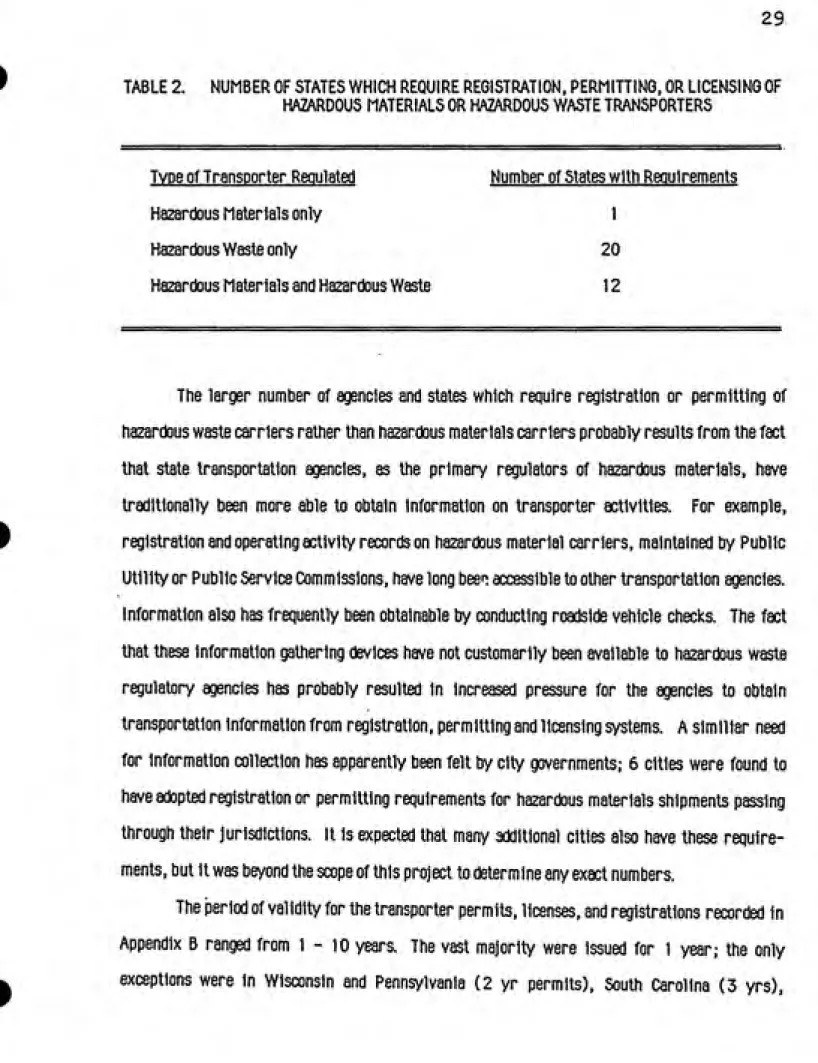
TABLE 2. NUMBER OF STATES WHICH REQUIRE REGISTRATION, PERMITTING, OR LICENSING OF
HAZARDOUS MATERIALS OR HAZARDOUS WASTE TRANSPORTERS
Tvoe of Transporter Reaulated Number of States with Reaulrements
Hazardous Materials only 1
Hazardous Waste only 20
Hazardous Materials and Hazardous Waste 12
The larger number of agencies and states which require registration or permitting of hazardous waste cerrlers rather than hsardous materials carriers probably results from the fsct
that state transportation agencies, as the primary regulators of hazardous materials, have
traditionally been more able to obtain Information on transporter activities. For example, registration and operating activity records on hazarctous material carriers, maintained by Public
Utility or Public Service Commissions, have long been accessible to other transportation a^ncies.
Information also has frequently been obtainable by conducting roadside vehicle checks. The fa:t
that these information ^thering devices have not customarily been available to hazardous waste
regulatory a^ncies has probably resulted in increased pressure for the g^ncies to obtain
transportation information from registration, permitting and licensing systems. A simillar need
for information collection has apparently been felt by city governments; 6 cities were found to
have adopted r^lstration or permitting requirements for hazardous materials shipments passing
through their jurisdictions. It is expected that many additional cities also have these require¬
ments, but it was beyond the scope of this project to determine any exact numbers.
Arkansas (5 yrs), and Virginia (10 yrs). The length of validity for each permit or registration is
shown In parentheses In column 4 of the appendix when the time period is greater than I year.
The fees for the transportation permits, licenses, and registrations, when known, are also
shown In column 4. Twenty-nine state ^ncles and one city, Denver, assess fees. First-time
charges range from approximately $20 to $575 for hazardous waste transporters and $100 to
$500 for hazardous materials transporters. Hazardous waste permit fees averaged in the
neighborhood of $180, while fees for hazardous materials permits avera^ around $250.
Accurate avera^ were difficult to calculate due to differences between first time f^s and renewal
f^s, and because many states assess fees a»3rd1ng to the number of vehicles which the
transporter operates.^me state agencies issue ^neral permits for hazarttous chemical transportation, while
others issue permits or licenses which are specific for the wastes carried, vehicles used, and
place of destination. 51 information which must be submitted to a r^ulatory ^ncy In order to
obtain a registration or permit, however, Is usually simlllar. Company name, aMress, and
emergency phone number are understandably required. A number of permit 3nd license
applications also require Information on the type and quantity of hazarttous material or waste
carried, and the origination and destination of the shipments. Other a^ncies, such as the New
Hampshire Department of Health and Human Services, request a list of customers from whom or to
whom the chemicals are transported. This type of information may be used to track chemical
shipments and to establish a network of information on businesses which use hazardous materials
and/or produce hazardous waste. Illegal operations, such as the processing or disposal of
hazardous waste without a permit, may be uncovered by examining this information.
Requirements for listing transporter vehicle ictentification numbers and names and aliases of
company stockholders on permit forms may also result in uncovering illegal activities. Some
hazardous waste transporters have been found to go out of business frequently to avoid prosecution
for illegal waste disposal activities. They then reopen under new company names with alias names
Natural Resources require information on company aliases and vehicles. Other licenses require
submittal of Information on past company suits, convictions, and fines. Massachussetts requires
not only this, but also mandates that public notice be macte of each licen^ application. A 5 year
history of company compliance (or noncompliance) with transportation regulations is required by
The Pennsylvania Department of Environmental Resources.
Special requirements associated with permit or license issuance are often related to
Improving safety, emergency response, and compliance with transportation regulations. Several
states require that drivers or company personnel be trained about the chemicals that they handle,
including safety precautions, emergency response techniques, and state and fecteral regulations.
Records of training must often be provided to regulatory ^ncies before permits or licenses are
issued. Many ^ncies also require submittal of contingency plans or ctescrlptions of emergency
response procedures and of equipment which will be used in the event of a spill or discharge.
Other states mandate that transportation companies post a bond or show evidence of Insurance
coverage for accictents before a permit will be Issued. To facilitate confirmation of company
compliance with permitting or licensing requirements, most e^ncies ctemand that copies of the
permits or licenses be displayed in each vehicle. Some agencies require assigned permit or
registration numbers to be visibly marked on transportation vehicles.
Some state agencies also require separate registration or licensing of hazarctous chemical
transportation vehicles, even though vehicle information may be Included In transporter permits.
The California Department of Highway Patrol, for example, requires that all carg) tanks used for
transporting hazardous materials be registered with their Department. The New Jersey
Department of Environmental Protection similiarly mandates the registration of h^arctous waste
vehicles, while The New Hampshire State Police demands that all ha^rctous materials and
hazarctous waste hauling vehicles obtain a vehicle license. Fees asscKiated with these registration
and licensing requirements ran^ from $3 to $200 per vehicle.
transportation companies to conduct cteily vehicle inspections ^2^ agencies such as the Missouri
and Wisconsin Departments of Natural Resources mandate ha2Brdous waste transportation
companies to conduct vehicle inspection programs and maintain records of company inspections for
Departmental review. The California Highway Patrol and the Oklahoma Department of Health, on
the other hand, inspect all ha^rdous waste vehicles themselves in association with their
transporter registration program. The Maryland Waste Management Administration and the
Michigan State Fire Marshal both require certification of all hazardous chemical transportation
vehicles before the vehicles may be used in their states. The abundance of these types of state
regulations attests to the states' awareness of the number of unsafe vehicles operating on public
highways, despite long-existing federal regulations.
Financial Responsibility