Jane M. McMahon. Evidence of Virtual Learning Commons in Independent School Library Webpages. A Master’s Paper for the M.S. in L.S. degree. November, 2010. 40 pages. Advisor: Sandra Hughes-Hassell.
This study describes a content analysis of library webpages in twenty-five North Carolina independent schools. The analysis was performed to identify evidence of instructional content that reflects the 21st century concept of libraries as learning commons. The rubric used was developed from AASL standards, NAIS guidelines, and other professional literature. The researcher found evidence of many information sources available
(OPACS, databases, style manuals) but less evidence that shows how these resources are being used (student work, assessments, annual reports). Consequently, it is unclear whether each webpage is part of a 21st century learning commons or a more traditional media program.
Headings:
School librarianship
School libraries – High schools
by
Jane M. McMahon
A Master’s paper submitted to the faculty of the School of Information and Library Science of the University of North Carolina at Chapel Hill
in partial fulfillment of the requirements for the degree of Master of Science in
Library Science.
Chapel Hill, North Carolina November 2010
Approved by
INTRODUCTION
In the 21st Century, families have many options for a child’s education, such as public schools, parochial schools, or homeschooling. Why, then, do so many families choose to spend thousands of dollars on tuition and fees at independent schools? Some
families may choose independent schools because they believe the physical environment is safer or that their child will receive more attention in a close-knit environment. In addition to these benefits, families often choose independent schools because they believe
independent school provide a more rigorous academic program and better preparation for college.
The world today is changing rapidly, growing smaller in some ways, yet increasingly complex in other ways. Is it is a considerable challenge for independent schools to hold onto to their cherished traditions and still adapt for the future. Of course,
educational challenges can also be exciting opportunities, and progressive-thinking school librarians can play a central role in making the most of these opportunities. With
the right resources and the right mindset, the traditional independent school library can evolve into a more productive, authentic learning environment.
As internet access has increased in schools and in homes over the past two
decades, most independent schools have established institutional websites for
informational and marketing purposes. Sometimes these school websites include library
into the virtual world. This study examines school library webpages in independent schools and analyzes them for features that facilitate 21st century learning.
LITERATURE REVIEW
21st Century Learning: The Objectives
What have educators and policymakers been discussing as the purpose of 21st century education? One vision comes from the Partnership of 21st Century Skills, which first assembled in 2002 with members from both non-profit and for-profit organizations
(Microsoft, National Education Association, Adobe Systems, etc.). The Partnership identified five necessary competencies: core subjects (math, science, language, civics),
21st century themes (global awareness, health literacy), learning and innovation (problem solving, communication), information/media/technology (multiple literacies), life and career skills (cross-cultural skills, leadership) (AASL, 2009, p. 9).
The Ontario School Library Association (OSLA) reflected similar views and objectives in the publication of ―Together for Learning‖ in 2010. One of the concerns
identified by the OSLA is that ―many students are finding it difficult to make meaningful
connections between what they learn in school and what they need to know outside of school‖ (2009, p. 34). To address this gap, the OSLA emphasizes a set of competencies
for learners (resembling those developed by the Partnership). These include a multitude of literacies, creative and critical thinking, discovery and inquiry, cultural awareness, and
metacognition.
21st Century Learning: The Environment
Obviously, the traditional school library would not be conducive to achieving all of
these competencies, though it could help with a few of them. (For the purpose of this discussion, some qualities that might be considered ―traditional‖ would be
fixed-scheduling, emphasis on print materials, limited role of digital resources). The traditional model limits the library’s learning environment to a physical space and a finite collection,
when libraries could become ―systems that accommodate the unique learning needs of
every learner and support the positive human relationships needed for effective learning‖ (AASL, p. 10).
A progressive system like this is often referred to as learning commons, defined as ―a vibrant, whole-school approach, presentingexciting opportunities for collaboration
among teachers, teacher-librariansand students” (OSLA, 2010, p. 3). The OSLA
identified the empowering components of learning commons as physical and virtual
space, equitable access, learning partnerships, and technology. Another important aspect
of the learning commons is the attitude that everyone is a learner, including teachers,
administrators, and parents. The ultimate goal of a learning commons is for students to
“view learning as a life pursuit” that is “modeled by everyone in the school” (OSLA,
2010, p. 8).
Although the school library is only one part of the plan, the library—and especially
1. The school library media program promotes collaboration among members of the learning community and encourages learners to be independent, lifelong users and producers of ideas and information.
2. The school library media program promotes reading as a foundational skill for learning, personal growth, and enjoyment.
3. The school library media program provides instruction that addresses multiple literacies, including information literacy, media literacy, visual literacy, and technology literacy.
4. The school library media program models an inquiry-based approach to learning and the information search process.
5. The school library media program is guided by regular assessment of student learning to ensure the program is meeting its goals. (p. 19)
Obviously, there are connections between the OSLA description of a learning commons and the AASL guidelines. Both emphasize the lifelong process of learning, the value of
collaboration and inquiry, and the need for multiple literacies, especially concerning technology.
In 2010, Robin Cicchetti published an account of Concord-Carlisle Regional High School’s transformation from traditional library to learning commons. This process
began as a physical transformation of the library’s cluttered, unwelcoming environment,
but it did not stop there. Nearly every aspect of the library administration changed in some way, such as revising staff job descriptions. Using the 2009 AASL guidelines as
one of their resources, the Concord-Carlisle staff made significant changes to and the library’s academic program. There had previously been little collaboration between
classroom teachers and the library staff, but ―teacher by teacher… we began to change the dialogue‖ (Cicchetti, 2010, p. 55). After three years of progress, Cicchetti describes
the results: more collaboration (strand 1), increased circulation (strand 2), increased
by tracking which skills are taught and which academic departments may require outreach (strand 5). In this case, the AASL guidelines were an instrumental building
block for establishing a learning commons and increasing learning.
Independent Schools: Educational Tradition and Innovation
Independent schools have operated in the United States for hundreds of years, and they have evolved in many different directions. They include elementary and secondary schools, day and boarding schools, religious and nonsectarian schools, rural and urban
schools. In spite of these differences, many belong to the same national or regional accrediting associations. As the Klingenstein Center (2010) at Columbia asserts,
independent schools can differ widely from each other, but they all share several essential characteristics: ―self-governance, self-support, self-defined curriculum, self-selected
students, self-selected students, self-selected faculty, and small size.‖
Considering the significant cost of attending an independent school—the median tuition for high school in the 2009-2010 academic year was over 19,000 dollars—what do
they offer in return? A 2004 study published by the National Association of Independent Schools reported ―The Lifelong Benefits of an Independent School Education.‖ Among
the claims, the NAIS observed that
NAIS graduates lead the nation in post-secondary achievement.
NAIS graduates express strong satisfaction in their careers and confidence in
opportunities for further training.
NAIS graduates are skilled in the technology of the 21st century workplace.
In addition to these academic or practical claims, other benefits reflected appreciation for
reported to participate in a wide range of non-work activities: cultural pursuits, exercise and sports, community service and civic engagement (NAIS, 2004, p. 2-5).
The Independent School Library
In 2008, Elisa Stern Cahoy and Susan G. Williams published ―Studying the Independent School Library.‖ Using a web-based survey constructed by the AASL/ISS
Data Committee, Cahoy and Williams gathered data from 420 independent schools. This sample included different types of independent schools, identified by the researchers with
the following labels: independent, independent religious, religious, alternative, and military. The data collected was also coded by geographic region and city cize. The
respondents represented school libraries in 43 states, as well as some international schools.
Looking at the differences between independent schools and public schools (using
public school data collected by AASL), Cahoy and Williams (2008) observed that independent school libraries were open for a higher number of hours per week (a
difference of almost 18 hours). Looking at the collections, independent schools generally had a larger number of total items in the collection and a higher number of print
periodicals compared to public school libraries. Cahoy and Williams reported that ―perhaps the most significant disparity showed up in the library budgets calculated as expenditures per student.‖ (2008, ―Library Budget‖ section). In the public school data,
the average amount budgeted per student was 40 dollars; the average per student in independent schools was 64 dollars. In examining library technology issues, the data showed smaller gaps between public schools and independent schools. The average
and the majority of both samples offered remote access to databases (public = 66%, independent 79%). Cahoy and Williams suggested in their study that the greater amount
of library resources and library access might partially explain the higher achievement claims published by NAIS. However, their data could not help them to make a direct
comparison between achievement in public schools and independent schools with comparable resources.
Independent School Libraries and Learning Commons
Cicchetti’s (2010) description of the Carlisle-Concord Library illustrates the
connection between the learning commons concept and the guidelines of 21st century learning, but does the learning commons concept directly connect to an independent school vision of best practice? Looking at the NAIS Guidelines of Professional Practice for Librarians (Appendix A), there are multiple connections. For example, the
independent school librarian is considered a ―member of the faculty‖ who ―partners with
teaching colleagues to integrate information, technology, and research skills into the
curriculum‖ (NAIS, 2008). This NAIS guideline clearly matches with the emphasis on collaboration in the learning commons. The model independent school librarian also ―motivates and guides students to appreciate literature and reading‖ (NAIS, 2008) which
connects to the 21st century guideline about reading promotion. Because the independent school librarian ―teaches information-seeking, critical analysis, synthesis‖ and ―utilizes a
variety of interactive tools to provide services, information, and tutorials,‖ he or she is
helping the school community develop multiple literacies that are key elements of a learning commons (NAIS, 2008). Because this study will examine evidence of
NAIS guidelines encourage librarians to provide ―intellectual, physical, and virtual access
to print and digital learning materials‖ (NAIS, 2008).
The State of School Library Webpages
While students still spend most of their day in the physical school environment, the concept of the learning commons extends into the virtual sphere as well. Most
schools today have some sort of general website, and many of those include webpages for the school library. How have these pages evolved? What support and resources do they offer students who are away from the physical library?
Clyde
Laurel Clyde has conducted a number of content analyses of school library websites, including a longitudinal study from 1996 to 2002. The first study in 1996
examined fifty school library websites from an international sample, and the results indicated that school library webpages varied widely in content and that the librarians had ―very different aims in developing their pages‖ (Clyde, p. 159). Clyde repeated the study
with the same sample in 1999 to see if and how the pages had developed over time. The majority of revisited sties had indeed developed, with the most notable features being the
addition of online resources such as OPACs and electronic reference materials. Concerning research, 24 percent of the pages offered features related to the research
process or illustrating a research model.
In 2002, Clyde returned to the same pages to determine what would be the ―state of the art‖ in school library webpages. In looking at the development of websites over
between 1996 and 1999 than they did between 1999 and 2002: ―despite this overall development, a number of sites [had] not been developed at all through the period, or
[had] seen little change, while a small number [had] actually declined‖ (2002, p. 165). Even so, there were still a few notable improvements since the previous update—in 1999
websites had been providing access to online resources from school, but in 2002 the school libraries were also offering remote access to online resources through the website. Besides providing resources for academic work, an increasingly popular feature was
recreational links for kids and teens. The features that declined the most were evidence of classroom library projects and information/links for parents.
The 2002 study ultimately echoed a conclusion from the initial 1999 study—that the sample of sites seemed to have different goals. The target audience for the site was also unclear—were they intended primarily for students, teachers, or visitors? In the
majority of cases, Clyde reported the library page ―still seemed to be aimed at no particular group of users‖ (2002, p. 167).
Simpson
Using Clyde’s work as a starting point, Carol Simpson at the University of North
Texas evaluated 127 Texas school library websites in the fall of 2000. The collected data revealed a geographic disparity, with an ―overwhelming‖ number of pages mounted in
the metropolitan areas of Houston and Dallas. Only 16 percent of pages provided OPAC access, while 47.2 percent provided database access. Curiously, some schools provided
NO database access, though every school in Texas is granted some level of service as a member of the Texas Library Connection. By far, the most popular resource on library
percent of Texas pages offered information about the research process or research models (compared with the 24 percent Clyde had observed in her 1999 publication), but nearly
20 percent of the pages offered assistance with citation issues (Simpson, 2001, p. 76). Other features observed related to administrative or ―housekeeping‖ information,
such as library rules (17.3 percent). Interestingly, 10 percent of the webpages but did not include the school’s name, and only about half featured information about hours,
programs, or personal contacts. In spite of this discouraging data, there were individual
schools with well-developed sites that could support student work, such as Rusk High School. In conclusion, Simpson (2001) urges that a website presence should be as carefully developed as the library it represents.‖ (p. 77)
Valenza
In 2007, Joyce Valenza completed a dissertation aimed at identifying the attributes
of exemplary school websites. Like Clyde and Simpson, Valenza used content analysis, but she looked in depth at a much smaller sample (ten schools). Nine of the schools were
American and one was Australian. There was a mix of private/public schools and rural/urban/suburban schools. Clyde’s sample had been selected at random, whereas
Valenza’s was the product of a Delphi panel made up of 22 professionals in the field of
library and information science. The Delphi panel was also instrumental in compiling a list of attributes for evaluation in this study. Unlike the extensive (but uncategorized) list of attributes in Clyde’s longitudinal study, Valenza’s rubric described distinct categories of ―potential content.‖ These categories were natural outgrowths of AASL’s standards
and included Information Access and Delivery, Learning and Teaching, Books and
The evidence Valenza collected indicated that Information Access and Delivery was the area that received the most attention in this sample (there was a higher
concentration of features coded under that category). Although the sample websites often included some features falling under Teaching and Learning, they still seemed more like online ―collections‖ rather than online learning environments (p. 123). Valenza also
noted the unrealized potential for Program Administration: ―Few libraries share their reports and public relations materials. Few use available interactive calendar tools to
share their library schedules. Few use available technology to survey users or to mine data‖ (p. 124). While Valenza observed that school library webpages were ―growing
more interactive and student-centered,‖ they still seemed slow to adopt new technologies.
LeSueur
Allison LeSueur followed up on Valenza’s observation in her subsequent study of
school library pages, completed in 2010. Rather than looking at the entire taxonomy developed in Valenza’s dissertation, LeSueur focused on the use of ―Web 2.0‖ tools in
high school libraries. Using content analysis, this study examined two samples of webpages: 1) a random sample of 100 high schools randomly selected from Newsweek’s
2008 rankings of the top 1,300 public high schools in the United States and 2) Valenza’s
sample of 10 exemplary high school library websites (2010, p. 19). (Ultimately, only nine of these pages were still accessible.) LeSueur examined both samples for evidence of an
assortment of Web 2.0 tools, such as blogs, wikis, social networks, podcasting, bookmarking, and photo/video sharing, etc.
Looking at the Newsweek Top School sample, LeSueur (2010) found evidence of
more than one 2.0 tool. Of all the tools noted, the most frequently used tool was a blog (14%), followed by wikis (5%) (LeSueur, 2010, p. 26).
Out of the nine Valenza sample pages, seven included Web 2.0 evidence, and all of those seven used more than one 2.0 tool. Blogs (6%) and social networks (6%) were the
most frequently used tools in this sample, followed by video sharing (4%) and wikis (4%). There was no evidence of the use of bookmarking or task-management/calendar tools in either sample (LeSueur, 2010, p. 27).
Besides reporting the mere existence of 2.0 tools on these sites, LeSueur (2010) discussed the functionality of the most popular tools. In general, the blogs appeared to be
written by librarians in order to publicize new materials, equipment, and events. They were generally not used as instructional tools or grounds for academic collaboration. Wikis, on the other hand, were used in multiple contexts (book clubs, class assignments)
and showed evidence of multiple editors and possible collaboration. LeSueur’s study concluded that 2.0 tools still have untapped educational potential, but that administrative
issues (blocked use of networking, etc) and lack of staff training are possibly slowing down their effective implementation (2010, p. 38).
METHODOLOGY
This study analyzed the content of independent school library webpages for evidence of information, resources, and services that extend the school’s learning
environment beyond the physical site and into the virtual world; that is, evidence of a learning commons approach to the delivery of library services and programs. Content analysis is an appropriate method to use in this case because the author is only
other hand, might blur the line between what is currently available and what is ―in the works.‖ Interview subjects may also want to emphasize that many services are available
on-site that are not available online, but that is not the focus of this particular study. The use of a survey might have been another possibility, but that would leave interpretation of
the webpage open to different opinions. Survey participants might, for example, all have different ideas of what constitutes a ―tool for self-assessment,‖ etc.
Content analysis does have some limitations for website analysis, given that
school-based webpages do not always offer access to people who are not affiliated with the school (students, staff, parents). Sometimes there is limited access, which gives a
introductory description of the library’s resources but does not allow the visitor to browse the actual resources. Webpages that allowed only this superficial level of access were not included in this study, even though some features might have been documented from the
description provided. This was considered a second-hand report of features rather than evidence of features.
Another issue connected with unobtrusive content analysis of school library webpages is the dynamic potential of online evidence. It is possible that the researcher noted evidence of student work that was taken down the following day—or vice-versa.
Also, the difference between the academic year and the calendar year may affect the amount of content evident on a library webpage. The researcher performed the bulk of
Sample
The webpages evaluated in this study are from twenty-five independent high
schools (or upper divisions of K-12 or middle/high schools) in North Carolina (Appendix B). All of the schools are members of the North Carolina Association of Independent
Schools (NCAIS). There are more than twenty-five NCAIS member schools, but some could not be included in the sample because their websites are password protected. If a school’s website was accessible, but the school had no library webpage, it was included
in the sample.
Procedures
The researcher used a rubric to evaluate each library webpage (Appendix C). Because this study is concerned with library webpages as a virtual extension of the school’s learning commons, the rubric focuses mainly on content associated with
teaching and learning. Although almost all aspects of school library administration potentially affect student achievement, issues such as budget, staffing, and collection
development are not central to this investigation. Neither does this study address webpage design issues (navigation, color scheme, handicap-accessibility, etc.), though these would certainly be worth considering in further research.
The researcher organized the rubric around the five strands suggested in the AASL’s guidelines for teaching and learning in Empowering Learners (listed earlier in
the literature review). The rubric includes many of the features identified in Valenza’s
taxonomy, as well as some that the researcher has observed in other academic websites. Although the rubric is organized using the five strands, the researcher acknowledges that
of pathfinders could fall under one strand about using/producing information, but
pathfinder creation/use could also be an integral part of inquiry, which is another strand. In cases like this, the feature is only accounted for under one strand. If a feature’s
potential function made it possible to account for it as two discrete features, the rubric
accounts for it under two strands. For example, there is no feature identified as simply ―blog,‖ but there are two features listed as ―research-related blog‖ (strand one) and
―reading-related blog‖ (strand two).
When using the rubric, the researcher noted whether particular features were present (Yes/No) and made a note about anything unusual or dysfunctional about the
features. No attempt was made to assess the quality of the feature or quantify characteristics within each feature. For example, if there was access to at least one database, then ―databases‖ was marked ―Yes‖—whether or not it seemed to be a
high-quality database or whether there was a large selection of databases available. Neither did the researcher attempt to ―rank‖ the individual schools in terms of their web-based
resources, though general trends and some strengths and weaknesses will appear in the results section of this study.
The researcher also emphasizes that this study only addresses evidence of
teaching and learning that appears on the library webpage. The schools included in this sample may be establishing learning commons in ways that occur in the physical space or
RESULTS
Of the twenty-five NCAIS schools in the sample, seventeen had library webpages.
Of these seventeen pages, each page demonstrated at least four of the features listed on the rubric, though most had more, and a few pages contained as many as twenty. As
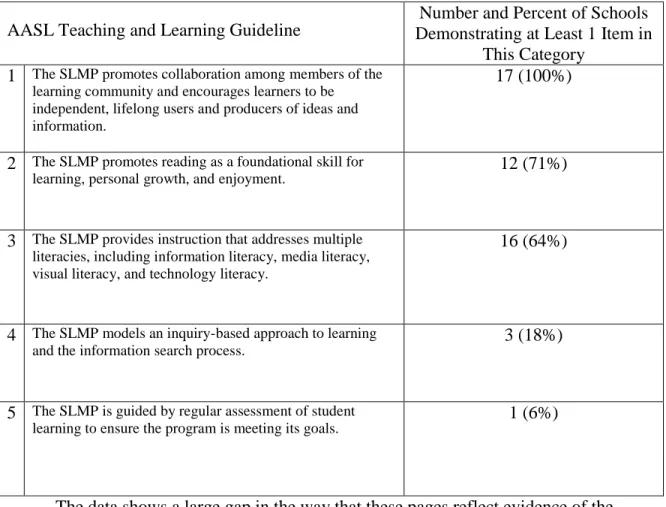
Table 1 shows, breaking the data down according to the five AASL Teaching and Learning guidelines or strands addressed in the rubric reveals distinctions among the pages. To be counted under a specific category, the page had to demonstrate at least one
of the features from that section of the rubric.
Table 1 – Frequency of AASL Guidelines on Library Webpages (n = 17)
The data shows a large gap in the way that these pages reflect evidence of the
AASL guidelines. While nearly every page included at least one feature relating to the AASL Teaching and Learning Guideline
Number and Percent of Schools Demonstrating at Least 1 Item in
This Category 1 The SLMP promotes collaboration among members of the
learning community and encourages learners to be independent, lifelong users and producers of ideas and information.
17 (100%)
2 The SLMP promotes reading as a foundational skill for learning, personal growth, and enjoyment.
12 (71%)
3 The SLMP provides instruction that addresses multiple literacies, including information literacy, media literacy, visual literacy, and technology literacy.
16 (64%)
4 The SLMP models an inquiry-based approach to learning
and the information search process. 3 (18%)
5 The SLMP is guided by regular assessment of student learning to ensure the program is meeting its goals.
first and third guidelines, almost none had features relating to the fourth and fifth
guidelines. In the next section, each of the five strands or guidelines will be discussed in
detail.
Guideline One: The SLMP promotes collaboration among members of the learning community and encourages learners to be independent, lifelong users and producers of ideas and information.
As expected, the library pages had more evidence related to this guideline than any other. However, some of the items included as evidence of addressing this
instructional guideline are merely the most basic information one might need to begin the collaboration process, such as having an email contact on the library page (see Table 2).
Other features covered in this section included items such as online access to the library OPAC or a research-related wiki. Overall, it seems the most frequently observed features are ones that indicate a potential for collaboration (information about access, links to
other libraries), rather than ones that might demonstrate collaboration that has already been done or is in progress (wikis, blogs). This might give the impression to webpage
Table 2 – Evidence of Guideline One (n = 17)
Guideline Two: The SLMP promotes reading as a foundational skill for learning, personal growth, and enjoyment.
Five of the seventeen library pages did not demonstrate any features associated
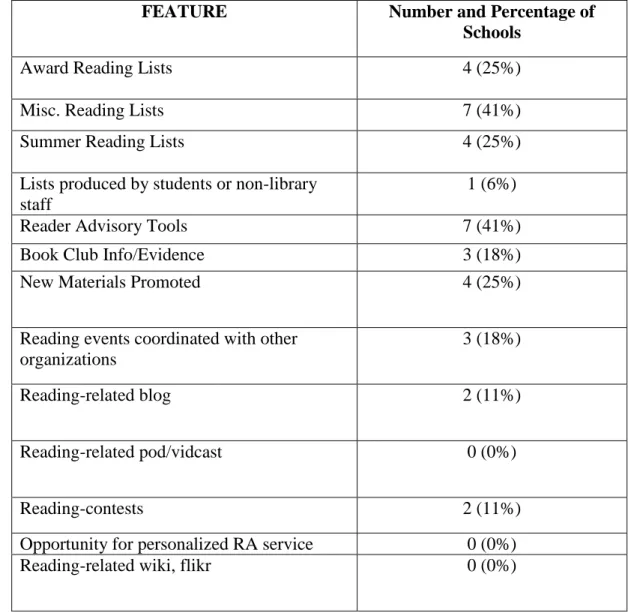
with reading promotion as it was described on the rubric. As Table 3 shows, the most frequently observed features were access to online reader advisory tools such as Novelist
and the inclusion of miscellaneous reading lists. Although none of the schools appeared to use social media tools directly with academic research, there were two library pages that included blogs about recreational reading. Three of the schools had coordinated
reading-related events with other libraries or community organizations (for example, a
FEATURE Number and Percentage of
Schools
Information about library hours/access 14 (82%)
Chat Reference 2 (12%)
Databases 14 (82%)
Research-related pod/vidcast 0 (0%)
Email Contact 11 (65%)
Discussion Board 0 (0%)
Links to Other Libraries 10 (59%)
Links to Teacher Pages 2 (12%)
News Links 6 (35%)
Links to Community Websites 2 (12%)
Pathfinders 5 (29%)
OPAC 12 (71%)
Evidence of Collaboration 2 (11%)
Password/Subscription Info 11 (65%)
Research-related blog, wiki, flikr 0 (0%)
book drive). This was encouraging because doing so helps diffuse the belief that independent schools are isolated from the ―outside‖ world and that they do provides
students with an opportunity to connect with the greater community beyond the school.
Table 3 – Data: Guideline Two (n = 17)
Guideline Three: The SLMP provides instruction that addresses multiple literacies, including information literacy, media literacy, visual literacy, and technology literacy.
Sixteen of the seventeen library pages demonstrated at least one of the features
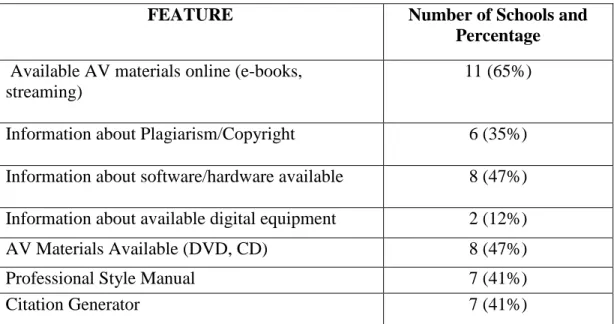
listed under this guideline on the rubric (see Table 4). The most frequently observed
FEATURE Number and Percentage of
Schools
Award Reading Lists 4 (25%)
Misc. Reading Lists 7 (41%)
Summer Reading Lists 4 (25%)
Lists produced by students or non-library staff
1 (6%)
Reader Advisory Tools 7 (41%)
Book Club Info/Evidence 3 (18%)
New Materials Promoted 4 (25%)
Reading events coordinated with other organizations
3 (18%)
Reading-related blog 2 (11%)
Reading-related pod/vidcast 0 (0%)
Reading-contests 2 (11%)
Opportunity for personalized RA service 0 (0%)
feature was the presence of online audio-visual materials, such as streaming videos. The next most popular feature was inclusion of audio-visual (AV) materials in the school’s collection. For example, schools included DVD’s and CD’s in their collections. These
were sometimes materials directly related to curriculum and sometimes more recreational
in nature (or materials that could be used for either purpose).
Unfortunately, there were fewer pages that contained features connected with using the collection responsibly and effectively—only six pages included information
about plagiarism/copyright, and only five pages included tools for evaluating resources. This might indicate that students have access to a variety of materials, but they may not
have enough support to gain literacy in multiple areas.
Also, there was little evidence of features that facilitate the students’ personal
creativity and productivity. Many can access AV materials, but it appears that fewer can
create their own AV materials (only two pages have information about digital cameras/recorders).
Table 4 – Data: Guideline Three (n = 17)
FEATURE Number of Schools and
Percentage
Available AV materials online (e-books, streaming)
11 (65%)
Information about Plagiarism/Copyright 6 (35%)
Information about software/hardware available 8 (47%)
Information about available digital equipment 2 (12%)
AV Materials Available (DVD, CD) 8 (47%)
Professional Style Manual 7 (41%)
Guideline Four: The SLMP models an inquiry-based approach to learning and the information search process.
Only three of the pages demonstrated any evidence of this guideline. One page
contained a brief diagram/model of the research process, while two pages contained detailed explanations about conducting research (Table 5). This is jarring when one considers all of the resources available to students. Yes, students have access to
resources, but resources are not a research process. A collection of online resources does not necessarily make a virtual learning commons any more than an on-site print
collection makes a physical learning commons.
Table 5 – Data: Guideline Four (n = 17)
FEATURE Number of Schools
and Percentage
Model/Diagram of Research Model 1 (6%)
Detailed Explanation of Research 2 (12%)
Professional Literature About Inquiry 0 (0%)
Evidence of Inquiry-based Learning 0 (0%)
Guideline Five: The SLMP is guided by regular assessment of student learning to ensure the program is meeting its goals.
Tools for Evaluating Resources 5 (29%)
School-specific Style Manual 3 (18%)
Evidence of Student Work in Multiple Formats; Tools for Synthesis/Question Formation
Only one page demonstrated a feature under this section of the rubric (see Table
6). Though it may not be the case in reality, the webpages give the impression that the school library staff are not involved in assessment, either at the classroom level or the library program’s administrative level. One assumes all of the information resources
provided on these webpages are used in both short-term and long-term assignments— but students might gain more from these long-terms assignments if they have opportunities
for formative assessment as well as summative assessment. Also, given that modeling is often a part of instruction—and it can be reassuring to students new to the research
process—the library webpage could be the perfect place to share models of assignments. Unfortunately, none of the pages included models. Neither did any of the pages include an annual report, which leaves observers to wonder if the library staff are engaging in
their own reflection and self-assessment as leaders in their learning communities.
Table 6 – Select Data: Guideline Five (n = 17)
FEATURE Number of Schools and
Percentage
Tools for Self-Assessment 0 (0%)
Models for Assignments 0 (0%)
Access to library-related data connected to student learning
0 (0%)
Access to Library Annual Report or Similar Material
0 (0%)
Testimonial from Students/Faculty, etc. 0 (0%)
DISCUSSION
This study was limited to evidence of 21st century teaching and learning on school library webpages. It is entirely possible that a school library program may be
establishing a robust learning environment in the physical space without documenting it
online. However, reflecting on the results of this study raises many questions about the establishment of virtual learning commons in North Carolina’s independent schools.
Collaboration
Collaboration is essential for 21st century learning and encouraged in NAIS best practice guidelines, but the researcher found little evidence of explicit collaboration on
the sample webpages (2%) and few links to teacher pages (2%). This is a salient difference from the ―exemplary‖ websites Valenza (2007) studied. Of the ten sites
Valenza examined, seven included ―collaborative documents with elements of instruction‖ (2007, p. 75).
Perhaps the NCAIS schools in the sample are implementing collaboration;
however, it is not evidenced on their webpages. Publicizing collaboration could have both internal and external benefits. Within the school, it would give teachers and students an opportunity to showcase their work—and it could nudge reluctant
collaborators to try something new. Publishing evidence of collaboration on a public webpage could also provide a resource to outside parties, such as other independent
schools, public schools, or homeschoolers. This might also help independent schools appear less insular and restricted. As a marketing venue, the webpage could also use evidence of collaborative work to illustrate the academic rigor of the school and the
Reading
Looking at the data collected about reading promotion (guideline 2), only 18
percent of webpages documented events coordinated with other community
organizations. Partnering with outside organizations can broaden students’ information horizons and help them find ―real world‖ contexts for the school curriculum. In addition
to the educational benefits, publicizing community-partnered events on the webpage can also be a strategy for dispelling one of the myths that NAIS president Patrick Basset has
described—the myth that ―independent schools are not part of the community‖ (2009). Fortunately, a few schools in this study are already publicizing reading promotion events
such as book drives and other service projects.
As Table shows, only 25 percent of webpages in the sample promoted new materials in the library’s collection. In Susan Williamson’s statistical analysis of
independent school libraries, she reported that 41 percent of students ―sometimes‖ or ―often‖ use the school library for assignments, but only 16 percent of students use the
library for leisure reading (2010, p. 42). If one of the librarian’s objectives is to guide students to appreciate literature and reading (as suggested by the NAIS guidelines of best practice), perhaps marketing new reading materials should be more of a priority. A
library staff that markets its collection and increases circulation would be better prepared to defend its budget for collection development in future years. Marketing new materials
for later collaboration—as well as encouraging faculty to model reading in front of students.
The AASL guidelines (2009) state that reading is a foundational skill for learning, and the library webpage could be a central resource to help with cross-curricular reading.
For instance, the librarian could post information about reading comprehension strategies tailored to different departments. The science department faculty may be less likely than the social studies department to use the library for collaboration, but both departments
need to help their students read subject-specific texts. Offering this kind of assistance on the website promotes the idea that the library serves the entire school.
The small amount of evidence connected with summer reading presents a particularly rich opportunity for developing the virtual learning commons concept. During the academic year, students complete assigned reading with the support of teacher
guidance, class discussion, and activities that promote comprehension and understanding. In the summer, however, students are given assignments that they must complete in relative isolation. While students are away for ―vacation,‖ the library webpage could
host online activities and discussions that make summer reading more interactive. For example, everyone who chooses a particular summer reading book could participate in
blog while they are actually reading—instead of waiting for school to start to discuss their reading.
The small amount of evidence about student participation in book clubs or in creating reading lists makes this researcher wonder if librarians are missing opportunities to learn about student reading interests. By the time students reach high school, perhaps
school, or perhaps they have grown more self-conscious about sharing their reading taste and opinions. Starting up online discussions or having students post recommendations on
the webpage is an opportunity for librarians to implement digital communication skills as well as a way to assess students’ interests and needs.
Web 2.0 and Multiple Literacies
The NAIS guidelines encourage school librarians to remain ―current in the fields of library and information science, education, and emerging technologies‖ (2008), but the
schools in this sample showed relatively little use of Web 2.0 tools, mirroring the
findings reported by Valenza (2007) and LeSueur (2010). While there are many reasons
why schools might hesitate to implement social networking tools (security, privacy), those tools have the potential to make learning much more interactive—allowing students to become producers of information and providing a virtual site of collaboration. In Cicchetti’s (2010) article about Concord-Carlisle High School, she explains that working
closely with faculty to acclimate them to web 2.0 use was essential to making them part
of their learning commons. Although the staff and administration hesitated to open up network filters for social networks such as Facebook, they did not report any major problems. In fact, the atmosphere of the library/learning commons changed so that the
staff were guiding use of these tools now, rather than policing them. If NCAIS schools are aiming to produce graduates who are responsible, independent learners, they may
want to emulate this example and give the community members more technological freedom.
Many of the webpages provided resources related to information literacy, media
search engine, tips for evaluating web resources, and advice of copyright and plagiarism. However, there was much more evidence of ―input‖ resources (AV materials) and tools
(citation generators) than there was evidence of student output. Because only two webpages in the sample included evidence of student work in multiple formats, it is not
clear how students are currently using these resources.
It would be a shame if the school was spending time and labor to provide these sources online if students are only using them sporadically or by chance. If students and
teachers could see how specific tools were being used—with evidence of products available—they might be more likely to use them in lesson planning or assignment
completion. For instance, if a teacher sees that another class has successfully completed a digital project and posted it on the webpage, that teacher might consider adapting a digital project in his or her own class. When work like this is published on the library
page, it encourages teachers to think that they can get help with digital technology.
Research and Inquiry
The NAIS guidelines (2008) state that the school librarian should help the community with information-seeking and ―free inquiry,‖ but there was almost no evidence of an inquiry-based approach to learning on the sample webpages. Twelve
percent of the NCAIS school webpages included an explanation of the research process, compared to fifty percent of Valenza’s sample (2007, p. 70). For a school’s library page
thinking, ―Where do I start?‖ Having access to a model of research, in addition to
information sources, could make off-site research more productive.
Assessment
The independent school librarian is charged to be a professional who ―assesses the
effectiveness of the library media program on an ongoing, regular basis‖ and who ―partners with the school administration to provide knowledge, vision, and leadership‖
(NAIS, 2008). However, the webpages analyzed in this study demonstrated almost no
evidence of assessment, whether it was used for instructional purposes or program administration. This is not surprising, considering Ann Weber’s 2010 article on program
assessment in independent school libraries. According to Weber, many librarians reported that they were rarely evaluated as faculty and that many librarians reported statistics without much analysis. Consequently, these reports don’t help anyone identify ―what changes in either the program or the facility might improve service‖ (2010, p.
102). The library webpage can help with program assessment in two directions—it can
be a virtual forum for collecting suggestions/feedback, and it is also a logical location for publicizing positive outcomes in annual reports, etc.
In addition to administrative assessment, school librarian can use webpages for
instructional assessment. According to Violet Harada and Joan Yoshima, (2005) ―students grow as learners when they participate in the assessment process‖ (p. 5). If
RECOMMENDATIONS
If an independent school librarian is interested in transforming a webpage from a
collection of resources to a virtual learning commons, the features discussed in this study could be worthwhile additions to current websites. Of course, more features don’t
necessarily make a more effective webpage. To develop a better virtual learning environment, might begin with the following:
Move learning to the center, instead of resources. Use the webpage to show
stakeholders what people are doing with the library budget, not what people are
buying with the library budget. More examples of student work, etc. Move students to the center. Look for ways to get student contributing and
interacting on the page. Students who are reluctant writers may choose to contribute digital pictures or videos.
Kill a flock of birds with one stone. The library webpage has the potential to
benefit many departments within the school. Talk to students, faculty,
administrators, business officers, alumni affairs, and the parents’ association.
Any of these groups could provide valuable feedback about the current state of a webpage and offer suggestions for improvement.
Assess, reflect, and redesign. One of the advantages of a virtual learning
commons is that it can be much more flexible than a physical space— and
Every independent school is different, and the goal should not be identical webpages. Perhaps the above strategies can help any independent school library reflect on how
its webpage can contribute to its specific educational mission.
CONCLUSION
North Carolina’s independent schools have a rich and successful history, and their
school libraries can play a central role in their future success. One hopes that all school libraries are gradually evolving from information repositories into productive learning commons. While this may be happening in the school’s physical environment, there is
relatively little online evidence. Many library webpages provide access to a wealth of
information, but interactive features are less likely to be found. These pages make it clear that students have access to resources, but it is unclear how students are using the resources and what they are creating from these resources. In the future, perhaps
REFERENCES
American Association of School Librarians. (2009). Empowering learners: Guidelines for
school library media programs. Chicago: American Library Association.
Bassett, P. (2009, August 1). Seven myths about independent schools. [Web log message.]
Retrieved from
http://www.nais.org/about/article.cfm?ItemNumber=152021&sn.ItemNumber=4181&t n.ItemNumber=147271
Cahoy, E. S. & Susan G. Williamson (2008). ―Studying the independent school library.‖
Retrieved from the American Association of School Librarians website:
http://www.ala.org/ala/mgrps/divs/aasl/aaslpubsandjournals/slmrb/slmrcontents/volume 11/cahoy_williamson.cfm
Cicchetti, R. (2010). Concord-Carlisle transitions to a learning commons. Teacher Librarian,
37(3), 52-58.
Clyde, L. A. (2004). School library Web sites: 1996-2002. The Electronic Library,
22(2), 158-167.
Harada, V. H., & Yoshina, J. M. (2005). Assessing learning: Librarians and teachers as partners. Westport, Conn.: Libraries Unlimited.
Klingenstein Center at Teachers College (2010). Independent school leadership. Retrieved from http://klingenstein.org/
LaSueur, A. (2010) High school libraries use of web 2.0 tools. (Unpublished master’s paper.)
National Association of Independent Schools. (2008). NAIS Guidelines of Professional Practice for Librarians. Retrieved from
http://www.nais.org/about/seriesdoc.cfm?ItemNumber=151374
Natonal Association of Independent Schools. (2004). Values added: The lifelong benefits of
an independent school education. Retrieved from
http://www.nais.org/research/article.cfm?ItemNumber=144826
Ontario School Library Association (2010). Together for Learning: School Libraries and the
Emergence of the Learning Commons. Retrieved from
http://www.accessola.com/osla/bins/content_page.asp?cid=626-648
Simpson, C. (2001). School library webpages in Texas. Texas Library Journal, 77(2), 28-30.
Valenza, J. K. (2007). Discovering a descriptive taxonomy of attributes of exemplary
school library websites. (Doctoral Dissertation, University of North Texas, 2007). Retrieved from http://digital.library.unt.edu/data/etd/2007_2/open/meta-dc-3911.tkl.
APPENDIX A: NAIS Guidelines of Professional Practice for Librarians Approved by NAIS in 2008
At the heart of the independent school library program is a professionally trained librarian who:
1.As a member of the faculty, partners with teaching colleagues to integrate information, technology, and research skills into the curriculum.
2.Motivates and guides students to appreciate literature and reading.
3.Teaches information-seeking, critical analysis of sources, citation methods, synthesis, and the ethical use of information, and is thus a strong resource to students, teachers, and the school.
4.Provides intellectual, physical, and virtual access to print and digital learning materials that are efficiently organized and conveniently stored according to accepted standards.
5.Evaluates continually the currency, quality, depth, and breadth of the collection. 6.Understands the school's curriculum so that he or she can develop a collection that
coordinates with long-term teaching goals as well as current and emerging needs. 7.Maintains a facility that is active, inviting, and conducive to student and faculty
learning.
8.Utilizes a variety of interactive tools to provide services, information, and tutorials to the learning community.
9.Encourages both formal and informal input from the school community into the types, quality, and format of the information resources provided.
10.Partners with the school administration to provide knowledge, vision, and leadership to plan for change and the future success of the library program and thus
guarantees that the library facilities, collection, and staffing will continue to meet the needs of the school over time.
11.Assesses the effectiveness of the library media program on an ongoing, regular basis. 12.Leads the school community in support of the principles of intellectual freedom, free
inquiry, and equal access to information.
13.Offers professional growth opportunities (e.g. workshops, reading groups) for faculty on topics of current and emerging importance.
APPENDIX B: NCAIS SAMPLE OF SCHOOLS
School City Webpage?
1 American Hebrew Academy Greensboro Y
2 Asheville School Asheville Y
3 Bishop McGuiness Catholic High School Kernersville Y
4 Cardinal Gibbons High School Raleigh Y
5 Carolina Day School Asheville Y
6 Carolina Friends School Durham Y
7 Cary Academy Cary Y
8 Central Academy Indian Trail N
9 Christ School Arden Y
10 Countryside Montessori Charlotte N
11 Dore Academy Charlotte N
12 Durham Academy Durham N
13 Emerson Waldorf Chapel Hill N
14 Fayetteville Academy Fayetteville Y
15 Fletcher Academy Raleigh N
16 Forsythe Country Day Lewisville Y
17 Greensboro Day Greensboro Y
18 Harrells Christian Academy Harrells N
19 Hobgood Academy Hobgood N
20 O'Neal School Southern Pines Y
21 Ravenscroft Raleigh Y
22 St. David's School Raleigh Y
23 Salem Academy Winston-Salem Y
24 Rocky Mount Academy Rocky Mount Y
APPENDIX C: RUBRIC
The SLMP promotes collaboration among members of the learning community and encourages learners to be independent, lifelong users and producers of ideas and information.
FEATURE YES/NO COMMENT
Email contact on Library page
Chat reference
Research-related Blog
Research-related Wiki
Research-related Photo/Flickr page
Research-related Videocast/Podcast
Information about Library hours/access
Evidence of collaborative projects
Discussion Boards/Forums
Links to teacher/class pages
Links to other libraries Links to other community websites
Pathfinders OPAC Databases
Passwords/Subscription Instructions
News Links
Links to static e-reference materials
The SLMP promotes reading as a foundational skill for learning, personal growth, and enjoyment.
FEATURE YES/NO COMMENT
New Materials Promoted
Class-specific reading lists
Summer reading lists
Award Reading Lists
Misc. Reading Lists
Lists Produced by Students or non-library Staff
Book Club Info/Evidence
Online RA tools: Novelist, etc.
Reading Contests Reading-related blog Reading-related wiki
Reading-related photo/flickr page
Reading-related podcast/videocast
Reading events coordinated with other
libraries/community groups Opportunities for
personalized RA service
Booktalks, Book Trailers
The SLMP provides instruction that addresses multiple literacies, including information literacy, media literacy, visual literacy, and technology literacy.
FEATURE YES/NO COMMENT
Tools for Evaluating Resources
AV materials available in collection
(DVD/CD/etc.) Online AV materials available (streaming, e-books, etc.)
Evidence of student work in multiple formats
Information about software/hardware available through SLMP Information about Plagiarism/Copyright
Information about available equipment (digital
cameras/recorders) Citation generator
Professional Style Manual
School-specific style manual
The SLMP models an inquiry-based approach to learning and the information search process.
FEATURE YES/NO COMMENT
Model/Diagram of Research Model
Detailed Explanation of Research Model
Professional Literature about Inquiry-based learning
Evidence of Inquiry-based Learning
Other?
The SLMP is guided by regular assessment of student learning to ensure the program is meeting its goals.
FEATURE YES/NO COMMENT
Tools for Self-Assessment
Models for Assignments
Access to library-related data connected to student learning
Access to Library Annual Report or Similar Material
Testimonial from Staff/Student/Etc.