The Role of Social Media in Public Health Marketing
By Sara L. Alden
A Master‘s Paper submitted to the faculty of the University of North Carolina at Chapel Hill
In partial fulfillment of the requirements for the degree of Master of Public Health in
the Public Health Leadership Program
Chapel Hill 2011
___________________________ Advisor signature/printed name
________________________________ Second Reader Signature/printed name
Abstract
The Role of Social Media in Public Health Marketing
Social marketing programs have long incorporated the Internet into their promotional strategies, encouraging target audiences to ―click‖ ―download‖ and ―learn more.‖ However, the
advent of Web 2.0 has opened up avenues for audience engagement and information sharing that researchers and practitioners have only recently begun to explore.
The Pew Research Center‘s Internet & American Life Project reports that, of the 74% of American adults who use the Internet, 80% have looked online for information related to a specific disease or treatment, 34% have read someone‘s blog or comments about health or medical issues, 25% have watched a health or medical video online, 24% have consulted online reviews of drugs or medical treatments, and 18% have sought out others online with similar health concerns (Fox, 2011). Furthermore, of the 62% of adult American Internet users who participate in online social networking sites, 23% have used them to read friends‘ personal health experiences and 15% have found health information on the sites (Fox, 2011).
While research into the effective use of social media in social marketing is limited, much of it has focused on its use as a tool for the fourth social marketing ―P‖ of promotion. In this paper, I will argue that social media also holds potential as a tool for collaboratively developing social marketing products and services through ―open-source marketing‖; exploring, setting and adjusting its price (monetary or otherwise); and determining the physical or virtual place in which a product or service will be offered or behavior performed.
Definition of social marketing
and control of programs calculated to influence the acceptability of social ideas and involving considerations of product planning, pricing, communication, distribution, and marketing research‖ (Kotler & Zaltman, 1971). In 1988, Lefebvre and Flora expanded upon the concept,
suggesting that social marketing is also defined by a consumer orientation, the concept of
exchange, audience analysis and segmentation, formative research, channel analysis, and the use of the ―four P‖ marketing mix – product, price, place and promotion. It is also defined, they
argue, by process tracking, and a management process that facilitates problem analysis, planning, implementation, feedback and control functions (Lefebvre & Flora, 1988). In 1995, Andreasen defined social marketing as ―the application of commercial marketing technologies to the
analysis, planning, execution, and evaluation of programs designed to influence the voluntary behavior of target audiences in order to improve their personal welfare and that of their society‖
(Andreasen, 1995). Social marketing programs may seek to change individual behaviors, their social and physical determinants, risk perception, social norms, or the skills required to carry out a specific behavior or access a product or service (Hughes, 2008).
Definition of social media
Kaplan and Haenlein define social media as ―a group of Internet-based applications that
build on the ideological and technological foundations of Web 2.0, and that allow the creation and exchange of User Generated Content‖ (Kaplan & Andreas, 2010). In a public health context, social media is ―a communications channel that can be integrated into a larger social marketing
Examples of social media applications include collaborative projects, such as wikis and social bookmarking services; blogs; photo, video and presentation content communities, such as Flickr, YouTube and Slideshare; social networking sites, including Facebook and MySpace; syndication services, like RSS feeds; virtual game worlds, like World of Warcraft; and virtual social worlds, such as Second Life ( Kaplan & Andreas, 2010). It can also include Internet forums, message boards, texting via mobile devices and podcasts (Hughes, 2008).
While social media are often discussed in terms of specific online technologies and mobile applications, health marketing researchers emphasize that social media should be conceptualized and leveraged as tools that facilitate online interaction among individuals and groups (Hughes, 2010). ―What these new technologies make plain,‖ writes Lefebvre, ―is that it is, indeed, a networked world – one in which we do not design ‗messages‘ for priority audiences, stakeholders, partners, donors, and others groups, but a world in which they talk back to us, and just as importantly, with each other‖ (Lefebvre, 2007).
Social media as an extension of a product or service
Social marketing products can be tangible items, such as condoms or oral rehydration therapy packets. However, they can also include intangibles, such as ideas, social causes and behavior change, such as recycling, healthy eating or breastfeeding (Lefebvre, 1988).
Mobile phones and smart phones are steadily being utilized and studied as technologies that enhance and support social marketing products. According to Lefebvre, ―mobile phones are rapidly becoming adjuncts, or features of behavior change products and services…[and are
across socioeconomic strata, Fogg recommends that mobile health programs be built for cell phones using text. ―Virtually everyone has a cell phone, and everyone can text. It‘s here and now, if you‘re going to do an intervention that reaches the masses‖ (Sarasohn-Kahn, 2010).
As one example, Hurling et al‘s evaluation of an exercise program incorporating a variety
of Internet and mobile tools found significant increases among the intervention vs. control group in physical activity, perceived control, intention or expectation to exercise and loss of body fat (Hurling, Catt, Boni, Fairley, et al; 2007). The authors reported that ―all parts of the [Web and mobile] system were used by at least one-third of participants‖ and that ―each individual [may require] an idiosyncratic selection of support tools to achieve behavior change such that no one tool can be universally considered the most influential.‖
Mobile phones have also been shown to be effective tools in the delivery of smoking cessation services. In a meta-analysis of four such text-message-based programs, Whittaker and colleagues found a significant increase in short-term self-reported quitting compared to control groups. When researchers combined data from Internet and mobile phone programs, they found statistically significant increases in both short- and long-term self-reported smoking cessation (Whittaker, 2009). More studies on the use and effectiveness of mobile technology in health marketing are expected and will add to the evidence base.
and valuable tool to help reduce infant mortality. Between the program‘s launch and May 2011, more than 155,000 women had enrolled, more than 6.7 million text messages had been sent and 96.5% of enrollees would recommend the program to a friend (Jordan, 2011). Program
evaluation to demonstrate behavior change and clinical outcomes is ongoing.
While social media tools can be a part, or extension, of a social marketing product or service, they can also play a key role in their development and improvement (Lefebvre, 2007) by providing the target audience the opportunity to collaboratively create a product with program managers and other potential ―customers‖ through a process called ―open-source marketing‖
(Freeman, 2009).
Wikipedia describes the term ―open source‖ as ―practices in production and development
that promote access to the end product's source materials‖ (Wikipedia). Pitt et al describe open source offerings as ―products, services and ideas where the intellectual input of the inventors and
producers is non-proprietary in nature… The intellectual contributions to [product] development and improvement are made freely and voluntarily, without expectation of payment‖; customers and users are encouraged to improve and extend the original product (Pitt, 2007). In open-source marketing, product developers make the development process transparent in order to solicit and leverage the collective input of their customers and stakeholders. This results in an end product that is a collaboration between the producer and the users (Freeman, 2009). While this concept originated in the software industry, it has since been leveraged by companies such as
advertising led consumers to the Camel website where they could post blog comments on their packaging and flavor preferences and vote on final packaging alternatives. Participants were mailed empty packages with the winning design. Consumers also posted online their own video reviews of the new flavors, on which others could comment. According to the authors, this campaign was particularly noteworthy as it exploited a loophole in tobacco industry advertising legislation, which prohibits tobacco advertising through most traditional media channels and offered the company a unique and valuable opportunity to promote their brands, build trust and strengthen relationships with current - and potentially future - smokers.
Freeman and Chapman concluded that social marketers must learn from and apply industry open-source marketing practices in order to build deeper engagement with target markets and facilitate two-way dialog about both health and lifestyle issues and about their branded product or service.
Branding is a key component in developing and marketing social marketing products and services. Stuart Agres defines a brand as ―an asset of differentiating promises that links a product to its customers‖ (Rothschild, 2001). In his review of David A. Aakers‘ book, Building Strong Brands, Rothschild argues that social marketers need to create brands imbued with unique
benefits and meanings, and to ensure that users feel that ―by consuming these brands they will receive the benefits and meanings, as well as the self-image enhancement that they seek.‖ However, he writes that social marketers ―have not been concerned enough with developing brands or bonds; we have been more concerned with telling people how to behave and less concerned with building relationships‖ (Rothschild, 2001).
relationships are over, and describes the future of, and eight principles behind, open-source marketing (Cherkoff):
1. Give consumers access. Allow them to interact with the brand-source (i.e. sponsoring
organization or agency), invite them to be co-creators of branded projects; make it easy for them to get involved with a brand and affect its direction and values.
2. Put the brand source materials in the hands of the consumers, especially brand ―fans‖, and allow members of the community to create and innovate.
3. Monitor rather than guard brand identity. Cherkoff writes that brand owners (i.e. sponsoring organizations) should supervise and monitor the brand identity rather than rigidly guard each of its components, thereby giving consumers the opportunity to interact with it and influence its character.
4. Listen intensely to consumers. Open-source communities are based upon ongoing dialogue. Therefore, open-source marketing requires that program managers listen closely to the ―rumors and whispers that bring the new marketplace alive‖ (Cherkoff).
5. Speak with an authentic, human voice. Corporate public relations jargon should be eliminated from communications with audiences and replaced with more genuine, everyday language.
7. Organizations need to relinquish much of the control over their brands. ―Brands are no longer proprietary and companies need to adapt to that reality. There‘s no point in calling in the
lawyers to try and change things back. The world has moved on.‖
8. Marketers need to open and change minds within their departments and organizations. While most organizations are accustomed to the ―one-to-many‖ communications model of television
commercials and press releases, leadership is needed to introduce the Web 2.0 mindset and the opportunities and necessities social media present.
Using social media to address the cost equation
According to Lefebvre, while little research has been done on the use of social media and mobile technologies to explore monetary price setting for physical products, progress has been made on exploring psychological costs and benefits of social marketing products and services. ―One of the exciting opportunities of mobile phones for public health,‖ he notes, ―is how to
utilize this technology to overcome many psychological and social barriers (costs) people have to engaging in new behaviors, develop mobile-mediated incentives and reinforcers, and create new ways of providing social support to people who are trying to change behaviors‖ (Lefebvre, 2009).
revealed that targeted youth viewed the service as private and valuable, if they could voluntarily ―opt in‖. During its first 25 weeks, the service received more than 4500 inquiries, 2500 of which
led to requests for additional information or referrals (Levine, 2011).
In another sexual health promotion program, the nonprofit social marketing organization DKT International launched mid- and low-priced condom brands throughout Turkey in 2009. Formative research among 13,000 young professionals and married couples showed that 57% would use the Internet as their primary source of sexual health information. ―Anonymous in nature, the Internet would allow those who were struggling with conservative norms surrounding sex and condoms to engage and learn about the issues (Purdy, 2011) The mid-priced condom brand was heavily promoted through social media channels including Facebook, Flickr.com, and Fotolog.com while the low-priced condom was not (Purdy, 2011). The campaign also targeted online advertisements through Google Adwords and placed banner ads on a gay and lesbian rights organization website. Furthermore, campaign managers developed and distributed e-newsletters and created professionally produced videos designed for viral distribution. Sales and Internet analysis indicated that the brand supported by the digital media campaign sold 1.7 million more condoms than the less-expensive brand with no social media support, and the campaign was deemed cost-effective per product sold (Purdy, 2011).
Place
innovator in mobile health, said, ―Part of our vision for Mayo is that it‘s not only a destination medical center. We are going to take care of patients here and ‗there,‘ whether at home or at work‖ (Sarasohn-Kahn, 2010). To that end, the Mayo Clinic and numerous health technology organizations have created applications allowing anyone with a smartphone, regardless of their physical location, to download simple programs for checking symptoms, managing chronic conditions like diabetes, comparing food choices, tracking exercise regimens, taking scheduled medications, and connecting with others who have similar health concerns, interests and experiences (Sarasohn-Kahn, 2010).
Robinson and Robertson argue that although young men are less likely than women to visit health-related Web sites, they may be more likely to exchange information, follow health recommendations or click on links to health Web sites found within the online communities that they frequently visit, i.e. ―where they are‖ (Robinson, 2010). These social, virtual places do not require users to visit a physical space in order to consume and share health and lifestyle
information and may offer men ―personalized knowledge reflecting shared concerns/interests‖ (Robinson, 2010). While their recommendations are based on research into gender theory, health promotion and young men‘s Internet usage, they note that more research is needed to explore
these ideas.
Lefebvre notes that ―one of the greatest strengths of mobile technology is to place-shift many different tasks and also to use global positioning services (GPS) to create locator applications…SMS and other mobile technologies [are being used to] shift clinical
Social media also ―allow users to try new behaviors in a virtual space that is free from ―geographic and temporal boundaries‖ (Lefebvre, 2007). Virtual worlds have been used by
program developers not only as entertainment. This fun, low-risk trial of new behaviors has the potential to increase positive views toward the behavior and increase self-efficacy.
One such virtual reality world is Second Life, by Linden Labs. Second Life is an online virtual world in which ―residents‖ create their own avatars and interact with others in a three-dimensional environment. In 2009, Beard, Wilson, Morra and Keelan conducted a survey of the health-related activities conducted on the virtual world Second Life (Beard et al, 2009). Of the 68 sites identified, 50% (34) focused on patient education or awareness of health issues. These education and awareness sites offered activities including health promotion messages in interactive information kiosks; poster and bulletin boards; health videos; slide shows;
presentations; health website links; Web access points for databases portals, search engines and townhall-style meetings; games; behavioral simulations; virtual labs and classrooms and other experiences.
The second-most common health-related site (14) was illness-specific support sites, which offer one-on-one discussions with trained physicians, therapists, nurses, librarians and other health care professionals, as well as peer support groups (ibid). Other sites included health care professional training sites (11), sites designed to market (6) health services, organizations, fundraising initiatives and health care initiatives, and research sites (3). The authors found that Second Life is being used to ―educate users about important public health issues, train health
engaged in a range of health-related activities…which are potentially impacting real-life behaviors‖ (Beard et al, 2009).
The Centers for Disease Control and Prevention has been a leader in the use of social media to advance the public‘s health, describing the technologies as effective tools that reach
people ―when, where, and how they want to receive health messages‖ (Centers for Disease Control and Prevention). From 2006-2008, the CDC collaborated with Whyville, a virtual world targeting children ages 8-15, to promote the importance of flu vaccinations (Centers for Disease Control and Prevention). According to the CDC website, the 2006-2007 and 2007-2008 six-week campaigns reached millions of children with their educational activities and games, which encouraged kids to vaccinate their virtual selves (avatars) and empowered them to share their knowledge about flu vaccinations with their family members, including their grandparents. During the first year‘s campaign, nearly 20,000 unique ―Whyvillians‖ were vaccinated. During
the campaign‘s second year, not only were 40,000 unique ―Whyvillians‖ vaccinated, but
Figure 1. Centers for Disease Control and Prevention virtual vaccination experience within the virtual world Whyville (Centers for Disease Control and Prevention).
Promotion
While traditional media channels such as public service announcements, billboards, posters, earned media (i.e. public relations), and print advertisements have long been used to promote social marketing campaigns, social media offer audience members the opportunity to actively participate in the development and dissemination of advertisements and other
promotional materials (Dahl, 2010).
According to Thackeray and colleagues, the extent to which social media will impact the promotion of social marketing products and services is yet to be seen; however, they note that it may provide several advantages. First, social media has been shown to increase buy-in, loyalty and the subsequent ―purchase‖ of marketed products or services (McKenzie, Neiger &
Third, customer-developed promotional elements, such as photos or videos, may be more cost-effective to produce than those created by professional agencies. Finally, promotional strategies developed by the ―customer‖ base may resonate with the priority audience, as they are ―‗created
for the people by the people‘ or ‗by the users for the users‘‖ (Thackeray, 2008).
Another example is the Facebook page Get Yourself Tested (GYT), part of a sexually transmitted disease prevention campaign sponsored by MTV, the Kaiser Family Foundation, CDC, Planned Parenthood Federation of America and other partners. Founded in 2009, the campaign goal is to ―reduce the spread of STDs among young people through information, open
communication with partners, health care providers, and parents, and testing and treatment as needed‖ (GYT, 2011). The campaign‘s Facebook page includes messages about the importance of getting tested for sexually transmitted infections, celebrity videos about testing, promotional contests, photos, and an online locator service for finding free and low-cost testing sites (Levine, 2011). As of June 2011, the page had more than 14,000 ―fans‖ (GYT, 2011).
Pempek and Calvert studied how online computer games, called advergames, could be used not only to market products, but also to market health food choices (Pempek, 2009). In their research with low-income African American children, they developed a Pac Man-like online computer game in which players were either rewarded or penalized for ―eating‖ nutritious or less nutritious foods. After playing the game, participants were offered the choice of healthy or less healthy snacks and beverages. The researchers found that children selected and ate whatever snacks were being marketed by the advergame, whether they were nutritious or not. ―If the game promoted less healthy foods and beverages, snacks of poor nutritional value were
advergames that market less healthy foods and beverages to children are justified‖ and that
advergames could be used to effectively promote healthy snacks among children (Pempek, 2009).
Media advocacy through social media: upstream social marketing
Social marketing involves not only ―downstream‖ individual behavior changes among a target population, but also ―upstream‖ changes in health policy, legislation and infrastructure. These ―upstream‖ changes can create the conditions in which communities and populations can
adopt healthy behaviors.
According to Dahl, online social media tools are useful components of social marketing programs targeting individual behavior change if target audiences are motivated to engage with the media and alter their behaviors. However, if they are unmotivated around these target behaviors, upstream social marketing may be more effective (Dahl, 2010). Upstream social marketing is used to change policies, laws, regulations, and physical environments in order to facilitate individual behavior change (Niblett, 2005). Advocacy often plays a central role in bringing the voice of communities to the health policy table and in driving change.
Maibach and colleagues described the use of civic journalism and photovoice as advocacy and civic engagement tools to highlight public health issues that disproportionately affect a given community. By using grassroots journalism to involve community members in civic life, and photography to document a public health problem of relevance to them,
community members can ―engage policy makers and other community leaders in the issue of
concern so that they will effect the changes as recommended by members of the afflicted community‖ (Maibach, 2007). While these concepts originated in a Web 1.0 world of
opportunities for activist bloggers and photographers to document, share, discuss and advocate for action and change.
In an article entitled, ―Guerilla advocacy: Using aggressive marketing techniques for health policy change,‖ Galer-Unti listed seven principles of guerilla marketing that can be
applied to health advocacy (Galer-Unti, 2009). The table below summarizes Galer-Unti‘s principles, and suggests ways in which social media tools may be leveraged to support them.
Principle Explanation Social media
implications 1 Use sound psychological
principles in your advocacy efforts
Do not overwhelm your audience with extraneous information or long-term disease consequences. Focus on key short-term benefits.
Linked support documents and Web sites should be carefully selected to support the main arguments, and not include a laundry list of all available information. 2 Investment and
commitment
Use the principles of
community organizing, training, and empowerment to reward and invest in volunteers. Evaluate efforts over time.
Use social networking sites and/or Twitter updates to keep volunteers informed and engaged, publicly acknowledge their work and build a sense of community. Monitor and evaluate
communications
activities through online analytic tools.
3 Use creativity, energy, and amazement
Bring together large crowds of people for rallies and events; incorporate creative, outlandish elements for media attention.
Utilize Twitter, social networking sites, and viral videos to bring together supporters in person and online for energizing gatherings. Use video contests to stimulate and harness group members‘
contributions. 4 Build relationships Expand networks and contact lists;
galvanize new and old allies; work to align with a variety of
individuals (someone in your network could have a member of the opposition in their network.) Focus on strengthening grassroots and collaborative efforts so that policy makers come to you.
Continuously connect with supporters and new contacts online with both one-to-one and one-to-many communications channels.
5 Focus Sharpen the focus of your
advocacy efforts by choosing one appropriate content area to concentrate on. Keep messages focused and simple.
Reinforce and repeat the one central theme of the advocacy effort throughout online, print and in person
communications. Monitor others‘ communications for consistency of message. 6 Vary your methods Develop a variety of methods for
distributing the key advocacy message, as different people respond differently to various forms of written and visual communication.
Utilize emailed newsletters, personal emails, postcards, face-to-face meetings and rallies, group-generated photos and videos and more to send the same consistent message. 7 Use current technology Stay attuned to trends in Web 2.0. Learn about and share
emerging
communication trends with your core team; listen and learn from the technologies that are most engaging to your followers.
Figure 2. Galer-Unti‘s seven principles of guerilla marketing, their application to health advocacy (Galer-Unti, 2009) and implications for the effective use of social media tools.
media should be used ―to facilitate in-person grassroots activities, not to substitute for them.‖
Program evaluation and metrics
Since the 1990s, research has been conducted into ways in which Internet content and search behavior can be tracked and mined for data relevant to public health, resulting in the field of infodemiology. Infodemiology is ―the science of distribution and determinants of information in an electronic medium, specifically the Internet, or in a population, with the ultimate aim to inform public health and public policy‖ (Eysenbach, 2009). These technologies were first used to analyze content being published on Web sites, blogs, Twitter, and other social media sources (Eysenbach, 2011) (e.g. ―supply-side infodemiology‖) (Eysenbach, 2002), but have expanded to now include health information seeking behavior (e.g. ―demand-based infodemiology)
These and related tools, including HealthMap, Outbreaks Near Me and Infovigil, are currently being used to understand and track the incidence of, and social networks relevant to, infectious disease outbreaks (Eysenbach, 2009; Garrity, 2011). The diagram below illustrates the relationships among the various components of infodemiology and its role in public health.
Figure 3. The role of infodemiology in public health (Eysenbach, 2011). This figure shows the interrelationship among public health, health communication and infodemiology.
health, and that ―tweets can be used for real-time content analysis and knowledge translation
researh, allowing health authorities to respond to public concerns‖ (Chew & Eysenbach, 2010). Wireless mobile technologies have also shown promise as tools for tracking self-reported health behaviors and providing input into public health interventions. For example, Bernhardt and colleagues used mobile devices called Handheld Assisted Network Diaries (HANDs) to gather self-reported alcohol consumption data from college students, comparing the data with that captured in paper-and-pencil Daily Social Diaries and Timeline Followbacks. The researchers concluded that the mobile devices captured similar drinking behavior data as the other two methods, validating the technology for use in measuring daily drinking among college students. They note that further research is needed to validate the tool for broader application to alcohol assessments and interventions (Bernhardt, 2009).
Management question and issues
Despite the great potential and growing evidence base for using social media in social marketing programs, Thackeray and colleagues recommend that program managers gather data and ask themselves numerous questions before proceeding. (Thackeray, R. 2008) Examples of the issues they suggest program managers consider are listed below.
Priority population preferences
Can the needs of the priority population best be met by using Web 2.0 social media?
For whom is Web 2.0 social media best suited? Are those individuals a part of your priority population?
Do those in the priority population have access to the Web 2.0 social media?
Do those in the priority population feel comfortable using the Web 2.0 social media? Do they have the knowledge and skills to use it?
Are there social costs (e.g., lack of social support) for using or not using the social media?
Is the social media accepted in the environment of the customers?
Resources
What are the costs associated with the media versus the benefits?
Can providers afford the financial costs (e.g., expertise to create, ability to distribute) associated with Web 2.0 social media?
How difficult will it be to implement?
Goals and objectives
Does it enhance the intervention strategy or is it just the thing to do or make the strategy more difficult to implement?
Is it the right time to introduce Web 2.0 social media to the priority population?
Do the Web 2.0 social media help to meet the needs of the priority population?
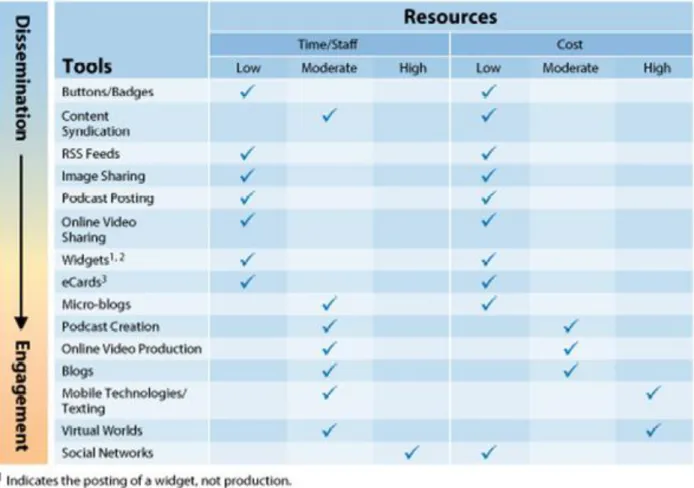
The Centers for Disease Control and Prevention (CDC) suggests that public health agencies that are interested in incorporating social media into their programs start with cost, low-involvement dissemination tools and progress over time to tools requiring greater staff time, resources, and expertise, but that result in greater audience engagement (Centers for Disease Control and Prevention). The CDC also recommends that agencies engaging in the use of social media establishing a governing structure, including boards and councils, as well as policies, guidelines, standards and recommendations that manage the effective and acceptable use of social media within their agencies and programs (Centers for Disease Control and Prevention). A chart detailing the tools, resource intensity and level of audience engagement is presented below.
Figure 4. Organizational resources required to develop and employ social media tools in health communication programs and associated levels of audience engagement (Centers for Disease Control and Prevention).
Recommendations
When taking these first steps into unfamiliar communications territory, social marketers should begin with tools and technologies that further program goals, but which require minimal resources and staff engagement. Once institutional knowledge and support grow, and sufficient staff and resources are allocated, social media tools that facilitate further dialogue with and insights from audience members may be incorporated and economic return-on-investment assessed.
To facilitate the introduction and effective use of these new technologies, public health organizations should also develop policies, guidelines, standards and best practices that govern their usage; establish boards or advisory councils responsible for ensuring high standards; and put in place systems to monitor the social media environment around their issues.
While social media tools may supplement and extend other forms of communication, they should never replace the face-to-face contact needed for building meaningful community partnerships. Stakeholder and community meetings may even be useful venues for launching and promoting social media initiatives (i.e. video contests), gathering feedback on effective and engaging uses (which may then continue in an online forum), and showcasing community members‘ contributions.
Finally, while social media tools allow social marketers to connect with target audiences in new ways (and to connect them with one another), they also allow health agencies a unique window into the innovative work done by some of their ―competitors‖, such as the tobacco industry and producers of unhealthy consumer goods. By strategically monitoring competitors‘ communications and marketing strategies, including their use of social media tools, social marketers have the opportunity to learn from, counter, publically comment on, and perhaps even replicate their most effective engagement techniques.
Conclusion
Web 2.0 technologies not only facilitate new ways of promoting healthful behaviors. They also allow program managers to interact in real time and build ongoing relationships with geographically dispersed target audiences throughout the development, implementation and evaluation of social marketing programs. With the power to self-organize, influence program decisions, design campaign components, promote causes and rally their networks, community members are evolving into active program developers with valuable insights into the programs‘ content, brand, promotion and more.
Social media technologies also show great promise for gathering the real-time health status and behavioral data needed to inform the development and improvement of social marketing programs. From monitoring influenza-related ―tweets‖ to gathering the number of drinks consumed on an evening out, social media tools are increasingly being leveraged for the tracking and measurement of key program indicators.
References
Aaker, D. A. (1996). Building strong brands. Free Press: New York.
Abroms, L. C., & Lefebvre, R. C. (2009). Obama‘s wired campaign: Lessons for public health communication. Journal of Health Communication, 14(5), 415–423.
Andreasen, A. (1995). Marketing social change: Changing behavior to promote health, social development, and the environment. San Francisco: Jossey-Boss.
Beard, L., Wilson, K., Morra, D., & Keelan, J. (2009). A survey of health-related activities on second life. Journal of Medical Internet Research, 11(2). Retrieved June 12, 2011, from http://www.ncbi.nlm.nih.gov/pmc/articles/PMC2762804/.
Bernhardt, J. M., Mays, D., Eroğlu, D., & Daniel, K. L. (2009). New communication channels:
Changing the nature of customer engagement. Social Marketing Quarterly, 15, 7-15.
Bernhardt, J. M., Usdan, S., Mays, D., Martin, R., Cremeens, J., & Arriola, K. J. (2009). Alcohol assessment among college students using wireless mobile technology. Journal of Studies on Alcohol and Drugs, 70(5), 771.
Centers for Disease Control and Prevention. The Health Communicator’s Social Media Toolkit.
Retrieved June 21, 2011, from http://www.cdc.gov/healthcommunication/ToolsTemplates/
SocialMediaToolkit_BM.pdf.
Centers for Disease Control and Prevention. Virtual worlds: EHealth marketing. Retrieved June 6, 2011, from http://www.cdc.gov/healthmarketing/ehm/virtual.html.
Cherkoff, J. Retrieved June 5, 2011, from http://www.collaboratemarketing.com/
open_source_marketing.
Chew, C., & Eysenbach, G. (2010). Pandemics in the age of twitter: Content analysis of tweets during the 2009 H1N1 outbreak. PloS One, 5(11), e14118.
Chou, W. Y. S., Hunt, Y. M., Beckjord, E. B., Moser, R. P., & Hesse, B. W. (2009). Social media use in the United States: Implications for health communication. Journal of Medical Internet Research, 11(4).
Dahl, S. (2010). Using social media for social good–A conceptual overview. Social Science Research Network. Retrieved June 12, 2011 from
http://papers.ssrn.com/sol3/papers.cfm?abstract_id=1624522.
Eysenbach, G. (2002). Infodemiology: The epidemiology of (mis) information. American Journal of Medicine, 113(9), 763-765.
Eysenbach, G. (2009). Infodemiology and infoveillance: Framework for an emerging set of public health informatics methods to analyze search, communication and publication behavior on the internet. Journal of Medical Internet Research, 11(1).
Eysenbach, G. (2011). Infodemiology and infoveillance: Tracking online health information and cyberbehavior for public health. American Journal of Preventive Medicine, 40(5), S154-S158.
Fox, S. (2011). The social life of health information. Washington, DC: Pew Research Center‘s Internet & American Life Project. Retrieved on June 13, 2011 from
http://pewinternet.org/~/media//Files/Reports/2011/PIP_Social_Life_of_Health_Info.pdf.
Freeman, B., & Chapman, S. (2009). Open source marketing: Camel cigarette brand marketing in the "web 2.0" world. Tobacco Control, 18(3), 212-217.
Galer-Unti, R. A. (2009). Guerilla advocacy: Using aggressive marketing techniques for health policy change. Health Promotion Practice, 10(3).
Garrity B. (2011, June 13). Social media join toolkit for hunters of disease. New York Times, Retrieved from http://www.nytimes.com/2011/06/14/health/research/14social.html?
pagewanted=2&_r=1&ref=health.
GYT. (2011). Get yourself tested (GYT) Facebook fan page. Retrieved June 21, 2011, from
Hughes, A. (2010). Using social media platforms to amplify public health messages: An examination of tenets and best practices for communicating with key audiences. Ogilvy
Washington & The Center for Social Impact Communication at Georgetown University.
Hughes, B., Joshi, I., & Wareham, J. (2008). Health 2.0 and medicine 2.0: Tensions and controversies in the field. Journal of Medical Internet Research, 10(3).
Hurling, R., Catt, M., Boni, M. D., Fairley, B. W., Hurst, T., Murray, P., Sodhi, J. S. (2007). Using internet and mobile phone technology to deliver an automated physical activity program: Randomized controlled trial. J Med Internet Res, 9(2), e7.
Jordan, E. T., Ray, E. M., Johnson, P., & Evans, W. D. (2011). Text4Baby. Nursing for Women's Health, 15(3), 206-212.
Kaplan, A. M., & Haenlein, M. (2010). Users of the world, unite! The challenges and opportunities of social media. Business Horizons, 53(1), 59-68.
Kotler, P., & Zaltman, G. (1971). Social marketing: An approach to planned social change. The Journal of Marketing, 35(3), 3-12.
Lefebvre, C. & Flora, J. A. (1988). Social marketing and public health intervention. Health Education & Behavior, 15(3), 299.
Lefebvre C. The implications of social media for social marketing and public health. In
Presentation at the Quarterly Seminar Series in Public Health Communication & Marketing, September 27, School of Public Health and Health Services The George Washington
Lefebvre, C. (2009). Integrating cell phones and mobile technologies into public health practice: A social marketing perspective. Health Promotion Practice, 10(4), 490.
Lefebvre, C. R., & Flora, J. A. (1988). Social marketing and public health intervention. Health Education & Behavior, 15(3), 299.
Lefebvre, R. C. (2007). The new technology: The consumer as participant rather than target audience. Social Marketing Quarterly, 13(3), 31-42.
Lefebvre, R. C. (2009). Getting busy doing the right things: A review of public health BrandingEvans WD and hastings G (editors). The European Journal of Public Health, 19(5), 563.
Lefebvre, R. C. (2011). An integrative model for social marketing. Journal of Social Marketing, 1(1), 54-72.
Levine, D. (2011). Using technology, new media, and mobile for sexual and reproductive health. Sexuality Research and Social Policy, 8(1), 1-9.
Levine, D., McCright, J., Dobkin, L., Woodruff, A. J., & Klausner, J. D. (2008). SEXINFO: A sexual health text messaging service for san francisco youth. American Journal of Public Health, 98(3), 393.
Luca, N. R., & Suggs, L. S. (2010). Strategies for the social marketing mix: A systematic review. Social Marketing Quarterly, 16(4), 122-149.
Maibach, E. W., Abroms, L. C., & Marosits, M. (2007). Communication and marketing as tools to cultivate the public's health: A proposed "people and places" framework. BMC Public Health, 7(88).
Mangold, W. G., & Faulds, D. J. (2009). Social media: The new hybrid element of the promotion mix. Business Horizons, 52(4), 357-365.
Møldrup, C. (2007). Individualised health marketing using SMS—A smoking cessation case. Journal of Medical Marketing, 7(3), 255-259.
Montgomery, K. C., & Chester, J. (2009). Interactive food and beverage marketing: Targeting adolescents in the digital age. Journal of Adolescent Health, 45(3), S18-S29.
Nall, J. (2010). CDC 2.0: Using social media to improve public health. Paper presented at the Proceedings of the 11th Annual International Digital Government Research Conference on Public Administration Online: Challenges and Opportunities, 1-1.
Pempek, T. A., & Calvert, S. L. (2009). Tipping the balance. Arch Pediatr Adolesc Med, 163(7), 633-637.
Pitt, L. F., Berthon, P. R., Watson, R. T., & Wynn Jr, D. (2007). Open to all: A postmodern perspective on product development and brands in an open-source environment. International Journal of Technology Marketing, 2(4), 316-330.
Purdy, C. H. (2011). Using the internet and social media to promote condom use in turkey. Reproductive Health Matters, 19(37), 157-165.
Robinson, M., & Robertson, S. (2010). Young men's health promotion and new information communication technologies: Illuminating the issues and research agendas. Health Promotion International, 25(3), 363.
Rothschild, M. L. (2001). Building strong brands, by David A. Aaker. Book review. Social Marketing Quarterly, 7(2), 36.
Thackeray, R., & Neiger, B. L. (2009). A multidirectional communication model: Implications for social marketing practice. Health Promotion Practice, 10(2), 171.
Thackeray, R., Neiger, B. L., Hanson, C. L., & McKenzie, J. F. (2008). Enhancing promotional strategies within social marketing programs: Use of web 2.0 social media. Health Promotion Practice, 9(4), 338.
Uhrig, J., Bann, C., Williams, P., & Evans, W. D. (2010). Social networking websites as a platform for disseminating social marketing interventions: An exploratory pilot study. Social Marketing Quarterly, 16(1), 2-20.
Vaughan, E., & Tinker, T. (2009). Effective health risk communication about pandemic
Wallack, L. (2000). The role of mass media in creating social capital: A new direction for public health. Promoting Health: Intervention Strategies from Social and Behavioral Research. National Academy Press: Washington, DC. 337-365.
Whittaker, R., Borland, R., Bullen, C., Lin, R., McRobbie, H., & Rodgers, A. (2009). Mobile phone-based interventions for smoking cessation. The Cochrane Collaboration. Published by JohnWiley & Sons, Ltd.
Wikipedia. Open source. Retrieved June 6, 2011, from http://en.wikipedia.org/wiki/Open_ source.