Strategic Planning and Evaluation
of a Collaboration between Duke University Medical Center Department of Psychiatry and Lincoln Community Health Center
in Developing a Mental Health Component to an Existing Health Care for the Homeless Clinic
By Maria Almond
A Master’s Paper submitted to the faculty of the University of North Carolina at Chapel Hill
in partial fulfillment of the requirements for the degree of Master of Public Health in
the Public Health Leadership Program
Chapel Hill 2009
_________________________ Advisor/Date
Strategic Planning and Evaluation
of a Collaboration between Duke University Medical Center Department of Psychiatry and Lincoln Community Health Center
in Developing a Mental Health Component to an Existing Health Care for the Homeless Clinic
Abstract: Mental illness affects approximately 16-25% of the adult US homeless population(1). A 2008 point-in-time survey in North Carolina identified 12,371 homeless individuals, amongst whom 16% reported having a serious mental illness, 34% a substance use disorder, and approximately 6% reported having been recently released from a mental health hospital or drug treatment program (2). Severe mental illness affects one’s ability to obtain basic needs, such as food, shelter and safety (3). Not having appropriate shelter can lead to further destabilization of an existing mental illness (4, 5). Despite research that has shown the benefits of intensive community-based mental health services (6), access issues to such services continue to contribute to the maintenance of the mentally ill on the streets or in jails and prisons (7-9)
Strategic Planning and Evaluation
of a Collaboration between Duke University Medical Center Department of Psychiatry and Lincoln Community Health Center
in Developing a Mental Health Component to an Existing Health Care for the Homeless Clinic
Table of Contents
I. Introduction………...4
II. Literature Review………....….5
Methods………....……...5
Research Challenges………...6
Evidence-Based Programming………...9
Current Models of Care for SPMI Homeless Population ………….11
Discussion………..14
III. Program Plan………...15
Local Framework………..15
Program Theory………18
Goals/Objectives………...20
Implementation Plan……….22
IV. Evaluation Plan………24
Design………24
Methods……….25
Dissemination Plan………26
Evaluation Planning Tables………..………….26
V. IRB Summary………..34
VI. Discussion………34
Strategic Planning and Evaluation
of a Collaboration between Duke University Medical Center Department of Psychiatry and Lincoln Community Health Center
in Developing a Mental Health Component to an Existing Health Care for the Homeless Clinic
Maria Almond
I. Introduction
Between 16-25% of the adult US homeless population has been diagnosed with a mental illness (1). Of the 12, 371 homeless individuals identified in a 2008 point-in-time survey in North Carolina, 1,961 (16%) identified as having a serious mental illness, 4,206 (34%) identified as having a substance use disorder, and 6% had been released from a mental health hospital or drug treatment program in the 30 days prior to becoming homeless (2). Within the homeless population, those who suffer from substance abuse and severe mental illness often are further marked by extreme poverty; underutilization of public entitlements; isolation from family, friends, and other support networks; frequent contact with correctional agencies; and poor physical health (10, 11). Homelessness significantly affects quality-of-life for those with mental illness (4, 5). As well, those with severe mental illness are at increased risk for homelessness. In one study which tracked those with serious mental illnesses, including schizophrenia, bipolar disorder, and major depression, over one year, the prevalence rate of homelessness was 15% (12).
on the streets or in jails and prisons (7-9). Care is often fragmented with poor coordination between providers leading to persons falling through the gaps and into emergency rooms, psychiatric institutions and correctional facilities (13).
This paper will examine one possible step towards closing the treatment gap: by meeting homeless clients where they are—on the streets and at the shelter. The details of developing and evaluating a mental health clinic, based at an existing Durham homeless shelter medical clinic, will be explored.
II. Literature Review
Over the past several decades increasing research of the US homeless population has led to the development of multiple approaches towards best maintaining stable housing for those with chronic mental illness and ensuring continued and appropriate mental and physical health care. This section touches on several theoretical approaches towards working with the homeless population living with chronic mental illness.
More specifically this literature review seeks to understand which programmatic elements best address the barriers to accessing services for the homeless adult, living with a mental illness, during transition from psychiatric hospitalization to community-level care.
Methods
initial search yielded 2479 papers. Limiting these papers to English language, human research subjects, adult subjects older than 19, clinical trials/randomized controlled trials/reviews/meta-analyses and papers published within the past 10 years led to a group of 101 papers. From these papers, abstracts were analyzed to look for papers specific to understanding how to obtain best outcomes for those previously homeless and also transitioning from mental health hospitalizations to community living. While many papers consider the question of those who are homeless with severe mental illness and how to increase access to social and psychiatric services, few deal specifically with this transition period from institution back to community. Three papers specifically addressed this topic. Of note, these did not focus on same outcomes with some only using housing and others including variations of psychiatric symptom evaluations.
Papers were excluded if they worked exclusively with substance abuse issues, precluding other forms of mental illness. As well, multiple papers have been published examining issues of HIV-related care among the homeless population. These were also excluded, given their specificity among a particular group of homeless adults. Other specific population papers were also excluded, such as those dealing only with women, children, or the veteran population for which particular governmental programs are being evaluated.
Research Challenges
population is always shifting making an understanding of current demographics difficult. Even basic point-in-time observational studies become obsolete within short periods of time. As well, multiple definitions of homelessness---those living on streets unsheltered versus those in unstable transitional or shelter housing versus those recently transitioned from street living—exist and differ between research projects. When considering “mental illness,” definitions also vary—for instance, at times substance abuse is included, at other times excluded. In some projects, researchers do extensive chart reviews to obtain previous documentation of a mental disorder; other projects depend on clinical evaluations done within the parameters of the research project to determine diagnosis; still others simply rely on self-report.
Therefore, any inference derived from these studies needs to be understood within the context of the specific target population definitions. A recently developed report by the National Alliance to End Homelessness uses data from the US Department of Housing and Urban Development (HUD)’s annual homeless census. These annual point-in-time estimates use Continuums of Care Centers (CoCs), which coordinate funding and services for the homeless locally. Yet collection methods are not uniform between CoCs due to individual geographic and demographic differences and even change annually, making the data interpretable only by estimates (14).
often are percentage retained in housing rather than level of overall functioning. As well, a single homeless individual may use multiple services, which can be extremely difficult to monitor and coordinate. The Colorado Coalition for the Homeless (CCH) examined the diversity of methodologies employed in research among homeless populations and the difficulty in performing multi-domain assessments by developing and validating an outcome scale to assessment and service planning needs (16). The National Health Care for the Homeless Council continues to coordinate efforts to improve evaluation and monitoring capacity at least among federal Health Care for the Homeless (HCH) grantees, yet these efforts are still in their infancy.
Evidence-Based Programming
Evidence remains limited regarding behavioral health care for the homeless—both in the number of studies published and also in the constraints placed on researchers due to challenges inherent in studying this population. In an effort to specifically understand the barriers to continued access to care after psychiatric hospitalization, this literature review began with a PubMed search that revealed only a few papers which had control groups or were randomized controlled trials (RCTs) addressing this particular issue. This paper examines programs that can be implemented to assist with access to psychiatric and social services during the specific period of transition from institution to community living.
One paper by Forchuk et al. describes a small sample of fourteen persons at-risk of being discharged from a psychiatric facility to “no fixed address” who were randomized to either immediate assistance with housing or usual care, which included discharge to shelters or the street. After six months all those within the intervention group maintained housing; all but one from the control group remained homeless (18). Of note, no psychometric measurements were obtained from the study group, which was also small in sample size.
those moving from psychiatric hospitals to community care. CTI arose out of observations from New York shelters during 1990s when housing options expanded significantly allowing for placement of homeless persons into independent living situations, that many were unable to maintain housing past 18 months. The transition period in which a person was required to maneuver through complicated systems of care, away from known support systems, often proved too complex(19).
A follow-up randomized trial by Herman et al. specifically looking at 150 persons on discharge from two New York state-operated psychiatric hospitals was to be completed in September 2007, with results still unpublished(19).
One paper by Bradford et al. did not deal specifically with the transition between psychiatric facilities and community level care, but did assess a similar shelter-based program to that being planned, designed to improve access to community psychiatric services for those with severe and persistent mental illness. A shelter-based intervention, meant to act as a bridge into community mental health care, was designed to include intensive outreach by a psychiatric social worker and weekly psychiatric visits. 102 subjects were enrolled. The primary outcome was making an initial appointment at a community mental health center. Secondary outcome measures were continued attendance at mental health appointments, participation in a substance abuse program, housing and employment status. The intervention was successful in increasing participation in at least an initial appointment with a community mental health care provider and in attendance at a substance abuse program. However, there was no significant difference with other outcomes including housing(22).
Current Models of Care for SPMI Homeless Population 1) Continuum of Care
homelessness. The fundamental steps of a Continuum of Care system, moving towards independent living, include 1) initial outreach, intake and assessment to identify needs and link to appropriate services; 2) emergency shelter; 3) transitional housing with supportive services in order to develop skills necessary for permanent housing; and 4) achievement of permanent housing (23). This model assumes that necessary skills for living must be obtained through stepwise learning and that ability to maintain housing depends on sobriety and engagement in psychiatric treatment.
2) Housing First
In the 1990s a NYC-based group Pathways to Housing, Inc. initiated this consumer-driven program under the belief that housing should not be dependent on the choices any person makes regarding substance abuse or mental health treatment, but should be made available without restriction. Housing First works by placing the homeless into independent housing from the start without moving through the traditional stages of housing support. The only requirements are that 1) consumers pay 30% of income towards rent usually assisted by a money management program and 2) agree to have staff visit their homes two to three times per month. Otherwise, the consumer chooses all assistance services (24).
decreased homelessness rates, as well as increased perceived choice. This perceived choice, partially mediated by mastery, is also linked to a decrease in psychiatric symptoms, giving support to the idea of consumer-driven care(24).
Currently HUD, SAMHSA, and the US Interagency Council on Homelessness support this model to address chronic homelessness (3).
3) Integrated Services
Exemplified by assertive community treatment teams (ACTT), this third model often works in coordination with either Continuum of Care or Housing First and includes outreach, integrated case management, safe havens, income support/benefits, vocational training, supported employment, psychiatric treatment and medical care (6).
Two federal funding programs, which are managed through SAMHSA, Projects for Assistance in Transition from Homelessness (PATH) and Grants for the Benefit of Homeless Individuals/Treatment for Homeless Persons (GBHI/THP), support community-based outreach and mental health support services to the homeless. Within North Carolina there are several PATH program grantees, mainly based out of the regionally based local management entities (LME), which serve as hubs for the mentally ill to connect with appropriate providers (3) .
Discussion
Most research, which is focused on improving psychiatric access for homeless persons with severe psychiatric illness, examines programs designed for those not yet in contact with the mental health system or in limited contact. The goal within this population is identification. Who are those suffering from mental illness within the homeless population? And how does one reach out to provide appropriate services?
community resources are not readily available. The scarcity means an appointment may be set for weeks after discharge, at a clinic located miles away from the patient’s shelter.
Few studies look at this particular period of transition and even within those studies primary outcome usually is housing, not improvement in psychiatric symptoms or quality-of-life. Evidence shows that housing for even the severely mentally ill produces significant added benefit to mental status, quality-of-life and healthcare utilization (17). But housing is not precisely the desired endpoint. Although an easy measurement piece, researchers must also remember that housing is only a moderating factor towards functionality. Housing and even appropriate mental health care are only steps in the push towards improving quality-of-life for this population.
This literature review examined the barriers to accessing services for the homeless adult, living with a mental illness, specifically during transition from psychiatric hospitalization to community-level care. While the mental health homeless clinic currently in development will provide care to those recently discharged from psychiatric hospitals to a local homeless shelter, the clinic will be open to any homeless client referred with the goal of ensuring appropriate continuity in mental health treatment.
III. Program Plan Local Framework
for Coordinating Homeless Programs (ICCHP). Currently twelve North Carolina communities, including Durham, have instituted 10-year plans to end homelessness (2). Several different initiatives have been launched to help the homeless with mental illness access services. The Homeless Mental Health Housing Initiative, funded through the Mental Health Trust Fund, uses support teams who move through hospitals, treatment programs, jails/prisons to assist those with severe and persistent mental illness to maintain or locate appropriate housing during times of transition back to the community until a community-based enhanced service provider steps in (2). The SOAR Initiative (SSI/SSDI Outreach, Access, and Recovery) is a federally-funded program working to improve rates of successful SSI and SSDI applications, which can be enhanced through having a complete mental health assessment (2).
In January 2009, the staff of the Durham Affordable Housing Coalition and Housing for New Hope, in conjunction with the U.S. Census Bureau, counted all persons who are homeless on a given day. Per this survey, 502 people including children were sheltered in local service agencies, and thirty-three people residing on the streets. 129 had been transitioned to permanent supportive housing. Of those within transitional housing, such as a shelter, or living on the street, 104 were diagnosed with a serious mental illness and 353 had a substance use disorder. Ninety-four had been released from the behavioral health system in the past thirty days prior to becoming homeless (29).
population at a clinic situated beside a local homeless shelter. Staff includes a nurse, physician assistant and social worker. The clinic is open 3-4 days/week with afternoon and evening hours. From January to November 2006 the clinic had over 3,000 visits (30). The clinic provides free medical care and basic screening for mental health and substance abuse treatment with referral to local agencies. On-site staff provide substance abuse counseling. However, no psychiatrist is available, and therefore, for those with severe and persistent mental illness, access to necessary medications is limited. Funding to staff psychiatric residents at the clinic is not currently available. Grant funding currently offers compensation for Duke psychiatric residents to work at the main Lincoln Community Health Center, but does not extend to Lincoln-associated clinics, located off-site. However, several willing psychiatric residents and staff members are volunteering time, allowing the opportunity to pilot-test a mental health clinic for the homeless at Urban Ministries homeless shelter. One necessary long-term goal would be to obtain permanent funding through government or private grants to maintain the clinic.
Homeless Program would assist in bridging this gap to serve those without stable housing diagnosed with a mental illness.
Program Theory
During psychiatric residency, interactions with the homeless population are frequent and often occur in situations in which the residents are fatigued and often overwhelmed. At such times of intense stress, the risk for defaulting to ingrained stereotypes is high (31). How then does a residency program assist in developing awareness of a resident’s own prejudices and support interactions that promote breakdown of such biases? The development of a program plan for psychiatric resident volunteer at a homeless clinic was based not only on past research indicating that even brief exposure to indigent populations in volunteer settings increases the likelihood of continued voluntary work(32), but also clinic social psychology theory, exploring the development of stereotypes and the possibilities for combating discriminatory behavior.
in relation to human interactions. Social emotions correlate with brain activity mainly in the medial pre-frontal cortex (mPFC) (34, 35). However, of note, when Fiske et al elicited contempt/disgust using images of known outgroups, such as drug addicts or homeless individuals, (i.e. those groups that elicited both low warmth and competence scores on the Stereotype Content Model), the mPFC had less activation (36). At a neural level, the brain was categorizing those from outgroups as more like objects, dehumanizing them. But by simply asking participants to envision food preferences for these outgroup members, more social emotion, more humanity was conferred upon these members and increased mPFC activity was noted (37).
Many psychiatric residents may have, yet not consciously be aware of, significant biases towards the homeless population. Within the stressful environments in which psychiatric residents first encounter those who are homeless, the risk for continued objectification and strengthening of prejudice and possible discriminatory behavior is significant. Understanding, then, that even a few hours spent in service with a population perceived to be different from oneself can uproot a bias, this project seeks simply to create a safe environment for healthcare providers to voluntarily work with those who are homeless.
(HBM), which focuses on developing a thorough grasp of the client’s perceptions and beliefs regarding his/her illness, will be integrated into both planning and evaluation, as means of creating an open environment in which providers and clients learn one from the other.
Goals/Objectives
GOAL: To improve access and referral to mental health care services among the homeless population in Durham, North Carolina with severe and persistent mental illness.
OBJECTIVES: SHORT (1-3yrs)
Care Coordinator will recruit 4-6 psychiatric residents to volunteer for at least onc two-hour clinic by June 2009.
Care Coordinator will recruit 2-3 attending physicians for on-site supervision of psychiatric residents for each clinic by June 2009.
Current primary supervising will assist in obtaining elective status for clinic rotation in order to provide credit to those residents and attending physicians working in the clinic by July 2009.
Clinic will hold 16 clinical sessions by the end of 2010.
Clinic will complete psychiatric evaluations of 20 persons with mental illness among the Durham homeless population by end of 2010.
Clients evaluated at the clinic will have an increased rate of attendance to initial community mental health follow-up appointments by end of 2011.
Clients evaluated at the clinic will increase use of other community resources to improve well-being by end of 2011.
By end of 2009-2010 academic year, Duke psychiatric residents will have an increased knowledge regarding community resources for the homeless population in Durham, and an awareness of evidence-based interventions proven to enhance psychiatric outcomes.
LONG (3-6yrs)
50% of the clients evaluated in the clinic will be in mental health treatment with a long-term provider by 2015.
Clients will decrease emergency room visits for mental health services by 2012.
60% of Duke psychiatric residents will report feeling decreased helplessness or increased skill in interactions with homeless population by 2012.
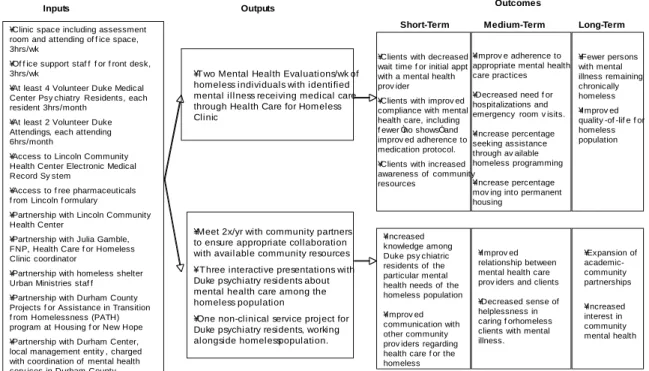
Figure 1: Logic Table
Implementation Plan
In January 2009 Duke University Medical Center psychiatry resident volunteers began working 2-hour sessions 1-2x/month at the Lincoln Health Care for the Homeless Clinic, under the supervision of an on-site volunteer attending psychiatrist. For each mental health clinic session, two clients, identified by the clinic manager Julie Gamble, are scheduled for a 45-minute psychiatric evaluation. All records are maintained within the Lincoln Community Health Center’s existing electronic medical record (EMR). Prescriptions, as needed, are printed out from the EMR and picked up for free from the clinic during daytime operating hours. Clients are referred to additional community
Goal: T o improve access and referral to mental health care services among the homeless population in Durham, North Carolina.
Collaboration between DUMC Department of Psychiatry and Lincoln Community Health Center in Development of Behavioral Health Component to Urban Ministries Homeless Clinic
Inputs Outputs Outcomes
¥Clinic space including assessment room and attending of f ice space, 3hrs/wk
¥Of f ice support staf f f or f ront desk, 3hrs/wk
¥At least 4 Volunteer Duke Medical Center Psy chiatry Residents, each resident 3hrs/month
¥At least 2 Volunteer Duke Attendings, each attending 6hrs/month
¥Access to Lincoln Community Health Center Electronic Medical Record Sy stem
¥Access to f ree pharmaceuticals f rom Lincoln f ormulary
¥Partnership with Lincoln Community Health Center
¥Partnership with Julia Gamble, FNP, Health Care f or Homeless Clinic coordinator
¥Partnership with homeless shelter Urban Ministries staf f ¥Partnership with Durham County Projects f or Assistance in Transition f rom Homelessness (PATH) program at Housing f or New Hope ¥Partnership with Durham Center, local management entity , charged with coordination of mental health serv ices in Durham County
¥Two Mental Health Evaluations/wk of homeless individuals with identified mental illness receiving medical care through Health Care for Homeless Clinic
Short-Term Long-Term
¥Improv ed relationship between mental health care prov iders and clients ¥Decreased sense of helplessness in caring f or homeless clients with mental illness. ¥Increased
knowledge among Duke psy chiatric residents of the particular mental health needs of the homeless population ¥Improv ed communication with other community prov iders regarding health care f or the homeless
¥ Three interactive presentations with Duke psychiatry residents about mental health care among the homeless population
¥One non-clinical service project for Duke psychiatry residents, working alongside homeless population. ¥Meet 2x/yr with community partners to ensure appropriate collaboration with available community resources
¥Clients with decreased wait time f or initial appt with a mental health prov ider
¥Clients with improv ed compliance with mental health care, including f ewer Òno showsÓ and improv ed adherence to medication protocol. ¥Clients with increased awareness of community resources
mental health resources as appropriate.
Based on the Health Belief Model (HBM) with an emphasis on consumer choice and perception of illness, all evaluations are conducted with an eye towards incurring the least amount of coercion, and in attempting to fully develop an understanding of the client’s needs and beliefs regarding his/her mental illness and interactions with the medical system.
Staff:
All residents and attending physicians must receive clinical privileges to practice at the Lincoln Community Health Center Healthcare for the Homeless Clinic (HCH). Those working at HCH must agree to adhere to Lincoln Community Health Center clinic policies and submit signed agreements. Copies of all policies are distributed to all staff.
Dr. Susco from Lincoln Community Health will supervise the initiative. Julia Gamble, MPH, FNP, Manager of the Health Care for the Homeless Program, will coordinate the clinic activities. Dr. Eric Christopher and Dr. Marvin Swartz will serve as liaisons between Health Care for the Homeless and Duke University Medical Center Department of Psychiatry. Volunteer on-site supervising attending physicians from Duke will rotate through the clinic at least once each month.
Maria Almond, Duke psychiatry resident, will organize educational programming for psychiatry residents throughout the 2009-2010 academic year, consisting of at least three presentations to the psychiatry residents and one non-academic service activity alongside those who are homeless.
IV. Evaluation Plan Evaluation Design
improved psychiatric symptoms, the evaluation process should reflect as much as possible the possibility of choice (24).
Methods
Open-ended interviews with psychiatric residents, attendings, and Lincoln Community Health Care Staff regarding whether clinic goals had been met and any changes in perception of homeless clients over time of working in clinic also will be discussed. Focus groups will also be held with all residents at the beginning of the academic year and one year later after a series of different activities both academic and clinical to gain increased exposure and experience in working with the homeless population.
Dissemination Plan
The results of the ensuing evaluation will be shared via a comprehensive report with all invested partnerships in this collaborative effort to launch a mental health component for an existing homeless shelter clinic, including Lincoln Community Health Care Center, the PATH program under Housing for New Hope, Durham Center Access, 10yr Plan to End Homelessness, and Duke University Medical Center Department of Psychiatry.
As well, results will be submitted for possible poster presentation at local and national psychiatric conferences—given possible future implications for public-academic partnerships at the residency level. Presentations on the results will also be delivered within the Duke Department of Psychiatry.
Evaluation Planning Tables
completed paperwork required to practice medicine under the Lincoln Community Healthcare for the Homeless clinic.
Evaluation question Participant Evaluation Method
Were 2-3 attendings and 4-6 psychiatric residents successfully recruited? If not, why?
Clinic Coordinator Open-Ended Interview
How might recruitment efforts be improved?
Clinic Coordinator Attendings and residents
Open-Ended Interview; Self-Report Questionnaire; Focus Group
What are reasons resident or attending chose to volunteer with the homeless shelter clinic?
Attendings and residents
Self-Report Questionnaire; Focus Group
If the residency recognized the clinic time as credit for community psychiatry, would the resident be willing to serve more hours?
Attendings and residents
Self-Report Questionnaire; Focus Group
What are some challenges that may limit a resident’s time working at the homeless shelter clinic?
Attendings and residents
Self-Report Questionnaire; Focus Group
Have all clinical participants completed the requisite paperwork? If not, why?
Clinic Coordinator Attendings and residents
Open-Ended Interview; Self-Report Questionnaire; Focus Group
Short-Term Process Objective #2: By project month 6, will have coordinated procedure for training new residents to work at clinic, including effectively using electronic medical record.
Evaluation question Participant Evaluation Method
Have all residents and attendings been trained to use electronic medical record system? If not,
Attendings and Residents
why?
Were all new residents and attendings trained regarding clinic procedures? If not, why?
Attendings and Residents
Self-Report Questionnaire; Focus Group
Are all residents and attendings aware of emergency procedures for this clinic (i.e. fires, medical/psychiatric emergency)?
Attendings and Residents
Self-Report Questionnaire; Focus Group
Was there anything that needed clarification after the first shift working?
Attendings and Residents
Self-Report Questionnaire; Focus Group
Was check-out with supervising attending efficient and useful?
Attendings and Residents
Self-Report Questionnaire; Focus Group
Are there any clinic procedures that the clinician would consider counter-therapeutic or about which there were safety concerns?
Attendings and Residents
Self-Report Questionnaire; Focus Group
How can clinic procedures be improved?
Attendings and Residents
Self-Report Questionnaire; Focus Group
Short-Term Process Objective #3: By project month 6, will have held eight 2-hour mental health clinic sessions and will have evaluated at least 6 patients.
Evaluation question Participant Evaluation Method
How many clinic sessions have been held?
Clinic Coordinator Open-ended interview What are the limitations to instituting
regular clinic hours?
Clinic Coordinator Open-ended interview Has clinic often ended early or late? Clinic Coordinator Open-ended interview How many patients have been
evaluated?
Clinic Coordinator Open-ended interview How many “no show” appointments
have there been?
Clinic Coordinator Open-ended interview What are the challenges some
homeless persons may have to
Clinic Coordinator; Residents and
walking into the clinic? Attendings What is the range of diagnoses seen
in the clinic setting?
Clinic Coordinator Open-ended interview How many clients have been
discharged from a psychiatric hospital within the past 30 days?
Clinic Coordinator Open-ended interview
Have any patients needed emergent care either medically or psychiatrically?
Clinic Coordinator Open-ended interview
Short-Term Process Objective #4: By project month 8 the education coordinator will have given three presentations to Duke psychiatry residents about mental health care for the homeless population and introduced incoming residents to community support services in Durham.
Evaluation question Participant Evaluation Method
What were the difficulties in scheduling additional lectures into resident academics?
Education Coordinator Open-ended interview
What were the challenges in recruiting outside speakers?
Education Coordinator Open-ended interview What did residents find most
helpful from the presentations? Least helpful?
Education Coordinator, Residents
Open-ended interview, self-report questionnaire What additional topics would
residents like to see addressed?
Education Coordinator, Residents
Open-ended interview, self-report questionnaire Did the presentations make
residents more or less willing to work with this population?
Education Coordinator, Residents
Short-Term Participant Objective #1: By project month 8, the rate among clients evaluated at the clinic of “showing” to initial community mental health follow-up appointments will be improved.
Evaluation question Participant Evaluation Method
What is the “no show” rate for initial community mental health appointments among those NOT seen previously at the shelter clinic?
Clinic coordinator, education coordinator
Chart Review
What is the “no show” rate for initial community mental health appointments of shelter clients?
Clinic coordinator, education coordinator
Chart Review
What is the “no show” rate for initial community mental health appointments for those NOT seen at the shelter clinic and also discharged from psychiatric hospitalization in the past 30 days?
Clinic coordinator, education coordinator
Chart Review
What is the “no show” rate for initial community mental health appointments for those seen at the shelter clinic and also discharged from psychiatric hospitalization in the past 30 days?
Clinic coordinator, education coordinator
Chart Review
What are the challenges those with mental illness who are homeless have to making scheduled appointments?
Attendings, residents
Homeless community members
Self-Report Questionnaire; Focus Group
Open-ended interview What steps could be taken to
improve “no show” rates among the mentally ill who are homeless?
Attendings, residents
Homeless community members
Self-Report Questionnaire; Focus Group
Short-Term Participant Objective #2: By project month 10, clients evaluated at the clinic will have an increased use of other community services.
Evaluation question Participant Evaluation Method
How many shelter clients use other community services aside from mental health care?
Clinic coordinator, education coordinator
Clinic clients
Chart Review
Open-ended interview How many of those who have not
been seen at the clinic use other community services aside from mental health care?
Clinic coordinator, education coordinator
Homeless
Community Members
Chart Review
Open-ended interview What are the barriers to accessing
other community services?
Attendings, residents
Homeless community members
Self-Report Questionnaire; Focus Group
Open-ended interview What would better assist those
who have mental illness and are homeless in accessing community services?
Attendings, residents
Homeless community members
Self-Report Questionnaire; Focus Group
Open-ended interview Short-Term Participant Objective #3: By project month 10, Duke psychiatric residents will have increased knowledge regarding community resources for the homeless population in Durham, and an awareness of evidence-based interventions proven to enhance psychiatric outcomes.
Evaluation question Participant Evaluation Method
Have residents increased their knowledge about community resources for the
homeless population in Durham?
What are two community resources available for the homeless population in Durham?
Residents Self-Report Questionnaire
Have residents’ awareness of evidence-based interventions for the homeless population in Durham increased?
Residents Self-Report Questionnaire
What is one evidence-based intervention proven to enhance psychiatric outcomes amongst the homeless?
Residents Self-Report Questionnaire
Have residents used the information acquired during earlier presentations in clinical practice?
Residents Self-Report Questionnaire
What other information would be most useful to clinicians in caring for those who are homeless?
Residents Self-Report Questionnaire
Long-Term Objective #1: By project month 18, 50% of the clients evaluated in the clinic, will be in mental health treatment with a long-term provider.
Evaluation question Participant Evaluation Method
How many clients served by the shelter clinic are in care with a mental health provider?
Clinic coordinator, education coordinator
Chart Review
What are the perceived barriers to remaining in long-term mental health care?
Homeless Community Members
Open-ended interview
Of those who are currently in long-term mental health care, how many times were they evaluated by the shelter clinic?
Clinic coordinator, education coordinator
Chart Review
Of those who are NOT currently in long-term mental health care, how many times were they evaluated by the shelter clinic?
Clinic coordinator, education coordinator
Long-Term Objective #2: By project month 18, fewer clients who had been evaluated at the clinic will use emergency departments for mental health services.
Evaluation question Participant Evaluation Method
Of the clients served by the shelter clinic, how many times have they used emergency mental health services?
Clinic coordinator, education coordinator
Chart Review
Of the clients served by the shelter clinic, how many times have they used emergency medical services?
Clinic coordinator, education coordinator
Chart Review
What are the challenges to receiving urgent care through Durham Access?
Homeless
Community Members
Open-ended interview Of the clients served by the shelter,
how may of those using emergency services more than 3x/year have a long-term mental health care provider?
Clinic coordinator, education coordinator
Chart Review
Long-Term Objective #3: By project month 18, at least 60% of Duke psychiatric residents will report feeling decreased helplessness in interactions with homeless population.
Evaluation question Participant Evaluation Method
Using Likert scale 1-5 (never to always), rate how often you feel helpless when working with the homeless population?
Residents Pre/Post Survey
Did at least 60% of residents report feeling decreased helplessness in interactions with the homeless population? If not, what would improve this rate?
Education Coordinator
Open-ended Interview
What would assist residents most in feeling less helpless when working with the homeless population?
Residents Pre/Post Survey
would be helpful in increasing feelings of competence in working with homeless population?
Schwarzer & Jerusalem (rev 2000). Scale of General Perceived Self-Efficacy (38)
Residents Pre/Post Survey
V. IRB Summary
No IRB approval was necessary for this project given that involvement of human subjects was limited to research designed to study, evaluate, or otherwise examine a public benefit or service program and possible changes in or alternatives to this program. Quality assurance investigations do not at this time require IRB approval.
Prior to implementing the evaluation, however, IRB counsel would be sought for clarification regarding need for approval.
VI. Discussion
community-based, enhanced service provider, remaining instead in limbo even after intensive in-patient treatment. Ensuring that mental health clients make the transition from hospital to community mental health care is difficult. Often lengthy follow-up periods, combined with a patient’s limited resources make such a transition feel impossible.
Yet the mental health care system itself also makes access at any stage improbable. Current behavioral health safety nets for those without health insurance, such as Local Management Entities in North Carolina, are often not set-up appropriately to address the complex social, economic and health needs of the homeless. Locations of mental health clinics can be inaccessible, often separate from the internal medicine clinics where additional appointments must be scheduled, and next available appointments can be weeks from the time of initial inquiry. In a system with few resources, the choice often is care versus no care. Many choose no care.
population to continue to choose engagement with other community resources? Studies indicate that developing strong personal relationships with those in transition, providing safe surroundings and the possibility of independent housing can assist in treatment engagement and retention (40, 41). What will be the effects of even a brief two-hour mental health clinic once a month?
The program is a small pilot, which begins to explore known weaknesses within the existing mental health system, and to examine the elements that do work to keep an individual within care. Time is limited for both residents and attending physicians, who work as volunteers; permanent funding is not yet available. There is no guarantee that a single additional engagement with a provider will improve the overall prognostic course for any individual, yet shelter-based clinics have been shown to at least increase the likelihood of making an additional appointment with a substance abuse program or community mental health center (22). The plan for this shelter-based mental health clinic has been put into action since January 2009 with the hope of beginning to close those gaps into which the homeless often fall.
the premises, being a provider willing to engage with those who are homeless may do so much more than simply improve access. Offering a hand brings humanity back. No longer is a homeless individual a problem to be solved, but rather a human being to be helped.
REFERENCES
1. NCH. Mental Illness and Homelessness. Washington, DC: National Coalition for the Homeless; 2008.
2. NCDHHS. Homelessness in North Carolina. 2009 [cited 1 March 2009]; Available from: www.dhhs.state.nc.us/homeless/homelessfacts.htm
3. SAMHSA. Center for Mental Health Services Division of Service and Systems Improvement Homeless Programs Branch Programs for Homeless People with Serious
Mental Illnesses. 2004 [cited 2009; Available from:
mentalhealth.samhsa.gov/cmhs/homelessness/about.asp
4. Schanzer B, Dominguez B, Shrout PE, Caton CLM. Homelessness, health status, and health care use. American Journal of Public Health. 2007;97(3):464.
5. Lehman AF, Kernan E, DeForge BR, Dixon L. Effects of homelessness on the quality of life of persons with severe mental illness. Psychiatric Services. 1995;46(9):922. 6. Coldwell CM, Bender WS. The effectiveness of assertive community treatment for homeless populations with severe mental illness: a meta-analysis. American Journal of Psychiatry. 2007;164(3):393.
7. Lamb HR, Weinberger LE. Persons With Severe Mental Illness in Jails and Prisons: A Review. Psychiatric Services. 1998;49(4):483.
8. Bachrach LL. The Homeless Mentally Ill and Mental Health Services: An Analytical Review of the Literature. The Homeless Mentally Ill: A Task Force Report of the American Psychiatric Association Washington DC. 1984:11-54.
9. Greenberg GA, Rosenheck RA. Jail Incarceration, Homelessness, and Mental Health: A National Study. Psychiatr Serv. 2008 February 1, 2008;59(2):170-7.
10. Fischer PJ, Breakey WR. The epidemiology of alcohol, drug, and mental disorders among homeless persons. American Psychologist. 1991;46(11):1115-28.
11. Fazel S, Khosla V, Doll H, Geddes J. The Prevalence of Mental Disorders among the Homeless in Western Countries: Systematic Review and Meta-Regression Analysis. PLoS Medicine. 2008 December 01, 2008;5(12):e225.
12. Folsom DP, Hawthorne W, Lindamer L, et al. Prevalence and Risk Factors for Homelessness and Utilization of Mental Health Services Among 10,340 Patients With Serious Mental Illness in a Large Public Mental Health System. Am J Psychiatry. 2005 February 1, 2005;162(2):370-6.
14. NAEH. Homelessness Counts: Changes in Homelessness from 2005-2007. Washington, DC: National Alliance to End Homelessness, Homelessness Research Institute; 2009 January.
15. NHCHC. Developing Outcome Measures to Evaluate Health Care for the Homeless Services. Nashville, TN: National Health Care for the Homeless Council, Inc; 2005.
16. Cook PF, Farrell E, Perlman J. The CCH Consumer Outcome Scales: A Brief Instrument to Assess the Multiple Problems of Homelessness. Journal of Nursing Measurement. 2007;15(2):83-104.
17. Kyle T, Dunn JR. Effects of housing circumstances on health, quality of life and healthcare use for people with severe mental illness: a review. Health & Social Care in the Community. 2008;16(1):1.
18. Forchuk C, MacClure SK, Van Beers M, et al. Developing and testing an intervention to prevent homelessness among individuals discharged from psychiatric wards to shelters and'No Fixed Address'. Journal of Psychiatric and Mental Health Nursing. 2008;15(7):569-75.
19. Herman D, Conover S, Felix A, Nakagawa A, Mills D. Critical time intervention: An empirically supported model for preventing homelessness in high risk groups. The Journal of Primary Prevention. 2007;28(3):295-312.
20. Herman D, Opler L, Felix A, Valencia E, Wyatt RJ, Susser E. A Critical Time Intervention with Mentally III Homeless Men: Impact On Psychiatric Symptoms. The Journal of Nervous and Mental Disease. 2000;188(3):135.
21. Jones K, Colson PW, Holter MC, et al. Cost-effectiveness of critical time intervention to reduce homelessness among persons with mental illness. Psychiatric Services. 2003;54(6):884.
22. Bradford DW, Gaynes BN, Kim MM, Kaufman JS, Weinberger M. Can Shelter-Based Interventions Improve Treatment Engagement in Homeless Individuals With Psychiatric and/or Substance Misuse Disorders?: A Randomized Controlled Trial. Medical care. 2005;43(8):763.
23. USHUD. Guide to Continuum of Care Planning and Implementation US Department of Housing and Urban Development; 2001.
24. Greenwood RM, Schaefer-McDaniel NJ, Winkel G, Tsemberis SJ. Decreasing psychiatric symptoms by increasing choice in services for adults with histories of homelessness. American Journal of Community Psychology. 2005;36(3):223-38.
25. Morse GA, Calsyn RJ, Klinkenberg WD, et al. An experimental comparison of three types of case management for homeless mentally ill persons. Psychiatr Serv. 1997 April 1, 1997;48(4):497-503.
26. Randolph F, Blasinsky M, Leginski W, Parker LB, Goldman HH. Creating integrated service systems for homeless persons with mental illness: the ACCESS Program. Access to Community Care and Effective Services and Supports. Psychiatric Services. 1997;48(3):369.
28. Morse GA, Calsyn RJ, Miller J, Rosenberg P, West L, Gilliland J. Outreach to homeless mentally ill people: Conceptual and clinical considerations. Community Mental Health Journal. 1996;32(3):261-74.
29. NCCEH. NC Point-In-Time Count Reporting Form. North Carolina Coalition to End Homelessness; 2009.
30. Gamble J. Health Care for the Homeless Program Progress Report: January to November 2006. Durham, NC: Lincoln Community Health Care; 2006.
31. Burgess DJ, Fu SS, van Ryn M. Why do providers contribute to disparities and what can be done about it? Journal of General Internal Medicine. 2004;19(11):1154-9. 32. O’Toole TP, Hanusa BH, Gibbon JL, Boyles SH. Experiences and attitudes of residents and students influence voluntary service with homeless populations. Journal of General Internal Medicine. 1999;14(4):211-6.
33. Fiske ST, Cuddy AJC, Glick P, Xu J. A model of (often mixed) stereotype content: Competence and warmth respectively follow from perceived status and competition. Journal of Personality and Social Psychology. 2002;82(6):878-902.
34. Frith CD, Frith U. Interacting minds--a biological basis. Science. 1999;286(5445):1692.
35. Ochsner KN, Knierim K, Ludlow DH, et al. Reflecting upon feelings: an fMRI study of neural systems supporting the attribution of emotion to self and other. Journal of Cognitive Neuroscience. 2004;16(10):1746-72.
36. Harris LT, Fiske ST. Dehumanizing the lowest of the low: Neuroimaging responses to extreme out-groups. Psychological Science. 2006;17(10):847-53.
37. Harris LT, Fiske ST. Social groups that elicit disgust are differentially processed in mPFC. Social cognitive and affective neuroscience. 2007;2(1):45.
38. Schwarzer. Generalized Perceived Self-Efficacy. 2000 [cited 31 May 2009];
Available from:
web.fu- berlin.de/gesund/skalen/Language_Selection/Turkish/General_Perceived_Self-Efficac/general_perceived_self-efficac.htm
39. Lehman AF, Dixon L, Hoch JS, Deforge B, Kernan E, Frank R. Cost-effectiveness of assertive community treatment for homeless persons with severe mental illness. BRITISH JOURNAL OF PSYCHIATRY. 1999;174:346-52.
40. Padgett DK, Henwood B, Abrams C, Davis A. Engagement and Retention in Services among Formerly Homeless Adults with Co-Occurring Mental Illness and Substance Abuse: Voices from the Margins. Psychiatric Rehabilitation Journal. 2008;31(3):226-33.