Assuring the Influenza Vaccine Supply
by
Pamela B. McCall March 24, 2006
A Master's paper submitted to the faculty ofthe University of North Carolina at Chapel Hill in partial fulfillment of the requirements for the degree of Master of Public Health in
the School of Public Health, Public Health Leadership Program.
Abstract
Influenza disease epidemics occur seasonally in the United States and cause
significant morbidity and mortality among certain high-risk groups. Influenza vaccines have been shown to decrease mortality and morbidity from influenza infection and are a safe and effective means of influenza prevention. Despite the
availability of vaccine many high-risk groups are not vaccinated annually as is recommended by public health and medical experts. Lack of predictable,
widespread vaccine uptake contributes to production and market issues affecting
a consistently adequate and timely influenza vaccine supply. Problems with vaccine production in general are exacerbated by unique qualities of influenza
vaccine production. Added to these problems is the urgent need to prepare for an impending influenza pandemic. Addressing these issues will involve public
Assuring the Influenza Vaccine Supply 2
Influenza Disease
Influenza is a contagious, viral respiratory infection characterized by fever,
dry cough, sore throat, extreme fatigue, headache, nasal congestion and body aches (Centers for Disease Control and Prevention [CDC], 2005). Duration of the
illness is most commonly 2-7 days however cough and malaise can continue for two weeks or more. Person to person spread occurs primarily via large
respiratory droplets. Incubation period is short, from 1-3 days. The period of
communicability for adults is probably 3-5 days from onset of symptoms and up to 7 days from clinical onset for children (Heymann, 2004, p. 283). Studies have
shown that influenza viruses can live for 24 to 48 hours on nonporous environmental surfaces and less than 12 hours on porous surfaces. This indicates that transmission can occur when hands that touch contaminated ·
surfaces subsequently come into contact with oral, ocular, or nasal mucosa. Fomite transmission appears to be rare (Bean, et. al., 1982).
Complications of influenza can include pneumonia, secondary bacterial infections, and exacerbation of underlying chronic heart or lung disease and
death. An estimated average of 36, 000 Americans die annually from influenza and 200,000 hospitalizations are attributed to this infection. (Thompson, et.al, 2003, 2004) In those aged greater than 65 years, influenza related deaths range
from between 30 and 150 per 100,000 (World Health Organization [WHO], 2005). Groups more likely to suffer complications or severe disease are the elderly, very
Treatment of influenza is largely palliative although there are antiviral
medications that can be used successfully to mitigate symptoms and/or shorten the course of the illness by 1.5-2.5 days. Currently there are two classes of
antiviral medication available for treatment of influenza. These are adamantanes or M2 ion channel inhibitors (i.e.amantadine and rimantadine) and neuraminidase
inhibitors (i.e.oseltamivir and zanamivir). Adamantanes are effective only against influenza A. These drugs may be used for treatment or chemoprophylaxis for influenza A. The neuraminidase inhibitors are effective against both influenza A
and B but are not approved in the U.S. for preventive treatment. The treatment for influenza infection must be initiated as soon as possible and within 48 hours
after symptoms begin to be effective (Stiver, 2003). These medications are very useful in outbreak situations and for prophylaxis treatment for high-risk
individuals. Recently one of the antiviral medications used to treat influenza, adamantine, was found to be ineffective because high levels of drug resistance had developed in the influenza A (H3N2) viruses. The CDC issued an alert to
medical providers to use one of the other antiviral drugs (CDC, 2006). This development emphasizes the need for prevention of influenza and the focus on influenza vaccination as the foundation of a successful influenza prevention
campaign (CDC, 2005).
Assuring the Influenza Vaccine Supply 4
and (H3N2) viruses have been circulating worldwide since 1977. Both influenza
A and B undergo genetic reassortment (antigenic drift), although influenza B
viruses undergo these changes less rapidly than influenza A. These minor genetic changes that occur during viral replication produce virus variants that
result in the need for seasonal changes in the influenza vaccine to match as closely as possible the circulating strains. (CDC, 2005).
Antigenic shift is a major genetic change in the virus, resulting in a new viral strain to which humans have little to no immunity. Proteins on the surface of
the virus recombine as a result of mutation or exchange of genetic material
between multiple influenza viruses. This dramatic mutation of influenza virus has historically caused flu pandemics. These flu pandemics have all been caused by ·influenza A viruses. Potential pandemic strains must have an antigenic makeup
to which the population has no immunity, be able to replicate in humans, and efficiently transmit from human to human. New pandemic strains are most likely
to be of subtypes not previously recognized in human populations. Currently, strains of H5 and H7 subtypes are of greatest concern (Centers for Infectious
Disease Research and Policy, 2005).
The following table outlines differences between seasonal influenza and
Table 1
Seasonal Influenza Pandemic Influenza
Outbreaks follow predictable seasonal Occurs rarely (three times in 20m patterns; occurs annually, usually in century-last in 1968)
winter, in temperate climates
Usually some immunity built up from No previous exposure; little or no
pre-previous exposure existing immunity
Healthy adults usually not at risk for Healthy people may be at increased serious complications; the very young, risk for serious complications
the elderly and those with certain underlying health conditions at
increased risk of serious complications
Health systems can usually meet public Health systems may be overwhelmed and patient needs
Vaccine developed based on known flu Vaccine probably would not be strains and available for annual flu available in the early stages of a
season pandemic
Adequate supplies of antivirals are Effective antivirals may be in limited
usually available supply '
Average U.S. deaths approximately Number of deaths could be quite high
36,000/yr (e.g., U.S. 1918 death toll
approximately 500,000)
Symptoms: fever, cough, runny nose, Symptoms may be more severe and muscle pain. Deaths often caused by complications more frequent
complications, such as pneumonia.
Generally causes modest impact on May cause major impact on society society (e.g., some school closing, (e.g. widespread restrictions on travel, encouragement of people who are sick closings of schools and businesses, to stay home) cancellation of larqe public qatherings) Manageable impact on domestic and Potential for severe impact on domestic
world economy and world economy
Note. From CDC website, http://www.pandemicflu.gov/season or pandemic.html Retrieved March 5, 2006.
Assuring the Influenza Vaccine Supply 6
a system that includes World Health Organization (WHO) and National
Respiratory and Enteric Virus Surveillance System (NREVSS) laboratories, a
network of approximately 1500 sentinel sites that report influenza-like illness (Ill)
patient visits, the percentage of U.S. deaths attributable to pneumonia and influenza (P&I) reported through the 122 Cities Mortality Reporting System and estimated levels of influenza reported to the Centers for Disease Control and
Prevention (CDC) by state and territorial epidemiologists. The U.S. Influenza Sentinel Providers Surveillance Network includes physicians, hospitals, university health centers and public health agencies. These participants report Ill data to
CDC each week and collect representative samples for virus strain identification. The case definition of Ill for these surveillance purposes is a fever of 100
degrees F or higher and cough or sore throat. Significant outbreaks of influenza, as well as reports of severe illness and death are also reported to the CDC by
local health officials. (CDC, 2003,2005). This system of disease reporting allows the CDC and local and state health officials to monitor influenza activity in the nation.
Economic burden of disease. Total economic costs associated with influenza disease are difficult to calculate for various reasons. In many cases influenza infection is not confirmed in persons seen at a medical practice or admitted to the hospital. A diagnosis is made based on clinical symptoms and is
influenza infection may not been seen at a medical provider because of lack of
health care coverage or if symptoms are relatively mild. However, it is estimated that approximately 62 million people restrict their work or school activities or seek
medical care for influenza-like illness every year (AHA, 2004). Studies have been done to assess the burden to families of influenza disease in children. Prinicipi
and Esposito (2004) reviewed studies that concluded that prevention of influenza in otherwise healthy school-aged children would have significant effects on the families. Results would include fewer missed workdays for adults and fewer
hospitalizations and medical visits for the children and their household contacts. Because school-aged children are considered an important source of
community-wide transmission of influenza, some experts have recommended mass vaccination of school-aged children to reduce the impact of influenza in the
community (White, Lavoie, Nettleman, 1999; Halloran& Longini 2006).
A 2001 study of the economic burden of influenza-like illness (Ill) in long-term-care facilities in Virginia demonstrated the substantial cost associated with
Ill. In the four facilities studied for the 1998-99 influenza season the mean costs for each case was between $968 and $1341, not including the cost of
prophylaxis for asymptomatic resident contacts (Carroll et.al, 2001 ).
The most common complication of influenza is pneumonia. Since
influenza may be confused with other respiratory infections and may not be laboratory confirmed in many cases, the mortality associated with influenza is
Assuring the Influenza Vaccine Supply 8
cost of influenza and pneumonia in their state in 1998 to be 170 million dollars in hospital admissions alone. The cost of influenza epidemics in the United States
is estimated to be 12 billion annually (Bower, 2000).
Influenza vaccine
Influenza vaccines have been available for more than sixty years (WHO, 2002). Inactivated influenza vaccine is composed of antigens matching the two
currently circulating wild influenza A viruses and an influenza B virus. Thus the vaccine is labeled a trivalent vaccine, protecting against three viral strains. Surveillance is used in the tropical regions of the world to determine which viruses are circulating and are likely to cause epidemic disease in the world's
temperate zones. The antigens are made non-infectious or "killed" in order to
promote immunogenic protection without producing disease. There are three types of killed influenza virus vaccines: whole virus, split and subunit virus
vaccines. Most industrialized countries use the split or subunit virus because it causes fewer vaccine reactions (WHO, 2005).
A live, attenuated influenza vaccine (LAIV) was approved for use in the
United States in June 2003. The vaccine is currently approved for use in healthy, non-pregnant individuals aged 5-49 years. This vaccine, Flu Mist TM, produced by
Medimune, Inc. of Maryland, is administered intranasally. The efficacy of the vaccine was studied and found not to be significantly different from the
limitations (must be kept frozen prior to administration) and higher cost than the
injectable vaccine (CDC, 2003). Obviously, the most important disadvantage to this vaccine is that it cannot be used to vaccinate high-risk individuals.
Vaccine efficacy. No vaccine is 100
% effective in all individuals. Various
factors influence the efficacy of the influenza vaccine. Most important is the accuracy of the match between the viral antigens contained in the vaccine and the particular pathogen to which the person is exposed. Factors contributing to the effectiveness of the vaccine include age and health status of the vaccineeand the accuracy of the diagnosis. In approximately 70-90% of healthy adults the trivalent vaccine will prevent laboratory confirmed illness (WHO, 2005). It is
expected that those with compromised immune systems will experience less efficacy with vaccination. The Advisory Committee on Immunization Practices
estimated only a 30-40% efficacy rate in the frail elderly (CDC, 1997). Trivalent influenza vaccines (TIVs) have been shown to be highly effective in children
greater than 6 years old but demonstrate poor efficacy in children less than 2 years. There is no licensed influenza vaccine for infants less than 6 months old. Children less than 36 months old receive one-half the adult dose of vaccine and children aged less than nine years should receive two doses of vaccine
administered one month apart. TIV can be administered at the same time as
other recommended childhood vaccines.
Vaccine administration recommendations. The Advisory Committee on Immunization Practices (ACIP) is a group of experts selected by the Secretary of
Assuring the Influenza Vaccine Supply I 0
guidance on the most effective means to prevent vaccine-preventable diseases.
This information is formalized via written recommendations for the administration dosage, schedule, and vaccine contraindications for pediatric and adult
populations (CDC, NIP, n.d.). As data is gathered regarding morbidity and mortality attributed to influenza or Ill, new groups may be added to those
recommended for influenza immunization. These guidelines are designed to provide vaccine coverage for groups at high risk for serious complications from influenza infection. This determination is based on influenza associated
hospitalization rates and mortality. Included in the priority groups currently are contacts to high-risk persons including health-care workers and household contacts of children less than 6 months old (CDC, 2005).
Vaccine manufacturing. The manufacturing process for the influenza vaccine is a very complex process and is different than that of many other
vaccines. As noted previously, the influenza vaccine changes or has the potential to change every year in order to match the strains of circulating influenza viruses.
The vaccine cannot be stored but excess doses must be destroyed or disposed of after the end of the vaccination season.
Cultivation and development of the vaccine is very labor intensive and
time consuming. Production time from start to delivery is approximately ten months (CDC, 2004). The virus is cultivated and grown in fertilized chicken eggs.
The vaccine must be designed, developed, tested and ready for delivery in a short period of time. The influenza vaccine must be delivered to providers by
October in order to be used to vaccinate high-risk individuals. In the United
States influenza season runs from November to March. The time between vaccination and development of antibodies is approximately two weeks.
Market factors. Vaccine manufacturing is not as profitable as other pharmaceutical products. Medications are used far more frequently than vaccines and vaccine prices are strongly influenced by the federal government. The federal government, at a significantly lower price than private purchasers · pay, purchases fifty-two percent of the childhood vaccines used in the U.S. This
combination of factors has contributed to the abandonment of vaccine
manufacture by many pharmaceutical companies (Cohen, 2002).
Influenza vaccine production is largely based on the previous year's
demand. This number can be variable and related to actual or perceived influenza activity, media reporting of deaths from influenza, etc. Few pharmaceutical countries in the United States produce influenza vaccine.
Vaccines produced in other countries must be approved and licensed by the FDA for use in this country.
Influenza Vaccine Delivery and Distribution
Problems with influenza vaccine delivery and distribution were evident in the 2000 and the 2001 influenza vaccination season. In 2000 problems with
Assuring the Influenza Vaccine Supply 12
Drug Administration (FDA) combined to create a significant delay in vaccine
delivery. The decision in 2000 by one pharmaceutical company to permanently discontinue the manufacture of influenza vaccine along with continued regulatory problems with two pharmaceutical companies led to another less severe delay in
delivery of influenza vaccine in 2001. While many in the public perceived these delays as shortages, they were not true shortages as the number of doses of influenza vaccine manufactured closely approximated the expected number.
However many providers did not receive vaccine delivery during peak times of high demand. A major concern of many physicians and other community
members was the uneven distribution pattern that allowed grocery store chains and other non-medical organizations to receive vaccine before hospitals, nursing homes and physicians offices (Fukuda, O'Mara & Singleton, 2002). One study in
Tennessee surveyed elderly residents and found that the vaccine delay resulted in changes in the location where the flu shot was obtained but did not change
vaccination rates in the patient sample (Santibanez, Nowalk, Zimmerman, Bruehlman, 2003).
A true influenza vaccine shortage emerged in October 2004 though it may not have been as extreme as widely reported. The U.S. pharmaceutical
manufacturer, Chiron, announced that they would not be delivering the
approximately 45 million expected doses of the influenza vaccine, Fluvirin. The
inspection they found bacterial contamination in a few lots of vaccine. This would
mean a delay in vaccine delivery. The company completed internal investigations
and submitted to reviews by the MHRA and expressed confidence that the problems were limited to the lots identified in August of 2004. However, on
October 5, 2005 Chi ron received a letter stating their manufacturing license had been suspended for three months for failure to follow Good Manufacturing Practice regulations in their operations (Congressional Quarterly, 2004 ).
The media reported that this loss of vaccine cut the nation's flu vaccine
supply in half. While this was technically true, when Chi ron projected almost 50 million doses would be supplied to the U.S. this was more flu vaccine than had
ever been available in this country before (Brookes). The average number of doses ofinfluenza vaccine used in previous recent years ·ranged from between ·
70-80 mill ibn (Fukuda, 2002). With the doses supplied by the other licensed flu vaccine manufacturer, Aventis Pasteur, this created a supply for the U.S. market
of almost 100 million doses. It is unclear if that many doses had been ordered or sold (Brookes). One study indicated that, based on immunization rates reported
for high-priority groups in the 2002-2003 season, about 43 million doses would be enough to immunize the high-risk population in the U.S. in 2004(Treanor, 2004 ). A report by the United States Government Accounting Office stated that
for the 2002-2003 influenza season there were 95 million doses of vaccine produced. Of these, about 83 million doses were used (GAO, 2004 ). Ironically,
Assuring the Influenza Vaccine Supply 14
made announcements expanding the recommendations for influenza vaccination. In the wake of the projected shortage these recommendations had to be
restricted and vaccination limited to the priority groups defined by the CDC and ACIP (CDC, 2004).
The following is the list of priority groups for vaccination with inactivated influenza vaccine as determined by the CDC and ACIP for the 2004-2005 influenza season.
• all children aged 6--23 months;
• adults aged ::65 years;
• persons aged 2--64 years with underlying chronic medical conditions;
s all women who will be pregnant during the influenza season;
~ residents of nursing homes and iong-term care facilities;
• children aged 6 months--18 years on chronic aspirin therapy;
• health-care workers involved in direct patient care; and
• out-of-home caregivers and household contacts of children aged <6
months (CDC, 2005).
The live attenuated intranasal vaccine was promoted for those eligible to
receive it. The recommendation included health care workers with direct patient contact Because it is a live virus vaccine, there is the potential of virus shedding
Affected populations. It was well documented in the media that the loss of the Chiron flu vaccine created severe problems in access for the most vulnerable
populations, specifically elderly adults. Dramatic reports emerged of elderly patients waiting in lines for hours to be immunized. One elderly woman in
California reportedly died after she fainted and fell during a four-hour wait for a flu shot (Boehm, 2004 ).
The Harvard School of Public Health conducted a national survey to
determine the experiences with obtaining influenza vaccination among persons in high priority groups during this shortage. Table two shows the results of the
survey, that approximately 63% of those 65 and 46% of chronically ill adults who attempted to get a flu shot were s.uvcessful. Sixty-seven pE)rcent of the children
aged 6-23 months who tried to obtain influen:;:a vaccination received the vaccine. Table 2
1 Percentage of respondents who reported that they tried to get the influenza
vaccine during the preceding 3 months, by priority group- Project on the Public and Biological Security, Harvard School of Public Health, United States, 2004
Priority Group % (95%CI*)
Persons aged
2:
65 years (n=242)Did not try to get vaccine Tried to get vaccine
Could not get the vaccine Received the vaccine
Persons with chronic illness (n=306)
Did not try to get vaccine Tried to get vaccine
Could not get the vaccine Received the vaccine
Children aged 6-23 months (n=249)
Did not try to get vaccine Tried to get vaccine
Could not get the vaccine
L Received the vaccine
I
Assuring the Influenza Vaccine Supply 16
* Confidence Interval
Note. From CDC Morbidity and Mortality Weekly Report (2004). 53(49): 1154.
The influenza vaccine shortage affected physicians as they were forced to
make decisions about who would or would not receive a flu vaccination. While
the CDC had defined priority groups for vaccination controlling administration of
private vaccine supplies was virtually impossible. Access to vaccine varied widely
with reports of some low-risk individuals getting immunized with no questions
asked to elderly persons waiting in line for up to nine hours ("Flu vaccine ",
2004).
Physicians Bernard Lo and Mitchell Katz (2005) developed an algorithm to
guide clinical decision making during public health emergencies.
Figure 1. Physician responses when patients disagree with public health guidelines in an emergency.
Department of Public Health declares emergency
Department of Public Health modifies and issues public
health guidelines guidelines on the basis of experience and feedback from physician.
Physician interacts with patient Patient expresses concerns to physician
Patient agrees Patient
I
PhysicianI
-with public declines to
health follow PH
guidelines guidelines
Physician attempts to persuade patient
1
Patient agrees
Patient still
I
Phvsician refers caseI
with publicdeclines to health
follow PH guidelines
guidelines
I
Public health measures mayI
he enforcecl hv no lice nower
Note. From Clinical Decision Making during Public Health Emergencies: Ethical Considerations. Ann Intern Med. 2005; 143:493-498.
Their conclusions state that while the medical provider may not be able to comply with the patient's request if it is contrary to public health guidelines the physician's responsibility remains as the patient's advocate, to address and
acknowledge their needs and concerns (Lo & Katz, 2005).
Hospitals and long-term care facilities faced similar ethical decisions during the vaccine shortage. Some hospitals confronted issues of defining
"direct healthcare workers" and explaining to some staff why they were not chosen to receive vaccine (Healthcare Benchmarks, 2004 ).
· · ' · :··Despite the confusion;. irconvenience and very serious consequences of
the vaccine shortage crisis, it appears that in most cases the majority ,Jf high-risk
·groups who wanted the vaccine were immunized (CDC, 2004). This can in large part be attributed to the public health response from the federal level to state and local health districts. The CDC coordinated distribution of available vaccine after
the October 5th Chiron announcement (NAACHO, 2005). In most cases the state and local health departments became the "brokers" for the distribution of vaccine
supplies to the most vulnerable citizens utilizing the secure Web-based database developed by the CDC and Aventis Pasteur. This information allowed states to
determine vaccine distribution in the private sector and identify gaps and excess supplies (Congressional Quarterly, 2004 ).
Assuring the Influenza Vaccine Supply 18
plans to coordinate vaccine administration and secure doses of influenza vaccine
for high-priority individuals (Bashir and Ransom, 2005). The public health infrastructure in many areas was burdened as workers were pulled from their
usual jobs to respond to the flu vaccine shortage crisis.
Tables 3 and 4 show some of the results of a web-based survey conducted by the National Association of County and City Health Officials to assess the response of their members to the flu vaccine crisis and the impact on
the routine public health activities. Table 3
k-.
How Did Your Agency Respond to the Shortage?'Act1on % of LPHAs Responding ·
~~---I Held late-season influenza clinics
-;c·-·-::-~-·-::-:---::-~-~~---·
._-_-__ -.
~
! Exercised
and
implem-ented -:----:-::~I
preparedness plans, including _-- . -
.
I
i
conducting mass vaccination clinics - · ,· ' ·- . .I
Rescheduled previously planned clinics 9I
Cancelled clinics 39Redistributed vaccine to local partners 38
Formed flu coalitions/community 94
partnerships
Implemented priority schemes, 19
including lotteries
Other 11
Table 4
Impact on Other Local Public Health Services and Activities
Action Delayed % of LPHAs Responding
I
Communicable disease investigations, 33 including surveillanceHIV/STD/TB testing, screening and 9
services
Inspections 6
Family planning/WIG/nursing outreach 24 services
Administrative activities 30
Note. From NAACHO Issue Brief. htto://archive.naccho.org/documents/lnfluenza-lssue-Brief-June-2005-3.pdf. Retrieved February 2, 2006.
Responses to vaccine shorlage. Unfortunately, there were some
unsavory reactions to the flu vaccine shortage crisis. There were reports of price
gouging, theft of vaccine and other drastic responses ("Flu vaccine", 2004). Many U.S. citizens traveled to Canada to obtain a flu shot (Brookes).
The U.S. Department of Health and Human Services did purchase vaccine
that was not licensed for use in this country. Glaxo Smith Kline provided 1.5 million doses of Fluvarix, which was approved for use in Germany (GAO, 2005). For legal purposes the vaccine must be administered as an investigational drug
and the recipient was required to signa waiver before the vaccine could be
administered. In addition to the relatively late arrival of the vaccine, in December 2004, reluctance by many citizens to sign the waiver and some citizens' concerns about safety meant that none of these doses were used (Desroches, et al, 2005,
GAO, 2005).
Prior to the eventual reallocation of sufficient flu vaccine to immunize the high-risk population, the dose-sparing strategies of using Y, of the adult dose and
intradermal versus intramuscular injection were considered. These strategies had
been studied previously and were found to have some validity (Treanor, et al., 2002, Kenney, et al., 2004).
In lieu of being vaccinated, persons not eligible for either the live virus
Assuring the Influenza Vaccine Supply 20
frequent hand washing and staying home when ill (CDC, 2004, Healthcare
Benchmarks, 2004 ).
Local public health agencies as well as private providers grappled with
distributing the limited vaccine to the priority groups (Brookes, 2005,). At the
time, the CDC was not willing to further prioritize vaccine delivery within the defined groups. The problem did prompt the CDC to create an ethics committee to debate such questions of rationing of vaccine during times of extreme
shortages or limited supply.
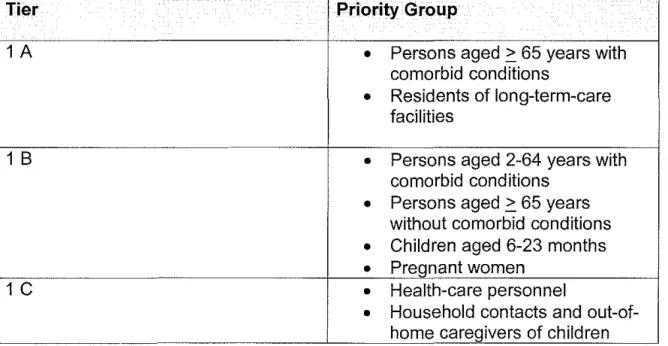
In August 2005 the CDC and ACIP provided tiered recommendations for use by state and local health officials in the event of another vaccine shortage.
The guidelines state that the groups in tier 1A should be vaccinated before · , - anyone in an extreme shortfall of vaccine. During less dramatic vaccine
shortages all groups in tier 1 should be considered equivalent and should be. vaccinated first, followed by groups 2 and 3.
Table 1 Priority Groups for Vaccination with Inactivated Influenza Vaccine
Tier Priority Group
1 A
•
Persons aged ~ 65 years withcomorbid conditions
•
Residents of long-term-care facilities1 B
•
Persons aged 2-64 years withcomorbid conditions
•
Persons aged ~ 65 years without comorbid conditions•
Children aged 6-23 months•
Pregnant women1
c
•
Health-care personnelaged < 6 months
2
•
Household contacts of childrenand adults at increased risk of influenza-related complications
•
Healthy persons aged 50-64 years3
•
Person aged 2-49 withouthigh-risk conditions Note. From MMWR Vol. 54 No. 30
Discussion
Increasing influenza vaccine uptake. One of the goals of Healthy People 2010 is to increase the influenza immunization rate among high-risk populations, up to 90% of those over age 65 and up to 60% for other high-risk individuals {CDC, 2000). Data collected from national surveys indicate that vaccine uptake,
even in times of sufficient supply and especially among those at highest risk is woefully inadequate. The following:tables illustrate the deficits in immunizing
these high priority groups in the two previous influenza vaccination seasons. Table 5
Selected Group
Ages 18-49, High-risk Ages 50-64, High-risk Ages 50-64, Total Ages 65 and older Pregnant Women Health Care Workers Household Contacts
Percentage Coverage
24.2 46.3 36.8 65.5 12.8 40.1 18.9
Table 6
Selected Group
Ages 18-64, High-risk Ages 65 and older
Ages 6-23 Months Ages 2-17, High-risk Health Care Workers
Assuring the Influenza Vaccine Supply 22
Percentage Coverage
25.5 62.7
48.4
34.8
35.7
L
_______________________________________________
~From the Behavioral Risk Factor Surveillance System (BRFSS), selected data collected during the 2004-05 influenza season (CDC, 2005).
Health care workers. CDC has recommended mfluenza vaccination for healthcare workers (HCWs) wfth direct patient contaCt since "1984 and for all
HCWs since 1993 (Talbot, et al, 2005). Despite this it is estimated that only 36-40% of HCWs receive flu vaccine each year (CDC 2005). Vaccination of health care workers key in controlling influenza spread to high-risk individuals.
Surveys of unvaccinated HCWs show that reasons for not receiving the
vaccine reflect those cited by members of the general public. The reasons include, 1) procrastinated/forgot; 2) inconvenience; 3) concerns about adverse effects; 4) belief that the vaccine is ineffective; 5) fear of needles; and 6) belief that influenza is not a serious disease (Toy, Janosky & Laird, 2005; Roush, 2005;
Zimmerman, et al).
The Immunization Action Coalition, a non-profit organization, creates and
goal is to increase immunization rates and prevent disease. The following are
steps outlined for health care institutions to establish an influenza vaccination program for their staff. The steps to include:
}> Persuade top management to commit to an annual employee vaccination
program.
}> Make the vaccination program convenient for all employees.
}> Offer vaccines free of charge to all staff-full-time, part-time, and volunteers.
}> Develop campaigns to educate employees.
}> Educate health care workers to be advocates for influenza vaccination.
(Immunization Action Coalition, 2004).
Vaccination of children. The CDC has recommended annual influenza
immunization for high-risk children 6 months of age or older for almost 40 years (Rickert, Santoli, Shefer, Myrick, Yusuf, 2006). Although in the past the flu vaccine has not been recommended for healthy children, today vaccination of
children 6-23 months of age is strongly recommended by the Advisory Committee on Immunization Practices.
However, vaccination of high-risk children remains unacceptably low.
Research has shown that medical provider recommendation is a strong motivator
for receiving influenza vaccination (Mayo & Cobler, 2004 ). One study researched reasons that physician adherence to national recommendations to administer influenza vaccine to high-risk children remains low. Their findings suggest a
Assuring the Influenza Vaccine Supply 24
generalists and a need for more organizational capacity for identifying and recalling high-risk patients (Rickert, Santoli, Shefer, Myrick, Yusuf, 2006).
Of course parents are the target of educational interventions and
recommendations related to immunization of children. Because children already
are required to have numerous vaccines some parents avoid the influenza vaccine. A Denver study of five pediatric practices showed a substantial positive change in parental attitudes about influenza vaccination during the 2003-2004 flu
season. This was attributed to an intensively publicized influenza outbreak and concurrent physician recommendation for vaccination (Daley, et al, 2006).
Public education. Unfortunately the public underestimates flu as an illness. Experts agree that education is necessary to .achieve broader public
understanding of the morbidity and mortality of influenza and the safety and
efficacy of the flu vaccine (Zimmerman, et al, 2003). Education about all forms of influenza protection, including the nasal spray vaccine is necessary (DesRoches, Blendon & Benson, 2005). Some have suggested direct to consumer advertising
to those aged 65 years and older would be a cost-effective method of promoting influenza immunization in this age group (Patel, et al, 2006).
Assuring the vaccine supply. Concerns about the influenza vaccine supply have been an issue for several years. Shortages of other vaccines recently have heightened the fear of influenza vaccine shortfalls (Cohen, 2002). The influenza supply is even more precarious for reasons noted previously: 1) the varying
season; 3) complexity of influenza vaccine development and 4) the dearth of
manufacturers supplying flu vaccine.
In
1993 the Institute of Medicine (10M) proposed the development of a
National Vaccine Authority that involves the creation of a government-owned,contractor operated national vaccine facility (I OM, 2001 ). This authority would control production and distribution of all vaccines and monitor supply and demand. This plan is widely opposed by the pharmaceutical industry (Cohen,
2002).
There has been legislation introduced to address the problems of influenza vaccine supply. The Flu Protection Act introduced by Congressman
Rahm Emanuel of Illinois in 2004 establishes funds for a influenza vaccine public · awareness campaign and provides tax incentives for companies to improve their
production capacities. The measure also calls for funds for the creation of more vaccine companies with more rapid production capability, requires planning by
the CDC for any future influenza vaccine shortages and calls for more accurate estimates of needed vaccine each year through greater cooperation between manufacturers and the federal government (US House of Representatives,
2005).
Senators Hillary Clinton of New York and Pat Roberts of Kansas introduced the Vaccine Security Act in 2005. Components of the bill include:
• Market guarantees:
Assuring the Influenza Vaccine Supply 26
o The Secretary authorized to stockpile and buyback vaccine and purchase antivirals
o Companies wishing to participate in buyback program must supply information allowing CDC to track distribution of vaccine
o Manufacturers must give 12 months notice to the Secretary before deliberately discontinuing influenza vaccine production
o Regulatory assistance to manufacturers
• Increased research into vaccine development alternatives
o Additional financing for NIH research into alternatives such as cell-based culture and permanent influenza vaccine
o Establishment of county by county electronic vaccine tracking
system
o Development of medical personnel registry to help during
emergencies including influenza vaccine shortages o Increased outreach and education on influenza vaccine
• Pandemic vaccine liability
o Liability protections for products specifically design for pandemic flu (U.S. Senate, 2005).
Senator Richard Burr of North Carolina introduced the Pandemic Vaccine
and Drug Development Act of 2005 to the U.S. Senate. On of the components of this bill is the creation of the Biomedical Advanced Research and Development
None of the above mentioned legislation has been passed yet. All the proposals are designed to strengthen and organize the nation's influenza vaccine supply and distribution process. The increasing reports of Avian influenza and
the prediction of an impending influenza pandemic have benefited the goal of
overhauling this country's interpandemic flu vaccine infrastructure. As part of the National Pandemic Influenza Preparedness and Response Plan, the U. S.
Department of Health and Human Services has awarded a $75 million grant to
Sanofi Pasteur to develop cell-based rather than egg-based influenza vaccine technology. The plan also calls for a U.S. based manufacturing facility for the cell-based influenza vaccine (Kling).
The cell-based technology has several advantages over the egg-based
production of flu vaccine. This process avoids risks associated with the egg-based technology: potential impurities in eggs that may cause sterility problems and allergies to egg albumin. The step of adapting the virus to grow in eggs is
avoided. The procurement of millions of eggs and long timeline from inoculation to delivery is unnecessary. Virus grown in mammalian cell culture is identical to the original clinical isolates. Growth of viruses in eggs result in antigenic variants
that are distinct from the original virus. The cell culture vaccine more accurately
matches the wild circulating virus (Giaxo SmithKiine [GSK], n.d.). Another considerable advantage of the cell-based technology is the ability to ramp up production fairly quickly in times of need. The cell cultures can be frozen for
Assuring the Influenza Vaccine Supply 28
Research and public health recommendations. Obviously research into the development of new influenza vaccine is important and is already underway. While the egg-based technology is well established. cost-effective and proven to
produce effective vaccine, there are disadvantages (GSK). The goal of
eliminating these issues fosters further research and development. Until these new methods are developed and established, strategies to assure an adequate
influenza vaccine supply must be addressed as well as contingency plans for another vaccine shortage.
Halloran and Longini (2004) suggest research is needed to
determine whether increased influenza vaccine coverage in schoolchildren would reduce overall influenza attack and death rates in the community as a whole.
This kind of data could guide vaccine rationing in times of shortfall and also· inform public education and marketing techniques for influenza prevention.
Mayo and Cobler (2004) identify the need for a comprehensive study to
compare motivators, barriers and decision making of vaccinated versus unvaccinated patients. Again, this would be useful information for designing promotional programs as well as helping clinicians educate clients and their
colleagues.
Decisions will have to be made on the best method to assure an adequate yearly supply of influenza vaccine. Should the government provide the industry
with tax incentives or subsidies in order to avoid the shortages that have
market forces that have contributed to the departure of influenza vaccine
manufacturers from the market. Perhaps there should be a compromise as in Canada, which has two sources of influenza vaccine, the government supplied at
no cost to high-risk persons and privately supplied vaccine for pay for all others
(Boehm). At the least, there must be both public and private investment in
manufacturing surge capacity and partnerships to more efficiently and effectively serve the public. A report by the United States Government Accountability Office (GAO) on the vaccine shortage of 2004-2005 concluded that, "planning, timely
action, and communication are key to an effective response" (GAO, 2005, p.23). Lessons learned from the influenza vaccine crisis will enable public health
agencies from the local to the federal level to develop communication and emergency response plans to deal with a similar situation in the future.
Conclusions. Achieving the goal of high levels of influenza vaccine coverage will backfire if there is not a consistently adequate, timely, and
accurately distributed supply of influenza vaccine. Conversely, increased demand for influenza vaccine will enable vaccine manufacturers to profit from vaccine manufacturing and provide incentive for continued private and public investment in the industry. In addition, advances in influenza vaccine technology
and production are an integral component of planning for an impending influenza
Assuring the Influenza Vaccine Supply 30
References
AHA meets with CDC head about flu vaccine shortage. (2004, October 29). American Hospital Association News. Retrieved February 3, 2006 from
Health Source: Nursing/Academic Edition database.
Bashir, Zarnaaz and Ransom, James (2005). Full-Use Preparedness: Addressing the 2004-2005 Influenza Vaccine Shortage. [Electronic version]. Journal of Public Health Management Practice. 11 (4): 375-377.
Bean B, Moore BM, Sterner B, Peterson LR, Gerding ON, Balfour HH Jr.
(1982). Survival of influenza viruses on environmental surfaces. Journal of Infectious Diseases. 146(1 ): 47-51. Retrieved January 29, 2006 from PubMed database.
Blitz SG, Cram P, Chernew ME, Manto AS, Fendrick AM (2002). Diagnostic testing or empirical neuraminidase inhibitor therapy for patients with influenza-like symptoms: what a difference a day makes. American
Journal of Managed Care. March;8(3): 221-7. Retrieved February 3, 2006 from PubMed database.
Boehm, Charles (2004 ). Flu-like Symptoms. RevolutioN: The Journal for RNs and Patient Advocacy, November-December: 8-9. Retrieved January 31, 2006 from Health Source: Nursing/Academic Edition database.
Bower, Carol. (2000). Influenza and Pneumonia. Issue Brief 2000-3. Connecticut Department of Public Health. Retrieved February 2, 2006 from
http://www.dph.state.ct.us/OPPE/pdfs!ib2000-3.pdf
Brookes, Tim (2005). A Warning Shot: Influenza and the 2004 Flu Vaccine Shorlage. Washington, D.C.: American Public Health Association. Caplan, Arthur L. (2004), Flu shot shortage poses public health disaster. Alden
March Bioethics Institute. http://bioethics.net Retrieved 2/10/2006 from Health Source: Nursing/Academic Edition database.
Carrol, NV, Delafuente, JC, McClure, KL, Weakley, OF, Khan, ZM, Cos, FM. (2001)Economic Burden of Influenza-Like Illness in Long-Term-Care Facilities [Electronic version]. American Journal of Health-System Pharmacists. 58( 12): 1133-1138. Retrieved January 27, 2006 from http://www.medscape.com/viewarticle/406979
Centers for Disease Control and Prevention (1997). Prevention and Control of Influenza: recommendations of the Advisory Committee on Immunization Practices (ACIP). Morbidity and Morlality Weekly Reporl
Centers for Disease Control and Prevention. (2003). Using Live, Attenuated Influenza Vaccine for Prevention and Control of Influenza: Supplemental Recommendations of the Advisory Committee on Immunization Practices. Morbidity and Mortality Weekly Report. 52 (RR-13): 1-8.
Centers for Disease Control and Prevention. (2003). Update: Influenza Activity-United States, 2003-04 Season. Morbidity and Mortality Weekly Report. 52(49): 1198-1200.
Centers for Disease Control and Prevention (2004). Experiences with Obtaining Influenza Vaccination Among Persons in Priority Groups During a Vaccine Shortage- United States, October-November, 2004. Morbidity and
Mortality Weekly Report. 53 (49):1153-1154.
Centers for Disease Control and Prevention (2004). Influenza, the Disease. November 15. http://www.cdc.gov/flu/about/disease.htm Retrieved February 11, 2006.
Centers for Disease Control and Prevention. (2005). Prevention and Control of Influenza: recommendations of the Advisory Committee on Immunization Practices (ACIP). Morbidity and Mortality Weekly Report
Recommendations and Reports. 5::\ (HRc6): 1AO.
Centers for Disease Control and Prevention. (2005). Update: Influenza Activity-· United States, 2004-05 Season. Morbidity and Mortality Weekly Report.
54(8):193-196.
Centers for Disease Control and Prevention. (2005). Tiered Use of Inactivated Influenza Vaccine in the Event of a Vaccine Shortage. Morbidity and Mortality Weekly Report. 54 (30): 749-750.
Centers for Disease Control and Prevention. (2006). High Levels of Adamantane Resistance Among Influenza A (H3N2) Viruses and Interim Guidelines for Use of Antiviral Agents-United States, 2005-06 Influenza Season.
Morbidity and Mortality Weekly Report. 55 (02): 44-46.
Center for Infectious Disease Research and Policy, University of Minnesota. Pandemic Influenza. Retrieved February 22, 2006 from
cidrap.umn.edu/cidrap/content/influenza/panflu/biofacts/panflu.html
Assuring the Influenza Vaccine Supply 32
Congressional Quarterly. (2004), 8 October. Capitol Hill Hearing Testimony, Flu Shot Shortage. Testimony by Howard Pien, President and CEO Chiron Corporation. Retrieved February 2, 2006 from LexusNexis database. Daley, M.F., Crane, L.A., Chandramouli, V., Beaty, B.L., Barrow, J., Allred, N.,
Berman, S., Kempe, A. (2006). Influenza Among Health Young Children: Changes in Parental Attitudes and Predictors of Immunization During the 2003 to 2004 Influenza Season. [Electronic version]. Pediatrics. 117 (2): 268-277.
DesRoches, C.M., Blendon, R.J., Benson, J.M. (2005). Americans' Responses To The 2004 Influenza Vaccine Shortage. [Electronic version]. Health Affairs. 24 (3): 822-831.
First do no harm. Protect your patients by getting vaccinated against influenza. Immunization Action Coalition, Retrieved March 1, 2006 from
]1ttp://www.immunize.org/catg.d/p2014.htm
Flu Vaccine Shortage creates ethical issues, safety challenges. (2004,
December). Vol.11, No.12: 133-136: Retrieved February2, 2006from Health Source: Nursing/Academic Edition database.
Fukuda, K., O'Mara, D., Singleton, J. (2002). How the Delayed Distribution of .Influenza Vaccine Created Shortages in 2000 and 2001. Pharmaceuticals
& Therapeutics. 27 (5): 235-242.
Glaxo SmithKiine. (n.d.) Backgrounder: Egg-based vs. cell-based influenza vaccine production. Retrieved February 10, 2006 from
http://www.gsk.com/press archive/press2005/flu backgrounder.pdf Halloran, M. Elizabeth and Longini, Ira M. Jr. (2006). Community Studies for
Vaccination Schoolchildren Against Influenza. [Electronic version]. Science. 311(5761): 615-616.
Heymann, David L. (Ed.). (2004 ). Control of Communicable Diseases Manual (181h ed.) Washington, D.C.: American Public Health Association.
Institute of Medicine of the National Academies. (2001 ). Statement from the /OM Council on Vaccine Development. Retrieved February 27, 2006 from http://www.iom.edu/CMS/5487.aspx
Kling, Jim (2005). Cautious industry welcome for US flu vaccine plan. Nature Biotechnology. 23, 1457-1458. Published online 6 December 2005. Retrieved February 24, 2006 from Health Source: Nursing/Academic Edition database.
Lo, Bernard and Katz, Mitchell (2005). Clinical Decision Making during Public Health Emergencies: Ethical Considerations. [Electronic version]. Annals of Internal Medicine, 143: 493-498.
Mayo, Ann M. and Cobler, Steffanie. (2004). Flu Vaccines and Patient Decision Making: What We Need to Know. Journal of the American Academy of Nurse Practitioners. 16 (9): 402-410. Retrieved February 26, 2006 from Health Source: Nursing/Academic Edition database.
Patel, Mitesh and Davis, Matthew. (2006). Could a federal program to promote influenza vaccination among elders be cost-effective? Preventive
Medicine. [Article in Press]. Retrieved March 3, 2006 from www.sciencedirect.com
Prinicipi N and Esposito S. (2004 ). Are we ready for universal influenza
vaccination in paediatrics? Lancet Infectious Diseases Feb; 4(2): 75-83. Retrieved February 2, 2006 from PubMed.
Ricker, D., Santoli, J., Shefer, A., Myrick, A., Yusuf, H. (2006). Influenza Vaccination of High-Risk Children What the Providers Say. [Electronic version]. American Journal of Preventive Medicine. 30 (2): 111-118. Retrieved March 2, 2006 from Health Source: Nursing/Academic Edition database.
Roush, Karen. (2005). Preventing Flu Outbreaks: An immunized health care staff is the best defense. American Journal of Nursing. 105 (1 0): 30-32.
Retrieved February 10, 2006 from Health Source: Nursing/Academic Edition database.
Santibanez TA, Nowalk MP, Zimmerman RK, Bruehlman RD (2003). Effects of the year 2000 influenza vaccine delay on elderly patients' attitudes and behaviors. Preventive Medicine.[Eiectronic version]. 37(5): 417-423. Stiver, Grant (2003). The treatment of influenza with antiviral drugs. Canadian
Medical Association Journal. 168: 49. Retrieved February 20, 2006 from Health Source: Nursing/Academic Edition database.
Talbot, T., Bradley, S., Cosgrove, S., Ruef, C., Siegel, J., Weber, D. (2005). Influenza vaccination of healthcare workers and vaccine allocation for healthcare workers during vaccine shortages. [Electronic version].
Assuring the Influenza Vaccine Supply 34
Thompson, W., Shay, D., Weintraub, E., Brammer, L., Anderson, L., Fukuda, K. (2003). Mortality associated with influenza and respiratory synctial virus in the United States. Journal of the American Medical Association. 289: 179-186. Retrieved January 30, 2006 from PubMed database.
Thompson WW, Shay DK, Weintraub E, Brammer L, Anderson L, Fukuda K. (2004). Influenza associated hospitalizations in the United States. Journal of the American Medical Association. 292: 1333-40. Retrieved January 30, 2006 from PubMed database.
Toy, W., Janosky, J., Laird, Susan. (2005). Influenza immunization of medical residents: Knowledge, attitudes, and behaviors. [Electronic version]. American Journal of Infection Control. 33 (8): 473-475.
Treanor, John, (2004). Weathering the Influenza Crisis. [Electronic version]. New England Journal of Medicine. 351 :2037-2040.
Treanor, J., Keitel, W., Belshe, J., Campbell, G., Zangwill, K., Wolff, M., Klimov, A., Levandowski, R., Lambert, L. (2002). Evaluation of a single dose of half strength inactivated influenza vaccine in healthy adults. [Electronic version]. Vaccine. 20(7-8): 10.99-1105. · · ·
United States Department of Health and Human Services (2005). HHS Awards. $97 Million Contract to Develop Cell Culture-Based Influenza Vaccine. Retrieved February 28, 2006 from
http://www.hhs.gov/news/press/2005pres/20050401.html
United States Government Accountability Office. (2005). Influenza Vaccine, Shortages in 2004-05 Season Underscore Need for Better Preparation. (GA0-05-984). Retrieved February 26, 2006 from U.S. GAO website via Lexus Nexus database.
United States House of Representatives. (2004). Congressman Emanual, Cosponsors of Flu Protection Act Ask House Leadership to Act on
Legislation During November Session. Retrieved February 23, 2006 from http://www.house.gov/apps/listloress/il05 emanuai/Fiu Hastert letter.html United States Senate (2005). Senators Clinton, Roberts Urge the Centers For
Disease Control and Prevention to Make Flu Vaccine Production and Distribution a Priority. Retrieved February 28, 2006 from
http:/ /clinton .senate.gov/news/statements/details. cfm?id=251308 World Health Organization. (2002). Influenza, Report by the Secretariat.
World Health Organization. (2005). Influenza vaccines. Weekly Epidemiological Record. 33 (19): 279-287. Retrieved January 28, 2006 from Health Source: Nursing/Academic Edition database.
Zimmerman RK, Santibanez TA, Janosky JE, Fine MJ, Raymund M, Wilson SA, Sardella IJ, Medsgar AR, Nowalk MP (2003). What affects influenza vaccination rates among older patients? An analysis from inner-city, rural