lh
r-vlarcus 'v' alc:ircc- 1\spcgrcn
Scnlur I [onors Thesis lnt..:rdiscip!inar;. Studies
l lnl\'crsi!)' pf Nn11h ('arolina at ('hapcl I Jill
Donaret provincias
Ius apostolorum
Jacobus Yspanias
Lux illustrat morum.
Primus ex apostolis
Martir Jerosolimis
Jacobus egregio
Sacer est martyrio
Jacobi Gallecia
Opem rogat piam
Plebe cuius gloria
Dat insignem viam
Ut precum frequentia
Cantet melodiam:
“Herru Sanctiagu
Grot Sanctiagu
E ultreya e suseya Deus aia nos”
Primus ex apostolis . . .
Jacobo dat parium Omnis mundus gratis
Ob cuius remedium
Miles pietatis
Cunctorum presidium
Est ad vota satis.
Que fiunt per illum
Arctis in periculis
Acclamet ad illum
Quisquis solvi vinculis
Sperat propter illum.
Primus ex apostolis . . .
O beate Jacobe
Virtus nostra vere
Nobis hostes remove
Tuos ac tuere
Ac devotos adibe
Nos tibi placere.
Primus ex apostolis . . .
Jacobe propicio
Veniam speremus
Et quas ex obsequio
Merito debemus
Patri tam eximio
Dignas laudes demus.
Primus ex apostolis . . .
-Dum Pater Familias, 12th
Introduction
Medicine in the northwestern portion of the medieval Iberian kingdoms remains largely
uncharted academic terrain. Scholars have attributed this gap in historical knowledge to a lack of
readily available, substantial documentation. While this could be the case, some scholars have
also argued that the documentation does exist, but that the area has been overlooked
academically and that more archival research is warranted1. Therefore, while historians like Luis
Garcia Ballester and Michael McVaugh have successfully been able to compose expansive and
compelling works describing healthcare in the crowns of Aragon and Castile, no such broadly
encompassing texts exist for Galicia, Asturias, Leon, and the surrounding northern territories.
Moreover, James D’Emilio writes in his book, Culture and Society in Medieval Galicia, that due to an “orientation of North American historiography towards Mediterranean Spain and Castile
[…] Galicia and Atlantic Iberia were consequently ignored [and] dismissed as a backwater, the
early medieval kingdom remained terra incognita in international, and particularly Anglophone,
scholarship.”2 That is to say, perhaps due to the shortage in material evidence, much of the
literature appears to, implicitly or otherwise, overlook or dismiss these areas as mere appendices
to the greater Castilian Kingdom. The writing of Louis Barrau-Dihigo exemplify this dismissal:
“The history of the Asturian kingdom is strictly national, and lacking in documents. Finally, it
is—in its extreme poverty—most monotonous, offering hardly anything but a recitation of
battles or revolts.”3 Indeed, it is rather undeniable that treating the region in isolation does
1 Marcelino V. Amasuno, Medicina Castellano-Leonesa Bajomedieval, (Zaragoza: Universidad de Valladolid, 1991),
9-11.
2 D'Emilio, James. Culture and Society in Medieval Galicia: a Cultural Crossroads at the Edge of Europe. Leiden: Brill,
2015.
3 D'Emilio, James. Culture and Society in Medieval Galicia: a Cultural Crossroads at the Edge of Europe. Leiden: Brill,
present a historically barren picture. However, there are good reasons to move away from these
notions of an intellectually and culturally isolated northwest—particularly in the study of its
medieval medical practices. This paper will attempt to demonstrate that, due to the unlikely and
spectacular transformation of Galicia into one of Europe’s principal destinations for Christian
pilgrimage from 11th-14th century, it would indeed be a mistake to treat medieval healthcare in
this region as a simple extension or derivative of medicine in Castile proper.
The Camino
The Apostle
Legend, as told by the 12th century chronicle Historia Compostelana, states that God tasked St. James the Great, one of Jesus’ original apostles, with the Christianization of Iberia.
After having a vision of the Virgin Mary, St. James returned to Jerusalem, where he was
eventually martyred—beheaded in 44 AD by King Herod Agrippa I4. The apostle’s disciples
took his body back to Iberia, where they buried him in the Galician countryside. This is where
his remains were eventually discovered in the early 9th century when Teodomiro, bishop of Iria
Flavia, entered an unearthed tomb in a field illuminated by the stars—Campus stellae.
4 Richard A Fletcher, Saint James’s Catapult: The Life of Times of Diego Gelmirez of Santiago, (Oxford University
The Way
The news of the recently discovered relics shortly reached the king of the Astur-Leonese
realm, Alfonse II el Casto, who ordered the erection of three churches around the burial site and
promptly informed Charlemagne, as well as Pope Leo III, of the discovery. This, in turn, led to
the rapid proliferation of information across the Holy Roman Empire; Galicia soon established
itself canonically as the final, holy resting place of the apostle.
This is a rather strange turn of events for the region—an area with a relatively
volatile history up until this point. Ancient Galicia, until the 5th century, was a long-term Roman
mining-colony and province. Then the Visigoths and later the Islamic Umayyad Caliphate
conquered the region before it was finally incorporated into the Christian Kingdom of Asturias in
the latter half of the 8th century. However, the incorporation of Galicia into a larger Christian
kingdom does not mean that the area immediately became part of some homogenized Christian
Iberia. Indeed, Richard Fletcher argues—in Saint James’s Catapult: The Life and Times of Diego Gelmirez of Santiago de Compostella—that, for various reasons, Galicia, until the discovery of
the holy remains, was almost completely isolated from the rest of Spain, let alone Western
Europe at large. Firstly, the region is geographically cut-off from the rest of the Iberian meseta
by La Cordillera Cantabrica, a colossal mountain range. This 4,000 to 7,000 ft. natural barrier
ensured that the early medieval Gallegos stayed separate from their eastern counterparts.
Interregional exchange was mostly of the violent sort and seemed mostly to occur in the form of
Viking raids and pirate attacks on the coastline, as well as a few forays into Portugal. Moreover,
Galicia, in its isolation before the 11th century, did not have a standardized system of coinage.
Primary documentation offers substantial evidence of a widespread local economy based solely
currency-based trade in the region was a rarity5. Eventually, the establishment of the Jacobean pilgrimage
was abruptly to upend centuries of geographic, cultural, and economic isolation. But this did not
happen in a wholly organic fashion; as Fletcher puts it, “In early medieval Europe saints’ cults
did not simply happen: they were made.”6 To understand how this occurred in the case of St.
James it is important to explore the sociopolitical situation of the Asturian realm, starting in
mid-9th century.
While King Alfonse II reigned at the time of the apostle’s unearthing, he and his
following two successors, Ramiro I and Ordoño I, did not do much beyond erecting and
maintaining a grouping of modest religious buildings atop the saint’s final resting place. This
was to change with the crowning of Alfonse III in 841. As was Gothic tradition, the king needed
a personal Saint; Alfonse III chose St. James. As a result, the king vastly expanded the landed
endowment of St. James’ church—as confirmed by charters dated to May 6, 899, which
explicitly established St. James’ as Alfonse’s patronus and outlines how the king had donated lands, recently claimed from rebels and Arabs, to the saint’s church.7 Furthermore, Alfonse—
under the guidance of Sisnando, the bishop of Iria—ordered the construction of a massive, lavish
church to replace the modest buildings erected by his predecessors. It is perhaps also noteworthy
that this is the largest surviving building constructed under Alfonse III’s time in power.8 The
tradition of St James as protector and benefactor of the crown continued beyond Alfonse III’s
rule, and led to further expansion of the Jacobean cult. The cult began to spread throughout
5 Richard A Fletcher, Saint James’s Catapult: The Life of Times of Diego Gelmirez of Santiago, (Oxford University
Press, 1984), 12.
6 Richard A Fletcher, Saint James’s Catapult: The Life of Times of Diego Gelmirez of Santiago, (Oxford University
Press, 1984), 68.
7 M. R. Garcia Alvarez, “Catalogo de documentos reales de la alta edad media referentes a Galicia (714-1109)”,
Compostellanum 8 (1963), 310-375.
8 Richard A Fletcher, Saint James’s Catapult: The Life of Times of Diego Gelmirez of Santiago, (Oxford University
northern Spain as members of the royal court began expanding St. James’ landed endowment
further—beyond Galicia. Royal charters called for land donations and the erection of churches in
the apostle’s name in Asturias, El Bierzo, and throughout Galicia—including the donation of a
road commonly used by merchants to enter and exit the region.9
In the middle 9th century, the cult of St. James, in addition to extending its landed assets
in northwestern Iberia, was already spreading its renown and becoming an internationally
recognized attraction. Scholars have been able to illustrate this primarily through the analysis of
two pieces of written evidence. The first of these comes from a rather unexpected source: an
Arabic envoy sent by the Umayyad Emir of Cordoba, Abderrahman II, to speak with a group of
Norman invaders who landed on the coasts of Galicia in 844. The record shows that, on his
return, this envoy stopped in Santiago for two months and from there travelled back to his Emir
in the company of homebound pilgrims, through Castile and Toledo, before finally arriving in
Cordoba—supposedly with a firsthand account of the city of Santiago and its status as holy
shrine10. The second document of import is a letter written by Alfonse III to the clergy of Tours
in 906. In it, the king primarily discusses the acquisition of an artifact—an “imperial crown”—
possessed by the clergy; it is a relatively standard correspondance. However, later in the letter,
Alfonse digresses to answers a question, presumably posed in a prior exchange: “Who is the
apostle whose tomb is venerated in Galicia?” The king responded, “It is James, the son of
Zebedee. This is attested by many reliable texts; and miracles are worked at his shrine.” He also
9 M. R. Garcia Alvarez, “Catalogo de documentos reales de la alta edad media referentes a Galicia (714-1109)”,
Compostellanum 8 (1963), 310-375 ; 9 (1964), 639-677 ; 10 (1965), 257-328 ; 11 (1966), 257-340 ; 12 (1967), 255-268, 581-636.
10 Vazquez de Parga, Las Peregrinaciones a Santiago de Compostela, (Madrid : Consejo Superior de Investigaciones
makes sure to mention the specific geographic location of the apostle’s shrine.11 Alfonse’s action
showed not only that the discovery of the remains of an apostle known in lands outside Iberia,
but also that the king himself actively strove to disseminate information regarding the shrine
beyond his kingdom.
By the middle 10th of the century, the previous nascent stages of an international
awareness regarding Compostella had crystalized into a regular arrival of pilgrims from outside
of the northwestern kingdoms. For example, in 951 there is a concrete record of some of the first
pilgrims to arrive in Santiago de Compostella from beyond the Iberian Peninsula. It was then that
Gotescalco, bishop of Puy, together with a group of attendants, entered the shrine of St. James
after what must have been months of arduous travel12. Of perhaps even greater import is another
recorded arrival—the coming of Cesarius, the founder and abbot of the Santa Cecilia monastery
of Montserrat. The abbot, also the bishop of Tarragona and one of the foremost churchmen in
Catalonia at this time, wrote of his pilgrimage in a letter to Pope John XIII and later also
defended the validity of St. James’ Spanish apostolate to this same Pope—something that was a
contested issue within the Catalonian clergy. While there certainly exists a wealth of further
written evidence describing the arrival of various important pilgrims, it would be redundant to
include these here; the point is already clear—Santiago de Compostella was already well
established as an internationally recognized site of Christian pilgrimage as early as the 10th
century.
11 Richard A Fletcher, Saint James’s Catapult: The Life of Times of Diego Gelmirez of Santiago, (Oxford University
Press, 1984), 72.
12 Teodoro Martinez, El Camino Jacobeo: Una Ruta Milenaria (Bilbao: Diputacion de la Excma. Diputacion de
Throughout the next millennium, millions of pilgrims walked in these early travelers’
footsteps to visit the remains of the apostle. As previously alluded to, the impacts of this
legendary vector of travel—pointing west across northern Iberia, towards Galicia—are manifold
and range from the economic to the medical. In fact, the apostle’s importance had just started
materializing by the middle 10th century, reaching its medieval apex over the course of the
following 200 years.
It is no overstatement to that St. James’s pilgrimage route spiritually, geographically, and
institutionally tied together large parts of Western Europe and connected them to the
Northwestern corner of Iberia. That is to say, the route to Santiago played a large role as a
homogenizing force in the creation of a Westernized Europe. As Horacio Santiago-Otero puts it
in the introduction to El Camino de Santiago, la Hospitalidad Monastica y las Peregrinaciones, each individual pilgrim was a “cultural operator” establishing important informational ties
between cities, not to mention kingdoms.13 With this in mind, it is not difficult to see how the
Camino was a generator of ideas, legends, culture, and knowledge across northern Spain.
The pilgrims themselves, in addition to bringing intangibles, like their cultures and ideas,
also, of course, brought their physical bodies. The regional increase in human activity had
profound impacts on the area. To name a few examples, the upsurge in foreign arrivals boosted
the trading economies of villages along the Way, justified the construction of monasteries
throughout the route that in turn spawned mushrooming urban communities, and additionally, the
influx of travelling pilgrims spread illness as well as an acute municipal awareness of the need
for public health measures. Ultimately, as I will suggest, the Camino did not just galvanize the
13 Horacio Santiago-Otero, El Camino de Santiago, La Hospitalidad Monastica y las Peregrinaciones, (Salamanca:
urbanization of the Astur-Leonese realm and the healthcare problems that accompanied it, it also
stimulated the establishment of an institutionalized proto-medical system of infrastructure in the
form of albergues and hospitals. Considering this final point is of utmost importance when
studying the state of medieval medicine in Galicia and surrounding territories. To grasp fully
how this system became established, it is necessary to focus on the concept of monastic
hospitality. One must analyze the monasteries that existed before the discovery of St. James’
relics and how these set the precedence and the foundation for the systematized hospitality that
was to come.
Early establishment of Hospitals and Monastic activity (7
th-12
thcentury)
Monastic Hospitality in Northern Iberia through Early Rules and Imperatives
It is important to note that before the advent of academic medicine around the 13th
century, Christian societies in Iberia had conflated matters of healthcare with more charity and
hospitality more generally; therefore, wellness and learning were largely in the hands of the
Church. More specifically, monasteries served as the first semblance of medical infrastructure—
offering housing, care, and burial rites to the poor and particularly to the pilgrim. To understand
how this charitable healthcare imperative developed in Galicia and along the entire Camino it is
important to study some of the underlying rules that outlined the monastic missions. Two early,
ubiquitous guidelines that specifically call for hospitality and caretaking were the rules and
examples of two Visigoth Spanish saints, St. Isidore and St. Fructuoso.
Although they lived in distant corners of the peninsula the two saints seemingly lead
almost parallel lives—both creating important early examples of monastic communities. One of
aquellos tiempos en el cielo de España, dos fulgurantes estrellas: al venerable varón Isidoro,
Obispo de Sevilla, y al bienaventurado Fructuoso […] Isidoro, maestro de la vida activa, fue el
pedagogo de toda la Hispania. Fructuoso, entregado a la contemplativa, encendió en los
corazones la ardiente llama del suyo.” This personal renown extended to their written works as
well, particularly for Isidore, whose books are some of the most common texts found in Spanish
monastic libraries.14
Rule and Thought of St. Isidore of Seville
St. Isidore’s famous writings lay some of the most fundamental groundwork for monastic
charity care and hospitality. To begin with, in his Etymologiarum, he not only specifically defines and gives etymological background for the terms hospitium15, hospes, and hospitalario16
(the title the people running the albergues still hold to this day), but he also records and venerates
the account of the first hospital in the context of Jewish pilgrimage in antiquity. This story is
particularly interesting as through it Isidore creates a historical precedence for the holiness of
hospitality. He told readers that John Hyrcanus collected a large sum of gold from the tomb of
David, which he used in part to bribe the Seleucids to lift the siege on Jerusalem. The Jewish
High Priest then used the remainder of David’s gold to erect the first hospital for poor pilgrims
traveling to Jerusalem. The propagation of this legend in this context serves to tie the ideas of
hospitality and pilgrimage together canonically. Beyond these etymological and historical
14 Antonio Vinayo Gonzalez, El Camino de Santiago, La Hospitalidad Monastica y las Peregrinaciones, (Salamanca:
Junta de Castilla y Leon, 1992), 39-40.
15 Antonio Vinayo Gonzalez, El Camino de Santiago, La Hospitalidad Monastica y las Peregrinaciones, (Salamanca:
Junta de Castilla y Leon, 1992), 39-40 citing : Isidorus Hispalensis, Etymologiarum 1. XV, PL, LXXXII, 542-543
16 Antonio Vinayo Gonzalez, El Camino de Santiago, La Hospitalidad Monastica y las Peregrinaciones, (Salamanca:
approaches to hospitality, St. Isidore also developed a proper monastic rule, in which he speaks
in more prescriptive terms.
The Isidorian Rule, recorded under the title Regula Monachorum, begins by detailing the organization of monastic hospitality. First, the text discusses the physical setup of the hospital
space and assigns hospital duties. The monastery and herbal gardens are to be separate from the
infirmary and hostel, to separate the outsiders from the monastic community. As far as hospital
roles were concerned, the abbot was to be the primary caregiver (entrusted with this task through
the rite of his benediction), a provost was to welcome the guests and give alms to the poor, and a
groundskeeper would announce the arrival of guests and maintain the infirmary. Additionally,
the text tasks secular laborers with stocking and maintain the pantry and warehouse; there is even
a call for special bakers to bake the bread for the guests separately.17 Evidently, the idea of
charitable hospitality was, according to this widely read text, central to the monastic life. This is
not difficult to understand after reading the more ideological and moralistic chapters of the
Regula which bring hospitality into biblical context. For example, chapter XXII describes in great lengths the loving, servile approach one must take when caring for strangers in order that
the Lord do the same in return. Matthew 10:40 “He that receiveth you, receiveth me: and he that
receiveth me, receiveth him that sent me.”18
Now, it is important to note that the hospital system described here differs greatly from
our contemporary notions of patient care both in mission and in practice. Firstly, this is a
religious, charitable establishment. The poor and the ailing are seen through a medieval,
17 Antonio Vinayo Gonzalez, El Camino de Santiago, La Hospitalidad Monastica y las Peregrinaciones, (Salamanca:
Junta de Castilla y Leon, 1992), 41.
Christian lens as “Jesus’s poor” and are to be treated accordingly. As far as care was concerned,
the revival of Galen and academic medicine was still to come. Therefore, healthcare was
primarily a matter of nutrition, rest, and the occasional herbal or apothecary remedy (for more
detail on this topic please see James Brodman’s Charity and Religion in Medieval Europe and
Charity and welfare: hospitals and the poor in medieval Catalonia). Indeed, the infrastructure and ideological imperative established by these early monastic institutions are important to
understand if one is to have an accurate idea of how a pilgrimage route like The Camino (a
generator of monastic activity) would have deeply affected the evolution of medicine in the
regions it passed through.
The Life and Rule of St. Fructuoso of El Bierzo
The recorded life and writings ofSt. Fructuoso of el Bierzo, the region where the
Leonese portion of the Camino leads into Galicia, provide good documentation on what early
monastic hospitality might have looked like in Galicia and Leon. Not only are there written texts
outlining his prescriptions for a monastic rule focused on hospitality, but one of his
contemporaries, a disciple, detailed his life in a written text, Vita Fructuosi. This biographical account establishes Fructuoso as an important historic player in the establishment of a
proto-medical hospital system along the Camino. We know that he studied in Palencia and was swept
up ideologically by the ascetic trends gaining religious traction during his lifetime. He became a
hermit for many years before going on several pilgrimages to shrines throughout Galicia and as
far as the isles of Leon.19 Moreover, scholars have attributed the establishment of several
19 Antonio Vinayo Gonzalez, El Camino de Santiago, La Hospitalidad Monastica y las Peregrinaciones, (Salamanca:
monasteries and monastic foundations to him, primarily in the Bierzo region but also beyond it20.
These monasteries were mostly located along what will later become The Camino. This is no
accident, as monasteries usually serve as generators of urbanization and, of course, any
pilgrimage route must pass through a large amount of urban centers to be viable. Fructuoso’s
monasteries were no exception. Even though he had instituted very strict ascetic rules and
punishments, the religious centers still managed to attract village-sized followings. One
particularly exaggerated example is the monastery he established at a currently unknown location
then known as Nono. The story has it that this monastery so prolifically recruited monks that a
local lord strongly complained that he was losing too large a portion of his military levy.21 These
monasteries were important not only in the city-founding sense. Fructuoso also made sure to, like
Isidore, emphasize a strong imperative towards hospitality and care in his rule.
Fructuoso’s monastic rule is spread across two written works, Regula monachorum and
Regula communis. Several chapters describe the monastic duties of charitable care, hospitality, geriatric care, and childcare. Much of it mirrors what one finds in the rule of St. Isidore.
Different institutional positions regarding care are described, including a chef that only cooked
food for pilgrims and the sickly (the monks themselves were almost never allowed to eat
elaborate dishes and followed a primarily vegetarian diet). Moreover, to become a part of these
monastic communities one was requiredto spend at least one full year working in the hospital “aliñando los jergones de huéspedes y peregrinos, calentando el ague para lavarles los pies,
transportando diariamente y a la espalda los haces de leña necesarios.”22 Additionally, the
20 María Adelaida Andrés Sanz; Carmen Codoñer Merino, La Hispania Visigótica y Mozárabe: Dos épocas en su
Literatura. Volume 28. (Universidad de Salamanca, 2010), 121.
21 Roger Collins, Early Medieval Spain. (New York: St Martin's Press, 1995), p. 84.
22 Antonio Vinayo Gonzalez, El Camino de Santiago, La Hospitalidad Monastica y las Peregrinaciones, (Salamanca:
villagers in charge of farming were instructed to specifically do so with a religious zeal, as their
labor maintained the hospital, the infirmary, and all other caretaking facilities and services.
While most of the Rule exudes a harsh tone—the text calls for whippings and starvation
as punishment for monks breaking its guidelines (transgressions included simply looking at other
monks)—the section on the caretaking of the sick was written in a much more compassionate
tone. As an aside, it is interesting to note that the segments on childcare, geriatric care and
general hospitality is not written in this more tender tone, reserved exclusively for the ill.23 The
person in charge of the infirmary received the special title of Celarius and was expected to take care of the sick in a way that they would not have a single complaint, that they would not miss
the care of their families, nor the comfort of their home village. In fact, it was expected that the
Celarius should carry and present himself in such a way that his mere presence would heal and provide relief for the sickly.24
The contemporary mind can only envision the type of community that resulted from these
rules as a very strict religious commune, led by monks and primarily focused on the caretaking
of strangers, particularly the sick and ailing. While these early communities predate the Camino,
it is certainly unclear (and rather unlikely) that any of them persisted in this form into the heyday
of Jacobean pilgrimage in the 12th century. However, it is no reach to imagine these communities
setting a clear precedence for the hospital system that later developed along The Way of St.
James.
23 Antonio Vinayo Gonzalez, El Camino de Santiago, La Hospitalidad Monastica y las Peregrinaciones, (Salamanca:
Junta de Castilla y Leon, 1992), 47.
The Benedictines
Now, one must reiterate an important distinction.While monasteries like those
established by Fructuoso, Isidore, and other Iberian abbots and saints were important in a
prototypical sense, the writings of these influential religious men—while commonly found in
libraries of monasteries across Asturias and its surrounding regions—never directly became the
primary ruleset of monastic communities in northern Iberia during the time of the pilgrimage’s
establishment. This honor belonged instead to the Benedictine Rule. However, I will argue that
the fertile spread and enormous popularity of Benedictine monasteries across Galicia, Asturias,
et cetera, should be at least partially attributed to a symbiotic interaction between St. James’
pilgrimage and the precedence of monastic hospitality that was culturally imbued into the region
by these pre-Benedictine monastic societies. We must also note here that “pre-Benedictine”
references specifically the Iberian context. St. Benedict and his written Rule both predate Isidore
and Fructuoso’s lifetimes; however, the impulse to establish Benedictine monasteries was not to
reach the Iberian Peninsula until later centuries. However, some scholars argue that Benedict’s
influence was already felt in these early days. For example, Perez de Urbel, through close
comparative textual analysis of the different rules in his seminal book Los Monjes Españoles de la Edad Media, went as far as to argue that Isidore and Fructuoso’s writings mirror Benedict’s so closely that they must have had access to at least some his works.25
Ultimately, the upcoming flood of pilgrims—holy strangers personified—combined with
a regional history of monastic hospitality much in the vain of St. Benedict’s would make Galicia
25 Justo Perez de Urbel, Los Monjes Españoles de la Edad Media, (Madrid: Ediciones Ancla, 1945), Tomo Primero
and its surrounding territories ripe for the proliferation of Benedictine monasticism; with it, the
foundations of an unprecedentedly homogenous proto-medical system.
The Establishment and Spread of Benedictine Monasticism
Benedictine monasticism arose from the ashes of the Roman Empire. According to the
written word of his most famous disciple, Pope St. Gregory the Great, Benedict was born
northeast of Rome, in the region of Nursia around the year 480. He received his schooling in
Rome and it was there that he came to renounce the material world. Benedict established over a
dozen monasteries in his lifetime. As he penned his Rule, Europe was in a war-torn state of deep
political disarray as the so-called barbarian invasion swept across the lands.26Undoubtedly, the
Rule’s relatively tempered approach to ascetic monasticism, its opposition to individualism and
its focus on civilized communal life was a reactionary yet forward thinking response to the chaos
and war that epitomized this period in European history. The timeliness of Benedict’s
philosophical response to the brutality of the barbarian invasion combined with (and perhaps
resulting in) the election in 590 of the first Benedictine Pope, less than half a century after
Benedict’s death in 543, explain how Benedictine monasticism could proliferate so readily
throughout Carolingian Europe.
Benedict’s Rule had already become accepted as the monastic guideline of Rome by 580 and by the turn of the century Pope Gregory had sent 40 Benedictine missionaries to the British
Isles, where the rule gained massive popularity. Then, documentation dated from circa 625
26 Martin Burne et al., The Rule of St. Benedict in Latin and English with Notes, (Collegeville, Minnesota: The
identifies the first French Benedictine monastery, Luxeuil, established by Celtic monks
emigrated from Ireland.27 By 680, the Council of Autun, a meeting of more than 50 Frank
bishops, had met and explicitly reminded all attending abbots and monks that they were to
observe without exception quidquid canonicus ordo vel Regula Sancti Benedicti edocet.28The
Benedictine Rule had thus triumphed among the Franks. However, the Iberian Peninsula, with
the exception of a few regions in Catalonia and some Celtic settlements in Galicia, had yet to feel
its influence directly.
The Umayyad conquest of Iberia further delayed the possibility of any widespread
monastic reform on the peninsula, largely cutting it off from the Carolingian cultural movements
taking off beyond the Pyrenees. As a result, the Benedictine reform of Iberia necessarily comes
in tandem with the Reconquista. The cenobite communities in Iberia were for many years
tolerated by the Muslim conquerors and so became insular bastions of both regional and religious
conservation. However, during the Muslim conquest, many monks had also abandoned their
monasteries to flee the horrors of war. The importance of this is two-fold. Firstly, many of these
monks settled in the northwestern territories still under Christian control—Asturias, Leon and
Galicia. Here they restored old Visigoth monasteries, including the monastery in Samos,
eventually to become one of the foremost Benedictine monasteries along the Camino.29
Secondly, Hispanic monks that had fled across the Pyrenees were undoubtedly exposed to the
Benedictine philosophies that dominated the intellectual landscape beyond the peninsula. It can
quite easily be imagined that this is how a specifically Hispanic brand of Benedictine
27 Justo Perez de Urbel, Los Monjes Españoles de la Edad Media, (Madrid: Ediciones Ancla, 1945), Tomo Segundo
259-260.
28 Justo Perez de Urbel, Los Monjes Españoles de la Edad Media, (Madrid: Ediciones Ancla, 1945), Tomo Segundo
260.
29 Justo Perez de Urbel, Los Monjes Españoles de la Edad Media, (Madrid: Ediciones Ancla, 1945), Tomo Segundo
monasticism first developed—through expatriates who were learning to live under the Rule of St.
Benedict, yet remembered and yearned to return to their geographic and cultural roots. This
desire is evidenced in the fact that as the Reconquista gained traction monastic communities
were the first eager volunteers to repopulate their old lands and serve as the primary driving
force for Christian resettlement—undoubtedly bringing their new community guidelines with
them.
Additionally, two particular events further boosted the spreading resettlement of
Christian monks throughout northern Iberia. In 851, a century before the arrival of the first
international pilgrims to Compostella, the Umayyad Emirat began actively persecuting Christian
cenobites and destroying their monasteries. This devastated most monastic communities in
Muslim Iberia and drove yet another huge population of monks into the northern territories.30 As
the monastic community began distinguishing itself as a powerfully efficient colonizing force,
capable of organizing labor and community while also educating the public and spreading
religious zeal, the Christian rulers took notice of their potential. One direct consequence of this
was the publication of Alfonse III’s repopulation edict in 876. In it, the king formally declared
that all his lands were open for monastic settlement and that The Crown would support such
activities as long as the appropriate taxes were paid. From this point onward the list of
monasteries built in Castilla and Leon by monks—cenobites either fleeing the Umayyad Emirate
or venturing out of Asturias to repopulate recently reclaimed territory—becomes very long.
30 Justo Perez de Urbel, Los Monjes Españoles de la Edad Media, (Madrid: Ediciones Ancla, 1945), Tomo Segundo
While it is beyond the scope of this paper to discuss any specific examples, those interested can
turn to De Urbel’s aforementioned book for greater detail.31
Beyond galvanizing the spreading of monastic settlements through his kingdom, King
Alfonse III also became one of the early driving forces of Benedictine reform in the
philosophical sense. Under his patronage, St. Fructuoso old monasteries in the Bierzo region
were restored and during their re-inauguration the king’s son, Ordoño, supposedly presented the
abbots with a copy of the Benedictine Rule.32 Furthermore, when in 905 the king funded the
restoration of the Sahagun monastery, he explicitly ordered the abbot to “follow, govern and
organize monastic life following the directives of the Rule of St. Benedict.”33 This directive
spreads throughout the early 10th century; and so, monastic life in northern Iberia had finally too
been, for the most part, ideologically conquered and homogenized by St. Benedict’s Rule. This
new landscape populated by Benedictine monastic societies provided the infrastructural
backbone for the meteoric rise in popularity of the Camino de Santiago in the coming centuries
and a symbiotic relationship formed. The Way of St. James could flourish because of the many
closely spaced monastic communities serving as pilgrim sanctuaries, places for rest and care.
And conversely, the monastic communities could flourish because the influx of travelers brought
economic activity and the exchange of knowledge, while also establishing a network of trails
connecting the budding urban and monastic centers34 (urban and monastic often being
synonymous) of medieval Iberia. In conclusion, the Benedictine communities formed in large
31 Justo Perez de Urbel, Los Monjes Españoles de la Edad Media, (Madrid: Ediciones Ancla, 1945), Tomo Segundo
284-295.
32 Justo Perez de Urbel, Los Monjes Españoles de la Edad Media, (Madrid: Ediciones Ancla, 1945), Tomo Segundo
385
33 Justo Perez de Urbel, Los Monjes Españoles de la Edad Media, (Madrid: Ediciones Ancla, 1945), Tomo Segundo
386.
34 Horacio Santiago-Otero, El Camino de Santiago, La Hospitalidad Monastica y las Peregrinaciones, (Salamanca:
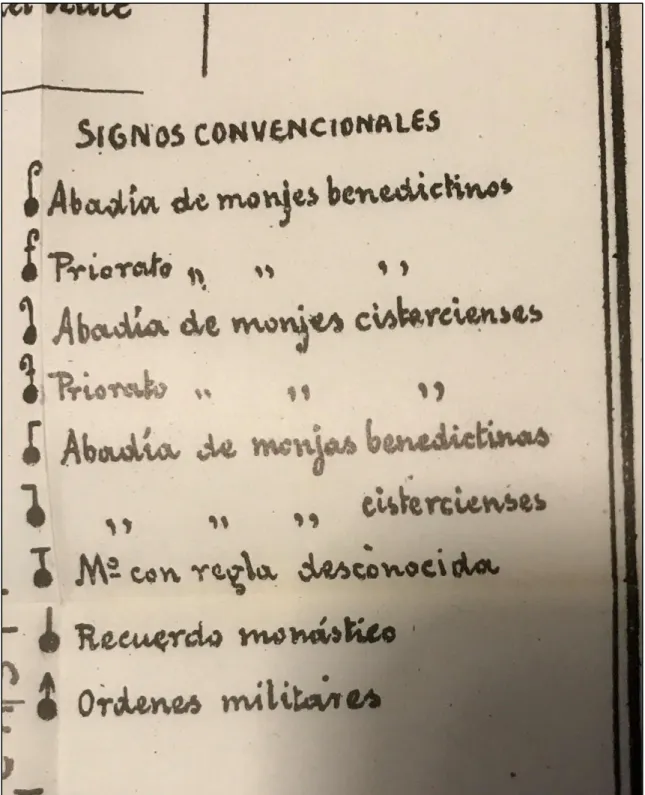
part the infrastructural backbone of the Camino. Please see Figures 1 and 2 for a visual
representation of Benedictine communities across Northern Iberia in relation to the Camino
Figure 1. Map of Known Centers for Monastic and Military orders in 12th century
Galicia and Leon.35
35 Justo Perez de Urbel, Los Monjes Españoles de la Edad Media, (Madrid: Ediciones Ancla, 1945), Tomo Segundo
Figure 2. Legend Corresponding to Figure 1.36
36 Justo Perez de Urbel, Los Monjes Españoles de la Edad Media, (Madrid: Ediciones Ancla, 1945), Tomo Segundo
Benedictine Hospitality
Now that we have understood the widespread nature of Benedictine communities in
Northwestern Spain at the dawn of the Jacobean pilgrimage, it becomes important to explore
how exactly these settlements ideologically upheld and evolved the notion of monastic
hospitality previously sown in the region by the rules of Isidore and Fructuoso. Indeed, I will
argue that this Benedictine notion of charitable hospitality became a (if not the) primary philosophical and ethical forbearer to the proper medical system of later centuries in Galicia,
Asturias, and Leon.
First, one must analyze the Regula Santi Benedicti itself to understand what drove these communities. The Rule is overtly focused on selflessness, humility, and obedience throughout.
Much like the Iberian Rules, this one is also heavily based in scripture. Chapter 4, “Quae Sunt
Instrumenta Bonorum Operum,” says, honorare omnes homines, et quod sibi quis fieri non vult, alio ne faciat. Abenegare semetipsum sibi ut sequatur Christum […] Pauperes recreare, nudum vestire, infirmum visitare, mortuum sepelire. In tribulation subvenire, doletem sonsolari.”37
Here, in the early sections of his work, Benedicts grounds his instructions for the selfless
caretaking and service of others in biblical scripture. As evidenced above, he makes specific
mention of the caring for the paupers, the sick and the ailing.
In later section of the Rule, Benedict brings these mandates into the pragmatic reality of
the world by fashioning them into concrete guidelines. For example, chapter 36, entitled “De
infirmis Fatribus”, states that, Infirmorum cura ante omnia et super omnia adhibenda est, ut sicut revera Christo ita eis serviatur, quia ipse dixit: Infirmus fui et vistastis me, et: Quod fecistis uni
de his minimis mihi fecistis. Sed et ipsi infirmi considerent in honorem Dei sibi servire, et non superfluitate sua constristent fratres suos servientes sibi; qui tamen pateinter portandi sunt, quia de talibus copiosior merces acquiritur. Ergo cura maxima sit abbati ne aliquam neglentiam patiantur.38 Here, Benedict explicitly establishes the care for the sick as the principal task of the
monks—above all else. Furthermore, this chapter goes on to outline some specific duties, how
the sick should be housed away from the regular living quarters, and puts the abbot in charge of
making sure the sick are treated without neglect and that the cellars are run well enough to serve
the ailing. Please see figure 3 for visual layout of a monastic infirmary—while the floor plan is
from a different region it can be assumed that other Benedictine monasteries, if they constructed
their quarters in accordance to the Rule, followed a similar plan.
Figure 3. 9th Century Plan of an Infirmary at Swiss Benedictine Monastery of St. Gall,
set up after the guidelines of the Regula Sancti Benedicti.39
39 Loren MacKinney, Early Medieval Medicine: with special reference to France and Chartres, (London: Oxford
Lastly, chapter 53 is another interesting section of the Regular Sancti Benedicti important to understand in order to imagine how these monasteries cultured their philosophy of healthcare
and hospitality. Here, Benedict writes that Omnes supervenientes hospites tamquam Christus suscipiantur, quia ipse dicturus est: Hospes fui et suscepistis me; et omnibus congruous honor exhibeatur, maxime domesticis fides et peregrinis.40Primarily, it is important to note the
emphasis on the care for all. This egalitarian mandate extends care beyond the religious and shows the beginnings of a secularized notion of hospitality that was to be expanded and
reiterated in later centuries with the advent of academic medicine.
As a Quick Aside: The Camino as Generator of Monastic Activity
Once an ideological link between monasticism in the Iberian northeast and a tradition of
hospitality is drawn, it becomes important to note how the Camino itself served to galvanize the
expansion of monastic infrastructure across the territory. For a regionally localized example, one
can turn to Vicente Jose Gonzalez Garcia’s essay “La hospitalidad Asturiana durante la primera
epoca del camino de Santiago (S. IX-XI).” In his text, Gonzalez Garcia summarizes his archival
findings regarding the development of medieval, monastic infrastructure in Asturias—primarily
garnered from the Archivo de la Catedral de Oviedo. He notes that archeological findings and
surviving documents from the early 9th century, right around the time the Apostle’s remains were
unearthed, can confirm the existence of around fifteen monasteries in Asturias.41 However, what
is more important is comparing this number to his findings from the 11th century. By then, more
40 Regula Sancti Benedicti, RB 1980, c. LIII, IIX-XIX
41 Horacio Santiago-Otero, El Camino de Santiago, La Hospitalidad Monastica y las Peregrinaciones, (Salamanca:
than 100 additional monasteries had been established in the region—a number that does not take
into account any secular hostels or confraternities.42 For a visual representation of the monastic
geography of this time, please see Figure 4. While some would argue that 11th century
documentation would, by sheer nature of being closer to the present moment, be better preserved
than records from prior centuries, it would be wrong to ignore Gonzalez Garcia’s findings by
virtue of this alone. Certainly, it is no leap to assume that the creation of an new, internationally
relevant Christian shrine in a neighboring province—and the great influx of pilgrims that came
along with it—would have led to a substantial increase in both the need for and the interest in the
establishment of monastic communities through the 12th century.
42 Horacio Santiago-Otero, El Camino de Santiago, La Hospitalidad Monastica y las Peregrinaciones, (Salamanca:
Figure 4. Map of Monasteries in Relation to the Camino de Santiago in 11th Century Asturias.43
43 Horacio Santiago-Otero, El Camino de Santiago, La Hospitalidad Monastica y las Peregrinaciones, (Salamanca:
The Revival of Classical Medicine: An Overview of Healthcare in the 12th Century
Up until the 12th century, as we have seen, (proto-)medicine, and all academic endeavors,
was almost exclusively limited to clerical enclaves and monasteries. At this time, in Christian
north-Iberia, any formalized imperative for patient care was derived from monastic Rules and
there was still no ubiquitous system of medicine (something that had already been developing in
the Muslim emirate of southern Iberia for over two centuries). To explain my use of
“proto-medicine” I must reiterate something mentioned in a previous chapter: The monastic hospitals in
these early days were far from what we know as the modern hospital today. Agustin Rubio Vela
describes the early medieval hospital as “instituciones para la práctica de la caridad y no como
lugares de curación […] el hospital de la Edad Media era, básicamente, un centro de
beneficencia entre cuyas funciones figuraba, pero no de modo exclusive, la cura y cuidado de
personas enfermas.”44 In other words, the hospitals up until the 12th century were not exclusively
interested (or even primarily interested) in the curing of disease, but rather in the general
charitable caretaking of anyone that needed assistance—particularly the poor and the pilgrim. Of course, this did include medicine in the early, non-systematic forms that were available to monks
at these times (herbalism et cetera). It is, however, worth mentioning again that “the sick” as a
caste of people were held in particularly high regard by the various monastic Rules dictating life
at these monasteries.
44 Agustin Rubio Vela, Pobreza, enfermedad y asistencia hospitalaria en la Valencia del siglo XIV, (Valencia:
With the advent of the 12th century, Christian Europe began to see very large social,
infrastructural, and academic developments. Additionally, at this same time, Santiago de
Compostella reached its peak popularity as an international travel destination45.
The reader may note that the following sections are not as densely packed with
information and citation as the parts of this text that precedes them. This can simply be explained
by the fact that documental evidence regarding Galicia and its surrounding regions in the 12th
and 13th centuries is quite sparse. However, this speaks to a point I made earlier; the region has
been severely under-studied. I will, with the thin evidence that does exist, suggest that the
important cultural exchanges along the Camino would bring Europe’s 12th century modernization
to Spain’s northern regions; that by attracting foreign travel (and settlement), the Jacobean
pilgrimage served as catalyst for the spreading of Western knowledge to the region. I hope that
my hypothesis can imagine the near parallel advancement of thought in the northern regions
when compared to the rest of Iberia, to show that new archival research in this territory could
lead to important discoveries about how knowledge travelled in medieval Spain and about
exactly how ubiquitous the European desire for scientific knowledge had become.
The 12th Century Renaissance
Some scholars of history describe the 12th century as an early “renaissance” the European
West. As Nancy Siraisi writes in her book Medieval & Early Renaissance Medicine this period is characterized by “a population increase, economic growth, urbanization, the development of
more sophisticated forms of secular and ecclesiastical government and administration, the
growth of professional specialization and of occupations requiring literacy, the multiplication of
45 Richard A Fletcher, Saint James’s Catapult: The Life of Times of Diego Gelmirez of Santiago, (Oxford University
schools, and the enlargement of philosophical, scientific, and technical learning.”46 In regards to
medicine, Michael McVaugh suggests that the upsurge of progress begun when a North African
intellectual known as Constantinus Africanus took his monastic vows at the Monte Cassino
Benedictine monastery in southern Italy.47 Once at the monastery, he took it upon himself to
translate many Arabic-language scientific and medical texts. These included many works from
Greek antiquity, originally penned by influential academic giants like Galen and Hippocrates.
Over the next century, the beginnings of an early, standardized medical canon begins to form—
shaped by these translated Greco-Arabic texts.
The Imporantce of Galenic Thought in the Christian Middle Ages
The effects of Constantinus’ translations were immediately felt in one of Europe’s
foremost early medical academies, Salerno, located only about 100 miles away from Monte
Cassino. Salernitan medical practitioners had already enjoyed a certain renown in the 10th and
11th centuries (they were already mentioned as far away as northern France during this period).
However, their fame was primarily noted through anecdotes regarding their practical skill in
healing practices; no particular mention was made regarding their book learning.48 This was to
change through the 12th century, when the Masters of Salerno began to take interest in the intense
literary study of these newly translated Greco-Arabic volumes49. Indeed, the Masters’ early
academic endeavors were to transform the field of medicine forever. Their work created the first
46 Nancy G. Siraisi, Medieval and Early Renaissance Medicine, (Chicago: The University of Chicago Press, 1990),
13-16
47 Irvine Loudon et al., Western Medicine: An Illustrated History, (New York: Oxford University Press, 1997), 56 48 Nancy G. Siraisi, Medieval and Early Renaissance Medicine, (Chicago: The University of Chicago Press, 1990), 13
impulse to equate medicine to a learned literary practice, consequently placing the previously lay
popular practice within the academy, the place it remains to this day.
More concretely, from 1100 onward, the Masters of Salerno had begun establishing a
standardized tradition of medical instruction by outlining the textual standard that was to define
medical education in the West for the next 500 years. This canon became known as the Articella
or Ars Medica and was composed of a collection of volumes has since helped contemporary historians understand Galenism as a cohesive system of thought. Specifically, the Ars Medica
included Johannitius’ Isagoge (Introduction to Medicine), Hippocrates’ Aphorisms and
Prognostics, Galen’s Ars parva, and two Byzantine treatises on the prognostic qualities of analyzing urine and pulse.50
Ultimately, this new literary current did little to revolutionize any actual medical
techniques or practices in a concrete way. However, what it did do is provide an intellectually
sophisticated and cohesive framework inside which medicine could exist and evolve. In the
words of Nancy Siraisi, it “greatly enhanced the theoretical, systemic, and learned elements in
medicine. [And] this tendency was further accentuated by the reception of Aristotelian logic and
natural philosophy.” 51
50 Irvine Loudon et al., Western Medicine: An Illustrated History, (New York: Oxford University Press, 1997), 56
The Spread of Salernitan Galenism throughout Europe
The academic movement that begins in Salerno in early 12th century is not contained
there for long. This comes as no surprise once one considers the infrastructural network that
existed throughout Europe in the form of Benedictine monasteries, especially since Constantinus
was himself a Benedictine monk. It bears mentioning that in these days Europe’s intelligentsia
was still clerical in nature—localized almost exclusively in religious enclaves, cathedral schools,
and monastic communities. By 12th century, it had become commonplace for monasteries to
exchange texts with one another and create duplicate copies via transcription to be stored in their
ever-expanding libraries. There is little doubt that this practice became further establish once the
Latin translations of the aforementioned texts gained a wider readership, particularly once
cultural value was beginning to be being placed on learned medicine and classical natural
philosophy. In fact, in the 1130s several clerical councils across Europe issued decrees that
forbade monks and clergy from studying medicine or leaving the cloister to practice.52 This
reactionary legislation speaks to the growing appeal amongst European intellectual communities
of a seemingly secular and specialized medical study with the potential for material
compensation.
To be more specific, documental evidence tells us that the classical revival had already
reached deep within French territory by early 12th century. Chartres, a cathedral school and
intellectual center about 100 miles south of Paris, had (like Salerno) long been known as an
outstanding medical center. In the 11th century this academy already housed three renowned
52 Darrel W. Amundsen, “Medieval Canon Law on Medical and Surgical Practice by the Clergy,” Bulletin of the
practitioners. Historian Loren MacKinney describes them as follows, “Heribrand, was a teacher
of medicine, another, Richer, an historian and medical academic somewhat similar to [another
French Master] Gerbert; the third, Bishop Fulbert, was an amateur practitioner who, like Gerbert,
avoided the profession of medicine, but knew how to prescribe and compound remedies.”53 It is
known that their twelfth century successors at Chartres used the Pantegni (an Italian commentary on the Ars Medica) as “an authoritartive source for their cosmological systems.”54
In fact, in his essay “Medicine as Science in the Early Commentaries on Johannituis”
Mark Jordan discusses an early copy of the Ars Medica, with scholarly commentary, found at Chartres. He claims that it is reasonable to suppose that the commentary itself was “a chartrian
composition.”55 In other words, scholarly analysis of the Ars Medica was probably already
taking place just south of Paris by mid-12th century. This would indicate a staggeringly fast
diffusion of information across the European continent—towards the Iberian Peninsula.
The Camino as Infobahn: Learned Medicine Reaches Northwestern Iberia
It is hard to imagine that Europe’s newfound yearning for classical knowledge would
have stopped at the Iberian border. While concrete evidence is scant, I will present the argument
that by late 12th century not only had Salernitan medicine spread across Northern Spain to
Compostella, but also that the pilgrimage route would itself, by virtue of its widespread hospital
system, have served as an incubator for the advancement of medical thought in the region.
53 Loren MacKinney, Early Medieval Medicine: with special reference to France and Chartres, (London: Oxford
University Press, 1933), 121.
54 Irvine Loudon et al., Western Medicine: An Illustrated History, (New York: Oxford University Press, 1997), 58. 55 Mark D. Jordan, “Medicine as Science in the Early Commentaries on Johannitius”, Traditio 43, (Fordham, 1986),
The first important piece of documentation we must look at regards the court of Diego
Gelmirez, the first archbishop of the Archdiocese of Santiago de Compostella (for those
interested, Richard Fletcher richly illustrates the bishop’s life with great historic detail in his
book St. James’s Catapult). Not only did Gelmirez show his high regard of academic learning by establish a cathedral school in Santiago and internationally importing teachers of the liberal arts,
but he also sent members of his clergy to visit the schools at Paris and Bologna.56 Surely, these
academic missions brought back knowledge of the classical texts studied in France and Italy at
this time. However, what truly solidifies my hypothesis that Santiago de Compostella became an
early 12th century center for the study of the Ars Medica is the mention in Historia
Compostellana of “Roberto, Medicus of Salerno” in Gelmirez’s court.57 The importance of this
information must not be understated. These documents from Gelmirez’s hayday concretely
establishes the end-point of the Camino, Santiago de Compostella, as a center of intellectual
activity. Moreover, when considering the foreign influences brought to the city it becomes easy
to imagine that the cathedral school in Santiago would plan its curriculum along the same
classical lines as Paris, Bologna, Salerno, and the other prestigious centers of learning in Europe.
56 Luis Garcia Ballester, “El Camino de Santiago y el descubrimiento de la naturaleza en los siglos XI y XIII”, El
Basilisco 22, (Oviedo: Fundacion Gustavo Bueno, 1996), 37
57 Luis Garcia Ballester, “El Camino de Santiago y el descubrimiento de la naturaleza en los siglos XI y XIII”, El
Figure 5. The Diocese of Santiago de Compostella in the time of Diego Gelmirez58
58 Richard A Fletcher, Saint James’s Catapult: The Life of Times of Diego Gelmirez of Santiago, (Oxford University
Indeed, I would argue that it would be closeminded to limit this academic activity to
within the city walls of Santiago de Compostella. The pilgrimage, by this point, had established
numerous, well-trodden trails connecting urban and monastic centers from Santiago to well
beyond the Pyrenees. These roads created an impressive network for which knowledge and
books could quickly diffuse throughout northern Iberia. Again, it is important to remember that
the centers of learning at this time were still exclusively religious—primarily the Benedictine
communities. It is therefore not difficult to imagine a situation where an increasing monastic
desire for knowledge would cause books—particularly the newly translated, pragmatically
useful, and intellectually exciting Latin volumes of the Ars Medica—to start being exchanged,
travelling between the now connected intellectual centers of the Iberian northwest. Moreover, as
far as medicine is concerned, the Camino not only created a possibility easier proliferation of
medical knowledge, but it also generated a growing need for this understanding through the
increased arrival of diseased and impoverished travelers.
There are two primary ways to validate the idea that The Way increased the need for, and
expansion of, healthcare throughout the region. First, let us consider that in the 12th century the
belief in the miraculous healing properties of shrines was still very widespread. For example, the
middle 12th century Chronicle of Pseudo-Turpin (Book IV of the Codex Calixtinus) describes
healing powers of St. James as being “greater than that of even the most illustrious doctor.”59
This particular quotation not only emphasizes the respect people had for supernatural healing,
but the juxtaposition also concretely establishes medici as a trusted and important source of healing and care.Additionally, the widely popular Liber Sancti Jacobi (a composite based
59 Ramon Baltar Dominguez, “Algunos Aspectos Medicos de las peregrenaciones Medievales a Compostela”, Actas
largely on the Codex Calixtinus) explains that at the Jacobean shrine the saint had “restored sight to the blind, gait to the lame, hearing to the deaf, voice to the mute, and life to the dead.” It goes
on to say that St. James could “cure people of all kinds of illnesses in the name of glorifying
Christ.” From here, the text uses more specialized medical language to say describe the
supernatural healing of “los leprosos, frenéticos, nefríticos, maniosos, sarnosos, paralíticos,
artéticos scomáticos, emigránicos, podrágricos, estranguiriosos, disuriosos, febricantes,
caniculosos, hepáticos, fistulosos, tísicos, disentéricos, aserpentibus lesos, hictéricos, lunáticos,
stomáticos, reumosos, amentes, epiforosos, albuginosos y enfermos de muchas enfermedades” (I
have not translated the Spanish terms into English to better approximate the the language of the
Latin text).60 We must remember that the writer (or writers) of the Codex was undoubtedly a
learned men of monastic background. His use of advanced medical terminology would suggest
that he had a good comprehension of 12th century prognostic language. This certainly does much
to reinforce notions regarding the widespread nature of the advancements in medical thought—
and it is of particular import as it appears in a text dealing specifically with the Galician
pilgrimage. Regardless, there is no need to discuss the factual accuracy of these supernatural
claims; rather, what is important here is that these legends of divine cure certainly would have
been taken seriously in their day and become an integral part of popular culture—causing
countless ailing people to undertake the pilgrimage to Santiago.
To show this influx of sick people more concretely, one can turn to existing
documentation outlining the increasing rate of expansion in the Iberian north of medical
institutions such as hospitals and leper houses along the Camino during the late 11th and
60 Ramon Baltar Dominguez, “Algunos Aspectos Medicos de las peregrenaciones Medievales a Compostela”, Actas
throughout the 12th century. I want to note that I do not want to argue that these establishments
sported, or were even exposed to, Salernitan medical learning. I am only pointing out the
increase in medical institutions for the sake of imagining a correlation with the growing
population of sick and ailing people in the region.
For example, sometime between 1065 and 1109 Benedictine monks of the Cluny order
founded a hospital in Sahagun that housed an impressive 70 beds and existed for the “housing,
reception, feeding, resting of the poor, as well as the providing cures when visitors fell ill.” In
another example, Don Pelayo de Leon writes in 1084 that he had ordered the construction of a
hospital (domus hospitalis) in Leon so that “the poor, blind, lame, mute, and pilgrims could find
refuge […] and care if any of them were to fall ill.” The aforementioned Diego Gelmirez also
founded a hospital. This institution was constructed in the city of Santiago and in 1104 Gelmirez
ordered that half of all money collected by his church should go towards the care of the “pilgrim
and the sick of the Hospital.” Another two famous Camino hospitals were then were established
at Roncesvalles (in 1127) and in Burgos (in 1195). The latter was said to have capacity for an
impressive 2,000 patients and had its own cemetery.61
The establishment of these hospitals, primitive as they may have been, certainly implies
an increased need for healthcare in the region. When this need combines with the possibility for
rapid spread of knowledge through the Camino’s infrastructural network it is not difficult to
imagine the northwestern region of Iberia as a bustling laboratory for the advancement of
medical thought and practice during the 12th century. Ultimately, once the society-shaping
powers of the Camino are taken into consideration, a very different picture emerges that is far
61 Ramon Baltar Dominguez, “Algunos Aspectos Medicos de las peregrenaciones Medievales a Compostela”, Actas
from the currently dominant descriptions of Galicia and its neighboring regions as the most
intellectually stagnant and academically barren parts of the early Spanish kingdoms. If further
extensive archival research were conducted at places like Astorga, Santiago, and Leon, it would
be very unsurprising to find 12th century documental mention of practicing physici and medici.
And if indices from a 12th century library collection were found in these regions, it would most
likely include mention of the texts in the Ars Medica. These archival research avenues should be explored in more depth as soon as possible to test my hypothesis against any potential evidence.
13th Century Academic Developments: Medicine beyond the Monastery
By beginnings of the 13th century, the way academia operated was once again profoundly
changed. The centers for learning across Europe started being granted newfound independence
as they gain legal authority over their own curricula and requirements for graduation. As far as
medicine was concerned, bachelor and masters degrees begun to be awarded in the field—both
contingent on literary study as well as practical training outside the academy.62 Additionally, a
rapidly expanding literary body of translated works began flooding these new institutions. In
addition to more classical works being translated from Greek were new translations of many
Arabic works. Perhaps most importantly, a Latin version of Avicenna’s Canon. Avicenna’s work
established a much more rigidly systematic and meticulously organized guide than its Galenic
counterparts read alongside it. It allowed medical faculties to construct the underlying
framework of their curricula. Academies like those of Toledo, Montpelier, Salamanca, and Paris
began gaining renown as centers of scientific import. However, as McVaugh points out,
academic medicine could not gain the widespread popularity that it enjoyed had it not been
actively welcomed by the lay public.63 The ever-expanding urban centers of Europe began taking
interest in early notions of public health as the close quarters of these urban space would start
making issues of hygiene and communicable disease come into sharp relief.
Monks beyond the Monastery: Franciscans and Dominicans
During early 13th century, monasticism began undergoing a fundamental transformation
with the arrival of two new religious orders—the Franciscans and the Dominicans. The former
was established by Francis of Assis in Italy around 1209, the latter by Dominic of Caleruega in
Montpelier around 1206. These two new groups were very different from their Benedictine
predecessors. While they did emphasize the ascetic lifestyle generally associated with traditional
monastic societies, they did not exist enclosed in monasteries. Instead, they were travelling
orders, moving freely to spread The Gospel as well as knowledge about the world and to explore
the beauty of creation through academic study—primarily the natural sciences.64 These types of
inquisitive academic pursuits became a foundation for Dominican and Franciscan Christianity,
galvanizing a new lively academic spirit in Western Europe. Of course, it is not difficult to
imagine that these new wandering orders would suit themselves very well to the landscape of
interconnected well-trodden paths established by the Camino; indeed, their presence was soon
felt in Santiago de Compostella.
63 Irvine Loudon et al., Western Medicine: An Illustrated History, (New York: Oxford University Press, 1997), 58. 64 Luis Garcia Ballester, “El Camino de Santiago y el descubrimiento de la naturaleza en los siglos XI y XIII”, El