ABSTRACT
RICHARD JAMES EROSTRCM, JR. The Iirpact of Public Comment on
Regulatory Decision-Making: The Arsenic Standards.
(Under the direction of Dr. Michael A. Berry)
A method for the characterization and analysis of public oarment
on an EPA standard was proposed. The arsenic anissions standard was
chosen since it was the most canmented upon standard ever pranulgated
by the Agency. Uie proposed method worked well, as participating
groups were clearly defined and the intent of each of the groups was
reasonable in relation to their inferred environmental ideology. The
effectiveness of each of the major groups of conmenters was measured by
relating the number of ccraments submitted versus the number of changes
nade.Comments received on the risk assessment constituted 89 percent of
all ocmnents sutmitted, over half were sulxnitted by citizens not
belonging to any particular special interest group. Few changes were
made to the risk assessment as a result of the conments and the
effectiveness of the conments for all groups was less than two percent.
Conments submitted on the technical issues of the standard were
more successful in causing change to the proposed standard. The
effectiveness of each group varied widely, but the average
effectiveness was 20 times greater than for ocranents subnitted on risk
issues. Many changes dealt with the sutxnittal of new cost and
emissions data by the affected industries.
To allow for a discussion of the oonment process, Godschalk's
Exchange Model was altered and applied to the standard. The Exchange
Model indicated that the conment process was successful except in the
Agency's response to the public ocxnment. A group theory model was used
to analyze the the Agency's response to the comment. This nradel
indicated that the changes made to the proposed standards by the EPA
could not be explained rationally on the basis of public conment.
I. INTRODUCTION/STUDY PURPOSE... 1
Introduction ... 1
Study Purpose ... 6
II. LITERATURE REVIEW... 9
Goals for Public Involvement ... 9
Realities of Public Involvement ... 10
Model of Public Involvement ... 13
Literature and Models ... 16
III. REEULATCRY HISTCRY OF ARSENIC... 17
Need for a Regulation... 17
Summary of the Proposed Standards ... 22
Public Canment Period... 29
Prcmulgated Standards ... 33
Final Outcome ... 34
IV. METIDDS... 36
Data Collection ... 36
Data Analysis ... 42
Representative Group Response... 44
V. RESULTS ... 46
Number of Ccmnents ... 46
Measuring Group Support for the Standard... 49
Measuring Group Intent ... 52
Measuring Group Effectiveness ... 59
Measuring Intent Versus Effectiveness ... 65
Research Methodology... 71
VI. DISCUSSION... 72
ttiase 1 - Opportunity... 72
Hiase 2 - Information ... 74
Hiase 3 - Response ... 76
Summary of the Model Phases ... 78
Consensus Explanation for Agency Response... 79
Group Theory Explanation for Agency Re^onse .... 82
VII. RECOMMENDATIONS... 87
VIII. REFERENCES... 90
APPENDIX A - Fbrms Used to Solicit Opinion of Draft Results
'ͣ^^;'?J^^.
SECTION I - INTRCOJCriCN/STUDy PURPOSE
Introduction
The chain of events which leads from public input to governmental
agency action is difficult to describe. The dynamics of an agency's
decisicn-making process is normally beyond casual observation (Berry,
1984). Yet, this link is the keystone whidi insures danocracy and
commands accountability in bureaucratic decisicn-making. It is abureaucracy's responsibility to consult with the general public and the
<
various interest groups. In environmental rule-making, citizen
involvement forces equity, efficiency and effectiveness, as both
corporate and enviroimental critics sed< to curb administrative
discreticai in two ways - through public participation and through
litigation.
Public corannent cxi proposed rules is one of the few nonadjudicatory
means for the expressicm of public opinicxi of a proposed agency
acticBi. Ccaigress has taken steps to insure adequate public involvement
in agency acticxis by demanding that certain measures be taken to
involve the public before a rule can be finalized. In its rule-making
procedures, EPA is required to actively solicit comment fran affected
publics, v^ch includes citizens, environiientalists, and the
potentially regulated industry.
Although the Agency is not compelled to make any decisicxis in
light of contents received, it is oonpelled, many times, to make very
issues, for exartple, the determination of acceptable risk, where
public conment becanes an inportant factor in the Agency
decision-making process. Since public input includes conments fran concerned
citizens, environmental groups and industrial supporters, the Agency is often forced to view many sides of the inpacts which stem fron a
regulation. Each rule promulgated has a varying degree of public
involvement. As each environmental rule is pronulgated, EPA builds its
own precedents on these controversial issues with input from the
public.
Precedents are also created by the courts, as many of these rules are adjudicated (more than 80 percent of all environmental standards
(Pederson,1975)). The courts establish precedents for the Agency to
follow based upon its decisions in light of the public will and the
technical data. The public will is determined on the basis of conment
received during the public conment period which accotpanies proposed
standards. However, citizen group suits have declined since 1975 due
to the willingness of officials to consult and accomidate citizen demands rather than precipitate a lawsuit (Lake, 1982).
Public input, then, affects Agency action on current environmental
standards, but is also contributing to the policy-creating and
precedent-setting actions of EPA vrtiich will affect environmental legislation for years to cone.
A good exanple of environmental rule-making which incorporates a
large amount of public involvement in critical issues can be found in
section 112 of the Clean Air Act. A section 112 regulation is camonly
called a "NESHAP", for national anissioi standards for hazardous air
ff^^^^^'y^^ms^^^^
to deal effectively with air toxic "hot spots", and provide a catch-all
for non-criteria pollutants v^ich may pose a threat to the public
health. With concern for toxic air pollutants growing, more and more
environmental rules will be pranulgated under section 112 legislation.
Figure 1.1 illustrates section 112 and other coraiDnly used statutory
mechanisms for regulation under the Clean Mr Act.
As can be seen fran Figure 1.1, section 112 is quite different
from other sections of the Act in two major areas:
1. NESiaPS are standards which are to be developed without the
consideration of costs.
2. NESHAPS are standards which are to be developed with great
consideration to evidence of demonstrated health effects.>ͣ
Type of
Pollutants
Use of Cost
Factors Allowed?
Need For Risk Assessment?
SECTIONS 108-110
National Ambient Air
Qualtiy Standards (NAAQS)
-<
Criteria Pollutants (SO„NO„CO,Pb,TSP) YES NOCLEAN flIR RCT
>-SECTION 111
New Scarce Performance
Standards (NSPS) Criteria YES NO Non-Criteria Low/Non-Toxic YES VERY LIMITED SECTION 112 > National Emission Standards for Hazardous
Air Pollutants (NESHAPS)
Toxic Air Pollutants
(Vinyl chloride. Be, Hg, As)
NOT SPECIFIED
YES
demonstrating health effects from many air carcinogens with any degree
of certainty. It is this distinction which make section 112 so
inportant for the preservation of the public health, while at the same
time makes the standard-setting process so unwieldy.
Like the criteria pollutant regiilations, section 112 has technical
issues which must be resolved by EPA in areas such as the selection of
prominent emissions source categories. In addition, the best available
emissions control technologies must be determined by an analysis of
existing or tested pollution control devices. The major difference
between NESHAP's (section 112) regulation and NSPS's (section 111)
regulation is the basis for regulation. While cost/benefit analyses
were spelled out by Congress for use in section 111, the basis for
regulation in section 112 is risk assessment.Unlike criteria pollutants, which have a definite measurable
health effect, health affects from toxic air pollutants are considered
permanent. The most canmon enc^xDint used for study is cancer. With
air carcinogens it is much more difficult to identify the exact
cause/effect relationship of pollutant source and health inpact. Given
the Agency's current approach to air carcinogens, the public is at sane
risk if exposed to any ambient concentration of carcinogen, however
small. The explanation for the acceptance of a non-threshold theory
for regulating air carcinogens can be found in the Agency's Air
Carcinogen Policy. Here, the Agency embraces an opinicxi put forward by
"...when there is exposure to a material, we are not starting
at an origin of zero cancers. Nor are we starting at an
origin of zero carcinogenic agents in our environment. Thus,
it is likely that any carcinogenic agent added to the
environment will act by a particular mechanism on a particular
cell populaticai that is already being acted on by the same
mechanism to induce cancer." (EPA,1983)
The use of risk assessment as a basis for regulation incorporates,
to a great extent, the issues in which the Agency must seek public
involvement to aid in its decisioi-making. The very issues discussed
earlier to which the Agency does not have a set policy are issues which
are incorporated into section 112 regulation. These issues include
acceptable/non-acceptable risks, regulation in the absence of a clearly
established health endpoint, and the use of econcmics as a factor in a
health-based regulation. Without a clearly defined, politically
acceptable policy in these issues, EPA must satisfy the public will, or
face the consequences in court.
If a single section 112 regulation incorporates Agency use of
public involvement as an input into the regulation process, it would be
the national emissions standards for inorganic arsenic promulgated in
August, 1986. The purpose of the rule was to limit the amount of
inorganic arsenic emitted into the air fran various industrial
sources. Many of the sources which emitted the volatile metal were
located in urban areas of the country. While the Agency had seme
evidence which indicated that people living near the sources would
probably receive seme health benefits from the regiilation, there could
be no doubt that the econatiic inpacts resulting from the standard would
The focal point of the standard centered primarily en one arsenic
emissiCTi source, the ASAE«X)-Taooma copper smelter in Tacona,
Washingtcn. Almost aie fourth of all arsenic emitted to the atmosphere
nationwide was durtped fron this smelter with nearly two million
residents within 50 km (EPA, 1983). The smelter, v^ch ettployed 600
people and provided over $20 million in local revenues, was already cxi
the brink of closure as inexpensive copper from South America began to
make its way into the U.S. market (U.S. Bureau of Mines, 1984). EPA
studies indicated that a strict arsenic emissiai regulation would most
certainly close the plant (EPA,1983).
On the other hand, several well documented epidemiological studies
had been published which showed that arsenic caused lung cancer in
exposed smelter workers, so BPA had a well documented health risk. This risk was stated publicly t^ the Agency in the proposed regulation
and caused an immediate reactioi by the public and the affected industry. Because of the urban locaticxi of the smelter, an enormous
amount of publicity occurred when the Agency announced its plans to
regulate arsenic emissions from copper smelters. This publicity was
soon turned by the Agency into public oorannent as EPA sought public
input from the conmunity to aid in its decision-making.
Study Purpose
Although it is clear that the Agency went to great lengths in the
solicitation of public conment on the arsenic standards, it is not
clear as to v*iether the ccrnments received actually served their
analyzing the public comment process exists. Hie purpose of this paper
is to suggest a method for analysis of the public ooitinent process
currently used in environmental rule-making. The standard chosen for
study is the inorganic arsenic standard pronulgated under section 112
of the Clean Air Act in August, 1986.
Since more than 2500 comments were received by the Agency, this
rule-making also provided a unique opportunity to measure a
cross-section of public oonment on an environmental standard with seme
measure of statistical validity. In characterizing the comment, the
following questions were be addressed:
• Who participated in establishing the standard?
• How intensively did the major groups (environmental,
business, industrial, university, local government,
etc..) participate?
• What was the collective "intent" of each of the groups
who participated in the process?
• How effective were each of the groups in ccaivincing EPA
to rethink its position and change the proposed arsenic
standard?
• Did EPA respond deferentially to oanments submitted
by any particular group?
The different modes of solicitating public opinion, hearings or
letters, are cotrpared and contrasted as to their effectiveness in
proipting Agency changes to the standard. Since the study will
petiticning the Agency can focus their limited resources into areas in
vAiich the Agency is most likely to change its proposed position. By
analyzing the effectiveness of conments submitted by citizens as
compared to ooraments suhxnitted by groups which shared the same opinion
on an issue, the relative value of different groups v*iich claim to
represent affected publics can be assessed.
Without a clear identification of the public intent as indicated
by the comments submitted, there is little chance for a meaningful
detennination of the effectiveness of the public canment process. This
study develops a method for determining the intent of each of the
groups who participated in the process. By applying the intent of each
of the groups with their relative success in procnpting EPA to change
the proposed standard, a measurenent of the effectiveness of each group
is possible.
Finally, this study eitploys two models for analzing the results of
the quantitative analysis. Godshaulk's Exchange Model is used to
analyze the effectiveness of the comment period framework used by EPA.
In order to explain EPA response to the public canment, a group theory
model is used. By incorporating these methods for analysis and the
public participation models, the utility of the public ccnment period
SBCnCN II - LITERATURE REVIEW
Goals of Public Participation
The use of public iiput as a guide to government agency
decision-making has developed a body of theoretical approaches v*iich can be used
to understand the oonplex process. Ihere has probably been more ink
spilled by policy analysts discussing the merits of the public
involvement process than by concerned citizens using it. No analysis
of the effectiveness of the public involvement process is meaningful
without a presentaticxi of the intended goals of public participation in
agency actions. James Creighton, author of the U.S. Department of the
Interior's Public Involvement Manual, lists three goals for useful
public participation.
• CREDIBILITY - Public comment is incorporated into the
decision-making process to add to agency credibility with groups having highly divergent viewpoints.
• IIENriFICATION CF PUBLIC CONCERNS - Public comnent
allows a government agency to receive input from
many different perspectives.
• DEVELCFING CONSENSUS - Comment serves to aid an agency in
developing a policy v*iich satisfies the most people.
(Creightai,1980)
It is this last point which is particularly inportant in
environmental rule-making, as the Environmental Protecticxi Ager^ seeks
development of ccaisensus is rarely achieved by Agency alignment with one view or another. Rather, the results of public oaiment most often represent a oonpromise of oortpeting interests. Agency ccnprcmise was recognized nearly half a century ago in an article which appeared in the Journal of Public Policy. Here, the Agency's use of public cpinion was described as a "fiction used to describe an amalgam of ccnpeting
interests v*iich is shaped and reshaped in the furnace of their
conflicts." (Fainsod, 1940). Ihis opinion points out the fact that the public ccmment process can be described as a fierce battleground for ootrpeting interests, rather than siirply a means for the agency to
collect the cpinion concerned citizens.
Realities of Public Involvement
Public input into agency actiai has been intensely criticized by
policy analysts and various citizen groups which seek a participatory role in the development of governmental regulatiai. Seme of this criticism is based upon oaimcxi misunderstandings of the realities of
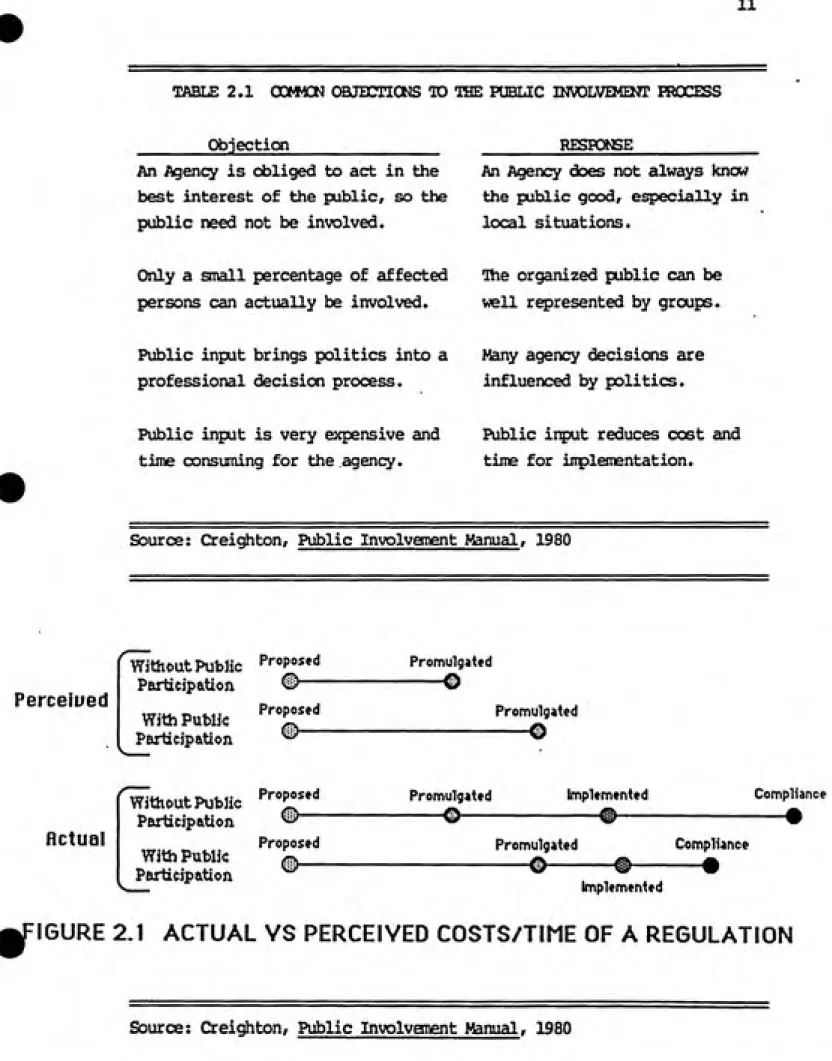
the public involvatent process. Creighton (1980) listed seme comtioi ctojections to the currently used public involvement process and the realities of the process which serve to dispel ccmmon myths. Tliree of the most frequent objections to public involvement are listed in
Table 2.1
The last objection listed in Table 2.1 identifies the increase in
time and cost to an agency as a result of the public participaticxi process and is represented in Figure 2.1. This figure shows that the
11
TABLE 2.1 COHXH CBJBCTIONS TO THE PUBLIC INVTOLVEMENT PROCESS
Objecticm
An Agency is obliged to act in the best interest of the public, so the public need not be involved.
RESPC»6E
An Agency does not always kncv; the public good, especially in
local situations.
Only a small percentage of affected
persons can actually be involved.
The organized public can be well represented by groups.
Public input brings politics into a
professional decisicxi process.
Many agency decisiois are influenced by politics.
Public input is very expensive and
time consuming for the agency.
Public input reduces cost and time for inplanentation.
Source: Creighton, Public Involvement Manual, 1980
Perceiued
Without Public Proposed
Participation ©—
With Public
PEoiicipatioii
Proposed
Promulgated
Promulgated
Actual
Without Public ''•""'^
Participation ^
With Public
Participation
Proposed
¥
Promulgated Implemented Compliance
Promulgated Compliance
Implemented
IGURE 2.1 ACTUAL YS PERCEIVED COSTS/TIME OF A REGULATION
spent previous to the pranulgaticxi of a rule, since the true costs of a
standard must include the iitplementaticxi jdiase. By satisfying the
public demands before pranulgaticai, mutch of the iirplementaticxi cost is
reduced due to the fact that costly citizen suits can be avoided and
industry coipiance is more quickly realized.
Other misunderstandings have been e^^lored by policy analysts who
present them in hopes of preventing unnecessary frustration cxi the part
of participating groups (Buck, 1981; Godschalk, 1981; Creighton,
1980). "Hiree of the major fallacies of public involvanent in government decision-snaking are presented belcw.
o FALIACy 1: All persons affected by a regulation should be
involved. Ihe belief that all affected persons should
participate in the public participation process is rooted in a "town-<teeting" approach to public decision-making.
Although ideal, this situation would most certainly cause
increased chaos in an already chaotic process.
Administrative realities and the wide scope of nuch of the enviroimental legislatioi make representative
participaticMi essential. Fortunately, the public can be
well represented by various groups en both ends of the spectrum of environmental philosophy. One study has shewn that the views of 63 percent of the public were adequately represented by a single envircxmental group (Budc, 1981). o FALIACy 2; Public participation outcomes are binding to
the Agency. As mentioied in Section I, even though the pjblic mist be heard from, the Agency is not ccnpelled to make decisions based vpon the outcome of the public
involvement procedures. However, the public can file suit
against EPA based upon Agency decisions made in light of
the public oornments presented, and the technical evidence
which exists.
o FALIACy 3; Public Participation is an integral part of
Agency decisions. In many cases, the public input has
little bearing cai the outccre of a regulatioi. This is
especially true in issues in v^ich EPA has a well
established regulatory precedent. Where this is the case,
the Agency may be n^rely "going through the motions" in
the public involvement process. However, for regulatory
issues in which there is no foundation for a decisicm, theAgenc;y may have to incorporate public caiment as an
13
Model of Public Participation
Different models have been proposed to depict the process of
public involvement in agency decisions. Godschalk and Stiftel (1981)
proposed a model which defines the process in terms of "exciiangephases" between an agency and the public. Although the model was
proposed for an agency's planning activities, the phases can be easily
adapted to regulatory analysis. Figure 2.2 depicts the model as
applied to the regulatory decisicxi-making process used by EPA.
This process, as described by the model, involves exchanges
between EPA and the public on three levels, or "phases". The first of
these is an exchange of opportunity. Here, the government agency nust
make itself accessible to the public. In the case of envirormental
rule-making, this availability is displayed nainly in two modes, the
public hearing and the acceptance of conment letters. In turn, the
public is responsible for its cwn involvement and participation in the
cjportunities provided by the Agency. As with all three phases, the
success of public participation depends upon activity on the part of
the Agency and the affected public.
Phase 2 is the Information phase. Here, background information
and points of view from both sides of the issues surrounding a
regulaticsi are presented in the hope of developing sane kind of
consensus \^ich EPA can incorporate into a standard. In this phase the
Agency is made aware of the public will, which most often lacks
consensus.
Openness of ^he Regulatory Process
^—--- Accessibility ^---^.^^^
Opportunities
A
G
^______^ Involvement ______..^---
Pu
Participation in the Regulatory Process
Information About Proposed Standard
E
^---" Public Awareness .^.^^
Information
B
N
C
>._______ Agency Awareness____—-"^
LI Information About Public Opinion
y
Changes in Proposed Standard
C
^---~ Effect on Agency /Standard ^>,_^
Response
^--~.,^_^_ Effect on Public ___________
Changes in Public Support for Standard
FIGURE 2.2 EXCHANGE MODEL OF PUBLIC PARTICIPATION
badtground infomation documents (BID'S) which are available for public
critique. In these background documents, EPA presents all the data and
calculations used to support a proposed or promulgated standard.
Because Phase 2 requires a means for the successful transfer of
information and opinion, its effectiveness depends, to a great extent,
15
The final jdiase of the Exchange Model is the Response piiase.
Here, changes in the proposed standard and changes in public si^^rt
are manifested. Agency respcaise to the public ccmment process is
relatively strai^^t-forward to assess, since any changes in the
proposed standard are outlined in published documents. Ihe Agency may
change a proposed standard on the basis of its own decisions. Unless
the change is a result of an exchange of informaticai in the public
comment forum, the effectiveness of the citizen participation process
cannot be assessed. Likewise, the Agency may respcaid to perceived
public discontent and change the standard, but unless public
dissatisfaction is brought forward by official public comment
oj^rtunities, the success of citizen participation cannot be measured.
Unlike EPA's respcxise to public input, public response to the
Agency is more difficult to assess and is measured by changes in public
support for the standard. Often, Agency ccnpranise an. an issue can
leave oonpeting groups unsatisfied since ncaie of the involved groups
acheives its stated goal. Yet, regardless of how public opinion on the
regulation changes, there is no doubt that changes in public support
occur as a response to the final rule, and these changes can be used to
measure the success of public participation.
In reality, the three phases presented in the Exchange Model are
used repeatedly. The announoanent of projected changes sparks the need
for additicxial ccmment frcm the public, and new hearings are scheduled
and the public cctnment period is extended or reopened. Still, the
Exchange Model presented by Godschalk and Stiftel can be used to
a breakdown of the different steps in v*iich the process is carried out,
the success of each of the three jAiases in the model can be assessed
and then combined to provide an indicatiai of the success of the entire
process.Literature and Models
The body of literature that exists for the analysis of public
ocnment indicates a najor problen with the process. A great deal of
misunderstanding surrounds the public involvanent process, and
misperceptions of the process have raised objections to citizen
involvement. Agency decisions are not always based extensively on the
results of citizen involvement, nor is the agency c^liged to act in
accordance to the public will.
In additicMi to describing the utility of citizen coranent, models
have been proposed to aid in the analysis of the public involvement
process as a whole. Godschalk's Exchange Model can be adapted for use
in envircMimental rule-making as well. The Exchange model provides a
method for analysis based upon the exchange of opportunity,
SECTION III - RBSULATCRY HISTCRY CF ARSENIC
The history of the regulatiai of arsenic as an air pollutant is an
interesting one, and provides a good exairple of the process required to
prottulgate a standard under the Clean Air Act. More inportantly for this stud|y, the standard highlights the public involvanent processes i:ised by EPA and prescribed by the Administrative Procedures Act of
1947. Public involvement methods described by the Administrative
Procedures Act include both the formal rule-snaking procedures, for
exanple, citizen suits, and informal notice-and-oocnment period
rule-making procedures. EPA also involved the affected public in workshops
and public hearings v*iich are not required by the Clean Air Act. The
following section briefly outlines the history of the regulation of
arsenic as an air pollutant, including both the standard-setting
approadi used and the role which public participation played in the
development of the final standard.
An analysis of the adequacy of the actual standards, in terms of
public health benefits, is not essential to the issue of public
participation in the standard-setting process. Indeed, it is well
beyond the scope of this work. Therefore, an analysis of the actual value of the regulation is not addressed.
Need For a Regulation
Sectioi 112 was added to the Clean Air Act in 1970 to cover all
sections 108-110 cover only criteria pollutants used by the agency to monitor air quality trends, section 112 is the primary mechanism for
the regulaticxi of toxic air pollutants. As an air pollutant vMch
posed a significant risk of adverse health effects, inorganic arsenic
was considered a candidate pollutant for a national emissicxi standard
regulation under sectiai 112.
The Clean Air Act, as amended in 1977, directed the Agency to
promulgate a rule to limit arsenic anissions under secticxi 112.
Although EPA had dealt with the country's main inorganic arsenic
emissiai sources (non-ferrous smelters) in 1976 with a new source
performance standard, the Agency failed to specifically consider
arsenic emissicais in the regulation (Ajax, 1985). Environmental groups
petitioned the Agency in the matter, and in response to this pressure
EPA made a commitment to begin the data collection process essential to
the proposal of a regulaticai.
In additicxi. Congress also pressured the Agency to act an the
arsenic issue. Since oily two hazardous air pollutants had been
regulated by the Agency under section 112 during 1970 to 1977, Ccxigress intentionally listed seven hazardous air pollutants for the agency to
study and regulate. According to the Act, a national emissicais
standard for any hazardous air pollutant must be proposed one-half year following the official listing of a hazardous air pollutant (HAP) in the Federal Register, and promulgated just one-half year after the
proposal.
In June, 1980 EPA listed arsenic as a hazardous air pollutant.
This listing procedure is iit^rtant as it begins the secticxi 112
19
following radicaiuclides, benzene, vinyl chloride, asbestos, mercury,
and beryllium, it was the last of the seven chemicals that the Clean
Air Act specifically directed EPA to act upon in secticxi 122.
The basis for this listing, beycaid the congressional mandate, was
a number of Agency studies which showed arsenic to be a probable human
carcinogen. Evidence for this classification was the consistent
increased risk found in different arsenic exposure studies, as well as
the observed specificity of tumor sites (skin and lungs) and the high
relative risks whidi resulted vAien conpared to other studied
carcinogens. In a major study from the\Agency's Carcinogen Assessment
Group, arsenic's carcinogenic potency was ranked in the first quartile
of 52 suspect carcinogens analyzed (EPA, 1984).
In additiai, airborne emissions of arsenic were well documented
and significant. Enissioi sources had been characterized, and
emissions quantified. In some instances, high arsenic atdssion sources
were found in areas with large populations. Since EPA's definition of
"hazardous" requires both significant exposures as well as an
established toxicity, the listing of arsenic as a hazardous air
pollutant was well justified.
However, it was not until June 20, 1983, two years after the
deadline specified by the Clean Air Act, that an arsenic rule was
proposed. Even then, the Agency was forced into issuing the proposed
regulaticai by a U.S. District Court after suit by the State of New
York. Stating that the administrator had "violated her duties to
promulgate regulations for the listed airborne arsenic", EPA's claim of
lack of timeliness in the regulatioi process (New York vs Gorsuch, No.
81 CIV 6678 (WCT)). EPA was given the statutory deadline of six months
to propose a regxiLation for arsenic.
In the proposed rule, source categories of arsenic emissions were
selected as targets for regulaticai. The most in^ortant of these were
the primary copper smelters vAiich emitted more than one fourth of all
airborne arsenic nationwide (EPA, 1983). Since this relatively
volatile metal is present as an iitpirity in nearly all copper deposits,
smelters anit arsenic v*ien roasting, smelting and converting the copper
ore at high tenperatures. The inorganic arsenic is emitted fron tall
stacks which vent the furnaces and ccxiverters and also escapes existing
control equipment and is emitted as a low-level fugitive.
Because there were two very distinct classes of arsenic-laden ores
lased by the copper smelters, a proposed standard for smelters was
published for eadi of the groups according to the arsenic content of
the copper ores used to produce the blister copper product. Figure 3.1
displays the range of arsenic containing ores used by the smelters.
Only one smelter, the ASAROO-Taccma smelter, fell into the high-arsenic
ore category, vtiile the natiai's other fourteen primary smelters refine
copper fron low-arsenic content ores.
The next most inportant emission source was the glass
manufacturers. Glass manufacturing plants were included as a source
category since seme manufacturers add arsenic to the raw materials used
4.0
3.0
21
UJ
^ 2.0
o z
<
o
ec UJ o.
1.0
-E
c
(J
I
o «=: <
U.S. Primary Copper Smelters
Figure 3.1 Percent Incrgan-ic Arsenic In Feed Materials At Primary Cop:
Smelters
emitted fron the glass mixture during the heating process, and emitted as both stack and fugitive emissions. As a group, glass manufacturers
were a relatively minor source of arsenic emissicxis, accounting for 7
percent, or 37 tons/year of airborne arsenic nationwide (EPA, 1983).
After these two categories, there were many smaller sources of
arsenic emissions in the country, c«ly one of which was considered
major enough to constitute a public health hazard, dose industries
not considered were zinc and lead smelters (both primary and
secondary), zinc oxide production plants, cotton gins, and arsenic
trioxide/inetallic arsenic chemical plants. The arsenic diemical plant category was not considered for regulation in the initial proposal but
<
was later proposed and promulgated in a rule which affected only the
arsenic production plant used in conjunction with the nation's lone high-arsenic primary copper smelter.
The Proposed Standards
All the comtnents analyzed in this study pertain to the proposed
standards for high- and low-arsenic smelters and the glass
manufacturing plants. Because of their iiiportance to understanding the
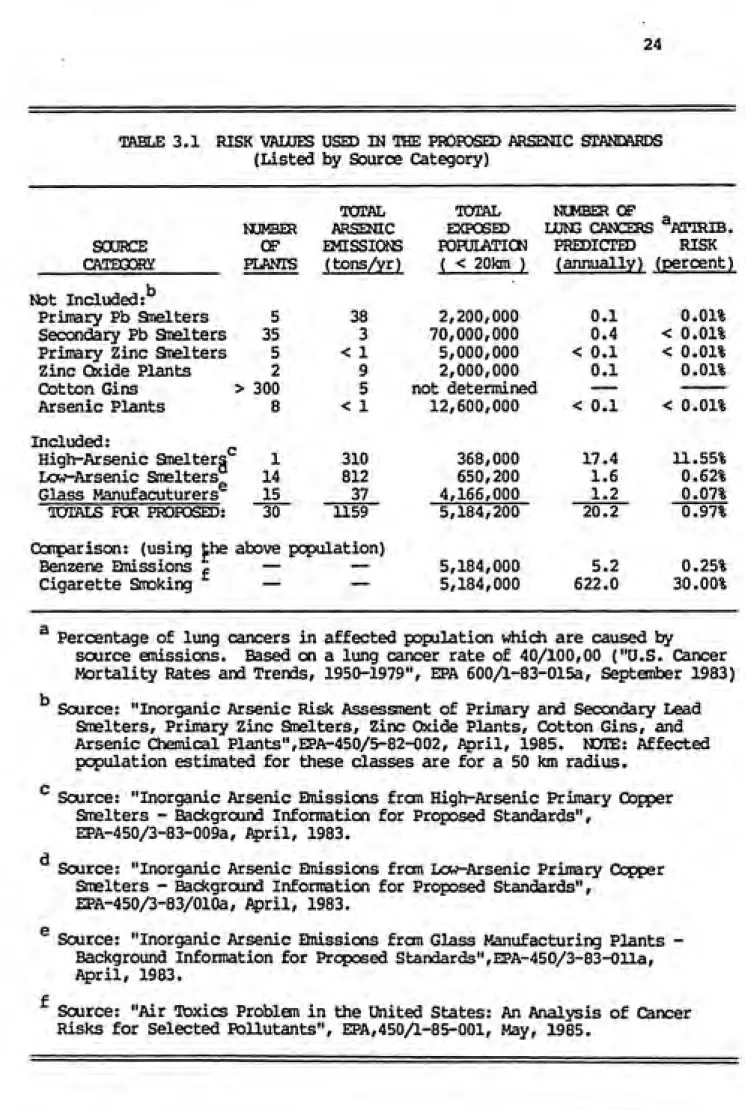
issues raised by conmenters, the proposed standards are outlined below. Included in the outline is the risk data used by the EPA for all the proposed standards. The risk assessment/risk management process is outlined as well.
• RISK ASSESS^EW^; In order to propose a national emissions standard for a hazardous air pollutant, an air pollutant must "ccaitribute
23
reversible, or incapacitating irreversible, illness" (CAA Secticai 112(A)(1)). In the case of inorganic arsenic, three
epidaiiiological studies were found vAiich indicated an increased incidence of lung cancer in smelter workers. No epidemiological studies existed v^ch analyzed arsenic exposure and the incidence of other suspected adverse health effects, such as peripheral neuropathy, growth retardation and brain dysfunction amcxig children, hyperkeratosis, and an increase in adverse birth
outcomes. Risk estimates used in the standard were based entirely
upon the incidence of lung cancer.
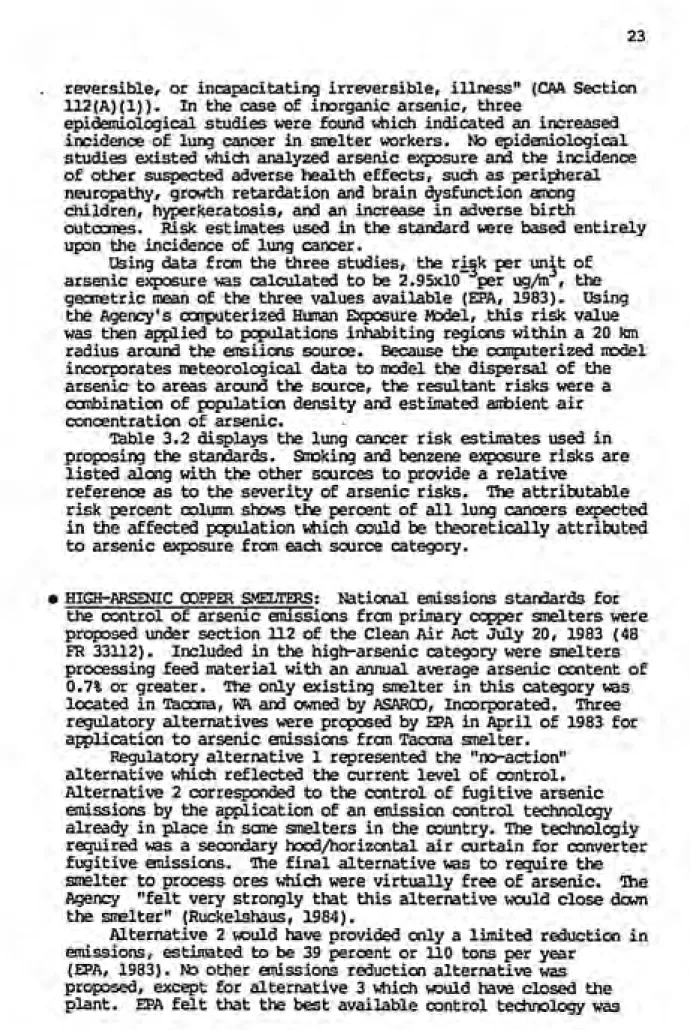
Ifeing data fran the three studies, the risk per unit of arsenic exposure was calculated to be 2.95x10 per ug/in , the geometric mean of the three values available (EPA, 1983). Using the Agerxr/'s conputerized Human Eb^xDSure Model, this risk value was then ^plied to populations inhabiting regicxis within a 20 km
radius around the ensiicxis source. Because the carputerized model incorporates meteorological data to model the dispersal of the
arsenic to areas around the source, the resultant risks were a conbination of populaticxi density and estimated ambient air
concentraticai of arsenic.
Table 3.2 displays the lung cancer risk estimates used in proposing the standards. Smoking and benzene exposure risks are listed along with the other sources to provide a relative
reference as to the severity of arsenic risks. The attributable
risk percent column shows the percent of all lung cancers expected in the affected population v*iich could be theoretically attributed to arsenic exposure from eacJi source category.
• HIGH-At^SENlC CDPPHR SMELTERS; Natiaial anissions standards for
the control of arsenic emissicxis from primary copper smelters were proposed under section 112 of the Clean Air Act July 20, 1983 (48 FR 33112). Included in the high-arsenic category were smelters processing feed material with an annual average arsenic content of 0.7% or greater. The only existing smelter in this category was located in Tacoma, WA and owned by ASARCD, Incorporated. Three regiilatory alternatives were proposed by EPA in /^ril of 1983 for applicaticxi to arsenic emissions from Tacoma smelter.
Regulatory alternative 1 represented the "no-action"
alternative whidi reflected the current level of control. Alternative 2 correspcxided to the caitrol of fugitive arsenic
emissions by the application of an emission control technology already in place in some smelters in the country. The technologiy
required was a secondary hood/horizontal air curtain for converter fugitive emissions. The final alternative was to require the smelter to process ores which were virtually free of arsenic. Ihe Agency "felt very strongly that this alternative would close down
the smelter" (Ruckelshaus, 1984).
Alternative 2 would have provided cxily a limited reducticai in
enissions, estimated to be 39 percent or 110 tons per year
(EPA, 1983). No other anissions reducticai alternative was
TABLE 3.1 RISK VAUTRS USED TN THE PROPOSED ARSFNTC STANTftRDS
(Listed by Source Category)
TOTAL 'iaiAL NUMBER OF
NUMBER ARSENIC EXPOSED LUNG CANCERS ''atirib.
SOJRCE CF EMISSIONS POREATICN PREDICTED RISK
CATEXSQRY PLANTS (tons/yr) ( < 20km )
(annually) (percent)
Not Included r*^
Primary Pb Shielters 5 38 2,200,000 0.1 0.01%
Secoidary Pb Shielters 35 3 70,000,000 0.4 < 0.01%
Primary Zinc Shielters 5 < 1 5,000,000 < 0.1 < 0.01%
Zinc Oxide Plants 2 9 2,000,000 0.1 0.01%
Cotton Gins > 300 5 not determined
---Arsenic Plants 8 < 1 12,600,000 < 0.1 < 0.01%
Included:
High-Arsenic Smelters Low-Arsenic Srielters
1 310 368,000 17.4 11.55%
14 812 650,200 1.6 0.62%
Glass Manufacuturers 15 37 4,166,000 1.2 0.07%
'lUmLH b'Oi. PKOHJSKI): 30 1159 5,184,200 20.2 0.97%
Cotiparison: (using the
Benzene Einissions ^
Cigarette Smoking
above population)
— —
5,184,000 5.2 0.25%
^ͣ~" ^ͣ^w
5,184,000 622.0 30.00%
Percentage of lung cancers in affected populaticxi which are caused by
source emissions. Based cxi a lung cancer rate of 40/100,00 ("U.S. Cancer
Mortality Rates and Trends, 1950-1979", EPA 600/l-83-015a, September 1983)
Source: "Inorganic Arsenic Risk Assessment of Prinary and Secondary Lead
Smelters, Primary Zinc Smelters, Zinc Oxide Plants, Cotton Gins, and
Arsenic Chemical Plants",EPA-450/5-82-002, i^ril, 1985. NDTE: Affected
population estiirated for these classes are for a 50 km radius.
Source: "Inorganic Arsenic Ehiissicxis from High-Arsenic Primary Copper
Smelters - Badcground Information for Proposed Standards",
EPA-450/3-83-009a, ;^ril, 1983.
Source: "Inorganic Arsenic Emissicxis frcm Low-Arsenic Primary Capper
Smelters - Background Information for Proposed Standards",
EPA-450/3-83/010a, April, 1983.
Source: "Inorganic Arsenic Ehiissicns from Glass Manufacturing Plants
-Background Information for Proposed Standards",EPA-450/3-83-011a,
April, 1983.
Source: "Air Toxics Problem in the United States: An Analysis of Cancer
25
already in place at arsenic enission points in the plant. Iftider these alternatives, the Agency proposed to regulate the high-arsenic primary ccKJer smelters category under alternative 2.
• LOW-ARSENIC (]CPPER SffiLTERS: National emissiois standards for the coitrol of arsenic emissiais from primary cqE^r smelters
processing feed material with an annual average arsenic ccxitent of 0.7% or less were also proposed on July 20, 1983 (48 ER 33112). The 14 anelters which process low-arsenic ores were evaluated for
both process and fugitive anissions to determine areas v*iere a reducticai in arsenic emissicxis was possible. The Agency's i^ril, 1983 review led to the development of five regulatory
alternatives.
Alternative 1, the "no-action" alternative, wDuld not affect the facilities. Alternatives 2, 3, and 4 provided for different levels of enission control by the applicaticsi of various control technologies and process techniques. Alternative 5, like the final alternative proposed for the high-arsenic category, would have required the smelters to process ores v*iich were virtually
free of arsenic content.
Ihe Agency selected two alternatives for the proposed
standard. The two alternatives chosen affected six smelters
nationwide. Oliese six plants would have been required to install secondary hoods/air curtains cm their ccxiverter operaticxis to control fugitive arsenic emissicais. In addition, four of the six would have had to install control devices for fugitive emissions from matte and slag tapping operaticais. Ihe selection of the two alternatives in the proposed regulation would have resulted in a 17 percent, or 137 tons/year, decrease in arsenic anissions from this source category (EPA, 1983).
• GLASS MANUFACTURING PLANTS; National emissions standards for the
control of arsenic emissicxis from glass manufacturing plants were
also proposed July 20, 1983 (48 FR 33112). Over 400 oonpanies are
involved in the production of the various types of glass, but only
fifteen furnaces in the glass industry manufacture glass v*iich ccMitains arsenic (EPA, 1983). The Pgency proposed three
alternatives for regulaticai in ;^ril, 1983.
Alternative 1, similar to the smelter category, was the no-action alternative which represented current levels of emission coitrol which existed at the time. Alternative 2 represented the ccmtrol achievable with a fabric filter or electrostatic
precipitator installed oi the furnaces in plants v*iich add arsenic to the glass batch. The last alternative was the most restrictive and would have required the ccnplete elimination of arsenic in the
manufacture of glass. Of these three possibilities, alternative 2
was chosen as the proposed naticmal emissions standard. Ihe
reducticm of arsenic emissicms in the eight affected plants was
Public Ccmment Period
The proposed standards prcnpted an unprecedented nuntoer of
comments from outside the i^ency. The EPA had never received such a
large number of comments relating to a single group of proposed
standards. A large number of comments were related to the
ASAROO-Taoana primary copper smelter. Ihe high cancer risks projected by EPA
models and the fragile economic situation of the copper smelter were
translated into an iirportant ccranunity issue.
The Agency felt that the intense local awareness in the Tacoma
area was an opportunity to involve public in the standard-setting
process to a degree v^ich had never before been considered in
environmental rule-making. In order to effectively involve the public,
EPA sent out a team of officials to hold three workshops preceding the
public hearings. Ihese workshops, all held in the Tacoma area, were
well attended by concerned citizens, smelter arployees, and industry
and environmental leaders alike. The workshops helped to explain
information in the proposed standard and the risk assessment process
upcwi which it was based. In addition, the Agency also provided public
education on issues such as risk management and emissicxi coitrol
27
the majority of v*iich supported the proposed standard as a reasonable oonpromise between jobs and health (EPA, 1984).
An additiaial public hearing session was held just four days later
in Washington, D.C. Lasting just one day, November 8, 1983, 13 speakers were heard, mostly from the affected glass and copper
industries. Uncertainties in the modeling studies were brought up at both hearings and EPA, along with environmental groups and the affected
industries, met c«i December 20, 1983 to discuss the data used for the
Taccxna smelter (Ajax, 1986).
Because of requests by ccxnnenters for additional time to prepare
oral testimDny and to review the revised modeling results for the
ASAROO Tacana copper smelter, the Agency postpaied closure ai>d reopened
the public conment period three times (48 FR 38009, 48 FR 55880, 49 re 36877). The conment period on the proposed standards officially closed
on November 5, 1984.
The Agency went to great lengths to solicit public ocmnent during
the preparation of the arsenic standard. Because the Agency was so
active in Tacoraa, some coramenters felt that EPA was actually asking the
public to vote on the proposed standard. Mministrator Ruckelshaus, in
an effort to assure these coramenters that he was not abdicating his responsibility in the matter, made the Agency's position clear in a
speech given at Princeton in February of 1984:
"We organized an extraordinary canpaign of public
education in Tacana. So unusual was this kind of event
that sane inferred that I was abdicating my
confusion on this score, we made it clear that it was
entirely wy decisicxi, and that although I wanted to hear, I was not catmitted to heed ... I suppose some would have been happier continuing in their fond belief that we could provide absolute safety with absolute certainty, and were disturbed by these proceedings."
(Ruckelshaus 1984)
In addition to the information gathered in the public hearings and
the workshops, EPA also received public comment on the standards by letter. Many groups sent comments or printed copies of their testiiroiy presented at the public hearings, since written letters are considered
jto be the caily admissible evidence of a oonplaint in future litigaticai
(Stewart, 1977). More than 650 letters were received by the Agency on
the ASAROO-Tacana standard alone. When all source categories are
considered, more than 800 commenters sutmtted questions and comments
pertaining to the proposed standards. Most of the comments received by
the Agency raised several issues, and, of course, many of the comments
were r^jeated by other ccinmenters.
As required, EPA considered all comments and responded to those
questicxis v^ich raised significant issues. The Agency was then
required to publish all comments which were deemed "significant", and
thus required a formal response. In issues relating to the risk
assessment procedures used in the proposed inorganic arsenic standards,
the Agency published over 2300 conments alcMie.
Comments were grouped by issue and then all comments relating to each issue were listed by EPA. "Hie official EPA response followed the
29
assessment issues was published in April, 1985. For camients relating
to more technical issues, such as the selection of best available
control technology or the use of different cost models, the Agency published separate documents for each of the proposed standards in
May, 1986.
Prcmulgated Standards
Promulgated national emission standards for hazardous air
pollutants for inorganic arsenic were published in the Federal Register
August 4, 1986 (51 FR 27956). The effect of public ooctment can only be
assessed by examining the final standards, since any changes made to
the standard can be identified by comparing the proposed and the final
standards. Oherefore, a brief discussion of the changes which occurred
follows.
• RISK ASSESSMENT; Two additional studies were added to the
epidCTiiological data base. This additicxTal^information increased
the unit risk estimate to 4.39x10 per ug/in , a 48 percent
increase over the proposed unit risk value (EPA, 1985). However,
emission estimates were revised downward as conment on the
proposed estimates was received by the Agency. The canbination of these two factors greatly decreased the estimated risks from the arsenic anission sources natiaiwide. Table 3.2 presents the updated lung cancer risk estimates used in promulgating the
arsenic standards. Again, smoking and benzene exposure risks are given to provide a relative reference as to the severity of
arsenic risks. The attributable risk percent column shows the percent of all lung cancers es^jected in the affected populaticai which could be theoretically attributed to arsenic exposure from each source category.
In addition to the changes in the emissions and unit risk data, the Agency expanded its caipaterized model to include all persons living within 50 km of each emissions source. Biis change was due to oonmenters who felt that significanly exposed
populations existed beycsid the 20 km limit used in the prcposed
TART.R ^.7 RISK VALUES USED IN THE PROMULGATED ARSQIIC STANDARDS
(Listed by Source Category)
'lUirAL TOTAL NUMBER CF
NUMBER ARSENIC EXPOSED LUN3 CANCERS ''Ai'lWlB.
SOURCE CF £MSSIONS POHJIATICN PKEDlCi'lD RISK
CATEGORY PLANTS (tons/yr) ( < 50km ) (annually) (percent)
Proposed: ,
Arsenic Plants 8 < 1 12,600,000 < 0.1 < 0.01%
High-Arsenic Stnelters'' Low-Arsenic SiiBlters
1 129 1,800,000 2.9 0.40%
14 306 1,900,000 . 1.0 0.13%
Glass Manufacuturers 15 37 11,600,000 0.4 0.01%
TOTALS: 30 472 27,900,000 4.3 0.04%
Cociparison: (using
fhe
above population)Benzene Bndssions
f
— —
27,900,000 27.9 0.25%
Cigarette Smoking •^~ ^^
27,900,000 3348.0 30.00%
Percentage of lung cancers in affected populaticxi which are caused by
source emissiais. Based on a lung cancer rate of 40/100,00 ("U.S. Cancer Mortality Rates and Trends, 1950-1979", EPA 600A-83-015a, September 1983)
Source: "Inorganic Arsenic Risk Assessment of Primary and Seccaidary Lead
Smelters, Prinary Zinc Snelters, Zinc Oxide Plants, Cotton Gins, and Arsenic Chemical Plants",EPA-450/5-82-002, i^ril, 1985.
Source: "Inorganic Arsenic Enissiois fran High-Arsenic Primary Copper Smelters - Badcground Information for Pronulgated Standards",
EPA-450/3-83-009b, Not published.
Source: "Inorganic Arsenic Ehiissicais fran Primary Copper Smelters and Arsenic Chemical Plants - Background Information for Pronulgated
Standards", EPA-450/3-83/010b, May, 1986.
Source: "Inorganic Arsenic Ehiissicxis from Glass Manufacturing Plants -Background Information for Promulgated Standards", EPA-450/3-83-011b,
May, 1986.
Source: "Air Toxics Problem in the tfiiited States: An Analysis of Cancer
•;; ͣ:'"^?f!!!^S"'S?
31
antoient arsenic anissions data in areas around the Taooma smelter, instead of relying on the modeled anissions levels. Ihe change in the risk assessment as a result of using ambient data was not great, since the measured data did not differ significantly from the modeled data, particularly v*ien caipared to the relative uncertainties in the risk assessment process (Fitzsimmons, 1986).
• HIGH-ARSENIC POPPER SMELTERS; Although EPA prepared a final
Standard for the high-arsenic category of primary copper smelters,
a standard was never promulgated. There was no need for the standard since the ASARPO-Taccma smelter closed in March, 1985
before a rule could be finalized.
LOW-ARSENIP POPPER SMELTERS; The final rule promulgated for
low-arsenic smelters, re-named to include all primary ccf^r smelters, incorporated several significant changes v*iich were pronpted by
comments received by the Agency. The two most notable dianges
occurred from data submitted by the copper smelting industry
during the notioe-and-ccrament period of the standard setting process. These changes included a 62 percent decrease in the
overall enissions from this source category and a 16 percent
increase in the capital costs projected for the installation of required control equipment (EPA, 1986). Table 3.3 shows some of the changes made in the anissions and cost data.
Probably the most significant change in the proposed standard was the ccaiverter feed cut-off level for those smelters which would be affec±ed by the standards. Tiie proposed cut-off,
affecting 6 out of the 14 smelters, was increased by an order of magnitude to include CHily one smelter. In additiai, the
provisions for emissiai reducticxis for slag and matte tapping operaticxis were dropped since the revised arsenic emission rates indicated that "the small reductiai in public health risk
resulting from matte and slag tapping controls did not warrant the imposition of these ccaitrols at any of the existing smelters" (EPA, 1986) The final standard resulted in a maxinum enoission reduction of 4.4 tons of airborne arsenic per year or 1.4
percent. To pxit this envirconental iitpact into perspective, the
maximum reduction in expected cancers from the standard was estimated to be 0.4 cases per year.
Public ccrament also prarpted EPA to add additicxial
provisicffis. These included an increase in opacity monitoring and
several steps which were required to minimize anissions due to
malfunctions and upsets. Upsets and malfunctions refer mostly to
coitrol equipment start-ups and ccmtrol equipment repair or
maintenance shut-downs. These sources of anissions had been left
out of the proposal but were added after state regulators and
envircximental groups brought them to the Agency's attention.
As an attachment to the standard on copper smelters, EPA
proctulgated standards on the arsenic chemical plant operated by
ASAROO in Taccraa. The Tacoma capper smelter was closed down butTftBLE 3.3 CHANGES IN SMELTER EMISSIONS/COST DATA
EMISSIONS DATA smelter
Proposal
Estimate
-1983-Revised
Estimate
-1986-(MgA)
Percent
Reduction
ASAROO-Hayden 30.1 5.4 82%
ASAROO-El Paso 27.5 16.7 39%
Kennecott-Utah 8 1.5 81%
Kennecott-ffcGill 45.9 10.1 78%
Phelps Dodge-Morenci 6.9 1»9 72%
Hielps Dodge-Ajo 2.6 U.5 81%
E*ielps Dodge-Hidalgo 1.2 0.2 83%
122.2 36.3 70%
OOSr DATA^
Snelter
Proposal
Estijuate
-1983-($1000)
Revised
Estimate
-1986-($1000)
Percent Increase
ASARCTKHayden 1,700 3,660 115%
ASAROO-El Paso 1,375 1,850 35%
Kennecott-Utah 5,200 8,800 69%
Kennecott-Hayden 6,730 8,000 19%
Kennecott-McGill 8,760 7,150 -18%
Rielps Dodge-Morenci 8,530 12,970 52%
32,295 42,430 31%
Ccxiverter fugitive anissicxis (EPA-4503/-83-010b pg 1-4-17)
^Capital cost estimates (EPA-450/3-83-01Ob pg 1-8-17)
the arsenic chemical productioi plant vrtuch had been processing
stockpiled smelter waste. Consequently, EPA felt that the
proposed fugitive ccMitrol measures for the arsenic plant should be
finalized. The rule pronulgated for this arsenic plant required
no specific coitrol technologies. Rather, the standard dananded a
modification of work practices at the facility, including the
preparation of a regular inspection, maintenance, and housekeeping
- '.'sm^ww^'^WT' ͣ'^'•^f?^'^
33
iiiprovanent in public health was not estimated by the Agency since
the plant was not required to install any particular control
device.
• GLASS MANUFflCTORINS PIANTS; Changes were also made to the
standard proposed for the glass manufacturing category, ttilike
the smelters category, the cost and anissions estimates were not
significantly changed. However, the cut-off limit for
unccxitrolled arsenic emissions was raised 625 percent and the
Agency also allowed ai^ furnace which added more than 2.8 tcxis per
year of arsenic to the batch to chose any ccxiceivable ccxitrol
option as long as an anissicai reduction of arsenic was at least 85
percent over the uncontrolled level. An emissicxi testing
exaipticxi was given to any furnace v*iich added less than 8 tons of
arsenic per year to the batch.
The increase in the cut-off and specific exsiptiais ocmbined to reduce the number of affected facilities from 8 to 2. One of the plants affected was scheduled to change production to a
ncHiarsenic glass type, vAiile the other was expected install an
electrostatic precipitator. Expected arsenic emission reduction
was 16.1 tons per year or 43 percent naticsnwide (EPA, 1986).
Final Outcane
Emission standards for arsenic were finally promulgated more than
five years after the statutory deadline given in section 112 of the
Clean Air Act. Public ccmment resulted in a large number of
significant dianges to the proposed standards, particulary in the data
used by EPA to estimate emissions and cortpliance costs. These changes
reflected a reduction in the ej^jected health impacts, as arsenic
emissiCTi estimates were revised downward. Consequently, the
promulgated standards were much less restrictive upon the
June, 1977 --->
CAA Directs EPA
To Inves'tigale
Arsenic as a Section 112
Hazardous Air
Pollutant ^
T 1/12/83 NESHAP Proposed For Smelters and Glass Plants 8/10/84
EPA Responds
to Public Comment on Risk Assesment
Arsenic NESHAP Final Rule Promulgated Federal Court Orders EPA To Propose Arsenic Standard
by June, 83
6/77
ͣ
//ͣ
V
6/80 1 /83 5/83
Arsenic Listed as a
Hazardous Air Pollutant 6/5/80 EPA Announces Delay Until Early 1985 Re-Opened .MMMtH-mWiWillMiaSiW f |Comment Period
9/83 1/84
-+
^^ |g^!tMlftHmM*.!H JJ_ Public Hearing Tacoma s____________> 11/3/83 __L_ Re-Opened 1/85 ^ Public Hearing Wash DC Stricter Arsenic Emissions Standards Proposed 6/15/841
T
7/15/86 NRDC Threatens Suit Over Cost/BenefitAnalysis in NESHAP
5/85 9/85 '/86 5/86 9/86
-M-11/8/83 NRDC Threatens Suit for Promulgation 8/9/84 ASARCO Tacoma Closes V_________' 3/15/85 EPA Responds To Glass Mfg, Plants (BID)
5/1/86 1 - ---s EPA Responds To Smelters, Arsenic Plants
^_(BID)^
5/1/86 ^ NRDC Sues Over Use of Cost Factors in NESHAP s___________^10/1/86
U).
' "VF^ ͣ-P^-»,"i»Sw^*s' ͣ "S^SSP^*" "^
EECTICW IV - METHXS
Data Collection
Ccranents nade on the standard were published in three documents:
Inorganic Arsenic NESHAPS; Response to Public Comments on Health, Risk
Assessment, and Risk Management (EPA-450/5-85-001), Inorganic Arsenic
Bnissicais frcm Primary Cog^r Snelters and Arsenic Plants - Badcground
Information for Promulgated Standards (EPA-450/3-83-010b), and
Inorganic Arsenic Bnissiais from Glass Manufacturing Plants
-Badcground Informaticai for Promulgated Standards (EPA-450-3/83-011b).
Ihese documents contain all of the public oonments considered
significant by the Agercy during the development of the standard. Only
these comments are publicly available. The documents also ccxitain the
official Agency respcMises to the questions raised by the ccmmenters.
The first document, subsequently referred to as the "Risk
Assessment" document, contains those comments that raised questions
regarding the risk assessment used to select arsenic as a hazardous air
pollutant, to select the various source categories of arsenic
anissiais, and to estimate health risks based ai these emissions. The
risk document includes comments cxi the risk assessment process used for
glass manufacturers, arsenic chanical plants, and higji- and low-arsenic
primary copper smelters.
As was mentioned in Secticai 3 of this study, the single facility
in the high-arsenic category closed down before a final rule was
promulgated. However, since comments on the risk assessment process
already evdced an official response from the Agency and are included in
the analysis presented in the next secticxi. Conments made on the
technical issues surrounding the high-arsenic smelter were not
published and the Agency made no official respcxise. Ccaisequently,
these oomnents are not included in this analysis.
The risk assessment dociment, released more than 16 maiths before
the final standard was prorulgated, contains more than 2350 individual
ooranents. To put this in perspective, the risk assessment document
contains more than 10 times the nuirber of comments appearing in the
other two documents v*iich related to more tedinical issues. Table 4.1
presents a summary of the types of issues raised by ooramenters in the
risk assessment document.
The other two coment documents contain 224 total ccnments
relating to the technical issues of the Arsenic NESEJAP and are
subsequently referred to as the "Technical Issues" documents. Any
questions or conments raised regarding EPA's cost estimates, choice of
source categories and selection of ccxitrol equipment were published in
Table 4.1 CATEX3QMZATI0N OF Q^WENTS IN RISK ASSESSMENT DOCUMENT
_-.-§:--3*»tf^»rs^~'—
37
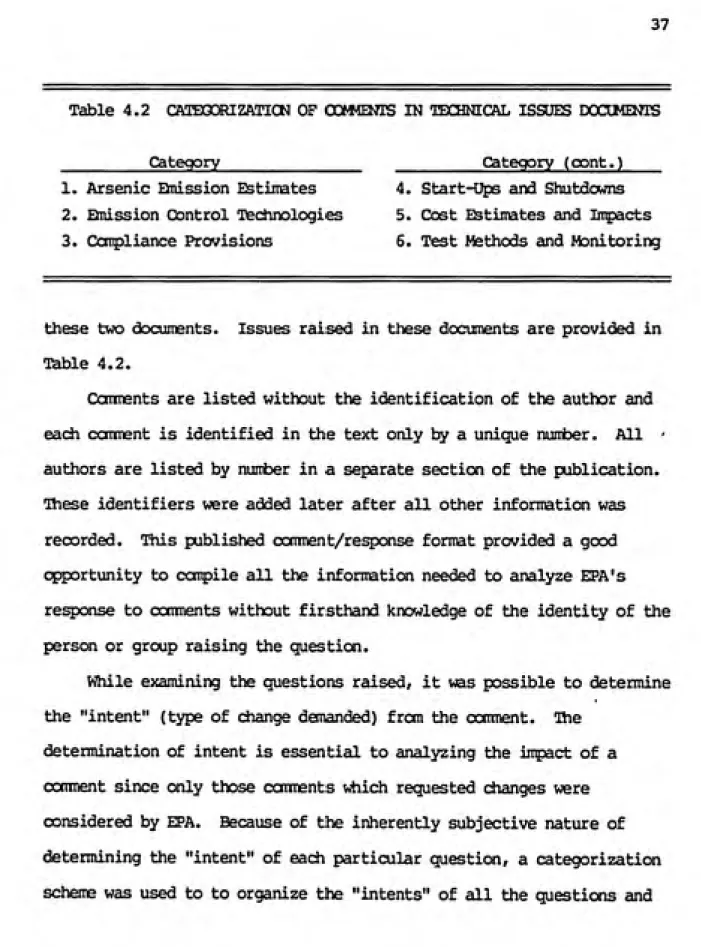
Table 4.2 CftlEQCRIZATICN OF OCMtENTS IN TEX3JNICAL ISSUES DOOWENTS
_________Category______________ Category (oont.) 1. Arsenic Bniission Estimates 4. Start-Ups and Shutdowns 2. Emission Control Technologies 5. Cost Estimates and Impacts
3. Coipliance Provisions 6. Test Methods and Monitoring
these two documents. Issues raised in these documents are provided in
Table 4.2.
Conments are listed without the identification of the author and
each ccinment is identified in the text only by a unique number. All ' authors are listed by number in a separate secticxi of the publication.
Ihese identifiers were added later after all other information was
recorded. This published oomnent/response format provided a good
opportunity to ccnpile all the informatiai needed to analyze EPA's
respaise to conments without firsthand knowledge of the identity of the person or group raising the questiai.
While examining the questions raised, it was possible to determine
the "intent" (type of change demanded) from the ooninent. The
determination of intent is essential to analyzing the iitpact of a
comment since only those conments v*iich requested dhanges were
considered by EPA. Because of the inherently subjective nature of
comments into four mutually exclusive groups. The categorization
scheme used is shown in Table 4.3.
After categorizing the iiiplied intent of each of the 2601
ccmnents, the official EPA response to each oonment was characterized.
EPA respcxided in many different ways to the ocnments, with responses
ranging frcm "EPA disagrees with the canment" to a 12 page
Table 4.3 CATEXXKEZATICN OF INTEbTT OF OONMENTS
Intent
Proposed
Standard is To Strict
Exarrples of Authors' Ccrtiments Exposure threshold exists
Standard is too costly in its present form Standard will cost too many jobs
Arsenic is not a proven carcinogen
Other epidemiological studies are negative
No ejcposure threshold exists
Proposed Standard uses the correct ratio of costs/benefits
Standard Standard will adequately protect the public health
is Good Standard ignores insignificant sources of emissicxis
Actiai is needed to control emissicxis
Proposed
Standard is
Not Enough
Risk estimate used is too low
Standard is overly concerned with cost
Standard will not protect the public health Standard does not consider other pollutants
Other risk factors (i.e. skin cancers) not considered
Not Standard should require cleanup of area soils
J^licable Standard should be set for aittDient air coioentraticais
or Standard should require costs of travel to hearings
39
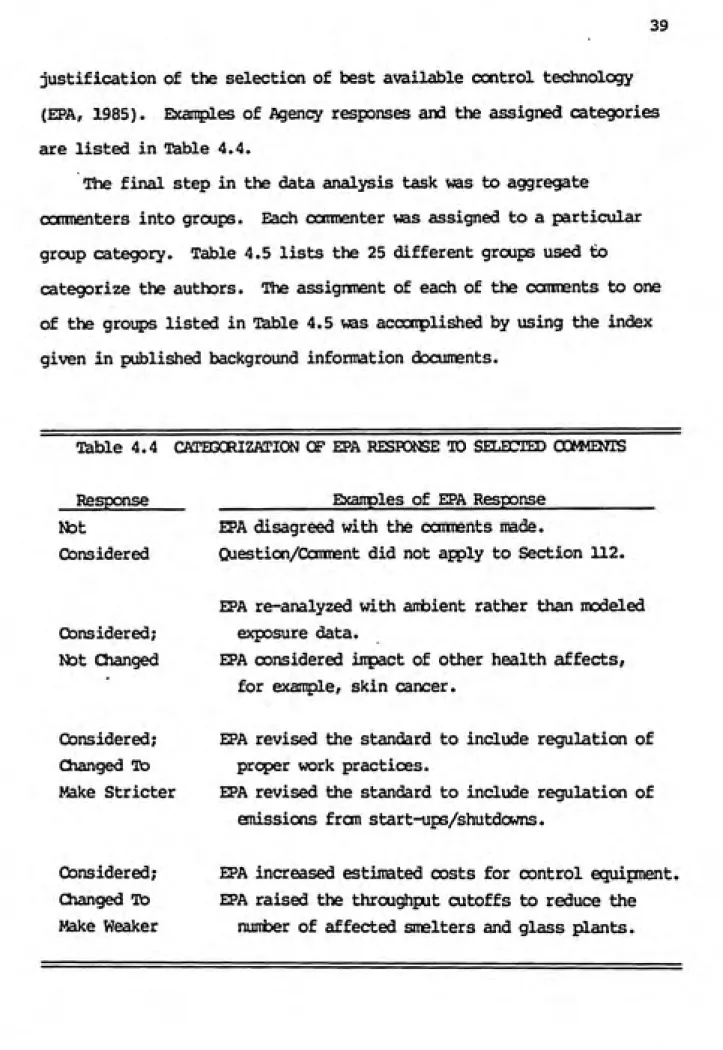
justification of the selecticai of best available control technology
(EPA, 1985). Exanples of Agency responses and the assigned categories
are listed in Table 4.4.
The final step in the data analysis task was to aggregate
ooranenters into groups. Each ooranenter was assigned to a particular
group category. Table 4.5 lists the 25 different groups used to
categorize the authors. The assignment of each of the comments to one
of the groi5)s listed in Table 4.5 was acootrplished by using the index
given in published background information documents.
Table 4.4 CATBGCRIZATIOJ CP EPA RESPC»BE TO SELECTED OCfWENTS
Respcaise
Not
Considered
Exanples of EPA Response
EPA disagreed with the ccranents made.
Questicxi/Ccrament did not apply to Section 112.
Considered;
Not Changed
EPA re-analyzed with ambient rather than modeled
exposure data.
EPA considered inpact of other health affects, for exanple, skin cancer.
Considered;
Changed To
Make Stricter
EPA revised the standard to include regulaticai of
proper work practices.
EPA revised the standard to include regulaticai of
anissions from start-ups/shutdowns.
Considered;
Changed To
Make Weaker
EPA increased estimated costs for control equipnent.
EPA raised the throughput cutoffs to reduce the
Table 4.5 GROCPS PARTICIPATING IN THE ARSENIC STANDARD Group Name Citizens (C) Environmental Groups (E) Subgroup Name Individuals (I) Groups (G) Uaion (U) tRDC (N)
Sierra Club (S)
Greeipeace (G)
Other (0)
Snelters (S) ASAROO (A)
Kennecott (K)
Phelps-Dodge (P)
Nevmont Mining (N)
IN Chemical (T)
Corning (C) Owens-Illinois (0) Miscellaneous (M) Groups (G) Cotton (C) Actual Participants
Glass Mfg (L)
Other
Industry (0)
561 Citizens
Smelter Crisis Education Project
Pierce Co Central Labor Council United Steelworkers of America WA State Labor Council AFL-CIO
Natural Resources Defense Council
Grand Canyon, Cascade Chapters
Greenpeace USA, Greenpeace NW
Friends of the Earth - NW Office Mount Rainier Council
Olio State Clearinghouse
ASAROO, Incorporated
Shea & Gardner
Kennecott, Incorporated
Prather,Seeger,Dooli tie,Farmer
Phelps-Dodge Corporaticn
Consultants in Epid & Occup Health
Evans, Kitchel & Jenckes
Newnoit Mining Corporaticai
Tennessee Chemical Caipany
Corning Glass Works
CX^ens-Illinois, Inc
Ford Motor Caipany
Glass Pacdcaging Institute
Lil*yK)wens-Pord Catpany
Chemical Manufacturer's Association