North
Carolina
Scott
Shuford
The
City of Wilmington,North
Carolina ison
the threshold ofphenomenal
growth. Recent initiatives toexpand
and improve
transportationnetworks
serving thecityareexpectedtoattracta surge ofnew
industry to thearea. Cityplanningofficials, in
an
attemptto ensure thatadequate infrastructureisprovidedtoaccommodate
new
development,are
examining
thefeasibilityof an impactfeesystem. Thisarticlediscusses the guidelinesand
methodologiesthatwere used in designing the cost recovery system.FOREWORD
The
City ofWilmington
haselected to follow theex-ample
ofmost
otherNorth
Carolina citieswhich
have enacted impact feesby
attempting to obtain special en-abling legislation to authorize fee collection.The
City's first effort, in the Fall of 1986,was
postponed
by
local legislatorswho
felt theyneeded
more
informationon
what
the Citywas
proposing in order to introduce this legislation.The
City subsequently preparedtheCost RecoveryFeereport,
which
providestheinformationthelocal legislativedelegation
was
seeking. Cityvoters,on
March
31, 1987,also illustratedtheir
commitment
tofundingneededtrans-portationfacilities
by
approvinga$20millionbond
refer-endum
primarily directedatthoroughfareimprovements.Despite this
example
of public concern regarding theCity's transportation needs,
and
despitehaving received a report detailingtherationaleand
extentofthethorough-fare cost recoveryfees, thelocal legislativedelegationhas
exhibited
some
reluctance to introduce enabling legisla-tion.Concern
has beenexpressed that thefeesaresohighas to discourage
new
development.The
City staff is researching the financial effect that thefeesmay
haveon
new
development
in order to pro-vide a responseto thisconcern.Given
legislativeschedul-ing, it appears that theearliest
any
enablinglegislationcan be introduced will be the latterpart of 1987.
The
Citystaffisalsoresearching the possibility ofusingexisting local authority, such as the subdivision process, for implementing the cost recovery fee system.
INTRODUCTION
The
City ofWilmington,likemany
othercommunitiesacross the country, is faced with an increasing
gap
be-tween
needed
capital facility expendituresand
therev-enues
which
support these facilities as stateand
federalgrant opportunities are
phased
outand
local revenuesources are maximized. Like
many
other communities,Wilmington
is re-examining itsdevelopment
policies in light of these fiscal realities.Because
Wilmington
isundergoinga periodof relativelyrapidgrowth,
much
oftheneedfornew
capitalfacilitiesiscreated
by
new
development.Many
capitalfacilitiesareaffected
by
new
development.These
facilities include: drainage, waterand
sewer,and
streets. Itisonlyfairthatnew
development
shouldabsorb itsshare of the cost ofprovidingthese
new
facilities, sinceit isthisdevelopmentwhich
creates the need for these facilities.The
technique usedby
othercommunities
inNorth
Carolina
and
otherstatestoinsurethatnew
development paysitsportion ofcapitalfacilitycostsisthecostrecoveryfeesystem.Costrecoveryfeesystemsare
known
by
many
othernames;
most
commonly
theyare called"impactfees"or "development fees." Properlyimplemented, a cost
re-coveryfeesystemcollectsa fee
from
anew
development
which
accuratelyreflectsthelevel of servicethatthenew
development
requiresfrom
existing orneeded
capital facilities. This fee is then used toimprove
the capital facilities utilizedby
thenew
development.Some
communities
have established costrecovery feesystemsfor
one
ortwo
capital facilitiesaffectedby
new
development.
Other
communities have chosentoexaminethe entire range of capital facilities affected
by
new
development
and
design acostrecoveryfeesystemwhich
reflects the total capital costs involved in serving this
development.
The
CityofWilmington
haselectedtouse the former approach, concentratingon
drainageand
thoroughfareimprovements.These
two
capital facilitiesrepresent the
most
significantdevelopment-relatedcapital costsWilmington
will face over the next ten to twentyFall, 1987, vol. 13, no. 1 31
Thisreport describes thecostrecoveryfeesystem
pro-posed for Wilmington. It first establishes the rationale
behind thesystem
— why
Wilmington
needsacost recov-eryfeesystem. Legal considerations involvedindesigningand
implementing the system are explored in the nextsection.
A
substantialamount
ofresearchinto othercom-munities' feesystemshasgoneintodesigning Wilmington's
proposedcostrecoveryfeesystem.
The
costrecoveryfeesystem is then
examined
as it affects the City's capital facilities. It isin this section thattheproposed
fee levelsare discussed.
RATIONALE
Costrecoveryfeesystems have evolved
from
thefailure ofotherlocalgovernment
revenuesourcestoadequately providecapital facilities to servenew
development
dur-ing times of rapid growth. Property taxes, the
major
source of revenueforlocalgovernments
inNorth
Caro-lina, are designedtoprovidea stable, long-term revenue
source for public facilities
and
services basedon
thedemand
createdby
properties within the localjurisdic-tion.
Undeveloped
land, quite naturally, pays relatively lesspropertytaxthandevelopedland.When
largequan-tities of undeveloped land are converted into developed
uses, as is the case in rapidly-growing areas like Wil-mington, theincreasedpropertytaxrevenuesareusually
insufficient to cover the large, short-termcapital costsa
local
government
incursinserving thenew
development. Propertytax rates oftenriseas aresult,creatingasituation inwhich
all propertyowners
in acommunity
partiallysubsidize
new
development. Developersmay
also face constructionmoratoriawhen
there areinsufficientfundsto provide capital facilities to serve
new
development.Other
potentialrevenuesources availabletolocalgov-ernmentssuffersimilarshortcomings.
The
generalobliga-tion
bond
provides short-term funds, but requiresthatallproperty
owners
help subsidizenew
development.Specialassessments
and
special service or taxing districts serveto isolate the beneficiaries ofparticular services, but
do
notdistinguishbetweenuseswhich
utilizeexisting capital facilitiesand
thosewhich
necessitatefacility expansion. Cost recovery fee systemsmay
eliminatetwo
of themajor
problems
associated with using localgovernment
revenuestofundcapitalfacilitieswhich
servenew
devel-opment. First, therevenuesareobtainedat orabout the time the facilities will be called
upon
to serve thenew
development; this
may
eliminatetheproblem withobtain-ing
enough
front-endmoney
tofundthefacilities. Second, there isa clear connectionbetween
themonies
receivedand
the services rendered: thosewho
benefit, pay. Thisresolves the equityquestionregarding existing residents partially subsidizing
new
development. Furthermore,developers
who
contributeto the feesystemarethen cor-rectlyperceivedtohavearight totheirshareofthe capital facilitieswhich
serve their projects.The
resolutionoftheequityquestionhasan importantbenefit for developers.
When
they contribute to a costrecoveryfeesystem, they findthat
many
of theoccasion-allyarbitrary
and
typicallyexpensive "developercontribu-tions" required
by
localgovernments
to provide capital facilitiestoservetheirprojects willbeeliminated.A
single fee,which
isalsopaidby
eachof theircompetitors,sub-stitutesfor
many
ofthetime-consumingnegotiationsand
contractswhich
currently complicate thedevelopment
process.Cost recoveryfeesystems are therefore the
most
prac-tical solution to shortfalls in revenues available to local
governmentsfor capitalfacilityprovisionto
new
develop-ment
during periodsofrapidgrowth.Communities which
have experienced rapidgrowth
for an extended period havegenerallyinstituted costrecoveryfeesystems.Com-munities
which
arebeginningtoexperience theeffectsof rapidgrowth
are generally starting to consider costre-coveryfee systems.
Communities which
areexperiencinglow
rates ofgrowth
generally have notfound
the needfor cost recovery fee systems.
The
CityofWilmington
isexperiencing rapidgrowth.Disregardingrecent largeannexations,theCityisexpected
to
grow by
more
thantenpercentbetween 1980and
1990.Takingtheseannexationsintoaccount, theCity'soverall
population
growth between
1980and
1990 could reachalmost
30%
(seeTable1).Given
Wilmington'sfavorableclimate,coastallocation,strong
economy
and impending
interstate
highway
link, thisrapidgrowth
canbeexpectedto continue into the foreseeable future.
TABLE
1CITY
OF
WILMINGTON
1980-1990
POPULATION
PROJECTIONS
City Population with Annexation Areas
A&B
Year "Old" City Population 1980 44,000 1981 44,440
1982 44,884
1983 45,333 1984 45,786 1985 46,244 1986 46,706
1987 47,173
1988 47,645
1989 48,121
1990 48,602
54,356 54,900 55,449
56,003
56,563 57,129
Sources: City ofWilmington Planning
&
Development DepartmentThe
Cityismaking
extensivepreparationstoprogram
and
budget for thisnew
growth.The
1986-91 CapitalImprovement
Program
budget totals $114,830,000and
consists of five categories of improvements:
TransportationFacility
Improvements
$15,550,000Streets
and
Drainage 16,445,000Public Facilities 6,550,000
Water and
Sewer-Rehabilitation 2,710,000Water and
Sewer-New
Facilities 73,575,000Most
ofthefundingfor theseimprovements
isexpectedto
come
from
the issuance ofbonds.A
$25,000,000infra-structure
bond
referendumwas
passedby
Cityresidentsin1985.
A
$16,200,000 transportationfacilitiesreferendum(Recently increasedto$20,000,000
by
actionofCityCoun-cil; this brings the total 1986-91
CIP
to $119,280,000.)isscheduledfor1986-87,
and
an $88,300,000multi-issuereferendum is anticipated for 1989-90.
The
CityCouncil hasalso recentlyadopted changestoitswater
and
sewer policieswhich
providefornew
fees tobe chargedtonew
development.Thesefeesaredesignedtoreflectthecostsincurred
by
theCityinextendingwaterand
sewerlines,making
capitalfacilityimprovements
and
absorbingnew
development
into the City's waterand
wastewater treatment systems.Unlesssimilarfees torecover theothercapital facility costs created
by growth
can be implemented, existingresidentswillbe asked tofoot
most
of the bill for these extensive improvements.While Wilmington
hasenjoyedconsiderable successinpersuading itscitizensto support
much-needed
capital facilityimprovements
and
expan-sions in the past, future reluctance
on
the part of thecitizenstoabsorb
new
development'sshare ofsuchproj-ects
may
be encountered,and
even expected.Failure toreceivecitizen supportfor these
bond
refer-enda
may
result inWilmington
being unable toprovidethe capital facilities necessary to adequately serve
new
development.
Given
the large capitalfacilityexpenditureswhich
are anticipated, it is therefore important for theCityto institute a costrecovery feesystem applicable to
new
development
for financial, equitableand
develop-mental reasons.LEGAL
CONSIDERATIONS
There are certain authorization
and
equityconsidera-tions
which must
be takenintoaccountindesigning acostrecoveryfeesystem
which
canwithstandlegalchallenge.The
first ofthese considerationsiswhether
the Cityhastheauthorityto
impose
costrecoveryfees.While
numer-ouscommunities
have simplyinstitutedcostrecoveryfeesystems
under
theirpolicepower
authority (as ameans
of regulating the negativeeffects ofnew
development),most communities
inNorth
Carolinawhich
have enactedthesefeesrequestedspecial enablinglegislation
from
thestate legislature inorderto resolveall questions regard-ing local authority to
impose
these fees.Wilmington'seffort toreceivesuchlegislativeauthority forstreets
and
drainagefacilities during the1986 "short session"was
postponed.The
local legislators felt theyneeded
further information before actingupon
specialenabling legislation. It is partially in response to this
request for
more
information that this report has been produced.Given
City Council support of both the conceptand
thedesignoftheproposedcostrecoveryfeesystem, itcanbe expected that a
new
request for enabling legislation willbeforwardedtothe legislatureforactionduringthe1987"long session".This reportwill
accompany
thatre-quest as an informational device.
The
secondmain
issuewhich must
be addressedinany
legally-defensible costrecoveryfeesysteminvolves equity considerations. Ifdevelopers orhomebuildersareasked
to contributefees to cover the capitalcosts ofproviding
publicservices to their
developments
or homesites, it isonly reasonablefor
them
toexpect that(1)thefeesrepre-sent an accurate assessment of the actual costs incurred
by
thecityinservingtheirproject,and
that(2)the servicesfor
which
thefeesare contributed are actuallyprovidedby
the city within a reasonable period of timeafter thefees are collected.
This means, first, that an accurate assignment offees
must
be designedinto thecostrecoveryfeesystemby
notonlycorrectlyestimating the actualcapitalcosts involved
inprovidingtheservice, butalso
by
givingpropercredit for other capital costpayments which
can be actuallydetermined or reasonablyanticipated
from
the project inboththepresentorthenearfuture. Forexample, theCity of
Wilmington
hasembarked on
amajor
program
ofimprovements
toitscapital facilitiesthroughthe issuance of bonds. Therefore, reasonably anticipatedbond
pay-ments
forvariouscapitalfacilitiesby
developersorindi-vidual property-owners
must
be taken into account indetermining theappropriatecost recoveryfeefor a
par-ticular project.
Theseequity considerationsalso
mean
thattheCity hasan
obligationtoactuallyprovidethecapitalfacilitiesforwhich
thefeesarecollected.While
certainpublicservicesare generallyprovidedat the timea particular project is
developed,suchaswater
and
sewerservice or policeand
fire protection, it
may
be quitesome
timebefore otherservices, such as parks or roads, are provided. It is
im-portant forall services for
which
cost recovery fees arecollected tobe providedwithin a reasonable periodoftime
Fall, 1987, vol. 13, no. 1 33
What
constitutesa "reasonable" periodoftimedependsgreatly
on
the type of serviceand whether
or not the servicehasbeenprogrammed
intothelocalgovernment's budget process. Regarding the type ofservice, ten yearsmay
be regarded as a reasonable time period inwhich
toprovide a major thoroughfarebut
may
not be regardedasa reasonabletime periodin
which
to provideaneigh-borhood
park.As
toprogramming
the service, if there isapublicly-acknowledgedcommitment
toprovidingtheservice ata particular point in the future, such
commit-ment
greatlydeterminesthetime periodregardedasbeing"reasonable". Therefore,
most
cost recovery fee systemsinclude alink
between
thefeecollectionprocessand
thelocal government's Capital
Improvement
Program.professionalstaff
who
willbecalledupon
toimple-ment
the systemand
whose
operations will beaffected by the system.
5.
The
cost recovery fee system should result in the long-term provision of servicestothedevelopment(s)from which
the fees are collected throughseparateservice-specific capital
improvement
reserve fundslinked toWilmington's Capital
Improvements
Pro-gram.6.
The
costrecoveryfeesystem should beunderstand-able, as well as inexpensive to apply.
7.
The
cost recovery fee system should be subject toperiodic revision as conditions
change
(e.g., inflation).COST
RECOVERY
FEE
SYSTEM
This section of the report describes the City of
Wil-mington
Cost RecoveryFeeSystem. Thisdescriptionin-cludesthesystem'sgeneral design, thefeecalculationsfor the capital services identified asbeingeligibleforinclusion
in the fee system,
and
the fee schedulewhich
lists the applicable fees for each land use type.General Fee System Design.
The
followingdiscussionsummarizes boththe general design of theproposed City
of
Wilmington
CostRecoveryFeeSystemand
theprocessby
which
thesystem isusedtocalculatethefees forpar-ticular
development
projects.Prior to final design of the feesystem, certain general guidelinesforthe system'sdevelopment weredetermined,
based
upon
theresearcheffortsdescribedintheprecedingsection. Theseguidelineswere used toproduce the
Wil-mington
system.General Guidelines For Cost Recovery Fee
System
Development
1.
The
costrecoveryfeesystemshouldconcentrateon
themore
pressingcityfacilityneeds. Allgrowth
re-lated capital costs for theseneedsshouldbeincluded.2.
The
cost recoveryfeesystem shouldresult ina fairand
accurateaccountingofcosts,using currentcosts toestimatefeesand
excluding operatingand
main-tenance costs
and
capitalimprovements
notrelated tonew
development.3.
The
costrecoveryfeesystem should"credit"new
de-velopmentfor: (a)Existingandreasonably-anticipated
bond
indebtednessrelatingtoprojects forwhich
feesare paid (to avoid the issue of "double taxation");
and
(b)Pre-existingdeficienciesinand
depreciationof cityfacilities
which
might becorrectedwith fundscollected
from
cost recovery fees.4.
The
costrecoveryfeesystemshouldbe designedby
THE
OVERALL
OBJECTIVE
OF
THE
WILMINGTON
COST RECOVERY
FEE
SYSTEM
ISTO
ACCURATELY
IDENTIFY
AND
EFFECTIVELY
RECOVER
GROWTH-RELATED
CAPITAL COSTS.
Once
theseguidelineswereidentified,eachaffectedCityDepartment
was examined
to identify capital facilitiesaffected
by
new
development. After considerable study,it
was
determined thatthefollowingmajor
service cate-goriescontainedidentifiablegrowth-relatedcapitalfacility costs: drainage, thoroughfares,and
waterand
sewerservices.
Among
these identified services, growth-related costrecovery fees for water
and
sewer facilities have beencalculated
and
addressed separatelyfrom
this report.Thereare
two
primaryreasonsforseparateconsideration ofwaterand
sewercapitalfacilities. First, statestatutory authority currentlyexistsforWilmington
to initiatewaterand
sewercapital facility cost recoveryefforts.The
sec-ond
reason isthat thereareseveral short-termproblems
with the city'swaterand
sewerfacilitieswhich
demand
expedient action.
Severalotherservice categorieshavealsobeen excluded fromcostrecovery consideration, butfor different reasons
thanthewater
and
sewerfacilities.The
PoliceDepartment
anticipatesno major
capitalexpenditures fornew
build-ingsfortheforeseeablefuture: expensesrelatedtovehicle purchase,manpower,
uniformsand
equipment,etcwere
generallyregardedtobeoperatingand
maintenancecosts, asopposed
tocapitalcosts.The
FireDepartment
hasmade
recent
improvements which
will provide adequatere-sponse timetoallareas ofthe cityfor
some
timeto come.The
citygolfcourse operatesina self-supportingman-ner through userfees; although
new
development
doesplace increased
demands
on
theexisting facilities, suchdemand
is difficult tomeasure
and
there areno
Improvements
to parksand
recreation facilities will be soughtthroughdifferentmeans.Other
service categorieswhich
areprimarily affectedby
new
growth
throughin-creased
demand
for additional personnelwere
also excluded.Once
identificationof theparticular service categoriesto
which
thecostrecoveryfeesystem istobeappliedwas
accomplished, attentionwas
directed at measuring the growth-relatedcostswhich
affecttheseservice categories.Operating
and
maintenancecostsand
othercapitalfacilityimprovement
costsnot relatedtogrowth were
excluded.These costs are discussed in the following section.
It should be noted that the following discussion of
drainagecost recoveryfeesis intendedsolely toserve as
an
example
ofhow
such fees are to be calculatedand
implemented.More
data has to be obtained for each drainage basinand
sub-basin prior toactual feecalcula-tion
and
implementation.On
theotherhand, discussion ofthoroughfarecostrecoveryfeespresents acompletefeeanalysis
and
calculation, ready for implementation. Drainage.The
citizensofWilmington
voicedtheir sup-port for a $7.6 millionbond
referendum for drainageimprovements
intheSpringof1986.Some
of themoney
approved
throughthisreferendumwillbeusedto installdrainagefacilities in the Burnt Mill
Creek
watershed tosolveoneofthe City's
most
importantdrainageproblems.A
portionof theBurntMillCreek
watershedimprove-ment
project has been utilized to calculate the costre-covery fees associated with the City's drainage facility
needs. This section of thewatershed represents a fairly typical watershed within the City with regard to both
existing
and proposed
drainage facilities. Considerable studyofitsdrainage needs hasbeen recentlyundertakenby
the Planning staff. This hasled to athorough
famil-iaritywiththeexisting
and
requireddrainagefacilitiesin this area.Thisis theonlyarea of
Wilmington
inwhich
such ananalysis hasbeen performed. Consequently, the follow-ingfee calculation exercise is undertaken to serve as an
example
ofhow
similarcalculationscanbeperformedforotherareas of thecity
when
thorough
analyses of drain-ageneedsareprepared. Untilsuchanalyses are prepared,no
drainage cost recovery fees can be calculated orimposed.
The
fee calculation process involved firstdeterminingtheexisting"regional"drainagefacilities
which
have beeninstalled in the past; these are facilities
which were
de-signed withmore
than site-specific drainage needs inmind.
Once
thesefacilitieswere
identified, theircurrent valuewas
determined, basedupon
estimates ofwhat
itwould
cost to install these facilities today. Their totalcurrent value hasbeen estimated at $1,843,000.
The
nextstep incalculatingdrainagecost recoveryfeesrequireddeterminingthe
major improvements which
areneeded to bring the watershed area drainage system
up
tocity standards (10 year, 24
hour
storm event). These improvements,and
their current value, are describedbelow.
Calculatingimprovementcosts.
Required Drainage Facilities for a Portion of
The
Burnt MillCreek Watershed
Required Facilities
Pipe
Manholes
Ditches (w/rip-rap)
Creek
Bank
Improvements
Pond
Improvements
Total
Current Value
$2,284,000 179,000 581,000
1,572,000
1,648,000
$6,264,000
Becausefeespaid
by
new
development
will be fundingnew
drainagefacilities,new
development
should notbeliable forexpendituresto correct the depreciation of the
existing facilities.
Any
bond
indebtedness incurred toprovide facilities in the past, or that canbe reasonably
anticipated in the future,
must
also be credited tonew
development
to avoid doubletaxation. Consequently, a"credit"
must
be given for both depreciationand
bond
indebtedness.
The
methodology
utilizedindeterminingthiscreditwas
developed for the City of Raleighby
Drs. Michael A.Stegman and
Thomas
P. SnyderoftheDepartment
of Cityand
Regional Planningat theUniversity ofNorth
Fall, 1987. vol. 13, no. 1 35
The
depreciation portion of the credit is determinedthrough the use of Table 2, a depreciation table
which
assumes atwo
percent real interest rate (that is, interestabove the rate of inflation) for various replacement life
cycles
and growth
rates.TABLE
2DEPRECIATION
TABLE
FOR
A
TWO
PERCENT
REAL
INTEREST
RATE
growth rate
replacement cycle (percent) orfacility life
(years) 0.5 1.0 1.5 2.0 2.5 3.0
3 0.494 0.493 0.491 0.490 0.489 0.488 5 0.490 0.488 0.485 0.483 0.481 0.479 8 0.483 0.480 0.477 0.473 0.470 0.467
10 0.479 0.475 0.471 0.467 0.463 0.458 12 0.475 0.470 0.465 0.460 0.455 0.450
15 0.469 0.463 0.456 0.450 0.444 0.438 18 0.463 0.455 0.448 0.440 0.433 0.426
20 0.458 0.450 0.442 0.434 0.426 0.417 25 0.448 0.438 0.428 0.417 0.407 0.397
30 0.438 0.426 0.413 0.401 0.389 0.377 35 0.428 0.413 0.399 0.385 0.371 0.358
40 0.418 0.401 0.385 0.369 0.354 0.339
45 0.480 0.389 0.371 0.354 0.337 0.320
50 0.398 0.378 0.358 0.339 0.320 0.302
60 0.378 0.354 0.331 0.309 0.288 0.268
70 0.359 0.332 0.306 0.281 0.258 0.236
80 0.340 0.310 0.281 0.254 0.229 0.207 90 0.322 0.289 0.258 0.229 0.203 0.180
100 0.305 0.269 0.236 0.206 0.179 0.156 Source: "EstablishingFacilityFeesinRaleigh: Issuesand Alter-natives";Michael A. Stegman and
Thomas
P. Snyder;DepartmentofCityandRegional Planning; University ofNorth Carolina atChapel Hill; July1, 1986;p. 47.
credit estimate
must
then be apportionedamong
thevariousland usetypes accordingto theirassessed value.
Note: It will be necessary to
modify
thebond
creditcalculated herein to reflect estimatedfee collec-tions
which
willbeappliedto reduce the overallbond
debt. Seethefollowingsectiononthorough-fare cost recovery fees
which
shows
how
thismodification is performed.
Such
modificationcannot occur without performingcarefulgrowth
projections foreachdrainagebasin,
work
which
has not yet been done.Because drainagecostrecoveryfees willbeassessed
on
an acreage basis, it is necessary to convert thecredit toan acreage basisinordertosimplifyfee calculation. This
was done by
first determining the percent of total Cityassessed value foreach landuse type
and
thetotalnum-ber of acres of the City'slandarea
which
are devoted toeachland usetype.
The
assessedvaluedatawas
generatedfrom informationreceived
from
theNew
Hanover County
TaxAdministrator'sOffice, whiletheacreageinformationwas
derivedfrom
arecent(October, 1985) land usesurvey by the Planningand
Development Department
staff.Multiplyingthe totalcreditestimate of$10.66million
by
the percent of total Cityassessed value of each landuse,
and
then dividing that figureby
the totalnumber
ofacresdevotedto thatlanduse,generatestheappropriatecreditperacre.Thiscalculationprocess is
shown
below.Residential:
$10.66 million x
49.8%
-4-5,471 acres= $970/acreCommercial
/Office&
Institutional:$10.66 million x
45.1%
-=-2,612 acres=$1,840
/acreIndustrial:
$10.66 million x
4.9%
-4-1,264 acres=$413/acreDrainagefacilities are
assumed
to havebeen providedat a rate similar to the City's
growth
over the life spanof the facilities,
which
is estimated at fifty years.Over
that period, the City'saverageannual
growth
ratehasbeen 1.5%. Therefore, the appropriate depreciation factor is0.358. Thisfactor,
when
multipliedby
thecurrent value of the existing regionaldrainage facilities (from above),resultsinafacilitydepreciation estimate ofapproximately $660,000 (0.358 x $1,843,000).
Total current
bond
indebtedness for the City withregard to drainage facilities is$2.4 million. There is
an
additional approved
bond
debtof$7.6 millionwhich
must
also beincluded incredit calculation, bringing the total
bond
indebtedness to $10 million.Adding
thedeprecia-tion estimate to the $10 million in
bond
indebtednessresultsinanoverall creditestimateof$10.66million.This
The
final step indeterminingthedrainagefacilitycostrecoveryfeeistocalculatethegrosscostper acrefor
need-ed drainagefacilitiesforeach typeoflanduse
and
tosub-tractthe credit
from
thatcost toproducethe costrecoveryfee peracre. This
was done by
determining the relativerunoffratefora
number
oflanduse typesand
proratingthetotalcostofallneededdrainagefacility
improvements
accordingtothe relativeimpactofeach landuse type
on
thesystem.The
basisfortherelativedifferencesbetween
land use types are runoff coefficients (measures of theamount
of runoff land uses produce—
calculatedby
theCity Engineering Department).
The
credit is thensub-tracted
from
thatgrossfiguretogenerate theacreagefee.Funds
collectedfrom
drainagecost recovery fees willbeplacedintoseparatecapital
improvement
reservefunds, segregatedby
drainagebasins.Only
fundscollectedfrom
each drainage basin can be spenton
drainageimprove-ments
for that basin.TABLE
3DRAINAGE
COST RECOVERY
FEESLand Use Type
Runoff Coefficient
Gross Cost PerAcre
Credit PerAcre
Cost Recovery
FeePer Acre Residential
LowDensity* 1.37 $2,367 $ 970 $1,397
Medium Density**
HighDensity***
1.88 2.25
3,262 3,897
970 970
2,292 2,927
Commercial
Office
&
3.19 5,528 1,840 3,688
Institutional
Industrial
2.25 3,897 1,840 2,057
Light Manufacturing
Heavy Manufacturing 2.74 3.00
4,735 5,188
413 413
4,322 4,775
*<5 units/acre
**>5 units/acre but < 17.4 units/acre ***>17.4 units/acre
Thoroughfares.
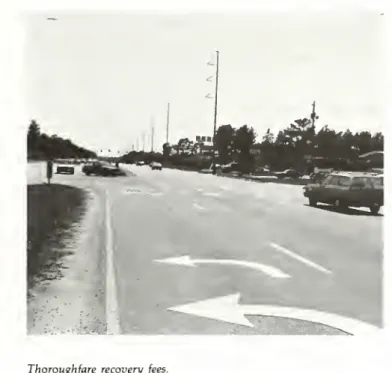
As
identifiedby
residentsand
officials,the solutiontoWilmington'stransportationproblems
con-stitutes thehighestcapital
improvement
priorityoverthe next few years. In order to provide thefunds necessarytohelp solve theseproblems, theCitystaffhasdeveloped,
and
theCityCouncil hasapproved,a transportationbond
proposal
which
willbetaken beforeresidents forapprovalintheSpringof1987.
The
entirebond
packagetotals$20million.
Of
thisamount,
$16,821,000 is slated forthoroughfare improvements.
These
thoroughfare im-provementsaredescribedinTable4below. (Notethatthecostsforutilitieshave beendeleted
from
theS.17th StreetExtension, University Parkway, 41st Street/ Holly Tree
Road
Extensionand
Independence Blvd. Extensionpro-jects toavoiddouble-countingthoseutilityprojectstobe funded
by
waterand
sewer facility fees.Where
utilityrelocation is
an
integral part oftheproposed
thorough-fare project, such as theKerr
Avenue
widening
project,the utility costs have been retained.)
Each
of these thoroughfareimprovements
is a com-ponentof theWilmington
Urban Area
Thoroughfare Plan (adopted 1986).While
there areotherthoroughfare im-provementprojectson
theThoroughfarePlan, the selectedprojects are those of highest prioritywithinWilmington. Thesesixprojectsalso constitutetheprobableupperlimit
ofWilmington'sfinancial abilitytoaddressits
thorough-fare
improvement
needs overthenexttenyears(thetimeperiod in
which
theseimprovements
areprogrammed
tooccur
and
forwhich
this thoroughfarecost recoveryfeesystem is designed).
These thoroughfare improvements, sincetheyarebased
on
a locally-adoptedand
state-approvedThoroughfare
Plan,would
eventually be constructedby
the N.C. De-partmentofTransportationbasedon
theprojects' priorityranking as
compared
withotherlocalThoroughfare
Planimprovements
acrossNorth
Carolina.One
optionavail-able to the City of
Wilmington
therefore is to patientlyawait state funding for these roadways.
Becausethelikelihoodofsuchfundingfor
most
of theseprojectsisvirtuallynonexistentovertheshort-term (0-10
years),
Wilmington
has opted topursuelocalimplemen-tationofa portion of theThoroughfare Plan
by
construc-ting five of the six
Thoroughfare
projects entirely withlocal funds
and by
purchasing portions of theright-of-way
forSmith Creek
Parkway
tomove
thatproject intoa higher priorityrankingfor eventualstateconstruction.
The
reasonforthislocalactioncanbetracedtotherapidgrowth
experiencedby
theWilmington
areasincethe early1980's.
When
theCityand
New
Hanover
County
updatedthearea'sCoastal
Area
Management
Act(CAMA)
Land
Use
Plan in 1981, transportationwas
not regarded as amajor
issue;by
thetime of the1986 update to theLand
Use
Plan, transportationwas
regarded as theprimary
local planning issue.
The
Wilmington
thoroughfare system iscurrentlyap-proaching its capacity to handle traffic in several city areas.
However,
ifnew
development were
to completelycease,
Wilmington
would
beabletowaitfor statefundingfor its
Thoroughfare
Plan withminimal
or negligible capacityproblems. Therefore, theprimary reasonforthedecision to pursue local funding of these thoroughfare
improvement
projects is toaccommodate
the impact ofnew
development on
thelocal thoroughfaresystem. Itisthereforereasonabletoexpectthisdevelopmentto
assume
itsfair share of the costs ofproviding these transporta-tion facilities.
The
proposed thoroughfare improvementsare relativelyevenly distributed acrossWilmington. Thisdistribution
pattern, alongwith the generally similar cost estimates
for each of the
proposed
improvements, results in theability to consider theentire cityas a single zone inthe
imposition ofthoroughfarecostrecoveryfees. This
con-trastswiththedrainagecostrecoveryfeesystemin
which
costswereexpectedtovarysignificantlyforeachdrainage
basin.
The
small size ofWilmington
also supports this single zone concept.While
several of thecommunities
studied have used separate zonesfor thoroughfare fees,each zonetypically exceeds the size of the City of
Wil-mington
inareaand
population(theCityofRaleigh, forFall, 1987, vol. 13, no. 1 37
Project
Smith Creek
Pkwy.
S. 17th St. Ext.
Kerr Ave.
University
Pkwy.
41st St./Holly
Tree
Road
Independence Blvd.
TABLE
4PROPOSED
THOROUGHFARE
IMPROVEMENTS
Roadway
CurrentLength City Cost
Description of Project
From
To (miles) EstimateRight-of-way acqui-
Eastwood
Rd.NE
Cape
Fear 7.7 $ 2,000,000sition for future con- Bridge
&
N. Frontstruction of 4 lane St. (Dntn. Spur) divided expressway
Design
&
R/W
for 4 800' S. of 2500'W.
of 2.5 2,900,000lane roadway, con- Shipyard Blvd College Rd.
struct 2 lanes
Design
&
R/W
(90'),Market
St. Wrightsville Ave. 2.0 4,253,000&
construct 5 laneroadway
w/relocatedand
installedW
&
Sutilities
Design
&
R/W
for 4 Wrightsville College Rd. 1.6 1,800,000lane roadway, con- Ave.
@
Mercerstruct 2 lanes Ave. Design
R/W
(60'where
practicable),and
construct 3 lane(36')
roadway
Design
&
R/W
(100') for 4 lane roadway,construct 2 lanes
Oleander
Dr.* PineGrove
Dr.*ShipyardBlvd. Carolina
Beach
Rd.1.8
1.9
17.5
2,118,000
3,750,000
$16,821,000
*Asection of thiscorridorbetween300'S. ofLake Ave. andShipyardBlvd. willbeconstructedby a privatedeveloperandisnot included in bondissue.
system;eachzone
was
significantlylargerthan Wilming-ton in both populationand
land area.)The
City'sthoroughfareimprovements,which
arepro-jected tobepartiallyfinancedwithcostrecoveryfees,will
beconstructedwith funds obtained
from
the issuanceofbonds, as indicated previously.
The
cost recovery feesobtained in
any
given year will be applied to thebond
payment(s) scheduledfor that year, thusreducingthe
con-tribution to
bond
repayment
made
by
general propertytax revenue
by
theamount
of the collected fees.It will not be feasible to utilize thoroughfare cost recoveryfeestocoverthe entirethoroughfare
bond
repay-ments for
two
reasons. First, the fee system isdesignedto initiallyrecovercostsassociatedwiththat
new
develop-ment which
occursoveratenyearperiod.The
proposed
thoroughfareswillbedesignedtoprovidetraffichandlingcapacity in excess of this ten year period. This excess capacity
beyond
theinitialperiodwillbepaidforby
costrecoveryfeescollected
from
thelaterdevelopment which
consumes
that capacity, notby
developmentoccurringatthe present time. This
means
that although the costre-covery fee system is designed to recover the entire cost ofthethoroughfareprojects
which
are attributabletonew
development, the cost recovery process will occur over
the entire effective life of the projects (i.e., until the Level-of-Service "D" capacity is reached), not just the
initial ten yearperiod.
Second, costrecoveryfeegenerationisdependent
upon
the occurrence of
new
development.New
development
does not occur at aconstant rate; therefore, the Cityisforcedtoreinforceitsfeecollectionswiththe
much
more
stableand
predictablerevenuesderivedfrom
localWith
theexception of dividing thecity into zones, themethod
usedincalculatingthethoroughfarecostrecoveryfeesissimilartothat utilizedforthedrainagecostrecovery
fees. First, the grosscostsattributedtoeach typeofland
use are calculatedbased
upon
theproportionalimpacton
thethoroughfaresby
each landuse type. Second, theap-plicable creditfor
bonded
indebtedness (both currentand
anticipated)and
pre-existingthoroughfarecapacity defi-ciencies is calculated. This credit is modified accordingto the anticipated contributions of thecost recoveryfee
systemin retiring the
bond
debt. Third, the net cost foreach typeofland usein eachzone iscalculated
by
sub-tracting thegrosscost figure
from
theapplicable(modi-fied) credit. Finally, the cost recovery fee is determined
by
multiplying the net costby
the relative distance oftravel foreach land use type. This process is described
in greater detail below.
As
indicated above, the first step in the thoroughfarecost recovery feecalculation process involvesproducing anaccurateestimate of thethoroughfarecosts
which
can beassociatedwith varioustypes ofnew
development
ex-pectedtooccur overthenext ten years.
The
NCDOT
has prepared estimates ofnew
vehicle tripswhich
can beexpectedthroughtheyear2005forWilmington. This
esti-mate
isperformed
aspart of thestatethoroughfareplan-ning process,
and
provides an accurate estimate of theamount
ofimpactnew
developmentwillhaveon
thelocalroadway
network.Becausethe
NCDOT
figuresreferredto intheparagraphabove
arebasedon
theWilmington urban
area,an
areasomewhat
largerthan theWilmington
city limits, acor-rection factor
must
be introduced to adjust for the sizedifference
between
thestatedata baseand
thecitylimits.Thisfactorhasbeen determined based
on
the differencein totalhousingunitsbetween the
Wilmington
urbanareaand
theWilmington
citylimitsforeachof the threestudyperiods(1982, 1990
and
2005).The
adjustmentfactorhas beencomputed
as0.57 forthe periodbetween
1982and
1990and
as0.54 for theperiodbetween
1990and
2005.These
factors are usedincomputing
the 1987and
1997trips in the following paragraphs.
Inordertocalculatethetotalcost forthoroughfare
im-provements
attributable tonew
development
occurringover the nextten years, thefollowingequationisutilized:
1997 traffic
volume
-1987
trafficvolume
Added
capacityfrom
proposedimprovements
The
above
equationisfrom
the previously-citedpub-lication, Payingfor
Growth:
UsingDevelopment
FeestoFinanceInfrastructure
by
Thomas
P. Snyderand
Michael A.Stegman
oftheDepartment
ofCityand
RegionalPlan-ning at theUniversity of
North
Carolina atChapel
Hill(ULI; 1986; p. 115). Itproducesa
measure
of thepropor-tion of the total costs of thoroughfare
improvements
which
shouldbe appliedtonew
development
occurringover the ten year period.
For the
Wilmington
cost recoveryfeesystem, theequa-tion is:
262,065-218,995 =0.38
113,300*)*Note: See Table 5 for source of this figure.
This figure (0.38) is then multiplied
by
the total costof the thoroughfare improvements, less
any
portion ofthe
improvements
designedtocorrect existing deficiencies(some
$790,000 of the KerrAvenue
project is used to correct existingcapacitydeficiencies)and
toaccommodate
throughtraffic(estimatedat10%
for thecityarea).This provides the total cost of theproposed
thoroughfareimprovements
towardwhich
cost recoveryfeesshould bedirected.
The
applicablecostfor theCityofWilmington
is therefore $5.48 million (0.38
X
$16,038,000X
.9).TABLE
5PROPOSED IMPROVEMENTS
AND
THEIR CAPACITIES
'Average Daily Traffic (ADT) capacity based on proposed
number
of lanes, Level of Service "D".**Peakhour tripsestimated at
10%
ofADT
capacity (fromWilmington Transportation Study: Technical Report 2;
NCDOT;
p. 16). Figureshown
istotal peakhour capacity, not 10 year peak hour estimates.**KerrAvenueiscurrentlyatwolanefacilityserving
approx-imately 17,000vehiclesper day;proposedimprovementswill increasecapacity to31,100vehiclesper day; improvement
costsreflectdeletion of costsneededtoimproveexisting
ADT
capacity to Level of Service"D".This $5.48million figure
must
thenbeallocatedtothedevelopment
anticipatedto occur over thenext 10yearsaccording to that development's relative impact
on
theProposed
ADT
Capacity of No. ofPeak City CostofImprovement Improvement* Hour Trips** Improvement Smith Creek
Parkway 44,000 4,400 $2,000,000
S. 17th St.
Extension 13,800 1,380 2,900,000
KerrAve.*** 14,100(net) l,410(net) 3,470,000 University
Parkway 13,800 1,380 1,800,000
41st St./Holly
TreeRd. 13,800 1,380 2,118,000
Independence Blvd. 13,800 1,380 3,750,000
Fall, 1987, vol. 13, no.1 30
thoroughfare system.
The
unit ofmeasure
selected for determiningthisrelativeimpactisthepeak hourtrip.The
peak
hour
trip isameasure
oftheamount
oftraffic gen-eratedby
various landusesat the highest (orpeak)hour
oftrafficgeneration.
The
Instituteof TrafficEngineers pro-videsstandardestimatesforpeak hourtripgenerationfora
wide
variety of land uses.For Wilmington,
peak hour
traffic is estimated to be10%
ofaveragedailytraffic(Wilmington Transportation Study: TechnicalReport 2-NC
DOT;
1986; p. 16).The
localgrosscostperpeak
hour
tripisthereforedetermined bymultiplyingtheaverage dailytrafficgeneratedby
new
development (previously estimated as 43,070 trips)
by
10%, and
then dividing thetotalthoroughfarecost appli-cabletonew
development ($5.48million)by
theestimatednumber
ofpeak hour
trips(4,307). This providesagrosscost per
peak hour
trip of $1,270.The
gross costmust
be further modified to reflectaverage
median
triplengths anticipatedfor different landuses. This provides a further refinement of the relative
impactcreated(andrelativebenefitreceived)
by
differentlanduses.Locally-derivedaverage triplengths
were
usedtoprovide thismodification (Wilmington Transportation Study: TechnicalReport1;
NCDOT;
1985; p. 17).These
average figureswere
translated into relative termsby
dividingthetriplengthsforall nonresidential usesby
theresidentialtriplength. This provides arelativecomparison
which
isshown
in Table 6.TABLE
6AVERAGE
TRIP
LENGTHS
AND
RELATIVE
COMPARISON TO
RESIDENTIAL USE
Average Length Relative
Land use (Minutes) Comparision
Residential 6.66 1.00
Commercial
Retail 6.54 0.98
Other 6.54 0.98
Office
&
Institutional 6.84 1.03Industrial 6.84 1.03
The
relativecomparison
factor is then utilized incal-culating the thoroughfare cost recovery fees.
The
nextstep inthefee calculationprocess istodeter-mine the credit
which
should be applied to the gross thoroughfarefeecalculatedabove. Thiscreditisameasureof three things: (a)
The
pre-existingcapacityproblemson
thecity'sthoroughfares; (b)depreciated city-maintained thoroughfares;
and
(c) the city'sbonded
indebtedness(existing
and
reasonablyanticipated) relatingtothorough-fareimprovements.
Use
of the creditisneeded
toavoid:(a)
new
development payingfeestocorrect existingdefi-ciencies (both
roadway
capacitydeficienciesand
depreci-ated);
and
(b)new
development payingmore
thanitsfairshare
by
havingtopay
forboththecostrecoveryfeeand
a portion of the debtrepayment
coming from
propertytaxes (thus creating a situation of "double taxation").
The
creditmust
be modifiedtoinclude the anticipated contributions ofnew
developmentintheform
of collected cost recovery fees, since these contributionswill be ap-plied to retiring the thoroughfarebond
debt. Sincenew
development
isexpectedtogenerateapproximately$5.48 millionin thoroughfarecosts overthe next10years,and
since the cost recovery fee system is intended to collect100%
of thesecosts, the creditmust
beadjusteddown-ward by
theamount
of$5.48million. Similarly, fee col-lectionsestimatedfortheremaining 10years($4.3 million)must
alsobe subtractedfrom
thecredit.The
total creditadjustment is $9.78 million,
which
represents theesti-mated
fee collections over the life of the thoroughfare bond.Pre-existing capacity deficiencies, not otherwise
ac-countedfor(i.e.,Kerr Avenue), exist atonlyonelocation,
the intersectionof S. College
Road
and Oleander
Drive. Intersectionimprovements
at thislocation are estimatedtocost$2million, withtheCity'sshareof thisState
con-struction project being
30%,
or $600,000.The
city-maintainedthoroughfaredepreciationisesti-mated
using the depreciation table referred to in thedrainage fee section (see Table 2).
The
city EngineeringDepartment
hasestimated thecostof resurfacingallcity-maintained thoroughfares at approximately $730,000.
Utilizing a depreciation factor of 0.463 (from Table 2),
the applicable depreciation credit is$340,000 ($730,000
X
0.463).The
thoroughfarebond
is$16.82million,from which
$9.78millionmust
besubtractedtoaccountfor thatpor-tion ofthe
bond
retirementtobepaidforby
costrecoveryfees.This providesthe
bond
portionof thecredit,which
amounts
to $7.04 million.The
total creditistherefore$7.98 million ($600,000+$340,000+$7.04
million),which
isdividedby
the currenttaxbase ($1,612million) toproducethe taxratenecessary
to retirea debtofthisamount. Thisrate(0.0050) isutilized to determine an averagecreditused to
modify
thegrossfee calculated above.
The
average credit isestimated at$350, representing an assessed valuation for residential
uses of approximately $70,000 perunit
and
fornonres-idential uses of approximately $70 per square foot.
Table 7 brings together the differentfactorsdiscussed
inthe
above
paragraphs.Peak hour
trips areshown
fordifferentlanduses in thistable. Also
shown
are netcostTABLE
7PEAK
HOUR
TRIP
GENERATION
AND
COST RECOVERY
FEE
CALCULATION
Land Use
Residential Single Family Multifamily
Mobile
Homes
Commercial
Auto
DealershipBank
Convenience Store
Fast
Food
RestaurantGrocery
StoreRestaurant
Shopping
Center/Retail (Small)***
Shopping
Center/Retail (Large)*** Office
&
InstitutionalGovernment
Bldg. OfficeIndustrial Industrial Park
Manufacturing
Mini-warehouse
Truck TerminalWarehouse
Ph
Trips*Net
Cost**(All figures per residential unit)
0.5
$460
0.3 275
0.3 275
(All figures per 1,000 gross square feet)
2.3 $ 1,058
8.4 3,864
23.4 10,764
15.8 4.4 5.2
3.0
1.6
7,268
2,024 2,392
1,380
736
(All figures per 1,000 gross square feet)
3.0/1000
GSF
$ 2,7601.0/1000
GSF
920(All figures per 1,000 gross square feet)
0.5 $ 460
0.4 368
0.1 92
0.4 368
0.8 736
Trip Length
Factor
1.00 1.00 1.00
0.98 0.98 0.98
0.98 0.98 0.98
0.98
0.98
1.03 1.03
1.03 1.03 1.03 1.03 1.03
CRFee
$ 460 275 275
$ 1,035 3,785
10,550
7,125 1,985
2,345
1,350
720
$ 2,845 950
$ 475 380 95 380 760
*P.M. PeakTraffic/ITE estimate
*
'Includesaverage credit. Note: Forcommercial uses, a diversion factor of0.5 isapplied in calculating the net cost in order to adjust for thetraffic alreadyontheroadwayswhichfrequentscommercialestablishments. Thisfactor approximatesthe diver-sion factorutilized bythe Cityof Raleigh (0.49). (SeePayingforGrowth: UsingDevelopmentFees to FinanceInfrastructure;
Thomas
P. Snyder andMichael A. Stegman; Urban Land Institute; p. 116.)*
'ShoppingCenter/Retail (Small)refers toestablishmentsunder 500,000 squarefeetinsize; ShoppingCenter/Retail (Large)refers toestablishments of 500,000 square feetor larger in size.
use(Px); (b) gross cost per
peak hour
trip ($1,270);and
(c) average credit ($350).
The
formula used to calculatethe net cost is
shown
below.Net
Cost=
(Px)X
(Gross Cost - Average Credit)or
Net
Cost=
(Px)X
($l,270-$350)or
Net Cost=(Px)
X
$920
The
net costisthenmultipliedby
thetriplength factortodeterminetheapplicablecostrecoveryfeeforeach land
use
shown.
Peak
hour
trip generation rates for severalother land uses are
shown
in Table 8.Fall, 1987, vol. 13,no. 1 41
TABLE
8PEAK
HOUR
TRIPS
FOR
OTHER
SELECTED
LAND
USES
Trip Length Land Use
Peak
Hour
Trips FactorCommercial*
Car
Wash
55/site 0.98Golf Course 0.2/parking space 0.98 Hotel/Motel
0.4/room
0.98Marina
0.1/berth 0.98Movie
Theater 0.1 /seat 0.98 Service Station 12.5/site 0.98 Office&
InstitutionalDay
School 0.1/pupil 1.03Elementary School 0.1/pupil 1.03
High
School 0.2/pupil 1.03 College 0.1/pupil 1.03Nursing
Home
0.1/bed 1.03'Diversion factor of 0.5 tobeapplied toallcommercial uses.
Thoroughfare recoveryfees.
Coastal area near Wilmington.
Examples
ofApplying
Thoroughfare Cost RecoveryFeesExample
1.What
will be the thoroughfare costre-coveryfeeforasinglefamilyhouse?Table 7indicates that
theperunit cost recoveryfeefor asinglefamily
residen-tial use is $460; the fee is therefore $460.
Example
2.What
willbe thethoroughfarecost recov-ery fee for a 100 unit garden apartment project?From
Table 7, the per unit cost recovery fee for multi-family usesis$275.
The
totalfee istherefore$27,500(100unitsX
$275 per unit).Example
3.What
willbe thethoroughfarecost recov-ery fee for a 20,000 square foot shopping center? Table7
shows
that the cost recovery fee for small-sizedshop-pingcenters(under500,000squarefeet)is$1,350 pereach
1,000 grosssquarefeet.
The
totalfeeforthisuseis$27,000($1,350
X
20).Example
4.What
willbe thethoroughfarecost recov-ery fee for an office building containing 35,000 squarefeet?
From
Table 7, the cost recovery fee foreach 1,000 grosssquarefeeof office useis$950; thismeans
thatthethoroughfarecost recoveryfee for a 35,000 squarefoot
office building is $33,250 ($950
X
35).Example
5.What
willbethe thoroughfarecost recov-ery fee for 75,000 square foot industrial park use?As
Table 7indicates, the costrecoveryfeeforeach1,000 gross
squarefeet is$475.
The
feefor thisuse is$35,625 ($475X
75).ScottShuford, the principalauthorofthisarticle, isaSeniorPlanner