F R O M G A S
S T A T I O N T O
G A S T R O P U B
THE POTENTIAL FOR
PETROLEUM BROWNFIELD
REDEVELOPMENT
THROUGH THE
NORTH CAROLINA
BROWNFIELDS PROGRAM
Kaley Huston
Department of City and Regional Planning
The University of North Carolina at Chapel Hill
1
CONTENTS
ABSTRACT ... 3
INTRODUCTION ... 4
BACKGROUND ... 6
U.S. EPA Brownfields Program ... 6
Land Revitalization Program ... 7
U.S. EPA Funding Mechanisms ... 8
Leaking Underground Storage Tank Trust Fund ... 9
Benefits of the Brownfields Program... 9
Brownfields and Real Estate Development ... 10
Petroleum Brownfield Redevelopment ... 12
Petroleum Brownfields and Real Estate Development ... 13
Gas Station Redevelopment... 15
CASE STUDY: NORTH CAROLINA ... 18
North Carolina Brownfields Program... 19
Brownfields Agreement ... 20
Brownfield Designations and Brownfield Agreements to Date ... 23
Gas Station Redevelopment ... 24
METHODOLOGY ... 25
Research Design ... 25
Data Limitations ... 26
Regression Analysis ... 26
RESULTS ... 28
Descriptive Statistics ... 30
Logistic Regression ... 31
Transformed Variables ... 32
Odds Ratio ... 33
Classification Statistics ... 34
Receiver Operating Characteristics Curve ... 35
DISCUSSION ... 36
Summary of Findings ... 36
Opportunities for Future Research ... 38
CONCLUSION ... 38
REFERENCES ... 40
Literature Cited ... 40
2
Figure 1: Land Revitalization Site Types. U.S. EPA. ... 8
Figure 2. Roles and Interests of Participants. Anatomy of Brownfields Redevelopment. U.S. EPA. ... 11
Figure 3: Abandoned Gas Stations, U.S. EPA. ... 16
Figure 4: Banner Bank Building, Boise, ID. ... 18
Figure 5: The Neighboring Building Economic and Fiscal Impacts, Westminster, CO. ... 18
Figure 6. State Sites. Region 4: Revitalization and Reuse. U.S. EPA. ... 18
Figure 7: Brownfields Agreement Process, North Carolina Brownfields Program ... 22
Figure 8: Brownfields Property Application Received in FY15, North Carolina DEQ. ... 23
Figure 9: Brownfield Agreement Completed Annually, as of FY15, North Carolina DEQ. ... 24
Figure 10: Cumulative Total Brownfields Agreements, as of FY15, North Carolina DEQ. ... 24
Figure 11: Construction at Former Gulf Service Station, Durham, North Carolina. ... 25
Figure 12: Before and After - Geer Street Gardens Redevelopment, Durham, North Carolina. ... 25
Figure 13: Total by BFA Phase. ... 28
Figure 14: Acreage by BFA Phase... 28
Figure 15: BFA Status and County Tier Designation. ... 29
Figure 16: RUST Designation and BFA Status. ... 30
Figure 17: ROC Curve – Model 1 (untransformed variables). ... 35
Figure 18: ROC Curve – Model 2 (untransformed variables). ... 36
Table 1. Summary of Brownfields Program Accomplishment as of October 1, 2017 ... 9
Table 2: Categories of Petroleum Brownfields - Commercial Land Use, U.S. EPA. ... 14
Table 3. Region 4 Cumulative Program Accomplishments. Targeted Brownfields Assessments Program. U.S. EPA. ... 19
Table 4. NCGS § 105-277.13. Taxation of improvements on brownfields. ... 20
Table 5: BFA Status and County Tier Designation. ... 29
Table 6: RUST Designation and BFA Status... 29
Table 7: Descriptive Statistics. ... 30
Table 8: Model 1 Summary. ... 31
Table 9: Binary logistic regression Model 1 describing relationships that predict a signed BFA. ... 31
Table 10: Test Statistic for Model 1 County Tier Designation. ... 32
Table 11: Test Statistic for Model 1 County Tier Designation. ... 32
Table 12: Transformed Model 2 Summary. ... 32
Table 13: Logistic regression Model 2 describing relationships that predict a signed BFA – transformation of variables. ... 33
Table 14: Odds-Ratio describing relationships that predict a signed BFA. ... 33
Table 15: Classification Statistics of Model 1. ... 34
Table 16: Classification Statistics of Model 1. ... 34
Table 17: Classification Statistics of Model 2 (transformed variables). ... 34
Table 18: Classification Statistics of Model 2 (transformed variables. ... 35
Acknowledgements
3
ABSTRACT
In this master’s project, I provide an overview of brownfields programs in the U.S. and State of North Carolina, analyze existing trends in successful petroleum brownfield (e.g., gas station) redevelopment to date in North Carolina, examine variables that could reasonably predict successful redevelopment, and provide recommendations to build upon these successes through additional policy mechanisms, financial interventions, and engagement strategies. This master’s project sheds light on the potential socioeconomic factors that could be positioned and utilized to influence interest in the North Carolina Brownfields Program and to, ideally, reach a mutually-beneficial agreement (with real estate developers, and successfully realize catalytic revitalization of petroleum brownfields (e.g., gas stations) across the state. In this master’s project, I attempt to determine the environmental, political, or social factors, if any, that could reliably predict the signing of a Brownfield Agreement (BFA) in North Carolina (e.g., measure of success). My hypothesis was that several social or economic factors (e.g., higher-income, higher-educated
populations with higher household value) should predict the probability of having a signed BFA within a certain geography (e.g., denser-populated, urban areas). To achieve this goal, I employed a mixed-method study. I used quantitative and qualitative mixed-methods to broadly comprehend key trends, policy framework, funding mechanisms, and market demands for brownfield remediation and petroleum brownfields redevelopment (e.g., gas stations) in the U.S. and, more specifically, North Carolina. I
reviewed academic, legal, policy, and periodical literature (e.g., qualitative methods) to develop a broad understanding of the U.S. EPA, its Brownfields Program, petroleum brownfield redevelopment, and its role in both public and private real estate development. After running multiple logistic regressions and other statistical tests, I found the model to be insignificant. Although some individual variables were significant and could be increasing the likelihood of signed BFAs, I found that the model was not wholly predictive of the likelihood of successful brownfield redevelopment in North Carolina. Future research should continue to examine variables which could influence brownfield redevelopment and how these could be leveraged in policy frameworks and funding mechanisms. Relatedly, future research should study these social, political, and environmental variables at the parcel level to observe any trends in land use, development patterns, or industry clusters.
4
INTRODUCTION
In this master’s project, I provide an overview of brownfields programs in the U.S. and State of North Carolina, analyze existing trends in successful petroleum brownfield (e.g., gas station) redevelopment to date in North Carolina, examine variables that could reasonably predict successful redevelopment, and provide recommendations to build upon these successes through additional policy mechanisms, financial interventions, and engagement strategies. I sought to shed light on the potential socioeconomic factors that could be positioned and utilized to influence interest in the North Carolina Brownfields Program, reach a mutually-beneficial agreement with real estate developers, and successfully realize catalytic revitalization of petroleum brownfields (e.g., gas stations) across the state.
The purpose of this master’s project is to determine the environmental, economic, or social factors, if any, that could reliably predict the signing of a Brownfield Agreement (BFA) in North Carolina (e.g., measure of success). A BFA is an agreement between a real estate developer and the North Carolina Department of Environmental Quality (DEQ) that is, principally, a contract not-to-sue contingent on the developer making the site suitable for a proposed reuse.1 My hypothesis is that a number of social or economic factors (e.g.,
higher-income, higher-educated populations with higher household value) should predict the probability of having a signed BFA within a certain geography (e.g., denser-populated, urban areas). To achieve this goal, I employed a mixed-method study. I used quantitative and qualitative methods to broadly comprehend key trends, policy framework, funding mechanisms, and market demands for brownfield remediation and petroleum brownfields redevelopment (e.g., gas stations) in the U.S. and, more
specifically, North Carolina. A review of academic, legal, policy, and periodical literature (e.g., qualitative methods) was conducted to develop a broad understanding of the U.S. EPA, its Brownfields Program, petroleum brownfield redevelopment, the and its role in both public and private real estate development.
A brownfield is defined by the U.S. EPA as “a property, the expansion, redevelopment, or reuse of which may be complicated by the presence or potential presence of a hazardous substance, pollutant, or contaminant.”2 Brownfield remediation, redevelopment, reinvestment, and revitalization protects the
environment, reduces blight, and removes development pressures from greenspace and working lands. By cleaning up and reusing sites, brownfield revitalization protects public health and the environment by preserving green space, preventing sprawl, and reenergizing communities. Since the 1990s, brownfield redevelopment has been increasingly used as a tool for renewal and revitalization by many local governments across the U.S.3 Brownfield redevelopment allows local governments to achieve many of its
economic development and environmental remediation goals at the same time, such as supporting industrial and commercial redevelopment, attracting private sector investment, generating new employment
opportunities, and expanding their tax base.4 The U.S. EPA and North Carolina Department of
Environmental Quality have a number of programs to financially incentivize and technically encourage communities to initiate brownfield redevelopment and return these sites to productive, and tax-leveraging, use. These programs pave the way for communities to take ownership of these redevelopment activities by leveraging public involvement, economic development, technical assistance, limited funding, and public outreach to maximize the efficiency of site cleanup efforts.
However, the complexity of brownfield redevelopment can present an obstacle to both public and private stakeholders. With more and more local governments financially constrained, the redevelopment process is
1 “Program FAQs,” Brownfields Program, North Carolina Department of Environmental Quality, https://deq.nc.gov/about/divisions/waste-management/bf/faqs#3.
2 “Overview of the Brownfields Program.” EPA, Environmental Protection Agency, 29 Mar. 2018, www.epa.gov/brownfields/overview-brownfields-program.
3 US Conference of Mayors, Recycling America's Land: A National Report on Brownfields Redevelopment, Volume III, Washington, DC: United States Conference of Mayors, 2000.
5
further complicated by divergent site classifications, lethargic legal authorities, and multi-faceted requirements. Private developers are often hesitant to choose brownfield redevelopment over more familiar, undeveloped “greenfield” land. With contamination clean-up being an added expense, federal and state incentive programs are critical to making brownfield remediation less costly and less risky to developers. Furthermore, tax credits make these redevelopment projects more appealing to outside investors. Without federal tax incentives, developers and investors will then look to leverage more state and local funding, as well as private and nonprofit sources. Thus, brownfield redevelopment is increasingly hinged upon state and local programs and associated funds.
Benefits of brownfield redevelopment can also include quality jobs and monetary investment in local communities, whether it be through improvements in the quality of residential or commercial options, health services, recreational space, industrial redevelopment, or other positive outcomes.5 These improvements
can, in turn, lead to reinvestment in the surrounding neighborhood or region, providing critical tax revenue to local government. Therefore, it is in North Carolina’s best interest to understand how to improve upon their Brownfields Program to encourage even more brownfield development and resulting community revitalization. Moreover, North Carolina should look outside of its existing political and financial frameworks to understand what other tangible and intangible variables might be influencing successful brownfield redevelopment. By understanding these variables, North Carolina can better leverage existing, and often constrained, resources to advance brownfield remediation and redevelopment, particularly in more distressed communities.
In this master’s project, I ask the following questions: what are the strengths and weaknesses of the U.S. EPA and North Carolina Brownfields Programs? How can these programs be leveraged for successful
redevelopment of petroleum brownfields (e.g., gas stations)? And what factors could reasonably predict a successful brownfield redevelopment in North Carolina (e.g., signed BFA)? This report begins by providing background information is provided on federal policy and programs related to brownfield remediation, revitalization, and redevelopment. I examine these policies and programs within the context of how they could potentially facilitate, or impede, successful gas station redevelopment. In this section I will explain current funding mechanisms (including the Leaking Underground Storage Tank [LUST] Fund), explore the benefits of participating in the U.S. EPA Brownfields Program, and briefly investigate familiar challenges and opportunities for developers within the realm brownfield redevelopment. Furthermore, I specifically explore petroleum brownfield redevelopment as it relates to real estate and potential gas station remediation and revitalization.
Next, I utilize North Carolina DEQ and its Brownfields Program as a case study to investigate the political and funding mechanisms that can be deployed at the state level. Since federal funding has been largely declining, state-level brownfields programs, such as in North Carolina, are increasingly indispensable in facilitating all stages of successful brownfield remediation and redevelopment. I detail specific elements of the North Carolina Brownfields Program within this case study, including the BFA process, brownfield designations and BFAs to date, and successful gas station developments to date. Following the literature review, I provide details on the methodology of this master’s project, including research design, data limitations, and description of the regression analysis. I then present my results and discuss the findings and their implications for petroleum brownfield redevelopment policy and planning in North Carolina.
6
BACKGROUND
The U.S. has heavily relied on automobiles, and their associated infrastructure, since the early 20th century; the history of retail gasoline stations has run parallel to the history of the automobile. The first motorists used above-ground storage tanks, transferred into smaller dispenses, and poured gasoline by hand. However, due to the associated risks, gasoline storage methods evolved; the gas pump was invented in 1905, which allowed gasoline to be stored underground. Eventually, gas stations and underground storage tanks (USTs) could be found everywhere throughout the U.S. Additionally, the use of USTs to store
petroleum products and hazardous substances expanded to airports and federal military facilities. USTs were made of bare unprotected steel until the mid-1900s, which made them susceptible to erosion over time. Although the risks were lowered using these USTs, and their lack of pumps, the danger of leakage was heightened.6
The U.S. Environmental Protection Agency (EPA) regulates UST systems, including tanks, underground piping, and auxiliary equipment. Currently, there are approximately 600,000 federally-regulated active UST systems at over 200,000 facilities in the U.S.7 The EPA estimates that over 95% of these systems are
gas stations. According to the EPA, petroleum brownfields, ground contaminated or thought to be
contaminated by fuel, make up half of the 450,000 documented brownfields in the U.S. When gas stations close, local governments must often contend with time-consuming and cost-prohibitive clean-up, which can migrate into groundwater or a neighboring site. To date, the EPA has consulted on several gas station redevelopment planning efforts and credits successful redevelopment of these sites with preserving the integrity of older neighborhoods and serving as a model that could be repeated at thousands of other sites across the country.8
U.S. EPA Brownfields Program
The U.S. EPA Brownfields Program, and its associated initiatives, works under the authority of Public Law 107-118 (H.R. 2869): “Small Business Liability Relief and Brownfields Revitalization Act,” more commonly known as the Brownfields Law.9 Signed into law on January 11, 2002, the Brownfields Law amended the
Comprehensive Environmental Response, Compensation, and Liability Act (CERCLA or Superfund) by clarifying CERCLA liability protections, providing funds to assess and remediate brownfields, and supplying funds to enhance state and tribal response programs.10
The Brownfields Program endows grants and technical support to communities, states, tribes, and others to evaluate, safely remediate, and sustainably reuse contaminated properties. According to the Anatomy of Brownfields Redevelopment, “a brownfield is a property on which expansion, redevelopment or reuse may be complicated by the presence, or perceived presence, of contamination.11 As such, the Brownfields
Program seeks to counteract this contamination and associated negative perceptions by providing grants to fund environmental assessment, cleanup, and related workforce development opportunities. The EPA strives to strengthen the local market and encourage stakeholders, both public and private, to leverage resources to clean up, redevelop, and revitalize brownfields. Brownfield remediation, redevelopment,
6 Helvey, Clete R., Environmental and Economic Impact of Underground Storage Tanks in the United States and Territories,”
Department of Civil Engineering, California State University, Long Beach, Dec. 1992.
7 Jenkins, Robin R., Dennis Guignet, and Patrick J. Walsh, “Prevention, Cleanup, and Reuse Benefits From the Federal UST Program, “National Center for Environmental Economics, U.S. EPA, Working Paper #14-05, Nov. 2014.
8 “Petroleum Brownfields.” EPA, Environmental Protection Agency, 1 Feb. 2018, www.epa.gov/ust/petroleum-brownfields. 9 “Brownfields and Land Revitalization in Alabama, Florida, Georgia, Kentucky, Mississippi, North Carolina, South Carolina, & Tennessee.” EPA, Environmental Protection Agency, 19 Jan. 2018, www.epa.gov/brownfields/brownfields-and-land-revitalization-alabama-florida-georgia-kentucky-mississippi-north-0.
10 “Brownfields Laws and Regulations.” EPA, Environmental Protection Agency, 9 Mar. 2018, www.epa.gov/brownfields/brownfields-laws-and-regulations.
7
reinvestment, and revitalization protects the environment, reduces blight, and removes development pressures from greenspace and working lands.
The EPA’s Brownfields Program was created in 1996 and, since then, has evolved into a “proven, results-oriented program that has changed the way contaminated property is perceived, addressed, and managed.”12 U.S. EPA aims to enable economic redevelopment in communities through the prevention,
assessment, safe cleanup, and sustainable reuse of brownfields. Brownfields transactions requires many crucial participants to ensure the site or property is guided through processes, such as pre-development, assessment, cleanup and development, and long-term property management. These processes are enabled through private, public, and public-private funding mechanisms.
Land Revitalization Program
Per the U.S. EPA, land revitalization refers to the sustainable redevelopment of abandoned properties back into productive use.13 By cleaning up and reusing sites, land revitalization protects public health and
the environment by preserving green space, preventing sprawl, and reenergizing communities. The EPA Land Revitalization Program integrates these reuse priorities into all of their cleanup determinations, including brownfields, underground storage tanks, and Superfund redevelopment.14 Sustainable reuse and
redevelopment can transform contaminated sites into new businesses, restored wetlands, and public parks. Land and community revitalization share a common vision – to make communities safer, greener, and more economically viable to residents and visitors alike.15
Sites considered for the Land Revitalization Program can include an abandoned industrial facility,
Superfund site, waste disposal area, or former gas station. There are a variety of programs nestled within the larger Land Revitalization Program that promote productive, sustainable, and convivial redevelopment of these sites. These programs include the following:
Brownfields Program;
Brownfields and Land Revitalization Technology Support Center;
Cleanups at Federal Facilities;
Resource Conservation and Recovery Act (RCRA);
Superfund Redevelopment; and
Underground Storage Tanks Program.16
The Land Revitalization Program encourages communities to utilize partnerships to leverage public
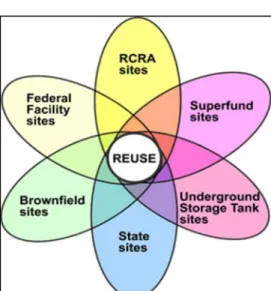
involvement, economic development, technical assistance, limited funding, and public outreach to maximize the efficiency of site cleanup efforts. The graphic (Figure 1) below depicts the nexus of land
redevelopment and revitalization towards the greater goal of reuse.
12 “Overview of the Brownfields Program.” EPA, Environmental Protection Agency, 29 Mar. 2018, www.epa.gov/brownfields/overview-brownfields-program.
13 “Land Revitalization Basics.” EPA, Environmental Protection Agency, 12 Aug. 2016, www.epa.gov/land-revitalization/land-revitalization-basics.
8
Regrettably, per the EPA, “there is no one-size-fits-all approach to return a formerly contaminated site back into reuse.”17 The diversity of revitalization sites or projects
requires a distinctive, tailored toolkit, with a variety of techniques to ensure appropriate cleanup and development approaches are implemented in their respective communities. The EPA, and their state equivalents, have different site classifications, legal authorities, and requirements, which can complicate the revitalization process. For example,
brownfields and Superfund sites use different legal authorities, liability protections, and funding mechanisms. However, this should not be considered an insurmountable obstacle to those communities that wish to redevelop and revitalize their contaminated sites or properties.18
U.S. EPA Funding Mechanisms
Traditionally, the EPA has provided limited seed money to local governments to launch hundreds of two-year Brownfields pilot projects. Moreover, the Brownfields Program developed guidance and tools to assist states,
communities, and other relevant stakeholders in the remediation and redevelopment of brownfield sites or properties.19 In January 2002, the Brownfields Law codified practices, policies, and guidance, as well as
expanded U.S. EPA’s assistance. Due to the Brownfields Act, U.S. EPA could provide new tools to both public and private parties to encourage sustainable remediation and redevelopment.20
Brownfield grants are the foundation of U.S. EPA’s Brownfields Program.21 The following grants support
revitalization by funding environmental assessment, cleanup, and workforce development activities:
Brownfields Area Wide Planning Grants;
Brownfields Assessment Grants;
Brownfields Cleanup Grants;
Brownfields Environmental Workforce Development and Job Training (EWDJT) Grants; and
Brownfields Revolving Loan Fund Grants.
Historically, federal government agencies have offered incentives, such as grants or loans, to encourage redevelopment of contaminated and formerly-contaminated properties. One such incentive, the Federal Brownfields Tax Incentive, was signed into law in 1997, but was not renewed past December 31, 2011. This grant included petroleum cleanup, as of 2006, but cannot be claimed for tax years beyond 2011. The loss of these tax incentives likely discouraged developers and investors from moving forward with
brownfields cleanup and redevelopment projects. The tax incentives and credits had encouraged
brownfield redevelopment through allowing developers and investors to diversify their sources of funding and leverage both public and private dollars for project expenses. With contamination clean-up being an added expense, the extra cash flow provided by this federal incentive program made brownfield remediation less costly and less risky to developers. Furthermore, these tax credits made the project more
17 Ibid. 18 Ibid.
19 “Overview of the Brownfields Program.” EPA, Environmental Protection Agency, 29 Mar. 2018, www.epa.gov/brownfields/overview-brownfields-program.
20 Ibid. 21 Ibid.
9
appealing to outside investors. Without these federal tax breaks, developers and investors have likely been looking to leverage more state and local funding, as well private or nonprofit sources.
Leaking Underground Storage Tank Trust Fund
Another notable funding mechanism provided by the EPA is the Leaking Underground Storage Tank (LUST) Trust Fund. Codified by Congress in 1986, the LUST Trust Fund addresses petroleum releases from
federally-regulated underground storage tanks (USTs). The LUST Trust Fund provides funds to conduct inspections and other release activities; enforce cleanup; oversee cleanups; and pay for cleanups at sites where the owner or operator is unknown, unwilling, or unable to participate, or where emergency action is required.22 Additionally, the American Recovery and Reinvestment Act of 2009 provided $200 million to
EPA’s LUST as a one-time allocation towards fulfilling its mission. The Trust Fund is financed by a 0.1 cent tax on every gallon of motor fuel sold nationwide and, in Fiscal Year (FY) 2016, received approximately $90 million to prevent, detect, and clean up federally-regulated USTs. Approximately 90% of EPA’s LUST money is provided directly to states, territories, and tribes for their associated cleanup and prevention programs. To qualify for LUST funds, states, territories, and tribes must have an assistance agreement with the federal government to ensure these dollars are used for LUST cleanup and prevention programs.23
Of note, sites which have utilized LUST Trust Fund dollars are not eligible for other U.S. EPA Brownfields Program grants, such as assessment grants, clean-up grants, and revolving loan funds. 24 However, this
disqualification may be waived if the project provides human health benefits, ecological benefits, aesthetic and recreational improvements, or increased land productivity.25
Benefits of the Brownfields Program
To date, the Brownfields Program has leveraged outcomes and benefits in communities across the U.S. These outcomes and benefits are tracked by type of Brownfields grant, such as Assessment, Cleanup, and Revolving Loan Fund grants. The following is a summary of Brownfields program accomplishments as of October 1, 2017:
Table 1. Summary of Brownfields Program Accomplishment as of October 1, 2017
Performance Measure FY17 Targets FY17 Accomplishments Cumulative Program Accomplishments
Properties Assessed 1,400 1,419 27,075
Jobs Leveraged 7,000 8,472 129,240
Dollars Leveraged $1.1 billion $1.7 billion $24.71 billion
Acres Made Ready for
Anticipated Reuse 5,500 3,676.96 69,275
As noted in the table above, although the Brownfields Program aimed to have 5,500 acres made ready for anticipated reuse, but only 3,676.96 acres (57%) was successfully remediated. Outside of these lost opportunities, the Brownfields Program creates quantifiable benefits throughout a community. Through FY16, $16.11, on average, was leveraged for each EPA Brownfields dollar; 8.5 jobs were leveraged per
22 “Leaking Underground Storage Tank (LUST) Trust Fund.” EPA, Environmental Protection Agency, 4 Apr. 2017, www.epa.gov/ust/leaking-underground-storage-tank-lust-trust-fund.
23 Ibid.
24 “EPA Brownfields Grants for Old Abandoned Gas Stations and Other Petroleum Brownfields,” National Service for Environmental Publications (NSCEP), U.S. EPA, October 2006.
10
$100,000 of funds. Outside of fiscal benefits, brownfield redevelopment can also lead to environmental benefits. Brownfield sites or properties have greater location efficiency than alternative development scenarios. Per U.S. EPA pilot studies, there is a 32% to 57% reduction in vehicles miles, and associated pollution emissions, traveled when developed occurred at a brownfield, as opposed to a “greenfield.” Additionally, stormwater runoff was reduced by 47% to 62% at brownfield redevelopment sites.
Benefits of brownfield redevelopment can also include quality jobs and monetary investment in local communities, whether it be through improvements in the quality of residential or commercial options, health services, recreational space, industrial redevelopment, or other positive outcomes.26 In addition to
environmental and social benefits, brownfield redevelopment can mean economic benefits for property owners and residents adjacent to these projects. A 2017 study in the Journal of the Association of Environmental and Resource Economists concluded that remediation and redevelopment increased
residential property values from 5 to 15.2 percent within 1.29 miles of the brownfield site.27 Near 48 of
those brownfields, a study in the Journal of Environmental Assessment Policy and Management found an estimated $29 to $97 million in additional tax revenue for local governments within a single year after cleanup. This tax revenue was 2 to 7 times more than the $12.4 million U.S. EPA contributed to remediation of these sites.28 To date, the Brownfields Program has leveraged over 97,000 jobs nationwide.29
Brownfields and Real Estate Development
From a real estate perspective, brownfields can pose many opportunities and challenges for both public and private developers. Per the U.S. EPA, several challenges make brownfields remediation and redevelopment more complex than other real estate development projects. These challenges include:
Cleanup Considerations, such as environmental assessment and cleanup activities,may mean a longer redevelopment timeline than typical real estate development;
Environmental Liability Concerns complicate developers and property owners managing past and future liabilities associated with the property’s environmental history;
Financial Barriers make private lenders reluctant to give loans to potentially-contaminated sites and properties where cleanup costs may be worth more than the property itself;
Reuse Planning may currently be lacking, which will require more information on economic and environmental goals (e.g., market potential)30
To expand on the challenges listed above, the issue of liability for environmental cleanup costs poses the highest risks and biggest impediments to developers. The total cost of environmental cleanup costs are often unclear at the start of a project, leading developers to oftentimes choose the less technical and costly scenario – greenfield development. Additionally, banks are hesitant to finance a redevelopment project where environmental liabilities exist, which makes financing brownfield redevelopment difficult. However, federal and state policies and programs (e.g., U.S. EPA Brownfield Programs and North Carolina
Brownfields Program) exist to respond to these issues, counteract market tendencies, and encourage brownfield remediation.
A critical area of the real estate development process is stakeholder engagement; brownfields
redevelopment is not exempt from this challenge. As demonstrated in Figure 4, to successfully redevelop a
26 “2015 Report to the General Assesmbly,” Brownfields Program, North Carolina Department of Environmental Quality, 27 Oct. 2015, https://deq.nc.gov/about/divisions/waste-management/bf/reports.
27 Haninger, K., L. Ma, and C. Timmins. 2017. The Value of Brownfield Remediation. Journal of the Association of Environmental and
Resource Economists 4(1): 197-241.
28 Sullivan, K. 2017. Brownfields Remediation: Impact of Local Residential Property Tax Revenue, Journal of Environmental
Assessment Policy and Management 19(3).
29 “Overview of the Brownfields Program.” EPA, Environmental Protection Agency, 29 Mar. 2018, www.epa.gov/brownfields/overview-brownfields-program.
11
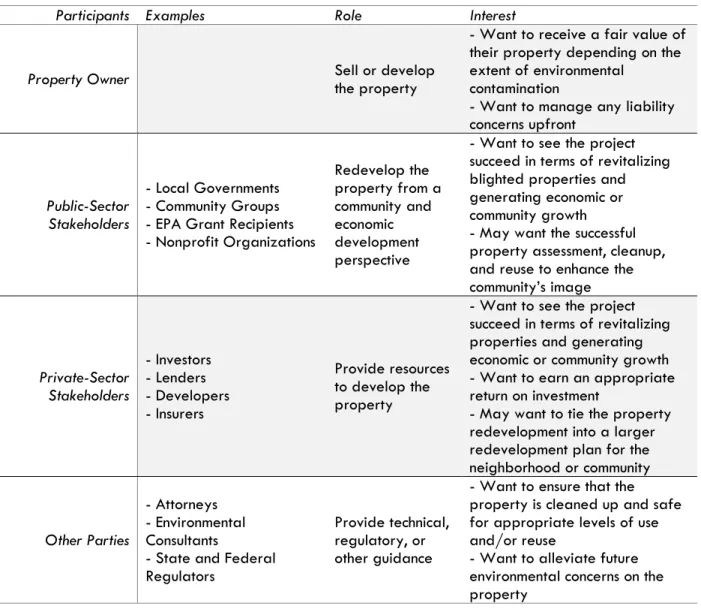
contaminated site, the developer must engage a wide variety of public and private-sector partners and participants. Public-private funding varies in levels and combinations from project-to-project, as
necessitated by the complicated nature of EPA Brownfield grants. Brownfields redevelopment often fall into three categories of real estate development and financing mechanisms: public, public-private, and private.
Figure 2. Roles and Interests of Participants. Anatomy of Brownfields Redevelopment. U.S. EPA.
Participants Examples Role Interest
Property Owner Sell or develop the property
- Want to receive a fair value of their property depending on the extent of environmental
contamination
- Want to manage any liability concerns upfront
Public-Sector Stakeholders
- Local Governments - Community Groups - EPA Grant Recipients - Nonprofit Organizations
Redevelop the property from a community and economic development perspective
- Want to see the project succeed in terms of revitalizing blighted properties and generating economic or community growth - May want the successful property assessment, cleanup, and reuse to enhance the community’s image Private-Sector Stakeholders - Investors - Lenders - Developers - Insurers Provide resources to develop the property
- Want to see the project succeed in terms of revitalizing properties and generating economic or community growth - Want to earn an appropriate return on investment
- May want to tie the property redevelopment into a larger redevelopment plan for the neighborhood or community
Other Parties
- Attorneys - Environmental Consultants
- State and Federal Regulators
Provide technical, regulatory, or other guidance
- Want to ensure that the property is cleaned up and safe for appropriate levels of use and/or reuse
- Want to alleviate future environmental concerns on the property
However, these challenges should not deter developers from taking advantage of the significant
opportunities provided by brownfields redevelopment. Brownfields redevelopments can revitalize long-lost areas and organize divergent stakeholder groups around a common goal – to create the momentum necessary to overcome challenges posed by brownfields.31 Although brownfields redevelopment can
follow a more-typical real estate development process, the process diverges at the cleanup and
development stage. Once the pre-development planning processes are complete, cleanup and construction
12
occur simultaneously. By integrating cleanup and construction activities, the process becomes more streamlined and all issues are resolved in tandem.32
Petroleum Brownfield Redevelopment
The EPA defines a brownfield as a “real property, the expansion, redevelopment, or reuse of which may be complicated by the presence or potential presence of a hazardous substance, pollutant or
contaminant.”33 Approximately one-half of the estimated 450,000 brownfield sites in the U.S. are thought
to be contaminated by petroleum; much of these sites are due to leaking underground USTs at old gas stations. These sites are referred to by the EPA as “petroleum brownfields.”34 The U.S. EPA’s Office of
Underground Storage Tanks (OUST) and Office of Brownfields and Land Revitalization (OBLR or Brownfields Program) administer programs that center on the cleanup and revitalization of petroleum brownfield sites. These offices provide technical assistance to states and local communities to help them tackle the challenges that are inherent with petroleum brownfields, and employ smart growth strategies into their redevelopment plans.35
Petroleum can negatively impact adjacent communities by threatening health and the environment, contaminating groundwater, and generating blight. These petroleum brownfields, and abandoned gas stations, are being remediated and redeveloped in communities across the nation. The remediation and revitalization of these petroleum brownfields can present opportunities that are protective of human health and the environment, while also helping to realize community redevelopment goals. Petroleum brownfields are generally determined by the EPA to be relatively low-risk priority and, as such, are often awarded brownfields grants for the assessment and cleanup or brownfield sites.36 While previous legislation
precluded petroleum-candidate sites from EPA grants, the Brownfields Law specifically allocated 25% of brownfields funding annually to the remediation of relatively low-risk petroleum brownfield sites.37
For a petroleum site to be eligible for brownfields grants, EPA or the state must make the determination that a petroleum-contaminated site38:
“Is ‘relatively low-risk’ compared to other petroleum contaminated sites in the state;
Has ‘no viable responsible party’;
Will be assessed, investigated, or cleaned up by a person not potentially liable for the contamination; and
Is not subject to a corrective action order under RCRA §9003(h).”39
According to the U.S. EPA, there are approximately 200,000 abandoned gas stations and other petroleum-contaminated sites nationwide. Although numerous, these properties present a unique
opportunity for redevelopment and revitalization.40 With the passage of the 2002 Brownfields Law, EPA
32 Ibid.
33Opportunities for Brownfield Redevelopment, EPA, United States Environmental Protection Agency, July 2011, http://www.epa.gov/oust.
34 “Petroleum Brownfields.” EPA, United States Environmental Protection Agency, 1 Feb. 2018, www.epa.gov/ust/petroleum-brownfields.
35Opportunities for Brownfield Redevelopment, EPA, United States Environmental Protection Agency, July 2011, http://www.epa.gov/oust.
36 Ibid. 37 Ibid.
38 P.L. 107-118 (H.R. 2869), Sec. 211(a)(39)(C)
39 “EPA Brownfields Grants for Old Abandoned Gas Stations and Other Petroleum Brownfields,” National Service for Environmental Publications (NSCEP), U.S. EPA, October 2006.
13
has acknowledged and leveraged public-private partnerships to clean up abandoned gas stations and redevelop them into new homes, businesses, parks, wetlands, and community centers.41
Petroleum Brownfields and Real Estate Development
Petroleum brownfields present unique opportunities for real estate developers. Per the U.S. EPA’s
Petroleum Brownfields: Selecting a Reuse Option, petroleum brownfields can benefit from a strong vision of the intended reuse, for which outreach and collaboration is necessary. The following phases were provided in EPA’s aforementioned study for successful redevelopment of petroleum brownfields:
Identify Properties: An inventory of petroleum brownfield properties should be consulted when evaluating petroleum-contaminated properties for cleanup or reuse.
Plan Preliminary Reuse Options: Although petroleum brownfields may present challenges to redevelopment, they also present opportunities. The reuse vision must meet the requirements of state and local regulatory programs, while also considering the size, shape, and environmental conditions of the given parcel.
Work with Partners: Public and private partners should be engaged during all stages of the redevelopment process. These partners can include state, tribal, and local government, businesses, community groups, and private developers. By including a wide range of stakeholder groups, the vision for reuse will address both public and private priorities.
Involve the Community: For a petroleum brownfield redevelopment to be successful, it must be met with widespread, ongoing community support. Community engagement can build momentum and expand the network of public-private investors, including tenants willing to be relocate to the redevelopment. The vision for reuse should be cognizant of and respectful to community needs, such as commercial services, housing, job creation, or public use.
Consider Redevelopment Early: Brownfields redevelopment projects require understanding and consideration of reuse at project inception. Early and consistent coordination with federal and state regulators is necessary to ensure the desired reuse will be compatible with cleanup levels. Additionally, interim uses before permanent reuse can provide a service to the community before a more beneficial use is identified and completed, such as a park, parking lot, or leasing of a building.
Understanding Financing: Brownfield redevelopment requires a significant budget, and strategic financing options, for assessment, cleanup, and redevelopment costs. A redevelopment project must consider eligibility requirements, the timing of public funding, and reporting and documentation requirements.42
The majority of petroleum brownfields fall into the “Commercial” category, which includes all sites related to automobile purchasing, repair, and fueling (e.g., gas stations). However, petroleum brownfields can also be categorized as the following:
Industrial: The second most common type – bulk oil storage, former refineries and natural gas treatment plants, power generation facilities, and mining-related sites;
Transportation: Railyards, railroad spurs, airport facilities, distribution center for oil and cola, and former oil pipelines;
Residential: Those sites used for housing or located in residential areas, vacant sites where historical documentation, housing on a military or industrial site, or an apartment building or home with a heating oil tank; and
41 Ibid.
14
Open Land: Undeveloped parcels of land with illegal dumping or storage, an above-ground storage tank, or proximity to another site with contamination issues.43
Table 2: Categories of Petroleum Brownfields - Commercial Land Use, U.S. EPA.
Former Land Use Commercial
Description
Property formerly used predominantly for retail or wholesale of products and services; to serve institutional, public, or civic needs; and commercial agriculture.
Commonly Observed Petroleum Brownfield Sites
Gasoline (and diesel) stations or fuel stations, including convenience stores, multi-use sites with gasoline stations on portion of site, garages, or repair shops (e.g., automotive, machine, farm equipment), storage, body shops, used car lots, dealerships (e.g., automobile tire), and agriculture supply stores.
Additional Petroleum Brownfield Sites
Automotive: Cab companies, junkyards, auto or truck salvage, asphalt/pavement companies, auto impound lots, parking lots, race tracks and drag strips, tractor-trailer and RV dealerships, truck stops, commercial driver training facilities, car rentals, and oil change shops.
General Commercial: Vacant storefronts, vacant supermarkets, retail shopping, hardware stores, auction houses, hotels, motels, warehouses, drive-in movie theaters, tiling companies, farms, landfill buffer areas, communications facilities, office buildings, and land used to service marinas, yacht clubs, or boatyards.
Public: Schools, hospitals, former national guard sites, job training facilities, correctional facilities, military facilities, fire stations, and churches.
Agricultural: Retail farm equipment and supply.
The remediation and redevelopment of petroleum brownfields are typically centered on the following uses, which are deemed compatible with historic uses:
Commercial: Retail, offices, restaurants, and other businesses;
Public: libraries, schools, government offices, public infrastructure, and other services for citizens;
Residential: Single-family homes, townhouses, condominiums, and apartments;
Greenspace: Sports facilities and fields, community parks, walking trails, open space, and other land conservation efforts; and
Mixed-use: Property used for multiple purposes.
15
Examples of funding sources and tools that stakeholders utilize in support of petroleum brownfield projects may include but are not limited to:
State petroleum cleanup funds;
EPA Brownfield Assessment, Cleanup, and Revolving Loan Fund grants, Section 128(a) State and Tribal Response Program funds;
U.S. Department of Housing and Urban Development (HUD) Community Development Block Grants (CDBG), Section 108 loans, HOME Funds;
U.S. Small Business Administration loans;
U.S. Department of Commerce Petroleum Environmental Cleanup Fund Awards (PECFA);
State-specific economic and community development funds;
The National Park Service, U.S. Department of Interior, U.S. Department of Agriculture,
Appalachian Regional Commission, U.S. Department of Energy, and the Economic Development Administration are examples of some of the federal agencies that can support activities on brownfields properties;
State financial tools;
Tax credits or increment financing; and
Private funding streams, including construction loans, private Real Estate Investment Trusts (REITs), and developer equity bonds.44
Gas Station Redevelopment
The commercial category of petroleum brownfields encompasses the most diverse and largest number of sites due to the volume of former-automotive service and sales-related sites in the U.S. Research indicates that contamination typically stems from floor drains in service station or auto shops, since oil and other products leak to the ground and are washed outside to pollute soil and groundwater.45 The most common
contaminants found at these commercial sites are petroleum contamination, volatile organic compounds (VOCs), polycyclic aromatic hydrocarbons (PAHs), lead, and other metals. Commercial sites vary in size from 0.01 acre to 57 acres, with the majority of sites at less than 3 acres in size (e.g., gas stations, garages, or vacant lots).
Per the National Association of Convenience Stores, more than 50,000 gas stations have closed their doors since 1991, which accounts for nearly 25% of the 200,000 gas stations nationwide. With the advent of hybrid cars and a greater penchant for transit, gas stations are on the decline, with busy street corners being replaced by boarded-up stations and vacant pumps. Many of these abandoned gas stations serve as entrances to business districts; thus, the redevelopment potential of these properties can be attractive to developers. Underutilized gas stations present a unique opportunity for towns and developers alike, particularly if they are at desirable intersections. However, these gas stations also present unique
challenges, such as environmental remediation and small lot size, which must be planned for and managed appropriately.46
44 “Petroleum Brownfields: Selecting a Reuse Option,” Office of Solid Waste and Emergency Response, U.S. EPA, Mar. 2013. 45Opportunities for Brownfield Redevelopment, EPA, United States Environmental Protection Agency, July 2011,
http://www.epa.gov/oust.
46 Kaysen, Ronda, “A Clean New Life for Grimy Gas Stations,” Commercial Real Estate, The New York Times, 10 Jul. 2012,
16 Figure 3: Abandoned Gas Stations, U.S. EPA.
Outdated, vacant gas stations can blight communities and discourage adjacent development and revitalization. These gas stations, also known as petroleum brownfields, present distinctive development challenges related to environmental remediation and risky financing. Many developers are reluctant to purchase, remediate, and redevelop these properties due to the liabilities associated with environmental contamination. However, U.S. EPA and state-equivalent agencies are committed to sustainable
development and the opportunities provided by the reuse of petroleum brownfields. Historically, petroleum brownfields have been redeveloped as greenspace, since many federal, state, and local leaders have deemed this the most compatible use for these contaminated processes.47 However, more
recently, public and private developers have given new life to these blighted gas stations by redeveloping them into commercial, retail, or other mixed uses.
Petroleum brownfields, such as old gas stations, often sit vacant for extended periods of time, which means no feasible responsible parties and fairly minimal risk. These “orphan sites” fall into vacancy due to the responsible party going out of business or lack of funds for cleanup. The costliest investment for petroleum brownfield redevelopment lies in assessment and/or cleanup. However, once these processes occur, the efficiency and productivity increase on the site or property. Reusing vacant gas stations, often located in corner lots or other prime locations, can reduce urban sprawl, minimize automobile use, reduce air
pollution, promote economic development, and provide better quality of life in these community centers.48
As federal and state funds for redevelopment become scarcer, both public and private developers should consider capitalizing on federal, state, and local programs, grants, and incentives to revitalize
oft-overlooked vacant gas stations in their communities. U.S. EPA, and its Brownfields Program, has united with state and local governments, community organizations, and private partners to undertake the remediation of abandoned gas stations and, ultimately, realize the benefits of redevelopment and revitalization. Gas stations are transformed into new businesses, homes, parks, and community centers. Oftentimes these gas stations have historical significance to their local community and, as such, are restored, adaptively reused, and revitalized through public-private partnerships.49
Many old, abandoned gas stations are in visible and central locations within main streets, suburban corners, neighborhoods, or larger communities. The location of gas stations makes redevelopment ideal for several commercial, residential, or public uses. Old gas stations are increasingly meeting the 50-year
47 DeSousa, Christopher A., “The greening of brownfields in American cities,” Journal of Environmental Planning and Management, Volume 24, 2004 – Issue 4.
48 McNeely, Steve, “Reuse of Abandoned Gas Station Sites – Information Sheet,” Office of Underground Storage Tanks, U.S. EPA, Feb. 2004, http://www.epa.gov/oust/rags/pb.pdf
17
threshold for historic significance, as delineated by the National Park Service (NPS). This historic significance can mean additional federal and state funding opportunities, as well as significant architectural features. Per Chad Randl, an Architectural Historian and Visiting Lecturer at Cornell University, “historic stations are increasingly appreciated for their contribution to the character of a neighborhood, and the way they are easily adapted for new uses.”50
Remediated gas stations can mean new businesses, jobs, tax revenue, and amenities in a community, including parks and recreation, improved walkability, and increased property values. Remediation and redevelopment means increased land productivity for the site, adjacent parcels, and surrounding
neighborhood. Remediation optimizes land uses more quickly for developers by reducing liability concerns, informational gaps, and asymmetries in the land market. By eliminating uncertainties and reducing risk, site owners, potential owners, potential financers, and potential real estate developers are more likely to purchase these properties. Property market transactions will increase at nearby parcels due the lessening of concern or suspicion regarding proximity to contamination.
In December 2013, the EPA provided technical assistance to the St. Louis Development Corporation (SLDC) to support redevelopment planning for three abandoned gas stations located south and southwest of downtown St. Louis. The EPA and SLDC collected input from community members, conducted an
environmental conditions analysis, examined market data and infrastructure evaluations, and developed conceptual site designs, which served as educational and marketing tools to promote site development to public and private investors.
While providing technical assistance, the EPA developed the following lessons learned that could be applicable for other communities considering gas station redevelopment:
Engage area residents in discussions early in the process to help refine developer requests for proposals (RFPs);
Utilize data and expert analysis to help local stakeholders better understand diverse options and opportunities;
Recognize unique reuse opportunities based on site location, site layout, reuse of the current building, and community market inputs; and
Leverage technical and financial assistance from public agencies (e.g., EPA) to make sites more attractive for reuse to private developers.51
Other examples of reuse projects include the redevelopment of a former Throckmorton Service Station (Throckmorton, Texas) into a small public park in 2007. The 0.05 acre site received a combined $103,000 from the EPA, which allowed for site assessment and cleanup. In 2004, downtown Boise, Idaho saw the redevelopment of a 0.45-acre auto service station into the Banner Bank Building, an environmentally-friendly, energy efficient 1965,000 square foot office building. The office building received U.S. Green Building Council Leadership in Energy and Environmental design (LEED) Platinum certification and a 2008 Phoenix Award for “exemplary brownfield redevelopment and revitalization.”52 Finally, the Pik Kwick gas
station in the Harris Park Historic Area of Westminster, Colorado was redeveloped state funding for remediation in 2007, which totaled $526,000 of site cleanup and integration with the property’s end reuse. The 0.5 acre site is now home to the 12,000-square foot Neighborhood Building, which contains
50 Randl, Chad, “The Preservation and Reuse of Gas Stations,” 46 Preservation Briefs, National Park Service, Sept. 2008. 51 “Redevelopment Planning for Abandoned Gas Stations: St. Louis, Missouri, EPA Region 7,” Planning for Sustainable Brownfield Redevelopment: Land Revitalization Success Stories, U.S. EPA, Oct. 2014.
18
office and retail space. Redevelopment created 24 full-time office positions and 10 full-time retail positions which, in turn, generated over $33,000 in city and county tax revenues.53
Figure 4: Banner Bank Building, Boise, ID. Figure 5: The Neighboring Building Economic and Fiscal Impacts, Westminster, CO.
CASE STUDY: NORTH CAROLINA
Although the U.S. EPA has resources to assist communities in successful
redevelopment projects, the most sustainable alternative is to utilize local resources and social capital to revitalize sites. EPA has a variety of informational, financial, legal, and technical revitalization tools to assist communities in revitalizing sites or properties.54 The U.S. EPA’s
Targeted Brownfield Assessments (TBA) Program is a voluntary, non-grant program intended to assist public entities in
minimizing the uncertainties of
contamination inherent with brownfield properties. The TBA Program provides funds and technical assistance to States, communities, public partners, and nonprofit partners; this funding and assistance helps partners to identify, assess, safely cleanup, and plan for revitalization and reuse of Brownfields properties across the
53 Ibid.
54 “Land Revitalization Basics.” EPA, Environmental Protection Agency, 12 Aug. 2016, www.epa.gov/land-revitalization/land-revitalization-basics.
19
Southeastern U.S.55 The state of North Carolina belongs to the Region 4 Brownfields program, along with
Alabama, Florida, Georgia, Kentucky, Mississippi, South Carolina, and Tennessee.
Per the U.S. EPA, TBAs have realized the following outcomes as of March 2015:
Table 3. Region 4 Cumulative Program Accomplishments. Targeted Brownfields Assessments Program. U.S. EPA.
Performance Measure Cumulative Program Accomplishments
Properties assessed 3,075
Cleanups completed 69
Properties made ready for reuse 513
Acres made ready for reuse 27,590
Dollars leveraged $4.3 billion
Jobs created 9,095
An EPA Region 4 Brownfields Grant enables Phase II Environmental Site Assessments and Cleanups. Parties interested in receiving a Brownfields Grant must complete a Site Eligibility Determination application. Recent recipients of grants in North Carolina include the Cities of New Bern, Hickory, Dunn, Greenville, Randleman, Wilson, as well as Burke County.56
Under the EPA’s TBA Program, North Carolina local governments have been awarded millions of dollars for brownfields assessment and cleanup activities. These local governments include the Cities of Charlotte, Raleigh, Greensboro, Winston-Salem, Wilmington, Fayetteville, High Point, Concord, Farmville, and the Land-of-Sky Regional Council of Governments.57
North Carolina Brownfields Program
Administered by the Division of Waste Management, the North Carolina Brownfields Program is the state’s endeavor to “break the barrier” of brownfields redevelopment.58 This Program is authorized by the
Department of Environmental Quality (DEQ) through the Brownfields Property Reuse Act of 1997 (NCGS 130A310.30 et seq.). This statute authorizes the program to work with potential developers (both public and private) to transition brownfield sites back into reuse. The program defines a brownfield as “[a site] that is abandoned, idled or underutilized, and where there is an interest in redevelopment.”59 Per the
statute, a qualified developer is “any person who desires to buy or sell a brownfields property for the purpose of redeveloping it and who did not cause or contribute to the contamination of the property.”60 As
a voluntary program, qualified developers negotiate a brownfields negotiate a brownfields agreement with the state that delineates the activities required to render the site suitable for reuse. Unlike the EPA’s
55 “Brownfields and Land Revitalization in Alabama, Florida, Georgia, Kentucky, Mississippi, North Carolina, South Carolina, & Tennessee.” EPA, Environmental Protection Agency, 19 Jan. 2018, www.epa.gov/brownfields/brownfields-and-land-revitalization-alabama-florida-georgia-kentucky-mississippi-north-0.
56 “Brownfields Grant Fact Sheet Search,” Brownfields and Land Revitalization, U.S. EPA, 2017, https://cfpub.epa.gov/bf_factsheets/index.cfm
57 “Program FAQs,” Brownfields Program, North Carolina Department of Environmental Quality, https://deq.nc.gov/about/divisions/waste-management/bf/faqs#3.
58 “Program Background,” Brownfields Program, North Carolina Department of Environmental Quality, https://deq.nc.gov/about/divisions/waste-management/bf/background.
59 “Program FAQs,” Brownfields Program, North Carolina Department of Environmental Quality, https://deq.nc.gov/about/divisions/waste-management/bf/faqs#3.
20
Program, the agreement does not stipulate that the sites must be cleaned up to regulatory standards; this is the requirement of responsible parties.61
Unlike federal programs, the North Carolina Brownfields Program has no upfront funding available to private prospective developers; a property tax exclusion is entitled once a brownfields agreement has been obtained. This property tax exclusion is on improvements made to the property for a period of five years. This exclusion can assist in funding assessment and cleanup activities associated with brownfields.62
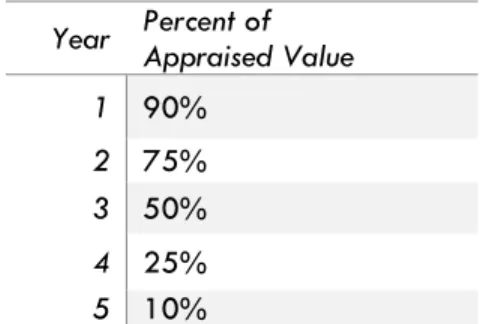
Per NCGS § 105-277.13. Taxation of improvements on brownfields, improvements made to real property subject to a brownfields agreement qualify as a percentage of the appraised value of the qualified improvements. Property tax exclusion applies for a total of five years, with deescalating percentage exclusion, as delineated in the table below:
Table 4. NCGS § 105-277.13. Taxation of improvements on brownfields.
Year Percent of Appraised Value
1 90%
2 75%
3 50%
4 25%
5 10%
Brownfields Agreement
Due to its pro-developer stance, the Brownfields Program has become very popular and its brownfields agreements are in high demand. However, since the program relies on increasingly-limited federal funding, project managers have become overwhelmed by the number of applications which, in turn, has lengthened the average time to obtain this agreement. Although many agreements are approved, many more are waiting for their approvals. However, the program recognized that this runs counter to the time-value-of-money costs for the developers and, thus, developed a pilot program in 2009, the
Redevelopment Now Option, which utilizes resources provided by voluntary prospective developers. Minimizing costs is central to overall project success; brownfields cleanup costs are pointedly higher than typical programmatic costs. Under the Redevelopment Now Option, the Brownfields Program utilizes a higher fee to hire project managers and Program attorney resources to respond throughout the brownfields agreement process on a “zero-queue basis.” The fee for developers to enroll in the
Redevelopment Now options is $30,000, instead of the standard $8,000. By lessening the bottlenecks and costs inherent to the negotiation and production of final brownfields agreements, the Program hopes to increase brownfields redevelopment, and provision of public good, statewide.63
Outside of the tax incentive, why would a private developer take on the added cost of a brownfields agreement and associated assessment and cleanup? The brownfields agreement, as entered by the Department of Environmental Quality (DEQ), is designed as a tool to eliminate the uncertainties for developers associated with environmental liability. Brownfields agreements are viewed by developers as assets for investment by minimizing risk and maximizing profits, almost eliminating environmental
61 “Program FAQs,” Brownfields Program, North Carolina Department of Environmental Quality, https://deq.nc.gov/about/divisions/waste-management/bf/faqs#3.
62 Ibid.
21
accountabilities. Per the North Carolina Brownfields Program, Brownfield Agreements (BFA) delineate the following:
“The agreement provides strong liability protection in the form of a covenant not-to-sue that can be shown to a lender to obtain project financing;
The liability protection in the brownfields agreement passes on to all new owners so long as they adhere to the land use restrictions (e.g. don't use the groundwater). This can be a selling point for the property;
The site remedies under the program are designed to prevent exposure and make the site suitable for reuse, not to meet environmental standards required of the site polluter in traditional cleanup programs. Thus, they are less costly and less time consuming, particularly with respect to
groundwater remedies;
Since remedies are put in the agreement up-front and therefore represent known costs, a business decision can be made with much reduced uncertainty;
Closure for the prospective developer can be obtained reasonably quickly, typically in much less time than for most other cleanup programs (see 3 above); and,
The brownfields property tax incentive significantly reduces property taxes on the improved value for five years after completion of improvements to the property. This benefit typically pays for (or at least offsets) site environmental assessment, risk mitigation, or cleanup activities that the
developer may need to conduct under the agreement.”64
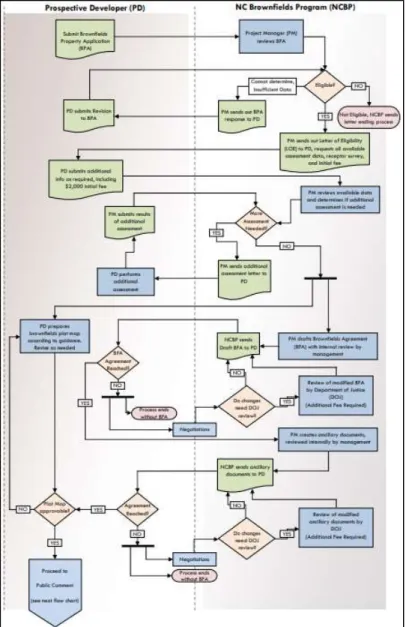
The following is a summary of the BFA process, as facilitated by the North Carolina DEQ’s Division of Waste Management (also outlined in Figure 4 below):
“Step 1: A prospective developer (PD) submits a Brownfields Property Application to the Division of Waste Management outlining a brownfields site it desires to buy or sell for the purposes of redevelopment, and for which it needs liability protection. The Division of Waste Management determines if the PD, the subject property and the proposed redevelopment project are eligible under the BPRA statute. The PD pays an initial $2,000 fee at the time its project is deemed eligible by the Division of Waste Management.
Step 2: The Division of Waste Management reviews existing site data to determine the risk posed by contamination at the site. If the data are insufficient to evaluate such risk, the Division of Waste Management advises the PD on further site assessment to gather the necessary data.
Step 3: The Division of Waste Management determines what actions are necessary to make the site suitable for the PD’s intended reuse and includes these actions in a draft brownfields
agreement. The PD and the Division of Waste Management negotiate the provisions of the draft brownfields agreement and other required statutory documents.
Step 4: A public notice of the brownfields agreement is published, with a 30-day public comment period.
Step 5: The brownfields agreement is finalized after any public comments are considered and incorporated. Prior to the execution of the finalized brownfields agreement, the PD pays the secondary fee negotiated in the agreement, and the agreement is executed and recorded at the County Register of Deeds.
Step 6: The PD completes any site safe-making actions required under the agreement, thereby triggering the agreement’s liability protections in the form of a covenant not-to-sue. The liability protection allows the flow of lender financing that facilitates redevelopment.
22
Step 7: Upon completion of the brownfields property improvements, the property owner is eligible for the brownfields property tax incentive, which reduces its property taxes for a five-year period.”65
Figure 7: Brownfields Agreement Process, North Carolina Brownfields Program
The Division of Management is charged with distinguishing between prospective developers of brownfields properties and polluters of those properties. The Brownfields Property Reuse Act requires developers to make the site safe for the identified reuse, but does not mandate that the site be remediated to
unrestricted use standards. After evaluating site contamination and identifying potential public health and environmental risks, the North Carolina DEQ identifies which actions (e.g., land use restrictions, cleanup) the prospective developer must take to ensure safe redevelopment. The North Carolina DEQ considers the BFA to be “a winning scenario for the environment and for economic development.” Risk reductions and
remediation are achieved side-by-side with job creation, improved quality of life in the surrounding
23
neighborhoods, local tax base expansion, and financial contribution to the general fund.66 Furthermore,
environmental gains are made in the fields of smart growth and sustainability by preserving or reducing the use of undeveloped greenfields. Through recycling and reusing property, brownfield redevelopment conserves greenspace, lessens suburban sprawl, and boosts sustainable urban development.
Brownfield Designations and Brownfield Agreements to Date
Per the Brownfields Property Reuse Act of 1997 (G.S. 130A-310.40), North Carolina’s Brownfields
Program is required to report to the General Assembly on their activities and status. Their latest report, for Fiscal Year (FY) 2015, expounds on the state’s efforts and successes in revitalizing and safely reusing brownfields properties.67 As of September 1, 2015, the program has finalized a total of 357 BFAs and
facilitated over $10 billion in estimated private investment in the redevelopment of brownfields across North Carolina. These 357 agreements represent 6,400 acres of recycled land and, in some cases, historic or significant buildings.
The following are totals for the measures specifically tracked in FY15. These totals, as seen in Figures 8 to 10, demonstrate the growth of the Brownfields Program portfolio and, connectedly, the increasing
popularity of the program and BFAs with both public and private developers in North Carolina.
Program applications received: 86 [as seen in Figure 8]
Brownfields agreements finalized: 39 [as seen in Figure 9]
Acres of Brownfields revitalized to safe, productive reuse: 740
Estimated committed capital investment for projects completed during FY15: $786 million (Funds spent in FY15 were either federal funds or from Program fee receipts; no state-appropriated funds are received for the program.)
Figure 8: Brownfields Property Application Received in FY15, North Carolina DEQ.
66 Ibid. 67 Ibid.
27 36
56
52
66 63
86
0 10 20 30 40 50 60 70 80 90 100
FY09 FY10 FY11 FY12 FY13 FY14 FY15
24 Figure 9: Brownfield Agreement Completed Annually, as of FY15, North Carolina DEQ.
Figure 10: Cumulative Total Brownfields Agreements, as of FY15, North Carolina DEQ.
Gas Station Redevelopment
Brownfield redevelopment is certainly a complicated process, but there are a variety of federal, state, and private funding mechanisms that make these projects more feasible. Previous brownfield projects in North Carolina have centered on historic manufacturing and mill sites, but gas stations could well be the new frontier of downtown redevelopment and revitalization.
The city of Durham has capitalized on this new frontier and the potential of gas station redevelopment in recent years. Notable examples in downtown Durham include Geer Street Garden restaurant and bar, Grub restaurant, Local Yogurt frozen yogurt shop, and Joe Van Gogh coffee shop. The redevelopment of abandoned gas stations has helped to revitalize the West End Neighborhood of Durham, where Grub, Local Yogurt, and Joe Van Gogh are located; real estate prices have risen significantly in the last few years. Joe Van Gogh owner Robbie Roberts saw a unique opportunity in the former Gulf Service Station
19
24
29 27
41
47
39
0 5 10 15 20 25 30 35 40 45 50
FY09 FY10 FY11 FY12 FY13 FY14 FY15
Brownfields Agreements Completed Annually (FY15)
150
173
202 229 271
318
357
0 50 100 150 200 250 300 350 400
FY09 FY10 FY11 FY12 FY13 FY14 FY15