The Al-hornblende geobarometer is a widely applied tool for calculating the depth of a pluton’s emplacement. Though its widespread use has been questioned, it is still often used with little investigation of its applicability, as there are few geobarometers available in these systems (Anderson and Smith 1995, Ague 1997).
To examine the applicability of the hornblende geobarometer within the Tuolumne Intrusive Suite within Yosemity National Park, California, samples of
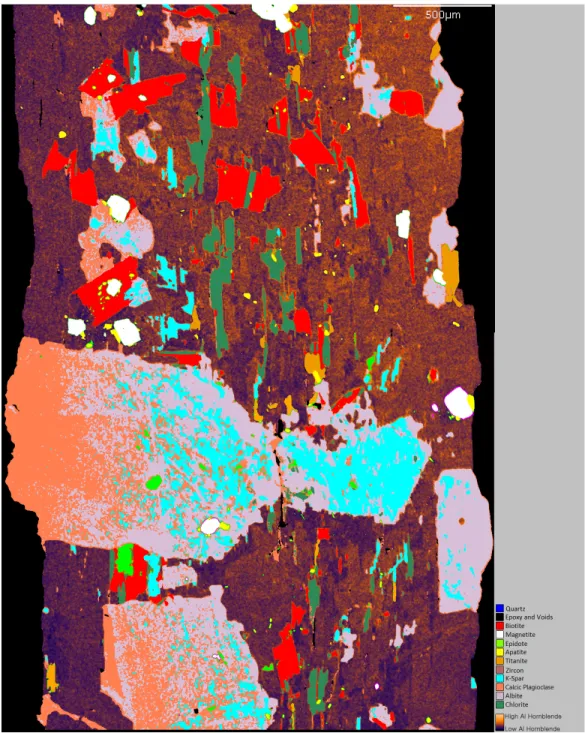
hornblende phenocrysts from the Half Dome Granodiorite were collected and analyzed. From them, maps of mineral inclusions and Al content were made using scanning electron microscopy and remote sensing techniques. Instead of the expected regular concentric zoning in Al content, zoning in Al is patchy and irregular. Furthermore, the crystals are riddled with inclusions of other minerals, some of them late crystallization products.
Introduction
The nature and formation of plutons has been a subject of fierce debate within the field of geology. While the dominant model has been one of single emplacement, a model of incremental emplacement has recently been proposed (Coleman et al, 2004). These models are important for the understanding not only of plutons but of their relationship to surrounding crustal rocks and to volcanic systems.
One important piece of information in understanding a pluton’s history is its depth of emplacement. However, plutons have few mineral assemblages that give obvious indications of their pressure (and thus depth) of formation. It was not until Hammarstrom and Zen (1986) that a geobarometer based on a common plutonic mineral assemblage became available to researchers. They showed a positive relationship between depth of pluton emplacement inferred from other data and the overall Al content of hornblende crystals found in these rocks. This is the result of Al entering tetrahedral configuration within the crystal. This geobarometer has been applied to a number of plutons. Further calibrations by Anderson and Smith (1995) added additional terms to take temperature and fO2 into account.
However, hornblende phenocrysts from the Half Dome Granodiorite in the Sierra Nevada batholith, a pluton which has become particularly important to this debate
within the hornblende crystals of this body. This in turn raises questions about the applicability of the Al geobarometer within this system, and possibly within other systems across the world.
Methods
Euhedral hornblende and biotite phenocrysts ranging from 1 to 2 cm in maximum dimension were collected by Dr. Allen Glazner in Yosemite National Park from grus developed on the Half Dome Granodiorite. Differential weathering releases intact hornblende phenocrysts with pieces of enclosing quartz and feldspars attached (see figure 1). Hornblende crystals were collected from 3 weathering pans on glacial pavement west of Tenaya Lake, and biotite crystals were collected from similar pans on the summit of Half Dome.
Five samples of hornblende were mounted in epoxy, sliced and polished. Three were cut perpendicular to the c-axis, one perpendicular to the a-axis and one
the Zr Kβ overlaps P Kα, the P map also includes Zr. These maps and the backscatter image were exported as image files, cropped, grayscaled and imported into ENVI.
In ENVI, the files were georeferenced to an arbitrary preexisting map file. The maps were then run through a Gaussian low-pass filter with a kernel size of 9x9 to reduce noise.
Regions of interest were placed on representative crystals of mineral inclusions within the hornblende crystals, which were readily identified by their spectral
characteristics. These regions of interest were then used as the basis for a supervised classification using the minimum distance method. The Al map was then superimposed over the areas of hornblende to better show Al zoning.
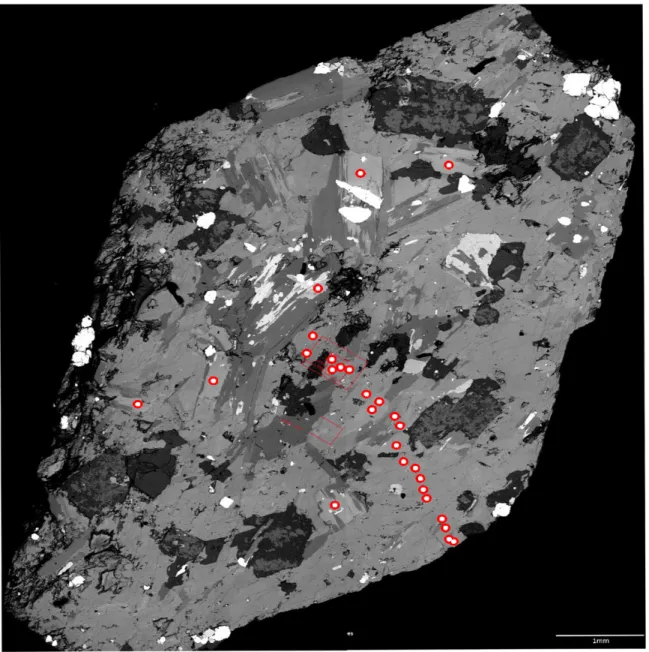
A single hornblende phenocryst was mounted and polished perpendicular to its a -axis and point analyses were conducted by Dr. Allen Glazner using a JEOL JXA-8530 field emission microprobe at Fayetteville State University to more precisely establish ranges of Al content.
To assess the effects these compositional variations would have on the hornblende geobarometer, pressures and temperatures of formation were calculated based on the hornblende point analyses. This was accomplished using a combination hornblende geobarometer and plagioclase-hornblende geothermometer (Anderson et al., 2008). A plagioclase composition of An17 was measured on the scanning electron microscope and
Results
Mineral maps were generated for seven of the nine available crystals. The mounted hornblende and biotite crystals and their mapped areas are pictured in Figure 1 below, and Figures 2-8 show the maps themselves.
Figure 1: The hornblende and biotite phenocrysts in their epoxy pucks, with labels indicating which map they correspond to and red overlays over the mapped areas.
Figure 3: A map of Hornblende H2
Figure 7:A map of biotite B1 showing the plane perpendicular to the c-axis
The zoning of Al within the hornblende is patchy and irregular. Large variations in aluminum content occur within close proximity within the hornblende crystals. Spectra taken from two points less than a millimeter apart within hornblende H3 (see Figure 4) clearly show a large variation in Al content, and similar variation can be seen in Figures 9 and 10. One shows a significant Al peak while the other barely exceeds noise.
A microprobe spot traverse across hornblende crystal H6 showed a range of Al content within the hornblende from 3.626 to 7.616 wt%, with no concentric pattern to the variations. The pressure values calculated from the point compositions showed a
similarly wide range and lack of concentricity, ranging from -0.3 to 3.1 Mb (see Figures 11 and 12).
The maps of the hornblende crystals revealed numerous inclusions, with a total of 13 different identified minerals within the hornblende. Inclusions comprise k-feldspar, albite, calcic plagioclase, biotite, chlorite, muscovite (in the form of sericite), apatite, magnetite, epidote, quartz, zircon and titanite. These inclusions make up a significant portion of the crystal. In the examined section of hornblendes H3 and H5, hornblende
makes up less than 50% of the mapped area. A summary of the area occupied by each mineral in hornblende crystals 1-4 is presented below in Table 1.
Table 1: Mineral composition of hornblende crystals
The biotite crystals, however, showed very few inclusions with a smaller variety of including minerals. Although the map of biotite B1 does include a significant amount of albite, it is a crystal attached to the outside of the biotite rather than an inclusion.
Percent Area of Mineral
Mineral H1 H2 H3 H4 H5
Low Al Hornblende 23.08 9.80 7.54 27.47 27.99 Med Al Hornblende 15.52 11.50 28.55 18.32 13.65 High Al Hornblende 35.95 37.00 11.09 11.61 2.57 Total Hornblende 74.55 58.30 47.18 57.40 44.21
4.50 0.00 16.08 17.82 4.02
7.17 19.25 6.67 1.41 5.81
11.67 19.25 22.75 19.23 9.83
5.41 10.88 22.94 9.48 35.56
Other 8.35 11.40 7.08 11.05 10.40
Biotite Chlorite
Biotite + Chlorite Feldspars
Table 2: Mineral Composition of Biotite Crystals
Discussion
Because pressure and temperature are uniform for a crystal at a given time, if Al content in hornblende crystals were only controlled by these conditions upon
crystallization they would show zones of uniform Al content parallel to planes of growth. The patchy and largely aconcentric Al zoning observed in these hornblende crystals does not match this prediction. It is thus unsurprising that, when pressures are calculated from the point analyses, they reveal a range and distribution of values which are clearly unreasonable. One important feature of the Al in hornblende barometer is that it is not intended to calculate pressures below 2 Kb, and that many of the pressures calculated fall below this mark (Anderson and Smith, 1995). However, independent of this limit it is clear that the aluminum content is not reflecting melt conditions on crystallization. Either pressure and temperature were not the dominant controlling factor in Al content when the crystal formed, or their effects were later masked by other processes.
Hammarstrom and Zen (1986) described hornblende crystals with internal variations but offered little elaboration, beyond their exclusion of crystals of “actinolite riddled with opaques” and which they considered to be “obviously altered.” Similarly, Anderson and Smith (1995) described hornblende crystals with patchy zoning which they
Percent Area of Minerals Mineral Biotite 1 Biotite 2
Biotite 83.34 93.35
Chlorite 0.74 0.00
Albite 12.42 0.00
Magnetite 1.55 5.02
Other 1.95 1.63
Percent Area of Minerals Mineral
83.34 93.35
0.74 0.00
12.42 0.00
Magnetite 1.55 5.02
Other 1.95 1.63
Biotite B1 Biotite B2 Biotite
excluded, though these were universally low in aluminum. However, no criteria which would exclude crystals like those in the Half Dome Granodiorite are given.
The presence of other minerals within the hornblende is also rather unusual. There is very little overarching pattern to the placement of the inclusions. In hornblende crystals 2, 4 and 5 the chlorite/biotite crystals appear to be preferentially aligned parallel to the faces of the hornblende crystal, but this relationship is not seen in 1 or 3.
Hornblende 6 seems to show some preferential orientation of biotites parallel to the c -axis, with the further detail that most biotites oriented this way are altered to chlorite, whereas non-oriented biotites are largely not. Another notable feature of the inclusions is the alteration which they have obviously undergone. Biotite in particular is widely altered to chlorite, with associated titanite which likely formed to accommodate Ti which chlorite could not. One proposed reaction for this transformation is Bi + 3.23H2O + 0.06H+ + 0.10Mg2* + 0.l6Fe2++ 0.01Mn2+ 0.1ECa2+ = 0.58chl + 0.18Titanite +
0.96H4SiO2 + 0.96K+ + 0.01Na+ (Veblen, 1983). However, the examined euhedral
biotite phenocrysts which dominate other areas of the Half Dome Granodiorite showed very little chloritization.
and suggests that they did not form in a single crystallization event as has been previously modeled.
Hornblende crystals showing either weak or no concentric zoning in Al content as well as numerous mineral inclusions have been reported from the Fish Canyon Tuff in Colorado (Bachmann and Dungan, 2002). When the authors attempted to calculate depths of crystallization using Hammarstrom and Zen's Al barometer the results were deemed unreasonable (Bachmann and Dungan, 2002). However, when these hornblende crystals were reassessed using a modified thermodynamic hornblende geobarometer (Ague, 1997), the results were much more reasonable and consistent.
Conclusions
The results indicate that, in the samples studied, Al content within hornblende is not controlled by pressure and temperature of crystallization. This suggests that use of the Al-hornblende geobarometer on these crystals would yield erroneous results.
Furthermore, the zoning of Al and sheer volume of inclusions in these crystals is unusual. While hornblende crystals from the Half Dome Granodiorite have been briefly described in the literature before (Dodge et al., 1968), there is no published explanation for the heavily and irregularly included nature. The inclusion of traditionally late-crystallizing minerals like quartz and k-feldspar within the phenocrysts is puzzling, but may be explained by an alternate model of pluton formation. For instance, thermal cycling caused by incremental emplacement has been proposed as an alternative
Works Cited
Ague, J. J., 1997, Thermodynamic calculation of emplacement pressures for batholithic rocks, California; implications for the aluminum-in-hornblende barometer: Geology, v. 25, no. 6. p. 563-566.
Anderson, J. L., and Smith, D. R., 1995, The effects of temperature and fO2 on the
Al-in-hornblende barometer: American Mineralogist, v. 80, no. 5-6. p. 549-559.
Bachmann, O., and Dungan, M.A., 2002, Temperature-induced Al-zoning in hornblendes of the Fish Canyon magma, Colorado: American Mineralogist, v. 87, no. 8-9. p. 1062-1076.
Bateman, P. C., and Chappell, B. W., 1979, Crystallization, fractionation, and
solidification of the Tuolumne intrusive series, Yosemite National Park, California: Geological Society of America Bulletin, v. 90, no. 5. p. 465-482.
Coleman, D. S., Gray, W., and Glazner, A. F., 2004, Rethinking the emplacement and evolution of zoned plutons: Geochronologic evidence for incremental assembly of the Tuolumne Intrusive Suite, California: Geology, v. 32, no. 5. p. 433-436. Dodge, F.C.W., Papike, J.J., and Mays, R.E., 1968, Hornblendes from granitic rocks of
the central Sierra Nevada Batholith, California: Journal of Petrology, v. 9, no. 3. p. 378-410.
Glazner, A. F., and Johnson, B. R., 2013, Late crystallization of K-feldspar and the paradox of megacrystic granites: Contributions to Mineralogy and petrology, v. 166, no. 3. p. 777-799.
Hammarstrom, J. M., and Zen, E., 1986, Aluminum in hornblende; an empirical igneous geobarometer: American Mineralogist, v. 71, no. 11-12. p. 1297-1313.