A COMPUTATIONAL MODEL FOR THE METABOLISM OF MYO-INOSITOL HEXAKISPHOSPHATE
by
James Evan Smith
A thesis submitted in partial fulfillment of the requirements for the degree of
BACHELOR of SCIENCE in
BIOMEDICAL and HEALTH SCIENCES ENGINEERING with HIGHEST HONORS
at
The UNIVERSITY of NORTH CAROLINA at CHAPEL HILL and NORTH CAROLINA STATE UNIVERSITY
The UNIVERSITY of NORTH CAROL! A at CHAPEL HILL and NORTH CAROLINA STATE U IVERSITY
We hereby approve the following thesis
A COMPUTATIO AL MODEL FOR THE METABOLISM
OF MYO-I OSITOL HEXAKISPHOSPHATE
by
ABSTRACT
This project formulates a computational model for the biochemical network interlacing
inositol phosphates (InsPs) critical in the metabolism of myo-inositol hexakisphosphate (InsP6). The role these InsPs are believed to play in developmental and homeostatic regulation underlines the need for novel analysis in model organisms like Arabidopsis thaliana. While some effects with
apparent cause may be accessible by means of conventional analytics, a computational model for InsP synthesis could facilitate the resolution of far more complex queries and provide a
comprehensive assessment of potential, even unintuitable, behavior. The primary goal of this project was to formulate an in silico model and to verify if, and to what extent, borrowed reaction kinetics for
the InsP synthesis network recapitulate the behavior seen in traditional, in vivo studies. Preliminary results suggest that while our model’s response to loss of function mutations emulates some aspects
of the expected results, divergent phenomena indicate the need for deliberate modification. A subsidiary goal of this project was to demonstrate the utility of the model through its application in a
variety of perturbation schemes. The model was able to, among other goal-oriented objectives, verify behavioral expectations in response to an indirect implementation of an energy-sensing kinase,
SnRK1, and thereby corroborate contemporary understanding of certain protein-protein interactions without the need for expensive testing. Clearly, the flexibility and heuristic capacity of this model are
of value and suggest that this project may very well represent the state of the art insofar as computational modeling of InsP signaling is concerned. In the future, iterative revision will only
To my parents, who have always believed in me.
TABLE OF CONTENTS
ABSTRACT ………iv
ACKNOWLEDGEMENTS ………..vii
List of FIGURES ………..viii
THESIS ………....1
Introduction ……….………1
Background ………..4
Significance ………..9
State of the Art ………...10
Research Goals ………...11
Methodology ……….……….13
Algorithms for System Analysis ………..23
Results ………....25
Discussion: Viability and Limitations ….……….30
Conclusion ……….33
ACKNOWLEDGEMENTS
Contributions made by members of the Gillaspy, Williams, Ducoste, and Perera labs are greatly appreciated.
This work was funded by the National Science Foundation (MCB #1052034).
LIST OF FIGURES
Figure 1 | Phosphorylation of C2 on Ins(1,3,4,5,6)P5 ………..4
Figure 2 | The InsP synthesis network ………..5
Figure 3 | Diagram of interplay between key objectives ………....12
Figure 4 | Limit to vacuolar capacity achieved by waning the activity of MRP5 ………...18
Figure 5 | Resolving the vector ϕ ………...21
Figure 6 | Maintaining a 9:1 ratio between synthetic feedback and material efflux ………...21
Figure 7 | Resolving the vector ϕ ………22
Figure 8 | Intersection of in vivo and in silico behavior ………....26
Figure 9 | Divergent phenomena ……….………....27
Figure 10 | Impact of new reaction ………..27
Figure 11 | Indirect energy modulation ……….28
Figure 12 | Tracking fitness of 20 individuals over 10 generations ………28
Figure 13 | An optimum ………..29
Figure 14 | Parameter uncertainty as a key limitation ………30
Figure 15 | Organizing a multiplicity of local optimums ………..31
A COMPUTATIONAL MODEL FOR THE METABOLISM OF MYO-INOSITOL HEXAKISPHOSPHATE
Introduction
Myo-inositol phosphates (InsPs) are signaling molecules with diverse function that can be
found in variety of organisms [1]. In animals, InsPs have been shown to demonstrate antineoplastic
influence by means of mitigated proliferation and modulated cellular differentiation [2-3]. In yeast,
the behavior of one particular InsP has been linked to mRNA export and chromatin remodeling [4].
In plants, the most prominent function of InsPs could be debated, but salient cases include roles in
developmental transitions [5], homeostasis [6, 7], and secondary messaging—a process central to the
continued transduction of extracellular stimuli [8]. These activities clearly illustrate the basic, if not
translational, significance of InsPs in a broad contextual sense and underline the need for novel
analysis in model systems like Arabidopsis thaliana.
In plants, the regulatory mechanisms supporting inositol signaling are of particular interest.
Unfortunately, very little is known about the gene regulatory network (GRN) responsible for
controlling the expression and activity of enzymes pertinent to InsP synthesis [1]. Network inference
is convoluted, or otherwise complicated, by the stochastic quality of molecular interaction, the
expense required to mitigate noise via the abstraction of high-throughput data, and the crosstalk that
occurs between “levels” of interaction, where the lattermost element here describes edges that
extend between nodes of the central dogma or detail catalysis. Phytogenetics, even in the kingdom’s
relevant transcription factors and the sequences they affect. This knowledge would be of great utility
in developing genetically modified organisms with characteristics optimized for a variety of
applications. To achieve this end, however, would require that the scientific community engage in
research that is traditionally hindered by costly experimentation—tests and assays that, without
adequate support, can be largely immaterial. Consequently, most related work has instead focused, at
least for the time being, on developing an understanding of the metabolic network InsPs comprise,
which is a logical precursor to resolving “deep” connections [9].
Some current research questions concerning InsPs might appear fairly elementary to those
unfamiliar with the subject. For instance, a legitimate question might ask, although there are existing
theories, when and where in cellular dynamics is myo-inositol hexakisphosphate (InsP6) synthesized?
Other questions might merit more intricate consideration. For instance, how and why might InsP6
be transported into vacuolar space (a form of storage), presuming its synthesis occurred in a
cytosolic compartment? What effect could the energy status of a cell or a perturbed enzymatic
balance have on said transport? Could a missing link in the metabolic network explain conceptual
discrepancies in the response to loss of function mutations? What regulatory quotient might push
the system toward a specific target state? These questions are just a few examples of the catechisms
that this project hopes to influence.
While some effects with apparent cause may be accessible by means of conventional
analytics, a computational model for InsP synthesis could facilitate the resolution of far more
complex queries and provide a comprehensive assessment of potential, even unintuitable, behavior
[10, 11]. The purpose of this research, then, is to employ a bottom-up approach to the resolution of
hierarchical influence in InsP signaling by first synthesizing prevailing theoretical schemes and
measurable parameters in an in silico environment before migrating into implicit dimensions or
dynamics as a function of enzyme concentrations. This operational link creates an opportunity for
meta-heuristics—in this case, system-level insight that exceeds simply evaluating time-course
kinetics. If this model demonstrates sufficient predictive power and has been agreeably verified, we
may gain new intuition concerning the enzymatic balance needed to push the system’s states toward
some target and peer, as it were, into regulatory space. If in nothing else, this approach finds merit in
that computational modeling tends to be relatively exhaustive and yet financially modest, so that any
cost can be outweighed by substantial benefit.
There are a variety of mathematical paradigms that could be utilized in this situation to
reconstruct subcellular interplay. The simplicity of flux balance analysis is attractive for systems with
gaps in documented kinetics, but this structure lacks analytical flexibility in its constraints [12]. We
turn, instead, to frameworks that boast resilience and familiarity in their use of ordinary differential
equations, for which there are many well-documented approaches to systems analysis. Control
theory and biochemical systems theory are robust schemes but rely on information that is either
unknown or limiting in terms of the heuristic scope this project could have [13]. Mass action kinetics
and Michaelian kinetics are differentiated by their popularity in biochemical modeling and the
mechanistic significance of Michaelis constants in vitro [14].
Unfortunately, most kinetic models require a large number of empirically derived constants
to accurately emulate in vivo behavior. Mass action models use “turnover” numbers or catalytic rate
constants for each reaction to estimate dynamics through a linear sum. Michaelian models employ
differential algebraic equations that rely on pairs of so-called “Michaelis constants.” Together, these
metrics describe substrate-enzyme affinity and reaction momentum. Notably, these mechanistic
equations involve knowledge of the absolute concentration of a network’s enzymes and metabolites.
While the experiments used to quantify these characteristics can be complicated and expensive, in
data curation [15, 16]. With the advent of BRENDA and other online resources for information
concerning biochemical reaction kinetics, computational models may instead rely on data abstracted
from literature [17]. The primary goal of this project is to, first, formulate an in silico model of the
biochemical network interlacing InsPs critical in the metabolism of InsP6and, then, to verify if, and
to what extent, borrowed reaction kinetics recapitulate the behavior seen in traditional in vivo studies.
Background
Chemically, InsPs differ according to the number and position of phosphate groups bound
to a myo-inositol ring, which is the most common stereoisomer of cyclohexanehexol. Together, these
characteristics (i.e., number and position) form the basis for a chemical language [9]. Figure 1
illustrates that InsP6 can be synthesized by phosphorylating the second position of Ins(1,3,4,5,6)P5, a
specific constitutional isomer of InsP5. Note that the rate of each kinase reaction is dependent on
the state of cellular energetics, since ATP is called upon to donate a phosphate group.
Figure 1
Phosphorylation of C2 on Ins(1,3,4,5,6)P5
Figure 2 depicts the section of the InsP synthesis network that we have chosen to include in
our pilot model. The selected window represents each path leading to the production and storage of
InsP6, beginning with either lower InsPs or inositol pyrophosphates (InsPs). To be clear,
PPx-InsPs are similar to PPx-InsPs but instead carry two phosphate groups at one (or more) position(s). Our
one avenue for “transportation,” or transmembrane migration. Despite an effort to account for
every salient reaction between the metabolites that appear, there may be additional interactions that
have not been described. For instance, while a single “reaction” has been employed to describe
material influx (a source of mass) at the top of Figure 2, Ins(1,3,4,5,6)P5 is actually synthesized via
one of two evolutionarily discrete channels, termed the lipid-dependent and lipid-independent
pathways [18]. The former sequence is shared with other organisms (e.g., animals and yeast) while
the latter is unique to plants [1]. That the model can readily integrate “new” or missing reactions on
the basis of biochemical theory is a testament to its flexibility. The effect of this capacity will be
demonstrated in rectifying a discrepancy between theoretical expectations and experimental
observations.
Figure 2
Once Ins(1,3,4,5,6)P5 has been synthesized, irrespective of its origin, a specific kinase (IPK1)
may readily phosphorylate its second carbon position, as depicted in Figure 1. In seeds and
vegetative tissue alike, this reaction results in the accumulation of InsP6 in subcellular space. At this
juncture, mass will flow in one of five “directions,” excluding the course just described.
That is, mass may:
Option 1. Shift back toward Ins(1,3,4,5,6)P5 if the reaction quotient has outstripped the
concomitant equilibrium constant,
Option 2. Migrate into vacuolar space (storage) via an ABC transporter, MRP5,
Note: this action does not alter chemical identity.
Option 3. Shift (a) to or (b) from the PPx-InsP branch via VIP1/2 or DIPP, respectively, or
Option 4. Shift “forward” into degradation, wherein Phytase is purportedly responsible for
facilitating a reclamation process or “positive synthetic feedback.”
Option 2 is of particular interest in biochemical research. As noted in the introduction, InsPs
are biologically diverse in function but can be thought of, in the simplest sense, as being molecular
storage units for phosphate groups. In the context of buffering the bioavailability of phosphate, the
ability to bind any number of these key substituents is of great importance and is only augmented by
creating sequestered pools of InsP6 in vacuolar space. In theory, plants could retain this particular
polyphosphate—InsP6—in nutrient-rich intervals, only to mobilize these deposits as incident
nutrients are drained. In this arrangement, transport to and from vacuolar space would be a function
of and reflect not only development, but also environmental conditions. There is evidence for
similar phenomena in Arabidopsis thaliana, the model organism we hope to emulate [19].
A member of the ATP-binding cassette (ABC) superfamily termed multidrug resistance
transmembrane migration of InsP6. This is significant because this particular ABC transporter can
only export mass from the intracellular compartment [20]. After InsP6 has migrated through some
imagined tonoplast, it may be integrated into one or another “globoid,” a spherical inclusion in
protein bodies that serves to store phytate and other nutrients. While the exact mechanism through
which InsP6 is released may not be understood and has only been theorized, nutrient discharge has
been documented throughout seedling development [19]. With this information in mind, it is
possible to ask informed questions. Specifically, what effect could the energy status of a cell or a
perturbed enzymatic balance have on this transport?
It is important to understand that options 1, 3b, and 4 entail degradation or the removal of
one or another phosphate group while options 2 (no change) and 3a (an addition) do not. Likewise,
it is critical that we distinguish each reaction on the basis of its complexity. In an attempt to reduce
the number of kinetic parameters required for each reaction, we have chosen to exclude kinetic
metrics for water and inorganic phosphate from all reactions, irrespective of volatility, but will
include ATP and ADP as important substrates tied to cellular energetics. Consequently, the
hydrolysis reactions catalyzed by either Phytase or DIPP are necessarily “uni-uni” reactions, meaning
these are reactions with a single substrate and a lone product. Fortunately, these reactions are, at
least when catalyzed by Phytase and DIPP, inherently irreversible. This scheme is somewhat
complicated by the reversible behavior IPK1 and the VIP kinases demonstrate, in that we classify
their reactions as “bi-bi,” despite the potential involvement, again, of water and inorganic phosphate.
Finally, we consider the transmembrane migration facilitated by MRP5 to be, at least conceptually, a
“bi-uni” reaction [14]. This is because while the concentration of ATP is critical in determining the
activity of the pump, its function is purportedly irreversible, making the concentration and
Michaelian kinetics of ADP inconsequential.
classes: the IP6 kinases (IP6Ks) and/or the VIP kinase sequence described above. The genes for the
former class do not appear in plants, establishing AtVIP1 and AtVIP2 as those enzymes most
pertinent to this and the neighboring PPx-InsP reaction: from InsP7 to InsP8 [21]. The specific
constitutional isomers of the PPx-InsP branch have not yet been definitively resolved in Arabidopsis.
A comparison with phylogenetically proximal organisms might suggest that the phosphorylation of
InsP6 and InsP7 is most likely to occur at the 1st or 5th position of the myo-inositol ring [22]. At any
rate, this project will instead delineate any diphosphoinositol pentakisphosphate as InsP7 and any
bis-diphosphoinositol tetrakisphosphate as InsP8 .
In general, option 4 presents difficulty in that while Phytase may theoretically reduce InsP6
to a simple polyol via intermediates that share an identity with substrates driving influx—thereby
creating some form of positive synthetic feedback—the specific identity of those intermediates is
largely unknown. Inasmuch, the influx, synthetic feedback, and efflux of the selected window must
be accounted for indirectly and represent the three “implicit” reactions mentioned earlier. A recent
article in the New Phytologist by Panzeri, et al. has suggested that in mutants with a defective ABC
transporter, this loop becomes “futile” and negative feedback inhibition represses IPK1 and a
handful of enzymes upstream [23]. Given this project’s limited resources and the modest number of
reactions it considers, addressing this theory directly is likely beyond scope of our pilot model but
could hopefully be investigated with future revisions. It is worth noting that MRP5 mutants are also
known to present decreased and increased concentrations of InsP6 and InsP7, respectively [24]. The
mechanism for this is not yet fully understood, but it is hoped that this model might provide insight
concerning what mechanism may be needed to rectify this and similar, unexpected observations.
For instance, a correlation between the proliferation of PPx-InsPs, low energy status, and
the necessity of VIP genes in responding to low energy conditions has led to the supposition that
PPx-InsPs and elevated enzymatic activity could be the sucrose non-fermenting related kinase 1 (SnRK1)
[unpublished]. This protein is a low-energy sensing kinase that, beneath a certain energetic threshold,
forms a protein complex with VIP. This interaction results in a key phosphorylation that may
increase VIP’s activity and is believed to escalate the concentration of “higher” and
pyrophosphorylated InsPs. We hope to verify these behavioral expectations in response to an
indirect implementation of SnRK1 and thereby further corroborate contemporary understanding of
this protein-protein interaction without the need for expensive testing.
In reviewing the in vivo response to various double VIP mutations, we noticed that the
presence of InsP7 was more or less unaffected by what should amount to pinching the source of
mass for the PPx-InsP branch. Naturally, this discrepancy engendered a series of questions that
culminated with the following query: could a missing link in the metabolic network we have
proposed explain conceptual discrepancies in the response to loss of function mutations? More
specifically, and on the basis of expert knowledge concerning this system, could a reaction between
Ins(1,3,4,5,6)P5 and InsP7 more or less bypass the activity of VIP in its absence? This hypothetical
reaction will herein be referred to as the system’s “X-link.”
Significance
Recall that Figure 1 illustrates the phosphorylation of Ins(1,3,4,5,6)P5 to generate myo-inositol
hexakisphosphate, or phytic acid. Decomposition of any InsP, by contrast, releases inorganic
phosphate, a macronutrient, through hydrolysis. Systematic degradation of InsP6 is, however,
particularly favorable as phytic acid is considered an “antinutrient” [25]. This property of InsP6 is a
physical consequence of its affinity for metal ions as a highly charged molecule. Phytic acid can
chelate (or bind) essential minerals like iron, zinc, magnesium, or manganese. This activity could lead
sequestered as a function of the cellular environmental or developmental stage and carries with it the
aforementioned minerals. At any rate, chelation leads to nutrient deficiency because InsP6 is, by
itself, indigestible by non-ruminant animals [26]. In the context of agricultural ecosystems and
nutritional balance, targeted decomposition of InsP6 could therefore lead to a reduction in dietary
interference in that these minerals would be more readily absorbed. Likewise, a deliberate shift in
state away from phytic acid in genetically modified plants may decrease the need for supplementary
inorganic phosphate in animal feed because endogenous bioavailability would necessarily increase.
Finally, these effects may, in turn, reduce nutrient runoff in nearby aquatic ecosystems, provided that
the inorganic phosphate released by hydrolysis is absorbed. The cascading consequence of the
lattermost effect is of particular significance, as phosphate runoff is understood to cause
eutrophication that threatens the survival of key endangered species and, at length, Earth’s delicate
biosphere [21, 27]. Despite the variety of potential translational applications for InsPs in general, our
focus on plants and Arabidopsis specifically has limited the immediate significance of this project to
applications that are likely agronomical in nature. If nothing else, this model will likely help to
address some of the long-standing issues in basic science that have for years impeded our
understanding of inositol phosphate signaling in plants.
State of the Art
Generating a resilient in silico model of complex biochemical dynamics using only broad
conceptual notions and external references certainly presents a challenge. To date, many biochemical
models with mathematical structures similar to ours have utilized in-house experiments to quantify
key kinetic or system parameters. This process can be complicated and expensive. While the
accuracy and applicability of pertinent information is certainly in direct proportion to success,
perspective. Indeed, measuring the value of each parameter only to construct a model that indicates
which metrics may need to be revised on the basis of verification seems a bit paradoxical. Why not
first estimate the required kinetics and cross check sensitivity analysis with uncertainty metrics to
determine which kinetic parameters are of relatively greater value and therefore worth resolving
more precisely? The latter approach, here, relies on whether or not it is possible to synthesize a more
or less functional system using information that has been synthesized from various sources.
In recent years there has been a growing precedence for parameter estimation and data
curation [15, 16]. With the advent of BRENDA and other online resources for information
concerning biochemical reaction kinetics, computational models may instead rely on data abstracted
from literature [17]. These online tools simplify the otherwise impossibly laborious task of sifting
through hundreds and maybe even thousands of papers to find a handful of key kinetic parameters.
As the results section illustrates, the flexibility and heuristic capacity of this model are of value and
suggest that this project may very well represent the state of the art insofar as computational
modeling of InsP signaling is concerned, certainly in that its parameters have almost entirely been
sourced from external assessments. In fact, to the best of our knowledge, there are no other
computation models for InsP signaling that employ a mathematical framework of similar quality,
particularly not any that consider this relatively unexplored set of reactions or have a capacity for
system level meta-heuristics.
Research Goals
In light of the state of the art, this project aims to forgo undertaking measurements for all
potentially relevant parameters by first synthesizing prevailing theoretical schemes and kinetic data
from online resources. If the resulting model is used to cross check sensitivity analysis with
value in goal-oriented tasks and thereby create a shortlist of parameters that are worth resolving
more precisely. This information can be used to optimize iterative improvements to the model by
focusing primarily on revising data points with the most influence.
To appreciate its impact, it is important to position this work in the context of being
preliminary to a larger cohort of related research. As a pilot model, this project need only produce a
basis for future iterations that, having been informed by the returns this model generates, aim to
improve the system’s validation, predictive power, and resilience. Since this venture is highly
interdisciplinary in nature, it may take time for future iterations to engender new developments as
the result of continued collaboration.
For reference, a reasonable functional metric in this context may be simply whether or not
the system’s response to perturbation matches the expected phenomena in a qualitative sense. For
instance, an acceptable outcome might be that, for one or another loss of function mutation, the
system’s states shift not only in the expected direction, but with a magnitude more or less
comparable to experimental data.
Figure 3
Figure 3 illustrates how the fundamental elements for this research project cooperate
diagrammatically to achieve key objectives. By piecing together the appropriate substituent data and
by corroborating early returns, we hope to assemble an in silico replica of the selected metabolic
window capable of facilitating key applications with the hope that in doing so we may glean insight
and new intuitions concerning system-level behavior in InsP signaling.
In summary, we hope to:
1. Formulate a computational model for InsP synthesis that will:
a. Employ parametric data obtained from literature and various databases to determine
if, and to what extent, borrowed reaction kinetics can recapitulate in vivo behavior
b. Facilitate key system-level analytics such as objective-driven optimization and
sensitivity analysis, among other more elementary tasks
2. Verify the pilot model by comparing the system’s response to in vivo observations for
knockout mutations in key enzymes
3. Demonstrate the utility of the model in various applications by:
a. Predicting the regulatory balance concomitant to a low energy state
b. Testing the response of the system to energetic modulation via SnRK1
c. Investigating the model’s behavior with a new reaction (the “X-link”)
Methodology
There are a variety of mathematical paradigms that could be utilized in this situation to
reconstruct subcellular interplay. Flux balance analysis is common [12]. Its structure only requires
knowledge of stoichiometric coefficients for each reaction. This simplicity is attractive for networks
optimality. In this framework, some objective function would describe a scenario wherein the
relative amount of each metabolite is defined. The system would then return the (or, more
problematically, a) flux distribution capable of maintaining the prescribed state. Subsequent
variability analysis might elucidate interdependent flux domains from which the optimal solution can
be obtained. Since analysis does not necessitate knowledge of kinetic parameters, the window of
analysis can be extended greatly, so long as gaps in the network are avoided. Such gaps are, however,
a shortcoming of research related to InsP signaling. Many reactions and their stoichiometric
coefficients are only just now being theorized. If the window of considered reactions needs to be
relatively limited to ensure accuracy, flux balance analysis would undoubtedly be outstripped by a
more robust mathematical device.
Control theory, for example, may be used to explicate relationships beyond the scope of flux
balance analysis by integrating information on feedback inhibition. More generally, biochemical
systems theory (BST) constructs ordinary differential equations for metabolite concentrations [Mi] as
a function of system variables [13]:
d[Mi]
dt = µij·λj j
[M]kQjk k
—with stoichiometric coefficients µ, rate constants λ, and kinetic order Q. Much like flux balance
analysis, however, BST relies on knowledge of stoichiometric coefficients and reaction order in a
way that limits the window of considered reactions without providing a sufficient advantage over
other methods that might warrant its use. One advantage of BST is the flexibility and familiarity of
ordinary differential equations (ODEs). There are many well-documented approaches to systems
analysis for ODEs. In contrast with Michaelian kinetics, BST does not utilize system parameters
In general, a kinetic system can be developed by assuming that the time derivative of any
quantity X varies as the difference between the rate, v, of its production and depletion. That is:
dX
dt = vproductionX
i
- vdepletionX
i
Much in the same way, we have created a system of differential algebraic equations by
considering this scheme for each metabolite within the InsP synthesis network—more specifically,
the window delineated in Figure 2. For simple uni-uni, irreversible reactions like those catalyzed by
Phytase and DIPP, we chose to employ the familiar Michaelis-Menten expression [14]. That is:
v= d[P]
dt =
kcatE E T S
KMS,E+ S
Here, KMS, E and kcatE represent the substrate-specific Michaelis constant and catalytic rate
constant (or turn over number) for the general reaction S + E ↔ ES → P + E, so that [S] and [P]
represent the substrate and product concentrations, respectively, while E denotes the enzyme
responsible for catalyzing the reaction. Since there may not be a one-to-one correspondence
between active loci and protein bodies, the total concentration of catalytic sites is symbolized by [E]T
to clarify this distinction. While rate equations are certainly simpler for uni-reactant systems, few
reactions truly consist of a single substrate-product pair. For similar bi-substrate, irreversible
reactions with the form A + B → P, we employ a related expression found in literature [14]:
v= kcatE E T A B
A B +KMA,E B +KMB,E A +KMA,EKMB,E
With some inspection, it should be clear that this equation is simply an extension of the
between the two forms have been highlighted in red to accentuate a sensitive trade off between the
accuracy of mechanistic equations and their simplicity. To consider an additional substrate for an
irreversible reaction, the expression must integrate knowledge of not only a new Michaelis constant,
but also the absolute value for boundaries that describe the range of state for the concentration of
the subsidiary substrate. The latter information is important for sampling initial conditions and
gauging the viability of the model’s response. The transmembrane migration of InsP6 is the only
network link that fits this description in the reactions this project considers. This is because while
the concentration of ATP is critical in determining the activity of the ABC pump, its function is
purportedly irreversible, making the concentration and Michaelian kinetics of ADP inconsequential.
While this form does not, in the strictest sense, describe the mechanism of this transport, the
selected expression should reasonably approximate the protein-substrate interactions required to
ship phytic acid across some vacuolar tonoplast.
Given the complexity of explicit mechanistic expressions for fully reversible bi-bi reactions
of the form A + B ↔ P + Q, we have opted to use a “simplified, generic” equation [28] developed
by Rohwer, et al. Again, key differences between this and the prior form, insofar as parametric
complexity is concerned, have been highlighted in red:
vnet=kcatE E T
A B
KMA,EKMB,E
1- K P Q
eqn A B
1+KA MA,E
+KQ
MQ,E
1+KB MB,E
+KP
MP,E
—where Keq
n denotes the equilibrium constant for the reaction. In total, this expression requires
knowledge of only seven additional values, two for each metabolite that together comprise the
favorable reduction as it eliminates the need for as many as twelve additional values. To be clear, this
form was originally derived by Rohwer for its “relative simplicity in comparison to … mechanistic
models.” Rohwer believed that the modeling “process would … be aided if a generic equation was
available that contained fewer parameters and yet described the kinetic behavior of [an] enzyme
adequately.” The value of his contribution, however, is not limited to the reduction of parametric
data. Mechanistic equations are further complicated by differences in form that account for the
order of substrate binding [14]. The primary mechanistic classifications include random,
ordered-sequential, and ping-pong schemes that describe operations that fit nominal expectation. Since the
mechanism for these reactions is unknown, that Rohwer’s equation is not only “simple,” but also
“generic” is of great importance since it “fits data from both the ordered and … ping-pong models
well.” The exact mechanism is “irrelevant” to “the behavior of the pathway as a whole.” In theory,
the rate given by this expression matches the mechanistic rate within, at most, 3% of the “true”
value for domains ranging well over 2 orders of magnitude [28].
The use of Michaelian kinetics is only further supported by its capacity to integrate explicit
measures of inhibition and activation. While specific details concerning feedback are yet to be
uncovered, these features can be integrated into the model by scaling the applicable Michaelis
constant. That is, by scaling either a KM value or kcat [E]T = Vmax. For reference, modifications are
feasible for competitive, non-competitive, and uncompetitive inhibition, respectively, where the
latter-most modification alters both kinetic constants as follows [14]. Here, KMi has scaled its
uninhibited counterpart KMo by some term with inhibitor I and its Michaelis constant Ki . Similar
adjustments are possible for enzyme activation.
KMi=KMo
I
Vmaxi =
Vmaxo
I
Ki+1
In theory, Arabidopsis should retain InsP6 in nutrient-rich intervals only to mobilize these
deposits as incident nutrients are drained. In this scenario, transport to and from vacuolar space is a
function of development. For the sake of simplicity, this project will assume that phosphate
accumulates in early development (that is, in seeds, if an organ-level distinction must be made)
before being called upon throughout maturity (or in leaves). This is consistent with documentation
of nutrient discharge throughout seedling development [19]. With this proposition, we may
reasonably assign a leak from storage in leaves while constraining vacuolar capacity in seeds to the
bounds of experimental observation.
Figure 4
This task is accomplished using a novel approach developed for this project. We begin by
sampling a threshold for capacity between the nominal concentration of phytic acid in vacuolar
space and half the distance to the upper bound of expectation. This sampling is repeated with each
set of initial conditions to maintain some semblance of freedom in the terminal cap. From a practical
perspective, once this threshold has been exceeded, the activity of MRP5 is diminished exponentially
as a function of the distance between the rising concentration and said threshold. This modulation is
made dynamically within the system of equations. Allegorically, this amounts to pinching some
channel connecting intra- and extracellular space. Figure 4 illustrates the result.
While the mechanism that releases InsP6 from storage may not be understood, a study by
Bohn et al. has quantified the Michaelis constants for the degradation of InsP6 found in isolated
phytate globoids, the protein structures within which phytic acid is believed to nest while in storage.
Additionally, Bohn identifies myo-inositol’s third carbon position as being the target for catabolic
activity in this context [29]. This suggests that, if this information is used to theorize some form of
emission, the “product” of our leak should be Ins(1,2,4,5,6)P5. Two caveats to this arrangement are
that it necessarily assumes that the phytic acid in storage is found only in globoid deposits and that
these complexes cannot be otherwise disintegrated.
Flux at the periphery of the selected window is accounted for using Hill functions with an
adjustable parameter vector ϕ and constants n [14]:
d[Xi]
dt =
ϕin
ϕin+ Xi n OR
Yi n ϕin+ Yi n
—where ϕ represents the “substrate” specific concentration concomitant to a reaction rate at half its
maximum value. Here, X and Y are used to differentiate whether or not a rate is self-dependent. A
approaches zero. The converse is also true. These characteristics are useful for modeling generic
influx. Likewise, a limit of the second expression shows that if the concentration of Y is small, the
rate of change for X approaches zero. Inasmuch, the latter expression is used to emulate not only a
generic efflux, but also the positive synthetic feedback described in the background section on pages
6 and 8. This scheme was favored in deliberations for its flexibility, as the appropriate definitions for
material flux can vary not only between seeds and other vegetative tissue, but also across
development. In general, Hill functions are appropriate because the resulting rate of mass transfer
may increase or decrease dynamically depending on what other strains the system is experiencing.
For these functions to stabilize the system in way that best emulates in vivo behavior, values
for each constantϕ must be resolved alongside some Hill constant n. Given that the purpose of
these “reactions” is to prevent systemic mass from either proliferating or becoming depleted, a value
of 3 was proposed for all Hill constants n on the basis that this balances the reactivity of these flux
channels and is therefore best suited for this context. This was confirmed empirically. Meanwhile,
the vector ϕ was set using Monte Carlo runs that aimed to minimize the Euclidean distance between
the present and wild-type steady state for select metabolites while maintaining a 9:1 ratio between
synthetic feedback and material efflux. This proportion was favored in discussions relating this
framework to biochemical experts. The algorithm responsible for pushing the system’s states to a
favorable location (i.e., ‘phiset.m’) would not be possible without empirical knowledge of the effects
each flux channel has on the system. These characteristics were discovered by inspection. Figures 5
and 6 demonstrate the algorithm’s ability to minimize this distance and maintain a 9:1 ratio between
Figure 5
Resolving the vector ϕ
Figure 6
Figure 7
Resolving the vector ϕ
Figure 7 illustrates the effect of this approach in 3-space, where each circle denotes a steady
state and each curve the trajectory from the system’s initial condition. The red box encloses the
expected space for solutions on the basis of probable boundaries for each concentration. Bounds
were derived either from literature or our own measurements [30-38, unpublished].
Kinetic data for each of the six enzymes was obtained in a literature search expedited by
online databases like BRENDA [20, 30-38]. Note that of the six, only two enzymes are currently
being modeled using data from Arabidopsis, while the rest use parameters obtained using enzymes
isolated from either other plants (1), yeast (1), or humans (2). Likewise, wild-type enzyme and
metabolite levels were derived either from related literature or from our own measurements.
MATLAB was selected as the coding environment for this work due to its matrix-oriented
can quickly select the organ she would like to investigate. The steady-state solution space is
determined with Monte Carlo runs that sample initial conditions within the bounds of expectation
for each reactant and solve the system of equations over some interval. It is wise to include a safety
factor here to avoid false returns in transience. The argument for this action must include a vector
containing the concentration of each enzyme. In most cases, the WT profile should be provided.
Redundant solutions are excluded on the basis of a tunable threshold for uniqueness. This approach
to steady state determination may be supplemented with the Levenberg-Marqaurdt algorithm.
Time-course data is then tabulated and plotted for some number of initial conditions. Solutions can be
viewed with or without a variety of key markers. The stability of a solution is assessed by evaluating
the sign of eigenvalues associated with the system’s Jacobian matrix at that location. Loss of
function mutations are modeled by executing the preceding tasks in quick succession, passing an
increasingly modulated enzymatic profile with each iteration. An algorithm has been developed to
automate this process and track the return.
Algorithms for System Analysis
Interest in predicting the regulatory balance concomitant to a particular steady state has led
to the development of an optimization function. The resulting framework uses a “genetic algorithm”
(GA) to assess the fitness of each solution and adjusts its operation accordingly [39]. Conceptually, a
GA appeals to preeminent ideas in the theory of evolution to inform its mechanism for
optimization. Much in the same way that key characteristics advantage certain individuals competing
for, say, food and shelter, our GA assigns an elevated metric of “fitness” to enzyme profiles that
correspond to states proximal to the target “location” in hyperspace. By using Euclidean distance as
a metric for strength and by sifting through a batch of entries, the function can rank a set, or
introducing variation through the stochastic combination of mutation and recombination. Mutation
is accomplished by resampling random indices within a profile while recombination applies a
complementary pair of binary masks to facilitate a random exchange between profiles in a process
analogous to chromosomal crossover. If this technique is repeated for a sufficient number of
generations, the function will likely reach an optimum. This process can be improved by adjusting
the mutation rate and by increasing the number of individuals within the population.
To determine which kinetic parameters are of greatest value in goal-oriented tasks, the model
needs to implement some form of sensitivity analysis. The Morris one-at-a-time (MOAT) method
was selected for its flexible scope and efficiency [40]. Conceptually, the MOAT method calculates
statistics for the so-called “elementary effects” of our parameter matrix. These elements are nothing
more than a measure of the effect a small change in one input can have on the system’s output. In
the simplest sense, this function generates a rank-ordered list that indicates which parameters have
the most influence in a particular context. Practically, this feat is accomplished by first reducing the
range of k parameters to dimensionless intervals between zero and one. The resulting unit
hypercube is then discretized along each dimension using a constant and predetermined interval. A
trajectory is formed within this space by selecting a random initial condition and by changing one
coordinate at a time using a premeditated step Δi k+1 times. Trajectories differ, then, according to
both the initial condition and the order of modulation. For each step Δi , an elementary effect EEi is
calculated:
EEi = y x+ei∆i -y x
∆i
… with parameter vector x, output y, and unit vector ei . The mean and standard deviation of
elementary effects are then calculated for each parameter. The former is a straightforward measure
interaction and divergence from linearity. This information can be used to optimize iterative
improvements to the model by focusing primarily on revising data points with the most influence.
Results
A comparison of the model’s response to key loss of function mutations with in vivo
observations yielded promising markers for verification. In some cases, the model performed
extraordinarily well by matching not only the direction of influence, but also its magnitude with
accuracy well within an estimated range of uncertainty. Figure 8 depicts one such case for an IPK1
knockdown in seeds. Experimental data reports an 83% reduction of InsP6 [20]. As is the case with
most observations concerning loss of function mutations, this value is reported without an explicit
metric for translational interference. If, however, the knockdown is presumed to affect about 90%
of translation with, say, a conservative 10% estimate for uncertainty, then the model’s prediction
either intersects the biological measurement or nearly does so. In other cases, the model
demonstrated a more qualitative capacity by tracking the direction of a response for one or another
metabolite without strictly matching its magnitude.
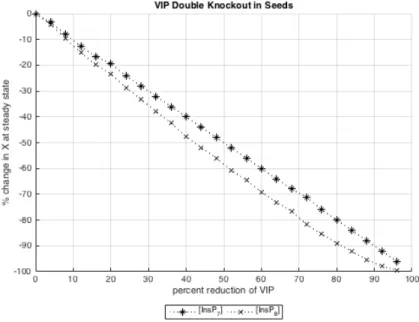
Of course, this trend for verification was not without exception. Figure 9 details an
interesting case in which the model predicts a steady decline in the concentration of both inositol
pyrophosphates in response to a VIP1/2 double knockdown. This behavior is not in line with
experimental observations that indicate that, in fact, little to no change occurs for these metabolites.
Intriguingly, however, there is no intuitable reason to conclude that the PPx-InsP branch would be
insensitive to a deliberate reduction of its only source. Could a missing link in the metabolic network
we have proposed explain this conceptual discrepancy? More specifically, and on the basis of expert
knowledge concerning this system, could a reaction between Ins(1,3,4,5,6)P5 and InsP7 more or less
effect of integrating this reaction (or, rather, set of reactions) using kinetic parameters for IPK, a
likely candidate for this interaction should it exist in actuality. While the specifics for this X-link are,
of course, almost entirely unknown and can only be theorized, the heuristic capacity of the model
supports our suspicion by sustaining the stability of diphosphoinositol pentakisphosphate. That the
model still predicts a steady decline in concentration for InsP8 may be a shortcoming of the model
to adequately capture material transfer without detailed kinetics or perhaps the consequence of yet
another uncharted connection.
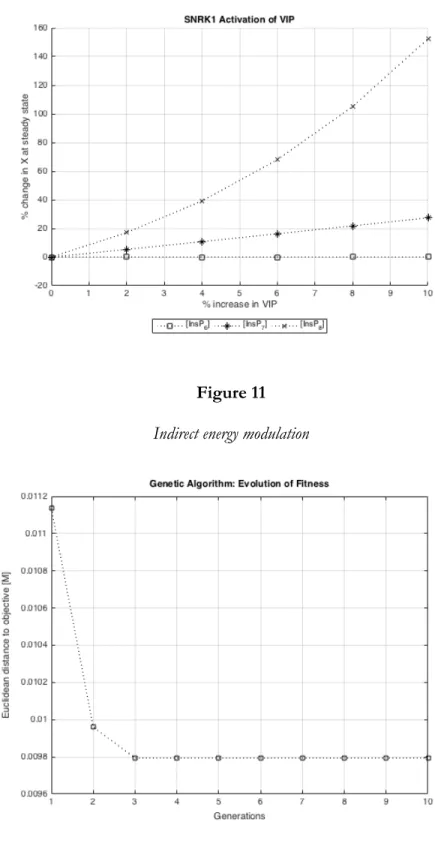
Much in the same way, we hope to investigate a correlation between the proliferation of
PPx-InsPs and low energy status. One possible mechanistic link between the PPx-InsP branch and
energetics could be SnRK1, a low-energy sensing kinase that phosphorylates VIP and augment’s its
activity [unpublished]. This cascade is believed to escalate the concentration of pyrophosphorylated
InsPs. Indeed, Figure 11 depicts the expected phenomenon in response to an indirect
implementation of SnRK1.
Figure 8
Figure 9
Divergent phenomena
Figure 10
Figure 11
Indirect energy modulation
Figure 12
Figure 13
An optimum
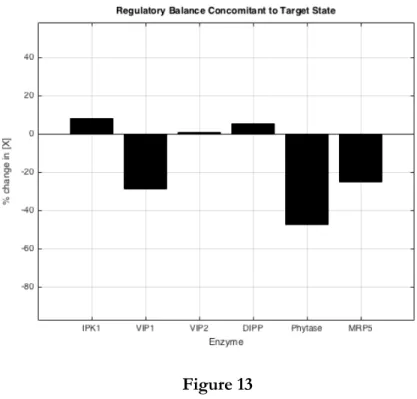
While the activity of SnRK1 could be modeled and evaluated by mapping its mechanism to
an increase in VIP’s activity, it is often desirable to reverse this process and begin by specifying a
target state. Since the low energy phenotype is of interest, we can use data on the relative abundance
of InPs in plants 24 hours without sucrose to estimate an appropriate objective. Since this batch of
data [unpublished] indicates relative abundance as a function of radioactive labeling, the time-course
difference between the WT and low energy state must be used to extrapolate absolute values via
percent difference. We ran optimization with the resulting target state using the genetic algorithm
described above. Figure 12 illustrates how the “fitness” of 20 individuals improved over 10
Discussion
Preliminary results suggest that while our model’s response to loss of function mutations
agreeably emulates some aspects of the expected results (Figure 8), divergent phenomena (Figure 9)
indicate a need for deliberate revision. It is thought that the observed discrepancies result from:
1. Considering a limited or incomplete window of reactions, 2. Disparity in reaction kinetics for different organisms, and / or 3. Assuming a constant state for cellular energetics
Fortunately, each of these issues can be readily addressed using the framework this project
has created. A key constraint to development has always been that the model be open to expansion.
As the X-link application demonstrated, the flexibility to add new reactions to the existing model
may very well be critical to reconciling differences between in silico and in vivo behavior and can even
reveal novel connectivity, so long as new channels are added on the basis of robust biochemical
theory and are implemented with caution (Figure 10).
Figure 14
Figure 15
Organizing a multiplicity of local optimums
Since a computational approach to biological modeling is inherently indirect, there will
inevitably be uncertainty propagation from input parameters to the results a system generates. This
is particularly true for this model given that parameters were obtained from experiments that involve
various, and often phylogenetically distant, organisms (e.g., yeast and humans). The influence of this
uncertainty is best illustrated by considering the model’s response to a VIP1/2 double knockdown
before and after having revised a set of parameters critical to activity in the PPx-InsP branch
(Figures 9 and 14). Clearly, this revision has a significant impact on the behavior we observe and
most likely stems from variance furnished by a disparity in reaction kinetics for different organisms.
Ideally, each parameter would be measured in the same environment using similar diagnostics by the
same team within a fixed interval of time. Practically, this process would be expensive, time
consuming, and prohibitive. Indeed, it is the daunting nature of this task itself that has led the state
with uncertainty metrics to determine which kinetic parameters are of value and therefore worth
resolving more precisely. To this end, this project has synthesized prevailing theoretical schemes and
measurable parameters into an in silico environment and customized a generic protocol for parameter
screening so that this goal may be accomplished.
Of the various forms of utility this model provides, its optimization framework is likely the
most attractive for its capacity to predict system-level organization and the regulatory balance
concomitant to specific states. With that said, however, it important to understand that there may be
a multiplicity of “optimal” profiles for a single target state, depending on how the algorithm is used
and on the location of the objective. In the former case, if only a few “individuals” are allowed to
evolve in the genetic algorithm over a handful of generations, the result will most likely be a local
optimum. This limitation is analogous to searching for a function’s critical points within a limited
interval. As Figure 12 illustrates, a local optimum can be found after only a few generations. In the
latter case, the model’s inherent dimensional constraints may prohibit the system from reaching a
global optimum, generating one or more possible locations that minimize the Euclidean distance
between the system’s state and its target without ever allowing the two to intersect. Singular value
decomposition was used to confirm that although this system’s state varies as a function of both its
enzyme profile and the flux vector ϕ, this model is nevertheless constrained to a complex subspace.
The issue of multiplicity in this context can be approached in one of two ways. The first is to
sacrifice computational cost for a deep search. Finding a global optimum may simply require the
evolution of a large population over many generations. This process can be improved by adjusting
the mutation rate. The second is to organize an array of optimums, found with the same argument,
using basic statistics. Of course, the variance each enzyme has would be of particular interest. Figure
15 illustrates this technique for the same low-energy objective described for Figure 13 and organizes
Figure 16
Vacuolar storage as a key limitation
Conclusion
As with any research project, this model has inspired a new set of questions for every answer
it helps facilitate. One key question concerns the model’s approach to emulating vacuolar storage of
InsP6. Since most translational applications and many basic research questions hinge on
understanding the mechanism for and influence of having stored large quantities of phytate, we
believe this feature should be emphasized as a focal point in future revision. Figure 16 illustrates
deficiency in contrast with the success this model has had in emulating in vivo behavior outside of
vacuolar space. The “noise” featured in this figure is the consequence of how the vesicle’s cap is
allowed to fluctuate with each initial condition. This measure ensures that the resulting steady states
are realistic but renders this space more or less non-responsive to modulation of the enzymatic
At any rate, iterative revision will help to improve the model’s efficacy and predictive power.
In the future, this model will likely help to address some of the long-standing issues that have for
years impeded our understanding of inositol phosphate signaling. Ultimately, this construct may
even serve as a tool in resolving certain features of the gene regulatory network that governs InsP
and PPx-InsP activity. As the results section illustrates, the flexibility and heuristic capacity of this
model are of value and suggest that this emulator may very well represent the state of the art insofar
as computational modeling of InsP signaling is concerned, certainly in that its parameters have
almost entirely been sourced from external assessments. In fact, to the best of our knowledge, there
are no other computation models for InsP signaling that employ a mathematical framework of
similar quality, particularly not any that consider this relatively unexplored set of reactions or have a
REFERENCES
1 Gillaspy GE. The role of phosphoinositides and inositol phosphates in plant cell signaling. Adv
Exp Med Biol. 2013; 991:141-57.
2 Shamsuddin AM, Vucenik I, Cole KE. IP6: a novel anti-cancer agent. Life Sci. 1997; 61(4):
343-354.
3 Shamsuddin AM. Inositol phosphates have novel anticancer function. J Nutr. 1995; 125(3):
725-732.
4 Monserrate JP, York JD. Inositol phosphate synthesis and the nuclear processes they affect. Curr
Opin Cell Biol. 2010; 22(3): 365–373.
5 Gillaspy GE. Signaling and the polyphosphoinositide phosphatase. In: Munnik T, editor. Lipid
signaling in plants. Berlin (Germany): Springer-Verlag.
6 Boss WF, et al. Basal signaling regulates plant growth and development. Plant Physiol. 2010;
154(2): 439–443.
7 Kuo HF, et al. Arabidopsis inositol pentakisphosphate 2-kinase, AtIPK1, is required for growth
and modulates phosphate homeostasis at the transcriptional level. Plant J. 2014; 80(3): 503–15.
8 Munnik T, Vermeer JE. Osmotic stress-induced phosphoinositide and inositol phosphate signaling
in plants. Plant Cell Environ. 2010; 33(4): 655–669.
9 Gillaspy GE. The cellular language of myo-inositol signaling. New Phytologist. 2011; 192(4): 823–
839.
10 Baghalian K, Hajirezaei MR, Schreiber F. Plant Metabolic Modeling: Achieving New Insight into
Metabolism and Metabolic Engineering. Plant Cell. 2014; 26(10): 3847-3866.
11 Wang JP, et al.Complete proteomic-based enzyme reaction and inhibition kinetics reveal how
monolignol biosynthetic enzyme families affect metabolic flux and lignin in Populus trichocarpa. Plant Cell. 2014; 26(3): 894-914.
12 Orth JD, Thiele I, Palsson BO. What is flux balance analysis? Computational Biology. 2010; 28(3):
13 Savagea MA, Voit EO, and Irvine DH. Biochemical Systems Theory and Metabolic Control
Theory: Fundamental Similarities and Differences. Mathematical Biosciences. 1987; 87: 127-145.
14 Bisswanger H. Enzyme Kinetics: Principles and Methods. Weinheim: Wiley-VCH; 2002.
15 Wittig U, et al. SABIO-RK: Integration and curation of reaction kinetics data. In: Leser U,
Naumann F, Eckman B, editors. DILS 2006, LNBI 4075, 94-103.
16 Beard DA. Simulation of Cellular Biochemical System Kinetics. Wiley Interdiscip Rev Syst Biol
Med. 2011; 3(2): 136–146.
17 Brenda: The Comprehensive Enzyme Information System [Internet]. BMFB and MWK; c2016.
Available from http://brenda-enzymes.info
18 Valluru R. Myo-inositol and beyond—emerging networks under stress. Plant Science. 2011;
181(4): 387-400.
19 Beecroft, P, Lott, JNA. Changes in the Element Composition of Globoids From Cucurbita
maxima and Cucurbita andreana Cotyledons During Early Seedling Growth. Canadian Journal of Botany. (1996); 74 (6): 838–847.
20 Nagy R, et al. The Arabidopsis ATP-binding cassette protein AtMRP5/AtABCC5 is a high affinity
inositol hexakisphosphate transporter involved in guard cell signaling and phosphate storage. The Journal of Biological Chemistry. 2009; 284(48): 33614-33622.
21 Abelson PH. A potential phosphate crisis. Science. 1999; 283(5410): 2015.
22 Thomas MP, Potter BVL. The enzymes of human diphosphoinositol polyphosphate metabolism.
The FEBS Journal. 2014; 281: 14-33.
23 Panzeri, et al. A defective ABC transporter of the MRP family, responsible for the bean lpa1
mutation, affects the regulation of the phytic acid pathway, reduces seed myo-inositol and alters ABA sensitivity. 2011; 191(1): 70-83.
24 Desai M, et al. Two inositol hexakisphosphate kinases drive inositol pyrophosphate synthesis in
plants. Plant J. 2014; 80(4): 642–653.
25 Stevenson-Paulik J, et al. Generation of phytate-free seeds in Arabidopsis through disruption of
inositol polyphosphate kinases. Proc Natl Acad Sci. 2005; 102(35): 12612–12617.
26 Cowieson AJ, Acamovic T, Bedford MR. Phytic acid and phytase: implications for protein
utilization by poultry. Poult Sci. 2006; 85(5): 878–885.
27 Brinch-Pedersen H. Engineering crop plants: getting a handle on phosphate. Trends in Plant
Science. 2002; 7(3): 118–125.
28 Rohwer JM, et al. Evaluation of a simplified generic bi-substrate rate equation for computation
29 Bohn L, et al. Quantitative Analysis of Phytate Globoids Isolated from Wheat Bran and
Characterization of Their Sequential Dephosphorylation by Wheat Phytase. Journal of Agricultural and Food Chemistry. 2007; 55: 7547-7552.
30 Phillippy BQ, Ullah AHJ, Ehrlich KC. Purification and some properties of inositol
1,3,4,5,6-pentakisphosphate 2-kinase from immature soybean seeds. The Journal of Biological Chemistry. 1994; 296(45): 28393-28399.
31 Sweetman D. Characterization of an Arabidopsis inositol 1,3,4,5,6-pentakisphosphate 2-kinase
(AtIPK1). Biochem J. 2006; 394: 95-103.
32 Sun Y. Inositol 1,3,4,5,6-pentakisphosphate 2-kinase from maize: molecular and biochemical
characterization. Plant Physiology. 2007; 144: 1278-1291.
33 Fridy PC. Cloning and characterization of two human VIP1-like inositol hexakisphosphate and
diphosphoinositol pentakisphosphate kinases. The Journal of Biological Chemistry. 2007; 282(42): 30754-30762.
34 Weaver JD, Wang H, and Shears SB. The kinetic properties of a human PPIP5K reveal that its
kinase activities are protected against the consequences of a deteriorating cellular bioenergetics environment. Biosci Rep. 2013; 33(2): 229-241.
35 Choi JH. Purification, sequencing, and molecular identification of a mammalian PPIP5 kinase that
is activated when cells are exposed to hyperosmotic stress. The Journal of Biological Chemistry. 2007; 282(42): 30763-30775.
36 Huang CF. Identification and purification of diphosphoinositol pentakisphosphate kinase, which
synthesizes the inositol pyrophosphate bis(diphospho)inositol tetrakisphosphate. Biochem J. 1998; 37: 14998-15004.
37 Phillippy BQ. Purification and catalytic properties of a phytase from scallion leaves. J Agric Food
Chem. 1998; 46: 3491-3496.
38 Wundenberg T, Mayr GW. Synthesis and biological actions of diphosphoinositol phosphates
(inositol pyrophosphates), regulators of cell homeostasis. Bio Chem. 2012; 393: 979-998.
39 Dorronsoro B, Alba E. Cellular Genetic Algorithms. New York: Springer; 2008.
40 Morris MD. Factorial Sampling Plans for Preliminary Computational Experiments.