Investigation of Photochemical Hydrogen Evolution from Ruthenium
Hydrides
By: Teddy Wong
Senior Honors Thesis Department of Chemistry
University of North Carolina at Chapel Hill 4/25/18
Abstract
Visible light-triggered hydrogen evolution from [(C6R6)Ru(bpy)(H)]+ (R=H, Me, bpy =
2,2ʹ-bipyridine) systems is reported. A range of arene Ru hydrides was isolated and their photochemical properties analyzed in water and acetonitrile. The electrochemical properties of
these complexes were then studied in water. Photolysis studies indicate a similar mechanistic
pathway as the Ir system. Understanding the chemical mechanism and electrochemical properties
will motivate future design of molecular photoswitchable hydride catalysts.
Introduction
The light-driven reduction of protons to form H2 has long been considered a promising
route towards the production of solar fuels.1 While the most advanced technologies are currently semiconductor photoelectrodes, molecular photocatalysts present a promising alternative to produce solar fuels like hydrogen gas. A single tunable molecular catalyst that can absorb light and produce H2 gas by itself would reduce the complexity of hydrogen generation compared to
similar multi-component methods.2,3 We pursued an approach in which a metal hydride is produced electrochemically, then absorbs light to generate H2.
One such candidate for solar fuel generation is [Cp*Ir(bpy)(H)]+ (Cp* = pentamethylcyclopentadienyl). We have previously shown that at high concentrations of Ir, near unity quantum yields can be achieved in a unique bimetallic self-quenching mechanism.4 In this
This study aimed to explore the photoreactivity of analogous ruthenium complexes. To our knowledge, use of Ru hydrides as photocatalysts is limited in scope, with the only example being Cp2*RuII (Cp*=C5Me5) which requires
chlorinated solvents and [H(OEt2)2][BarF4] as a
proton source.5 We hypothesize that the unique photochemical mechanism of [Cp*Ir(bpy)(H)]+ will extend to similar [(Ar)Ru(bpy)(H)]+ complexes. We propose a series of Ru hydrides that can produce hydrogen gas upon illumination in mild, aqueous conditions and be regenerated at low overpotentials and neutral pH (Scheme 1). Examples of [(Ar)Ru(bpy)(H)]+ are limited in catalysis and may have further potential in proton
transfer processes like its Ir counterpart.6,7 One difference between the Ir and Ru hydrides is the added flexibility to functionalize the neutral Ar moiety compared to Cp* or Cp. Demonstrating photochemical hydrogen evolution from Ru hydrides will expand our understanding of hydrogen evolution from metal hydrides and inform future catalyst development.
In this work, both acetonitrile and water are explored as solvents. Acetonitrile allows control of the pKa of the protons, minimizes speciation, and enables H/D experiments. Water is a
safe, abundant, and viable proton source that photoelectrocatalyst should target.2 Photolysis studies were conducted in both solvents and found near identical results. In this work, only the data from one solvent is shown for each sample.
carbon electrode
H2
H2O
X = H, COOH
visible light
2e–
H2O Ru
N N Cl + X X Ru N N H + X X
Scheme 1: Photoelectrochemical H2
Results and Discussion
Synthesis of complexes
[(p-Cymene)Ru(bpy)(Cl)][Cl] (1Cl), [(p-Cymene)Ru(bpy)(H)][Cl] (1H), [(C6Me6)Ru(bpy)(Cl)][Cl] (2Cl), and [(C6Me6)Ru(bpy)(H)][Cl] (2H) were prepared according
to literature.7 Purity of the hydride complexes was confirmed via NMR.
[(C6Me6)Ru(bpy)(H)]+[PF6]- (3H). Prepared using a modified prep of 2H. In an inert
atmosphere, 2Cl (18.0 mg, 0.0367 mmol) and excess NaBH4 (10.0 mg, 0.264 mmol) were stirred
for one minute in 4 mL of pH 7 0.05 M NaPi. An immediate color change occurs as the
yellow-orange 2Cl converts to very bright yellow-orange 2H. The resulting solution was quickly filtered onto an excess of NaPF6 (30 mg, 0.178 mmol), resulting in a bright orange precipitate. The precipitate
was collected and washed thoroughly with water, yielding 3H (18.9 mg, 91% yield). The 1H
NMR spectrum matched that of 2H.
[(C6Me6)Ru(4,4ʹ-COOH-bpy)(Cl)]+[Cl]- (4Cl). This complex is yet to be published in the
literature. A tube with a screw cap was charged with [(C6Me6)RuCl2]2 (30.0mg, 0.0436 mmol)
and 4,4ʹ-COOH-bpy (27.9 mg, 0.072 mmol). The tube was then sparged under nitrogen before 8 mL of dry DMF was added to the tube. The mixture was stirred and heated to 60° C for 12 hours. A bright red filtrate was filtered from unreacted bipyridine. Addition of a large excess of Et2O
afforded an orange brown precipitate. The solid was filtered and washed thoroughly with Et2O
Figure 1. 1H NMR of 4Cl in CD 3OD
Photodecomposition of [(p-cymene)Ru(bpy)(H)]+[Cl]-
To establish photochemical properties, an NMR study was performed to determine the photoreactivity of [(p-cymene)Ru(bpy)(H)]+[Cl]- (1H). Figure 2 shows the irradiation of identical samples of 1H over the course of 2 hours in CD3CN with no acid present.
Figure 2. NMR Scale Photolysis of 1H in CD3CN before irradiation (bottom), after 2
hours of irradiation (middle) and after 2 hours of no irradiation (top) Light: 455 nm, 250 mA
Ru N
N H
Cl
+ hν
CD3CN
Ru N
N Cl
+
H2 +
Initial 1.5H No Light
After 2 hours of irradiation at 443 nm, 56% of 1H had reacted in light compared to 5% reaction with no light. A miniscule H2 peak was observed by NMR in the irradiated sample.
Similar reactivity was observed in D2O, indicating 1H is photoreactive.
Over the course of 1.5 hours of irradiation in CD3CN, free p-cymene was observed. NMR
scale photolysis of 1H suggested that p-cymene was dissociating from the metal center at a high rate. Growth of free cymene occurred at a rate about 1/3 of the loss of 1H. Cymene dissociation in D2O was also observed, but at a slower rate.
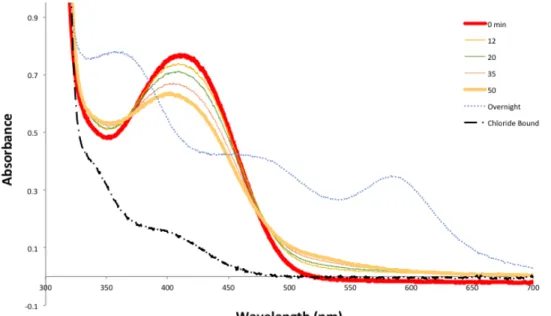
UV-Vis spectroscopy was used to analyze the change in hydride concentration over time. Photolysis over the course of one hour in H2O showed a decrease in absorbance at the max of
420 nm and a slight increase in absorbance at wavelengths greater than 475 nm (Figure 3). Irradiation overnight resulted in drastic changes to the absorbance. As a reference of what the exhaustively photolyzed product should resemble if Scheme 1 were followed, a sample of [(p-cymene)Ru(bpy)(Cl)][Cl] (1Cl) was dissolved at a similar concentration to the sample of 1H.
During photolysis, the MLCT of 1H at 423 nm decays as 1Cl is made in solution, as seen in Figure 3. However, the photolyzed sample does not approach the molar absorptivity of 1Cl, indicated by the increasing absorbance over time at wavelengths greater than 500 nm. Further, overnight photolysis results in the loss of any isosbestic points. These data imply cymene loss and are in agreement with the NMR data. This phenomenon makes this complex both difficult to study and a poor target for a catalyst. Thus, 1H was photoreactive and with evidence for hydrogen release but also photochemically unstable. Dissociation of ligands during photolysis is a well-known phenomenon, resulting in ligand loss.3 We therefore sought to prevent ligand dissociation with a more electron donating Ar.
Photolysis of [(C6Me6)Ru(bpy)(H)]+[X]-
C6Me6 was selected as a more donating Ar candidate, and the relative stability compared
to p-cymene complexes was compared. 1Cl and [(C6Me6)Ru(bpy)(Cl)]+[Cl]- (2Cl) were
dissolved in CD3CN and photolyzed for 4 and 18 hours. Photodissociation was not acid
dependent, so no acid was added. Almost no Ar loss of 2Cl was observed overnight relative to an internal standard compared to the 60% Ar loss of 1Cl.
[(C6Me6)Ru(bpy)(H)][Cl] (2H) was analyzed by NMR and UV-Vis spectroscopy with
Figure 4. 1H NMR photolysis of 2H in D2O before irradiation (top), no irradiation
(middle), and after 1.5 hours of irradiation (bottom)
Figure 4 shows the bpy region of 2H by NMR in D2O. Mass balance suggests the total
concentration of species remains constant at 5 mM, even after irradiation for 4 hours. After 1 hour of irradiation, only 12% of 2H remained compared to 97% of 2H with no light. The resonances of 2H drift due to intermolecular interaction between two species that are dependent on the concentration of the hydride. In both D2O and CD3CN, bubbles were visibly formed
during photolysis, suggesting H2 release. This was supported by a small H2 peak present in
CD3CN. These data suggests that 2H is photoreactive and does not quantitatively dissociate on a
time scale of photolysis. In CD3CN, an external acid source is necessary to achieve 100% yield.
Acetic acid (pKa of 23.51) and chlorophenol (pKa=29.14) were both found to be sufficiently
acidic to produce hydrogen, so acetic acid was used in this work when in organic solvent.
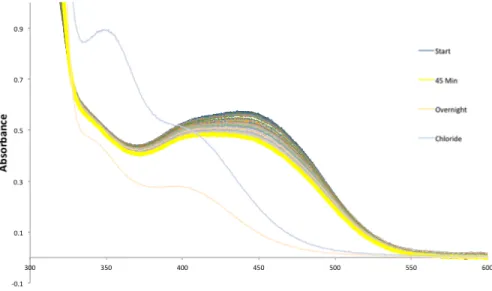
UV-Vis experiments with 2H were again done to investigate the incremental changes in hydride concentration. A 0.2 M solution of 2H in pH 7 0.1 M NaPi buffer was photolyzed over
the course of 45 minutes, and compared to a sample of 2Cl.
Ini$al' 1.5H'No'Light' 1.5H'With'Light' H2 hν Ru N N
H N Ru
N L
Cl +
Figure 5. UV-Vis Spectroscopy of 2H in pH 7 Buffer irradiated at 443 nm for 0 min (green) to 45 min (yellow). Included are spectra of the sample two days later (peach) and 2Cl (blue)
As seen 1H, over the course of the irradiation the MLCT band now at 450 nm drops as 2H converts into 2Cl (Figure 5). The apparent differences between the overnight sample and the
Figure 6. Quantum Yield of 2H in CH3CN with 100 mM HOAc irradiated at 443 nm
While still preliminary, the non-linear shape of the quantum yield vs concentration graph (Figure 6) is indicative a higher-order reaction mechanism. In the previous studies on Ir catalysts, concentrations up to 25 mM in Ir were examined. Eventually, once the quantum yield of higher concentrations of 2H can be measured, the slope of a log-log plot of Figure 6 should be indicative of the mechanism. For reference, the quantum yield of [Cp*Ir(bpy)(H)]+ at similar
concentrations is approximately 25 times greater than those measured in Figure 5, which confirms experimental observations of slower kinetics for 2H compared to Ir counterparts.
One concern while doing measurements of quantum yield for 2H was the purity of the hydride. Following literature preparation7 for 2H resulted in a 95/5 mixture of 2H/2Cl by 1H NMR. Partial impurities could impact the calculated quantum yield through processes such as excited state quenching, especially at high concentrations. Many variations to the literature preparation were made and are detailed in the methods section, although all proved unsuccessful. Difficulties in synthesis come from a combination of the slow protonation and low solubility of the neutral (C6Me6)Ru(bpy) (2). DFT calculations have indicated that in CH3CN the chloride
[(C6Me6)Ru(bpy)(H)]+[PF6]- (3H) was synthesized in a one-pot, quick reaction that
resulted in hydride that was 99/1 of 3H/2Cl by 1H NMR. While this synthesis results in clean hydride, it is no longer water-soluble. Thus, all characterization of this complex was done in CH3CN.
Figure 7. 1H NMR Scale Photolysis of 3H in CD3CN with 100 mM HOAc before irradiation
Figure 8: Expected photolysis products of 3H in CH3CN with 100 mM HOAc
Compared to the Ir hydride, the kinetics of the Ru hydride is much slower. Thus, these photolysis experiments take much longer to run and result in more opportunities for oxygen to leak into the cuvettes. Special precautions must be taken in future UV-Vis experiments to minimize oxygen leaking such as storing all samples in the glove box between each run.
High Concentration UV-Vis Spectroscopy
If the mechanism that Scheme 1 proceeds through is bimetallic self-quenching, then at high concentration of photocatalyst, we expect to reach near unity quantum yields. Analyzing the concentration of catalyst at these concentrations requires measuring the absorbance in the shoulder, as the detector is saturated at all other wavelengths.
Figure 9: UV-Vis Spectra of 3H at 0.7 mM in CH3CN with 100 mM HOAc with irradiation over
2 hours in a 1 cm path length cuvette
H OAc H2
hν
Ru N
N
H N Ru
N OAc
+ +
Ru N
N NCCH3
In Figure 9, the UV-Vis of a high concentration of 3H shows minimal change over time when it should be shifting left. At these concentrations only photons of long wavelength pass through the sample while changes in the rest of the spectra cannot be resolved. If the products of photolysis do not absorb light at these long wavelengths, then the change in absorbance at this shoulder should be reflective of hydride concentration.
Figure 10: Concentration of 3H by molar absorptivity at 523 nm in CH3CN with 100 mM HOAc
with irradiation in a 1 cm path length cuvette
Figure 11: UV-Vis Spectra of 3H at 0.7 mM in CH3CN with 100 mM HOAc with irradiation
over 2 hours in a 0.4 cm path length cuvette
Using a shorter path length cuvette allows more light to pass and prevent detector saturation like in Figure 9. Relative rates of reaction shown in Figure 9 and 11 are different due to different photon flux through a 1 cm or 0.4 cm path length cuvette, respectively. The molar absorptivity at 465 nm and in the shoulder at 523 can be compared to determine if using shorter path length cuvettes is a viable strategy to measure high concentration quantum yields.
Figure 12: Concentration of 3H at 465 and 523 nm in CH3CN with 100 mM HOAc with
Comparing the change in concentration predicted at the max and the shoulder in Figure 12 shows the absorbance in the shoulder initially rises as it did in Figure 9. In contrast, the concentration at λmax displays a linear slope that can be used to estimate quantum yield. This is
likely a result of the intermediate having a relatively greater molar absorptivity in the shoulder than at the λmax, so its impact is magnified in the shoulder where 3H does not absorb strongly.
Electrochemical Studies
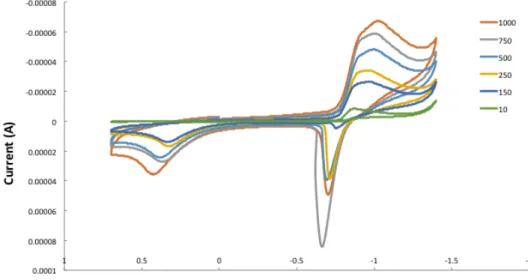
As seen in Scheme 1, the 2H species should be generated electrochemically from the 2Cl. We sought to establish a photoelectrocatalytic cycle with 2Cl as had been done with Ir.2 Cyclic voltammetry (CV) was first conducted to analyze the 2e- reduction of 2Cl to form (C6Me6)Ru(bpy) (2), which should be protonated at neutral pH to produce 2H. This reduction
was found to occur at -0.72 V vs Ag/AgCl.
Figure 13. Cyclic Voltammetry of 2Cl in the dark from 1000 mV/s (red) to 10 mV/s (black), with scan rates of 750, 500, 250, and 150 mV/s vs Ag/AgCl in pH 7 NaPi buffer
irreversible. Instead, the oxidative wave both increases at faster scan rates and is Gaussian in shape. These data suggest upon reduction 2Cl losses chloride and deposits on the electrode surface rather than being protonated. This explains both the Gaussian shape of the oxidation and how the current spikes as the scan rate increases. Similar issues have been previously published especially at high pH, but in these results the adsorption is more pronounced.7 One explanation for the adsorption is a combination of insolubility of 2 in neutral water and slow protonation kinetics to form 2H leading to preferential adsorption.
To increase solubility of the Ru0 species and prevent adsorption, [(C6Me6)Ru(4,4ʹ
-COOH-bpy)(Cl)]+[Cl]- (4Cl) was analyzed. The added carboxyl moieties should discourage Ru deposition onto the electrodes.
Figure 14. Cyclic Voltammetry of 4Cl with and without 443 nm light at 100 mV/s vs Ag/AgCl in pH 7 NaPi buffer
In contrast to Figure 13, the CV in Figure 14 is well behaved. The reduction of 4Cl at -0.9 V occurs irreversibly. Likewise, the reduction of 4H2O occurs irreversibly at -0.8 V. We
hypothesize the oxidation of 4H occurs at +0.3 V and oxidation of 4Cl occurs at +0.8 V. Near ±1 V, the current begins to take off. The increase at +1 V is likely due to oxidative ligand loss
Ru-Cl/H2O (2+/0+)
Ru-H (3+/2+)
resulting in some Ru oxide species that catalytically oxidize hydroxide to oxygen. Likewise at -1 V, the current increase may be due to formation of the hydride that can subsequently be reduced to release H2 or some other chemistry. Interestingly, there is slight photochemical current
enhancement of the reduction near -1 V.
Figure 15. Cyclic Voltammetry of 4Cl with added NaCl 100 mV/s vs Ag/AgCl
An expanded sweep range supports the theory that catalytic activity is occurring near ±1
Figure 16. Bulk electrolysis of 4Cl at -1.1 V vs Ag/AgCl
Synthesizing [(C6Me6)Ru(4,4ʹ-COOH-bpy)(H)]+[Cl]- (4H) chemically is challenging, so
an electrochemical method was sought instead. The electrolysis occurs quickly and is indicated by a color shift from bright yellow to bright red. Approximately 2.4 mol e- were passed for each mol of Ru, which is near stoichiometric. Using a 50/50 mixture of H2O and D2O allows the
hydride proton to be visualized at the cost of spectra quality. GC analysis was done to confirm the presence of hydrogen, with further characterization forthcoming.
Conclusions and Future Work
An investigation of the photocatalytic behavior of several Ru hydrides for H2 generation
has been conducted. [(p-Cymene)Ru(bpy)(H)]+[Cl]- was found to dissociate under photolysis conditions. [(C6Me6)Ru(bpy)(H)]+[Cl]- and [(C6Me6)Ru(bpy)(H)]+[PF6]- reacted under
irradiation to likely produce H2, and some preliminary steps using UV-Vis and NMR have been
-1000
-900
-800
-700
-600
-500
-400
-300
-200
-100
0
0
0.1
0.2
0.3
0.4
0.5
taken towards quantifying said mechanism. To confirm the presence of H2, GC experiments have
been done.
One key step in this project will be to develop a technique to study the reaction kinetics at high concentration of Ru catalyst. This could be done using NMR photolysis experiments, but the time cost and quantifying the photon flux through a cylinder present a challenge. Another approach is to analyze the intermediates that are produced upon excitation and address the shoulder in the Ru hydrides by UV-Vis. One final approach would be to use GC to quantify the H2 in the headspace to estimate reaction completion.
Finally, more experiments will need to be done utilizing [(C6Me6)Ru(4,4ʹ
-COOH-bpy)(Cl)]+[Cl]-. Current efforts are directed at controlled potential electrolysis (CPE) to isolate the hydride and quantify H2 production. Hydride generation through chemical means is being
explored as well. Other electrochemical studies such as shuttered CPE and chronoamperometry will give kinetic information about the catalysis. Finally, photolysis experiments to determine quantum yield will be used to give insight into the mechanism.
Methods
General Considerations
All procedures were carried out under nitrogen except where noted. All solutions containing metal hydride species were protected from ambient light during preparation to prevent excited state reactions. All NMR spectra were collected on a Bruker 400NB instrument unless otherwise noted. [(p-Cymene)Ru(bpy)(Cl)][Cl] (1Cl), [(p-Cymene)Ru(bpy)(H)][Cl] (1H), [(C6Me6)Ru(bpy)(Cl)][Cl] (2Cl), and [(C6Me6)Ru(bpy)(H)][Cl] (2H) were prepared according
NMR-Scale Photolysis. Photochemistry from 1H and 2H was followed by 1H NMR spectroscopy. For acetonitrile, the hydride was dissolved into 1100 µL of CD3CN to result in a
solution approximately 5 mM in ruthenium. Then a mesitylene standard (approximately 8 mM, exact concentration varied by experiment) and excess acetic acid (approximately 100 mM) were added to create two NMR samples.
For water, a 0.1 M NaPi buffer at pD 7.0 in D2O was prepared. The hydride was
dissolved into 1100 µL of the buffer to result in a solution approximately 5 mM in ruthenium. A dioxane standard was added (approximately 7 mM) two create two NMR samples.
Photolysis was done 50 cm from the Thorlabs Lamp at 443 nm at 250 mA over the course of 2 hours.
UV-Vis Spectroscopy. Approximately 0.2 mg of 1H, 2H, or 3H was dissolved into 2 mL
(0.5 mM) of either acetonitrile with excess acetic acid or 0.1 M NaPi pH 7 H2O. From this stock
samples of varying concentration were prepared. Upon removal from the glove box, the cuvettes were promptly wrapped with parafilm to minimize oxygen leakage. Photolysis was done at 50 cm from a Thorlabs lamp at 443 nm and 250 mA (photon flux ~3.94∗10!![1−10!!!!"] mol
photon per minute).2
Electrochemistry. Electrochemical experiments were done using a glassy carbon working
electrode, Ag/AgCl reference electrode (3 M NaCl), and a platinum wire counter electrode. 6 mL of 0.1 M NaPi pH 7.0 H2O were sparged for 15 minutes with N2. In a divided cell, 3 mL of
References
(1) Walter, M. G.; Warren, E. L.; McKone, J. R.; Boettcher, S. W.; Mi, Q.; Santori, E. A.; Lewis, N. S. Chem. Rev. 2010, 110 (11), 6446–6473.
(2) Pitman, C. L.; Miller, A. J. M. ACS Catal. 2014, 4 (8), 2727–2733.
(3) Perutz, R. N.; Procacci, B. Chem. Rev. 2016, 116 (15), 8506–8544.
(4) Chambers, M. B.; Kurtz, D. A.; Pitman, C. L.; Brennaman, M. K.; Miller, A. J. M. J. Am. Chem. Soc. 2016, 138 (41), 13509–13512.
(5) Rivier, L.; Peljo, P.; Vannay, L. A. C.; Gschwend, G. C.; Méndez, M. A.; Corminboeuf, C.; Scanlon, M. D.; Girault, H. H. Angew. Chemie - Int. Ed. 2017, 56 (9), 2324–2327.
(6) Wiedner, E. S.; Chambers, M. B.; Pitman, C. L.; Bullock, R. M.; Miller, A. J. M.; Appel, A. M. Chem. Rev. 2016, 116 (15), 8655–8692.
(7) Pitman, C. L.; Brereton, K. R.; Miller, A. J. M. J. Am. Chem. Soc. 2016, 138 (7), 2252– 2260.
(8) Matsubara, Y.; Fujita, E.; Doherty, M. D.; Muckerman, J. T.; Creutz, C. J. Am. Chem. Soc. 2012, 134 (38), 15743–15757.
![Figure 1. 1 H NMR of 4Cl in CD 3 OD Photodecomposition of [(p-cymene)Ru(bpy)(H)] + [Cl] -](https://thumb-us.123doks.com/thumbv2/123dok_us/8330314.2209634/5.918.230.684.106.410/figure-nmr-cl-cd-od-photodecomposition-cymene-ru.webp)