Integrating Green Stormwater Infrastructure into the Built Environment
by
Avery Livengood
A Masters Project submitted to the faculty of the University of North Carolina at Chapel Hill
in partial fulfillment of the requirements for the degree of Master of City and Regional Planning
in the Department of City and Regional Planning
Chapel Hill
2015
Approved by:
Integrating Green Stormwater Infrastructure into the Built Environment
By Avery Livengood
Masters project submitted in partial fulfillment of the requirements for the Master of City & Regional Planning degree in the Department of City & Regional Planning at UNC Chapel Hill.
Introduction
Cities are increasingly looking to green stormwater infrastructure (GSI) to attain Clean Water Act compliance. GSI practices are seen as a sustainable and vital approach to effectively mitigate water quality impairment associated with wet weather flows. GSI systems may also provide a wide range of additional ecosystem services and public and private benefits. While the U.S. Environmental Protection Agency (EPA) has effectively driven widespread adoption of stormwater management regulations requiring the control of stormwater runoff on-site, these regulations typically only apply to new development and redevelopment on large sites. In older cities and neighborhoods, these regulations do not address a significant portion of developed land that falls below the regulatory size threshold.
EPA, state governments, and non-profit organizations have developed an abundance of guidance materials, case studies, and handbooks to help municipalities incentivize the
implementation of GSI practices on such properties. Much of the guidance is focused on incentives that directly impact local finances, including grants, tax credits, stormwater billing credits, and rebates. Financial incentives are typically outside the control of local planning departments. However, stormwater management is closely linked to local land use decisions. Land use decisions affect both the need for better stormwater management, as well as property owners’ ability to finance, construct and maintain stormwater infrastructure.
Incentive zoning has been proposed as a relatively low-cost tool that can be
implemented by local planning departments to facilitate GSI adoption (Carter & Fowler, 2008). While there has been little discussion in the peer-reviewed literature on the effectiveness of this tool for GSI implementation, a simple survey of its prevalence among communities engaged in stormwater management might inform whether local governments view incentive zoning as a useful way to manage stormwater on developed sites. This project identifies examples of zoning incentives for green stormwater infrastructure from a sample of 15 U.S. cities, through review of local zoning codes, land development ordinances, and subdivision regulations. The variety of zoning incentives used for GSI were compared to those utilized for other public amenities, in order to determine whether general incentive zoning practices can inform strategies for incentivizing GSI.
Clean Water Act Coverage of Wet Weather Flows
Provision of stormwater management services became commonplace in U.S. cities during the 20th century to promote better sanitation and prevent flooding (Porse, 2013). Flood control was necessitated by increased impervious cover in urban areas, which decreased the capacity for rainfall to infiltrate and evaporate before forming runoff. Traditional, centralized stormwater management approaches involved routing stormwater away from buildings as quickly as possible, via gutters and subsurface storm drains (Roy et al., 2008). In many older cities, stormwater drains also served as sanitary sewers to help flush the systems clean of waste (Tarr, 1988).
Though effective for achieving the intended purpose at the time, these systems have had many unintended negative consequences for water quality. Reduced stormwater infiltration lowers the water table and reduces baseflows, in turn reducing the capacity of natural systems to dilute the pollution entering streams and rivers. Higher peak runoff and shorter lag times can erode channel banks and cause sedimentation in streams (Poff et al., 1997). Higher peak flows can also overwhelm drainage infrastructure. In cities with combined sewer systems (CSS), stormwater can cause overflows of combined sanitary and storm sewage (CSOs) into nearby streams and rivers. Untreated sanitary sewage contains disease-causing microbial pathogens and toxins, and contributes to eutrophication. An estimated 850 billion gallons of combined sewage are discharged by CSOs nationwide each year (U.S. EPA, 2004).
Cities with municipal separate storm sewer systems (MS4s) and sanitary sewer systems (SSS) also contribute to water quality impairment. High concentrations of built-up particulate matter, nutrients, and contaminants deposited on urban surfaces are washed off and drained into receiving waters during storms via MS4s. Pollutant and sediment concentrations are far higher in MS4 discharges than in discharges from treatment facilities, contributing to the status of many impaired rivers (13%), lakes (21%), and estuaries (45%) (U.S. EPA, 1999). Poorly maintained SSS infrastructure can intercept stormwater through leaks and breaks, resulting in sanitary system overflows (SSOs) with impacts similar to CSOs. EPA estimates that SSOs cause 3 to 10 billion gallons of untreated sanitary discharges per year (U.S. EPA, 2004).
The combined effect of these wet weather flows impairs drinking water quality, in-stream habitat, and recreational and economic uses of rivers, lakes, estuaries, and beaches. In 1990, EPA expanded coverage of Clean Water Act regulations to include wet weather flows in order to spur state and local efforts to address the widespread problem. MS4s, SSS and CSS are now regulated under Section 402 of the Clean Water Act, which requires National Pollution Discharge Elimination System (NPDES) permits to discharge into waters of the U.S. An estimated 1,017 cities are covered by the Phase I regulations to reduce wet weather flows (U.S. EPA, 2000). Approximately 5,040 cities are designated for Phase II implementation (U.S. EPA, 1999).
EPA developed a CSO Control Policy in 1994 to coordinate federal, state and local efforts to reduce CSOs, and codified the Policy in 2001 (59 Fed. Reg. 18688). The Policy requires
implementation of nine minimum controls and the development and implementation of a Long-Term Control Plan. Control plans are developed locally to fit local conditions, but must include an alternatives analysis and cost benefit analysis to support the selection of strategy or
strategies to improve water quality. NPDES permits are issued to municipalities with combined sewer systems contingent on implementation that meets state and federal standards for
Local governments can take two types of approaches to reduce the incidence and impacts from wet weather flows: centralized approaches that increase the capacity of existing drainage infrastructure, or on-site approaches that filter out key pollutants and decrease the total volume of stormwater entering the system during peak flows. Centralized approaches include constructing underground stormwater holding tanks, replacing combined sewer systems with separate sewer lines, and treating stormwater at a wastewater treatment facility prior to release into receiving waters. These approaches are constructed in public right-of-ways and on public or utility property, and are managed and maintained by a central agency (Porse, 2013). On-site approaches, also known as green stormwater infrastructure (GSI) practices, mitigate contaminated runoff at its source. These approaches are typically land-based (above-ground) and can be located on either public or private property.
Green Stormwater Infrastructure
Green stormwater infrastructure (GSI) consists of engineered stormwater management systems that mimic the retention, infiltration, and evapotranspiration components of the natural water cycle. As the name implies, GSI systems are typically vegetated, using soil and plants to treat, infiltrate, and transpire stormwater before it can form runoff. Common vegetated GSI systems include green roofs, street trees with stormwater infiltration pits, bioswales, rain gardens, and stormwater wetlands. Some non-vegetated stormwater infrastructure systems are also categorized as GSI because they control runoff on-site and can mimic the retention and infiltration components of natural systems. These include rain barrels, downspout
disconnections, and permeable paving (Rouse & Bunster-Ossa, 2013). The Clean Water Act has driven much of the recent activity and interest in GSI at the local level (Roy et al., 2008). EPA is increasingly encouraging municipalities to use GSI to meet permitting requirements for Phase I and Phase II MS4 systems and as a strategy in local CSO Long-Term Control Plans and Total Maximum Daily Load Implementation Plans (Stoner & Giles, 2011, Grumbles 2007).
In addition to attenuating peak flows and improving water quality, GSI systems have been found to provide a number of other ecosystem services and environmental benefits.
Vegetated systems can reduce the urban heat island effect (Susca, Gaffin, & Dell’Osso, 2011) and reduce demand for air conditioning (Castleton, Stovin, Beck, & Davison, 2010; Fioretti, Palla, Lanza, & Principi, 2010). Reduced energy demand is linked to improved air quality (Akbari, Pomerantz, & Taha, 2001), and vegetated systems can also improve local air quality by
intercepting particulate matter and absorbing gaseous pollutants during photosynthesis (Yang, Yu, & Gong, 2008). Reuse systems like cisterns and rain barrels reduce demand on the peak capacity of water distribution systems in addition to wastewater treatment systems, providing a cost savings to users and utilities (Heaney, Wright, & Sample, 1999).
with using land for GSI, more space-efficient practices are likely more appropriate and cost-effective (Roy et al., 2008).
In addition, different GSI practices have differing capacities to attenuate peak wet weather flows and remove pollutants; thus the primary source of impairment may dictate the preferred type of GSI for particular localities or sites. For example, detention ponds may be used to attenuate peak flows from frequent storm events, but may be less successful at
mitigating the damage associated with high flows relative to many smaller infiltration practices (Roesner, Bledsoe, & Brashear, 2001; Roy et al., 2008). The storage capacity or pollutant removal efficiency of a particular GSI practice also depends on the design, which must account for site conditions and local engineering standards (Roesner et al., 2001; Roy et al., 2008). Because many GSI practices are new relative to traditional stormwater management infrastructure, there is a paucity of performance and cost data available for weighing GSI practices against one another and against centralized infrastructure practices (Roy et al., 2008). The distributed nature of the systems requires greater awareness and knowledge among professionals and property owners, to understand which practices are best applied to specific circumstances, and how to design, pay for, and maintain the systems (Porse, 2013).
While centralized approaches align with traditional stormwater management
governance structures, and may therefore be easier to manage (Porse, 2013), GSI approaches may be more cost-effective in some circumstances, particularly when the additional public and private benefits are accounted for (Roy et al., 2008; U.S. EPA, 2013; Wallner, 2014). Cost-benefit analyses are required for CSO control plans, allowing local governments the opportunity to account for the non-market benefits associated with GSI approaches. However, some GSI practices have higher up-front costs than conventional materials (Booth & Leavitt, 1999) and the non-market benefits of the higher-cost option cannot balance out a negative cash flow. Funding is the primary challenge identified by local communities for CSO control plan implementation (U.S. EPA, 2001).Funding is also a major concern for local governments facing NDPES Phase II requirements (White & Boswell, 2007). Thus, cities are seeking tools to achieve an efficient balance of centralized and GSI approaches to comply with EPA regulations. Planners have the potential to contribute innovative approaches to GSI implementation that stretch local resources to achieve compliance (White & Boswell, 2007).
Existing Implementation Guidance
As a majority of land in cities is privately-owned, the private sector must be engaged in GSI implementation in some way. This can be accomplished via regulations that compel GSI implementation on specific sites, or through financial, regulatory, and recognition-based
incentives that encourage GSI implementation by private actors (Porse, 2013). Most likely, cities will need to use an integrated approach that includes regulation, incentives, and direct land-acquisition (Carter & Fowler, 2008) as well as traditional infrastructure financing mechanisms (Young, 2011).
Stormwater regulations required under the NPDES program have already captured the low-hanging fruit by requiring GSI implementation on new development and redevelopment projects that disturb sites of 1 acre or more (Thurston et al., 2008; U.S. EPA, 2005). EPA’s model post-construction stormwater runoff control ordinance encourages municipalities to set
performance-based standards for removal of total suspended solids, heavy metals, phosphorus, and other pollutants for all subdivisions and site plan applications above a certain size
5,000 square feet for applicability of the ordinance (U.S. EPA, 2012). Development and
redevelopment on smaller sites would not have to comply with post-construction controls, or be compelled to implement GSI on-site. Thus, in cities with a majority of parcels below the size threshold, standard stormwater regulations will not compel development and redevelopment to control runoff on-site. In addition, only a small percentage of developed area is redeveloped each year, meaning cities with extensive existing development will face the greatest challenge in managing stormwater runoff with GSI (Thurston et al., 2008).
To demonstrate compliance with Clean Water Act regulations over the time frame of an NPDES permit deadline, cities need additional tools to compel and incentivize GSI
implementation. EPA, state governments, and non-profit organizations have developed copious literature on stormwater best management practices,1 GSI financing, and implementation strategies attempting to address this gap (Bitting & Kloss, 2008; Missouri DNR, 2012; U.S. EPA, 2008, 2009a, 2009b, 2010) as well as guidance on quantifying the co-benefits of these systems to better justify their widespread adoption by both the public and private sector (Center for Neighborhood Technology, 2010; Clements et al., 2013; Garrison & Hobbs, 2011; Odefey et al., 2012; Rouse & Bunster-Ossa, 2013). These strategies tend to focus on financial mechanisms such as grants, tax credits, stormwater billing credits, and rebates to incentivize GSI in existing developed areas and on private property. Of 43 local governments surveyed by EPA, nearly all offered financial incentives but only five included regulatory incentives such as floor area bonuses and expedited permitting (U.S. EPA, 2009a).2
Strategies within the purview of city planning departments have not factored as heavily in the guidance literature, despite the strong connection between land use change and the volume of stormwater runoff and the obvious relevance to a land-based stormwater
management approach. There is evidence that local governments understand this connection but have not yet identified strategies to incorporate stormwater management into planning and zoning (White & Boswell, 2007). Green infrastructure has the lowest presence in municipal zoning ordinances (9.4%) relative to other zoning strategies designed to protect ecosystems and natural functions (Jepson & Haines, 2014).
EPA does provide some guidance on integrating open space and permeable area requirements into zoning ordinances (U.S. EPA, 2014), but this primarily applies to large-scale greenfield development, an anomaly in older cities where wet weather flows are most
problematic. Beyond open space requirements, zoning regulations can mandate GSI
implementation on specific sites or in concert with specific uses. Zoning regulations can also create incentives for GSI by relaxing regulatory standards. Moreover, zoning tools do not direct impact the capital budgets of local governments, unlike direct public provision of stormwater management infrastructure; thus, zoning tools may help address local concerns about
insufficient funding for achieving Clean Water Act compliance. This project seeks to fill the gap in the guidance literature, by identifying specific examples of zoning incentives for
implementation of GSI practices.
1 Although best management practice is a term often used interchangeably with green stormwater infrastructure, here it reflects a different meaning. Best management practices, as used by EPA with regard to the NPDES program, “include, but are not limited to, treatment requirements, operating procedures, or practices to control plant site runoff, spillage, leaks, sludge or waste disposal, or drainage from raw material storage” (U.S. EPA, 2001, GL-1). EPA’s National Menu of Stormwater Best Management Practices includes public education, public involvement, illicit discharge detection and elimination, construction management, post-construction management, and pollution prevention. Construction and post-construction management practices could include, but are not required to include GSI practices.
Incentive Zoning
Zoning incentives were conceptualized in the 1960s as a flexible way to offset the impacts of new development without adding to the regulatory burden of the private sector (Meshenberg, 1976). The tool grants developers exemptions, bonuses, or credits with regard to existing land use regulations in exchange for the provision of a public amenity. For example, a developer might earn approval to construct a higher-density building than would otherwise be allowed in a base zoning district by incorporating a public plaza into the design and
construction of the site. In this example, the public would benefit from having access to the plaza without the obligation to finance its construction, the developer would gain revenue from the additional floor area, and the impacts of the increased population density would be offset by the provision of new public space.
Local governments use incentive zoning to provide a wide variety of public amenities including affordable housing, open space, public restrooms, job training, transit improvements, daycare facilities, public art, historic preservation, and more (Lassar, 1990; Yowell, 2007).
Incentive zoning programs are legally defensible so long as the program is voluntary, the public amenity is rationally related to the incentive (per Nollan v. California Coastal Commission, 483 U.S. 825, 1987), and the local government has the legal authority to create the program (Benson, 1969). Some states authorize local governments to use “innovative land use regulations”
generally, whereas others only allow incentives that are explicitly identified under state law for specified purposes (Morris, 2000).
The effectiveness of incentive zoning is challenging to measure, as it is impossible to know what could have occurred without the incentives, given local market forces. Presumably, programs will generate more participation during periods of active real estate development and less during downturns (Lassar, 1990). This may explain why evaluations of incentive programs have drawn divergent conclusions about effectiveness at different points in time (Calavita & Grimes, 1998; Johnston, Schwartz, Wandesforde-Smith, & Caplan, 1989; Ryan & Enderle, 2012).
Differences in program effectiveness are also tied to the valuation of incentives (Seyfried, 1991). Incentives must be sufficient to encourage utilization by the private sector while not incurring too great an impact (Morris, 2000). Generous incentives are more likely to encourage participation (Johnston et al., 1989; Seyfried, 1991; Skiles, 2003), but may be viewed as a “windfall” for developers at the expense of the public. Although zoning incentives are not typically associated with any direct costs to local government, they do have indirect costs – otherwise the justification for the underlying regulations would not exist. Thus, local
governments must carefully balance the public welfare with the attractiveness of the incentives offered.
As GSI technology is relatively new, research examining the effectiveness of incentive zoning in generating GSI has yet to be conducted and incentive valuation strategies for GSI have not been systematically identified. However, cities are seeking creative approaches to encourage GSI and are willing to test unproven but promising ideas, including zoning
incentives (Carter & Fowler, 2008). The diffusion of cutting-edge policy ideas can be facilitated via model codes or guidance that local governments can copy or adapt to their local political and environmental contexts (Koski, 2010). This project used a sample of local zoning ordinances to identify promising examples of zoning incentives designed to encourage implementation of GSI. Examples from these ordinances were incorporated into a model ordinance that is
Sample of Local Zoning Ordinances
In order to identify common and creative types of zoning incentives for GSI among a manageable selection of local governments, this project reviewed a sample of 15 local zoning ordinances from cities recognized by EPA for innovative approaches to GSI implementation. A list of 59 communities was generated from EPA handbooks and case studies on GSI (EPA, 2009 a; U.S. EPA 2009 b; U.S. EPA, 2010). Utility districts and international jurisdictions were
removed from this list, leaving only U.S. jurisdictions with local land use authority, as other types of local governments do not have the authority to enact incentive zones. The remaining jurisdictions were sorted by type, leaving 41 cities (77% of total) and 12 counties (23% of total). A random sample was taken from the list of cities using a random number generator (Table 1).
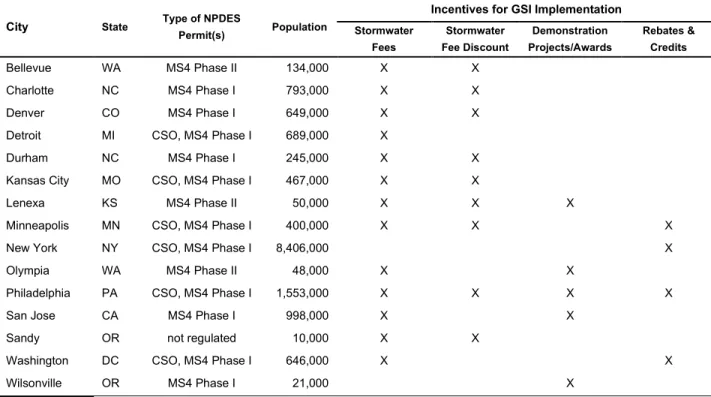
Table 1. Characteristics of Sample
City State Type of NPDES
Permit(s) Population
Incentives for GSI Implementation Stormwater
Fees
Stormwater Fee Discount
Demonstration Projects/Awards
Rebates & Credits
Bellevue WA MS4 Phase II 134,000 X X
Charlotte NC MS4 Phase I 793,000 X X
Denver CO MS4 Phase I 649,000 X X
Detroit MI CSO, MS4 Phase I 689,000 X
Durham NC MS4 Phase I 245,000 X X
Kansas City MO CSO, MS4 Phase I 467,000 X X
Lenexa KS MS4 Phase II 50,000 X X X
Minneapolis MN CSO, MS4 Phase I 400,000 X X X
New York NY CSO, MS4 Phase I 8,406,000 X
Olympia WA MS4 Phase II 48,000 X X
Philadelphia PA CSO, MS4 Phase I 1,553,000 X X X X
San Jose CA MS4 Phase I 998,000 X X
Sandy OR not regulated 10,000 X X
Washington DC CSO, MS4 Phase I 646,000 X X
Wilsonville OR MS4 Phase I 21,000 X
Tools were identified based on the tables and case studies in U.S. EPA (2009 a); U.S. EPA (2009 b); and U.S. EPA (2010). Jurisdictions may use tools that were not identified in these documents, as each guide and report focused on different sets of tools. Jurisdictions that use stormwater fee discounts as an incentive for GSI were assumed to use stormwater fees as well, even if not specified in the case studies. Population is based on Census Bureau 2013 Estimates of the Resident Population for Incorporated Places rounded to the nearest 1,000.
These 15 jurisdictions represent 11 different states and the District of Columbia, and include Phase I and Phase II MS4 communities as well as CSO communities. All seven of the CSO communities also have MS4 systems, though the extent of the separate systems varies by city.3 These communities are assumed to be highly likely to have adopted incentive zoning for GSI because they were all using at least one type of innovative tool to encourage GSI adoption as of 2010. Although only four of the 15 cities in the sample were identified by EPA as using
development incentives to encourage GSI, additional jurisdictions may have adopted incentive zoning in the five years since the EPA reports were published.
Methods
Each jurisdiction’s zoning ordinance was downloaded as a PDF and linked as a primary document (PD) for content analysis in Atlas.ti v.7 (Atlas.ti GmbH, 2015). Content analysis is a qualitative research method by which standardized review procedures are used to make inferences from textual data (Weber, 1990). For the purposes of this project, the textual data consists of land use management ordinances, unified development ordinances, subdivision regulations, and other types of local land use codes, which are considered equivalent to and collectively referred to as “zoning” codes. Local stormwater regulations were not included in the analysis, though they were used to determine the regulatory thresholds for stormwater management controls when threshold information was not stated in the zoning ordinance.
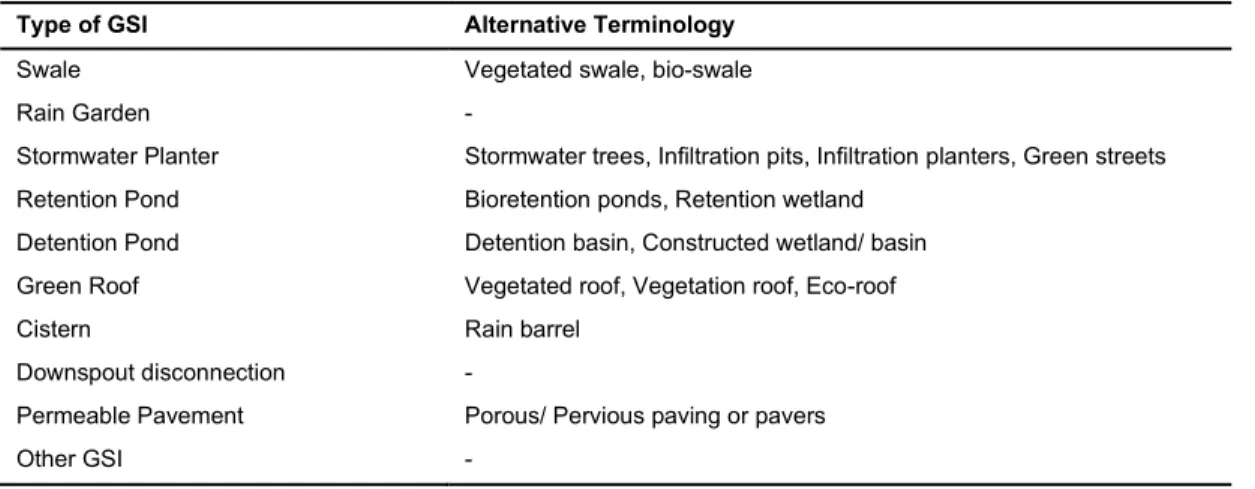
Criteria for reviewing zoning ordinances were designed to gauge the presence or absence of different types of incentives relating to green stormwater infrastructure. Identifiers for general types of GSI practices and general categories of incentives and zoning tools were drawn from stormwater management and growth management literature respectively. Terminology relating to stormwater management is regional in nature, and has evolved over time to address changing technologies, practices, and scope (Fletcher et al., 2014). Because nomenclature varies from jurisdiction to jurisdiction, variations of each practice and tool name were included in the review protocol. Names and categories of practices were drawn from Fletcher et al. (2014). A total of 10 types of GSI practices were included in the coding protocol (Table 2) (see Appendix A for full Protocol).
Table 2. GSI Practices
Type of GSI Alternative Terminology
Swale Vegetated swale, bio-swale
Rain Garden -
Stormwater Planter Stormwater trees, Infiltration pits, Infiltration planters, Green streets Retention Pond Bioretention ponds, Retention wetland
Detention Pond Detention basin, Constructed wetland/ basin Green Roof Vegetated roof, Vegetation roof, Eco-roof
Cistern Rain barrel
Downspout disconnection -
Permeable Pavement Porous/ Pervious paving or pavers
Other GSI -
and that density bonus could be transferred to other sites, both the bonus and the transferable development rights were coded.
Because the efficacy of zoning incentives is closely tied to the value of incentives offered, the review process was intended to identify the development standards for GSI associated with different types of incentives. Standards for GSI practices might include the minimum volume of stormwater managed or the minimum land area of the GSI practice. Objective, quantifiable development standards help to ensure that the public amenities are of an acceptable quality (Lerable, 1995). Incentives should be similarly objective and quantifiable (Morris, 2000). The objective and quantifiable development standards used by the sample cities were identified during the review process and incorporated into the model ordinance where applicable.
Code quality criteria were used to identify high-quality code language for inclusion in the model ordinance. Features associated with high-quality ordinance structure included clear definitions, a purpose statement providing statutory intent, explanation of review and
permitting procedures, and enforcement provisions (Lerable, 1995; Morris, 2000). Where
incentives for the provision of GSI were present, development standards and indicators of code quality were also coded. Incentives that were present but unrelated to GSI were also coded, but the development standards and code quality associated with these incentives were not coded.
A single reviewer read each zoning ordinance, focusing on chapters pertinent to development standards, and coded the presence/absence of each type of GSI and each type of incentive. Although it is generally preferable for multiple reviewers to review each ordinance in order to evaluate the reliability of the codes (Weinberger et al., 1998), this project is focused on fairly objective presence/absence criteria and did not require reconciling subjective, normative codes. The protocol contained a clear list of terms to be searched and coded in each ordinance, providing as much objectivity as possible to the single set of codes produced from the review.
The co-occurrence tool in Atlas.ti was used to identify codes where particular incentives were used for particular types of GSI, or for other amenities. Simple frequency statistics were tabulated for the use of zoning incentives, both for GSI and for other public amenities, as well as for references to different types of GSI practices. Frequency statistics were also tabulated for zoning regulations and guidelines pertaining to specific types of GSI.
Results
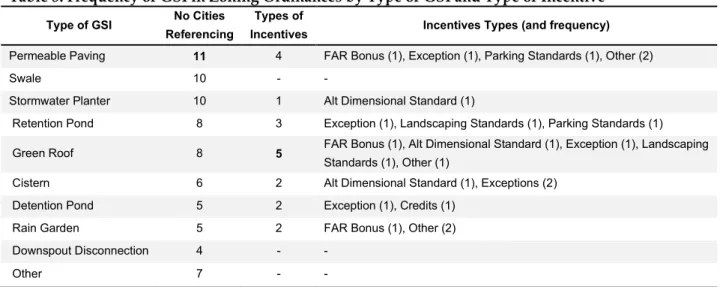
All 15 of the zoning ordinances referenced at least one specific type of GSI practice. The City of San Jose zoning ordinance referenced the fewest types of GSI (n=1, detention pond), while the City of Wilsonville referenced all ten types (n=10). Permeable paving was the most common type of GSI specifically mentioned in local zoning ordinances (n=11), followed by swales and stormwater planters (n=10) (Table 3). This supports the finding from Jepson & Haines (2014) that permeable surfaces have more of a presence in zoning ordinances (18.8%) than green roofs (12.5%) or other types of GSI. Downspout disconnections were the least common type of GSI mentioned by zoning ordinances (n=4). Cities used a wide range of terminology for practices categorized as stormwater planters, including stormwater tree pits, green streets, and curbside infiltration planters, so some of the variation in how frequently specific GSI practices were referenced may be due to the categorization of these practices by the coding protocol.
greatest variety of incentive types were used for green roofs (n=5), followed by permeable paving (n=4) (Table 3). No incentives were offered for swales or downspout disconnections.
Table 3. Frequency of GSI in Zoning Ordinances by Type of GSI and Type of Incentive Type of GSI No Cities
Referencing
Types of
Incentives Incentives Types (and frequency)
Permeable Paving 11 4 FAR Bonus (1), Exception (1), Parking Standards (1), Other (2)
Swale 10 - -
Stormwater Planter 10 1 Alt Dimensional Standard (1)
Retention Pond 8 3 Exception (1), Landscaping Standards (1), Parking Standards (1)
Green Roof 8 5 FAR Bonus (1), Alt Dimensional Standard (1), Exception (1), Landscaping Standards (1), Other (1)
Cistern 6 2 Alt Dimensional Standard (1), Exceptions (2) Detention Pond 5 2 Exception (1), Credits (1)
Rain Garden 5 2 FAR Bonus (1), Other (2)
Downspout Disconnection 4 - -
Other 7 - -
Incentives for GSI were used slightly less frequently (n=22) than mandates (n=29) in zoning ordinances, but far more frequently than guidelines for GSI (n=3). This result could simply be a function of the types of documents reviewed, as many cities maintain separate design guideline documents that are not incorporated into the zoning ordinance, but which could govern stormwater management-related guidelines. Four cities had mandates but offered no zoning incentives for GSI, three cities offered zoning incentives but had no mandates for GSI, and four cities had both mandates and incentives for GSI. Thus, zoning incentives for GSI do not appear to be a substitute to mandatory provisions, nor an indicator of the number of GSI-related mandates in a particular ordinance.
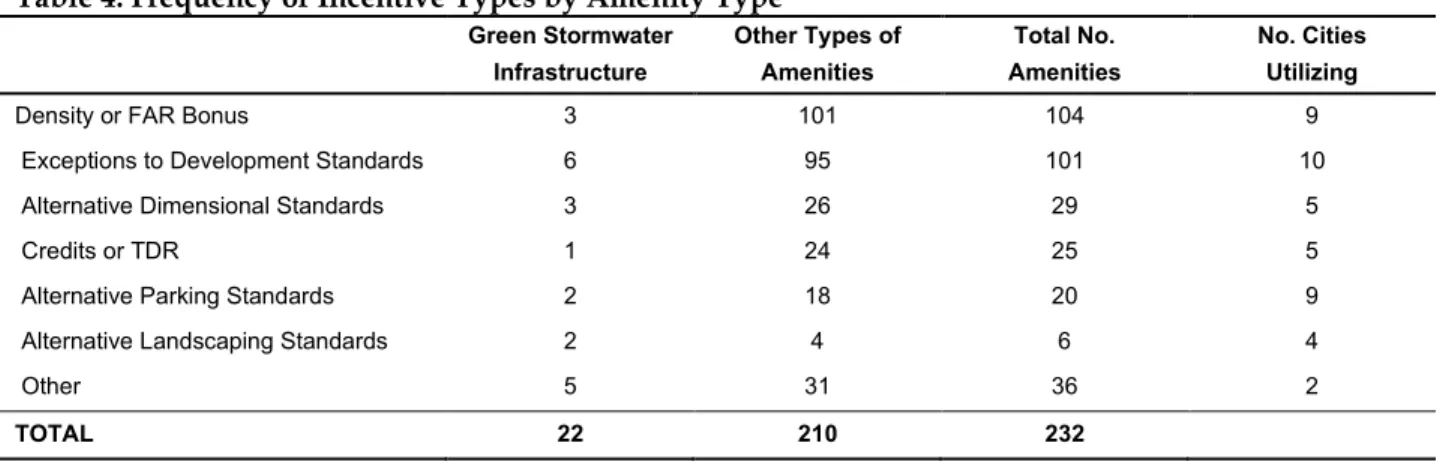
Across all amenity types – both for GSI and other types of public amenities – the average zoning ordinance provided three different types of zoning incentives. Exceptions to
development standards were the most common type of incentive offered among the 15 cities in the sample (n=10), followed by floor area bonuses (n=9) and alternative parking standards (n=9) (Table 4). Floor area bonuses were the most frequently utilized incentive (n=104).4 The next-most frequent incentives were exceptions to development standards (n=101), which were predominantly exceptions to setback requirements. Alternative dimensional standards, which included reduced setbacks and increased height limitations, were a distant third in terms of the frequency of application among the sampled zoning ordinances (n=29). Alternative landscaping standards were the least frequently utilized type of incentive (n=6).
Table 4. Frequency of Incentive Types by Amenity Type
Green Stormwater
Infrastructure
Other Types of Amenities
Total No. Amenities
No. Cities Utilizing
Density or FAR Bonus 3 101 104 9
Exceptions to Development Standards 6 95 101 10
Alternative Dimensional Standards 3 26 29 5
Credits or TDR 1 24 25 5
Alternative Parking Standards 2 18 20 9
Alternative Landscaping Standards 2 4 6 4
Other 5 31 36 2
TOTAL 22 210 232
The use of incentive zoning appears to be somewhat related to city size. All of the cities except Sandy offer at least one type of zoning incentive. Sandy is the smallest city in the sample, with a population of only 10,000. Lenexa and Wilsonville, are the next-smallest cities in the sample, and offered only one zoning incentive each. Charlotte, Detroit, Minneapolis, New York, and Philadelphia used the greatest variety of incentives in their zoning ordinances (n=5). All but Minneapolis were in the top five largest cities in the sample, by population.
Discussion
The results demonstrate that there has been growth in the number of cities utilizing zoning incentives for GSI, compared to EPA survey results from 2009. The large amount of variation in incentives used for specific types of GSI suggests that there is no clear type of zoning incentive most suitable to GSI. Rather, the types of incentives offered for GSI may be a stronger reflection of an individual city’s predisposition toward or against offering certain types of zoning incentives at all. Nevertheless, some zoning incentives for GSI implementation did appear more frequently than others. The most popular zoning incentives included exceptions to development standards, floor area bonuses and alternative dimensional standards.
Exceptions to Development Standards
Exceptions to development standards were a very common type of zoning incentive, offered by 10 of the cities in the sample, and accounting for six of the incentives identified for GSI. The relative popularity of this incentive type may be due to its simplicity. Unlike most zoning tools, which require carefully-constructed standards and code language, this tool simply requires a statement that a particular GSI device is not required to meet existing standards under defined conditions. For example, the City of Bellevue provides a specific exception for pervious pavement for the purposes of determining maximum impervious cover on sites in critical areas (2014 § 20-20-460). This exception allows developers to utilize more of the true impervious cover maximum by only considering effective impervious area and making the difference explicit in the code language. Because the incentive is an exception rather than a new or alternative standard, it does not require the time and expense of writing a separate code section into the ordinance.
under specific conditions (2015 § 4-1-B-26(B)(7)). Kansas City excepts rain barrels and cisterns from all setback standards (2011 § 88-820-12) while Minneapolis excepts rain barrels and cisterns from setback requirements in residential side and rear yards (2009 § 535-281(b)). These exceptions create an incentive by enabling developers and property owners to accommodate GSI practices on-site without affecting the dimensions and scale of the primary structure. Making this exception explicit for certain types of GSI also provides security for developers and property owners to implement these GSI practices in setback areas without having to go
through a variance application process. Removing the need for unnecessary variance requests may reduce permitting and holding costs and provide greater certainty of outcomes for developers (Kimelberg, 2011).
Similarly, New York City specifically permits green roofs to exceed the maximum height limit and sky plane limits by 3.5 feet, not including vegetation (2013 § 43-42). This code ensures that existing development standards will not prevent green roof implementation simply due to the additional height resulting from structural improvements to support the roof. The City of Philadelphia also excepts green roofs from maximum building heights (2011 § 14-701-6).
Though not specific to GSI, Philadelphia also provides exceptions to maximum building heights for amenities that earn floor area bonuses (2011 § 14-702-4). Used in combination with the floor area bonus incentive, the exception ensures that developers seeking to add floor area will not be limited by baseline development standards. As with the exceptions to setback and lot coverage standards, these exceptions provide security to the developer that an additional variance will not be necessary in order to utilize the incentive.
Floor Area Bonuses
The prevalence of floor area bonuses in the sample is surprising, given the controversial nature of the incentive and challenges associated with developing standards for
implementation. As noted earlier, the effectiveness of other floor area bonus programs has been linked to the valuation of the amenity and the bonus – and whether it is cost-effective for a developer to provide the amenity in exchange for added square footage. Thus, adopting floor area bonus incentives for GSI requires setting a ratio at which developers can earn additional density for managing a certain level of stormwater runoff or providing GSI of a particular size and quality. The complexity of valuing GSI practices is further complicated by the valuation of alternative amenities eligible for bonuses.
Cities in the sample offer floor area bonuses for many different amenities, including GSI. Bellevue offers floor area bonuses for 35 different amenities, including for GSI and six related amenities. Charlotte offers bonuses for 12 different types of amenities; New York City for 19; Olympia for 7; Philadelphia for 7; and Washington, DC for 21. The public amenities eligible for floor area bonuses range from public toilets, child care services and covered pedestrian spaces to new theater uses, stream restoration, and green building certification. Where cities offer a variety of floor area bonus options, the overall eligible bonus is typically capped to prevent developers from utilizing every bonus option and constructing a building that negatively impacts the surrounding community.
Although the popularity of floor area bonuses suggests that these are an effective strategy for incentivizing desirable public amenities, it may not be an effective approach to achieving a specific level of implementation for a specific amenity. When developers and
property owners have a multiplicity of options to choose from in order to achieve the maximum density bonus, the likelihood that they will choose to implement GSI rather than other
development itself. Some vegetated GSI practices have been found to increase property values and rents, and thus could produce value-added for a developer (Clements et al., 2013; Donovan & Butry, 2011; Ichihara & Cohen, 2011); however, opportunities to earn bonuses from public art, plazas, open space, or covered walkways may have a better cost-benefit outcome from the perspective of a developer or property owner.
For example, Bellevue allows a development to exceed the base floor area ratio by up to 0.5 within a particular overlay district if the developer provides GSI practices, in combination with several other higher-priority amenities (2014 § 20-25D-090). But GSI practices are one of seven amenities eligible for the 0.5 FAR bonus, and are not weighted as favorably as some of the alternatives. The provision of an active recreation facility earns 9.7 square feet of bonus area for each square foot of amenity, and an outdoor plaza earns 2.3 square feet of bonus area for each square foot of amenity. In contrast, rain gardens, pervious pavement, and green roofs are valued at 0.7 square feet of bonus area for each square foot of GSI. If the cost of providing GSI is less than the alternative amenities, the lower valuation ratio may still be sufficient to encourage implementation of GSI. A key challenge to developing effective floor area bonuses is achieving the desired balance between the valuation of different types of public amenities.
Alternative Dimensional Standards
Alternative dimensional standards are very similar to density bonuses in that they create an incentive for a particular amenity by allowing for smaller setbacks and greater building height. Alternative dimensional standards such as narrower sidewalks, driveways, and streets may also reduce costs for developers required to construct public improvements as part of a subdivision or planned unit development.
The City of Durham uses this type of incentive extensively both for GSI and for other public amenities. Durham’s Unified Development Ordinance grants an additional 15 feet of height to buildings with a green roof covering at least 50% of the building footprint area (2012 § 6-12-3(A)(2)(c)). A cistern used for on-site reuse earns 20-25 additional feet. Incorporating stormwater planters into 50% of the required street trees can earn an additional 15 feet. In combination, these incentives could accommodate up to 5-6 additional stories. Additional height is capped at 50 feet for one of two subdistricts in which the incentive is available (2012 § 6-12-3(A)(2)(a)). Thus, as with floor area bonuses, developers may choose to implement other eligible public amenities to achieve the maximum building height if the GSI practices are not valued highly enough to compensate for the cost of implementation.
Alternative Landscaping & Parking Standards
Although alternative landscaping standards and alternative parking standards were coded separately during the review of the sample zoning ordinances, all of the alternative landscaping standards applied to interior parking lot landscaping. In combination with alternative parking standards, there were four instances of this incentive offered for GSI devices. The majority of mandatory provisions for GSI implementation in the sample ordinances were also related to parking standards and interior parking lot landscaping. Understandably, there is a very close connection between parking – a major source of contaminated runoff – and green stormwater infrastructure.
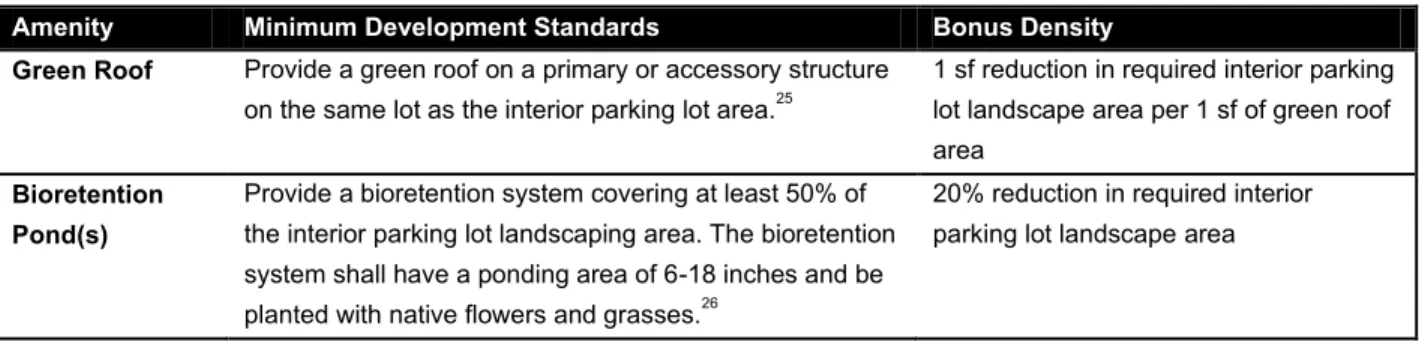
landscaping requirement for parking lots at a 1:1 area ratio for green roofs installed on structures on the same lot (2011 § 14-803(5)(e)). Interior landscaping is otherwise required to cover 10% of all parking lot area. Reducing the landscape requirement provides more site area for development, or additional revenue-generating parking spaces, thus creating a great incentive for the implementation of GSI. Other cities, such as Minneapolis, require parking lot landscaping to include retention areas. Philadelphia’s zoning ordinance includes both
requirements for GSI in parking lots in addition to incentives provided for interior parking lot landscaping.
Parking consumes space that could otherwise be dedicated for buildings or other developed uses, so reductions in parking requirements can be a major cost savings in cities that have a high opportunity cost associated with parking minimums. Alternatively, in cities that are more car-dependent or for which the opportunity cost of using land for parking is lower,
incentives that allow developers to increase parking may compel GSI implementation. The City of Durham allows its maximum parking limits to be exceeded if the additional spaces are constructed with pervious paving (2012 § 10-3(B)(8)). Other zoning ordinances in the sample require that a proportion of parking areas or driveways be constructed of pervious materials, particularly in environmentally sensitive watersheds.
Transferable Credits and Development Rights
Although there was only one instance of a zoning ordinance assigning transferable credits to a GSI device, this incentive type was fairly popular across other amenity types and is worth further discussion. The City of San Jose subdivision ordinance allows large stormwater detention ponds (8,000 square feet or greater) with a suitable grade to be credited towards parks and recreational space requirements in new subdivisions (2015 § 19-38-430). Credit is awarded at a rate of 50% of the area of the facility. This incentive effectively enables developers to
achieve stormwater management compliance and compliance with parks and recreational space standards using the same amenity. Unfortunately, this particular code is unlikely to incentivize additional GSI beyond that required by the baseline stormwater ordinance because only large-scale developments have to comply with parks and recreation exactions.
Nevertheless, transferable credits or development rights can be a great compliment to density and floor area bonuses by increasing the thickness of the market for the amenity. While floor area bonuses provided on-site may have more limited demand in areas that already have sufficient density or in areas where density is capped, TDR programs allow the excess density to be transferred to other sites that may have greater demand. Washington DC allows for bonus density to be transferred off-site to lots with eligible zoning designations (District of Columbia, 2014 § 1603-4; 1703-4). Additionally, Washington DC allows for bonus density earned for amenities in the Downtown Historic District to be transferred to other eligible districts at a 1:1 ratio (2014 § 1707-5). Applied to GSI, this concept could support the provision of stormwater management in areas where additional density is undesirable, while providing for additional density on sites where it is needed.
Combined Incentives and Point Systems
Minneapolis takes a different approach to increasing the flexibility of its zoning ordinance. The ordinance includes a unique point-based system to allow for a range of
parking standards (§ 527-180). Under the system, all planned unit developments must provide amenities totaling at least 10 points, and amenities totaling five additional points for each alternative requested. Amenities eligible for points include green roofs covering 50% of the total roof area (10 points), outdoor open space that incorporates rain gardens and pervious pavers (5 points), pervious or decorative pavers on 75% of parking areas and walkways (3 points), and enhanced stormwater management (1 point) in addition to many related amenities. The point system provides greater flexibility for developers and property owners to mix and match amenities for different types of incentives, potentially providing broader coverage and opportunities to make use of incentives.
The Model Ordinance
Based on the range of GSI incentives identified in the sample zoning ordinances, there is no clear predisposition for any particular tool. However, the most consistent examples
identified in the sample were floor area bonuses and parking lot landscaping incentives,
providing adequate fodder for developing a model ordinance specific to these two tools. Model ordinance language was developed for an FAR Incentive System (see Appendix B for model ordinance) drawing upon code language and valuation ratios identified in both the zoning ordinances that provided FAR incentives for GSI and those that offered alternative dimensional standards. Combining both incentive types into a single code provided for a greater range of GSI options; however, it should be noted that the inter-mixing of development standards and valuation ratios from different zoning ordinances may not accurately reflect an effective valuation of a particular device. Planners seeking to implement an FAR Incentive System (or height bonus system) should conduct further research on their market area to assign a context-specific bonus density to each GSI device.
Model ordinance language was also developed for a Parking Lot Landscaping Incentive System (see Appendix B) drawing upon code language and valuation ratios identified in Kansas City and Philadelphia, as well as from mandatory GSI provisions and codes incentivizing the provision of other, related amenities.
Where development standards or code language were unavailable for certain types of GSI zoning incentives, the standards and language from incentives for related amenities proved a useful substitute. For example, four cities offered floor area bonuses for the provision of open space, two cities offered bonuses for park improvements, and two offered bonuses for public plazas. Open space, parks and plazas are all closely related to GSI because they are land-based amenities that typically include vegetation and therefore require similar consideration for ongoing maintenance. As with these related amenities, the allocation of risk and maintenance costs over the life of the GSI device could affect whether incentives are viewed as worth the investment on the part of developers and property owners (Roy et al., 2008).
Code language associated with related amenities provided insight into how the cities in the sample balance the cost of long-term maintenance with zoning incentives. Bellevue requires that park improvements made for the purpose of earning a floor area bonus include an
amenities. The model ordinance drew from these codes to construct a high-quality, enforceable implementation framework for GSI.
Finally, the model ordinance includes purpose statements, definitions and enforcement measures largely adapted from stormwater management regulations rather than zoning ordinances. Overall, the sample ordinances contained more general purpose statements that were not specific to GSI, and did not provide systematic definitions for GSI devices or
implementation tools. This may be due to internal references to the stormwater management regulations, and the assumption that developers and property owners will reference both types of ordinances when preparing a project. The model ordinance includes these purposes
statements and definitions explicitly in order to ensure that the terms are interpreted appropriately for the specific code section.
Conclusion
It is the hope of this project that the model ordinance will provide interested
municipalities with a guide for incorporating incentive zoning approaches into their suite of GSI implementation tools. The more general findings from this review may also be informative for those seeking to develop new implementation strategies for GSI. Due to the small sample size, the frequency of particular zoning incentives for GSI and other types of public amenities identified in this project cannot be generalized across the broader population. The 15 cities in the sample were selected from a list of communities recognized for innovation in stormwater management, and are not necessarily representative of other cities in the U.S. Nevertheless, the incentives identified in this project may serve as a guide for cities just beginning to develop their stormwater management programs, as well as cities with existing programs.
Several of the most well-known green stormwater infrastructure programs were not included in these results. Chicago and Portland offer density bonuses for GSI, and were not included in this project as a result of the random sample; Toronto was excluded from the sample because it is not located in the U.S. Despite the exclusion of these well-established programs, this project identified 22 instances of zoning incentives offered for GSI, and many more references to stormwater management and green stormwater infrastructure in general. A surprising number of examples came from smaller cities, including cities that only became regulated more recently, under Phase II of the NDPES program. Thus, cities developing new GSI implementation strategies may find that there are informative examples from peer communities in addition to the most familiar case studies.
Implementation of GSI programs will likely require a range of strategies, including different types of mandates and incentives to capture different types of properties and projects (Carter & Fowler, 2008). Greater awareness of the benefits of GSI and the availability of
incentives may also increase uptake (Porse, 2013). This project did not attempt to evaluate the relative effectiveness of these approaches, but as GSI programs become more commonplace, effectiveness will be an important consideration. Further research is needed to help cities target limited resources toward approaches that will have the greatest impact.
Acknowledgements
References
Akbari, H., Pomerantz, M., & Taha, H. (2001). Cool surfaces and shade trees to reduce energy use and improve air quality in urban areas. Solar Energy, 70(3), 295–310.
http://doi.org/10.1016/S0038-092X(00)00089-X
Atlas.ti GmbH. (2015). Atlas.ti (Version 7). Berlin, Germany: Scientific Software Development GmbH. Retrieved from http://atlasti.com/
Benson, D. J. (1969). Bonus or Incentive Zoning--Legal Implications. Syracuse Law Review, 21, 895.
Bitting, J., & Kloss, C. (2008). Green Infrastructure Retrofit Policies (Municipal Handbook No. EPA 833-F-08-008). Washington, DC: U.S. Environmental Protection Agency. Retrieved from http://water.epa.gov/infrastructure/greeninfrastructure/gi_policy.cfm
Booth, D. B., & Leavitt, J. (1999). Field evaluation of permeable pavement systems for improved stormwater management. American Planning Association. Journal of the American Planning Association, 65(3), 314–325.
Calavita, N., & Grimes, K. (1998). Inclusionary Housing in California: The Experience of Two Decades. Journal of the American Planning Association, 64(2), 150–169.
Carter, T., & Fowler, L. (2008). Establishing green roof infrastructure through environmental policy instruments. Environmental Management, 42(1), 151–164.
http://doi.org/http://dx.doi.org.proxy.lib.duke.edu/10.1007/s00267-008-9095-5
Castleton, H. F., Stovin, V., Beck, S. B. M., & Davison, J. B. (2010). Green roofs; building energy savings and the potential for retrofit. Energy and Buildings, 42(10), 1582–1591.
http://doi.org/10.1016/j.enbuild.2010.05.004
Center for Neighborhood Technology. (2010). The Value of Green Infrastructure: A Guide to
Recognizing Its Economic, Environmental and Social Benefits (p. 73). Chicago, Illinois: Center for Neighborhood Technology.
Center for Watershed Protection. (2013, July). Stormwater Management Guidebook. District Department of the Environment.
City of Bellevue. A Codification of the General Ordinances of the City of Bellevue, Washington, § 20 Bellevue Land Use Code (2014).
City of Charlotte. City Code Book of Ordinances, Zoning Ordinance § Appendix A (2015).
City of Durham. City Code of Ordinances, § 70-736 Stormwater Performance Standards for Development (2012).
City of Durham. Unified Development Ordinance, § 6 District Intensity Standards (2012).
City of Lenexa. 1992 Code of the City of Lenexa, § 4 Unified Development Code of the City of Lenexa (2015).
City of Minneapolis. Minneapolis Code of Ordinances, § 20 Zoning Code (2009).
City of New York. Zoning Resolution of the City of New York (2013).
City of Olympia. Olympia Municipal Code, § 17 City of Olympia Platting and Subdivision Ordinance (2015).
City of Philadelphia. The Philadelphia Code, § 14 Zoning and Planning (2011).
City of San Jose. San Jose, California Code of Ordinances, § 19 Subdivisions (2015).
Clements, J., St. Juliana, A., Davis, P., & Levine, L. (2013). The Green Edge: How Commercial Property Investment in Green Infrastructure Creates Value (NRDC Report No. R:13-11-C) (p. 41). New York, NY: Natural Resources Defense Council. Retrieved from
http://www.nrdc.org/water/commercial-value-green-infrastructure.asp
District of Columbia. District of Columbia Municipal Regulations, § 11 Zoning Regulations of the District of Columbia (2014).
Donovan, G. H., & Butry, D. T. (2011). The effect of urban trees on the rental price of single-family homes in Portland, Oregon. Urban Forestry & Urban Greening, 10(3), 163–168. http://doi.org/10.1016/j.ufug.2011.05.007
Fioretti, R., Palla, A., Lanza, L. G., & Principi, P. (2010). Green roof energy and water related performance in the Mediterranean climate. Building and Environment, 45(8), 1890–1904. http://doi.org/10.1016/j.buildenv.2010.03.001
Fletcher, T. D., Shuster, W., Hunt, W. F., Ashley, R., Butler, D., Arthur, S., … Viklander, M. (2014). SUDS, LID, BMPs, WSUD and more – The evolution and application of terminology surrounding urban drainage. Urban Water Journal, 0(0), 1–18. http://doi.org/10.1080/1573062X.2014.916314
Garrison, N., & Hobbs, K. (2011). Rooftops to Rivers II: Green Strategies for Controlling Stormwater and Combined Sewer Overflows. Natural Resources Defense Council. Retrieved from http://search.proquest.com.libproxy.lib.unc.edu/docview/1030885450?pq-origsite=summon
Heaney, J. P., Wright, L., & Sample, D. (1999). Research Needs in Urban Wet Weather Flows. Water Environment Research, 71(2), 241–250. http://doi.org/10.2175/106143098X121743
Ichihara, K., & Cohen, J. P. (2011). New York City property values: what is the impact of green roofs on rental pricing? Letters in Spatial and Resource Sciences, 4(1), 21–30.
http://doi.org/10.1007/s12076-010-0046-4
Johnston, R. A., Schwartz, S. I., Wandesforde-Smith, G. A., & Caplan, M. (1989). Selling Zoning: Do Density Bonus Incentives for Moderate-Cost Housing Work. Washington University Journal of Urban and Contemporary Law, 36, 45.
Kimelberg, S. M. (2011). Inside the Growth Machine: Real Estate Professionals on the Perceived Challenges of Urban Development. City & Community, 10(1), 76–99.
http://doi.org/10.1111/j.1540-6040.2010.01351.x
Koski, C. (2010). Greening America’s Skylines: The Diffusion of Low-Salience Policies. Policy Studies Journal, 38(1), 93–117. http://doi.org/10.1111/j.1541-0072.2009.00346.x
Lassar, T. J. (1990). Great Expectations: the Limits of Incentive Zoning. Urban Land, 49(5), 12.
Lerable, C. (1995). Preparing a conventional zoning ordinance. Chicago: American Planning Association, Planning Advisory Service.
Meshenberg, M. J. (1976). Administration of Flexible Zoning Techniques. APA Planning Advisory Service.
Missouri DNR. (2012). Missouri Guide to Green Infrastructure: Integrating Water Quality into Municipal Stormwater Management (No. PUB2446). Jefferson City, MO: Missouri Departmentof Natural Resources. Retrieved from
http://www.dnr.mo.gov/env/wpp/stormwater/mo-gi-guide.htm
Morris, M. (2000). Incentive zoning: meeting urban design and affordable housing objectives. Chicago, IL: American Planning Association.
Morris, M. (Ed.). (2009). Model Transfer of Development Rights (TDR) Ordinance. In Smart codes: model land-development regulations (pp. 109–115). Chicago, IL: American Planning Association.
Poff, N. L., Allan, J. D., Bain, M. B., Karr, J. R., Prestegaard, K. L., Richter, B. D., … Stromberg, J. C. (1997). The Natural Flow Regime. BioScience, 47(11), 769–784.
http://doi.org/10.2307/1313099
Porse, E. C. (2013). Stormwater Governance and Future Cities. Water, 5(1), 29–52. http://doi.org/http://dx.doi.org.proxy.lib.duke.edu/10.3390/w5010029
Roesner, L. A., Bledsoe, B. P., & Brashear, R. W. (2001). Are Best-Management-Practice Criteria Really Environmentally Friendly? Journal of Water Resources Planning and Management, 127(3), 150–154. http://doi.org/10.1061/(ASCE)0733-9496(2001)127:3(150)
Rouse, D., & Bunster-Ossa, I. F. |. (2013). Green infrastructure: a landscape approach. Chicago, IL: American Planning Association.
Roy, A. H., Wenger, S. J., Fletcher, T. D., Walsh, C. J., Ladson, A. R., Shuster, W. D., … Brown, R. R. (2008). Impediments and Solutions to Sustainable, Watershed-Scale Urban
Stormwater Management: Lessons from Australia and the United States. Environmental Management, 42(2), 344–59.
Ryan, S., & Enderle, B. E. (2012). Examining spatial patterns in affordable housing: the case of California density bonus implementation. Journal of Housing and the Built Environment, 27(4), 413–425. http://doi.org/http://dx.doi.org.proxy.lib.duke.edu/10.1007/s10901-011-9259-0
Seyfried, W. R. (1991). Measuring the Feasibility of a Zoning Bonus. Journal of the American Planning Association, 57(3), 348–356. http://doi.org/10.1080/01944369108975506
Skiles, K. (2003). Density Bonuses and Affordable Housing in California: Examining the Economic Impact on Three Cases (Master’s Thesis). Massachusetts Institute of Technology, Boston, Massachusetts. Retrieved from http://dspace.mit.edu/handle/1721.1/7582
Susca, T., Gaffin, S. R., & Dell’Osso, G. R. (2011). Positive effects of vegetation: Urban heat island and green roofs. Environmental Pollution, 159(8–9), 2119–2126.
http://doi.org/10.1016/j.envpol.2011.03.007
Tarr, J. A. (1988). Sewerage and the Development of the Networked City in the United States, 1850-1930. In G. Dupuy & J. A. Tarr (Eds.), Technology and the rise of the networked city in Europe and America (pp. 159–185). Philadelphia, PA: Temple University Press. Retrieved from
http://search.proquest.com.libproxy.lib.unc.edu/docview/37328549?pq-origsite=summon
Thurston, H. W., Taylor, M. A., Roy, A., Morrison, M., Shuster, W. D., Templeton, J., … Cabezas, H. (2008). Applying a Reverse Auction to Reduce Stormwater Runoff. Ambio, 37(4), 326–327.
U.S. EPA. (1999). Report to Congress on the Phase II Storm Water Regulations (Report to Congress No. EPA 833-R-99-001) (p. 40). Washington, D.C.: U.S. Environmental Protection Agency.
U.S. EPA. (2000). Report to Congress on the Phase I Storm Water Regulations (Report to Congress No. EPA 833-R-00-001). Washington, D.C.: U.S. Environmental Protection Agency.
U.S. EPA. (2001). Implementation and Enforcement of the Combined Sewer Overflow Control Policy (Report to Congress No. EPA 833-R-01-003) (p. 32). Washington, D.C.: U.S.
Environmental Protection Agency.
U.S. EPA. (2004). Impacts and Control of CSOs and SSOs (Report to Congress No. EPA 833-R-04-001). Washington, D.C.: U.S. Environmental Protection Agency.
U.S. EPA. (2005). Stormwater Phase II Final Rule: Post-Construction Runoff Control Minimum Control Measure (Fact Sheet 2.7 No. EPA 833-F-00-009) (p. 3). Washington, DC: U.S. Environmental Protection Agency.
U.S. EPA. (2008). Funding Options (Municipal Handbook No. EPA 833-F-08-007). Washington, DC: U.S. Environmental Protection Agency. Retrieved from
U.S. EPA. (2009a). Incentive Mechanisms (Municipal Handbook No. EPA 833-F-09-001). Washington, DC: U.S. Environmental Protection Agency. Retrieved from http://water.epa.gov/infrastructure/greeninfrastructure/gi_policy.cfm
U.S. EPA. (2009b). Water Quality Scorecard: Incorporating Green Infrastructure Practices at Municipal, Neighborhood, and Site Scales (No. EPA 231-B-09-001). Washington, DC: U.S. Environmental Protection Agency.
U.S. EPA. (2010). Green Infrastructure Case Studies: Municipal Policies for Managing Stormwater with Green Infrastructure (No. EPA 841-F-10-004). Washington, DC: U.S. Environmental Protection Agency.
U.S. EPA. (2012, November 29). Model Ordinances Language: Model Post-Construction Stormwater Runoff Control Ordinance. U.S. Environmental Protection Agency. Retrieved from http://water.epa.gov/polwaste/nps/mol6.cfm
U.S. EPA. (2013). Case Studies Analyzing the Economic Benefits of Low Impact Development and Green Infrastructure Programs (No. EPA 841-R-13-004). Washington, DC: U.S. Environmental Protection Agency.
U.S. EPA. (2014, July 2). Zoning [Overviews & Factsheets]. Retrieved October 31, 2014, from http://water.epa.gov/polwaste/npdes/swbmp/Zoning.cfm
Wallner, M. (2014). Economic approaches to managing stormwater runoff in the Seattle area (Master’s). University of Washington, United States -- Washington. Retrieved from http://search.proquest.com.proxy.lib.duke.edu/docview/1622374876/abstract/AFFF3 B096CE74825PQ/1?accountid=10598
Weber, R. P. (1990). Basic Content Analysis (2nd ed.). Thousand Oaks, CA: SAGE Publications, Inc.
Weinberger, M., Ferguson, J. A., Westmoreland, G., Mamlin, L. A., Segar, D. S., Eckert, G. J., … Tierney, W. M. (1998). Can raters consistently evaluate the content of focus groups? Social Science & Medicine, 46(7), 929–933. http://doi.org/10.1016/S0277-9536(97)10028-4
White, S. S., & Boswell, M. R. (2007). Stormwater Quality and Local Government Innovation. Journal of the American Planning Association, 73(2), 185–193.
http://doi.org/10.1080/01944360708976152
Yang, J., Yu, Q., & Gong, P. (2008). Quantifying air pollution removal by green roofs in Chicago. Atmospheric Environment, 42(31), 7266–7273.
http://doi.org/10.1016/j.atmosenv.2008.07.003
Young, R. F. (2011). Planting the Living City. Journal of the American Planning Association, 77(4), 368. http://doi.org/10.1080/01944363.2011.616996
APPENDIX A. REVIEW PROTOCOL
Criteria Description and Alternative Terminology Coding General Does the zoning code mention…?
Stormwater Management If yes, code 1; otherwise 0
Green Stormwater Infrastructure - Green Infrastructure (GI)
- Best Management Practices (BMP) - Stormwater Management Practices (SMP) - Stormwater Treatment/Control Unit (STU)/ (SCU)
If yes, code 1; otherwise 0
Types of GSI Does the zoning code have provisions for…?
Swale - vegetated/ bio-swale If yes, code 1; otherwise 0
Rain Garden If yes, code 1; otherwise 0
Stormwater Planter - stormwater trees/ infiltration pits/ infiltration planter/ green street If yes, code 1; otherwise 0 Retention Pond - bioretention pond/ retention wetland If yes, code 1; otherwise 0 Detention Pond - detention/ constructed wetland/basin If yes, code 1; otherwise 0 Green Roof - vegetated/ vegetation/ eco-roof If yes, code 1; otherwise 0
Cistern - rain barrel If yes, code 1; otherwise 0
Downspout disconnection If yes, code 1; otherwise 0
Permeable Pavement - porous/ pervious paving If yes, code 1; otherwise 0
Other GSI If yes, code 1; otherwise 0
Use of Incentives Does the zoning code have provisions for…?
GSI Incentives - incentives that encourage GSI If yes, code 1; otherwise 0 Related Amenities Incentives - Open Space, LEED, Green Building, Parks If yes, code 1; otherwise 0 Other Incentives - incentives unrelated to GSI If yes, code 1; otherwise 0 GSI Guideline - guidelines that encourage GSI If yes, code 1; otherwise 0
GSI Mandate - requirements for GSI If yes, code 1; otherwise 0
Types of Incentives Does the zoning code have provisions for…?
Density Bonus - floor area/ density/ height bonus If yes, code 1; otherwise 0 Alt. Dimensional Standards - reduced setback/increased max height
- increased maximum coverage
If yes, code 1; otherwise 0
Exemption - exemptions from other development standards If yes, code 1; otherwise 0 Alt. Parking Standards - reduced parking space minimum If yes, code 1; otherwise 0 Alt. Landscaping Standards - reduced landscaping/screening If yes, code 1; otherwise 0 Credits - transfer of development rights/incentive credits If yes, code 1; otherwise 0
Other Incentive If yes, code 1; otherwise 0
Development Standards Does the incentive specify…?
Volume the minimum volume of stormwater managed If yes, code 1; otherwise 0
Acreage the size of the GSI practice If yes, code 1; otherwise 0
Plants the types of trees and plants used If yes, code 1; otherwise 0 Valuation how the incentive is calculated If yes, code 1; otherwise 0
Ownership who owns the amenity If yes, code 1; otherwise 0
O&M who maintains the amenity If yes, code 1; otherwise 0
Code Quality Does the incentive language include…?
Definitions Definitions of key terms If yes, code 1; otherwise 0
Purpose A purpose statement If yes, code 1; otherwise 0
APPENDIX B. MODEL ORDINANCE
I. FAR Incentive System
A. Purpose. Pursuant to the authority granted by [state enabling legislation or constitutional powers], this ordinance is enacted to further the health, safety and general welfare of the public through:
(1) Protecting receiving waters impacted by stormwater runoff discharged from development within the city;
(2) Complying with the city's municipal stormwater National Pollutant Discharge
Elimination System permit, issued under the authority of Section 402 of the Clean Water Act and implementing regulations at 40 CFR Part 122 et seq.;
(3) Complying with [state statutes] and implementing regulations for such state statutes, including but not limited to [relevant water quality regulations];
(4) Allowing for development intensities that match existing and proposed infrastructure investments, while striving to maintain environmental quality and the overall character of the city;5 and
(5) Providing appropriate economic incentives to encourage stormwater capture, detention, and/or infiltration, and suitable on-site density.
Commentary: Local governments should determine whether incentive zoning is an authorized planning tool under state law and whether there are specific purposes for which incentive zoning techniques may be utilized. This subsection should be customized to align with the purposes for which incentive zoning is authorized, as well as to fit local needs and objectives.
B. Definitions. As used in this section, the following words and terms shall have the meaning specified herein.
(1) Bonus density: additional floor area or FAR permitted on a given site earned through the provision of public amenities beyond the maximum floor area ratio permitted on that site without public amenities.
(2) Floor area: the gross horizontal area of all floors in a building or structure measured from the exterior walls or from the centerline of party walls.
(3) Floor area ratio (FAR): the amount of floor area on a lot expressed as a proportion of the net area of the lot.This figure is determined by dividing the gross floor area of all buildings on a lot by the area of that lot.
(4) Green stormwater infrastructure (GSI) device: a man-made structure that is designed or constructed to store, retain, infiltrate or otherwise control stormwater runoff quality, rate, or quantity in accordance with the [local stormwater management manual].