Dynamical evolution of nonclassical properties in cavity
quantum electrodynamics with a single trapped ion
(Invited Paper)
S. Shahidania, M. H. Naderib and M. Soltanolkotabib a
Department of Physics, University of Isfahan, Isfahan, Iran b
Quantum Optics Group, Department of Physics, University of Isfahan, Isfahan, Iran
ABSTRACT- In this paper, by considering a system consisting of a single two-level trapped ion interacting with a single-mode quantized radiation field inside a lossless cavity, the temporal evolution of the ionic and the cavity-field quantum statistical properties including photon-counting statistics, quantum fluctuations of the field quadratures and quantum fluctuations of the ionic dipole variables are investigated. It is found that in the Lamb-Dicke limit it is possible for the cavity-field to evolve into a nonclassical state (squeezed state or state with sub-Poissonian statistics) and this possibility is solely affected by the internal and external quantum dynamics of the ion. Also it is found that the dipole squeezing may occur in the dynamics of the trapped ion which sensitively depends on quantum statistics of the cavity-field.
KEYWORDS: Trapped ion, cavity quantum electrodynamics, nonclassical properties
I. INTRODUCTION
Since the first single ion was experimentally realized [1], single trapped ion system has become a subject of increasing interest [2]-[6]. This increasing interest is due to its exclusive features such as isolation of the ion from the environment and localization of it to a few ten nanometers or below, which allows long interaction times with the field and makes it as a suitable system for high precision spectroscopy [7], quantum computation [8]-[10] and precision measurement of physical constants [11].
A semiclassical model describing the dynamics of trapped ions interacting with a traveling-wave light field was introduced by Blockley et al. [12]. An analogous model employing standing-wave light fields was proposed by Cirac et al. [13]-[14]. In these models a single two-level ion undergoes quantized vibrational motion within a harmonic trapping potential and interacts with a classical single-mode light field. It was found [12] that in the Lamb-Dicke regime the dynamics of trapped ion can be described by a very simple Hamiltonian similar to that of the Jaynes-Cummings model [15]. Later it was shown that beyond the Lamb-Dicke regime the vibrational motion of a trapped ion can be described by a strongly nonlinear Jaynes-Cummings model [16]-[18]. Within the framework of these Jaynes-Cummings-like models, various aspects of the dynamics of trapped ions have been studied. For example, quantum nondemolition measurement of vibrational quanta of trapped ions has been analyzed theoretically [19] and several schemes proposed for generating nonclassical motional states of trapped ions, such as Fock states [20]-[21], squeezed state [22]-[24], even and odd coherent
states [25]-[26] and their various kinds of superpositions [27]-[29].These nonclassical motional states may be used to perform quantum computation [30] and study quantum decoherence effects [31]. Furthermore, several schemes proposed [32]-[34] for the reconstruction of quantum mechanical vibrational states of a trapped ion. One of these schemes has been successfully applied to the experimental reconstruction of the Wigner function of nonclassical states of the vibrational mode of a trapped ion [35].
On the other hand, under certain circumstances in which full quantization of the three subsystems becomes necessary, we have an interesting combination of two bosonic systems i.e., quantized vibrational motion of the ion and the quantized cavity-field coupled to a spin-like system i.e., the ion internal levels. A possibility is to place the ion inside a high-finess cavity in such a way that the quantized field gets coupled to the ion. This system provides the possibility of inspection of some known phenomena in cavity quantum electrodynamics with cold trapped ions and predicts some new phenomena which arise from the quantum nature of the field. In this regard, Zeng and Lin [36] and Buzek et al. [37] studied the influence of the field statistics on the ion dynamics, Parkins and Kimble [38] investigated the transfer of coherence between the motional states and the field and Semiao et al. [39] proposed a scheme for generation of matter-field Bell-type states. Furthermore, Buzek et al. [37] investigated the possibility of the construction of the fully correlated Greenberg-Horne-Zeilinger (GHZ) state [40].
In this contribution, our purpose is to investigate nonclassical properties of the cavity-field and the trapped ion in cavity quantum electrodynamics with cold trapped ion. We explore how the quantum dynamics of the ion influences on quadrature squeezing and sub-Poissonian statistics of the cavity-field and also how dipole squeezing of the ion depends on the field statistics. An outline of the present paper is as follows: in Section II we introduce the model describing the interaction of the trapped ion with the cavity-field in the Lamb-Dicke limit and we obtain the density operator of the system. In Section III we investigate the dynamical evolution of nonclassical properties of the cavity-field and the influences of internal and external dynamics of the ion on those properties. In Section IV we study the dynamics of quantum fluctuations of dipole variables of the cold trapped ion inside the cavity and the influence of field statistics on its evolution. Finally
we summarize our conclusions inSection V.
II. PHYSICAL MODEL
Consider a two-level ion of mass m confined to oscillate in a one-dimensional Paul trap, which is placed inside a high-Q cavity. The Hamiltonian of this system may be written as [39]
(
)
(
)
(
)
0 ˆ ˆ
ˆ ˆ ˆ
ˆ ˆ
ˆ ˆ sin ˆ ˆ ,
H e e a a b b
g b b a a
ω ν ω
σ σ η φ
+ + + − + + = + + + ⎡ ⎤ + + + ⎣ + + ⎦ = = =
= (1)
where the first three terms describe the free Hamiltonian of the system and the last one describes the coupling of the external and internal degrees of freedom of the ion to the quantized cavity field. The operators aˆ (aˆ+) and bˆ (bˆ ), + respectively, are the annihilation(creation) operators for the vibrational motion (with frequency
ν
),and for the cavity-field mode (with frequencyω), σˆ± are the operators describing the transitions between upper (e
)and lower( g ) atomic levels, ω0 is the atomic transition frequency,g
is the coupling constant of the ion–field interaction, η=k 2mν(k=ω c)is the Lamb-Dicke parameter and φ is the parameter which determines the position of the trap in the cavity.We are interested here in the behavior of the system for the small values of Lamb-Dicke parameter (
η
<<
1
), where the motion of the ion is restricted to spatial dimensions small compared to the optical wavelengthλ
. Furthermore, we assume the field mode is tuned to the first blue sideband(
ω
=
ω
0+
ν
)
. Hence, under the rotating wave approximation the interaction part of the Hamiltonian reduces to(
)
int ˆ ˆ
ˆ ˆ ˆ ˆ ˆ .
H ==gη b a+ σ++ba+σ− (2)
This Hamiltonian describes the situation where the absorption (emission) of one photon results in excitation (de-excitation) of the ion and increasing (decreasing) of its vibrational motion by one quantum. The time evolution operator associated with this Hamiltonian in the two-dimensional atomic basis is given by:
1 ˆ ˆ
ˆ ˆ ˆ ˆ
ˆ( ) n n n ˆ ˆ n ,
U t =C+ e e +C g g −iS ba e g+ −ib aS g e+ (3) where Cˆn,Cˆn+1,Sˆn are given by:
( )
ˆ ˆˆ cos ˆ ˆ ,
n
C = ⎡⎢ηgt a a b b+ + ⎤⎥
⎣ ⎦ (4)
(
)
1 ˆ ˆ
ˆ cos ˆ ˆ 1 ,
n
C+ = ⎡⎢ηgt a a b b+ + + ⎤⎥
⎣ ⎦ (5)
(
)
(
)
ˆ ˆ ˆ ˆ sin 1 ˆ . ˆ ˆˆ ˆ 1
n
gt a a b b S
a a b b
η + +
+ +
⎡ + ⎤
⎢ ⎥
⎣ ⎦
=
+ (6)
Now, we assume that the two-level trapped ion is initially prepared in a coherent superposition of the internal
levels e and g ,
. 1 , ) 0 (
ˆ * 2 2
, , = + = ρ
∑
= g e j g e j i ii cc i j c c (7)
The cavity-field and vibrational motion are supposed to be in generic states with density operatorsρˆf(0) and ρˆν(0) , respectively. Furthermore, we assume that the initial state of the system is direct product of these states (ρˆ(0)=ρˆν(0)⊗ρˆf(0)⊗ρˆi(0)).Using the time evolution operator (3) we obtain the following expression for the density operator of the system in the atomic basis,
ˆ ˆ
ˆ( ) ( ) (0)ˆ ( ) ( )ˆ ˆ ( ) ˆ ( ) ( )ˆ ,
ee gg
eg ge
t U t U t t e e t g
g t e g t g e
ρ ρ ρ ρ
ρ ρ
+
= = +
+ + (8)
where , ˆ ) 0 ( ˆ ) 0 ( ˆ ˆ ˆ ˆ c ˆ ˆ ˆ ) 0 ( ˆ ) 0 ( ˆ ˆ c ˆ ˆ ˆ ) 0 ( ˆ ) 0 ( ˆ ˆ ˆ ˆ ˆ ) 0 ( ˆ ) 0 ( ˆ ˆ ) ( ˆ * g e * e g 2 2 n f n n f n n f n e n f n g gg C S a b ic a b S C ic a b S S a b c C C c t ν + + ν + ν + ν ρ ρ − ρ ρ + ρ ρ + ρ ρ = ρ (9) , ˆ ˆ ˆ ) 0 ( ˆ ) 0 ( ˆ ˆ c ˆ ) 0 ( ˆ ) 0 ( ˆ ˆ ˆ ˆ c ˆ ) 0 ( ˆ ) 0 ( ˆ ˆ ˆ ˆ ˆ ) 0 ( ˆ ) 0 ( ˆ ˆ ˆ ˆ ) ( ˆ 1 * g e 1 * e g 1 1 2 2 n f n n f n n f n e n f n g ee S a b C ic C a b S ic C C c S a b a b S c t + ν + + ν + + ν + + ν + ρ ρ + ρ ρ − ρ ρ + ρ ρ = ρ (10) , ˆ ) 0 ( ˆ ) 0 ( ˆ ˆ c ˆ ˆ ˆ ) 0 ( ˆ ) 0 ( ˆ ˆ ˆ ˆ c ˆ ˆ ˆ ) 0 ( ˆ ) 0 ( ˆ ˆ ˆ ) 0 ( ˆ ) 0 ( ˆ ˆ ˆ ˆ ) ( ˆ 1 * g e * e g 1 2 2 n f n n f n n f n e n f n g eg C C c a b S a b S c a b S C c i C a b S c i t ν + + ν + + ν + ν + ρ ρ + ρ ρ + ρ ρ + ρ ρ − = ρ (11) . ˆ ˆ ˆ ) 0 ( ˆ ) 0 ( ˆ ˆ ˆ ˆ ˆ ) 0 ( ˆ ) 0 ( ˆ ˆ ˆ ) 0 ( ˆ ) 0 ( ˆ ˆ ˆ ˆ ˆ ˆ ˆ ) 0 ( ˆ ) 0 ( ˆ ˆ ) ( ˆ * g e 1 * e g 1 2 2 n f n n f n n f n e n f n g ge S a b S a b c c C C c c C S a b c i S a b C c i t + ν + + ν + ν + + ν ρ ρ + ρ ρ + ρ ρ − ρ ρ = ρ (12)
Making use of the density operator (8), we can evaluate the mean values of the operators of interest. In the next two sections we shall use it to investigate the dynamical properties of the cavity-field and the trapped ion.
III. DYNAMICAL PROPERTIES OF THE FIELD In this section we investigate the dynamical evolution of the nonclassical properties of the quantized radiation field which interacts with a single trapped ion within a high-Q cavity.
A. Photon counting statistics
One of the interesting nonclassical properties of quantized cavity-field, through the interaction with the single trapped
ion, is the sub-Poissonian photon statistics of the field state. We assume that the cavity-field is initially in a Glauber coherent state
∑
∞ = β
− β
= β
0 2
!
2
n n
n n
e (β=βeiθ). To determine the time evolution of the photon counting statistics we consider the Mandel Q parameter defined by [41]:
2 2
2 2
ˆ ( ) ˆ( )
( ) 1
ˆ( )
ˆ ˆ ˆ ˆ
( ( ( )) ) ( ( ( ( )) )) 1. ˆ ˆ
( ( ( )) )
f a f a
f a
n t n t
Q t
n t
Tr Tr t n Tr Tr t n
Tr Tr t n
ρ ρ
ρ
−
= −
−
= −
(13)
For Q<0(Q>0) the statistics is sub-Poissonian (super-Poissonian) and Q=0stands for Poissonian statistics.
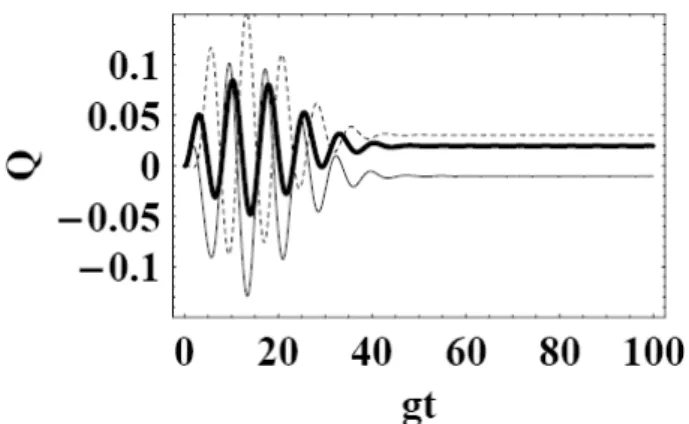
In Fig.1we have assumed the vibrational motion to be initially in a number state and plotted the Mandel parameter for different initial internal state (excited state, ground state and superposition of the ground state and the excited state) versus the scaled time gt. As it is seen, however it is possible for the field to evolve into a nonclassical state with sub-Poissonian statistics for each of those initial states (excited state, ground state and superposition of the ground state and the excited state) but initial excited state is the best candidate for obtaining nonclassical field state with sub-Poissonian statistics. It is noticeable that this behavior is different for an initial vacuum state of the vibrational motion because in this case for an initial excited state of the ion, the field remains in a coherent state through the interaction (Q=0).
Fig. 1.Time evolution of the Mandel parameter versus the scaled time gt for η=0.02 and for initial excited state ( ), ground
state( ), and coherent superposition of the excited state and the ground state ( ). Here, we have assumed that the vibrational motion is initially prepared in the number state m = 4 and the cavity field is initially in the coherent stateβ with β=5.
For an initial coherent state of the vibrational motion the effect of initial excited and ground states of the ion on the dynamical behavior of the Q parameter is almost the same as before (Fig.2). However, for an initial coherent superposition of the ground state and the excited state the possibility of evolution of the cavity-field statistics to a nonclassical state with sub-Poissonian statistics depends on the phase angle difference (θ−ϕ) between the coherent states of the cavity-field and the vibrational motion
(
f i
eθ
β ,
ν ϕ
α i
e ). For example, for θ−ϕ=0 the evolution of the cavity-field into a nonclassical state with sub-Poissonian statistics is not possible. As it is seen from Fig.2, in this case as before the initial excited state is the best candidate for obtaining nonclassical field state with sub-Poissonian statistics. Hence, the dynamical behavior of the Mandel parameter is solely determined by the initial states of the internal and external degrees of freedom of the trapped ion.
Fig. 2. Time evolution of the Mandel parameter versus the scaled time gt, for η=0.02 and for initial excited state ( ), ground
state( ), and coherent superposition of the excited state and the ground state ( ).Here, we have assumed that the vibrational motion is initially prepared in the coherent state α with |α|=2and the cavity field is initially in coherent stateβ with |β|=5and θ=π/4 .
B. Quadrature squeezing of the cavity-field
The investigation of photon counting statistics relates to the intensity of the field and its fluctuations. On the other hand, investigation of the quantum fluctuations of the quadrature amplitudes of the electromagnetic field concerns with a different aspect of nonclassical properties of the field i.e., quadrature field squeezing . The field in a squeezed state exhibits fluctuations in one quadrature component below the standard quantum limit (at the expense of increased fluctuation in the other quadrature component).Quadrature field squeezing is defined in terms of the two Hermitian operators Xˆ1 and Xˆ2defined by [42]
(
)
(
)
1
2
1
ˆ ˆ ˆ , 2
1
ˆ ˆ ˆ .
2
X a a
X a a
i
+
+
= +
= −
(14) A state of the field is said to be squeezed in Xˆi variable when the squeezing parameter Si(i=1,2) is negative
2), or 1 (i 0 1 ) ˆ ( 4 )
( ≡ ∆ i 2 − < =
i t X
S (15)
where
. ˆ ˆ ) ˆ
(∆Xi 2= Xi2 − Xi 2 (16)
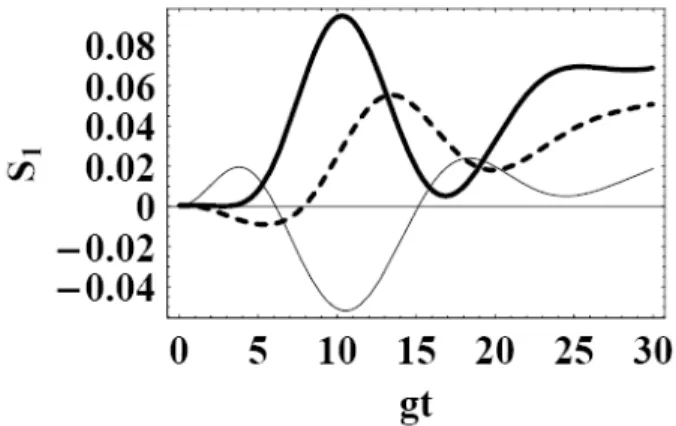
Fig. 3. Time evolution of the squeezing parameter S1 versus the
scaled time gt for η=0.02 and for initially excited state ( ),
ground state( ), and coherent superposition of the excited state and the ground state ( ).Here, we have assumed that the vibrational motion is initially prepared in the coherent state α
with α=2and the cavity field is initially in coherent state β with
β=5.
Considering the cavity-field is initially prepared in a coherent state we now investigate the possibility of squeezing of the quadrature amplitudes of the field through the interaction with trapped ion. Also, we explore the effect of internal and external dynamics of the ion on the time evolution of the squeezing parameter
S
i(t
)
. In Fig.3 the effect of internal dynamics of the trapped ion on the squeezing parameterS
1(
t
)
is shown. As it is seen, the temporal behavior of the squeezing parameter of the quantized cavity-field depends considerably on the internal state of the trapped ion. Besides, the effect of the initial state of the external degree of freedom of the trapped ion on the temporal evolution of the squeezing parameterS
1is plotted in Fig.4. As it is seen, for an initially coherent state of the vibrational motion, the quadrature field squeezing is not possible (initial internal state is ground state) but for initial Fock state (even for initial vacuum state) of the vibrational motion, the field squeezing may occur. It is also noticeable that the possibility of the quadrature amplitude squeezing of the field depends very sensitively on the phase angle of the coherent state of the radiation field (θ).
IV. DYNAMICAL EVOLUTION OF THE IONIC DIPOLE SQUEEZING
In this section we study the time evolution of the quantum fluctuations of the ionic dipole variables and explore the effect of the cavity-field statistics on it. For this purpose, we consider the two slowly varying Hermitian quadrature operators
Fig. 4. Time evolution of the squeezing parameter S1 versus the
scaled timegt for η=0.02 and for an initially coherent stateα
with α=2 ( ), an initially Fock state m = 4 ( ), and an initially vacuum state m = 0 ( ) of the vibrational motion. Here, we have assumed that the initial internal state is the ground state and the cavity- field is initially in the coherent state β with β=5.
(
)
(
)
1
ˆ ˆ ˆ ,
2 1
ˆ ˆ ˆ .,
2
x
y
i
σ σ σ
σ σ σ
+ −
+ −
= +
= −
(17) These Hermitian operators correspond respectively, to the dispersive and absorptive components of the amplitude of atomic polarization [43]. Commutation of σˆx and σˆ isy
ˆ ˆy, y iˆz 2
σ σ σ
⎡ ⎤ =
⎣ ⎦ (18)
Hence the variances (∆σˆi)2 = σˆ2i − σˆi 2(i=x ,y) satisfy the uncertainty relation
2 2
2 ˆ
16 1 ) ˆ ( ) ˆ
(∆σx ∆σy ≥ σz (19)
Fluctuations in the component σˆi(i=x or y) are said to be squeezed if the variance in σˆisatisfies the condition
) (
ˆ 4 1 ) ˆ
( 2 i x or y
z
i < σ =
σ
∆ . (20)
Since
4 1 ˆ 2 =
σi , we can write the dipole squeezing condition as
). (
0 ˆ ˆ
4
1 2 i x or y
Fi = − σi − σz < = (21)
Now we assume that the trapped ion is initially prepared in the excited state e (cg =0) and its vibrational motion is initially prepared in a coherent state α iϕ
e . Using (8) we obtain the expectation values of the ionic operators as
(
)(
)
(
)
1, , 1 , 1 1,
,
ˆ ( (0) (0) (0) (0))
2
sin 1 1 cos 2 ,
f f
x n n m m n n m m
m n
i
gt m n gt m n
ν ν
σ ρ ρ ρ ρ
η η
+ + + +
= −
⎡ + + ⎤ ⎡ + ⎤
⎣ ⎦ ⎣ ⎦
∑
(22)
Fig. 5. Time evolution of F2(t)corresponding to the squeezing of σˆ2 for η=0.02and for initial coherent state of the cavity- field with the amplitude |β|=5with different phase angle
θ=0 ( ) θ=π/6 ( )and θ=π/4( ) Here, we have assumed the vibrational motion is prepared in the initial coherent state α
with α=2and the ion is initially in the excited state e .
(
)(
)
(
)
1, , 1 , 1 1,
,
1
ˆ ( (0) (0) (0) (0))
2
sin 1 1 cos 2 ,
f f
y n n m m n n m m
m n
gt m n gt m n
ν ν
σ ρ ρ ρ ρ
η η
+ + + +
= +
⎡ + + ⎤ ⎡ + ⎤
⎣ ⎦ ⎣ ⎦
∑
(23)
(
)
, ,
,
1 ˆ
ˆ (0) (0) cos 2 1 .
2
f
z m m n n
m n
gt m n
ν
σ =
∑
ρ ρ ⎡⎣ η + ⎤⎦ (24)It is evident that for the field in an initial Fock state 0
) 0 ( )
0 ( 1,
1
, =ρ =
ρ + f+
n n f
n
n and thus σˆx = σˆy =0. It means that for the initial number state of the field
0 ˆ 1− σ >
= z
i
F and the dipole squeezing is not possible. However, for the field in the initial coherent state, the dipole squeezing may occur. The possibility of the dipole squeezing in this case depends very sensitively on the phase of the coherent state of the field (Fig.5). Furthermore, for the field initially prepared in a
Schrödinger cat state ⎟
⎠ ⎞ ⎜
⎝ ⎛
⎥⎦ ⎤ ⎢⎣
⎡β +β
=
ψ(0) iθ −iθ 2
f N e e the
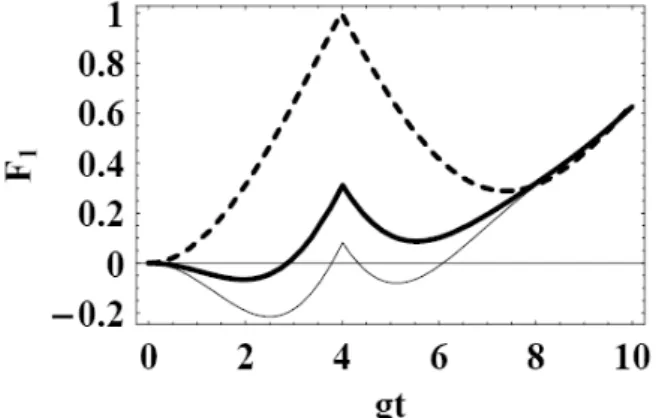
dipole squeezing may occur (Fig.6). However, for this initial state of the field the possibility of the dipole squeezing depends on the phase angle of the coherent state of the vibrational motion )(ϕ and the phase angle between the amplitudes of the two components of the Schrödinger cat state of the field (θ). For example, for the field in even coherent state (withθ=π 2) σˆx = σˆy =0and thus the dipole squeezing never take place. In Fig.6 we have displayed the effect of various field statistics on the dipole squeezing in σˆ1.
V. SUMMARY AND CONCLUSION
In this paper, by considering a system consisting of a single trapped ion interacting with a single-mode quantized radiation field inside a high-finesse cavity, we have investigated the dynamical evolution of the nonclassical properties of the cavity-field and the trapped ion including photon-counting statistics, quantum fluctuations of the cavity-field quadratures and quantum fluctuations of the ionic dipole variables. For this purpose, we have assumed
Fig. 6. Time evolution of F t1( )corresponding to the squeezing of 1
ˆ
σ for η=0.02 and for coherent state with the amplitude|β|=5 ( ), number state n = 25 ( ) and Schrödinger cat state with β|=5 and θ=π/6 ( )of the cavity- field .Here, we have assumed the vibrational motion is prepared in the initial coherent state αexp(iπ 2) with |α|=2and the ion is initially in the excited state e .
in the Lamb-Dicke limit the field-mode is tuned to the first blue sideband and we have obtained the density operator of the system. It is found that
1. It is possible for the cavity-field to evolve into a nonclassical state with sub-Poissonian statistics and the possibility of this evolution depends sensitively on the initial state of the internal and external degrees of freedom of the trapped ion.
2. It is possible for the cavity-field to evolve into a squeezed state and the possibility of field squeezing through the interaction with trapped ion is considerably dependent on the initial state of the internal and external degrees of freedom of the trapped ion.
3. The temporal evolution of the quantum fluctuations of the ionic dipole variables and the possibility of the dipole squeezing is solely dependent on the field statistics.
4. For the field in the initial coherent state the possibility of the dipole squeezing depends very sensitively on the phase of the coherent state of the field.
These results can be used in the preparation of the nonclassical states of the field and high precision measurement of the absorption and dispersion of the light through the interaction with trapped ion.
REFERENCES
[1] W. Neuhauser, M. Hohenstatt, and H. Dehmelt,
Phys. Rev. A 22 1137, 1980.
[2] D. Leibfried, R. Blatt, C. Monroe, and D.
Wineland, Rev. Mod. Phys.75 281, 2003.
[3] M. Fang, Swain S, and P. Zhou, Phys. Rev. A 63
013812, 2001.
[4] D. Jonathan, M. B. Plenio, and P. L. Knight,
Phys. Rev. A 62 042307, 2000.
[5] S. Maniscalco, J. Opt. B: Quantum Semiclass.
Opt. 7 R1, 2005.
[6] G. M. Meyer, H. J. Briegel, and H. Walther,
Europhys. Lett. 32 317, 1997.
[7] D. J. Wineland, J. I. Bollinger, W. M. Itano, and
F. L. Moor, Phys. Rev. A 46 R6797, 1992. [8] J. I. Cirac and P. Zoller, Phys. Rev. Lett. 74 4091,
1995.
[9] A. M. Stean and D. M. Lucas, Fortschr.Phys.48
839, 2000.
[10] D. J. Wineland, C. Monroe, W. M. Itano, D.
Leibfried, B. E. King, and D. M. Meekhof, J. Res. Nat. Inst. Stan.103 259, 1998.
[11] R. J. Rafac, B. C. Young, J. A. Blatt, W. M.
Itano, D. J. Wineland, and J. C. Bergquist, Phys. Rev. Lett.85 2462, 2005.
[12] C. A. Blokhley, D. F. Walls, and H. Risken,
Europhys.Lett.17 509, 1992.
[13] J. I. Cirac, R. Blatt, P. Zoller, and W. D. Pilliphs,
Phys. Rev. A 46 2668, 1992.
[14] J. I. Cirac, R. Blatt, A. S. Parkins, and P. Zoller,
Phys. Rev. A. 48 2169, 1993.
[15] E. T. Jaynes and F. W. Cummings, Proc. IEEE 51
89, 1963.
[16] W. Vogel and R. L. de Matos Filho, Phys. Rev. A 52 4214, 1995.
[17] R. L. De Matos Filho and W. Vogel, Phys. Rev.
A 50 R1988, 1994.
[18] R. L. De Matos Filho and W. Vogel, Phys. Rev.
Lett. 76 608, 1996.
[19] R. L. De Matos Filho and Vogel W 1996 Phys.
Rev. Lett. 76 4520.
[20] J. I. Cirac, R. Blatt, A. S. Parkins, and P. Zoller,
Phys. Rev. Lett.70 762, 1993.
[21] E. Solano, P. Milman, R. L. de Matos Filho, and
N. Zagury, Phys. Rev. A 62 021401, 2000. [22] J. I. Cirac, A. S. Parkins, R. Blatt, and P. Zoller,
Phys. Rev. Lett. 70 556, 1993.
[23] D. J. Heinzen and D. J. Wineland, Phys. Rev. A 42 2977, 1990.
[24] H. S. Zeng, L. M. Kuang, and K. L. Gao, Phys.
Lett. A 300 427, 2002.
[25] S. B. Zheng, Phys. Rev. A 58 761; C. C. Gerry
1997 Phys .Rev. A 55 2478, 1998. [26] S. B. Zheng, Phys. Lett. A 248 25, 1998.
[27] S. B. Zheng and G. C. Gou, Eur. Phys. J. D1 107,
1998.
[28] G. C. Gou, J. Steinbach, and P. L. Knight, Phys.
Rev. A 54 1014, 1996.
[29] W. J. Muro, G. J. Milburn, and B. C. Sanders,
Phys. Rev. A 62 052108, 2000.
[30] C. J. Myatt, B. E. King, Q. A. Turchete, C. A.
Sackett, D. Kielpinski, W. M. Itano, C. Monroe, and D. J. Wineland, Nature 403 269, 2000.
[31] S. Wallentowitz and W. Vogel, Phys. Rev.
Lett.75 2932, 1995.
[32] J. F. Poyatos, R. Walser, J. I. Cirac, and P. Zoller,
Phys. Rev. A 53 R1966, 1996.
[33] P. J. Bardroff, C. Leichtle, G. Schrade, and W. P.
Schleich, Phys. Rev. Lett 77 2198, 1996.
[34] D. Leibfreid, D. M. Meekhof, B. E. King, C.
Monroe, W. M. Itano, and D. J. Wineland, Phys. Rev. Lett.77 4281, 1996.
[35] H. Zeng and F. Lin, Phys. Rev. A 50 R3589
1994.
[36] V. Buzek, G. Drobny, M. S. Kim, G. Adam, and
P. L. Knight, Phys. Rev. A 56 2352, 1997.
[37] A. S. Parkins and H. J. Kimble, J. Opt. B:
Quantum Semiclass. Opt. 1 496, 1999.
[38] F. L. Semiao, A. Vidiella-Barranco, and J. A.
Roversi, Phys. Rev. A 64 024305, 2001.
[39] D. M. Greenberg, M. H. Horn, and A. Zeilinger,
Bell
’
s Theorem, Quantum Theory, andConceptions of the universe, edited by M.
Kafatos (Kluwer, Dordrecht, 1989).
[40] L. Mandle, Opt. Lett. 4 205, 1979.
[41] M. O. Scully and M. S. Zubairy, Quantum Optics
(Cambridge University Press, Cambridge 1997).
[42] S. M. Barnett, Opt.Commun.61 432, 1982. [43] P. Zhou and J. S. Peng, Phys. Rev. A 44 3331,
1991.