Sharif University of Technology
Scientia IranicaTransactions F: Nanotechnology http://scientiairanica.sharif.edu
Fast and clean dielectric barrier discharge plasma
functionalization of carbon nanotubes decorated by
electrodeposited nickel oxide: Application to glucose
biosensors
A.A. Khodadadi
a, Y. Mortazavi
b, and M. Vesali-Naseh
c,*a. Catalysis and Nanostructured Laboratory, School of Chemical Engineering, University of Tehran, Tehran, Iran. b. Nanoelectronics Centre of Excellence, University of Tehran, Tehran, P.O. Box 11365-4563, Iran.
c. Department of Chemical Engineering, Hamedan University of Technology, Hamedan, 65155, Iran. Received 18 September 2018; received in revised form 19 April 2019; accepted 28 May 2019
KEYWORDS Plasma; Functional; Carbon nanotubes; Nickel;
Biosensor.
Abstract. In this study, multi-walled carbon nanotubes (MWCNTs) were function-alized through dielectric-barrier-discharge plasma in the presence of the H2O-saturated
atmosphere at 70C and atmospheric pressure. The functionalized MWCNTs (F-CNTs)
were decorated with 10 nm electrochemically deposited nanoparticles of NiO followed by glucose oxidase (GOx) immobilization, and the treated electrode was used for glucose detection. TEM, FE-SEM, TPD, and XPS techniques were used to characterize NiO/F-CNTs samples. The maximum extent of oxygen-containing functional groups, including carbonyl, hydroxyl, and carboxylic groups, formed in the plasma contact time of 4 min. The optimum time for the chronoamperometric deposition of NiO was 3 min. The presence of GOx on the NiO/F-CNTs electrode displayed a quasi-reversible and surface-controlled reduction-oxidation wave at 0:52 V. The peak separation of this wave is 0.05 V. The GOx/NiO/F-CNTs electrode showed a linear performance at a glucose concentration of 0.2-3.8 mM with a sensitivity rate of 2.16 A/mM and a detection limit of 93.0 M. © 2019 Sharif University of Technology. All rights reserved.
1. Introduction
Hybrids of carbon nanotubes (CNTs) and metal ox-ide nanoparticles (NPs) or polymeric materials have received particular attention for their potential appli-cations in various devices such as ion batteries [1], fuel cells [2], medical instrument [3,4], tissue engi-neering [5], and biosensors [6]. Glucose biosensors have remained the most attractive in terms of their *. Corresponding author. Tel.: +98 81 38411406
Fax: +98 81 38411520
E-mail addresses: [email protected] (A.A. Khodadadi); [email protected] (Y. Mortazavi); [email protected] (M. Vesali-Naseh).
doi: 10.24200/sci.2019.51666.2302
signicance in dierent applications including clinical detection, food industries, and environmental protec-tion [7,8]. Many approaches including uorescent spectroscopy [9], colorimetry [10], conductometry [11], and electrochemical [12,13] methods have improved for glucose monitoring. These techniques mostly rely on the detection of hydrogen peroxide, generated through the reaction of glucose oxidase (GOx) and glucose [14]. The electrochemical biosensors have been frequently used due to their high sensitivity and selectivity, simplicity, and low cost [13,15].
In spite of the exceptional properties of CNTs, the inherent hydrophobic surface hinders their dispersion in aqueous solutions. The functionalization of nan-otubes with hydrophilic groups improves their interac-tion with solvent matrices and enhances their abilities
to be used in dierent applications such as biological systems [16]. The connection of dierent functional species to the CNTs' surface can be achieved by using either wet chemical or dry oxidation approaches. The later method including plasma functionalization is a fast, exible and non-polluting technique, which can create new active sites for enhancing the NP loadings and reducing their sizes on the surface of CNTs. Dielectric Barrier Discharge (DBD) is low-temperature and atmospheric pressure plasma, which can produce a uniform discharge atmosphere. The quantity of functional groups and surface defects may be controlled by power and exposure time of the plasma [16-17].
Among the various metal (oxide) NPs uti-lized in combination with CNTs, NiO with a small bandgap [18] has acquired special interest due to its ion exchange, molecular adsorption, environmental friendliness, and catalytic and electrochemical proper-ties [19,20]. In addition, nickel can be combined with other metals, such as cobalt and copper, to enhance the electrochemical and catalytic properties of the biosen-sor electrode [21-22]. To the best of the author's knowl-edge, the composition of NiO and CNTs was rarely utilized for analytical glucose detection. One of the promising methods for fabricating CNT-NiO hybrid is the electrochemical deposition approach, by which the thickness of NiO lm might be controlled through reg-ulating parameters of the electrochemical process [23]. In the present work, multi-walled carbon nan-otubes (MWCNTs) are functionalized through DBD plasma in the H2O-saturated atmosphere at 70C for 4 min. Afterwards, NiO-NPs are decorated on the MWCNTs' surface by an electrodeposition method. Finally, the glucose sensor is constructed using GOx immobilization on the surface of NiO/F-CNTs and is utilized in glucose detection experiments.
2. Materials and methods 2.1. Reagents
GOx (EC 1.1.3.4) and MWCNTs were purchased from Sigma-Aldrich and Shenzhen Nanotech Co. Ltd., re-spectively. All other reagents are of analytical grade, obtained from Merck. The phosphate buer solution (PBS, KH2PO4 + K2HPO4) and the other solution samples were made using deionized water at pH 7.0. 2.2. Equipment
The electrochemical studies were performed through the typical three-electrode cells that include Pt as a counter electrode, a working Glassy Carbon Electrode (GCE, A = 3:14 10 2 cm2), and Ag/AgCl as a reference electrode. The experiments were carried out in ambient conditions. The structure, morphology, and oxygenated groups of the nanotube hybrids were examined by Transmission Electron Microscopy (TEM) equipped with energy dispersive X-ray spectroscopy (EDS), Field Emission Scanning Electron Microscopy (FE-SEM), X-ray Photoelectron Spectroscopy (XPS), and Fourier transformed infrared spectroscopy (FTIR). The Temperature-Programmed Desorption (TPD) was performed for quantitative analyses of the functional groups of plasma-functionalized MWCNTs. This method was explained in another research work of ours [12].
2.3. DBD plasma functionalization of MWCNTs
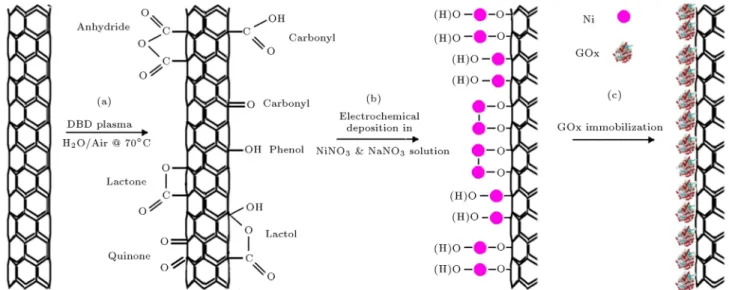
In order to remove surface groups that are possibly produced via synthesis or purication period, the pur-chased MWCNTs were annealed at high temperatures (1000C) in He. The process of functionalization (Figure 1(a)) was done through DBD in saturated air. The zero air with a ow rate of 40.0 sccm was humidied using H2O at 70C and moved over the
annealed MWCNTs inside a plasma reactor. The details of the reactor were given elsewhere [16]. The nanotube samples were exposed to DBD plasma at various times (i.e., 1, 2, 4, and 6 min). In this text, the DBD functionalized nanotubes are called F-CNTs. 2.4. Preparation of electrodes
The unmodied electrode was cleaned using polishing tissue and alumina slurry and was sonicated in the ethanol/water mixture. The F-CNTs were dissolved in naon solution (0.5 wt.%) and mixed for 10 min using an ultrasonic homogenizer (250 UL Hielscher) to obtain uniform suspension (2.0 mg/ml). Then, 10.0 l of this mixture was cast on the surface of GCE and dried at 25C. To fabricate the NiO/F-CNTs/GCE (Figure (1)b), F-CNTs/GCE was inserted in the solution of NiNO3/NaNO3 (0.005 M) at constant potential (i.e., 0:8 V), versus reference electrode, for 3 min and rinsed in water. Subsequently, 5.0 L of the GOx solution at a concentration of 10.0 mg/ml was immobi-lized on the surface of NiO/F-CNTs/GCE (Figure 1(c)) and dried at 4C overnight. A concentration range of 0.01-4.0 mM glucose was selected for glucose detection experiments. The GOx/NiO/F-CNTs/GCE was stored at 4C in the refrigerator.
3. Results and discussion 3.1. Characterization 3.1.1. TPD analyses of F-CNTs
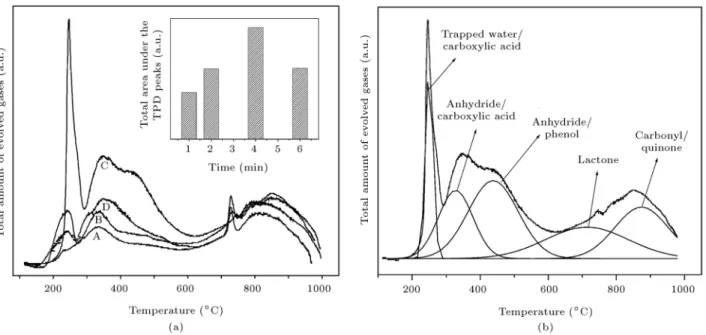
Figure 2 presents TPD proles of F-CNTs samples functionalized in the humid air for dierent exposure times. The gas evolution prole starts from 160C
and shows three major peaks at around 250, 400, and 800C. These evolved gases that mainly include H2O, CO2, and CO result from the decomposition of oxy-genated functional groups [24]. The area at the peaks of TPD spectrum (Figure 2 inset) corresponds to the total amount of the evolved gases. As the exposure time increases from 1 to 4 min, the amount of evolved gases is enhanced. An additional exposure time of 6 min results in a smaller quantity of functional groups. Since there is a limited number of defect points on the surface of nanotubes, as the primary site for functionalization, further plasma treatment leads to the detachment of some of the functional groups [25]. Figure 2(b) shows the TPD prole of MWCNTs functionalized for 4 min, which is deconvoluted to 5 peaks corresponding to H2O, CO2, and CO evolution during the decomposi-tion of various oxygenated funcdecomposi-tional groups including carboxylic, anhydride, phenol, lactone, carbonyl, and quinone groups.
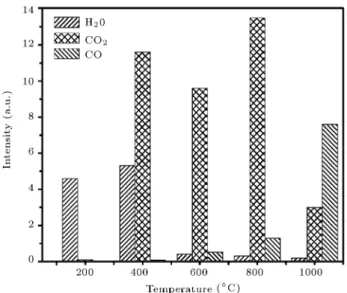
In order to evaluate the emerged gases, the TPD instrument was coupled with an FTIR gas cell, and the results of the identied and quantied evolved gases at various temperatures are shown in Figure 3. The major component in the low-temperature region of 160-280C is H2O, which is originated either from water trapped in the micropores or from the interaction of adjacent OH-containing groups [26]. The decomposition of these functional groups leads to the formation of carboxylic anhydrides and H2O molecules [27].
The intermediate temperature region in the range of 260-600C is mostly a mixture of H
2O and CO2. These gases have evolved from the dissociation of phenol and carboxylic/anhydride groups [27,28]. The
Figure 2. (a) TPD spectra of MWCNTs functionalized at power = 30.6 W and various exposure times of (A) 1, (B) 2, (C) 4, and (D) 6 min. Inset: the inuence of contact time on the total amount of evolved gases. (b) Deconvoluted peaks of TPD prole of MWCNTs functionalized for 4 min corresponding to dierent functional groups.
Figure 3. The relative amounts of evolved H2O, CO, and
CO2 from the MWCNTs functionalized in the DBD
plasma for 4 min at various temperatures during the TPD experiment.
slight CO evolution around 600C results from the decomposition of anhydride and phenol groups [28]. The high-temperature region of 600-1000C is mainly attributed to the evolution of CO2and CO from lactone and carbonyl/quinone groups, respectively [28]. The existence of these oxygenated functional groups on the F-CNTs' surface was conrmed by FTIR in our other work [12]. Another major source of CO2desorption in the high-temperature region is the secondary reaction between CO and oxygen surface species, as shown in the following:
CO + C O ! CO2+ Ca; (1)
where Ca is the adsorption site on the CNTs' surface, and C-O is the oxygenated group attached to the nanotubes. During the TPD, Ca may also react with the desorbed H2O, CO2, and CO and reform the oxygenated functional groups.
3.1.2. XPS results
To further study the surface chemical state of dierent F-CNTs samples, XPS survey spectra were employed. The XPS data for the annealed sample and F-CNTs (Figure 4(a)) indicate the presence of carbon and oxygen atoms. During the DBD plasma treatment of MWCNTs, the photoelectron peak of O 1s at 533 eV increases from 1.5% to 5.6% for the annealed and functionalized samples, respectively. In order to examine the bond structure of the oxygen-containing species, the C 1s peak was deconvoluted, the results of which are presented in Figure 4(a), inset. The major component at 284.9 eV is attributed to C=C bond, and the peaks at 286.3, 287.2, and 288.4 eV can be assigned to hydroxyl, carbonyl, and carboxyl groups, respectively [29]. These oxygenated species are created through the interaction of the reactive components such as O, O3, H, and OH with the surface of MWCNTs. These reactive species generated during DBD plasma in humid air atmosphere can split C=C bond and interact with open ends and defect points of CNTs [16]. The oxygenated groups have polar properties and make negative charges on the surface of CNTs and improve dispersion in aqueous solutions [12]. Figure 4(b) illustrates XPS spectra of NiO/F-CNT sample. The attachment of nickel oxide to the surface of F-CNTs leads to increasing the percentage of oxygen atoms to 11.3%. Two photoelectron peaks
Figure 4. (a) The XPS spectra of the annealed sample and F-CNTs. Inset: deconvolution of C 1s XPS spectra of F-CNTs. (b) XPS spectra of NiO/F-CNTs. Inset: the magnied region of Ni 2p: The peaks at 857.7 and 875.7 eV were attributed to Ni 2p3=2and Ni 2p1=2, respectively.
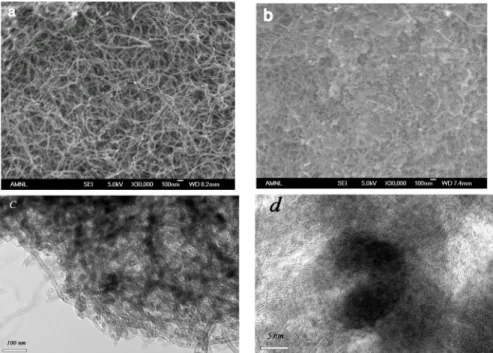
Figure 5. The SEM micrographs of (a) F-CNTs and (b) NiO/F-CNTs. (c) TEM image and (d) HRTEM of NiO/F-CNTs hybrid.
at 857.7 and 875.7 eV might be related to Ni2p3=2 and Ni2p1=2, respectively [30]. Moreover, the percentage of Ni atoms in the NiO/F-CNT hybrid was calculated to be about 5.4%.
3.1.3. Morphology of F-CNTs and NiO/F-CNTs The FE-SEM micrograph obtained for F-CNTs (Figure 5(a)) reveals a twisted morphology of MWCNTs with diameters of 20-30 nm, while the length reaches tens of micrometers. The SEM of NiO/F-CNTs sample (Figure 5(b)) shows that NiO-NPs are deposited on the nanotubes' surface and a relatively thin lm is created. The TEM image of NiO/F-CNTs (Figure 5(c)) further shows that NiO has uniformly and directly grown on the CNTs' surface. From the HRTEM image of the NiO/F-CNTs (Figure 5(d)), the particle size of NiO-NPs was determined to be approximately 10 nm. EDS analyses (data not shown here) conrm the presence of carbon, oxygen, and nickel elements in the NiO/F-CNTs hybrid.
3.2. Biosensor performance 3.2.1. Optimum deposition time
Figure 6 presents the cyclic voltammogram of NiO/F-CNTs electrodes synthesized by chronoamperometry at dierent deposition times. The formation of NiO-NPs (Eqs. (2)-(4)) [20] on the surface of F-CNTs/GCE increases current, indicating that the electroactive surface of NiO/F-CNTs/GC electrode is enhanced.
2OH + Ni2+! Ni(OH)
2; (2)
Ni(OH)2! H2O + NiO; (3)
Figure 6. The cyclic voltammograms of blank F-CNTs and NiO/F-CNTs electrodes synthesized by the
chronoamperometry method at dierent deposition times.
2C = O + 2Ni+2! 2C NiO: (4)
The charging current improvement is the greatest for the optimum deposition time of 3 min, and a further increase in the deposition time may cause the agglomeration of NiO-NPs and the reduction of the reactive surface of the modied working electrode. 3.2.2. Enzyme immobilization
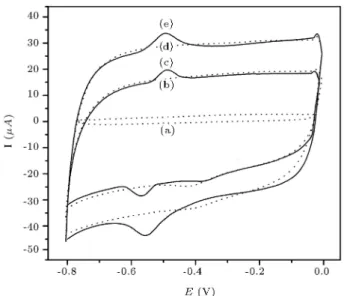
The modied electrodes were investigated using cyclic voltammetry in the range of 0:8-0 V, the results
Figure 7. The cyclic voltammograms of (a) bare GCE, (b) F-CNTs/GCE, (c) GOx/F-CNTs/GCE, (d) NiO/F-CNTs/GCE, and (e) GOx/NiO/F-CNTs/GCE.
of which are illustrated in Figure 7. The anodic charging current has increased from 2.0 A for the bare GCE (Figure 7(a)) to 15.0 A for F-CNTs/GCE (Fig-ure 7(b)), indicating that the functionalized nanotubes improve the reactive surface of treated electrodes. The GOx immobilization on the F-CNTs/GC electrode (Figure 7(c)) has created a reduction-oxidation wave centered at 0:54 V with a peak-to-peak potential separation (Ep) of 0.08 V.
Because of the existence of NiO-NPs on the F-CNTs/GCE (Figure 7(d)), the reactive surface has further increased and enhanced the ecient points for the adsorption of GOx. The GOx/NiO/F-CNTs/GCE (Figure 7(e)) presents a reduction-oxidation wave at 0:52 V with Ep of 0.05 V. The metal NPs may act as eective electron-conducting channels and decrease working potential and Epfor the enzymatic electrode. The modied electrodes in the absence of GOx show no faradic current as a result of the oxidation-reduction process, suggesting that the reduction-oxidation ac-tivity of the modied electrodes is assigned to the immobilized GOx as follows:
GOx(FAD) + 2e + 2H+$ GOx(FADH
2): (5)
3.2.3. Eect of the scan rate
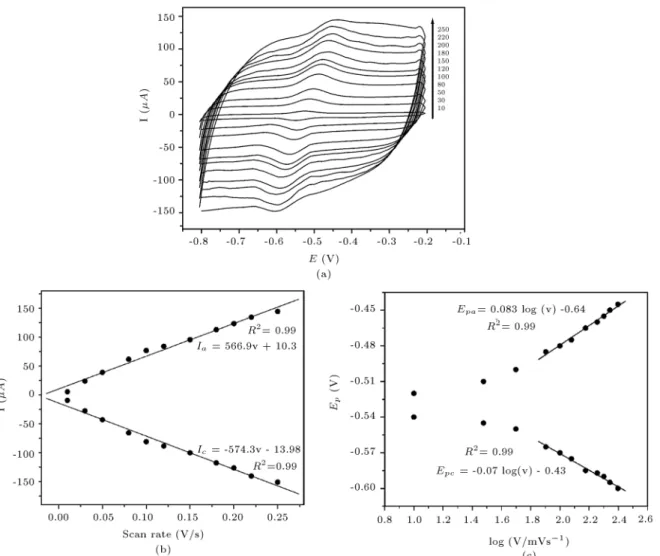
The eect of various scan rates on the cyclic voltammo-grams of GOx/NiO/F-CNTs electrodes is presented in Figure 8. Epof GOx peaks has slightly increased with an increase in the scan rate. Moreover, the currents of cathodic and anodic peaks are closely equal and show linear behavior (R2 = 0:99) versus the scan rate in the range of 10-250 mV/s. The results (Figure 8(b)) illustrate that the reduction-oxidation process is quasi reversible and surface conned [31].
The plots of cathodic and anodic potential peak
(Ep) versus the log of scan rate are given in Figure 8(c). As shown, at a scan rate of 80 to 250 mV/s, two lines with the slopes of 2:3RT=nF are generated. In this equation, is the coecient of charge transfer, n is the number of transferred electrons, and other parameters are constant (T = 298 K, R = 8:314 J/mol.K, F = 96485). Through the slope of plotted lines, the mean values of and n were approximated to be 0.39 and 2, respectively. In addition, the charge transfer rate constant (ks) of the enzyme at a scan rate of 250 mV/s was evaluated to be 1:12 0:1 s 1 based on Laviron's equation [32]:
log ks= log(1 ) + (1 ) log log(RT
nF ) (1 )
nF Ep
2:3RT : (6)
The average GOx concentration ( ) was calculated through the following equation:
Ip= (n 2F2A
4RT ); (7)
where A denotes the surface area of the treated elec-trode (0.125 cm2), and I
pis the peak current. Through the slope of plot of peak currents versus scan rate (Figure 8(b)), the GOx concentration was calculated to be 1:2 10 9 mol/cm2. In addition, the ratio of GOx/NiO was estimated to be about 5.4, suggesting that the multi-layered GOx was involved in the process of electron transferring.
3.2.4. Glucose detection using GOx/NiO/F-CNTs/GCE
The response of GOx/NiO/F-CNTs/GCE toward the addition of glucose was studied using cyclic voltam-metry [33,34], the results of which are shown in Figure 9. The oxidation current decreases from 19.8 to 11.0 A with a sequential glucose addition due to the blocking eect of the modied electrode [28]. The reaction mechanism of glucose in the sensor matrix was proposed to be [13]:
Glucose + GOx(FAD) ! Gluconolactone
+ GOx(FADH2); (8)
2NiO + 2H2O2! 2Ni(OH)2+ O2; (9) 2OH +2Ni(OH)2$ 2H2O+2NiO(OH)+2e ; (10) GOx(FADH2) + 2NiO(OH) ! GOx(FAD)
+ 2NiO + 2H2O: (11)
Figure 9, inset, presents the corresponding curve of calibration based on anodic faradic current response. The current response in the range of 0.2-3.8 mM presents a linear performance with the equation of:
Figure 8. (a) The cyclic voltammograms of GOx/NiO/F-CNTs/GCE in 0.1 M PBS at various scan rates of 10-250 mV/s. (b) The peak current plot versus scan rate. (c) The plot of Epversus log (scan rate).
Figure 9. Cyclic voltammograms of the
GOx/NiO/F-CNTs/GCE in the presence of 0.2 (outer) to 3.8 mM (inner) glucose. Inset: the curve of calibration for oxidation currents at dierent glucose concentrations.
I(A) = 2:16C (mM) + 19:32 (R2= 0:99):
The modied electrode shows relatively high sensitivity of 2.16 A/mM that may be assigned to the high sur-face area of F-CNTs and high electro-catalytic activity and adsorption ability of NiO-NPs. The detection limit of the fabricated electrode was estimated to be 93.0 M based on a signal-to-noise ratio of 3. Table 1 reports the analytical characteristics of the GOx/NiO/F-CNTs/GCE. This result is comparable to other works that have utilized nickel oxide in the medium of immobilization. It is noted that the electrode preparation process in the present work is fairly faster and simpler than that of other reports. 4. Conclusions
GOx/NiO/F-CNTs modied electrodes for glucose de-tection were fabricated by the treatment of nanotubes in the DBD plasma reactor in humid air, followed by electrodeposition of NiO and immobilization of GOx.
Table 1. The comparison of GOx/NiO/F-CNTs/GCE and other similar electrodes. Electrode material Formal potential (V) Sensitivity ( A.mM 1 )
Detection limit (M)
Linear
range (mM) Ref.
GOx/NiO/GC 0:42 0.44 24 0.03-5 [34]
CHITa /GOx/NiO/GC 0.35 3.43 47 1.5-7 [19]
NiCFPbelectrode 0.6 3.3 1 0.002-2.5 [7]
GOx/NiO/F-CNTs/GCE -0.52 2.16 93 0.2-3.8 This work
a Chitosan;bCarbon nanober paste.
The functionalization increased the oxygen-containing groups of MWCNTs from 1.5 to 5.6%, which in turn led to an important improvement of the anodic charging current. The larger number of oxygenated groups rolled as active centers for the uniform decoration of the F-CNTs with 10 nm NiO-NPs. This decoration improved the electroactive surface area and enhanced the immobilization of GOx by electrostatic attraction on the basic NiO. The presence of NiO-NPs improved electron transfer eciency and reversibility of GOx reduction-oxidation wave, which is a quasi-reversible and surface-conned process.
References
1. Ren, J., Wang, Z., Yang, F., Ren, R.P., and Lv, Y.K. \Freestanding 3D single-wall carbon nanotubes/WS2
nanosheets foams as ultra-long-life anodes for recharge-able lithium ion batteries", Electrochimica. Acta, 267, pp. 133-140 (2018).
2. Huang, J., Zhu, N., Yang, T., Zhang, T., Wu, P., and Dang, Z. \Nickel oxide and carbon nanotube composite (NiO/CNT) as a novel cathode non-precious metal catalyst in microbial fuel cells", Biosens. Bioelectron., 72, pp. 332-339 (2015).
3. Amirian, M., Nabipour Chakoli, A., Cai, W., and Sui, J. \Eect of functionalized multiwalled carbon nanotubes on thermal stability of poly (L-LACTIDE) biodegradable polymer", Sci. Iran, 20, pp. 1023-1027 (2013).
4. Foroughi, M.R., Khoroushi, M., Nazem, R., and Akbarian Tefaghi, E. \The eect of carbon nan-otubes/bioglass nanocomposite on mechanical and bioactivity properties of glass ionomer cement", Sci. Iran, 23, pp. 3123-3134 (2016).
5. Karbasi, S., Zarei, M., and Foroughi, M.R. \Eect of multi-wall carbon nanotubes (MWNTs) on structural and mechanical properties of poly(3-hydroxybutirate) electrospun scaolds for tissue engineering applica-tions", Sci. Iran, 23, pp. 3145-3152 (2016).
6. Si, P., Huang, Y., Wang, T., and Ma, J. \Nano-materials for electrochemical non-enzymatic glucose biosensors", RSC Adv., 3, pp. 3487-3502 (2013). 7. Liu, Y., Teng, H., Hou, H., and You, T.
\Nonenzy-matic glucose sensor based on renewable electrospun Ni nanoparticle-loaded carbon nanober paste electrode", Biosens. Bioelectron., 24, pp. 3329-3334 (2009).
8. Qian, Q., Hu, Q., Li, L., Shi, P., Zhou, J., Kong, J., Zhang, X., Sun, G., and Huang, W. \Sensitive ber microelectrode made of nickel hydroxide nanosheets embedded in highly-aligned carbon nanotube scaold for nonenzymatic glucose determination", Sens. Actu-ators, 257, pp. 23-28 (2018).
9. Barrio, M., Moros, M., Puertas, S., Fuente, J.M., Grazu, V., Cebolla, V., Marcos, S., and Galban, J. \Glucose oxidase immobilized on magnetic nanoparti-cles: Nanobiosensors for uorescent glucose monitor-ing", Microchim. Acta, 184, pp. 1325-1333 (2017). 10. Pang, Y., Huang, Z., Yang, Y., Long, Y, and Zheng, H.
\Colorimetric detection of glucose based on cin with peroxidase-like activity", Spectrochim. Acta A Mol. Biomol. Spectrosc., 189, pp. 510-515 (2018).
11. Miwa, Y., Nishizawa, M., Matsue, T., and Uchida, I. \A conductometric glucose sensor based on a twin-microband electrode coated with a polyaniline thin lm", Bull. Chem. Soc. Jpn., 67, pp. 2864-2866 (1994). 12. Vesali-Naseh, M., Khodadadi, A.A., Mortazavi, Y., Moosavi-Movahedi, A.A., and Ostrikov, K. \H2O/air
plasma-functionalized carbon nanotubes decorated with MnO2 for glucose sensing", RSC Adv., 6, pp.
31807-31815 (2016).
13. Mathew, M., and Sandhyarani, N. \A highly sensitive electrochemical glucose sensor structuring with nickel hydroxide and enzyme glucose oxidase", Electrochim. Acta., 108, pp. 274-280 (2013).
14. Gao, F., Yin, J., Yao, Z., Li, M., and Wang, L. \A nanocomposite modied electrode: electrocatalytic properties and its sensing applications to hydrogen peroxide and glucose", J. Electrochem. Soc., 157, pp. F35-F39 (2010).
15. Gorgin Karaji, Z., Houshmand, B., Abbasi, S., and Faghihi, S. \Electrochemical anodic oxidation process of porous titanium granules for biomedical applica-tions", Sci. Iran, 22, pp. 2745-2751 (2015).
16. Vesali-Naseh, M., Khodadadi, A.A., Mortazavi, Y., Pourfayaz, F., Alizadeh, O., and Maghrebi, M. \Fast and clean functionalization of carbon nanotubes by dielectric barrier discharge plasma in air compared to acid treatment", Carbon, 48, pp. 1369-1379 (2010). 17. Zhang, H., Li, H., Fang, M., Wang, Z., Sang, L.,
Yang, L., and Chen, Q. \Roll-to-roll DBD plasma pretreated polyethylene web for enhancement of Al coating adhesion and barrier property", Appl. Surf. Sci., 388, pp. 539-545 (2015).
18. Abdi, M.H., Ibrahim, N.B., Baqiah, H., and Halim, S.A. \Structural, electrical and magnetic characteriza-tion of nickel-doped tin oxide lm by a sol-gel method", Sci. Iran, 21, pp. 2459-2467 (2014).
19. Li, C., Liu, Y., Li, L., Du, Z., Xu, S., Zhang, M., Yin, X., and Wang, T. \A novel amperometric biosensor based on NiO hollow nanospheres for biosensing glu-cose", Talanta, 77, pp. 455-459 (2008).
20. Yao, M., Hu, Z., Xu, Z., Liu, Y., Liu, P., and Zhang, Q. \High-performance electrode materials of hierarchical mesoporous nickel oxide ultrathin nanosheets derived from self-assembled scroll-like a-nickel hydroxide", J. Power Sour., 273, pp. 914-922 (2015).
21. Ammara, S., Shamaila, S., Zafar, N., Bokhari, A., and Sabah, A. \Nonenzymatic glucose sensor with high performance electrodeposited nickel/copper/carbon nanotubes nanocomposite electrode", J. Phys. Chem. Solids., 120, pp. 12-19 (2019).
22. Ko, T.H., Seong, J.G., Radhakrishnan, S., Kwak, C.S., Khil, M.S., Kim, H.Y., and Kim, B.S. \Dual func-tional nickel cobalt/MWCNT composite electrode-based electrochemical capacitor and enzymeless glu-cose biosensor applications: Inuence of Ni/Co molar ratio", J. Ind. Eng. Chem., 73, pp. 1-7 (2019). 23. Xu, J.J., Feng, J.J., Zhong, X., and Chen, H.Y.
\Low-potential detection of glucose with a biosen-sor based on the immobilization of glucose oxidase on polymer/manganese oxide layered nanocomposite", Electroanal., 20, pp. 507-512 (2008).
24. Chen, J., Kobayashi, F., Eguchi, K., and Waki, K. \Understanding the redox reactions of adjacent carboxyl groups and anhydride groups following citric acid treatment of defect-containing multiwalled carbon nanotubes", Electrochem. Commun., 91, pp. 25-30 (2018).
25. Xu, T., Yang, J., Liu, J., and Fu, Q. \Surface modication of multi-walled carbon nanotubes by O2
plasma", Appl. Surf. Sci., 253, pp. 8945-89451 (2007). 26. Rosenthal, D., Ruta, M., Schlogl, R., and Kiwi-\Combined XPS and TPD study of oxygen-functionalized carbon nanobers grown on sintered metal bers", Carbon, 48, pp. 1835-1843 (2010). 27. Boehm, H.P. \Surface oxides on carbon and their
analysis: a critical assessment", Carbon, 40, pp. 145-149 (2002).
28. Figueiredo, J.L. and Pereira, M.F. \The role of surface chemistry in catalysis with carbons", Catal. Today, 150, pp. 2-7 (2010).
29. Tayyebi, A., Tavakoli, M.M., Outokesh, M., Shaekhani, and A., Simchi, A. \Supercritical syn-thesis and characterization of graphene PbS Quantum dots composite with enhanced photovoltaic proper-ties", Ind. Eng. Chem. Res., 54, pp. 7382-7392 (2015). 30. Hoa, L.T., Tien, H.N., Luan, V.H., Chung, J.S., and Hur, S.H. \Fabrication of a novel 2D-graphene/2D-NiO nanosheet-based hybrid nanostructure and its use
in highly sensitive NO2 sensors", Sens. Actuators B,
185, pp. 701-705 (2013).
31. Mohammadi, F., Vesali-Naseh, M., Khodadadi A.A., and Mortazavi, Y. \A comparison of a nanostructured enzymeless Au/Fe2O3/MWCNTs/GCE electrode and
a GOx modied one in electrocatalytic detection of glucose", Electroanalysis, 30, pp. 1-10 (2018). 32. Haghighi, N., Hallaj, R., and Salimi, A.
\Immobiliza-tion of glucose oxidase onto a novel platform based on modied TiO2and graphene oxide, direct
electrochem-istry, catalytic and photocatalytic activity", Mater. Sci. Eng. C., 73, pp. 417-424 (2017).
33. Li, F., Song, J., Li, F., Wang, X., Zhang, Q., Han, D., Ivaska, A., and Niu, L. \Direct electrochemistry of glucose oxidase and biosensing for glucose based on carbon nanotubes@SnO2-Au composite", Biosens.
Bioelectron., 25, pp. 883-888 (2009).
34. Salimi, A., Shari, E., Noorbakhsh, A., and Soltanian, S. \Immobilization of glucose oxidase on electrode-posited nickel oxide nanoparticles: Direct electron transfer and electrocatalytic activity", Biosens. Bio-electron., 22, pp. 3146-3153 (2007).
Biographies
Abbas Ali Khodadadi received his MSc in Chemical Engineering from University of Tehran in 1986 and his PhD in Catalysis and Reaction Engineering from University of Waterloo, Canada in 1994. His research interests include nanostructured materials synthesis, surface functionalization, characterization and use as (bio/photo/electro) catalysts, adsorbents, membranes in energy, environmental, chemicals production, and gas/bio-sensors applications.
Yadollah Mortazavi received the BSc degree in Chemical Engineering from University of Shiraz, Shi-raz, Iran and the MSc and PhD degrees in Chemical Engineering from University of Waterloo, Waterloo, Ont., Canada. He joined University of Tehran, Tehran, Iran in 1995. His research interests include catalysis and reaction engineering, especially in C1 chemistry, environmental catalysis, chemical gas-sensors, and nano-structured materials. Currently, he is the Chair of Nanotechnology Department at College of Engineering, University of Tehran, Tehran, Iran.
Masoud Vesali-Naseh received MSc and PhD de-grees from University of Tehran in 2009 and 2014, respectively. He is an Assistant Professor at the Chem-ical Engineering Department, University of Hamedan since 2014. His research interests are environmental issues, nanostructured materials, and catalytic reaction engineering.