Sharif University of Technology
Scientia Iranica
Transactions D: Computer Science & Engineering and Electrical Engineering
http://scientiairanica.sharif.edu
Twinner: A framework for automated software
deobfuscation
B. Momeni and M. Kharrazi
Department of Computer Engineering, Sharif University of Technology, Tehran, P.O. Box 11155/1639, Iran. Received 29 July 2017; received in revised form 6 October 2018; accepted 12 October 2019
KEYWORDS
Virtualization obfuscation; Malware analysis; Automated deobfuscation; Twincode generation.
Abstract.
Malware analysis is essential to understanding the internal logic and intent ofmalware programs in order to mitigate their threats. As the analysis methods have evolved, malware authors have adopted more techniques such as the virtualization obfuscation to protect the malware inner workings. This manuscript presents a framework for deobfuscating software, which abstracts the input program as much as a mathematical model of its behavior through monitoring every single operation performed during the malware execution. Also, the program is guided to run through its dierent execution paths automatically in order to gather as much knowledge as possible in the shortest time span. This makes it possible to nd hidden logics and deobfuscate dierent obfuscation techniques without being dependent on their specic details. The resulting model is recoded as a C program without the articially added complexities. This code is called a twincode and behaves in the same manner as the obfuscated binary. As a proof of concept, the proposed framework is implemented and its eectiveness is evaluated on obfuscated binaries. Program control ow graphs are inspected as a measure of successful code recovery. The performance of the proposed framework is evaluated using the set of SPEC test programs.
©2019 Sharif University of Technology. All rights reserved.
1. Introduction
Malware programs have evolved rapidly over the past decade, initially developed for fun, now being tools for nancial prot and espionage. The new generation of malware, as depicted by the EquationDrug and the GrayFish [1], are constructed from well-developed modules responsible for a variety of duties such as ex-ploitation, C&C communication, rootkit functionality, and so on. For example, the main module of the Flame [2] occupies about 6 MB and integrates all of the noted components together.
*. Corresponding author. Tel.: +98 21 6616 6627
E-mail addresses: b [email protected] (B. Momeni); [email protected] (M. Kharrazi)
doi: 10.24200/sci.2019.21601
Understanding the internal logic of a malware is of great importance in order to defend against it and limit its eectiveness. For example, knowledge of the Domain Name Generation (DNG) algorithm of a botnet could be used to predict its following command and control domain name; the propagation IP address selection algorithm of a worm indicates its infection strategy and may provide insight into its target goals; and knowledge of vulnerabilities employed by a rootkit make it possible to immune systems to them. Gaining this knowledge is not easy, because malware authors use obfuscation techniques to protect the internal logic of their code. Although initial obfuscation techniques focused on changing the function names or replacing them with multiple functions to create a more complex looking code, as time has passed, much more advanced techniques have been proposed to obfuscate the code not only in its look but also in its logic.
One of the advanced obfuscation techniques currently being used is Virtualization Obfuscation (VO) [3]. VO can be seen as a virtual machine for a dynamically constructed computing architecture in-stance. In its simplest form, the obfuscator has a single virtual language consisting of a small set of assembly instructions. Given a program in source/binary form, it is (re)compiled to this virtual language. The obfus-cator can translate each assembly instruction from the source language (e.g., x86 assembly) to one or more instructions in the target language. Finally, it assigns random opcodes to the target language instructions. This makes the nal binary representation look like pseudorandom bytes. The resulting code is stored in the data section and the executable code is replaced with a dynamically generated interpreter.
Many deobfuscation methods [3-8] depend on specic aspects of the obfuscator. In the analysis of a VO protected malware, static solutions need to analyze the executable, which is entirely replaced with the VO interpreter code. Therefore, they need to go deep into the data section, distinguish those bytes as data and encoded virtual opcodes, and decipher them into a set of instructions for the used virtual machine. This makes static analysis impractical specially if the VO is combined with other obfuscation techniques such as anti-disassembly and data encryption tricks. Dynamic solutions are also challenging since many aspects of the software runtime behavior such as Control Flow Graph (CFG) and memory/registers access patterns have changed. For example, although a solution, which inspects executed branches to reconstruct the program CFG, obtains a view of the VO interpreter CFG, it misses the higher level CFG, which has been formed among the virtual instructions. This may require the deobfuscator to put more precise assumptions about the VO strategy to focus on the hidden virtual program and the deobfuscator may fail when those VO strategies or used template languages are changed.
There have been two general approaches to deob-fuscating the code. Consider an image which has been broken into pieces like a jigsaw puzzle. One approach to solving the puzzle and restoring the image is to examine how each individual piece can t into another piece. For example, the low-level obfuscation patterns [9] are listed in a database and whenever one of them is detected in the obfuscated binary, it is replaced by its corresponding original code. Nevertheless, growing number of possible obfuscation techniques/patterns and dependence on the proper knowledge about each pattern complicate such an approach. An alternative approach is to focus on the major image components (e.g., a cloud in the sky) and try to group puzzle pieces which hold a similar content together. These solu-tions [10] consider high level characteristics such as the syscalls existence and capture the related instructions
(e.g., to prepare syscall arguments). Such methods can be used against new obfuscators to analyze their behavior (e.g., list called syscalls), but they are not useful for learning the internal logic, such as the DNG algorithm of a bot or hidden behavior, e.g., a backdoor which remains inactive until a secret message is received. In other words, like in our puzzle example, those solutions put a number of pieces in the center of the puzzle as they look related to the mountains and put other pieces at the top as they look like the clouds, but they cannot match pieces which are gathered at the top or in the center of the puzzle together. They cannot generate any source code, detect/remove any deadcode, or analyze hidden logics, which may be executed if the malware environment is dierent.
This manuscript proposes a middle approach to the deobfuscation problem. Like in the puzzle example, an alternative approach is to understand what the image is and to slice it to create a new puzzle, which shows the same image but with much simpler pieces. In the context of deobfuscation problem, we mathe-matically model the malware by capturing its behavior alongside all possible execution paths. Afterwards, the obtained model is used to generate a new code, namely twincode, which is a compilable C program without the initial articial complexities of the obfuscated malware and behaves exactly as the original binary. Most importantly, twincode enables an analyst to inspect the functionality of dierent parts of the program by modifying, compiling, and reevaluating it as required.
In the proposed framework, dynamic analysis is employed to instrument the input binary using Pin [11], tracing all assembly instructions, and monitoring the binary (including changes in registers, memory, and in-voked syscalls). Furthermore, to decrease the required resources for a xed degree of deobfuscation, concrete-symbolic (concolic [12,13]) execution is employed by which concrete inputs (and required environment con-guration) drive the execution through a specied path while the executed instructions are also inspected symbolically to nd the input/output relationship for
allinputs which could drive the program through the
same execution path. As the program becomes more complicated, an open opportunity for understanding the internal code logic is maintained. Understanding the internal logic of a malware such as DNG algorithm of a bot, generation of comprehensive behavioral signa-tures for categorizing malware in their related families, debugging benign software which are obfuscated, and analysis of close sourced and obfuscated benign soft-ware for the presence of concealed backdoor are a few possible use cases of this framework.
The resulting twincode has a CFG similar to that of the original code. It performs the same memory changes as the original code and invokes the same syscalls with the same parameters and
mem-ory/registers states. Behavior of complicated oper-ations is captured by symbolic expressions in order to eliminate the eects of the junk codes. Since twincode is obtained by monitoring and simplifying the program behavior through dierent execution paths, it is eective against behavior-preserving obfuscations. For example, if an obfuscation transformation adds to program behavior by checking for existence of a le, its corresponding twincode will also check for existence of that le. Twinner framework implementation is open sourced and available to the research community.
The contributions of this manuscript can be sum-marized as:
1. Proposing an automated deobfuscation frame-work based on the deep abstraction and recoding approach, keeping deobfuscation independent of known obfuscators;
2. Providing a canonical representation of the deobfus-cated code (i.e., twincode), which is a structured C code with the same runtime behavior as the input program, but simplied for easier analysis;
3. Evaluating the proposed framework by employing a proof of concept implementation to deobfuscate a series of VO protected binaries.
The rest of this manuscript is structured as follows. Section 2 enumerates and briey explains the related deobfuscation techniques. Section 3 describes the proposed framework. It enumerates key framework elements and reduces the deobfuscation problem into a set of subproblems. Section 4 deals with the implemen-tation details of the proof of concept code, which is used for the practical evaluations in Section 5. Afterwards, Section 6 discusses the remaining challenges and how they can be addressed, and compares the proposed framework and other related works objectively. The manuscript is concluded in Section 7.
2. Related work
Analysis and deobfuscation solutions can be put in the following general categories. Some methods try to detect obfuscation layers and reverse them one by one. Such solutions [3,5] lead to high quality results but are always a step behind the obfuscators. Alternatively, a number of methods focus on specic program features which are hard to hide, such as used syscalls. These methods [6,10] work in the presence of new obfuscation techniques but produce lower quality results. Some frameworks [14,15] use these approaches to present binary inspection services to higher level analysis algorithms. But, there is also a third middle approach, which is not investigated adequately. It is to try to remove obfuscation eects by abstracting pro-gram features and then, recoding the resulting abstract
behavioral model. This approach minimizes the trans-formation errors since no program portion is ignored during the inspection and simplication process and works despite future/unknown obfuscation techniques, because the higher abstraction of the intermediary model captures the core logic of the protected program itself independent of the applied obfuscations. The rest of this section enumerates and briey compares some of the most notable studies related to the proposed framework.
The Rolles [3] method from the rst category em-ploys symbolic execution to map dierent parts of a VO protected malware onto symbolic functions. It assumes that the VM interpreter is reverse engineered once and the only unknown thing about it is the randomization of its opcodes and/or internal obfuscations of the VM code. It also assumes that it is notied when the execution of the VM part starts. The VM parts are converted to symbolic functions and compared with the reverse engineered VM parts using theorem proving techniques. When it nds invoked parts, it replaces them with the reversed codes. This method fails if (a) the malware used VM is instantiated from a dierent family of VMs (with some dierent template language) or (b) the theorem prover cannot nd the equivalent symbolic function of the executed part among reverse engineered parts.
Kinder [4] approaches this problem by static analysis. The main issue of the static analysis is domain-attening, in which the analysis of the VO protected malware leads to analysis of the interpreter. Assuming that VM has a decode-dispatch style, there would be some Virtual Program Counter (VPC) in-dicating the virtual opcode, which should be executed. Assuming that the VPC can be found by some analysis, Kinder resolves the domain-attening issue by creating a separate state per each value of (PC, VPC) pair. This method does not recover any code to allow further analysis of the resulting program, but allows analysis of the malware behavior statically without merging calculated states after each cycle of the decode-dispatch loop.
Yadegari et al. [5] used taint propagation to identify data ows during an execution and then, applied a series of semantics preserving transformations to simplify that logic. For this purpose, they employed Ether to obtain code traces and then, applied ve simplication methods to the traces. Finally, they constructed a CFG from the simplied traces. This method can work for packers which do not test their environment settings (e.g., execution delay) to conceal their runtime behavior. Peng et al. [16] proposed an algorithm for exploring all possible execution paths of an input program. It forces branch instructions by changing them in memory to follow an intended side.
pro-gramming as an obfuscation technique. It uses dynamic analysis to discover ROP gadgets, chain them to obtain higher level traces by skipping over some of return-to-library functions, and then merges gadget contents. It reconstructs CFG diagrams from these gadgets as its deobfuscated output. It also applies standard compiler optimizations in order to remove some redundancies.
Methods from the second category resist more complicated obfuscations, but they need to sacrice their output completeness. The Coogan et al.'s [10] method relaxes the problem from reversing the given code into eliminating as much VM code as possible. It achieves this by inspecting invoked syscalls, check-ing their arguments, and ndcheck-ing causal dependencies among instructions to nd codes with some inuence on those arguments. The Rotalume method [6] focuses on reversing the code of the VM itself (instead of the protected code, which is encoded in the data section). For this purpose, it needs to know about the used opcode values (random numbers) and their meaning. It assumes that VM has a decode-dispatch structure in which a big loop over a switch-case statement fetches opcodes and then, jumps to the corresponding part of the VM to emulate that instruction. Accordingly, Ro-talume tries to gure out fetched numbers as opcodes and code parts, which are executed after each fetch as their corresponding functionalities.
Another kind of malware obfuscation, which is worth noting, is using weird machines. Weird machines [18] are used in some unexpected manner. For example, the ELF le metadata can be used as a Turing-complete language to execute the malware while the executable program is not yet loaded [19]. Since our method starts instrumenting the input program before the start of runtime loader, it can watch instructions of runtime loader itself and generate twincode of ELF-metadata weird machine. However, there are weird machines which employ kernel-level codes for their execution. As the kernel code is not instrumented by our method, such machines remain undetectable. For example, a sequence of page fault and double page fault handling procedures can be used as a weird machine [20]. The weird machine executes the malware completely while no single instruction is fetched to be executed yet.
3. Framework
Even though dynamic analysis is a powerful approach to binary analysis, it has a set of issues which need to be considered. Specically, the executed code may be analyzed incompletely due to missing proper inputs to uncover important code portions. Even when the program is executed along an interesting path, it may look too complex since a simple logical operation could be replaced with an obfuscated version. The rst issue
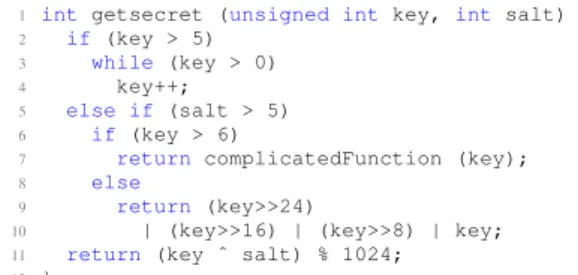
1 int getsecret (unsigned int key, int salt) {
2 if (key > 5)
3 while (key > 0)
4 key++;
5 else if (salt > 5)
6 if (key > 6)
7 returncomplicatedFunction (key);
8 else
9 return(key>>24)
10 | (key>>16) | (key>>8) | key;
11 return (key ˆ salt) % 1024;
12 }
Figure 1.
An example code with several obfuscations,e.g., a while loop, which does not stop before an overow; an unreachable code that calls a complicated function; and some arithmetical obfuscations.
leads to a trade-o between the dynamic code coverage and the used time and memory resources. The second issue can lead, in an extreme case, to analysis of the used packing and/or emulation code instead of the protected code, inuencing the analysis eectiveness.
In order to better understand the two noted issues, consider the code presented in Figure 1. For example, all code lines except lines 9-10 are there to
hide the main logic of the getsecretfunction. Each
time the program is executed, information about one of its many execution paths is obtained, depending on the values passed to the function as input. Without prior knowledge about the internal logic of the code, it is challenging to distinguish between inputs, which activate important paths or alternatively trigger traps providing no useful analysis results.
Furthermore, after traversing dierent execution paths and identifying deadcodes, important parts of the code may contain further obfuscations. For example, the conditional branch of line 2 guarantees that the key ts in one byte when line 9 is being executed. Thus, lines 9-10 can be simplied to return the key itself. Hence, each analyzed execution path should be simplied based on the asserted constraints in the collected context in order to remove the path-dependent obfuscations.
In what follows, the twinner framework is pre-sented, which eliminates both syntactical and logical obfuscations by observing the executed binary code during a gray-box instrumented run, modeling its behavior, simplifying the model by abstracting the be-havior/logic, and then regenerating the code according to the simplied logic. It should be noted that it is dicult to conceal high level program behaviors. For example, a variable may be stored in multiple memory locations to hide existence of a common variable. However, still those addresses have to be used instead of that common variable. Thus, abstracting out the memory addresses used cancels out the eect of such an obfuscation. In fact, the higher the abstraction level, the easier the transformation to simplied logic in practice.
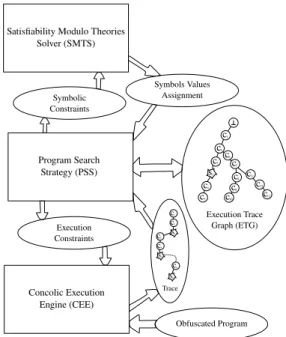
Figure 2 shows the proposed framework in which the components/products are shown as rect-angles/ellipses. This framework inspects an input obfuscated program iteratively using dynamic analysis. In each iteration, an execution path of the program is analyzed to obtain the relevant information of that part. Meanwhile, the program interacts with its environment, manipulates its memory/registers, and invokes syscalls. A malware can hide its logic in each part. For example, it can move user input through many locations to evade its ultimate usage place or it may obfuscate the memory contents by non-interfering
dummy operations such as calculating (+ 1)2 2
instead of 2expression.
All such activities are monitored symbolically to aggregate the obtained information and form an abstract behavioral model. Behavior of the program is simplied in two phases. First, while capturing each execution trace, several simplication rules are applied to the program input-to-output symbolic relationships. Second, while updating the behavioral model based on the simplied traces, a theorem proving tool is used to further simplify expressions and constraints as well as to remove possible deadcode branches. The model evolves by each iteration and at the end, a twincode is generated, which has a simplied logic but behaves exactly as if it is the original code.
The Concolic Execution Engine (CEE) compo-nent, shown at the bottom of Figure 2, deals with the dynamic analysis challenges, runs the protected binary in an specic desired path, and reports its symbolic execution results. The Program Search Strategy (PSS)
Obfuscated Program
Concolic Execution Engine (CEE)
c1
c2
c3
c4
c5
c6
c7
c8
c9
c10
c11
c12
c13
Execution Trace Graph (ETG) c1
c2
cn
s1
sk
c3
c4
s2 Trace
s1
Program Search Strategy (PSS) Satisability Modulo Theories
Solver (SMTS)
Execution Constraints Symbolic Constraints
Symbols Values Assignment
Figure 2.
The deobfuscation framework in whichcomponents are shown as rectangles and products are drawn as ellipses.
component, shown at the center of Figure 2, employs the CEE in each iteration to learn about an execution path, updates its behavioral model accordingly, decides about the next path, and places a new call to the CEE component to analyze the next selected path. The PSS component also consults with the Satisability Modulo Theories Solver (SMTS) component, at the top of Figure 2, in order to nd the required concrete inputs to inspect the next program paths and to simplify the obtained mathematical model.
The rest of this section discusses the proposed code behavior modeling approach in Section 3.1. After-wards, Section 3.2 describes how the obtained model can be simplied by abstracting its behavior/logic and Section 3.3 discusses how it can be encoded as a twincode for further analysis.
3.1. Path exploration and modeling
An intermediate goal of the proposed deobfuscation framework is to obtain a behavioral model of the protected binary. This model is represented by the Execution Trace Graph (ETG) in the middle of Fig-ure 2. Upon running a program, a series of assembly instructions are executed depending on the program inputs and its environment (e.g., network status). Each one of the followed execution paths covers parts of the program, forming a trace, which indicates a list of events including the satised conditions, the changes in the memory/registers contents, and invoked syscalls, all as symbolic expressions.
statements::= connedc jilluminatedi: (1)
Eq. (1) shows two types of statements which can be seen during the execution. Conned statements are those which are instrumented and their complete behavior can be tracked symbolically. Illuminated statements constitute the sources of uncontrolled ran-domness, such as invoked system calls. When a conned statement is executed, it updates the concrete memory state, the symbolic changes of the program, and satised constraints. When an illuminated state-ment is executed, it changes the concrete program state in an uncontrolled way and hence, it can lead to the creation of new symbols. The operational semantics of statements execution is shown in Figure 3. Each
operation rule has the form of Eq. (2), in which E
(bottom-left) shows the current state of the program
and s indicates the current statement. For execution
of s, a series of computations are carried out (top)
and consequently, the program state is updated to E0
(bottom-right). The next statement is shown bys
0:
computations
E;s E
0; s
0
Name-of-Operation: (2)
The rst rule in Figure 3 models the execution of a
f=Behavior(c) c=Condition(c) c(S) => c 0=c
mCj s=Next(f(S);c) S;j;hTSki
j 1
k=1;
Cj;mCj;mI;c f(S);j;hTSki
j 1
k=1; Cj^c
0;f
mCj;mI;s
CONFINED-OP
S 0=
SmI[j+ 1] SCj=Terminator(i) TSj= (Cj;mCj;SCj) s=Next(S
0; i) S;j;hTSkij
1
k=1;
Cj;mCj;mI;i S 0;j+ 1;
hTSkijk =1;
>;idm S;m
I;s
ILLUMINATED-OP
Figure 3.
Operational semantics for execution of the program in CEE.is denoted by S. Behavior(c) : mS ! mS is a
function from the current memory state (S) to the
next state, encoding how the statementcupdates the
program state. The memory state mS := N ! N is
a map from memory addresses (and registers) to their
encoded values. Finally,Condition(c) : mS !f?;>g,
is a function over the current program state, encod-ing the constraint which was checked by statement
c. Updating the environment to invert the value of
Condition(c) can change the subsequent instructions.
Each execution trace, modeling a single execution path, can be divided into multiple trace segments
(TSk) by illuminated statements. This division allows
the symbolic changes of conned statements in each fully instrumented sequence of instructions to be kept separately. It also allows memory symbols, which are introduced by execution of illuminated statements, to be controlled and initialized at the beginning of each trace segment.
TheCONFINED-OPrule updates the concrete state
(S) by passing it through the behavior function of c
statement (f(S)). As it does not nish the execution
of a trace segment, the segment index (j) remains
unchanged. Similarly, the sequence of trace segments
(hTSki
j 1
k=1) is not aected. But, the symbolic encoding
of memory changes and satised constraints in the
current segment (TSj) should be updated based on the
behavior (f) and condition (c) functions of statement
c. mCi:mS!mS, which maps the old program state
(exactly before execution of TSj) onto its new state
(after execution ofTSj), can be updated by combining
with the behavior function (f mCj), because the
program state should undergo changes of all executed
instructions, sequentially (f(mCj(:))). Ci : mS !
f?;>ginspects the old program state (exactly before
execution of TSj) and reports whether all assertions
of TSj are satised (Ci(:) = >) or some alternative
sequence of statements and their corresponding
seg-ment should be executed (Ci(:) = ?). Because the
condition function (c) of statement c operates in the
current program state (S), we have to update it to
take care of program state dierences (c0 = c
mCj)
so that it can process the old program state and then, update the segment assertions using a boolean
conjunction (Cj^c
0). m
I : N !mS, which indicates
how new symbols should be initialized at the beginning
of each trace segment, is not aected too. Finally, the next statement, which is observed during the concolic
execution, is denoted bys=Next(f(S);c).
S 0=
SmI[j+ 1](x)
=
(
mI[j+ 1](x); mI[j+ 1](x)6=?
S(x); otherwise
(3)
TheILLUMINATED-OPrule is invoked after execution of
an illuminated statement (i) and when the program
state has been updated out of the instrumentation
control. The program state (S) needs to be updated
as dictated in its corresponding memory initialization
function (mI [j + 1] : mS where mS = N !
N [ f?g). As shown in Eq. (3), the new state is
formed by overriding the memory cells which have been assigned to a new value by PSS decision. The trace
segment index is increased to (j+1) and the new trace
segment is appended to the sequence of trace segments
(TSj = (Cj;mCj;SCj)). Cj and mCj are symbolic
conditions and behavior encodings of the segment, which are accumulated during the execution of trace
segment TSj, and SCj = Terminator(i) denotes
the terminating operation, which nishes execution of that segment (e.g., invoking the \open" system call). The condition and behavior tracking functions need to be updated for the new trace segment too. For
this purpose, a tautology function (>) is assigned as
the new condition (Cj+1) and an identity function
(idmS(x) =x forx
2mS ) is used for initializing the
behavior function.
Denition 1 (Trace):
The traceTn is a sequence ofntrace segments hTSk = (Ck;mCk;SCk)ink=1 where the
TSk models a section terminated by SCk 2 N. Ck :
mS ! f?;>g, and mCk : mS ! mS are obtained
as shown in the operational semantics in Figure 3 and they denote the conditions which must be satised in
the program state before execution of TSk in order to
guide the execution through the statements ofTSk and
observe changes ofmCk in the program state.
Denition 2 (Guided execution):
When a programP is executed according to the operational semantics
beginning of each trace segmentTSk according tomI:
N ! mS, it is said that execution of P is guided by
the function mI. This guided execution is shown as
E[P;mI], which is the set of all possible tracesT that
can be obtained through the execution.
ETG is a graph consisting of all program traces. It is not necessarily a tree, because parts of the ETG can refer (via branches) to its other parts. However, it does not correlate with the obfuscated program CFG, because all branches that are resolved during a trace are simplied together. The ETG branches only when there is an input-dependent condition. For example, deobfuscating a VO protected program eliminates all checks on the values of the pseudo-opcodes, because inspecting those opcodes always leads to their corresponding implementation in the used vir-tual machine instance. Instead, the ETG corresponds to the original program CFG. The ETG is eventually encoded as the twincode, as will be discussed later in Section 3.3.
The PSS component is responsible for driving the deobfuscation process to extract information from the input binary iteratively. Pointing to the algorithm sketch in Figure 4, the PSS starts with an initial
execution of the P obfuscated program. This initial
trace establishes a single-path ETG to approximate the input program. In each iteration, PSS executes the binary through a new execution path trying to collect a set of traces covering all assembly instructions (static coverage) and all possible branching paths (dynamic coverage). As an example, given that a read register contains a symbol which was checked to be greater
than to follow an execution path, PSS can assign a
number less thanto that symbol in order to guide the
program along a new path in the following iteration. This issue is correlated with deadcode (i.e., the parts which cannot be executed with any input) detection challenge. To solve either of the above issues, the PSS needs to know whether there is a set of concrete values for the used symbols to drive the CEE along a specic path. This problem is equivalent to solving
the constraints corresponding to the desired execution path, which is known as Satisability Modulo Theories (SMT) [21] solving. If an SMT query is proved to be unsatisable, the related code is a deadcode. If a concrete solution can be found, the CEE can be guided through that path.
The SMTS component, at the top of Figure 2, is designed to respond to SMT queries of PSS. Since SMT solvers are decision procedures, they can terminate eventually. However, deciding that a SMT query is satisable is an NP-complete problem and can be a performance bottleneck in the worst case. To ensure that SMTS terminates in a polynomial time similar to other components of the proposed framework, it is possible to congure a deadline for solving each SMT query and obtain a concrete solution. In the worst case, when the SMT solver cannot answer within a xed-time deadline, the corresponding branch is left unexplored and marked as possible deadcode. An alternative in the worst-case scenarios is to negate the conditions of non-conforming branches in memory so that the solver can follow the desired side of each branch independent of the used concrete values. However, it can be used by a malware to slow down deobfuscation and delay analysis of other execution paths. The current PoC implementation does not use branch negation to avoid analysis of possible deadcode areas and save the analysis time for other parts.
The search strategy indicates which execution path should be queried thereafter. Putting collected traces together, it builds a conception of the complete ETG, searches within it, and decides where to explore more to construct a more comprehensive model. In other words, in each iteration, the constructed graph approximates the obfuscated binary in more details. An example of the strategy is to perform
Depth-First Search (DFS) until an instruction is visited k
times (hence, k rounds of an input-dependent loop
unfolded). Search strategies and maximizing code coverage are research subjects [22,23] in the eld of software automated testing.
Figure 4.
Sketch of the PSS algorithm using SMTS for solving symbolic constraints and CEE for executing through the3.2. Abstraction and simplication
As discussed earlier, dynamic analysis approaches need to address two main issues, namely eectiveness and dynamic coverage. In complex obfuscation scenarios, such as VO, the analysis may follow the logic of the used virtual machine instead of the protected code, making the deobfuscation ineective (even though technically correct). To overcome the eectiveness challenge, instead of capturing the executed assembly instructions (like [8]), CEE captures the behavior of each executed instruction in terms of its mathematical formula. Although instructions can be obfuscated, their functionality and hence, the formula modeling how registers and memory addresses are changed by the program execution remain obtainable across all obfuscations. In addition, dynamic coverage makes a trade-o between completeness of analysis and the used time and memory resources. For this trade-o, concolic [12,13] execution is employed in which all instructions are executed normally (therefore, anti-disassembly techniques are mitigated automatically) and each instruction is inspected symbolically (there-fore, the obtained input/output relationship is not restricted to the environment/concrete inputs).
Another challenge pertains to how to drive the program during the dynamic analysis (under the con-trol of the CEE) along the execution path, which is determined by the PSS (in terms of a set of concrete inputs). For this purpose, the CEE traces all input values as symbols during the concolic execution. There-fore, the CEE has the chance of modifying values of all symbols in the memory and registers before they are read by the program.
Denition 3 (symbol):
A symbol SYM = (v;t)models a value which can be stored at some memory
address or register. v is the concrete value represented
bySYMin the current execution andtis the type ofv
(e.g.,uint16 t) indicating the set of values which could
be used bySYM.
Denition 4 (more constrained initialization
relation):
A memory initialization function mI0 is
said to be \more constrained" than another memory
initialization function mI and is denoted by mI b
mI
0 if and only if m
I
0 is exactly the same as m
I,
but initializes more memory symbols. It is formally depicted in Eq. (4).
8mI;mI 0 :
N !mS:mIbmI 0
()
mI6=mI 0
^8j:N:8x 2N:
mI[j](x)6=?=)mI[j](x) =mI 0[j](x)
: (4)
An obfuscator can challenge dynamic analysis solutions in two main ways. On the one hand, it can add guard codes to hide the original program at runtime. A notable guard code is the latency-checker by which a time consuming action is performed and its measured time is compared with a threshold. As debugging slows down the execution, the malware can detect such extra latency. In defense, the notion of symbolic inputs can be extended to consider the
intermediate memory states. For example, the RDTSC
instruction loads the current time-stamp into registers. Although this value is not a user-input, it is not computed by the program either. It is a system-input. The CEE component can mark such inputs and report them back to the PSS. This resolves the guard code problem by asking the PSS component to nd user and system inputs in order to maximize the analysis code coverage.
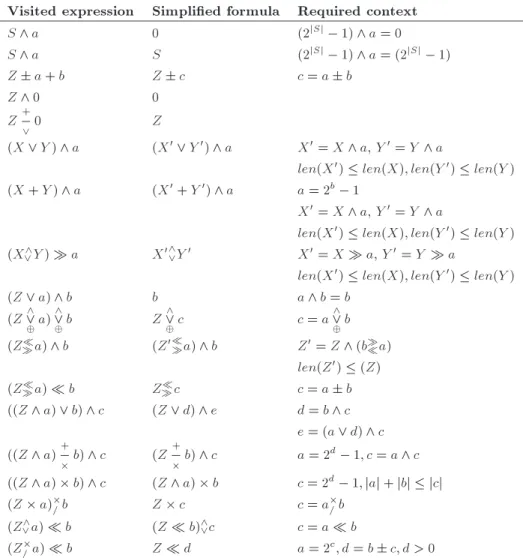
On the other hand, the computed function can be complicated (e.g., by additional neutral arithmetic); as a result, the observed functionality of the program remains incomprehensible. To address this issue, the calculated symbolic expression is simplied as it is gathered by the instruction analysis routines based on a set of expression simplication rules. Some of these rules are listed in Table 1. For the complete list, the Operator subclasses from the exptoken namespace in the Twinner git repository can be inspected. For example, the rst row of Table 1 states that the bitwise
AND of a symbol withjSjbits and some bitmask, which
is zero in its lowestjSjbits, removes the symbolS.
Theorem 1 (repeatability):
Given a programP andone of its traces Tn = hTSk = (Ck;mCk;SCk)ink=1,
which has been acquired through an executionE[P;mI]
for some memory initialization function mI, either
repeating the execution E[P;mI] always produces the
same trace or there exists a more constrained memory
initialization function mI
:
N ! mS that always
produces the same execution trace, as depicted in Eq. (5):
8P;mI:8Tn:E[P;mI]:9mI :
N !mS:
(mI =mI
_mIbmI )
^jE[P;mI ]
j= 1^Tn2E[P;mI ]
: (5)
Proof.
Repeating the execution E[P;mI] (usingmI = mI
), a trace such as
T
m = hTS
k =
(C
k;mC
k;SC
k)imk=1 is produced. If we can prove
equality of this arbitrary trace with the target trace
of the theorem (T
m =Tn), it is proved that no other
Table 1.
List of the runtime symbolic expression simplication rules used within the CEE component.X Z show symbolic expressions;S shows a symbol;a eshow concrete values;j:jfunction shows the bit length; andlen(.) represents the number of used tokens.Visited expression Simplied formula Required context
S^a 0 (2
jSj 1) ^a= 0
S^a S (2
jSj 1)
^a= (2 jSj 1)
Za+b Zc c=ab
Z^0 0
Z +
_
0 Z
(X_Y)^a (X 0
_Y 0)
^a X
0=X ^a,Y
0=Y ^a
len(X0)
len(X);len(Y 0)
len(Y) (X+Y)^a (X
0+Y0)
^a a= 2b 1
X0=X
^a,Y 0=Y
^a
len(X0)
len(X);len(Y 0)
len(Y) (X^
_Y)
a X
0 ^ _Y
0 X0=X
a,Y 0=Y
a
len(X0)
len(X);len(Y 0)
len(Y)
(Z_a)^b b a^b=b
(Z ^ _ a
)^ _
b Z
^ _
c c
=a^ _ b (Z
a)
^b (Z
0 a)
^b Z
0=Z ^(b
a)
len(Z0)
(Z) (Z
a)
b Z
c c=a
b ((Z^a)_b)^c (Z_d)^e d=b^c
e= (a_d)^c
((Z^a) +
b)^c (Z
+
b)^c a= 2d 1;c=a^c
((Z^a)b)^c (Z^a)b c= 2d 1;jaj+jbjjcj (Za)
=b Zc c=a
=b
(Z^ _a)
b (Zb)
^
_c c=a
b (Z
=a)b Zd a= 2c;d=bc;d >0
and hence,jE[P;mI
]
j= 1 which completes the proof.
For this purpose, it is enough to show thatn=jTnj=
jT
mj = m and (Ck;mCk;SCk) = (C
k;mC
k;SC
k) for
1 k n. Also, in scenarios that this equality
cannot be proved,E[P;mI
] can be changed by adding
more constraints to mI
in order to maintain the
equality of traces while the equation mI b mI
is
not violated. In these scenarios, the second form of the target proposition (Eq. (6)) is proved.
(mI bmI
)
^jE[P;mI ]
j=1^Tn2E[P;mI ]
:
(6)
In both traces, execution ofP is initiated by the
same statement; thus, the initial states of TS1 and
TS
1 trace segments are the same. If we can prove
that this equality is maintained during the execution of the rst trace segment and the same sequence of statements is executed in both runs, the nal system call of both segments will be the same (since it is the
last statement obtained during the execution of the rst
segment) and it observes the same concrete state of P
(because the equality has been preserved during the execution of that trace segment). This ensures that either both traces will terminate or both will continue execution from the second trace segment. However, the possible dierences in the kernel state can make the initial concrete states of the following two trace segments dierent.
By induction, we prove that if the rst q trace
segments are equal (hTSki
q
k=1 = hTS
ki
q
k=1), the
q + 1th trace segments (TSq+1 and TS
q+1), which
have to start with the same statements but dierent concrete states, can be made equal only by adding more
constraints to mI
while maintaining the equation
mI bmI
. This completes the proof by showing that
n = m, because no trace can be terminated earlier
when the concrete states of both are the same at the time of invoking the same system calls. For this proof,
S 0
q+1 =Sq+1mI[q+ 1]SCq=Terminator(i)TSq = (Cq;mCq;SCq)s=Next(S 0
q+1;i)
Sq+1;q;hTSki
q 1
k=1;Cq;mCq;mI;i S
0
q+1;q+ 1;hTSki
q
k=1;>;idm
S;m I;s
ILLUMINATED-OP:
(7) Box I
TS
q+1is an illuminated statementi, which is seen after
return of theSCq =SC
q, while the concrete states of
the two runs (see Figure 3) can dier (Sq+1 6=S
q+1)
before executingiitself. However, after execution ofi,
all following statements should be conned, because the rst following illuminated statement will terminate the trace segment. Execution of the rst illuminated state-ment uses the operation rule of Eq. (7) shown in Box I. The set of possible dierence points between two
functionsu;v:N !N can be obtained by Eq. (8):
uv=vu=fx:Nju(x)6=v(x)g: (8)
The possible dierence points of the initial program
states (Sq+1S
q+1) can either be overridden bymI[q+
1] during execution ofi(in which case it is not required
to updatemI
) or will remain dierent in some cases
between two sets ((Sq+1S
q+1) fx2NjmI[q+1](x)6=
?g). In this case, the concrete states can be made equal
by updatingmI
[q+ 1] according to Eq. (9) shown in
Box II. This ensures thatS
0
q+1 =S
0
q+1.
Because this reasoning is made about an arbitrary
member of the new guided execution set (T
m 2
E[P;mI
]), it shows that from any initial dierence
set such as (Sq+1S
q+1), an appropriate patch can be
constructed for updatingmI
[q+ 1] and consequently
equating trace segmentsTSq+1 andTS
q+1. However,
for constructingmI
[q+ 1] in practice, there are two
approaches. One approach is to override all memory cells which were not overridden by the rst memory initialization vector, as shown in Eq. (10):
mI
[q+ 1] =
Sq+1mI[q+ 1]: (10)
Another approach is to repeat the execution
iteratively, once running E[P;mI(1)], where mI(1) =
mI, in order to obtain dierence sets and produce
mI(2)for overriding those dierences and then, running
E[P;mI(2)] to obtainmI(3)and so on. Since more cells
are initialized in each turn, the initialization vector
becomes more constrained (mI(1) b mI(2) b ::: b
mI
) and the guided execution set will converge to a
single-member set.
Since concrete program states are made equal, the next executing statements in both trace segments will
also be the same (s=Next(S
0
q+1;i) =Next(S
0
q+1;i)).
In addition, the initial constraints and behavior
func-tions are initialized with the same value (>;idm
S).
Execution of the next conned statement c is
per-formed by the operation rule of Eq. (11), shown in Box III.
Because both trace segments are running the
same c statement, their condition/behavior functions
will also be the same (f = f and c = c).
Furthermore, since Sq+1 = S
q+1 before execution
of c, the following concrete states will also be the
same (f(Sq+1) = f
( S
q+1)). Similarly, the updated
condition (Eq. (12)) and behavior (Eq. (13)) functions will be equal. Finally, equality of the following concrete
states (f(Sq+1) =f
( S
q+1)) leads to execution of the
same following statements (s = Next(f(Sq+1);c) =
Next(f( S
q+1);c)).
Cq+1^c 0 =
Cq+1^(cmCq+1)
=C
q+1^(c
mC
q+1) =C
q+1^c
0
; (12)
mI
[q+ 1](x) =
8 > < > :
mI[q+ 1](x); mI[q+ 1](x)6=?
Sq+1(x); mI[q+ 1](x) =?^Sq+1(x)6=S
q+1(x)
?; otherwise
(9) Box II
f =Behavior(c)c=Condition(c)c(Sq+1) =>c 0 =c
mCq+1 s=Next(f(Sq+1);c) Sq+1;q+ 1;hTSki
q
k=1;Cq+1;mCq+1;mI;c f(Sq+1);q+ 1;hTSki
q
k=1;Cq+1^c
0;f
mCq+1;mI;s
CONFINED-OP:
(11) Box III
fmCq+1=f
mC
q+1: (13)
Repeating this reasoning for every following
con-ned statementc, the concrete and symbolic program
states will remain equal in both trace segments until
execution of the next illuminated statement i, which
terminates the trace segment.
Theorem 1 states that all programs are determin-istic. That is, without interacting with the outside world (e.g., an OS syscall), a program has no inherent source of randomness which is not marked as a symbolic input. In other words, since all instructions, which can provide some inputs to the program (e.g., syscalls or hardware timers), are instrumented, those inputs can be modied by CEE before being used for the rst time. For example, opening a le may succeed/fail at dierent times, but even if a le is deleted, the malware can be made to believe that the le is present by feeding the le data stream to the malware through memory modications. Ensuring that the environment is not changed at all (or the malware cannot sense those changes), re-executing it leads to the same results all the times.
3.3. Twincode generation
Completing the introduced chain of components of the proposed framework, this section explains how the twincode is generated as the ultimate result. Twincode is structured as the ETG, encoding the same conditions of the analyzed program, preparing memory/registers contents as a function of their previous states, and invoking the same syscalls. Consequently, it behaves like the obfuscated program with the dierence that its functionality is simplied and visible in the C code. Thus, it can be used as input to other analysis techniques and/or manual inspection. Each trace represents the program behavior during an execution path. Therefore, if all execution paths of the input program are determined, their corresponding traces can be mined out and putting those traces together, the nal twincode can be generated.
Denition 5 (twincode of a program):
Thetwin-code of the program P, shown as (P), is an encoding
of its ETG as shown in Figure 5.
The algorithm in Figure 5 starts with the ETG root node and visits its nodes as follows. Visiting a
node such as u, which is connected to n other nodes,
an if-elseconstruct is outputted having an if part
for each one of then connected nodes. Upon visiting
a segment terminator node, the symbolic changes of that part are simplied using SMTS and outputted; the syscall invocation code for its corresponding syscall is outputted afterwards; register/memory symbols of the next segment are instantiated and initialized with concrete register/memory values at that time instant; and the segment identier is incremented. Upon
Figure 5.
Sketch of the twincode encoding algorithm.visiting a previously encoded ETG node, its previous encoding is reused by moving its corresponding code to a separate function.
As the program is analyzed more in each iteration, its new parts are discovered and its ETG is evolved. Thus, any realization of the PSS must be able to perform the search incrementally. Another feature of the twincode is that, starting from dierent obfuscated versions of a program, similar twincodes are produced. In other words, twincodes of all obfuscated versions will contain traces which can be obtained from the original program. This allows the twincode to be analyzed instead of a specic obfuscated version.
Denition 6 (equivalent programs):
Twopro-grams P and P
are equivalent, shown as
P P
,
if and only if they behave equivalently for all pos-sible memory initializations (inputs), as depicted in Eq. (14).
8P;P :
P P
()
8mI :N !mS:E[P;mI]=E[P ;m
I]: (14)
Theorem 2 (equivalence):
If OP and O
P are two
obfuscated instances of programP, with the assumption
that the used obfuscation transformation has neither eliminated nor added to the observable behavior of
P, both (O
P) and (
O
P) are equivalent with
P, as
depicted in Eq. (15).
8P;P ;
O(:):[(O P
P)^(O P
P)] =)
(O
P)
(O
P)
Proof.
In order to prove the target proposition( (O
P) (O
P)
P) based on the given assumption
(O
P
O
P
P), we can use the proof by contradiction
technique. In other words, we should start by assuming that Eq. (16) holds and show that it leads to a contradiction.
[O
P
O
P
P]^[( (O P)
6P)_ (O P)
6P]:(16)
Without loss of generality, assume that (O
P) 6
P holds (the same reasoning can be used about the
case of (O
P)
6P). Note Eqs. (17) to (22) shown in
Box IV.
Alternatively, in Eq. (19), it is possible to say:
9T P[x]
m 2E[P;mI]:8T
(OP)[x]
n 2E[ (O
P);m I]: T
(O P)[x]
n 6=T
P[x]
m :
However, due to their symmetry, we use the rst case without loss of generality. Thus, the opposite
assumption of Eq. (17) leads to O
P
6P in Eq. (22),
which is in contradiction with the assumption ofO
P P.
Providing better, faster, and more optimized search strategies and/or SMT solvers, as presented in [24], automatically provides a better twincode gen-erator. This is a notable contribution, which allows the research line of software deobfuscation to directly benet from progress in the software automated testing and SMT solving elds. Any SMT solver can be tted in this framework aecting the analysis performance, but not its correctness or completeness. The following section explains the details of the implementation and the related practical concerns.
4. Implementation
This section discusses how the implementation has been carried out and enumerates some of the major practical challenges which should be resolved in the
process. It is noteworthy that the proposed framework has been implemented in C++ and consists of more than 35 thousand lines of code. Furthermore, the code is released under GPLv3 through the project page in [25].
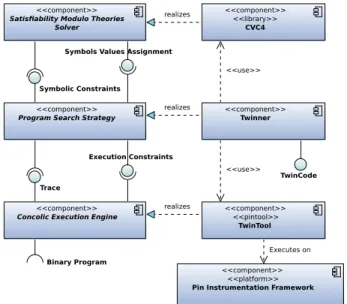
Figure 6 depicts the component diagram of this reference implementation. The PSS is realized by the twinner component. It provides a command line interface to congure the deobfuscation parameters and uses DFS as its search strategy. In each analysis round, it forks a new process to execute the CEE; extracts a trace information including a sequence of satised constraints; and updates the ETG accordingly. Although the DFS works over an evolving graph, it does not miss any part since the graph can be ordered unambiguously. ETG nodes contain constraints and are ordered in such a way that all constraints observed in the former traces are placed on the left of those which are seen afterwards.
<<component>> <<platform>> Pin Instrumentation Framework
<<component>> <<pintool>>
TwinTool <<component>>
Twinner <<component>>
<<library>> CVC4
<<component>>
Concolic Execution Engine
<<component>>
Program Search Strategy
<<component>>
Satis ability Modulo Theories Solver
Execution Constraints
Trace
Symbolic Constraints
Symbols Values Assignment
Binary Program
TwinCode <<use>>
<<use>> realizes
realizes
Executes on realizes
Figure 6.
Component diagram of the proposedframework reference implementation.
(O
P)
6P; (17)
=)9mI :N !mS:E[ (O
P);m
I]6=E[P;mI] Bby Denition 6; (18)
=)9T
(OP)[x]
n 2E[ (O
P);m I]:8T
P[x]
m 2E[P;mI]:T
(OP)[x]
n 6=T
P[x]
m Bby Denition 2; (19)
=)9T
OP[x]
n 2E[O
P;m I]:T
OP[x]
n =T
(OP)[x]
n ^8T
P[x]
m 2E[P;mI]:T
OP[x]
n 6=T
P[x]
m Bby Denition 5; (20)
=)9mI :N !mS:E[O
P;m
I]6=E[P;mI] Bby Denition 2; (21)
=)O
P
6P Bby Denition 6: (22)
1 .section .rodata 2 .LC0:
3 .string"overflow\n"
4 .LC1:
5 .string"underflow\n"
6 .LC2: 7 .string"%d\n"
8 .text
9 main: 10 pushq %rbp 11 movq %rsp, %rbp 12 subq $32, %rsp 13 movl %edi, -20(%rbp) 14 movq %rsi, -32(%rbp) 15 movq -32(%rbp), %rax 16 addq $8, %rax 17 movq (%rax), %rax 18 movzbl (%rax), %eax
19 movb %al, -9(%rbp) 20 cmpb $47, -9(%rbp)
21 jle.L2
22 cmpb $57, -9(%rbp)
23 jg.L3
24 movsbl -9(%rbp), %eax
25 subl $48, %eax
26 movl $0, -8(%rbp)
27 jmp.L4
28.L5:
29 addl %eax, %eax
30 addl $1, -8(%rbp) 31.L4:
32 cmpl $9, -8(%rbp)
33 jle.L5
34 movl %eax, %esi
35 movl $.LC2, %edi
36 movl $0, %eax
37 callprintf 38 movl $0, %eax
39 jmp.L7
40.L3:
41 movl $.LC0, %edi
42 callputs
43 movl $-2, %eax
44 jmp.L7
45.L2:
46 movl $.LC1, %edi
47 callputs
48 movl $-1, %eax
49.L7: 50 leave
51 ret
(a) X86 64 code (AT&T syntax)
Complete CFG root
L21: jle .L2 F T
L23: jg .L3
F T L45
L31 L40
L28 L33: jle .L5
F T
L37
L49 L42 L47
(b) Non-pruned CFG
Sample ETG root
L21: jle .L2
F T
L23: jg .L3
F T L45
L37 L40
L49 L42
L47
(c) The ETG
1#include"twincode.h"
2
3intmain (intargc,char*argv[]) { 4 struct RegistersSetregs; 5 SAVE_REGISTERS (regs);
6 const UINT64rax_0 = regs.rax, rbx_0 = regs.rbx, rsp_0 = regs.rsp, ...; 7 const UINT8m7fffffffe5eb_0_8 = *((UINT8*) 0x7fffffffe5eb);
8 ...
9 if((((UINT64(rsp_0) +UINT128(0xffffffff, 0xffffffff, 0xffff8000, 0x1d28)) & 0xffffffffffffffff) == 0)) { 10 if((((UINT64(argv[1]) +UINT128(0xffffffff, 0xffffffff, 0xffff8000, 0x1a15)) & 0xffffffffffffffff) == 0)) { 11 if((UINT128(0x0, 0x0, 0x0, 0x2f) < signExtend_0x80_0x8 (UINT64(m7fffffffe5eb_0_8)))) {
12 if((UINT128(0x0, 0x0, 0x0, 0x39) >= signExtend_0x80_0x8 (UINT64(m7fffffffe5eb_0_8)))) {
13 ...
14 regs.rdi =UINT64(0x4006a7);
15 regs.rsi =UINT64((((signExtend_0x20_0x8 (m7fffffffe5eb_0_8) - 0x30) * 0x400) & 0xffffffff)); 16 printf (/*"%d\n"*/(const char*) 0x4006a7,
17 (UINT64) (((signExtend_0x20_0x8 (m7fffffffe5eb_0_8) - 0x30) * 0x400) & 0xffffffff));
18 regs.rax =UINT64(0x0);
19 return int(regs.rax);
20 }else{
21 regs.rdi =UINT64(0x400694);
22 puts (/*"overflow"*/(const char*) 0x400694); 23 regs.rax =UINT64(0xfffffffe);// -2
24 return int(regs.rax);
25 }
26 }else{
27 regs.rdi =UINT64(0x40069d);
28 puts (/*"underflow"*/(const char*) 0x40069d); 29 regs.rax =UINT64(0xffffffff);// -1
30 return int(regs.rax);
31 }
32 }
33 } 34 }
(d) Twincode of the above assembly code
Figure 7.
Example assembly code, corresponding CFG, ETG, and twincode depicting some of trace extraction runtimechallenges such as requirements for the management of the memory consumption, constraint simplication, and other abstractions.
For example, consider the program shown in Figure 7(a). It reads an input byte in line 18; compares it in lines 21 and 23 to lter out small and large values; computes a function over the input in lines 27-34; and prints the result in lines 35-37. Assume that the rst execution goes through the left path shown in Figure 7(c) (false branches of lines 21 and 23 conditions). When the DFS nishes traversing the
subgraph starting atL37, i.e., left childLof constraint
C of nodeL23, it continues by asserting all constraints
from the root node of ETG up to C and negation of
constraintL. The next execution of the program will
produce a list of constraints starting withL21 andL23.
Therefore, the new nodes which are added to the ETG
are placed in the subgraph starting at right child ofC
and the DFS does not miss the ETG parts which are added during the search.
The CEE is realized by twintool, which is imple-mented within the ldmbl [26] architecture. The ldmbl architecture abstracts low-level OS and
hardware-dependent implementation details based on the Pin [11] Dynamic Binary Instrumentation (DBI) framework in order to facilitate heavyweight instrumentation use cases such as concolic execution. Twintool is responsi-ble for extracting a single trace from the given binary. It runs the input program concolically, instrumenting all assembly instructions, tracking memory, and reg-ister changes symbolically. This gray-box approach has the advantage that the intermediate conditions which have been inspected by the binary will become visible to twintool and can be recorded in the trace without any dependence on extra information, such as a specic compiler or the source code, which is normally unavailable during the malware analysis. The intel64 assembly instructions are represented by 1148 dierent mnemonics, each one having several modes for dierent
operands. For example, the SUB mnemonic encodes
22 distinguished forms [27, p. 1459] such as SUB AX,
imm16 and SUB r/m8, r8. Deobfuscating a program
to be supported in the twintool. To make it scalable, twintool implements a Generic Instrumentation Layer (GIL) as designed in the ldmbl [26] architecture. It automatically detects operand types (e.g., memory address) and their read/write sizes; organizes them within 40 generic categories (e.g., DstRegSrcImplicit); and instruments them using a set of Generic Analysis Routines (GARs). Thereafter, every invoked GAR nds the appropriate instruction analysis callback; wraps operands with proxy objects hiding dierent operand types/sizes; and invokes the callback to op-erate on them.
There are three proxy classes for memory, reg-ister, and constant values. Each one allows reading and writing (on mutable expressions), taking care of separation of pintool and input program memory, operation sizes, and overlapping locations. For exam-ple, the RegisterResidentExpressionValueProxy class
updates EAX, AX, AH, and AL registers when an
instruction updates theRAXregister. This allows each
instruction analysis routine to focus on its own specic logic while the GIL applies it to a bunch of lower-level assembly instruction models.
Figure 8 shows implementation of the ADD
in-struction analysis routine. It reads immutable/mutable source/destination expressions from proxy objects at lines 4 and 6, clones the destination expression at line 7, performs symbolic addition at line 9, and updates the destination (memory or register) using the proxy object at line 10. The abstraction provided by the twintool library makes it more extensible and easier to support new assembly instructions. For example, whenever an address is accessed for the rst time, a new symbol
is allocated for it. If an ADD instruction uses a new
user input as its source operand, line 4 of Figure 8 allocates the new symbol for it. Afterwards, symbols may be copied to other addresses and/or undergo dierent operations (e.g., addition and multiplication). When symbols are created, some concrete values exist in them. Those initial values form the concrete state of the program and dictate which execution path will be followed within its running instance. Consequently, the program can be forced to follow another path by changing initial values of the symbols. Finally, line 11
updates theEFLAGSregister with an
AdditionOpera-tionGroupobject, which can be queried in the following
conditional instructions, e.g., conditional branches.
The last component of the framework (i.e., the SMTS) is realized using the CVC4 [28] library for solving symbolic constraints. It accepts a set of symbolic constraints and produces one of the three possible answers. It analyzes constraints to nd a concrete solution satisfying all of them, simultaneously. If constraints are unsatisable, the CVC4 library either proves this fact or fails after a maximum analysis time. Several challenges arise here. First, the constraints which twintool has extracted from the binary may depend on the real inputs to the program and/or articially added parts such as the VM interpreter code in a VO scenario or the decryptor/decompresser code for a packed malware. Next, these symbolic constraints may become more and more complicated; as a result, keeping them in the memory becomes a challenge. This makes solving of those constraints time consuming or infeasible within the given time limits.
Addressing these challenges requires more knowl-edge about the program inputs and how they aect the execution path. The rst input category is user inputs, which are given as initial values to the program, and the second category is system inputs (including syscalls), which may depend on states which are hidden from the malware. User inputs (i.e., command line arguments of the program and environment variables) are placed in the stack and can be read by the program. Consequently, they change the execution path either
(a) explicitly, via conditional branches (e.g., je .L2);
or (b) implicitly, via calculated values (e.g., movq
-16(%rbp), %rax; jmp %rax). The next inuencing
factor (i.e., syscalls) depends on the OS. This includes reading from a le, network communication, or even reading from the standard input. A typical syscall receives some arguments from the caller program (e.g., a buer given to \read(fd, buf, len)") and completes its logic according to the given arguments and other parts of its memory (state of the caller process, in general, such as the open \fd" le descriptor) as well as the internal state of the kernel itself (e.g., the mounted le systems). Finally, syscall may change any parts of the caller's memory and/or registers.
On the one hand, the user and system inputs are captured as symbols. On the other hand, ob-fuscator related data items such as articial arith-metic operations are treated as constants. For ex-ample, the virtual opcodes which encode the text
1 voidInstructionSymbolicExecuter::addAnalysisRoutine (constMutableExpressionValueProxy &dst,constExpressionValueProxy &src) { 2 edu::sharif::twinner::trace::Trace *trace = getTrace ();
3 edu::sharif::twinner::util::Logger::loquacious () <<"addAnalysisRoutine(...)\n\tgetting src exp..."; 4 constedu::sharif::twinner::trace::Expression *srcexp = getExpression (src, trace);
5 edu::sharif::twinner::util::Logger::loquacious () <<"\tgetting dst exp..."; 6 constedu::sharif::twinner::trace::Expression *dstexpOrig = getExpression (dst, trace); 7 edu::sharif::twinner::trace::Expression *dstexp = dstexpOrig->clone ();
8 edu::sharif::twinner::util::Logger::loquacious () <<"\tbinary operation..."; 9 dstexp->add (srcexp);
10 setExpression (dst, trace, dstexp);
11 eflags.setFlags (newedu::sharif::twinner::twintool::operationgroup::AdditionOperationGroup (dstexpOrig, srcexp)); 12 edu::sharif::twinner::util::Logger::loquacious () <<"\tdone\n";
13 }
section of the malware are the same in all executions. Although the execution path depends on both the virtual opcodes and the program inputs, the opcodes may not be changed based on the user interactions or the network and le system states. Consequently, simplifying constraints and transformation expressions based on the symbols is enough to automatically remove any dependence on those obfuscator related details.
Another example is shown in Figure 7(b). The
loop created by node L33 is totally removed in
Fig-ure 7(c) because it depends on -8(%rbp), which is
initialized in line 26 of Figure 7(a) as a constant. This will not help the obfuscator to initialize it as a function of user inputs and then, cancel their eects in the comparison of line 32, because simplication of the constraints can simplify and remove the articial dependency. A more concerning challenge is how these obfuscations aect the memory used for keeping transformations and constraint symbolic expressions. As an example, consider lines 28-33 in Figure 7(a), in
which the value of%eaxregister, e.g., symbolic input s,
is added to itself repeatedly to produces+s,s+s+s+s,
etc. growing the required memory exponentially. To overcome this challenge, twintool simplies symbolic expressions as they are captured, instead of keeping them up to the end of execution to be processed in
SMTS. Thus, the expression is kept as 2s, 4s, etc. with
constant memory footprint.
The twincode generated by the described assem-bly code is shown in Figure 7(d). Lines 9-10 check the stack location and the program arguments on the stack; lines 11-12 check for the input interval leading
to the execution of partL37 of the ETG, as shown in
Figure 7(c); line 16 prints the input multiplied by 1024 (i.e., 0x400); and lines 22 and 28 print messages about overow/underow scenarios of the original program. Some of the initialization parts of Figure 7(d) are replaced with dots for sake of clarity. The complete compilable version can be retrieved from the test folder within the twinner repository.
5. Evaluation
This section evaluates Twinner from the practical point of view. For this purpose, Twinner is tested against the VO technique to observe the practical quality of the deobfuscation results. The VO replaces the entire text section of the program with an interpreter and it contains the classic obfuscations. That is, evaluation of the VO-protection scenario subsumes the deobfuscation of classical methods such as packing and encryption. Additionally, the set of SPEC [29] test programs is instrumented to examine the performance of a trace extraction run for large and complex real-world programs.
5.1. Eectiveness
To measure the similarity of the original program and the deobfuscated twincode, we can compare their ETGs. The structure of ETG is preserved while being encoded as a twincode. ETG is an appropriate metric, because it encodes the behavioral model which has been learned by analysis of the given binary. It also corresponds with the CFG of its twincode counterpart while CFG of the original program can be altered and replaced completely by obfuscation transformations. VO is one of the most complicated methods for obfuscating an arbitrary program. In this technique, a random instance of a template language is selected; the program is compiled to it and placed in the data section; and the entire text section is replaced by a virtual machine interpretor generated to be able to parse that random template language instance. Thus, CFG of the obfuscated program is completely independent of the original program and it can be examined as a dicult test scenario. If the CFG of the original program can be recovered in the structure of the resulting twincode, which can be seen as the resulting ETG, it shows that obfuscation eect has been cancelled.
In this section, we will VO-protect 4 programs with a variety of CFGs as the rst step to obtain similarly incomprehensible and indistinguishable bi-naries, which only dier in the pseudorandom data sections. Afterwards, VO-protected programs are re-versed and deobfuscated to obtain their execution trace graphs. Finally, similarity of ETGs of the deobfuscated programs and the corresponding original programs is measured according to Denition 7 in order to quantify eectiveness of the Twinner deobfuscation process.
Denition 7 (ETG similarity):
Similarity of twoETG instances, shown as g1 = (V1;E1) and g2 =
(V2;E2) graphs, where jV1j jV2j, is given by g
1;g2
and dened as follows:
SG = fH = (VH;EH)j9Vh VH:H[Vh]
= Gg is
the set ofH graphs which have an induced subgraph
H[Vh] being the isomorph of the given G graph;
Sg 1;g2 =
Sg 1
\Sg
2is the set of all graphs which have
some induced subgraphs being the isomorph of the
given g1 andg2;
^Sg
1;g2 = (^V ;E^) 2 Sg
1;g2
^ 8G = (VG;EG) 2 Sg
1;g2:
jVGj jV^j indicates the supremum graph of
the g1 and g2 graphs, which is a member of Sg
1;g2
set and has the minimum number of vertices among all members of the set;
The similarity of the g1 and g2 graphs is dened
as g1;g2 = 1
jV^j jV 1
j
jV^j while g
1;g2 = 1 shows
identical graphs and g1;g2 = 0 shows the minimum