iSELF: The development of an Internet-Tool for Self-Evaluation and
Learner Feedback
Nicolet Theunissen and Hester Stubbé
Dep. of Training & Performance Innovations, TNO, Soesterberg, The Netherlands
[email protected]
[email protected]
Abstract: This paper describes the theoretical basis and development of the iSELF: an Internet-tool for Self-Evaluation and Learner Feedback to stimulate self-directed learning in ubiquitous learning environments. In ubiquitous learning, learners follow their own trails of interest, scaffolded by coaches, peers and tools for thinking and learning. Ubiquitous learning solutions include on- and off-line, formal and informal learning. To benefit from its possibilities, learners need to develop competencies for self-directed learning. To do so, a self-evaluation tool can help the learner to get insight in his/her own development, to manage and monitor his/her own learning process, to collaborate in learning, to relate the learning to 'real life' needs, and to take control over educational decisions. The iSELF was developed in an iterative process, complying to the following high level requirements: (1) Enabling learning anytime, anywhere; (2) Supporting self-directed learning; (3) Evaluating learner, learning solutions and job-needs; (4) Assessing learner competencies; (5) Using card-sort method for questionnaires; (6) Facilitating questionnaires 'under construction'; and (7) User-friendly design. The resulting online tool contained a card-sort module, looking somewhat like a 'solitaire' game, a profile module to evaluate core competencies, and a feedback module to suggest learning possibilities. For illustration, 14 different studies that contributed to the development of iSELF and to the development of self-evaluation questionnaires compliant to iSELF, are briefly discussed. These illustrative studies included various populations: e.g. students, employees from small and medium enterprises, crisis management organizations, and the military. Usefulness and usability of the self-evaluation tool were valued positively. The iSELF contributes to an adaptive ubiquitous learning environment in which the learner can make the educational decisions according to self-directed learning principles. The iSELF will stimulate self-directed learning in a ubiquitous learning environment and will help to create learners for life.
Keywords: self-evaluation, self-assessment, internet-tool, ubiquitous learning, self-directed learning, feedback
1.
Introduction
1.1
Ubiquitous learning needs self-directed learners
Nowadays, technology is very much part of everyday life and work (Mork 2011). Information and knowledge is handled and shared by using ubiquitous technology; ICT that makes it possible to access information ‘anytime, anywhere’ (Adkins et al. 2002). A learning environment that makes use of this technology is often referred to as ‘ubiquitous learning’. This is a way of learning in which learners follow their own trails of interest, scaffolded by coaches, peers and tools for thinking and learning (Dieterle & Dede 2007). Ubiquitous learning solutions include on- and off-line, formal and informal learning.
The availability of ubiquitous learning possibilities may assume that learners are able to learn and will develop themselves anytime, anywhere (G. D. Chen et al. 2008). However, this assumption might be too ambitious. Since the ability to manage one’s own learning is becoming increasingly important, one of the goals of education should be to create learners for life. Learners for life can be described as learners who have a flexible and pro-active attitude toward learning and developing themselves (Du Bois & Staley 1997). In this context the concept of self-directed learning is often mentioned and intensively discussed (Collins 2004).
In a review study of Stubbé &Theunissen (2008), five crucial elements of self-directed learning were identified: Learner control: Control over educational decisions and learning process.
Self-regulating learning strategies: Skills that support the learner to manage and monitor his/her own learning process (e.g. setting goals, planning, problem solving, and strategy use).
Reflection: The combination of self-assessment and self-evaluation on both the performance and the learning process that gives the learner insight in his/her own development.
ISSN 1479-4403 313 ©ACPIL
Reference this paper as: Nicolet Theunissen and Hester Stubbé “iSELF: The development of an Internet-Tool for Self-Evaluation and Learner Feedback” The Electronic Journal of e-Learning Volume 12 Issue 4 2014, (pp299-325) available online at www.ejel.org
Nicolet Theunissen and Hester Stubbé
Interaction with the social environment: The interaction with others, learners and teachers/coaches, in order to determine what goal should be set, discuss in what way this goal can be achieved, cooperate and collaborate during the learning process and ask for help.
Interaction with the physical environment: The learning experience should be set in the ‘real world’ and should relate to ‘real-life’ (work)situations.
Reality shows that some people develop a self-directed attitude toward learning, especially in relation to work or a hobby, others do not (Collins 2004). Explicitly teaching self-regulating learning strategies or reflection and stimulating (perceived) learner control, helps learners to become more self-directed (Stubbé & Theunissen 2008). Therefore, a ubiquitous learning system must not only provide the learner with learning resources anytime and anyplace (C.-M. Chen & Li 2010). It must also actively provide the learner with the appropriate learning possibilities for self-directed learning (Hiemstra 2006; S. L. Wang & Wu 2011). Self-directed learners are not merely consumers of learning facilities, they should also be able to contribute to the facilities by sharing knowledge and supporting other learners (Koper et al. 2005).
Self-evaluation (also called 'self-monitoring' or 'self-assessment') refers to an individual systematically observing his/her own behaviour and performance. Realistic evaluation will help the learner to gain self-regulatory control (Boekaerts 1991). Therefore, to become a self-directed learner, one should get insight in one’s own development. During self-evaluation, the learner makes a comparison between the noted behaviour and some designated standard (Hughes et al. 1991). In order to be able to assess his/her performance realistically, the learner must have access to internal standards of performance, involving a definition of what is meant by a 'good' or 'adequate performance. A person acquires these internal standards and self-conceptualizations on the basis of his experiences but also on the basis of statements made by significant others and self-attributions (Boekaerts 1991). Therefore, peer or expert observation can help learners to evaluate their own opinion about themselves. Self-evaluation as motivator for future behaviour agrees with Bandura's Social cognitive theory of self-regulation, assuming that a person can become can become knowledgeable about his/her own capabilities and skills (Bandura 1991).
Although self-evaluation presumes higher order cognitive skills, it is proven to be possible even in populations of people with mild cognitive retardation (Hughes et al. 1991). There are indications that self-reported abilities and competencies have concurrent validity with ratings by others, although it is found that self-assessment can be somewhat more positive (Jones & Fletcher 2004; Kelso et al. 1977). Moreover, ‘People may not be right about themselves, but their self-evaluations are the ones that most powerfully affect their future behaviour’ (page 45, (Byrnes 1984). As a result, self-evaluations are relevant for learner behaviour.
Thus, self-evaluation will help the learner to get insight in his/her own development, to manage and monitor his/her own learning process, to collaborate in learning, to relate the learning to 'real life' (work)needs, and to take control over educational decisions. In this way, all five elements of self-directed learning, mentioned before, are stimulated by self-evaluation.
2.
Assessment of competencies
To answer the question: ‘What to evaluate?’ we specifically look at the fifth element of self-directed learning: Interaction with the physical environment. Learning needs to be related to ‘real-life’ (work)situations, because meaningful knowledge is constructed only when process of learning integrates with cultural and life contexts (C.-M. Chen & Li 2010). In our rapidly changing society, initial training alone cannot meet the need for the development of working individuals. Training results become obsolete the moment they are obtained. A flexible and innovative economy requires permanent adaptations of knowledge, skills and attitudes, also called 'competencies'. Competencies are indivisible clusters of skills, knowledge, conduct, attributes and notions (e.g. (Boekaerts 1991). They are context dependent, connected to activities and tasks, but also flexible in time (van Merriënboer et al. 2002). In their essence, competencies can be used in more situations than the current task. This means that when one's job changes, the acquired specific skills become obsolete, but the acquired competencies can still be useful. Nevertheless, in our fast changing society it is possible that competencies themselves become obsolete or less important.
Another characteristic of competencies is that they can be acquired by learning and development. Competencies can be valuable to match individual performance and career planning with organizational job needs (Marko & Savickas 1998). In that context the concept 'core competencies' is used, competencies which
Electronic Journal of e-Learning Volume 12 Issue 4 2014
are essential for certain tasks or positions (Case 2003) and as such will provide the content for the relationship with 'real-life’ work situations.
Reporting on one's behaviour poses a difficult cognitive task and participants' reports are influenced by the wording of questions, format, and content (Schwarz & Oyserman 2001). In a study on self-assessment for selection purposes it was found that measurement conditions have substantial positive impact on the quality of self-ratings (Jones & Fletcher 2004). Self-ratings appeared to improve for instance when social comparison instructions were given; when they expected external validation; the anonymity of raters, previous self-assessment experience, unbalanced, positively toned scale; motivational instructions; framing questions unambiguously, ensuring measures are tied to actual performance, specifying the time period under consideration (i.e., past, present, or future behaviour); competencies broken down into distinct dimensions. However, it was also found that individual and gender differences were substantial and should be taken into account (Jones & Fletcher 2004). A self-evaluation instrument in a ubiquitous learning environment needs an easy to use, flexible and reliable method to gather information on selected competencies. A card-sort method is such a method, with good psychometric characteristics (Lievens & Sanchez 2007). Card-sorts involve the placement of cards onto piles, based on how each participant feels the concepts or statements on them are related. When using this method for evaluation of competencies, competency statements can be placed on the cards. Former research with this technique showed that people are able to sort a large number of separate cards in a relatively short time, which will increase learners’ motivation to use it for evaluation. The technique is particularly useful for identifying the common ground between a larger and diverse collection of competencies with a large and diverse group of participants (Caldwell & O’Reilly 1990).
There are two approaches in card-sort: the free and the restricted procedure (Harper et al. 2003). In the free approach, a participant is allowed to make as many piles of related cards as necessary, and label them. In the restricted approach, a participant uses piles that have already been defined (e.g. questionnaire Likert scales like 'not applicable at all' to 'totally applicable'). This enables the use of statistical techniques to cluster related competency statements into core competencies. The restricted card-sort relies less on the categorization skills of the participants. This makes it useful for a sample with various levels of education and experience, as is the case in a ubiquitous learning environment. Moreover, a standardized categorization makes it possible to make learner profiles that can be related to peers and that can show development over time. The same categorization can also be used to evaluate job-needs or the available learning solutions. An automatic match of the learner profiles with the learning solution profiles will show if they are beneficial to the learner. The results should be presented as suggestions so that the learner can make the educational decisions according to self-directed learning principles.
The aim of this paper is to describe the development of the iSELF: an Internet-tool for Self-Evaluation and Learner Feedback to stimulate self-directed learning in a ubiquitous learning environment. The theoretical background and characteristics of the iSELF, based on the developments so far, will be discussed. In addition, the first experiences with the tool and the matching self-evaluation questionnaires will be illustrated on the basis of 14 different studies.
3.
The iSELF itself
3.1
High level requirements
With the introduction text in mind, a set of requirements was developed for the iSELF:
1. Enabling learning anytime, anywhere: available for every learner through internet, with the possibility to embed the tool into Learning Management Systems.
2. Supporting self-directed learning: helping the learner to get insight in his/her own development, to manage and monitor his/her own learning process, to collaborate in learning, to relate the learning to 'real life' (work)needs, and to take control over educational decisions. To support control and to provide a 'safe' learning environment, it is important that the learner is the only one who can see personal evaluation results, until he/she decides otherwise.
3. Evaluating learner, learning solutions and job-needs: possibility of using the same content: (a) to score the learner competencies of all kinds of learners (e.g. low and high educated), (b) to assess the learner competencies by the learners themselves or by peers, colleagues, coaches or subject matter experts, invited by the learner, (c) to score which competencies are trained by certain learning solutions or are
Nicolet Theunissen and Hester Stubbé
relevant for a job or position. Using the same content in all situations enables a comparison between them.
4. Assessing learner competencies: assessing competencies that are specific for a group of learners in their (work)situations, and at the same time generic enough to remain relevant in our rapidly changing society. 5. Using card-sort method for questionnaires: this technique is less time-consuming and more objective than
other methods. This will increase motivation to use it in a large and diverse group of participants.
6. Facilitating questionnaires 'under construction': with new developments in the workplace, new competencies will become important. Therefore, new questionnaires will be developed all the time.
7. User-friendly design: most people do not like questionnaires. A playful appearance, user-friendly operation and clear, relevant content will increase motivation.
3.2
Design
The overall structure of the iSELF is presented in Figure 1 and explained in the next paragraphs.
Figure 1: Overall structure 3.2.1 Users
The overall structure includes the following iSELF users: 1. Learner: the learner in a ubiquitous learning environment.
2. Invitees: peers, colleagues, coaches or subject matter experts, invited by the learner to assess the learner. 3. Educational expert: the evaluator of available learning solutions.
4. Subject matter expert: the evaluator of competency requirements for a job or position.
5. Administrator: administrates the tool content: competency statements, information about core competence clusters and reference group- or norm figures.
3.2.2 Card-sort
The appearance of the card-sort tool, a front-end input module, is somewhat like a 'solitaire' game (see Figure 2). Instead of sorting playing cards, learners sort competency statement cards on their importance. The tool offers the possibility to get an overview or skip a statement temporarily. The competency statements are formulated in such a way that they are easy to comprehend for people with different backgrounds. A second person singular verb at the beginning of every statement emphasises the fact that competencies express themselves in behaviour (E.g. ‘Cooperates with people from other organizations’ or ‘Uses ICT systems to collect information and knowledge quickly’.) These statements can be used with different overall opening questions. For the learner the opening question could be: 'In the last two weeks, was this applicable to you?’ For the invitee it would be: 'In the last two weeks, was this applicable to [name learner]?’ For the use with the learning
Electronic Journal of e-Learning Volume 12 Issue 4 2014
solutions of job-requirements: ‘Is this applicable to [name learning solutions or job]?’ The card-sort module was built using Adobe Flex, an open source framework for building rich Internet applications that are delivered via the Flash Player 6.0.
Figure 2: Card-sort module in input mode 3.2.3 Profiles
The profile module shows the results of the card-sort input to the learner. After analyses, the competency statements are clustered into core competencies. The results are presented to the learner in one or more graphs. It can show learner results in combination with reference scores or scores from former sessions. The profile module was built using ColdFusion 8.0, a rapid application development platform that includes advanced features for enterprise integration and enables the development of rich Internet applications.
3.2.1 Feedback: suggestions for further learning
The feedback module can be used to compare perspectives by interpreting the results of both the learner and the invitee. The feedback can also be used to provide suggestion for learning solutions beneficial to the learner or for job-training and selection. The feedback is based on an automatic match of the learner scores with the learning solution scores. The feedback module was built using ColdFusion 8.0.
3.2.2 Administration
The administration module, a back-end module, combines several input functions: overall opening question, statements, number and content of answering categories, assignment of statements to clusters, personal accounts, data export, reference or norm score input. The module was built using ColdFusion 8.0 running Railo Server, the main version of Railo (a compiler) which can be integrated into standard web servers. It is suitable for production use.
Nicolet Theunissen and Hester Stubbé
Figure 3: A learner profile
Figure 4: Administration of competencies
3.2.3 Content: psychometric sound questionnaire
The content of the iSELF card sort module is created according to social sciences standards in questionnaire construction (Schwarz & Oyserman 2001). Currently, four questionnaires are under development (see Table 1). The presented scales are based on theoretical concepts and data analyses so far (more information can be obtained from the authors). At any moment in the development of a questionnaire it is possible to export the data for statistical analyses for validation and reliability tests. Using a.o. principal component analysis (factor analyses) and Cronbach's alphas ( 0.7), clusters can be identified and transformed into scale scores. The results from these analyses can be fed back through the administration module. The data export option can also be used to perform additional statistical analyses for group comparisons and determination of the influence of background variables like age or experience. These possibilities make the iSELF not only a learner tool but a scientific tool as well.
Electronic Journal of e-Learning Volume 12 Issue 4 2014
Table 1. Questionnaires developed in iSELF-style
Questionnaire No. Scales Scales items Example of item
Competencies for deploying
simulators in Military training (ComSim)
5 Using simulators, Coaching,
Advising, Teaching and Organizing, Accurate planning and documentation.
65 'Translates learning goals into the possibilities of a certain simulator'
Competencies for multidisciplinary cooperation in a Network Centric Organization (NCOQ)
7 Leadership skills, Working in ad hoc teams, Open mind for ICT tools, Own role in behalf of the team, Informatin processing, Social skills, Communication skills.
71 'Cooperates with people from other organizations' Competencies for Self-directed Learning Questionnaire (CSLQ)
5 Learner control, Self-regulating learning strategies, Reflection on learning and performance,
Collaborative learning, Reflection on relevance for work.
32 'Chooses what to improve in your work'
Military leadership competencies (MilLead)
8 Communication, Take initiative, People oriented, Employee development, Organization orientation, Planning and organizing; Results-oriented, Vision
40 'Takes the personal situation and wishes of others into account'
4.
The iSELF: development in phases
The development of the iSELF was an iterative process in which the modules (card-sort, profile and feedback) were prototyped, built and tried successively. Experiences were gathered using 14 different studies with various study aims and designs. All studies contributed to the development of the iSELF and will briefly be discussed as illustration of the iSELF possibilities. The general characteristics of the studies are presented in Table 2. More information about these studies can be obtained from the authors.
4.1
Phase 0: Prototyping with a paper card-sort tool
4.1.1 The paper-based iSELFIn this paper-based version, the iSELF only contained the card-sort module. The selected competency statements were each placed on a paper cards. Together with this set of cards came five envelopes with the labels ‘not important’, ‘somewhat important’, ‘important’, ‘very important’ and ‘essential’. A participant could express the importance of a competency statement for a position by assigning the cards to the envelopes. In this way, a 5-point Likert-scale was created for each statement.
4.1.2 Context
The paper-based prototype was used for career planning using core competencies (see Table 2, study 1). Semi-structured interviews and a document study resulted in 65 cards with competency statements. Subject matter experts sorted the cards twice for their own function: on expert and on novice level. In a group discussion both the method and the content of the cards was discussed. Using principal component analysis, five core competencies could be identified.
Nicolet Theunissen and Hester Stubbé
4.1.3 Experiences
The participant sorted the large set of statements cards quickly: each round of 65 cards took about 5 to 15 minutes. Most participants were positive about the procedure and preferred it to a standard questionnaire. The card-sort module was considered useful.
Table 2. General characteristics of the studies with iSELF
Refr. nr.
iSELF modules used
Questionnaire (1) N Domain Subjects characteristics
Study aim Research type
(2)
1 Prototype
Card-sort
ComSiM 28 military Subject matter
experts training-related functions in
the Royal Netherlands Army
Identification of competencies for career
planning
obs
2 Card-sort NCOQ 158 crisis
management organizations
Members of safety regions (fire department, police force, medical troupes, office of a dike-reeve)
Development of an instrument for
self-assessment of Competencies for Network
Centric Organizations
obs
3 Card-sort NCOQ 74 military Navy personnel
involved in Information
Management
Translating Lessons Learned into Education and Training,
case Information management
obs
4 Card-sort CSLQ 16 Research
institute
Researchers behavioural and social sciences
Determinants for innovation in multi-disciplinary teams
obs
5 Card-sort CSLQ 22 training and
organization consultancy agency Teachers and Consultants Measuring competencies for self-directed learning
obs
6 Card-sort CSLQ 86 crisis
management studies
Students Serious gaming
intervention, effect on self-directed learning
quasi
7 Card-sort CSLQ 335 SMEs Employees from 22
SMEs in the potato, vegetable & fruit retail business
Assessing the learning culture
obs
8 Card-sort CSLQ & NCOQ 40 crisis
management organizations
CoPI members from 4 different safety regions.
Development of a tool to Improve Team Situation
Awareness in multidisciplinary Crisis Management Teams
exp
9 Card-sort CSLQ 57 Military Personnel from the
Royal Netherlands 1th-CIMIC (Civil-Military Cooperation) battalion
Development of a ubiquitous learning environment
obs
Card-sort CSLQ 43 Military Navy personnel Training instructors in using
the Job Oriented Training approach
obs
10 Card-sort,
Prototype Profile,
CSLQ 66 Military Navy personnel Minimal e-coaching
intervention to support social learning in an online Community of Practice
Electronic Journal of e-Learning Volume 12 Issue 4 2014
Refr. nr.
iSELF modules used
Questionnaire (1) N Domain Subjects characteristics
Study aim Research type (2)
11 Card-sort,
Prototype Profile,
CSLQ 29 Military Personnel from the
Royal Netherlands National Reserve Corps
Minimal e-coaching intervention to support self-directed learning using e-mail
exp
13 [regular online
questionnaire], Profile, Feedback
MilLead 79 Military Royal Netherlands Air
Force, Military rank: Sergeant-major to Captain.
Development of an instrument for self-assessment and invitee-assessment of leadership competencies
obs
14 Card-sort,
Profile, Feedback
CSLQ 11 Crisis
management organizations
COPI and ROT members from different safety regions
Usability pilot obs
(1) see Table 1 for more information about the questionnaires
(2) obs=observational, quasi= quasi-experimental, exp: experimental; [Decision rule: I: are the subjects randomly assigned to conditions? II: has the experimenter functional control over independent variable(s): I yes+ II yes = exp.; I no+II yes = quasi.; I no+ II no = obs.]
4.2
Phase 1: Learner-profiling
4.2.1 The iSELF alpha versionThis version contained an internet based card-sort module and a half-automatic prototype of the profile module. The card-sort module was transformed in an online version, looking like a 'solitaire' web-game. The prototype profile module used MS Excel to produce a graph and MS Word for handmade individual reports.
4.2.2 Context
The alpha version was tested in three steps: (1) several try-outs of the card-sort module, (2) the profile module was added and presented to the learners and (3) the effect of receiving and discussing a personal profile was tested. To try out the card-sort module, various self-evaluation questionnaires were developed (see Table 1) and psychometrically tested in crisis management organizations, the military and with employees from small and medium enterprises (see Table 2, study 2-11 & 13). The iSELF was presented to the participants from within a learning management system (ILIAS, MOODLE) or with a hyperlink in an email. The data-output of the card-sort module was used to identify core competencies using the statistical package SPSS.
Next, in one of these studies, the participants received a personal profile about their Self-directed learning competencies. A group of Navy personnel received a profile after a pre-post-test intervention study (see Table 2, study 10). The profile showed the individual results on three points of measurement and the overall average scores of the whole group. Afterwards the participants were interviewed.
Finally, in one study (see Table 2, study 11) military personnel participated in an experiment in which the experimental group received their profile and minimal e-coaching by email. Compared to the control group, their taking control for their learning increased significantly because of the intervention.
4.2.3 Experiences
The card-sort module of the iSELF alpha version was used successfully: the technique worked, questionnaires could be validated and the participants valued the module positively. The profile prototype was evaluated as useful in the communication with the participant. Moreover, receiving and discussing a profile in itself improved some aspects of self-directed learning.
Nicolet Theunissen and Hester Stubbé
4.3
Phase 2: Prototyping the match of learner profiles with learning solutions profiles
4.3.1 The iSELF beta versionThis version contained all iSELF-functionalities (card-sort, profile, feedback).
4.3.2 Context
The beta version was tested in two steps: First, the profile and feedback modules were used as an addition to a 'classic' online-questionnaire embedded in MOODLE. It was developed for self-assessment and invitee-assessment of leadership competencies in Air force personnel (see Table 2, study 12). The suggestions the participants received from the feedback module included formal (training, e-learning) and informal learning possibilities (e.g. documents, discussion, movies). The employees could choose to use the iSELF or not and could invite others to assess them if they wished. The next step was a usability pilot (see Table 2, study 13) with the complete iSELF that was carried out with employees from crisis management organizations. Afterwards participants were interviewed about their evaluations.
4.3.3 Experiences
In the Air Force case, using the iSELF was voluntary. Many employees did use it and their numbers are still increasing. In the usability pilot, participants were enthusiastic about the iSELF. One of the conclusions was that matching the learner profile with learning possibilities saves time and will improve adaptation of the learning environment to the learner. These experiences indicate that the tool is usable and useful.
5.
Discussion and conclusions
This paper describes the iterative development, testing and evaluation of the iSELF: an Internet-tool for Self-Evaluation and Learner Feedback. The tool is designed to stimulate self-directed learning in a ubiquitous learning environment and our experiences so far confirm its usefulness.
The experiences with the card-sort module in a large and diverse group of participants proved that the technique was highly appreciated. When they had the possibility to use it anytime and anywhere, participants used it voluntarily. The playful appearance, the user-friendly operation and the clear, relevant content increased motivation to use it.
The profile module helps the learner to gain insight in his/her own development in relation to the competencies important for his/her work. These competencies always need to be identified before they can be used in the iSELF. We emphasize the importance to assess competencies that are specific for a group of learners, and at the same time generic enough to remain relevant in our rapidly changing society. This helps the learner to reflect on 'real life' (work)needs.
The possibility to compare their results with previous results or with those of invited peers, colleagues, coaches or subject matter experts, seemed to improve reflection as intended. In future, it is possible to include e-coach possibilities that will stimulate reflective competencies more explicitly.
The feedback module presents suggestions for learning, which helps the learner to manage and monitor his/her own learning process and to take control over educational decisions.
An important requirement for the iSELF is that it should support learning anytime, anywhere. Some organizations use Learning Management Systems (LMS) to provide learning solutions like e-learning, others use the LMS as a portal and offer links to learning solutions outside the LMS. Therefore, the iSELF needed the possibility to be embedded into Learning Management Systems. The beta version was tested both inside and outside an LMS and could thus be used anytime and anywhere. LMS also offer the possibility to monitor the learner’s progress. When the iSELF is used within an LMS, it is possible to make the learner profiles available for monitoring.
In spite of these positive findings, it is clear that there are some limitations and many challenges left in our quest to provide learners with a self-assessment and feedback tool for self-directed ubiquitous learning. For instance, it is technically possible to use the iSELF for selection purposes by combining the job-requirements
Electronic Journal of e-Learning Volume 12 Issue 4 2014
with the individual competencies. However, to support learner control and to provide a 'safe' learning environment, it is important that the learner is the only one who can see personal evaluation results, until he/she decides otherwise. Therefore, we use this tool exclusively for learning or career suggestions and not for selection. It is, however, possible to combine the individual results and present them an average on group-level, for organizational purposes.
As described in the introduction, ubiquitous learning is a way of learning in which learners follow their own trails of interest, scaffolded by coaches, peers and tools for thinking and learning (Dieterle & Dede 2007). It includes on- and off-line, formal and informal learning. To support all that, the iSELF should be available through internet independent of the learning solution chosen. iSELF was not tested for off-line learning solutions and therefore we do not know if learners who prefer off-line solutions will use the on-line iSELF. Future research should look into this limitation. However, the other way around does not present any problems: the on-line iSELF can refer to off-line learning solutions. The profile of any learning solution that is evaluated by educational experts can be included. As such the iSELF can be used for both formal and informal learning.
Another challenge that influences the usefulness of the iSELF is that in a self-directed ubiquitous learning environment there is no pre-defined learning content and learners can select content from on- and off-line, formal and informal learning (Gütl et al. 2011). Especially informal learning can help learners to collaborate with others when learning, a requirement for self-directed learning. Of course, it is almost impossible to provide profiles of all possible learning solutions. To start with, the most useful or important learning possibilities for a certain group of learners can be profiled. In addition, it might be possible to ask learners for suggestions for useful learning solutions, which in itself increases collaborative learning.
When judging the match of learning solutions with the learners profile, a personalisation of learning solutions is needed to knowledge level, goals and other characteristics of individual learners (Papanikolaou et al. 2002). For adaptation, one has to consider both the content and the didactics of a learning solution. There are interesting developments concerning content adaptation to the learners profile: one option is to filter out unsuitable course materials to reduce cognitive load (Barker 2011). To do so, for instance the Automatic test item creation can be used (Gütl et al. 2011), or content selection based on item response theory (C. M. Chen et al. 2005). However, one has to bear in mind that for self-directed learners, technology must not take away control from the learner, but in stead provide stimuli to increase competencies for self-directed learning. In that respect didactical adaptation to the learner's profile is needed. Coaching and instruction style must fit the learners need for personalized learning guidance. In our study with minimal e-coaching, it appeared that receiving and discussing a profile in itself improved some aspects of self-directed learning. There are interesting developments concerning the adaptation of the didactical approach to the learner's profile as well: for instance in the development of Intelligent Support for Discovery Learning (Veermans, De Jong, & Van Joolingen, 2000). Veermans et al (2000) showed that it is possible to develop algorithms that provide the learner with advice, while preserving the open nature of the discovery environment.
A limitation of the presented work is that the development in phases was performed using many different studies and convenience samples. Some of the development iterations would have been different if a dedicated science program with sharply defined samples could have been used. On the other hand, the large amount of studies in different domains, with different sets of competencies and with different study designs, provided many challenges that helped us to develop a better tool. As a result the iSELF was developed to be not only a learner tool but a scientific tool as well. Extensive analyses could be made using the output of the card-sort. Plus-point of the card-sort was the absence of missing data and a good response. It facilitated questionnaires 'under construction' so one can keep up with new developments and new competencies needed in the workplace.
A flexible and innovative economy requires permanent adaptations of knowledge, skills and attitudes. Formal, initial training alone cannot meet the need for the development of working individuals to face these challenges. There is, therefore, a growing need for self-directed, flexible and innovative employees who can and will keep on learning throughout their entire lifespan. Research had shown that fostering students to become self-regulated learners is complicated and should be seen as a long-term process (Van den Boom et al. 2007). The iSELF will stimulate self-directed learning in a ubiquitous learning environment and will help to create learners for life.
Nicolet Theunissen and Hester Stubbé
Acknowledgement
We like to express our deepest appreciation to R. van Rijk, J.P. Sassen-van Meer, C. Six, M. van Schaik and J. Roes for sharing their knowledge with us. We are indebted to many people for their participation in our projects.
References
Adkins, M., Kruse, J. & Younger, R., 2002. Ubiquitous computing: Omnipresent technology in support of network centric warfare. Proceedings of the 35th Annual Hawaii International Conference on System Sciences (HICSS’02), 1, p.40. Bandura, A., 1991. Social cognitive theory of self-regulation. Organizational Behavior & Human Decision Processes, 50(2),
pp.248–287.
Barker, T., 2011. An automated individual feedback and marking system: An empirical study. The Electronic Journal of e-Learning, 9(1), pp.1–14.
Boekaerts, M., 1991. Subjective competence, appraisals and self-assessment. Learning & Instruction, 1(1), pp.1–17. Du Bois, N. & Staley, R., 1997. A Self-Regulated Learning Approach to Teaching Educational Psychology. Educational
Psychology Review, 9(2), pp.171–197.
Van den Boom, G., Paas, F. & Van Merriënboer, J J G, 2007. Effects of elicited reflections combined with tutor or peer feedback on self-regulated learning and learning outcomes. Learning and Instruction, 17(5), pp.532–548. Byrnes, J.F., 1984. The psychology of religion, Virginia, USA: Free Press.
Caldwell, D.F. & O’Reilly, C.A., 1990. Measuring Person-Job Fit With a Profile-Comparison Process. Journal of Applied Psychology, 75(6), pp.648–657.
Case, D.A., 2003. Antecedents and outcomes of end user computing competence, Air Force Inst of Tech Wright-Patterson Afb OH School of Engineering and Management.
Chen, C.-M. & Li, Y.-L., 2010. Personalised context-aware ubiquitous learning system for supporting effective English vocabulary learning. Interactive Learning Environments, 18(4), pp.341–364.
Chen, C.M., Lee, H.M. & Chen, Y.H., 2005. Personalized e-learning system using Item Response Theory. Computers & Education, 44(3), pp.237–255.
Chen, G.D., Chang, C.K. & Wang, C.Y., 2008. Ubiquitous learning website: Scaffold learners by mobile devices with information-aware techniques. Computers and Education, 50(1), pp.77–90.
Collins, J., 2004. Education techniques for lifelong learning: princip R of the Radiological Society of North America, Inc, 24(5), pp.1483–9.
Dieterle, E. & Dede, C., 2007. Building University Faculty and Student Capacity to Use Wireless Handheld Devices for Learning. In M. [Ed] van ’t Hooft & K. Swan, eds. Ubiquitous computing in education: Invisible technology, visible impact. Mahwah, NJ: Lawrence Erlbaum Associates Publishers; US, pp. 303–328.
Ellis, C., 2013. Broadening the Scope and Increasing the Usefulness of Learning Analytics: The Case for Assessment Analytics. British Journal of Educational Technology, In press.
G W D H T L N A G F L A
Educational Technology and Society, 15(3), pp.42–57.
Gütl, C. et al., 2011. Enhanced automatic question creator EAQC: Concept, development and evaluation of an automatic test item creation tool to foster modern e-education. The Electronic Journal of e-Learning, 9(1), pp.23–38. Harper, M.E. et al., 2003. TPL—KATS-card sort: A tool for assessing structural knowledge. Behavior Research Methods,
Instruments, & Computers, 35(4), pp.577–584.
Hiemstra, R., 2006. Is the internet changing self-directed learning? Rural users provide some answers. International Journal of Self-Directed Learning, 3(2), pp.45–60.
Hughes, C.A., Korinek, L. & Gorman, J., 1991. Self-management for students with mental retardation in public school settings: A research review. Education & Training in Mental Retardation, 26(3), pp.271–291.
Jones, L. & Fletcher, C., 2004. Short report: The impact of measurement conditions on the validity of self-assessment in a selection setting. European Journal of Work and Organizational Psychology, 13(1), pp.101–111.
Kelso, G.I., Holland, J.L. & Gottfredson, G.D., 1977. The relation of self-reported competencies to aptitude test scores. Journal of Vocational Behavior, 10(1), pp.99–103.
Koper, R. et al., 2005. A design model for lifelong learning networks. Interactive Learning Environments, 13(1-2), pp.71–92. Lievens, F. & Sanchez, J.I., 2007. Can training improve the quality of inferences made by raters in competency modeling? A
quasi-experiment. The Journal of applied psychology, 92(3), pp.812–9.
Marko, K.W. & Savickas, M.L., 1998. Effectiveness of a Career Time Perspective Intervention. Journal of Vocational Behavior, 52(1), pp.106–119.
Van Merriënboer, Jeroen J G, Van der Klink, M.R. & Hendriks, M., 2002. Competenties, van complicaties tot compromis: Over schuifjes en begrenzers [Competencies, from complications to compromises; about tuning knobs and limiters], The Hague, the Netherlands: Onderwijsraad.
Mork, S.M., 2011. An interactive learning environment designed to increase the possibilities for learning and communicating about radioactivity. Interactive Learning Environments, 19(2), pp.163–177.
Papanikolaou, K.A. et al., 2002. Towards new forms of knowledge communication: the adaptive dimension of a web-based learning environment. Computers & Education, 39(4), pp.333–360.
Electronic Journal of e-Learning Volume 12 Issue 4 2014
Schwarz, N. & Oyserman, D., 2001. Asking Questions About Behavior: Cognition, Communication, and Questionnaire Construction. American Journal of Evaluation, 22(2), pp.127–160.
Stubbé, H.E. & Theunissen, N.C.M., 2008. Self-directed adult learning in a ubiquitous learning environment: a meta-review . Proceedings - 4th EduMedia Conference 2008 Special track -Technology Support for Self-Organised Learners
(TSSOL08), Salzburg, Austria, 2.& 3.of June 2008.
Veermans, K., De Jong, T. & Van Joolingen, W.R., 2000. Promoting Self-Directed Learning in Simulation-Based Discovery Learning Environments Through Intelligent Support. Interactive Learning Environments, 8(3), pp.229–255. Wang, S.L. & Wu, C.Y., 2011. Application of context-aware and personalized recommendation to implement an adaptive
ubiquitous learning system. Expert Systems with Applications, 38(9), pp.10831–10838.
Improving Virtual Collaborative Learning through Canonical Action
Research
Peter Weber
1, Christian Lehr
2and Martin Gersch
2 1Computer Science / E-Business, Fachhochschule Südwestfalen, 59494 Soest, Germany
2Freie Universität Berlin, 14195 Berlin, Germany
[email protected]
[email protected]
[email protected]
Abstract: Virtual collaboration continues to gain in significance and is attracting attention also as virtual collaborative learning (VCL) in education. This paper addresses aspects of VCL that we identified as critical in a series of courses named ‘Net Economy’: (1) technical infrastructure, (2) motivation and collaboration, and (3) assessment and evaluation. Net Economy is an international online setting, focusing on the business impact of new technologies and is highly notable for the divergent educational and cultural backgrounds of its participants. Having been subject to research from the onset in 2008, in which approximately 10 students were analysed and evaluated, the course has continued to gain significant success as a learning tool, with over 150 students currently enrolled throughout the various course cycles. In this paper we focus on how we implemented changes with regard to the above mentioned critical elements as part of canonical action research between the last course cycles. We outline the general learning scenario behind our VCL-courses, describe problems that we identified with the help of evaluation results and explain solution approaches and the impact of their implementation. The paper aims to provide a comprehensive example for virtual collaborative learning as well as explaining and exemplifying a systematic approach of improving complex e-learning settings through a series of steps, developed to ease the transition between each stage.
Keywords: Social Networking Services, Virtual Collaborative Learning, Virtual Team Work, Web 2.0, International Cooperation, Community of Inquiry Framework (CoI)
1.
Introduction and action research approach
The possibilities for virtual collaboration are increasingly becoming an important aspect in theory and practice (Chen et al. 2008; Nunamaker et al. 2009). They are therefore being addressed more frequently in higher education, especially in the context of e-learning as virtual collaborative learning (VCL) (Ehsan et al. 2008; Hasan and Ali 2007; Lee et al. 2006; Rambe 2012; Stahl et al. 2006). Apart from the benefits of increased flexibility in terms of time and location and the greater focus on dealing with the topics in compliance with individual needs, the potential to foster communicative, social and media competencies is particularly worth mentioning. VCL-settings thus aim at the skills that are required and considered indispensable within a virtual collaboration involving heterogeneous teams working at various international locations.
These large and growing potentials can only be realized through a suitable design and a well-structured learning process that creates adequate solutions to major challenges of VCL, such as social, technical and didactic requirements (Garrison 2011; Lee et al. 2006; Stahl et al. 2006). The contribution of this paper demonstrates our own VCL-activities in a series of courses between 2008 and 2012. The paper aims to provide a comprehensive example for virtual collaborative learning, aiming at supporting other instructors who are working on VCL-settings with ideas and experiences. Considering the complexity and individuality of such settings, the second objective is to explain and exemplify canonical action research (CAR) as a systematic research and improvement approach in the e-learning context.
After briefly introducing the concept of virtual collaborative learning in Section 2.1, we will provide the example of the ‘Net Economy’ learning scenario as our own international setting for virtual collaborative learning in Section 2.2. Following Weber and Abuhamdieh (2011), we thereby conceive a learning scenario as a model for a certain type of class (Weber and Abuhamdieh 2011). In this sense the learning scenario, Net Economy, depicts the main processes and organizational solutions for our VCL-courses, examples include; the basic order of events, the time frame, approaches for video conferencing, team composition, course
ISSN 1479-4403 313 ©ACPIL
Electronic Journal of e-Learning Volume 12 Issue 4 2014
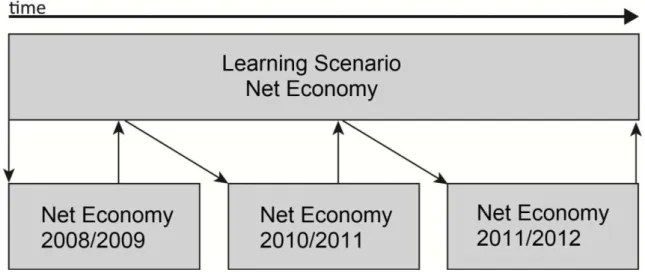
evaluation, and assessment. Figure 1 depicts the ‘build-and-evaluate’ relationship between the general learning scenario, Net Economy, and the specific course cycles that we will focus on in this paper.
Figure 1: Build-and-Evaluate Loop
Based on our experiences and evaluation results from the Net Economy course cycle of 2008/2009 and in reference to the relevant literature, we will identify a selection of required improvements for the Net Economy learning scenario in Section 2.3. In Section 3, these needs for improvement are then compared to specific solution approaches, which we implemented in the course cycles of 2010/2011 and 2011/2012. After describing the solution approaches we will then evaluate and reflect on their effects with the help of the initial evaluation results from the latest course cycles. In summary, the paper addresses the following guiding questions:
What are the main characteristics of virtual collaborative learning in general as well as within our specific VCL learning scenario, Net Economy, and what problems arose when we accomplished virtual collaborative learning based on the described learning scenario? (Diagnosis)
What solution approaches for these problems did we derive from our own evaluation results and from VCL-related literature? (Action Planning)
How did we implement these solution approaches as interventions in the course cycles of 2010/2011 and 2011/2012? (Intervention)
What were the effects of these changes? (Evaluation)
Is there a need for further changes in our learning scenario and what lessons have we learned? (Reflection)
In answering these questions we follow the five steps of canonical action research (CAR): diagnosis, action planning, intervention, evaluation, and reflection (Davison et al. 2004; Susman and Evered 1978). Action research is committed to “[…] the production of new knowledge through the seeking of solutions or improvements to “real-life” problem situations.” (McKay and Marshall 2001) It thus serves both, research and practice by studying the real world while taking a particular theoretical framework into consideration. From the various forms of action research that differ regarding their process model, structure, researcher involvement, and primary goals, we chose canonical action research (CAR), which stands out due to its iterative, rigorous and collaborative approach focusing on the above mentioned dual aim of improving practice and contributing to scholarly knowledge. It applies a cyclical process model, provokes deliberate self-involvement of the researcher, and – if carried out correctly – produces research that is both rigorous and relevant. Despite its practical aims, many researchers insist that action research requires a clear theoretical framework (McKay and Marshall 2001; Davison et al. 2004). In addition to direct references on VCL (e.g. Dillenbourg 1999, Prasolova-Førland and Divitini 2002, or Tan and Lin 2008) and with regard to the VCL-characteristics described in Section 2.1, we therefore study VCL in the context of the Community of Inquiry framework for e-learning (Garrison 2011); we also consider the challenges and principles of successful (virtual) team work (Nunamaker et al. 2009). We specifically refer to this scholarly framework when discussing the problems which we identified regarding the course cycle of 2008/2009, in order to substantiate our solution approaches.
Peter Weber, Christian Lehr and Martin Gersch
2.
Virtual collaborative learning and the net economy learning scenario
2.1
Virtual Collaborative Learning
In the respective literature, VCL is employed in the context of various forms and aspects of learning scenarios, with the term itself not being used uniformly. For example “Collaborative Virtual Learning” (CVL) is also used by various authors (Prasolova-Førland and Divitini 2002; Tan and Lin 2008). VCL aims at establishing guided collaboration in a virtual environment to enable learning. Haythornthwaite and Andrews (2011) argue that, the value of merging collaboration and community in e-learning, lies in the intellectual and human benefits of collaborative activity. They state that such settings combine attention to work and work goals, with the affiliate needs of those who work together to achieve these goals (Haythornthwaite and Andrews 2011). With regard to the remainder of this paper we would like to point out the following characteristics of VCL as discussed in (Balázs 2005; Dillenbourg 1999; Ghaoui 2003; Haythornthwaite and Andrews 2011; Li and Gong 2007; Prasolova-Førland and Divitini 2002; Schoop et al. 2005):
1. VCL builds on team work in small groups. Accordingly, various (educational) methods of group learning need to be adapted for VCL scenarios. This also implies the need for a very clear definition of appropriate tasks, which are usually based on authentic questions and problems from (professional) practice.
2. Virtual collaborative learning harnesses information and communication technology to facilitate direct interaction of learners in a virtual environment, rather than in face-to-face meetings. It thus combines the strength of interactive learning with technology driven flexibility. The preconditions of virtual interaction are however significantly different from face-to-face interaction, therefore deliberate attention to participant interaction must be paid.
3. Due to the high organizational challenges of VCL-settings, they require a very detailed and systematic preparation of the learning experience, as well as an explicit definition of the learning objectives. 4. The complex processes, together with the active role of the learners, require strong guidance of the
students. This special need for “teaching presence”, as Garrison (2011) calls it, must be considered in the planning and design of the virtual and the collaborative elements of a VCL scenario.
The theoretical background for our action research is based on the Community of Inquiry Framework (CoI) with its collaborative-constructivist perspective on learning (Garrison 2011). The CoI-framework strongly supports the idea of virtual collaborative learning settings, since it focuses on the opportunities of technology enabled learning. It is at the same time based on the premise “that a community of learners is an essential, core element of an educational experience when higher-order learning is the desired learning outcome” (Garrison 2011, p. 19). E-learning is thus considered as a means of facilitating interactivity and creating a quality learning experience. This corresponds with the idea of VCL in general and the Net Economy learning scenario in particular (see Section 2.2). The CoI-framework relies upon the three interdependent elements of (1) social presence, (2) cognitive presence, and (3) teaching presence as constituent parts of a successful (e-learning) experience (Akyol and Garrison 2008; Rambe 2012):
• The social presence is “the ability of participants to identify with a group, communicate purposefully in a trusting environment, and develop personal and affective relationships progressively by way of projecting their individual personalities” (Garrison 2011, p. 23).
• The cognitive presence in contrast is “the extent to which learners are able to construct and confirm meaning through sustained reflection and discourse in a critical community of inquiry” (Garrison et al. 2001, p. 11).
• Finally, the teaching presence is “the design, facilitation and direction of cognitive and social processes for the purpose of realizing personally meaningful and educationally worthwhile learning outcomes” (Anderson et al. 2001). It is this teaching presence that combines and balances the elements of a community of inquiry in the overall setting.
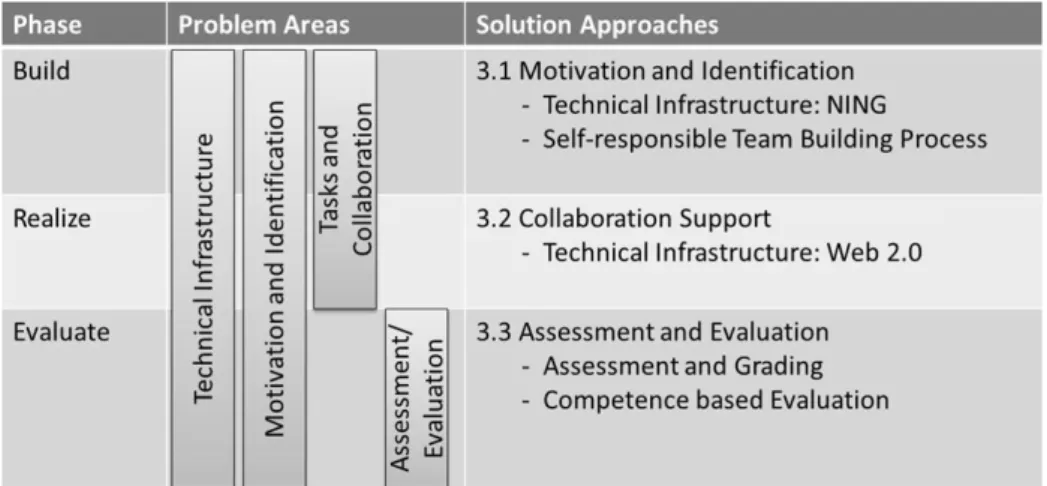
The CoI-framework serves as orientation when identifying any need for improvement as well as developing changes accordingly, in order to strengthen our VCL-setting Net Economy. For example, in Sections 3.1.1 and 3.1.2 we describe a new type of coordination platform that we implemented (a social network instead of a traditional learning management system) and a modified team building approach that we developed, both with regard to the need for social presence. While this paper is meant to provide an overview of these
Electronic Journal of e-Learning Volume 12 Issue 4 2014
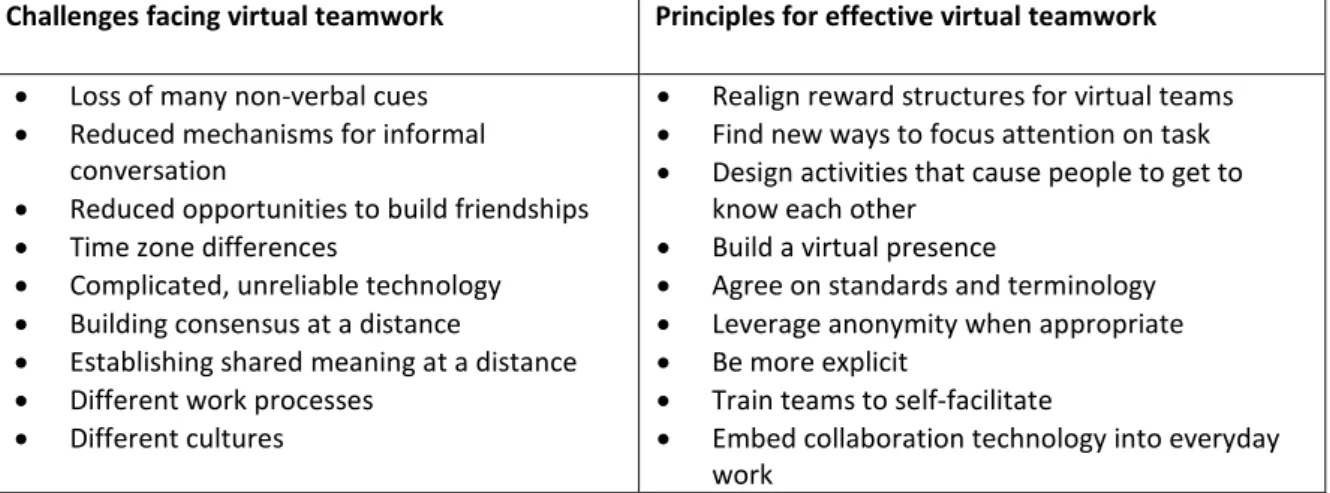
changes, their effects, for example the social effects of introducing a social networking service as the main coordination platform, are analysed in related papers. (Reference will be added after the review process) With regard to virtual teamwork as an integral part of VCL, we also consider the challenges and principles of effective virtual teamwork as summarized by Nunamaker et al. (2009) as guidance. Nunamaker et al (2009) emphasize competing demands for attention, ambiguity of virtual communication, the establishment of personal relationships, and the need for accessible, stable, and user-friendly technology as the biggest challenges for successful virtual teamwork. Table 1 summarizes the challenges and the principles that proved to be a good ‘fit’ for our VCL-setting Net Economy.
Challenges facing virtual teamwork Principles for effective virtual teamwork
• Loss of many non-verbal cues
• Reduced mechanisms for informal conversation
• Reduced opportunities to build friendships
• Time zone differences
• Complicated, unreliable technology
• Building consensus at a distance
• Establishing shared meaning at a distance
• Different work processes
• Different cultures
• Realign reward structures for virtual teams
• Find new ways to focus attention on task
• Design activities that cause people to get to know each other
• Build a virtual presence
• Agree on standards and terminology
• Leverage anonymity when appropriate
• Be more explicit
• Train teams to self-facilitate
• Embed collaboration technology into everyday work
Table 1: Virtual Teamwork – Challenges and Principles (Nunamaker et al. 2009)
2.2
The Learning Scenario Net Economy
In the framework of an international learning network we have offered cross-location VCL-courses entitled Net Economy numerous times over the past few semesters. Our general VCL-setting targets participants with heterogeneous educational backgrounds in the fields of business and economics, business informatics, and educational sciences, as well as with different cultural backgrounds from Germany (Bochum, Berlin, Dresden, Soest), Turkey (Istanbul), China (Shanghai), Lithuania (Kaunas), Latvia (Riga), and Indonesia (Jakarta). All partners agreed on the general learning scenario Net Economy, leading to a stabile VCL-concept that is being systematically improved throughout the course of the, previously mentioned, canonical action research approach. Through each course-cycle a different set of partners participated, with a different location taking the lead and responsibility for the course coordination.
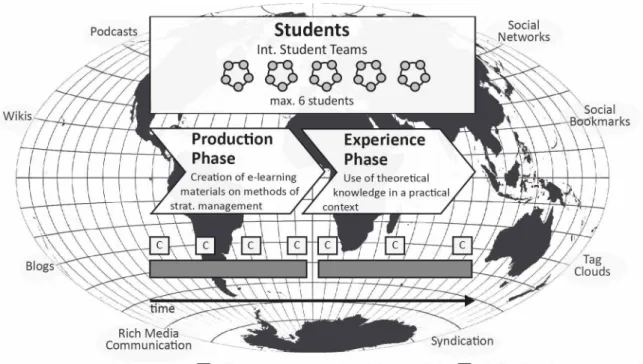
The general VCL learning scenario Net Economy is divided into the two phases ‘production phase’ and ‘experience phase’. Throughout the course, project work is conducted in small teams of 4-6 students across various locations, with team composition as well as presentation and discussion of findings being conducted through video conferencing. By separating these phases, the learning and working process is structured as a project with the use of predefined milestones. The students are asked to present and discuss their (interim) findings at so-called ‘steering committees’ and within phase-specific final presentations. These steering committees and final presentations are held at each location and are merged together through video conferencing. The participants are prepared for this through introductory presentation training, but also through e-lectures on project management, group coordination, and the use of specific communication tools (e.g. the video conferencing tool ‘Adobe Connect’). These efforts aim to reconcile the differing levels of media and teamwork skills among the students and enable them to fulfil the requirements of the VCL-setting.
During the production phase participants experience a “learning through teaching approach” (Biswas et al. 2005). Under their instructors’ guidance they develop multimedia learning materials such as web-based training systems or Google sites on methods of strategic management (VRIO, business model analysis, SWOT analysis, scenario planning) or current IT-topics such as “Web 2.0”. In this way they are able to gain a new insight and prepare themselves for the next phase. The experience phase, in contrast provides the students with a case study, with previous examples including; electronic marketplaces (2008/2009), grocery home delivery (2010/2011), or the use of Web 2.0 within and between companies (2011/2012). While working on
Peter Weber, Christian Lehr and Martin Gersch
these case studies the students can apply their newly acquired knowledge to real-life business challenges. The two phases are thus linked together in a way that the learning material, created during the production phase, provides a substantive knowledge base for the tasks within the case study phase. In addition, both phases (production and experience phase) provide the participants with the opportunity to foster international contacts and to gain experience in cross-cultural, technology-based learning and work.
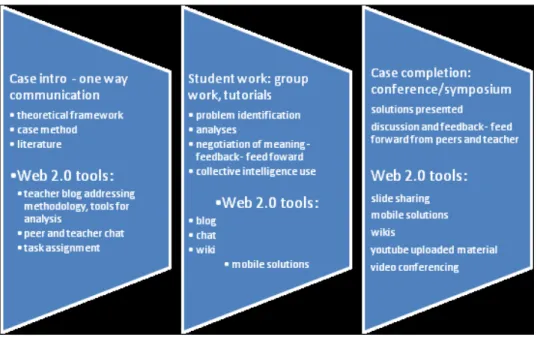
Figure 2 summarizes the main aspects of the learning scenario Net Economy: its global context, the use of information and communication technology (especially Web 2.0 applications), its two phases, the student teams, as well as the combination of classroom presentations and online group-work phases. Further details on the organizational structure and the main processes of the Net Economy classes will be provided in the following Sections, where we will discuss problems that have arisen and the solutions that we developed with respect to these problems.
Figure 2: The Net Economy Learning Scenario
In summary, the learning scenario Net Economy is not only associated to cognitive, but also to affective and psychomotor learning goals. Considering the mostly, content-focused, classes in the students’ curriculums, it was developed to help the students experience coordination, team work, language and cultural challenges in a modern, technology-based work environment. In addition to the impartment of new knowledge, attention is paid to fostering and deepening vocational abilities, such as the use of new media (software tools, Web 2.0 applications) and ultimately the preparation for life-long learning (Chen et al. 2008; Safran et al. 2007). Due to the international setting, the students understand and fully agree with the need for virtual collaboration and the use of English as the primary language for correspondence. In addition, the cooperation of the different universities and their instructors/researchers created an agile and innovative teaching/research alliance within the e-learning field itself.
The learning scenario Net Economy as a VCL-setting aims at initiating: Online group-work processes;
The employment of methods of strategic management, project management, and team coordination; The design of social, medial and cultural activities and their interactions in a global and digitized context; An on-going creative cooperation and exchange among the participating institutions.
The Net Economy course cycles which we derived from this general learning scenario have proven to be a motivating and enlightening learning experience for all those involved. In the courses, e-learning and online cooperation were not just phase-specific or redundantly supporting features of a traditional setting, but rather
Electronic Journal of e-Learning Volume 12 Issue 4 2014
provided the systematic and consistent foundation for innovative learning and working processes. Still, the challenging overall setting incurred problems and the evaluation results regularly point at improvement needs. In Section 2.3 we will show, which problems we identified after the course cycle of 2008/2009 and how these challenges relate to the above described scholarly framework.
2.3
Necessary Improvements
Our evaluation of the 2008/2009 course cycle focused on learning satisfaction and was accomplished in three steps via online forms: (1) At the beginning of the course the students’ attitudes and expectations were surveyed with the help of a master data sheet. (2) During the experience phase, the students were asked to evaluate the learning material and the case study provided to them. (3) Finally, after the course ended, the students were asked to evaluate the complete course and aspects of the instructional setting, e.g. the collaboration concept. The evaluated items of this final questionnaire covered five subject areas that score a satisfaction rating (scale: 1 = very good, …, 6 = inadequate) for key aspects of the learning scenario:
• Overall learning arrangement;
• Support by lecturers and tutors;
• Organization and implementation of project work;
• International collaboration;
• Technical infrastructure / Use of media.
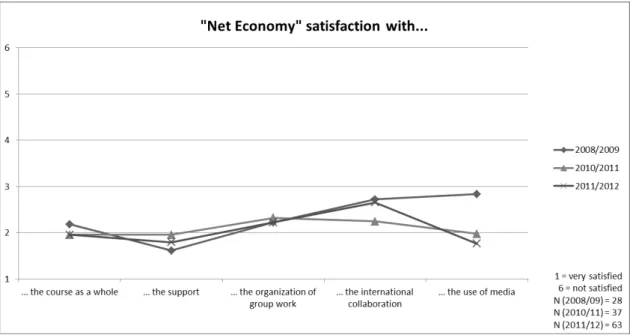
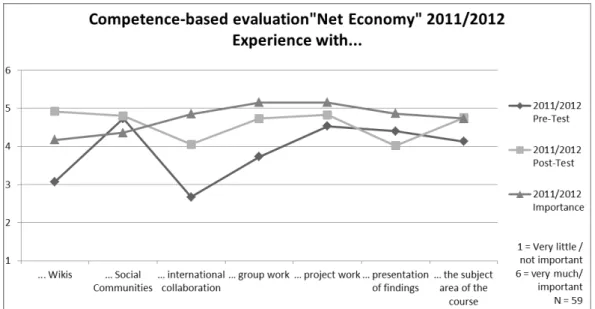
While systematically building on to this rather simple evaluation approach during the past years (see Section 3.3), we kept the questions from 2008/2009 in the questionnaire to allow for a comparison of the various course cycles regarding the students’ learning satisfaction. Figure 3 summarizes the results from the last three runs of the class.
Figure 3: Comparison of student satisfaction
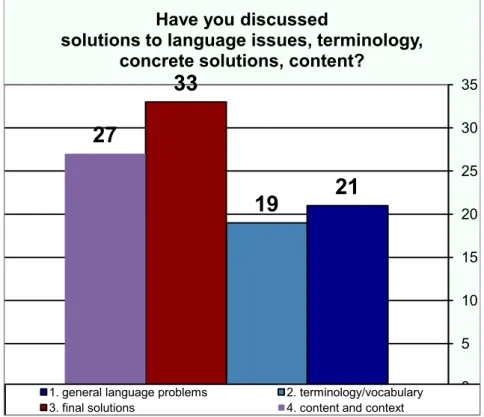
While the students from 2008/2009 were very satisfied with their support, the good evaluation results for the overall course and for the organization of the project work leave leeway for further improvements. According to the students’ feedback, the international collaboration and the technical infrastructure provided to them turned out to be the most challenging aspects of the setting. The depicted evaluation results for the later course cycles show that the changes we implemented in 2010/2011 and 2011/2012 had positive effects regarding these two critical aspects of the setting. Table 2 shows the detailed results from the 2008/2009 evaluation. The evaluation combined a standard form, provided by one of the participating universities, with additional questions concerning the specific Net Economy setting. Since grading questions were added, two additional measurement scales needed to be included in the evaluation: *: approval from 1 to 4 (1 = absolutely yes … 4 = absolutely no) and **: grades according to the German grading system (1 = very good … 6 = inadequate)
Peter Weber, Christian Lehr and Martin Gersch
Aspect Statement Av. DV N
C
la
ss
The course was well structured.* 1.93 0.65 29
I gathered knowledge and skills of high relevance.* 1.89 0.74 28 Theoretical and practical aspects were combined successfully.* 1.82 0.61 28 There was a clear conception that was kept throughout the course.* 1.89 0.75 28 I enjoyed the inclusion of external experts.* 1.48 0.59 25 Blackboard (Learning Management System) supported the learning process* 1.96 0.92 28
Overall grade for the course** 2.18 0.86 28
In st ru ct o rs
The instructors were well prepared.* 1.36 0.68 28
The instructors lead the course in a clear manner.* 1.75 0.75 28 The instructors demonstrated dedication to the course.* 1.36 0.68 28 The instructors were open to questions/criticism.* 1.54 0.74 28
Overall grade for the instructors** 1.61 0.68 28
P ro je ct w o rk
I valued the project structure of the course. * 1.96 0.76 27 There was a clear structure of project phases due to the steering committees.* 1.93 0.73 27 The online presentations of (intermediary) results were an important exercise.
* 1.89 0.80 27
The project tasks were clear and unmistakable.* 2.22 0.89 27
Overall grade for the project organization** 2.22 0.98 27
C o ll a b o ra ti o n
Online collaboration with students from other locations was a good
experience.* 1.37 0.69 27
Online teamwork helped me to get introduced to helpful tools and procedures.
* 1.89 0.85 27
The assignment of given roles facilitated our teamwork. * 2.27 1.00 26
I enjoyed the online collaboration.* 1.81 0.94 26
Overall grade for the online collaboration** 2.37 1.18 27
P a rt ic ip a n
t Male / female 16/12 - 28
Age 25.19 2.93 26
I enjoyed the topics of the course.* 1.93 0.77 28
My attitude towards e-learning developed positively.* 1.96 0.70 27
Table 2: Net Economy evaluation results 2008/2009
*: Approval from 1 to 4 (1 = absolutely yes … 4 = absolutely no)
**: Grades according to the German grading system (1 = very good … 6 = inadequate)
Taking both the presented scholarly framework and our own evaluation-based experiences into consideration, we will now describe the need for improvements that we derived in preparation for the 2010/2011 course cycle. We make no claim that this selection is complete, rather we chose aspects that came to the fore when discussing our experiences and the evaluation results in preparation of an extended and improved learning scenario.
1. Flexible, low-cost and technically simple infrastructure for plenary interactions and collaborative learning and working processes within the teams: As Nunamaker et al. (2009) point out, “Technological glitches will cripple the productivity of even the most knowledgeable and motivated virtual teams.” In line with this statement, during the 2008/2009 course we encountered considerable difficulties due to differing technical equipment and skills among the participating students, instructors and institutions. A low-cost and flexible technical architecture which is geared towards the interests and abilities of the participants therefore appears more important than sophisticated functionality of high end tools. The challenge lies in providing a coherent package of communication tools in an integrated form which fosters effective team-work processes and positive team development, while being embedded into the everyday life of the students (see Table 1; Nunamaker et al. 2009). Also, the technical infrastructure (especially for the purpose of video conferencing) needs to be simple in order to allow for the flexible integration of all participating institutions and instructors with their heterogeneous equipment and skills. With regard to group dynamics, video